Introduction
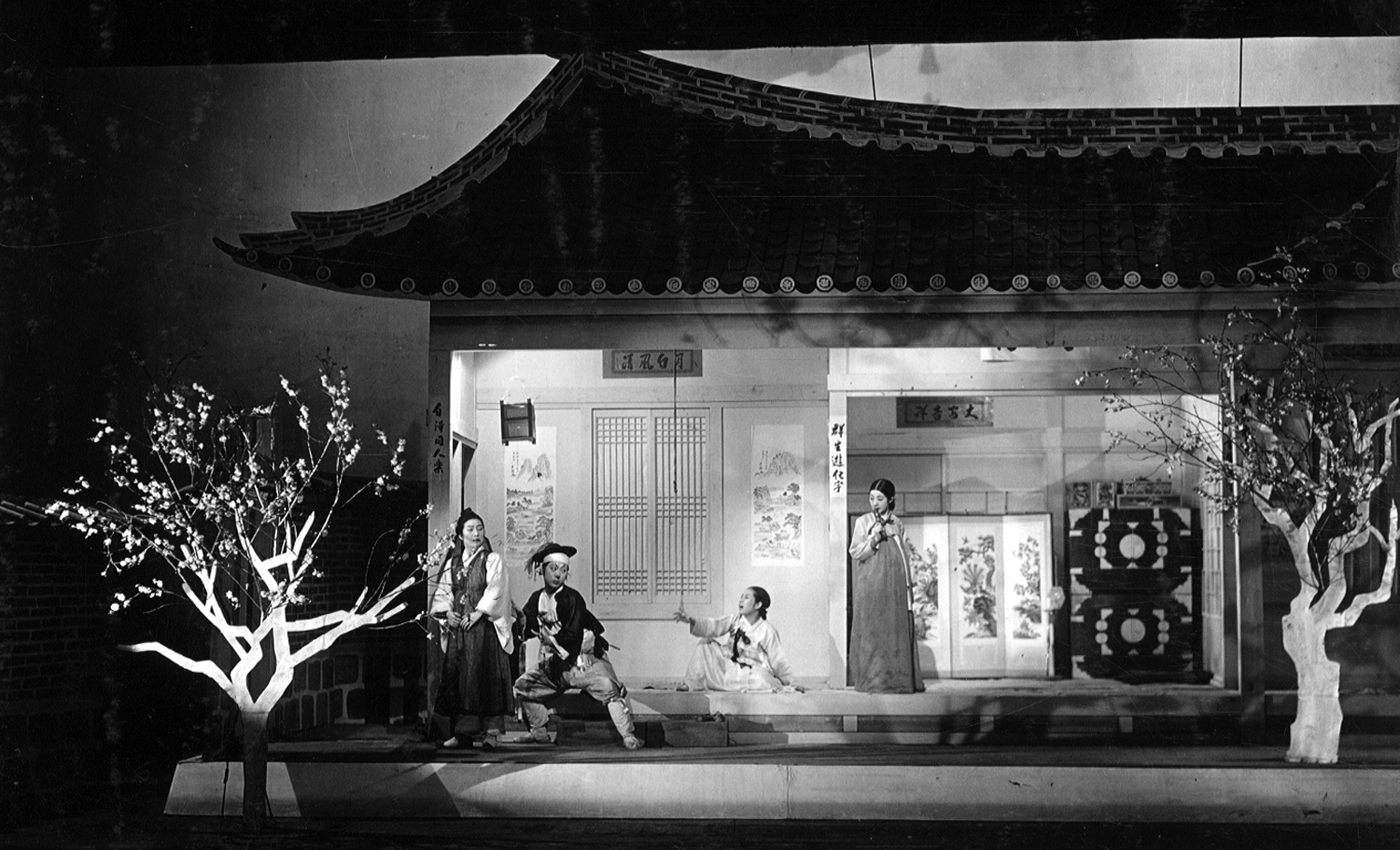
Spring 1938. As the Japanese empire was invading and expanding into China and beyond, its imperial policies in the then-veteran colony of Korea were fluctuating accordingly from differentiation (ika) and assimilation (dōka) toward imperialization (kōminka), with the catchy slogan Naisen ittai (One body, Japan and Korea) mobilizing the support of Koreans for the wartime empire (Caprio Reference Caprio2009; Duus et al. Reference Duus, Myers, Peattie and Zhou1996; Fujitani Reference Fujitani2011; Im Chongguk Reference Chongguk1966; Komagome Reference Takeshi1996). Part and parcel of the Japanese metropolitan consumer trend of the “Korea Boom” (Chōsen Būmū), which embodied an imperialistic fascination with colonial culture as exotica, the highly anticipated Japanese-language theatrical adaptation of Korean folktale Ch'unhyang chŏn (The Tale of Ch'unhyang)Footnote 1 opened to rave reviews in major cities throughout Japan (see figure 1).Footnote 2 The popularity of the play ignited an encore run later the same year throughout colonial Korea, and the significance of the transcolonial traveling performance became the object of heated discussions throughout the empire. The play was commissioned by Murayama Tomoyoshi (1901–77), the Japanese modernist playwright and artist, and was staged by his Shinkyō Theater Troupe. The script was penned in Japanese by Chang Hyǒkchu (1905–97), a bilingual Korean colonial writer, who was active in the bundan (Japanese literary establishment), at a time when Japanese was the official language in the colony, and Korean-language and cultural productions were subjected to increasing censorship.
Staging the Japanese-language play Ch'unhyang chŏn. Reprinted with permission from the Tsubouchi Shōyō Theater Museum.

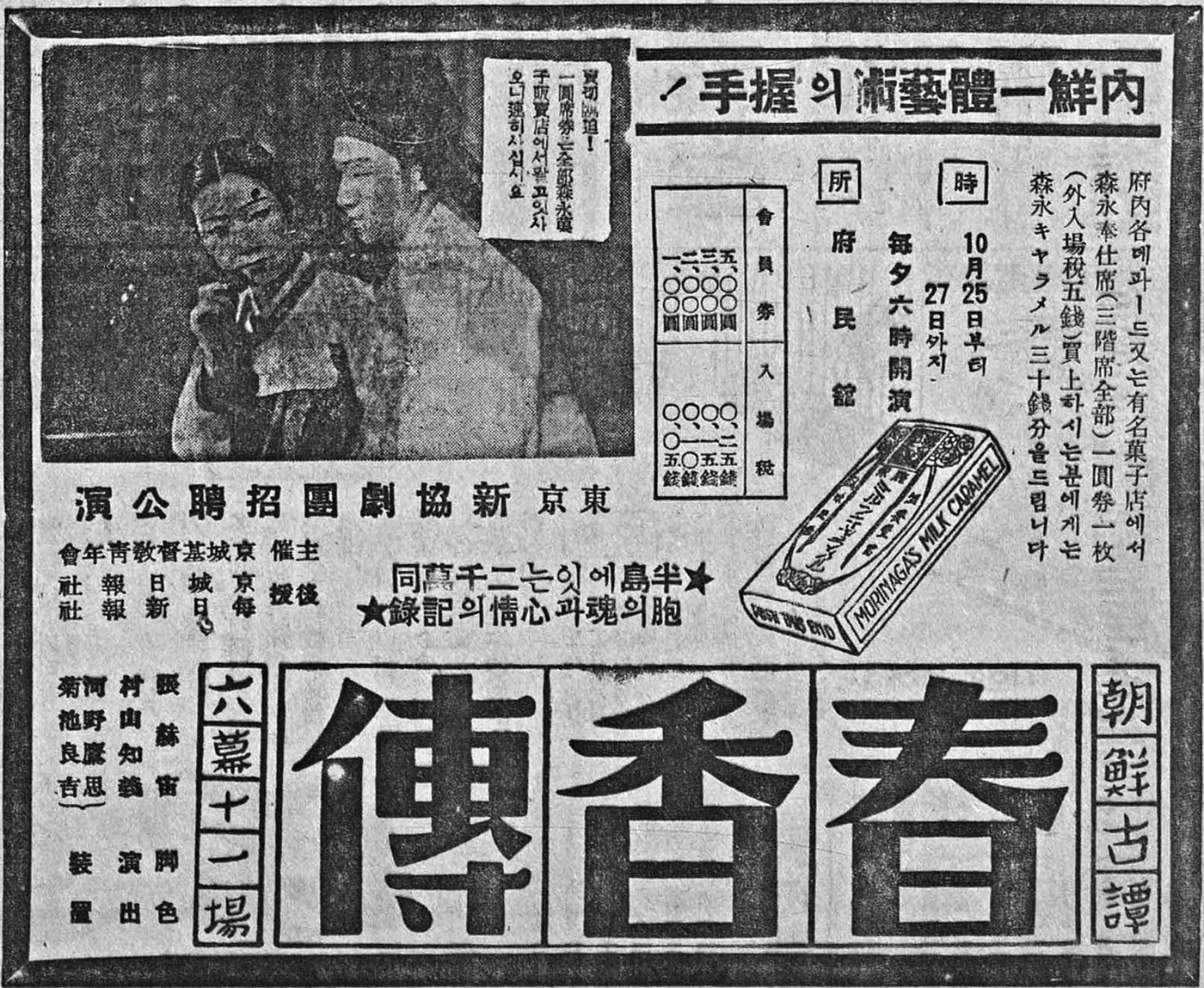
This article considers a long-forgotten moment of colonial “collaboration” between Korea and Japan when their literary histories converged in a much-publicized spectacle performance in the Japanese-language kabuki rendition of a p'ansori tale, that was, and still is, considered the epitome of Korean “tradition.”Footnote 3 By paying attention to tensions between the reproduction and consumption of the tale as trendy “colonial kitsch” in imperial Japan and as timeless “national tradition” in colonial Korea, as well as the untranslatable desires of cultural producers between the colony and the metropole, I suggest that the event may be read against the grain of its commissioned purpose, not as the embodiment of harmonious assimilation of Korea into Japan, as touted by pundits and in advertisements and reviews at the time (see figure 2),Footnote 4 but rather as performing the anxieties and breakdown of imperial ideologies.
Advertising the play as “the handshake of the art of Naisen ittai” (Naesŏn ilch'e yesul ŭi aksu). Reprinted from Maeil sinbo.
Colonial kitsch refers to the devaluation and exoticization of elements of the colony's culture becoming mass-produced objects for indiscriminate imperial consumption. It is a type of sentimental desire common in colonial encounters, which, as Renato Rosaldo notes, is “a particular kind of nostalgia often found under imperialism in which people mourn the passing of what they themselves have transformed” (Rosaldo Reference Rosaldo1989, 108; see also Norindr Reference Norindr1996). Nostalgia for colonial kitsch may appear as innocently genuine appreciation for colonial culture but in fact veils collusion with its domination and destruction. Colonial objects that were circulated during the passing trend of the “Korea Boom” appeared to conflate far-flung fields: tourism, folk culture, food, fashion, architecture, literature, and art. Each object, whether from highbrow or lowbrow culture, was significant only as a symbol of “Koreanness,” arbitrary and exchangeable among a potentially infinite chain of possible signifiers. I am interested in exploring the particular significance of the contest over colonial literature, notably its demotion from national canonicity to colonial kitsch in the colonial encounter between Japan and Korea.
Conflicting nostalgic desires between the colonizers and the colonized (for colonial kitsch and for national tradition respectively) may converge on the same object but for different purposes. I suggest that this moment of convergence may offer productive insight into the failed collaboration and translation of colonial culture in the unequal context of empire as well as of the significance of its forgotten legacy in the postcolonial era.
Retelling The Tale of Ch'unhyang (春香傳)
In an era of imperial wars on a global scale and worldwide economic instability, a general sense of unease was pervasive in Japan and, by extension, in its colony of Korea. This period was often characterized in the mass media as an era of “crisis” or “transition,” and urgent debates sprouted up throughout the wartime expansionist empire on how best to respond to the onslaught of an epistemic shift of “world historical” import. The putative West was said to be in the throes of decline, and what once seemed to be universalist assumptions of the supremacy of the Western world order were being questioned in Asia, with Japan as a self-described leader (Duara Reference Duara1995; Saaler and Koschmann Reference Saaler and Koschmann2007). In such a context, Japan's imperialist expansion into Asia was justified by the rhetoric of a shared “Asian tradition” on the basis of which Asia was to unite against the imminent threat of Western imperialism. Japan assumed the privileged role of a leader among “fellow Asians” it had colonized for what was considered the common plight of the East in the contest against the West. Overlooking the irony that Japan justified its leadership role in part based on the merits of having been the first non-Western country to have acquired modern trappings and technological acumen from the West, nonetheless Japan called for a spiritual unity of the East against the infiltrations of the materialist West. Such debates culminated in the famous “Overcoming Modernity” debates of the early 1940s, when the threat of the West began to take concrete form as an actual wartime enemy. The sense of urgency ushered in at this time may have been unprecedented, but the discourse of an East/West binary and the call for a “Return to Asian Traditions” harked back to a long history of Japan's ambivalent modern experience, self-consciously situated between “the West and the Rest.”Footnote 5
Japan's unstable position between competing universals of East and West would further complicate the perspective of its colonial periphery of Korea (on competing universals in the East Asian context, see Liu Reference Liu1999, introduction). The pursuit of “tradition” in colonial Korea at this time accompanied a nationalist sense of urgency, an attempt to preserve cultural assets that were increasingly under threat from both direct Japanese domination and the pervasive and ominous shadow of Western imperialism. By the mid-1930s, as Japan's assimilationist policies in Korea intensified, an increasingly constricted and claustrophobic political sphere resulted in the cultural realm taking on rising symbolic import as a metonym for the identity of the absent nation and its lack of political sovereignty.
A discourse of “Revival of Traditions” began to garner popularity in the colony, which called for the compilation and cataloguing of past cultural artifacts to be preserved for posterity in the face of pressures to assimilate into the image of the imperialist cultures of the West and Japan (Cha Reference Sŭnggi2003; Cho Reference Cho2003; Hwang Reference Hwang1988, 217–60). Such a nostalgic turn toward a lost past, however, could not but be ambivalent in a culture relegated to colonial status in the modern era. The very logic of colonialism justified Korea's subjugation based on the assumed stagnancy and pastness of the colony's culture. Furthermore, the very desire for the construction of a national genealogy from the colony's imagined, hoary past was in fact of rather recent vintage, as it relied on modern structures of feeling of imperialist nationalism as well as technologies learned from the colonizers themselves for excavating, cataloguing, and evaluating these relics according to new global standards set and promulgated from the imperial centers.
Likewise, the invention of tradition would be an ambivalent gesture in Korea, a colony of Japan, a fellow Asian state that was itself lurking in the shadows of Western imperialism. This desire to construct and preserve a national tradition embodied the colony's need to affirm its coevalness with global standards of value and to ameliorate its sense of lack in the modern imperialist world order that was fully abiding by the logic of the nation-state. However, highlighting the uniqueness of colonial culture under threat of imperial assimilation would ironically bring these very “traditions” under the desiring attention of the imperial gaze. In the metropole, the same colonial traditions became the object of a forked imperialist nostalgia, which simultaneously subsumed such regional particularities throughout the empire into a so-called shared “universal Asian tradition,” while relegating them to a devalued status as exotic objects of colonial kitsch, highlighting their particular “local color” and denying coevalness by casting the colonized culture to the realm of a quaint and distant temporality.
Colonial Nostalgia
The sentiment of nostalgia was fixated on the same object—relics from colonial Korea's past—and was shared by the Koreans and the Japanese (see figure 3). However, a perceived and real difference in spatial and temporal relationships to that same object of desire renders the nostalgia of the colonizer and that of the colonized untranslatable across the colonial divide—a divide wider than the sea that separates them. Nostalgia, defined as a sentimental longing for a place, especially a past home, akin to homesickness, or as a longing for a period of the past, assumes a familiarity with the lost object that is now distant in either space or time, from the standpoint of the subject's present perspective.Footnote 6
Modern Japan, Korea special issue cover.
In the case of Japan's imperialist nostalgia for colonial kitsch, this assumed familiarity with the “lost” object is in fact an illegitimate and imaginary relationship to Korea's bygone days based not on an actual memory but on the present colonizing desire to subsume even a past prior to colonization. Conversely, Korea's nostalgic desire for a national tradition is similarly a projection of present anxieties onto a past constructed as an ideal time and place uncontaminated by current imperial incursions.
In her seminal work, The Future of Nostalgia, Svetlana Boym's (Reference Boym2001, xiii) reminder that “while the longing is universal, nostalgia can be divisive” seems pertinent, particularly when contemplating contending nostalgia arising from the unevenness of colonial encounters and the contested significance accorded to the same object of nostalgic desire across the colonial divide. In this article, I would like to pay attention to the significance of such divisiveness, and in particular to the untranslatability of these parallel nostalgic desires in the modern colonial encounter between Korea and Japan in the era of late colonialism as well as of the dialectics of forgetting and remembering the encounter itself in the postcolonial era.Footnote 7
Ch'unhyang as (Lost) National Tradition
It is widely claimed that Ch'unhyang is Korea's most popular and most widely recognized story. How did the oral narrative Ch'unhyang rise to national prominence? Why was there so much fascination over Ch'unhyang? In both Koreas (North and South), Ch'unhyang’s place in the literary canon is undisputed. For years, many have asked how the story has charmed so many over time and what qualities might be the story's most endearing. Various reasons have been put forth to explain why this tale is an ideal text to be passed on as the representative “tradition” of Korea (Sǒl Reference Sŏl2001). It is often deemed the single most “representative” text of classical Korean literature, with numerous extant versions, either in vernacular Korean or in literary Chinese, the lingua franca of the educated, passed down from the premodern period.Footnote 8 From the late nineteenth to the early twentieth centuries, with the emergence of the modern era in Korea, the tradition of Ch'unhyang experienced a renaissance. Even the strict colonial censorship of that time did not seem to affect the popularity of Ch'unhyang. In fact, in this dynamic period of colonial modernity, Ch'unhyang emerged anew in various novel manifestations. New forms of mass entertainment and the arts—such as theater and “motion pictures” (hwaltong sajin)—appropriated Ch'unhyang as a popular subject for experimental adaptation. The significance accorded Ch'unhyang in the colonial modern era is evident, as it became the subject of Korea's first “talkie.”Footnote 9 Thus reinvented through a ritual of repetition as the most popular subject matter for these newly emerging mass cultural forms, Ch'unhyang’s place as the premier modern tradition of Korea was undisputed by the 1930s (Baek Reference Baek2001; H. Lee Reference Lee2001; P. Lee Reference Lee2010).
Conventionally, the concept of “tradition” has been understood in two overlapping yet opposing ways: that which precedes the modern, as a changeless, timeless relic of the past, and as a continuously transmitted cultural trace—spanning past, present, and future.Footnote 10 Reevaluating such assumptions, many scholars have pointed to the formation and legacy of tradition as involving a selective process indicative more of present desires than signifying some unaltered and continuous transmission from the past to the present (Hobsbawm and Ranger Reference Hobsbawm and Ranger1992; Vlastos Reference Vlastos1998). Here, I would like to not only keep in mind the ideological effects of such inventions as false consciousnessFootnote 11 or contrivance, but also remember the imaginative desires at odds in the struggle to reproduce traditions in the colonial context.Footnote 12 Rather than dismiss the fixation on an invented tradition simply as the product of shortsighted, colonized natives blinded by an ideological trap that might seem obvious to the more perceptive (presumably contemporary critics), I would like to remain mindful of the historicity of such an ambivalent and melancholy nostalgic turn in the colony toward a perceived and actual loss of its culture, and to a desire to construct symbols of a national tradition as a fetishistic placeholder for the absent nation.
Ch'unhyang Becomes Colonial Kitsch
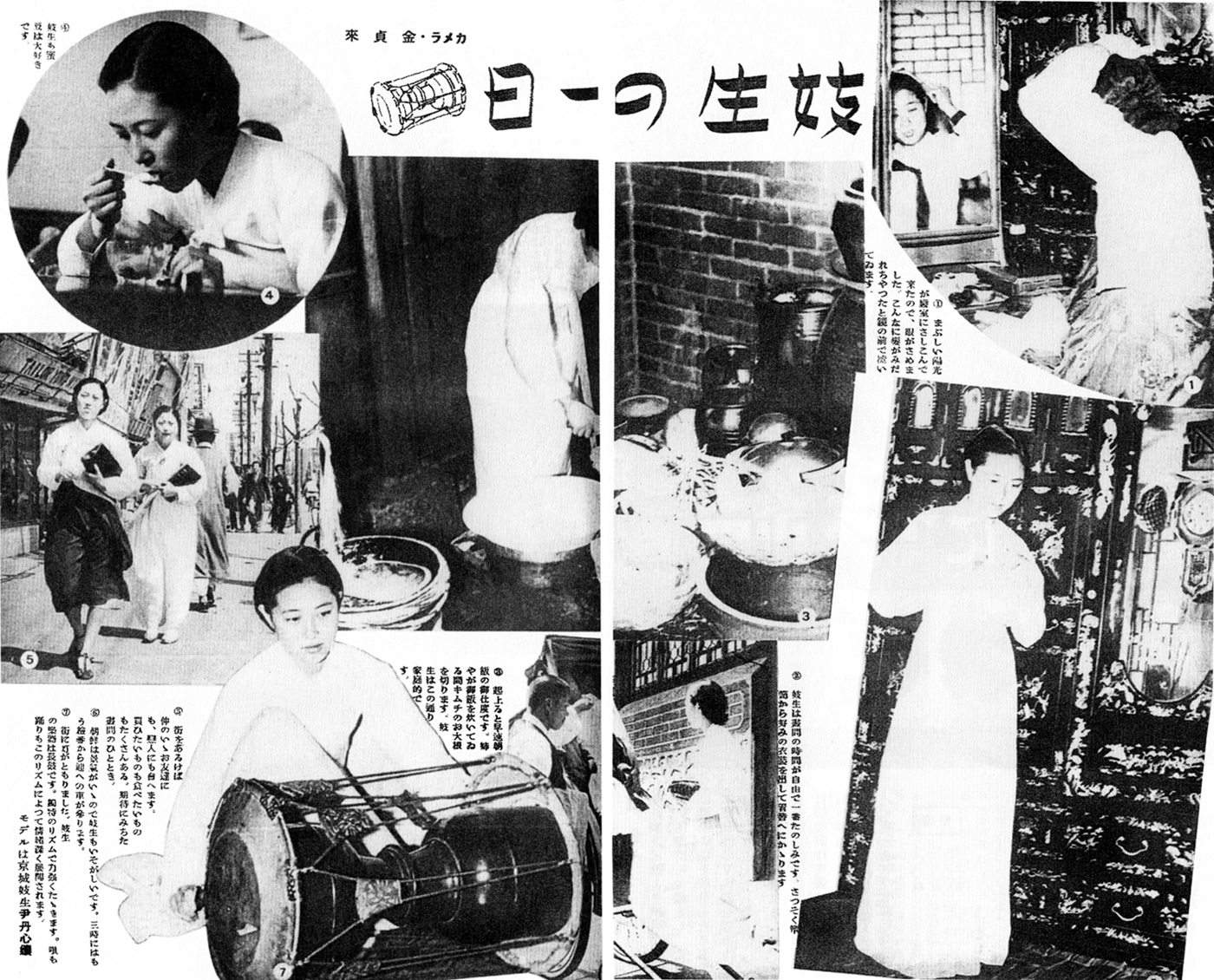
This fascination with Ch'unhyang in colonial Korea was part and parcel of the contemporaneous discourse on “Revival of Traditions.” Such nostalgic attempts by Korean cultural nationalists to define and invent their “traditions,” seen to be under threat from modern imperial incursions, were not without internal conflicts. A heated quarrel ensued about the significance of the very meanings of “tradition” and “modern,” and on the implications of these definitions for the future of a colonized society (Cha Reference Sŭnggi2003; Hwang Reference Hwang1988). But the same objects of the past were simultaneously being reproduced to serve a parallel yet competing desire of imperialist nostalgia in Japan. If the “Revival of Traditions” in Korea focused on the transformative role of such “traditions” in constructing an autonomous cultural sphere and imagining a different future for the colony's absent nation, the fad of the “Korea Boom”Footnote 13 in the metropole was merely a passing trend for instant gratification of imperial desires in the here and now. The colony as a whole was fetishized as colonial kitsch, as a reified and devalued object of quick contemplation and indiscriminate consumption, and its “traditions” were being appropriated and exoticized as objects of a popular consumer trend sweeping through the empire, in mass reproductions of everything from alluring destinations in the tourist industry to kisaeng in the pleasure quarters, to translated books in the literary market (see figure 4).Footnote 14
“A Day in the Life of a Korean Kisaeng.” Reprinted from Modern Japan, Korea special issue.
The demand for exotic “Koreanness” (Chōsentekina mono) seemed insatiable (Brandt Reference Brandt2000, Reference Brandt2007). The inordinate attention paid to Korean objects as exotic colonial kitsch stands in stark contrast to the assimilation policies imposed throughout the colony to erase Korean difference.Footnote 15 Korean-language journals and newspapers were being censored and banned on an unprecedented scale, and the usage of the Korean language itself was prohibited in schools and other official realms. This was also the time when Koreans were called to give up their Korean names and take on Japanese-style names, and to serve the Japanese imperial agendas of war and expansion in a shifting world arena. What seem to be two contradictory trajectories—on one hand, highlighting and preserving objects of Korean “traditions,” while on the other hand attempting to repress its particularities—may be understood within the inherently dual logic of imperialism itself: the simultaneous need to differentiate colonized subjects (in order to justify colonial subjugation) and the need to assimilate them based on the ideology of shared Asian traditions (in order to mobilize support for imperial expansion and war efforts against the imperial West).
Various colonial nationalists were attempting to reinvent and recuperate their national legacies and to construct an identification with such traditions, in a nostalgic turn toward a lost past, to prove the dynamic depth and living continuities in their culture and, in turn, their right to exist as a people into the future. Meanwhile, in the metropole, these very same cultural artifacts came to signify colonial difference, as objects of imperial nostalgia for colonial bricolage, “exotic” and “primordial” relics of an ancient past that needed to be excavated and preserved (with the help of modern archeology and discerning imperial eyes). The consumption of colonial kitsch objects of the colonized past occurred in visual Technicolor, through the vexing marriage of imperialism with cutting-edge technology, relying on visualism as an important tool of domination through colonial knowledge. There arose a proliferation of travel guides, films, postcards, and journals, advertising and exoticizing the colonies for consuming passions in Japan (Baskett Reference Baskett2000, Reference Baskett2008; Robertson Reference Robertson1998). These objects were also to be displayed in museums or in colonial expos and would become metonyms for Korea itself, as an exotic place to visit, objectified as a quaint anachronism, revived in ever-new forms of mass culture to satisfy imperial desires.
The “Korea boom” expressed forked imperialist desires: to assimilate and to differentiate the colony. While imperial expansions may have been justified under the name of a common tradition of Asia, these same “traditions” were also being marketed for their difference, as kitsch objects of imperial desire for the exotic colony. The irony of such imperial discourses becomes obvious when one compares the logic behind the “Korea Boom” with the debates on “Overcoming Modernity” and “Return to Tradition.” While all of these discourses embodied the desire to return to the spirit of Asian traditions against the threat of the materialist West, they also reified Asia as a primordial past, following the logic of Western Orientalism while simultaneously essentializing the West as Other. The commodification and consumption of colonial kitsch in Japan mirrored the same materialist imperialism of the West that Japanese imperialism had claimed to repudiate. The ultimate irony of Japanese Orientalism is that it unwittingly reflected an objectifying gaze toward itself as it schizophrenically sought to identify with, yet distinguish itself from, its Asian neighbors vis-à-vis the West (Tanaka Reference Tanaka1993).
Conflicting Nostalgic Desires
The performance of the Shinkyō Theater Troupe under the guidance of Murayama Tomoyoshi was staged first in Japan, in the metropolitan city centers of Tokyo, Kyoto, and Osaka. It was widely touted as a “harmonious exchange between two merging cultures” (yūgō shita futatsu no bunka no kōryū) in reviews and advertisements, as well as through carefully staged promotional roundtable discussions (Akita Reference Ujaku1938). Ch'unhyang became the locus of various converging debates in the metropole and in the colony as the first Korean play to be performed in the Japanese language by Japanese actors, with the historical import of the cultural exchange between Korea and Japan being pointed out by pundits on both sides (Chang Reference Hyŏkchu1938a, Reference Hyŏkchu1938b, 1941). For all appearances, it seemed to be a timely and poster-perfect symbol of the harmonious merging of Korea and Japan, particularly at a time when the colony was being called on to play a more active role in the expanding Japanese empire. But on closer examination of tensions embedded in its production and reception, the performance can be read rather as a strange hybrid that simultaneously embodies and rejects the logic of assimilation inherent in the violent colonial encounter.Footnote 16
Colonial Translator and Native Informant
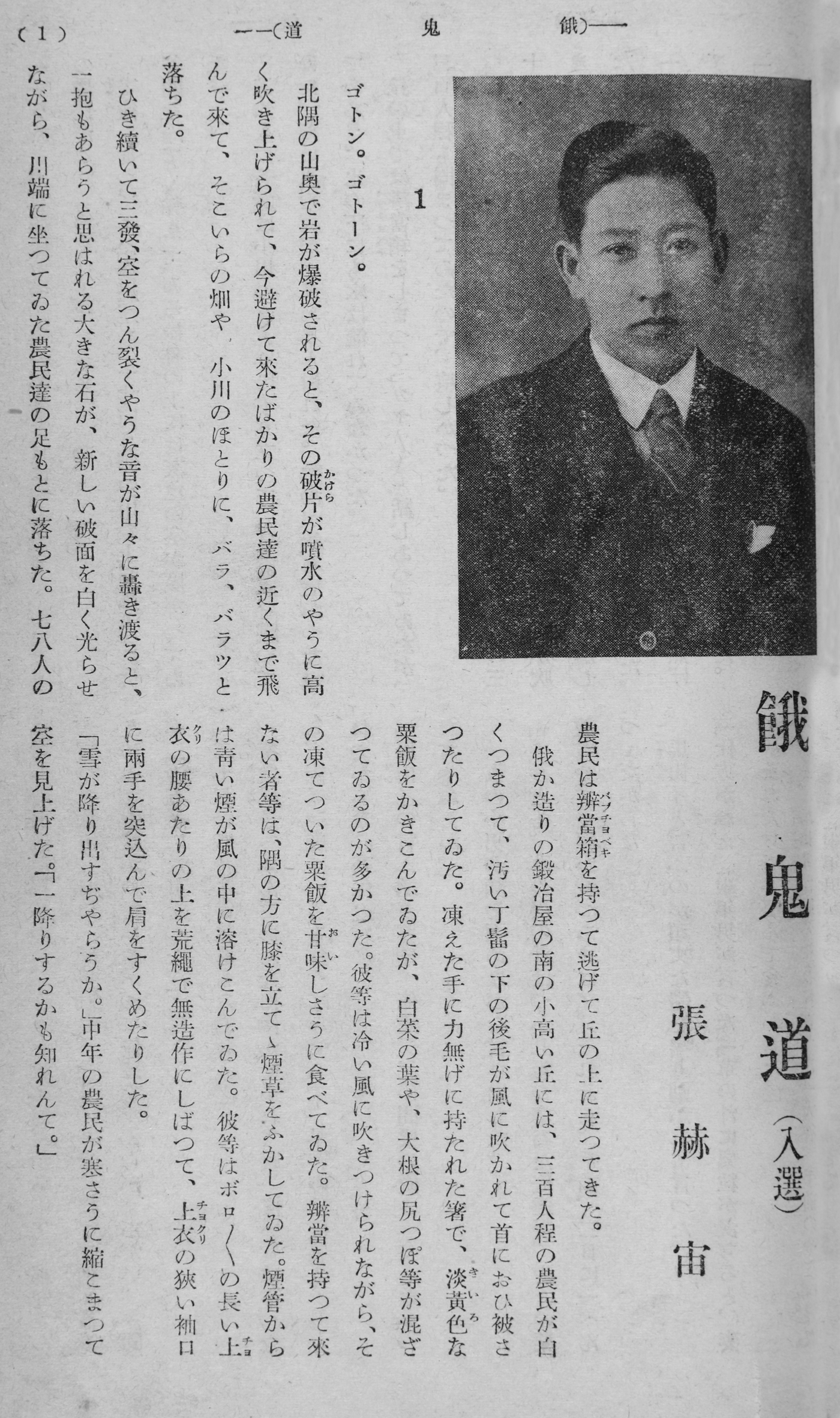
Chang Hyŏkchu's role as the translator caught in the midst of these contending debates provides insight into his precarious position between the colony and the metropole, and reveals the pain of a colonized writer in the borderlines of empire. Like many intellectuals in various colonial contexts, Chang was educated in the colonial system, acquiring the requisite language of the colonizer, which was privileged over his own “mother tongue.”Footnote 17 Embracing aspirations as a writer, Chang, like so many of his peers, voyaged-in to the metropole that offered more opportunities to write and to publish than Korea (Said Reference Said1994). What set Chang apart from his peers was his growing success in the bundan, even winning second place for a prestigious literary prize sponsored by the prominent journal Kaizō (see figure 5). In fact, his meteoric rise in the bundan was beyond anyone's expectations, especially since Chang was a second-class colonized writer who was still somewhat awkward at wielding the language of the colonizer.
Chang Hyŏkchu's literary debut in Kaizō. Reprinted with permission from Waseda University.
After his initial success in Japan, Chang continued to write in both Japanese and Korean, but he found more success with his Japanese-language writings. During this time, he was often criticized in the Korean literary field as a traitor for his role in the Japanese bundan, and eventually he began to write exclusively in Japanese. In the postcolonial period, he chose to remain in Japan, adopted his Japanese wife's surname, and became Noguchi Minoru, a naturalized Japanese with a hybrid penname, Noguchi Kakuchū. It is worth noting that Chang's success began to decline in postcolonial Japan when he tried to write as a “Japanese” writer. His writing had once been in demand because of his ability to provide authentic “local color” as a colonized writer and because it was used to support the imperialist agenda of assimilation. There was no demand for a colonized writer passing as a Japanese after the empire's collapse.Footnote 18
Chang's relationships to Korea and Japan were always of complex ambivalence rather than a simple alignment on one side or another, as has often been portrayed, particularly in Korean discourses that dismiss him as a quintessential “pro-Japanese” or collaborationist writer. Chang was always peripheral, trying to find his place but never succeeding. Despite a prolific writing career and the prominent role he played in the early literary histories of modern Korea and Japan, he has been virtually forgotten in the postcolonial aftermath in both contexts.
In the colonial era, the colonized writer's conundrum lay in his need to authenticate and introduce colonial culture, to bring imperial attention to it at a moment when the colony was being assimilated and devalued. Likewise, Chang's privileged position between the colony and the metropole—which seemed to make him the ideal translator, able to move fluidly between two cultures—simultaneously tainted his “authenticity” as a Korean native informant. Further, his social awareness of the need to “represent” the endangered, disappearing culture of the colony conflicted with his personal ambition to cultivate a singular point of view as an individual artist and writer, beyond serving as a translator or native informant for imperial ethnographic needs.
Murayama Translates “Koreanness”
Regardless of Chang's personal dilemmas as an individual writer, the drama he penned soon took on a life of its own in the broader context of empire. Murayama Tomoyoshi, the leftist, avant-garde playwright who commissioned the play, was keenly aware of the historical import of staging a “Korean” performance for imperial consumption at this particular historical juncture. For Murayama, the desire to pioneer a performance of “something Korean” (Chōsentekina mono) seemed pressing, above all other concerns, and the inconvenient fact of his own lack of knowledge about Korean culture would not dampen his determination. In a newspaper article, he describes the backstory of the project's beginnings:
I had wanted to introduce Korean arts and culture to Japan for a long time. I asked Chang Hyŏkchu to write something with a “Korean theme,” and he came up with Ch'unhyang. . . . Chang told me that his version was his own adaptation, which was different from the “traditional” version of Ch'unhyang, and I wanted to retain this flavor, too. (Murayama Reference Tomoyoshi1938b, 60)
Murayama's foremost concern was to pioneer the first Korean drama to be performed by a Japanese cast in Japan, though he was keenly aware of the “great influence” (ōkina eikyō) such a precedent would have on the exchange between the theatrical worlds (engekiteki kōryū) of Japan and Korea (Murayama Reference Tomoyoshi1938a). Elsewhere he writes, “This is the first time that Japanese players are putting on a Korean drama in Japan, so I absolutely wanted to make it a success” (Murayama Reference Tomoyoshi1938b, 59).
Overshadowed by Murayama's “historical” vision (which, ironically, seemed blind to the power dynamics inherent in the colonial setting of which he himself was a privileged participant), Chang was relegated a peripheral role, and reduced to a native informant providing ethnic data of “Korean authenticity” as one among many (exchangeable) informants with whom Murayama surrounded himself during the production.
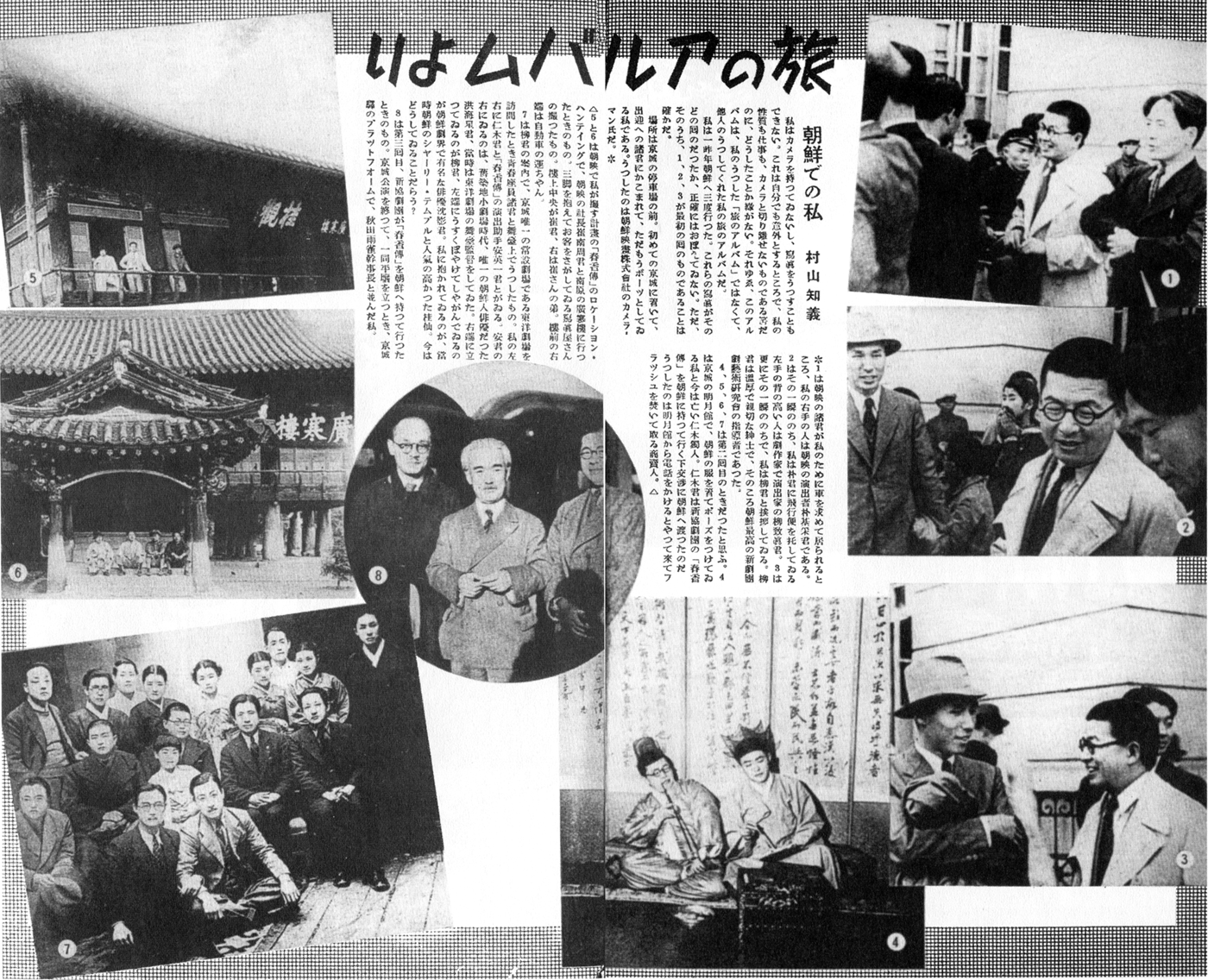
What is even more ironic is that Murayama, the one in charge of shaping the performance and introducing the colonial culture, readily admitted he did not “know” Korea. According to newspaper articles of the period, Murayama went to Korea for the first time and took a speedy tour for a taste of an “authentic” experience in preparation for the upcoming play (see figure 6). On his whirlwind tour, he famously inquired of his tour guides: “If I want to know Korea, where should I go? Please show me around” (Yu Reference Ch'ijin1938a, emphasis added).
Murayama's photo album from his visit to Seoul. Reproduced from Modern Japan, Korea special issue.
In order to quickly make up for his lack of knowledge about Korea, Murayama consulted Chang and many other colonized intellectuals (Murayama Reference Tomoyoshi1938a, Reference Tomoyoshi1938c; Yu Reference Ch'ijin1938b), and made significant adjustments to the script, even grafting entire sections from another version of Ch'unhyang by a different writer, and thus substantially altering the final script.Footnote 19 Contrary to Murayama's previous remark about wanting to retain the “flavor” of Chang's creation, he later wrote, “The script was not just what Chang Hyŏkchu had written in the beginning, but I incorporated [playwright] Yu Ch'ijin's input and I myself added my own pen to it” (Murayama Reference Tomoyoshi1938c). Yu Ch'ijin himself later recollected the uncanny feeling he had watching the performance at the Kŭkyŏnjwa theater, which included an entire scene lifted from his own version.Footnote 20
Under power dynamics inherent in the colonial setting, it seems Chang, in the end, had little control over the fate of the play. Murayama's concerns were about making an impact on the Japan-Korea historical exchange, not on the nuanced interpretation that an individual writer like Chang may have envisioned.
The speed with which Murayama was able to acquire sufficient colonial knowledge to realize his grand vision is remarkable. Here is Murayama's recollection of subsequent plans to produce a film version of Ch'unhyang. He mentions his first trip to Korea back in February 1938, in preparation for the Tokyo performance of Ch'unhyang to open in March:
February was my first time [in Korea] . . . and it was only for eight days, and I only went to Seoul. But now that there was talk about making the movie version of “Ch'unhyang chŏn,” I thought, for that, I needed to know more about Korea, so I took twenty days, and during my stay in Korea, I traveled and walked around as much as possible. (“Chōsen no inshō” 1938, 53)
One may rightly wonder just how much of Korea this colonialist flâneur got to “know” during his speedy tour. What is known is that the result was the production of the grand spectacle of Ch'unhyang, which traveled around major cities in Japan, and after much pomp and circumstance, crossed the sea to major cities throughout Korea following much anticipation in the mass media throughout the empire.
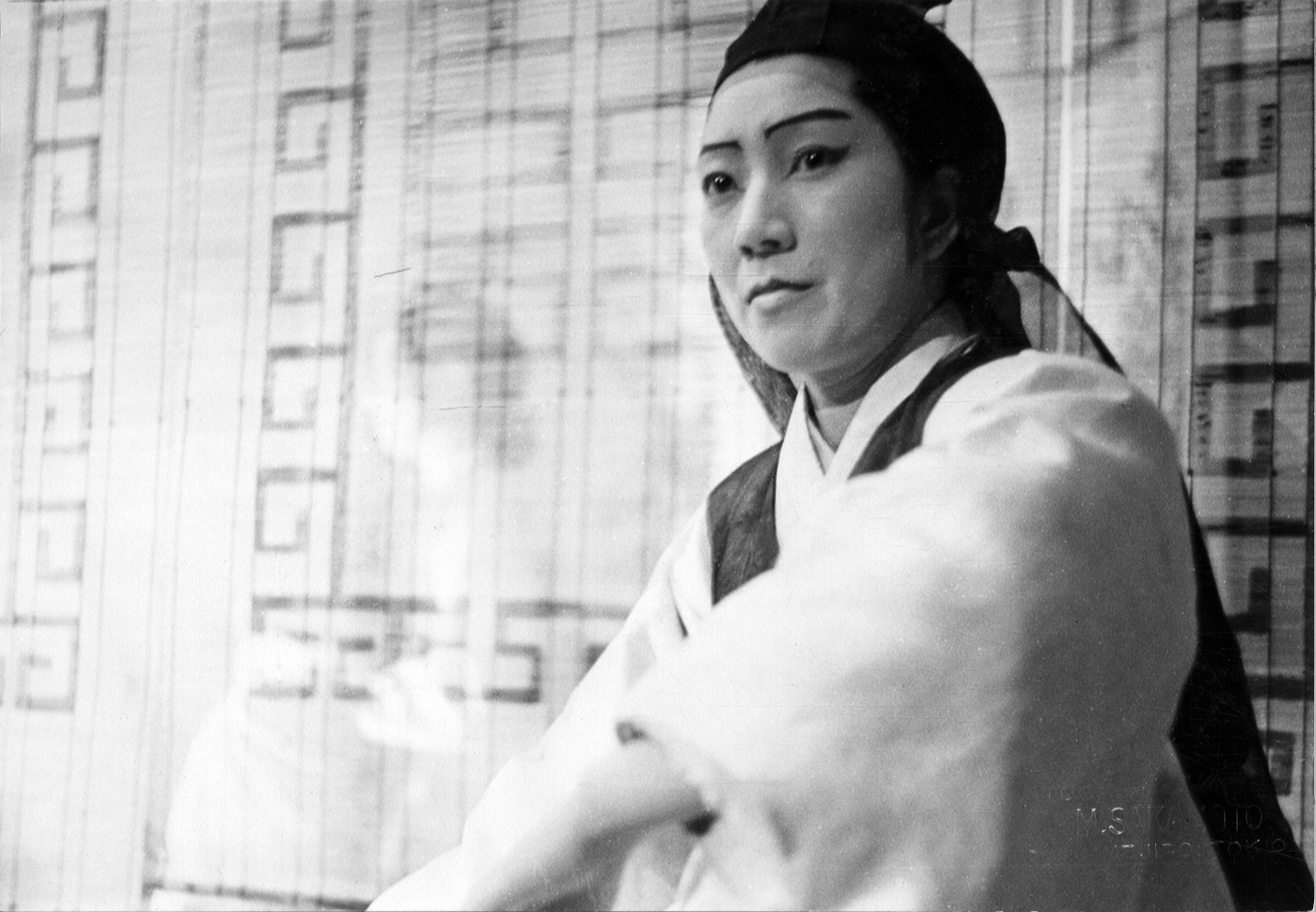
Murayama imagined a daringly experimental play beyond generic and cultural boundaries hitherto unprecedented across the colonial divide. Murayama envisioned and realized a hybrid transcolonial Ch'unhyang that transgressed temporal, generic, gender, and cultural borders. Murayama's Ch'unhyang was pan-Asiatic: “Korean,” “Japanese,” and “Oriental.” Murayama's Ch'unhyang was genre-bending: kabuki, p'ansori, and modern theater. Murayama's Ch'unhyang was gender-bending: the role of the hero Mongnyong was played by a cross-dressed actress, Akaki Ranko (see figure 7).
Actress Akaki Ranko cross-dressed as hero Mongyong. Reprinted with permission from the Tsubouchi Shōyō Memorial Museum.
Was Murayama an avant-garde genius ahead of his time? Probably, but my immediate concern here is not to assess the value of Murayama's tremendous artistic contributions toward upending conventions in theater, literature, film, and visual culture. What I am interested in is closely examining the troubling logic underlying Murayama's apparently revolutionary artistic experiments when refracted through the lens of the uneven colonial encounter.
The performances in Japan (Tokyo, Osaka, Kyoto) received rave reviews and were widely praised for their total success,Footnote 21 and no time was lost in preparation for the play's travel to Korea. Months before the Korea shows, the mass media announced the coming attraction, building up anticipation through newspaper articles, previews, interviews, roundtables, musings, discussions, and grand advertisements. An article by Murayama in the May 31 issue of the Keijō nippō, entitled “Shunkōden yodan: Keijō demo jōen shitai” (Musings on Ch'unhyang: I want to show it in Keijō too) is prefaced by the announcement of his arrival in Keijō via “Akatsuki” (Dawn), the shiny new limited-express train linking the port city of Pusan (Fusan, J.) to the colonial capital (Kyŏngsŏng, K.; Keijō, J.). This was the aforementioned trip in which Murayama went to Keijō for the second time to get to “know” Korea better. His primary goal was to prepare for the film version of Ch'unhyang, but he also expressed eagerness to realize a tour of the performance throughout Korea (Murayama Reference Tomoyoshi1938c). Here Murayama offers his own assessment of the play's success in Japan:
Ch'unhyang performed by the Shinkyō Theater Troupe introduced Korean customs, sentiments (ninjō), and cultural traditions, and as the first Oriental Classic to have been performed by Shinkyō as a historical drama, it was met with an extremely favorable critical response by many.
I borrowed the form of kabuki and actually received acting instructions from Zenshinza [kabuki troupe]. To this we mixed in Korean traditions and colors, and then added the sensibility of modern theater to envision an altogether new form of theater. Some criticized it as a mere beautifully romantic scroll painting (egakimono), a simple spectacle (supekutakuru), but . . . it was met with an extremely positive critical response by the majority (daihō). (Murayama Reference Tomoyoshi1938c)
In his review of the performance, it is noteworthy that Murayama's assessment of its success was based on what he perceived as a significant separation between form and content. Murayama distinguished his own contribution of experimental stylistic innovations from what he characterized and saw as the play's fixed “Korean” elements. According to Murayama's binary assessment, Korean customs and sentiments embodied the historical drama of a “timeless Oriental classic” while his adaptation of kabuki as style or method raised this ancient “tradition” of Japan to the level of modern experimental theater. The eclectic blending of traditional and modern in form was predicated upon the separation of the content of Korean customs and colors as essences signifying “tradition” in contrast to what was coded as Murayama's own “modern” stylistic and formal inventiveness. An insistence on the separation of content (Korean) and form (Japanese) assumed a visual segregation between the content of “Koreanness” as symbols of fixed authenticity and old tradition, in the sense of pastness, as provided by Chang and others, and the distinct formal experiments envisioned by Murayama (blending styles of kabuki and modern theater) as symbolizing the new and modern.
In a later roundtable discussion, Murayama similarly repeated this symbolic act of severing an essentialized and stagnant notion of “Koreanness” as content from the dynamic formal level of modern Japan (symbolized by kabuki mixed with modern theater). Refuting those who criticized the lightness of the overall atmosphere as being “silly romance” (itazura ren'ai), unlike the usual Shinkyō performances, Murayama insisted that one of the major accomplishments of this performance was that it broke with old assumptions that the Shinkyō troupe could perform only dark and depressing dramas. The performance of Ch'unhyang showed instead that the troupe could tap a wide range of styles to produce something beautiful.
Murayama lamented, “These critics have a fixed sense of what modern theater should be. They don't understand that modern theater is not such a narrow concept. Besides, they don't seem to see the significance of introducing Korean culture to those who didn't know it already” (Murayama et al. 1938).
Here, Murayama saw two major and distinct accomplishments of the play: one, pushing the stylistic limits of modern theater, and two, introducing “Koreanness.” The division of these two elements in Murayama's assessment of the performance seems significant. What I would like to pay attention to in Murayama's comments is the implication behind such a separation of the modern experimental form of the performance (including the incorporation of kabuki as method) from the content of its Korean subject matter. While insisting on stylistic innovations that made this performance new and dynamic, this aspect stands juxtaposed to an essentialist view of “Koreanness” as a static object to be introduced “as is” to the audience. Here it is worth pointing out that the form of “kabuki” is not conflated with an essential “Japaneseness” or with “Japanese” tradition, or even with “Oriental” tradition. Kabuki is associated with its dynamic potential to trespass the generic limits of modern theater itself. What seems to be a radical experiment that reaches beyond rigid boundaries in the form of modern theater is based on rather narrow assumptions of the essence of the content of an Other culture.
Another experimental aspect of Murayama's performance was to cast a woman for the role of the male hero, Mongnyong. Cross-dressing and gender performance play important roles in the history of theater not only in Japan but in Korea and elsewhere. Here, the kabuki form of onna-gata (males in female roles) is reversed to surpass limits of conventional expectations. However, the reasoning behind Murayama's decision warrants pause: Murayama explained that none of the Japanese actors in his troupe could truly capture what he essentialized as “Korean suppleness and grace” (Chōsentekina jūnanseiga) (Murayama et al. 1938). Therefore, such characteristic “Koreanness” of the male hero would be better captured if performed by a Japanese woman. What first appears to be a revolutionary experiment in queering gender constructions is tinged with racialist views that hark back to the imperial ideology of the time. Murayama idealized what he presumed as “suppleness and grace” essentially characterizing a Korean man that could only be “performed” by a Japanese actress who may better approximate what her male counterpart does not naturally inhabit. What needs to be artificially staged here is not gender as constructed—but rather colonized race as gendered—the Korean male as effeminized.Footnote 22 This view not only mirrors the colonial relationship often depicted in gendered hierarchies, but ironically presupposes a radical un-translatability of racial difference, unwittingly revealing a contradiction to the slogan of Naisen ittai (One body, Japan and Korea) that the play was purportedly staging.
Murayama's Monolingualism
When critics posed questions about the translatability of the language of Ch'unhyang, Murayama offered a revealing comment:
I don't know the Korean language at all, but I have been told by An Yŏngil, the assistant director, that there are indeed certain unique elements of the language of Ch'unhyang (tokuina yunikuna kotoba dearu to kikimashita). During the performance in Japan, I used coughing, sighs, ne—[yes] and aigo! [exclamation] in Korean style (Chōsenfūni yarimashita). When in Keijō, I want to observe the real thing (jitsubutsu o mite itadakitai). (Murayama et al. 1938)
Here, the interviewer was referring to the lyrical and literary language of Ch'unhyang, but Murayama defensively exposed his lack of knowledge of the Korean language and missed the tenor of the question by turning to what he considered as Korean sounds that he claimed could be captured based on anthropological observations of the “real thing” (jitsubutsu). The performance as a whole was assimilated into the Japanese language, but Murayama attempted to represent “Korean” colonial difference through bodily expulsions such as coughing and sighs and simple utterances, as if to say such noises were easily recognizable as marking Koreanness even to those like Murayama himself who were unfamiliar with the language. Again, it is clear that, while on the formal level Murayama seemed to have envisioned an eclectic blending of styles that crossed rigid boundaries, when it came to representing the content of colonial culture, he relied on essentialist assumptions of “Koreanness,” thus perpetuating rather than debunking age-old colonial stereotypes.
While Murayama seemed eager to point out the significance of pioneering the first Japanese-language performance of a Korean drama in the cultural exchange between Korea and Japan at that particular historical moment, he did not seem to recognize the very power dynamics of empire that gave a cultural monolingual carte blanche to travel throughout the colony to appropriate just enough information from his native informants and translators to produce a play about the colony for imperial consumption. Nor did he see the obvious connection between the production of a Japanese-language Ch'unhyang with the assimilationist, imperialist policies that paralleled the censorship of the Korean language and other coercive measures of forming and fashioning “imperial subjects” in the colony. Perhaps the possibility that he himself may have helped perpetuate the ideology of imperialism would have been too much to bear for a social progressive like Murayama who saw himself aligned with the underprivileged.Footnote 23 However, in the context of the late 1930s, when new assimilationist laws and slogans were ubiquitous in the colony, it is difficult to deny that the performance, in its primacy of the Japanese language and the relegation of the Korean language to a secondary position, wittingly or not, embodied the hierarchical logic of empire.
The play was vigorously promoted as a performance of harmonious cultural exchange of Naisen ittai by, in fact, evading the actual unevenness of the relationship in the colonial context. Murayama's focus on transgressing borders and his own peregrinations back and forth between the metropole and the colony further highlight a seemingly fluid and even spatial continuum across the empire. The colonizer's unimpeded movements across the borderlines of the empire seem to be misrecognized as the absence of borders when, in fact, they merely highlight his illegitimate colonial license to trespass into territories seized as imperial possessions. The ease with which Murayama seemed to move across imperial borders, allowing him to take center stage in envisioning and realizing a transnational and transcolonial production of Ch'unhyang, despite his lack of knowledge of the language and customs of the culture he was purportedly “representing,” no less stands in stark contrast to the peripheral role played by Chang Hyŏkchu, who was relegated to a mere native informant, despite his fully bilingual and bicultural background as a colonized writer active in the metropolitan literary field. In fact, the performance and the controversy it ignited amongst Korean intellectuals eventually ousted Chang from the Korean literary field altogether, marking a point of no return for the migrant writer.Footnote 24
Responses in Colonial Korea
Now, I would like to turn to one of the many roundtable discussions surrounding the performance of Ch'unhyang. Most of these roundtable discussions were carefully staged performances themselves, enacted to promote the appearance of harmonious exchange by bringing together Koreans and Japanese to the discussion table. Here, I want to consider a gathering among Korean cultural figures to discuss the performance in the city of Keijō. Numerous promotional roundtables that gathered together Koreans and Japanese cultural figures, some of whom were directly involved with the production and others not, were published in major newspapers and journals; these focused on the overwhelming success and the historical significance of the traveling performance of Ch'unhyang in the empire. Here, however, I would like to focus on a little-known roundtable published in an obscure leftist journal in Korea, which exists now only in rare collections in Korea. This roundtable is noteworthy in that there was no pretension toward performing a harmonious exchange between Koreans and Japanese. In fact, it excluded Japanese participants altogether, as well as anyone directly involved in the production of Ch'unhyang. From start to finish, the roundtable participants had no qualms about criticizing and poking fun at Chang and Murayama's staging of Ch'unhyang.
Roundtable in Seoul
A roundtable discussion assembled on the occasion of the Seoul performance began by expressing skepticism about the play's putative success in Japan: “It is said the reception in Japan was quite good, but that does not mean the performance was indeed a success because what can the Japanese know or understand about Ch'unhyang in the first place?” (Yi et al. 1938). With the tone thus set, the floodgates of the respondents’ discontent were opened, to point out one flaw after another exposing the play's “inauthenticity.”
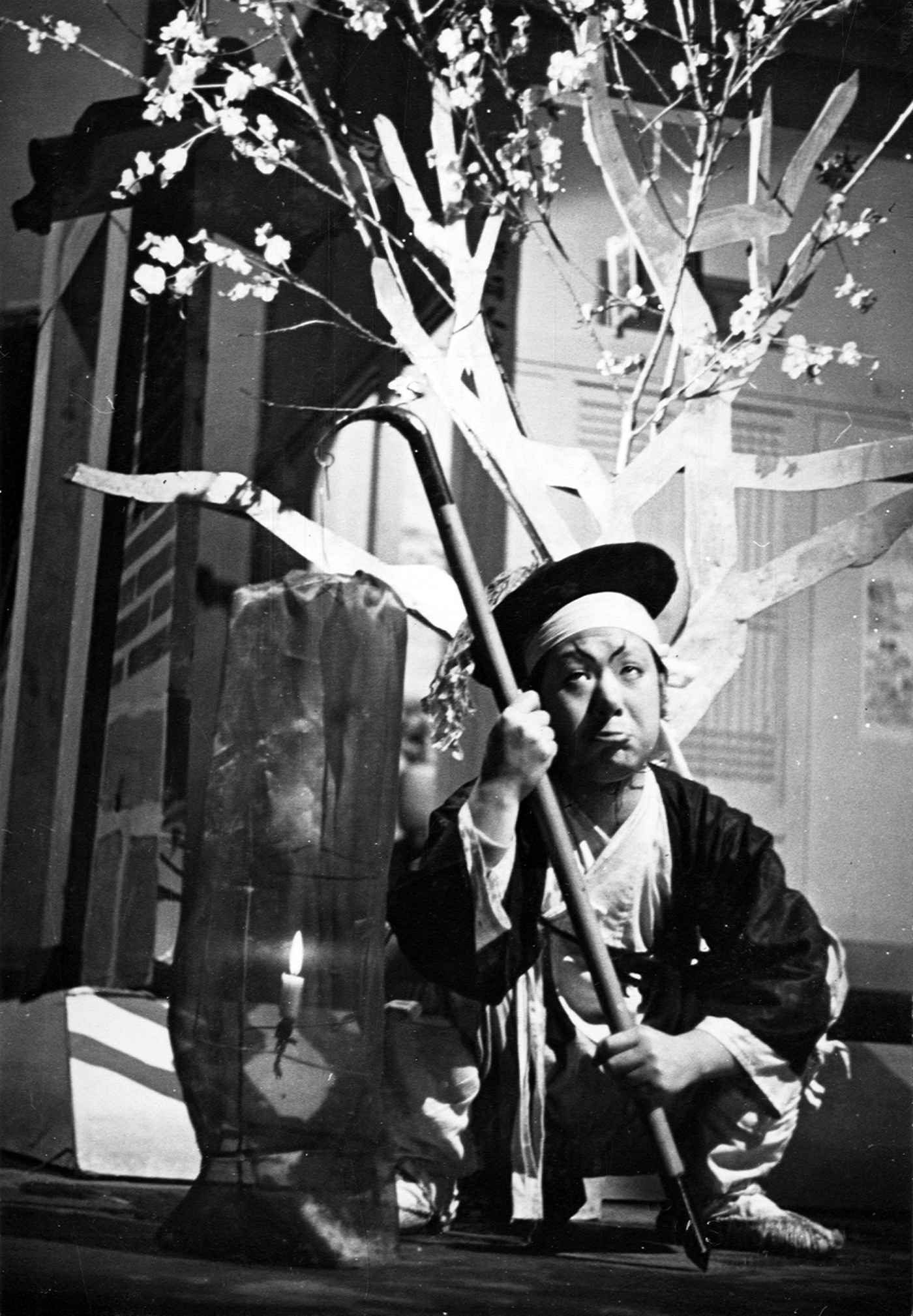
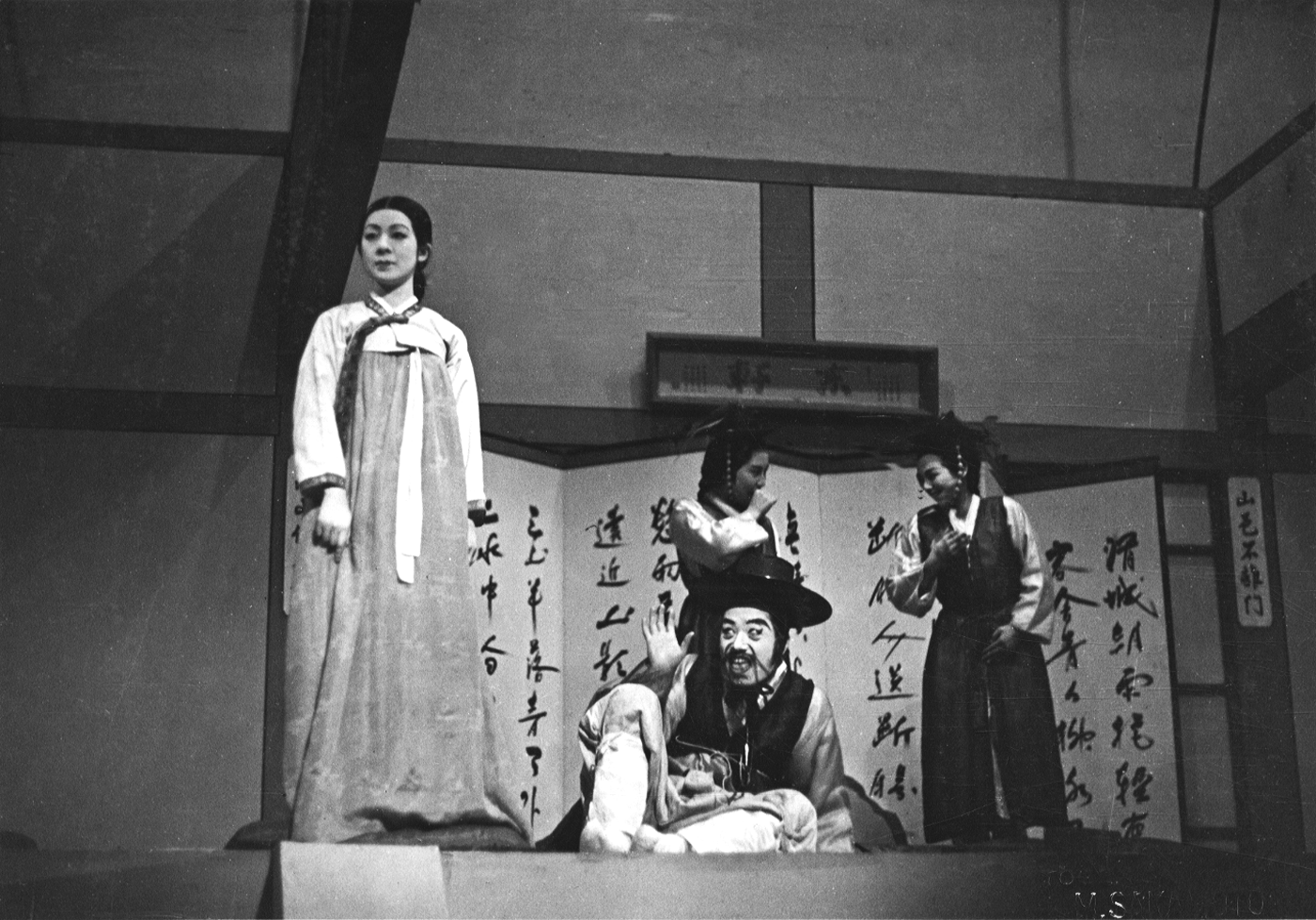
A substantial amount of time was spent poking fun at the performance, from the details of costume (Ch'unhyang's dress is too fancy, the color scheme is wrong, and her hairstyle is inappropriate), to inconsistencies in cultural references. For example, Mongnyong is called “wakasama” (young master) in Japanese, whereas the servant Pangja is called “Pangja” in Korean (see figure 8). The mannerisms are inappropriate: Mongnyong does not behave as a proper Chosŏn aristocrat with his servant; it is absurd that he would drink with his servant. While granting that the evil magistrate is indeed smitten with Ch'unhyang, his overtly lascivious attitude seems more fitting of a low-born drunkard than someone from elite society (see figure 9). The audacity of Ch'unhyang boldly prancing over to Mongnyong reminds one of a sketch lifted from a “rendezvous (rangdebu) between a modern girl (modan gŏr) and modern boy (modan ppoi)” rather than an authentic scene from the Chosǒn dynasty. (“Even today's modern girls would not be so bold and flirtatious. And the way she flung herself around to change her costume right before the audience!” (Yi et al. 1938).Footnote 25
Servant Pangja squats and pouts. Reprinted with permission from the Tsubouchi Shōyō Memorial Museum.
Drunken evil magistrate heckles Ch'unhyang while cross-dressed servants snicker. Reprinted with permission from the Tsubouchi Shōyō Memorial Museum.
Underlying the laughter and the jokes, however, the disapproval felt by the colonized critics was revealed in the way they confronted the monstrously disturbing text of Ch'unhyang. Their anxiety was most evident when they jokingly compared the dirty, primitive depiction of Korea in the play to the South Pacific during the discussion of Ch'unhyang's costume: one critic commented on the scarf veiling Ch'unhyang's head and asked whether Murayama may have mistaken Korea for a place in the South Pacific.
While critics pointed out the ridiculousness of equating Korea to the “barbaric” South Pacific islands’ “natives” (t'oin), one detects a nervous recognition of the parallel location occupied by both in the imperial hierarchy of Asia. Colonized Korean nationalists were not immune to exoticizing and disdaining others within the empire whom they considered inferior to themselves. One lingering issue in Korean colonial studies is the tendency to critique Japan for colonizing Korea but not the greater logic of colonization itself. Many Korean intellectuals, like their Japanese counterparts, bought into the ideology of social Darwinism and the discourse of civilization and enlightenment. They accepted the structuring of the world in hierarchies; the problem was Korea's low place in it (Schmid Reference Schmid2002). The roundtable revealed a moment of anxious recognition that the analogy between Korea and the South Pacific may not have been so far-fetched in the imperial world scheme. The critics were offended by the equation, but the reality was that in the broader global context, merely a small degree of difference distinguished their situation from that of Japan's other colonies in the South Pacific.Footnote 26
Some of the roundtable criticism on the issue of authenticity seems rather petty, focusing on the body of Ch'unhyang: what she was wearing, her actions, and such. In the larger discourses on modernity and tradition, however, aspects of the quotidian—hairstyles, courtship, and clothing, which filled the pages of popular journals and newspapers—took on larger implications as they portended the imminent and forced disappearance of a familiar way of life and the world order as they knew it. Likewise, the seemingly petty debates over Ch'unhyang's body, what she was wearing, where she was allowed to walk or not walk, and what she could or could not say held larger symbolic import for the anxious male critics who were trying to hide such tensions behind silly jokes and nervous laughter.
From a modern perspective, the laughter can be interpreted as not only the site of the anxieties of the colonized intellectual, but also as a site of the disturbance to imperial ideology.Footnote 27 The object of their jokes was Murayama, the cultural illiterate in this case, clueless of Korean customs, though able to stage a grandiose spectacle of a transnational Ch'unhyang. The Korean critics dismissed the performance, treating it with irreverence as mere slapstick comedy. Perhaps it is better characterized as a tragi-comedy from the perspective of these colonized intellectuals who had to be relegated to making backhanded remarks and jokes in their critiques, unable to effectively prevent the damage that was already being done while the much-publicized Japanese Ch'unhyang was touring throughout their beloved Korea.
Korean critics were idealizing Korea, much as Murayama had done, but for different ends. Their assumption was that Ch'unhyang as a quintessential Korean text would be impossible for a Japanese (or any non-Korean) to truly understand or appreciate. Such essentialist views in the defensive mode show well the conundrum of the colonized nationalists: their blindness toward how they were perpetuating the same logic of the colonizer in their critique of the colonizer (Chow Reference Chow1991; Duara Reference Duara1995; Schmid Reference Schmid2002).
Murayama became the object of the Korean critics’ taunts and jokes, but the harshest critique was reserved for Chang Hyŏkchu, the “traitorous” translator of Korean culture for imperial consumption. First, Chang's fame was dismissed as illegitimate, as he was relegated to being seen as an undeserving crony of the Japanese. The critics accused Chang of having “made it” only with the backing of a Japanese drama troupe and for having what they considered to be a lack of concern about the question of “authenticity.” One participant of the roundtable discussion admitted that he had not actually seen the play, but that did not prevent him from claiming the right to criticize it because the assumption was that as an ethnic Korean, he was more than qualified to make pronouncements on Ch'unhyang.
The critique of Chang often resulted from the participants’ equating of Chang with Murayama, and thus accusing them both of being ignorant of Korean culture. By conflating Chang and Murayama, and both of their “inauthentic” relationships to Korea, as well as their ignorance of Korean customs, Chang was more harshly implicated by their essentialist logic: as an ethnic Korean, Chang had no excuse for his ignorance, but Murayama, as a Japanese, was expected to be ignorant.
The critics made no attempt to understand the power relationship between Chang and Murayama in the making of the play. Chang's complex position as a translator between colonial cultures and his attempts to negotiate an autonomous space of creative expression—despite the strong hand of Murayama—was simplified and dismissed. Chang was further chastised as lacking self-awareness of his true position as merely a puppet and traitor in the service of empire.
Because Ch'unhyang in this context had been coded as a metonym for the lost nation itself while remaining a national “tradition” to be protected from the infiltration of the foreign, the attempt to modernize it—especially at a time when modernity was often seen as synonymous with imperial Japan and the West—was met with strong opposition as being “inauthentic betrayal.” The ambivalence of the Korean critics toward the modern adaptation of Ch'unhyang revealed the anxieties of cultural nationalists in the colonial modern era.
It is not without significance that such gestures of simultaneous essentialization and exoticization of colonized Korea were contested over the female body of Ch'unhyang. Paralleling the fate of the eponymous tale itself, Ch'unhyang, its heroine, was appropriated for nationalist and imperialist desires. The body of Ch'unhyang became the locus of contradictory contentions for these critics.Footnote 28
Postcolonial Legacies
In Korea, the trauma of the colonial period still haunts society. Whether because of the lack of a full assessment of the colonial period in the postliberation political chaos, or because of the shame in being colonized by a neighbor who had been historically looked down upon as a cultural inferior, or because of the construction of a cult of blame, shame, and outrage by nationalists post-1945, much of Korea's colonial past remains to be examined. This difficulty is exacerbated by the turbulent post-1945 divisive histories between Korea and Japan despite their shared postwar experiences in the Cold War world order.
The Japanese-language Ch'unhyang, arising out of the “collaboration” between Chang Hyŏkchu and Murayama Tomoyoshi, was assessed as a monstrous grafting of kabuki and Korean elements and was seen as “impure.” The performance emerged in the context of imperial assimilation policies, but with the end of empire, it became a text too disturbing to be remembered. The lively debates, photo ops, advertisements, and other forms of fixation on Chang and Murayama's Ch'unhyang are matched by the depth of silence that followed, resulting in an almost complete erasure from the collective memories of both Korea and Japan in the formation of national literary canons. In Korea, Chang and Murayama's Ch'unhyang is a painful reminder of a history of “collaboration.” The fact that a Korean-born writer rewrote the story in Japanese may have been seen as a sign of betrayal. However, because the issues of “collaboration” blur the lines of colonizer and colonized, and have not yet been worked through, they still haunt the politics and history of Korea, as seen in the formation of a president's committee of historians to “cleanse” the collaborationist history sixty years after the end of colonial occupation. A similar erasure and forgetting have been enacted in Japan as well. For all the fetishization of and fixation on colonized writers during the “Korea Boom” years, when many Korean writers were invited to share the limelight at the center of the bundan, their sudden rise to fame was matched by an equally abrupt forgetting of their very existence.
The Question of “Homecoming” in Lieu of a Conclusion
I have discussed the ambivalence of transcolonial nostalgia in the empire on multiple levels, and I would like to conclude with some musings on the issue of the “homecoming” of the bilingual translator. One metropolitan critic, Akita Ujaku (Reference Ujaku1938), expressed his hope that this performance would be received warmly as a “son returning home” to Korea. He was referring to the performance itself and not to Chang specifically, but this issue is an interesting one to ponder in the case of Chang's personal experience of homecoming along with the performance of Ch'unhyang. For Chang, this was a literal homecoming; however, the hostile reception rendered this homecoming an ambivalent one at best. Just as Ch'unhyang was appropriated by contending ideologies at the time, this statement, which on the surface explicitly promotes the imperial project of Naisen yūwa (Harmony between Japan and Korea), can also be appropriated as a trace, albeit unintended, of the irony and ambivalence of the experience of individuals across the borderlines of empire. Ironically, imperialist desires for colonial kitsch and nationalist desires for a national tradition converged on the same object of desire for contending purposes. Likewise, the dilemma of a bilingual writer caught between the contradictions of a nationalist demand for authenticity and the imperialists’ demand for exoticization exposes his conundrum in the uneven colonial exchange. Here, I considered a moment of “collaboration” between the colonized and the colonizers when conflicting nostalgic desires came to a head within the uneven context of empire. I hope to draw attention to a moment when the literary histories of Korea and Japan converged before they divided into their own separate nation-centered master narratives in the postcolonial era. By rethinking the issue of “collaboration” and “translation” in the colonial cultural exchange, I hope to open up new dialogue on contested histories that call for a transnational reconsideration.
Acknowledgments
An earlier version of this paper was presented with the panel “Cultural Exchanges between Korea and Japan in the Colonial and Postcolonial Eras” at the 2008 Annual Meeting of the Association for Asian Studies. I would like to thank the organizer, Noboru Tomonari, and our discussant, Jung-Sun Park, as well as the other panelists, E. Taylor Atkins and Sang Mi Park, for the productive exchange. I would also like to thank the two anonymous reviewers for their insightful suggestions.