Introduction
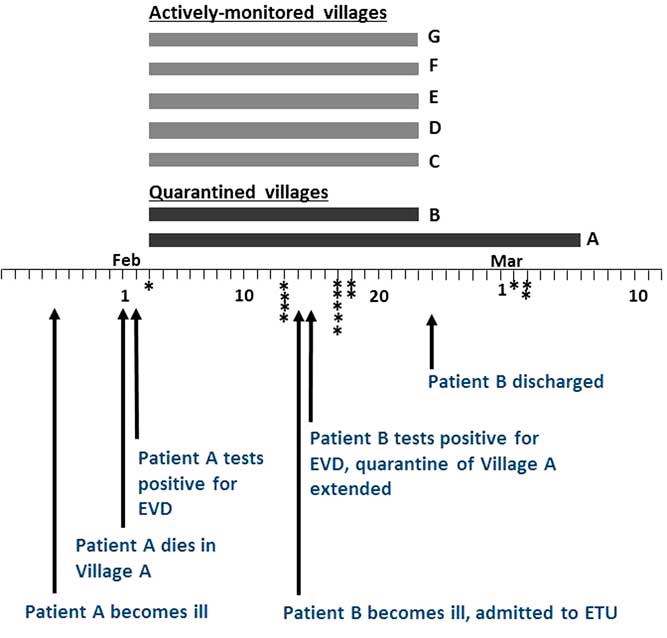
In early 2015, a cluster of 22 cases of Ebola Virus Disease (EVD) in Monrovia, Liberia was identified and contained after three generations of transmission.Reference Nyenswah, Fallah and Sieh 1 A patient from this cluster (Patient A, 2nd generation of EVD transmission) became ill on January 27 and travelled using a different name to a rural village (Village A) in Margibi County (Figure 1). He was cared for by family in Village A, had contact with numerous people in Village A and nearby Village B, and had possible contact with an unknown number of persons in five other nearby villages (Villages C-G). He died on February 1 in Village A and was safely buried on February 2. Post-mortem testing of an oral swab collected on February 2 confirmed Ebola Virus infection, prompting the Margibi County Health Team (CHT; Kakata, Margibi, Liberia) to initiate active monitoring for all residents of Villages A-G and community quarantine for Villages A and B from February 3-23.
Timeline of Events Surrounding the Active Monitoring and Quarantine of Seven Rural Villages, Margibi County, Liberia, January-March 2015. Note: Duration of quarantine of Villages A and B and active monitoring of Villages C-G are represented by bars. Asterisks indicate date at which a resident in Village A or B was admitted to the ETU with illness later determined to be non-EVD. Abbreviations: ETU, Ebola treatment unit; EVD, Ebola Virus Disease.

Methods
Outbreak Response
The Margibi CHT met with Town Chiefs and households of each village to initiate and sustain active monitoring and quarantine. Residents of quarantined villages were restricted from leaving their village, including for going to work, school, or market. The CHT contact tracers and case finders were instructed to visit all residents of each village twice daily and screen them for signs and symptoms of EVD. The CHT and emergency partners coordinated delivery of food and water to quarantined villages.
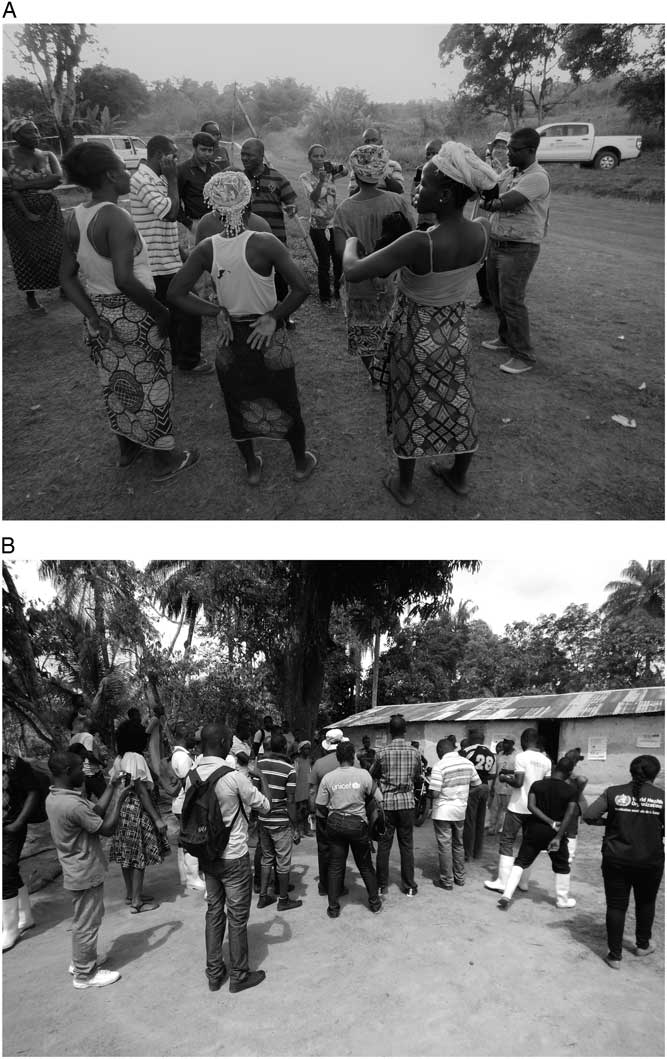
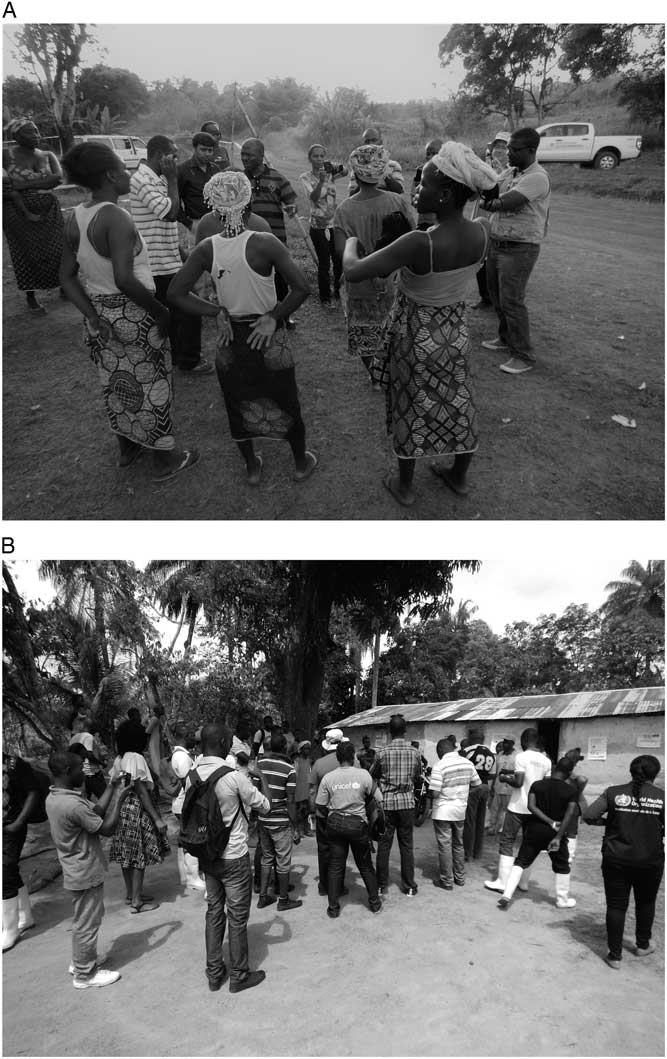
On February 14, case finders identified a Village A resident with EVD-consistent illness. She was transported to the Margibi Ebola treatment unit (ETU), and on February 15, tested positive for Ebola Virus infection (Patient B, 3rd generation of EVD transmission). The Margibi CHT extended the quarantine of Village A until March 7. Patient B recovered at the ETU and was discharged on February 24; the Margibi CHT held a reintegration ceremony for Patient B at Village A the same day (Figure 2).
In-Person Interactions between Margibi County Health Team and Actively Monitored or Quarantined Villages. Panel A. Re-integration ceremony for Patient A at Village A. The Margibi County Health Officer explains to Village A residents that Patient A is Ebola-free and should be welcomed back into her community as an ambassador in the fight against Ebola (February 24, 2015). Panel B. The Margibi CHT explains to a village that their active monitoring period is complete, but that they should refrain from entering Village A until Village A’s quarantine period is complete.
During the 33-day and 20-day quarantines of Villages A and B, respectively, case finders identified an additional 15 persons with suspected EVD (Figure 1). Each was transported to the Margibi ETU and tested for EVD infection twice over a 3-day period. None tested positive. On February 23 and March 7, the Margibi CHT lifted the quarantine or monitoring at Villages B-G and A, respectively (Figure 2).
Knowledge, Attitudes, and Practices Survey
Though community quarantines have been implemented to control EVD transmission,Reference Borchert, Mutyaba and Van Kerkhove 2 - Reference Nyenswah, Blackley and Freeman 6 no reports have described factors that supported compliance or led to barriers complying with quarantine restrictions. A head-of-household knowledge, attitudes, and practices (KAP) questionnaire that included questions about EVD; attitudes about quarantine to prevent the spread of EVD; and for Villages A and B, experiences and practices during quarantine was designed by the Centers for Disease Control and Prevention (CDC; Atlanta, Georgia USA), the CHT, and Peace Corps staff (Appendix 1; available online only). Two Liberian Peace Corps staff compared their interpretation of each survey question and constructed Liberian English versions of each question by consensus. Liberian English questions were used when preferred by interviewed households. Every household in Villages A-G was approached April 24-29 by local YMCA volunteers trained by Liberian Peace Corps staff. The Human Subjects Research Office of the CDC approved this assessment as public health practice (public health emergency response and program evaluation; Human Subjects Review #EOC Ebola Response 2015 1017) and the assessment was approved by the Margibi County Health Officer.
Results
Teams completed seven, nine, and 99 interviews in Villages A, B, and C-G, respectively. The Margibi CHT previously had estimated the population of Villages A, C, F, and G as 71, 96, 67, and 55, respectively, but had no estimates for number of households, and also did not have population estimates for Villages B, D, or E. The sum of persons living in interviewed households in Villages A, C, F, and G was 56, 95, 42, and 39, respectively; therefore, similar representation was estimated by interviewed households for the population of these villages (80%), quarantined villages (79%), and 81% of the total population of these villages was likely represented by interviewed households of monitored villages.
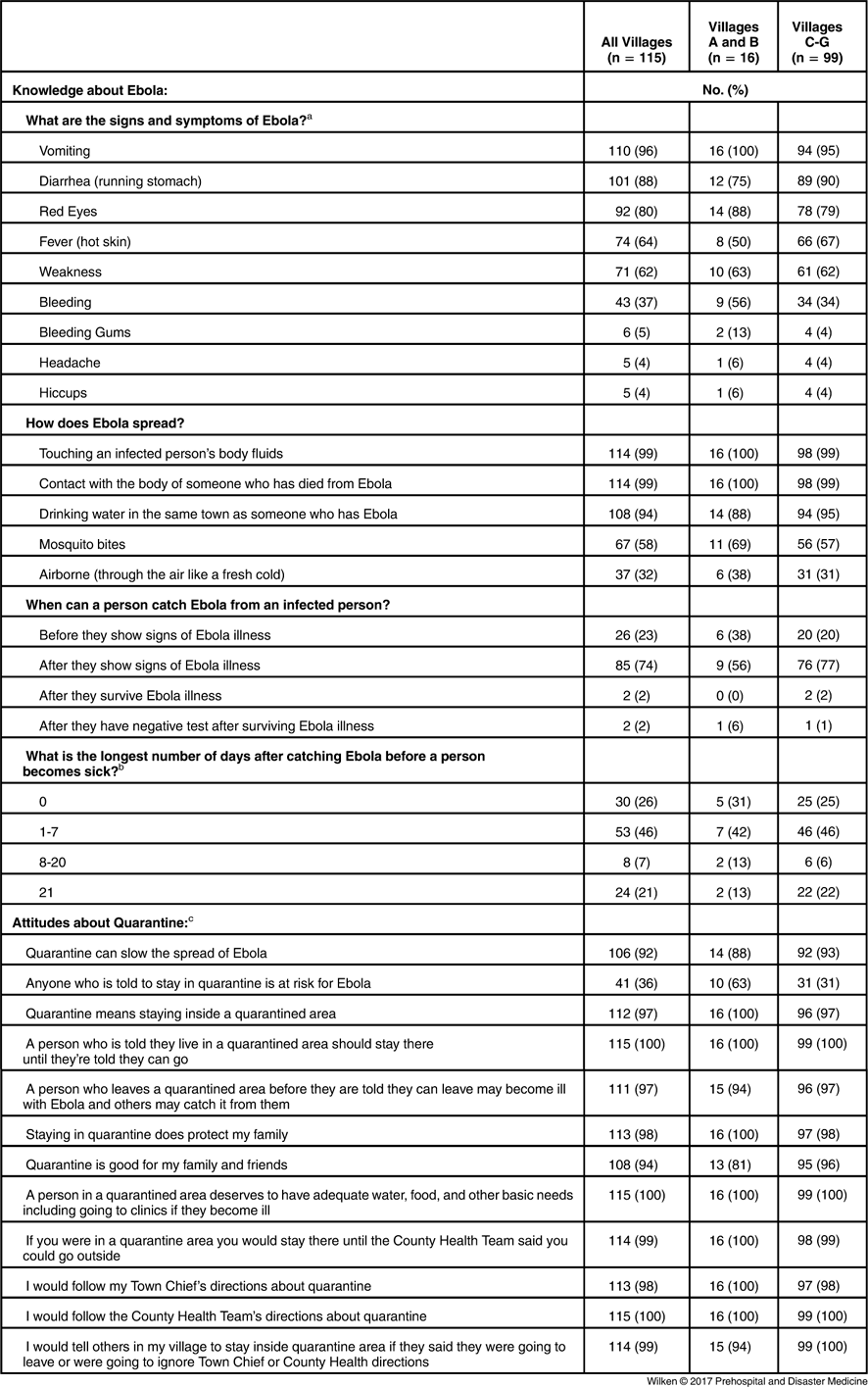
Respondents correctly identified vomiting (96%), diarrhea/“running stomach” (88%), red eyes (80%), fever/“hot skin” (64%), and weakness (62%) as signs and symptoms of EVD (Table 1). Most (99%) correctly identified contact with an infected person’s bodily fluids or with the body of someone who had died from EVD as routes of transmission, but mosquito bites and airborne/“through the air like a fresh cold” were incorrectly identified by 58% and 32%, respectively. Although most (74%) correctly identified that EVD could be caught from an infected person only after they showed signs of illness, most (72%) incorrectly identified the longest number of days after catching Ebola before a person becomes sick as ≤seven. These data indicate that residents were well-informed about the signs and symptoms of EVD, but that knowledge of EVD transmission routes and incubation period (and likely the rationale for a 21-day monitoring/quarantine period) was suboptimal.
Knowledge of EVD and Attitudes about Community Quarantine, Villages A-G (N=115), Margibi County, Liberia

Abbreviation: EVD, Ebola Virus Disease.
a Multiple answers were allowed. Interviewer was instructed to not read a list of symptoms to the respondent.
b Responses were categorized as listed.
c Number and percent of respondents that agreed with the statement.
Most households agreed with statements about the rationale for community quarantine and expected behaviors of persons quarantined (eg, “quarantine can slow the spread of Ebola” [92%], and “I would follow my Town Chief’s directions about quarantine” [98%; Table 1]). More households in Villages A and B versus Villages C-G (63% vs 31%; χ2 P=.04) agreed that anyone who was told to stay in quarantine had the potential to acquire EVD, which might have been due to the CHT presence in Villages A and B, the EVD death, and the potential transmission within Village A. All (100%) respondents agreed that a person in a quarantined area deserved to have adequate water, food, and other basic needs, including going to clinics if they become ill.
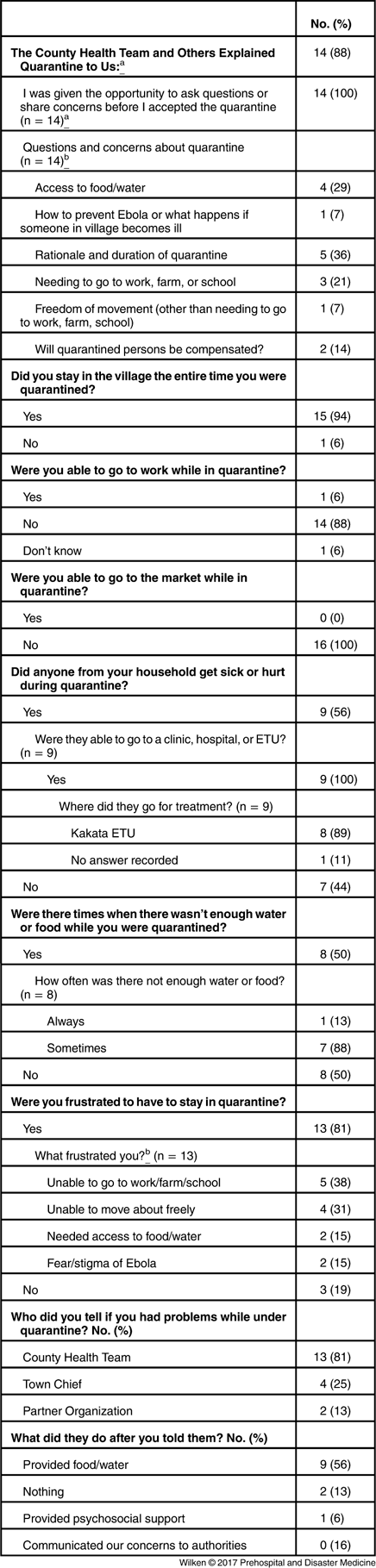
Most (88%) residents of Villages A and B reported that the Margibi CHT explained “quarantine” to them, and of these households, all (100%) reported that they were given the opportunity to ask questions or share concerns before accepting the quarantine; the most common concern regarded the rationale and/or duration of quarantine (36%; Table 2). Most (56%) reported that someone from their household became sick or hurt during the quarantine; of these, all (100%) reported that they were able to go to a clinic, hospital, or ETU. One-half (50%) reported times when there was not enough water or food while they were quarantined. Most (81%) were frustrated to stay in quarantine, the most common reasons being unable to go to work/farm/school (38%) or to move about freely (31%).
Practices and Experiences during Quarantine, Villages A and B (N=16), Margibi County, Liberia

Abbreviation: ETU, Ebola treatment unit.
a Number and percent of respondents that agreed with the statement.
b Multiple answers were allowed.
Discussion
Quarantine can be an effective method for preventing the spread of communicable diseases, and several communities in Liberia were subjected to quarantine during the epidemic as a method for preventing the further spread of EVD.Reference Nyenswah, Blackley and Freeman 6 The decision to quarantine must consider both the risk of transmission of EVD and the societal and economic costs,Reference Gostin 7 and failure to provide for residents’ basic needs can undermine a community quarantine.Reference Viens, Bensimon and Upshur 8 - Reference Thompson 10 While the residents of the villages understood the importance of quarantine, most were also frustrated, for various reasons, to stay in quarantine. Like previous quarantines to prevent the spread of EVD,Reference Borchert, Mutyaba and Van Kerkhove 2 , Reference Reaves, Mabande, Thoroughman, Arwady and Montgomery 3 imposing the quarantine required substantial coordination between the Margibi CHT and emergency partners, staff time, and resources to both prevent spread of EVD outside of the affected villages and to meet the needs of the village residents.
This KAP assessment was performed retrospectively and it cannot be determined if or how monitoring/quarantine affected resident’s knowledge of EVD or attitudes about quarantine, or what unmet needs of residents existed before the quarantine. The fairly small number of households within this assessment precludes extensive statistical analysis, and the proportion of residents represented in these surveys could not be estimated for three villages. Respondent bias and interviewer bias are also possibilities, and the results presented here might not be generalizable outside of the surveyed communities.
Based on the findings presented here, health authorities might anticipate the need to:
-
∙ Consider the health literacy of residents to ensure their understanding of the range of EVD known transmission routes, the EVD incubation period, and why the incubation period is crucial for determining the duration of monitoring or quarantine; and
-
∙ Coordinate with partners to address the needs and concerns of quarantined persons (including access to water, food, and medical services), and actively work to meet these needs and address these concerns in order to maintain trust.
Conclusions
The community quarantine described here limited the spread of EVD. Residents understood the importance of monitoring and quarantine but had suboptimal knowledge of the routes of transmission and incubation period of EVD. One-half of quarantined households reported times of inadequate food and water, and most reported frustration with being in quarantine for various reasons; however, all household reporting injuries or illnesses while in quarantine received medical care.
Supplementary Material
To view supplementary material for this article, please visit https:/doi.org/10.1017/S1049023X17006720