Wastewaters from the textile industry comprise organic micropollutants and highly coloured chemicals, including detergents, pigments and dyes, which cause serious environmental harm. These pigments and dyes are often used in excess to improve the dyeing process; thus, the wastewaters are rich in dyes (mostly synthetic) and complex compounds with high molecular weights, which are more stable and resistant to biological degradation, making removal difficult. With increasing demand from industry for these dyes, >10,000 different dyes are being manufactured, with an estimated annual production of ~7.108 kg (Benguella et al., Reference Benguella and Yacouta-Nour2009; El-Latif et al., Reference El-Latif, Ibrahim and El-Kady2010; Canli et al., Reference Canli, Abali and Bayca2013; Dwivedi & Tomar, Reference Dwivedi and Tomar2018). Wastewaters from the textile industry laden with dyes pose threats to human health and the environment. The serious and immediate toxic impacts of these effluents have become a worrying issue (Berez et al., Reference Berez, Ayari, Abidi, Trabelsi-Ayadi and Schäfer2014; Rawat et al., Reference Rawat, Mishra and Sharma2016).
Early studies (Anliker, Reference Anliker1979; Chung et al., Reference Chung, Fulk and Andrews1981) demonstrated the toxic and/or carcinogenic effects of azo dyes (dyes in the textile industry), meaning that the effluents containing these dyes should be treated before release into nature. Their toxicity/carcinogenicity is due to the presence of aromatic groups, phthalogen, cyanide, a salt of barium and lead. These carcinogenic groups (in electrophilic or radical form) attack the pyrimidine bases of DNA and RNA and thus cause alterations to the genetic code, leading to mutations and increasing the risk of cancer (Zollinger, Reference Zollinger2003).
The application of dye treatment and purification processes by coagulation–flocculation, biodegradation and oxidation has limited utility, either because of excessive costs or because there is insufficient removal of the aforementioned compounds (Benguella et al., Reference Benguella and Yacouta-Nour2009; Canli et al., Reference Canli, Abali and Bayca2013). Adsorption, widely used in industrial processes for various separation and purification purposes, is rapidly becoming an important method of treating aqueous effluents, including the removal of dyes from wastewater from the textile industry (Apreutesei et al., Reference Apreutesei, Catrinescu and Teodosiu2008; Kuleyin & Aydin, Reference Kuleyin and Aydin2011). Numerous studies have shown that several alternative adsorbents can be applied for the adsorption of textile dyes, such as activated carbon, clay minerals and natural and modified zeolites (Apreutesei et al., Reference Apreutesei, Catrinescu and Teodosiu2008; Benguella et al., Reference Benguella and Yacouta-Nour2009; Canli et al., Reference Canli, Abali and Bayca2013).
Natural zeolites with a porous structure are generally present in volcanic tuffs that are composed of volcanic ash consolidated into fragments of various sizes. They are ejected from vents during volcanic eruptions (Turhan et al., Reference Turhan, Yildirim, Kurnaz, Hancerliogullari, Altikulac, Atici, Varinlioglu and Bassari2017). Indeed, natural zeolites are hydrated aluminosilicate. They are economically acceptable materials for environmental applications due to their exceptional ion exchange and sorption properties. Their effective applications in various technological processes depend on their physicochemical properties, which are closely related to the nature and mineralogical composition of geological deposits. (Margeta et al., Reference Margeta, Logar, Šiljeg, Farkas, Elshorbagy and Chowdhury2013). These nanoporous solids (pore size <5 nm) have a unique three-dimensional porous structure in the form of a cage adapted for adsorption and ion exchange due to the isomorphous replacement of Al3+ by Si4+, resulting in a positive charge deficit in the structure. This charge is balanced by mono- and di-valent exchangeable cations such as Na+, Ca2+, K+ and Mg2+ (Perić et al., Reference Perić, Trgo and Medvidović2004). These interesting physicochemical properties, namely cation exchange, molecular sieve, catalysis and sorption, present natural zeolites with various application possibilities, such as in industry and agriculture (Chutia et al., Reference Chutia, Kato, Kojima and Satokawa2009; Wang et al., Reference Wang and Peng2010; Canli et al., Reference Canli, Abali and Bayca2013). In fact, a large proportion of natural zeolite applications have been driven by environmental concerns. These materials play an important role in reducing toxic waste and energy consumption (Apreutesei et al., Reference Apreutesei, Catrinescu and Teodosiu2008). Mordenite is one of the most siliceous natural zeolites, occurring in large quantities in some vitreous weathered tuffs (Oprea et al., Reference Oprea, Popescu and Birghila2008). It is characterized by a one-dimensional structure with wide channels (6.5 Å × 7 Å) straight through the entire crystal. The chemical formula of mordenite is |Na8(H2O)24| [Al8Si40O96]. The Si/Al atomic ratio is equal to 5 for the pure mordenite phase; but it can be modified within certain limits (Hernáandez et al., Reference Hernáandez, Corona and Rojas2000; Zhou et al., Reference Zhou and Boyd2014; Ormándi et al., Reference Ormándi, Cora, Dallos, Kristály and Dódony2017).
The present work focuses on the application of natural tuff rich in mordenite from the Tinebdar deposit (Algeria) for the removal of textile dyes (Asucryl red) by adsorption. Various parameters affecting sorption, such as contact time, adsorbent quantity, pH and temperature, were evaluated. Kinetic and isotherm adsorption models were constructed to better understand the dye-adsorption mechanisms.
Materials and methods
The adsorbent used in the present study is a tuff taken from the Tinebdar deposit in the Sidi Aich region (Algeria). After milling and sieving to a particle size of <125 μm, the sample was dried at 105°C for 24 h. The sample was used in adsorption experiments without any chemical treatment.
The industrial dye used as adsorbate was Asucryl red GRL, which belongs to the family of basic textile dyes, supplied by ALFADITEX, an Algerian company that manufactures various textiles.
Characterization of natural tuff
The mineralogical composition of the tuff was examined via X-ray diffraction (XRD), using a PANalytical powder diffractometer, monochromatic Cu-Kα1 radiation, a step size of 0.02°2θ and a counting time of 10 s per step. The chemical composition of the natural tuff was determined using X-ray fluorescence (XRF) (spectrometry (PANalytical Perl'X 3 XRF spectrometer). The textural characterization was carried out using adsorption isotherms, the specific surface area obtained by N2 adsorption according to the Brunauer–Emmett–Teller (BET) method and the pore volume of the previously degassed samples at 300°C was determined from low-temperature nitrogen adsorption (Quantachrome NovaWin2 analyser). Before initiating the dye-adsorption study of the natural tuff, absorbance measurements were performed using an ultraviolet–visible spectrophotometer (Shimadzu UV-1800) at 532 nm, corresponding to the absorption maximum of the Asucryl red dye.
Adsorption tests
The adsorption tests were carried out in a batch reactor with stirring. Dye solutions in the presence of the adsorbent were prepared with 150 mg L–1 of dye and 1 mg L–1 of adsorbent.
The effects of temperature, pH, contact time and initial concentration on dye adsorption studied. The adsorption isotherms were studied and the thermodynamic parameters of the adsorption (entropy, enthalpy and free enthalpy) were determined by varying the temperature from 293 to 333 K. These parameters show the degree of disorder at the solid–liquid interface ΔS°, the exothermic or endothermic nature of the adsorption process ΔH° and allow for the specification of the spontaneity of the process ΔG°.
The adsorption of the Asucryl red dye on the adsorbent was studied at pH values of 2, 5, 6 and 9. The pH of the solution (Asucryl red–water) was adjusted to the desired values by the addition of 0.1 N HCl or NaOH.
Absorbance measurements were performed after centrifugation at 5000 rpm for 2 min. The residual dye concentration in the solution was measured with an ultraviolet–visible spectrophotometer after establishing a calibration curve.
The amounts (q t; mg g–1) of the adsorbed dye (mg) per unit mass (g) of the adsorbent at time t were calculated according to equation 1:
 $${q}_{\rm t} = \displaystyle{{\lpar {{C}_{\rm i}-{C}_{\rm t}} \rpar {V}} \over {m}} $$
where C i is the initial concentration of the dye, C t is the concentration at time t (mg L–1), m is the mass of tuff (g) and V is the volume of the solution (L).
The removal rate is defined as the efficiency of the adsorption reaction. Hence, this expresses the ratio of the amount of adsorbed dye (removed) relative to the initial amount of dye in the aqueous solution.
 $$\% \ {\rm Adsorption} = \displaystyle{{\lpar {{C}_{\rm i}-{C}_{\rm e}} \rpar } \over {{C}_{\rm i}}} \times 100 $$
where C i (mg L–1) is the initial concentration of the dye in the solution and C e (mg L–1) is the concentration of the dye in the solution at equilibrium.
Results and discussion
Characterization of the tuff
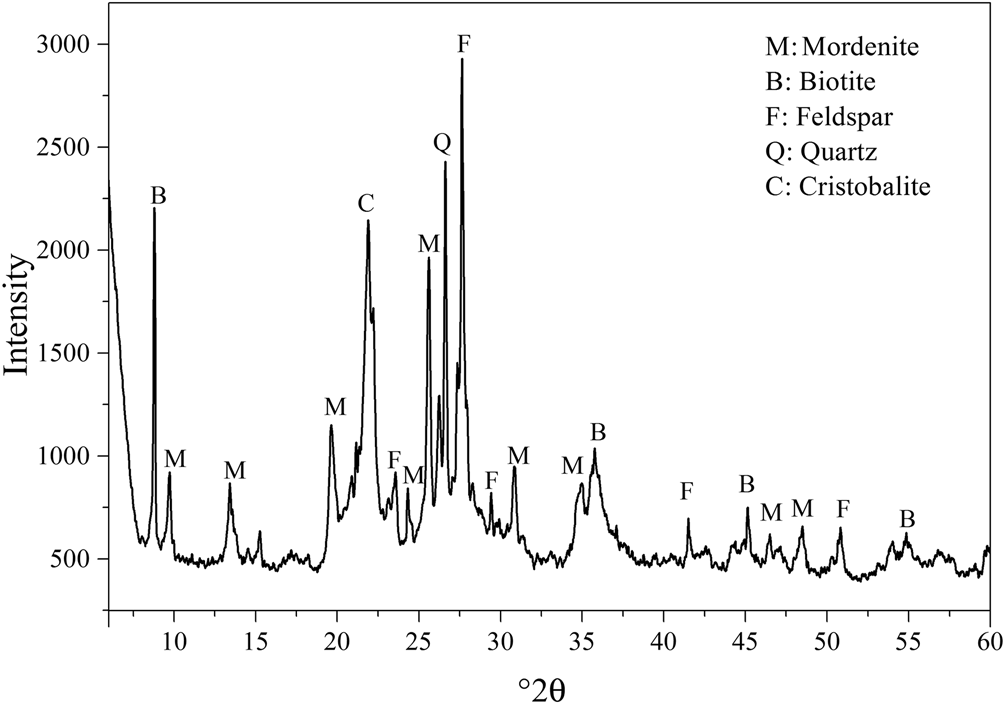
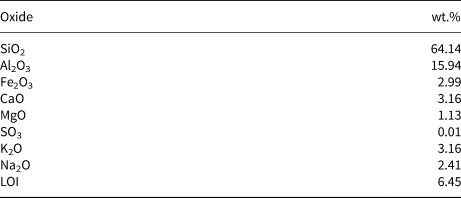
The XRD trace of the tuff is shown in Fig. 1. Mordenite is the main mineralogical phase present associated with plagioclase, biotite and quartz. The chemical analysis of the adsorbent (Table 1) shows that (SiO2 + Al2O3) represents 80 wt.% of the mineral. The SiO2/Al2O3 ratio is 4.02; this value controls the formation of zeolites, which is close to the lower limit for mordenite given by the literature at 4.15–5.15 (Hernáandez et al., Reference Hernáandez, Corona and Rojas2000; Khoury et al., Reference Khoury, Ibrahim, Al Dwairi and Torrente2015). Biotite, hematite and feldspar are accessory minerals and affect the colour of the tuff (Bouzidi et al., Reference Bouzidi, Siham, Concha-Lozano, Gaudon, Janin, Mahtout and Merabet2014) because these minerals contain transition metals such as Fe2+, Ti3+ or Mn2+.
XRD trace of the natural tuff from Tinebdar.

Chemical composition of the natural mordenite tuff.

LOI = loss on ignition.
Other oxides such as K2O and CaO (3.16 wt.% for each oxide) are linked with mordenite and feldspars. On the other hand, Fe2O3 (3 wt.%) and MgO (1.13 wt.%) are associated with biotite (Fig. 1). The chemical composition indicates the presence of Mg+, K+ and Na+ exchangeable cations in mordenite, which favour the adsorption process.
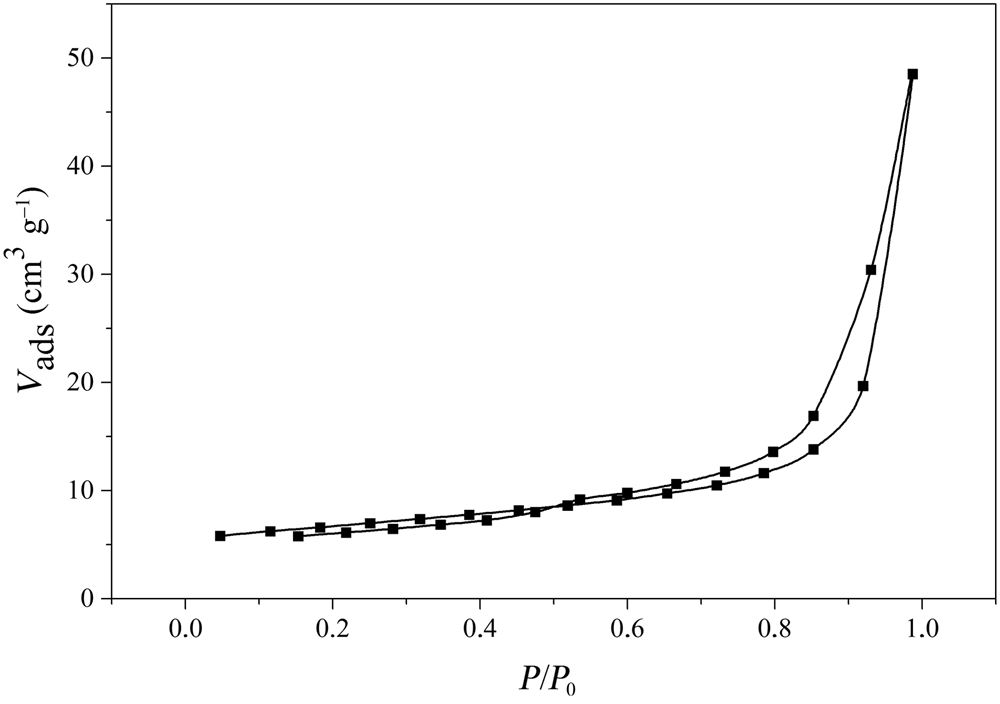
The textural characterization of the natural tuff samples was based on the nitrogen adsorption isotherm obtained at 77.35 K (Fig. 2). The BET-specific surface area was 21.8 m2 g–1 and the corresponding pore volume was ~0.075 cm3 g–1. For natural zeolites, the pore-size distribution shows only one peak at ~20.6 Å, suggesting a very narrow pore size distribution (Wang & Zhu, Reference Wang and Zhu2006).
Nitrogen adsorption and desorption isotherm of the natural tuff.

The average pore diameter calculated according to the Barret–Joyner–Halenda (BJH) method is ~2.1 nm, indicating the mesoporous character of the tuff. Indeed, the cumulative pore area determined by the BJH method (14.79 m2 g–1) was smaller than that determined by the BET method, indicating that the tuff is an adsorbent containing both mesopores and micropores.
Effect of contact time
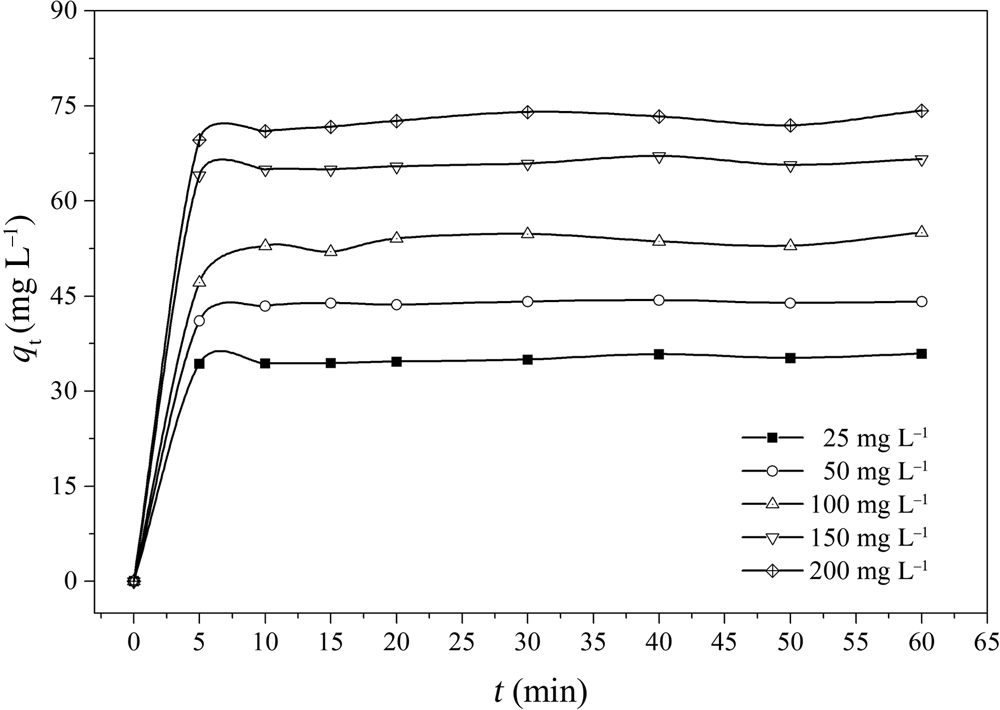
The Asucryl red adsorption kinetics show a rapid first step corresponding to the external mass transfer and a slow second step linked to the diffusion phenomenon (Sakr et al., Reference Sakr, Sennaoui, Elouardi, Tamimi and Assabbane2015) for all of the initial concentrations of dye (Fig. 3). Equilibrium is attained in just 10 min of adsorption for all of the initial concentrations of the dye solutions, which shows that the adsorption process is very fast. Beyond this limit, the amount adsorbed remains constant. This is explained by the availability of vacant sites on the surface of the adsorbent used and the importance of the electrostatic attractive forces between the dye molecules and the adsorbent, which accelerate the diffusion process (El Latif et al., Reference El-Latif, Ibrahim and El-Kady2010; Mokri et al., Reference Mokri, Modirshahla, Behnajady and Vahid2015).
Effect of contact time on the quantity of Asucryl red adsorbed on the natural tuff.

The effect of the initial concentration is very significant regarding the adsorption capacity of the tuff, in contrast to the equilibrium time. Adsorption of the dye increases with increasing initial concentration, for which a maximum of 74.24 mg g–1 is absorbed for the greatest initial concentration (200 mg L–1) due to the increase in the number of molecules scattered on the surface of the adsorbent. However, the greatest dye-removal rates (69.04%) are observed for small initial concentrations (25 mg g–1).
Effect of the amount of tuff on adsorption
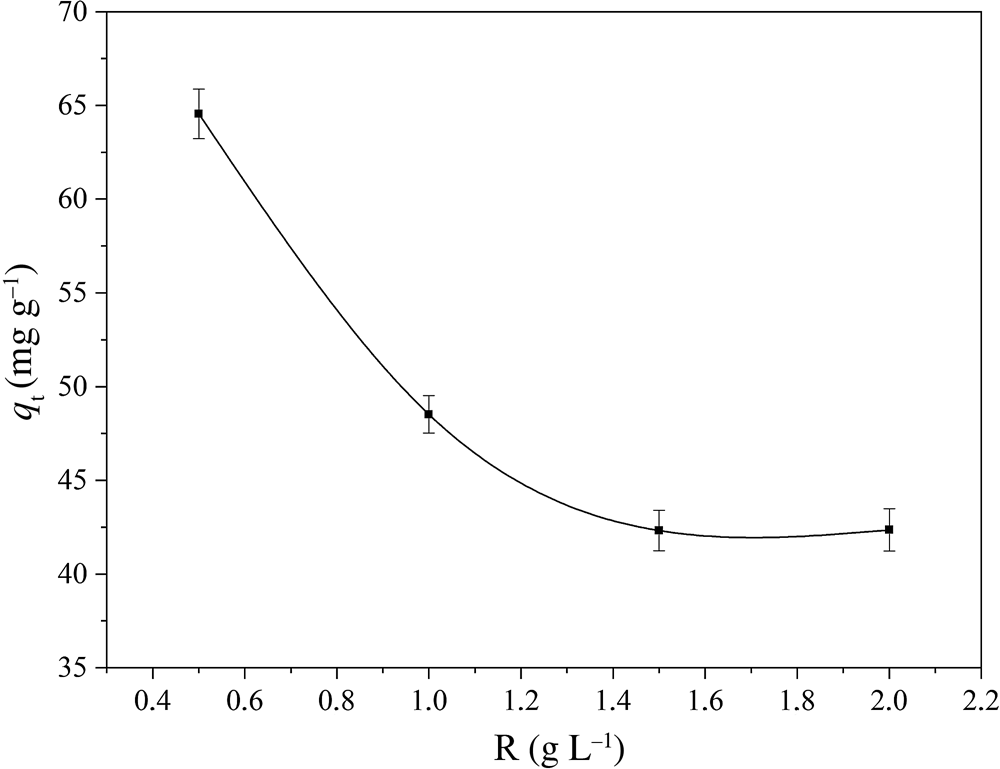
The increase in the adsorbent dose resulted in a decrease in the absorption capacity from 64.55 to 42.35 mg g–1 (Fig. 4). The maximum amount adsorbed is obtained for an R ratio of 0.5 g L–1, and the adsorption capacity continues to decrease towards the highest ratio values. This decrease is attributed mainly to the congestion caused by the excess presence of the mass of the adsorbent and the unsaturation of the adsorption sites during the adsorption process (El Latif et al., Reference El-Latif, Ibrahim and El-Kady2010). Zhou et al. (Reference Zhou and Boyd2014) suggested that greater absorption efficiency might be achieved by applying small amounts of mordenite for the removal of ammonia nitrogen.
Effect of ratio R (madsorbent/Vsolution) on the adsorption capacity of the natural tuff.

Effect of pH on adsorbed quantity
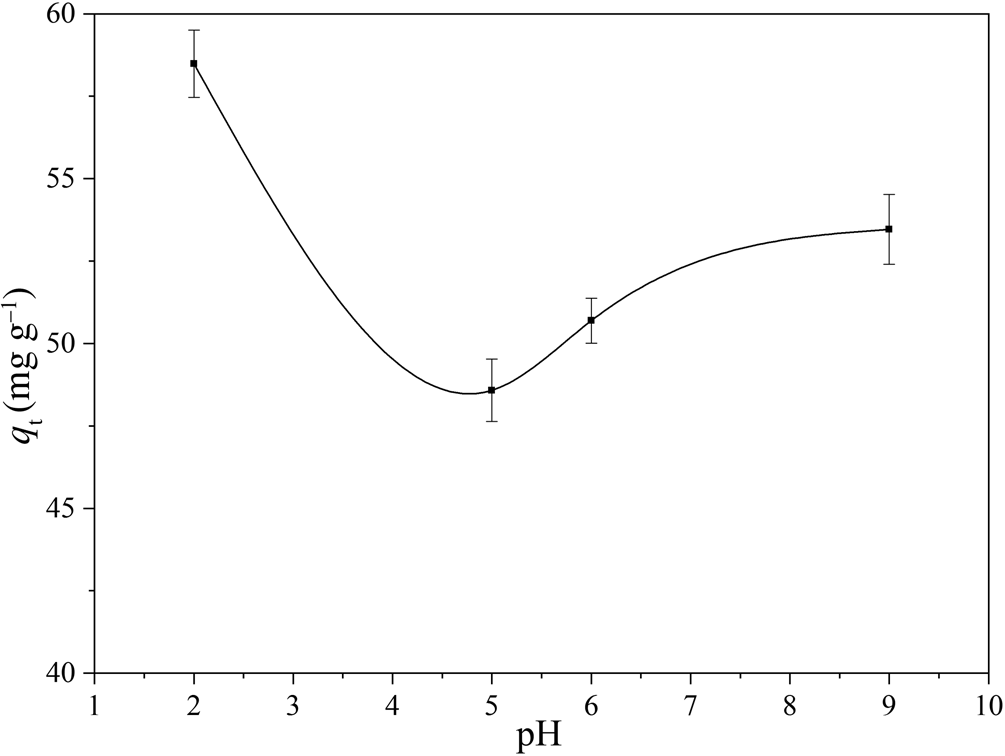
The maximum amount, 58.48 mg g–1, of Asucryl red was adsorbed at an acidic pH of the solution (pH 2) and decreasing thereafter, before finally increasing slightly to 53.46 mg g–1 in basic medium (pH 9) (Fig. 5). This behaviour of the ‘dye–tuff’ system at various pH levels may be related to the characteristics of the textile dye and to the mineralogical composition of the tuff, which contains abundant mordenite (Humelnicu et al., Reference Humelnicu, Băiceanu, Ignat and Dulman2017). The presence of mordenite may influence the dissociation and the surface charge of the dye. In this context, the adsorption capacity is related to the adsorbent surface charge, the degree of ionization of the molecules and the dissociation of active adsorption functional groups (Amin et al., Reference Amin, Đorđević, Konstantinović and Jordanov2017).
Effect of pH variation on the quantity of Asucryl red adsorbed on the natural tuff.

Maximum dye removal at acidic pH levels may be attributed to surface protonation reactions that decrease the competition between H3O+ ions and the dye. However, in basic medium and in the presence of HO– ions, the surface of the mordenite particles is negatively charged and the dye may be retained due to electrostatic attraction (Wang et al., Reference Wang and Zhu2006; Humelnicu et al., Reference Humelnicu, Băiceanu, Ignat and Dulman2017).
Effect of temperature on dye adsorption
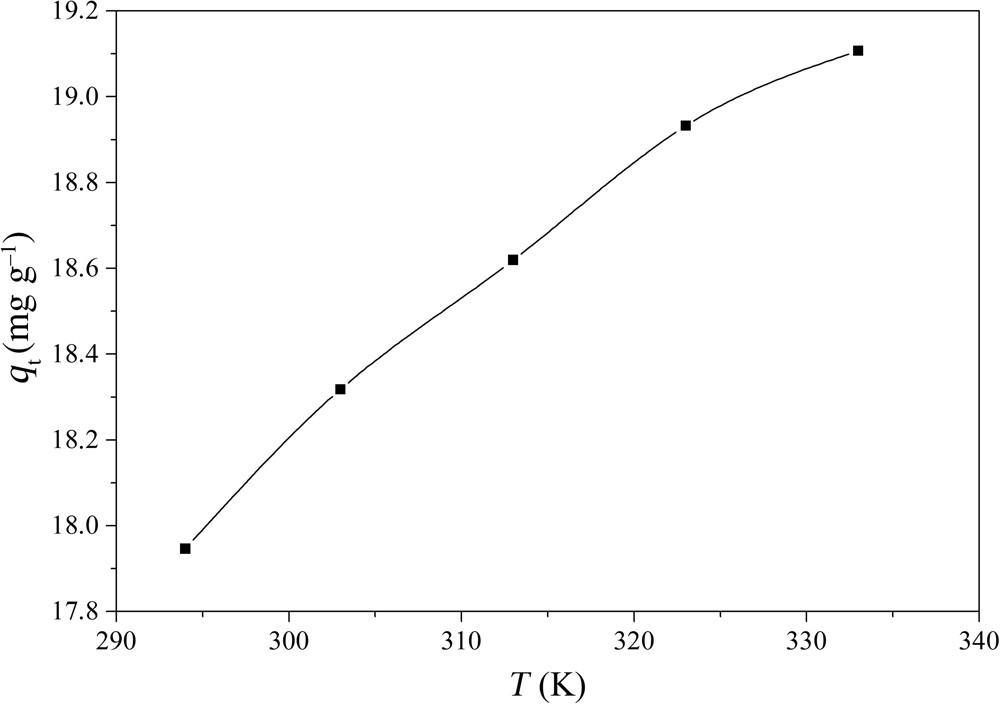
The effect of temperature on dye adsorption was examined in the temperature range of 293–333 K. A slight increase in the amount of dye adsorbed, from 17.94 to 19.11 mg g–1 was observed, depending on the temperature (Fig. 6). This result indicates that the adsorption is endothermic in nature (Kuleyin & Aydin, Reference Kuleyin and Aydin2011; Berez et al., Reference Berez, Ayari, Abidi, Trabelsi-Ayadi and Schäfer2014), where the increase in temperature favours the increase in diffusion rate of the adsorbate molecules across the external boundary layer and pores of the adsorbent (Canli et al., Reference Canli, Abali and Bayca2013).
Effect of temperature on the quantity of Asucryl red adsorbed on the natural tuff.

The adsorption capacities of textile dyes as a function of temperature have shown the same behaviour in several studies on bentonite and natural zeolites (Kuleyin & Aydin, Reference Kuleyin and Aydin2011; Berez et al., Reference Berez, Ayari, Abidi, Trabelsi-Ayadi and Schäfer2014; Abaei et al., Reference Abaei, Faghihian and Esmaeeli2017).
Adsorption isotherms
The adsorption isotherm of the dye onto natural tuff corresponds to the L-type (Giles et al., Reference Giles, Smith and Huitson1974). This type of isotherm indicates strong dye affinity towards the adsorbent and weak competition with the solvent molecules for active adsorption sites.
Modelling of adsorption isotherms
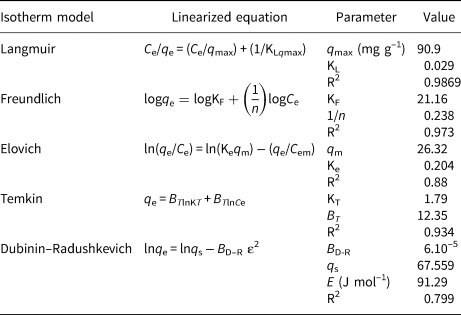
The Langmuir, Freundlich, Elovich, Temkin and Dubinin–Radushkevich (D-R) models are the most common types of isotherm equations, and they were applied to analyse the experimental sorption data. The adequacy of these models for predicting the experimental data was evaluated by the coefficient of determination (R2), and the results are given in Table 2.
Adsorption isotherm parameters on the Tinebdar tuff.

The greatest R2 values were observed for Langmuir and Freundlich isotherm models. The value of maximum adsorption capacity q m was 90.9 mg g–1 for the Langmuir model. The maximum adsorption capacity of Asucryl red onto natural tuff was high. The adsorption capacity of the natural tuff was notably higher than values reported from similar studies (Yousef et al., Reference Yousef, El-Eswed and Ala'a2011; Karatas, Reference Karatas2012). The KL value of 0.029 indicated favourable adsorption. The Freundlich isotherm model, based on multilayer adsorption, exhibited good applicability (R2 = 0.973). The estimated Freundlich adsorption constant KF was 21.16 mg1–n Lng–1. Therefore, the tuff exhibited a greater adsorption capacity compared to other clay materials, such as kaolinite or vermiculite. The Freundlich coefficient n value is 4.2, ranging from 1 to 10, supporting the favourable adsorption of Asucryl red onto the studied natural tuff. By contrast, the D-R model was less satisfactory in describing the experimental data (Table 2). Within D-R parameters, mean free energy (E) offers valuable information on the mechanism of adsorption. E values >8 kJ mol–1 indicate the dominance of chemical adsorption. In our case, the E parameter is much lower (0.091 kJ mol–1).
Adsorption kinetics
In order to study the controlling mechanism of the adsorption process, three kinetic models were investigated. A pseudo-first-order kinetic model, a pseudo-second-order kinetic model and an intra-particle diffusion model were applied to find the best-fitting model for the experimental data. The application of these models made it possible to determine the characteristic coefficients of the limiting process. The applicability of these models was tested using the construction of linear curves for each of them. The coefficient of determination (R2) of the regression lines was used to verify the validity of the models.
Pseudo-first-order model
The integral form of the model is generally expressed as in equation 3:
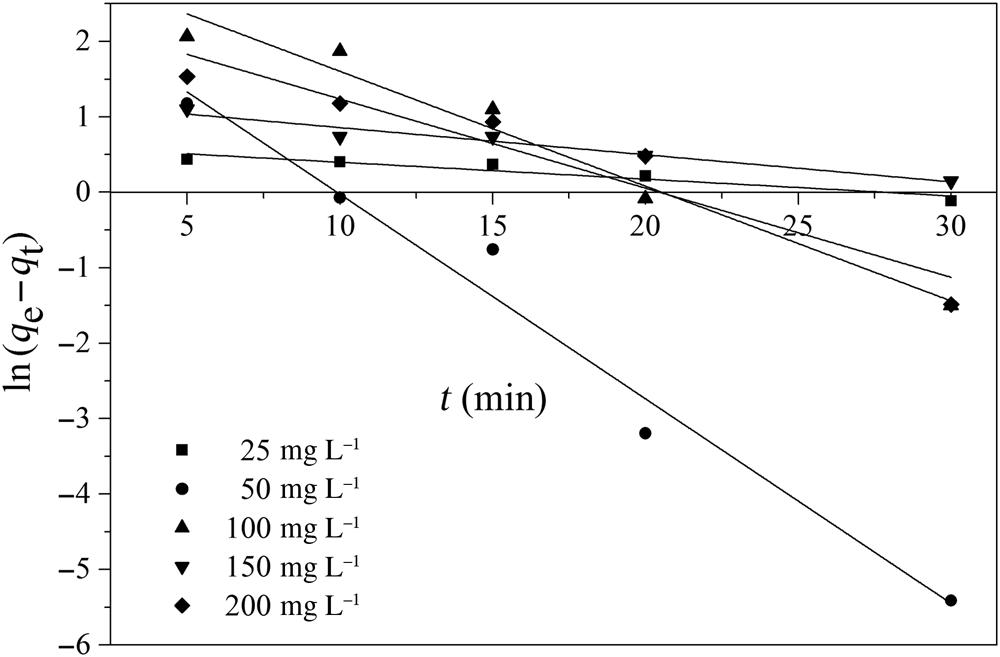
 $$\ln\!\lpar {{q}_{\rm e}-{q}_{\rm t}} \rpar = \ln\!{q}_{\rm e}-{\rm K}_1{\rm t} $$
where q t and q e are the amounts of Asucryl red adsorbed (mg g–1) at contact time t (min) and at equilibrium time, respectively, and K1 is the adsorption first-order rate constant (min−1). A plot of ln(q e − q t) vs t gives the values of K1 and q e.
The first-order kinetic model of natural tuff revealed the low correlation value of the regression (maximum value = 0.986), which suggests that the adsorption does not follow the pseudo-first-order kinetic model (Fig. 7, Table 3).
Parameters of the kinetic models for the adsorption of Asucryl red dye on the natural tuff.

ARE = average relative error.
Plot of the pseudo-first-order model for the adsorption of Asucryl red on the natural tuff.

Pseudo-second-order model
The linear form of the pseudo-second-order kinetic model is defined as in equation 4:
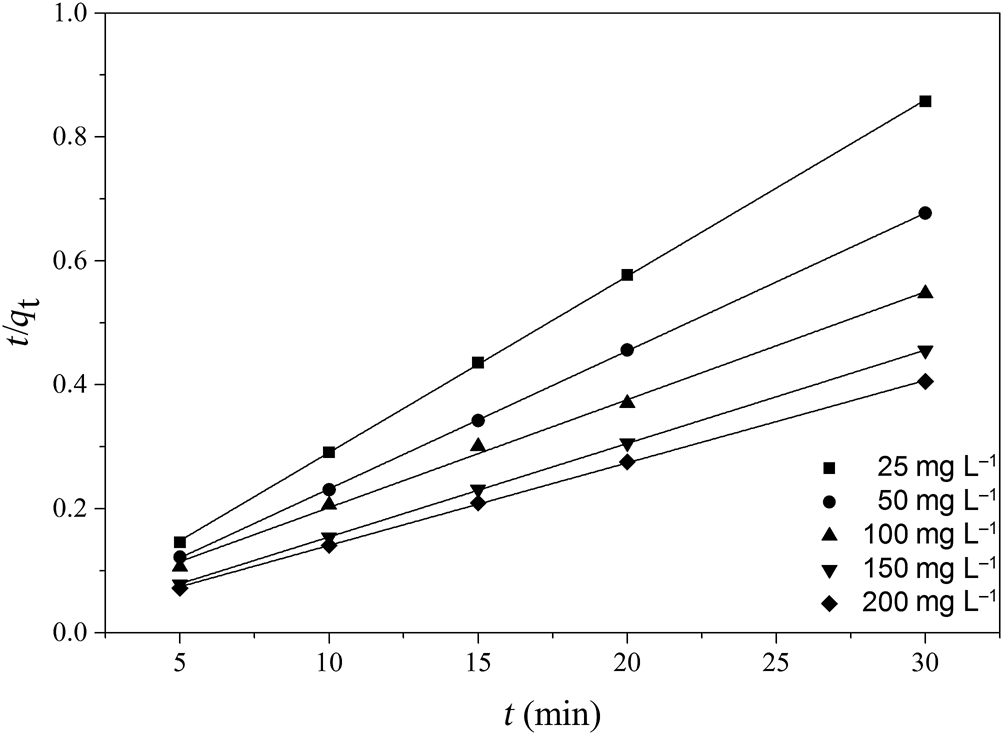
 $$\displaystyle{{\rm t} \over {{q}_{\rm t}}} = \displaystyle{1 \over {{\rm k}_{2} {q}_{\rm e}^2}} + \displaystyle{{\rm t} \over {{q}_{\rm e}}} $$
where K2 is the pseudo-second-order rate constant (min–1 g mg–1).
The straight-line plot of t/q tvs t was used to determine rate parameters. Figure 8 shows a straight line plot of (t/q) vs time for pseudo-second-order adsorption, which allows for computation of the rate constant K2. The linear regression coefficient, R2, obtained is high (0.999) (Table 3), suggesting that the dye-adsorption experiment follows the pseudo-second-order kinetic model. Moreover, this model makes a closer prediction of the equilibrium adsorption capacity, indicating the applicability of this model.
Plot of the pseudo-second-order model for the adsorption of Asucryl red on the natural tuff.

Intra-particle diffusion model
According to the diffusion model proposed by Weber and Morris (equation 5) (Srivastava et al., Reference Srivastava, Swamy, Mall, Prasad and Mishra2006), the uptake varies almost proportionately with t 1/2 rather than with the contact time for most adsorption processes, and can be represented as follows:
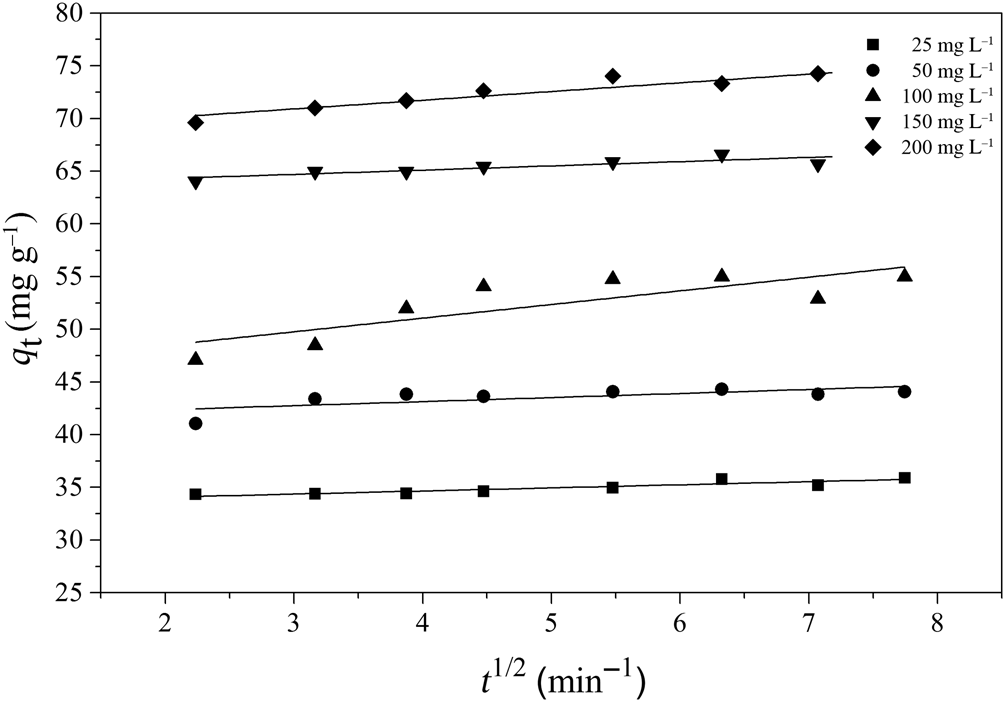
 $${q}_{\rm t} = {\rm K}_{{\rm id}}{t}^{{1 \over 2}} + {C} $$
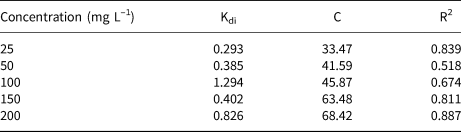
where qt is the amount adsorbed at time t, t 1/2 is the square root of the time, Kid is the rate constant of intra-particle diffusion and C is the intercept that represents the boundary layer thickness.
The non-null value of the intercept C (Fig. 9) indicates the intra-particle diffusion, and other diffusional phenomena also control the sorption rate of Asucryl red on the outer surface of the materials. This corroborates the hypothesis that the dye adsorbs on the adsorption sites present on the surface of the solid (mesopores).
Plot of the intra-particle diffusion model for the adsorption of Asucryl red on the natural tuff.

According to the intra-particle diffusion rate constants (Table 4), based on the Weber and Morris approach, the film diffusion takes place simultaneously with intra-particle diffusion. Thus, both can be considered as the rate-controlling steps of the adsorption.
Intra-particle diffusion rate constants for the adsorption of Asucryl red on the natural tuff.

Thermodynamic parameters
The free energy change of the sorption reaction is given by equations 7 and 8:
 $$\Delta {G}^\circ = -{\rm R} T{\rm ln}{\rm K}_{\rm d} $$
 $${\rm ln}{\rm K}_{\rm d} = \displaystyle{{\Delta {S}^\circ } \over {\rm R}}-\displaystyle{{\Delta {H}^\circ } \over {{\rm R} {T}}}$$
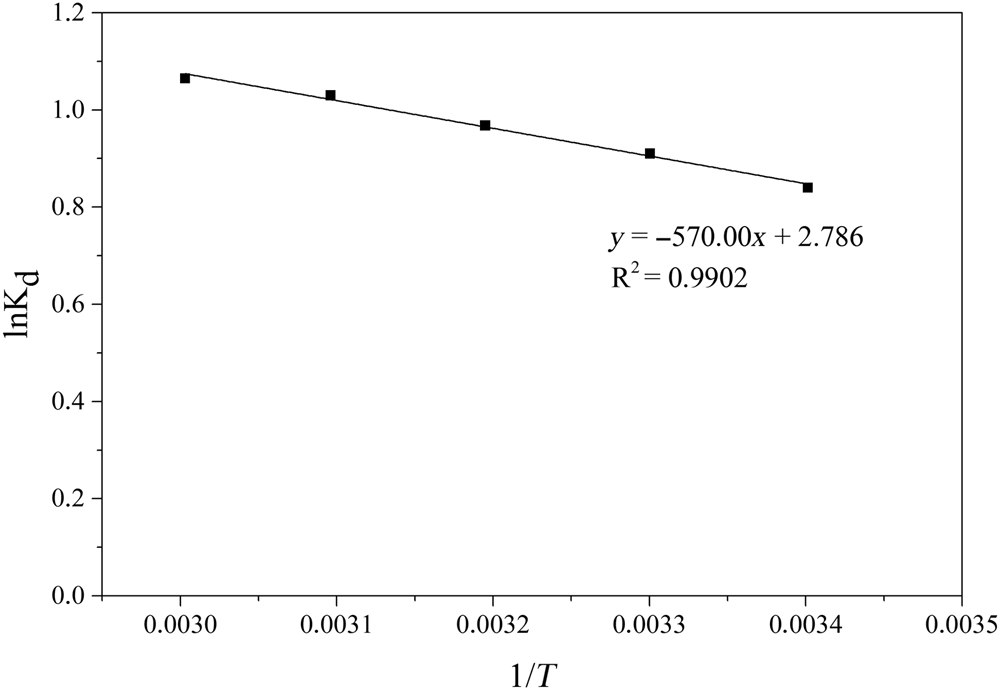
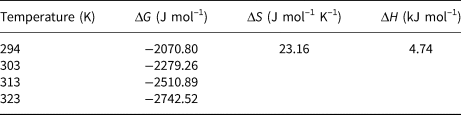
The plot of lnKd as a function of (1/T) (Van't Hoff plot) yields a straight line (Fig. 10). ∆H° and ∆S° are determined from the slope and intercept, respectively, R is the universal gas constant (8.314 J mol–1 K–1) and T is the absolute temperature (K). The results are summarized in Table 5.
Projection of lnKdvs reciprocal temperature (1/T).

Thermodynamic parameters of the adsorption of Asucryl red on the natural tuff.

In the temperature range of the experiments (293–333 K), the free energy (∆G°) values are from –2.07 to –2.74 kJ mol–1, respectively, indicating spontaneous adsorption of the dye by the natural tuff. These data are published in the literature (Yousef et al., Reference Yousef, El-Eswed and Ala'a2011; Humelnicu et al., Reference Humelnicu, Băiceanu, Ignat and Dulman2017). The enthalpy of adsorption of Asucryl red onto natural tuff was 4.74 kJ mol–1 (Table 5), corroborating the notion that the adsorption is physical (in accordance with the activation energy results). Finally, the positive value of ΔS° (0.023 kJ mol–1 K–1) suggests an increase in disorder at the solid–solution interface. This result is probably due to structural changes in the adsorbent and adsorbate during adsorption.
Summary and conclusions
This study investigated the removal of Asucryl red dye from aqueous solution by a natural tuff from Tinebdar (Sidi-Aich, Algeria) under various operational conditions such as adsorption amount, contact time, pH and temperature. The tuff is composed mainly of mordenite (zeolite) associated with accessory quartz, biotite and feldspar. Mordenite controls the adsorption capacity of Asucryl red on the tuff.
The efficiency of the dye adsorption on the mordenite tuff was confirmed. The adsorption kinetics was rapid and the equilibrium was attained within 10 min with an adsorption capacity of 90.9 mg g–1. The adsorption is enhanced in acidic solutions (pH 2), decreasing at neutral pH values and is favourably influenced by the increase in temperature from 293 to 333 K.
The adsorption process follows the Langmuir isotherm model and the adsorption mechanism follows the pseudo-second-order kinetic model. Thermodynamic studies showed that the sorption process of the dye by the natural tuff was endothermic and spontaneous. Thus, the positive value of ∆H° (4.74 kJ mol–1) demonstrated the endothermic nature of the adsorption.
The mordenite tuff has significant potential for removing the textile dye Asucryl red from wastewater because of its high adsorptive capacity and availability in nature.