Introduction
Seasonal reproduction is a main cause in fluctuation of population abundance, therefore studying seasonal reproduction mechanisms is beneficial to rationally control population abundance. Seasonally reproductive mammals can regulate fertility by controlling photoperiodic signals (Goldman, Reference Goldman2001). Photoperiod information is translated by the pineal hormone melatonin in the brain and variation in melatonin levels is synchronized with photoperiod. Therefore, the melatonin rhythm is important for synchronizing reproduction with seasons (Pitrosky and Pévet, Reference Pitrosky and Pévet1997; Helfer et al., Reference Helfer, Barrett and Morgan2019).
Gonadotropin-releasing hormone (GnRH) is released mainly around the capillaries of the pituitary portal system (Hahn and Coen, Reference Hahn and Coen2006). It mainly acts in the hypothalamic–pituitary–gonadal (HPG) axis to control gonadotropin, luteinizing (LH), and follicle-stimulating (FSH) hormone secretion in mammals. LH and FSH stimulate testicular spermatogenesis, follicular growth, and estradiol and testosterone release, therefore feeding back to and regulating the HPG axis. Therefore, GnRH is the most important factor for regulating reproductive activity in animals.
The ways in which the melatonin signal transfers to GnRH neurons are less understood, and melatonin acts indirectly on GnRH neurons (Urbanski et al., Reference Urbanski, Doan and Pierce1991). Revel et al. (Reference Revel, Saboureau, Pévet, Simonneaux and Mikkelsen2008) found that the RFamide-related peptide (RFRP) gene was expressed in Siberian and Syrian hamsters (Revel et al., Reference Revel, Saboureau, Pévet, Simonneaux and Mikkelsen2008). In addition, RFRP-immunoreactive fibres were found to directly contact GnRH neurons (Smith and Clarke, Reference Smith and Clarke2010; Rizwan et al., Reference Rizwan, Poling, Corr, Cornes, Augustine, Quennell, Kauffman and Anderson2012). Therefore, RFRP neurons may be a factor in melatonin signalling (Simonneaux et al., Reference Simonneaux, Ancel, Poirel and Gauer2013); this indicated that RFRP may centrally control the reproductive axis. Alternatively, RFRP levels in the hypothalamus were strongly regulated by melatonin, corresponding to the length of the photoperiod (Revel et al., Reference Revel, Saboureau, Pévet, Simonneaux and Mikkelsen2008), which further indicated that RFRP may be a bridge between melatonin and GnRH neurons to translate its effects on reproduction (Simonneaux et al., Reference Simonneaux, Ancel, Poirel and Gauer2013). The striped hamster is a main rodent pest in northern China farmland and has typical seasonal reproductive characteristics (Mu et al., 1999). Its reproductive activity intensity is higher in spring and autumn than in summer and winter (Luo et al., 2000). Whether photoperiod regulates RFRP-3 levels in hypothalamus and gonads and the role of RFRP-3 in the reproduction of striped hamsters are all unknown. To explore whether RFRP-3 levels are controlled by MLT, RFRP-3 levels in hypothalamus, ovarian or testis of striped hamsters from LD, MD and SD photoperiods were detected. To further assess whether RFRP-3 regulates the seasonal reproduction of the striped hamster, the relationships between RFRP-3 levels and GnRH, FSH or LH were also analyzed.
Materials and methods
Animals and protocols
Striped hamsters were captured in May 2011 in Wu Village, Qufu City of Shandong Province. The trapped striped hamsters were sexed, weighed, and appraised to provide information on size, age and reproductive condition. Twenty-four adult male and female striped hamsters weighing 22–24 g were selected at random and housed in the animal experiment centre of Qufu Normal University under natural photoperiod and temperature conditions for 1 week. Then, the hamsters were randomly raised under long (LD; 16 h light/8 h dark), medium (MD; 12 h light/12 h dark) or short day lengths (SD; 8 h light/16 h dark) for 2 months. The estrous cycle of the striped hamsters was examined at 5 p.m. to 6 p.m. every day. For estrous, hamsters were immediately killed by CO2 asphyxiation. The flow rate of CO2 displaced was no more than 20% of the chamber volume per minute. Their blood samples, hypothalamus, ovaries or testes were collected. All experiments performed were approval by the Animal Ethics Committee of Qufu Normal University.
qRT-PCR
Total RNA from hypothalamus, ovaries or testis of striped hamsters in the LD group, MD group and SD group were extracted using a tissue total RNA isolation kit (TaKaRa, Japan) under conditions recommended by the manufacturer. Total RNA was reverse transcribed into cDNA using reverse transcriptase XL AMV with an oligodeoxythymidylate primer (TaKaRa, Japan). The primers (forward primer: 5´-AACCTGCCCCTGAGATTTG-3´ and reverse primer: 5´-ACTCTGGATTTCTTGATGCTGG-3´) for RFRP-3, (forward primer: 5´-GAGACCTTCAACACCCCAGC-3´ and reverse primer: 5´-ATGTCACGCACGATTTCCC-3´) for β-actin, and forward primer: 5´-CTGGTCCTATGGGTTGCG-3´ and reverse primer: 5´-GAAGTGCTGGGGTTCTGCT-3´ for GnRH) were used to carry out qRT-PCR. qRT-PCR was carried out using the Brilliant II SYBR Green QPCR Master Mix (TaKaRa) to detect the quantity of the products. Amplification efficiency was verified using a standard curve (Rutledge and Stewart Reference Rutledge and Stewart2008). β-Actin was used as the control (Livak and Schmittgen, Reference Livak and Schmittgen2001).
Measurement of serum melatonin, FSH and LH concentration
Blood samples were centrifuged (2400 g) for 10 min at 4°C. The concentrations of MLT, FSH and LH in serum were detected using ELISA and a Labsystems Multiskan MS 352 spectrophotometer.
Statistical analysis
Data were expressed as means ± standard deviation. Data were compared by independent sample t-test and analysis of variance (ANOVA) using SPSS Statistics v.22.0 software (International Business Machines, Corp., Armonk, NY, USA). Values of P < 0.05 or P < 0.01 were considered as significantly different. Pearson’s correlation between RFRP-3 mRNA and GnRH mRNA, serum melatonin, and FSH and LH concentrations were analyzed using SPSS v.22.0.
Results
Correlation between serum MLT concentration with RFRP-3 mRNA in striped hamsters
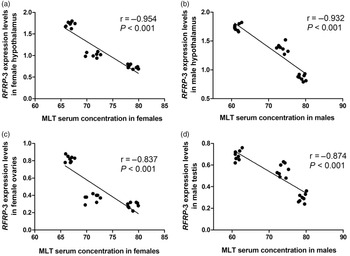
The relationship between serum MLT concentration and RFRP-3 mRNA in the hypothalamus and gonads is shown in Figure 1. In female striped hamsters, serum MLT concentration was significantly negatively correlated with RFRP-3 mRNA in the hypothalamus (r = −0.954, P < 0.001) (Figure 1a) and the ovaries (r = −0.837, P < 0.001) (Figure 1c). In male striped hamsters, serum MLT concentration was also significantly negatively correlated with RFRP-3 mRNA in the hypothalamus (r = −0.932, P < 0.001) (Figure 1b) and the testis (r = −0.874, P < 0.001) (Figure 1d). Our results suggested that MLT is an inhibitory factor to control RFRP-3 levels in hypothalamus and gonads, and the role of MLT in RFRP-3 expression was sex independent.
Relationship between serum MLT concentration and RFRP-3 mRNA in the hypothalamus and gonads of striped hamsters. (a) Correlation between serum MLT concentration with RFRP-3 mRNA in the female hypothalamus. (b) Correlation between serum MLT concentration and RFRP-3 mRNA in the male hypothalamus. (c) Correlation between serum MLT concentration and RFRP-3 mRNA in the female ovaries. (d) Correlation between serum MLT concentration and RFRP-3 mRNA in the male testis.

RFRP-3 and GnRH in hamsters from different photoperiodic conditions
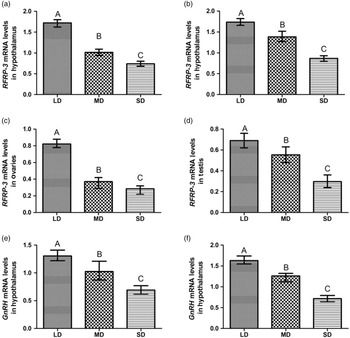
mRNA expression of RFRP-3 in the hypothalamus and gonads and GnRH in the hypothalamus were quantitatively determined in striped hamsters from different photoperiods (Figure 2). The results suggested that RFRP-3 mRNA levels in hypothalamus and ovaries or testis were significantly different among striped hamsters from different photoperiods (P < 0.01). The highest RFRP-3 levels in hypothalamus and in ovaries or testis were detected in individuals under LD conditions, and the lowest levels were detected in individuals from SD conditions (Figure 2A–D). In addition, GnRH mRNA levels in striped hamsters from LD conditions were notably higher than those from MD and SD conditions. Lowest GnRH mRNA levels were determined in the hypothalamus of hamsters under SD conditions (Figure 2E, F). These results further indicated that photoperiod was a main environmental factor for regulating the expression of RFRR-3 in striped hamsters.
RFRP-3 in striped hamsters. (a) RFRP-3 expression in the hypothalamus of females under LD, MD and SD conditions. (b) RFRP-3 expression in the hypothalamus of males under LD, MD and SD conditions. (c) RFRP-3 expression in the ovaries of females under LD, MD and SD conditions. (d) RFRP-3 expression in the testis of males under LD, MD and SD conditions. (e) GnRH expression in the hypothalamus of females under LD, MD and SD conditions. (f) GnRH expression in the hypothalamus of males under LD, MD and SD conditions. Relative quantities with different capital letters differ significantly (P > 0.01).

Correlation between RFRP-3 and GnRH
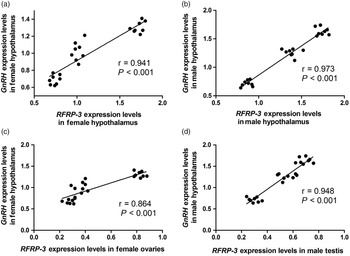
In female hamsters, RFRP-3 mRNA levels in hypothalamus were significantly positively correlated with GnRH mRNA levels in hypothalamus (r = 0.941, P < 0.001) (Figure 3a) and those in ovaries were also significantly positively correlated with the GnRH in hypothalamus (r = 0.864, P < 0.001) (Figure 3c). In male hamsters, RFRP-3 mRNA levels in hypothalamus were significantly positively correlated with GnRH in hypothalamus (r = 0.973, P < 0.001) (Figure 3b) and those in testis were also significantly positively correlated with GnRH in hypothalamus (r = 0.948, P < 0.001) (Figure 3d).
Relationships of RFRP-3 mRNA in the hypothalamus and gonads with that of GnRH mRNA in the hypothalamus of striped hamsters. (a) Correlation between RFRP-3 and GnRH in the female hypothalamus. (b) Correlation between RFRP-3 and GnRH in the male hypothalamus. (c) Correlation between RFRP-3 in ovaries and GnRH in the hypothalamus in females. (d) Correlation between RFRP-3 in the testis with that of GnRH in the hypothalamus in males.

Correlation of RFRP-3 mRNA levels in hypothalamus with serum FSH and LH concentrations
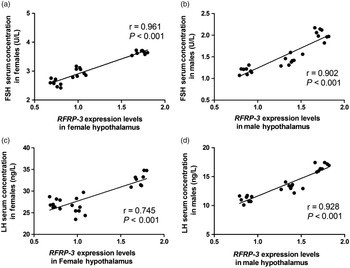
In female hamsters, RFRP-3 mRNA levels in hypothalamus were significantly positively correlated with serum FSH and LH concentrations (r = 0.961, P < 0.001; r = 0.745, P < 0.00; Figure 4a, c). In male hamsters, RFRP-3 mRNA levels in hypothalamus were also significantly positively correlated with serum FSH and LH concentrations (r = 0.902, P < 0.001; r = 0.928, P < 0.001; Figure 4b, d). These results showed that RFRP-3 immediately regulated the synthesis and secretion of FSH and LH in hamsters.
Relationships between RFRP-3 mRNA in the hypothalamus with serum FSH and LH concentrations in the striped hamsters. (a) Correlation between the RFRP-3 mRNA in the hypothalamus with the serum FSH concentration in female striped hamsters. (b) Correlation between the RFRP-3 mRNA in the hypothalamus with serum FSH concentration of male striped hamsters. (c) Correlation between the RFRP-3 mRNA in the hypothalamus with serum LH concentration of female striped hamsters. (d) Correlation between the RFRP-3 mRNA in the hypothalamus with serum LH concentration of male striped hamsters.

RFRP-3 in hamsters between sexes and tissues
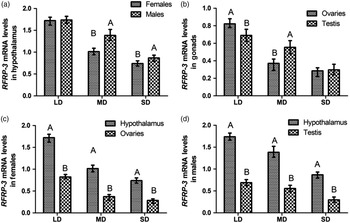
RFRP-3 mRNA levels in male hypothalamus were markedly higher than those in female hypothalamus from MD and SD conditions. However, there were no significant differences in the hypothalamus between the males and females from LD conditions. RFRP-3 mRNA levels in testis were significantly higher than those in ovaries of hamsters from LD and MD conditions, while there were no significant differences between testis and ovaries from SD conditions (Figure 5). These results indicated that the difference between RFRP-3 mRNA levels between sexes was photoperiod dependent. RFRP-3 mRNA levels in hypothalamus were significantly higher than those in ovaries and testes of hamsters from LD, MD or SD conditions (Figure 5). These results indicated that the difference between RFRP-3 mRNA levels in hypothalamus and gonads was photoperiod independent.
Differences of RFRP-3 mRNA between sexes and tissues of striped hamsters from different photoperiods. (a) Differences of RFRP-3 mRNA in the hypothalamus between males and females under LD, MD and SD conditions. (b) Differences of RFRP-3 mRNA between ovaries and testis of striped hamsters under LD, MD and SD conditions. (c) Differences of RFRP-3 mRNA between the hypothalamus and ovaries of females under LD, MD and SD conditions. (d) Differences of RFRP-3 mRNA between the hypothalamus and testis of males under LD, MD and SD conditions. Relative quantity with different capital letters are significantly different (P > 0.01).

Discussion
Photoperiod is an important environmental seasonal cue affecting a broad spectrum of physiological parameters including reproductive status (Pitrosky and Pévet, Reference Pitrosky and Pévet1997). Photoperiodic mammals rely on the annual cycle of melatonin changes in nocturnal secretion to regulate their reproductive activity (Bronson, Reference Bronson1989). Striped hamsters are photoperiod-sensitive mammals, and the intensity of their reproductive activity significantly varies with seasons (Lu et al., 2000). If RFRP-3 is involved in the control of reproductive activity in striped hamsters, RFRP-3 levels should be regulated by photoperiod and melatonin. In our study, we found that the mRNA levels of RFRP-3 were significantly correlated with serum melatonin concentration, and there were significant differences in mRNA levels for RFRP-3 among individuals under different photoperiods. These results further proved that striped hamsters were photoperiodically sensitive mammals. Our results were also consistent with findings that RFRP neurons were strongly downregulated by melatonin in Syrian hamsters (Simonneaux and Ancel, Reference Simonneaux and Ancel2012) and Siberian hamsters (Ubuka et al., Reference Ubuka, Inoue, Fukuda, Mizuno, Ukena, Kriegsfeld and Tsutsui2012). However, the expression levels of gonadotropin inhibitory hormone (GnIH), orthologous to RFRP-3, were also regulated by melatonin in an opposite manner when compared in mammals (Ubuka et al., Reference Ubuka, Bentley, Ukena, Wingfield and Tsutsui2005). Therefore, the effect of melatonin on expression of RFRP-3 is species dependent. For most seasonal mammalian species, RFRP expression is decreased under SD conditions and increased under LD conditions, regardless of reproduction carried out under SD or LD conditions. In striped hamster, RFRP-3 mRNA levels were significantly lower under SD conditions than those under LD, indicating an inhibitory effect of pineal melatonin on RFRP neurons. This result was consistent with the discoveries in Syrian hamsters (Revel et al., Reference Revel, Saboureau, Pévet, Simonneaux and Mikkelsen2008; Mason et al., Reference Mason, Duffy, Zhao, Ubuka, Bentley, Tsutsui, Silver and Kriegsfeld2010) and sheep (Dardente et al., Reference Dardente, Birnie, Lincoln and Hazlerigg2008), while a discrepancy was founding with quail (Ubuka et al., Reference Ubuka, Bentley, Ukena, Wingfield and Tsutsui2005).
In the Siberian hamster, the mRNA expression levels of GnIH were higher under LD conditions than those under SD conditions, and the mRNA expression levels of GnIH were suppressed by melatonin, which is a nocturnal pineal hormone (Ubuka et al., Reference Ubuka, Inoue, Fukuda, Mizuno, Ukena, Kriegsfeld and Tsutsui2012). RFRP mRNA levels in hypothalamus from hamster significantly varied among different photoperiodic conditions, and there were reduced expression levels under SD conditions, which were consistent with the observation that the number of RFRP neurons was higher and they were more intensive in hamsters under LD conditions compared with SD conditions (Revel et al., Reference Revel, Saboureau, Pévet, Simonneaux and Mikkelsen2008).
mRNA expression levels of RFRP-3 in the hypothalamus or in the gonads were significantly positively correlated with the quantity of GnRH mRNA in the hypothalamus and serum FSH and LH concentrations in striped hamsters. These results were in line with a study that showed that RFRP-3 could increase GnRH neuron activity and gonadotropin secretion in the Syrian hamster (Simonneaux and Ancel, Reference Simonneaux and Ancel2012), and were not correlated with findings in sheep, in which expression of RFRP-3 was decreased under SD conditions and increased under LD conditions, indicating that RFRP-3 was an inhibitory factor (Dardente et al., Reference Dardente, Birnie, Lincoln and Hazlerigg2008; Smith et al., Reference Smith, Coolen, Kriegsfeld, Sari, Jaafarzadehshirazi, Maltby, Bateman, Goodman, Tilbrook, Ubuka, Bentley, Clarke and Lehman2008). In the Syrian (Simonneaux et al., Reference Simonneaux, Ancel, Poirel and Gauer2013), Siberian (Revel et al., Reference Revel, Saboureau, Pévet, Simonneaux and Mikkelsen2008; Ubuka et al., Reference Ubuka, Inoue, Fukuda, Mizuno, Ukena, Kriegsfeld and Tsutsui2012) and European (Simonneaux and Ancel, Reference Simonneaux and Ancel2012) hamsters and jerboa (Janati et al., Reference Janati, Talbi, Klosen, Mikkelsen, Magoul, Simonneaux and El Ouezzani2013) considered as LD breeders, expression of RFRP-3 was decreased under SD conditions and increased under LD conditions (Revel et al., Reference Revel, Saboureau, Pévet, Simonneaux and Mikkelsen2008). While in sheep considered as an SD breeder, expression of RFRP-3 was increased under SD conditions and decreased under LD conditions. These results suggested that the action of RFRP-3 on seasonal reproduction was species dependent. However, in non-photoperiodic sensitive rats, the mRNA levels of RFRP were not regulated by photoperiodic conditions (Revel et al., Reference Revel, Saboureau, Pévet, Simonneaux and Mikkelsen2008). Those findings indicated that whether photoperiod changes the expression of RFRP-3 in the hypothalamus is based on the photoperiodic sensitivity of the mammal. In seasonally reproductive mammals, photoperiod regulates the expression of RFRP-3. We hypothesized that the expression levels of RFRP-3 varied between the SD and LD mammals, and whether the expression of RFRP-3 varied with photoperiods could be thought as a clue to photoperiod sensitivity or not.
In the present study, expression levels of RFRP-3 in the striped hamster were positively correlated with serum FSH and LH concentrations, indicating that RFRP-3 acts as an activator to regulate the synthesis or secretion of FSH and LH. These results did not correlate with the results showing that RFRP-3 inhibited LH secretion in Syrian hamsters (Kriegsfeld et al., Reference Kriegsfeld, Mei, Bentley, Ubuka, Mason, Inoue, Ukena, Tsutsui and Silver2006) and rats (Murakami et al., Reference Murakami, Matsuzaki, Iwasa, Yasui, Irahara, Osugi and Tsutsui2008) in vivo, and also inhibited gonadotropin release from cultured pituitary cells in sheep (Clarke et al., Reference Clarke, Sari, Qi, Smith, Parkington, Ubuka, Iqbal, Li, Tilbrook, Morgan, Pawson, Tsutsui, Millar and Bentley2008; Sari et al., Reference Sari, Rao, Smith, Tilbrook and Clarke2009) and cattle (Kadokawa et al., Reference Kadokawa, Shibata, Tanaka, Kojima, Matsumoto, Oshima and Yamamoto2009). However, a central injection of RFRP-3 to male Syrian hamsters under SD conditions could increase gonadotropin release, and 5 weeks of continuous central administration of RFRP-3 to male Syrian hamsters under SD conditions also could reactive the reproductive axis (Simonneaux and Ancel, Reference Simonneaux and Ancel2012). This indicated that RFRP-3 was an activator under certain conditions, and was in line with our results that RFRP-3 could increase gonadotropin release. The effect of RFRP-3 on secretion of FSH and LH varied with species, photoperiod, environmental conditions, and even stage of the estrous cycle, therefore this complicated mechanism needs further study.
Central administration of hamster RFRP-3 inhibited LH release in the Siberian hamster after administration under LD conditions, while RFRP-3 stimulated LH release in the Siberian hamster after administration under SD conditions (Ubuka et al., Reference Ubuka, Inoue, Fukuda, Mizuno, Ukena, Kriegsfeld and Tsutsui2012). These results indicated that the effect of RFRP-3 on the reproduction of the mammals may be photoperiod dependent. In our study, if the samples were analyzed separately in LD, MD or SD groups, the correlation between mRNA expression of RFRP-3 in the hypothalamus with serum LH concentration was not significant. If the samples were analyzed together without considering photoperiods, mRNA expression of RFRP-3 in the hypothalamus was significantly correlated with serum LH concentration. This difference may be due to the number of fewer samples, the small effect, the various administrated periods under different photoperiods, and so on.
For most seasonal mammalian species, the effect of photoperiod on expression of RFRP-3 in the hypothalamus was consistent with expression levels of RFRP-3 in the hypothalamus of the Syrian hamster, Siberian hamster and sheep, which were increased under LD and decreased under SD conditions. However, the effect of RFRP-3 on seasonal reproduction varied between the LD and SD breeders (Simonneaux and Ancel Reference Simonneaux and Ancel2012). That meant that the mechanism of action of RFRP-3 on seasonal reproduction was complicated.
In conclusion, taken together, the present results indicated that pineal melatonin decreased mRNA expression of RFRP-3, and that RFRP-3 increased GnRH neuron activity and the release of FSH and LH in the striped hamster. The differences in RFRP-3 mRNA levels between male and female striped hamster was photoperiod dependent.
Acknowledgements
We thank two anonymous reviewers for excellent criticism of the article.
Statement of ethics
The study was approved by the Animal Ethics Committee of Qufu Normal University.
Disclosure of statement
The authors declare that they have no competing interest.
Funding
This study was supported by the National Science Foundation of China (31670385, 31570377, 31770455, 31972283).
Author contributions
Huiliang Xue, Jinhui Xu and Laixiang Xu are dedicated to guarantee of the integrity of the entire study. Huiliang Xue and Jinhui Xu carried out the study concepts, definition of intellectual content, manuscript preparation and manuscript editing. Huiliang Xue, Lei Chen and Lei Zhao were involved in the study design. Huiliang Xue and Lei Chen handled the literature research. Huiliang Xue and Lei Zhao were dedicated to the studies. Huiliang Xue, Jinhui Xu, Lei Chen and Lei Zhao carried out the experimental studies. Huiliang Xue, Lei Chen and Ming Wu were involved in data acquisition and statistical analysis. Lei Chen and Lei Zhao carried out data analysis. Jinhui Xu and Lei Chen were involved in the manuscript review. All authors have read and approved this article.