Numerous studies show that the children from low socioeconomic status (SES) lag behind in language and literacy development, as well as in academic performance, compared to children from middle and high SES families (Chen & Hung, Reference Chen and Hung2011; Chien & Tzeng, Reference Chien and Tzeng2007; Fernald, Marchman, & Weisleder, Reference Fernald, Marchman and Weisleder2013; Hart & Risley, Reference Hart and Risley1995; Hoff, Reference Hoff2003; Hoff-Ginsberg, Reference Hoff-Ginsberg1998; Letts, Edwards, Sinka, Schaefer, & Gibbons, Reference Letts, Edwards, Sinka, Schaefer and Gibbons2013). Chien and Tzeng (Reference Chien and Tzeng2007), for example, found that disadvantaged kindergarteners in Taitong, Taiwan, scored significantly lower in cognitive skills than those from middle or high SES family backgrounds. Chen and Hung (Reference Chen and Hung2011) investigated the Chinese character size (amount of word recognition) of 2,144 students in Grades 1 to 9 in Taiwan. They found that the character size of the students living in disadvantaged counties in Taiwan, such as Taitong and Hualien, was lower than the national norm, and that the gap in character size between the students from the disadvantaged counties and the national norm increased with grade level. SES disparities were also evident in the language and literacy performance of English-speaking children in the United States (Dickinson & Tabors, Reference Dickinson and Tabors2001; Hoff, Reference Hoff2003; Lee & Burkam, Reference Lee and Burkam2002). According to the US Department of Education's Early Childhood Longitudinal Study, Kindergarten Cohort, which was based on a nationally representative sample of kindergarteners in the United States, children from disadvantaged families start kindergarten with lower cognitive and language skills than do those from more advantaged backgrounds. SES inequalities in language processing skill and vocabulary are even observed in English-learning infants as young as 18 months old. The above studies all show that SES differences are evident in children's cognitive, language, and literacy abilities from “the starting gate” (Lee & Burkam, Reference Lee and Burkam2002).
According to sociocultural theory, children develop language and literacy through interactions with competent adults, particularly their parents and caregivers (Vygotsky, Reference Vygotsky1978). Based on Vygotskian theory, the dialogue between mothers and their children and the strategies these mothers use to interact with their children have been examined with the purpose to understand the source of SES differences in children's language and literacy development and achievement performance. Joint book reading has been regarded as an activity that supports a child's language and early literacy development. It is widely accepted that early joint book-reading experiences are helpful for children's later reading and academic performance (Britto & Brooks-Gunn, Reference Britto and Brooks-Gunn2001; Bus, van IJzendoorn, & Pellegrini, Reference Bus, van IJzendoorn and Pellegrini1995; De Temple, Reference De Temple, Dickinson and Tabors2001; Ninio, Reference Ninio1980; Panofsky, Reference Panofsky, John-Steiner, Panofsky and Smith1994; Raikes et al., Reference Raikes, Pan, Luze, Tamis-LeMonda, Brooks-Gunn and Constantine2006; Scarborough & Dobrich, Reference Scarborough and Dobrich1994; Snow & Ninio, Reference Snow, Ninio, Teale and Sulzby1986; Wells, Reference Wells, Olson, Torrance and Hildyard1985). Conversations during mother–child joint book reading have been used to examine children's internalization of the strategies provided by their mothers and to understand the link between maternal interaction strategies and children's language and literacy development.
Diversity in the quality of adults’ book reading styles was found in past research on English-speaking mother–child dyads from European American backgrounds. Some mothers pay attention to the storyline of the book, relate story events to their children's personal experiences, and encourage them to produce decontextualized talk (De Temple & Tabors, Reference De Temple, Tabors, Hinchman, Leu and Kinzer1995; Haden, Reese, & Fivush, Reference Haden, Reese and Fivush1996). These mothers, who used a high-level/high-demand strategy, were termed as the comprehender mothers in Haden et al.'s (Reference Haden, Reese and Fivush1996) work. Other mothers focus on the information immediately available from the text or pictures, such as labeling and counting. These mothers, who engaged in low-level/low-demand scaffolding, were called describers (Haden et al., Reference Haden, Reese and Fivush1996). Reese, Cox, Harte, & McAnally (Reference Reese, Cox, Harte, McAnally, Kleeck, Stahl and Bauer2003) also identified two different parental book-reading styles: the describer style and the performance style. The two styles benefit children with different vocabulary proficiency: the describer style was helpful for children with lower level vocabulary, whereas the performance style helps children with high-level vocabulary. A similar finding was evident in a study of Taiwanese mother–child book-reading interaction (Chang, Reference Chang2000). According to Chang's study (Reference Chang2000), the children of high demand mothers had better decontextualized language skill and narrative performance, compared to the children of low demand mothers. The results of the studies mentioned above all indicate that the effectiveness of reading to young children depends heavily on parental reading styles.
Variation in book-reading styles was particularly obvious across mothers from different SES. Examining the speech of low, lower-middle, and upper-middle SES parents to 2-year-olds in reading and free play, Snow et al. (Reference Snow, Arlman-Rupp, Hassing, Jobse, Joosten and Vorster1976) found that upper-middle SES parents produce more open-ended questions and fewer yes/no questions and directives than the other two groups. Another early investigation of social differences in mother–child talk during book reading was conducted by Ninio (Reference Ninio1980). She examined vocabulary acquisition in the context of joint book reading and found different teaching styles of vocabulary learning across low and high SES groups. While no significant differences were observed in the structural aspects of conversation between mothers and children across the two groups, low SES mothers were found to be less sensitive to changes in their children's needs and more limited in scaffolding their children's language development than were high SES mothers (Ninio, Reference Ninio1980). Variations in maternal book-reading styles were also evident in numerous later studies exploring mother–child book-reading interactions across different communities and social classes in the United States (Anderson-Yockel & Haynes, Reference Anderson-Yockel and Haynes1994; Heath, Reference Heath1982; Hoff-Ginsberg, Reference Hoff-Ginsberg1991; Rodriguez, Hines, & Montiel, Reference Rodriguez, Hines and Montiel2009).
As in the United States and some European countries, early reading to young children is also stressed in recent years in Taiwan. The Taiwanese government started the National Reading Movement in Young Children in 2000. One of the important activities advocated by this movement is to support book-reading programs for children and mothers from low-income families and minority groups (National Academy for Education Research, 2013); they sent books to these groups and encouraged the mothers to read to their children. According to a survey on mother–child book-reading practices and maternal belief in joint book reading (Kang, Reference Kang2006), over 90% of the mothers of preschoolers and kindergarteners in New Taipei City read to their children, and mothers from both high and low SES thought it was essential to read to their children. Maternal belief of the value and importance of joint book reading, however, was found to be diversified across mothers from different SES backgrounds in Kang's study (Reference Kang2006). More than four times as many mothers from low SES regarded joint book reading as an activity to teach children world knowledge than did mothers from high SES, and the difference reached a significant level (Kang, Reference Kang2006). This finding not only reflects SES difference in maternal belief of joint book reading but also suggests that mothers from both high and low SES backgrounds use diverse interaction strategies and discuss different kinds of information when reading books with their children.
Moreover, research on cross-linguistic and cross-cultural samples found culture-specific joint book-reading interactions (Kato-Otani, Reference Kato-Otani2004; Luo, Snow, & Chang, Reference Luo, Snow and Chang2012; Melzi & Caspe, Reference Melzi and Caspe2005; Murase, Dale, Ogura, Yamashita, & Mahieu, Reference Murase, Dale, Ogura, Yamashita and Mahieu2005). Kato-Otani (Reference Kato-Otani2004) compared book-reading interactions between Japanese and American mothers and their 3-year-old children. She found that Japanese mothers produced significantly fewer interactive utterances, and their interactions with their children were more silent, compared to American mothers. Variation in mother–child joint book-reading interaction in Japan and the United States was also evident in the study by Murase et al. (Reference Murase, Dale, Ogura, Yamashita and Mahieu2005). They observed substantial differences in producing and responding to labels and in interaction models between Japanese and American mother–child dyads. Investigating Spanish- and English-speaking mothers and children, Melzi and Caspe (Reference Melzi and Caspe2005) found striking differences in maternal narration styles during book reading in Peru and the United States. According to their study, Peruvian mothers were oriented to use the style of storytellers, who act as the sole narrator during book reading, while American mothers tended to adopt the style of story builders, who play the role of co-narrators. In a recent study comparing interaction styles during joint book reading between American and Taiwanese mothers, Luo et al. (Reference Luo, Snow and Chang2012) found that Taiwanese mothers talked more, and gave and requested more information, but requested and received fewer evaluations from their children than American mothers did. Provision of moral lessons and behavioral regulations whenever possible, the so-called opportunity education (jihui jiaoyu) in Fung's term (Reference Fung1999), as well as the use of tag questions to prepare children for teacher–student interaction and to arouse children's attention to the information discussed were also observed in Chinese mothers’ conversations with their children (Erbaugh, Reference Erbaugh and Slobin1992; Fung, Reference Fung1999; Fung, Miller, & Lin, Reference Fung, Miller, Lin, Pratt and Fiese2004; Luo et al., Reference Luo, Snow and Chang2012; Zhou, Reference Zhou2002).
The results of the above-mentioned studies not only shed light on sociocultural differences in mother–child book-reading interactions but also suggest the importance of developing culturally appropriate family literacy and intervention programs based on research on various cultural and socioeconomic groups. As far as the researchers know, however, there has been no research focusing on social class difference in talk between Mandarin-speaking mothers and children during joint book reading. Past research on conversation between Mandarin-speaking mothers and children focus either on subjects only from one social class, primarily the middle class (Chang, Reference Chang2003), or on cross-cultural comparison (Miller, Potts, Fung, Hoogstra, & Mintz, Reference Miller, Potts, Fung, Hoogstra and Mintz1990; Miller, Wiley, Fung, & Liang, Reference Miller, Wiley, Fung and Liang1997; Wang, Reference Wang2006). Although cross-cultural studies observe striking differences in conversational styles between Mandarin-speaking mothers and mothers from the United States, whether the cultural specific interaction styles observed in Mandarin-speaking mothers are also evident in those from different social classes is unknown. Within-culture variation is a factor often neglected in cross-cultural research. To better understand the features of a culture, however, SES differences should also be taken into consideration.
The only study concerned about SES differences in conversation between Mandarin-speaking mothers and their children, as far as the researchers know, is the one conducted by Lai (Reference Lai2010). What she examined, however, was SES differences in maternal coconstruction styles in narrative conversations with their children, rather than in the context of joint book reading. She compared the maternal narrative styles of 40 mother–child dyads, half from middle-class families and half from the working class. Significant differences were found in maternal conversational styles in her study: mothers from middle-class backgrounds were more elaborative and confirmative; in contrast, the working-class mothers tended to include multiple topics in one conversation. As indicated, practices of reading books to young children have become increasingly common in Taiwanese families regardless of SES (Kang, Reference Kang2006). The population of low-income families has also been rapidly increasing in the past few years in Taiwan. According to the Department of Statistics, Ministry of the Interior in Taiwan (2013), 357,436 persons (1.53% out of the total population in Taiwan) and 145,887 households (1.78% out of the total households in Taiwan) were classified as low income in 2012. The percentage of low-income families had increased 13.73%, compared to that in 2011. These statistics call for attention to the development and education of the children from low SES families. It is therefore important to understand how mothers from low-income families read with their children and how their interaction styles differ from those of middle or high SES. Previous studies examining practices of mother–child joint book reading in Taiwan used questionnaires for investigation (He, Reference He2006; Kang, Reference Kang2006). The actual verbal interaction during mother–child joint book reading across different SES groups in Taiwan has not been examined.
Two research questions were intended to be answered in the study:
1. What interaction strategies do Mandarin-speaking mothers and children from upper-middle SES families and low-income families use during story book reading?
2. What kind of information is discussed in mother–child book-reading interactions in upper-middle and low-income families?
The present study puts the focus on investigating the interaction strategies (e.g., request for or provision of information, evaluation, and attention) mothers and children used during joint book reading because previous studies found that Taiwanese mothers provided and requested more information from their children, elicited and gave fewer evaluative comments, and used tag questions more frequently than American mothers did (Erbaugh, Reference Erbaugh and Slobin1992; Luo et al., Reference Luo, Snow and Chang2012; Zhou, Reference Zhou2002). We are interested in understanding whether these culture-specific features of Chinese mothers’ interaction strategies vary as a function of SES. Prior research (De Temple, Reference De Temple1994; He, Reference He2006) suggests that nonimmediate talk (talk not tied to the book, such as inference, predictions, text–child link, etc.) provided or requested by mothers during joint book reading is more helpful for their children's language and literacy development than is immediate talk (talk restricted to the book being read, such as location of the story, labeling, speech, etc.). In view of SES disparities in children's language and literacy skills, this study is interested in finding out whether use of immediate talk occurs more in mothers from low SES backgrounds and vice versa. Moreover, talking about moral transgressions and behavioral regulations, that is, “opportunity education,” was evident in prior studies of Mandarin-speaking mothers’ conversation with their children (Fung, Reference Fung1999; Fung et al., Reference Fung, Miller, Lin, Pratt and Fiese2004; Luo et al., Reference Luo, Snow and Chang2012). These studies, however, did not examine within-culture difference in use of opportunity education in Mandarin-speaking mothers. The present study aims to fill this gap.
METHOD
Subjects
Thirty-two mother–child dyads, 16 pairs from upper-middle-class families and 16 from low SES families, participated in this study. Families from low SES were defined as those who met the criterion for low-income households set by the Taipei City Government. Most of the mothers in the low SES group received a high school education (primary school: N = 3, high school: N = 10, college: N = 3), but mothers from the upper-middle SES group all graduated from college (N = 12) or graduate school (N = 4). Both groups of children were recruited from kindergartens in Taipei City.
The average ages of children from the upper-middle and low-income groups were 42 and 41 months, respectively. Gender of the children in each group was evenly divided. Mandarin Chinese was the primary language mothers and children spoke at home, and both groups of children had experiences of reading books with their mothers at home.
Procedures
Each dyad was visited at home, and mothers were asked to read an unfamiliar, nearly wordless storybook titled Good Dog, Carl (Day, Reference Day1985) with their children. The book was about a dog, Carl, who took care of a baby while his mother was out of the house. The primary reasons this book was chosen were that (a) the pilot work of this study showed that the story in the book was appealing to 3-year-olds; (b) the book depicts a story that involves description of events, locations, emotions, causality, and so on, which provides opportunities for mothers to discuss different kinds of talk; and (c) none of the subjects had read the book before.
The reading processes were tape-recorded and transcribed. All utterances produced by mothers and children during joint book reading were transcribed verbatim in Codes for the Human Analysis of Transcripts formats (MacWhinney, Reference MacWhinney2000). All of the transcripts were verified, coded, and analyzed using the Child Language Analysis programs (MacWhinney, Reference MacWhinney2000).
Coding schemes
Two coding schemes, interaction coding and information coding, adapted from De Temple (Reference De Temple1994), Chang (Reference Chang2000), and Luo et al. (Reference Luo, Snow and Chang2012), were used in this study. Modifications of the coding schemes were made based on the data collected. The unit of coding used in this study was utterance. An utterance is defined as a unit of speech bounded by a clear pause or falling intonation. Details of the two coding systems are illustrated in the following sections.
Interaction coding
The interaction coding system was designed to examine functions of mothers’ and children's talk in book reading, including the following main codes:
1. Request for/provision of information: refers to utterances that request the interlocutor to provide information about the storyline. Example (a) Mother: “What else did he take?” Example (b) Mother: “Wow, he took grapes for the baby to eat.”
Request for or provision of information was further divided into two categories: elaboration and repetition information. Elaboration information refers to talk that includes new information spontaneously provided or requested. Repetition information, by contrast, refers to repetitive talk about the same information or requests for information. Moreover, as stated in prior research (Snow et al., Reference Snow, Arlman-Rupp, Hassing, Jobse, Joosten and Vorster1976), question types contribute to differences in maternal book-reading styles. For example, open-ended questions require higher language skill to answer than do yes/no questions. Request for information, therefore, was also subdivided into two codes, that is, open-ended question and yes/no question, to examine whether mothers from two different social classes differ in types of questions they ask.
2. Request for/provision of evaluation: utterances requested or provided by the speaker to show perspectives on the characters or events in the story. Example (a) Mother: “Was that dangerous?” Example (b) Mother: “He was so naughty!”
3. Request for/provision of attention: refers to talk that shows attention or requests for the interlocutor to pay attention to the ongoing topic, including tag questions. Utterances that do not carry any positive or negative meaning toward the other participant's previous utterances, such as “mm” or repetitions of total or partial utterance of the other speaker, were coded as provision of attention. For example, Mother: “Then where did (Carl) put the baby?” Child: “Mommy's bed.” Mother: “Oh, mommy's bed.”
Tag questions frequently occur in Chinese mothers’ conversation with their children (Erbaugh, Reference Erbaugh and Slobin1992; Luo et al., Reference Luo, Snow and Chang2012). They do not serve as real questions, but as a discourse marker to maintain the children's attention (Chen & He, Reference Chen and He2001). For example, Mother: “Mommy wanted to go out, didn't she?” Child: “Yes.”
4. Request for/provision of clarification: requests for repetitions of what were previously stated or repetitions of prior talk in response to a request for clarification. For example, Mother: “Look, here!” Child: “What?” Mother: “Here!”
5. Task oriented: refers to utterances of negotiation about who will tell the story. For example, Mother: “Do you want to take the turn telling the story?” Child: “I don't know how to do it.”
6. Feedback: this code includes approval (positive reaction toward the information given by the interlocutor), correction or disputation (a negative feedback or challenge to the information previously given), and response to feedback.
7. No response: utterances that show the speaker's refusal to answer the interlocutor's questions or requests. Utterances such as “I don't know” and “I don't remember” are typical examples.
Information coding
Information coding aims to investigate the information that mothers and children discussed during book reading. Codes in this tier were examined along two primary levels. One level is to differentiate talk that is spontaneously provided by the speaker or responsive to the previous requests (De Temple, Reference De Temple1994). The proportion of spontaneous and responsive information reveals the extent to which mothers and children participate in the book-reading interaction. The other level is to differentiate information that is immediately (immediate talk) or nonimmediately (nonimmediate talk) available to the mothers and children (De Temple, Reference De Temple1994). Definitions and examples of the subcategories under immediate and nonimmediate talk are discussed in the following subsections.
IMMEDIATE TALK
Immediate talk refers to the utterances that are directly tied to the book and the information that is physically present in the text or pictures of the book (De Temple, Reference De Temple1994), including the following:
1. Location: information about the place the story happened, for example, “Where did they go?”
2. Labeling: Name of a certain object, for example, “What did he take?”
3. Attribute: information about the so-called basic school skills, such as, size, color, counting, and so on, for example, “I want to count, 1, 2, 3, 4, 5, 6, 7.”
4. Book focus: direction or information about the book as an object, rather than a picture or a story, such as page turning, talk about the title and author, and physical features of the book, for example, “What's the book about?”
5. Recite: repetition of what is read, for example, Mother: “Carl.” Child: “Carl.” Mother: “You have to.” Child: “You have to.” Mother: “Take care of.” Child: “Take care of.”
6. Event: information about what is happening and what has happened in the story, for example, Mother: “What did Carl use to dry the baby?” Child: “This.” (point to the picture)
7. Speech: direct or indirect speech, for example, Mother: “Then she said to her dog, ‘Carl, take good care of the baby.’”
NONIMMEDIATE TALK
Nonimmediate talk refers to the information indirectly tied to the book and not immediately available to the mothers and children (De Temple, Reference De Temple1994), including the following codes:
1. Inference: utterances that request or provide explanations and inferences about the story, for example, “Then he called Carl to come to him because his bed was high.”
2. Prediction: utterances that predict and imagine what will happen in the story, for example, “Mommy will get angry.”
3. Text–reader link: reference of the story event to the real life of the speakers, for example, “Oh, look, he was so smart. Can you do so?”
4. Text–text link: information about the connection between the book and other texts or story characters, for example, “Then they danced, the same as Snoopy.”
5. Vocabulary and language: talk regarding the way to pronounce or define a word, for example, Mother: “How do you say Xiao-gou in English?” Child: “Dog.”
6. Knowledge: general world knowledge or moral lessons, for example, Mother: “Babies can not walk.”
OPPORTUNITY EDUCATION
In order to understand if there is any SES difference in use of opportunity education when Taiwanese mothers read the book with their children, utterances about moral transgressions and behavioral regulations (e.g., Mother: “It is dangerous to swim in the fish tank.” “You cannot do that.”) were also coded.
Reliability of coding
Four transcripts randomly selected from each group were coded by another Mandarin speaker. Cohen κ was then used to estimate the interrater reliability of the interaction and information coding systems. High reliability of coding was achieved across coders: 98% for interaction coding and 98.9% for information coding.
RESULTS
Basic length measures
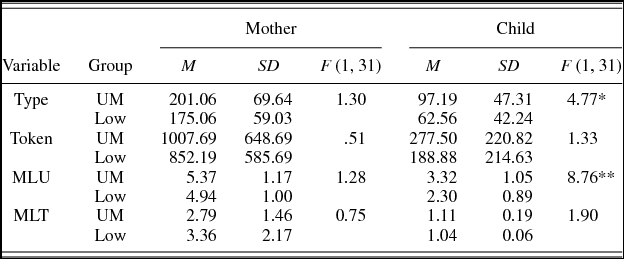
One-way multivariate analyses of variance (MANOVAs) were used to examine the SES differences in four basic length measures: total number of different words, total number of words, mean length of utterance, and mean length of turn, in children's and mothers’ talk, across the upper-middle and low SES groups (see Table 1). The MANOVAs showed that there was no statistically significant difference in mothers’ talk regarding these basic length measures across SES group, Wilks λ = 0.89, F (1, 31) = 0.82, p > .05, but a statistically significant SES difference in children's talk was observed, Wilks λ = 0.71, F (1, 31) = 2.73, p < .05. Subsequent analyses of variance revealed that SES had a statistically significant effect on word type and mean length of utterance produced by children. Children in the upper-middle group produced significantly more word types, F (1, 31) = 4.77, p < .05, and longer utterances, F (1, 31) = 8.76, p < .01, than the children from low-income families. These findings suggest that although children in the high SES group, on average, might have higher language skills in terms of vocabulary and syntactic structure, they did not talk more over turns compared to the children in the low SES group. In other words, the level of conversational participation in both groups was controlled.
Means and standard deviations of total number of different words, total number of words, MLU, and MLT across groups
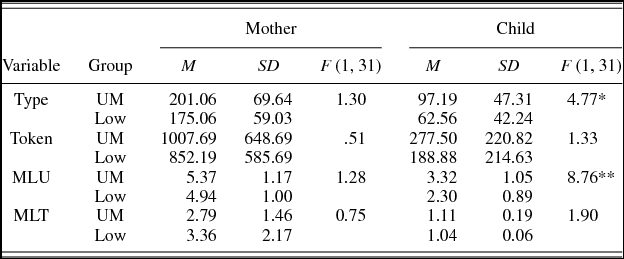
Note: Type, Total number of different words; Token, total number of words; MLU, mean length of utterance; MLT, mean length of turn; UM, families of upper-middle class; LOW, low income families.
*p < .05. **p < .01.
Interaction strategies
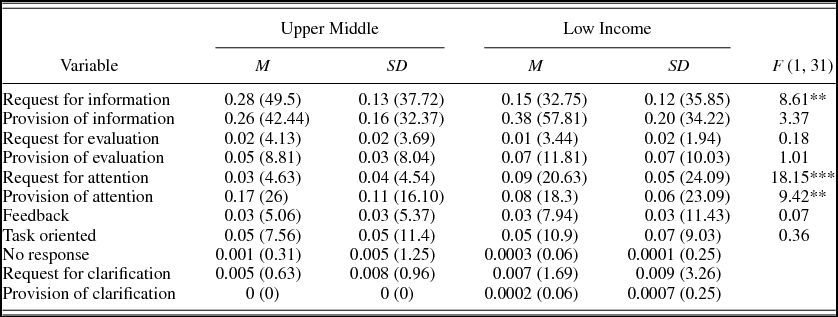
The proportions and raw frequencies of interaction strategies in upper-middle and low-income mothers are presented in Table 2. As Table 2 shows, the three most common strategies in upper-middle-class mothers’ talk were request for information (28%), provision of information (26%), and provision of attention (17%). With respect to mothers from low-income families, the three strategies used most frequently by them were provision of information (38%), request for information (15%), and requests for attention (9%). The result shows that upper-middle and low-income mothers spent most of their time requesting and providing information and in paying to or asking for children's attention. Both groups of mothers had relatively few talks about evaluation, task, clarification, and feedback.
Proportions and raw frequencies of maternal interaction strategies across groups

Note: Actual frequencies are in parentheses. Due to low frequencies of no response, request for clarification, and provision of clarification, these variables were excluded from cross-group comparisons.
**p < .01. ***p < .001.
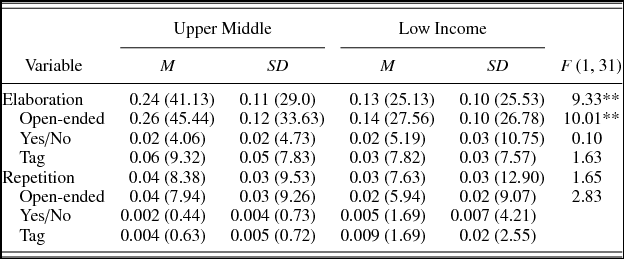
MANOVAs revealed that there was a significant SES differences in proportions of interaction strategies used by mothers, Wilks λ = 0.39, F (1, 31) = 2.83, p < .05. Across the two groups of mothers, no significant differences were observed in rates of provision of information, request for/provision of evaluation, feedback, and task orientation. Significant group differences in terms of maternal interaction strategies were evident in request for information, F (1, 31) = 8.61, p < .01, request for attention, F (1, 31) = 18.15, p < .001, and provision of attention, F (1, 31) = 9.42, p < .01. The proportion of request for attention in utterances of mothers from low-income families (9%) was three times higher than that in mothers from middle-class families (3%). In contrast, upper-middle-class mothers (17%) provided significantly more attention talk than did low-income mothers (8%). These results imply that low-income mothers were more concerned about whether their children listened to their talk attentively than were mothers from upper-middle-class families. Nevertheless, mothers from upper-middle-class families paid more attention to what their children produced than did low-income mothers during book-reading interactions. Another significant group difference was observed in proportion of request for information. Mothers from upper-middle-class families (28%) requested that their children engage in book talk more frequently than did mothers from low-income families (15%). As stated, maternal requests for information were further divided into two categories: elaboration and repetition. Types of questions, that is, open-ended, yes/no and tag questions, were also analyzed to understand the form mothers used to request information. Proportions and raw frequencies of types of questions are presented in Table 3.
Proportions and raw frequencies of maternal requests for information across groups
Note: Actual frequencies are in parentheses. Due to low frequencies of repetitive yes–no questions and repetitive tag questions, these two variables were excluded from cross-group comparisons.
**p < .01.
MANOVAs suggested statistically significant SES differences in types of questions produced by mothers, Wilks λ = 0.60, F (1, 31) = 2.76, p < .05. As displayed in Table 3, both groups of mothers asked many more elaboration questions than repetitive questions, but upper-middle-class mothers (24%) asked for more elaborate information than did low-income mothers (13%), and the difference reached statistical significance, F (1, 31) = 9.33, p < .01. This finding suggests that upper-middle-class mothers requested more information from their children and they encouraged their children to provide new and unstated information more often than low-income mothers did.
As to question types, proportions of the yes/no questions and proportions of tag questions in both groups did not reach significant differences, but a striking difference in proportion of open-ended questions was evident across groups. Mothers from middle-class families used more open-ended questions (26%) to request new information than did mothers from low-income families (14%), and the group difference reached statistical significance, F (1, 31) = 10.01, p < .01. For children, open-ended questions are more difficult to answer than are yes/no questions. Group differences in types of questions implies that Taiwanese mothers from upper-middle-class families, as the high-demand mothers in the study of Haden et al. (Reference Haden, Reese and Fivush1996), tended to give their children more challenges in joint book reading, compared to mothers from low-income families.
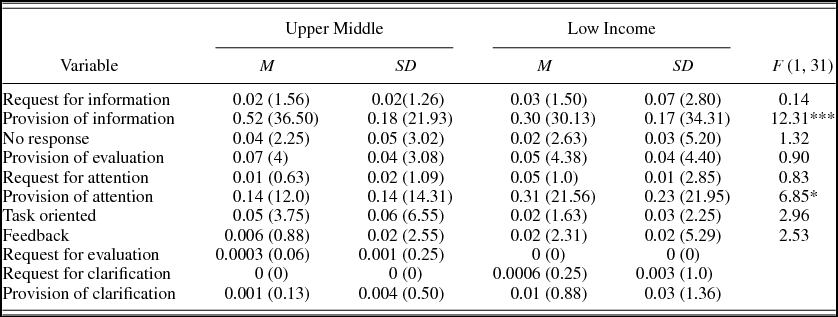
MANOVAs were also conducted to explore if there was a statistically significant difference in terms of interaction strategies used by children across the two SES groups. As with their mothers, a significant SES difference was observed in interaction strategies used by children, Wilks λ = 0.41, F (1, 31) = 2.63, p < .05. Different from their mothers, however, children in both groups spent much time providing information and attention, and the proportions of these two strategies across the two groups were significantly different (see Table 4). Half of the talk (52%) in children from upper-middle-class families was devoted to provision of information about the book. The proportion of provision of attention followed in frequency, and its occurrence covered only about 14% of their talk. In contrast, the proportion of provision of information in children from low-income families (30%) was much lower than that produced by children from upper-middle-class families F (1, 31) = 12.31, p < .001. The proportion of provision of attention talk (31%) in low-income family children, nevertheless, was significantly higher than that produced by the children from upper-middle-class families F (1, 31) = 6.85, p < .05.
Proportions and raw frequencies of children's interaction strategies across groups
Note: Actual frequencies are in parentheses. Due to low frequencies of request for evaluation, request for clarification, and provision of clarification, these variables were excluded from cross-group comparisons.
*p < .05. ***p < .001.
Low frequencies were observed in request for information, request for evaluation, request for attention, and request for clarification in both groups of children. These findings reflect the passive role the children played in the joint book-reading activity. Although the mothers from low-income and upper-middle-class families showed diverse interaction patterns in reading books with their children, both groups of mothers dominated the talk during the interaction.
Types of information
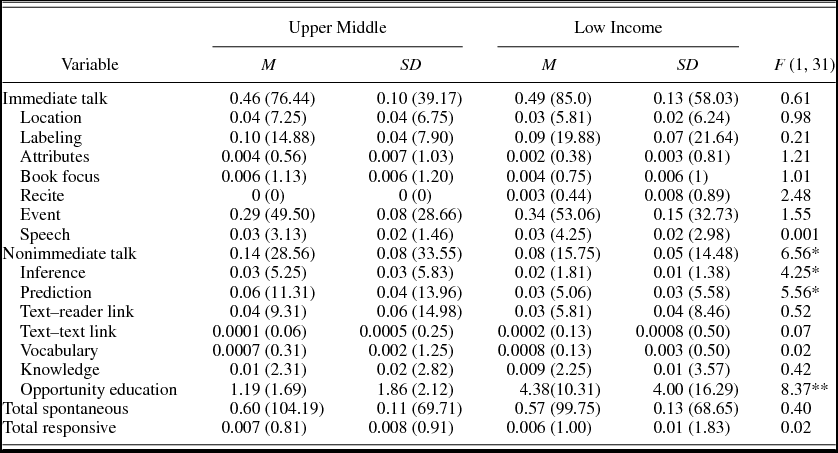
The information that mothers and children discussed during book reading was also examined using MANOVAs. Table 5 presents the results of proportions and occurrences of various types of information talk mothers produced across groups.
Proportions and raw frequencies of maternal information talk across groups
Note: Actual frequencies are in parentheses.
*p < .05. **p < .01.
A significant SES difference was observed in the information types mothers produced, Wilks λ = 0.29, F (1, 31) = 2.56, p < .05. As Table 5 shows, both groups of mothers produced much more immediate talk than nonimmediate talk. Across groups, however, mothers from the upper middle class produced proportion of nonimmediate talk significantly higher than did mothers from low-income families, F (1, 31) = 6.56, p < .05, and the proportion of inference, F (1, 31) = 4.25, p < .05, and the proportion prediction talk, F (1, 31) = 5.56, p < .05, were statistically different. No significant differences were evident in the proportion of immediate talk and other kinds of information. These results support the claim that mothers from upper-middle-class families set higher demands for their children than do those from low-income families. Another important finding shown in this table is that most of the maternal utterances in the two groups were spontaneous talk. The occurrence of responsive talk was extremely low in both groups. These findings again suggest that mothers played an active role during book reading.
With regard to use of “opportunity education” strategy, more than half of the mothers in both groups, regardless of their SES backgrounds, talked about transgressions of their children or behavioral regulations when they read together, but the number of low-income mothers who used opportunity education strategy (N = 13, 81%) was higher than that of mothers from upper-middle SES (N = 9, 56%). Significant SES difference was also found in proportions of mothers’ utterances about opportunity education, F (1, 31) = 8.37, p < .01 (see Table 5). This finding suggests that there is within-culture difference in use of opportunity education strategy in Taiwanese mothers.
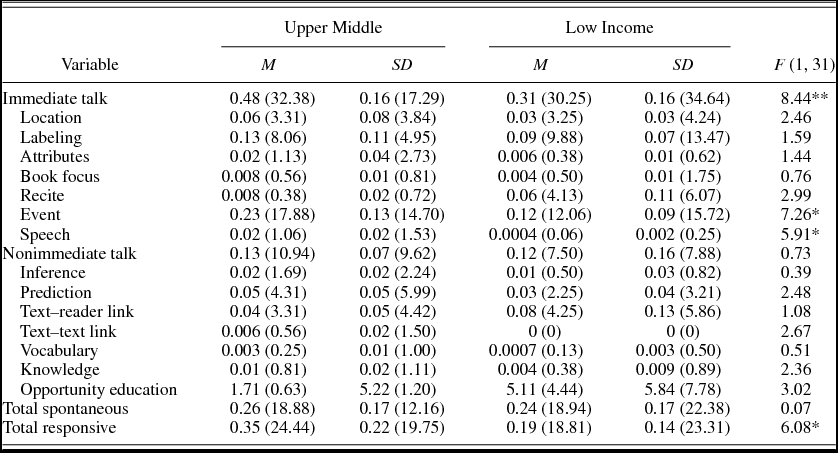
Table 6 presents the proportions and frequencies of types of information discussed in children across groups. As with their mothers, a significant SES difference was observed in the information types children produced, Wilks λ = 0.48, F (1, 31) = 2.40, p < .05. Both groups of children also produced much more immediate talk than nonimmediate talk during joint book reading. Overall, the proportion of each type of talk in children's utterances was similar across groups. Significant differences were evident only in the proportions of immediate talk, responsive utterances, and talk about events and speech. The immediate talk (48%), responsive talk (35%), and utterances about events and speech produced by the children from upper-middle-class families were significantly higher than those produced by the children from low-income families, immediate talk: F (1, 31) = 8.44, p < .01; responsive talk: F (1, 31) = 6.08, p < .05; event talk: F (1, 31) = 7.26, p < .05; speech talk: F (1, 31) = 5.91, p < .05. Significant correlations were found between proportions of maternal request for information and proportions of children's talk about events (r = .58, p < .05) and speech (r = .46, p < .05). These findings suggest that upper-middle-class children participated more in story narration and their mothers made more requests for them to respond than the other group. In contrast, no significant difference was observed in nonimmediate talk across groups. The low frequencies of each type of nonimmediate talk produced by both groups of children imply that producing utterances beyond the book context might not be what the 3-year-olds can do, regardless of SES.
Proportions and raw frequencies of children's information talk across groups
Note: Actual frequencies are in parentheses.
*p < .05. **p < .01.
Excerpts
In order to demonstrate the main findings gained from the quantitative analyses, excerpts selected from the actual data are presented in this section. As stated, although both groups of mothers dominated talk during book reading, mothers from upper-middle-class families gave their children more chances to participate than did mothers from low-income families. A significantly higher proportion of requests for elaborate information and a significantly higher proportion of provision of information were found in mothers and children from upper-middle-class families, respectively. In contrast, mothers from low-income families made significantly more requests for their children's attention during book-reading interaction. Excerpts (1) and (2) are two examples that demonstrate the differences across the two groups:
In the above two excerpts, both mothers asked questions, but the forms for their questions were different. Han-han's mother in Excerpt (1) asked an open-ended question to request her child to participate (Line 1). In contrast, Wei-wei's mother in Excerpt (2) asked two tag questions (Lines 2 and 5), whose function was not to ask Wei-wei to participate, but to arouse her attention to the book.
In terms of types of information, mothers from upper-middle-class and low-income families also exhibited differences. As demonstrated in the previous section, mothers from upper-middle-class families produced significantly more nonimmediate talk and more open-ended questions than did mothers from low-income families. Excerpts (3) and (4) show the obvious contrast across groups:
While reading the same page about the dog Carl using the hair dryer to dry the baby's hair, Bei-bei's mother in Excerpt (3), a mother from an upper-middle-class family, used three open-ended questions to ask her child what the dog Carl was doing (Line 1), what the dog used to dry the baby's hair (Line 3), and why the dog blew on the baby (Line 7). Instead, Qi-qi's mother in Excerpt (4), a mother from a low-income family, directly told her child what happened in one line without asking Zhi-qi any questions.
As indicated, both groups of mothers talked about transgressions of their children and behavioral regulations when they read the book with their children. Excerpts (5) and (6) are two examples to show this feature:
In Excerpt (5), Mei-mei's mother interpreted the conduct of the dog and the baby as “bad” (Line 1) and linked the story plots in the book with Mei-mei's past transgressions, that is, not cleaning up (Line 3). Da-da's mother also linked the event about the baby playing with his mother's belongings to Da-da's previous transgression (Line 4). When Da-da denied this, his mother even responded, “(You) lied” (Line 6). At the end of the joint book-reading session, Da-da's mother kept reminding Da-da of some regulations, such as “(You) cannot put the soap into your mouth. (You) cannot put the soap in your eyes either. (You) have to put your toys in the right place at home so Mother will like you. (You) cannot hit people. Be a good boy.” Both of the mothers used the book as a medium to teach their children moral rules and appropriate behaviors.
DISCUSSION
This study compared interaction strategies and types of information discussed during joint book reading in upper-middle and low-income mother–child dyads in Taiwan. Similarities and differences in mother–child conversation during book reading across groups were evident. Both groups of mothers provided similar amounts of information about the book and took the major responsibility of reading. These findings suggest that from the mothers’ perspective, regardless of the difference in their SES, their 3-year-old children were too young to tell the story, and hence took an active role in the storytelling task. Moreover, mothers from both groups used tag questions, and there was no significant difference in proportions of tag questions across groups. This finding supports what Erbaugh (Reference Erbaugh and Slobin1992) and Luo et al. (Reference Luo, Snow and Chang2012) observed and suggests that tag questions are the discourse marker commonly used by Mandarin-speaking mothers in Taiwan, regardless of their SES. Moreover, more than half of the mothers across the two groups provided “opportunity education” when they read with their children, which suggests that explicit teaching of moral rules is still a common practice used by Chinese-speaking mothers, regardless of their SES backgrounds. As for the children's participation, this study found that the occurrences of spontaneous talk in both groups of children were low and there was no significant difference between the groups. This finding implies that 3-year-old children, regardless of their family SES level, primarily rely on the scaffolding of their mothers.
With respect to variation across groups, one major difference was observed in request for children's participation in story telling. Mothers from upper-middle-class families asked their children to provide information more often than did mothers from low-income families. Other sharp differences were evident in the amount of nonimmediate talk and open-ended questions. Compared to the mothers from low-income families, mothers from upper-middle-class families exhibited the features of high-demand mothers, to use Haden et al.'s (Reference Haden, Reese and Fivush1996) term: producing more nonimmediate talk and asking more open-ended questions. This finding is consistent with what Snow et al. (Reference Snow, Arlman-Rupp, Hassing, Jobse, Joosten and Vorster1976) observed in upper-middle SES English-speaking mothers, who produce more open-ended questions and fewer yes/no questions than did mothers from low and low-middle SES. In contrast, mothers from low-income families provided less information about the nonimmediate context. Children across the two groups also exhibited different interaction skills. In response to their mothers’ requests, upper-middle-class children provided more new information about the book, but low-income children provided more attention to maternal talk.
The differences found in this study might reflect diverse beliefs upper-middle and low-income mothers have about childrearing in Taiwan. Traditional Chinese ways of childrearing emphasize authority and obedience (Chao, Reference Chao1993; Fung, Reference Fung1999; Fung et al., Reference Fung, Miller, Lin, Pratt and Fiese2004; Gao, Reference Gao1998). As indicated by Fung et al. (Reference Fung, Miller, Lin, Pratt and Fiese2004), the traditional Chinese perspective on a good child is a child who is obedient, attentive, and “listens to words” (tinghua). Low-income mothers in the present study resemble traditional Chinese parents in that they tended to see themselves as an authority in the activity and asked children to be attentive and listen to their reading. In contrast, upper-middle-class mothers tended to regard children as conversational partners. They not only gave their children more opportunities to speak but also demanded that they accomplish more challenging tasks, that is, answering open-ended questions and producing nonimmediate talk. Influenced by Western culture, traditional Chinese childrearing beliefs have been changing, especially in middle or high SES parents (Chen et al., Reference Chen, Liu, Li, Cen, Chen and Wang2000; Liu & Guo, Reference Liu and Guo2010). Elements such as a child-centered instead of a parent-directed perspective, a parallel instead of a hierarchal parent–child relationship, and indirect instead of direct instruction have been exhibited in childrearing attitudes in modern Chinese parents to some extent (Chao, Reference Chao1994; Fung et al., Reference Fung, Miller, Lin, Pratt and Fiese2004; Lieber, Fung, & Leung, Reference Lieber, Fung and Leung2006; Pomerantz & Wang, Reference Pomerantz and Wang2009). It would not be appropriate to regard all Chinese mothers as “authoritarian” or “controlling.”
The contrast between upper-middle and low-income Mandarin-speaking mothers is similar to the difference Kato-Otani (Reference Kato-Otani2004) observed in her study of book-reading styles in middle-class American and Japanese mothers. She found that American mothers requested more information from their children, but Japanese mothers took the responsibility of telling the story. According to Kato-Otani (Reference Kato-Otani2004), the differences in American mothers’ and Japanese mothers’ reading styles were due to diverse childrearing perspectives American and Japanese societies held. In the United States, children were viewed as independent learners; their mothers tend to ask them more cognitively demanding questions. In contrast, Japanese children were regarded as incompetent learners, and they need more assistance from their mothers. The divergent joint book-reading styles observed in American and Japanese mothers seem to be manifested in upper-middle and low-income Mandarin-speaking mothers in Taiwan, respectively. Careful investigation, nevertheless, needs to be conducted to compare the cross-cultural differences in book reading in Eastern and Western societies (Kato-Otani & Chang, Reference Kato-Otani and Chang2005), especially the definitions and interpretations of “children as independent learners” and “children as incompetent learners” in American, Japanese, and Chinese mothers’ views.
According to De Temple (Reference De Temple1994), the amount of maternal immediate talk is negatively related to their children's language ability, but mothers providing and requesting more nonimmediate talk such as prediction and inference have children with better language performance. He (Reference He2006) asked Taiwanese mothers to fill out questionnaires on their book-reading practices with their 6-year-old children and tested the children's reading comprehension ability. She found that mothers who asked their children to predict and reason during book reading have children with higher scores in story comprehension. The present study found mothers from upper-middle-class families produced more nonimmediate talk and their children provided more new information about the book and produced longer utterances compared to mothers and children from low-income families. This finding supports what De Temple (Reference De Temple1994) and He (Reference He2006) observed in their studies and suggests that maternal nonimmediate talk is beneficial to children's language development.
As stated, numerous prior studies have found a close relationship between maternal reading styles and children's later language and literacy development (Britto & Brooks-Gunn, Reference Britto and Brooks-Gunn2001; Bus et al., Reference Bus, van IJzendoorn and Pellegrini1995; De Temple, Reference De Temple, Dickinson and Tabors2001; Ninio, Reference Ninio1980; Panofsky, Reference Panofsky, John-Steiner, Panofsky and Smith1994; Raikes et. al., Reference Raikes, Pan, Luze, Tamis-LeMonda, Brooks-Gunn and Constantine2006; Scarborough & Dobrich, Reference Scarborough and Dobrich1994; Snow & Ninio, Reference Snow, Ninio, Teale and Sulzby1986; Wells, Reference Wells, Olson, Torrance and Hildyard1985). The results regarding the SES differences in maternal book-reading styles observed in this study highlight the importance to develop culturally and socioeconomically appropriate family literacy programs for children from various sociocultural backgrounds. Intraculture factors such as SES differences must be taken into consideration while examining cultural specific features in conversation between mothers and children across various ethnic groups. Both race and SES of the children and mothers should be considered in planning these programs.
Although SES differences in Chinese childrearing perspectives and maternal belief in the value of book-reading practices were found in prior research (Kang, Reference Kang2006; Lai, Reference Lai2010), there has been no research focusing on conversation during book reading across different SES families in Taiwan. This is the first study investigating conversation between Mandarin-speaking mothers and children during joint book reading across different socioeconomic classes. Several limitations of this study, however, have to be noted. This study only examines SES differences in maternal interaction styles at one time point. Further research needs to be done to understand the long-term relationship between diverse maternal book-reading styles within and across SES and children's later language and literacy development. Moreover, the sample size of this study is small. In order to increase the power of generalization, more mother–child dyads from various SES backgrounds should be included for future investigation. This study primarily focuses on the impacts of maternal interaction styles on children's participation during joint book reading. Children's language and cognitive skills, however, might affect the way mothers interact with their children. For future research, it is therefore suggested to either control children's language and cognitive abilities before examining maternal interaction styles or to investigate the potential influences of children's contributions on maternal interaction patterns during joint book reading.
ACKNOWLEDGMENTS
This study was supported in part by the Aim for the Top University Project and the Center of Learning Technology for Chinese of the National Taiwan Normal University, sponsored by the Ministry of Education, Taiwan, Republic of China, and the International Research-Intensive Center of Excellence Program of the National Taiwan Normal University and the Ministry of Science and Technology, Taiwan, Republic of China, under Grants NSC-91-2413-H-152–017 and NSC 103-2911-I-003-301. The authors are grateful to Si-hua Chen, Jia-hui Lin, Wan-yu Tsai, and Jing-han Fu for their help in data collection and data analyses. Special thanks go to the families who participated in this study.