Introduction
Income security of older people is an emerging policy concern in South Korea. The majority of the current elderly population were born prior to Korea's rapid development to an advanced economy and received little formal education during their youth. Consequently, they often worked in unstable or underpaid jobs and secured little savings for old-age security (Park Reference Park2007). Moreover, while the current older cohort had engaged in the labour force in the 1970s and 1980s, the Korean government implemented an aggressive economic development plan with little attention to welfare policies, such as providing a social buffer for older people. The policy makers have instead relied on Confucian virtues and the traditional role of family for the provision of income support to older people (Palley Reference Palley1992). Concurrent with the nuclearisation of the family, however, the extent of economic support from family members has notably decreased in recent decades, keeping a large number of Korean older people financially vulnerable. In the mid-2000s, the poverty rate of people aged 65 and above in South Korea was 45 per cent, the highest among Organisation for Economic Co-operation and Development (OECD) member countries. The old-age poverty rates of Australia, Ireland and Mexico ranked second highest, hovering at approximately 25 per cent, only nearly half that of South Korea (OECD 2011).
In response to the increasing demand for a social safety net for the aged, the government revised the National Pension Act for its reform in July 2007, with the introduction of the Basic Old-Age Pension (BOAP) in April 2007. The BOAP, a non-contributory, means-tested pension with flat-rate benefits, then came into effect in January 2008 and initially covered individuals aged 70 years or older with a monthly income of less than 400 kW (thousand Korean won, approximately equivalent to US $1) for singles or 640 kW for couples. The lower age bound was reset at 65 years in July 2008 to cover 60 per cent of the elderly population. In 2009, in an effort to increase the coverage to as much as 70 per cent, the government increased the income thresholds to 680 and 1,080 kW for singles and couples, respectively. These changes were reflected in the government spending on the new pension scheme, which had more than doubled in 2010 compared to that of the first year of the pension reform in 2008 (Jeong et al. Reference Jeong, Lee, Choi, Kim, Lee, Lee, Son, Kang, Kwon and Lee2009).
Despite the large amount of government spending, little empirical evidence exists to estimate the effects of the BOAP on the financial wellbeing of older people. The lack of empirical studies has been attributed to the brief history of the policy and the absence of relevant data. Several studies have examined a limited range of outcomes, largely relying on a simulation method. For example, using cross-sectional data from 2007, Kang and Choi (Reference Kang and Choi2010) predicted that the BOAP will increase the probability of the poor becoming the nearly poor, defined as having an income below the 100 and 120 per cent poverty lines, respectively. Similarly, by presenting descriptive statistics of administrative data provided by the National Pension Service and conducting a simulation analysis, Jeong et al. (Reference Jeong, Lee, Choi, Kim, Lee, Lee, Son, Kang, Kwon and Lee2009) argued that the BOAP has increased the income of older people and decreased old-age poverty rates.
The majority of studies conducted elsewhere came from countries with a longer history of implementing non-contributory pension schemes. Bertranou and Grushka (Reference Bertranou and Grushka2002) found that Argentina's non-contributory pension programme contributed to reducing the household poverty rate and the ‘extreme’ household poverty rate by 31 and 67 per cent, respectively. In Brazil and South Africa, Barrientos (Reference Barrientos2003) found that non-contributory pensions had a positive impact on poverty reduction and prevention. Of the 72 countries that are currently implementing a non-contributory pension (Yang, Williamson and Shen Reference Yang, Williamson and Shen2010), however, much empirical research has focused on Latin American (Barrientos Reference Barrientos2003; Bertranou and Grushka Reference Bertranou and Grushka2002; Schwarzer and Querino Reference Schwarzer and Querino2002) and African countries (Barrientos Reference Barrientos2003; Gassmann and Behrendt Reference Gassmann and Behrendt2006; Kakwani and Subbarao Reference Kakwani and Subbarao2005, Reference Kakwani and Subbarao2007). In general, these countries have a relatively large share of informal workers. A non-contributory pension gains more attention in societies where an employment-based pension system cannot play an effective role in guaranteeing a sufficient old-age income (Jeong et al. Reference Jeong, Lee, Choi, Kim, Lee, Lee, Son, Kang, Kwon and Lee2009). The empirical evidence is relatively scarce in Asia, although a growing number of people in East Asian countries have been forced into the informal sector since the East Asian financial crisis in the late 1990s and a non-contributory pension has been increasingly considered or adopted by these countries (McGuire and Conroy Reference McGuire and Conroy1998).
Using data from a nationally representative panel survey of South Korean adults, the current study evaluates the effects of the government's experiment with the new pension scheme on three sets of measures of financial wellbeing, namely older people's self-reports on financial difficulty, monthly consumption and overall financial satisfaction. Based on these outcomes, the current study provides a more detailed picture of how additional income generated by the new pension scheme is spent and how it improves the financial wellbeing of pensioners, compared to previous studies that only focused on whether the benefits help the poor to rise above the poverty line (Jeong et al. Reference Jeong, Lee, Choi, Kim, Lee, Lee, Son, Kang, Kwon and Lee2009). Moreover, the results may add to the current body of knowledge on non-contributory pension programmes in the context of Asia, where relatively few studies have been conducted.
Public income support for older people in South Korea and the BOAP
By 2007, the National Pension Scheme (NPS) had been a major old-age income security programme in South Korea. The NPS is a contributory public pension that calculates entitlements based on an individual's earnings and the length of his/her contribution period. The scheme was enacted in 1988 and was expanded to cover the general population in 1999. The level of benefit was at 60 per cent until it was reduced to 50 per cent of the average earnings of pensioners during their working period in 2007. This level is set to be decreased further to 40 per cent by 2028 with an annual reduction of 0.5 per cent, assuming a minimum participation period of 40 years. However, only approximately one-quarter of senior citizens aged 65 and above are receiving pension benefits as of 2010, and the average benefit level is below 15 per cent because of the short participation period of the current beneficiaries.
The National Basic Livelihood Security (NBLS) is a means-tested government support system that provides a social safety net for the poor who fall below the poverty line and who have no family members to provide care, regardless of age. Since its enactment in 2000, the NBLS has served as a minimum guarantee of old-age income, given that a significant portion of the recipients consists of senior citizens. Similarly, an earlier pension programme called ‘Pension for Elders (PE)’ had provided older people whose income fell below 120 per cent of the poverty line with a monthly support of approximately 30–50 kW, serving as public assistance for poor older people. However, due to the restrictive eligibility criteria, only about 15 per cent of people aged 65 and above were supported by either the NBLS or the PE, until the BOAP was introduced, eventually replacing the PE (Moon Reference Moon2008).
The introduction of the BOAP was initially discussed to expand the low coverage rate of the existing income support system for older people. The government proposed a public assistance pension that targeted approximately 40 per cent of the old-age population in poverty, whereas the opposition party insisted on the adoption of a universal basic pension. As a result of political considerations, the coverage rate was established between these goals (initially 60% and currently 70%), and the benefit level was established rather low to make the scheme affordable (capped at 84 kW per month for singles and 139 kW per month for couples as of 2008, which is equivalent to 5 per cent of the average monthly income of the NPS participants) (Moon Reference Moon2008).
The effectiveness of a wide coverage (60% initially, 70% as of 2009) combined with low benefit levels is controversial. The BOAP appears to function as a means of public assistance that targets poor seniors whose eligibility is determined by means testing. However, the current monthly benefit of 84–139 kW appears below the levels of what can be considered public assistance that is specifically aimed at poor older people. Although a similar combination is found in the non-contributory pensions of other countries (e.g. Old-Age Allowance in Taiwan), only a few studies have examined the effects of this type of pension arrangement (Choi and Kim Reference Choi and Kim2010).
In addition, the question of who actually benefits from the BOAP has remained unanswered. For instance, the BOAP may have a greater influence on female pensioners because these individuals have often been excluded from privileged occupational groups (e.g. teachers, civil servants, military personnel, and employees of large and stable companies) and have no retirement benefits to rely on. The issue of whether more disadvantaged older people are gaining more benefits is important for means-tested non-contributory pensions because, despite the higher administrative cost required, such pension programmes are preferred in many countries due to their better capacity to allocate resources to people with the greatest need (Yang, Williamson and Shen Reference Yang, Williamson and Shen2010).
Study hypotheses
Given the increasing government spending and the on-going controversies associated with the BOAP, this study evaluates the effects of the programme by focusing on three sets of outcome measures on the financial wellbeing of Korean older people. Specifically, the current study hypothesises that the additional income provided by the new public pension scheme reduces financial difficulty, and increases monthly consumption and overall financial satisfaction. In addition, this study defines three sub-groups of older people, namely singles, females and the older old (aged 75 and above), and hypothesises that the effects are larger for these groups because those who are older, female or live without a spouse have lower incomes on average (Jeong et al. Reference Jeong, Lee, Choi, Kim, Lee, Lee, Son, Kang, Kwon and Lee2009), and the additional income provided by the BOAP may play a greater role in improving their financial conditions.
Methods
Data
This study used data from the Korea Welfare Panel Study (KoWePS), an annual longitudinal survey of South Koreans aged 15 and above. Jointly administered by the Korea Institute for Health and Social Affairs and the Social Welfare Research Institute of Seoul National University, the KoWePS aims to provide information on household income, assets, employment status, as well as the use of and attitude towards welfare services of a nationally representative sample of Korean adults. A total of 14,463 respondents from 7,072 households were surveyed in 2006 (baseline); follow-up data were obtained from 13,083 respondents in 2007 (90.46% retention rate), 12,191 respondents in 2008 (84.29%), 11,909 respondents in 2009 (82.34%) and 11,400 respondents in 2010 (78.82%). With a two-stage stratified cluster sampling design, the sample households were equally distributed between low- and high-income groups, which were distinguished by a threshold of 60 per cent of the median income. Five waves of data were available (2006–2010), but only the third to fifth waves were used in this study (2008–2010) as some of the key outcome variables were not surveyed in previous years. The questions that were used to construct the outcome variables and main explanatory variables in the survey asked the respondents to describe their experiences in the previous year. Hence, the 2008 data represented the transition period from the PE to the BOAP in the year in which the government announced the introduction of the BOAP and people's expectations began to play a role. The 2009–2010 data captured information for the periods subsequent to the implementation of the BOAP.
The study sample was restricted to respondents aged 65 and over. The age limit of 65 may not be appropriate in 2008 because the lower age limit was 70 at the beginning of the pension reform. However, this limit was lowered to 65 in the middle of the same year, and people were informed of the change in advance, alleviating concerns for potential bias. The sample was further restricted to those who responded in all of the data collection waves from 2008 to 2010. Without this restriction, more disadvantaged elderly individuals could be less represented in the latter sample because of the potentially higher attrition rates in this group (Kim Reference Kim2012). Excluding observations with missing values for the study variables, the final sample for this study included 9,725 complete cases.
Variables
Three sets of outcome variables for financial wellbeing were constructed from relevant survey questions. First, a set of binary variables related to financial difficulty were defined from the survey module on living conditions, which asked each respondent to indicate whether his or her household was unable to afford any of the following during the past year: (a) regular meals, (b) nutritious meals, (c) sufficient meals, (d) rent, (e) utilities, (f) heating, (g) health care, (h) health insurance, (i) taxes, (j) child education and (k) credit card bill payment. Each variable was equal to one if the answer was yes and zero otherwise. Of these variables, the child education variable was not used in the estimation because the study sample included only people over 65 years old who tend to spend little on child education. Additionally, a composite variable was created to capture the total count of positive responses to the aforementioned items. Second, continuous variables for monthly consumption were derived from the expenditure module, which asked the average amount that each respondent's household spent per month during the previous year on each of the following items: (a) food, (b) rent, (c) home maintenance, (d) utilities, (e) furniture and appliances, (f) clothing, (g) health care, (h) leisure, (i) transportation, (j) taxes, (k) education, (l) social security contributions, (m) transfers to other family members, (n) others and (o) total. The ‘others’ category was redefined by deducting the sum of all expenditures with the exception of the original category of ‘others’ from the total expenditure to render each item mutually exclusive. As in the case of financial difficulty, the education variable was not used because of the low number of positive outcomes reported. All expenditure data were divided by the square root of the number of household members to adjust for households of different sizes (Kim and Choi Reference Kim and Choi2011). These data were further adjusted to the constant 2010 Korean won using the Consumer Price Index (CPI) released by the Korea National Statistics Office (2010). Finally, an ordinal variable of self-assessed overall financial satisfaction was measured by the following survey question: ‘How satisfied are you with your household income?’ (1=very dissatisfied, 2=dissatisfied, 3=fair, 4=satisfied, 5=very satisfied).
The main explanatory variable was a binary variable that was equal to one if a respondent received BOAP benefits and zero otherwise. Although individual self-reports on the specific amount of benefits received were available, a binary variable was preferred as a large portion of the responses regarding the benefit amount were outside the reasonable distribution (84–139 kW). These inaccurate reports may be related to recall bias, which can be more conspicuous during the initial period of policy implementation. Moreover, the results obtained using a binary variable may not be substantially different from those obtained using a continuous variable for pension benefits, given that most of the recipients (72.5% in 2008) received the maximum amount of benefits within the cap (Kang and Choi Reference Kang and Choi2010). The control variables included gender, education level, age, marital status, number of family members, household income quintiles, survey years and the type of residential area. Gender and education level were defined at the baseline and these time-invariant variables were not included in the fixed-effects estimation.
Statistical analysis
Panel data analyses were conducted to estimate the effect of the BOAP on improving financial wellbeing of older people. Fixed-effects estimation, which exploits within-individual variation in financial wellbeing outcomes in relation to changes in BOAP status over the study period, was theoretically preferred to random-effects estimation in the current study. Fixed-effects estimation has the advantage of controlling for unobserved time-invariant individual heterogeneity, such as different perceptions to self-reported measures of financial wellbeing and different vulnerability to economic hardships between BOAP beneficiaries and non-beneficiaries. The following equation was estimated:
 $$FWB_{it} = \beta _0 + \beta _1 BOAP_{it} + \Sigma \beta COV_{it} + YEAR_t + \mu _i + \varepsilon _{it}, $$
where FWB it denotes a measure of financial wellbeing of an older individual i in year t; BOAP is a binary variable indicating the BOAP status; COV is a vector of other individual factors including gender, education, age, marital status, number of family members, household income and type of residential area; YEAR t corresponds to the year of survey; μ i denotes time-invariant unobserved individual effects; and ε it is the random error term. Fixed-effects estimation was used to account for the potential correlation between BOAP and time-invariant unobserved heterogeneity (μ i). Results were then compared with the corresponding random-effects estimates that would show consistent findings on the condition that the BOAP status and other explanatory variables are uncorrelated with μ i. The Hausman test was used to guide the preferred estimation method between the random-effects and fixed-effects models (Hausman Reference Hausman1978). Although two groups of the study outcomes were not continuous in nature (i.e. binary indicators of financial difficulty and an ordinal variable of overall financial satisfaction), the linear specification was mainly used for all models given the undesirable statistical property of the fixed-effects binary and fixed-effects ordered logit models, that drops all observations without within-individual variation in outcomes (while a robustness check examined qualitative consistency in the key results, using these alternative, non-linear estimation methods). The models were estimated for both the total sample and separately for the sub-samples of single older people, women and the ‘older old’ (⩾75), which were defined according to the information from the baseline year data (2008).
Several robustness checks were conducted. First, as described above, models with non-linear outcome variables were re-estimated to examine whether the key results from the preferred linear models remained consistent with those from fixed-effects binary logit estimation for the binary outcomes of financial difficulty and fixed-effects ordered logit estimation for the ordinal variable of overall financial satisfaction (Baetschmann Reference Baetschmann2012). Second, the study sample excluded observations that may potentially confound the results. Specifically, data for the transition period (2008) were excluded and only the data after the implementation of BOAP (2009–2010) were used in the estimation. In addition, observations for those who experienced a simple replacement of the PE by the BOAP were dropped to capture the pure effects of receiving the BOAP. Third, for the expenditure models, the outcome variables were log-transformed. The key results did not change qualitatively; thus, the estimation results of the preferred linear models were used to ease the interpretation of findings in quantifying the policy effects in the entire sample. Other results that are not presented here are available upon request.
Results
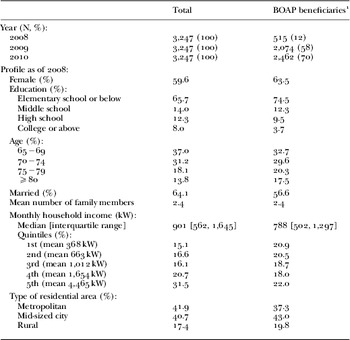
The BOAP recipients who are listed under year 2008 in Table 1 were beneficiaries of the PE, a predecessor of the BOAP, in calendar year 2007. The percentage of the recipients increased dramatically from 12 per cent in 2008 to 58 per cent in 2009. The subsequent increase to 70 per cent in 2010 corresponded with the implementation and expansion of the BOAP. The percentages of the BOAP beneficiaries in the 2009 (58%) and 2010 (70%) samples coincided with the take-up rates reported by the government in the respective years (60 and 70%). The BOAP sample included more females and older people with lower income and education levels. The median monthly household income was 901 kW for the total sample and 788 kW for the BOAP sample, with the corresponding benefit of the BOAP (84–139 kW) amounting to 9–15 and 11–18 per cent.
Sample profile by Basic Old-Age Pension (BOAP) status

Notes: 1. BOAP beneficiaries were defined in 2010 to show the sample profile of both current and potential beneficiaries in the baseline year (2008). kW: thousand Korean won (approximately equivalent to US $1).
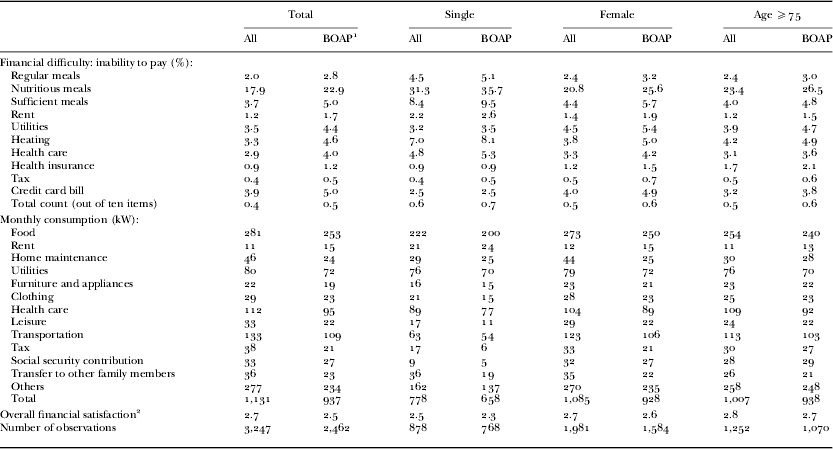
Overall, the respondents in the three sub-groups and the BOAP beneficiaries in each group reported greater difficulties in acquiring basic goods and services (Table 2). For most of the items, BOAP beneficiaries who were single showed the highest percentages of reporting difficulties. In particular, the percentage of older individuals who could not afford nutritious meals was 35.7 per cent among BOAP recipients in the sub-group of singles, almost twice that of the full sample (17.9%). Similarly, older people in the sub-samples spent relatively less in most of the consumption categories. The differences across samples were less evident for the outcome of overall financial satisfaction.
Sample means of outcome variables in the baseline year (2008) by sample
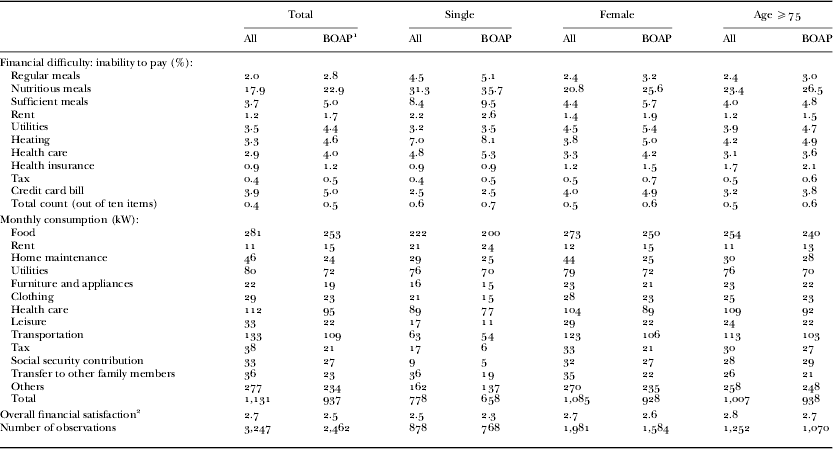
Notes: 1. Basic Old-Age Pension (BOAP) beneficiaries were defined in 2010 to show the sample means of both current and potential beneficiaries in the baseline year (2008). 2. Five-category ordinal variable ranging from 1 (very dissatisfied) to 5 (very satisfied). Sampling weights were applied. kW: thousand Korean won (approximately equivalent to US $1).
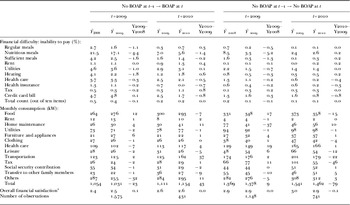
Before estimating the regression models, the means of the outcome variables among the newly covered beneficiaries in 2009 and 2010 were compared with the means of those who stayed uncovered in the respective years (Table 3). There were 1,575 new entrants and 1,148 status quos in 2009 – the year that the BOAP included the poorer 60 per cent of the old population. In 2010, there were 431 new entrants in the sample whose incomes are supposed to fall between 60 and 70 per cent of the average of the old population. The pre–post differences were evident in financial difficulty among the entrants in 2009, showing reductions in most of the items included. Older people who remained uncovered in both years 2008 and 2009 experienced similar reductions in financial difficulty, but with smaller magnitudes. Likewise, the new entrants in 2010 showed a greater decrease in financial difficulty than those who stayed as non-beneficiaries in 2010. However, people in both groups generally exhibited lower financial difficulty, higher monthly consumption and higher financial satisfaction in both the pre- and post-periods compared with their counterparts in 2009. The beneficial effects observed among the newly covered groups in years 2009 and 2010 were less clear for the outcome variables of monthly consumption and overall financial satisfaction. In sum, when control variables were not considered, the beneficial effects of the BOAP on financial wellbeing were observed only in reducing the difficulty of paying for basics, especially among the early entrants.
Changes in the means of outcome variables by a shift in Basic Old-Age Pension (BOAP) status

Notes: 1. Five-category ordinal variable ranging from 1 (very dissatisfied) to 5 (very satisfied). Sampling weights were applied.  $\bar Y$year: means of outcome variables in each year. kW: thousand Korean won (approximately equivalent to US $1).
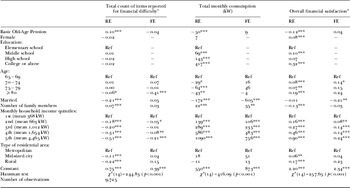
Results from the linear regression models of the three generic measures of financial wellbeing (i.e. total count for the number of items reported for financial difficulty, total monthly consumption and overall financial satisfaction) are presented in Table 4. Most prominently, all three outcome variables were strongly associated with household income, with consistent gradients. Regarding estimates on the main variable of interest, while the random-effects estimates may suggest that the BOAP status reduced financial wellbeing (all statistically significant at the 1% level), the fixed-effects estimates were statistically insignificant, with switched signs. The Hausman test statistics favoured fixed-effects estimates over random-effects estimates (p<0.001), implying the importance of accounting for unobserved individual heterogeneity in all models. These results suggest that the BOAP status did not lead to a noticeable improvement in the overall financial wellbeing of older people, after controlling for observable and unobserved individual heterogeneity.
Random-effects (RE) and fixed-effects (FE) linear regression of generic measures of financial wellbeing

Notes: 1. Financial difficulty (inability to pay: regular meals, nutritious meals, sufficient meals, rent, utilities, heating, health care, health insurance, tax and credit card bill). 2. Five-category ordinal variable ranging from 1 (very dissatisfied) to 5 (very satisfied). Year dummies were included but not presented here. Robust standard errors were used. kW: thousand Korean won (approximately equivalent to US $1). Ref: reference category.
Significance levels: * p<0.1, ** p<0.05, *** p<0.01.
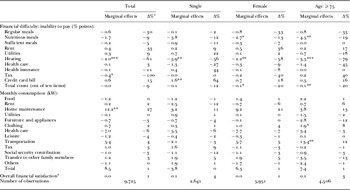
Table 5 summarises the results of the fixed-effects linear regression models for all specific items in each set of outcome variables for the total sample and the three sub-samples. In the total sample, the coefficients in the models of financial difficulty (inability to pay) were statistically significant for two outcomes: heating and tax. These negative and statistically significant fixed-effects estimates indicate that when unobserved individual heterogeneity was controlled for, BOAP benefits reduced the likelihood of having inadequate heating or having outstanding tax debt by 2.0 and 0.4 percentage points, respectively. These values are not negligible in magnitude, as they represent 61 and 100 per cent reductions from the means of the corresponding total sample in the baseline year (2008). For consumption outcomes, the estimates were statistically significant only in the model for home maintenance (12.2). This result suggests that receiving BOAP benefits is associated with an increase of 12.2 kW in home maintenance expenditures or a 27 per cent increase from the mean expenditure in 2008. The estimate for overall financial satisfaction was not statistically significant. The same analysis was conducted separately for the three sub-groups representing singles, females and people older than 75 years. In the models for financial difficulty, statistically significant reductions were observed in the outcomes of nutritious meals, heating and total count, with greater magnitudes in the sub-groups than in the total sample. In the consumption models, the statistically significant estimates of the BOAP were found for people aged 75 years and above, predicting a consumption increase of 1.9 kW in clothing and 13.4 kW in transportation. The estimates for overall financial satisfaction were not statistically significant.
Effects of the Basic Old-Age Pension on the financial wellbeing by sample

Notes: 1. The ratio of the marginal effects to the sample means of all observations of each group in Table 2, multiplied by 100. 2. Five-category ordinal variable ranging from 1 (very dissatisfied) to 5 (very satisfied). Estimates from fixed-effects linear probability models are presented. Covariates included age, marital status, number of family members, household income, calendar years and type of residential area. Robust standard errors were used. kW: thousand Korean won (approximately equivalent to US $1).
Significance levels: * p<0.1, ** p<0.05, *** p<0.01.
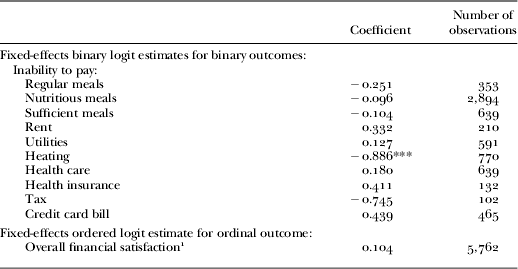
Qualitatively, estimates of the fixed-effects binary and fixed-effects ordered logit models in the total sample showed a similar pattern (Table 6). The only statistically significant and notable result was that the BOAP reduced the probability of reporting financial difficulty with heating, which is largely consistent with the results using the linear specification presented in the first column of Table 5.
Robustness checks using non-linear fixed-effects models
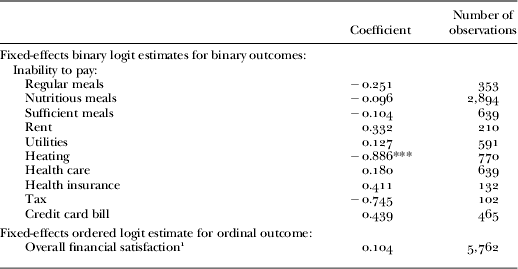
Note: 1. Five-category ordinal variable ranging from 1 (very dissatisfied) to 5 (very satisfied). Covariates included age, marital status, number of family members, household income, calendar years and type of residential area.
Significance level: *** p<0.01.
Discussion
The study findings suggest that the BOAP improved certain domains of financial wellbeing among Korean older people. Specifically, the BOAP substantially reduced difficulties in meeting certain basic needs such as paying tax and ensuring adequate heating, and increased home maintenance expenditures in the overall elderly population. The beneficial effects were more prominent in the sub-groups of the elderly population defined in this study (i.e. singles, females and the older old). For older women and individuals older than 75 years, in particular, additional income generated by the new pension programme increased the affordability of nutritious meals and heating. In addition, the older-old group experienced an increase in clothing and transportation expenditures. These results suggest that the beneficial effect of the BOAP on the financial wellbeing of Korean older people was limited in that it improved affordability for only a few basic necessities such as heating and nutritious meals. Overall financial wellbeing and other important indicators remained unchanged, implying that the current benefits of the BOAP (i.e. 84–139 kW, equivalent to 5% of the average monthly income of the NPS participants) may be insufficient to improve the varied dimensions of the lives of beneficiaries. In fact, increasing the BOAP's level of benefits was intensely discussed during the 2012 South Korean presidential election; the new administration has proposed to increase the benefits to twice the current level (Ahn Reference Ahn2012). The results of the current study provide empirical support to the policy direction of increasing the benefit level of the BOAP. In addition, the beneficial effects of the BOAP were evident among the more marginal groups of older people. These group-specific effects were consistent with the results of previous studies (Jeong et al. Reference Jeong, Lee, Choi, Kim, Lee, Lee, Son, Kang, Kwon and Lee2009), supporting the effectiveness of the BOAP in alleviating old-age poverty, particularly among the most needy elderly Koreans. Nevertheless, evidence of the limited effectiveness of the BOAP also points to the policy challenge of effectively improving the financial wellbeing of poor older people, concurrent with maintaining financial sustainability. This challenge has become the centrepiece of on-going policy debates on the old-age support system in South Korea.
This study adds to the small but growing literature on the policy responses to old-age poverty, and more specifically, non-contributory pension programmes for older people, in several important ways. First, the study focuses on the context of an Asian country facing the growing challenge of old-age poverty. Many emerging and developing economies in Asia encounter challenges associated with rapid population ageing, changes in traditional family support arrangements and nascent social security systems with limited coverage (Giang and Pfau Reference Giang and Pfau2009). Our study provides useful insights for the current debates in South Korea and relevant policy responses to old-age poverty in other Asian countries. Second, this study employed comprehensive sets of outcome variables that directly capture the financial wellbeing of older people, while previous studies have only focused on the outcomes of the poverty rate and gap (Barrientos Reference Barrientos2003; Bertranou and Grushka Reference Bertranou and Grushka2002; Choi and Kim Reference Choi and Kim2010; Gassmann and Behrendt Reference Gassmann and Behrendt2006; Giang and Pfau Reference Giang and Pfau2009; Kakwani and Subbarao Reference Kakwani and Subbarao2005; Matsaganis, Papadopoulos and Tsakloglou Reference Matsaganis, Papadopoulos and Tsakloglou2000; McGarry Reference McGarry, Feldstein and Liebman2002; Schwarzer and Querino Reference Schwarzer and Querino2002). Thus, the results showed specifically where the benefits of poverty reduction are directed towards, providing a more detailed picture from the older person's perspective. Third, this study exploited individual-level panel data to improve causal inference of the effects of the BOAP on financial wellbeing.
These findings should be interpreted with consideration of a few study limitations. First, although the fixed-effects models controlled for time-invariant individual effects, the models could not address the potential issue of omitted variable bias due to time-varying covariates (e.g. such as financial transfers from family members), which were not included in this study but may affect both BOAP eligibility and the financial wellbeing of older people. There is also the concern of contemporaneous reverse causality. For example, older individuals who have monthly incomes near the eligibility limit are more likely to expect financial difficulties and may quit their job or reduce work hours to fall below the income threshold and become eligible for the BOAP. However, such strategic behaviour is not likely given the low level of current benefits. Individuals may also attempt to misreport their true incomes to be eligible for the pension. Nevertheless, this concern is alleviated by the fact that BOAP eligibility is determined by a central administrative database, which updates individual information on income every month and requires respondents to report any change in their eligibility status within 30 days. Hence, although it may be theoretically possible for individuals to achieve BOAP status strategically, it is less likely on a practical level given the institutional framework. Second, all of the key variables were self-reported and may be subject to individual reporting heterogeneity. For instance, low levels of expenditures and financial satisfaction may reflect individual preferences and tastes rather than involuntary deprivation (Beverly Reference Beverly2001). However, this concern is lessened by the nature of the fixed-effects estimation in which time-invariant individual preferences and reporting habits are controlled for. Third, although the best available data were employed, only two years of post-intervention periods were examined, thereby limiting the results to short-term effects.
Despite these limitations, this study provides rich insights into the current policy debate on the new non-contributory pension programme for older people in South Korea. The BOAP has beneficial effects on the financial wellbeing of older people by improving the affordability of basic subsistence items such as heating and nutritious meals. In addition, the more vulnerable groups of older people reap greater benefits from the pension programme. However, the results also suggest that the current benefit level is limited in improving the financial wellbeing of older people beyond relieving difficulties in obtaining several daily necessities. Increasing the level of benefits of the BOAP in conjunction with developing a long-term plan for old-age support is advised for the financial wellbeing of poor older people in South Korea.
Acknowledgements
The data for this study were made available by the Korea Institute for Health and Social Affairs and the Social Welfare Research Institute of Seoul National University. The authors thank Hye-Won Kim and two anonymous reviewers for helpful comments and suggestions on earlier versions of this paper. Mary Ann Bautista provided helpful comments and suggestions for the manuscript revision.