Interviewing Québécois director Robert Lepage in London in 1992, Richard Eyre, then director of the Royal National Theatre, admits to feeling ‘very jealous’ of the ‘extraordinarily moving’ effects that Lepage achieves with ‘very simple, very primitive’ means.Footnote 1 Using such minimal materials as, for example, ‘a simple carousel projector’ and one ‘small slide’, Lepage is said by Eyre to create unforgettably ‘magical’ moments that are ‘exquisitely beautiful’ and ‘terribly moving’.Footnote 2 Lepage replied by summing up his approach to theatre-making as follows: what is most moving to audiences is not ‘sophisticated’ technologies or ‘realism’ or ‘naturalism’ or anything ‘already masticated and organized and painted’, but rather, quite simply, ‘the opportunity to invent’:
The audience is much more moved and feels much more stimulated and excited by something that allows them to be inventive . . . Sometimes I think I can do beautiful, magical images that are very stunning but they're too high-tec[h;] they don't give the audience the opportunity to invent them.Footnote 3
In describing his mise en scène as one calculated to stimulate the spectator's own creativity, Lepage could be describing, with equal accuracy, the art of sekitei, the traditional Japanese practice of stone gardening. According to Japanese aesthetic theorist Donald Keene, such Zen gardens are expressly designed to invite viewers to ‘participate’ in their creation, and as a result, says Keene, can ‘move us even more’ than art-forms that cast us in a passive role.Footnote 4 The art of the Zen gardener, in theorist Camilia Nakagawara's words, is ‘highly interactive’, deliberately stimulating the viewer ‘to participate in the creation’ of the work before them.Footnote 5 Not only do we find the same demand for a creative viewer in both Lepage's theatre and the ancient Japanese art of Zen gardening; we also find that both elicit this active spectatorship through the same aesthetic techniques. In a Lepage-directed work such as Seven Streams of the River Ota (1994–6), for example, we notice the presence of such Zen gardening techniques as a radical reduction of scale, or shukukei (miniature landscape); the use of minimalistic material metaphors, or mitate (metaphoric representation); and an asymmetrical, fragmented style, or fusuma-e (fragmented scene).Footnote 6 Indeed, as we will be arguing here, the Zen gardening techniques of miniaturization, metaphoric minimalism, and asymmetrical fragmentariness can be observed across Lepage's directorial oeuvre, pointing to a strong aesthetic kinship between the mise en scène so admired by Richard Eyre and the representational mode of the Japanese garden.
Lepage himself recognizes that stone gardening and theatre-making are comparable aesthetic practices. Speaking of the ‘precise rules’ of the Japanese garden's ‘spatial organization’, Lepage likens ‘Zen gardens’ directly to ‘theatres’:Footnote 7 ‘[t]hese are planned empty spaces that don't exist in daily life’, spaces that are extremely important in ‘a world in which everything is built up and occupied . . . That's why the Japanese meditate in front of Zen gardens . . . that's also the great pleasure of experiencing Noh theatre’.Footnote 8 Lepage's view of the similarly meditative function of the two aesthetic forms is nicely captured by the fact the Lepage built a Japanese garden directly in front of his office window in La Caserne, his creation centre in Québec City.Footnote 9 By its Japanese theorists, too, the Zen stone garden is understood in terms that apply equally to theatre: the garden is conceived as a ‘playing’ space,Footnote 10 and a space, moreover, that is intended not for physical interaction but solely for ‘viewing’. As Seiko Goto, historian of the Japanese garden, explains, Zen gardens are ‘not for strolling’ in but, like theatrical stages, ‘for gazing at’.Footnote 11 They are places, in Nakagawara's words, of ‘playful’ or ‘ludic mimesis’,Footnote 12 meant to be viewed, like theatrical spectacles, ‘while sitting’ in the house.Footnote 13 This idea, of a playing space intended for viewing rather than physical intervention, is, of course, captured exactly by the Greek word and concept for theatre, theatron, or ‘viewing place’. And according to Nakagawara, the effect of the ‘viewing place’ of the Zen garden is ‘meta-experiential’, productive of ‘a thoughtful, detached mode of attending’, meditative and metaphysically enlightening.Footnote 14 As we will see, in his mise en scène of Seven Streams of the River Ota and other works, Lepage arranges his materials in similar ways and for similar purposes as do Japanese stone gardeners, using the Zen aesthetic techniques of shukukei, mitate and fusuma-e to cultivate an enlightened creative spectator.
In addition to installing one outside his office window, Lepage has also incorporated stone gardens into his stage works. In The Dragons’ Trilogy (1985–2007), for example, a Japanese garden is evoked through the shape and materials of the permanent set, a rectangular space covered with sand. This almost empty space is used to represent a variety of geographical locations from Québec City to Toronto to Vancouver, but its identity as a Japanese garden is made explicit in the final act. Pierre and Yukali, falling in love, visit a Zen garden and compare themselves to its stones: ‘My name is Pierre, and en français, it means rock, stone, it means pierre’; Yukali responds by saying, similarly, ‘My name is Yukali Ishi[i] and in Japanese, it means purple stone, amethyst.’ Pierre and Yukali then say, ‘We are like two stones in a Zen garden.’ The arrangement onstage of these two theatrical figures is thus likened to the placement of stones in a Japanese garden, making the similarities between Zen contemplation and theatrical spectatorship explicit. (And note that Pierre, whose last name is Lamontagne, literally embodies the entire representational logic of the Japanese garden, in which stones, or pierres, stand in symbolically for mountains, or montagnes). Seven Streams of the River Ota similarly depicts a Japanese garden. In designer Carl Fillion's set, a rectangular area covered with white gravel adjoins and extends the full width of the verandah of a traditional Japanese house. In the stage directions, this space is described as ‘a narrow raked stone garden’;Footnote 15 in the final act, the space is explicitly identified by a character, Hanako, as a Japanese stone garden.Footnote 16 Until that point, however, as in The Dragons’ Trilogy, this rectangular ‘playing space’ represents many different geographical locales, in this case from Hiroshima to New York to Amsterdam to Theresienstadt. As human figures are placed upon it in various configurations, like the stones symbolizing mountains in a Zen garden, this gravelled area does more than simply represent a stone garden: it also functions as one. This is because the Zen garden is a ‘work of art’ that one gazes on ‘while sitting’ in the house.Footnote 17 Fillion's Japanese house-and-garden set thus makes of the theatre auditorium, or ‘house’, a mirror image itself, a place of Zen contemplation, putting the viewer in the position of one gazing, from the ‘house’, at a Japanese garden.
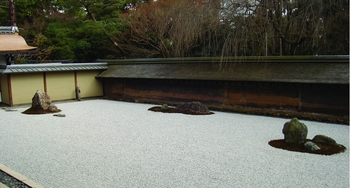
The garden type that Lepage features in these works, and gazes at from his office, is called sekitei. In the oldest book on Japanese gardening, Sakuteiki (eleventh century), we notice that the Japanese for ‘creating a garden’, ishi wo tatenkoto, literally means ‘setting stones upright’.Footnote 18 The setting up of stones, the mise en scène of stones, thus comprises the first principle of Zen gardening. In general, such gardens are categorized as karesansui, dry landscape gardens, where kare means ‘withered’, ‘dead’, and sansui refers to a landscape of mountains and water. Since the garden is supposed to be ‘dead’, actual water is generally not allowed in karesansui, although trees and plants are sometimes used. For this reason, as Nakagawara notes, the term karesansui ‘is often used ambiguously’, ‘in competition and overlapping with other terms’, such as sekitei (stone garden) and zen niwa (Zen garden).Footnote 19 The term sekitei, however, refers specifically to a garden of gravel and stones without any trees.Footnote 20 In such gardens, stones typically stand in for mountains, and raked gravel symbolizes water. Sekitei is clearly exemplified in the garden at Ryoan-ji (Fig. 1).
Garden at Ryoan-ji. Photo: Mai Kanzaki.

In its use of ‘dead’ materials to represent living forces, the sekitei garden embodies a Zen spiritual paradox: the unity of opposites. Gazing at a sekitei garden, the spectator is meant to experience an enlightening ‘apprehension of the world as a dialectical continuum’ rather than as a set of binary oppositions; according to Nakagawara, this Zen transcendence of binaries is ‘one of the most quintessential attributes’ of sekitei.Footnote 21 It is also the central theme of Seven Streams of the River Ota.
Lepage's inspiration for the work came from the Zen unity of life and death that he experienced during a visit to Hiroshima in 1993.Footnote 22 When the atomic bomb exploded there in 1945, people threw themselves into the River Ota to escape the heat; dead bodies were seen floating down the river for days. Because Hiroshima and its seven-branched river had come to symbolize mass carnage, Lepage expected to be met there with a scene of devastation. Instead, the river's continuous flow through the city, and the verdant vitality of Hiroshima as Lepage experienced it in 1993, both testified to nature's ongoing life force. As one of the play's characters, Jana Čapek, explains,
The Seven Streams of the River Ota is about people from different parts of the world who came to Hiroshima and found themselves confronted with their own devastation and their own enlightenment. For if Hiroshima is a city of death and destruction, it is also a city of rebirth and survival.Footnote 23
This Zen apprehension of the continuum of life and death is captured in the paradoxical aesthetics of sekitei, which uses ‘dead’ materials to create a strong impression of life.
In fact, all of sekitei's attributes are deeply rooted in Zen Buddhist philosophy. As Goto explains, Buddhism spread in Japan during the fourteenth century through simplified new sects such as Pure Land and Zen.Footnote 24 But whereas Pure Land makes total dependence on Buddha a precondition of enlightenment, Zen is premised on the contrasting idea that everyone already contains Buddhahood; Zen therefore emphasizes independent personal agency and active individual effort in the quest for enlightenment. Because it was on the grounds of Zen monasteries and temples that stone gardening achieved its highest form, the aesthetics of sekitei were shaped early by Zen philosophy.Footnote 25 Accordingly, its techniques share the goal of encouraging a personally effortful type of spectatorship, and one calculated to enlighten viewers, in the Zen sense, with an experience of the unity of opposites.Footnote 26 The opposites overcome in a Zen art like sekitei include not only death and life, but the related binary of body and mind, or ‘matter and consciousness’:Footnote 27 gazing at stones and gravel while imagining living oceans and forested mountains, the viewer experiences extreme physical limitations and great imaginative freedom simultaneously.
Toward this end, the sekitei garden miniaturizes, minimalizes and enframes its materials to the point where the viewer is able to see the whole and all of its parts simultaneously, from a single enlightening viewpoint. The Japanese garden not only miniaturizes in terms of scale, but also minimalizes in terms of materials, using two physical substances only (stones and gravel). Its representational style is consequently, and inevitably, symbolic, inviting considerable imaginative input on the part of the viewer. Sekitei gardens in fact demand that viewers exert their imaginations to translate the given materials (stones and gravel) into other materials in their minds (naturally occurring ocean and mountain landscapes). The miniature scale and minimal materials of sekitei are therefore mutually reinforcing strategies, for while the first allows the viewer to see the whole in a single gaze, the symbolic nature of the materials ensures that this gaze must be an active, imaginative one. In addition, as we see in Figure 1, the asymmetrical arrangement of stones, the large but irregular amount of ‘blank’ space between them, functions as a third strategy for stimulating a metaphysical, intellectually active viewing experience. The beholder is led to ask, what is the pattern here? Is there a meaning to this arrangement? How are these elements connected? The (deliberate) absence of a predictable symmetry encourages the viewer to supply an explanatory, meaning-making pattern through his or her own efforts. Together, these three aesthetic techniques stimulate viewers to contemplate, creatively comprehend and ultimately achieve an enlightened understanding of phenomena that, in their naturally occurring state, are immense and incommensurate with human understanding.
We start, then, with sekitei's most striking strategy: its radically condensed scale. This principle is conveyed by the Japanese word for ‘miniature landscape’, shukukei. The technique of shukukei is to compress representation into a confined space that is much smaller than the objects represented. The Japanese garden obeys this principle by being strictly confined within a clearly defined rectangular space, a space that is much smaller than any of the natural phenomena it purports to represent. For example, the Ryoan-ji sekitei in Kyoto (Fig. 1), while it can be viewed as representing phenomena like mountains, islands, and bodies of water that would naturally extend over tens of thousands of square miles, takes up approximately 0.06 acre.Footnote 28 Compared to the Jardin Luxembourg in Paris (61.8 acres), or a typical English landscape garden such as Stourhead (forty acres), Petworth (seven hundred acres), or Chatsworth House (a thousand acres),Footnote 29 a sekitei garden is miniature. Further emphasizing its radically reduced scale is sekitei's reliance on an emphatic border that nothing exceeds.
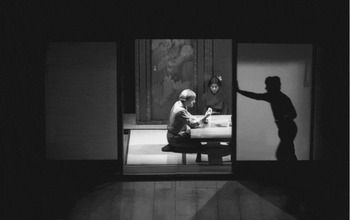
Though it may at first sound illogical to speak of an eight-hour play in terms of a principle of miniaturization, Seven Streams of the River Ota does in fact exemplify the technique of shukukei in its mise en scène. The play's narrative material is as vast as the ocean-and-mountain landscapes depicted in a Japanese garden: Seven Streams tells the fifty-year story of Hiroshima, the Shoah, and the AIDS epidemic, three of the twentieth century's most incomprehensibly large-scale catastrophes. And the geographic extent of the story is equally huge – global, in fact – as it spreads over four countries and three continents. The narrative landscape of the play is thus immense, spanning a half-century, a world war, millions of deaths, and unimaginably vast suffering. And yet the mise en scène depicts these immensities according to the laws of shukukei, confining its representations within relatively tiny frames. Using the seven rice-paper doors of the permanent set, Lepage creates a series of small enframed spaces. Between each scene, actors slide the doors, setting each dramatic action within a compact and clearly demarcated frame. The miniaturizing practice of shukukei is emphasized by the way these compartments are used, with light illuminating only their interior, leaving other parts of the stage in darkness (Fig. 2).
Seven Streams of the River Ota. Photo: Emmanuel Valette.

By way of this miniaturizing and enframing technique, the geographically and historically huge phenomenon of a German concentration camp is reduced to the corners of two partially visible bunk beds in a dormitory at Terezin. The international baby boom of the post-war period is likewise compressed into the tiny frame of a cramped New York bathroom. The state of global human ‘Progress and Harmony’Footnote 30 ten years later is enframed as the backstage area of the Canadian exhibit at the Osaka World's Fair, as a translator's booth, as a phone box, and as a private compartment in a restaurant (Fig. 2). The atomic bomb blast of 1945 is miniaturized into the confines of a train station photo booth. Scenes that are not played within one of the three small compartments of the set-house are compacted and enframed by the façade of the house, by the borders of the gravel garden, or by a tatami mat laid on the floor.
Lepage is aware that miniaturization is one of the animating principles of his art. A washing machine inspired Lepage's creation of Far Side of the Moon (2000) because, as Lepage puts it, a washing machine is ‘a miniaturization of the centrifugal forces of the universe’.Footnote 31 The narrative landscape of Far Side is so vast as to exceed planet Earth itself, encompassing the Moon and cosmic space beyond; Lepage miniaturizes this vastness within the door-hatch of a front-loading washing machine. In The Dragons’ Trilogy, three Chinatowns from Québec City to Vancouver over nearly a century are reduced to the confines of an ordinary parking lot; neighbourhoods and houses are scaled down to the shukukei of shoeboxes; the armies of the Second World War are miniaturized in the ice skates of uniformed figures slicing their way across a skating rink. Lepage has said that all his work ‘is about geography’;Footnote 32 the technique of shukukei allows him to represent for our enlightening contemplation geographies of a planetary and even supra-planetary scale.
The Zen enframement of enormous narrative landscapes within small emphatic borders is attested throughout Lepage's works. A Dream Play (1994) confines the actors within a cubic set of four-by-five meters. In The Blue Dragon (2008), the stage design replicates a four-frame comic strip, with a two-tiered steel set divided into four clearly demarcated squares. In Lipsynch (2009), a large bustling city is depicted within the rectangular enframement of a bookstore vitrine, and scenes of the life of a prostitute are reduced to a door-sized rectangle illuminated by fluorescent strips from within. In addition to the many small physical boxes and frames of Lepage's mise en scène (parking attendant's booth, phone booth, photo booth, sex-shop viewing booths, time machine, airport gift shop, doorway, window frame, etc.), small Japanese-garden-like frames are also sometimes created with tight rectangles of light, as in The Far Side of the Moon when Philippe talks about the immensity of the solar system, as well as in Macbeth (1992), Geometry of Miracles (1998), and Eonnagata (2009).Footnote 33
The structure of acts and division of time in Seven Streams, as well as in Lipsynch, further reinforces the spectator's sense of shukukei miniaturization. The sprawling narrative spans of both these works, representing fifty and seventy years respectively, are divided into a series of strictly enframing containers of one hour or less each; between each of these small-scale units of time the viewer leaves the auditorium, goes outside, eats dinner from a pre-ordered bento box, and so on, returning for another relatively short and, because predictably short, almost ritualized meditation. The experience of viewing these immense plays is thus the opposite of anything lengthy or marathon-like, but feels, on the contrary, as compact and clearly demarcated a sekitei garden or bento box. Of the 1995 production of Seven Streams in Toronto, for example, Japanese theatre scholar Cody Poulton marvels that ‘six hours sped by in what seemed a good deal less time’ than many shorter plays seem to take.Footnote 34
The second technique of sekitei that we find in Lepage's works is a minimalism of physical materials so extreme that it must represent the world not literally but metaphorically. This technique is captured by the Japanese term mitate, representation by metaphor. Whereas English gardens represent the diversity of nature through a corresponding profusion of colours, shapes, materials, and textures,Footnote 35sekitei gardens are radically simplified and almost monochromatic. The Butchart Gardens in Victoria, for example, contain seven hundred different species of plants, as well as many other materials (ponds, fountains, bridges and so on). A sekitei garden, by contrast, represents nature using two components only – gravel and stones. These two components are vastly fewer than, and therefore in some cases inevitably quite unlike, the naturally occurring phenomena they represent: gravel is materially unlike water and oceans, and a bare stone a poor mimetic stand-in for the multifarious ecosystems of a forested mountain island. Too few in number and too monotone in quality to represent nature's diversity directly or literally, these minimal components instead function metaphorically.
As Nakagawara crucially reminds us, however, the Zen garden's stones and gravel are not verbal but ‘material metaphor[s]’,Footnote 36 meaning that their materiality remains part of the experience of interpreting them. That is, gravel serves as a material metaphor for water despite being unlike it both phenomenally and semiotically; indeed, in a Zen sense gravel could even be described as water's opposite.Footnote 37 Nevertheless, its arbitrary materiality does not disappear and is not intended to disappear in an act of gazing at it. Contemplating the garden's real physical materials and its imaginary ocean landscape, we are treated to what Nakagawara describes as the quintessentially Zen experience of an ‘equilibrium of contraries’, a perception of both gravel and its watery opposite.Footnote 38
Lepage's use of material metaphors is as conscious as his reliance on the principle of miniaturization. In fact he traces his directorial method directly to his childhood discovery of the paradoxical pleasures of this aesthetic technique. He describes receiving, as the child of a poor taxi driver, a long-wished-for fancy toy for Christmas.Footnote 39 But while the play potential of the toy itself was quickly exhausted, he found that he had endless fun playing imaginatively with the box it came in – an object of extreme material minimalism compared with the toy.Footnote 40 As a director, he continues, he seeks to create ‘moments of poetry’ for the audience by playing with materials in a similarly non-literal way: ‘you explore [these] mediums until one day you express something very profound that has some echo in the audience’.Footnote 41 Lepage's ‘mediums’, like the stones and gravel of sekitei, are used to poetically evoke a larger concept in the viewer's mind. Whether in a Japanese garden or in the hands of Lepage, the technique of mitate thus involves selecting or finding a material component – a cardboard box, a pile of gravel, a few stones – and then exploring its potential as a metaphor, while never obscuring its materiality (as box, as gravel). In Lepage's words, his use of materials is one in which ‘matter’ is sensuously perceived and enjoyed as such – and also ‘transcended’ imaginatively.Footnote 42
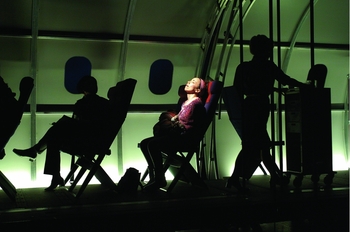
While the costliness and technical complexity of Lepage's works might tend to obscure this fact, one of the central principles of his theatrical aesthetic is the metaphorical minimalism of mitate. Seven Streams and other works exhibit a mise en scène comprising vastly fewer physical objects, actors and materials than the realities they are standing in for, and these materials – from the set, to the actors, to their props and costumes – are often used not as directly mimetic tools but as ‘material metaphors’ in the Zen sense conveyed by mitate. Accordingly, the house-and-garden set of Seven Streams remains present to our gaze throughout the play. Yet through the actors’ physical and our imaginative uses of it, this set metaphorically represents many different realities, locations and milieux around the world, from a New York tenement bathroom to an Amsterdam café to an Osaka theatre, from a railway station to a concentration camp. The basic set of Lipsynch, by Jean Hazel, functions in the same way, representing a Lufthansa aircraft, a London underground train, and a Montreal hotel room, while never fading from our gaze as itself, the unique material object created for the show, a metal-framed half-cylinder with sliding panels. In one scene, we find ourselves imaginatively contemplating all the sensory realities of an overnight flight, while remaining ever aware that the ‘passengers’ are sitting on ordinary folding wooden chairs, and their ‘aircraft’ is little more than a curved metal grid (Fig. 3).
Lipsynch. Photo: Erick Labbé.

Two particularly clear examples of mitate in Seven Streams will have to suffice. The atomic blast at Hiroshima is metaphorically conveyed by the flash of an automated camera in a train station photo booth. When the flashbulb goes off, Hanako covers her face, even though her blind eyes are protected behind dark glasses. The fact that this sightless victim of the atomic bomb instinctively shields her eyes from the light of the camera flash poetically suggests, with scant material means save for the sound and light of a flashbulb, not only the blinding explosion of the A-bomb but its lasting physical and emotional legacy for all who were affected by it. The sequence at the end of the play – when a kimono is used in a continuous sleight-of-hand to clothe, hide, reveal and draw connections between five different characters – works similarly. The kimono serves as a material metaphor for the equivalence of human trauma beneath all surface distinctions of age, gender and nationality, a metaphysical idea vastly more complex than, and not literally signified by, the item of clothing being used to evoke it. Using Lepage's own language for describing such effects, we could say that the magic trick takes place, we see the ocean and mountain landscape, in this case the unity of five characters’ stories of trauma and rebirth, but the strings, the material means, remain deliberately visible throughout.Footnote 43
What Günter Nitschke has said of the art of sekitei, that it stands ‘at the crossroads’ of ‘matter and consciousness’, and discloses both simultaneously,Footnote 44 applies also to Lepage's use of actors. His casting practices call equally strong attention to materiality and illusion, ‘matter and consciousness’, by foregrounding the performers’ own unique physical appearance and abilities, while also using them to represent a large number of different and extremely unlike characters. In Seven Streams, ten adult actors perform the roles of thirty-six characters of a wide variety of ages, nationalities and language groups; in Lipsynch, nine actors embody multiple characters of a similar variety. But because the same actor is cast as both mother and daughter, both father and son – Rebecca Blankenship performs Sarah Weber and Sarah's daughter Ada; Normand Daneau plays both Jeffery Yamashita and his son David – the audience is treated to a Zen-like double consciousness of the material before them. Marie Brassard's transformation from an eleven-year-old Czech prisoner of Terezin to an elderly blind Japanese translator is effected with the material help of little more than a wig and a pair of dark glasses; the extreme minimalism of these materials remains a conscious component of the imaginative illusion. In Lipsynch, Hans Piesbergen morphs before our eyes into a variety of hierarchically and professionally distinct individuals, from a Lufthansa airline employee to a Frankfurt police official, with a stunning minimalism of material aids: a slightly different posture in the chair and way of answering the phone, differently rolled-up shirtsleeves. Just as one ordinary stone might stand, through the magic of mitate, for an island mountain, a single actor here stands in for an entire human chain of responsibility within highly stratified corporate and governmental organizations across two continents and three language groups. He becomes not just ‘a’ voice on the phone, but ‘the voice on the phone’, in all its metaphysical dimensions.
Mitate is used across Lepage's oeuvre. In Playing Cards 1: Spades (2012), four actors operating vacuum cleaners under the beams of searchlights become a material metaphor for the vulnerability of the hardworking poor and their terror of being found – whether by helicopters in Iraq or by immigration agents in Nevada. Semiotically, the actors represent chambermaids in a Las Vegas hotel; but metaphorically, they materially convey something more conceptual: the violent cleaning up of nations by aerial bombardment and deportation.Footnote 45 In the same ‘playful’ way that a material as unwatery as gravel can function as water within a sekitei garden,Footnote 46 objects throughout Lepage's work are given a variety of imaginative roles. In The Far Side of the Moon, a washing machine's window serves as the hatch of a spaceship, a clock and a goldfish bowl. In The Dragons’ Trilogy, a parking lot attendant's hut suggests a Chinese laundry, a shoe store, a time machine, an airport shop, an art gallery and a rooftop; shoeboxes depict houses, and sheets of hanging laundry become the sails of a Chinese junk. In Lepage's Ring (2010), the ribs of a giant ‘tectonic’ spine become a rainbow bridge, the roof of a house, a staircase down to Nibelheim, a waterfall in the Rhine, a troupe of Valkyrie horses in flight, and the single flying horse of Brünhilde.Footnote 47 Like the stones and gravel of a Japanese garden, Lepage's materials offer us a simultaneous Zen perception of the physical limitations of the objects used and the limitless play of imagination.
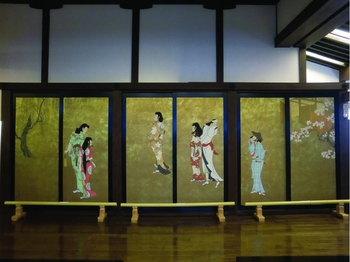
The third and last principle of sekitei on view in Lepage's work is the technique of asymmetrical fragmentariness, which we will be calling fusuma-e.Footnote 48 We take the term from the multi-part paintings found, among other places, in the Zen Buddhist temples that adjoin so many stone gardens in Japan, specifically within the ceremonial room called the ho-jo.Footnote 49 This room, in front of which Zen rock gardens are typically set and from which they can be viewed, is enclosed with sliding rice-paper doors. But it is from the particular type of sliding door within the ho-jo, its fusuma screens, that we take the term we are using to describe the fragmentary quality of Lepage's approach. These fusuma screens feature paintings, fusuma-e, that depict various natural and mythological scenes.Footnote 50 Goto says that these paintings ‘render profound spirituality with a stroke of brush and blank space’; they are intended to stimulate the viewer's imagination in much the same way as sekitei does.Footnote 51 Each painting is itself only a fragment, but when the screens are drawn together and closed, they become a complete picture (Fig. 4).
Shinya Kaneda, Gosho no yu, Kinosaki. Photo: Mai Kanzaki.

Like the other techniques of sekitei, asymmetrical fragmentariness has deep roots in Zen philosophy, which, as noted above, emphasizes independent personal agency and active individual effort in the quest for enlightenment. On the grounds of Zen monasteries and temples where stone gardening achieved its highest form, according to Nakagawara, ‘an entirely new form of space’ was created, and one in which asymmetrical fragmentariness was ‘crucial’.Footnote 52 As Nakagawara explains, asymmetry gives maximal scope to individuals in actively imposing their own forms upon nature: one has not really imposed one's own uniquely creative form on nature if one arranges everything regularly and predictably on an ‘externally superimposed mathematical grid’.Footnote 53 The experience of those who contemplate the resulting aesthetic forms is likewise individual and effortful in the Zen sense, for they must actively impose a pattern on material that seems to be marked by lacunae, blank space, and missing connective elements.Footnote 54
Consequently, in Zen art forms in general, according to theorist Thomas Hoover, ‘we search in vain for straight lines, even numbers, round circles. Furthermore, nothing ever seems to be centered’.Footnote 55 In a French garden, by contrast, for example at Vaux-le-Vicomte and Versailles, everything is positioned in predictably geometric and symmetrical patterns;Footnote 56 such patterns do not exist in Japanese gardens according to Yukio Mishima.Footnote 57 The elements of sekitei are placed so asymmetrically, in fact, that at first glance such gardens appear to be disordered. Their irregular arrangement of rocks is deliberate, however, meant to duplicate the mysteries of the universe, and to invite the viewer's active, sense-making interpretation. The spiritual content of this Zen preference for asymmetry thus bears close comparison with what, in critic and scholar Richard Hornby's view, is one of the central themes of Seven Streams: that existence is inherently random and shapeless, and that, as we see with especial clarity in the holocausts of Hiroshima, the Shoah, and the AIDS epidemic, ‘good luck and bad have nothing to do with virtue or destiny but result from pure chance’, the happenstance of being in the right or wrong place at the right or wrong time.Footnote 58 What meaning there might be in such random occurrences is for those viewing with a sufficiently active state of mind to discover.
We have named this aesthetic technique after the fusuma screens of the ho-jo because they so clearly exemplify the structural mechanisms and effects of Lepage's approach to narrative. Consider the six separate panels of the fusuma-e in Kinosaki (Fig. 4). As we see, the fragmented nature of the scene and large but asymmetrical amounts of blank space within and between the panels create many narrative mysteries. Who are the two figures on the left looking at? Is the figure in the plain white kimono talking to the solitary figure on the right, dressed in blue? What are the relationships between these figures? What is ultimately happening here? Do these separate panels together depict a single story with a meaning that unites them?Footnote 59
Each act of Seven Streams is presented in exactly this way, as a separate panel in a fusuma-e painting. Act I depicts the 1945 love affair between a Japanese widow disfigured by the atomic blast and an American soldier from Houston sent with his camera to document the effects of the explosion. Act II gives us a seemingly unrelated panel depicting the lives of neighbours in a New York apartment in the 1960s. The next panel portrays the efforts of an AIDS sufferer in the 1980s to gain access to an assisted suicide in Amsterdam by marrying a Dutch citizen. In the next panel, a Czech artist has an exhibit in Tokyo and begins to face her past as a Holocaust survivor. The next act or narrative panel depicts the Osaka Expo of 1970, at which a French-Canadian actor performs Georges Feydeau's The Lady of Maxim as a demonstration of Québécois culture. The sixth panel is set in 1995 and features a bunraku puppet play based on an old Chinese tale about the invention of gunpowder.
Like the six panels of our fusuma-e painting (Fig. 4), each of the seven acts of Seven Streams is surrounded by lots of narrative ‘blank space’. Indeed, as much as twenty-five years elapse between one act and the next. As in fusuma-e, furthermore, the blank space is asymmetrical and unpredictable: sometimes there are decades’ worth of ‘untold story’ between one act and the next, sometimes only one year.Footnote 60 Some panels are crowded with incident, some relatively bare. The quantity and asymmetry of the narrative blank space in Seven Streams ensures that when characters appear, disappear and unexpectedly reappear, their relationships with the other figures are not immediately apparent. Like the figures in a fusuma-e, these characters are presented as isolated elements within self-contained panels. As a result, the narrative itself is fragmentary and discontinuous.
The fragmentary structure of Seven Streams, moreover, was integral to its creation. As co-creator Marie Brassard explains, the play began not as a continuous narrative but as seven separate ‘boxes’ containing ‘one or two ideas’ each; ‘the first box was China, the second box was Prague, the third box was Paris’.Footnote 61 The company then engaged in the ‘visual’ process of joining the boxes together in a storyboard and looking for echoes and connections.Footnote 62 Aleksandar Dundjerović's 2007 study of the Ex Machina creative process confirms Brassard's words:Footnote 63 during the creation of Seven Streams and other works, an overarching ‘performance narrative’ is ‘non-existent’ at the start; it is, rather, ‘discovered’ later.Footnote 64 Along with the other creators, Lepage, as ‘outside eye’, looks for ‘an underlying unity’ between the separately boxed elements and ‘reassembles’ them in pursuit of ‘a connecting story’.Footnote 65
Like the panels of a fusuma-e painting, the narrative fragments of Lepage's works do eventually comprise a single picture, but one that only becomes visible when the panels are physically drawn together – before and by a viewing audience. Only with the addition of the audience does ‘narrative unity’ really begin to enter into Lepage's creative process, according to Dundjerović.Footnote 66 Up to that point, the story ‘remains fragmented and disjointed’.Footnote 67 For example, as company member Rebecca Blankenship recounts, it was only as a result of the Tokyo production that the play's central narrative, the life of Jeffery Yamashita, was even found: it was discovered by the audience, who noticed, as a result of a prop left onstage by accident in the wrong scene, that Jeffrey had a half-brother in the United States.Footnote 68 This ‘whole new’ narrative, which in the final version of Seven Streams connects all seven panels of the play, ‘was created’ by the audience; neither the actors nor the director had seen it before.Footnote 69 Dundjerović therefore rightly concludes that the audience of Seven Streams and other Lepage works performs a key creative function, ‘fram[ing] the meaning’ of the play and even ‘author[ing]’ it to some degree.Footnote 70
Examples of fusuma-e narratives that are unified only in and through the audience's creative gaze can be found across Lepage's oeuvre. Footnote 71 In The Dragons’ Trilogy, three apparently unrelated figures appear in Act II: Jeanne dances in Toronto with her ex-boyfriend to a Kurt Weill song in 1935, Yukali remembers making love to an American officer in Japan as a geisha, Françoise entertains the troops at a Christmas show in London in 1945. These fragments feature different characters, different locations and different time periods. For the active viewer who brings them together, however, they compose a single picture: Jeanne and Françoise were childhood friends; Yukali is connected to Jeanne both through the title of Weill's song, Youkali Tango, and through their East–West love affairs, and also to Françoise through the latter's audience and function as an entertainer. Indeed, when actively ‘brought to a close’ by the viewer, such fusuma-e panels often join up with a sense of cathartic inevitability, just as the seven streams of the River Ota merge and flow together, by geographic necessity, at Hiroshima Bay. The temporally and spatially disconnected figures of Seven Streams likewise turn out to be intimately connected, either through love, family, friendship or artistic passion. Thus, by the end of Seven Streams, we see a unified fusuma-e portrait of the global fallout of the war-ending blast at Hiroshima – on the single family of mankind.
The ‘profound spirituality’ that Goto says is rendered by the Zen art of fusuma-e is also accomplished by the narrative structure of these plays, for in overcoming the lacunae of blank space and fragmentariness in the mise en scène, spectators are rewarded with an all-encompassing vision that has been attained by their own efforts. Creative spectators will notice, for example, that a given play's material metaphors evoke related ideas. In Seven Streams these metaphors are often eye-centred (cameras, photographs, flashbulbs, eyes, eyeglasses and theatrical spectacles), together producing a coherent portrait of retina-burning horrors that cannot be looked at directly without physical or emotional damage. The material metaphors of Lipsynch, in keeping with its depiction of acoustic self-expression from birth to death, are mainly ear-centred (radios, microphones, telephones, sound stages, recording studios, dubbing processes and various genres of vocal music including opera, jazz and heavy metal). For spectators alive to the many forms of artistic creation depicted in these works, Lepage's narrative fragments might also tell a story about the capacity of art-making to transcend the pain of life. And because this joined-up picture, this coherent meaning, has to some degree been discovered by us, it could be said that in the very act of contemplating and understanding these plays we ourselves experience the salvation through art that they depict.
But not always, of course, and not by everyone. Theatre critic Paul Taylor of The Independent, for example, could not ‘see’ a unified picture in the panels of Seven Streams in 1994.Footnote 72 The first outing of Playing Cards 1: Spades in Toronto in 2012 similarly left some viewers delighted with individual scenes but baffled by the whole. Like early versions of The Dragons’ Trilogy, Seven Streams, and Lipsynch, however, this performance offered but the first few panels of a much larger panorama still to be developed, with the help of audiences around the world, over a period of years.Footnote 73 Still, some spectators of the complete Seven Streams and Lipsynch complained of never seeing a unified vision or experiencing a coherent narrative.Footnote 74 Like the panels of a fusuma-e, however, the fragments of Lepage's mise en scène must be drawn together by the viewer, by each viewer's own pattern-making skill, associations and ability to parse the poetry of material metaphors. It is therefore not surprising to learn that Lepage's spectators experience his works in different, but equally introspective, ways. Surveying a wide range of critical responses to The Dragons’ Trilogy and Seven Streams, Christie Carson found that these plays functioned as ‘deeply personal’ mirrors for individual spectators; she even went so far as to suggest that, as a result, the plays ‘can appear as profound and complex or as shallow and trivial as the viewers or reviewers themselves’.Footnote 75 But the important point from our perspective is that, like the spiritual exercise of contemplating Zen art forms, overcoming the asymmetrical blank space of Lepage's fragmentary mise en scène requires a personally effortful creative investment on the spectator's part.
Nakagawara describes the spiritual payoff of this Zen effort as follows: contemplation ‘becomes synonymous with introspection, and observing the outside world means looking into one's own nature’.Footnote 76 For Hoover, too, gazing upon sekitei gardens leads to a cultivation of oneself.Footnote 77 Keene explains the stone garden's tendency to cultivate its spectators’ own creativity by comparing Ryoan-ji with the art of Michelangelo:
The Sistine Chapel is magnificent, but it asks our admiration rather than our participation; the stones of the Ryoanji, irregular in shape and position, allow us to participate in the creation of the garden, and thus may move us even more.Footnote 78
Because it relies on our willingness to play imaginatively with the material and find patterns in the fragments, this is an art that quite simply ‘makes an artist of the viewer’.Footnote 79 In Nakagawara's words, sekitei is ‘a highly interactive form of art, where the beholder is permanently summoned . . . to participate in the creation of meaning’.Footnote 80
The same could be said of the art of Robert Lepage, who similarly judges the success of his work according to whether it gives each and every spectator the chance to create its meaning. ‘I think I've achieved something when it's extremely simple but triggers in 300 people in the house 300 different’ meanings: ‘There are two ways of being attentive to a show, either you can watch in a very passive way or in a very active way. I believe that the audience wants to create.’Footnote 81 By inviting us to participate in their creation, plays like Seven Streams, The Dragons’ Trilogy, and Lipsynch function like sekitei gardens, making artists of us all. Contemplation of the outer material world becomes a practice in cultivating of our own inner powers, and through this Zen dialectic, in Goto's words, we achieve the enlightenment of rediscovering ourselves ‘as a part of the universe’.Footnote 82 Through active contemplation of Lepage's miniaturized global landscapes, we likewise rediscover ourselves, quite literally, as a part of the cosmopolitan universe we call Planet Earth. Using the Zen techniques of an asymmetrical fragmented narrative, material metaphors, and a miniaturizing enframement of vast terrain, Lepage's sekitei gardens allow us to imagine and make sense of complex global geographies – while gazing on strings, boxes, gravel and stones.