1. Introduction
“More is more” would seem to be a tautology. But in some contexts, less is more. The argument of this article is that one such context is in the endeavor to explain how organization affects the behavior of a mechanism. To understand organization, one often needs to abstract from the structural specifics of a mechanism and represent it in a skeletal, coarse-grained manner. To illustrate this, we look at some recent work on so-called network motifs in genetics and cell biology. Models in this area allow researchers to explore the internal connectivity of a mechanism. In this form of modeling, the pattern of causal relations within a system is highlighted, while structural aspects of components are suppressed. We discuss how such abstract, skeletal models explain temporal properties of mechanisms.
The new mechanistic philosophy of science has championed the idea that explanation in the life sciences (and kindred areas) often works by decomposing systems into their parts/entities and their operations/activities. In developing this outlook, one set of authors has tended to emphasize completeness and specificity, as an explanatory virtue or ‘regulative ideal’ for mechanistic explanation (Machamer, Darden, and Craver Reference Machamer, Darden and Craver2000; Darden and Craver Reference Darden and Craver2002; Darden Reference Darden2006; Craver Reference Craver2007). A second group of writers on mechanisms (Wimsatt Reference Wimsatt, Donagan, Perovich and Wedin1986; Bechtel and Abrahamsen Reference Bechtel and Abrahamsen2005; Bechtel Reference Bechtel2006; Bechtel and Richardson Reference Bechtel and Richardson2010) has not evinced this attitude, but they have not said much about the role of abstraction either. This article is intended as a contribution to the mechanist framework. We see it as continuous with the second line of thinking and as a friendly, yet significant, corrective to the first line of thinking.
The article is structured as follows. We start, in section 2, with a general discussion aimed at characterizing the central notions of abstraction and mechanistic organization. In section 3 we look briefly look at some older work in biology that appealed to networks and graph theory, introducing some general concepts along the way. Section 4 looks in more detail at some recent work on network motifs and highlights the kind of representation involved in this line of work, which we call connectivity modeling. Section 5 discusses the explanatory role of connectivity modeling in more general terms and relates our account of abstraction to other accounts found in the mechanist literature.
2. Preliminaries and Basic Notions
We begin by characterizing some basic notions we will appeal to throughout, starting with abstraction. Tersely put, abstraction is the omission of detail. An abstract description includes only some of what could, in principle, be said about its subject matter. It leaves matters open, in certain respects. A simple case would be specifying that a certain property falls within a range (“between 3 and 10 kilograms”; “smaller than 5 microns”), while not indicating the exact value (which may, in principle, be known). More interesting cases involve depicting global features without specifying how they are realized. Thus, one can specify the average of some property, its variance, or some aspect of its distribution, without giving details about the individuals thus distributed or averaged over. In the cases we will deal with below, the abstraction consists in representing the pattern of causal connections among elements of a system, suppressing structural features of the elements, and specifying how connections between them are “forged.”
Abstraction is, of course, a matter of degree. Indeed to say of a description that it is abstract is to imply, or at least suggest, that a more concrete description is possible. Many, perhaps all, descriptions are abstract in some respects and to some degrees. But abstractness becomes interesting when the degree is high and when the respects are ones that, in other salient contexts, one would not want to abstract from.Footnote 1
It is important, in a scientific context, to distinguish abstraction from idealization (Jones Reference Jones, Thomson-Jones and Cartwright2005; Godfrey-Smith Reference Godfrey-Smith, Barberousse, Morange and Pradeu2009). Broadly understood, idealization is the introduction into a theoretical model of simplifying falsehoods—assumptions that are known not to describe accurately the target phenomenon but that nevertheless expedite analysis and understanding. To say that a population of rabbits is infinitely large is an idealization, in this sense. Insofar as a model is abstract, it need not contain any falsehood or inaccuracy. Abstractions are poor in detail yet potentially true and accurate. Idealizations are by definition mismatched to reality.Footnote 2 We will focus on abstraction and largely set aside idealization in this article. This is not to say that it is absent from the cases we discuss. For instance, in section 4 we describe a model in which a transcription factor that has continuous output is treated in an idealized fashion as a Boolean AND-gate. However, we focus our discussion of that and other models on the role of abstraction, not idealization.
It is worth emphasizing that abstraction bears no special connection to abstract entities. Or at least, we do not presuppose any such connection. Historically, especially among empiricists, some have thought that abstract objects, such as numbers, properties, and concepts, are the product, in some sense, of abstraction from concrete instances. Nowadays this is not a popular idea (Lewis Reference Lewis1986, sec. 1.8; Rosen Reference Rosen and Zalta2001). We, at any rate, speak of abstraction purely as a feature of descriptions or representations. We are not concerned with abstract things.
Another notion that is central to this article is that of organization. This notion figures prominently in the writings of mechanists, but it rarely receives an explicit characterization. Our focus will be on a specific aspect of organization, namely, causal connectivity. But we think it helpful to provide a few general comments as well. When we speak of organization, we do not mean simply the having of some internal structure. Organization, as we see it, involves an internal division of causal labor whereby different components perform different causal roles. A homogenous fluid in a flask has complex internal structure. But (for the most part) its behavior does not involve differential causal roles of components. On this conception, some systems are organized, whereas others are not. More precisely, some systems are more organized than others.
To put the matter more formally, we will say that given some effect or behavior, a system is organized with respect to that effect or behavior if (a) different components of the system make different contributions to the behavior and (b) the components’ differential contributions are integrated, exhibiting specific interdependencies (i.e., each component interacts in particular ways with a particular subset of other components).Footnote 3 In our view, both conditions are necessary, although both may be met to varying extents, resulting in different forms and degrees of organization.
Elsewhere we refine this characterization and discuss its significance for modeling (Levy Reference Levy2013). Here we only highlight a few pertinent features of it. First, note that organization is relativized to a system-level behavior. Some system-level behaviors are highly sensitive to the exact functioning of components, in the right place, time, order, and so on. Other behaviors may be less sensitive to such features.
Second, it is important to us that not all systems—not even all systems with a definite and specifiable internal structure—are organized. To say that mechanisms are organized is to attribute distinctive causal features to them. It is to say that they are systems that exhibit a certain form of dependency of the whole on its parts. And so one way to put our central claim is to say that abstraction is a theoretical tool that often allows scientists to represent and reason about such causal features.
On this understanding, some systems are organized (or more organized) relative to others. In biology, macromolecular structures, such as the ribosome or the bacterial flagellum, are paradigm examples of organized systems: they have a diversity of parts, each playing a distinct role. And the layout and interdependence of parts is key to the system’s overall behavior. On the other hand, a phenomenon like diffusion is paradigmatically disorganized: parts play all but identical roles, and integration is minimal.
Mechanistic explanations address organized systems: they decompose a system into its parts, ascertain their different contributions, and determine how these are integrated into a whole. It is the fact that the system is organized (and the type of organization it has) that makes it amenable to mechanistic description and analysis. Systems that are internally disorganized—like a flux of diffusing molecules—where constituents do not make distinctive contributions, or internal integration is secondary, are ones in which decomposition tends (epistemically) to be less powerful. This motivates a better understanding of the role played by different organizational patterns and the tools available for doing so.
Our focus in this article is on techniques through which scientists understand how a particular aspect of organization, the pattern of causal connections between the parts of a mechanism, affects its functioning. By ‘causal connections’ within a system (or its ‘causal connectivity’), we simply mean which components effect changes in which other components. Typically, a model of a system’s connectivity will specify the pattern of connections, as well as provide some, but not much, information about the nature of the connections—whether they are inhibitory or excitatory, the rate at which components activate or inhibit each other, and the magnitude of the effect measured along some dimension. But a connectivity model will typically say very little about the properties and specific causal powers of the components as such. It will typically also be sparing with respect to the concrete relations in virtue of which connections in the system obtain—whether they are due to a particular spatial layout, a “lock and key” like compatibility, or whatnot.
Our contention is that it is often the connectivity, treated abstractly, that explains why a mechanism exhibits the particular behavior it does—especially when the behaviors in question concern nontrivial dynamic patterns. In the simplest cases, the operations in a mechanism exhibit sequential connectivity, such that the product of one operation is the input to a subsequent operation. However, although sequentially ordered processes exist, they are rare in the living world. Moreover, few interesting general principles can be extracted from a representation that treats complex systems as sequential, stepwise devices (except perhaps for the idea developed in biochemistry that any pathway has a rate-limiting step). So it is important to consider more complex, nonsequential modes of connectivity. Until quite recently there had not been much work, especially not within biology, along such lines. But even the little that exists typically takes the form of accounts that abstract from the details of the parts and operations of a mechanism and look at the pattern of connections among them. For example, negative feedback, as employed in the design of governors (control systems) for various machines, was analyzed abstractly by Maxwell (Reference Maxwell1868) and popularized by the cyberneticists (Wiener Reference Wiener1948). We touch briefly on negative and positive feedback in the next section, where we describe the tools and concepts required for representing connectivity and comment on some early work in this vein, which primarily targeted basic features of large networks. We then turn to more recent research on particular patterns of connectivity that is especially relevant to explaining the dynamic behavior of the sorts of mechanisms on which the new mechanists have focused.
3. Network Modeling and Causal Connectivity
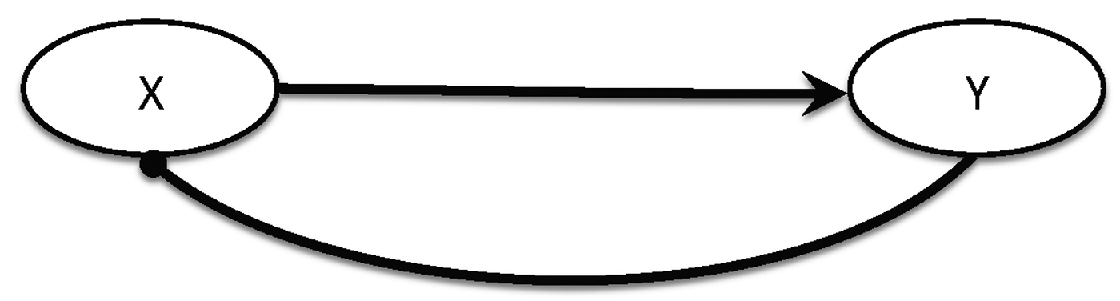
Graph theory, a field in mathematics, provides an important set of tools for representing patterns of connectivity. In a graph, parts are represented as nodes and their operations as edges. Figure 1 provides a graphic representation of negative feedback in which an effect of an operation feeds back to affect a part performing an operation represented as occurring earlier in the graph. When used to represent a particular empirical system, or set of systems, a graph may be abstract in a variety of ways. For instance, nodes on the graph may represent parts of a similar type (e.g., genes), but in principle, and sometimes in practice too, nodes (in one and the same graph) might stand for entities of rather different varieties—genes, proteins, and other elements they interact with, such as whole cells or even organisms. Graphs also tend to contain little by way of structural information about parts—a node may represent both an intricately structured object and a far simpler one with which it interacts. In many cases, a node is, in effect, only a representation of the fact that a certain element in the system exists, along with some basic features of its response to other elements, especially the conditions under which it becomes active (which may take the form of treating it as, e.g., a gate). Similarly for edges, which typically represent no more than the direction and magnitude of the interaction between two nodes and may remain silent on much else: whether the interaction is mechanical, chemical, or electrical, which conditions and properties allow for the “meshing” of two parts, and so on. Thus, graph-based models represent connectivity in a similar manner even when parts and operations vary in many of their concrete properties.Footnote 4
Abstract representation of a simple negative feedback loop in which X is transformed into Y in one operation, and in another Y represses the transformation of X into Y.

The basic behavior of simple graphs can often be understood informally, even in one’s head. For example, one can understand how the negative feedback loop portrayed in figure 1 maintains a system near a target state by reflecting that as X increases, so will Y, leading to more inhibition of X, whereas if X decreases, so will Y, and this will lead to less inhibition of X. But even if negative feedback brings a mechanism close to a target state, it will typically do so only after initial oscillations around the target point. Moreover, in some cases, negative feedback will generate sustained oscillations. Understanding such behaviors, even of this simple mode of organization, often exceeds what can be accomplished through mental simulation. Rather, one must turn to mathematical representations in which nodes are characterized in terms of variables representing properties of component parts (e.g., the concentration of a substance) and edges in terms of parameters representing operations (e.g., operations that increase or decrease the substance’s concentration). For the purpose of understanding the effects of the mode of organization, one abstracts from the parts and operations involved and considers only the values of the variables and parameters incorporated into the equations. Researchers then employ these equations to determine how any mechanism organized in this way will behave. Sometimes they can derive analytically what will happen. In cases in which analytical solutions are not possible, they rely on computational simulations to determine how the mechanism will respond given initial values of the variables and settings of the parameters.Footnote 5
When a graph has been adequately constructed, the nodes and edges represent parts and operations in actual mechanisms. Moreover, it is through assigning specific values to the variables and parameters that mathematical representations are tied to mechanisms constituted of specific parts and operations.Footnote 6 Even then, it is the values of the variables and parameters that matter in accounting for the pattern of behavior, not the concrete aspects of the parts and operations. Hence, an analysis of the graph (or a simulation of it) applies to any mechanism in which those values obtain. Moreover, often researchers are focused not on consequences of the mode of organization when specific variable and parameter values are employed but on consequences that are robust across a range of variable and parameter values. In exploring these consequences, investigators tend to abstract even further from the specific details of the mechanism. Let us very briefly review some key developments in applying graph theory to the modeling of organizational patterns, before we turn to network motifs, where we illustrate our claims in a fuller way.
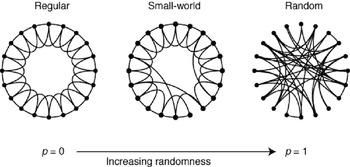
One important line of investigation has analyzed the effects of global patterns of connectivity among large numbers of components. Winfree (Reference Winfree1967) constructed and analyzed a mean field model in which each node is connected to all the other nodes and is affected by the mean behavior of all the other nodes. His concern was with the synchronization of oscillatory behavior within such a network. In Winfree’s model there are two global transitions as the value of the strength of the coupling among nodes changes. At the first, the oscillators transition from independent to synchronized behavior; at the second, their phase and amplitude become locked. There are few mechanisms, however, in which all components are connected to one another. Accordingly, Erdös and Rényi (Reference Erdös and Rényi1960) considered what happens if connections between units are established randomly (as on the right in fig. 2). They demonstrated that, if the number of connections was much less than the number of nodes, only small, disconnected clusters of connected nodes would develop in which oscillators could synchronize but that, when the number of connections was approximately equal to half the number of nodes, a phase transition occurred, and a single giant cluster would emerge in which nodes could synchronize. Although most biological networks do not appear to exhibit random connectivity, the notion of a giant cluster has been found useful in analyzing many networks such as protein interaction networks in yeast (Yook, Oltvai, and Barabási Reference Yook, Oltvai and Barabási2004). In contrast to networks in which there are edges between all units or between randomly selected ones, Ermentrout and Kopell (Reference Ermentrout and Kopell1984) focused on regular lattice designs in which each node is connected to just its neighbors so as to form a chain of oscillators (as on the left in fig. 2); they showed that such networks could generate traveling waves of activity rather than populations of synchronized oscillators. They employed this analysis to understand the behavior of biological mechanisms such as central pattern generators that regulate motor behavior in various animals (Kopell and Ermentrout Reference Kopell and Ermentrout1988). Each of these classical graph-theory analyses reveals the behavior of classes of networks viewed very abstractly.
Watts and Strogatz’s (Reference Watts and Strogatz1998) representation of small networks as resulting from randomly changing a few local connections in a lattice into long-range connections.

Another contribution of large-scale graph-based modeling has been to develop measures of network structure. In regular lattices, local connectivity generates clusters of units that can collaborate on specialized tasks, but the paths for communicating across the whole network are quite long. In random networks, communication pathways between any two nodes are quite short, but there are no clusters. Watts and Strogatz’s (Reference Watts and Strogatz1998) made a major advance in graph-theory analysis by demonstrating that adding a few long-distance connections to a regular lattice (as shown in the middle in fig. 2) generates a network structure with both high clustering and short average path lengths between nodes. They termed such networks small-world networks, argued for their virtues in activities involving information processing, and determined that many real-world networks, including those in biological mechanisms (protein networks and neural networks), exhibit a small-world structure. Barabási and his colleagues (Barabási and Albert Reference Barabási and Albert1999) showed that in many real-world networks the number of connections from a given node is not distributed randomly but according to a power law. Some nodes are extremely highly connected and serve as hubs. The role of hubs and other generic network elements can be analyzed by looking at the effects or their presence, abundance, and distribution within a large-scale network, such as providing for local clusters that perform specialized tasks or enabling coordinated activity in a large system. These analytical techniques have revealed functionally relevant small-world organization with hubs in, for example, neural networks identified in the human brain analyzed in resting-state fMRI that coordinate in the performance of different information-processing tasks (Power et al. Reference Power, Cohen, Nelson, Wig, Barnes, Church, Vogel, Laumann, Miezin, Schlaggar and Petersen2011; for a highly informative general discussion, see Sporns [Reference Sporns2010]). Recent studies have revealed that distortion in this small-world structure accompanies disorders such as schizophrenia (He et al. Reference He, Sui, Yu, Turner, Ho, Sponheim, Manoach, Clark and Calhoun2012) and Alzheimer’s disease (Sun, Tong, and Yang Reference Sun, Tong and Yang2012).
The analysis of large-scale graph structures operates at a very high level, abstracting even from the specific pattern of connectivity and focusing on statistical features of the network (e.g., cluster coefficients, mean path lengths, and degree of connectivity; see Newman Reference Newman2003). We have provided just a few examples of how such analysis is proving valuable to biologists as they attempt to understand the systems into which individual components are organized. But here we wish to focus more squarely on a class of models that occupy an intermediate ground in terms of abstraction and that connect more directly with philosophical analyses of mechanisms and mechanistic explanation. These involve smaller-scale structures with particular functions. Paradigm examples have been biochemical circuits that ferment sugars or cellular processes such as long-term potentiation. In this realm, negative feedback and positive feedback have, until recently, seemed to exhaust the taxonomy of recognized connectivity patterns that have distinctive consequences. Throughout most of the twentieth century, negative feedback was reasonably well understood as a means of controlling mechanisms, thanks to Maxwell’s (Reference Maxwell1868) mathematical analysis. Positive feedback, however, was regarded as resulting only in runaway behavior. Only when Field, Körös, and Noyes (Reference Field, Körös and Noyes1972) developed a mathematical model of coupled autocatalytic reactions constrained by negative feedback did positive feedback become recognized as a means of generating self-organizing systems.
However, recently a number of researchers, most prominently Uri Alon (Reference Alon2007a, Reference Alon2007b), have pioneered the study of patterns of connections between small numbers of units that have distinctive consequences for the behavior of the network. Alon terms these ‘network motifs’. We see this newer line of work as offering an original perspective on organization and as pointing to the potency of abstract models that target connectivity in the kinds of systems that new mechanists have seen as paradigms of biological explanation. We next discuss motifs in general and then look at one simple example in particular.
4. Network Motifs
Alon’s program focuses on regulation of gene expression, principally in bacteria and yeast. There the unit, consisting of a gene and the promoter at which the product of another gene activates or represses its transcription, is called an operon. The relations between genes that figure in such regulation are commonly represented in networks in which nodes stand for individual operons and edges represent the regulation of one gene by another. On superficial examination, there does not appear to be any systematic organization in such networks. Alon’s approach was to consider the possible ways in which a small number of nodes could be connected together and determine which of these occurred more frequently than chance in actual networks. When the number of units is small, the number of distinct possible subgraphs is limited, and it is possible to determine their relative frequency using an effective algorithm. Alon and colleagues define motifs to be those subgraphs that occurred in gene-regulatory networks much more frequently than in randomly constructed graphs of similar size and connectivity.Footnote 7
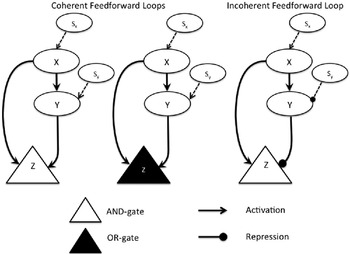
Consider three node graphs. Of the 13 possible configurations of directed edges linking three nodes (employing from two to six edges), the only arrangements that qualify as motifs in the transcription regulation network of E. coli are various forms of the feed-forward loop (FFL). In an FFL, an initial transcription factor (X) regulates a second transcription factor (Y), and both of them regulate an operon (Z). Thus, the graph has three nodes and three edges. This is illustrated in figure 3.
Three forms of the feed-forward loop that appear as motifs in E. coli. Left and middle implement sign-sensitive delays. Left, activation of target Z is delayed after presentation of Sx until sufficient gene product X accumulates to generate enough Y so that together X and Y can activate Z and ceases as soon as Sx ceases to produce X. Middle, activation of target Z begins as soon as sufficient gene product X accumulates, but its termination is delayed after Sx is interrupted until there is no longer sufficient Y to activate Z. Right, pulse generator: production of X after Sx activates Z, but since X also initiates production of Y, which represses Z, Z will be repressed as soon as enough Y accumulates.

To understand how a network employing the FFL motif will behave, a bit more than the sheer pattern of connections needs to be specified. But we need to attend only to two generic aspects of the relations among components: whether a part X activates (increases) or represses (decreases) the operation of another part Y and how the inputs from X and Y combine in affecting the behavior of Z. With respect to activation and repression, Alon distinguishes whether the two pathways that converge on Z both serve to activate or repress Z (such motifs he calls coherent) or whether one activates whereas the other represses Z (he calls these incoherent). The overall effect of the pathway through Y represses Z if one of the two edges represses and the other activates—if both activate or both repress, the overall effect is activation (when both repress, the repression of Y removes the repression of Z). In fact, the prevalent forms of coherent FFLs involve all activating edges, whereas the prevalent form of incoherent FFL has a repressor connection between Y and Z. Technically, Alon designates these as coherent type 1 and incoherent type 1 FFLs, but for simplicity we will just refer to coherent and incoherent FFLs. The vast majority of FFLs in the E. coli transcription regulation network are coherent.
We now turn to how the two pathways are combined: some operons require both inputs to be present before beginning transcription, others require only one to be present. A helpful idealization is to treat the target as a Boolean gate. This is not strictly true since inputs typically affect target genes in a graded and potentially complex fashion, but to understand the dynamics of motifs, a Boolean treatment serves well (for details, see Alon Reference Alon2007a, secs. 2.3.4–2.3.5). When both inputs are required to activate the target gene, the operon is regarded as an AND-gate. When only one is required, it is treated as an OR-gate.
Thus, the overall model includes a connectivity pattern, like some version of the FFL, and a target gate, either AND or OR. In terms of these distinctions, Alon identifies three versions of FFLs that qualify as motifs in E. coli. These are shown in figure 3; we will consider each in turn.
To understand the coherent feed-forward motif with an AND-gate input to Z (fig. 3, left), only three additional factors need to be taken into account. First, there is a time delay between the binding of a transcription factor to the promoter of the gene and the accumulation of sufficient concentration of gene product (X or Y or both) to activate the target (Z). Second, gene products gradually diffuse away or decay after they are produced. Third, the time delay on the indirect path to Z ( ) is greater than that on the direct path (
 ). Under these conditions, production of Z will not begin immediately after the input signal Sx (and Sy if needed) but will be delayed until a sufficient quantity of Y has been generated. However, once the production of X (or Y) decreases, the production of Z will also be curtailed as quickly as the transcription factors decay or diffuse sufficiently. What could be the role of such a response pattern? Alon suggests that by delaying the generation of Z for a period after X appears, the motif prevents the unnecessary generation of Z, and processes downstream from it, when the production of X was only transitory; that is, it is a useful buffer when, from the point of view of a regulator of Z, the X signal is noisy. The motif, in Alon’s terms, functions as a persistence detector.
Having analyzed the behavior of the coherent FFL with an AND-gate abstractly, Alon and his colleagues consider a specific instance of the motif to check the appropriateness of their analysis. One place it appears is in the arabinose regulation system. Bacteria have a mechanism to use the sugar arabinose as a fuel when glucose (a better fuel source) is in low supply and L-arabinose is present. The signal for the absence of glucose is cAMP, but there are spurious pulses of cAMP (e.g., as the bacterium transitions between different growth conditions). Here cAMP plays the role of Sx, triggering a specific transcription factor CRP (in the role of X). Another transcription factor, AraC, plays the role of Y, and the operon that expresses the enzymes necessary for breaking down arabinose serves as Z. As expected, most cAMP pulses are of shorter durations than the time required for the generation of sufficient AraC (Y) to activate the arabinose operon (Z). Only when the cAMP signal is longer than the typical spurious pulse does the arabinose operon begin synthesis of three of the key enzymes employed in arabinose metabolism (Mangan, Zaslaver, and Alon Reference Mangan, Zaslaver and Alon2003). In this case, the occurrence of a coherent FFL with an AND-gate makes sense: it functions as a persistence detector.
Note an important feature of this analysis: it does not depend on the details of the arabinose system. Persistence detection is a consequence of the abstract organization of the system. Following Alon, we have given specific details about the parts and operations in the arabinose circuit. But these do not serve to elucidate why the mechanism operates as a persistence detector. They only show that it is present in the arabinose context and suggest why it is useful there. Altering the details of the components (as long as they meet the minimum conditions for fulfilling the role in the organizational schema) does not change the behavior, whereas altering the organization (changing what is connected to what) does.
We will be briefer in considering the other two FFL variants. When an OR-gate rather than an AND-gate is employed as the input function for Z (fig. 3, center), very different behavior results—indeed the opposite of persistence detection. As soon as the signal Sx activates sufficient X, Z is activated; there is no delay. The effect of Y is seen when the signal activating X terminates. This will stop the generation of new Y, but the accumulated Y will continue to activate Z until it either disperses or degrades. This enables Z to continue to function even through temporary interruptions of the signal to X and to complete activities already initiated. Once again, we can appreciate the value of this by turning to one of the instances in which the motif is employed. It occurs in the system that initiates the construction of the flagellum motor in E. coli (Kalir, Mangan, and Alon Reference Kalir, Mangan and Alon2005). The delay in shutting off Z is approximately 1 hour, which corresponds to one cell generation and the time required to complete the biogenesis of the flagellum motor.
Alon characterizes the two consistent FFLs as sign-sensitive delays (one with respect to the turning on of the input signal to X, one with respect to its being turned off). A rather different pattern of behavior results when the effect of Y is to repress Z, resulting in the incoherent FFL shown on the right of figure 3. In this subgraph, the activation of X when Y is not yet present results in the production of Z. But X also activates the production of Y, and when it is present in sufficient concentration, it represses the production of Z. In this arrangement, X will generate Z, only until it also has generated sufficient Y to repress the production of Z; the result is a pulse of Z, and Alon refers to this motif as a pulse generator. This inconsistent FFL can also serve an additional function. It allows Z to be generated very quickly in response to X without fear of generating too much Z. For before it could do so, the generation of Y will repress Z (either completely or partially). Accordingly, Alon also refers to this motif as a sign-sensitive response accelerator.
The inconsistent FFL appears to play this role in the galactose-utilization system in bacteria (Mangan et al. Reference Mangan, Itzkovitz, Zaslaver and Alon2006). Galactose is another sugar that bacteria use only when glucose is absent. Again in this system X registers the absence of glucose, but in this case Y, GalS, is repressed by the presence of galactose. So when galactose is present, GalS does not play its repressor role on Z (galETK) until the concentration of X (CRP) accumulates. Hence, when glucose is absent and galactose is present, galETK is quickly produced but soon afterward is repressed. If galactose were not present, GalS would already play its repressor role, and no pulse would result.
It should be noted that, in theoretical simulations of these and other motifs, Alon and his colleagues generate kinetic equations that allow them to make precise predictions and to test the parameter ranges within which the motifs are expected to exhibit the behaviors in question. For ease of presentation, and because the basic dynamics of the motifs we have looked at can be understood without the math, we have not reproduced the equations. But that is not because we see them as of secondary importance. Indeed, we believe that the fact that these sorts of models readily permit the formulation of mathematical representations makes them all the more powerful, adding to their ability to discriminate the conditions under which the models apply and subtle differences in the behavior of the target systems. We comment on this further below.
The three variations of FFLs represent rather simple designs for organizing mechanisms to achieve specific behavioral effects. We understand how such designs work, by abstracting from the details about the parts and operations and considering only very general conditions that the components must realize for the design to work. Alon and his colleagues have considered the role of motifs in gene regulatory networks. But they note that many of their conclusions are transferable, with minor adjustments, to other networks in which similar motifs exit. The dynamic patterns characteristic of motifs are a function of the bare-bones organizational features: connectivity, the nature of the target “gate,” and a few basic kinetic attributes. The properties of parts beyond this are unimportant. Changing these other properties will not affect the behavior of the network, whereas changing the organizational features will.
As we see it, this line of work is representative of a family of models that focuses on patterns of connectivity and their dynamics. Additional work in this framework includes Alon’s work on other motifs, such as so-called bifans and multioutput FFLs (see Alon Reference Alon2007a, Reference Alon2007b, for overviews and references). These motifs account for dynamics such as “first in, first out” and cascades of various kinds. Models of connectivity patterns have also been proposed to account for other dynamic features, such as those related to homeostasis and maintenance of a steady state. For instance, Barkai and Leibler have suggested a form of feedback structure that explains sensory “adaptation” in bacterial systems—the tendency of bacteria to adjust to a stepwise increase in sensory stimulus by returning to a steady-state level of motion (Reference Barkai and Leibler1997). Acar et al. (Reference Acar, Pando, Arnold, Elowitz and van Oudenaarden2010) have suggested a connectivity pattern that accounts for dosage compensation—maintenance of stable expression levels in the face of changes in transcript copy numbers—in a range of genetic networks. In these cases mathematical analysis plays a larger role, in part because the phenomena the models are aimed at are defined in a quantitative way. But in all of them a key feature is that the analysis is directed at skeletal representations that highlight causal connectivity within mechanisms, while suppressing nearly all detail concerning parts. In the next section, we characterize this form of explanation and say more about its relation to philosophical accounts of mechanistic explanation.
5. Connectivity Modeling and Mechanistic Explanation
Organization, as characterized above, is a matter of the interactions between causally differentiated parts within a complex system. The concrete relations that are pertinent to organization differ across different systems. In many cases, one needs to know, for instance, which structural attributes of parts enable them to “mesh” with each other (shape, size, etc.), their layout in space, and the temporal order and duration of operations. When discussing organization, existing literature on mechanisms has tended to emphasize these aspects. We do not wish to deny their importance, but we contend that another aspect of organization has been insufficiently emphasized.
It is always possible and, we argue, often desirable to overlook the more concrete aspects of a system and represent its organization abstractly as a set of interconnections among its elements. Oftentimes such a detail-poor representation will be well suited for the explanatory purposes at hand. We have tried to illustrate this in one class of cases, those targeted by network motif models. It is probably fair to generalize and say that connectivity modeling is well suited for explaining nonlinear dynamical patterns, either simple ones like sign-sensitive delay or more complex ones such as maintenance of a steady state and the generation of oscillatory behavior. The explanatory power of such approaches has not been duly appreciated in extant philosophical writing on mechanistic explanation. Indeed, some new mechanists (Machamer et al. Reference Machamer, Darden and Craver2000; Darden Reference Darden2006; Craver Reference Craver2007) seem to emphasize completeness and concreteness in a way that suggests that they would not be friendly to the main message of this article. Let us first expand a bit on the explanatory virtues of this form of modeling and then discuss the relation to the views of Machamer, Darden, and Craver.
Consider arabinose metabolism again. As we see it, the coherent FFL model explains a dynamic pattern exhibited in arabinose metabolism by treating it abstractly. The model is, effectively, a highly selective depiction of the underlying mechanism, charting only a very limited set of its properties. What guides this selection? We contend that the model aims to track those features of the system that make a difference to the behavior being explained—namely, persistence detection (or more generally sign-sensitive delay). In his recent book, Strevens (Reference Strevens2008) argues that good explanations are those that abstract to the least detailed causal model that enables one to demonstrate the causes of the explanandum. We do not wish to subscribe to the details of Strevens’s account, such as his characterization of causal derivation, or to suggest that explanation always requires abstraction. But we do think that Strevens is on to an important idea: oftentimes, omitting detail permits one to distinguish those underlying factors that matter from those that do not. This, we think, is especially true when one wants to ascertain the effects of the organizational aspects of a system. Thus, in the example of arabinose metabolism, to understand why bacteria do not respond to transient pulses of a stimulus (cAMP), it is not necessary to attend to structural aspects of the enzymes and transcriptions factors, to the specific spatiotemporal layout of components, or to physicochemical interactions among them. What is most relevant is to notice that they exhibit a certain pattern of connectivity—namely, that of a coherent FFL. Making very minimal dynamic assumptions about how such an FFL works (in the main, that the short arm takes less time than the long arm) allows one to explain the dynamic pattern of sign-sensitive delay. This dynamic pattern holds simply because of the way the system’s elements are causally interconnected. Indeed, along with the scientists in this area, we contend that the resultant explanation is better because—à la Strevens—it depicts those aspects of the system that make a difference. The FFL-based explanation provides a better account of the dynamics of the arabinose system because it distills those features of it that matter for understanding the phenomenon in question.
A further explanatory feature of the appeal to motifs, and to connectivity models more broadly, is generality (or, what is in this context much the same, unification). Because a connectivity model omits information about specific parts and interrelations, and focuses on basic organizational features, it is readily generalized. Thus, any system that exhibits FFL-like structure, and meets the basic dynamic conditions we noted, is expected to behave like the arabinose system. The point applies more widely. Abstraction, in most contexts, enhances one’s ability to unify diverse phenomena.Footnote 8 Alon, like others who propose connectivity models, sees the abstractness of his models as, in part, affording the virtue of generality.Footnote 9 It is an empirical question, to which there is currently no settled answer, how far network motif models generalize. But the relation between abstraction and generality holds regardless of the scope of network motifs.
With these remarks in mind, let us return to the new mechanistic philosophy. While mechanists have emphasized the importance of organization, they have said less about what organization is and even less about how organization is discerned, represented, and explained. We see the current discussion as a move in this direction. It is meant to contribute both to our understanding of the relationship between representing a system a certain way—namely, as a skeletal network—and understanding the contribution of its organization. It is also meant to point to developments in science that may have the potential to offer a taxonomy of kinds of organization, at least of one sort. Alon’s characterization of motifs and their functions, which we have illustrated with an example (but have not delved into beyond that), is a promising first step in this direction.
We think all advocates of the new mechanistic philosophy should be sympathetic to the claims we have made in this article. But we are not sure this will actually be the case. Machamer et al. (Reference Machamer, Darden and Craver2000) discuss abstraction in the context of describing a mechanism schema, which they define as “a truncated abstract description of a mechanism that can be filled with descriptions of known component parts and activities” (15). They clarify that schemata are abstractions (in much the same sense we described in sec. 2) and can often be generated by omitting detail. They go on to say that “when instantiated, mechanism schemata yield mechanistic explanations of the phenomenon that the mechanism produces” (17). Similarly worded remarks are found in several chapters of Darden’s (Reference Darden2006) book.Footnote 10 These kinds of claims suggest that schemata are seen as templates for explanation and not as explanatory in themselves. In other words, they suggest that it is the filling in that turns a schema into a bona fide explanation. The suggestion, it appears, is that the more detailed, concrete accounts are also more explanatory (and partly in virtue of their concreteness). Craver makes even more explicit this tendency. He defines “a mechanism sketch” to be “an incomplete model of a mechanism. It characterizes some parts, activities or features of the mechanism’s organization, but it leaves gaps” (Reference Craver2007, 113). He then treats “schemas” (somewhat differently than do Machamer et al. Reference Machamer, Darden and Craver2000) as descriptions that lie “between sketches and complete descriptions” (114). He goes on to say that “progress in building mechanistic explanations involves movement along … the sketch-schema-mechanism axis” (114).Footnote 11 A closely related attitude is expressed by Craver in his discussion of the Hodgkin-Huxley model (Craver Reference Craver2007, Reference Craver2008). (For an alternative account of the Hodgkin-Huxley model that construes its abstractness as a virtue in the manner compatible with our discussion above, see Levy, Reference Levyforthcoming.) Thus, Machamer, Darden, and Craver appear to treat abstractions as, at best, templates for explanation. They regard the filling in of concrete detail as a hallmark of explanatory progress.
We have argued that this is a mistake; abstraction both serves the virtue of identifying the relevant causal organization and facilitates generalization. It is possible that Machamer, Darden, and Craver will view such appeals to abstract representations as a throwback to the nomological tradition that characterized explanation in terms of subsumption of individual cases under general laws. We do not think, however, that the connection to generality must be seen in a logical-positivist light. Rather, the approach we have outlined is grounded in the effort to understand mechanisms. Indeed it is a necessary extension of the mechanistic project if it is to achieve its objectives of accounting for scientific practice. One might characterize connectivity models as generalizations since the appeal to the same organization is intended to show why the same behavior occurs in all the mechanisms in which it is realized. In this respect, mechanistic explanations are lawlike. However, the role played by lawlikeness in mechanistic explanations differs markedly from the role it played in the deductive-nomological framework. For advocates of that account, particular cases were explained by being subsumed under—derivable from—laws. We take it that generality is a virtue because it points to a common underlying causal structure. A general model tells one that the same causal features—in cases we have looked at, the same organizational features—play a similar role in diverse systems. Thus, the generality we are invoking here is not part of a regressive move back to logical positivist thinking about explanation. It is entirely of a piece with the mechanistic program.
These comments about generality notwithstanding, we also think that abstract models play a role in explaining the particular behavior of particular systems. This seems to be in direct contrast with the remarks from Machamer, Darden, and Craver concerning schemata. We have attempted to show, via a consideration of work on network motifs, that abstract models, such as models of connectivity, play a central role in accounting for the particular behavior of the arabinose system. This is because these models highlight the features of that specific system that make a difference in it—namely, its pattern of internal causal connections. Thus, we see the claim that abstract description stands in need of filling in as incorrect even with respect to explaining particular behaviors of particular systems. That is not to say that details are unimportant. In some contexts they surely are. But for some explanatory purposes, especially those having to do with organization, less is more.
6. Conclusion
The focus of this article has been a pervasive form of abstract representation, connectivity modeling, and its role in mechanistic explanation. We have tried to show that by moving to a description of a system that highlights only the pattern of causal connections within it, scientists give illuminating general accounts of dynamic behavior of mechanisms. The existing literature on mechanisms has focused mainly on concrete structural aspects of parts and their layout. Our contention is that this focus needs to be supplemented with recognition of the role of connectivity models, and of abstraction in general, especially when the phenomenon in question is the dynamic behavior of mechanisms. We think that looking at work on network motifs and kindred approaches is likely to give us a handle on different forms of mechanistic organization and their explanatory significance.