Introduction
The stressors accompanying the profession of paramedicine lead to mental health concerns, increased use of disability stress leave,Reference Young and Cooper 1 , Reference Regehr, Goldberg, Glancy and Knott 2 and disrupted family life.Reference Regehr 3 , Reference Roth and Moore 4 However, little is known about the effects of stress on paramedics’ ability to care for patients during stressful events. If stress impairs clinical performance, it could have a significant impact on patient management, potentially resulting in suboptimal patient care. Given accumulating evidence that correctly performed paramedic care can significantly improve patient outcomes,Reference Stiell, Wells and Field 5 - Reference Metzger, Eastman, Benitez and Pepe 7 it is important to achieve a deeper understanding of performance in acutely stressful conditions.
Stress results from an individual's perception of the demands and resources present in a particular situation.Reference Kemeny 8 - Reference Harvey, Nathens, Bandiera and LeBlanc 10 When faced with potential stressors, individuals appraise both the demands being placed by the stressor and their resources to meet those demands.Reference Tomaka, Blascovich, Kelsey and Leitten 11 , Reference Tomaka, Blascovich, Kibler and Ernst 12 When the resources are perceived as sufficient to meet the demands, the situation is interpreted as a challenge, and a positive psychological state ensues. When the demands are perceived as outweighing the resources of the individuals, the situation is interpreted as a threat to maintaining or achieving a desired goal,Reference Tomaka, Blascovich, Kibler and Ernst 12 and a negative psychological state of distress (or stress) ensues. This stress leads to a variety of emotional states, the most common being anxiety. The stress is also associated with the activation of the hypothalamic-pituitary adrenal (HPA) axis, resulting in a release of cortisol that peaks 20-30 minutes after the onset of a stressful event.Reference Kemeny 8
Stress responses, particularly elevated anxiety and cortisol levels, have been associated with impairments in memory, attention, and decision-making abilities in research conducted with military recruits and with university students.Reference Takahashi, Ikeda and Ishikawa 13 - Reference Eysenck, MacLeod and Mathews 15 However, there is also evidence suggesting that decision-making and memory abilities remain intact under acutely stressful situations.Reference LeBlanc and Bandiera 16 - Reference Regehr, LeBlanc, Jelley and Barath 18 The effects on memory appear to be determined by the particular component of memory that is at play during the stress response. Laboratory-based studies show that when individuals have elevated cortisol levels during stressful events, they show impairments in their ability to remember previously learned information (memory recall) and in their ability to store and process information in current use (working memory).Reference LeBlanc 19 However, most of the research into the effects of stress has been conducted in laboratory settings, where the source of stress is unrelated to the task being performed (e.g., being video-recorded while counting backwards in increments of 7),Reference Kirschbaum, Klauer, Filipp and Hellhammer 20 and the tasks often have little direct relevance to everyday life (e.g., remembering lists of words).Reference Domes, Heinrichs, Rimmele, Reichwald and Hautzinger 21 As such, it is unclear how those effects observed in laboratory settings would translate to paramedics’ ability to care for patients and to accurately recall relevant clinical information during complex realistic situations.
The goal of this study was to examine paramedics’ stress responses and performance during simulated stressful clinical cases. Stressful encounters with real patients are impossible to predict and unethical to manipulate in the real setting. As such, high fidelity mannequin-based simulators were placed in a realistic ambulance setting to replicate common clinical situations. It was hypothesized that an acutely stressful scenario would lead to increased stress responses, as measured by subjective anxiety and salivary cortisol levels. It also was hypothesized that clinical performance and the ability to recall relevant patient information would be impaired in an acutely stressful scenario.
Materials and Methods
Participants
Twenty-two advanced care paramedics (five women, 17 men) from regional ambulance services in Canada took part in the study. Advanced care paramedics function within nationally defined core competencies 22 and perform delegated medical acts such as electrocardiogram (ECG) acquisition and interpretation, advanced life support procedures such as tracheal intubation, and emergency medication administration that requires dosage calculations. 22 All of the paramedics worked for emergency services that regularly used mannequin-based simulation for training. They participated in the study on “off-duty” days. They were required to refrain from strenuous exercise, smoking, drinking caffeinated or low pH beverages, and eating for at least one hour before participation. Paramedics with known endocrine diseases or on corticosteroids were excluded from the study.
Based on the results of a similar study with paramedics,Reference LeBlanc, MacDonald, McArthur, King and Lepine 23 and setting α at .05 (two-sided) and β at .10, 22 paramedics were needed to attain sufficient power to detect a 15% difference with a standard deviation of 15 on the study's measures of performance.
Study Design
Each paramedic participated in one three-hour session that involved participating in both the low stress and the high-stress scenario (see description of scenarios below). The design was a crossover one, with half of the participants working through the low-stress scenario first, and the other half working through the high-stress scenario first. The participants served as their own controls.
All sessions took place between 11 AM and 8 PM, when cortisol levels are most stable.Reference Kudielka, Schommer, Hellhammer and Kirschbaum 24 At the beginning of each session, there was an accommodation period, during which the research assistant described the session, introduced the paramedics to the simulator setting, answered any questions, and obtained their consent. The paramedics were then given a rest period (15 minutes) during which baseline measures of anxiety and salivary cortisol were obtained. Following the rest period, the paramedics participated in a 15-minute simulated clinical scenario, followed by the completion of documentation regarding patient care details (Ambulance Call Report (ACR); see measures below for description) (10-15 minutes). The paramedics then received a second rest period (45 minutes) to ensure that performance in the second scenario was minimally affected by residual elevations in cortisol levels (which return to baseline approximately 45 minutes after a stressful event).Reference Dickerson and Kemeny 25 At the end of this rest period, the paramedics participated in the second simulated clinical case, followed by the completion of the ACR. The paramedics provided salivary samples and completed an anxiety questionnaire (see description in measures below) at baseline and following each scenario. Post-scenario salivary cortisol samples were obtained 25 minutes after the start of each scenario, in order to capture the peak period of response.
Materials
An adult-sized computerized mannequin (Medical Education Technologies Inc – METI; Sarasota, Florida USA) was placed in a recreated ambulance. The recreated ambulance environment was identical in functionality (e.g., equipment, dimensions) to real ambulances. The METI mannequin can be programmed to replicate many human physiological functions (heart rate, pulse in the limbs, breath sounds), simulating a wide variety of medical conditions. A simulation operator controlled the scenarios from outside of the simulated ambulances to facilitate immersion into the scenario by the paramedics. A closed-circuit audio-visual system was used to monitor the simulator environment and to record the paramedics’ performance.
Simulated Scenarios
Patient presentation and treatment expectations for each scenario were developed by consensus with four experts in the field of prehospital care. The patient was to be treated based on existing medical directives that were familiar to the participants. Both scenarios consisted of a patient in his/her 50s who initially presented with chest pain. As the scenario progressed, the patient developed pulmonary edema and became hypotensive; a 12 lead ECG revealed that the patient was suffering from an acute myocardial infarction. The participants were expected to treat the initial chest pain and subsequent progression of symptoms in a timely fashion. Throughout the case, a confederate paramedic assisted the participants as requested, but did not take the initiative in any decision-making or interventions. This closely approximates clinical practice situations in which advanced care paramedics work with a partner who possesses a different scope of practice.
In the low-stress scenario, the paramedics were required to manage a 50-year-old female cardiac patient. In the high-stress scenario, the paramedics were required to manage a 54-year-old male cardiac patient. The management requirements and complications were similar to the low-stress scenario, to avoid any confounds due to difficulty of the patient care. To create a high-stress situation, several stressors were integrated into the scenario: auditory noise (volume and alarms on monitors set a maximum volume, constant two-way radio communication noise) and a socio-evaluative stressor (actor playing the role of patient's partner is visibly distressed and challenging participants’ actions and decisions). The actor's role was carefully scripted not to directly interfere with patient care or the participants.
Dependent Stress Response Measures
State-Trait Anxiety Inventory (STAI)—State anxiety is a commonly used assessment of subjective stress, and is sensitive to acute stress manipulations.Reference Spielberger 26 The state anxiety scale of the STAI consists of 20 statements (e.g., “I am tense”) to which respondents indicate their agreement on a four-point scale regarding how they feel at the given moment (1 = not at all to 4 = very much so). The scores on each item are summed into a total anxiety score, which can range from 20 to 80. The internal consistency of the state anxiety scale is quite high, with an α of .92.Reference Spielberger 26 In research aimed at determining population norms for the STAI, the difference in scores between normal working adults at baseline and adults placed in an examination condition was seven points on the scale.Reference Spielberger 26 In a previous study with paramedics, the state anxiety scale was sensitive to anxiety increases following participation in stressful simulated scenarios.Reference LeBlanc, MacDonald, McArthur, King and Lepine 23
Salivary Cortisol—Activation of the HPA axis was measured using salivary cortisol levels, which show a close linear relationship with plasma cortisol levels.Reference Harris, Watkins, Cook, Walker, Read and Riad-Fahmy 27 Participants chewed on a roll-shaped collector (Salivettes, Newton, North Carolina USA) until it was saturated with saliva (∼45 seconds). The collector was then placed in a collection tube and frozen until analysis. Duplicate analyses of the salivary cortisol analyses were conducted using an ELISA technique.Reference Dressendorfer, Kirschbaum, Rohde, Stahl and Strasburger 28
Performance Measures
Two independent raters reviewed the videotaped performance of the paramedics. The averaged score between the raters was used in the analyses of the results. Although the raters were not blinded to the high- and low-stress conditions, they were blinded to the purpose and the hypotheses of the study, in order to minimize potential biases in their scoring.
Checklist measure of performance—The raters evaluated the paramedics on a checklist of specific actions directly relevant to patient care, based on local medical directives. The checklist was comprised of 14 actions, including primary assessment, administration of oxygen therapy, administration of medication according to local protocol, application of a 12 lead ECG, and assessment for need for thrombolytic agents. Two of the co-investigators (KK, RM) generated the items for the checklist based on local medical directives. The items were refined using a modified Delphi methodReference Thompson 29 with four experienced paramedics instructors/preceptors familiar with the clinical protocols of the local paramedic services where the participants worked. Each action was scored on a 5-point Likert-type scale, with the middle and end point anchored with descriptors (1 = unacceptable, 3 = competent, 5 = clearly superior). The scores on each action were summed into a total checklist score for each scenario, which could range from 14 to 70. The inter-rater reliability of the checklist, as calculated with the intraclass correlation coefficient, was .76.
Global rating scale—The raters also scored the videotaped performances using a global rating of the more generic aspects of performance. This global rating scale was developed previously for the purposes of re-certification examinations within the local paramedic services. The global rating scale included three items related to more general aspects of performance: organized approach, communication and interpersonal skills, and overall performance. Each item was scored on a 7-point Likert-type scale, with middle and end points anchored with descriptors (1 = inadequate, 4 = competent, 7 = clearly superior). The scores for each action were summed into a total global rating score for each scenario, which could range from 3 to 21. The inter-rater reliability of the global rating scale, as calculated with the intraclass correlation coefficient, was .89.
Information recall—The paramedics completed documentation regarding patient care, an Ambulance Call Report (ACR), following each case, as they would following a real patient encounter. The ACR includes details regarding patient and call history details, physical examination findings and procedures or skills performed during the clinical encounter. The ACR is standard use at the local EMS services where the participants worked. Participants were instructed to complete the documents as they would in real life. For the scoring of the ACR, three raters independently observed the recorded scenarios and documented in detail all information gathered by, reported by, and made known to the participants, as well as all procedures performed by the participants. The raters then scored the completed ACRs based on omission errors (failing to record information or actions that were present during the scenario) and commission errors (recording information and/or procedures that were not part of the scenarios). The inter-rater reliability of the scoring of the ACR as calculated with the intra-class correlation coefficient was .72.
Analyses
The state anxiety scores and cortisol levels were analyzed with separate 2x2 repeated measures analyses of variance (ANOVA) with time (baseline versus end of scenario) and scenario (low-stress versus high-stress) as the repeated measures. Post hoc analyses were conducted using t-tests.
Total scores on the checklists and the global rating scales, averaged across the two raters, were analyzed with a paired-samples t-test comparing the high-stress and low-stress cases. The total number of omission and commission errors made in the high-stress and low-stress cases, averaged across the three raters, was analyzed with paired sample t-tests. All analyses were conducted using SPSS Statistics (version 19, IBM, Armonk, New York USA).
Results
Stress Responses
The analysis of the anxiety scores revealed a main effect of time (F(1,21) = 15.74, mean squared error (MSE) = 50.02, P < .01), with anxiety scores being higher at the end of the scenarios than at baseline. There was no overall main effect of scenario (F(1,21) = 1.145, MSE = 50.02, P = .20). However, there was a significant time by scenario interaction (F(1,21) = 4.08, MSE = 61.87, P = .01), with anxiety increasing more as a result of participating in the high-stress scenario than as a result of participating in the low-stress scenario (P < .05) (Table 1).
Mean Anxiety and Cortisol Responses to Each Scenario

Abbreviation: SD, standard deviation
The analysis of the cortisol levels revealed no overall main effect of time (F(1,21) = 2.78, MSE = 25.99, P = .06) and no overall main effect of scenario (F(1,21) = 1.58, MSE = 64.54, P = .11). There was a significant time by scenario interaction (F(1,21) = 4.06, MSE = 24.16, P = .02), with cortisol levels increasing more as a result of participating in the high-stress scenario than as a result of participating in the low-stress scenario (P < .05) (Table 1).
Performance
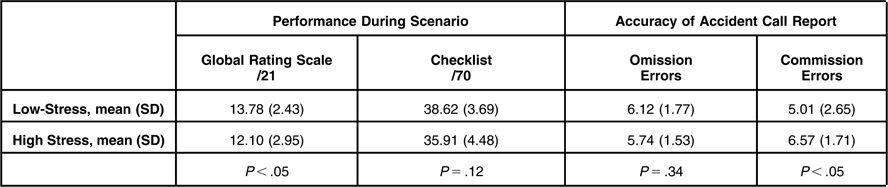
Scores on the global rating scales were significantly lower in the high-stress scenario than in the low-stress scenario (P < .05). In contrast, the checklist scores were not significantly different between the low- and high-stress scenarios (P = .12) (Table 2).
Performance During Low- and High-Stress Scenarios
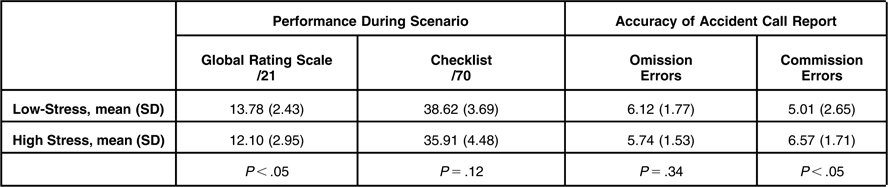
The paramedics committed more errors of commission (reporting information that was not present in the scenario) following the high-stress scenario than following the low-stress scenario (P < .05; Table 2). In contrast, there were no differences in the number of omission errors (failing to recall information that was present in the scenario) between the low- and high-stress scenarios (P = .34; see Table 2). The errors of commission in the high-stress scenarios consisted of reporting procedures or symptoms (e.g. administration of acetylsalicylic acid (ASA) or jugular vein distention) which did not occur during the scenario, and of reporting the results of assessments (e.g. abdomen soft and non-tender, changes in pain rating after nitroglycerin, absence of dizziness) that were not performed during the scenarios.
Discussion
Using simulation technology, realistic clinical scenarios capable of inducing different levels of stress in paramedics were created. When faced with clinically relevant stressors, paramedics demonstrated significant increases in subjective (anxiety) and physiological (salivary cortisol) measures of stress. These stress responses were accompanied by impairments in some aspects of clinical performance and in the ability to accurately recall information from the case. Although the paramedics demonstrated no impairments in their ability to complete each individual action required for the particular scenario, decreased scores on the global rating scale indicate that overall they did so more poorly, with less organization and poorer communication or interpersonal skills.
Although the finding of significant differences on the global rating scale and no difference on the checklist may appear surprising, these results are consistent with previous research showing that global rating scales exhibit better psychometric properties, and are more sensitive to differences in performance levels, than are checklists of specific actions.Reference Regehr, MacRae, Reznick and Szalay 30 , Reference Hodges and Herold McIlroy 31 Although checklists are designed to assess whether particular actions are performed, it is often argued that they are inadequate to assess important aspects of performance such as taking an organized approach to patient care, as well as performing procedures and drug administrations in a timely fashion.Reference Regehr, MacRae, Reznick and Szalay 30 , Reference Hodges and Herold McIlroy 31
In addition to the impaired performance during the high-stress scenario, the paramedics were impaired in their ability to accurately recall information from these scenarios. Interestingly, the errors occurred not in the ability to remember those events or pieces of information that were present, as demonstrated by a lack of difference in omission errors. Rather, the paramedics were more likely to commit commission errors—reporting information or actions that had not been present in the scenario. These results showed important information regarding the effects of stress on memory. Following stressful events, it appears that individuals are not more susceptible to forgetting or failing to remember things or events that did occur. However, they are more likely to incorrectly reconstruct the events and to remember things that have not occurred. Research in the domain of psychology has shown that memory recall is a reconstructive process influenced by expectations of what should occur in particular situations.Reference Willingham 32 An individual's knowledge is represented as a set of schemas, mental structures that represent some aspect of the world that can set expectations as to what one would expect in a particular situation (e.g., the schema of eating in a restaurant includes being seated at a table, reading a menu, ordering from the wait person, having food brought to the table and paying a bill at the end). During memory recall, these schemas (or expectations) can influence performance by helping individuals reconstruct the details of a particular situation.Reference Willingham 32 The results of this study demonstrate that individuals appear to rely more strongly on this reconstruction process under acutely stressful conditions.
Implications for Clinical Care
The finding of decreased performance during high-stress scenarios has important clinical implications. Currently, training of health professionals is primarily focused on equipping them with the clinical skills and knowledge required to care for patients. There is less focus on the emotional or psychological preparation for acute events. A recent examination of safety culture across emergency medical services in the US revealed that <30% of respondents perceived stress as having an impact on patient safety.Reference Patterson, Huang, Fairbanks, Simeone, Weaver and Wang 33 However, the results from this study indicate that clinical skills and knowledge can be impaired significantly in critical events where paramedics exhibit stress responses. Paramedic educators should consider complementary training aimed at the minimization or management of stress responses. A number of approaches have been developed in other domains, such as stress management interventions (e.g. preparatory information, stress inoculation training).Reference Inzana, Driskell, Salas and Johnston 34 , Reference Meichenbaum 35 In stress management interventions, the emphasis is placed on modifying the individual's appraisal of a potentially stressful situation.Reference Inzana, Driskell, Salas and Johnston 34 , Reference Meichenbaum 35 These types of interventions go beyond the clinical skills and biomedical knowledge required during patient care. Their objectives are to render these clinical skills and biomedical knowledge less vulnerable to impairments due to stress responses or to reduce the likelihood of stress responses themselves. In domains outside of health professions, these approaches have proven effective in enhancing performance during high-stress events.Reference Gaab, Sonderegger, Scherrer and Ehlert 36 , Reference Saunders, Driskell, Johnston and Salas 37
The findings of impaired memory recall of paramedics following the high-stress scenario also have important implications for the systems currently in place to document patient information, clinical findings, and procedures. ACRs are commonly used by public health officials and researchers to gain an understanding of the type of patients cared for by emergency services workers and to make decisions about areas in need of improvements. In many emergency services, these ACRs are completed by the paramedics after a clinical encounter. The findings from this study suggest that the information included may be inaccurate, especially after high-stress calls. As such, the field needs to consider how to design documentation of care systems so that they can compensate for this susceptibility in human memory.
The findings of impaired memory recall also have important implications for the continuity of care for patients. An important aspect of patient care is the transfer of patients from prehospital to in-hospital care. Receiving hospitals obtain critical information during the transfer of patient care, including initial findings, procedures completed, and hemodynamic values of the patient during prehospital care. The findings of increased errors in memory recall suggest that some of the information relayed during the transfer of care may be inaccurate following stressful events. Specifically, events or procedures that did not occur may be reported as having occurred, potentially affecting the subsequent care of the patient. The true impact of this memory deficit in the care of real patients is not known, but the findings in this study indicate a need for more research on memory recall and transfer of information, and their impact on patient care, particularly around stressful clinical situations.
Limitations
A limitation of this study is that the effects of acute stress during a simulated clinical event were examined, which could raise concerns as to whether the findings are generalizable to clinical events with real patients. However, research in numerous domains is converging to show that it is the activation of the HPA axis and the ensuing cortisol response that appear to be associated with performance impairments, more so than the source of the stressors.Reference LeBlanc 19 Thus, although some of the stressors from the real world may differ somewhat from the stressors used in this study (real lives at stake), many of the stressors are similar (working in a public space, noises), so the findings from this study are likely applicable to real world situations in which paramedics will have stress responses. However, more research investigating the actual stressors of the workplace is required to fully understand the impact of stress on clinical practice.
Conclusions
In this study, paramedics exposed to acute stressors during a simulated clinical event demonstrated increased anxiety and physiological stress responses. The paramedics also showed impairments on some aspects of clinical performance and in their ability to subsequently report information from the scenarios. These findings indicate that clinical performance and documentation are vulnerable to stress. This highlights the importance of developing systems and training interventions aimed at supporting and preparing emergency workers who face stressful clinical events as part of their every day work responsibilities.
Abbreviations
- ACR:
-
Ambulance call report
- ASA:
-
acetylsalicylic acid
- EGC:
-
Electrocardiogram
- HPA axis:
-
Hypothalamic-pituitary-adrenal axis
- MSE:
-
mean squared error