

1. Introduction
In light of increasing life expectancy, low fertility rates and rising financial pressure on social security budgets, many countries have introduced (or consider) reforms of their public pension systems. Many of these reforms impose parametric adjustments to the existing pay-as-you-go (PAYG) scheme. Among the most frequent adjustments are an extension of the normal or statutory retirement age and a reduction in pension benefits (Beetsma et al., Reference Beetsma, Klaassen, Romp and van Maurik2020). On average over all EU28 countries, the normal retirement age for men who entered the labour market at age 20 in 2018 will be 2.1 years higher than for men who retired in 2018. For women the increase will be 2.6 years (OECD, 2019). Undoubtedly, in the coming years further increases will be decided.
Although raising the retirement age and reducing benefits will directly reduce expenditures and improve the financial sustainability of public pension arrangements, the question arises if these frequent reforms also dominate other reforms when it comes to promoting macroeconomic performance and welfare, and to avoiding inequality. Maybe other reforms are possible with equally good budgetary effects, but better results regarding employment and all-inclusive per capita growth and welfare? The question is important. Considering the downward pressure of demographic change on per capita income, the underemployment of older and low educated people in many economies, and the increasing sensitivity in society to the problem of inequality, not only budgetary outcomes, but also productive efficiency and – especially – equity demand attention.
This paper addresses this research question. Basically, our aim is to evaluate alternative pension reforms from the perspective of financial sustainability, productive efficiency and equity. We compare the effects of a single increase of the retirement age and a single reduction of the benefit replacement rate, generating equal budgetary savings, with the effects of more comprehensive reforms also including (smart) changes in the earnings-related linkage in a PAYG systemFootnote 1. The government in this paper can impose a strong, a weak or no linkage between the pension benefit and past individual labour earnings (and contributions). When there is a linkage, it can give different weights in the pension assessment base to labour income earned at different ages, i.e., the pension accrual rate can change by age. If the government prefers no direct link to individual earnings, it can guarantee a minimum pension to those who would otherwise run the risk of old age poverty. For earnings-related pension systems, the government can choose the level of the replacement rate. This can be different for individuals with different market income (ability). Otherwise, it can choose the level and/or the specific type of the minimum pension.
To approach the question, we employ a 28-period overlapping generations model for an open economy. We developed this model in Devriendt and Heylen (Reference Devriendt and Heylen2020) and found it able to replicate the evolution since 1960 of key macro variables in Belgium. The model explains hours worked by the active generations at different age, (tertiary) education and human capital accumulation by the young, physical capital formation by firms, aggregate output and income, and welfare, within one coherent framework. Heterogeneity in the innate ability of individuals is the main source of inequality. Individuals with higher innate ability enter the model with more human capital. They are also more productive in building additional human capital when they allocate time to education. Modelling endogenous behaviour and behavioural reactions will be key for us in this paper to quantify the macroeconomic repercussions and the welfare effects of pension reforms. Furthermore, introducing differences in ability will allow us to monitor also inequality between individuals with high versus low human capital and earnings capacity.
Our main findings are as follows. Public pension reforms involving an increase of the normal retirement age or a reduction in the pension benefit replacement rate can make the system financially sustainable, but they fail when the objective is also to improve macroeconomic performance without raising intergenerational or intragenerational welfare inequality. A reduction of the replacement rate to restore the financial balance of the public pension system fails on both these criteria. An increase of the retirement age promotes long-run macroeconomic performance, but will create more welfare inequality. The different capacities of high and low ability individuals to respond to an increase in the retirement age by building more human capital, is a key element behind rising inequality. Our results prefer a more comprehensive reform which supplements an increase of the retirement age with an intelligent adjustment of the linkage between the pension benefit and earlier labour earnings. This adjustment maintains a tight link between the pension benefit and past individual labour income, but with a high weight on labour income earned when older and a low weight on labour income earned when young. Furthermore, to avoid rising welfare inequality this linkage should be complemented by a strong rise in the benefit replacement rate for low ability individuals (and a reduction for high ability individuals). Attempts to cope with rising inequality by introducing a minimum pension may also perform well if the level of the minimum pension rewards hours worked over the career. A minimum pension that is unrelated to hours worked is negative for aggregate employment and welfare.
This paper relates to a large existing literature. Many studies have documented how the pension system may affect the incentives of individuals of different ages to work (e.g., Sheshinski, Reference Sheshinski1978; Sommacal, Reference Sommacal2006; Fisher and Keuschnigg, Reference Fisher and Keuschnigg2010; Jaag et al., Reference Jaag, Keuschnigg and Keuschnigg2010; de la Croix et al., Reference de la Croix, Pierrard and Sneessens2013). Others have investigated the relationship between the pension system and investment in human capital, as a major determinant of productivity and growth (e.g., Zhang, Reference Zhang1995; Kemnitz and Wigger, Reference Kemnitz and Wigger2000; Le Garrec, Reference Le Garrec2015). More recently, Ludwig et al. (Reference Ludwig, Schelkle and Vogel2012), Buyse et al. (Reference Buyse, Heylen and Van de Kerckhove2013, Reference Buyse, Heylen and Van de Kerckhove2017) and Kindermann (Reference Kindermann2015) made progress by studying pension reform in OLG models where both employment by age and human capital are endogenous. Last but certainly not least, a large literature has demonstrated the major impact of the pension system on inequality and old-age poverty (e.g., von Weizsacker, Reference von Weizsacker1996; Docquier and Paddison, Reference Docquier and Paddison2003; Sánchez-Romero and Prskawetz, Reference Sánchez-Romero and Prskawetz2017; Etgeton, Reference Etgeton2018; Tyrowicz et al., Reference Tyrowicz, Makarski and Bielecki2018).
Most directly relevant for our research is work by Fehr (Reference Fehr2000), Kotlikoff et al. (Reference Kotlikoff, Smetters and Walliser2007), Fehr et al. (Reference Fehr, Kallweit and Kindermann2012), Imrohoroglu and Kitao (Reference Imrohoroglu and Kitao2012), Kitao (Reference Kitao2014), Li (Reference Li2018) and Laun et al. (Reference Laun, Markussen, Vigtel and Wallenius2019). These authors analysed alternative reforms of the pension system aimed at reducing the level of future public pension expenditures and balancing the budget in the context of demographic change (ageing). Among other policy measures, they also studied the effects of an increase of the normal retirement age and a reduction of the benefit level. We make progress compared to these papers in two ways. First, we model also human capital accumulation as an endogenous variable, and therefore account for the endogeneity of labour productivity and earnings capacity to demographic change and the characteristics of the pension system. The importance of having endogenous human capital for a proper analysis of the aggregate effects and the inequality effects of pension reform is obvious, considering the work of e.g., Cervellati and Sunde (Reference Cervellati and Sunde2013), Ludwig et al. (Reference Ludwig, Schelkle and Vogel2012) and Kindermann (Reference Kindermann2015), and the arguments of Kanbur and Stiglitz (Reference Kanbur and Stiglitz2015). Second, in our evaluation of alternative pension reforms we put the issue of (reducing) inequality more at the centre. Kitao (Reference Kitao2014), Fehr (Reference Fehr2000) and Fehr et al. (Reference Fehr, Kallweit and Kindermann2012) also report welfare effects of pension reforms for individuals who differ by level of financial wealth or exogenous productivity level. They do not search for a reform, however, that combines financial sustainability and macroeconomic performance and welfare with a reduction of welfare inequality. This is exactly our main contribution. We propose a reform that achieves not only financial and macro performance objectives, but also succeeds in realising this inequality reductionFootnote 2.
The proposal that we develop, as described above, is strongly inspired by Buyse et al. (Reference Buyse, Heylen and Van de Kerckhove2013, Reference Buyse, Heylen and Van de Kerckhove2017). Their model and analysis, however, neglected demographic change and ageing, and therefore the main source of rising pressure on social security and pension systems. Moreover, they did not study an extension of the retirement age, nor a reduction of pension benefits, and largely neglected dynamic effects induced by pension reform apart from welfare effects.
Many researchers have introduced heterogeneous abilities in OLG models before. Some have done this to study the effects of the pension system on inequality, as one of the dependent variables. The way in which heterogeneity is introduced differs, however. Some authors model individuals with different human capital (or skill) levels when they enter the model (e.g., Fehr, Reference Fehr2000; Sommacal, Reference Sommacal2006; Kotlikoff et al., Reference Kotlikoff, Smetters and Walliser2007; Fehr et al., Reference Fehr, Kallweit and Kindermann2012; Frassi et al., Reference Frassi, Gnecco, Pammolli and Wen2019). Others introduce individuals with the same initial human capital, but different learning abilities (e.g., Kindermann, Reference Kindermann2015), or subject to idiosyncratic productivity shocks during life (e.g., Fehr et al., Reference Fehr, Kallweit and Kindermann2013; Kitao, Reference Kitao2014). In our model in this paper, like in Buyse et al. (Reference Buyse, Heylen and Van de Kerckhove2017), individuals with higher (lower) ability have both higher (lower) initial human capital and are more productive in building additional human capital when they allocate time to (tertiary) education. We abstain, however, from shocks to individual human capital and productivity during individuals’ life. This set of assumptions may offer the best match to findings by Huggett et al. (Reference Huggett, Ventura and Yaron2011) and Keane and Wolpin (Reference Keane and Wolpin1997) that heterogeneity in human capital endowment at young age and learning abilities, rather than shocks to human capital, account for most of the variation in lifetime utility. A final important element is the relationship between the human capital of subsequent generations. In this paper, we follow Ludwig et al. (Reference Ludwig, Schelkle and Vogel2012) and Kindermann (Reference Kindermann2015), among others, and assume that individuals’ initial human capital is predetermined and generation-invariant. Growth will then be exogenous.
The structure of this paper is as follows. Section 2 sets out the main building blocks of our model. In Section 3 we describe our calibration procedure and the parameterization of the model. Section 4 describes the results of a range of model simulations. We investigate the employment, education, output, financial and welfare effects of various reforms of the pension system. We study effects per generation and per ability group. Section 5 concludes the paper.
2. The model
We developed our model in Devriendt and Heylen (Reference Devriendt and Heylen2020) to study the macroeconomic and distributional effects of demographic change. In this section and the next we describe a slightly simplified version of the model and its calibration. We focus on those elements that are important to answer the research questions that we raised in the introduction to this paper. We drop the elements of the model that are immaterial for a good understanding of our analysis of (the effects of) pension reformFootnote 3.
2.1 Basic setup
We assume an open economy with an exogenous but time-varying world interest rate. Physical capital moves freely across borders. Human capital and labour, however, are assumed internationally immobile. Time-varying exogenous fertility and survival rates drive demographic change. Twenty-eight generations of individuals coexist. Individuals enter the model at the age of 18. They live at most for 28 periods of 3 years. Within each generation one fraction of the individuals is assumed to have low innate ability, others have medium ability, a third group has high innate ability. Depending on their ability, individuals will enter the model with a different initial human capital endowment and with a different productivity of schooling. Young individuals with high or medium ability will continue education when they enter the model at 18. Individuals with low ability will not. Next to education and endogenous human capital, our model also has endogenous employment. Besides studying (for high and medium ability individuals) everyone optimally allocates time to labour and leisure. As to output, domestic firms are modelled to employ physical capital and effective labour under constant returns to scale. Technology is assumed to have exogenous growth.
A central part of our model is the public pension system, the specification of which allows us to simulate a great variety of pension reforms. Finally, the government is an important actor in our model also from the side of fiscal policy. It sets tax rates on labour (both on employees and employers), consumption and capital income. It allocates resources to goods and services and pensions (to finance possible deficits in the public PAYG system). It may also borrow.
Concerning notation, superscript t denotes the time an individual or group of individuals (a generation) enter the model. Subscript j refers to the j-th period of life or, in other terms, the age. It goes from 1 to 28Footnote 4. When a subscript s is used, it denotes one of three levels of innate ability: low (L), medium (M) or high (H). Last but not least, time subscripts t added to aggregate variables indicate historical time.
2.2 Demography
Demographic change in our model is captured by time-varying fertility and survival rates, with the latter determining individuals’ expected length of life. Equation (1) expresses the size of the youngest generation at time t relative to the size of the youngest generation at t–1. f t( > 0) is the time-dependent ‘fertility’ rate in the model.

Equation (2) describes the evolution of the size of a specific generation over time. We denote by $sr_{j-1}^t ( { < 1} )$ the probability for each individual of generation t to survive until model age j conditional on reaching age j − 1. This survival rate is both generation and age-dependent.

The trajectories of both f t and $sr_j^t$ are taken as exogenous in our model. Finally, the population consists of low, medium and high ability individuals:

Given our assumption in this paper that the fertility and survival rates are equal across ability types, the share of each group will be constant. We assume it equal to one-thirdFootnote 5.
2.3 Individuals
2.3.1 Preferences
An individual with ability s (s = L, M, H) reaching age 18 and entering the model at time t maximizes expected lifetime utility described by equation (4) subject to his budget and time constraints (cf. infra). In this equation β is the discount factor and $\pi _j^t$ the unconditional probability to survive until age j.

with $0 < \beta < 1, \;\;\pi _1^t = 1, \;\;0 < \pi _j^t = \mathop \prod \nolimits _{i = 1}^{j-1} sr_i^t < 1$ for 1 < j < 29, and $\pi _{29}^t = 0$
 .
Utility depends positively on consumption $c_{j, s}^t$ and leisure time $l_{j, s}^t$
 as shown in equation (5). The intertemporal elasticity of substitution in leisure is 1/θ. The relative utility value of leisure versus consumption is γ j. It may differ by age.

with γ j > 0 and θ > 0 (θ ≠ 1).
2.3.2 Time constraints
Every period, an individual is endowed with one unit of time that can be split into hours worked while employed (n), education (e) and leisure (l) depending on age and innate ability. Equations (6)–(8) describe the age-dependent time constraints for medium and high ability individuals (s = M, H). Only in the first four periods an individual can spend time in post-secondary education next to working and enjoying leisure. From period 5 until 15, time can be allocated only to labour and leisure. From period and age 16 on an individual is eligible for public old-age pensions.


Equations (9) and (10) relate to low ability individuals. Since these individuals start working earlier than individuals of medium or high ability, they can also leave the labour market earlier. They receive a public pension from period and age 15 onFootnote 6.


2.3.3 Budget constraints
Individuals have varying budget constraints over their life cycle depending on age and innate ability. Equation (11) describes the budget constraint faced by individuals during active life, i.e., at age j = 1 − 15 for individuals of high and medium ability, and age j = 1 − 14 for individuals of low ability.

Disposable income is used to consume $c_{j, s}^t$ and accumulate non-human wealth. We denote by $a_{j, s}^t$
 the stock of wealth held by a type s individual at the end of the j-th period of his life. τ c is the tax rate applied by the government on consumption goods. When individuals assign a fraction $n_{j, s}^t$
 of their time to work, with productive efficiency $\varepsilon _jh_{j, s}^t$
 , they earn a net labour income of $w_{t + j-1}^s \varepsilon _jh_{j, s}^t n_{j, s}^t ( {1-\tau_{w, j, s}} )$
 . Underlying factors are the real gross wage per unit of effective labour of ability type $s\;( w_{t + j-1}^s )$
 , an exogenous parameter linking productivity to age (ɛj), human capital $( h_{j, s}^t )$
 , and the average labour income tax rate (τ w,j,s). The contribution rate cr 1 of workers to the public pension system is included in τ w,j,sFootnote 7.
Next to labour income, disposable income consists of interest income earned on assets, $r_{t + j-1}a_{j-1, s}^t$ with r t+j−1 the exogenous world real interest rate, and lump-sum transfers received from the government z t+j−1. A final source of income are transfers from accidental bequests tr t+j−1 (plus interest). There are no annuity markets in our model. Transfers are uniformly distributed among the population.
From the eligible age individuals receive public pension benefits $ppt_{j, s}^t$ . Equation (12) presents the budget constraint of retirees.

All individuals in our model are born without assets. They also plan to consume all accumulated assets by the end of their life. A final assumption is that retired individuals cannot have negative assets. Algebraically, $a_{0, s}^t = a_{28, s}^t = 0$ and $a_{j, s}^t \ge 0$
 for j > 15 (for s = H, M) or 14 (for s = L).
2.4 Human capital production
Individuals enter the model at the age of 18 with a predetermined ability-specific endowment of human capital. In equation (13), h 0 stands for the initial time-invariant human capital endowment of a high ability individual. Low and medium ability individuals are respectively endowed with lower human capital stocks ω Lh 0 and ω Mh 0 with 0 < ω L < ω M < ω H = 1.

High and medium ability individuals can engage in higher education to accumulate additional human capital in the first four periods (equation (14a)). ϕ s is a positive ability-related efficiency parameter reflecting the productivity of schooling, and σ the elasticity of human capital growth with respect to time input. After the first four periods, their human capital remains constant (equation (14b)). Since individuals with low innate ability do not study, their human capital remains constant from model age 1. Human capital does not depreciate. We have in mind that learning by doing while at work may counteract depreciation.


with: 0 < σ < 1, ϕ H, ϕ M > 0.
2.5 The pension system
Our model includes a public PAYG pension scheme of the defined benefit type that makes pension payments to retirees out of contributions (taxes) paid by current workers and firms. Individuals receive a pension benefit from model age j = 16 (for s = H, M) or j = 15 (for s = L) on, i.e., respectively actual age 63 or 60. The amount $ppt_{j, s}^t$ they receive at the time of retirement is

with: J = 15 for s = L and J = 16 for s = M, H and $\mathop \sum \nolimits p_j = 1.$
The pension benefit is related to one's own contributions during active life. More precisely, the pensioner receives a fraction of the weighted average of revalued earlier net labour income. In equation (15), p j determines the weight of net labour income earned at age j, rr s is the net replacement rate, which can differ by ability (income), and wg is the period-wise revaluation factor applied to net labour income earned in the past. The pension will rise in the earned wage, the individual's hours of work and his productive efficiency with the latter also increasing in human capital. For retired low ability individuals the pension amount is very similar, except for the lower eligibility age of 60 (model age 15).
After the initial pension payment, the pension benefit may be revalued to adjust for a changed living standard, so $ppt_{j, s}^t$ then becomes

with pg k the coefficient that revalues the pension benefit of period k − 1 to k.
The public pension system's budget identity is as follows:

with: cr = cr 1 + cr 2.
The left side of equation (17) indicates total pension expenditures at time t. As public pensions are organized on a PAYG basis, this amount is financed by (a) the working population from taxes on their gross labour income applying contribution rate cr 1 and by (b) the firms applying cr 2. As we have mentioned before, cr 1 is part of the labour tax rate τ w,j,s in equation (11) while cr 2 is a component of the employers’ social contribution rate (cf. infra). Tailored to institutional reality in Belgium, GPP t denotes the total resources assigned to pension payments by the government to ensure that equation (17) holds.
2.6 Individual optimization and the role of the pension system
Low ability individuals will choose consumption and labour supply to maximize equation (4), taking into account their instantaneous utility function in equation (5), their time and budget constraints in equations (9)–(12), and the human capital process in equations (13) and (14b). Individuals of medium and high ability will in addition choose the fraction of time they spend in education when young. They optimize equation (4), subject to equations (5)–(8) and (11)–(14b). For details on the optimality conditions, see supplementary online Appendix B.
Building on our discussion of the pension system in the previous section, and equation (15) in particular, our focus here is on the effects on behaviour in earlier periods of life that the specific organization of public pension benefits may have. We first discuss these effects for a given way of financing. Both income and substitution effects occur:
• For given contribution rates, a higher replacement rate rr raises the return to working (for all ability groups) and to building human capital (for high and medium ability individuals) in earlier periods. It will encourage individuals to work and to invest in education.
• Changes in the particular weights of the periods that constitute the pension assessment base p j may modify these incentive effects. The return to working in a particular period rises in the weight attached to that period. A shift in weight from labour income earned when young to labour income earned when older brings strong incentives to work less when young, and to work more and longer when old. This shift also includes an incentive to invest in human capital, due to the reduced opportunity cost of education and the increased return to employed human capital (for given hours worked) at higher age.
• Pension systems that encourage individuals to work more when middle aged or older also stimulate them to study when young (at least when they have medium or high innate ability). The reason is that an increase in labour supplied during these periods raises the return to education. Following the same logic, an increase in the normal retirement age will also make it more interesting for young individuals to study. Conversely, individuals who invest more in human capital when young will also prefer to work more and longer at higher age. The reason here is that a higher level of human capital raises wages and the return to working.
• Higher replacement rates do not only bring about substitution effects, however. Raising individuals’ lifetime consumption possibilities, they also cause adverse income effects on labour supply.
Obviously, for a proper assessment of the effects of pension systems and reforms, it is good also to consider the issue of financing. Maybe tax or contribution rates do not changeFootnote 8, but of course they can. In this respect, it has been shown in the literature that if an increase of the replacement rate and the future pension benefit is associated with an increase in the tax or contribution rate on labour, the positive effect on labour supply disappears. In most cases, i.e., when the present discounted value of benefits is lower than the value of the contributions, the effect may turn negative (see e.g., Cigno, Reference Cigno2008; Fisher and Keuschnigg, Reference Fisher and Keuschnigg2010). The positive effect on education will not disappear, however. A PAYG pension system with earnings-related benefits will always encourage individuals to invest in education when youngFootnote 9. The reason is that when the present value of future benefits is lower than the value of the contributions, an implicit tax structure results that has high tax rates on labour income in the first period of active life and lower tax rates towards the end. This subsidizes human capital formation (see also Kindermann, Reference Kindermann2015). Raising individuals’ future wages, a higher level of human capital will then recreate positive incentive effects for individuals to work when middle aged and older. All these interactions between endogenous labour and endogenous human capital, supplied by individuals of different generations and ability, clearly highlight the need for a larger scale numerical analysis of pension reform.
2.7 Firms, output and factor prices
Identical firms act competitively on output and factor markets. The constant returns to scale production function to produce a homogeneous good is given by


In equation (18), K t is the stock of physical capital at time t, while A tH t indicates employed labour in efficiency units at that time. Technical progress is labour augmenting and occurs at an exogenous rate g a,t. Total effective labour H t is defined in equation (20) as a CES-aggregate of effective labour performed by the three ability groups. H s,t indicates effective labour supply by ability, as specified in equation (21), and λ is the elasticity of substitution between the different ability types. We will impose that the input share parameters η L, η M and η H sum to 1.

with:

Competitive behaviour implies in equation (22) that firms will hire labour of each ability type up to the point where its marginal productivity is equal to the total wage cost per unit of effective labour. τ p is the employer's social contribution rate. It includes the contribution cr 2 to the public pension system.

Furthermore, firms install physical capital up to the point where the after-tax marginal product of capital net of depreciation equals the exogenous world interest rate r t:

with δ the depreciation rate of physical capital, and τ k a tax paid by firms on capital returns. For a given interest rate, firms will install more capital when the amount of effective labour increases or the capital tax rate falls. Pension reform may affect the former.
2.8 Fiscal government
Equation (24) describes the government's budget constraint. Its revenues consist of taxes on labour income paid by workers T nt, employer taxes on labour income T pt, taxes on capital T kt and consumption taxes T ct. They are allocated to interest payments on outstanding debt r tB t, government purchases of goods and services G t, pension payments GPP t and lump-sum transfers Z t. Fiscal deficits explain the issuance of new government bonds (B t+1 − B t).

Except for G t and Z t all revenues and expenditures are determined in a straightforward way within the model (for details, see Devriendt and Heylen, Reference Devriendt and Heylen2020). For G t, we assume that the government spends a constant amount g per capita, adjusted for technical change, as in equation (25). Lastly, lump-sum transfers Z t can be adjusted by the government if it sets specific targets on the evolution of public debt.

2.9 Aggregate equilibrium and the current account
Equation (26) describes aggregate equilibrium defined for all generations living at time t. The LHS of this equation represents national income. It is the sum of domestic output Y t and net factor income from abroad r tF t, where F t stands for net foreign assets at the beginning of t. Accumulated foreign assets are part of aggregate private wealth Ωt, which can also be allocated to physical capital K t and domestic government bonds B t (equation (27)). The RHS of equation (26) includes aggregate demand from individuals, firms and the government, while CA t stands for the current account in period t. Equation (28) denotes that a surplus on the current account translates into more foreign assets. Equation (29) is the well-known identity relating investment to the evolution of the physical capital stock.

with:


3 Parameterization
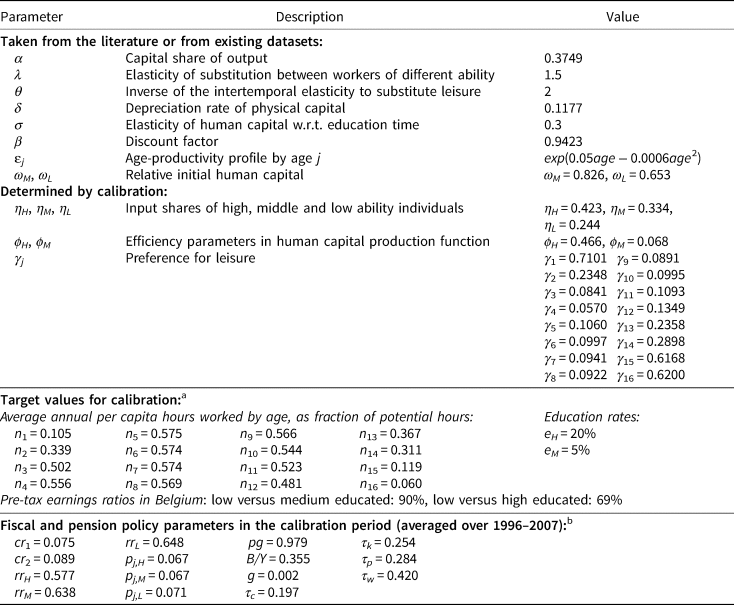
The economic environment described above allows us to simulate the macroeconomic, financial and welfare effects of different parametric changes in the public pension system. An important contribution in this paper is that we model and assess differential effects for individuals with different ability (education level). This simulation exercise requires us first to parameterize and solve the model. Table 1 contains an overview of all parameters. Many have been set in line with the existing literature. Others have been calibrated to match key data for Belgium in 1996–2007, the last long and fairly stable period before the financial crisis.
Parameterization of the model

a As to annual hours worked, our proxy for potential hours per capita is 40 hours per week during 52 weeks per year. The targets for the fraction of time spent in education are averages for the ages of 18–29. For more details about the data of the target values of our calibration, we refer to Appendix C of Devriendt and Heylen (Reference Devriendt and Heylen2020).
b An overview of the exogenous variables and the underlying data is provided in supplementary online Appendix A. The reported labour income tax rate on workers (τ w) is the rate that applies to workers earning average gross labour income. For more details on the progressive tax function in our model, see also online Appendix A. Lump-sum transfers adjust as the residual category in equation (24).
We have taken a first set of parameters from the literature or from existing datasets. For the discount factor β we impose a value of 0.9423, which is equivalent to a rate of time preference equal to 2% per year (see e.g., Kotlikoff et al., Reference Kotlikoff, Smetters and Walliser2007). For the value of the intertemporal elasticity of substitution in leisure (1/θ) we follow Rogerson (Reference Rogerson2007) and Rogerson and Wallenius (Reference Rogerson and Wallenius2009). Rogerson (Reference Rogerson2007) puts forward a reasonable range for θ in macro studies from 1 to 3. In line with this, we set θ equal to 2. Furthermore, we impose a physical capital share coefficient α of 0.375 and a depreciation rate of 4.1% per year (Feenstra et al., Reference Feenstra, Inklaar and Timmer2015, Penn World Table 8.1). The latter implies δ = 0.118 considering that one period in the model consists of 3 years. Following Caselli and Coleman (Reference Caselli and Coleman2006), who state that the empirical labour literature consistently estimates values between 1 and 2, we set the elasticity of substitution λ between the three ability types in effective labour equal to 1.5. In the human capital production function, we choose a conservative value of 0.3 for the elasticity with respect to education time (σ). This value is within the range considered by Bouzahzah et al. (Reference Bouzahzah, de la Croix and Docquier2002), but much lower than the value imposed by Lucas (Reference Lucas1990). The literature provides much less guidance for the calibration of the relative initial human capital of low and medium ability individuals relative to the initial human capital of high ability individuals, ω L and ω M. To determine these parameters we follow Buyse et al. (Reference Buyse, Heylen and Van de Kerckhove2017) who rely on PISA science test scores. These tests are taken from 15-year-old pupils, and therefore indicative of the cognitive capacity with which individuals enter our model at age 18. We use the test scores of pupils at the 17th and the 50th percentile relative to the score of pupils at the 83rd percentile, as representative for ω L and ω M. This approach yields values for ω L and ω M of 0.653 and 0.826, while ω H = 1. The last parameters that we took directly from the literature are the age-specific productivity parameters ɛ j. We follow the hump-shaped pattern imposed by Miles (Reference Miles1999).
A second set of parameters is determined by calibration. Our procedure follows Ludwig et al. (Reference Ludwig, Schelkle and Vogel2011). It consists of six steps which are described in greater detail in Devriendt and Heylen (Reference Devriendt and Heylen2020, Section 4). In brief, we start with an initial guess for these parameters obtained from calibrating the model to Belgium in 1996–2007 under the assumption of being in a steady state with all exogenous variables, including demographic variables, the rate of technical progress, the world interest rate and policy variables, taken to be constant at their level of 1996–2007. The target values for the calibration are reported in the middle block of Table 1. They concern hours worked by age (averaged over the three ability types), average participation in education by ability and wage differences between ability groupsFootnote 10. With the obtained parameters from step 1 and data (or proxies) for the exogenous variables in 1948–50, we compute an artificial initial steady state. Next, we simulate the transition from the initial steady state to the final steady state, feeding into the model the (time-varying) fertility and survival rates, the world interest rate, the rate of technical progress and data on policy variables as exogenous driving forcesFootnote 11. In the new steady state all these exogenous drivers stay constant. The simulated transitional paths in the calibration period may at first differ substantially from the targets. The last steps in the procedure adjust the parameters and repeat the previous steps so as to minimize the distance between the target data and the simulated data produced by the model in 1996–2007. In the end, the ratio of the model output to the data in 1996–2007 varies between 97% and 105% for all but one target variable. As to the results, we find that the calibrated taste for leisure (γ j) declines at younger ages, and then stays flat at a low level for about ten model periods. At higher ages, it shows a trend increase.
Our calibration implies that our model's predictions very closely match the data in Belgium in 1996–2007. Before we use the model for policy simulations, a minimal test of its validity and empirical relevance is whether it can also match the data in other periods. We did this test in Devriendt and Heylen (Reference Devriendt and Heylen2020, Section 5.2). We introduced the time-varying data for the exogenous variables into the model, and then compared the model's fitted values with the data in 1960–2014 for the old-age dependency ratio, per capita GDP growth, aggregate average per capita hours worked, the capital-output ratio, participation in tertiary education and the pre-tax Gini coefficient. We concluded that the evolution predicted by the model is in strong accordance with the evolution observed in the data. Furthermore, we compared fitted values and data for per capita hours worked in different age and different ability (or education) groups in the shorter time period 2005–2007. The match between the data and model predictions is also strong cross-sectionally. These observations raise confidence in the reliability of our calibration, and our simulations in the next section.
4. Parametric public pension reform
In this section we compare the effects of various parametric public pension reforms with a baseline simulation. In this baseline simulation all policy variables, except the consumption tax rate, and all parameters of the public pension system remain constant at their 2014 values. The other exogenous variables (fertility and survival rates, technical progress and the world interest rate) continue to change, some for many more decades. Online Appendix A includes data on their past and projected future evolutionFootnote 12. Furthermore, in line with the specification of our model, the baseline assumes retirement at model age j = 15 for low ability workers and at age j = 16 for high and medium ability workersFootnote 13.
In the baseline simulation, as well as in all policy simulations, total public pension expenditures will change over time. It is our assumption that the government ensures financial balance in the system by adjusting its own grant (GPP) in equation (17), while the consumption tax rate is adjusted to maintain a constant public debt to GDP ratioFootnote 14. In all simulations, including the baseline, the pension system will therefore be financially sustainable. The various scenarios will differ, however, in the cost or consumption tax increase to achieve this.
4.1 Main endogenous variables
We focus our attention on variables related to macroeconomic performance (employment, education, per capita output), financial viability (pension expenditures), welfare and welfare inequality. We report aggregate dynamic effects as well as dynamic effects by ability group and by generation. To measure the welfare effects of policy changes for individuals, we compute the (constant) percentage change in baseline consumption in each period of remaining life that the individual should get to attain the same lifetime utility in the baseline as after the policy shock (following e.g., Buyse et al., Reference Buyse, Heylen and Van de Kerckhove2017; Fried et al., Reference Fried, Novan and Peterman2018)Footnote 15. Next to welfare effects for individuals of exemplary cohorts, we also report cumulative welfare measures for all current and/or all future cohorts of different abilities. Our most comprehensive aggregate welfare measure reflects the net utility gain from policy reform after the winners have hypothetically compensated all those who lose. We report the consumption volume that is equivalent to this net utility gain as a percentage of GDP in the last period before the policy reform.
All reforms considered are announced in 2014, but implemented in 2029Footnote 16. From 2014 onwards, individuals and firms can alter their behaviour. For the welfare analysis we consider individuals of eight exemplary cohorts, being the high and the low ability individuals from four different generations. More precisely, the generations observed are individuals of age 18–20 in 2011–13, individuals of age 42–44 in 2011–13, individuals of age 66–68 in 2011–13 and individuals of age 18–20 in 2035–37. Note that individuals of age 18–20 in 2011–13 and especially individuals of age 42–44 in 2011–13 can only partially adjust their behaviour. Individuals of age 66–68 in 2011–13 are not directly affected by the pension reforms. Individuals of age 18–20 in 2035–37 will be living under the new policy regime during their whole life. The reported cumulative welfare measures obviously include all individuals of current and/or future generations of specific abilities, as will be specified below (see also the note below Table 2).
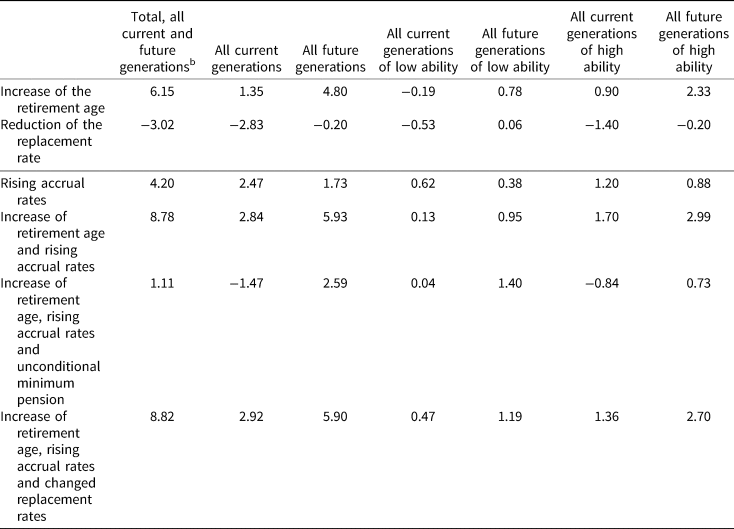
Aggregate welfare effects of alternative pension system reformsa

a To compute aggregate welfare effects we take three steps. First, we compute for each cohort the present discounted value of the total change in consumption (volume) over life that is required in the baseline to make the cohort equally well off in the baseline as under the policy reform. (The basis of our computation are the data for individuals that we report in Figures 3 and 6. Cohort data follow from taking into account the size (and its expected evolution) of the cohort that individuals belong to. For young individuals the data in Figures 3 and 6 apply to many periods, whereas for the oldest individuals they only apply to one remaining period). Discounting is done to 2011–13, the last period before the announcement of the policy change. For future cohorts, the present value of their required total consumption change is also discounted to 2011–13. Second, we impose that all cohorts within a considered group of cohorts (e.g., all future generations of low ability) who lose under the new policy, are compensated by the winners in that group of cohorts. Third, the present discounted value of the net aggregate consumption gain of all winners after having compensated the losers is expressed in per cent of GDP in 2011–13.
b The first three data columns include all cohorts of low, medium and high ability; the last four columns only consider cohorts of low or high ability. The results for the medium ability cohorts are fairly close to those for the high ability cohorts (available upon request).
4.2 Increase of the retirement age and reduction of pension benefits
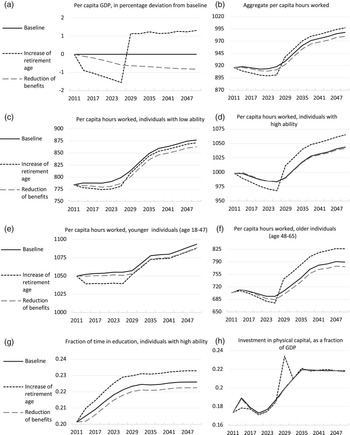
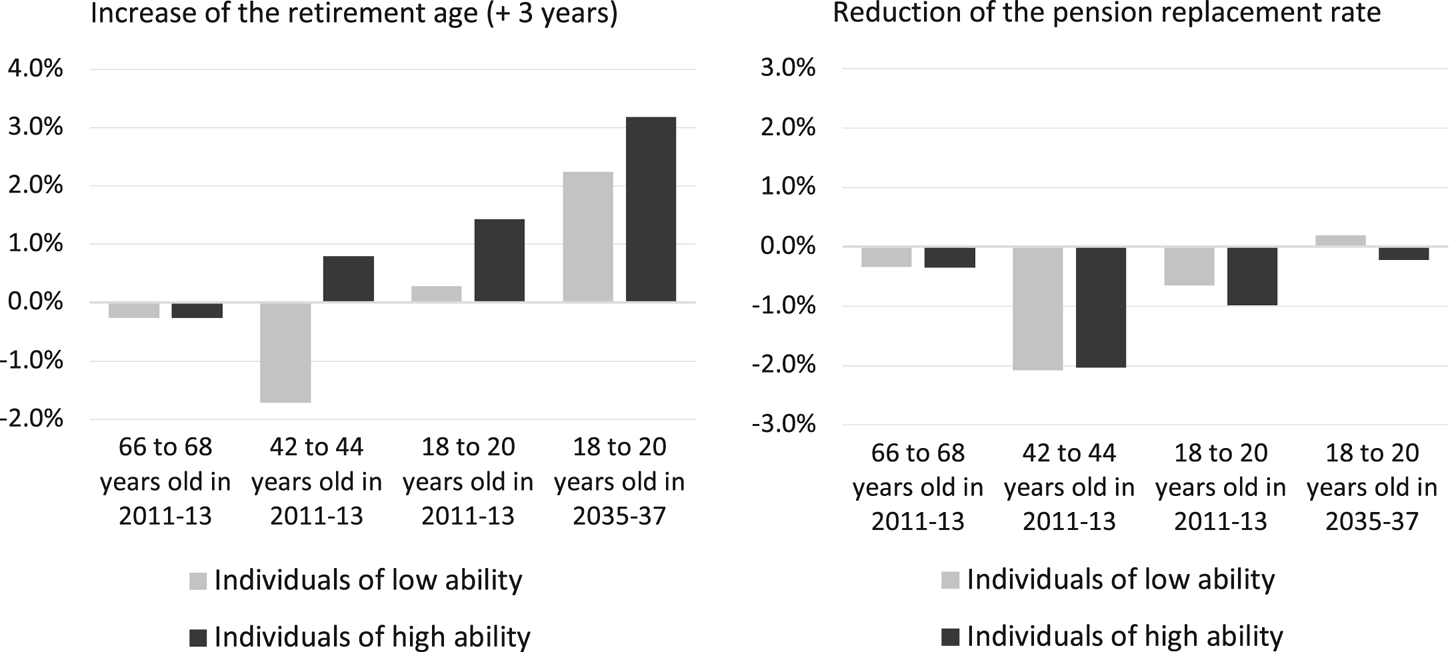
Figures 1–3 and the upper part of Table 2 report the effects of the two most frequently imposed reforms to make the public pension system financially viable: macroeconomic effects (Figure 1), financial effects (Figure 2), welfare effects for eight individuals (Figure 3) and aggregate welfare effects (Table 2). The first reform is an increase of the retirement age. From 2029 onwards, the normal retirement age is extended with one model period of three years. Individuals of medium and high ability will consequently face an exogenous retirement age of 66. Those of low ability will be eligible for a public pension at age 63. The second reform is a reduction in the pension benefits that individuals receive by lowering the public pension replacement rates. We introduce a permanent cut in these replacement rates for new retirees (from 2029 onwards) such that the present value of total savings in public pension expenditures is equal to the value obtained from extending the retirement age. This comes down to a 12.6%-points cut in rr L, rr M and rr H in equation (15).
Macroeconomic effects of pension reform – part 1 (most frequent reforms).

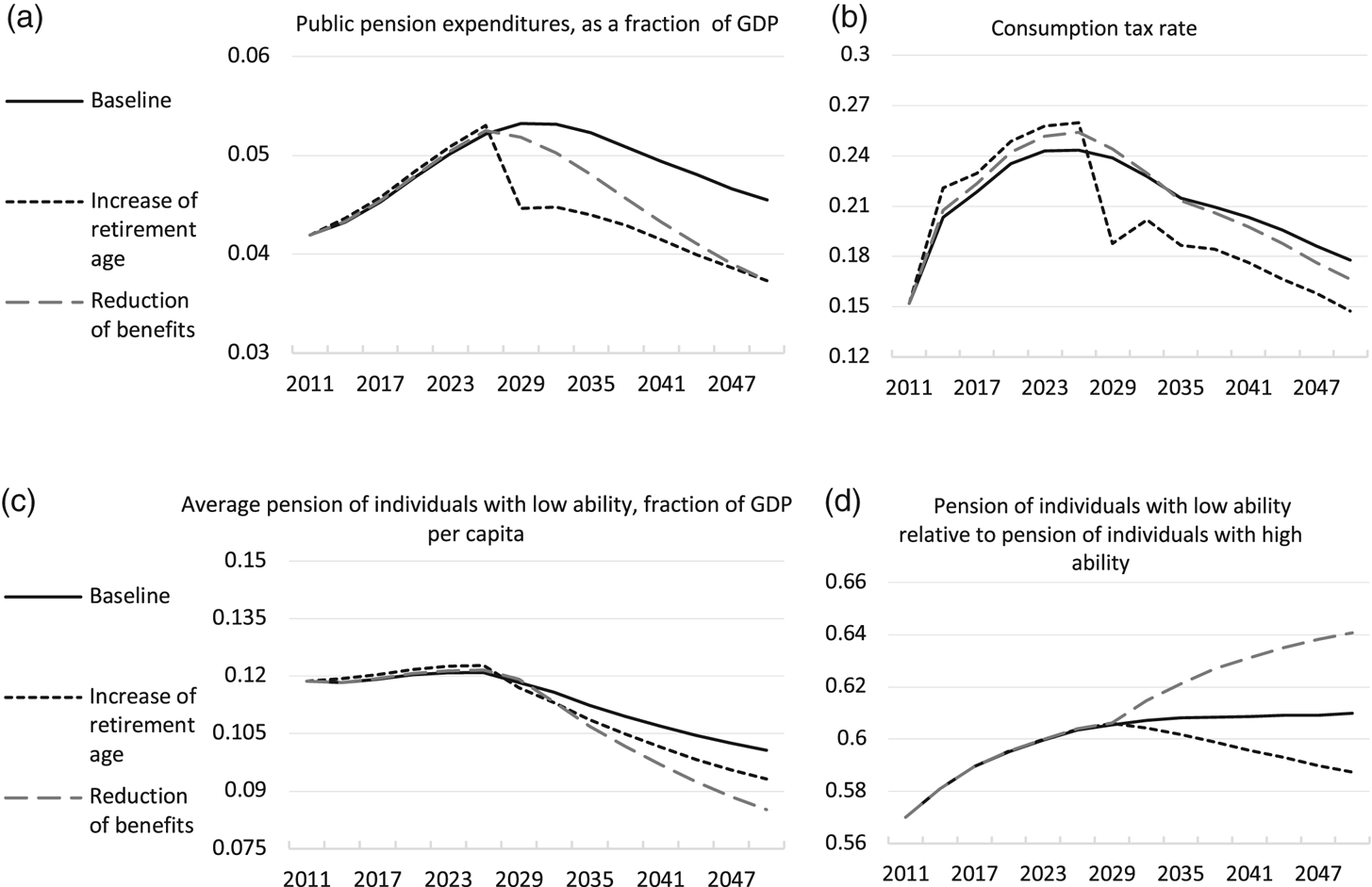
Financial effects of pension reform – part 1 (most frequent reforms).

Welfare effects of pension reform – part 1 (most frequent reforms).
Note: Our welfare measure is the (constant) percentage change in baseline consumption in each remaining period of life that individuals should get to attain the same lifetime utility in the baseline as after the policy shock.

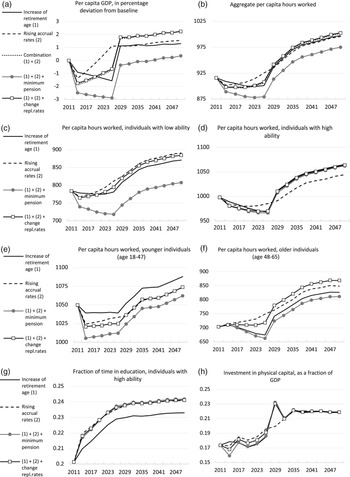
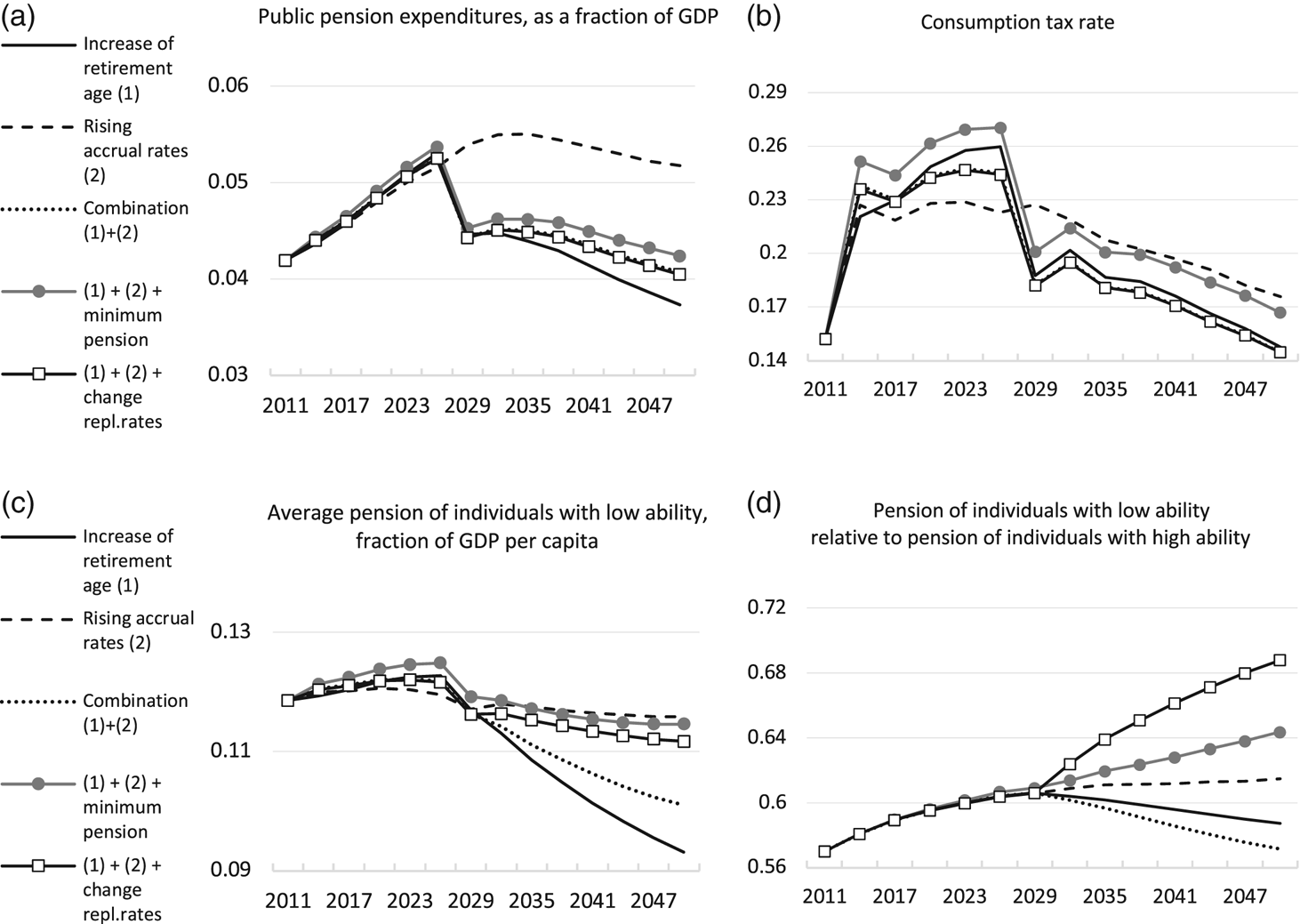
From a macroeconomic perspective, the long-run effects of raising the retirement age are clearly better than those of a reduction in the benefit replacement rate. Compared to the baseline, the former reform implies in the long run higher per capita output (Figure 1a), higher per capita hours worked (Figure 1b), mainly among individuals with medium or high ability (Figure 1d) and among older individuals (Figure 1f), and higher investment in education (Figure 1g). Unsurprisingly, these positive effects only manifest themselves from 2029 onwards. The main factors driving these results are the sudden increase in the active population and the decline in the number of dependent retirees at the macro level, and the perspective of working longer at the individual level. Encouraged by this perspective, young higher (and medium) ability individuals will expand their participation in higher education. The reason is that as their career length increases with three years, the return to education rises (Cervellati and Sunde, Reference Cervellati and Sunde2013). Accumulating more human capital, they will later also earn higher wages, which raises the gain from work and stimulates hours worked. Moreover, given the earnings-related linkage in the pension system, both the higher wage and the increase of hours worked will further bring a higher pension benefit. Last but not least, the drop in consumption taxes in Figure 2b, resulting from a reduction of public pension expenditures to lower levels than in 2014, reinforces the increase in purchasing power even more. The stronger accumulation of human capital and higher labour supply of older workers improve the productivity of physical capital and consequently private investment. We observe in Figure 1h an investment boom with long-lasting effects on the stock of physical capital in 2029.
Before the actual implementation of the higher retirement age, however, some of the effects go in the opposite direction. From 2014 onwards, individuals anticipate that they will have to work one period of three years longer and therefore will supply slightly less labour in earlier periods (intertemporal substitution of labour) with negative effects on private investment, GDP per capita and pension expenditures in per cent of GDP.
Our description of the effects of an extension of the retirement age directly also implies that this reform will be much less applauded by low ability individuals. They are no longer eligible to pension benefits at age 60–62 and should work longer (at an age when their taste for leisure is the highest), but they cannot enjoy the important gains on wages and future pension benefits from having a higher human capital. It then comes as no surprise in the left panel of Figure 3 that (especially middle aged) low ability individuals experience significant negative welfare effects caused by the reduction of leisure time. For high ability individuals, this negative effect is more than compensated by the increased consumption possibilities from higher wages, higher future pension benefits and lower consumption taxes. Although the latter also holds for lower ability individuals, this effect isn't strong enough. If we consider all current and all future generations, net aggregate welfare effects are clearly positive. We observe in Table 2 an increase equivalent to a consumption volume of 6.15% of initial GDP. Consistent with the left panel of Figure 3, Table 2 also reveals the rising welfare inequality that we explained. Considered as a group, current generations of low ability individuals lose (−0.19%), while current generations of high ability individuals win (+0.90%). As to future generations, the difference in welfare effects is less extreme: both high and low ability individuals experience welfare gains. However, high ability individuals again gain the most. They can optimally allocate more time to education to improve their productivity and future wage path. The latter translates (through the earnings-linkage in the public pension formula) into an increasing average pension of high ability retirees relative to low ability retirees (Figure 2d) and consequently leads to rising welfare inequality.
Summarizing, an extension of the retirement age improves long-run macroeconomic performance, the financial viability of the pension system and the welfare of all future generations. However, current generations of low ability individuals experience significant welfare losses, especially those of middle and older age. The less they can optimally adjust labour supply over their life cycle, the more negative these effects are. In addition, future low ability generations experience smaller welfare gains than their high ability counterparts. Rising welfare inequality is the resultFootnote 17.
The aggregate effects of a permanent reduction by 12.6%-points in the public pension replacement rates for all new retirees (from 2029 onwards) are not positive, quite on the contrary. Both from the perspective of macroeconomic performance and aggregate welfare, reducing everyone's own-earnings-related pension replacement rate is a bad idea. The lower replacement rates affect the utility gain from working and studying, and cause a fall in hours worked by most individuals and a reduction of investment in human capital (Figures 1b and 1g). The induced slow decrease of consumption taxes in Figure 2b (which has positive effects on the gain from work) cannot compensate this. Furthermore, undermining the marginal product of physical capital, lower effective labour will also bring about a (slight) fall in the private investment rate in physical capital (Figure 1h). All these effects lead in Figure 1a to a lower GDP per capita than in our baseline simulation. All current generations experience a loss of welfare in Figure 3 and Table 2. Future generations do not experience significant welfare effects compared to the baselineFootnote 18. The only aspect in which a reduction in the replacement rates ‘dominates’ an increase in the retirement age relates to inequality. Now both high and low ability individuals are more or less treated equally. Relative to individuals with high ability, the pension level of individuals with low ability even increases (Figure 2d). A major reason is that the former will gain less from their ability to study.
The negative effects that we find when benefit replacements are reduced to ensure the financial viability of the public pension system, contrast with the more positive observations of e.g., Fehr (Reference Fehr2000), Kotlikoff et al. (Reference Kotlikoff, Smetters and Walliser2007), Kitao (Reference Kitao2014) and Laun et al. (Reference Laun, Markussen, Vigtel and Wallenius2019). There are reasons for this difference. First, in our simulations contribution rates to the pension system are unchanged. They cannot fall in parallel with benefits, since it is an important objective to restore or maintain the financial balance of the system in times of ageing. For the marginal gain from work and education this is bad news. Second, in our open economy model the strong increase in savings induced by the reduction of the benefit replacement will largely flow out of the country, rather than raise domestic investment and the physical capital stock. Again, this is bad news for wages and the marginal gain from work. So it is for output.
4.3 Broader parametric pension reform: efficiency and equity
Our simulations in the previous section revealed clearly positive long-run effects on macro-economic performance and aggregate welfare when the retirement age is increased. Welfare inequality rises, however: current generations of low ability individuals experience welfare losses, while those of high ability gain. Also future generations experience an increase in welfare, but again individuals of high ability gain more. In Figures 4–6 we therefore investigate alternative and broader parametric reforms which try not only to improve macroeconomic performance (productive efficiency), but also equity. Our point of reference in these figures is the simulation with increased retirement age.
Macroeconomic effects of pension reform – part 2: productive efficiency and equity?
Notes: (1) increase in the retirement age by 3 years (see also Figures 1–3). (2) In all simulations in Figures 1–3 and in the first simulation in this figure, the weights in equation (15) have constant values of 0.067 (for s = M, H) or 0.071 (for s = L). Here, they are put at zero until age 29, and increased to 0.12 (for s = M, H) or 0.143 (for s = L) from age 48 onwards. The retirement age is not increased in this simulation. (1) + (2) + unconditional minimum pension: this simulation extends (1) + (2) by the introduction of a minimum pension of 40% of average net labour income in the economy. (1) + (2) + change repl. rates: this simulation extends (1) + (2) by increasing the replacement rate rr in equation (15) from 64% to 72% for individuals of low ability and reducing it from 54% to 49% for high ability individuals.

Financial effects of pension reform – part 2: productive efficiency and equity?

Welfare effects of pension reform – part 2: productive efficiency and equity?

The first alternative, indicated as ‘rising accrual rates’ in Figures 4–6 and Table 2, has been inspired by Buyse et al. (Reference Buyse, Heylen and Van de Kerckhove2013, Reference Buyse, Heylen and Van de Kerckhove2017). They argue in favour of a change in the weights p j attached to past labour income in the calculation of the pension benefit (equation (15)). Labour income earned at older age should generate more pension benefits. Labour income earned at young age should generate fewer pension benefits, reducing the opportunity cost to participation in education and to building human capital. The implication is an accrual rate that rises with age (for a given replacement rate, rr s). In line with their argument, our third pension reform reduces the weights p j attached to net labour income earned at age 18–29 for all individuals to zero, and raises these weights for net labour income earned from age 48 onwardsFootnote 19. In the periods between (age 30–47), the weights remain unchangedFootnote 20. The normal retirement age also remains unchanged in this simulation. Despite that, in the long run aggregate per capita hours worked are not much lower when only accrual rates are increased (compare (1) and (2) in Figure 4b). In the short run, hours worked are even higher. Immediately after announcement of this reform, older workers increase their hours of work, since these will now yield higher pension benefits. The same (but opposite) rationale explains why, on average, younger workers start to work fewer hours. Encouraged by the reduced opportunity cost of education when young, and the higher reward to accumulated human capital when old, individuals of medium and high ability will prefer to study. As a result, the anticipated implementation of increasing accrual rates will raise participation in higher education in Figure 4e much more than an extension of the retirement age. The change in hours worked and education, and their positive effects on the marginal productivity of physical capital, feed through in private investment in physical capital (Figure 4h) and in per capita output (Figure 4a). In the long run, per capita output is as high as when the retirement age is extended. In the short and medium-long run, however, annual per capita output is 1–2% higher.
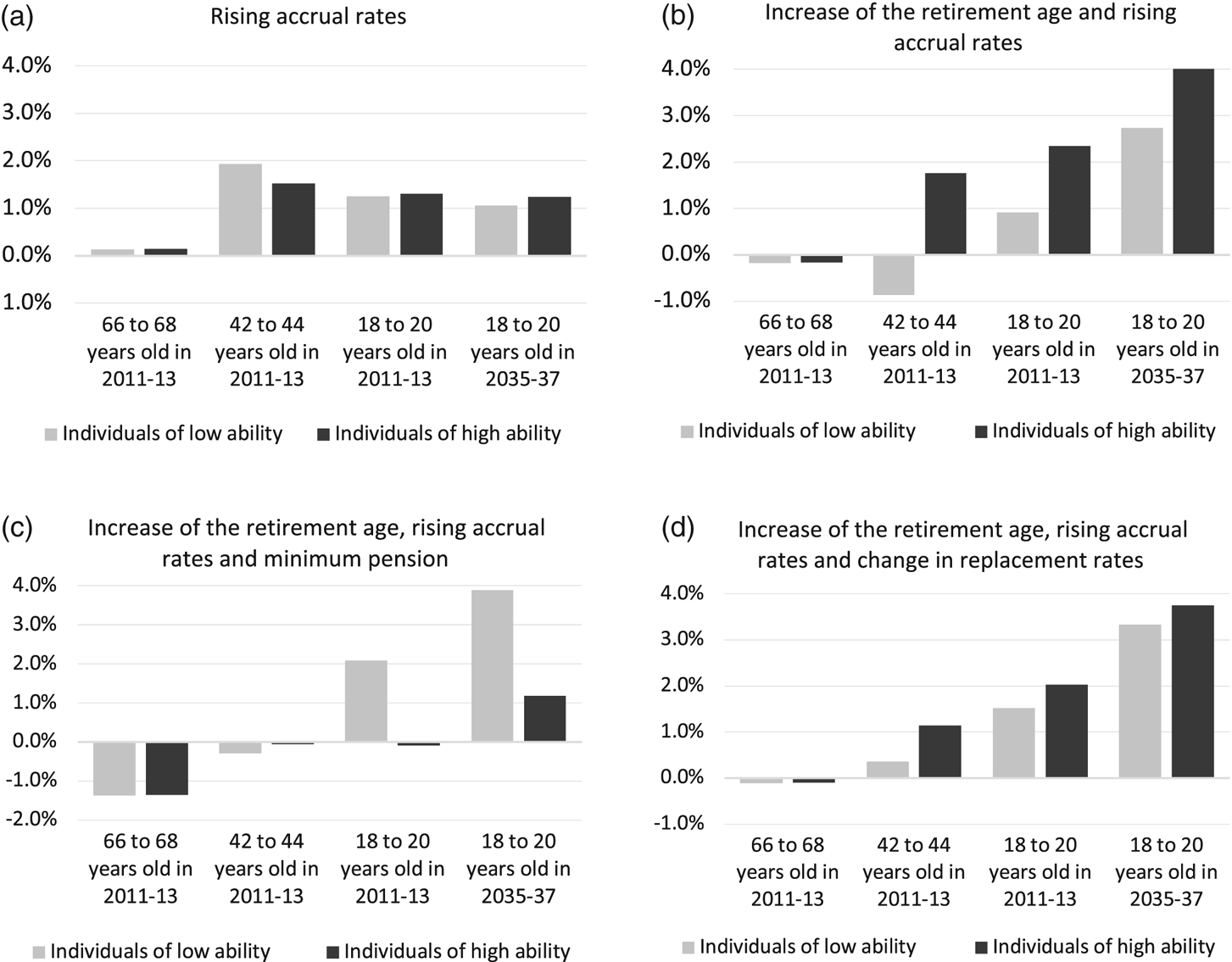
If we then consider welfare, a comparison of Figure 6a with the left panel of Figure 3 and a comparison of the third row in Table 2 with the first row show much better effects for the current generations (in particular those of middle age) from the reform with accrual rates rising with age than from an extension of the retirement age. Moreover, the former avoids the strong increase in welfare inequality for generations that are directly affected by the reform. The downside, however, are much smaller welfare gains for future generations. We observe in Table 2 an aggregate gain for all future generations equivalent to a present discounted consumption volume of only 1.73% of GDP (compared to 4.80% of GDP after an increase of the retirement age). The main reason is that these future generations will have to finance very high pension expenditures to currently active generations, causing future consumption tax rates to rise. Figure 5b reveals a consumption tax rate that is 3–4%-points higher than when the normal retirement age is lifted. Underlying the significantly higher pension expenditures is, first, the higher number of pensioners (when the retirement age is not increased) and, second, the typical life cycle profile of labour income with individuals earning more when they are older. Attaching higher weights to labour income earned when older will consequently increase average pension benefits. As to welfare effects for current generations and welfare inequality, our results are thus fully in line with the findings of Buyse et al. (Reference Buyse, Heylen and Van de Kerckhove2017). For future generations, however, the results here are much less optimistic. The reason is that Buyse et al. (Reference Buyse, Heylen and Van de Kerckhove2017) did not account for demographic change and ageing (they assumed a constant population and population structure), nor for the increasing life cycle profile of labour income.
A fourth parametric pension reform combines the above-mentioned policies: the extension of the retirement age and pension weights rising with age. This unique pension policy mix exploits the complementarity of both reforms. While both improve macroeconomic performance, the former reform is financially viable, but strongly disadvantages the current generations of low ability. The latter reform has much better welfare effects for current generations of low ability and reduces welfare inequality somewhat, but it is too expensive and impairs the consumption possibilities of future generations (and thus their welfare). Figures 4a and 4b show among the best macroeconomic effects from this combined policy for per capita output and labour. This also holds for education and human capital accumulation (not shown)Footnote 21. At the same time, it reduces public pension expenditures in Figure 5a (although less so than when only the retirement age is increased). In Table 2 this policy also brings almost the strongest net aggregate welfare gain if we include all current and future generations. We observe a welfare increase equivalent to a consumption volume of 8.78% of initial GDP. One disadvantage remains, however. Although welfare effects for both current and future generations are better than when only the retirement age is adjusted, high ability individuals still win (much) more than low ability individuals. An additional correction to reduce welfare inequality is therefore needed.
To this end, we simulate two more parametric pension reforms. Starting from pension reform 4, pension reform 5 additionally imposes a minimum pension. Individuals are sure of a pension equal to at least 40% of the average net labour income per worker in the economyFootnote 22. In practice the latter implies an increase in the pension level for the low ability group (see also Figure 5c and 5d), but no ex-ante change for the other two groups. The minimum pension considered here is of the unconditional type (see also Buyse et al., Reference Buyse, Heylen and Van de Kerckhove2017). In a robustness check in Section 4.4, we also consider a minimum pension conditional on hours worked. Pension reform 6 adds to reform 4 an increase in the pension replacement rate of low ability individuals by 8%-points and reduces the pension replacement rate of high ability individuals by 5%-points. An increase in the own-earnings-related replacement rate for the individuals of low ability was another key element in the pension reform preferred by Buyse et al. (Reference Buyse, Heylen and Van de Kerckhove2017).
Compared to reform 4, the introduction of a minimum pension and an increase of the own-earnings-related replacement rate for lower ability individuals are effective in raising these individuals’ welfare and in reducing inequality between low and high ability individuals. Our simulation results reveal significant progress for low ability individuals of working age in Figures 6c and 6d in comparison with 6b. Considering macroeconomic performance (productive efficiency) and the welfare of high ability individuals, however, policy reforms 5 and 6 are very different. The introduction of an unconditional minimum pension strongly undermines the incentive to work for all low ability individuals in Figure 4c. They now receive a public pension benefit unrelated to their own past labour supply and earnings. As a result, aggregate hours worked in Figure 4b are seriously reduced, and so is GDP per capita (Figure 4a). Pension reform 6 retains all the advantages of reform 4, but reduces welfare inequality by strengthening the earnings-related link in the calculation of the public pension benefit for low ability individuals. This reform brings the best results when it comes to hours worked by low ability individuals and older individuals, without affecting hours worked by individuals of high ability. Also the effects on investment in human and physical capital are very positive. Unsurprisingly, together with aggregate hours worked, per capita GDP rises strongly in the medium to long run. In Table 2, policy 6 achieves the best aggregate welfare increase, equivalent to a consumption volume of 8.82% of initial GDP.
4.4 Robustness
In reality, minimum pensions do not have to be of the unconditional type. As an alternative, we considered a minimum pension that is conditioned on the history of individuals’ hours worked. More precisely, the government decides to raise the pension benefit of individuals who under the normal pension system (equation (15)) would not reach a certain threshold. Conditionality is such that the adjusted benefit depends on each individual's average life-cycle hours worked relative to the average life-cycle hours worked by all individuals retiring at that same moment. We define the conditional minimum pension at time t as

$\tilde{y}_t^n$ denotes average net labour income per worker in the economy at time $t$
 , $\tilde{n}_{lc,t}$
 the average life-cycle hours worked by all individuals of all abilities who retire at time $t$
 and $rr_{min}$
 the minimum pension replacement rate determined by the government. It is set to 0.46 so that the conditional minimum pension is comparable with the unconditional minimum pension of 40% of $\tilde{y}_t^n$
 that we assumed above. Note that we use subscript $L$
 on the right side of equation (30) as in practice the minimum pension only applies to the low ability group. The more an individual works over the course of his life relative to those who retire at the same moment, the higher will be his pensionFootnote 23.
The pension reform that adds to reform 4 a conditional minimum pension performs almost as well as reform 6 (see Table 3), although the introduction of this type of pension proves to be somewhat more expensive and is a little less successful in reducing welfare inequality between current generations of low and high ability individuals. This comes as no surprise as in this reform the replacement rate of the high ability group remains untouched. In comparison with the unconditional minimum pension, the conditional minimum pension provides far fewer disincentives to work. Details are available upon request.
Aggregate welfare effects of implementing a minimum pension conditioned on hours workeda

a Details on the computation of the aggregate welfare effects are provided below Table 2.
b The first three data columns include all cohorts of low, medium and high ability; the last four columns only consider cohorts of low or high ability.
As a second robustness check, we evaluated whether our main results and conclusions depend on the imposed taste for leisure in model period 16 (γ 16). The alternative values we consider are 0.54 (lower than the γ 16 previously used), and 0.7 (higher). We find that they do not. Based on aggregate welfare effects and on the same criteria as used before, we find that the policy that combines an extension of the retirement age with rising accrual rates and a change in the replacement rates remains our preferred one, irrespective of the value of γ 16. Here also, underlying simulation details are available upon simple request.
5. Conclusion
Demographic change forces governments in all OECD countries to reform the public pension system. Increased sensitivity to rising inequality in society has made the challenge for policy makers only greater. In this paper we employ a 28-period overlapping generations model for an open economy to evaluate alternative reform scenarios. Our model explains hours worked, education and human capital accumulation, and physical capital, output and welfare within one coherent framework. The model also incorporates heterogeneity in innate ability between individuals as the main source of inequality.
We find that frequently adopted reforms in many countries such as an increase of the normal retirement age or a reduction in the pension benefit replacement rate can guarantee the financial sustainability of the system, but they fail when the objective is also to improve macroeconomic performance without raising intergenerational or intragenerational welfare inequality. A reduction of the replacement rate to restore the financial balance of the public pension system (i.e., without a parallel reduction of contributions or labour taxes) fails on both criteria. An increase of the retirement age promotes long-run macroeconomic performance, but will create more welfare inequality. Openness of the economy and the endogeneity of human capital seem to be important elements behind these findings. Existing literature on pension reform and inequality in the context of demographic change has, however, neglected the endogeneity of human capital and/or the possibility of international capital flows.
Our results prefer a reform that combines an increase of the retirement age, which decreases pension expenditures relative to GDP, with an intelligent design of the linkage between the pension benefit and earlier labour earnings. First, this design conditions pension benefits on past individual labour income, with a high weight on labour income earned when older and a low weight on labour income earned when young. Such a linkage between the pension benefit and earlier labour income provides strong incentives to invest more in education by reducing its opportunity cost when young, and stimulates working more hours when older. Second, to avoid rising welfare inequality this linkage is complemented by a strong rise in the benefit replacement rate for low ability individuals (and a reduction for high ability individuals). Low ability individuals in our model are not productive in education at the tertiary level. Since their low ability is a circumstance for which they cannot be held responsible, a compensation mechanism is justified. Attempts to cope with rising inequality by introducing an unconditional minimum pension are negative for aggregate employment and welfare. Another approach, conditioning the level of the minimum pension on an individual's hours worked over the career, brings much better results, which are quite close to those of our preferred reform.
Although our model accounts for key dimensions of heterogeneity across individuals like age and labour productivity, we abstract from other dimensions such as (differences in) health and life expectancy. Including them in future work could further enrich the analysis. However, because of their strong positive correlation with innate ability and education, it would not change our main results. It would mainly strengthen the concern for avoiding higher welfare inequality in pension reform, which is at the centre of this paper.
Supplementary material
The supplementary material for this article can be found at https://doi.org/10.1017/S1474747222000051.
Acknowledgement
We are grateful to Tim Buyse, Bart Capéau, André Decoster, Hans Fehr, Glenn Rayp, Dirk Van de gaer, Frank Vandenbroucke and two anonymous reviewers for useful comments and suggestions during the development of this paper, and to Lars Heylen for technical support. We also benefited from discussions at the 31st Annual Conference of the European Society for Population Economics (Glasgow, 2017) and during seminars at KU Leuven and Universität Würzburg. We acknowledge financial support from Belgian Science Policy (BRAIN-be Programme). Any remaining errors are ours.
Financial support
This study was funded by the Belgian Science Policy Office (BR/132/A4/BEL-Ageing).
Conflict of interest
None.