What can models of interest group behaviour from American politics tell International Relations (IR) about the activities and influence of international non-governmental organisations (INGOs) engaged in advocacy in world politics? A number of IR scholars note parallels between the behaviour of advocacy INGOs and interest groups, citing prima facie similarities between the two as evidence.Footnote 1 None of these authors examine this analogy systematically, however, nor consider the theoretical implications of explicitly applying interest group theories to advance our understanding of INGOs.Footnote 2 More recent scholarship by Sell and Prakash, Shareen Hertel, Clifford Bob, David Baron, Sarah Henderson, Cooley and Ron, and Paul Burnstein demonstrates that INGOs like corporate interest groups are instrumental as well as normative actors, thus more similar in their orientations than past work has indicated.Footnote 3 I argue that the similarities between interest groups and INGOs are even deeper and broader. A systematic analysis of pre-existing research into interest groups might thus suggest additional productive avenues of research for IR scholars examining advocacy INGOs. This article tests the advocacy INGO-interest group analogy theoretically and statistically. If advocacy INGOs are sufficiently similar to interest groups, IR can borrow theory, research designs, and testable hypotheses from past studies of interest groups. Furthermore, viewing advocacy INGOs as interest groups provides a curative to the tendency to view them as self-sacrificing knights in shining armour. Nevertheless, competing advocacy INGOs, each representing a narrow interest on which their survival depends, can contribute significantly to the public good in the form of effective, efficient policy, even if they must do so by working within frameworks set by states.
The debate in American politics over the agency and influence of interest groups echoes the debate in international relations over the power and importance of INGOs in a state-dominated international system. In American politics, strategic information transmission with or without campaign contributions and mass mobilisation provide interest groups means to influence policy, despite the fact that the policymaking process is dominated by the executive and legislature. The approach taken here thus helps IR scholars mediate between neo-medieval arguments that declare the end of the state at the hands of multiple conflicting sub-national and supranational sources of authority,Footnote 4 arguments that non-state actors are epiphenomenal reflections of state interests,Footnote 5 and claims that INGOs serve useful, if limited, functions in national and international policymaking.Footnote 6
American politics theories of interest groups can provide insight into questions which International Relations has so far had problems answering, including where and when advocacy INGOs are likely to arise; the future growth of INGOs; and why decision-makers need advocacy INGOs as much as INGOs need decision-makers. Using theories from American politics, I propose several concrete avenues for future research into: 1) advocacy INGO growth patterns; 2) the propensity of INGOs to become more formal, complex bureaucracies; 3) the effects of advocacy INGO motives and rivalry on the quality of foreign policy; 4) the changing roles and efficacy of advocacy INGOs at different stages in the policy process and, 5) government regulation and relations with advocacy INGOs.
IR and the study of NGOs
Thirty-five years of concerted research on non-governmental organisations has brought IR a long way in terms of our understandings of the tools INGOs use to influence international relations, the forums in which advocacy INGOs prefer to operate, and the issues on which advocacy INGOs focus.Footnote 7 From early works by Skjelsbaek and Feld to later works by Keck and Sikkink, Price, and Carpenter, studies of INGOs have examined differences in the capabilities, principles, goals, and accomplishments of INGOs and provided numerous case studies which demonstrate INGOs have a profound impact on international law, international regime formation, national politics, and the quality of life within individual countries.Footnote 8 Nevertheless, the theoretical literature on the conditions under which they are likely to take different forms and fill different functions is underdeveloped.Footnote 9 This article targets particular shortcomings in the existing literature: overly rosy and naïve portrayals of the intentions and operations of INGOs, INGO population ecology, understandings of INGOs integration and involvement within national political processes, and government regulation of INGOs.
Although there are peculiarities to the US political system which make some interest groups theories from American politics irrelevant to the study of INGOs, there are several reasons to believe that there is still much that we can learn from past scholars. While the US political system is unique in some aspects – the degree of decentralisation, presidential rather than parliamentary institutions, and a weak political party system – theories of interest group influence often focus on electoral pressure, the mobilisation and representation of public opinion, and the communication of information which are universal across liberal democracies. The literature on interest groups outside of the US has largely focused upon the role of interest groups in Europe, often in corporatist systems in which select groups enjoy close relations with the government. Baumgartner and Mahoney find that while interest group scholars in Europe have in the past focused on policy networks and systems approaches that integrate interest groups and their states, there has been convergence in recent years between studies of interest groups in the US and in Europe and a focus on group creation, mobilisation, and tactics for influence.Footnote 10 Recent literature on interest representation in the EU includes attention to collective action models, campaign contribution models, and mass mobilisation as well as informational advocacy.Footnote 11 The extent to which American interest group models account for the behaviour of INGOs raises an interesting question. Are INGOs the internationalisation of a particularly American form of organisation?Footnote 12
The UN, and associated agencies, as well as the EU have operating procedures similar to the US, including regulatory limits on access for interest groups and rules for formal participation. In this context, interest group theories are more directly applicable. In one of the few quantitative studies of interest groups in international organisations, Christine Mahoney argues that the primary difference between lobbying in the UN or the EU as opposed to the US is one of constituency base and representation.Footnote 13 International NGOs represent large and diverse transnational constituencies. They depend more upon their reputations as reliable source of information and expertise than electoral threats for access to unelected international forums. This is reflected in the criteria for accreditation at the UN. NGOs must demonstrate competence in a relevant issue area in order to gain admission. Thus, while interest group theories based on electoral threat may not apply to the actions of NGOs in international organisations, information theories are particularly useful. INGOs active in national decision-making forums, however, are likely to be able to draw upon the full complement of interest group strategies, including naming and shaming as an extension of information advocacy as well as mass mobilisation and campaign contributions. The analogy between traditional interest groups and INGOs hinges on the definition of an interest group, the definition of an INGO, and the empirical characteristics and behaviours of typical members of each group. The next sections of this article examine each of these elements in turn.
Interest group studies in American politics
There is great debate on the definition of an interest group, since a wide variety of organisations seek to exert influence on public policy.Footnote 14 ‘Groups will vary considerably in the kinds of benefits they seek, the kinds of constituencies they seek to mobilize, and the formal resources they can bring to bear in approaching congressmen.’Footnote 15 There seems to be general consensus on a minimal definition, however. Interest groups are political organisations with autonomy from both government and political parties which make some attempt to influence government.Footnote 16 The first criterion separates interest groups from spur of the moment social movements and requires interest groups to have an institutional structure which sustains them beyond a single impulse or leader. The second criterion implies that interest groups are officially outside of government, although government officials can participate in their private capacity. Interest groups are explicitly political, however. Groups may have larger economic or social goals, but they seek to achieve these goals by affecting government policy or behaviour.Footnote 17 While groups may claim that they are non-political to garner support, this claim rests on a very narrow definition of politics, that is, official and formal alignment with a political organisation.
Interest groups can be identified by either their structural characteristics or their behaviour. Because the definition above is minimal, it is also quite general. Specific national regulations may require interest groups to meet additional criteria, which may narrow, at least formally, what is considered an interest group. In the US, there are official requirements groups must satisfy in order to lobby, including provisions that they register with Congress and file reports with the Federal Election Commission.Footnote 18 A second, behavioural, means of identifying interest groups is useful. Interest groups transform money, membership, and labour into political influence.Footnote 19 Elaborate taxonomies have been developed to categorise groups by their membership type (staff, organisations, or individuals); goals (public or private goods or economic or non-economic benefits); target for advocacy (the courts, the executive, or Congress); strategies (direct lobbying, PAC contributions, or grassroots mobilisations); and organisational structure (unitary or federated). They all seek to provide something to government decision-makers as a means to influence policy.Footnote 20 Interest groups may ultimately seek to influence the content of government policy, the configuration of government (via elections), the distribution of government resources (via grants and kickbacks), or to protect the status quo.Footnote 21
Most scholars resort to pre-existing directories to identify interest groups to study. ‘No matter what the conceptual definition of interest groups that an author might want to use, those interested in large-scale investigations have consistently noted that there are few alternatives to consulting some sort of published list of groups.’Footnote 22 The Encyclopaedia of Associations (now the database Associations Unlimited from the Gale Group), The Washington Information Directory, and Washington Representatives are the most common sources. Some of the most-studied include: Common Cause, the Sierra Club, the National Wildlife Federation, the American Civil Liberties Union, the tobacco and sugar lobbies, the AFL-CIO, the Business Roundtable, the American Petroleum Institute, the US Chamber of Commerce, the National Rifle Association, the American Association of Retired Persons, and the National Education Association.Footnote 23
From this brief review of the interest group literature, it seems safe to define interest groups broadly as associations of members (unit of analysis may vary) united by a common interest and a desire to achieve this interest, at least in part, by political means. Because this definition leaves open the interests involved, the degree of organisation required, the type of institutionalisation likely, the means of influence employed, and the goals sought, most scholars resort to published lists to identify interest groups.
American politics models of interest group behaviour
American politics theories of interest group influence centre on three mechanisms: campaign contributions and electoral pressure, strategic information transmission or expertise, and grassroots representation and mobilisation. Campaign contributions are argued to influence decision-makers by targeting their desire to be re-elected and their need to fund their campaign. In return for a contribution, interest groups expect special consideration in future policymaking. The transmission of information by interest groups, on the other hand, is argued to influence policymakers because interest groups have expertise and private information which allows policymakers to better meet their policy goals and satisfy their constituents.Footnote 24 These two strains in the literature are sometimes linked. Campaign contributions can be a signal of credibility by an interest group (a signal that it has information worth this price) or a means to secure the attention of a decision-maker.Footnote 25
Interest groups as representatives of the grassroots, as well as agents of mobilisation, have two additional sources of influence in policymaking: interest aggregation and electoral turnout. Scholars have devoted particular attention to which interests overcome the collective action problem to exert sustain political pressure on decision-makers (group-mobilisation approach) as well as the biases which result within the interest group community as a whole as selective, often economic, interests tend to organise better than groups with ‘democratic’ representation.Footnote 26
I present a brief overview of a diversity of interest group models in order to suggest the rich theoretical resources that might be developed as potential explanations for INGO characteristics and behaviours, several possibilities of which are examined at the end of this article. Most models of interest group influence are based on variations of the same narrative: a legislator, uncertain about the ramifications of an impending decision, seeks information about likely constituency reaction and the economic, social, or environmental impacts of two competing policy proposals (one of which is the status quo). The legislator is concerned with re-election and needs information to vote in a way that does the least damage to his chances. Interest groups collect information about constituency opinion through grassroots mobilisation or sponsoring a public action (demonstration) at which they can observe constituency support for alternative policies. If the interest group discovers the decision-makers' constituency favours the policy that they also prefer (often this is assumed to be the innovative policy), they will honestly communicate this to the legislator. If the interest group collects information that the public prefers the status quo, the interest group has an incentive to remain quiet or to misinform the legislator about this information. If the interest group remains quiet, the legislator assumes the public supports the status quo. The legislator evaluates the interest group's information and then decides how to vote. While the legislator can acquire his own information about the proposed policies by making a trip home, hiring a pollster, or holding a town meeting, these activities are costly. The legislator would like to avoid this expense if the lobbying process is likely to be informative, that is, if interest groups will deliver credible information.
Most authors conclude that, at least in certain circumstances, legislators will listen to interest groups because, while they carry some risk of misinformation, in the long-run legislators expect to gain from shifting the cost of data collection to interest groups.Footnote 27 The question is when information is influential, that is, the conditions under which decision-makers use interest group information. The key is the credibility of the interest group and its information. Decision-makers want information to improve their policymaking, but they need good quality information. As information increases in credibility, decision-makers face a smaller risk of being misinformed, selecting an inappropriate policy, and/or being overwhelmed with noise. It is characteristic of interest groups that while they may have valuable expertise and specialised private information, they always have a strategic incentive to present (or withhold) this information in a way that favours their cause.Footnote 28 Decision-makers must screen groups and their information prior to use.
If decision-makers suspect that an interest group has more of an incentive to send information when it is uninformed than when it is informed (for example, if the group has extremist preferences which data is unlikely to support or if the group is too small or poor to collect a sufficient quantity of quality information) then they are likely to assume that information is manipulative rather than informative.Footnote 29 Some scholars argue that it is not the information itself that decision-makers evaluate, but the nature of the interest group. Because decision-makers know that interest groups have an incentive to deliver information in the most favourable way possible, the content of the message is less informative than the fact that this particular group sent a signal.Footnote 30 Only when the bias of the interest group and the decision-maker are compatible does the interest group have an incentive to share private information truthfully. If their biases diverge, the decision-maker suspects that the interest group is trying to misinform him to produce a policy outcome closer to their preferences but farther from his.Footnote 31
The field is divided between scholars who argue that interest groups tend to lobby only those who share their beliefs and those who argue that interest groups must lobby their foes to change policy. This first group argues that interest groups serve as service bureaus for decision-makers. Given limited time, money, and manpower, and because decision-makers are predisposed to listen selectively to information, lobbyists do not try to inform those they know to be in opposition.Footnote 32 On the other side of the debate are those who argue that because lobbying is expensive, interest groups only have an incentive to lobby if the legislator might otherwise vote against their interests. Thus interest groups lobby uncommitted decision-makers and those who are predisposed to vote against them.Footnote 33 This group argues that interest groups only lobby ex ante supporters to counteract the lobbying efforts of opposing groups. A third group has emerged contending interest groups lobby decision-makers in key positions in government no matter what their preferences. An interest group ‘has no choice but to lobby enemies if everyone on the decisive congressional committee deciding the fate of the policy is a legislative enemy.’Footnote 34
Despite debates about tactics and targets, a common line of argumentation emerges from the literature on interest groups. First, groups are at the heart of the political process – they are central to representation, democratic participation, and popular mobilisation. Second, interest groups play an important role in the dissemination of information between levels of government, in particular the transfer of political preferences from the public to decision-makers and the communication of policy from elite levels to the masses.Footnote 35 Third, interest groups provide an important source of expertise in policymaking.Interest groups can purchase access and influence via campaign contributions, thus serving as ‘service bureaus’ for like-minded decision-makers. But interest groups can also provide new information to decision-makers producing a policy different than otherwise expected.Footnote 36 A number of theoretical debates remain which can only be resolved empirically: who individual interest groups should target to maximise their influence (friend, foe or key committee member); whether money or information is more influential; and the most effective way to communicate with decision-makers (direct lobbying, campaign contributions, grassroots mobilisation or some combination).
I look to the interest group literature as a means to study the role of advocacy INGOs in IR. Current IR theory is insufficient to explain the growing numbers and roles of advocacy INGOs or to incorporate their activities and influence into the cannon of IR theory in a systematic and rigorous fashion. Advocacy INGOs attempt to convince decision-makers to change government policy, while wishing to remain out of government themselves. These organisations cannot compete with states in terms of coercive capability or money, but they can use information. American politics models of interest group behaviour include several alluring ideas and avenues of research for those who study advocacy INGOs. In order to legitimately (much less usefully) transport theories from American politics to international relations, the analogy between American politics conceptualisations of interest groups and international relations definitions of an advocacy INGO must hold.
INGOs as interest groups
IR studies of advocacy INGOs suffer from some of the same conceptual disagreement as do American politics discussions of interest groups. Non-governmental organisations are ‘autonomous organizations that are non-governmental, that is, they are not instrumentalities of government; and non-profit, that is not distributing revenue as income to owners; and formal, legal entities.’Footnote 37
Like in American politics, coding rules from authoritative data sources have become the staple definition. INGOs are defined by the main international organisations that record their activities, the UN and the Union of International Associations (UIA), as formally organised bodies independent of government representation with international aims and projects in, and funding and members from, at least three countries, a permanent headquarters, and a governing body.Footnote 38 Like interest groups in the US, advocacy INGOs must meet certain criteria and obey regulations in order to be officially recognised and included in intergovernmental proceedings. As of 1968, the UN requires the following for NGO accreditation: the NGO must be involved in, or have expertise germane to, issues of concern to the UN, have an international scope, hierarchical structure, and established headquarters.Footnote 39
Also like interest groups, advocacy INGOs come in a wide variety of forms with vastly different membership densities, institutional structures, and issue concerns. However, these groups all share a common goal: to directly or indirectly influence policy. It may be that INGOs intend to change government policy or behaviour via public opinion or intergovernmental organisation rules, but in the end INGOs must change policies or practices to be politically efficacious.Footnote 40
A number of INGO scholars have drawn rough parallels between advocacy INGOs and traditional interest groups, although they have not systematically tested this analogy empirically, however, nor elaborated theoretical and empirical implications should it hold true. Examples include: ‘[s]cholars of transnational advocacy also claim that NGOs are savvy interest groups who maximize opportunities and scarce resources’;Footnote 41 ‘[l]ike lobbyists in a domestic setting, NGOs act as conduits for ideas and political pressure’;Footnote 42 ‘[i]n addition to working the proverbial hallways in the same way that domestic interests lobby the Congress, NGOs have managed to insinuate themselves into decision-making contexts […]’.Footnote 43 The comparison between interest groups and advocacy INGOs has been drawn implicitly and explicitly by other authors, including Willets, Risse-Kappen, Brown et al., Hertel, Burstein, and Bob.Footnote 44
Even when the analogy to an interest group is not explicit, many authors have noted advocacy INGO behaviour which resembles interest groups, including information provision and expert consultation.Footnote 45 In a comprehensive 2004 survey of environmental NGOs in Europe, Russell Dalton finds almost the same range of behaviours used by INGOs as others have found for interest groups. INGOs rely on the same range of tactics, including inside lobbying, public education, protest and demonstration, and judicial action, in roughly the same proportion as traditional interest groups. Face to face contact and policy research combined with public information campaigns are the preferred tactics of both advocacy INGOs in the EU and traditional interest groups in the US.Footnote 46
Not only do NGOs behave in ways that are comparable to interest groups, authors have noted that government decision-makers have similar concerns regarding advocacy INGOs as interest groups. ‘[T]he plurality of sources provides a check on exaggeration, obfuscation, and poor logic and data.Footnote 47 Scholars also argue that NGOs must worry about their reputations as reliable sources of information as they engage in advocacy.Footnote 48
An important difference separates INGOs from traditional domestic interest groups and thus requires closer examination. INGOs, with their networks of national chapters and partner organisations, can be national and transnational agents. NGOs can gain strength from their network form of organisation in two ways. First, they can use their networks to call on powerful external actors (often states) when they face domestic political constraints. Second, NGOs can shop venues and select the most receptive political arena to press their cause.Footnote 49
The transnational nature of INGOs increases their ability to influence policy by targeting decision-makers from above and below simultaneously and by shopping policymaking forums. When dealing with a recalcitrant government, INGOs can keep pressure on decision-makers at home while simultaneously lobbying intergovernmental organisations and other states' decision-makers to put pressure on the state from the outside.Footnote 50 INGOs form alliances with intergovernmental organisations and other NGOs to pressure a resistant state to alter its policy.Footnote 51
The ability to use networks to change arenas gives INGOs more choice and freedom than nationally-bounded interest groups. INGOs can shop political arenas to influence the most receptive decision-makers in the most accessible sites. INGOs can aim their lobbying efforts at the traditional targets – the legislature and back hallways of Congress, the executive and executive agencies, and the public – or international arenas. International arenas include the UN and its specialised agencies, as well as special treaty organisations, intergovernmental conferences, and multilateral banks. A number of IGOs grant NGOs observer status, including the International Tropical Timber Organization, the London Dumping Convention, the International Whaling Commission, the UN Environmental Program, and the Montreal Protocol.Footnote 52 The World Bank and the IMF also consult with NGOs regularly.
There are limits to the advantages provided by transnational networks. While NGOs have more control in their own forums, for example parallel conferences like the one held in Rio in 1992, they cannot influence state policy in non-governmental forums. States' sovereignty and power thus impose constraints on INGOs very much like those on interest groups. Often particular states must be convinced to change policy for an international regime to form. These states have an overwhelming stake in an issue and without whose cooperation an international agreement would be worth little.Footnote 53 It is in these states that INGOs must stand their ground and lobby, even if conditions are not favourable. Transnational networks may also cause more problems than they solve, including internal power politics over campaigns and difficulties building coalitions large enough to overcome stalemates among members.Footnote 54
The analogy in data
The analogy which drives this article suggests advocacy INGOs can be seen as a type of interest group, and therefore theories derived from the study of interest groups can be usefully applied to advocacy INGOs. Other studies of domestic interest groups and advocacy INGOs find that they share similar defining characteristics and engage in similar types of activity. I would like a more comprehensive and carefully controlled test of such a fundamental, and potentially powerful, assertion. If advocacy INGOs and interest groups are really one and the same type of actor, then these two groups are subsets of a larger group of organisations, or they are samples taken from the same underlying population. In essence, it could be ‘as if’ traditional domestic interest groups and advocacy INGOs are two draws from the same pool rather than two distinct categories of organisations. This finding would provide strong evidence that theories based on one, that is, American politics theories of interest groups, could be applied to the other.
Description of data
I use the sources and methods of previous quantitative studies of INGOs and interest groups to collect the data used in this study. Representative interest groups were selected from Associations Unlimited (formerly the Encyclopedia of Associations). This annual publication, now a searchable database, lists all national non-profit membership groups in the US.Footnote 55 This source was used by David Knoke and Kevin Leyden in their studies of domestic interest groups.Footnote 56 Representative INGOs were selected from a list of NGOs with General or Special consultative status with ECOSOC. For both organisation types, I selected a limited number of issues (Environment, Human Rights, Peace and Disarmament and Nuclear War, and Development/Social Welfare) and used every tenth organisation from the resulting alphabetical lists to produce a limited random sample of domestic interest groups and INGOs.Footnote 57 Some organisations appear in both sources and so are coded as both interest groups and NGOs. The final dataset contains 166 organisations: 83 interest groups, 83 INGOs, and 29 overlapping organisations.Footnote 58
For each organisation, I collected data on the following variables – founding date, budget, staff, membership, headquarters location, issue, goals/aims, publications, and network connections – using the Associations Unlimited database for domestic organisations and the Union of International Associations' Yearbook of International Organizations for NGOs for 2002/3.Footnote 59 Data on whether the organisation possessed a political action committee (PAC), PAC contributions, in-house registered lobbyists, lobbying budget, and a Washington, DC office was taken from the Federal Election Commission, the Center for Responsive Politics, and Washington Representatives respectively (2001–2002).Footnote 60 I also used the CIS Annual Report index for testimony before Congress for each organisation (2002). Variables were selected because they feature prominently in American politics studies of interest groups' character, activity, and influence. They most commonly appear as independent variables in explanations of interest group influence, and represent the range of tactics that interest groups use, including grassroots mobilisation, campaign contributions, and informational lobbying. Age, resources, geographic location, and tactics also feature predominantly in IR scholars' analysis of INGOs. Thus, if INGOs and interest groups are overlapping categories of organisations these variables, which feature in both literatures, should have values within similar ranges.
Methodological issues
The resulting data set has three problems. The first problem strengthens the underlying argument, although complicates empirical analysis. For some organisations, categorisation as a domestic interest group or as an INGO is artificial, as some organisations appear in both sources and they function as both. Overlap between categories (and the blurring of the boundary separating them) is what I hope to find, as it indicates the analogy is sound. For the purposes of conducting statistical analysis, organisations which fall into both categories are treated as INGOs. Coding overlapping organisations as interest groups instead does not significantly change the overall findings.Footnote 61
Second, because the dataset is limited to selected issue areas, albeit key issues in both American politics and IR, this may systematically omit certain types of organisations and over-represent others. The most problematic omission is economic organisations, or private interest groups, as the issues selected largely concern public goods. If the results of this analysis are promising, this problem can be addressed by widening the scope of the dataset. For now, however, this problem is not a great concern. The majority of advocacy INGOs and domestic interest groups operate in the issue areas considered. Even if only theories of public interest groups apply to advocacy INGOs, this is still a large body of promising literature.
Third, I use ECOSOC consultative status to operationalise advocacy INGO. This was done because NGOs with consultative status are more likely to be established organisations with reliable available data. This may have imposed a selection effect for the INGOs which most closely resemble interest groups. In future, it would be better practice to select organisations from the UIA Yearbook of International Organizations, which catalogues all international organisations. This data source is vast – it includes many times the number of organisations that have consultative status at the UN (approximately 15,000 compared to 2,000). Using the ECOSOC list makes an initial probe of this analogy possible, but future studies might eliminate this bias by using the UIA data. This would also make the variable ‘consultative status at the UN’ meaningful for future studies.
Hypotheses
In this section, I run several reinforcing tests. First, I test if the mean and variance of the sample population of advocacy INGOs are the same as the mean and variation of the sample population of domestic interest groups. A positive result indicates that these two groups of organisations behave in very similar ways and it would be worthwhile to test empirically if theories of one groups' behaviour can be applied to the other. I compare the mean and variance of the two groups for a range of different characteristics including: organisation age, staff, budget, network (affiliations), lobbying budget, publications, and testimony before Congress. I expect to find that the two groups cannot be distinguished in any statistically significant way across any of these characteristics except affiliation. I expect to find advocacy INGOs engage in more networking.
Second, I test if organisation type (advocacy INGO or interest group) is systematically related to behaviour using a series of Pearson chi-square tests. Again, the only relationship I expect to be significant is that between organisation type and international networking.
The evidence: INGOs as interest groups
Simple descriptive statistics are highly revealing. The percentage of organisations which appeared in both data sources, Associations Unlimited and the Yearbook of International Organizations, and thus are considered both INGOs and domestic interest groups, was 17.5 per cent. There is overlap between the two categories, including groups like the American Jewish Council, Friends of the Earth, Human Rights Watch, the Society for International Development, and Zonta International.
The percentage of organisations with official access to both the US government and the UN is strikingly high. Forty per cent of all organisations which had registered lobbyists in-house also had consultative status at the UN. Examples include Greenpeace USA, the Natural Resource Defense Council, Peace Action, and the Sierra Club. A large number of advocacy INGOs are engaged in lobbying in the US and a number of US groups are represented at the UN.
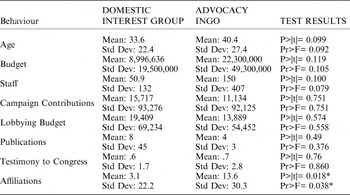
I test formally if the means and variances of each group are the same (at least statistically speaking) over a range of characteristics and activities. Table 1 below gives the means and standard deviations for each characteristic and behaviour by organisation type.
Descriptive statistics for interest groups and INGOs
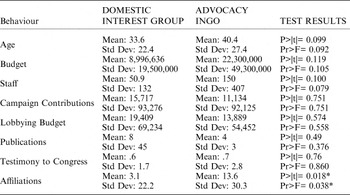
I use t-tests and F-tests to compare the means and distributions of the two populations. Formally speaking, I have run hypothesis tests for the difference in the means and the equality of the variances of these two populations. If these two populations take basically the same shape and form, that is, domestic interest groups and advocacy INGOs share the same characteristics and engage in the same behaviours, then there should be no difference in the means or the variances. If the analogy holds, the difference of means and variance tests should be rejected in favour of the null hypothesis. T-tests (comparison of means) and F-tests (comparison of variance) are reported in Table 2 with the typical indications of significance (* for 5 per cent). As expected, the two sample populations vary significantly on only one variable – affiliation. Advocacy INGOs have significantly more affiliates (ties to other organisations) than domestic interest groups.Footnote 62
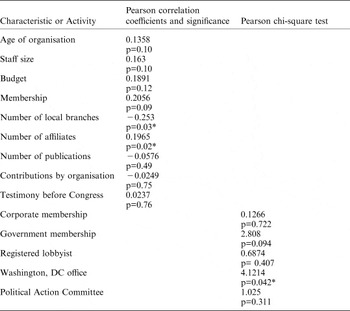
I confirm this result using Pearson tests for associations between organisation type and a range of behaviours, including whether these have corporate members or not, have government members or not, have a registered lobbyist in the US, keep a Washington, DC office or a PAC. There should be no statistical relationship between being an advocacy INGO or an interest group and the propensity to engage in the above behaviours. I find, as is shown in Table 3, that the only significant relationships exist between organisation type and local branches, affiliates, and having a DC office.Footnote 63
Pearson tests for correlation

Advocacy INGOs are more likely to have affiliations to independent organisations while national interest groups are more likely to have local branches. INGOs have the advantage of transnationalism and can form international networks. Domestic groups do not have this option, and so must form local branches. It is not entirely surprising that national, that is, US, organisations would have offices in Washington, DC, more frequently than advocacy INGOs as INGOs can choose to base their operations in a range of national capitals.
Based upon this simple statistical analysis, I conclude with some confidence that domestic interest groups and INGOs are sufficiently analogous that interest group theories from American politics can be usefully applied to the behaviour of advocacy INGOs in International Relations. The last section of this article argues this would be a progressive development for IR and suggests several avenues for future research.
There are, however, several limitations to this analogy which bear elaboration first. While it is plausible that INGOs draw upon the same range of strategies as interest groups, it is unlikely that this is in fact the case. The common perception is that INGOs are likely to engage in non-monetary strategies, for example. The relative frequency of INGOs' use of alternative strategies needs further empirical analysis, however. Second, to the extent that a regional INGO, or a single INGO, operates only in places or issues without strong interest group traditions, or within a corporatist system with distinctive institutions connecting interest groups and the state, I would expect to find different patterns of influence and activities. For these cases, we need additional theorising beyond American interest groups. Similarly, interest group models do not sufficiently account for normative strategies of INGOs beyond information advocacy or mass mobilisation. INGO research on framing and norm cascades might help to enrich interest group theories.
INGOs as interest groups: a research agenda for international relations
In this article I detail an analogy between traditional American politics interest groups and advocacy INGOs to argue that they engage in the same range of behaviours towards the same goals.Footnote 64 I thus propose that carefully applying models of interest group behaviour from American politics could help us to incorporate the activities and influence of INGOs into state-centric theories of international relations without underestimating the importance of advocacy INGOs or overstating the decline of the state. Lobbying, campaign contributions, and grassroots mobilisation are used to alter government decision-makers' evaluation of policy alternatives and funding allocations. NGOs can be included in international relations without having to debate whether states are still the primary actors in IR.Footnote 65 States may be sovereign, but state decision-makers are not omniscient. Given that state decision-makers must choose to form an international regime or not, trade or not, or go to war or not, there is plenty of room for INGO activism in important decisions without questioning the structure of the state system.Footnote 66
The remainder of this article examines six areas of advocacy INGO research which could be improved by introducing interest group theories from American politics: INGO motivations and their importance for political outcomes, likely areas of advocacy INGO growth, ‘professionalization’, strategic lobbying in different phases of issue evolution, INGO competition, and the regulation of advocacy INGOs. I briefly address the current approach to each topic, but focus on new directions for research suggested by interest group theories which provide a rich source of empirically testable hypotheses for future INGO studies.
Playing politics with the public good
A recent wave of academic literature has excoriated INGOs for malfeasance, particularly playing politics for their own organisational goals, including survival, aggrandisement, or enrichment, at the expense of the populations and principles they profess to serve.Footnote 67 While authors in the 1990s were concerned about NGOs lack of accountability, particularly undemocratic decision-making structures and weak accounting systems,Footnote 68 this newer literature is a more fundamental critique of the operation of INGOs. First, the organisational imperatives of INGOs may outweigh their moral imperatives. Second, good intentions do not guarantee good outcomes. The need for visible, easy, and cheap successes make INGOs easy prey for states seeking political pawns.Footnote 69
This literature is a backlash against a much longer trend of celebrating INGOs. ‘Such scholarship identifies too closely with NGO goals and reiterates in theory the self-legitimating discourse of NGOs. The tunnel vision of such approaches fails to reveal the politics of NGOs in its full range and complexity.’Footnote 70 Price, in his review of transnational civil society (TCS), states ‘The liberal cast of much TCS research has drawn the frequent complaint that it analyses “good” campaigns, but not “bad” campaigns or failed campaigns.’Footnote 71 While Price rejects this as a critique of the theoretical or methodological rigor of the research programme, he argues that future scholars should consider ‘how TCS actors produce outcomes against their (moral) interests due to organizational pressure or material incentives’.Footnote 72
Insights from American politics can help authors rise to meet Price's challenge. Viewing advocacy INGOs as interest groups means we assume they are self-interested actors that play politics. They should strategise how to use scarce resources to obtain their political ends. Yet we can still argue advocacy INGOs act for the public good, including the diffusion of international norms. The need for a reputation for honesty naturally constrains the worst NGO behaviour. Irresponsible NGOs will be unable to access the resources and decision-makers necessary to achieve their goals.Footnote 73 Decision-makers expect INGOs acting as interest groups to be biased and represent a specific point of view based upon their principles and goals. For academics to do any less misses a fundamental point: partisan, politically-savvy INGOs can still improve policymaking, distribute humanitarian assistance, and advocate environmental stewardship and human rights. We just have a clearer idea about how they do this.
Areas of expansion: issues and geography
Current studies of NGOs focus upon a relatively limited number of organisations of similar nature operating in a limited number of issue areas. Case studies concentrate on large INGOs like Greenpeace, Friends of the Earth, Amnesty International, the International Red Cross, Jubilee 2000, the International Campaign to Ban Landmines, SANE/Freeze, or social movements within a limited number of issue areas – human rights, environment, peace, global justice, and women's issues.Footnote 74 A closer look at the interest group literature raises the question of whether there is a wider population of advocacy INGOs which is being ignored, or if current research has this focus for good reason. Little systematic research has been done on the reasons INGOs take the forms they do, operate where they do, on the issues they do. The impact of financing on groups' operating decisions has received some attention, particularly large humanitarian NGOs in need of government funding and human rights organisations concerned about their independence.Footnote 75 Less research has been done on the collective action problems advocacy INGOs face and links between institutional context and organisational design.
Both of these strains of thought are well developed in the interest group literature.Footnote 76 As Mancur Olson demonstrated, not all interests are likely to be represented in politics, as the costs of organising deter large groups with diffuse interests.Footnote 77 Later literature has amended Olson's conclusion, demonstrating that social and expressive incentives and entrepreneurs may help public interest groups overcome collective action problems. Large groups and diffuse social movements are still likely to have difficulty in prolonged mobilisation and advocacy.Footnote 78 Institutions which facilitate free speech, improve public access to policymaking, and lower the costs of organising can help large membership groups, while institutions which present numerous gatekeepers, privilege campaign contributions, or otherwise distance state from society are more likely to spur professional lobbying groups and PACs.Footnote 79 Different substantive issues have distinct constituencies of differing sizes and levels of commitment. Interest and issue awareness also ebb and flow, causing groups to gain and lose membership (and financial support) over time. Philip Shabecoff argues that changes in issue awareness, public interest, and political ideology explain the rise of environmental groups in the early 1970s and the near-death of the environmental movement in the early 1980s.Footnote 80
Given collective action problems and institutional constraints, it would not be surprising to find different constellations of advocacy INGOs in different countries and in different time periods. One of the clearest differences between advocacy INGOs active in international arenas and interest groups within US domestic politics is the range of institutions they confront. Contributors to Risse-Kappen and Busby demonstrate that different political institutions affect the activities INGOs undertake and the difficulties they encounter in different ways.Footnote 81 Institutional constraints on INGOs may help explain why most INGO influence starts at ‘home’. Advocacy INGOs have the most direct influence where they form a loud, active, politically powerful constituency, and they can use local knowledge to mobilise and lobby. Institutional access also helps explain the nature of the geographic spread of INGOs, particularly the fact that most INGOs are headquartered in Western liberal democracies with multiple regularised channels of access for societal actors.Footnote 82
Gray and Lowery argue interest group emergence is more complicated than collective action and institutional opportunities. American politics has turned to population ecology models in order to explain complex patterns in the emergence of interest groups. Groups must find new niches and compete with each other to occupy these niches. Interest groups will have a difficult time organising, sustaining, and exerting influence in fields which are too empty, for lack of legitimacy and a clear sense of their utility and function, while interest groups will have to compete for scarce resources in fields which are too full.Footnote 83
Population ecology models are making inroads in the study of international organisations,Footnote 84 but have not been applied to INGOs. Boli and Thomas undertake the most ambitious quantitative analysis of NGOs, but their study largely concerns commonalities as opposed to differences within the INGO population. Boli and Thomas, as well as earlier studies by Skjelsbaek and Feld, find a geographic shift in the founding of NGOs, beginning in Europe then moving to the Americas in the 1930s and to Asia and Africa in the 1970s. These studies also find more INGOs for industry and trade than any other issue. Many high profile INGOs, including Greenpeace and Amnesty International, come from the smallest sectors – environmental and human rights organisations accounted for only 7 per cent of the total INGO population in 1988.Footnote 85
IR offers few explanations for geographic and issue patterns among INGOs, leaving a wide field of inquiry for population ecology models. Boli and Thomas offer little explanation for NGO growth patterns beyond world culture. As countries develop economically and technologically, they are increasingly incorporated into the world polity and ‘world culture authorizes and compels organization at diverse levels’.Footnote 86 Skjelsbaek argues that INGOs emerge in those areas which are most relevant for states and in which national governments are most active.Footnote 87 Studies of INGOs in IR have failed to test this argument, however. Carpenter, Bob, and Prakash and Gugerty mark a recent shift in focus to explicitly examine the emergence of NGO advocacy organisations and networks. All authors agree that we need further research into the necessary and sufficient conditions for INGO emergence and the INGO populations that result.Footnote 88
Formalisation and institutionalisation
One of the biggest gaps within IR studies of advocacy INGOs is their physical infrastructure and formal organisation. To be an INGO, according to the UIA, an organisation must have a formal infrastructure and democratic procedures to choose their leaders. While inattention to INGO infrastructure may be unsurprising given IR assumptions about unitary rational actors, political sociology invites investigation into the organisation of NGOs and their bureaucratic structures. Case studies of NGOs have noted organisational features which provided distinct advantages or disadvantages, including Wapner's assessment of Greenpeace and Friends of the Earth and studies of the ICBL as a model for Abolition 2000 and Jubilee 2000.Footnote 89
Observers have also noted an increasing trend towards professionalisation by NGOs, including more formal bureaucratic structures, glossier websites, higher paid consultants, and stricter protocols, even as the anti-globalisation movement seems to spin out of control.Footnote 90 These trends can be explained by strategic information transmission models from American politics. Professional groups with a polished image, well-known experts, and large budgets, are more likely to gain access to decision-makers. Experts with solid reputations and a flashy, expensive presentation serve as costly signals to decision-makers that the group has good information despite possible biases. Given the interest group had to invest considerable effort and expense into preparing this information, and risks reputation and future lobbying efforts should they be proven wrong, decision-makers are better able to trust this group and its information.Footnote 91 From the point of view of decision-makers, control over the costliness of access to decision-makers is one key means to control lobbyists, select for useful information, and avoid being deceived. Demanding interest groups look and act a certain way, which in turn guarantees they invest considerable time, effort, and resources into becoming an organisation of this sort (professional, accountable, transparent), is one means of imposing costs to exclude organisations with malign intent.Footnote 92 Increasingly formal organisations, with organisational charts, clear lines of authority and responsibility, regular audits, and official status as lobbyists, help meet this standard.
Stages, phases, and strategising
Current NGO research tends to focus narrowly on the change of government policy and a limited set of NGO strategies, particularly NGOs' use of normative means to effect policy change by states.Footnote 93 This generic story misses two interesting sets of questions that could be better addressed with insights from American politics. First, NGOs as interest groups have a broader array of strategies to influence decision-makers than is currently studied in IR. NGOs can be coopted into service by governments (development organisations implementing foreign aid programmes abroad or Think Tanks working to buoy a government's policy agenda), cooperate with governments in enacting a common normative framework via domestic policymaking and international regime formation (Middle States like Canada and the Scandinavian states on issues of arms control and environmental protection), or NGOs can put blunt moral pressure on resistant governments for normative change via framing, naming, shaming, and protest actions (particularly radical organisations seeking dramatic environmental change or human rights NGOs in repressive states). But this is not the full extent of their repertoire. NGOs also hire professional lobbyists to work within the halls of power, fund research scientists and political consultants to support their causal and normative arguments, conduct public opinion surveys, publish newspapers and broadcast radio shows, put new issues on the policy agenda, draft international agreements and national bills, and take governments and corporations to court. Many NGOs use more subtle calculations in conducting their campaigns than IR researchers give them credit for. As Richard Prices writes, ‘little attention has been paid to how activists themselves learn, both substantively about the issues they become involved in and strategically or tactically across campaigns about how to get what they want’.Footnote 94 IR has begun to examine the power of information in the hands of NGOs, alongside norms and money, but there is less consensus on how informational lobbying should be done, when, and who should be lobbied.Footnote 95
More important than the range of tactics NGOs use, is understanding patterns of relative effectiveness. Effectiveness depends not only upon issue (as has been widely acknowledged) and institutional context, but also the policymaking process.Footnote 96 Policymaking consists of multiple phases between agenda setting and implementation in which NGOs can seek to influence outcomes. The gap between issue awareness and the emergence of a NGO campaign is as important as the gap between the emergence of a NGO campaign and policy change. Separate waves of research have examined the impact of NGOs on issue emergence,Footnote 97 agenda setting,Footnote 98 norm cascades,Footnote 99 and post-implementation monitoring.Footnote 100 But there has been a lack of research which unifies the steps in the policymaking process in order to assess where NGOs are the most effective, although the implicit assumption is that this occurs at the beginning of the process, and which strategies are most influential in each phase of the policy process. Case studies of NGO campaigns trace through the aspects of the policy process in which the NGO is involved,Footnote 101 but skip steps in which NGOs are less involved as a matter of expediency and without analysis as to why NGOs are more involved in some parts of the policy process than others. In American politics, the literature on interest groups began answering some of these questions several decades ago. ‘One thing we should have learned from these studies is that we were asking the wrong question. It should not be whether interest groups are ever influential, but when, why, and to what extent they are powerful on what types of issues.’Footnote 102
NGO competition in international relations
IR scholars agree that the category NGO is not monolithic in that NGOs are active in a range of issue areas, geographic locations, representing a number of different goals and values, using a range of tactics. Despite recognition of this diversity, there is little study of competition between NGOs although there is a burgeoning literature on cooperation or networking between NGOs.Footnote 103 Most issue areas are in fact characterised by competing interest groups, particularly public interest groups such as Friends of the Earth or Greenpeace facing off against industry interest groups such as the International Chamber of Commerce. This has been noted in passing by Risse-Kappen and Wapner.Footnote 104
Skjelsbaek argued in 1971 that the growth of NGOs and their increasing density was likely to promote specialisation, which he argued would ease cooperation and networking between NGOs. Indeed, ‘transnational advocacy networks are proliferating […]’.Footnote 105 Feld expresses a common view that ‘although in many cases the objectives and interests of NGOs are conflictual and antithetical, INGOs have found it useful to form an umbrella group of their own […]’.Footnote 106 But as more NGOs compete for resources, attention, and influence, they are likely to face increasing amounts of conflict despite specialisation and networking.
The presupposition that cooperation rather than conflict will occur is only beginning to change. Cooley and Ron, Mallaby, and Bob argue that competition for resources, media attention, and success is likely to drive NGOs to conflict as they fight for organisational survival.Footnote 107 There are political and economic stakes to NGO success beyond philanthropy, humanism, and the warm glow of a healthy civil society. The interest group literature in American politics explicitly recognises and examines the hard realities of competition between interest groups in ways that would help to bring IR literature back to earth. It is not that NGOs should be separated into benign and malign categories, but that survival imperatives may compel certain means to achieve even the best (most normative) of ends in the nasty sausage-making process of policymaking. As Cooley and Ron state ‘we do not criticize the normative agendas, moral character, or nominal goals of individual transnational groups. Rather we suggest that dysfunctional organisational behaviour is likely to be a rational response to systematic and predictable institutional pressures.’Footnote 108
In American politics, competition between interest groups is argued to allow decision-makers to observe a range of positions and interpretations; compile a more complete set of information; and even promote debate among contending interests.Footnote 109 ‘But it is interesting, possibly surprising, and even encouraging that one can focus on what are traditionally viewed as some of the most parochial organizations in the US political system, especially interest groups and congressional committees, and can assume that these organizations are selfishly motivated, and yet the aggregate effect of their work can still be informative debates and enlightened legislation.’Footnote 110
The key questions then become how do NGOs compete for policy influence and under what conditions will conflicting advice from competing NGOs improve policy? NGOs can play upon the information problems of decision-makers or help to alleviate uncertainty depending upon the circumstances. While IR focuses on problems which emerge from the principal-agent relationship between NGOs and decision-makers, the literature on strategic information transmission in American politics helps understand when information can be credible despite differences in interests and incentives.
This literature also posits situations in which no communication is possible, even if a NGO has good information, because the incentives stemming from the principal-agent problem are insurmountable. Decision-makers must be able to evaluate interest groups in order for interest groups to improve the quality of decision-making.Footnote 111 Interest groups, however, are in a bind as even lobbyists with good information have an incentive to exaggerate the significance of the information, salience of the issue, or size of the group affected in order to balance (or overbalance) competing interests.Footnote 112 Knowing this, decision-makers will not listen to any interest group information if they lack a means to differentiate good and bad sources of information or if the interests of the group deviate too widely from their own.Footnote 113
The willingness of decision-makers to listen creates a strategic question for interest groups: to lobby friends or enemies. We know that powerful allies are important in determining the efficacy of NGO campaigns,Footnote 114 but IR has less to say about who becomes an ally and why. Should an organisation focus its advocacy only upon its friends, as they are more inclined to listen to and act upon this information? But if this is the case, how do opponents ever see the light? Debates within American politics on counteractive lobbying can help to address these questions and help NGO lobbyists decide between lobbying friend and foe. While some argue lobbyists should focus on allies, given limits on resource,Footnote 115 others argue that while interest groups prefer to lobby those who do not already support their positions, they must also lobby supporters to counteract lobbying from opponents.Footnote 116 A third groups argues that interest groups must lobby influential decision-makers, be they friend or foe.Footnote 117 In general, however, American politics sees competition among interest groups as good, because not all interest groups compete for the attention of the same decision-makers and this allows a market for information to emerge. But competing information can be dangerous, as decision-makers can find reinforcement of their views rather than a true market of information.
Regulating NGOs
The pro-NGO bias generally held within IR has not only prevented this literature from fully examining the extent of NGO behaviour (admirable and not), but also from examining how NGOs ought to be regulated. While some discuss the dangers of too lax regulation on NGOs,Footnote 118 and more are concerned about the effects of overregulation on democracy, popular representation, and human rights,Footnote 119 there is little explicit theorising on the proper degree and type of regulation for NGOs.
How should NGOs be regulated in order to ensure accountability, quality information, responsible behaviour, and good working relationships? American politics studies of interest groups have examined the legal strictures on interest groups and the implications of changing institutional settings for interest groups' organisation and operation. Understanding the specifics of national regulation on interest groups, non-profit organisations and lobbying, helps to explain the nature of the relationship between a state and non-state actors active within its borders. Legal standing and registration criteria are particularly important for interest groups and NGOs. NGOs must choose between a political non-profit status, explicitly anti-political charitable status, or political freedom at the cost of tax benefits. In order to give campaign contributions, at least in the US, interest groups must go one step future and form political action committees (PACs). Each of these decisions affects the organisational structure of a NGO as well as its available tactics and political strategy.
NGOs can seek legal standing in multiple countries and international forums, such as UN agencies. Variations in national regulations are thus likely to attract or repel NGOs. Limits on NGO organising in China and Russia, and even the ejection of foreign NGOs, make NGO activity more difficult compared to guarantees on freedom of speech, press, and association made by the US and most other liberal democratic countries. National regulations will both reflect and enable particular relationships between NGOs and governments.Footnote 120
Decision-makers can refine rules to thwart harmful activities of NGOs (such as misuse of tax loopholes) while spurring NGOs' beneficial activities, including interest representation, public mobilisation, and information gathering. Ainsworth recommends regulations on lobbyists, including registration, limits on foreign representation, accounting practices, and penalties for knowingly giving false information (such as perjury or censure), in order to improve information quality and ensure fair competition between interests.Footnote 121 There is a danger that regulation may go too far, particularly overly enthusiastic responses to public outcries in the aftermath of visible NGO failures. More explicit study is necessary on current NGO regulations, and their impact on the creation and operation of NGOs, before more precise recommendations can be made for the appropriate amount and type of NGO regulation.Footnote 122
Further study of the interest group literature could open new debates about when and how NGOs have access to decision-makers and influence in world politics and invites comparative studies into the tactics, targeting, organisational structures, and resources that are the most effective in different issue areas and decision-making contexts. Viewing NGOs as interest groups helps to reign in claims about the extent of NGO influence while at the same time demonstrating these organisations have an important role to play in national and world politics. State sovereignty has similar effects and imposes similar constraints on the activities and influence of interest groups and INGOs. But American politics studies of interest groups suggest a number of interesting research questions for IR – what effect does the availability of an international arena have on NGO bargaining power in domestic politics? Which is more influential – money, morals, or information – and why? Do certain non-state actors resort to certain tactics and forums more often and why? When and why do decision-makers entertain NGO influence? Influence of what type, from what sources, at what phase of the policymaking process? Questions such as these must be addressed empirically (as in American politics), but American politics theories of interest groups can provide the theoretical backbone to do this. Further research might then extend beyond American politics models of interest groups to examine other relationships between states and interest groups and the broader effects of domestic institutions on INGO organisational and operational styles. This research could help us understand not only what INGOs do and how well they do it, but if INGOs and advocacy are the same around the world.