1 Introduction
Over the years, great research effort has been focusing on the realization of the Semantic Web. The Semantic Web has been developed as an extension of the current Web in which information is given well-defined meaning, better enabling computers and people to work in cooperation (Berners-Lee et al., Reference Baader and Hanschke2001). Therefore, one of the key issues in the development of the Semantic Web is to enable machines to exchange meaningful information and knowledge across heterogeneous applications to reach the users’ goals. The aim is to allow both users and systems to communicate with each other by the shared and common understanding of a domain (Soo & Lin, Reference Sánchez and Tettamanzi2001; Bandini et al., Reference Bobillo and Straccia2006). For this purpose, ontology, which can capture the knowledge in a domain in a formal and machine-processable way, plays an essential role in creating machine-processing content in the context of the Semantic Web.
Ontology is a World Wide Web Consortium (W3C) standard knowledge representation model for the Semantic Web (Berners-Lee et al., Reference Baader and Hanschke2001). There are different definitions of the term ‘ontology’, from philosophy, linguistics, and artificial intelligence. In general terms, ontology, which is an explicit formal specification of a shared domain conceptualization, can be used to describe the objects, properties, concepts, and their relationships existing in the domain. Ontology helps people and machines to communicate concisely by supporting information exchange based on semantics rather than just syntax. A number of ontology definition languages, such as RDF(S), SHOE, OIL, DAML, DAML+OIL, and web ontology language (OWL), have been developed over the past years (Horrocks et al., Reference Haarslev, Pai and Shiri2003). The OWL (Smith et al., Reference Studer, Benjamins and Fensel2004) and its successor OWL 2 (Cuenca Grau et al., Reference Calegari and Sanchez2008) is the W3C recommended ontology representation language. The theoretical underpinnings of OWL and ontologies are strongly based on Description Logics (DLs), a subset of first-order logic especially suitable for representing structured knowledge (Horrocks & Sattler, Reference Haarslev, Pai and Shiri2001; Baader et al., Reference Bahri, Bejaoui and Chakhar2003; Horrocks et al., Reference Haarslev, Pai and Shiri2003).
Although ontology is a quite expressive formalism, it features limitations, mainly with what can be said about fuzzy information. Nowadays, in ontology-based and many applications information is often vague and imprecise. This is a well-known problem especially for semantics-based applications of the Semantic Web, such as knowledge management, e-commerce, and web portals. For example, a task like a ‘doctor appointment’ could look like: ‘Make me an appointment with a doctor close to my home not too early and of good references’ (Stoilos et al., Reference Stoilos, Simous, Stamou and Kollias2010). The conceptual formalism supported by typical ontology may not be sufficient to represent such information and knowledge. Therefore, many proposals have attempted to apply different formalisms such as fuzzy logic (Zadeh, Reference Zhang, Ma, Yan and Wang1965) and rough set theory (Pawlak, Reference Parry1982) into ontology definition and reasoning. In particular, the problem to deal with fuzzy information has been addressed in several decades ago by Zadeh (Reference Zhang, Ma, Yan and Wang1965), who gave bird in the meanwhile to the so-called fuzzy set and fuzzy logic theory and a huge number of real-life applications are based on it. The fuzzy set theory has been identified as a successful technique for modeling the fuzzy information in many application areas such as information system, database, and especially in the context of the Semantic Web (Klir & Yuan, Reference Klir and Yuan1995; Smets, Reference Singh, Dey and Abulaish1997; Chen et al., Reference Castano, Ferrara, Lorusso, Näth and Moeller1999; Ma, Reference Mailis, Stoilos, Simou and Stamou2006; Sanchez, Reference Sánchez and Tettamanzi2006; Costa et al., Reference Cross and Voss2008; Straccia, Reference Straccia and Visco2011).
With the emergence of fuzzy information in many applications and tasks both of the Semantic Web as well as of applications using knowledge representation formalisms, up to now a huge number of fuzzy extensions of knowledge representation formalisms have been presented in the literature. Lukasiewicz and Straccia (Reference Lukasiewicz and Straccia2008) and Straccia (Reference Straccia2008) gave an overview on the extensions of DLs with fuzzy logic. In this paper, to grasp the main ideas and results of fuzzy ontologies and identify the direction of fuzzy ontologies for the Semantic Web study, we aim at providing a comprehensive overview of fuzzy ontologies, including fuzzy ontology representation (categories, definitions, languages, and tools), reasoning, some relevant applications, and almost all the other important issues such as construction, mapping, integration, query, storage, evaluation, extension, and directions for future research. Here we mainly restrict our attention to approaches based on fuzzy set theory for handling imprecise and vague information. Other relevant formalisms that are based on approaches like probabilistic theory or non-monotonic logics are not covered here.
In our review, we will first introduce fuzzy ontologies from the most common aspects, that is, fuzzy ontology representation (including categories, formal definitions, representation languages, and tools of fuzzy ontologies), reasoning (including reasoning techniques and reasoners), and applications (the most relevant applications about fuzzy ontologies). Then, the other important issues on fuzzy ontologies, such as construction, mapping, integration, query, storage, evaluation, extension, and directions for future research, will also be discussed in detail. Also, we make some comparisons and analyses in our whole review. However, it does not mean that this paper covers all publications in the area and gives complete descriptions. In summary, this paper will review a number of approaches for fuzzy extensions to ontologies in the following two aspects:
-
(i) Approaches that extend traditional ontologies with fuzzy logic from the basic representation and reasoning aspects (including categories, formal definitions, representation languages, editing tools, the logical foundation DLs, reasoning techniques, and reasoners). These approaches play an important and fundamental role in representing and reasoning about fuzzy information and knowledge in the Semantic Web and other application domains.
-
(ii) Approaches that directly relate to fuzzy ontologies, especially the application problems of fuzzy ontologies, and the other important issues on fuzzy ontologies such as construction, mapping, integration, query, storage, evaluation, extension, and directions for future research.
In more detail, regarding the first aspect, we will cover the representation and reasoning problems of fuzzy information and knowledge in various application domains based on the fuzzy ontology technique (more exactly, the representation and reasoning of fuzzy ontologies), which includes the following issues (see Sections 3 and 4 in this paper):
-
∙ Representation of fuzzy ontologies: there have been several extensions of ontologies in the literature. We classify fuzzy ontologies with the different formalisms. Also, the existing languages and tools are summarized to well support fuzzy ontology representation and management.
-
∙ Reasoning on fuzzy ontologies: it is well known that fuzzy DLs are the theoretical foundation of fuzzy ontologies, and reasoning on fuzzy ontologies is mainly based on the reasoning abilities of fuzzy DLs. Therefore, we first survey the existing fuzzy DLs from the origin, development (from weaker to stronger in expressive power), reasoning techniques, and reasoners. Furthermore, we introduce how to provide reasoning support over fuzzy ontologies by applying the reasoning mechanism of the fuzzy DLs.
Regarding the second aspect, on the basis of the survey on the representation and reasoning of fuzzy ontologies, in Sections 5 and 6 we further review other important issues that directly relate to fuzzy ontologies:
-
∙ Applications of fuzzy ontologies are an extremely important issue as fuzzy ontologies have been employed in various application domains. We will survey the most relevant applications of fuzzy ontologies and classify them.
-
∙ Other important issues of fuzzy ontologies, such as fuzzy ontology construction, mapping, integration, query, storage, evaluation, extension, and directions for future research, will be summarized in detail. Moreover, regarding ease case above we make some comparisons and analyses in our whole review.
2 Ontologies and fuzzy set theory
In this section, we first introduce some notions of ontologies. Then, we provide a brief introduction to fuzzy set theory. All of them are the basis for the issues discussed in the later sections.
2.1 What is an ontology?
‘The short answer for this question is: a crisp ontology is an explicit formal specification of a shared domain conceptualization’.
The vocabulary ‘ontology’ often appears in various applications. While having its roots in philosophy, the term ontology is today popular also in computer science. In general terms, ontologies are a formal, explicit specification of a shared conceptualization (Studer et al., Reference Singh, Juneja and Sharma1998):
-
∙ Conceptualization refers to an abstract model of some part of the world which identifies the relevant concepts and relations between these concepts.
-
∙ Explicit means that the type of concepts, the relations between the concepts, and the constraints on their usage, are explicitly defined.
-
∙ Formal refers to the fact that the ontology should be machine readable.
-
∙ Shared means that the ontology should reflect the understanding of a community and should not be restricted to the comprehension of some individuals.
In particular, ontology allows the semantics of a domain to be expressed in a language understood by computers, enabling automatic processing of the meaning of shared information. Therefore, ontologies are a key element in the context of the Semantic Web, an effort to make information on the Internet more accessible to agents and other software (Tommila et al., Reference Tommila, Hirvonen and Pakonen2010). Some ontology definitions have already been presented sparsely in various papers, which will not be listed here. The detailed introduction about ontologies can be found in Chandrasekaran et al. (Reference Calegari and Ciucci1999), Nieto (Reference Nováček and Smrž2003), and Ding et al. (Reference Dasiopoulou, Kompatsiaris and Strintzis2005). From these definitions, we can identify some essential aspects of ontologies:
-
∙ Ontologies are used to describe a specific domain.
-
∙ The terms (including concepts, properties, objects, and relations) are clearly defined in that domain.
-
∙ There is a mechanism to organize the terms commonly as a hierarchical structure.
-
∙ There is an agreement between users in such a way the meaning of the terms is used consistently.
An ontology can be defined by the ontology representation languages such as RDF(S), SHOE, OIL, DAML, DAML+OIL, and OWL (Horrocks et al., Reference Haarslev, Pai and Shiri2003). Among them, the most widely used is OWL, which is a W3C standard for expressing ontologies in the Semantic Web (Smith et al., Reference Studer, Benjamins and Fensel2004). OWL has three increasingly expressive sublanguages such as OWL Lite, OWL DL, and OWL Full. OWL Full has the highest expressiveness while it has been proved to be undecidable (Motik, Reference Mailis, Stoilos and Stamou2005). OWL Lite and OWL DL are almost equivalent to the DLs SHIF(D) and SHOIN(D). It is ‘almost’ as OWL Lite and OWL DL can provide annotation properties while DLs do not. Moreover, OWL has two interchangeable syntactic forms. One is the exchange syntax, that is, the RDF/XML syntax. Another form is the frame-like style abstract syntax.
Based on the existing ontology definitions (Nieto, Reference Nováček and Smrž2003; Ding et al., Reference Dasiopoulou, Kompatsiaris and Strintzis2005) and the standard ontology language OWL, in the following, we summarize a formal definition of ontologies in order to provide readers a general understanding of the components of ontologies. In order to model the structure and object instance information of a domain, an ontology O can be considered as a couple which consists of the ontology structure O S and the ontology instances O I. O S is a set of OWL identifiers and class/property axioms used to describe concepts, properties, and their relationships in the domain, and O I is a set of individual axioms used to describe objects, concepts, and their relationships in the domain. Definition 1 gives a formal definition of ontologies, where the representation forms of OWL identifiers and axioms in the OWL syntax are omitted and can be found in Smith et al. (Reference Studer, Benjamins and Fensel2004) in detail:
Definition 1 (ontologies). An ontology may be defined as a couple O=(O S, O I)=(ID 0, Axiom 0), where:
(1)ID 0=CID 0 ∪ IID 0 ∪ DRID 0 ∪ OPID 0 ∪ DPID 0 is an OWL identifier set:
-
∙ A subset CID 0 of class identifiers, which models the concepts of a domain. A concept is often considered as a class in an ontology.
-
∙ A subset IID 0 of individual identifiers, which models the objects of a domain.
-
∙ A subset DRID 0 of data range identifiers; each data range identifier is a predefined XML Schema data type, which models the data types of properties of an object, such as integer, string, etc.
-
∙ A subset OPID 0 of object property identifiers, which models the relationships between concepts.
-
∙ A subset DPID 0 of data type property identifiers, which models the properties of concepts in a domain.
(2)Axiom 0 is an OWL axiom set:
-
∙ A subset of class/property axioms, used to represent the ontology structure, which models the structure information of a domain.
-
∙ A subset of individual axioms, used to represent the ontology instance, which models the object instance information of a domain.
2.2 Fuzzy set theory
Over the years, fuzzy set theory (Zadeh, Reference Zhang, Ma, Yan and Wang1965) has been identified as a successful technique for modeling the fuzzy information and has been extensively introduced into various real-world applications, for example, databases and the Semantic Web (Bosc et al., Reference Bakillah and Mostafavi2005; Sanchez, Reference Sánchez and Tettamanzi2006; Ma & Yan, Reference Ma and Yan2008). Also, in the context of the Semantic Web as well as applications using ontologies, the fuzzy set theory has been considered as the theory basis for extensions to ontologies to handle fuzzy information.
In the following, we recall several basic notions of fuzzy set theory with examples in Zadeh (Reference Zhang, Ma, Yan and Wang1965). Let U be a space of points, with a generic element of U denoted by u. Thus U={u}. A fuzzy set F in U is characterized by a membership function μ F (u) which associates with each point in U a real number in the interval [0, 1], with the value of μ F (u) at u representing the ‘grade of membership’ of u in F. Thus, the nearer the value of μ F (u) to unity, the higher the grade of membership of u in F. For example, let U be the real line R and let F be a fuzzy set of numbers which are much greater than 1. Then, one can give a precise, albeit subjective, characterization of F by specifying μ F (u) as a function on R. Representative values of such a function might be: μ F (0)=0, μ F (1)=0, μ F (5)=0.01, μ F (10)=0.2, μ F (100)=0.95, μ F (500)=1. It should be noted that the assignment of the membership function of a fuzzy set is subjective in nature, and it should reflect the context in which the problem is viewed. Although assignment of the membership function of a fuzzy set is subjective, it should not be assigned arbitrarily. This still begs the question, as to what specific form the function will take. The more details about the assignment of the membership function of a fuzzy set can be found in Zadeh (Reference Zhang, Ma, Yan and Wang1965, Reference Zhou, Zhang, Chen, Xie, Ding and Sun1978) and Pham and Valliappan (Reference Pham and Valliappan1993).
Moreover, in this paper we mainly restrict our attention to approaches for extensions to ontologies based on fuzzy set theory. Other relevant formalisms that are based on approaches like probabilistic theory are not covered here. Thus, the preliminary on the probabilistic theory and the gaps between fuzzy set and probability are not recalled here and can be found in Dubois and Prade (Reference Duong, Nguyen, Kozierkiewicz-Hetma’nska and Jo1993) in detail.
For more concepts and operations about fuzzy sets, please refer to Zadeh (Reference Zhang, Ma, Yan and Wang1965, Reference Zhou, Zhang, Chen, Xie, Ding and Sun1978).
3 Representation of fuzzy ontologies
Ontology is the backbone of the Semantic Web. For the Semantic Web to be implemented in its full swing, it must handle fuzziness, inherent in user requests. For that ontologies must be represented in such a way to cope up with fuzzy information. This section covers the representation problem of fuzzy ontologies, including the following issues:
-
(1) Basic notions of fuzzy ontologies
In Section 3.1, we first summarize the main notions and notations of fuzzy ontologies within a definition, so that readers have a general understanding of fuzzy ontologies. These notions and notations will be further used in the subsequent subsections. It should be noted that we do not expect to give a universal and original standard definition of fuzzy ontologies, and we understand that a universal fuzzy ontology definition is difficult owing to the different application requirements.
-
(2) Categories of fuzzy ontologies
In order to provide the necessary means to handle imperfect information in real-world applications there are today many proposals for extensions to ontologies with different logical formalisms (such as fuzzy set, intuitionistic fuzzy set, type-2 fuzzy set (T2FS), compensatory fuzzy logic, fuzzy rough set, and dynamic fuzzy logic). In Section 3.2, we summarize the categories of fuzzy ontologies according to the different logical formalisms.
-
(3) Representation languages and tools of fuzzy ontologies
In the context of the Semantic Web, in order for information to be structured in a formal and machine-understandable way, the knowledge representation model, that is, (fuzzy) ontology, needs to make use of knowledge representation languages. Currently, there are some languages (such as fuzzy OWL and dynamic fuzzy OWL (DFOWL)) and tools (such as KAON and Fuzzy Protégé) for supporting fuzzy ontology management. In Section 3.3, we summarize the representation languages and tools of fuzzy ontologies.
3.1 Basic notions of fuzzy ontologies
In the following, we summarize the main notions and notations of fuzzy ontologies within a definition, so that readers can first have a general understanding of fuzzy ontologies. The notions and notations may be used in the subsequent subsections when we further discuss and analyze the existing work.
In general, a fuzzy ontology is a shared model of some domain which is often conceived as a hierarchical data structure containing concepts, properties, individual, and their relationships in the domain, where these concepts, properties, and so on may be defined imprecisely.
Definition 2 (fuzzy ontology). A fuzzy ontology FO may contain the basic notions individuals I, properties A, concepts C, relations H, and/or axioms X, where:
-
∙ I is a set of individuals. Each individual is an instance of a fuzzy concept with a membership degree of [0, 1].
-
∙ A is a set of properties, and a property may have crisp as well as fuzzy values. A fuzzy value such as ‘young’ or ‘cheap’ is defined through fuzzy sets which allow for fuzzy properties to be modeled to sets using a gradual assessment of a membership. Currently, there are some membership functions for fuzzy sets membership specification (Oliboni & Pozzani, Reference Olivas, Garcés and Romero2008). Formally, a property a∈A can be defined as an instance of a ternary relation of the form a(c, v, f), where c∈C denotes a fuzzy ontology concept as will be mentioned below, v is a property value associated with c, and f denotes the restriction facets on v such as the types of the property (e.g. integer or string) or the cardinality constraints of the property (i.e. the upper and lower limits on the number of values for the property). More precisely, in a fuzzy ontology, a property can be classified into two kinds of properties:
-
− A R is a set of fuzzy object properties. Each fuzzy object property link individuals to individuals, and each fuzzy object property has its characteristics (e.g. symmetric, functional, transitive, etc.) and its restrictions (e.g. someValuesFrom, allValuesFrom, minCardinality, etc.).
-
− A T is a set of fuzzy data type properties. Each fuzzy data type property links individuals to data values, and the domains of data values may be the fuzzy data types (Oliboni & Pozzani, Reference Olivas, Garcés and Romero2008). Each fuzzy data type property also has its characteristics and restrictions.
-
∙ C is a set of fuzzy concepts (also called fuzzy classes). In a fuzzy ontology, a fuzzy concept c∈C may be defined from several different viewpoints:
-
− A concept may be defined by a list of its object instances, that is, individuals. In this case, the concept can be considered as an enumeration class, where some individuals with similar properties are fuzzy ones. The concept or class defined by these individuals may be fuzzy, and these individuals belong to the concept or class with membership degree of [0, 1], that is, the fuzzy concept or class c∈C is a fuzzy set on the domain of individuals c: I→[0, 1].
-
− A concept may be defined by a set of attributes and their admissible values. The domains of some attributes may be fuzzy, and thus a fuzzy concept is formed.
-
− A concept defined using concept-forming expressions (e.g. concept conjunction or inheritance) may be a fuzzy one, for example, a subclass produced from a fuzzy superclass may be fuzzy.
-
∙ H is a set of fuzzy relations denoting a type of interaction between concepts. A fuzzy relation h∈H can be formally defined as h⊂C×C×[0, 1], and the membership degree in [0, 1] denotes the strength of such relation. In a fuzzy ontology, a fuzzy relation may be classified into two types:
-
− Taxonomic relations: such relations are usually used to represent the hierarchical structure of concepts, such as equivalence, generalization, and part_of. Here, equivalence denotes that two concepts are equivalent; generalization is the most adopted taxonomic relation and denotes the subclass/superclass relation, and if a fuzzy class is a subclass of another fuzzy class, for any individual, say d, let the membership degree that it belongs to the subclass, say C i , be u Ci (d) and the membership degree that it belongs to the superclass, say C j , be u Cj (d). Then u Ci (d)⩽u Cj (d). This characteristic can be used to determine if two classes/concepts have a subclass/superclass relationship; part_of relation denotes that one concept is a part of another concept, and in a fuzzy ontology a fuzzy concept which is defined as aggregation of other fuzzy concepts is expressed using this relation.
-
− Description relations: such relations denote the non-taxonomic relations between two concepts and are commonly used to define relations between instances. For example, we may define a description relation named Take between the concept Student and the concept Course. We can equally associate a degree in [0, 1] to the instantiated relations, for example, the Student John is related to the Course physics with the relation Take and this relation has a degree of 0.85. The main difference between a membership degree associated with taxonomic relations and description relations is that the first quantifies relations between concepts while the second quantifies relations between instances.
-
∙ X is a set of fuzzy axioms defined over I ∪ A ∪ C ∪ H, which includes fuzzy class axioms, fuzzy property axioms, and fuzzy individual axioms. The fuzzy axioms are used to represent the relationships among individuals, concepts, properties, and relations in the domain. The fuzzy class and property axioms are used to represent fuzzy ontology structure information, and fuzzy individual axioms are used to represent fuzzy ontology instance information.
3.2 Categories of fuzzy ontologies
Much work has been carried out toward extending ontologies with different logical formalisms to meet the application requirements. In general, several extension formalisms of ontologies can be distinguished, including the extensions of ontologies based on:
-
∙ Zadeh’s fuzzy set theory (Lam, Reference Lau, Lai and Li2006; Sanchez, Reference Sánchez and Tettamanzi2006; Quan et al., Reference Quan, Hui and Fong2006b; Yeung & Leung, Reference Yaguinuma, Afonso, Ferraz, Borges and Santos2006; Abulaish & Dey, Reference Alexopoulos, Wallace, Kafentzis and Askounis2007; Calegari & Ciucci, Reference Calì, Lukasiewicz, Predoiu and Stuckenschmidt2007; Ghorbel et al., Reference Ghorbel, Bahri and Bouaziz2010; Cai & Leung, Reference Chen, Nikolaidis, Cudney, Rosca and Haftka2011; Elleuch et al., Reference Ejegwa, Akowe, Otene and Ikyule2011; Singh et al., Reference Soo and Lin2011);
-
∙ intuitionistic fuzzy set (Zhai et al., Reference Zadeh2007, Reference Zadeh2008);
-
∙ T2FS (Lee et al., Reference Lukasiewicz and Straccia2010);
-
∙ compensatory fuzzy logic (Valdés et al., Reference Valdés, Espin Andrade and Marx-Gómez2011);
-
∙ fuzzy rough set (Klinov & Mazlack, Reference Klinov and Mazlack2006; Dey et al., Reference Dey, Abulaish, Goyal and Shubham2007);
-
∙ dynamic fuzzy logic (Calegari & Loregian, Reference Carlsson, Brunelli and Mezei2006; Cui et al., Reference Carlsson, Fullér and Mezei2009).
In the following, regarding each topic we summarize the main components of fuzzy ontologies and make some comparisons and analyses to highlight similarities and dissimilarities in the existing work.
3.2.1 Extensions of ontologies based on fuzzy set
To highlight similarities and dissimilarities in the existing work, Table 1 summarizes some main results of fuzzy extensions to ontologies, and points out the main notions of fuzzy ontologies. Also, some comments can be found in Table 1. Note that, here we do not list the fuzzy ontology definition of each paper in its own terms, and the interested readers can easily grasp their respective fuzzy ontology definitions from the existing work.
A summary and comparison of some main results of fuzzy extensions to ontologies

3.2.2 Extensions of ontologies based on intuitionistic fuzzy set
In fuzzy set theory (Zadeh, Reference Zhang, Ma, Yan and Wang1965), the membership of an element to a fuzzy set is a single value between 0 and 1. That is to say, the fuzzy set uses single membership degree to describe the two states of the support and opposition simultaneously. If the membership degree of supporting some proposition u is μ A (u) as mentioned in Section 2.2, then the membership degree of opposing the proposition u is just equal to the complement to 1, that is, 1−μ A (u). Hereby, the fuzzy set is in no means to describe the neutral state, that is, neither support nor opposition. However, in reality, it may not always be true that the degree of non-membership of an element in a fuzzy set is equal to 1 minus the membership degree because there may be some hesitation degree (Ejegwa et al., Reference Escovar, Yaguinuma and Biajiz2014). Thus, a generalization of fuzzy sets was introduced as an intuitionistic fuzzy sets (Atanassov, Reference Attia, Gadallah and Hefny1986) which incorporated the degree of hesitation called hesitation margin (and is defined as 1 minus the sum of membership and non-membership degrees, respectively). Formally, an intuitionistic fuzzy set I F on a universe U is defined as an object of the following form: I F={(u, μ IF(u), v IF(u)) | u∈U}, where the functions μ IF(u): U→[0, 1] and v IF(u): U→[0, 1] define the degree of membership and the degree of non-membership of the element u∈U in I F, respectively, and for every u∈U: μ IF(u)+v IF(u)⩽1. Obviously, when μ IF(u)+v IF(u)=1, the intuitionistic fuzzy set is an ordinary fuzzy set. From the definition above, it can be found that the intuitionistic fuzzy set uses the membership and non-membership degrees to describe fuzziness and hereby can represent three states of the support, opposition, and neutrality simultaneously. That is, an intuitionistic fuzzy set provides more choices for the attribute description of an object and has stronger ability to express uncertainty than an ordinary fuzzy set.
On the basis of the intuitionistic fuzzy set, a fuzzy extension of ontology called intuitionistic fuzzy ontology was presented in Zhai et al. (Reference Zadeh2007, Reference Zadeh2008). In general, an intuitionistic fuzzy ontology includes:
-
∙ a set of concepts C;
-
∙ a set of concept properties A, and a property is defined as a 5-tuple of the form (c, v, q, f, U), where c∈C is an ontology concept, v represents property values, q models linguistic qualifiers, which can control or alter the strength of a property value v, f is the restriction facets on v, and U is the universe of discourse;
-
∙ a set of inter-concept relations H, and the relation type is not only the ordinary binary relation of C×C, but also is the fuzzy relation and the intuitionistic fuzzy relation from C to C as will be presented below;
-
∙ a set of relation properties and a relation property is defined as a 4-tuple of the form (c 1, c 2, h, s F), where c 1 and c 2 are concepts, h represents a relation, and s F∈[0, 1] or s F⊆[0, 1] models relation strengths and has meaning of fuzzy set or intuitionistic fuzzy set on C×C, which can represent the strength of association between concept pairs <c 1, c 2>;
-
∙ a set of fuzzy rules and in a system the set of fuzzy rules is used as knowledge base.
Unlike the fuzzy ontology, in an intuitionistic fuzzy ontology the strength of a relation between concept pairs can be a fuzzy value or an interval value. For instance, the strength of a relation ‘loyalty’ between ‘customer’ and ‘brand’ in an intuitionistic fuzzy ontology can be 0.7, a fuzzy value, or can be [0.6, 0.8], an interval value, that is, intuitionistic fuzzy value. Moreover, instead of fuzzy axioms, fuzzy rules are introduced into the intuitionistic fuzzy ontology definition to represent the knowledge.
3.2.3 Extensions of ontologies based on type-2 fuzzy set
T2FS was originally introduced by Zadeh (Reference Zhao, Wang and Halang1975) as an extension of fuzzy sets. In fuzzy sets membership functions are totally certain, whereas in T2FS membership functions are themselves fuzzy. While a membership grade in a fuzzy set is a crisp number in [0, 1], a type-2 membership grade can be any subset in [0, 1] which is called primary membership. In addition, there is a secondary membership value corresponding to each primary membership value that defines the possibility for primary memberships. Moreover, because of the computational complexity of using a general T2FS, many systems use interval T2FS, the result being an interval T2FS (Liang & Mendel, Reference Lee, Wang and Hagras2000). Formally, a fuzzy set F, which is in terms of a single variable, x∈X, may be represented as F={(x, μ F (x)) |∀x∈X}, where the membership function μ F (x) is constrained to be between 0 and 1 for all x∈X. On this basis, a T2FS F′ may be represented as F′={((x, u), μ F′(x, u)) |∀x∈X, ∀u∈J x ∈[0, 1]}, where μ F′(x, u) is the type-2 fuzzy membership function in which 0⩽μ F′(x, u)⩽1, J x is called primary membership of x. Furthermore, when all μ F′(x, u) are equal to 1, then F′ is an interval T2FS. For more concepts and operations about interval T2FS, please refer to Liang and Mendel (Reference Lee, Wang and Hagras2000) and Castillo et al. (Reference Cui, Fang, Xian, Zhang and Zhao2014).
On the basis of interval T2FS, a novel ontology model, called type-2 fuzzy ontology (T2FO) was proposed to handle the uncertainties in the group decision-making process, where interval T2FS can provide additional degrees of freedom that can make it possible to model the interuser (group) uncertainties, which involve the varying opinions and preferences of experts.
A T2FO (Lee et al., Reference Lukasiewicz and Straccia2010), which is an extension of the domain ontology based on interval T2FS, contains six layers, that is, a domain layer, a category layer, a fuzzy-concept layer, a fuzzy-variable layer, a type-1 fuzzy set (T1FS) layer, and a T2FS layer:
-
∙ Domain layer: this layer represents the domain name of an ontology and comprises various categories, and the relationship between the domain layer and the category layer is the generalization (i.e. is-kind-of relationship).
-
∙ Category layer: this layer defines several categories, and the relationship between each category in the category layer and its corresponding concepts in the next fuzzy-concept layer is the aggregation (i.e. is-part-of relationship).
-
∙ Fuzzy-concept layer: there are lots of fuzzy concepts in this layer, and the relationship between the fuzzy-concept layer and the next fuzzy-variable layer is the aggregation. There are many fuzzy variables in the fuzzy-variable layer, which are defined for the fuzzy concept in the fuzzy-concept layer.
-
∙ Fuzzy-variable layer: there are two kinds of relationships, aggregation and association (i.e. represents a semantic relationship between concepts), in the fuzzy-variable layer. The relationship between the fuzzy-variable layer and the next T1FS layer is aggregation. The association relationship also exists between two fuzzy variables in the fuzzy-variable layer.
-
∙ T1FS layer: the concepts in this layer are T1FS, that is, fuzzy sets (Zadeh, Reference Zhang, Ma, Yan and Wang1965), and the association relationship also exists between the T1FS layer and the T2FS layer.
-
∙ T2FS layer: this layer is an extension of the T1FS layer, and the concepts in this layer are T2FSs aggregated from the T1FS layer.
More recently, Mezei et al. (Reference Ma2015) introduced a new Web-based framework of interval-valued fuzzy numbers, T2FO, and aggregation operators, and the potential application of the framework in the case of paper machine maintenance was described. Wikström and Mezei (Reference Wikström and Mezei2015) proposed a framework based on T2FO and similarity measures to incorporate expert knowledge and represent and make use of imprecise information in the intrusion detection process. Bukhari and Kim (Reference Baader, Calvanese, McGuinness, Nardi and Patel-Schneider2012) proposed an integrated secure T2FO multi-agent platform to completely automate the laborious process of manual air ticket booking. Also, the concept of a T2FO-based semantic knowledge simulator is proposed by Ali et al. (Reference Abulaish and Dey2015) for autonomous underwater vehicles to calculate the collision risk degree and avoid obstacles. Lee et al. (Reference Lukasiewicz and Straccia2010) applied the T2FO to diabetes and nutrition domain to propose a T2FS-based intelligent ontological agent for diabetic-diet recommendation. Note that it is different from the fuzzy ontology based on the ordinary fuzzy set, a T2FS is characterized by a fuzzy membership function, that is, the membership value for each element of this set is a fuzzy set in [0, 1], but the membership grade in a T1FS is a crisp number in [0, 1]. Therefore, using T2FS has the potential to outperform the system using T1FS, especially when dealing with an environment with high interuser uncertainty levels, such as diabetes handling (Lee et al., Reference Lukasiewicz and Straccia2010).
3.2.4 Extensions of ontologies based on compensatory fuzzy logic
Compensatory fuzzy logic is especially suited for selection problems; yet it is also convenient for ranking, appraising, and classificatory purposes. Compensatory fuzzy logic is a branch of fuzzy logic with modified rules for conjunction and disjunction. When the truth value of one component of a conjunction or disjunction is increased or decreased, the other component is decreased or increased to compensate. This increase or decrease in truth value may be offset by the increase or decrease in another component. An offset may be blocked when certain thresholds are met. Therefore, the incorporation of the concepts of compensatory fuzzy logic inside ontologies in order to take advantage of the use of vagueness in the knowledge domain allows the enhancement of the formal representation and its employment in knowledge management. For this purpose, Valdés et al. (Reference Valdés, Espin Andrade and Marx-Gómez2011) presented the compensatory fuzzy ontology, which allows selection of relevant information and useful knowledge discovery and is very important for decision making.
A compensatory fuzzy ontology is a conceptualization of a domain into a human understandable, machine-readable format consisting of fuzzy concepts and non-fuzzy concepts, fuzzy properties and non-fuzzy properties, fuzzy relationships and non-fuzzy relationships, and axioms, using compensatory fuzzy logic to obtain the truth values of fuzzy elements expressed through fuzzy predicates. In detail, the concepts, properties, relationships, and axioms keep the exact same definitions and play the same roles as in a classical ontology. The fuzzy concepts, fuzzy properties, and fuzzy relationships are defined by compensatory fuzzy logic that are used to represent elements of the fuzzy area modeled.
3.2.5 Extensions of ontologies based on fuzzy rough set
Rough set theory was proposed in early 1980s as an effective approach to deal with indiscernibility of objects. Rough set theory expresses vagueness, not by means of membership, but employing a boundary region of a set. If the boundary region of a set is empty it means that the set is crisp, otherwise the set is rough (inexact). Non-empty boundary region of a set means that our knowledge about the set is not sufficient to define the set precisely. Therefore, the rough set theory can be used to complement fuzzy set theory for managing imprecision (Yao, Reference Yao1998).
To deal with the indiscernibility of objects in the context of the Semantic Web, the fuzzy rough approaches for handling imprecision in ontologies were presented. A rough fuzzy ontology (Klinov & Mazlack, Reference Klinov and Mazlack2006; Dey et al., Reference Dey, Abulaish, Goyal and Shubham2007) is an ontology extended based on the rough set theory. In general, a rough fuzzy ontology includes:
-
∙ a set of roughly defined concepts defined for the domain. Domain objects encountered in any related application are expected to be instances of ontology concepts;
-
∙ a set of fuzzy property descriptors associated with a concept;
-
∙ a set of the lower approximation and upper approximation of concept descriptions. In detail, the lower approximation denotes the set of properties that have been identified as essential for an object to qualify as an instance of the concept and are adjudged mandatory properties for an object to be judged as an instance of the concept. The upper approximation denotes a generic set of properties from which some, though not all, are likely to be observed in an instance of the concept, and it denotes the optional set of properties to be associated with definition of the concept;
-
∙ a set of structural relations (i.e. is-a, part-of, and kind-of) and semantic relations of concepts.
Being similar to the fuzzy ontology mentioned in Table 1, a rough fuzzy ontology also contains concepts, properties, and axioms. However, the uncertainty and imprecision in the rough fuzzy ontology is expressed by a boundary region of a set, and not by a partial membership as in fuzzy ontology. Some interested readers may understand rough fuzzy ontologies well from the study by Klinov and Mazlack (Reference Klinov and Mazlack2006) and Dey et al. (Reference Dey, Abulaish, Goyal and Shubham2007).
3.2.6 Extensions of ontologies based on dynamic fuzzy logic
Much knowledge has dynamic and fuzzy characters, traditional fuzzy set approaches are very difficult to express them accurately and effectively, such as, she is a girl who becomes more and more beautiful. Here ‘become’ and ‘beautiful’ have embodied ‘dynamic character’ and ‘fuzzy character’ sufficiently. In this case, the dynamic fuzzy logic can be employed to resolve these problems having dynamic and fuzzy characters.
In order to deal with uncertain and dynamic knowledge in the Semantic Web and other application domains, a new fuzzy extension of ontology based on dynamic fuzzy logic call dynamic fuzzy ontology (DFO) was presented in Calegari and Loregian (Reference Carlsson, Brunelli and Mezei2006) and Cui et al. (Reference Carlsson, Fullér and Mezei2009). In detail, Calegari and Loregian (Reference Carlsson, Brunelli and Mezei2006) showed how fuzzy ontologies can be dynamically built and updated, that is, the details of how fuzzy values are dynamically assigned to concepts and relations. In Cui et al. (Reference Carlsson, Fullér and Mezei2009), a DFO is defined as consisting of concepts, of dynamic fuzzy relations among concepts associative relationships, and of a set of ontology axioms, expressed in an appropriate logical language.
In general, a DFO is an ontology that evolves in time to adapt to the environment in which they are used, and whose taxonomies and relationships among concepts are enriched with fuzzy weights (i.e. numeric values between 0 and 1). Formally, a DFO includes:
-
∙ a set of dynamic fuzzy concepts;
-
∙ a set of dynamic fuzzy relations;
-
∙ a set of taxonomy and non-taxonomic relations; The taxonomy relations represent the subclass/superclass relations, and the non-taxonomic relations relate concepts across tree structures;
-
∙ a set of axioms;
-
∙ a set of constrained conditions denoted by [0, 1]×[←, →], that is, a DFO is an ontology extended with dynamic fuzzy values assigned through the functions i: Instances ↦ [0, 1]×[←, →], v: Property_values ↦ [0, 1]×[←, →], and rel: Instances×Instances ↦ [0, 1]×[←, →]. Here, the semantics have been extended, and the main idea is that concepts and roles are interpreted as fuzzy subsets of an interpretation’s domain, and thus axioms, rather being satisfied (true) or unsatisfied (false) in an interpretation, become a degree of truth in [0, 1]×[←, →]. The symbol [←, →] is symbolized by dynamic fuzzy operator as introduced in Cui et al. (Reference Carlsson, Fullér and Mezei2009).
The interested readers can find the details of DFO in Cui et al. (Reference Carlsson, Fullér and Mezei2009), where they extended the DL, ontology language OWL, and ontology based on dynamic fuzzy logic. The syntax and semantics of the dynamic DL, DFOWL, and DFO are formally defined, and the forms of axioms and assertions are specified. Comparing with the fuzzy ontology, by allowing richer descriptions of the domain, DFOs can be exploited to provide for higher user awareness in learning environments, as well as for greater creative stimulus for knowledge discovery.
3.3 Representation languages and tools of fuzzy ontologies
In order for information to be structured in a formal and machine-understandable way in the context of the Semantic Web, the knowledge representation model, that is (fuzzy) ontology, needs to make use of knowledge representation languages. Currently, there are some languages (such as fuzzy OWL, DFOWL, and fuzzy RDF) and tools (such as KAON and Fuzzy Protégé) for supporting fuzzy ontology expression and management.
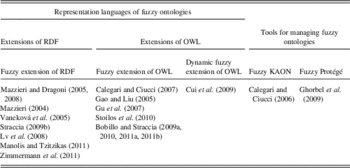
In the following, we summarize fuzzy ontology languages and tools in the literature, and also make some comparisons and analyses. Some existing fuzzy ontology languages and tools are mainly summarized in Table 2.
Some existing fuzzy ontology languages and tools

3.3.1 Representation languages of fuzzy ontologies
A number of ontology definition languages, such as RDF, SHOE, OIL, DAML, DAML+OIL, and OWL, have been developed (Horrocks et al., Reference Haarslev, Pai and Shiri2003). The most widely used among them are the RDF and OWL. In particular, OWL is the W3C recommendation standard ontology language.
In the following, we report the approaches of extending RDF and OWL for representing non-crisp information, and mainly focus on fuzzy extensions to RDF and OWL.
Extensions of RDF. RDF (the main Semantic Web data format) is a quite popular Semantic Web representation formalism. However, under the classical semantics, RDF cannot represent vague information and, to this purpose, fuzzy extension of RDF has been done as will be shown in the following:
-
∙ Fuzzy extension of RDF: to represent fuzzy data, Mazzieri (Reference Mezei, Wikström and Carlsson2004) and Mazzieri and Dragoni (Reference Mazzieri and Dragoni2005, Reference Molinera, Gálvez, Wikström, Viedma and Carlsson2008) defined a syntactic and semantic extension of RDF. Following the same guidelines, how to extend from RDF Schema to fuzzy RDF Schema was also discussed, and also they described an implementation strategy that relies on translating the fuzzy triples into plain RDF triples by using reification. Vaneková et al. (Reference Venetis, Stoilos, Stamou and Kollias2005) studied the possibility of combining fuzzy logic principles with RDF data structure, and used RDF as a framework for inductive and deductive fuzzy logic programming. Straccia (Reference Straccia2009b) presented fuzzy RDF under a generalized semantics based on t-norms and its r-implication, and also provided a minimal deductive system, top-k fuzzy disjunctive queries and showed how these can be answered by relying on the closure computation and state of the art top-k database engines. More precisely, in fuzzy RDF, triples are annotated with a degree of truth in [0, 1]. For example, ‘Room is a big city to degree 0.8’ can be represented with (Rome, type, BigCity): 0.8. Also, Lv et al. (Reference Li, Xu, Lu and Kang2008) proposed a quite general fuzzy extension of the RDF including fuzzy RDF syntax and fuzzy RDF semantics. Manolis and Tzitzikas (Reference Motik2011) proposed a session-based interaction model for exploring fuzzy RDF knowledge bases in a simple and intuitive manner. Zimmermann et al. (Reference Zadeh2011) introduced a general framework for representing, reasoning, and querying with annotated Semantic Web data and provided a generic method for combining multiple annotation domains allowing to represent, for example, temporally annotated fuzzy RDF.
In summary, the existing proposals for fuzzy extension to RDF allow to state that a triple is true to some degree, for example (tom, likes, tomato) is true to degree at least 0.9. Although RDF and its extension formalisms above allow representation of some ontological knowledge but still there is need for ontology development languages, as major focus of RDF is on organizing vocabularies in hierarchical fashion only. Therefore, in addition to RDF, the Semantic Web requires richer languages such as OWL as will be shown in the following.
Extensions of OWL. OWL (Smith et al., Reference Studer, Benjamins and Fensel2004) is the W3C recommendation standard ontology representation language. However, OWL cannot represent fuzzy information that is commonly found in the context of the Semantic Web and various application domains. Therefore, in order to provide the necessary means to handle such non-crisp information and knowledge there have been some proposals for extensions to OWL based on different formalisms such as fuzzy set theory and dynamic fuzzy logic as will be introduced as follows:
-
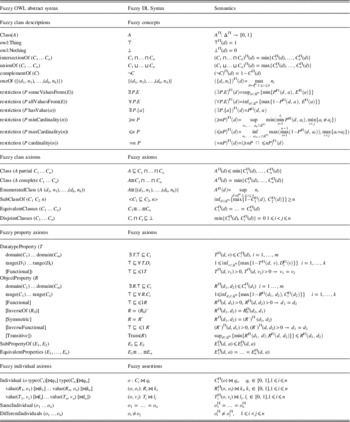
∙ Fuzzy extension of OWL: in Calegari and Ciucci (Reference Calì, Lukasiewicz, Predoiu and Stuckenschmidt2007), a fuzzy extension language of OWL, called fuzzy OWL was proposed, and the RDF/XML syntax of several axioms in fuzzy OWL language was provided, but a full fuzzy extension of OWL, including its syntax and semantics, was missed. Stoilos et al. (Reference Stoilos, Simous, Stamou and Kollias2010) gave a complete introduction of fuzzy extensions of the OWL language, where they presented the syntax and semantics of fuzzy OWL in detail and provided an investigation on the semantics of several special fuzzy OWL axioms (e.g. functional role axioms and disjointness axioms), and also proposed a translation method which reduces inference problems of fuzzy OWL into inference problems of expressive fuzzy DLs, in order to provide reasoning support through fuzzy DLs. The work may provide well support for handling and managing fuzzy information in many applications and tasks, both of the Semantic Web as well as of applications using OWL. Moreover, based on fuzzy DLs, Gao and Liu (Reference Gangemi, Catenacci, Ciaramita and Lehmann2005) extended OWL by encoding fuzzy constructors, axioms, and constraints and mapped semantics of new fuzzy terms to fuzzy DL, and the RDF/XML syntax of fuzzy OWL was also given. In addition, a solution of representing fuzzy relation in OWL was provided by Gao and Liu (Reference Gangemi, Catenacci, Ciaramita and Lehmann2005), where a fuzzy relation R is a set of triples {<x, y, μ R (x, y)> | x∈X, y∈Y}. The μ R (x, y) is a membership function mapping from universe of discourse X×Y to real number region [0, 1] and denotes the membership degree of relation R between x and y. More recently, OWL 2 (an extension and revision of OWL) is extended based on the fuzzy set theory. The fuzzy OWL 2 was proposed and has increasingly received attention. Bobillo and Straccia (2009a, Reference Blanco, Marín, Martínez-Cruz and Vila2010, Reference Blanco, Vila and Martínez-Cruz2011a, Reference Bobillo2011b) consider a very general fuzzy extension of the language OWL 2, which is not simply restricted to a fuzzy ABox, but contains many other differences with respect to OWL 2, such as fuzzy data types, fuzzy modifiers, or weighted sum concepts. The syntax and semantics of fuzzy OWL 2 are introduced in detail. As we have known, OWL is the W3C standard ontology language. Accordingly, fuzzy OWL is commonly chosen to represent fuzzy ontologies. Therefore, in the following, we will introduce fuzzy OWL in detail, in order to help readers to well understand the representation formalism of fuzzy ontologies. Fuzzy OWL has three increasingly expressive sublanguages such as fuzzy OWL Lite, fuzzy OWL DL, and fuzzy OWL Full. Fuzzy OWL Lite and fuzzy OWL DL are basically fuzzy DLs; there are almost equivalent to the fuzzy DLs f-SHIF(D) and f-SHOIN(D) (Sanchez, Reference Sánchez and Tettamanzi2006; Calegari & Ciucci, Reference Calì, Lukasiewicz, Predoiu and Stuckenschmidt2007). Furthermore, fuzzy OWL has two interchangeable syntactic forms: the RDF/XML syntax and the frame-like style abstract syntax. For example, the axiom ‘SubClassOf (AdminStaff Staff)’ written in fuzzy OWL abstract syntax may be equivalently represented as the axiom ‘<fowl:Class rdf:ID = ‘AdminStaff’> <fowl:SubClassOf rdf:resource = #Staff/> <fowl:ineqType fowl:degree = 1.0/> </fowl:Class>’ written in RDF/XML syntax in Calegari and Ciucci (Reference Calì, Lukasiewicz, Predoiu and Stuckenschmidt2007). Table 3 gives the fuzzy OWL abstract syntax and semantics. In Table 3, the semantics for fuzzy OWL is based on the interpretation of fuzzy DL f-SHOIN(D) (Straccia, Reference Straccia2005a). In detail, the semantics is provided by a fuzzy interpretation FI=(ΔFI, Δ D , ∙FI, ∙D), where ΔFI is the abstract domain and Δ D the data type domain (disjoint from ΔFI), and ∙FI and ∙D are two fuzzy interpretation functions, which map an abstract individual d to an element d FI∈ΔFI; a concrete individual o to an element o D ∈Δ D ; a concept name C to a membership degree function C FI: ΔFI→[0, 1]; an abstract role name R to a membership degree function R FI: ΔFI×ΔFI→[0, 1]; a concrete data type D to a membership degree function D D: Δ D →[0, 1]; a concrete role name T to a membership degree function T FI : ΔFI×Δ D →[0, 1]. Based on the fuzzy interpretation FI, the complete semantics of fuzzy OWL abstract syntax is depicted in Table 3. In Table 3, C denotes fuzzy class description (i.e. fuzzy DL concept); D denotes fuzzy data range (i.e. fuzzy DL concrete data type); R denotes fuzzy ObjectProperty identifier (i.e. fuzzy DL abstract role); T denotes fuzzy DatatypeProperty identifier (i.e. fuzzy DL concrete role), d is an abstract individual; o is a concrete individual; q∈{d, o}; and ⋈∈{⩾, >, ⩽, <}.
-
∙ Dynamic fuzzy extension of OWL: to deal with uncertain and dynamic knowledge on the Semantic Web and its applications, fuzzy extensions of DLs, OWL, and ontology based on dynamic fuzzy logic called the dynamic DLs (DFDL), DFOWL and DFO were presented in Cui et al. (Reference Carlsson, Fullér and Mezei2009). The syntax and semantics of DFDL, DFOWL, and DFO were formally defined, and the forms of axioms and assertions were specified.
The syntax and semantics of fuzzy ontology representation language fuzzy OWL

P ∈ {R, T} is an abstract role R or a concrete role T; E ∈ {C, D} is a concept C or a concrete data type D; d and o are abstract individuals, v is a concrete individual, a ∈ {d, v}, and ⋈ ∈ {⩾, >, ⩽, <}.
In summary, fuzzy OWL language shares essentially the same syntax with the crisp OWL language, and the differences between fuzzy OWL syntax and crisp OWL syntax only raise in the definition of facts (individual axioms in Table 3) in order to be able to specify the membership degree and the type of inequality of an individual (pair of individuals) to a fuzzy class (property). For example, one might want to state that an employee, e 1, is a young-employee to a degree ⩾0.7 using such a fuzzy OWL axiom Individual(e 1 type(young-employee)⩾0.7). Moreover, although the syntax modifications are minor, the semantics of fuzzy OWL language, which are very different from the crisp OWL, are based on fuzzy interpretation as shown in Table 3.
3.3.2 Tools for managing fuzzy ontologies
Currently, there are many approaches for extentions to ontologies as well as several ontology languages intended to provide representation and inference support for fuzzy information as mentioned above. Furthermore, to effectively manage fuzzy information in ontology definitions, several editor tools were developed:
-
∙ Fuzzy KAON tool: Calegari and Ciucci (Reference Cao, Li and Zhang2006) integrated fuzzy logic in KAON (a well-known comprehensive ontology editor suite allowing easy creation, maintenance, and management of ontologies) so that fuzzy ontologies can be directly represented and handled in KAON tool. It should be noted that the current KAON’s ontology language is based on RDFS with proprietary extensions for algebraic property characteristics (symmetric, transitive, and inverse), cardinality, modularization, metamodeling and explicit representation of lexical information. In fact, all the limits about the RDFS are well known. Therefore, KAON2 has been developed that is a successor of the KAON project, where KAON2 is based on OWL DL (a sublanguage of OWL). Also, to represent and handle fuzzy information, in future it may be necessary to implement a fuzzy extension of OWL in KAON2.
-
∙ Fuzzy Protégé tool: Ghorbel et al. (Reference Ghorbel, Bahri and Bouaziz2009) proposed a framework for fuzzy ontology building, that is, Fuzzy Protégé, as an extension of the well-known ontology editor Protégé, where they introduced how to use Fuzzy Protégé to define fuzzy ontology components in detail. Fuzzy Protégé defines new meta-classes to allow the definition of parameterized membership functions, and also gives support to instantiate fuzzy concepts and roles and allows automatic computing of membership degrees. Moreover, Fuzzy Protégé allows querying fuzzy ontologies based on fuzzy criteria.
4 Reasoning of fuzzy ontologies
Reasoning is one of the most important research lines in the area of the Semantic Web. In particular, the knowledge representation systems based on ontology language OWL and DLs provide their users with various reasoning capabilities, which may deduce implicit knowledge from the explicitly represented knowledge, such as computing subsumption and checking satisfiability.
After introducing the representation of fuzzy ontologies in Section 3, in this section, we further discuss the reasoning of fuzzy ontologies. In fact, as we have known that the reasoning of fuzzy ontologies is based on the reasoning mechanisms of fuzzy DLs, as the logical underpinnings of the fuzzy ontology representation language OWL are mainly expressive fuzzy DLs such as f-SHIF(D) and f-SHOIN(D) as mentioned in Section 3. According to the fuzzy DLs introduced in Lukasiewicz and Straccia (Reference Lukasiewicz and Straccia2008), Straccia (Reference Straccia2008), and Ma et al. (Reference Ma, Zhang, Yan and Cheng2013), in this section we will recall and introduce the existing fuzzy DLs and their relevant reasoning techniques.
4.1 Reasoning on fuzzy Description Logics and fuzzy ontologies
In the following, we recall the existing reasoning techniques of fuzzy DLs, which are the basis of reasoning on fuzzy ontologies. Before that, it is necessary for us to survey the existing fuzzy DLs first. The more detailed introduction about the fuzzy DLs and the reasoning techniques of fuzzy DLs can be found in Lukasiewicz and Straccia (Reference Lukasiewicz and Straccia2008), Straccia (Reference Straccia2008), and Ma et al. (Reference Ma, Zhang, Yan and Cheng2013).
4.1.1 The existing fuzzy Description Logics
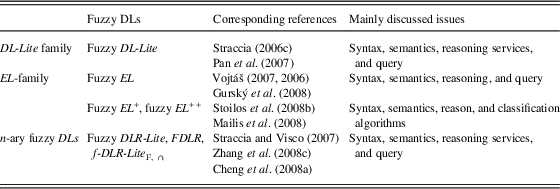
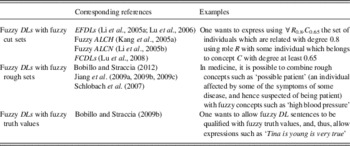
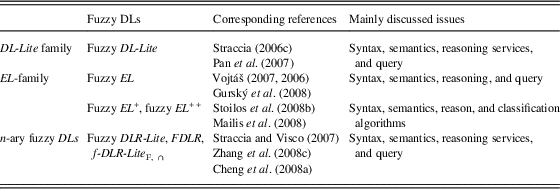
DLs, which is a logical formalism that has gained popularity in the last decade, are the logical foundation of the Semantic Web. In order to handle fuzzy information and knowledge there are today lots of proposals for fuzzy extensions to DLs, and some important existing fuzzy DLs can be summaried in Tables 4–6 (here, different kinds of fuzzy DLs are listed in different tables for intuitive purposes). Notice that, however, it does not mean that Tables 4–6 covers all publications in the research area and gives complete descriptions.
Some existing fuzzy Description Logics from weaker to stronger in expressive power

The tractable fuzzy Description Logics (DLs)
The other special fuzzy Description Logics (DLs)

From Tables 4–6, the fuzzy DLs may be classified into the following types, that is, the fuzzy DLs for representing the fuzzy terminology and concept knowledge; the fuzzy DLs for representing fuzzy data information; the tractable fuzzy DLs; and the other fuzzy DLs with fuzzy cut sets, fuzzy rough sets or fuzzy truth values:
-
(i) For representing the fuzzy terminology and concept knowledge, researchers proposed some basic fuzzy DLs such as f-TSL, f-ALC, ALCQ F + , and f-ALCIQ. Here, the initial idea combining fuzzy logic and DLs was presented by Yen (Reference Yeung and Leung1991), where a construct called membership manipulators was introduced, and a structural subsumption algorithm was also provided in order to perform reasoning. In particular, the fuzzy extension of the DL ALC, that is, f-ALC, was presented in Straccia (Reference Straccia1998), which is considered as the most basic fuzzy DL. The later approaches were presented by extending the fuzzy DL f-ALC, such as ALCQ F + and f-ALCIQ as shown in Table 4. Such kind of fuzzy DLs is called the family of f-ALC languages. The family of f-ALC languages can effectively express fuzzy knowledge, but they provide limited representation and reasoning ability. For example, they only contain some simple operators, such as conjunction, intersection, negation, value restriction, and existential quantification, which cannot represent and reason on more complex fuzzy knowledge (e.g. the inverse of roles and the transitive roles). Therefore, some scholars have carried out researches on more expressive fuzzy DLs, such as f-SI, f-SHIN, f-SHOIN, and f-SROIQ as shown in Table 4 (note that in order to avoid very long names for expressive DLs, the abbreviation S was introduced for ALC R+, that is, DL that extends ALC by transitive roles). This kind of fuzzy DLs is called the family of f-S languages.
-
(ii) In order that fuzzy DLs can represent and reason on fuzzy concrete knowledge (i.e. fuzzy data information) in the real-world applications, by extending the concrete domains (Baader & Hanschke, Reference Bahri, Bouaziz and Gargouri1991), several fuzzy DLs with fuzzy concrete domains (D) and fuzzy data type group (G) have been proposed, such as f-ALC(D), f-SHOIN(D), f-SROIQ(D), and f-ALC(G) as shown in Table 4. The Semantic Web is expected to process knowledge information and data information in an intelligent and automatic way. But recent research has shown that the OWL ontology language is very limited in representing fuzzy data information. To this end, Straccia (Reference Straccia2005b, Reference Straccia2005c, Reference Straccia2005d) proposed a fuzzy DL called f-ALC(D), together with an inference procedure based on a mixture of a tableaux and bounded mixed integer programming. The more expressive fuzzy DL which can support fuzzy concrete domains was shown in Straccia (Reference Straccia2005a), where the language is the fuzzy extension of SHOIN(D), which is the corresponding DL of the ontology description language OWL DL. Moreover, Bobillo et al. (Reference Bobillo, Delgado and Gómez-Romero2009a) and Bobillo and Straccia (2009a) proposed the fuzzy extension of OWL 2 language, that is, f-SROIQ(D), and also presented a reasoning preserving procedure to obtain a crisp representation for the f-SROIQ(D). Furthermore, in order to support fuzzy customized data type information, a new kind of fuzzy DL called f-ALC(G) was proposed by Wang and Ma (Reference Wallace and Avrithis2008), which cannot only support the representation and reasoning of fuzzy concept knowledge, but also support fuzzy data information with customized fuzzy data types and customized fuzzy data type predicates.
-
(iii) Besides several kinds of fuzzy DLs mentioned above, in the area of DLs, another family of DLs cannot be ignored, that is, the tractable DLs, which are rich enough to capture significant ontology languages but keeping low complexity of reasoning. Some existing tractable fuzzy DLs have been summaried in Table 5. The first kind of tractable DLs is DL-Lite family, which has the low complexity of reasoning, has received much attention in recent years. The detailed introduction about the DL-Lite family can be found in Calvanese et al. (Reference Calegari and Ciucci2007). Besides, DLs that allow for intersection of concepts and existential quantification (but not value restriction) are collected in the EL-family (Vojtáš, Reference Vojtáš2007), which can also be considered as the tractable DLs. In addition, in order to model relationships among more than two objects in some real-world situations, various extensions of DLs with relations of arbitrary arity such as fuzzy DLR-Lite (Straccia & Visco, Reference Straccia2007) and FDLR (Zhang et al., Reference Zhang, Ma and Chen2008c) were proposed.
-
(iv) The other fuzzy DLs with fuzzy cut sets, fuzzy rough sets, or fuzzy truth values were also proposed for representing more kinds of fuzzy information in the real-world applications. For example, one wants to express using ∀R 0.8 .C 0.65 the set of individuals which are related with degree 0.8 using role R with some individual which belongs to concept C with degree at least 0.65, that is, the fuzzy DLs allow for the cut sets of fuzzy concepts/roles. To this end, based on the cut sets, several works also proposed different extension of DLs and reasoning algorithms for EFDLs (Li et al., Reference Ling, Gu, Wang and Shi2005a; Lu et al., Reference Li, Xu, Lu, Kang and Wang2006), fuzzy ALCH (Kang et al., Reference Kang, Lu, Xu, Li and He2005a), and fuzzy ALCN (Li et al., Reference Lisi and Straccia2005b). Furthermore, in order for fuzzy DLs to support the expression of comparisons between fuzzy membership degrees. For example, it is a familiar description that ‘John is taller than Tom’, which can seem as a comparison between two fuzzy membership degrees. Toward this goal, Lu et al. (Reference Li, Xu, Lu, Kang and Wang2008) extended fuzzy DLs with the fuzzy comparison cuts, and the extended language was called FCDLs. Moreover, in Schlobach et al. (Reference Sanchez2007), Jiang et al. (Reference Jiang, Tang, Wang and Tang2009a, Reference Jiang, Wang, Deng and Tang2009b, Reference Jiang, Wang, Tang and Xiao2009c), and Bobillo and Straccia (Reference Bobillo, Delgado and Gómez-Romero2012), the authors provided a simple solution to join fuzzy DLs and rough DLs, and studied how to combine fuzzy DLs with fuzzy rough sets, that is, fuzzy rough DLs. In addition, Bobillo and Straccia (Reference Bandini, Calegari and Radaelli2009b) allowed fuzzy DL sentences to be qualified with fuzzy truth values, and thus, allow expressions such as ‘Tina is young is very true’ and ‘Tina is young is almost true’. The syntax, semantics, and reasoning algorithms for the extended languages were provided.
4.1.2 Reasoning techniques for fuzzy Description Logics and fuzzy ontologies
Based on the observation above, the literature of fuzzy extensions of DLs has been flourishing. One of the most important advantages of (fuzzy) DLs is their reasoning ability. As we have known, the reasoning of fuzzy ontologies is mainly based on the corresponding fuzzy DLs. On this basis, in the following, we introduce the existing fuzzy DL reasoning techniques and fuzzy DL reasoners.
As the different fuzzy DLs have the different expressive power and reasoning complexity, kinds of reasoning techniques for different fuzzy DLs have been proposed. In general, the reasoning techniques may be summarized in three categories: tableau-based reasoning technique, reasoning technique for general concept inclusions (GCIs), and reduction to crisp DLs:
-
(1) The tableau-based reasoning technique
Most of the existing reasoning algorithms for fuzzy DLs (e.g. Straccia, Reference Straccia2001, Reference Straccia2005b; Li et al., Reference Lisi and Straccia2005b; Sánchez & Tettamanzi, Reference Simou, Athanasiadis, Stoilos and Kollias2006; Stoilos et al., Reference Stoilos, Stamou and Pan2005b, Reference Stoilos, Stamou and Tzouvaras2006b, Reference Stoilos, Stamou, Pan, Tzouvaras and Horrocks2007, Reference Stoilos, Stamou and Kollias2008a; Wang & Ma, Reference Wallace and Avrithis2008) are tableau-based algorithms, which have turned out to be very useful compared with the early structural subsumption algorithms (Baader et al., Reference Bahri, Bejaoui and Chakhar2003). Here, we will not introduce the detailed procedures of tableau-based algorithms, please refer to Stoilos et al. (Reference Stoilos, Stamou, Pan, Tzouvaras and Horrocks2007) and Straccia (Reference Straccia2001) in detail. Moreover, most of tableau-based algorithms are given with respect to the simple Tbox (Stoilos et al., Reference Stoilos, Stamou, Pan, Tzouvaras and Horrocks2007). A Tbox T is called simple if it neither includes cyclic nor GCIs, that is, axioms are of the form A ⊆ C or A≡C, where A is a concept name that is never defined by itself either directly or indirectly, and A appears at most once at the left hand side. Reasoning on fuzzy DLs with a simple Tbox can be transformed into reasoning on fuzzy DLs with an empty Tbox by a transformation called unfolding, or expansion (Nebel, Reference Nagypal and Motik1990): concept inclusion introductions A ⊆ C can be replaced by concept equivalence introductions A≡A' ∩ C, where A' is a new concept name, which stands for the qualities that distinguish the elements of A from the other elements of C. Subsequently, if C is a complex concept expression, which is defined in terms of concept names, defined in the Tbox, we replace their definitions in C.
-
(2) The reasoning technique for GCIs in fuzzy DLs
The GCIs (i.e. the Tbox in a fuzzy DL knowledge base is a set of GCI axioms of the form C ⊆ D, where C and D are arbitrary concepts) is an important feature of DLs, for example, GCIs are necessary to represent domain and range constraints. The procedures to deal with GCIs, in the context of fuzzy DLs, have been recently developed. Some discussions about how to reason on f-ALCH with GCIs and how to provide a tableau for FALC with GCIs were given in Straccia (Reference Straccia2004a) and Stoilos et al. (Reference Stoilos, Straccia and Stamou2006c). In particular, Stoilos et al. (Reference Stoilos, Straccia and Stamou2006c) pointed out that a major theoretical and computational limitation so far is the inability to deal with GCIs, and the authors also addressed this issue and developed a calculus for fuzzy DLs with GCIs. Moreover, the other approaches for reasoning with respect to simple and acyclic Tboxes were considered, for example, Li et al. (Reference Liu, Lee, Wang, Tseng, Kuo and Lin2006a) extended the fuzzy tableau of f-SHI (Stoilos et al., Reference Stoilos and Stamou2005a) with an additional rule to handle with general and cyclic Tboxes in the language f-SHI.
-
(3) The reasoning technique of reducing to crisp DLs
In order to reason on fuzzy DLs, several approaches for reducing fuzzy DLs to classical DLs have been developed, so that reasoning on a fuzzy DL knowledge base can be performed by using existing DL systems. The first effort in this direction was presented by Straccia (Reference Straccia2004a), where the authors presented a technique for reasoning on an f-ALCH knowledge base by reduced f-ALCH to crisp ALCH. Li et al. (Reference Lisi and Straccia2005b, Reference Loia2006b) also provided reasoning for fuzzy DLs f-ALCN and f-ALCQ using the idea of the reduction. Vojtáš (Reference Vojtáš2007) also used the idea of the reduction to reduce fuzzy EL to crisp EL in order to provide reasoning for fuzzy EL. Moreover, Bobillo et al. (Reference Bobillo, Delgado, Gómez-Romero and Straccia2006) proposed a technique to be able to reduce an f-SHOIN knowledge base to a crisp SHOIN knowledge base. In addition, Bobillo et al. (Reference Berners-Lee, Hendler and Lassila2007) and Stoilos and Stamou (Reference Stoilos, Stamou and Pan2007) provided reasoning support for fuzzy SROIQ by extending well-known reduction techniques of fuzzy DLs to classical DLs. Overall, by reducing fuzzy DLs to crisp DLs, reasoning in a fuzzy DL knowledge base can be performed by using the existing and optimized DL systems.
Fuzzy ontologies have the reasoning nature because of the existence of fuzzy DLs as mentioned above, as the logical underpinnings of fuzzy ontologies are mainly very expressive fuzzy DLs. Currently, some researchers proposed several kinds of fuzzy ontologies based on different fuzzy DLs, such as fuzzy DL-Lite ontology (Pan et al., Reference Parry2007, Reference Pawlak2008), fuzzy DLR-Lite F,∩ ontology (Cheng et al., Reference Cheng, Ma, Yan and Wang2008a), fuzzy ALCN ontology (Cheng et al., Reference Cheng, Ma, Zhang and Wang2009a), fuzzy SHIN ontology (Cheng et al., Reference Cheng, Ma, Zhang and Wang2009b), and fuzzy OWL ontology (Sanchez, Reference Sánchez and Tettamanzi2006; Calegari & Ciucci, Reference Calì, Lukasiewicz, Predoiu and Stuckenschmidt2007; Stoilos et al., Reference Stoilos, Simous, Stamou and Kollias2010; Yaguinuma et al., Reference Yen2010b; Singh et al., Reference Soo and Lin2011). Most of the approaches provide reasoning support for fuzzy ontologies by mapping fuzzy ontologies into fuzzy DL knowledge bases (Straccia, Reference Straccia2001; Horrocks & Patel-Schneider, Reference Habiballa2004; Lukasiewicz & Straccia, Reference Lukasiewicz and Straccia2008; Stoilos et al., Reference Stoilos, Stamou, Pan, Tzouvaras and Horrocks2007, Reference Stoilos, Simous, Stamou and Kollias2010). Moreover, more recently, Bobillo et al. (Reference Bobillo and Straccia2013) presented some parallel algorithms to reason with fuzzy ontologies when there is a finite number of possible degrees of truth. Also, Pan et al. (Reference Pereira, Ricarte and Gomide2012) presented a novel tractable semantic infrastructure based on the OWL 2 profiles. The infrastructure provides tractable fuzzy and crisp ontology reasoning services, as well as keyword-plus-entailment search services and tailored support for folksonomy systems, validation services for business process refinement, and guidance services for ontology-driven software development.
4.1.3 Fuzzy reasoners
As mentioned in Section 1, DLs serve as the theoretical counterpart of ontologies and the Semantic Web and provide reasoning supports for them, and thus DL reasoners are the basic supporting bodies for the Semantic Web coming into use. Therefore, in order to implement the automatic reasoning of fuzzy information and knowledge in the context of the Semantic Web, kinds of reasoners based on different fuzzy DLs have been put forward.
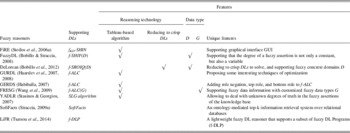
Table 7 lists the existing fuzzy reasoners that can support the processing of fuzzy and vague information. These reasoners are the basic of implementing the automatic reasoning of fuzzy ontologies. In general, there are two strategies for the implementation of a fuzzy DL reasoner: one is to translate the fuzzy DL into the classic DL and then call the classic DL reasoner for reasoning, for example, DeLorean in Table 7. Another strategy is to directly implement fuzzy reasoners based on the tableau algorithm of the corresponding fuzzy DL, for example, the reasoners in Table 7 except for DeLorean and SoftFacts. The latter strategy has the advantage that the optimized technology can be adopted according to the specific fuzzy DL, and their efficiency in the implementation can be enhanced.
The existing fuzzy reasoners and their comparisons

5 Applications and other issues of fuzzy ontologies
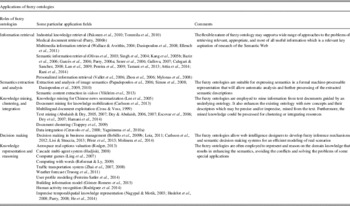
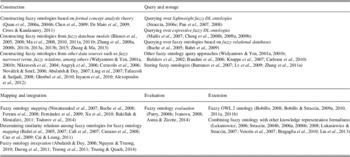
As mentioned in the previous Sections 3 and 4, fuzzy ontologies have been employed in the context of the Semantic Web regarding knowledge representation, reasoning, querying, and so on. Over the years, fuzzy ontologies have received much attention from lots of research areas, such as data integration, data mining, information retrieval, text mining, among others. In general, some relevant applications about fuzzy ontologies are listed in Table 8. Besides, other issues of fuzzy ontologies (such as fuzzy ontology construction, query, storage, mapping, integration, evaluation, and extension as shown in Table 9) are also extremely important in order for fuzzy ontology technologies to be more widely adoptable in the Semantic Web and other application domains.
Some relevant applications of fuzzy ontologies

The other issues of fuzzy ontologies

In the following, we first summarize the relevant applications about fuzzy ontologies, and then discuss other important issues of fuzzy ontologies.
5.1 Applications of fuzzy ontologies
With the development of fuzzy ontologies in the Semantic Web, fuzzy ontologies have received much attention and have proved to be very useful in many application domains, such as information retrieval, semantics extraction and analysis, knowledge mining, clustering, and integration, decision making, and knowledge representation and reasoning. These applications investigated how fuzzy ontologies can be employed to handle vague information in a more effective way as will be summarized in the following.
5.1.1 Information retrieval
Recently, an increasing number of approaches to information retrieval based on the use of fuzzy ontologies were developed. Baziz et al. (Reference Bragaglia, Chesani, Ciampolini, Mello, Montali and Sottara2006) proposed an approach to information retrieval based on the use of a fuzzy conceptual structure (ontology) that is used both for indexing document and expressing user queries. Calegari and Sanchez (Reference Calvanese, De Giacomo, Lembo, Lenzerini and Rosati2008) showed how a fuzzy ontology-based approach can improve semantic documents retrieval. Kang et al. (Reference Kang, Xu, Lu, Li, He, Chu and Chen2005b) focused on the approximate information retrieval approach to solve the heterogeneity problem of both common ontologies as well as fuzzy ontologies in the Semantic Web. Also, Lau et al. (Reference Lu, Kang, Zhang, Li and Zhou2009) illustrated the design and development of a fuzzy ontology-based granular information retrieval system to facilitate domain-specific search. Pereira et al. (Reference Pan, Thomas, Ren and Taylor2009) presented FROM, the fuzzy relational ontological model, a novel approach to encode knowledge for information retrieval applications based upon a fuzzy set framework that consider more generic concepts differently from specific terms. Rani et al. (Reference Rani, Muyeba and Vyas2014) developed a hybrid approach for semantic question answering based on semantic fuzzy ontology for retrieval systems. Tamani et al. (Reference Todorov, Hudelot, Popescu and Geibel2013) developed a new approach for flexible querying of complex information systems that combines a reasoning mechanism (an ontology based on the fuzzy bipolar DLR-Lite) with a bipolar relational language of a high expressivity (Bipolar SQLf language). The reasoning mechanism can also answer queries in approximative way, based on degrees expressing at which extent it is possible to substitute a concept in the query with other concepts, while still meaningful to the user. Other efforts on adaptation of fuzzy ontology for information retrieval can be found in Olivas et al. (Reference Oliboni and Pozzani2003), Singh et al. (Reference Stasinos and Georgios2004), Garcés et al. (Reference Gómez-Romero, Bobillo, Ros, Molina-Solana, Ruiz and Martín-Bautista2006), Sezer et al. (Reference Smith, Welty and McGuinness2006), Gallova (Reference Gurský, Horváth, Jirásek, Novotný, Pribolová, Vaneková and Vojtáš2007) and Attia et al. (Reference Abulaish and Dey2014).
In particular, several proposals suggested that fuzzy ontologies may be applied in some more special information retrieval tasks, such as industrial knowledge retrieval, medical document retrieval, multimedia information retrieval, and personalized information retrieval. In detail, Pakonen et al. (Reference Parry2010) and Tommila et al. (Reference Tommila, Hirvonen and Pakonen2010) used the fuzzy ontologies in industrial knowledge retrieval, where how to build fuzzy ontologies for the process industry domain to enhance knowledge retrieval was introduced in detail, and a concrete benefit of fuzzy ontologies is the extension of information queries—allowing the search to also cover related results, and make the decisions about relatedness based on modeled domain knowledge. The tentative has also been made in the context of medical document retrieval (Parry, Reference Pan, Stamou, Stoilos and Thomas2006b) by adding a degree of membership to all terms in the ontology to overcome the overloading problem. Moreover, as multimedia content is becoming a major part of more and more applications every day, the applications of this work are numerous. To this end, fuzzy ontologies are used for multimedia information retrieval (Wallace & Avrithis, Reference Wang, Ma and Ying2004; Dasiopoulou et al., Reference Dasiopoulou, Kompatsiaris and Strintzis2008; Elleuch et al., Reference Ejegwa, Akowe, Otene and Ikyule2011). Elleuch et al. (Reference Ejegwa, Akowe, Otene and Ikyule2011) proposed a novel and efficient approach to enhance semantic concept detection in multimedia content, by exploiting contextual information about concepts from visual modality. Wallace and Avrithis (Reference Wang, Ma and Ying2004) have extended on the crisp relations defined in ontologies and followed a fuzzy relational approach to knowledge representation. Using this knowledge, they have defined and extracted the semantic context of a set of semantic entities, that is their common meaning. This allows ones to follow a unified approach to intelligent information retrieval, both for textual and multimedia documents. In addition, ontology-based context for personalized information retrieval was investigated in Vallet et al. (Reference Vallet, Fernández, Castells, Mylonas and Avrithis2006), Zhou et al. (Reference Zhai, Chen, Wang and Lv2006), and Mylonas et al. (Reference Mazzieri and Dragoni2008). Mylonas et al. (Reference Mazzieri and Dragoni2008) and Vallet et al. (Reference Vallet, Fernández, Castells, Mylonas and Avrithis2006) proposed methods for the automatic extraction of persistent semantic user preferences, and live, ad hoc user interests, which are combined in order to improve the accuracy and reliability of personalization for retrieval. Zhou et al. (Reference Zhai, Chen, Wang and Lv2006) showed a presentation and comprehensive retrieval framework, which incorporates a module to control the degree of personalization that is applied in the search result ranking, automatically adjusting it depending on the uncertainty contained in the search before personalization.
5.1.2 Semantics extraction and analysis
The fuzzy ontologies are suitable for expressing semantics in a formal machine-processable representation that will allow automatic analysis and further processing of the extracted semantic descriptions. Accordingly, fuzzy ontologies were applied to image processing as introduced in Papadopoulos et al. (Reference Papadopoulos, Mylonas, Mezaris, Avrithis and Kompatsiaris2006), Simou et al. (Reference Smets2008), and Dasiopoulou et al. (Reference Dasiopoulou, Saathoff, Mylonas, Avrithis, Kompatsiaris, Staab and Strinztis2009, Reference Dellschaft and Staab2010). Papadopoulos et al. (Reference Papadopoulos, Mylonas, Mezaris, Avrithis and Kompatsiaris2006) proposed an approach based on fuzzy ontology to semantic image analysis, where fuzzy ontologies are used to capture general, spatial, and contextual knowledge of images from different domains. Moreover, Dasiopoulou et al. (Reference Dasiopoulou, Saathoff, Mylonas, Avrithis, Kompatsiaris, Staab and Strinztis2009, Reference Dellschaft and Staab2010) and Simou et al. (Reference Smets2008) applied fuzzy ontologies into the semantic image analysis, and developed a framework for capturing the vagueness of the extracted image descriptions and accomplishing their semantic interpretation.
In addition, recent increase in the use of video-based applications has revealed the need for extracting the semantic content in videos. Raw data and low-level features alone are not sufficient to fulfill needs, and thus a deeper understanding of the content at the semantic level is required. Currently, manual techniques, which are inefficient, subjective, and costly in time and limit the querying capabilities, are being used to bridge the gap between low-level representative features and high-level semantic content. In this case, on the basis of the high semantic expressiveness of fuzzy ontology, an automatic semantic content extraction in videos using a fuzzy ontology and rule-based model was proposed by Yildirim et al. (Reference Yildirim, Yazici and Yilmaz2013). The novel idea is to utilize domain ontologies generated with a domain-independent ontology-based semantic content meta-ontology model and a set of special rule definitions. The results show that the proposed ontology-based automatic semantic content extraction framework is successful for both event and concept extraction.
5.1.3 Knowledge mining, clustering, and integration
Some researchers pointed out fuzzy ontologies would contribute to text mining. For this purpose, Abulaish and Dey (Reference Alexopoulos, Wallace, Kafentzis and Askounis2007), Dey et al. (Reference Dey, Abulaish, Goyal and Shubham2007), and Dey and Abulaish (Reference Ding, Kolari, Ding, Avancha, Finin and Joshi2007) presented a fuzzy ontology generation framework (FOGA) in which concept descriptors and inter-concept relations are represented as fuzzy relations. This work has been integrated with a text-mining system such that, starting with a seed ontology, a domain ontology can be extended with new knowledge extracted from text documents. Also, Abulaish and Dey (Reference Ali, Kim and Kim2005) proposed a system that performs both ontology-based text information extraction and ontology update using the extracted information, and the system employs text-mining techniques to mine information from text documents guided by an underlying ontology. They enhanced the existing ontology with new concepts and their descriptors which may be precise and/or imprecise, mined from the text. Dey and Abulaish (Reference Dubois and Prade2006) proposed an approach for enhancing an existing biological concept ontology into a fuzzy relational ontology structure using generic biological relations and their strengths mined from tagged biological text documents. Lee et al. (Reference Lukasiewicz2005) employed a fuzzy ontology and its application to natural language processing (Chinese news summarization), and the experimental results showed that the news agent based on the fuzzy ontology can effectively operate for news summarization. Cross and Voss (Reference Ceravolo, Corallo, Damiani, Elia, Viviani and Zilli1999) explored the potential that fuzzy mathematics and ontologies have for improving performance in multilingual document exploitation. Carlsson et al. (Reference Cai and Leung2013) used the fuzzy ontology for knowledge mobilization, where the fuzzy ontology is used to find a sufficiently small set of documents that are relevant for the problem solving even if they are imprecisely classified with keywords.
Moreover, the major drawbacks of data mining methods are that they generate a notably large number of rules that are often obvious or useless or, occasionally, out of the user’s interest. To address such drawbacks, Hamani et al. (Reference Horrocks, Patel-Schneider and van Harmelen2014) proposed an approach that detects a set of unexpected rules in a discovered association rule set based on fuzzy ontology. The proposed approach investigates the discovered association rules using the user’s domain knowledge, which is represented by a fuzzy domain ontology. Also, they rank the discovered rules according to the conceptual distances of the rules. Escovar et al. (Reference Elleuch, Zarka, Ammar and Alimi2006) extended the SSDM (Semantically Similar Data Miner) algorithm in order to use ontologies as background knowledge to represent semantics over the mined data. These fuzzy ontologies include similarity degree values between concepts, which are processed by SSDM to generate more understandable association rules that reflect the semantic similarity among data.
In addition, fuzzy ontologies are employed to cluster and integrate resources. A new methodology to automatically interpret and cluster knowledge documents using an ontology schema is presented by Trappey et al. (Reference Truong, Nguyen and Nguyen2009), and the results show that the fuzzy ontology-based document clustering approach outperforms the K-means approach in precision, recall, F-measure, and Shannon’s entropy. Yaguinuma et al. (Reference Yaguinuma, Santos, Camargo and Nogueira2010a) developed a data integration system (DIS), and it employs fuzzy ontologies in order to integrate heterogeneous data sources. To evaluate the DIS system in a real environment, a case study was performed in the domain of watershed analysis. Ceravolo et al. (Reference Chandrasekaran, Josephson and Benjamins2008) presented the idea of extending the scope of the ontology of uncertainty for hybrid reasoning under managing different types of uncertainty and showed a simple application of this idea to data integration.
5.1.4 Decision making
Several proposals have been presented to apply fuzzy ontologies in decision making, which plays an important role in business management. In Loia (Reference Lu, Xu, Li and Kang2011), how to join fuzzy ontologies and fuzzy markup languages was introduced, and the joint exploitation of these technologies will allow web intelligence designers to develop fuzzy inference mechanisms and semantic decision-making systems for an efficient modeling of real scenarios. Moreover, as we have known, balanced scorecard is a widely recognized tool to support decision making in business management, but current balanced scorecard-based systems present two drawbacks: they do not allow to define explicitly the semantics of the underlying knowledge and they are not able to deal with imprecision and vagueness. To overcome these limitations, Bobillo et al. (Reference Bobillo, Delgado and Gómez-Romero2009b) proposed a semantic fuzzy expert system which implements a generic framework for the balanced scorecard, where the knowledge about balanced scorecard variables is represented using an OWL ontology, and the ontology acts as the basis for the fuzzy expert system, which uses highly interpretable fuzzy IF–THEN rules to infer new knowledge. Moreover, Carlsson et al. (Reference Cuenca Grau, Horrocks, Motik, Parsia, Patel-Schneider and Sattler2012) and Pérez et al. (Reference Pérez, Wikstrom, Mezei, Carlsson and Herrera-Viedma2013) showed that a number of soft computing techniques, for example, aggregation functions and interval-valued fuzzy numbers, can support effective and practical decision making on the basis of the fuzzy ontology. In addition, Molinera et al. (Reference Mylonas, Vallet, Castells, Fernandez and Avrithis2014) designed a decision support system build over a fuzzy ontology in order to help people to select the perfect smartphone for them.
5.1.5 Knowledge representation and reasoning
Some approaches were developed to employ fuzzy ontology to represent and reason on the domain knowledge. That results in enhancing the semantics, avoiding the conflicts, and solving the problems of some special applications. In Hadjiski (Reference Horrocks and Patel-Schneider2008), an intelligent multicascade control system was proposed using hybrid multi-agent and fuzzy ontology framework. Usage of fuzzy ontologies to share the knowledge improves the cascade control system and decrease the communication rate. In Ling et al. (Reference Lee, Jian and Huang2007), a fuzzy ontology is taken as a common understanding and unequivocal sharing of the domain knowledge in computer game community. In Reformat and Ly (Reference Reformat and Ly2009), an integration of the computing with words (CW) paradigm with the concept of ontology was investigated. The fuzzy ontology was used to represent and enhance the semantics of propositions used in CW. The fuzzy ontology was used to share and reuse knowledge between traffic intelligent transportation systems in Zhai et al. (Reference Zadeh2007, Reference Zadeh2008). Rodger (Reference Rodger2013) presented a fuzzy linguistic ontology payoff method for the valuation of real options in the aerospace industry. A framework of building a fuzzy ontology for representing the meteorological knowledge was proposed by Truong et al. (Reference Trappey, Trappey, Hsu and Hsiao2011), and a method for fuzzy ontology integration is introduced for solving inconsistency among weather services’ knowledge. The use of fuzzy ontologies to represent user profiles has been proposed by Ferreira-Satler et al. (Reference Ferreira-Satler, Romero, Olivas and Serrano-Guerrero2014), and one of the main strengths of this approach is the possibility of capturing relevant user information automatically, and representing it in a way that can be easily recovered and used by any application. More recently, Rodríguez et al. (Reference Rodríguez, Cuéllar, Lilius and Calvo-Flores2014) proposed a fuzzy ontology for human activity representation, which allows us to model and reason about vague, incomplete, and uncertain knowledge. The resulting fuzzy ontology is able to model uncertain knowledge and represent temporal relationships between activities using an underlying fuzzy state machine representation. Gómez-Romero et al. (Reference Gallova2015) presented a fuzzy logic-based extension of the semantic Building Information Models (BIMs) that provide support for imprecise knowledge representation and retrieval. They proposed an expressive fuzzy ontology language, and described how to use a fuzzy reasoning engine in a BIM context with selected examples.
Moreover, to represent fuzzy temporal-spatial information that is commonly found in many application domains, the fuzzy ontology models for representing fuzzy temporal-spatial information were thus developed. A fuzzy temporal ontology was presented by Nagypal and Motik (Reference Nebel2003), where they first presented a fuzzy interval-based temporal model capable of representing imprecise temporal knowledge, and then discussed how this model was integrated with the ontology model to allow annotating ontology definitions with time specifications. A fuzzy spatial ontology was presented by Hudelot et al. (Reference Hudelot, Atif and Bloch2008), where they introduced an ontology of spatial relations and proposed to enrich it by fuzzy representations of these relations in the spatial domain. The choice of spatial relations is motivated on one hand by the importance of structural information in image interpretation, and on the other hand by the intrinsically ambiguous nature of most spatial relations. A combined fuzzy ontology and fuzzy spatial model approach was presented in Parry (Reference Pan, Stamou, Stoilos, Thomas and Taylor2008). The combination may be helpful in a location-aware device, mobile devices, that are designed to be contextually aware may need to perform information retrieval processes on the Semantic Web. He et al. (Reference He, Yue, Jiang and Zhang2014) presented a fuzzy spatial relation ontology-driven approach for detection of complex geospatial features in a geospatial service environment. By formalizing spatial relations and fuzzy sets in ontology, the fuzzy spatial relation ontology creates a knowledge base for semantics of complex features. The ontology can automate the workflow generation and service chaining for complex feature discovery. Compared with traditional algorithm-based geospatial image mining and feature extraction, their approach focuses on technologies and flexible intelligent systems enabled by e-science to support discovery of complex geospatial features. Interested readers can find more detailed introduction about the applications of fuzzy ontologies in these research areas above in the corresponding literature as summarized in Table 8.
5.2 Other issues of fuzzy ontologies
The literature on fuzzy ontologies, including representation, reasoning, and applications, has been flourishing as shown in the previous sections. However, the researches on fuzzy ontologies are still in a developing stage, and it should be noted that there are still several important issues regarding construction, mapping, integration, query, storage, evaluation, and extension of fuzzy ontologies need to be investigated in depth until fuzzy ontology technologies may be more widely adopted in the Semantic Web and other application domains.
In the following, we will introduce several important issues of fuzzy ontologies, including construction, mapping, integration, query, storage, evaluation, and extension.
5.2.1 Construction of fuzzy ontologies
Construction of ontologies is a very important issue in the context of the Semantic Web. The Semantic Web aims at creating ontology-based and machine-processable web content, and thus the success and proliferation of the Semantic Web largely depends on constructing ontologies (Berners-Lee et al., Reference Baader and Hanschke2001; Maedche & Steffen, Reference Ma, Lv and Yan2001). To this end, kinds of approaches and tools have been developed to construct ontologies from various data resources such as Text, Dictionary, XML documents, database models, among others (Maedche & Steffen, Reference Ma, Lv and Yan2001; Corcho et al., Reference Calegari and Loregian2003).
Also, considering that information is often imprecise and vague in many real-world applications, and thus many research have been concentrated on fuzzy ontology construction. On one hand, constructing fuzzy ontologies may facilitate the fuzzy ontology development and the information sharing in the context of the Semantic Web. On the other hand, after constructing fuzzy ontologies from some domains, that is, representing the information of the domains in the form of fuzzy ontologies, it is possible to make use of fuzzy ontology techniques to handle some issues of the domains (e.g. after constructing fuzzy ontologies from fuzzy database models, the reasoning tasks of fuzzy database models, such as whether a fuzzy class is the subclass of another fuzzy class, or whether there is redundancy in a fuzzy database model, may be detected automatically through the reasoning mechanism of fuzzy ontologies instead of checking them by hand (Zhang et al., Reference Zhang, Ma, Lv and Wang2008a)).
Regarding the requirement of constructing fuzzy ontologies, some efforts have been made to construct fuzzy ontologies, such as fuzzy ontology construction based on the formal concept analysis (FCA) theory, fuzzy ontology construction from some data sources (fuzzy narrower terms, fuzzy relations, among others), and fuzzy ontology construction from fuzzy databases:
-
∙ Several approaches have been developed for constructing fuzzy ontologies based on the FCA theory. Quan et al. (Reference Quan, Hui, Fong and Cao2006a, Reference Quan, Hui and Fong2006b) proposed a framework known as FOGA that can automatically generate a fuzzy ontology from uncertainty data based on the FCA theory. Chen et al. (Reference Castillo, Melin, Tsvetkov and Atanassov2009) focused on research on automatic fuzzy ontology generation from fuzzy context, where fuzzy FCA and fuzzy concept hierarchy structure were adopted to automatically generate primitive fuzzy ontology, and they also showed that how to use fuzzy concept lattices from fuzzy formal context to support the modeling automatic or semi-automatic for fuzzy ontology generation. Moreover, based on the FCA theory, De Maio et al. (Reference Dey and Abulaish2009) presented an approach for automatic generation of a fuzzy ontology. The approach indeed presented the mapping steps for translating the fuzzy lattice generated by FCA theory into an ontology.
-
∙ Currently, there are some approaches for constructing fuzzy ontologies from several data sources such as fuzzy narrower terms, fuzzy relations, among others. Widyantoro and Yen (Reference Widyantoro and Yen2001b) proposed an approach for constructing a fuzzy ontology based on the narrower and broader term relations. Ceravolo et al. (Reference Carlsson, Mezei and Brunelli2006) presented a way of building fuzzy ontologies in a bottom-up fashion based on a fuzzy representation of XML document structure and content. Angryk et al. (Reference Atanassov2006) described an approach that allows for automatic creation of ontologies understood as taxonomies of abstract terms based on the list of descriptions provided by the user. Inyaem et al. (Reference Ivanova2010) proposed a methodology for constructing terrorism fuzzy ontology for event extraction work using OWL. Moreover, fuzzy ontology was generated and used in search engines (Widyantoro & Yen, Reference Widyantoro and Yen2001a), in which membership values are used to evaluate the similarities between the concepts in a concept hierarchy. Also, the automatic construction of fuzzy ontologies for search in the World Wide Web was investigated in Nikravesh et al. (Reference Niwattanakul, Martin, Eboueya and Khaimook2004). In addition, Ling et al. (Reference Lee, Jian and Huang2007) presented a use-case-based fuzzy ontology constructing methodology that incorporated with fuzzification processes, and the constructed fuzzy ontology has been applied to computer games. Abulaish and Dey (Reference Alexopoulos, Wallace, Kafentzis and Askounis2007) developed a FOGA for handling uncertainties and non-uniformity in domain knowledge description. Tafazzoli and Sadjadi (Reference Truong and Quach2008) developed a framework to generate malware fuzzy ontologies from malwares. Also, Ghorbel et al. (Reference Ghorbel, Bahri and Bouaziz2010) defined a new fuzzy ontology building methodology called Fuzzy OntoMethodolog, which consists of three-step conceptualization, ontologization, and operationalization. Nováček and Smrž (Reference Nikravesh, Takagi, De Cock and Guadarrama2006) introduced a novel representation of uncertain knowledge in the domain of automatic ontology acquisition. Alexopoulos et al. (Reference Asma and Zizette2012) developed IKARUS-Onto, a comprehensive methodology for developing fuzzy ontologies from existing crisp ones.
-
∙ Recently, constructing fuzzy ontologies from fuzzy database models has received much attention. Over the years, fuzzy databases have been widely studied for modeling the imprecise and uncertain information that is commonly found in real-world applications. Therefore, some researches pointed out that it is necessary to investigate fuzzy ontology construction from fuzzy databases for supporting the development of the Semantic Web. Ma et al. (Reference Ma, Zhang and Cheng2010) and Zhang et al. (Reference Zhang, Ma, Lv and Wang2008a) presented a fuzzy ontology construction approach from fuzzy ER model. Furthermore, a fuzzy ontology construction approach from fuzzy EER model was presented in Zhang et al. (Reference Zhang, Ma and Yan2013b). A formal approach for constructing fuzzy ontology from fuzzy UML model was developed in Zhang and Ma (Reference Zhang, Ma, Yan and Cheng2013), where the constructed fuzzy ontologies are formulated in the fuzzy OWL language. Also, how to represent and reason on fuzzy UML models with the fuzzy DL was presented by Ma et al. (Reference Ma, Zhang, Wang and Yan2011b). Moreover, Zhang et al. (Reference Zhang, Ma, Wang and Meng2008b) translated the fuzzy relational schema into the fuzzy ER model and then constructed the fuzzy ontology from the fuzzy ER model at schema level. Similarly, how to construct fuzzy ontologies from fuzzy relational databases was also investigated in Ma et al. (Reference Ma, Zhang, Yan and Lv2008), where they first implicitly translated the fuzzy relational schema into the fuzzy ER model by means of reverse engineering, and then translated the fuzzy ER model and database instances into the fuzzy ontology structure and fuzzy RDF data model, respectively. Also, an approach for extracting the fuzzy DL knowledge from fuzzy relational databases was proposed by Ma et al. (Reference Maedche and Steffen2011a), and how to reason on fuzzy relational databases with the extracted fuzzy DL knowledge was briefly discussed. Blanco et al. (Reference Bulskov, Knappe and Andreasen2008) presented an ontology for representing the fuzzy information of a fuzzy relational database. Owing to the formality of this representation, fuzzy metaknowledge base access is more accessible to users or applications which use the ontology as an interface for access. Blanco et al. (Reference Bukhari and Kim2005) used the ontology to represent fuzzy data regardless of implementations in concrete database models, and the structure of this ontology allows scalability so new data types as well as fuzzy ones can be represented. In addition, a fuzzy DL approach for representing and reasoning on fuzzy object-oriented database models was presented by Zhang et al. (Reference Zhang and Ma2011b). More recently, an approach for construct fuzzy ontologies from fuzzy XML models was proposed by Zhang et al. (Reference Zhang, Ma and Yan2013a). A formal approach and a tool for constructing fuzzy ontologies from fuzzy object-oriented database models were developed in Zhang et al. (Reference Zhang, Ma, Yan and Cheng2015).
5.2.2 Mapping and integration of fuzzy ontologies
The need for sharing and reusing independently developed ontologies has become even more important and attractive. Ontology reuse is now one of the important research issues in the ontology field. Ontology mapping, integration, merging, alignment, and versioning are some of its subprocesses. One common issue to these subprocesses is the problem of defining similarity relations among ontology components (Zhao et al., Reference Zimmermann, Lopes and Straccia2007). In particular, ontology mapping and integration are the effective methods to solve the problems of knowledge sharing and reusing across the heterogeneous ontologies in the Semantic Web.
However, the current ontology mapping and integration technologies are not sufficient for fuzzy ontologies. Both crisp and fuzzy ontologies are concerned with the problem of ontology reuse. Therefore, with the growing importance in fuzzy knowledge representation of ontology, the fuzzy ontology mapping and integration that can handle both crisp and fuzzy data become a research hotpot.
Currently, some approaches have been developed for fuzzy ontology mapping. A method based on the fuzzy FCA theory had been proposed for ontology mapping (Xu et al., Reference Xu, Wu and Chen2010), where a fuzzy formal concept context among ontologies was constructed to enable modeling vague data, and then the concept similarity measure model based on fuzzy FCA was proposed. A method of an ontology mapping based on a similarity measure and fuzzy logic was developed in Niwattanakul et al. (Reference Nguyen and Truong2007), in which a similarity measure for ontology mapping is used for computing the probability of the similarity of ontology structure and fuzzy logic is used for classifying the ontology similarity. Bakillah and Mostafavi (Reference Bobillo and Straccia2011) presented a fuzzy semantic mapping approach for fuzzy geospatial ontologies, and the approach has the capability to produce fuzzy qualitative semantic relations between concepts of fuzzy ontologies. Buche et al. (Reference Buche, Dibie-Barthelemy and Ibanescu2008) proposed a fuzzy ontology mapping approach using fuzzy conceptual graphs and rules. Ferrara et al. (Reference Fernández, Velasco and López-Carmona2008) presented a fuzzy approach for handling the problem of conflicts among ontology mappings. Fernández et al. (Reference Ferrara, Lorusso, Stamou, Stoilos, Tzouvaras and Venetis2009) provided mechanisms to support experts in the first steps of the ontology mapping process using fuzzy logic techniques to determine the similarity between concepts from different ontologies.
Moreover, there are several researches on determining similarity relation among fuzzy ontologies for fuzzy ontology mapping. Bahri et al. (Reference Bobillo and Straccia2007, Reference Bobillo and Straccia2005) proposed an approach to determine similarity relation among fuzzy ontology components based on their intentional definitions. An intentional definition of an ontology component is a set of DL formulae that represent the meaning of that component. Cai and Leung (Reference Chen, Nikolaidis, Cudney, Rosca and Haftka2011) provided a formal mechanism to determine object memberships in concepts automatically based on the defining properties of concepts and properties which objects possess. Also, Cao et al. (Reference Chen, Yang, Zhu and Wen2009) proposed an approach to measure concept similarity between fuzzy ontologies, which applies the fuzzy sets to represent fuzzy concepts, and evaluates the concept similarity by their common characters of linguistics, fuzzy set, super-concepts, sub-concepts, instances, and properties.
In addition, several studies have focused on mapping validation with respect to the semantics of the ontologies involved and, at the same time, by maintaining the uncertain nature of mappings. Castano et al. (Reference Cross and Kandasamy2008) presented a tool for mapping validation with the help of probabilistic reasoning. The idea is to assume a semantic interpretation of ontology mappings as probabilistic and hypothetical relations among ontology elements in order to build a unique distributed knowledge base from the two independent ontologies and, subsequently, check for inconsistencies. Calì et al. (Reference Costa, Laskey and Lukasiewicz2007) proposed a language for representation and reasoning with uncertain mappings by combining ontology and rule languages with probabilistic reasoning. This method represented confidence values as error probabilities in order to resolve inconsistencies by using trust probabilities, and to reason about these on a numeric level.
Besides, as different fuzzy ontologies vary greatly in terms of the level of detail of their representations, as well as the nature of their underlying logical specifications, fuzzy ontology integration has increasingly received attention in the ontology field. Nguyen and Truong (Reference Nieto2010) developed a framework of consensus-based method for fuzzy ontology integration, where a conception for fuzzy ontology definition was proposed and three problems for fuzzy ontology integration on concept and relation levels were also defined. Duong et al. (Reference Dey and Abulaish2011) clearly defined a domain fuzzy ontology, and its components such as fuzzy relation, concrete fuzzy concept, and fuzzy domain concept as well as similarity measures between the components were addressed. On this basis, fuzzy ontology integration on concept level using consensus method to solve conflicts among the ontologies was proposed. In particular, the postulates for integration are specified and algorithms for reconciling conflicts among fuzzy concepts in ontology integration were developed. Moreover, a framework of building a fuzzy ontology for representing the meteorological knowledge was proposed in Truong et al. (Reference Trappey, Trappey, Hsu and Hsiao2011), and the weather fuzzy inference system was suggested, which takes the fuzzy ontology and the corresponding instances as its knowledge base. Furthermore, a method for fuzzy ontology integration was introduced for solving inconsistency among weather services’ knowledge. In addition, a fuzzy ontology framework for interoperability among distributed overlapping ontologies was developed in Abulaish and Dey (Reference Angryk, Dolan and Petry2006), and the framework provides appropriate support for application integration by identifying the most likely location of a particular term in the ontology. The proposed idea for ontology integration and amalgamation is different from others because this method does not tend to integrate or merge multiple ontologies but rather produces a unique measure of consistency for each concept that is defined for any ontology. More recently, Truong and Quach (Reference Tsatsou, Dasiopoulou, Kompatsiaris and Mezaris2014) gave an overview of selected results of recent research on the methods of resolving conflicts between ontologies in fuzzy ontology integration approaches.
5.2.3 Query and storage of fuzzy ontologies
With the increasing use of fuzzy ontologies in the Semantic Web and other application domains, the efficient query and storage of fuzzy ontologies gain more attention in recent years.
Regarding the requirement of querying fuzzy ontologies, many efforts have been made, such as query over lightweight fuzzy DL ontologies, query over expressive fuzzy DL ontologies, query fuzzy ontologies based on fuzzy relational databases, and query fuzzy ontology with some special approaches:
-
∙ To query over fuzzy ontologies, several approaches have been initially developed to query over lightweight fuzzy DL ontologies. Straccia (Reference Straccia2006c) investigated how to compute efficiently the top-k answers of a complex query (i.e. conjunctive queries) over a huge set of instances in fuzzy DL-Lite ontology knowledge bases. Furthermore, built on Straccia (Reference Straccia2006c), Pan et al. (Reference Parry2007, Reference Pawlak2008) proposed two new expressive query languages accompanied with query answering algorithms over fuzzy DL-Lite ontology, where they allowed the users to specify threshold queries and presented a prototype implementation for querying fuzzy DL-Lite ontologies.
-
∙ Also, querying in other fuzzy ontologies which are based on expressive fuzzy DLs has been carried out to provide users with expressive querying services. Mailis et al. (Reference Mazzieri2007) proposed a fuzzy version of existential entailment algorithm for answering conjunctive queries in fuzzy ALCNR, which is a knowledge representation language combining fuzzy DLs with Horn rules. However, it allows only positive role atoms in a query, while the negative atoms are not touched on. Furthermore, Cheng et al. (Reference Cheng, Ma, Zhang and Wang2008b, Reference Cheng, Ma, Zhang and Wang2009a) presented the algorithms for answering expressive and fuzzy conjunctive queries, allowing in a query both positive atoms and negative atoms, over the relative expressive fuzzy DLs, namely f-ALC and f-ALCN. Furthermore, Cheng et al. (Reference Cheng, Ma, Zhang and Wang2009b) developed a tableau-based algorithm for deciding query entailment over f-SHIN ontology, where the query also allowed the occurrence of both lower bound and the upper bound of threshold in a query atom, and the authors proved that the algorithm for query entailment is co3NExpTime in the size of the knowledge base and the query.
-
∙ Moreover, other approaches for querying fuzzy ontologies based on fuzzy relational databases were developed in recent years. Bahri et al. (Reference Bobillo and Straccia2009) addressed the problem of implementation and query answering of fuzzy ontologies on databases. They proposed a language to define fuzzy ontology schema and to query fuzzy ontology databases, and also developed an inferential engine to infer instances and subsumption relations between fuzzy concepts defined using concept-forming expressions. Also, Buche et al. (Reference Buche, Dervin, Haemmerle and Thomopoulos2005) presented a new method, called multi-view fuzzy querying, which permits to query incomplete, imprecise, and heterogeneously structured data stored in a relational database using ontologies and rules.
-
∙ In addition, there are several fuzzy ontology query approaches which are different from the approaches above. For example, Carlsson et al. (Reference Corcho, Fernández-López and Gómez-Pérez2010) suggested the use of a context-dependent fuzzy aggregation method to rank the results of fuzzy queries over fuzzy ontologies, where the fuzzy aggregation rules are provided by the experts, the coefficients of the consequence part of the rules are derived from the linguistic values used in the conditional part of the rules, and the rank of a search result is determined by the Takagi–Sugeno fuzzy reasoning scheme. Bandini et al. (Reference Bobillo and Straccia2006) presented a solution to handle vague information in query processing into fuzzy ontology-based applications. They introduced the quality concept in the fuzzy ontology to better define the degree of truth of the fuzzy ontology entities. The constraint tree has been defined as a hierarchical indication of what qualities should be considered significant to evaluate an instance of a concept. Also, a strategy to parse a sentence in a set of constraints was proposed, and this will allow users to submit queries to the system using natural language requests. Bulskov et al. (Reference Bosc, Kraft and Petry2002) and Knappe et al. (Reference Knappe, Bulskov and Andreasen2007) introduced principles for ontology-based flexible querying of information bases, where the authors discussed how the ontology influences the matching of values, especially how the different relations of the ontology may contribute to overall fuzzy similarity between concepts. Widyantoro and Yen (Reference Widyantoro and Yen2001a, Reference Widyantoro and Yen2001b) used fuzzy ontology for query refinement, which is very promising to be useful to help users find the information they need. In addition, they implemented and incorporated the fuzzy ontology of narrower and broader terms for query refinement in personalized abstract search services search engine.
Besides the query technique of fuzzy ontologies, the efficient storage of fuzzy ontologies is of paramount importance. Lots of fuzzy ontologies have been created and fuzzy ontologies tend to become very large to huge (millions of items). Therefore, one problem is considered that has arisen from practical needs, namely, possibilities for storing fuzzy ontology information. In particular, being similar to the most common proposals that use relational databases to store ontologies, the fuzzy relational database may be a good candidate for storing fuzzy ontologies because of the widespread use and mature techniques. On this basis, several approaches have tried to resolve the storage problem of fuzzy ontologies in fuzzy databases. Barranco et al. (Reference Bahri, Bouaziz and Gargouri2007) presented a schema structure to store ontologies and their instances in a fuzzy object relation database management system capable of handling fuzzy data types. The proposed schema covers the main constructs of OWL ontologies and sets the groundwork necessary to develop internal reasoning in the database. Also, the approaches for storing fuzzy ontologies in fuzzy relational databases were presented in Lv et al. (Reference Li, Xu, Lu and Kang2009) and Zhang et al. (Reference Zhai, Shen, Zhou and Liang2011a), where fuzzy classes, fuzzy properties, and individuals in fuzzy ontologies were considered and stored in fuzzy relational databases. Note that there has not been much work in the fuzzy ontology storage at present, and it is shown in these approaches that some constructors and fuzzy data types in fuzzy ontologies, the overall architecture of storage approach and the detailed storage procedure, and the prototype tool were still missed. Therefore, much research on fuzzy ontology storage may need to be done in the future.
5.2.4 Evaluation of fuzzy ontologies
As mentioned in Gangemi et al. (Reference Garcés, Olivas and Romero2006), Dellschaft and Staab (Reference De Maio, Fenza, Loia and Senatore2008) and Ivanova (Reference Inyaem, Meesad, Haruechaiyasak and Tran2008), ontology evaluation is very important for ontology selection in an open dynamic and rapidly changing web environment. During the process of semi-automatic or automatic ontology development, enrichment or population, based on existing ontologies or text corpus ones need to determine which of several ontologies would best suit a particular purpose or is the new ontology better than the old one. In general, ontology evaluations are done at four basic ontology levels: lexical, vocabulary, or data level; hierarchy or taxonomy level; semantic relations level; and context or application level (Vrandeeie & Sure, Reference Vojtáš2007). Currently, various approaches to the evaluation of the ontologies have been considered in the literature, please refer to Gangemi et al. (Reference Garcés, Olivas and Romero2006), Vrandeeie and Sure (Reference Vojtáš2007), Dellschaft and Staab (Reference De Maio, Fenza, Loia and Senatore2008), and Ivanova (Reference Inyaem, Meesad, Haruechaiyasak and Tran2008) in detail. In these approaches, a few approaches exist that define a set of ontology evaluation criteria for manual usage by experts or knowledge engineers, and other automatic approaches that cover different evaluation perspectives and levels are developed.
Crisp ontology evaluation approaches become less suitable in all domains in which the concepts to be represented have vague and imprecise definitions. Fuzzy ontologies are developed to cope with these aspects. They are equally concerned with the problem of fuzzy ontology evaluation. Unfortunately, as we have known, only less research has been done in fuzzy ontology evaluation. An evaluation proposal for a fuzzy ontology-based medical information system was presented by Parry (Reference Pan, Stamou, Stoilos and Thomas2006b). In more detail, Ivanova (Reference Inyaem, Meesad, Haruechaiyasak and Tran2008) discussed the issue of fuzzy ontology evaluation, proposed a metric for evaluation of fuzzy ontologies, automatically learned from text and other ontologies, and developed an approach for evaluation of the quality of learned ontologies and an approach for evaluation of similarities between fuzzy ontology and various web ontologies returned by semantic document search engines. Here, it should be noted that fuzzy ontologies may be very different from each other and it is difficult to find universal criteria for fuzzy ontology evaluation, which remains an important open problem in the context of the Semantic Web.
5.2.5 Extension of fuzzy ontologies
To overcome the identified shortcomings of the standard ontology representation language OWL, such as expressivity issues and deficiencies in the definition of OWL species, OWL 2, an extension to and revision of OWL that is currently being developed within the W3C OWL Working Group (Cuenca Grau et al., Reference Calegari and Sanchez2008). Following the current trend of research, in order to deal with the imprecise and vague information, fuzzy ontology based on the fuzzy OWL 2 language (a fuzzy extension of OWL 2) has increasingly received attention.
Bobillo and Straccia (2009a, Reference Blanco, Marín, Martínez-Cruz and Vila2010) introduced how to represent fuzzy ontologies in OWL 2. Also, they developed two open-source parsers that map fuzzy OWL 2 statements into fuzzyDL (Bobillo & Straccia, Reference Bobillo, Delgado and Sanchez-Sanchez2008) and DeLorean (Bobillo et al., Reference Bobillo, Delgado, Gómez-Romero and López2012) statements, respectively. Some advantages of such an approach are that (i) fuzzy OWL ontologies may easily be shared and reused according to the specified encoding; (ii) the ontology could easily be extended to include other types of fuzzy OWL 2 statements; (iii) current OWL editors can be used to encode a fuzzy ontology; and (iv) it can easily be translated into the syntax of other fuzzy DL reasoners. Bobillo and Straccia (Reference Blanco, Vila and Martínez-Cruz2011a) investigated how to include aggregation operators within fuzzy DLs, and proposed a mechanism to support these aggregation operators in fuzzy OWL 2. In more detail, Bobillo and Straccia (Reference Bobillo2011b) addressed this issue, where they proposed a concrete methodology to represent fuzzy ontologies using OWL 2 annotation properties, and reported on some prototypical implementations: a plug-in to edit fuzzy ontologies using OWL 2 annotations and some parsers that translate fuzzy ontologies into the languages supported by some reasoners. Moreover, Bobillo (Reference Baziz, Boughanem, Prade and Pasi.2008) investigated the main logical foundation of fuzzy OWL 2, that is, the fuzzy DL f-SROIQ(D), introduced its syntax, semantics, knowledge base, and reasoning method, and implemented a fuzzy DL reasoner which is the first reasoner that supports fuzzy extensions of the languages OWL and OWL 2.
Moreover, in the context of the Semantic Web, both aspects of structured and rule-based representation of knowledge are becoming of interest, thus extending ontologies with rules, that is, integrating the rules and the ontology layer, has become a key requirement for the layered architecture of the Semantic Web. Bragaglia et al. (Reference Bobillo and Straccia2010) combined two technologies such as fuzzy ontology and rule to provide a unified framework for supporting fuzzy reasoning. As a case study, they considered a decision-support system for the tourism domain, where ontologies are used to formally describe package tours, and rules are exploited to evaluate the consistency of such packages. By using a fuzzy ontology and rule-based model, Yildirim et al. (Reference Yildirim, Yazici and Yilmaz2013) proposed a semantic content extraction framework that allows the user to query and retrieve objects, events, and concepts that are extracted automatically. The proposed framework has been fully implemented and tested on three different domains, and obtained satisfactory precision and recall rates for object, event, and concept extraction. The other efforts on combining fuzzy ontologies (or more accurately, fuzzy DLs, the main logical underpinnings of fuzzy ontologies) and fuzzy logic programs (rule-based representation languages) have been carried out in Lukasiewicz (Reference Lv, Ma and Yan2006), Straccia (Reference Straccia2004b, Reference Straccia2006a, Reference Straccia2006b, Reference Straccia2008), Lukasiewicz and Straccia (Reference Lv, Ma and Zhang2007), and Venetis et al. (Reference Vaneková, Bella, Gurský and Horváth2007).
6 Discussions and conclusions
Based on the introduction in the previous sections, it is shown that fuzzy ontologies and related issues have been widely investigated in order to handle fuzzy information in the context of the Semantic Web and other real-world applications. In the end of this paper, we once more provide a brief summarization of the main content of this paper to well gain a general understanding of the field. First, in order for ontologies to represent non-crisp information, many proposals for extensions to ontologies with different formalisms such as fuzzy logic, dynamic fuzzy logic, intuitionistic fuzzy set, compensatory logic, or fuzzy rough set were proposed, and thus lots of different formal definitions of fuzzy ontologies were presented as shown in Section 3. Also, for representing and managing such fuzzy ontologies, several kinds of fuzzy ontology languages (such as fuzzy OWL and DFOWL) and tools (such as KAON and Fuzzy Protégé) were developed. Furthermore, as we have known that reasoning is one of the most important research lines in the area of the Semantic Web, and thus in order that the knowledge representation systems based on fuzzy ontologies could provide their users with various reasoning capabilities, some reasoning techniques and fuzzy reasoners have been developed as introduced in Section 4. Finally, based on the representation, reasoning, and other capabilities of fuzzy ontologies, fuzzy ontologies have been extensively employed to many application domains, and some very important issues regarding construction, mapping, integration, query, storage, evaluation, and extension of fuzzy ontologies were investigated as mentioned in Section 5.
After reviewing most of the proposals of fuzzy extensions to ontologies, it has been widely approved that fuzzy ontologies could play an important role in the context of the Semantic Web and other application domains by serving as a framework for fuzzy knowledge representation, reasoning, and so on. However, the researches on fuzzy ontologies are still in a developing stage and still the full potential of fuzzy ontologies has not been exhaustively explored. The following issues may be important in order for fuzzy ontology technologies to be more widely adoptable in the Semantic Web and other application domains:
-
∙ Representation of fuzzy ontologies needs to be further investigated to satisfy the requirement of applications. For example, extending ontology languages toward supporting fuzzy user-defined data types and fuzzy user-defined data type predicates; extending ontology languages with other formalisms such as fuzzy rough set, fuzzy temporal-spatial relations or rule languages; extending the fuzzy OWL 2 language more completely. Moreover, there needs to be support of the fuzziness features of fuzzy OWL 1 and 2 languages from specialized editing tools.
-
∙ Implementation and optimization of fuzzy reasoners may be needed to support the reasoning of fuzzy ontologies. In fact, implementation and optimization of fuzzy DL reasoners is always a very important issue in the context of the Semantic Web. Currently, the logical underpinnings of fuzzy ontologies, that is, fuzzy DLs, have been investigated relatively enough regarding the theoretical side. Another important side is the development of tools and systems that would provide a flexible and efficient way to build and manage fuzzy knowledge. Although there have been several fuzzy DL reasoners as introduced in Section 4.1, most of them cannot support fuzzy data information, DIG standard interface, and so on. Therefore, to satisfy the need of applications, more fuzzy DL reasoners should be implemented and applied to the real world, and also the performance of them should be improved.
-
∙ Some important issues about fuzzy ontologies, such as construction, mapping, query, and storage, will be very interesting topics for future research. For example, currently, most of the researches on querying over fuzzy ontologies mainly focus on lightweight fuzzy ontology languages as mentioned in Section 5.2. Therefore, querying over even more expressive fuzzy ontology languages should be carried out, for example, fuzzy ontology languages additionally extended with nominals and data type groups. Moreover, there exist a few fuzzy query engines which can be applied in real-world applications, only CARIN system (Mailis et al., Reference Mazzieri2007) and ONTOSEARCH2 (Pan et al., Reference Parry2007) which is a query engine for both DL-Lite and fuzzy DL-Lite ontologies. Thus, fuzzy query engines should be further exploited. In addition, there has not been much work in the fuzzy ontology storage at present, and it is shown in the existing approaches that some constructors and fuzzy data types in fuzzy ontologies, the overall architecture of storage approach and the detailed storage procedure, and the prototype tool were still missed as mentioned in Section 5.2. With the emergence of fuzzy ontologies, much work on fuzzy ontology storage needs to be done in the future.
-
∙ Evaluation of fuzzy ontologies will increasingly receive attention in the future work. As we have known that fuzzy ontologies may be very different from each other. However, with the development and application of fuzzy ontologies in the context of the Semantic Web and other domains, maybe it is necessary to find criteria or methods for fuzzy ontology evaluation, which remains a difficult and important open problem at present.
-
∙ The application problems of fuzzy ontologies will become important research lines. As introduced in this paper, there have been kinds of extensions of ontologies, while relatively speaking few applications of them, and thus how to employ kinds of extensions of ontologies to the real-world application domains will attract increasing attention. Moreover, how to combine fuzzy ontologies with other domain techniques will be interesting topics for future research so that fuzzy ontology technologies could be employed in more and more application domains.
Acknowledgments
The authors wish to thank the anonymous referees for their valuable comments and suggestions. The work is supported by the National Natural Science Foundation of China (61202260, 61370075, 61370154, 61370155) and Fundamental Research Funds for the Central Universities (N140404010, N140404005).