Prime Minister Recep Tayyip Erdoğan was given a hero's welcome in Turkey after he stormed out of a meeting during a heated debate with Israeli Prime Minister Shimon Peres at the Davos Economic forum in 2009. The event, known as the “one-minute crisis,” was a reflection of Turkey's foreign policy activism in the new millennium.Footnote 1 This activism is usually attributed to the Adalet ve Kalkınma Partisi (AKP, the Justice and Development Party) and its chief foreign policy strategist Ahmet Davutoğlu, who became Turkey's foreign minister in 2009.
The new activism in foreign policy is most visible in the government's approach toward Middle Eastern countries. The Islamic credentials of the AKP leadership combined with the country's increasing orientation toward this region have led some students of Turkish politics to talk of the “Middle Easternization” of foreign policyFootnote 2 or of a profound shift “enacting neo-Ottomanism,”Footnote 3 although others have argued that Turkey's foreign policy continues to be oriented mainly toward the West.Footnote 4 One line of criticism of the AKP's foreign policy builds on the argument that a trend of Islamization is taking place in Turkish society and that this is causing a shift from the West to the East in foreign policy orientation. According to some observers, the AKP is pursuing this shift in order to appeal to a religiously conservative and nationalistic constituency and thereby enhance its electoral fortunes.Footnote 5 Some scholars explain the new foreign policy activism as reflecting a broader trend toward the “democratization of foreign policy”Footnote 6 and other developments in domestic politics.Footnote 7 These explanations are connected to a widespread perception that public opinion has become highly significant in Turkish foreign policy decisions.
In this article, which focuses on the preferences of domestic actors as one factor in Turkey's recent foreign policy shifts, I examine individual perceptions to test whether and how social identity informs attitudes about foreign policy. The paper inquires into social identities based on national, religious, ethnic, or international affiliations and their relation to individuals’ opinions about foreign affairs. The focus of the research was on the attitudes of university students, an important segment of Turkish society. The analysis that follows draws on the results of an original survey I conducted among 800 university students in Turkey.
Studying students' attitudes toward foreign policy is important for several reasons. First, past research on the relationships between public opinion, identity, and foreign policy in Turkey has been largely theoretical.Footnote 8 Empirical research dealing with these relationships is likely to enhance our understanding of them. Second, despite a widespread perception that public opinion plays an increasingly important role in Turkish foreign policy, previous studies have generally neglected the microlevel foundations of foreign policy and have examined systemic and state-level factors.Footnote 9 Third and finally, the political attitudes of youth are not addressed adequately in Middle East studies more broadly.Footnote 10 The significant role of educated young people in the Arab Spring suggests that the politics of youth will continue to play an important role in the Middle East.
In the next section, I provide a brief survey of scholarly research on the recent transformation of Turkish foreign policy. Then, I explore some theoretical insights about the increasing salience of public opinion and social identity in Turkey in shaping foreign policy. After developing a conceptual framework based on the notion of multiple identities, I argue that social identity may be constructed in relation to either the national context or the international environment.Footnote 11 For example, ethnic, religious, or national identities may exemplify the former and regional or global attachments the latter. The distinction between nationally and internationally situated identities is utilized to evaluate the findings from the survey. In the results section, I report students' general perceptions of international affairs and present the cross-tabulation of the data on the relationship between social identity and foreign policy orientations in Turkey.
A NEW FOREIGN POLICY ACTIVISM: THE AKP ERA
During the Cold War, Turkey's major foreign policy occupation was dealing with the Soviet threat. The government's alliance with the West and particularly its NATO membership provided security against the Soviets while distancing the country from Middle Eastern and other neighbors. Despite moments of crisis,Footnote 12 Turkey's relations with the major powers turned it into a Western “status quo power par excellence,” and Turkey's foreign policy during the Cold War is best “characterized as tactical, defensive, and unimaginative.”Footnote 13
By the end of the Cold War, Turkey was already in search of a new role in an increasingly globalized world order. Throughout the 1980s, Prime Minister Turgut Özal's neoliberal economic policies began to move the country from import substitution to an export-oriented economy.Footnote 14 In the early 1990s, the government attempted to gain influence in Central Asia and the Balkans with no tangible success. In the same period, the increasingly violent struggle with the separatist Kurdistan Workers’ Party (PKK) and perceived threats from neighbors such as Greece and Syria led to a new security paradigm steered by the military establishment. These external and internal threats produced a feeling of insecurity, which in turn drove the increased use of hard power against the PKK, leading some observers to define Turkey as a “post-cold war warrior.”Footnote 15 Meanwhile, the military-bureaucratic establishment chose to capitalize on a strategic partnership with Israel during a time of slow progress in Turkey's application for European Union (EU) accession. Turkey was in search of a new direction in its foreign policy strategies and according to some observers was “muddling through” the 1990s.Footnote 16
The rise of the AKP to power in 2002 marked the beginning of a new era, though the party's foreign policies were not a complete rupture with the past.Footnote 17 The shift was first observed during Özal's presidency from 1991 to 1993; examples include Turkey's increasing diplomatic and economic activities in Central Asia, the rhetoric of “From the Adriatic to the Great China Wall,” and the government's support for U.S. policies during the first Gulf War.Footnote 18 Later, amid the economic and political turmoil of early 2000, the foreign minister of the coalition government, Ismail Cem, initiated a multidimensional foreign policy strategy that aimed to strengthen relations with Turkey's neighbors beyond the EU. This trend continued with the AKP's rise to power.
Ziya Öniş and Şuhnaz Yılmaz argue that Turkish foreign policy activism since the end of the Cold War can be separated into three periods: a Western-oriented proactive policy in the years immediately following the Cold War; an early period of AKP activism characterized by Europeanization (2002–2007); and a later AKP period of loose Europeanization and soft Euro-Asianism (2007–present).Footnote 19 The last of these periods has drawn considerable scholarly and political attention because it increased Turkey's involvement in the Middle East, leading some observers to conclude that the country was shifting its axis by Middle Easternizing and/or Islamizing its foreign policy orientation, a shift that some have framed as neo-Ottomanism.Footnote 20 This does not necessarily imply a total break with the West. For example, Tarık Oğuzlu, citing Turkish foreign minister Ahmet Davutoğlu, asserts that “Turkey is increasingly capitalizing on its Eastern identity with a view to securing its place within the West.”Footnote 21 Larrabee similarly rejects the claim that Turkey's recent activism is an attempt to turn its back on the West, arguing instead that it is a rational strategic attempt to adapt to a changing international environment.Footnote 22 In a similar vein, Henri Barkey states that “for all the appearance of conflict with the West, the fact of the matter is the AKP leadership was careful not to veer too far off from established consensus. There was never talk of abandoning any of the Western institutions Turkey belonged to.”Footnote 23
Geopolitical concerns, new economic policies, and changes in the world system are frequently invoked as the main frameworks for the AKP's foreign policy shifts.Footnote 24 As a chief advisor until 2009 and foreign minister thereafter, Davutoğlu has influenced the AKP's foreign policy decisions; indeed, his doctrine of “strategic depth” has been implemented as Turkey's foreign policy orientation.Footnote 25 Corresponding to the weight assigned to the Middle East by Davutoğlu, the AKP's foreign policy strategies are most visible in this region.Footnote 26 According to his doctrine, foreign policy in the new world order should be understood not as a set of bilateral relations but rather as a series of reinforcing and interlocking processes. Davutoğlu believes that in developing a long-term foreign policy strategy, policymakers need to consider the “historical depth” and “geographical depth” of their country. The former consists of the links between the country's past, present, and future and the latter of the complex relations between domestic, regional, and global actors. Davutoğlu's notion of strategic depth encompassing a country's geocultural, geoeconomic, and geopolitical roles can be understood by looking at the intersection of these two components. In this model, Turkey is considered to be a central country located in the Afro-Eurasian landmass with a significant heritage of Islamic culture and Ottoman history. With these unique geopolitical and cultural features, Turkey carries multiple regional identities that make it European, Middle Eastern, Asian, Mediterranean, Islamic, and Western at the same time. Based on this theoretical model, Davutoğlu argues that Turkey should maintain its traditional Western orientation with a strong Eurasian and Middle Eastern component.Footnote 27
Turkey's image in the Middle East has changed significantly since 1997, when Turkish president Süleyman Demirel had to leave a meeting of the Islamic Conference Organization early because of protests against Turkey's alliance with Israel. At the same conference in 2003, Abdullah Gül received welcome remarks by the members of this organization as the foreign minister of the most modernized and democratic Muslim country.Footnote 28 While this advance came at the cost of deteriorating relations with Israel,Footnote 29 AKP's proactive foreign policy strategies paid off in policies toward Cyprus and Armenia and have helped Turkey to emerge as a regional power. It is within this international context that public opinion and social identity in Turkey have gained salience in shaping Turkish foreign policy.
PUBLIC OPINION AND TURKISH FOREIGN POLICY
In his seminal work, James Rosenau defines six factors that influence a country's foreign policy: individual factors, role factors, governmental factors, societal factors, relational factors, and systemic factors.Footnote 30 Students of Turkish politics have made invaluable contributions by exploring some of these factors to explain foreign policy choices in Turkey.Footnote 31 In this section, I focus on the linkages between public opinion and international affairs.
The influence of domestic actors and public opinion on a government's foreign policy is well established by international relations scholars.Footnote 32 For example, there is an extensive literature in the United States on how public debates have influenced government decisions on the Vietnam War and U.S. involvement in the Middle East.Footnote 33 In contrast, there is a paucity of studies analyzing the relation between individual attitudes and international affairs in Turkey, even though numerous scholars have noted how Turkey's ongoing democratization process has increased the influence of domestic actors on foreign policy.
The nexus of domestic politics and international affairs in Turkey can be viewed in different ways. One plausible linkage between the two levels is the impact of the increasing weight of international trade in the Turkish economy. Kemal Kirişçi employs an economic approach to explain the recent transformation in Turkish foreign policy.Footnote 34 He argues that the emergence of a devout bourgeoisie, known as the “Anatolian tigers,”Footnote 35 in electorally conservative provinces of Turkey and the related shift from a territorial state to a trading state have put economic considerations at the top of Turkey's foreign policy agenda. Under these conditions, he argues, business circles may exert a greater influence on the political elite than they did previously, helping to transform foreign policy strategies.Footnote 36 Kirişci employs a multilevel approach that amalgamates individual, governmental, and societal factors in one model.Footnote 37
The increasing interactions between domestic and international politics are also highlighted by scholars who argue that the democratization of foreign policy has been a characteristic of the AKP era.Footnote 38 Ziya Öniş argues that “civil society involvement in foreign policy initiatives became increasingly important and parallel to the democratization of foreign policy. Public opinion matters assume greater weight in shaping key foreign policy decisions.”Footnote 39 Meliha Altunisik believes that since the 1980s, Turkey's foreign policy has been transformed into a “contentious and pluralistic” area, involving more inputs not only from the bureaucracy and political parties but also from think tanks and the broader public.Footnote 40 In a similar vein, Meltem Müftüler-Baç contends that EU-related reforms have improved democratization in Turkey, which in turn has opened avenues for previously excluded groups to be more vocal and assertive in formulating their foreign policy opinions.Footnote 41
Whatever the causes, as the distinction between domestic and international politics declines, two important consequences follow. First, foreign policy becomes a contested issue to be exploited in domestic politics, either by economically motivated business circles who want to influence policymakers or by politicians who seek to increase their electoral fortunes by appealing to citizens. Second, and related, identity politics gains greater weight in the formulation of foreign policy, whether through pressure from the export-oriented Anatolian tigers affiliated with a religious, conservative, and nationalistic identity or from political leaders who are forced to pay more attention to the rising influence of new social groups.Footnote 42
Overall, as Turkey has made significant advances toward democratization in the new millennium, domestic politics have gained salience in foreign policy making. Domestic politics may influence foreign policy formulations through many different avenues, including political institutions, ideologies, electoral preferences, and economic structures. In the next section, I look at the role of social identities on foreign policy preferences and provide an empirical assessment by analyzing the attitudes of university students in Turkey.
SOCIAL IDENTITY AND ATTITUDES TOWARD FOREIGN POLICY
Oğuzlu argues that the “Middle Easternization” of foreign policy may partly be attributed to the increasing importance of Islamic identity in Turkey.Footnote 43 Other observers agree that there has been an identity shift in Turkey and that AKP leaders have been using foreign policy to gain leverage with the electorate.Footnote 44 This argument builds on the notion of audience costs that force the AKP leadership to take into account the preferences of a nationalistic and religious constituency when making foreign policy choices. As evidence for this proposition, scholars frequently point to an influential study suggesting that a rising tide of religiosity and conservatism has recently been observed in Turkish politics.Footnote 45
Kardaş frames the connection between the AKP's foreign policies and religious-conservative ideology in a different way. He states that “the AKP's reference to public ‘demand’ in many cases has an instrumental value allowing it to justify its foreign policy domestically and deflect criticism from outside.”Footnote 46 Aydın, too, disputes the primary role of Islamic considerations in determining the AKP's foreign policy preferences and asserts that they are more likely to be used as a “cover.”Footnote 47 These studies do not discredit the role of identity-based and societal explanations for the recent shifts in Turkish foreign policy; rather, they argue that this impact is utilized in an electorally pragmatic manner by the AKP elite.
Whether social identity is used as a strategic cover or truly informs party strategies, it is one of the factors exerting an influence on foreign policy, yet its content and relation to international decision making need further study.Footnote 48 In addition, the distinction between identity, ideology, and political worldview is not always clear-cut. Altunışık argues that different ideas on foreign policy choices represent political worldviews about Turkey's identity, interest, and future and that the debates over foreign policy are “intertwined with domestic power struggles and identity politics in Turkey.”Footnote 49
The complex structure of identity, ideology, and political worldviews leaves scholars with an intricate web of relations shaping foreign policy choices. A person with a Muslim identity may have a liberal worldview and may support an active foreign policy toward the West rather than merely toward the Muslim world. A social-democratic and Western-oriented foreign minister may promote policies that generate proactive involvement in the Middle East as exemplified by Foreign Minister Ismail Cem (1999–2002). Given the multifaceted nature of the relationship between foreign policy and citizens’ identity, ideology, and worldviews, it is imperative to study identity as part of a complex social reality.
In foreign policy analysis, scholars have examined identity in two ways. Some researchers have employed the notion of state identity, defined as an overall orientation of a particular state, in a comparativeFootnote 50 and Turkish foreign policy context.Footnote 51 Other students of foreign policy have utilized the concept of identity as a microlevel trait.Footnote 52 In what follows, I employ the latter approach, focusing on the relationship between social identity and perceptions of foreign policy.
Tajfel defines identity as “that part of the individual's self-concept which derives from his knowledge of his membership of a social group (or groups) together with the value and emotional significance attached to that membership.”Footnote 53 According to this definition, identity is best understood as a relational concept that has formative effects on individual attitudes and preferences through a mechanism based on notions of in-group and out-group. Individuals are likely to view the world through lenses that are favorable for the group they are attached to and critical toward the group they perceive as the other.Footnote 54 Perceptions of in-group and out-group may become even more salient in international relations than in domestic politics. Since international relations is defined as an anarchic environment where political units are in a constant search for security, individuals are likely to favor the nationhood they are attached to against other states that may be viewed as threats to their national existence. Thus, citizens of a state are likely to construct a national identity based on the perceptions of others residing outside their political territory.Footnote 55
There is a rich array of social identities in Turkey related to national, ethnic, and religious belongings. A Turkish citizen may feel affinity to categories such as Turk, Kurd, and Muslim, among others. These different layers of social identity may not be exclusive, and individuals may hold multiple identities at local, national, and international levels.Footnote 56 Thoits and Virshup point to the existence of multiple overlapping identities, and they differentiate between personal role-based identities, collective identities, and social category identities.Footnote 57 The Turkish case provides ample opportunities to examine such multiple and overlapping identities.
The following analysis makes a distinction between domestic and international forms of social identity. The former includes feelings about ethnic, national, and religious attachments. The latter is related to how individuals define themselves with respect to the regional and international position of their country. Given Turkey's unique position and the multiple state identities it holds, individuals may define themselves based on the country's geopolitical, geocultural, or geoeconomic position. An individual may define his/her international identity to be Middle Eastern, European, or both. These different layers and types of identity are likely to shape individual attitudes toward foreign policy. Individuals will hold positive attitudes toward policy initiatives about a region or people viewed as in-group. In contrast, they will have unfavorable views toward policy initiatives that are incompatible with their identity and the perceptions of their in-group interests.Footnote 58 In addition to the in-group versus out-group dynamic, any form of identity may be coupled with a political worldview, ideology, or a domestic problem to inform individual choices.Footnote 59
SAMPLE AND DATA
To explore the relationship between social identities and perceptions of foreign policy, an original survey was conducted among the students of Cumhuriyet University in central Turkey.Footnote 60 University students constitute an important segment of the electorate, tend to act as opinion leaders, and are generally more active in political discussions compared to older generations and uneducated citizens.
The questionnaire was designed as a computer survey and was conducted in the computer labs of the university. This technique maximized the participation rate, and a total of 800 students took the survey. A representative sample was obtained with respect to gender; 49 percent (392 students) of the respondents were male and 51 percent (408) female. Although more than half of the students were chosen from the College of Economics and Administrative Sciences (the college where surveys were administered), the rest of the students were picked on a voluntary basis from other colleges on the campus.Footnote 61 The sample represents a balanced distribution of university levels and socioeconomic status; 42 percent of the students reported being in their first year, 14 percent in their second, 26 percent in their third, and 18 percent in their fourth or higher year of education. Among all participants, 26 percent reported coming from low-income, 14 percent from high-income, and the remaining 60 percent from middle-income families. The regional distribution of the survey respondents’ origins was also balanced; according to the responses, the 800 students originated from 75 different provinces out of 81 in Turkey. Although 236 students (30%) are from the province where the campus is located, the rest of the sample is fairly evenly distributed across the regions.Footnote 62
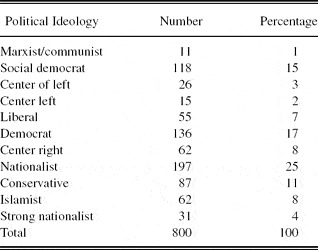
Special care was taken to offset the limitations associated with the use of a single university campus. Campuses are political spaces where students are often engaged in political activities.Footnote 63 In the 1970s, leftist and nationalist students in Turkey utilized campuses as sites of peaceful and violent political demonstrations. Starting in the early 1990s, Turkish campuses were divided over the headscarf controversy. Based on my conversations with colleagues and students during the field study, I believe this campus is not dominated by any political group. Furthermore, the selected sample demonstrates considerable variability in terms of students' political ideologies (see Table 1). The largest numbers identified as Social Democrat (15%), Democrat (17%), Nationalist (25%), and Conservative (11%). Some students reported stronger ideological positions, including Marxist (1%), Islamist (8%), and strong nationalist (4%). Thus, I was able to obtain a highly representative sample that allows me to make generalizations about foreign policy orientations of university students in Turkey.
Ideological preferences of students

Note: The categories are selected based on the recommendations of experts on Turkish politics working in the same institution. Some categories were added after the pilot testing of the survey.
STUDENTS' PERCEPTION OF FOREIGN POLICY STRATEGIES AND GOALS
I first report results related to the students' general perceptions of foreign policy. The participants were asked whether the foreign policy strategy of the current government was on the right track, the wrong track, or neither. Of 800 respondents, 296 (37%) believe that the foreign policy is on the right track, 249 (31%) believe it is on the wrong track, and the remaining 255 (32%) take a neutral position. The educated youth do not appear to provide unconditional support for the AKP's foreign policy strategies.
One of the survey questions was: “In one word, how would you describe the identity of Turkey in foreign policy?” The students then were given a list of identity categories. Of 800 students, 47 percent described the country's identity as “Turk,” 22 percent as “Muslim,” and 11 percent as “Ottoman.” Those who believe that Turkey's state identity is “Western” or “European” add up to 11 percent, and the remaining 9 percent think of Turkey as “Middle Eastern.” These results show that about half of the university students view Turkey through nationalistic lenses. Those who view Turkey's state identity as Western or Middle Eastern constitute a small minority. Thus, in accordance with the findings of past studies,Footnote 64 state identity is perceived through a political–territorial lens rather than through regional, religious, or historical frameworks.
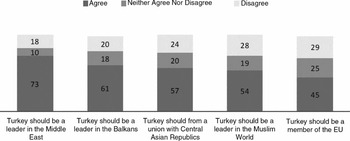
The survey also included an item tapping into the respondents’ views of Turkey's role and goals in neighboring regions where Turkey pursues an active foreign policy. The respondents were asked to specify whether they strongly agree, agree, disagree, strongly disagree, or are neutral about some statements (see Figure 1). For each statement, positive responses (strongly agree and agree) and negative responses (strongly disagree and disagree) are combined. As Figure 1 demonstrates, a very high percentage of the respondents (73%) believe that Turkey should be a leader in the Middle East, followed by 61 percent who support a leadership goal in the Balkans. One can argue that Turkey's historical legacy may be leading educated youth to favor an ambitious goal in the Middle East and the Balkans, both former Ottoman territories. Since about half of the students think that Turkey's state identity is “Turk,” it may not be surprising that 57 percent agree with the idea of political integration with the Central Asian Turkic republics. More than half of the students (54%) agree that Turkey should be the leader of the Muslim world, yet 28 percent of the respondents disagree with this goal. It is interesting that support for EU membership is only 45 percent; 29 percent of the students oppose EU membership. When the goals of Turkish foreign policy and Turkey's leadership role in international affairs are considered, the young and educated segment of Turkish society gives more weight to nationalistic, historical (i.e., Ottoman), and religious affinities. It seems that educated youth value increased involvement in the Middle East, the Turkic republics, and the Muslim world, and that a majority believes that Turkey's state identity should be defined in nationalist terms. So, what is behind these preferences about foreign policy? Do different types of identity shape attitudes about foreign policy among university students? In the next section, I try to answer these questions by reporting the results of the survey questions related to individual identity and attitudes toward foreign policy.
The perceptions of Turkey's role in international relations.

IDENTITY AND PERCEPTIONS OF FOREIGN POLICY
The survey included some items measuring social identity at the national and international levels. Among many questions tapping respondents’ attachments, the following two were selected for empirical analysis.Footnote 65
Which one of the following describes you best?

Which one of the following describes you best?
European
Middle Eastern
Global Citizen
Both European and Middle Eastern
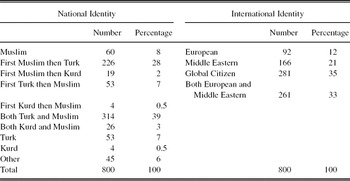
The first item measures social identity in a domestic/national context, while the second asks about the respondents’ orientations with respect to regional and international attachments. Therefore the first item is named a “national” identity in the results, while the second item is labeled an “international” identity (see Table 2).
Nationally and internationally oriented identity

Note: The result from the cross-tabulation table: Pearson chi square (27) = 38.6117, Pr = 0.069. The total percentage may not add up to 100 due to rounding.
Table 2 shows that on the first question, related to the national context, 81 percent of respondents describe their social identity as a combination of religious and ethnic attachments. Among all participants, 39 percent report the best description of their identity as “both a Turk and Muslim” and 3 percent report “both a Kurd and Muslim.” In a similar vein, 28 percent of the respondents identify as “Muslim first and then Turk” and 2 percent as “Muslim first and then a Kurd,” and finally 7.5 percent chose “first a Turk/Kurd and then a Muslim” (7% Turk and 0.5% Kurd) as their primary attachment. While multiple overlapping identities appear to be the norm, nationalist and religious social identities are dominant among university students. Those who define themselves solely by ethnic or religious identity are only 15.5 percent of all participants (8% Muslim, 7% Turk, and 0.5% Kurd). On the second question, considering attachments in an international context, the largest group is formed by those who describe themselves as “global citizens,” while 33 percent of the educated youth feel that they are both European and Middle Eastern. A larger number of respondents stated that their international identity is only Middle Eastern (21%) than only European (12%). Overall, the distribution of students across these two dimensions shows a good degree of variance.Footnote 66
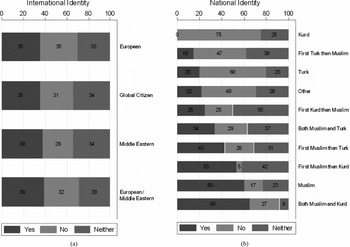
Given respondents’ self-reported identity, what are their foreign policy preferences? Do they support the AKP's foreign policy vision? Where do they see Turkey's future? What are their preferences in relation to Turkish foreign policy? Figure 2 shows the two-way distribution of students' identity (national and international) and their beliefs about their government's foreign policy strategy. The bars show the percentage of respondents who believe that Turkey's foreign policy is on the right track, wrong track, or neither (see Figure 2). The responses demonstrate that domestic social identities powerfully inform preferences toward foreign policy. In particular, Islamic identity, whether on its own or in conjunction with ethnic/national identity, is a strong predictor of support for the AKP's foreign policy choices. Overall, 37 percent of the students support the current government's foreign policy. To be more specific, as the right panel of the graph demonstrates, 60 percent of those who describe their identity solely with reference to Islam support the AKP's foreign policy. A pattern of strong support is similarly observed among those who define themselves as first Muslim and then Turk (43%), first Muslim and then Kurd (53%), both Muslim and Turk (34%), and both Muslim and Kurd (65%).Footnote 67 In contrast, those who define their primary identity along ethnic terms demonstrate somewhat weak support for the government's foreign policy strategy. This is especially true for those who describe their identity as solely Turk; 25 percent of these students believe that the AKP's foreign policy is on the wrong track. Overall, a strong association exists between social identity in the national context and support for the government's foreign policy strategies.Footnote 68 This relationship is more visible, as a positive correlation, when a religiously informed identity is considered. However, no clear and strong association is observed between identity in relation to the international context and support for the AKP's foreign policy. While those who consider themselves both European and Middle Eastern and only Middle Eastern appear to be slightly more supportive of the government's policy, the differences with the other identity groupings remain miniscule.
The identity and support for the AKP's foreign policy. (a) Pearson chi square (6) = 2.7550, Pr = 0.839. (b) Pearson chi square (10) = 79.6964, Pr = 0.000.

The previous results show that domestically oriented identity strongly informs support for or opposition to the AKP's foreign policy among university students. To be more specific, Islamic identity alone and when prioritized within overlapping forms of identity is significantly associated with support for the government's foreign policy. While these results cannot empirically substantiate an electoral connection or an elite–mass linkage, they clearly show that students holding religious forms of identity demonstrate support for AKP policies. This is an interesting insight from the results of the survey, but we also need to examine whether a similar relationship is observed between identity and an individual's preferences for more specific foreign policy strategies.
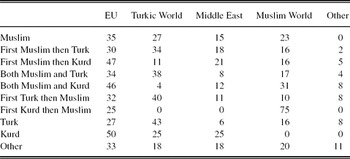
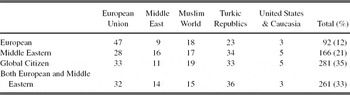
In the survey, the participants were asked: “Where does Turkey's future lie?” Table 3 and Table 4 provide a cross-tabulation of respondents’ views about the future of the country and self-reported nationally and internationally situated identities. The percentages demonstrate a strong statistical association between domestically oriented identity and perceptions of the future of the country's foreign policy directions (see Table 3).Footnote 69 Across most identity categories, significant proportions of respondents believe that Turkey's future is either in the EU or the Turkic republics, while the proportion of university students who believe that Turkey's future lies in the Middle East and the Islamic world is generally lower. It is not surprising that 43 percent of the respondents who describe their identity primarily as “Turk” favor a future orientation toward the Turkic republics. In a similar vein, a sizable proportion of individuals who define their primary identity as Muslim believe that their country's future is in the Muslim world (23%), though this proportion is lower than those who believe that Turkey's future lies in the EU (35%) or in the Turkic republics (27%).
National identity and perceptions of Turkey's future

Note: Pearson chi square (45) = 82.6387, Pr = 0.001. Cell entries are percentages.
International identity and perceptions of Turkey's future

Note: Pearson chi square (12) = 17.0096, Pr = 0.149. Cell entries are percentages.
The results in Table 3 combined with the other findings discussed previously show that the association between social identity and youth's perceptions of foreign policy is multifaceted. First, most university students describe state identity in nationalistic terms (i.e., Turkish). Second, a positive association is observed between support for the AKP's foreign policy and Islamic/ethnic identity. Third, when prescribing future goals in international affairs, university students assign greatest weight to the EU and the Turkic world. This last finding is particularly important; it shows that while religious identity is correlated to greater support for the AKP's foreign policy choices, most students see Turkey's future in the EU and the Turkic world. These two positions are not necessarily at odds, because the AKP's foreign policy activism relies on a geostrategic and realist strategy while exploiting the geocultural identities unique to Turkey.
More interesting results can be seen in the cross-tabulation of perceptions of the future direction of Turkey and internationally oriented identity (see Table 4). Across all internationally situated identity groupings, the priority is given either to the EU or the Turkic world. The EU is perceived to be the primary region for future policy strategies by 47 percent of the respondents who identify as European, 28 percent who identity as Middle Eastern, 33 percent holding a global citizenship identity, and 32 percent of those who combine a European and Middle Eastern identity. The respective ratios are very similar for the choice prioritizing the Turkic world. It is interesting that across all international identity categories, the Islamic world and the Middle East are ranked lower than the EU and the Turkic republics. For example, of those who hold a Middle Eastern identity, only 16 percent believe that the future of Turkey is in the Middle East, compared to a rate of 34 percent who see the future of the country in the Turkic republics.
CONCLUSION
Turkey's recent foreign policy involvement in the Middle East has drawn considerable attention. A novel characteristic of Turkish foreign policy in the AKP era is the increasing degree of interaction between domestic politics and international relations. As foreign policy choices become more connected to the electoral fortunes of the political parties, public opinion and individual choices gain more weight and identity becomes more salient because of its capacity to shape individual preferences and attitudes. In this article, I have examined the relationship between social identity and attitudes about foreign policy in Turkey, utilizing data from an original survey conducted among university students to empirically test this relationship. Despite some limitations, the empirical analysis of the survey data reveals interesting insights about the association between social identity and perceptions of foreign policy.
Most educated youth conditionally support the AKP's foreign policy choices and about one-third of them believe that the current foreign policy is on the wrong track. While about half of the respondents (47%) define Turkey's state identity as Turk, only a small percentage (11%) of the students view its state identity as Middle Eastern.Footnote 70 When asked about foreign policy goals, significant numbers of respondents report that Turkey should be a leader in the Middle East, the Balkans, or the Turkic republics. Individuals appear to be less enthusiastic about Turkey's accession to the EU as a foreign policy goal.
Moving beyond these general perceptions, the young and educated segment of the Turkish electorate believes that Turkey's future lies in the EU or the Turkic republics. Only a small fraction of the respondents has an orientation toward the Middle East or the Islamic world. It appears that individuals develop attitudes differently about the goals and the future of foreign policy. When it comes to the former, most educated youth appear to emphasize foreign policy strategies that are more in line with a nationalistic perception of state identity. This view is compatible with Davutoğlu's strategic depth approach, which favors a multidimensional policy exploiting multiple identities. Since Davutoğlu has implemented his foreign policy vision as Turkish foreign minister, the finding shows that university students carry orientations that are in line with this theoretically inspired policy framework. Furthermore, students' orientations appear to be in line with the scholarly approach explaining foreign policy activities with notions such as balance of power, geopolitics, and economic interestsFootnote 71 rather than with accounts describing the new directions in Turkish foreign policy as an axis shift or Middle Easternization.Footnote 72
The results also imply that defining identity with respect to the national and international attachments has an instrumental value. This distinction helps us better predict foreign policy choices among educated youth. Identity defined in terms of religious attachments more strongly informs preferences about foreign policy than do internationally oriented attachments. In particular, individuals who combine religious and ethnic attachments to define their identity may be more likely to make use of these feelings in forming their attitudes toward the AKP's foreign policy. For instance, those who hold an Islamic identity exclusively or in conjunction with ethnic identities are more likely to support the AKP's increased foreign policy involvement in the Middle East. At first look, this finding may be taken as supportive of the claim that the AKP is serving the needs of a religious constituency by Middle Easternizing Turkish foreign policy. However, the results also show that respondents holding the same religious identity may be supportive of active foreign policy in the EU, Central Asia, and the Caucasus. Overall, the findings from the survey suggest that an interest-based pattern of attitudes may be at work when the future goals of Turkey are considered. It can be argued that the predictive power of identity on attitudes toward foreign policy is conditioned by perceptions of national interest. Scholars of foreign policy are still debating the role of ideas and interests in foreign policy choices.Footnote 73 The results presented in this paper show that attachments of individuals to both multiple identities and national interest matter in shaping foreign policy preferences. Students of foreign policy need to conduct more analyses to explain the subtle ways in which identity and interest may interact to shape individual and state choices in international affairs.