International loans of artworks (whether between museums or between countries) are a critical element of cultural exchange. But each time an artwork leaves the borders of the nation where it is currently held, there is some degree of uncertainty about whether it will return. In an effort to provide a level of confidence to institutions in lending countries, many nations have passed various forms of antiseizure legislation, each one trying to balance a moral and legal imperative (the return of stolen property) with a cultural and societal privilege (the exchange of timeless treasures). Because of laws that favor good-faith purchasers of stolen cultural property, it is often difficult to recover stolen artworks from the countries where they are currently held. Therefore, when stolen or looted artworks leave the country where they “reside” for a temporary loan or exhibition, the opportunity to use legal process to recover those artworks may arise, depending on the laws of the nation to which they are sent. This article focuses on representative cases that illustrate what remedies are available when cultural property whose ownership is disputed enters the United States or the United Kingdom.
Much of this article is devoted to discussions of laws in the United States and the United Kingdom that can provide immunity from seizure by judicial process for artworks imported into the country for temporary exhibition. Before turning to the discussion of those laws, however, it will be helpful to review the background against which they were enacted. Both of these immunity from seizure laws stem directly from pressure by Russia to protect property nationalized after the Russian Revolution while on loan abroad, but the decision by Russia to press for an immunity from seizure law in the United Kingdom has also been related to concerns about possible claims to “cultural valuables” taken during and after World War II and the passage of the Federal Law on Cultural Valuables Displaced to the USSR as a Result of the Second World War and Located on the Territory of the Russian Federation, enacted by the Russian Federation in 1998 and subsequently amended in 2000 and 2004.Footnote 1 As we shall see, claims to artworks nationalized after the Russian Revolution have been rejected in the United States and several European countries, generally following official recognition of the legitimacy of the Soviet government by those countries. The circumstances of the Russian takings during and after World War II, however, are of a different character, and it remains to be seen whether Russian assertions of ownership pursuant to its laws will be honored abroad.
In the aftermath of the Russian Revolution, the Soviet Government passed nationalization decrees abolishing private ownership of property and appropriating banks, ships, works of art, and private residences containing cultural objects.Footnote 2 Nationalization affected countless cultural valuables, including the famous French Impressionist art collections of Sergei Shchukin and Ivan Morozov and the residences of Princess Olga Paley and Count Alexander Sergeevitch Stroganoff, among others. The nationalization decrees were condemned and challenged in foreign courts by foreign nationals and Russian émigrés. As the Western nations established diplomatic relations with the Soviet Union, its laws, including the laws extinguishing property rights of those who fled after the revolution, were recognized and deemed to be in effect retroactively.Footnote 3
The often-cited case Princess Olga Paley v. Weisz, which was brought in the United Kingdom, held that nationalization decrees issued by the Soviet Government were legitimate, and they were upheld by the court. Princess Olga was a widow of Grand Duke Paul of Russia. In 1919, she fled to England after her husband was arrested and executed by the Soviet Government. Their private residence, the Paley Palace, and its contents were nationalized. Some of these objects were purchased by a syndicate of English and French dealers in 1928 and taken to England for sale. Princess Paley's claim to recover her former property was dismissed because the court found that, since the Soviet Government had been recognized by the English government, the English courts were bound “to give effect to the laws and acts of that Government so far as they relate to property within that jurisdiction when it was affected by those laws and acts.”Footnote 4
Similar decisions were reached in Germany and later in the United States.Footnote 5 To cite only one example, in the 1937 decision in U.S. v. Belmont the court held that New York State wrongly refused to give effect to the Soviet nationalization decrees because the “international compact” between the United States and the Soviet Government in 1933 resulted in the formal recognition of the Soviet government by the United States and “validate[d] … , all acts of the Soviet Government from commencement of its existence.”Footnote 6
Notwithstanding these decisions, at the height of the Cold War in the 1960s, when loans of artworks from Russia that had been the subject of the nationalization decrees were sought by an institution in the United States, “as a condition to the loan, the Soviets insisted on a grant of immunity from seizure” so that the artworks would be protected against claims by the former owners or their heirs.Footnote 7 In part for this reason, in 1965 the U.S. Congress enacted 22 U.S.C. § 2459, Immunity From Seizure Under Judicial Process of Cultural Objects Imported for Temporary Exhibition or Display, which prevents the judicial seizure of artworks loaned to museums and similar institutions in the United States under certain circumstances. In the second half of this article, we shall see that a law granting immunity from seizure for artworks on temporary exhibition was recently enacted in the United Kingdom under very similar circumstances. But first I will examine the practical effects of 22 U.S.C. § 2459 and related legal principles and statutes in the United States.
LITIGATION AGAINST A FOREIGN SOVEREIGN IN THE UNITED STATES TO RECOVER ARTWORKS ON TEMPORARY LOAN
Pursuant to 22 U.S.C. § 2459, any not-for-profit museum or other exhibitor may apply to the U.S. Department of State for a determination that art or other cultural property loaned from abroad to the United States for an exhibition is culturally significant and that the exhibition is in the national interest. The covered artworks will be immunized from judicial seizure only after such an application has been granted by the U.S. government. In order to obtain a determination that the loan of the artworks is in the national interest, the applicant must certify that it has undertaken professional inquiry, including independent, multisource research into the provenance of the objects being loaned. The applicant must also state whether there are any potential competing claims of ownership. For objects where competing ownership claims may exist, the applicant must describe those competing claims and the likelihood that a claim might succeed.Footnote 8
Under U.S. law, a foreign sovereign is not immune from suit in this country simply because it is a sovereign. Previously, the United States followed the “absolute theory” of sovereign immunity under which the government of a nation, state, or other political subdivision could not, without its consent, be subjected to process in a court of law. This was a basic principle of U.S. law for over 150 years.Footnote 9 In 1952, however, the State Department issued the “Tate Letter,” a letter from Jack B. Tate, the acting legal advisor of the Department of State, to the acting attorney general. This letter advised the Justice Department that henceforth the Department of State would “follow the restrictive theory of sovereign immunity in the consideration of requests of foreign governments for a grant of sovereign immunity.”Footnote 10 In general, the restrictive theory extended immunity to foreign sovereigns in legal actions arising out of acts that are governmental in nature, but not to cases that arise from commercial or private acts.
The new policy announced in the Tate Letter was difficult to implement because it provided no criteria for the application of this “restrictive theory” of sovereign immunity. Consequently, American courts began seeking advice from the U.S. Department of State on the question of sovereign immunity, which filed “suggestions of immunity” when it deemed them appropriate. This practice was based on the principle that the executive branch had a “constitutionally mandated prerogative of action in the field of foreign relations, and in part on a reluctance to embarrass the executive in its conduct of foreign policy.” Nevertheless, it soon became apparent that the Department of State's “suggestions of immunity” were deficient, as they were lacking in consistency and principle and could not be used as precedent because they lacked a clear objective or policy.Footnote 11
In 1976, the doctrine of sovereign immunity was codified in the U.S. Foreign Sovereign Immunities Act (FSIA), 28 U.S.C. §§ 1602 et seq., which provides that a foreign state, its political subdivisions and its agencies and instrumentalities are immune from jurisdiction in U.S. courts unless certain exceptions apply. The exceptions are enumerated in sections 1605 and 1605A. These include two types of cases: (1) cases
in which the action is based upon a commercial activity carried on in the United States by the foreign state; or upon an act performed in the United States in connection with a commercial activity of the foreign state elsewhere; or upon an act outside the territory of the United States in connection with a commercial activity of the foreign state elsewhere where that act causes a direct effect in the United States
and (2) cases
in which rights in property taken in violation of international law are in issue and that property or any property exchanged for such property is present in the United States in connection with a commercial activity carried on in the United States by the foreign state.Footnote 12
If the criteria laid out in the FSIA are met, the door is open to litigation over disputed artworks that enter into the United States on loan for exhibition at museums, even, as we shall see, if the U.S. Department of State has granted immunity for judicial seizure in connection with the exhibition. This was established in Malewicz v. City of Amsterdam.Footnote 13
The Malewicz Case
Malewicz was a case of first impression with regard to these issues. As explained in more detail later, the Stedelijk Museum, owned and operated by the City of Amsterdam (the “City”), a political subdivision of the Dutch government, loaned a number of paintings by the artist Kazimir Malevich to two American museums as part of a temporary exhibition.Footnote 14 The borrowing museums secured the necessary certifications from the U.S. Department of State to ensure that the artworks would be immune from any court-ordered seizure while in the United States. Shortly before the exhibition closed and the works were returned to the lender, however, an action was commenced against the City by the Malevich heirs in the U.S. District Court for the District of Columbia—one of the venues designated by the FSIA. The heirs sought to recover the artworks, asserting that the City expropriated them in violation of international law 50 years earlier. Under the FSIA, an expropriation in violation of international law is one of the exceptions to sovereign immunity that a claimant can invoke.Footnote 15 The claimants' assertion of jurisdiction over the government-lender was based on the artworks' presence in the United States pursuant to a grant of immunity from judicial seizure. The City moved to dismiss the lawsuit, claiming, inter alia, that since the artworks were present in the United States pursuant to a grant of immunity from judicial seizure by the U.S. Government, their presence could not be the basis for jurisdiction over the City in a suit to recover the artworks. The U.S. Department of Justice, acting on behalf of the Department of State, submitted a formal Statement of Interest to the Court, indicating its concern that, because immunity from judicial seizure had been granted, a foreign government loaning artworks for exhibition in the United States would not expect that it could still be subject to a lawsuit in the United States to determine ownership of the artworks.
The historical background of the case was not uncomplicated.Footnote 16 In 1927, the renowned artist Kazimir Malevich brought more than 100 of his paintings, drawings, and other works to Berlin, where many were exhibited at the prestigious Berliner Kunstausstellung. In June of that year, Malevich was unexpectedly called back to Leningrad and could not take his artworks with him. Since he expected to return soon to the West, he entrusted them for safekeeping to several friends in Germany. The Berliner Kunstausstellung closed in September 1927, and all of the Malevich works were packed and stored in Berlin. Years later, the works were transferred from the facility where they were being kept to one of Malevich's friends, Dr. Alexander Dorner, to whom he had entrusted the works. At that time it would have been futile to return the works to Malevich in the Soviet Union because Stalinist condemnation of abstract art would undoubtedly have led to their confiscation and eventual destruction.
For some time, Dorner exhibited some of the works at the Landesmuseum in Hannover. The Nazi attacks against “degenerate art” and Hitler's ultimate ascension to power, however, compelled Dorner to conceal the works in the museum's basement. Before Dorner fled Germany in 1937, he took steps to ensure that the Malevich works he was leaving behind would be kept secure for the benefit of Malevich's heirs. Malevich had died in 1935, and the Malevich name and his Suprematist art were anathema in Stalinist Russia. The majority of the German friends to whom he had entrusted his works in 1927 had already fled or, like Dorner, were about to leave Germany—all that is, but one: Hugo Häring, who lived and worked in Berlin. Therefore, Dorner had the crate of paintings and drawings sent to Häring, to whose care alone the works were now entrusted. Häring safeguarded the works in Berlin, until the bombing of the city in 1943, and then in his native town of Biberach. During the time that the works were in Biberach, Häring's friends attempted to convince him to secure the works against loss or dispersal by entrusting them to the care of a museum. As alleged in the complaint, for years Häring refused to do so, repeatedly emphasizing that he was only the custodian of the works, responsible for their safekeeping, and that he had no right to sell them.
In 1956, after a prolonged illness, Häring finally agreed to loan the works to the Stedelijk Museum, whose director had been attempting for years to persuade him to sell or, at the very least, lend the works to the museum. Häring entered into a loan contract with the Stedelijk “that contained an option to purchase the Malevich Collection.” The heirs alleged that the statements in documents on which this loan contract was based—which purported to effect transfer of the ownership of the artworks from Malevich to Häring upon Malevich's death—were false and that the director of the Stedelijk was fully aware that they were false, because Häring had previously stated to him that he was only a custodian, not an owner, of the works. Thus, according to the heirs' allegations, despite knowing that Häring did not own the Malevich artworks, the Stedelijk purported to purchase them in 1958 and thereafter kept them as part of its collection.
The circumstances that led to the lawsuit being brought in the United States arose in 2003, when 14 of the 84 artworks in the Malevich Collection at the Stedelijk were exported to the United States to be part of a temporary exhibition at the Solomon R. Guggenheim Museum in New York City (from 22 May 2003 to 7 September 2003) and the Menil Collection in Houston (from 2 October 2003 to 11 January 2004). Prior to the exhibition, the U.S. Department of State issued the required certifications, and consequently, the artworks were granted immunity from judicial seizure while in the United States (Figure 1).
Kazimir Malevich, Desk and Room (oil on canvas, 1913). One of the fourteen paintings brought to New York for temporary exhibition, and later among the five transferred to the Heirs. Image courtesy of the Heirs of Malevich.

As noted earlier, the Malevich heirs' suit in the United States was brought under the FSIA's expropriation exception, 28 U.S.C. § 1605 (a)(3), which provides that a foreign state (including a political subdivision thereof) shall not be immune in a case “in which rights in property taken in violation of international law are in issue and that property … is present in the United States in connection with a commercial activity carried on in the United States by the foreign state.” The heirs argued that (1) the defendant, the City of Amsterdam, through the Stedelijk Museum, took the Malevich artworks without giving compensation to the heirs, their true owners, none of whom was at any time a citizen of The Netherlands; (2) when the action was commenced in January 2004, the 14 Malevich works at issue were “present in the United States” in connection with the exhibition, vesting jurisdiction over them in the United States pursuant to § 1605 (a)(3); and (3) the loan of the artworks to the Guggenheim and Menil museums was a “commercial activity” for the purposes of the FSIA, because it was a transaction or act that could be engaged in by a private party.Footnote 17
The City of Amsterdam moved to dismiss the heirs' complaint, arguing, inter alia, that they could not claim a violation of international law because they had not exhausted first their possible remedies in the Dutch courts; the artworks were not “present in the United States” as a matter of law during the course of the exhibitions because they had been federally immunized from seizure; and that the loan of the Malevich artworks to the U.S. museums was not a “commercial activity carried on in the United States.”Footnote 18
In an opinion dated 30 March 2005, the U.S. District Court for the District of Columbia, among other things, denied the City's motion to dismiss. First, the court found that the City's arguments concerning exhaustion of remedies were not a basis for dismissing the suit on jurisdictional grounds because the court could “not require Plaintiffs to take their case to a Dutch court unless the City of Amsterdam waiv[ed] its statute of limitations defense and the Dutch court accept[ed] that waiver,” a course of action the City refused to pursue. Second, the court held that immunization from judicial seizure did not somehow negate the physical presence of the paintings in the United States at the time the suit was filed, and, therefore, they were present for purposes of FSIA jurisdiction. Last, as to whether the exhibition loan was a “commercial activity,” the court based its analysis on the “rule of thumb” adopted by the courts in the District of Columbia: “If the activity is one in which a private person could engage, it is not entitled to immunity.” Consequently, the court concluded that it was “clear that the City of Amsterdam engaged in ‘commercial activities’ when it loaned the 14 Malevich works to museums in the United States” because there is “nothing ‘sovereign’ about the act of lending art pieces, even though the pieces themselves might belong to a sovereign.” As the court explained, even if the loan were purely educational and cultural in purpose, as the City alleged, it still would be “commercial activity” under the FSIA, citing the language of the FSIA itself: “[t]he commercial character of an activity shall be determined by reference to the nature of the course of conduct or particular transaction or act, rather than by reference to its purpose.” The U.S. Government's Statement of Interest in the case contended that “§ 1605(a)(3) requires a sufficient nexus with the United States to provide fair notice to foreign states that they are submitting themselves to United States jurisdiction and abrogating their sovereign immunity” and that “foreign states are unlikely to expect that this standard is satisfied by a loan of artwork for a United States Government-immunized exhibit that must be carried out by a borrower on a non-profit basis.” The court disposed of these arguments by stating that although “the opinions of the United States are entitled to ‘great weight,’” the court “concludes that § 2459 granting immunity and § 1605(a)(3) establishing jurisdiction for certain claims against a foreign sovereign are both clear and not inconsistent,” and therefore “the Court is bound to the plain meaning of these statutes”; that is, that they are “unrelated except that a cultural exchange might provide the basis for contested property to be present in the United States and susceptible, in the right fact pattern, to an FSIA suit.”
On the factual record before it, however, the court could not ascertain the substantiality of the City's contacts with or activities in the United States in connection with the loan of the Malevich artworks, which the court held was required by the relevant definition of “commercial activity” in the FSIA itself: “A commercial activity carried on in the United States by a foreign state” means commercial activity carried on by such state and having substantial contact with the United States. Therefore, although it denied the City's motion to dismiss, the court requested further development of the factual record in order to make a final determination of the substantiality of the City's contacts with the United States and conclusively determine the question of whether or not the City of Amsterdam was immune from suit and thus whether or not the court had jurisdiction to hear the case.
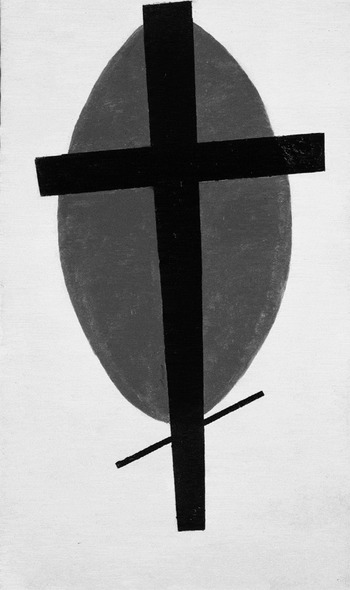
As a result, the City submitted additional evidence to support its position that it did not have substantial contacts with the United States and that it was immune from suit under the FSIA.Footnote 19 In a 27 June 2007 opinion, the U.S. District Court for the District of Columbia found that the record contained “sufficient contacts to establish jurisdiction under the FSIA's expropriation exception.”Footnote 20 The court thus conclusively denied the City's motion to dismiss. The City appealed this order. While the appeal was pending in the U.S. Court of Appeals for the District of Columbia Circuit, however, the matter was settled by the parties, and five of the Malevich paintings from the Stedelijk Museum were transferred to the heirs (Figure 2).
Kazimir Malevich, Mystic Suprematism (black cross on red oval, oil on canvas, 1920–1927). One of the five paintings transferred to the Heirs. Image courtesy of the Heirs of Malevich.

As the written opinions in the Malewicz case demonstrate, in the United States immunity from seizure only protects cultural objects on loan to museums to a certain extent—they are still subject to certain types of litigation, and claimants are not barred from all avenues of redress.
The Wally Case
As discussed earlier, although the applications are granted routinely, museums must apply to the U.S. Department of State in order to receive federal immunity from judicial seizure. But there are a few states, including New York, Texas, Tennessee, and Rhode Island that have automatic immunity statutes.Footnote 21 By way of example, the New York statute was at issue in one well-known case involving the claim of the heirs of Lea Bondi Jaray to Portrait of Wally, a painting by Egon Schiele.Footnote 22 The case was litigated for more than a decade against two museums that have not only forcefully fought the claim of a Holocaust victim's heirs but also fought the government of the United States, as well as the New York County District Attorney's Office, all in order to prevent the return of a painting stolen by a Nazi agent over 60 years ago.
Lea Bondi Jaray was a Jewish art dealer in Vienna who was forced to sell her art gallery to a Nazi named Friedrich Welz pursuant to Aryanization laws in Austria, which prohibited Jewish business ownership.Footnote 23 Bondi owned a painting by Egon Schiele called Portrait of Wally, which she maintained as part of her private art collection in her apartment. Shortly before Bondi and her husband were to flee to England, Welz came to their apartment to discuss the gallery's transfer. Upon spotting Wally, he insisted that she give it to him. Out of fear for what Welz could do if she refused, she turned it over. After the war, the U.S. armed forces transferred the painting to the Austrian government, but the painting was erroneously mixed in with a collection of artworks belonging to a Viennese art collector, Dr. Heinrich Reiger, and then mistakenly sold to the Austrian National Gallery by Reiger's heirs. Upon discovering that her painting was hanging in the Austrian National Gallery, Bondi told Dr. Rudolph Leopold, an Austrian Schiele collector who visited her London gallery in 1953, that she was the true owner of the painting and asked him to help her recover it. Dr. Leopold, however, acquired the painting for himself. Bondi retained lawyers to attempt to convince Dr. Leopold to return her painting to her, but to no avail. Lea Bondi Jaray died in 1969 without having recovered her painting.
In 1994, Dr. Leopold's art collection, which included Portrait of Wally, became part of the newly formed Leopold Museum, where Dr. Leopold himself is director for life. In late 1997, Portrait of Wally was loaned by the Leopold Museum to the Museum of Modern Art (MoMA) in New York for an exhibition of Schiele's artworks. Upon learning that the painting was being exhibited at MoMA, Bondi's heirs demanded that MoMA hold the work pending the resolution of the heirs' claim to ownership of the painting. MoMA refused, citing its contractual obligation to return the painting to the Leopold Museum at the end of the exhibition.Footnote 24 MoMA had not applied for federal immunity from judicial seizure for the exhibition. But, since a New York statute, the only one of its kind in the country at the time, provided that art loans from out-of-state lenders to not-for-profit institutions in New York are exempt from seizures, the heirs could not ask a court to attach the painting to prevent its return to Austria pending the determination of the heirs' ownership claim. Nevertheless, New York District Attorney Robert Morgenthau issued a subpoena for Portrait of Wally in connection with a criminal investigation into the matter and directed MoMA not to return the painting to the Leopold Museum. Litigation over the validity of the subpoena under New York's antiseizure law followed. Finally, the New York Court of Appeals held that the antiseizure law should be read broadly to prohibit the district attorney's subpoena of the painting and ruled that the painting could be returned to the Leopold Museum in Austria.Footnote 25 Within hours of that decision, however, the U.S. Customs Service obtained a warrant of seizure for the painting, and the U.S. Attorney's Office commenced a civil forfeiture action to remove the property permanently from the Leopold Museum.Footnote 26
The Leopold Museum made an application to the court to terminate the action without going to trial. In addition, it made an application to dismiss the heirs' claim, contending that they did not properly represent the Bondi Estate, as well as on statute of limitations grounds, and even claimed that Portrait of Wally was not really stolen from Lea Bondi Jaray by the Nazi Welz since she had handed it to him when he demanded it. The court granted the Leopold Museum's motion to dismiss the case. The basis of the court's decision was simply that Wally was not stolen property within the meaning of the applicable U.S. criminal statute, known as the National Stolen Property Act, because after it was recovered by U.S. forces, it was no longer “stolen property.” The court based this ruling on the so-called sting cases where the police recover stolen property, then use the property to trap the next criminal up the line, usually called the fence. In such cases, U.S. courts have ruled that the fence cannot be convicted of receiving stolen property, because that property, often televisions or cars, is no longer considered stolen, because the police who initially recovered the property were acting as agents for the true owner, who effectively recovered it at that time. Thus, the court in Wally concluded that, when the painting was recovered from Welz by the U.S. forces after the war, it was no longer stolen because they had recovered it as agents for Lea Bondi Jaray, even though they did not know her name or that the painting was hers.
The court eventually reversed its prior ruling, when the government's complaint was amended to allege, among other things, that at the time they recovered the property, the U.S. forces did not even know the painting had been stolen by Welz; that the Allies, unlike the police, were under no obligation to turn over Portrait of Wally to the true owner, but only to return the confiscated property to the Austrian government without the need for any authority from the owner; and finally, that Leopold had wrongfully converted the painting so it was stolen all over again.Footnote 27 After more than 10 years of litigation, the Leopold Museum and the government filed cross motions for summary judgment. On 30 September 2009, Judge Loretta Preska issued a 110-page opinion denying both sides' summary judgment motions.Footnote 28 The judge ruled in the government's favor on every one of the many issues in the case except for one that she left for trial. She ruled that the estate of Lea Bondi Jaray and the government had made the necessary showing that Dr. Leopold knew that the painting (Portrait of Wally) was stolen or converted when he imported it to the United States. A trial was scheduled to begin on 26 July 2010 at which the Leopold Museum would have had an opportunity to overcome that showing by a preponderance of the evidence.
On 20 July 2010, however, days before the trial was scheduled to begin, the estate, the government and the Leopold Museum entered into an agreement, finally resolving the case. Under the terms of the settlement agreement, the Leopold Museum paid the estate $19,000,000, reflecting the true value of the painting, the estate released its claim to Portrait of Wally and the government dismissed the case and released the painting to the Leopold Museum. In addition, the Leopold Museum agreed that it will provide signage at all future displays of the painting that will reflect the true provenance of the painting, including Lea Bondi Jaray's ownership and its theft from her by a Nazi collaborator. Also pursuant to the settlement agreement, before the painting was transported to the Leopold Museum, it was exhibited at the Museum of Jewish Heritage—A Living Memorial to the Holocaust in New York for three weeks, beginning with a ceremony commemorating the legacy of Lea Bondi Jaray and the successful resolution of the case.
In sum, as the Malewicz and Wally cases demonstrate, under the right circumstances, U.S. courts will have jurisdiction over suits for the recovery of stolen cultural objects. And in some cases, there can be a basis for jurisdiction even though the property in question has been granted immunity from judicial seizure by the U.S. government or under automatic state immunity statutes.
LITIGATION AGAINST A FOREIGN SOVEREIGN IN THE UNITED KINGDOM TO RECOVER ARTWORKS ON TEMPORARY LOAN
I turn now to the laws of the United Kingdom and recent concerns surrounding similar antiseizure legislation.
The Royal Academy's 2008 Russian and French Master Paintings Exhibition
On 26 January 2008 the Royal Academy in London opened its long-awaited landmark exhibit entitled From Russia: French and Russian Master Paintings 1870–1925 from Moscow and St. Petersburg, presenting modern masterpieces from some of Russia's most important museums: the Pushkin State Museum of Fine Art, the State Tretyakov Gallery in Moscow, the State Hermitage Museum, and the State Russian Museum in St. Petersburg.Footnote 29
The exhibition included works that had been in the collections of Ivan Morozov and Sergei Shchukin, which were mentioned in the initial discussion of Soviet nationalizations earlier. The Royal Academy described the two, who were textile merchants, as “the most brilliant and daring Russian collectors of their day.” Their collections included “paintings by the Impressionists and Post-Impressionists,” including “works by Monet, Renoir, Cézanne, van Gogh, Gauguin, Matisse and Picasso.”Footnote 30
The Royal Academy's description did not note that these collections are now in Russian museums because they were nationalized by the Bolsheviks and that descendents of the collectors have tried repeatedly but unsuccessfully to recover the artworks. Between 1993 and 2004, Shchukin's grandson, French citizen Andre Marc Delocque-Fourcaud, lodged claims in Paris, Rome, and Los Angeles for the return of various works of art, but each failed.Footnote 31
On 20 December 2007, just over a month before the Royal Academy exhibit was set to open, the Russian Federal Agency for Culture and Cinematography refused to issue export licenses to allow the paintings to be shipped to London for the exhibition.Footnote 32 The Russian Federal Agency argued that Britain had failed to provide the necessary guarantees that the artworks would not be subject to seizure.Footnote 33 Russia's reticence may have been related to an action in Switzerland two years before when a Swiss judge briefly impounded 55 paintings from the Pushkin Museum in response to a claim against the Russian state by a Geneva-based trading company.Footnote 34 Ultimately, the works were released and returned to Russia.Footnote 35
Even if the initial refusal of export permits had an underlying political motivation, Russia's concern about seizure did have some validity. At the time, the United Kingdom was one of the few countries in Europe without a law protecting loaned art from seizure.Footnote 36 Nevertheless, according to the United Kingdom's Department for Culture, Media and Sport, James Purnell, the culture secretary, wrote on 7 December 2007 to the head of the Russian Federal Agency for Culture and Cinematography and confirmed that the artworks would be subject to and protected by the State Immunity Act of 1978.Footnote 37 His letter stated: “I confirm that under English law, the property of a state, including works of art lent to an exhibition in this country, which are judged by a court not to be in use, or intended use for commercial purposes, will be immune.”Footnote 38
At the time, antiseizure legislation was being prepared as part of the Tribunals, Courts and Enforcement Bill 2007 and was scheduled to become effective in England on 31 December 2007.Footnote 39 Because the United Kingdom had not yet passed the antiseizure legislation, they could only allay Russia's concerns by referring to the State Immunity Act of 1978. The Russian Federal Agency was afraid that, in the absence of a clear antiseizure law in the United Kingdom, this “governmental guarantee” would not protect them from legal action.Footnote 40
State Immunity Act of 1978
The State Immunity Act of 1978 provides that:
(1) A state is immune from the jurisdiction of the courts of the United Kingdom except as provided in the following provisions of this Part of this Act.
(2) A court shall give effect to the immunity conferred by this section even thought the State does not appear in the proceedings in question.
The act also provides for several exceptions to that immunity. One of these relates to commercial transactions:
[a] state is not immune as respects proceedings related to—(a) a commercial transaction entered into by the State or (b) an obligation of the State which by virtue of a contract (whether a commercial transaction or not) fails to be performed wholly or partly in the United Kingdom.Footnote 41
Insofar as it is applied to artworks, the State Immunity Act of 1978 provides some protection for works that are state owned, but this protection does not apply to property used or intended to be used for commercial purposes. Consequently, “[t]he application of the Act to works of art which are lent to this country for exhibitions [was] not entirely clear.”Footnote 42
Therefore, it appears that Russia did have a legitimate reason for concern. If the English courts determined that art loaned for exhibitions was property used or intended for use for commercial purposes (as the U.S. District Court in Malewicz had concluded), or if a court determined that a public entity like a state museum lending artwork did not enjoy the same immunity accorded to a state, the art would not have been protected and could have been subject to seizure.
The Tribunals, Courts and Enforcement Act of 2007
As a result, the United Kingdom sped up passage of its legislation protecting artworks on loan from seizure.Footnote 43 The new legislation, Part 6 of the Tribunals, Courts and Enforcement Bill 2007, was introduced by the Ministry of Justice and went into effect on 31 December 2007.Footnote 44
On 9 January 2008, a mere 17 days before the exhibition was set to open, the Russian government gave its final approval for the exhibition. The Royal Academy of Arts received official notification from Mikhail Shvydkoi, director of the Russian Federal Agency for Culture and Cinematography, approving the loans. Shvydkoi said that “having consulted with colleagues from the Ministry of Foreign Affairs, we have come to the conclusion that, having received the maximum possible assurance of the British Government, there is therefore every reason to permit the holding of such exhibition in the designated time frame—from 26 January to 18 April 2008.”Footnote 45
Part 6 of the Tribunals, Courts and Enforcement Act 2007
Part 6 of the act provided “the maximum possible assurance” because it granted immunity from seizure for objects lent to the United Kingdom to be included in a temporary exhibition at a museum or gallery. Immunity is extended to any form of seizure ordered in civil or criminal proceedings and from any seizure by law enforcement authorities.Footnote 46
Part 6 is divided into five sections numbered 134–138. Section 134 provides the conditions that must be met in order for an artwork to be protected. Five conditions must be satisfied: (1) The object must usually be kept outside the United Kingdom; (2) the object must not be owned by any one resident in the United Kingdom; (3) the import of the object must comply with the law on the import of goods; (4) the object must be brought to the United Kingdom to be displayed to the public in a temporary exhibition at a museum or gallery; and (5) the museum must have complied with regulations requiring publication of information about the object. Protection is bestowed for 12 months beginning with the day the object enters the United Kingdom if the object is in the United Kingdom for one of the purposes defined in the act. The protection may continue after 12 months if the object suffered damage while protected and is undergoing repair, conservation, or restoration because of such damage or is leaving the United Kingdom following repair, conservation, or restoration because of such damage.Footnote 47
The scope of the protection offered by Part 6 of the act is described as follows:
135(1): While an object is protected under this section, it may not be seized or forfeited under any enactment or rule of law, unless—
(a) it is seized or forfeited under or by virtue of an order made by a court in the United Kingdom; and (b) the court is required to make the order under, or under provision giving effect to, a Community obligation or any international treaty.
As the Explanatory Notes to the Act advise, protection will not be given “where seizure or forfeiture is required to enable the UK to comply with its obligations under EU or other international law, for example, where the court is asked to enforce an order for the seizure of an object made by the courts of another country to confiscate proceeds of crime.”Footnote 48
The reference to the United Kingdom's “obligations under the EU or other international law” is presumably related to the 1993/7/EEC of 15 March 1993, as amended, on the Return of Cultural Objects Unlawfully Removed from the Territory of a Member State (the “1993 Directive”) and the 1970 UNESCO Convention on the Means of Prohibiting and Preventing Illicit Import, Export and Transfer of Ownership of Cultural Property (the “UNESCO Convention”). But the interplay between these protections and international agreements has not yet been examined by a court.Footnote 49
The act further provides that:
Protection under this section does not affect liability to an offence of importing, exporting or otherwise dealing with the object, but (subject to subsection (1)) any power of arrest or otherwise to prevent such an offence is not exercisable so as to prevent the object leaving the United Kingdom.
The act's Explanatory Notes advise that “the protection given to an object loaned to an exhibition does not give any protection from prosecution to those dealing with the object, where the dealing in question constitutes an offence.”Footnote 50
As in the United States, protection is not automatic. A museum or gallery must apply to become an approved institution. Before becoming an approved institution, the applying museum/gallery's “procedures for establishing provenance and ownership of objects” and its compliance with the Secretary of State's guidance regarding establishing provenance and ownership are evaluated.Footnote 51 But immunity will routinely be provided to objects on loan to approved institutions.
Prior to enactment of this legislation, museums were guided by the Due Diligence Guidelines Combating Illicit Trade.Footnote 52 Pursuant to those guidelines, due diligence is comprised of (1) an initial examination of the item; (2) a consideration the type of item and likely place of origin; (3) consultation with an appropriate expert; (4) a determination as to whether the item was lawfully exported to the United Kingdom; and (5) an evaluation of the information provided by the lender. Most significantly, the guidelines provide that “in all cases if there is any suspicion whatsoever about the item, then you should not proceed with the acquisition.” According to the United Kingdom's Department for Culture, Media and Sport:
To obtain approval, a museum or gallery must demonstrate that its procedures for undertaking due diligence are robust, comply with international standards and specifically with Combating Illicit Trade: Due diligence guidelines for museums, libraries and archives on collecting and borrowing cultural material, issued by DCMS [Department for Culture, Media and Sport] in 2005. Each authority will be assisted in assessing applications for approval by independent experts.Footnote 53
During discussions over Part 6 of the act, concerns were raised that antiseizure litigation would be a disincentive for museums to conduct proper due diligence into the provenance of art, making the United Kingdom a haven for looted art.Footnote 54 The legislation, however, permits the Secretary of State to promulgate regulations requiring the borrower to provide certain specified information about an object.Footnote 55 In September 2007, the Department for Culture, Media and Sport issued a Consultation Paper on draft regulations for the publication of information by approved institutions.Footnote 56 Consultation closed on 21 December 2007. These draft regulations were laid before Parliament on 23 April 2008 and came into force on 20 May 2008.Footnote 57
Among other things, the regulations require approved institutions to publish on their web sites, for free inspection by the public: (1) information identifying the lender; (2) information identifying the object; (3) details related to the provenance of the object; and (4) details relating the proposed exhibition.Footnote 58 The regulations further provide that where an institution considers there to be a “reasonable” claim to an object, upon written request by the claimant, the institution must provide (1) the name of the lender, if not already provided; (2) a link to the web site which contains the information published by the borrowing institution; (3) a summary of the inquiries that the institution has made into the provenance, ownership and history of the object; and (4) any other information that the institution has obtained as a result of its inquiries into the provenance of the object.Footnote 59 The regulations, however, do not require the institution to forego the loan of the object, remove protection from the object where concerns are raised by a claimant or contain the same strong language as the Due Diligence Guidelines, which warn that “in all cases if there is any suspicion whatsoever about the item, then you should not proceed with the acquisition.”Footnote 60 Approved institutions, however, will presumably be subject to some type of annual compliance review through a “programme of spot checks,” and an “annual report to the Secretary of State on museums' compliance must also be produced.”Footnote 61
Criticism of the Act and the Regulations: Generally
Part 6 of the act has been criticized because of the way it is to be applied and because of the guidelines and regulations that were provided.
First, Section 134 (5) seems to extend the protected period without limitation in cases of repair, etc. Ideally, the legislation should specify some limited period after repair is completed.Footnote 62 Second, the legislation makes no distinction between seizures by authorities in connection with violations of criminal law and civil claims.Footnote 63 Loans are important to the cultural welfare of a nation, but such concerns should not trump the need to enforce criminal laws. If authorities have reason to believe that an object was stolen, it would seem unacceptable for them to stand aside and watch while the evidence is permitted to leave the country, especially when the chief wrongdoer (perhaps the lender) is likely to be beyond the reach of the authorities. This could, at least arguably, have some chilling effect on future loans, but it seems logical to believe that only those who know they have a problem would be affected. We have to assume that the authorities in the United Kingdom would not seek to seize an object unless they had good cause to do so in connection with criminal activity.
Third, the virtually automatic application of the protection once an institution has been approved, without any chance for an investigation into a particular loan, is troubling. While a museum may be protected because it generally has good provenance procedures, a loan should be refused and objects denied entry in the country if claimants have made a good case that the objects were stolen and asked that immunity be denied. Claimants, of course, may choose to permit such goods to come in if it might provide jurisdiction for a lawsuit (in rem, or long-arm jurisdiction) even if seizure were not possible. But that should be their choice. That is not to suggest, however, that the immunity should be lifted once the artworks are in the United Kingdom, even if the claimants urge it. Lifting the protection under those circumstances would defeat the purpose of the law and adversely affect the desire of lenders to send goods to the United Kingdom.
Fourth, Section 135 (2) provides that even if artworks cannot be seized, one can still be liable for criminal offenses, but it should also make clear that one could face civil liability based on the artworks' presence in the United Kingdom or otherwise.Footnote 64
Another criticism of the legislation involves the use of the word “owner.”Footnote 65 Under the terms of the act, protection is only extended to objects owned by non-UK residents. A claimant in the United Kingdom may therefore argue that no protection is afforded to an object that the claimant truly owns but that has been misappropriated. In addition, the disclosure requirements of the regulations may raise concerns about security and legal privileges.Footnote 66
Regulations currently in place attempt to deal with some of these concerns; however, there are still some flaws. Although the special provisions regarding provenance information for the Nazi-era are helpful,Footnote 67 it would be better to require as much provenance information as possible for all objects. Similarly, photographs of all objects, not only those with possible Holocaust-era provenance issues, should be required. As written, the law favors Holocaust-era claimants over governments seeking information about stolen antiquities, a distinction that does not seem warranted. Also—and this is very important—the photographs should include photographs of the verso of the works if they are paintings or drawings and the like and, of course, all sides of sculptures or similar objects. Any backing on paintings should be required to be removed for photographs of the verso unless it would be potentially hazardous to the artwork or unduly burdensome to do. The verso of works, especially looted works from the Holocaust-era, often have crucial information like exhibition labels, stamps, and/or inventory numbers that can be helpful in reconstructing their provenance.
More importantly, the ultimate decision about whether to accept a loan is still in the hands of the borrowing museum or gallery. The government should have the ability to overrule any such decision and reject the loan of any objects it believes may be stolen, if claimants request such relief.
Finally, while the existing Due Diligence Guidelines counsel museums and galleries to conduct careful examinations of loans and reject those to which apparently valid claims have been asserted, it is not clear what mechanism for oversight is available to the government if it disagrees with a museum or gallery's decision.Footnote 68
Part 6 of the Act Implicitly Condones the Russian Law on Cultural Valuables Displaced to the USSR as a Result of World War II
With respect to the legislation's recent application to the loans from Russia to the Royal Academy, there is also a question about whether the legislation gives an imprimatur of legitimacy to the Russian Federal Law on Cultural Valuables Displaced to the USSR as a Result of the Second World War and Located on the Territory of the Russian Federation.Footnote 69 As noted earlier, in 1998 the Russian government enacted the Federal Law on Cultural Valuables (Federal Law N-4-FZ of 15 April 1998).Footnote 70 Article 6 of that law provides that, with certain exceptions, “All displaced cultural valuables imported to the USSR in realization of its right to compensatory restitution and located on the territory of the Russian Federation, … are the property of the Russian Federation and are federally owned.”Footnote 71 The law essentially nationalized all cultural treasures transported to Russia after World War II as partial compensation for the loss of Russian cultural heritage during the war.Footnote 72 The Duma had overridden President Yeltsin's two vetoes of the law, and the Constitutional Court obligated Yeltsin to sign the law. Despite signing the law, Yeltsin lodged a request challenging the law's constitutionality. In 1999 the Constitutional Court issued a decision essentially upholding the law, but finding that it was partially unconstitutional. In 2000 the Duma amended the law in light of the Constitutional Court's holding, and the amendment was signed into law by President Vladimir Putin. The amendment did not alter the basic structure or intent of the law that nationalized any and all cultural objects transported to Russia during the period.Footnote 73 By providing immunity from seizure to these works, is the United Kingdom is implicitly condoning Russia's legal construct that allows it to retain ownership over blatantly misappropriated cultural objects?Footnote 74
Does Part 6 of the Act Preclude All Claims?
The original purpose of many antiseizure laws was to prevent seizure by third parties who sought to use artworks as a pawn in their disagreement with a lender (e.g., to enforce a debt unrelated to the artworks). The use of antiseizure legislation for protection against claims of stolen property is a more recent development. At its core, the United Kingdom's legislation provides protection from seizure, but the question is whether the act will protect museums or lenders from being subject to civil claims like conversion.
During the vetting of the legislation In the House of Lords, however, Lord Falconer noted that “the immunity will only provide protection from seizure. It will not protect museums in the UK or lenders from beings subject to a claim in conversion.”Footnote 75 Further, as noted in the 1 March 2007 Research Paper by the House of Commons Library, “the effect of providing immunity from seizure in civil proceedings will be to remove one potential remedy from claimants, but not to remove the basis for any cause of action in relation to a particular work of art. It will remain possible for a claimant to bring proceedings for damages against the museum (or anyone else who may be liable to such a claim).”Footnote 76 It therefore appears that civil lawsuits were contemplated under the legislation.
Another question in cases like that of the Royal Academy exhibition, where the act complained of is nationalization of property after the Bolshevik revolution, is whether the foreign government may be protected from suit in the United Kingdom under the Act of State Doctrine, which prevents a court from questioning decrees of foreign governments that affect property situated within that state's own territory.Footnote 77 English courts have applied the Act of State Doctrine in similar circumstances: “Our Government has recognized the present Russian Government as the de jure Government of Russia, and our Courts are bound to give effect to the laws and acts of that Government so far as they relate to property within that jurisdiction when it was affected by those laws and acts.”Footnote 78 In this example of the Royal Academy exhibition, where the artworks were nationalized after the Bolshevik revolution, application of the Act of State Doctrine may be appropriate and the works may nevertheless be protected.
In summary, the immunity from seizure legislation in both the United States and the United Kingdom provide broad protections to art loaned from foreign countries. But just how far those protections reach will only be determined as the legislation is tested by the courts. We have seen that Russian nationalizations and demands for protection have played no small part in the development and enactment of immunity laws in the United States and the United Kingdom. And they may well play an important role in future explorations of the limits of the protections provided by immunity. It has been suggested that Russia's concern about the United Kingdom's immunity from seizure laws has been connected to the Russian Federations stated intention to retain trophy art taken during World War II as reparations for losses of Russian cultural property during the war. In this view, the Russian Federation is interested not simply with protecting art on loan to foreign museums but also, more generally, in seeing that the Russian government's declarations about the status of property that has been seized will be respected. And there is already evidence that the reasons for those concerns are valid. In Chabad v. Russian Federation, which is discussed in more detail in this issue (article by Bazyler and Gerber),Footnote 79 The claimants are attempting to recover, inter alia, an important collection of manuscripts seized by Soviet troops in Poland during 1945 and taken back to Russia, where it remains, along with a collection of books belonging to their religious community that was nationalized after the revolution. The books and manuscripts were in Russia when the suit was filed, so immunity from seizure has not been an issue in the case. Even so, in addition to the nationalization issue, it is a test of how U.S. courts will respond to Russian assertions of ownership of property taken during World War II and thus may well indicate what kind of cases we can expect to see more of in the future.