INTRODUCTION
While engaging in everyday conversations with children, adults provide information about words, sometimes intentionally, but oftentimes without awareness. For example, they produce words in different sentence frames, thereby indicating that different words belong to different lexical categories: in the sentence frame this is an x, x is a count noun, while in the sentence frame this is an x one, x is an adjective. However, knowing that a word is an adjective does not tell a child to which property it refers. Physical characteristics of objects in non-linguistic contexts are one obvious source of information, but not all adjectives label perceptual attributes. Beyond word class, how much information do adults provide about adjective meanings while conversing with children?
Partial word knowledge
Information in the input is potentially relevant to lexical acquisition, even when children do not learn the meaning of an adjective immediately. Several theories of word meaning emphasize the importance of relationships among words and their linguistic contexts (e.g. Jones & Mewhort, Reference Jones and Mewhort2007; Landauer & DuMais, Reference Landauer and DuMais1997; Lund & Burgess, Reference Lund and Burgess1996). Words occurring in similar contexts in large samples of language are represented more closely in semantic space, implying that complete word knowledge requires exposure to many different contexts. In fact, there is considerable evidence that speakers hold partial knowledge of many words. Adults who deny knowing a word can sometimes pick out a sentence that uses it correctly if alternative sentences violate general semantic constraints, but not if there are more specific violations. For example, Shore & Kempe (Reference Shore and Kempe1999) noted that individuals who recognize that dowager is a word, but who cannot define its meaning or use it in a sentence, can still recognize that (1a) contains a correct use of the word, while (1b) does not. On the other hand, when they are given a choice between sentences (1a) and (1c), they are unable to decide which is correct.
(1a) The dowager has her dead husband to thank for her great wealth.
(1b) The circus performer juggled a dowager and two bowling pins.
(1c) The dowager and her husband recently celebrated their fiftieth wedding anniversary.
Recent advances in on-line measurement techniques have enabled researchers to show that even young infants have partial knowledge of words before they demonstrate comprehension on traditional measures (Fernald, Reference Fernald2003). For example, Skolnick & Fernald (Reference Fernald2003) showed infants a picture of a doggy on an object labeled as a noopa; infants inferred that the unfamiliar object was the noopa, even though it was only mentioned incidentally. These studies indicate that even if the context provides only partial information about a word's meaning, it can prove useful in adding to a child's incremental acquisition of vocabulary items.
Laboratory vs. naturalistic studies of adjective learning
To my knowledge, work on partial word knowledge has not examined adjectives. With a few exceptions (e.g. Blackwell, Reference Blackwell2005), work on adjective acquisition has involved laboratory comprehension tasks where children hear nonsense words describing observable properties such as color, texture or pattern and are tested to see whether they recognize that novel objects with the same properties can be labeled with the same adjectives (e.g. Akhtar & Montague, Reference Akhtar and Montague1999; Hall & Moore, Reference Hall and Moore1997; Klibanoff & Waxman, Reference Klibanoff and Waxman2000). The goal of such situations is to teach children to comprehend adjective labels for observable properties. Hoff & Naigles (Reference Hoff and Naigles2002: 428), in describing how children use input to acquire a lexicon note that ‘the question of what children can use in word learning, which experiments address, and what children actually do use, which naturalistic data address, are two different questions’. The same can be said about adult input: the question of what information adults provide when explicitly attempting to teach words, which experiments address, may not be the same input they provide in naturalistic situations. Although there is some work on maternal input about nouns in book reading situations (e.g. Gelman, Coley, Rosengren, Hartman & Pappas, Reference Gelman, Coley, Rosengren, Hartman and Pappas1998), little is known about what information adults provide about adjective meanings in settings where their goals may be less specifically focused on teaching and more focused on general communication of meaning than they are in laboratory situations. Because experimental studies tend to focus on object properties that are easily perceived, little is known about how information is conveyed about other sorts of properties. There is also little known about linguistically conveyed semantic information (but see Graham, Welder & McCrimmon, Reference Graham, Welder and McCrimmon2003), because in most laboratory studies information about meaning is provided by contrasting real-world referents that vary on the property being labeled.
Adjectives are used relatively infrequently compared to other form classes. Sandhofer, Smith & Luo (Reference Sandhofer, Smith and Luo2000) found that only about 10% of parental tokens spoken to English-speaking children between 2 ; 0 and 4 ; 0 were ‘descriptors’ (mainly adjectives). Because the likelihood of an adult producing a novel adjective to a target child is relatively low in any given setting, an individual investigator could wait a long time before collecting a large enough sample of novel adjectives to allow reasonable generalizations about the conditions of their use. This is certainly one reason why the most common method for studying acquisition of adjectives has been laboratory studies that use nonsense words. However, large samples of naturalistic data covering a broad range of discourse settings are available in the CHILDES database (MacWhinney, Reference MacWhinney2000). The overall goal of the current paper is to examine aspects of adjective meaning that have been identified in experimental studies, to see whether findings about adjective acquisition generalize to data from English-language conversations between adults and children in situations where adults were not explicitly instructed to teach children about adjective meanings.
Using a large, precompiled corpus such as CHILDES yields many adjective exemplars. A problem with using the full range of adjectives produced by adults in the corpus is that it is not always clear whether a word was novel to the child. To circumvent this problem, the current study examined rare adjectives. Ninety-nine percent of adult lexical input to children consists of the 3,000 most frequent English words (Weizman & Snow, Reference Weizman and Snow2001). Examining very infrequent words increases the probability that words are actually novel to the children hearing them.
Knowing the characteristics of linguistic contexts surrounding adult's language to children can provide data about what semantic information is available, but does not provide information about whether this information is unique to child input or is characteristic of all language involving adjectives. To address this issue in the current study, information contained in child-directed speech was compared to that in adult-directed speech in the same settings. These comparisons were possible because many of the corpora contained within CHILDES have multiple adult participants, who sometimes speak to each other.
Four types of linguistic contextual information were examined in the current study: semantically related words/phrases (including explicit definitions), compare/contrast information, affective/evaluative information, and the noun/pronoun that the adjective modified.
Semantically related language
To provide explicit information about new adjectives, adults may introduce them by producing words that are close synonyms, either stating that x means y or by producing y and leaving the child to infer that the two words are related. Hall, Burns & Pawluski (Reference Hall, Burns and Pawluski2003) instructed adults to teach nonsense-word adjectives to their children. On 70% of trials, adults gave definitions by saying ‘this means … ’ and on 77% of trials they translated nonsense words into English adjectives.
Less explicitly, partial adjective meaning can be inferred, in English, when adjectives occur in strings that are loosely related because they all apply to the same noun. For example, in that's stale old candy leftover from Halloween, the target adjective stale is related to both old and leftover (Bloom, in MacWhinney, Reference MacWhinney2000).
Another type of implicit semantic information occurs when adults describe an example of an entity or event having the characteristic described by the adjective. This is illustrated in (2) (Kuczaj, in MacWhinney, Reference MacWhinney2000), where not opening the door is an example of a behavior that is not hospitable.
(2)


Compare/Contrast information
Another type of contextual information concerns properties that compare or contrast with those named by target adjectives. Waxman & Klibanoff (Reference Klibanoff and Waxman2000) suggested that comparison is a general, psychological process used to extend novel adjectives to new exemplars. Adults may choose to introduce novel adjectives when there is non-linguistic contextual information that provides opportunities for comparative or contrastive labeling. Manders & Hall (Reference Manders and Hall2002) reviewed literature showing that children learn new adjectives best when they are introduced in one of two contexts: (1) where two basic level nouns from the same category are presented (two planes) that differ in the adjective that is applied to them (one is blue); (2) where two basic level nouns from different categories are presented (one plane, one car), both of which have the same adjective applied to them (blue plane, blue car). When adults in the laboratory were presented with examples to use in teaching children new adjectives, they chose those that conformed to one of the two optimal contexts.
However, outside the laboratory, optimal conditions may not happen to exist when an adult wants to use an adjective. That is, there may not be two basic level category exemplars available at the same time in the immediate environment and there may not be two members from different categories with the same attribute available. Adults could produce an adjective anyway or they could refrain from introducing new adjectives until optimal conditions apply.
Comparative and superlative forms of adjectives (e.g. friendlier, friendliest) inherently provide comparative information to adults who know the morphology of their language. By 2 ; 6 children show comprehension of both -er and -est forms with some adjectives such as big and little (Layton & Stick, Reference Layton and Stick1979), but it is not at all clear whether they understand that any -er or -est form provides information about comparison. Adult production of simpler forms such as more and most with the base form of the word can also provide comparative information for young children (e.g. more friendly), as can other word prefixes such as un- or over-.
Contrastive information can also be provided when speakers use words that are opposite in meaning from the adjective. Words can either be direct antonyms, as in this boy is strong, but this boy is weak, or can be less explicit. For example, in the following exchange between a child of 2 ; 10 and his father, acrobatic game is contrasted with surprise game (Kuczaj, in MacWhinney, Reference MacWhinney2000).
(3)

Evaluative/Affective information
A third type of contextual information refers to the evaluative/affective meaning of adjectives. Evaluation is a general term used to refer to aspects of language that express a speaker's opinion. Other terms commonly used to label these aspects of language are connotation, affect, attitude and appraisal (Thompson & Hunston, Reference Thompson, Hunston, Hunston and Thompson2000). The clearest case of evaluation in discourse occurs where ‘an entity is attributed with evaluative qualities through the use of an adjective’ (Hunston & Sinclair, Reference Hunston, Sinclair, Hunston and Thompson2000: 83). Evaluation is the primary task and meaning for some adjectives, e.g. splendid, terrible, untrue (Thompson & Hunston, Reference Thompson, Hunston, Hunston and Thompson2000). Other adjectives indicate evaluation when their meaning is ‘subjective and value-laden’, for example beautiful or important (Hunston & Sinclair, Reference Hunston, Sinclair, Hunston and Thompson2000).
In addition to observable perceptual properties that experimentally elicited adjectives typically describe, adjectives are also used to describe emotional states (e.g. sad), unobservable or abstract properties (e.g. astounding) or properties that refer to traits (e.g. shy) (Graham et al., Reference Graham, Welder and McCrimmon2003). Two dimensions that underlie the affective/connotative meaning of such adjectives are evaluation and potency (Osgood, Suci & Tannenbaum, Reference Osgood, Suci and Tannenbaum1957). Evaluation is how good or bad something is and potency is how strong or weak it is. Evaluation and potency have also been identified as major factors in people's trait judgments and causal attributions (Corrigan, Reference Corrigan2002; Vonk, Reference Vonk1996). Kamps & Marx (Reference Kamps and Marx2002) examined the WordNet lexical database (Fellbaum, Reference Fellbaum1998) and found a cluster of about 5,400 words (25% of the adjectives in the database) that carried affective meaning involving evaluation and potency.
The role of the noun or pronoun modified by the adjective
A fourth source of contextual information about adjective meaning is the noun or pronoun that the adjective modifies. Once children know that adjectives name properties of objects, then they know that new adjectives must refer to some property of the objects with which they are associated. That is, if children know the meaning of the noun bunny, then white in white bunny must refer to some property of the bunny. Several studies have now indicated that the label attached to the object associated with an adjective is important for learning the adjective label (Mintz, Reference Mintz2005; Mintz & Gleitman, Reference Mintz and Gleitman2002; Waxman & Klibanoff, Reference Waxman and Klibanoff2000). Specifically, labeling objects in a concrete way is important for adjective acquisition. Three-year-old children learn novel adjective labels for salient properties if the objects they modify belong to the same basic-level category (Klibanoff & Waxman, Reference Klibanoff and Waxman2000). Mintz & Gleitman (Reference Mintz and Gleitman2002) found that three-year-olds failed to acquire adjective labels when this is a stoof one replaced this is a stoof horsie. However, Mintz (Reference Mintz2005) found that three-year-olds could interpret one as long as it referred to a familiar object. Do adults in naturalistic settings use adjectives with specific nouns that refer to concrete objects rather than with general nouns such as one or thing?
Research questions
Based on issues identified in the literature review, the following research questions were addressed in this study:
(1) How informative are contexts surrounding rare adjectives in child-directed speech compared to contexts in adult-directed speech?
(2) Are some types of contextual information more frequently available to some age groups than to others?
(3) How common is explicit instruction in naturalistic conversations?
(4) How explicit are the nouns or pronouns that adjectives modify in natural conversations? How concrete are the nouns?
METHOD
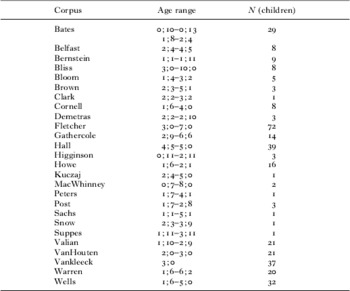
Li & Shirai (Reference Li and Shirai2000) compiled the frequency of words used by parents, caregivers, experimenters and other adults in 27 corpora of typically developing English-speaking children (N=359) that were contained in the original CHILDES database. Table 1 shows the corpora used and the number and age range of children in each corpus. The current study used the same data to compile a list of rare adjectives used by adults and to examine contextual information surrounding their use.
CHILDES corpora used to examine adult production of rare adjectives

The Parental Corpus vocabulary list, available on the CHILDES website, contains about 2·6 million word tokens (about 24,000 types, counting all inflected forms of a single word separately). In the current analyses, the arbitrary criterion used to determine that a word was rare was that it occur five or fewer times in the corpus. About 16,800 types met this criterion. About 9,900 of these were words that were used only once in the entire database. Many infrequent words in the Parental Corpus were sounds (e.g. zzzz), proper names, misspellings or other non-standard forms. To separate legitimate from non-legitimate words, the list was submitted to a lexical analysis program (Hayes, Reference Hayes2003) that divided the list into legitimate and illegitimate types by comparing words to a 10,000 common word lexicon (Carroll, Davies & Richman, Reference Carroll, Davies and Richman1971). Legitimate types (n=3609) on the list were examined by hand to eliminate all obvious nouns, verbs and adverbs. This first pass yielded a list of 1,330 potential rare adjectives. This list was submitted to the Computerized Child Language Analysis (CLAN) programs (MacWhinney, Reference MacWhinney2000) that accompany the CHILDES database. Data from the corpora were searched for adult uses of rare adjective types (directed either to target children or to other adults who were present at recording sessions). Each occurrence of a word on the list and its discourse context (three utterances on each side of the utterance containing the target adjective) was examined. The utterance containing the target adjective was always produced by an adult. Surrounding utterances could be produced by anyone present in the session. Examining these episodes enabled elimination of words that were not used as adjectives in the particular contexts in which they were produced (e.g. alcoholic is potentially an adjective, but it was not included in cases where it was used as a noun). At this point, the word list contained 909 word types.
Corpora were then searched for children's use of rare adjectives. Any words that were known to a given child, as indicated by the child's use of the word prior to the adult's use of the word (either in the same session, or, in the case of longitudinal samples, in previous sessions) were eliminated. The total number of word types eliminated was 39/909 (0·04), providing additional support that the rare words were largely unknown to the children. After eliminating known words, the final rare adjective list contained 878 words. While the adjectives are rare in the CHILDES corpora, they are generally words that one would expect an adult to know; that is, they are not obscure or archaic. Examples include: agreeable, disappointing, explicit, nameless, overloaded, wasteful, wooly.
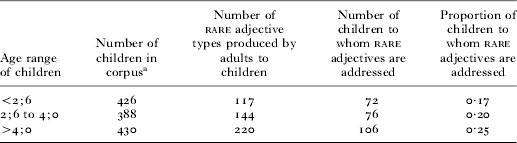
In order to compare characteristics of adult adjectives directed to children of different ages, children were grouped into the categories shown in Table 2. Not all corpora are represented in each age grouping. For example, all the children in the Bates corpus fall into the younger than 2 ; 6 group, while children in the MacWhinney corpus are represented in all three age groups. Adults directed rare adjectives to about 20% of children in the sample.
Distribution of rare adjective production by adults to children of different ages
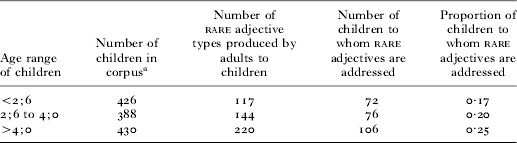
a In longitudinal samples, the same child is counted multiple times, once for each age range in which data are produced.
RESULTS
To provide an approximate measure of relative frequency of rare word types produced to addressees of different ages, the total number of rare adjective types produced by each adult dyad member was divided by the total number of word types produced by that speaker. Because CLAN programs base total frequency of word types on the speaker of an utterance, not to whom speech is addressed, proportions are not exact. The number of rare adjectives is based on the age of the person to whom an utterance is directed, while the total word types produced includes language addressed to both the target child and other persons present in the recording session. Results are plotted in Figure 1. On average, when speaking to children younger than 4 ; 0, adults produced about 1·50 rare adjective types for every 1,000 total word types. Adults produced the largest number of rare adjectives in corpora where they were either addressing children older than 4 ; 0 or where they were addressing other adults, but even in those circumstances, rare adjectives occurred at a rate of only about 4 out of every 1,000 word types.
Frequency of Rare adjective types directed by adult speakers to addressees of different ages.

Overall informativeness of child-directed and adult-directed speech
The basic strategy used to analyze the categorical data for this and all subsequent analyses was to compute a Likelihood Ratio Chi Square (LR) and then to decompose it into component parts to test contrasts of interest. This is similar to the technique used with ANOVA, but involves categorical rather than integer level data. Like the Pearson Chi Square, the LR is a ratio of observed to expected frequencies; unlike the Pearson, LRs of the contrasts sum exactly to the overall LR. Complete partition of an LR yields as many 2×2 tables as there are degrees of freedom for an overall table (Rindskopf, Reference Rindskopf, Von Eye and Clogg1996). There are a several different ways that groups can be combined in partitioning the Chi Square. The one used in this paper is joining, where two rows of the overall table thought to have roughly the same proportions are tested for independence. If they do not differ significantly, they are combined and compared with another row until all rows are used. For each two row subtable, the same procedure is repeated for the columns until a complete partition is achieved (Rindskopf, Reference Rindskopf, Von Eye and Clogg1996).
Each adjective was scored for clues to its meaning in the surrounding linguistic context. This scoring is relatively conservative in that it did not include any non-verbal or intonational information provided by speakers (unless explicitly marked in the transcripts) or other supporting information provided by the environment, such as observable characteristics of people and objects. Scoring categories and examples of text to which they apply are shown in Table 3. To check for reliability, 22% of contexts were scored by a second rater. Overall reliability was 92%.
Types of information provided in texts surrounding rare adjectives

Note: Target adjectives are in SMALL CAPITALS with boldface type. Contextual information is in bold.
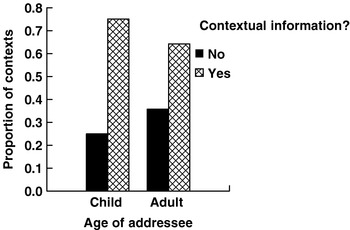
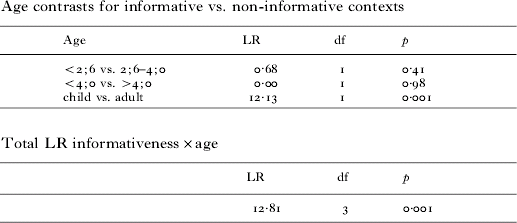
Contexts (three utterances on each side of the utterance containing the target adjective) were considered informative if they contained at least one instance of information types 1 through 3 shown in Table 3. To address the first research question, the first analysis summed all types of information about rare adjective meanings provided in contexts surrounding them. The proportion of contexts that provided at least one contextual clue to meaning and those contexts in which no meaning clues occurred were compared for adult language directed to children of different ages and adult language directed to other adults. The significant overall relationship between age and contextual informativeness is shown in Table 4, along with decomposition of the overall LR Chi Square. There were 481 adjectives in child-directed speech; of these, 361 were in informative contexts. There were 397 adjectives produced to other adults; of these, 255 were in informative contexts. As shown in Figure 2, a higher proportion of contexts surrounding adjectives spoken to children were informative compared to the proportion of contexts that were informative in adult-directed language.
Proportion of informative and non-informative contexts surrounding Rare adjectives directed to adults vs. children (proportions for each age separately sum to 1·00).

Decomposition of Chi Square for total informative information surrounding adjectives for different ages
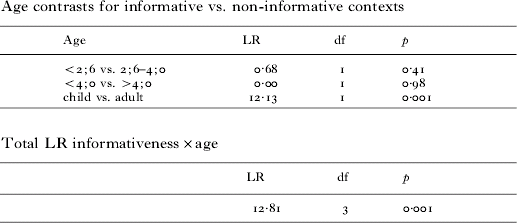
The next set of analyses addressed the second research question to ask whether there were differences across ages in the number of surrounding contexts containing different types of information. Each of the three main types of information (semantically related, evaluative, compare/contrast) shown in Table 3 were examined separately because the categories are not mutually exclusive; contexts surrounding many adjectives contained multiple types of information. Frequencies of each type of information are shown in Table 5.
Frequency of different types of information in contexts surrounding Rare adjectives directed to different ages

Semantically related language
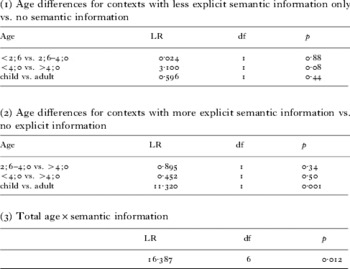
Adults produced semantically related information in surrounding contexts for about 47% of adjectives, regardless of age of addressee. However, as shown in Table 3, some information was more explicit and some was less explicit. Information was scored as explicit if: (1) the adult provided the information while answering a direct query from the child about the meaning of the word, as in the photogenic example in Table 3; or (2) the adult preceded the information with it means; or (3) the information was contained as all or part of the definition of the word in a learner's dictionary of English, as in the scented example in Table 3; or (4) the information was listed as a synonym for the word in the dictionary (e.g. timid was produced in the context surrounding shy). To partially address research question 3, Table 6 shows the decomposition of the Chi Square comparing contexts with more and less explicit semantic information to those without semantically related information. There were no differences across ages in the proportion of contexts with less explicit semantic information vs. those with no information. About 33% of those 692 adjectives (the last two subcolumns of semantically related information in Table 5) had less explicit information and about 67% had no information. Although there was relatively little explicit semantic information in either child- or adult-directed speech (only 21% of all adjectives as shown in column 1, Table 5), there were significant age differences. Of the 186 adjective contexts that contained explicit semantic information, 66% occurred in child-directed speech and 33% occurred in adult-directed speech.
Decomposition of Chi Square for more and less explicit semantically related contextual information surrounding adjectives directed to different ages

Compare/Contrast information
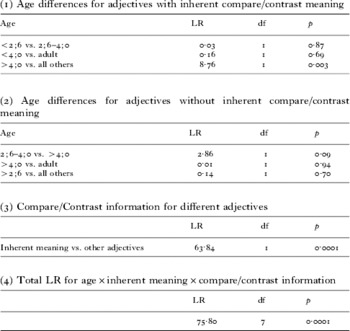
Some adjectives contain compare/contrast information as part of their definitions. For purposes of this study, these were defined as adjectives with comparative or superlative endings, -er or -est, those with prefixes such as un- or over-, suffixes such as -ish and hyphenated words such as medium-sized. The amount of compare/contrast information in contexts surrounding this subset of adjectives differed across age groups, as shown in Table 7. For language directed to children older than 4 ; 0, adjectives that had comparative/contrastive information as part of their meaning were most likely to be used in contexts that contained compare/contrast information (56%) rather than contexts that had no such information (44%). The average number of contexts containing compare/contrast information for all other age groups including adults was only 33%. Adults supplied very little compare/contrast information in the context of adjectives that were not inherently comparative. Only about 12·5% of those contexts contained comparative or contrastive information, regardless of the age of the person to whom utterances were addressed.
Decomposition of Chi Square for compare/contrast information surrounding inherently comparative and other rare adjectives directed to different ages

Evaluative information
The total amount of evaluative information did not differ across ages (LR (3)=7·40, p=0·06).
As with compare/contrast information, some adjectives are inherently evaluative, containing affective information as part of their denotative or connotative meanings. To determine whether the rare adjectives studied in the sample were or were not inherently evaluative, I used several dictionaries that are part of content analysis programs that categorize words for evaluative/affective content. General Inquirer is an English-language content analysis program that uses several general-purpose dictionaries (General Inquirer website, 2005). The dictionaries contain two large valence categories, positive and negative, as well as categories of strength and weakness based on work by Osgood et al. (Reference Osgood, Suci and Tannenbaum1957) who found that potency is one of the major universal dimensions of affective word meaning. A second dictionary, Linguistic Inquiry and Word Count (LIWC: Pennebaker, Francis & Booth, Reference Pennebaker, Francis and Booth2001) categorizes words into positive and negative emotion categories. Two criteria were used to determine whether or not adjectives were inherently evaluative: (1) where adjectives or words related by derivation (sweet and sweetest) were contained in either Inquirer or LIWC dictionaries, adjectives were categorized as evaluative if they were classified as positive, negative, strong or weak by the Inquirer dictionary or as positive or negative emotion words by LIWC (e.g. agreeable is classified as positive, silly is classified as positive and weak, and tiniest (tiny) is classified as weak by the Inquirer); otherwise the adjectives were classified as non-evaluative (e.g. quietest); (2) where adjective words related by derivation were not contained in the two dictionaries, adjectives were categorized as evaluative or non-evaluative if words comprising their definitions were categorized in either Inquirer or LIWC (e.g. rowdy was not classified in the dictionaries, but its definition ‘behaving in a rough, noisy way that is likely to cause fighting’ has three words, rough, noise and fight that were classified as negative by Inquirer).
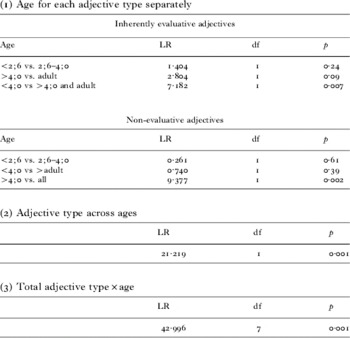
Seven hundred and thirty-five of the original 878 adjectives were categorized (shown in the bottom panel of Table 5). Table 8 shows the LR Chi Square analyzing whether contexts three utterances on each side of evaluative compared to non-evaluative adjectives differed by age. The amount of evaluative information in contexts surrounding inherently evaluative and non-evaluative adjectives did differ significantly by age. Contexts surrounding evaluative adjectives directed to children younger than 4 ; 0 included evaluative information 46% (70/151) of the time compared to only 34% (127/376) of the time for evaluative adjectives directed to children older than 4 ; 0 and adults. For non-evaluative adjectives, 85% (131/154) of the contexts directed to adults and to children younger than 4 ; 0 and 65% (35/54) directed to children older than 4 ; 0 contained no evaluative information.
Decomposition of Chi Square for evaluative information surrounding inherently evaluative and non-evaluative adjectives directed to different ages

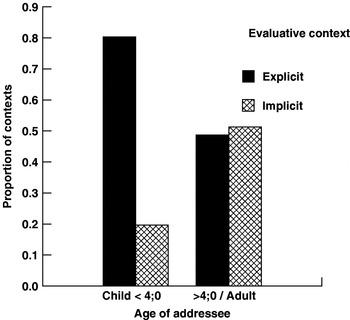
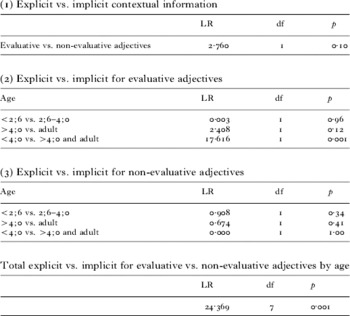
As with semantically related information, some contextually evaluative information was more explicit and some was less explicit. Specifically, the following basic words, listed in the MacArthur-Bates CDI (2005) as likely to be known by young children, were scored as explicit when they occurred in contexts surrounding adjectives: bad, better, big, fine, good, little, naughty, nice, poor, tiny, yucky, uh oh. In addition, short vocative phrases marked in the CHILDES transcripts with an exclamation point were also considered to be indicative of basic evaluative information, e.g. Great! Wow! Yes! Don't do that! Oh dear! No! To partially address research question 3, the next analysis included only those adjectives whose surrounding contexts contained either explicit or implicit evaluative information to test whether the proportions varied as a function of age and whether or not the adjectives were inherently evaluative. The decomposition of the overall Chi is shown in Table 9. As shown in Figure 3, more explicit than less explicit evaluative information surrounded evaluative adjectives for children younger than 4 ; 0, while for older children or adults, the proportion of explicit and implicit evaluative information was approximately equal.
Proportion of rare evaluative adjectives occurring in contexts with explicit and implicit evaluative information directed to addressees of different ages (proportions for each age separately sum to 1·00).

Decomposition of Chi Square for explicit vs. implicit evaluative contextual information surrounding adjectives directed to different ages

Explicitness and concreteness of referents
The final set of analyses addressed research question 4 by examining whether referents to which adjectives referred were plainly stated in the text. Each adjective used by adults in the corpus was examined to see if its referent could be determined in the ±3 utterance context used in the current study. Referents were classified as either specific nouns/pronouns or non-specific nouns/pronouns. Examples of referent types and their contexts are shown in Table 10.
Examples of referents modified by rare adjectives and their surrounding contexts

Note: Adjectives and the nouns they modify are in boldface type.
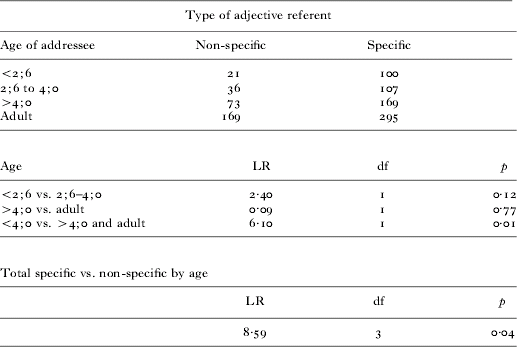
Table 11 shows the frequency of specific vs. non-specific adjective referents for different ages and the decomposition of the corresponding Chi Square. Most referents in speech directed to all age groups (671/922=73%) were plainly stated in the linguistic context. However, there were fewer non-specific referents in language directed to children younger than 4 ; 0 (57/264=22%) than to older children and adults (194/658=30%).
Frequency of specific and non-specific adjective referents for different ages and decomposition of Chi Square
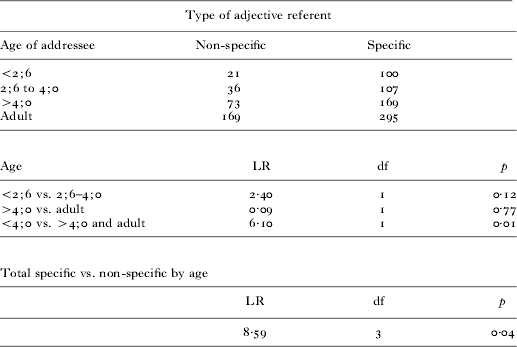
To examine whether or not adjectives modifying specific nouns were more concrete for younger children, each noun to which an adjective referred was given a concreteness value based on ratings in the MRC database (2005). Concreteness values in the norms range from 158 to 670 (M=438, SD=120). An ANOVA was calculated on data from the current study, with age as the independent variable and concreteness rating as the dependent variable. There was a significant age effect (F(3)=3·02, p=0·03). A follow-up t-test indicated a significant difference in concreteness ratings of child-directed nouns (M=547·53, SD=95·32) versus those directed to other adults (M=513·82, SD=110·22; t(335)=2·99, p=0·003). That is, adults used rare adjectives to modify more concrete nouns when they were talking to children than to other adults.
DISCUSSION
This study examined linguistic characteristics of contexts surrounding rare adjectives in the CHILDES Parental Corpus (adult language in the original 27 CHILDES corpora of typically-developing, English-speaking children). The research extends previous work on nouns (e.g. Gelman et al., Reference Gelman, Coley, Rosengren, Hartman and Pappas1998) to show that adults also provide substantial information about adjective meanings in their input to children.
Two aspects of this study's methodology are unique. First, rare adjectives (those that occurred with a frequency of less than five in the Parental Corpus) were studied in order to increase the likelihood that they were novel to children to whom they were addressed. This allowed use of a larger input sample (878 adjectives and their surrounding contexts of±three utterances) than is usually possible with laboratory studies. Second, because many corpora contained within CHILDES have multiple adult participants, who sometimes speak to each other, input information contained in adults' utterances to target children could be compared to their utterances to other adults within the same settings. In this way, it was possible to examine whether information was unique to child input or was characteristic of all language involving adjectives.
Overall, adults provided more information about adjective meanings to their young conversational partners (about 75% of contexts) than they did to other adults (about 64% of contexts). It is actually possible that the relative amount of information provided to children was underestimated. Because contexts were arbitrarily defined in terms of number of utterances rather than number of words on either side of the target, fewer words were generally included in episodes to younger children than to older children and adults. That is, adults usually had more opportunity to produce informative language when they were speaking to other adults than when they were speaking to children.
Even with this advantage, it may still seem surprising that contexts in adult-directed speech were so informative. Presumably, adults assume that other adults already know the meaning of words they are using and are therefore not providing information in order to teach word meanings. However, semantic information is a natural by-product of discourse. This suggests that even when adults are not explicitly trying to teach children about word meanings (which is probably the majority of the time), linguistic contexts are still a rich source of semantic information. In fact, one implication of theories that describe word meanings as based on the co-occurrence of words in different contexts (e.g. Jones & Mewhort, Reference Jones and Mewhort2007; Landauer & Dumais, Reference Landauer and DuMais1997; Lund & Burgess, Reference Lund and Burgess1996) is that exposure to rich linguistic contexts is more important than explicit teaching of meaning for vocabulary acquisition. Children can even learn partial information about words to which they have not yet been exposed. For example, Nagy & Scott (Reference Nagy, Scott, Kamil and Mosenthal2000) note that children who know the meaning of hot, cold and warm already know something about the meaning of cool, even if they have not yet been introduced to cool.
Four types of information provided rich linguistic contexts surrounding rare adjectives: semantically related words or phrases (including explicit definitions), compare/contrast information, affective/evaluative information, and the noun or pronoun that the adjective modified.
Semantically related information was relatively common, occurring in about 47% of contexts, regardless of age. However, the subset of information consisting of explicit definitions or close synonyms occurred in only 25% of contexts in child-directed speech. This was far lower than the 70% to 77% reported by Hall et al. (Reference Hall, Burns and Pawluski2003) in a structured, laboratory setting.
Adjectives are often used to provide comparative information because many of them are graded. A person who is pretty is nice-looking, but a person who is beautiful is even nicer-looking. If all adjectives are included, there was more compare/contrast information in contexts directed to the oldest age group of children (25%) than to younger children and other adults (16%). In the subset of adjectives that included compare/contrast information as an inherent part of their meaning (e.g. comparatives or superlatives), 56% of contexts directed to children older than 4 ; 0 contained compare/contrast information, compared to only 33% of contexts directed to younger children or to other adults. Adults appear to be particularly likely to supply information that indicates comparative or contrastive information to children older than 4 ; 0. This is the age that children are showing evidence of understanding comparative and superlative forms in their productive speech.
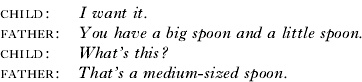
Laboratory type conditions where adults have two, basic-level objects available that differ only in the adjectives that apply to them (one red car and one blue car) or two different basic level objects that share a property (one car and one truck, both of which are blue) were uncommon in the current study. This may be because it is an unusual condition in naturalistic settings in general, or because the rare adjectives used in the current study were less likely to apply across multiple exemplars because they were less likely to refer to perceptual attributes. Instances of comparing similar objects that differed in the adjectives applied to them did occur in the naturalistic sample with hyphenated adjectives such as medium-sized, as in example (4) from Sachs (in MacWhinney, Reference MacWhinney2000):
(4)
Conveying information about the evaluation or potency of a modified entity is an important function of some adjectives. For example, stating that an entity is beautiful expresses a positive evaluation of it. Because the emphasis in existing child language literature is on common adjectives that describe physical attributes such as size, shape or texture, the evaluative function of adjectives has not been widely examined. In the current study, adults provided contextual information to children more than they did to other adults about the meaning of adjectives that contained evaluative information as part of their definitions. Additionally, contextual information tended to be explicit for children younger than 4 ; 0. That is, adults did not simply use another positive word in the context surrounding a positive adjective, but they used words such as good or nice or wow that even the youngest children were likely to understand.
Finally, replicating laboratory studies, adults were much more likely to combine adjectives with explicit nouns (e.g. dog or boy) or pronouns than with less explicit referents such as one or thing. There were fewer non-explicit referents in language directed to children younger than 4 ; 0 than there were to older children and adults and nouns that were used with children tended to be more concrete than nouns used with other adults.
Much of the data presented in the current study is consistent with a statistical view of word learning where bits and pieces of meaning are cobbled together from the input. Literature on vocabulary learning indicates that people have partial knowledge of many more words than they can define or use explicitly. Blackwell (Reference Blackwell2005) found that maternal input frequency and syntactic diversity influenced the order of acquisition of different semantic categories of adjectives. The current study adds semantic information in context as a potential source of adjective knowledge.
One potential problem with the current study is that the decision to use words that occurred only five times or fewer in the CHILDES parental corpus may have been an overly stringent criterion for defining rare adjectives. Although the words are clearly ones that would be known by typical adults, they may not be completely representative of novel adjectives used to children. Choosing a slightly less stringent cut-off might produce words that are still novel to the children but that adults view as more ‘teachable’. If so, more explicit synonyms or definitions might be provided in the contexts surrounding these words.
The findings from this research highlight the importance of looking at adult input in situations where teaching adjective meanings is not an explicit goal. In laboratory settings, explicit contrasts are arranged so that links between a word's meaning and its referent are clearer than they are in many naturalistic settings. In everyday discourse, children must learn word meanings in situations where input is sloppy and contains information that may be irrelevant to the meaning of the word along with relevant information that may only be implicitly related to a word's meaning. This study has shown the range of information about rare adjectives that is available in natural conversations between children and adults.