In Elizabethan England, music was widely regarded as a tool of governance. The court composers Thomas Tallis and William Byrd declared that it was ‘indispensable to the state’ (‘necessarium Reipub.’) and, following Plato's Republic, it was believed that ‘the chaunging of Musicall notes, hath caused an alteration of the common state’.Footnote 1 Elizabeth recognized the political potential of music, utilizing her own performances, musicians and courtly entertainments as means of diplomacy, image-making and managing the political ambitions of her nobility.Footnote 2 Yet in an age without recording or broadcasting and with low levels of verbal and musical literacy, music's potential as a medium of propaganda that would reach the majority of subjects across an entire kingdom was more limited than in the modern state.
Music's political usefulness for monarchs via their household musicians, royal chapel, ceremonial performances and printed polyphonic music collections is well known.Footnote 3 It was, however, only a small section of the population who had the opportunity to hear the music of the court or the means and musical literacy to purchase music books. To reveal music's potential to influence the breadth of the population one needs to turn to songs that could circulate orally and in cheap print, and were consumed across both the elite and the lower classes. Such genres have caught the attention of those investigating the religious politics of the period, when metrical psalms and hymns became the rallying calls and persuasive instruments of Protestants and Catholics alike in the Germanic states, Dutch Revolt and French civil wars.Footnote 4 Ballads, too, are recognized as a means of protest or of voicing popular opinion.Footnote 5 Yet the appropriation of these cheaply printed or orally disseminated songs by monarchs to further their royal image or political aims has inspired little investigation.Footnote 6
The sung prayers and cheaply printed songs for the Accession Day of Queen Elizabeth I (1558–1603) provide a long-term study of countrywide musical celebrations for a monarch, crossing social classes and spanning sacred and secular spheres. Contextualizing these songs reveals the mechanisms and institutions behind their creation and dissemination, the areas of society such political songs were able to reach, and the extent to which they were controlled by Elizabeth and her government or shaped by other local, popular or commercial forces. Music's ability both to signify and to enact political harmony differentiated it from other forms of propaganda, enhancing the potential of cheaply printed or orally circulated songs to support a monarch's governance of all their subjects.
Accession Day
Accession Day commemorated the moment when Mary I died on 17 November 1558, allowing Elizabeth to succeed her as monarch, although it was commonly, but erroneously, referred to as coronation day.Footnote 7 While never an official holiday, the festivities were unique: Elizabeth was the first English monarch to have a yearly celebration in her honour, and no European king had such a tribute. The Londoner John Chamberlain described Accession Day in 1602 as filled with ‘preaching, singing, shooting, ringing, and running [at the tilt]’.Footnote 8 His account encompasses both courtly and civic celebrations. At Whitehall, noblemen honoured Elizabeth's accession with a tournament open to paying spectators, followed by a private banquet and entertainments in the evening.Footnote 9 Across the realm there was bell-ringing along with prayers, sermons, bonfires, the giving of alms, and even pageants performed in the streets.Footnote 10 It is these events away from court that reveal how music could unite people around their queen even in her physical absence.
Music-making was central to the political imagery of Accession Day. Poetic tributes to the occasion frequently portrayed singing, dancing and playing on instruments, deploying them as metaphors for communal joy and harmony. Maurice Kyffin's The Blessednes of Brytaine (1587) described a kingdom filled with music made by people of all degrees. Country people ‘Lowd Carols sing, to celebrat this Tyme’, while each shepherd and swain should ‘sound his piping Reede / For ioy’.Footnote 11 Another stanza portrayed the more elaborate music of the church, consorts and military ceremony, evoking both civic and courtly music:
Ring out lowd sounding Bels; on Organs play;
To Musiks Mirth, let all Estates incline:
Sound Dru[m]mes, & Tru[m]pets, renting Ayre & Grou[n]d
Stringd Instruments, strike with Melodious sound.Footnote 12
Similarly, George Peele's poem Anglorum feriae (1595) exhorted nymphs: ‘paeans singe & sweete melodious songes; / Alonge the chaulkie clyffes of Albion’; and described how ‘coorte and cuntrie carrol in hir praies / And in hir honor tune a thousande laies’.Footnote 13 Harmonious sound and communal music-making symbolized the idealized love of English subjects for their monarch and the political harmony that Elizabeth was credited with creating.Footnote 14
This all-encompassing harmonious image was far from reality, however. The occasion was never uniformly celebrated. Some localities never honoured the day, while others did no more than ring their bells. Church services, when held, were not necessarily well attended, while few towns put on civic festivities and these were not held every year.Footnote 15 The celebrations had a distinctly Protestant tone and could at times be explicitly anti-Catholic.Footnote 16 Moreover, one of the earliest churches to mark the day, St Peter Westcheap in London, did so not out of praise, but in order to admonish Elizabeth for not having achieved sufficient reform yet.Footnote 17 In addition, both Puritans and Catholics complained that the celebrations were idolatrous in their worship of Elizabeth.Footnote 18
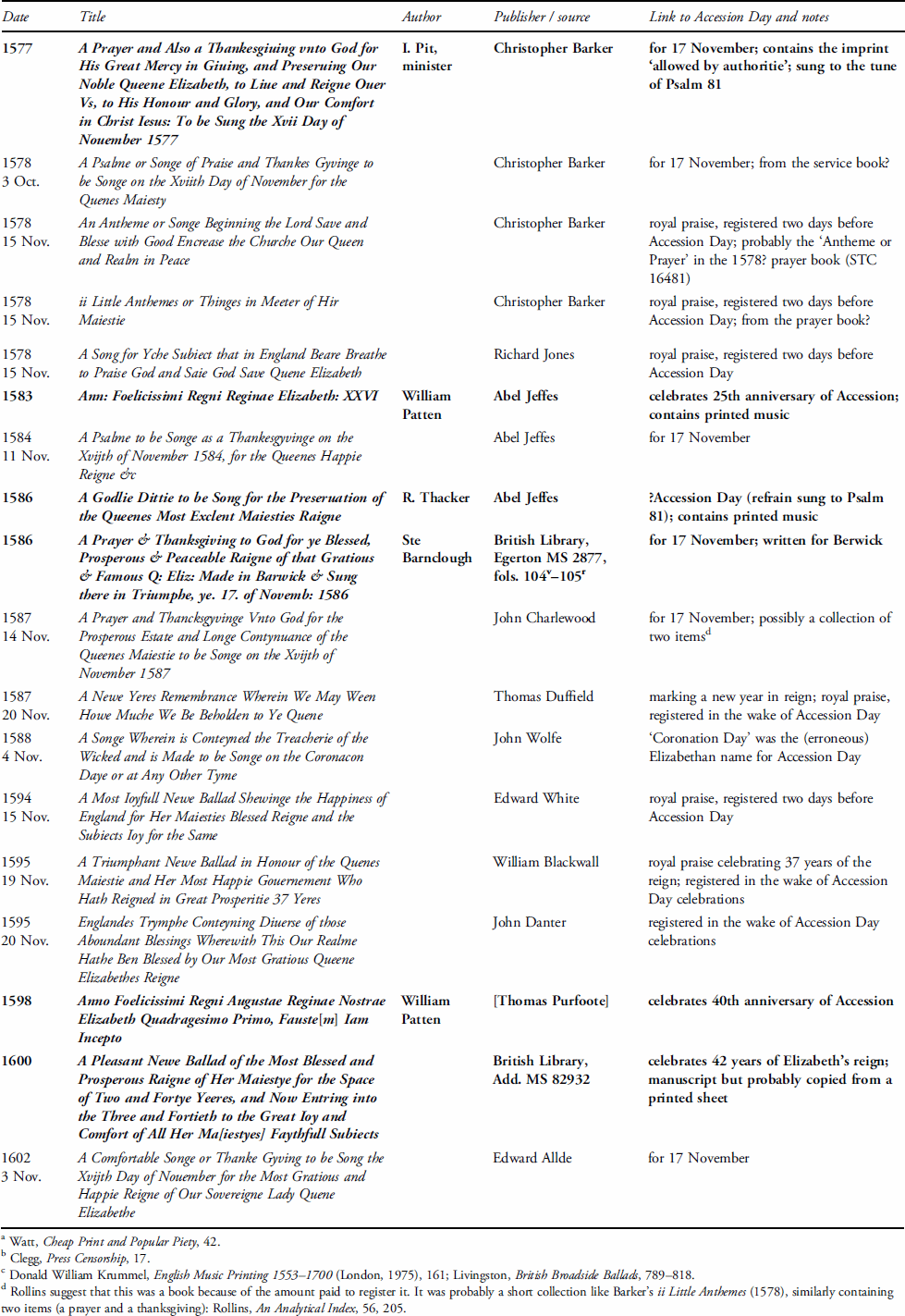
Nevertheless, this musical imagery was not merely political metaphor, but inspired by the social phenomenon of Accession Day singing around the kingdom that had been developing since the late 1570s. Many songs would have circulated orally and been learnt by copying the ballad-seller or through communal singing in church, home or alehouse.Footnote 19 Some, however, can be traced in extant manuscripts, single-sheet publications, prayer books and records of further, now-lost publications in the Stationers’ Register (see Appendices 1 and 2).Footnote 20 The task here is to understand how these songs came to play a significant role in Accession Day celebrations beyond the queen's presence, to gauge the extent to which they were official propaganda or indirect contributions to her authority and image, and to assess their political impact through exploring the different contexts into which this singing spread.
While the majority of these songs might be broadly labelled ‘popular’ (and thus differentiated from more exclusive polyphonic genres that circulated in expensive collections and required musical literacy or professional performers), they were not associated with any particular class.Footnote 21 Instead, these cheaply printed Accession Day songs formed a shared culture in which all levels of society participated, from the educated and wealthy to the poor and illiterate.Footnote 22 Popular songs for Accession Day were those designed to be accessible and affordable to the broadest possible audience: cheaply printed, monophonic songs, drawing on widely known tunes and able to be picked up through repeated communal singing, if not from the printed form. Although a handful of single-sheet songs were more exclusive – containing Latin or printed music, or demanding the ability to sing in ensemble – these were nevertheless based on the same textual themes and practice of using psalm tunes found in the shared tradition and are indicative of the wide social spread of this repertory.
Not only was Accession Day singing widespread across the social spectrum, but it was also diverse in tone. In 1601, the Oxford theologian Thomas Holland identified the Accession Day celebrations as having two parts: the ecclesiastical (those which ‘haue warrant out of Gods word & by approved practice of the church’) and the civil (‘ringing of Bells, Bone-fires, Triumphes &c’), to which might also be added the informal or domestic.Footnote 23 Changing contexts for singing are suggested by a noticeable shift from psalm-based singing towards more secular themes and tunes in the 1590s. Yet this shift is one of emphasis, not contrast. In practice the sacred and secular always intermingled, reflecting Elizabeth's dual roles as head of the church and monarch of the kingdom, both of which were honoured on Accession Day. As we shall see, devotional singing was never confined to the church, and thanksgiving to God was often a front for monarchical praise, while a secular tune and praise of Elizabeth as monarch did not exclude comment on her piety.
In comparison with the court spectacles, this countrywide singing has a noticeable lack of emphasis on Elizabeth's gender. Without her physical presence, the focus shifted away from her feminine, personal body and onto her (masculine) political roles as monarch and head of the church.Footnote 24 The majority of songs would serve a monarch of either gender equally well if ‘queen’ were exchanged for ‘king’. Religion and topical events were a more significant influence than gender.
While all these songs promoted a positive image of Elizabeth, their deeper political significance depends on the extent to which they were carefully engineered government propaganda or popular outpourings of love for the queen. Underpinning all royal panegyric, this issue has long been controversial. The extensive poetic and musical tributes to Elizabeth were traditionally considered symptoms of the people's great love and admiration for their queen before Roy Strong reinterpreted such tributes as evidence of a manufactured ‘cult of Elizabeth’.Footnote 25 He regarded such royal praise as official propaganda intended to maintain order and loyalty within a kingdom marred by religious division.Footnote 26 This was ‘government by illusion’, which seduced English subjects with images of prosperity and peace often quite at odds with reality.Footnote 27
More recently, the notion of an official royal cult has been the subject of criticism from a number of directions. First, what could it achieve for Elizabeth in practical terms? Could it really prevent criticism or gain support for a particular political issue?Footnote 28 To what extent was royal pageantry and ceremony able to impress and win the loyalty of these subjects?Footnote 29 Or were such flattering portrayals of Elizabeth rather serving the interests of noblemen attempting to earn royal favour?Footnote 30 Secondly, did Elizabeth's government even have the means and mechanisms to set up such a cult? Where was the evidence for the systematic distribution of royal imagery to the people?Footnote 31 Finally, the royal image depended not just on Elizabeth's actions, but also on the commissions of courtiers and the creations of artists, writers and musicians, whose political interests competed with those of the queen. A less ‘monolithic’ view of Elizabethan government offers a more subtle understanding of the politics behind the royal image.Footnote 32
Careful analysis of the mechanisms of production and influence surrounding Accession Day songs suggests that neither a top-down model of royal propaganda nor a bottom-up one of popular devotion quite captures the complexity of the creation and functions of this royal image-making.Footnote 33 Levels of participation remain hard to judge, and the anonymity of the majority of authors obscures the role of individual self-interest in the production of these songs. Yet a picture emerges of a celebration that Elizabeth (with her Privy Council and major bishops) developed rather than created, and that was ultimately sustained by commercial printers, local elites and popular enthusiasm (even if only as a means of enlivening a cold and gloomy November). Elizabeth and her Privy Council primarily influenced the religious aspect of the musical festivities, whereas the civil and more secular features developed through local or commercial initiative. While this singing was never universal, it was probably widespread and socially varied. It was closely connected with the need to believe that England was a harmonious kingdom, with subjects united in loyalty to their queen and under God's special protection, such that enthusiasm for the celebration only increased as the threats to English stability mounted.
Origins
Elizabeth and her government were surprisingly slow to utilize the potential of single-sheet songs or psalms. Even the five-year reign of her predecessor, Mary I, had seen the publication of the punningly entitled A New Ballade of the Marigolde, written by her chaplain, William Forrest.Footnote 34 By contrast, although a couple of single-sheet songs in praise of Elizabeth were published in the early years of her reign, it was 20 years before there were official songs, and these were for Accession Day.Footnote 35
Neither were the Accession Day celebrations instigated by Elizabeth. Rather these appeared as a local tradition in London in the mid-1560s, the earliest known activities being bell-ringing at St Botolph Aldersgate and St Peter Westcheap in London in 1564.Footnote 36 Bell-ringing and bonfires were traditional means of local, spontaneous celebration to mark the deaths, accessions, marriages and births of monarchs, as well as military victories.Footnote 37 Such festivities would usually be initiated by local leaders, and participants like the bell-ringers were not volunteers but were paid, usually by the churchwardens but sometimes by civic authorities.Footnote 38 Although there was much variation in whether communities participated and how enthusiastically, celebrations gradually spread around the kingdom: bells were rung in Worcester as early as 1568; Kent, the South West and Shropshire began ringing in the early 1570s, Lancashire in 1579, Yorkshire in 1585 and Durham in 1590.Footnote 39 Yet there is no evidence of government pressure or enforcement from the queen and court, and it was 12 years before there was even an official form of a prayer.
According to William Camden, an early seventeenth-century historian, it was the Northern Rising (1569) and the papal bull excommunicating Elizabeth (1570) that initially caused the celebrations to spread.Footnote 40 The Northern Rising was the first major threat to the stability of Elizabeth's rule, while her excommunication freed Catholic subjects from any obligations of loyalty and opened up the possibility of further rebellions and of foreign invasion.Footnote 41 The inspiration for Accession Day singing may also lie at least partly in the single-sheet songs published during these events. Among the songs circulating news, rejoicing in the fall of the rebels and spreading anti-papist sentiments are two that prefigure the style of metrical prayer that would become typical of the early Accession Day songs:Footnote 42 John Awdelay's A Godly Ditty or Prayer to be Song Vnto God for the Preseruation of His Church, Our Queene and Realme, Against All Traytours, Rebels, and Papisticall Enemies and John Kingston's now-lost Godly Meditation in Myter for the Preservation of the Queens Maiestie for Peace.Footnote 43 Awdelay's sheet was to be sung ‘after the tune of the cxxxvij. Psalme which begins When as we sat in Babilon. Or such lyke’. The choice of tune was surely symbolic. This psalm of captivity frequently evoked religious oppression in the sixteenth century, in this case a sense of being under siege from enemies within and without the realm.Footnote 44
Godly songs like these were bought not only by individuals for their personal devotions, but also by churches. St Dunstan in the West and St Mary Woolnoth in London both purchased songs to be sung ‘agaynst the rebelles’.Footnote 45 Elizabeth's royal injunctions of 1559 had offered no explicit support for congregational singing, but with the support of many of her bishops it had soon become established in most parish churches. In the early 1560s psalm-singing achieved royal approval: psalms had been sung at state occasions such as the opening of Parliament in 1562, and instructions for psalms that might be sung were included in a special prayer book for deliverance from the plague in 1563.Footnote 46 Providing newly composed prayers enabled Awdelay (and presumably Kingston) to address the current troubles more specifically than the pre-existing biblical psalms could do, most obviously in introducing anti-papist rhetoric. Moreover, there were precedents for metrical prayers in the widely used Whole Booke of Psalmes (1562), some of which also had a political or anti-papist edge.Footnote 47 As metrical prayers for a specific political occasion, to be sung to psalm tunes and with potential uses in the church and home, Awdelay's and Kingston's prints prefigured the first Accession Day songs. With the Stationers’ Register for 1571–6 missing, however, the precise link between these songs in time of crisis and the development of regular Accession Day singing remains unclear.
The prayer book and the official songs
The first known Accession Day songs appeared in a series of official prayer books (see Appendix 2). When these prayer books were first issued, Elizabeth and her government were not initiating a new form of celebration, but merely encouraging practices that had already begun in particular localities to become more widespread. Some churches in Oxford were already marking the day with sermons or communion services, while St Dunstan in the West in London paid singers to enhance its services.Footnote 48 Nor was the idea of using church services as a form of royal propaganda new. The Book of Common Prayer and Book of Homilies required in every parish church were already a significant means of influencing popular perceptions of the monarch. These included intercessory prayers for Elizabeth in all the main services, along with sermons on good order and obedience, and (from 1570) against disobedience and rebellion.Footnote 49 Furthermore, previous occasional prayer books had been commissioned for bad weather (1562), for the plague (1563) and for the preservation of Christians invaded by the Turks (1566).Footnote 50
As to who created the Accession Day service, the State Papers contain no mention of its inception; however, surviving correspondence regarding other forms of prayer indicates that the key figures were usually the Bishop of London, the Archbishop of Canterbury and the Privy Council (especially William Cecil), with approval from Elizabeth. Detailed correspondence concerning the 1563 prayer book indicates that Elizabeth and Cecil had a great deal of control over the content. On this occasion prayers began as local initiatives inspired by Matthew Parker (Archbishop of Canterbury) and Edmund Grindal (Bishop of London), before Cecil initiated turning these into a countrywide publication. Cecil was often sent drafts of prayers and thanksgivings for the queen's approval and several survive with his personal corrections.Footnote 51 Even the Archbishop of Canterbury was reluctant to proceed in circulating one without Elizabeth's personal approval, while questions such as how the prayer books were to be authorized, where they were to be used and whether there were to be penalties for non-attenders were all left for the Privy Council to determine.Footnote 52
The Accession Day prayer book, therefore, was probably created by a combination of the highest sacred and secular authorities in the realm. No immediate political event appears to have inspired its creation, but the first was produced in the initial year of Grindal's appointment as Archbishop of Canterbury.Footnote 53 Grindal may have shown his gratitude for promotion through initiating the production of this prayer book. On Accession Day the previous year, the composers Tallis and Byrd may have presented Elizabeth with their Cantiones sacrae (1575), whose format had been arranged to mark 17 years of her reign and clearly displayed the printing patent she had granted them that year.Footnote 54
The 1576 Fourme of Prayer printed by Jugge contained no specially written songs, but appointed the first eight verses of Psalm 21 to be sung before the sermon and Psalm 100 after it.Footnote 55 While the latter was a generic psalm of thanksgiving to God, the first – ‘Lord how joyfull is the king’ – was listed in the preface to The Whole Booke of Psalmes (1562) as appropriate for when ‘thou wouldest prayse God, because he hathe geuen vs a good Prince whiche wyll […] punish the enemies of Christes religion’.Footnote 56 In praising God for the blessings, guidance, long life and protection from enemies he gives to the pious monarch, the psalms chosen for this prayer book set the tone for later songs. In contrast to the use of paid singers at St Dunstan's, these psalms now encouraged congregational singing.
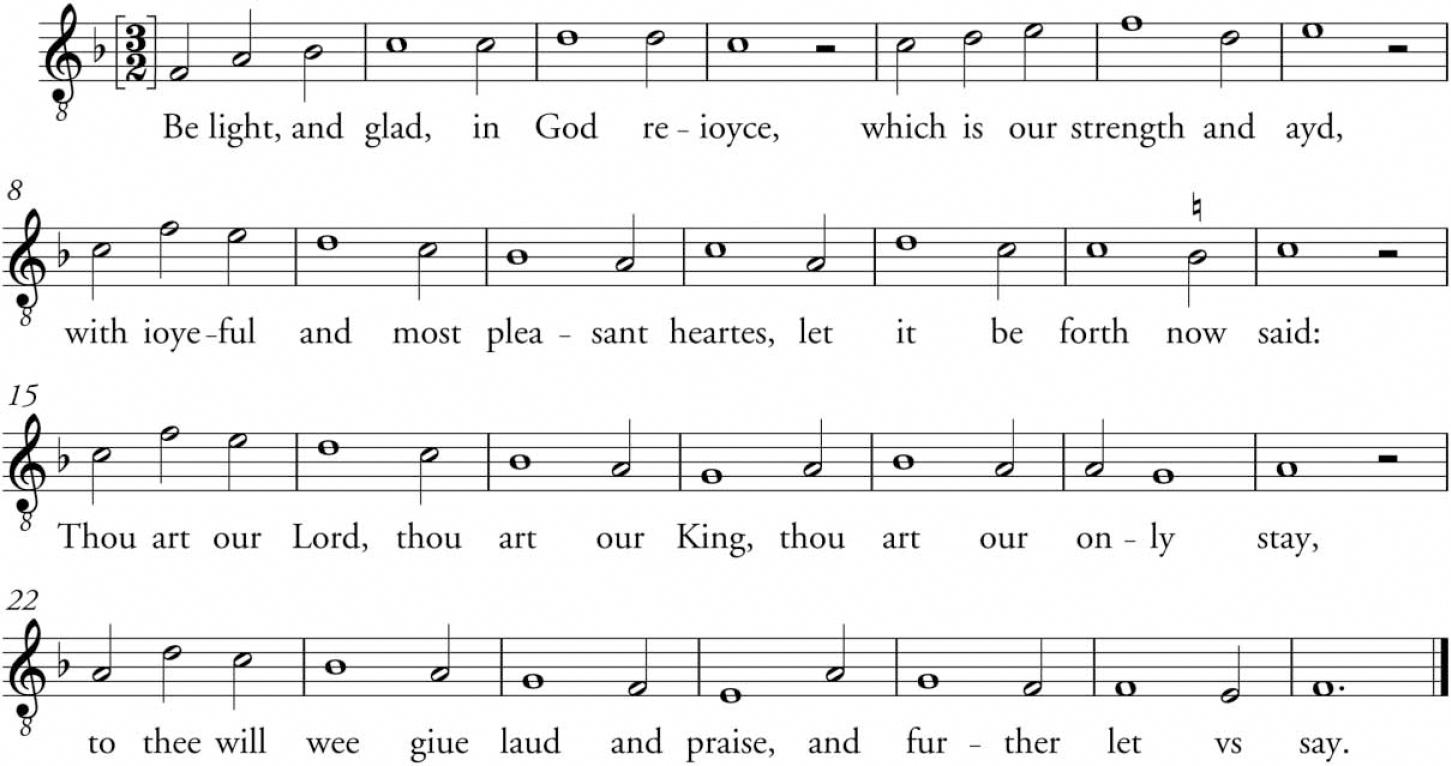
Already there seems to have been a desire for more devotional songs and single-sheet publications that could be quickly typeset and printed to provide a swift supplement to the suggested psalms. Within a few months of succeeding Jugge as the royal printer, Christopher Barker published A Prayer and Also a Thankesgiuing vnto God for His Great Mercy in Giuing, and Preseruing Our Noble Queene Elizabeth for Accession Day 1577, to be sung to the tune of Psalm 81 (see Example 1).Footnote 57 This, too, was an official publication, written by ‘I. Pit, minister’ and (unusually for a single-sheet publication) bearing the line ‘allowed by authoritie’ to confirm that official approval had been granted. Pit took his opening line – ‘Be light, and glad, in God reioyce, / which is our strength and ayd’ – from the psalm, but compiled the rest from a range of biblical verses, providing references in the margins.Footnote 58
I. Pit's A Prayer and Also a Thankesgiuing (first stanza) as it could be sung to the tune of Psalm 81. The tune is taken from The Whole Booke of Psalmes (1562), 201. This has a particularly awkward rhythm in bars 8–9 which fits neither the original psalm words nor these lyrics comfortably. I have shortened the note on ‘ioye-’ and lengthened the first beat of bar 10 to match the similar phrase in bars 15–17.

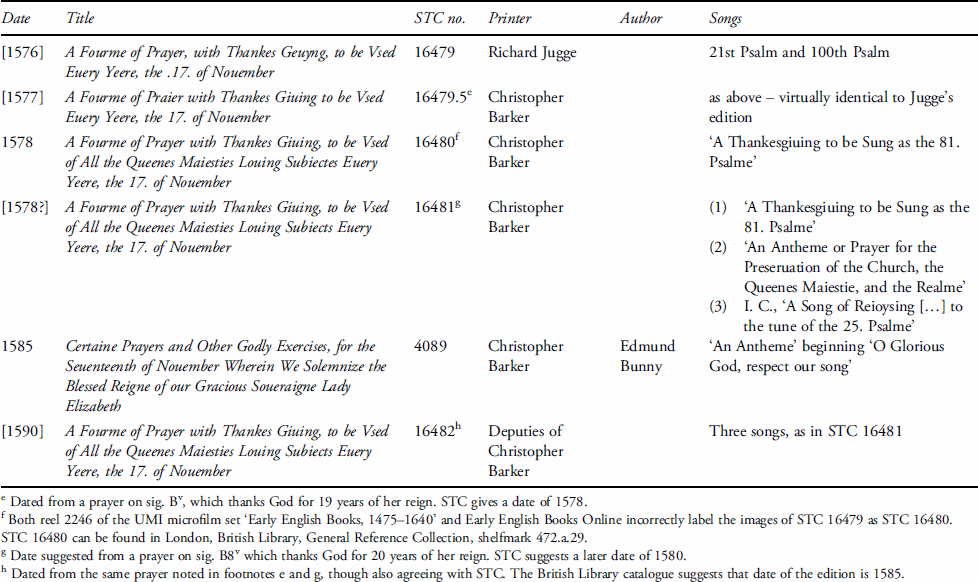
Accession Day singing received its biggest boost on the twentieth anniversary of the queen's reign. The exact chronology of these 1578 publications is uncertain, but it seems that production of an extended edition of the prayer book started early, in anticipation of a large increase in parishes requiring books for this anniversary. This edition (STC 16480; see Appendix 2) now included ‘A Thankesgiuing to be Sung as the 81. Psalme’. Despite using the same psalm tune and opening lines as Pit's Prayer, these were newly composed lyrics with little direct quotation from scripture, although the first three stanzas were clearly inspired by Psalm 81's opening evocation of praising God with the voice and different kinds of instruments.
Two further songs arrived at the printer later in the year (possibly only a few weeks before Accession Day), causing a second edition with three songs to be produced (STC 16481).Footnote 59 Two single sheets were also registered in October and November, as well as a collection of ii Little Anthemes or Thinges in Meeter of Hir Maiestie (probably a combined edition), presumably for churches that had already purchased the prayer book.Footnote 60 The situation was certainly unusual. No other single-sheet songs were produced by a royal printer, and it was rare for one to register publications with the Stationers. As registering was a means of discouraging piracy, Barker was perhaps attempting to prevent pirated copies.Footnote 61
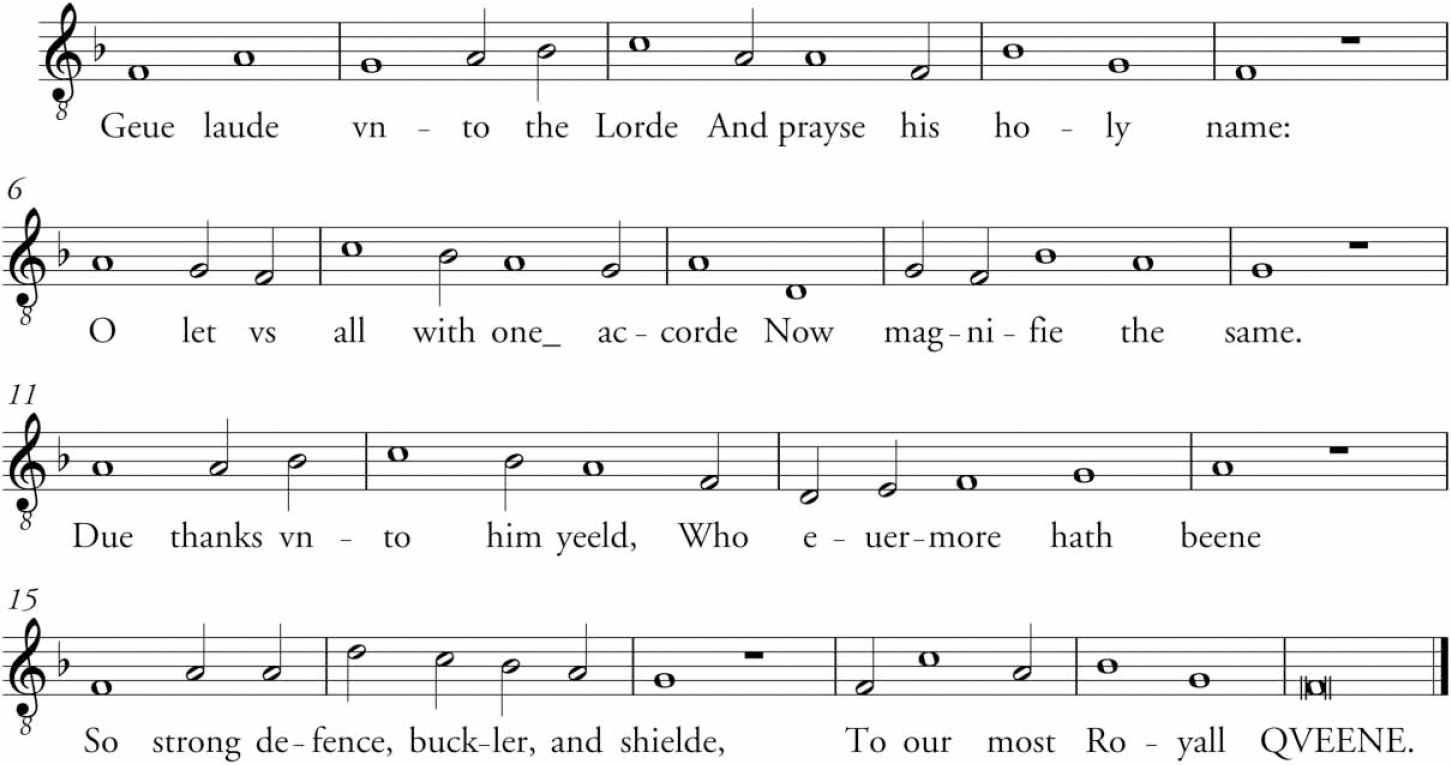
To the earlier ‘Thankesgiuing’ was added ‘A Song of Reioysing for the Prosperous Reigne of Our Most Gratious Soueraigne Lady Queene Elizabeth’, an acrostic on ‘God Saue the Queene’ by ‘I. C.’ ‘made to the tune of the 25. Psalme’ (see Example 2).Footnote 62 More intriguing, however, is ‘An Antheme or Prayer for the Preseruation of the Church, the Queenes Maiestie, and the Realme’. There is no designated tune, but its repeated burden (or refrain) between each stanza suggests that it may have been written to fit a well-known carol melody. Significantly, this song was appointed not just for Accession Day but ‘to be sung after Euening prayer at all times’. To what extent this prescription was followed is unclear, but the intention was surely to use Accession Day as a platform to launch sung prayers for the queen as a regular feature of church worship.
‘I. C.’, ‘A Song of Reioysing for the Prosperous Reigne of Our Most Gratious Soueraigne Lady Queene Elizabeth’ (first stanza) as it could be sung to the tune of Psalm 25. The tune is taken from The Whole Booke of Psalmes (1562), 50–1. No time signature has been provided, as the phrases move flexibly between bars of six and four minims.

Congregational singing was a remarkable new tool for promoting a sense of communal harmony. Whereas singing in the medieval church had been the preserve of professionals, the collective singing of psalms created a new sense of religious community in England.Footnote 63 Bishop John Jewel described ‘six thousand persons, young and old, of both sexes, all singing together and praising God’ at St Paul's Cross in 1560.Footnote 64 Psalms were lauded as a means of instilling unity and social harmony. Archbishop Parker quoted St Basil the Great (a fourth-century theologian) when he described how a psalm
maketh amitie, where was discorde, it knitteth frendes together, it returneth enemies to an vnitie againe […] the song of the Psalme worketh charitie […] deuising by this inducement of concord singing the knot and bonde of vnitie, so ioyning the people together after the similitude of a quiere in their vnitie of singing.Footnote 65
With a monarchy that was head of both church and state it was only a small step to apply these theories of unifying a religious community to bringing together the subjects of a kingdom in loyalty to their monarch, as occurred on Accession Day.
Several Accession Day songs make these functions explicit, foreshadowing the harmonious imagery that became typical in the later poetic tributes (see above, pp. 275–6). In phrases reminiscent of Jewel, Pit's lyrics depict how ‘The company of hygh and lowe, doe prayse thy [God's] holy name, / both yong and olde, both riche & poore, with heart do euen the same’. The 1578 ‘Thankesgiuing’ emphasizes the musicality of the celebrations by repeating the word ‘sing’ nine times, as well as referring to trumpets, harps and lutes. This song also expresses hope that what is sung may not be empty words, but endue a heart-felt loyalty: ‘let heart and tongue in one accorde, / as it is iust and meete’. Reformists such as John Calvin had credited song with a ‘great force and vigour to move and inflame the hearts of men to invoke and praise God with a more vehement and ardent zeal’.Footnote 66 Now hearts were to be inflamed for both God and queen. Rejoicing and unity were both expressed in the lyrics and created in the act of singing.
The focus of these songs, however, is God. They praise and thank God for his blessings on England and its queen, while Elizabeth is not explicitly praised and sometimes not even referred to for several verses. She is presented as God's servant, sent to free England from Mary's Catholic reign and bring about the true Protestant religion. The prayer book's ‘Thankesgiuing’, for example, praises God because:
when we were bound in thral
and eke in griefe did stand
The Lord did set us free from all,
by this his servants hand.Footnote 67
The direction of praise is not so much ‘to God through the crown’, as Strong described the royal ‘cult’, but through God to the crown.Footnote 68
The lyrics are in the plain literary style thought suitable for psalm paraphrases. This style was thought to make the text easier to understand, making God's word accessible to all people. The apostles, argued Christopher Tye in his Actes of the Apostles (1553), ‘sought an easye vayne / Playnely to speake, their maisters wyll / The people to enstruct’, and so in his own works ‘though my style be grosse and bad / The truth perceyue you maye’.Footnote 69 While these Accession Day songs did not always contain scriptural words like a psalm paraphrase, they were devotional texts intended to instruct a wide audience on the blessings God had provided through Elizabeth's reign.
The chosen psalm tunes were appropriate to the mood of the occasion and added extra layers of meaning to those who recalled the original words.Footnote 70 Psalm 81 developed a particular link with Accession Day (it was also used again in the 1580s – see below, pp. 296–7), probably owing to its joyous opening words and themes of musical rejoicing. It also has (somewhat unusually for a psalm) a lively, triple-metre tune that Nicholas Temperley suggests may have been an earlier carol or court song.Footnote 71 It has a particularly high degree of rhythmic and melodic repetition or sequence (especially in lines 2–4) compared with many of the tunes in the 1562 Whole Booke of Psalmes, making it particularly memorable. Similarly, Psalm 25 appears to have been chosen for ‘A Song of Reioysing’ both because of its opening prayer to God for deliverance from enemies – a recurring idea in the new lyrics – and for its tune. The lively syncopations and shifts between a sense of duple and triple metre are particularly suited to the theme of rejoicing. While not as homogenous as Psalm 81, Psalm 25 still has repeated figures that would aid learning (such as the triple-metre falling figure in bars 3, 7 and 12 in Example 2). ‘An Antheme or Prayer’ took a different approach to memorability, having a refrain that would allow congregations (particularly less literate members) to participate in singing these repeated sections before they knew the verses.
There was still an initial challenge, however, in spreading these songs across the realm to reach even those of limited literacy, musical training or financial means. By promoting Accession Day singing through these special forms of prayer, Elizabeth and her government utilized the church for this purpose. At St Mary Woolnoth the ‘balletts’ bought in 1577 and 1578 are described as ‘for the p[ar]son and clarcke to singe’, indicating that the clerk and parson may often have been responsible for singing in the early years, with congregational singing developing only as the words and tunes were gradually learnt. Another way of performing psalms was ‘lining out’, where the clerk spoke or chanted on a single note the words of each verse, before the congregation sang each one.Footnote 72
These prayer books and songs were certainly popular with the London churches. St Peter Westcheap purchased two ‘litle bookes of praies’ in 1576, followed by ‘a boocke and two ballets’ and ‘two books & two psalmes’ in the following two years.Footnote 73 Many other London churches bought ‘books’, ‘prayers’ or ‘prayer books’ along with ‘songes’ or ‘ballades’ in 1577 and 1578, while St Benet Gracechurch acquired a particularly extensive range of celebratory material in 1578, including ‘v bookes and Ballats for the Queen the 17 daie of novembre & all sorts of praiers and thanckesgeuing for the Queens ma[jestie]’.Footnote 74 Nevertheless, spreading Accession Day singing was a slow process. The church of St Petrock in Exeter, for example, purchased its ‘boke of service appointed for […] crownacion days’ only in 1583–4,Footnote 75 while in 1585 Edmund Bunny wrote Certaine Prayers and Other Godly Exercises, for the Seuenteenth of Nouember to encourage Accession Day services, particularly around York, where he was subdeacon.Footnote 76 His book included a foldout guide to the key themes ministers might use in sermons for the day and concluded with ‘An Antheme’, calling on God to ‘Graunt that our Queene may prosper long, / And scape the snares her foes deuise’ as faithful hearts ‘To thee giue honour, laude, and prayse’.Footnote 77 The provision of Accession Day services relied on the enthusiasm of a local minister to lead such a service, as well as a congregation willing to attend.
Commercial printing and devotions beyond the church
Whereas prayer books and homilies had long allowed Elizabeth to promote her image in every parish church, the beauty of psalm adaptations and other non-scriptural hymns as propaganda was that they spread beyond services and into households and workplaces.Footnote 78 As The Whole Booke of Psalmes (1562) declares, psalms were ‘very mete to be vsed of all sortes of people priuately for their solace & comfort’, while the harmonized edition included a picture of a family gathered to sing psalms.Footnote 79 Despite originating in the courtly sphere, metrical psalms had gained broad appeal.Footnote 80 Aristocratic women such as Lady Margaret Hoby and Lady Grace Mildmay sang psalms privately and with their household servants.Footnote 81 Equally, merchants purchased their own metrical psalters and children were taught them in schools, while weavers, milkmaids and wet nurses reportedly sang psalms at work.Footnote 82
As well as via the church, psalm tunes could be learnt directly from The Whole Booke of Psalmes in households where someone could read music. Furthermore, several collections of harmonized psalms or arrangements for accompanied solo singing were printed solely for domestic use, aimed at the educated classes with the ability to read and perform them.Footnote 83 The harmonized edition of The Whole Booke of Psalmes printed by John Day and the collections of William Daman and Thomas East all contain four-voice prayers to be sung for Elizabeth.Footnote 84
Accession Day songs would have had an equally broad appeal, spreading to those of even modest means either orally or through Barker's single-sheet prints, and applied to harmonized psalm settings by the musically literate. Domestic Accession Day devotions were specifically provided for in Thomas Bentley's religious collection for women, The Monument for Matrones (1582).Footnote 85 Though none of his psalms, prayers and meditations were metrical or suitable for singing, the wider context of sung prayers for Elizabeth makes it probable that Accession Day singing took place in the home, too.
This potential domestic market is likely to have encouraged many of the commercially printed songs, though printers responded slowly (see Appendix 1). Richard Jones produced A Song for Yche Subiect that in England Beare Breathe for the twentieth anniversary of Elizabeth's reign. Although the title suggests that it mirrored the religious tone of the official songs, there is no evidence that his song was official propaganda. Ballads were Jones's staple publications, and he was probably motivated simply by the desire to make a profit from the twentieth-anniversary celebrations, for which he also produced a commemorative book: Edward Hake's A Ioyfull Continuance of the Commemoration of the Most Prosperous and Peaceable Reigne of our Gratious and Deare Soueraigne Lady Elizabeth (1578).Footnote 86
While the title of Jones's song proclaims its inclusivity, at least one of Abel Jeffes's publications was aimed at a more elite audience. Jeffes had an interest in musical publications, having registered a now-lost edition of William Bathe's Introduction to the True Art of Music (1584) and using as his printer's device an image of a bell with the motto ‘Praise the Lord with Harpe and song’.Footnote 87 His 1583 Accession Day publication indicates a particularly intellectual audience for some devotional singing. The catalyst for Ann: Foelicissimi Regni Reginae Elizabeth: XXVI was the twenty-fifth anniversary of Elizabeth's reign, and its author, William Patten, wrote another for the fortieth anniversary in 1598. Patten's Latin titles and use of Latin psalms by Johannes Campensis alongside his English adaptation immediately suggest a well-educated audience.Footnote 88 The scholarly stance of his prefaces confirms this impression, in both cases explaining the numerical symbolism of the seven verses of seven lines in connection with the Hebrew meaning of Elizabeth's name, ‘Seventh of God’.
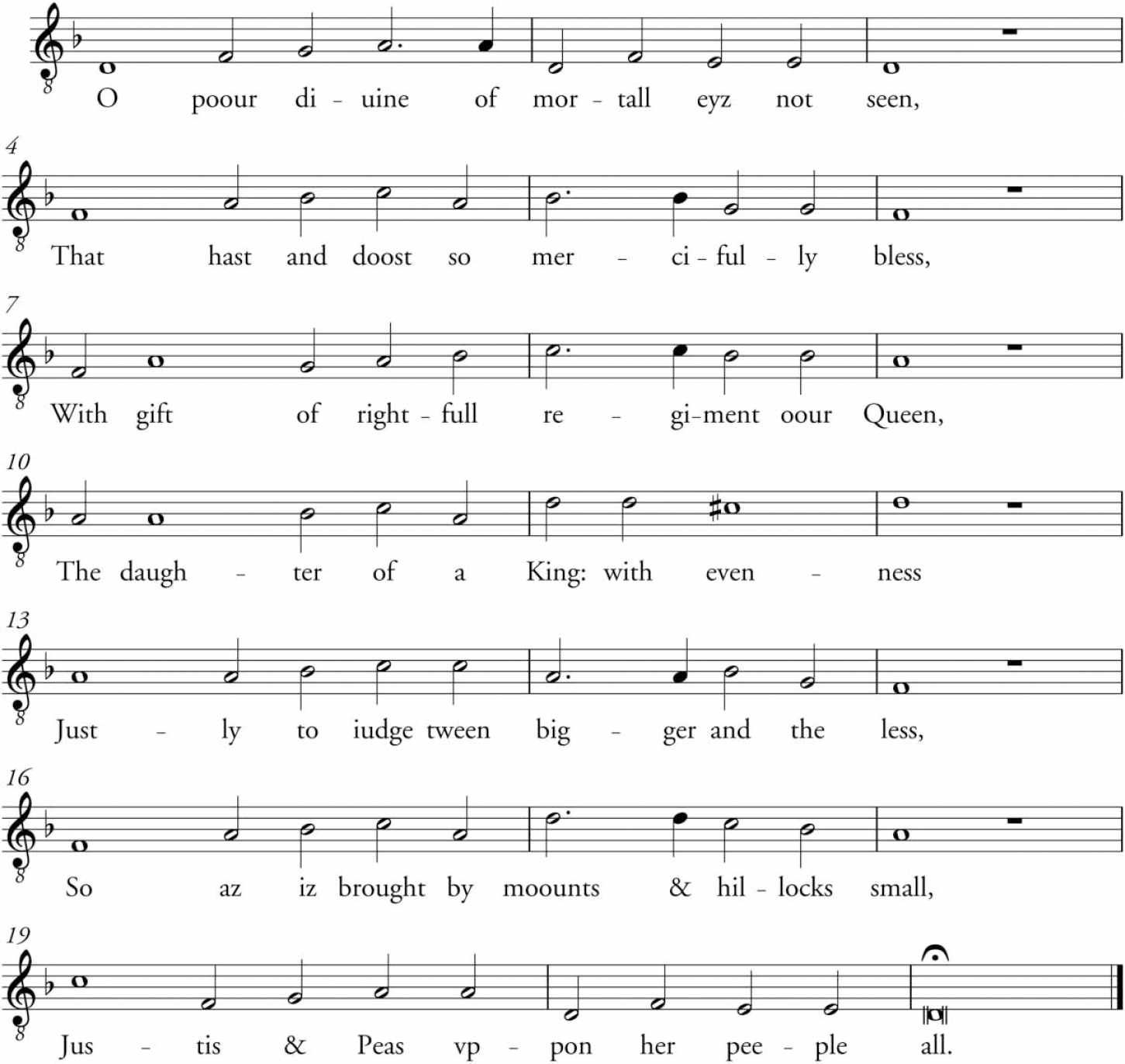
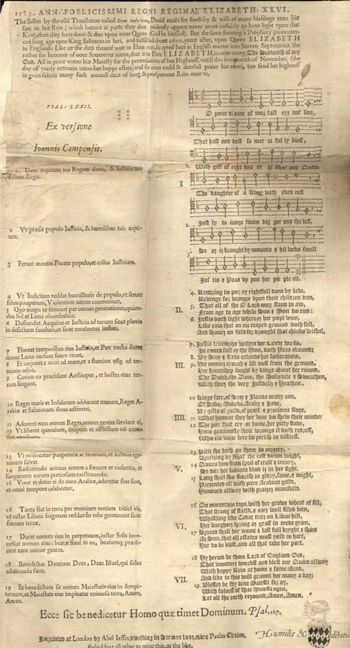
Patten's choice of Campensis's psalms (which use ten-syllable lines rather than the six and eight usual in those of Sternhold, Hopkins and others in the 1562 Whole Booke of Psalmes) required him to supply a new psalm tune on the 1583 sheet (see Example 3 and Figure 1). Although simple, the tune is carefully constructed using melodic and rhythmic repetition that provides cohesiveness and direction. The second phrase, for example, is a free sequential repetition of the first, the closing motif of the first phrase returns for the final line, and the dotted-rhythm motif that ended phrase 2 recurs three further times. The melody also gradually intensifies through the first four lines. Each one expands the range of the tune and cadences on a progressively higher degree of the tune's D-dorian mode until it has spanned the full octave. Then the remaining phrases return to the opening d for the final note.
William Patten's Ann: Foelicissimi Regni Reginae Elizabeth: XXVI (1583), first stanza. No time signature has been provided, as the phrases move flexibly between bars of six and four minims.

William Patten's Ann: Foelicissimi Regni Reginae Elizabeth: XXVI (1583). Colchester, University of Essex, Albert Sloman Library, Harsnett Collection.

This song has been variously interpreted as being for ‘mass circulation’ or as a private commission presented to the queen and court worthies.Footnote 89 Neither description seems adequate. The extant copy was clearly a presentation copy, as it includes an ink drawing of Patten's own shield and motto on the bottom corner.Footnote 90 Patten had been a teller of the exchequer until a scandal in 1568, and later enjoyed the patronage of the earl of Arundel, Sir Christopher Hatton, and the earl of Leicester.Footnote 91 The song may be a personal bid for royal favour or courtly patronage. Yet if the intended audience was so limited there would be little reason to circulate the song in print rather than manuscript – especially given the efforts needed to include musical notation. The printer's unusual imprint ‘forbidding all other to print this, or the like’ would have been unnecessary on a sheet intended for a select few at court. While the surviving sheet is a special copy, Patten's songs were aimed at a broader audience, if one that was specifically musically literate and well educated.
Finally, it should not be assumed that this singing was restricted to Protestant households. Stretching further into the elite end of Accession Day singing, the manuscripts of Edward Paston – a Catholic who maintained a Mass centre at Appleton – contain three versions of Byrd's consort song ‘Rejoice unto the Lord’.Footnote 92 This commemorated 28 years of Elizabeth's reign and, given Byrd's position in the Chapel Royal, was probably originally composed for celebrations at court in 1586. The Paston copies include instrumental versions without text and arrangements for lute and voice, strongly indicating that the song was not merely collected, but also performed in the household. Religion, it seems, did not prevent the Pastons from joining the festivities – despite their obvious Protestant tone – and this raises the possibility that other Catholics who nevertheless considered themselves loyal Englishmen were similarly prepared to participate.
Civic festivities
A series of threats to Elizabeth and England in the 1580s and the celebrations following their defeat amplified the popularity and scale of festivities for Accession Day. The Throckmorton Plot (1583) saw Francis Throckmorton plan an assassination of Elizabeth and an invasion by the duke of Guise funded by the Pope and the Spanish king. This was followed by the Babington Plot (1586), which aimed to depose Elizabeth in favour of Mary Queen of Scots (who was executed in February 1587). Finally, the Armada of 1588 was the most iconic event in a war with Spain that lasted from 1585 until the end of the reign.Footnote 93 In their immediate aftermath, these events sparked numerous commercially printed ballads commemorating the defeat of the plotters or the destruction of the Spanish ships,Footnote 94 as well as localized festivities like the ‘public bonfires, ringing of bells, feasting in the streets [and] singing of psalms’ in London after the Babington Plot.Footnote 95
Following these conspiracies, enthusiasm for Elizabeth peaked, and in this climate Accession Day celebrations expanded and intensified.Footnote 96 The prayer book's ‘Antheme or Prayer for the Preseruation of the Church’ had emphasized Elizabeth's divine appointment (‘that vine thy Right hand planted hathe’) and prayed for her preservation from ‘enemies wrath’ and ‘all foes […] and Rebels eke’.Footnote 97 Events had seen such prayers answered and seemed to confirm divine favour towards England and Elizabeth. Thanksgivings for deliverance from these enemies were incorporated into subsequent Accession Day celebrations. This is clearest in 1588, when the usual celebrations on 17 November were followed by an Armada thanksgiving on 19 November.Footnote 98 This merging of celebrations could be maintained for several years: Norwich, for example, continued to hold a combined two-day celebration for ‘the daye of the alteracion of her Maiestes Reigne [and] on the daye of thankesgeveyng for dryving awaye and discomforting the houge and greate navy of Spanyardes’.Footnote 99 Accession Day songs, too, responded to recent events: John Wolfe's A Songe Wherein is Conteyned the Treacherie of the Wicked and is Made to be Songe on the Coronacon Daye or at Any Other Tyme (1588) merged Accession Day themes with outrage over the treasonous plots and Spanish aggression (see Appendix 1).
While small-scale civic festivities such as bonfires, gun salutes or dinners for the town elite had emerged in the early years of Accession Day celebration, these now became more widespread, regular and extravagant. At their most elaborate they included pageants, plays, fireworks and orations by local children.Footnote 100 Music was provided by the city waits and trumpeters, while drummers (sometimes with flutes) might add a military flavour.Footnote 101 Singers could also be paid, while in Dover the chamberlains paid for ‘certen songes (geven to the maior Iurates and Common Counsell) to be songe at the Coronacion Daye’.Footnote 102 The Dover songs are not extant, but a local song from Berwick survives in the commonplace book of Gilbert Frevile from Bishop Middleton, near Durham (see Appendix 3). Though the tune is not indicated, the text has a sermon-like quality, beginning with a lengthy exposition on why people should give thanks to God before beginning its praises of Elizabeth. Despite the religious tone, the phrase ‘sung […] in triumphe’ suggests it was part of a public celebration (processions, pageants and tournaments could all be referred to as triumphs).
Amateur music-making on these occasions leaves little trace, but it was common for single-sheet prints to be pasted up in public places or learnt orally and sung for communal entertainment, and there are records of alehouse singing in Chester to celebrate the Armada victory.Footnote 103 Communal singing in the street among the celebratory bonfires or in the alehouses would be plausible for Accession Day, too.
R. Thacker's A Godlie Dittie (1586) is an extant song that probably resulted from this mutual influence between Accession Day and other political celebrations in the 1580s.Footnote 104 The publication itself is exceptional in containing not just printed music, but the tenor of a four-part song (this is suggested by the opening rests). The verse appears to be newly composed, but the refrain uses the tune of Psalm 81, the same as two of Barker's songs (see Example 4 and above, pp. 284–5, 288).Footnote 105 This psalm tune and the phrase ‘this day of ioye’ (verse 6) suggest a link to Accession Day, though as this ballad is unregistered and contains no specific reference to an occasion, its connection to 17 November is less certain than other examples discussed.
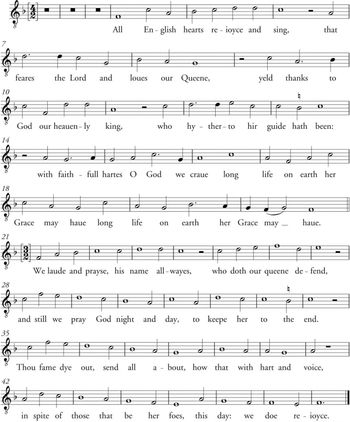
R. Thacker, A Godlie Dittie to be Song for the Preseruation of the Queenes Most Exclent Maiesties Raigne (1586), first verse and chorus. The song has a verse in duple metre followed by a refrain (‘We laude and prayse’) in triple metre. The transcription corrects several errors by comparing the refrain with the tune for Psalm 81 in The Whole Booke of Psalmes (1562), 201. For the phrase ‘and still we pray’ I have used the same correction as in Example 1.

John Milsom suggested that partsongs printed on single sheets like this one originated in pageants, processions or state occasions.Footnote 106 This song would certainly suit a civic festivity in honour of the queen, perhaps with a professional ensemble providing the verses and harmony throughout, while the well-known tune in the refrain would allow a crowd to join in the melody at these points. Although the identity of ‘R. Thacker’ is unclear, there was a Robert Thacker who was a wait at Norwich between 1580–1 and 1589.Footnote 107 As the Norwich waits played both on the day of the exposing of the Babington Plot and for Accession Day in 1586, an alternative possibility is that it was intended for public rejoicing after the Babington Plot (indeed, the occasion may even have been left deliberately ambiguous so that it could serve for both).Footnote 108 The Godlie Dittie does make references to traitors, but this would not be untypical for Accession Day either (as in Wolfe's A Songe Wherein is Conteyned the Treacherie of the Wicked for Accession Day 1588).Footnote 109 As the traitors were executed on 20 September, less than two months earlier, the plot would still have been a current concern at these celebrations on 17 November. This unusual polyphonic sheet shows how devotional psalms had spread from the prayer books into civic festivities and, after its use in civic festivities, the decision to publish the song would have been encouraged by the domestic market for four-part psalm harmonizations (see above, p. 290).
Increasing secularity in the 1590s
Although civic festivities did not mark an immediate departure from the devotional tone in earlier songs, church services and prayerful singing in the home increasingly took place alongside the spectacles of plays, pageants and bonfires. The growing significance of civic festivities and the gradual spread of the celebrations contributed to a marked change in Accession Day singing from the late 1580s onwards. First, a noticeable increase in the number of songs registered with the Stationers suggests that celebratory singing was becoming more popular. Publications were both more frequent and more widespread, with eight different printers issuing song sheets in the final 16 years of the reign (see Appendix 1). This coincided with an increase in other forms of Accession Day literature, particularly commemorative poems and single-sheet songs describing the court tournaments.Footnote 110 Several songs were also registered immediately after Accession Day, suggesting either that printers were aiming to capitalize on post-Accession Day patriotic spirit or else that they were sometimes slow in registering their publications. While the civic celebrations were instigated by local government, this market for songs seems to indicate the popularity of celebratory singing among the population.
Secondly, these songs were less overtly religious in tone than those from earlier in Elizabeth's reign. Whereas the earlier songs were primarily described as ‘psalms’, ‘prayers’, ‘godlie ditties’ or ‘anthems’, several of these later single-sheet publications now chose to describe their contents as ‘ballads’ (see Appendix 1). While the term ballad was not exclusively secular in its connotations (the biblical ‘Song of Songs’ might be referred to as the ‘Ballat of ballats’Footnote 111), printers were no longer defining the contents as explicitly devotional. This impression is reinforced by the lack of religious language in titles after 1587. These no longer address God, but instead make Elizabeth their primary subject. Rather than praising or thanking God, these songs now declare that they will show ‘the happiness of England for her maiesties blessed reigne’, tell of England's ‘aboundant blessings’ and be sung ‘in honour of the Quenes maiestie’.Footnote 112
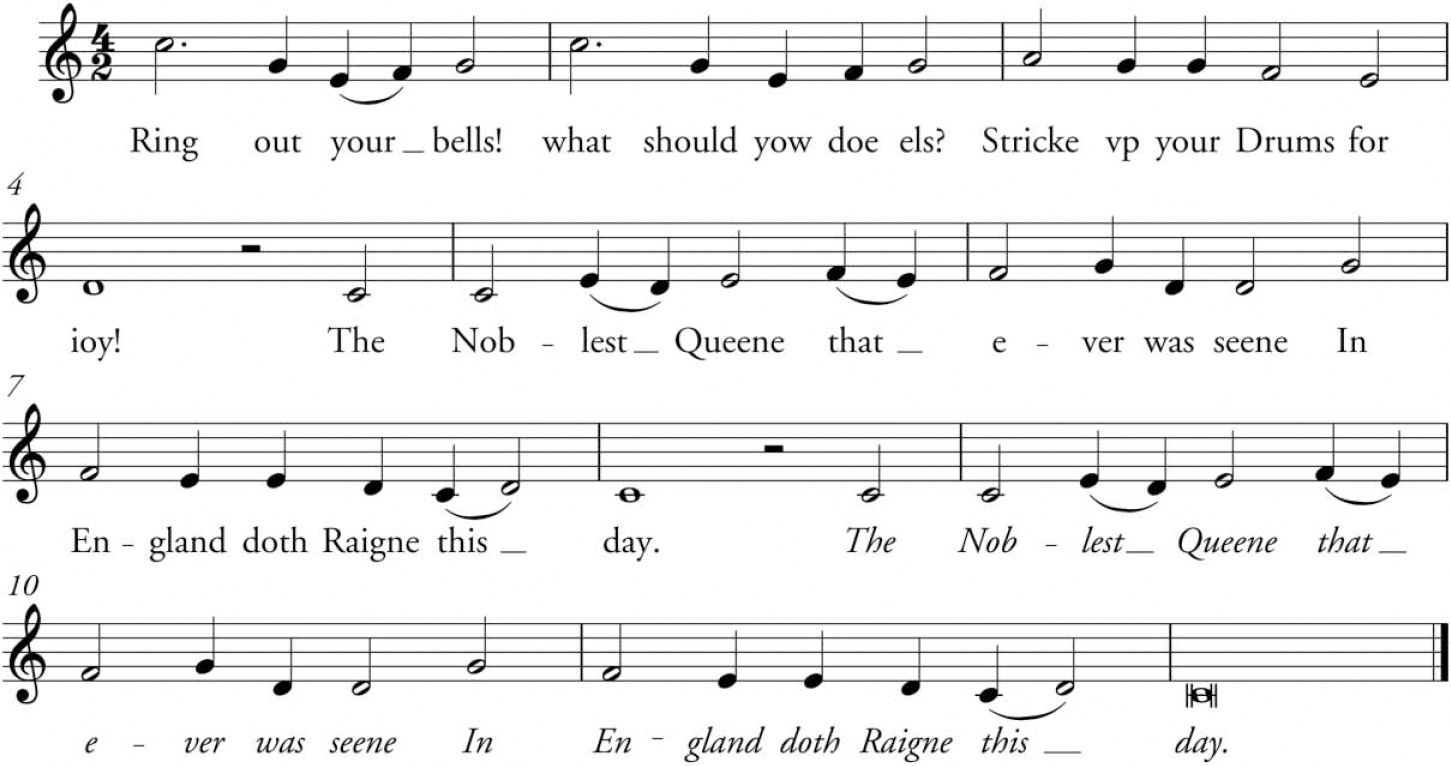
Similarly, psalm tunes were being replaced by ballad tunes. A Pleasant Newe Ballad of the Most Blessed and Prosperous Raigne of Her Maiestye for the Space of Two and Fortye Yeeres (1600), copied into the Shirburn ballad collection, was sung to the tune of ‘The Queen's Hunt's Up’ (see Example 5). This fits the popular tune ‘The Hunt is Up’, which John Ward describes as more a ‘collection of possibilities’ than a single definitive tune.Footnote 113 ‘The Queen's Hunt's Up’ was probably a variant and, appropriately, had been used previously for a song in praise of women: Anthony Munday's ‘Women are Strongest’ from A Banquet of Daintie Conceits (1588).Footnote 114 The last three lines of each verse are repeated as a refrain, potentially allowing one person with the printed sheet to sing the verses and a larger group to join in with the refrains.
A Pleasant Newe Ballad of the Most Blessed and Prosperous Raigne of Her Maiestye for the Space of Two and Fortye Yeeres (1600), first stanza, as it could be sung to a version of the tune ‘The Hunt is Up’. The tune used here is from Het Luitboek van Thysius, c.1600, given in Claude Simpson, The British Broadside Ballad and its Music (New Brunswick, NJ, 1966), 325. This was chosen as a near-contemporary variant that was used for a ballad, the now-lost ‘O Swete Olyuer’ (1584), though many variants of this tune are in triple rather than duple metre. Some minor rhythmic alterations have been made.

That A Pleasant Newe Ballad's tone is more civic than ecclesiastical is apparent from its opening verse, which evokes the bells and drums typical of civic festivities. The verses describe Elizabeth's achievements as queen, including how she has defended England with naval forces, maintained castles and fortifications, and been called to help foreign kings. Nevertheless, the sacred element of Accession Day is still evoked as the lyrics urge people to ‘pray’ and ‘keepe holy-daye’, while anti-Catholic sentiments remain in the claim that Elizabeth has ‘banisht away / all Papisticall play, / And maintaynes the Ghospell true’.Footnote 115 The devotional elements of Accession Day did not end, but as civic festivities became more widespread and elaborate, religious elements became less important in new songs.
Significantly, there is no evidence that any single-sheet songs of the late 1580s or 1590s were produced at the request of Elizabeth or her government. Not only are the names of the authors lacking, but also the printers certainly do not appear as loyal champions of the monarchy. John Danter had his press seized for printing a Roman Catholic book of devotions only a year after producing his Accession Day song.Footnote 116 Edward Allde, too, had his press seized in 1597 for printing a popish confession, and was in further trouble in 1599 for printing condemned books and a ‘Disorderly ballad’.Footnote 117 These were not the kind of men to be printing their songs out of loyalty to the queen or her church, but rather to be acting out of commercial self-interest: they printed what would sell.Footnote 118 The careers of the other printers of Accession Day songs in the 1590s also fit this pattern: Blackwall and White both largely dealt in cheap, single-sheet publications, so an Accession Day song would be a logical addition to their stock, while Thomas Duffield's A Newe Yeres Remembrance is his only known publication.Footnote 119
John Charlewood is the only one to have a known aristocratic patron; however, this was not a member of Elizabeth's government, but rather the Catholic earl of Arundel.Footnote 120 The timing of his song in 1587 after a period of increasing religious tension (see above, pp. 294–5) might indicate that Charlewood felt the need to affirm his loyalty to Elizabeth, or perhaps that he was doing so on behalf of Arundel. Like Patten's song, then, this may be another sign of how individual concerns could be a motivation for Accession Day publications.
It is not sufficient to argue, as does Carole Rose Livingston, that the Tudors’ ‘iron control of press’ meant that ‘every news ballad, every prayer and exhortation to virtue, was, in effect, government propaganda. Nothing less would be tolerated.’Footnote 121 There has been a tendency to exaggerate the censorship of the Elizabethan press; Elizabeth certainly did have means of control, but according to the literary historian Cyndia Clegg these were ‘largely reactive rather than proactive’.Footnote 122 The existing controls were not designed positively to promote government propaganda, but rather to restrict opposition to Elizabeth and particularly to her religious settlement. Authorization was primarily required for religious and political works, and the 1559 Injunctions appointed the Archbishop of Canterbury and the Bishop of London as the official authorizers. It was not particularly thorough, however, and there were no efforts to seek full compliance.Footnote 123 Although Accession Day songs were clearly political and usually religious, only two of those registered with the Stationers had ecclesiastical authorization (both in 1587).
Furthermore, although ecclesiastical licensing was a bar to Catholic or otherwise subversive material, it was not a means of ensuring that pro-Elizabethan literature was produced. The granting of printing privileges provided some royal influence, but this was primarily a means of patronage, not of censorship. The only proactive circulation of propaganda occurred through the office of the royal printer, and consisted of publications such as special forms of prayer, single-sheet printed prayers and carefully worded proclamations.Footnote 124 The government's turn to print was often in response to a specific event or problem (as in the prayer books for the plague, the 1580 earthquake, the plots of the 1580s and the Armada).Footnote 125 Although the Accession Day was a yearly event, the government's involvement was a similarly short-lived intervention. In the 26 years following the production of the prayer book, the extant State Papers and visitation articles give no sign of any concern on the part of Elizabeth, her Privy Council or her major bishops over how widespread or enthusiastic the celebrations were, or how many parishes owned and used the prayer books and their songs. Nor was there any compulsion from Elizabeth and her government for printers other than Jugge and Barker to print Accession Day songs or prayers.
Finally, it might be argued that this picture of civic celebrations increasing in frequency and scale, and greater numbers of Accession Day songs praising Elizabeth's reign, seems incongruous with the historian John Guy's image of the 1590s as an increasingly troubled decade in which Elizabeth's reputation declined.Footnote 126 There was certainly trouble: in addition to the plots and warfare discussed above, four successive harvest failures in 1594–7 caused a sharp rise in food prices; there were outbreaks of plague and influenza; heavy taxation was levied to pay for the war; there was large-scale unemployment as overseas trade diminished; crime and vagrancy increased; and signs of civil unrest were seen in rioting in London (1595) and the failed Oxfordshire Rising (1596).Footnote 127 Elizabeth increasingly struggled to control factional rivalries such as that between the Earl of Essex and Robert Cecil,Footnote 128 while her refusal to name a successor was a continual cause for concern when as many as 13 candidates were being discussed.Footnote 129 There were clearly ups and downs in the enthusiasm of celebrations: Chamberlain noted that in 1598 there was only ‘ringing, and running’ in London, whereas the festivities he described in 1602 were more extensive (see above, p. 275).Footnote 130 Yet there was no obvious decline in civic celebrations or song publications, which continued until the very last year of her reign.
This paradox of increasing celebrations at a time of mounting insecurity and unrest may be interpreted in two ways: either as a genuine expression of an existing social harmony or as an attempt to create such unity in the face of mounting unrest. The expanding market for printed Accession Day songs was commercial rather than governmental, responding to the popular mood rather than official direction. Therefore, Accession Day singing may be an indication that Elizabeth's popularity with the wider populace was not significantly diminished, despite the troubles.Footnote 131 Conversely, the growth in civic festivities was led by local authorities. The increased potential for disorder may have caused civic leaders to see Accession Day as an important occasion on which to reinforce a sense of loyalty to the queen in the hope of maintaining order. The two were potentially interdependent: if successful, civic celebrations would inspire the market for printed songs, while general enthusiasm for the occasion might spur future local festivities.
Yet Elizabeth's popularity need not have been great for people to have welcomed an opportunity to liven up a cold, wet November. Nor was singing necessarily an unqualified expression of English harmony. The more insecure a community feels, the greater the need for people to assert their unity, even though this may be more hopeful than actual. As foreign threats and domestic difficulties increased, there was perhaps a growing need to believe in England as a harmonious kingdom unified by its queen. A subtle mixture of continued royal esteem but growing anxiety, of popular will and encouragement from local leaders, is the most likely explanation for the paradox.
Conclusion
These songs mirrored the developments of Accession Day itself. Under the influence of various civic and church authorities, and in response to Elizabeth's dual role as monarch and head of the church, Accession Day singing moved easily between church, domestic and civic spheres and from psalms to secular tunes. Encouragement by church and state came only after the celebrations were long established, and spanned only a short period before the supply of new materials was left to local and commercial forces. These official publications were, however, significant in encouraging musical celebrations and in setting the tone throughout the 1580s. By the last decade of Elizabeth's reign, songs had become a natural part of Accession Day festivities. Despite foreign enemies, Catholic conspiracies, social and economic hardship and the weakening powers of an ageing queen, this singing helped create and perpetuate the image of England as a joyful, harmonious kingdom which became so popular in Accession Day literature and reinforced the stability and unity of the kingdom against such threats.
The Stuart monarchs followed Elizabeth's lead in celebrating their Accession Days.Footnote 132 By the 1620s, dissatisfaction with the Stuarts and threats from Catholicism and Spain revived Elizabeth's popularity, and many parishes began to ring bells and light bonfires for her Accession Day again, some paying out more than they did for Charles. Her Accession Day came to be seen as a Protestant holy day celebrating Elizabeth's ‘mythic role as Protestant deliverer’, and its observance contained an implied criticism of the current regime.Footnote 133 This ringing was certainly not encouraged by the government, but was a matter of local preference. Her Accession Day was still being marked in a few places as late as 1739.Footnote 134 Yet the regular tradition of Accession Day songs ended with Elizabeth's death. Neither James nor Charles included songs in their Accession Day prayer books (despite otherwise closely modelling their services on Elizabeth's example),Footnote 135 and neither did commercial printers produce single-sheet songs of praise for the day.
What remains to be seen is how typical the relationship between Elizabethan governance (local and national) and the encouragement of countrywide singing was. Elizabeth's Accession Day celebrations were unique, and she did have more control over the liturgy of her church than many sixteenth-century monarchs; however, the associations of music and political harmony were not distinctive to England. The various modes of influence between monarch and song analysed here could easily have been reproduced in differing forms and combinations elsewhere. Further research is necessary before direct comparisons can be made with other monarchs, but there are some tantalizing parallels. Earlier in the sixteenth century, Emperor Charles V disseminated news of his victories to his subjects in the Low Countries via town councils and parish clergy, and through printed propaganda aimed at a range of readers. He also ordered processions with supporting prayers and sermons, and civic celebrations with bonfires and pageants.Footnote 136 There are clear similarities with the events and publications of Elizabeth's Accession Day, but to what extent did Charles harness communal music-making for these prayers and celebrations? In Heidelberg a funeral song for the palatine administrator Casimir in 1592 used the same practice of composing new words to a popular psalm tune seen in songs for Elizabeth and was circulated in a printed pamphlet, but how widely was this used in praise of rulers?Footnote 137 Cheap print and orally circulated songs need to be considered more thoroughly as potential instruments of government as well as outlets for popular or subversive political opinion. Such an approach will deepen our appreciation of music's contribution to the art of governance by revealing a monarch's musico-political influence not just over social and learned elites but across the broader populace.
This work was supported by the Arts and Humanities Research Council (award no. 2007135743) and the British Academy for the Humanities and Social Sciences.
APPENDIX 1
| Date | Title | Author | Publisher / source | Link to Accession Day and notes |
|---|---|---|---|---|
| 1577 | A Prayer and Also a Thankesgiuing vnto God for His Great Mercy in Giuing, and Preseruing Our Noble Queene Elizabeth, to Liue and Reigne Ouer Vs, to His Honour and Glory, and Our Comfort in Christ Iesus: To be Sung the Xvii Day of Nouember 1577 | I. Pit, minister | Christopher Barker | for 17 November; contains the imprint ‘allowed by authoritie’; sung to the tune of Psalm 81 |
| 1578 3 Oct. |
A Psalme or Songe of Praise and Thankes Gyvinge to be Songe on the Xviith Day of November for the Quenes Maiesty | Christopher Barker | for 17 November; from the service book? | |
| 1578 15 Nov. |
An Antheme or Songe Beginning the Lord Save and Blesse with Good Encrease the Churche Our Queen and Realm in Peace | Christopher Barker | royal praise, registered two days before Accession Day; probably the ‘Antheme or Prayer’ in the 1578? prayer book (STC 16481) | |
| 1578 15 Nov. |
ii Little Anthemes or Thinges in Meeter of Hir Maiestie | Christopher Barker | royal praise, registered two days before Accession Day; from the prayer book? | |
| 1578 15 Nov. |
A Song for Yche Subiect that in England Beare Breathe to Praise God and Saie God Save Quene Elizabeth | Richard Jones | royal praise, registered two days before Accession Day | |
| 1583 | Ann: Foelicissimi Regni Reginae Elizabeth: XXVI | William Patten | Abel Jeffes | celebrates 25th anniversary of Accession; contains printed music |
| 1584 11 Nov. |
A Psalme to be Songe as a Thankesgyvinge on the Xvijth of November 1584, for the Queenes Happie Reigne &c | Abel Jeffes | for 17 November | |
| 1586 | A Godlie Dittie to be Song for the Preseruation of the Queenes Most Exclent Maiesties Raigne | R. Thacker | Abel Jeffes | ?Accession Day (refrain sung to Psalm 81); contains printed music |
| 1586 | A Prayer & Thanksgiving to God for ye Blessed, Prosperous & Peaceable Raigne of that Gratious & Famous Q: Eliz: Made in Barwick & Sung there in Triumphe, ye. 17. of Novemb: 1586 | Ste Barnclough | British Library, Egerton MS 2877, fols. 104v–105r | for 17 November; written for Berwick |
| 1587 14 Nov. |
A Prayer and Thancksgyvinge Vnto God for the Prosperous Estate and Longe Contynuance of the Queenes Maiestie to be Songe on the Xvijth of November 1587 | John Charlewood | for 17 November; possibly a collection of two itemsFootnote d | |
| 1587 20 Nov. |
A Newe Yeres Remembrance Wherein We May Ween Howe Muche We Be Beholden to Ye Quene | Thomas Duffield | marking a new year in reign; royal praise, registered in the wake of Accession Day | |
| 1588 4 Nov. |
A Songe Wherein is Conteyned the Treacherie of the Wicked and is Made to be Songe on the Coronacon Daye or at Any Other Tyme | John Wolfe | ‘Coronation Day’ was the (erroneous) Elizabethan name for Accession Day | |
| 1594 15 Nov. |
A Most Ioyfull Newe Ballad Shewinge the Happiness of England for Her Maiesties Blessed Reigne and the Subiects Ioy for the Same | Edward White | royal praise, registered two days before Accession Day | |
| 1595 19 Nov. |
A Triumphant Newe Ballad in Honour of the Quenes Maiestie and Her Most Happie Gouernement Who Hath Reigned in Great Prosperitie 37 Yeres | William Blackwall | royal praise celebrating 37 years of the reign; registered in the wake of Accession Day celebrations | |
| 1595 20 Nov. |
Englandes Trymphe Conteyning Diuerse of those Aboundant Blessings Wherewith This Our Realme Hathe Ben Blessed by Our Most Gratious Queene Elizabethes Reigne | John Danter | registered in the wake of Accession Day celebrations | |
| 1598 | Anno Foelicissimi Regni Augustae Reginae Nostrae Elizabeth Quadragesimo Primo, Fauste[m] Iam Incepto | William Patten | [Thomas Purfoote] | celebrates 40th anniversary of Accession |
| 1600 | A Pleasant Newe Ballad of the Most Blessed and Prosperous Raigne of Her Maiestye for the Space of Two and Fortye Yeeres, and Now Entring into the Three and Fortieth to the Great Ioy and Comfort of All Her Ma[iestyes] Faythfull Subiects | British Library, Add. MS 82932 | celebrates 42 years of Elizabeth's reign; manuscript but probably copied from a printed sheet | |
| 1602 3 Nov. |
A Comfortable Songe or Thanke Gyving to be Song the Xvijth Day of Nouember for the Most Gratious and Happie Reigne of Our Sovereigne Lady Quene Elizabethe | Edward Allde | for 17 November |
a Watt, Cheap Print and Popular Piety, 42.
b Clegg, Press Censorship, 17.
c Donald William Krummel, English Music Printing 1553–1700 (London, 1975), 161; Livingston, British Broadside Ballads, 789–818.
d Rollins suggest that this was a book because of the amount paid to register it. It was probably a short collection like Barker's ii Little Anthemes (1578), similarly containing two items (a prayer and a thanksgiving): Rollins, An Analytical Index, 56, 205.
APPENDIX 2
| Date | Title | STC no. | Printer | Author | Songs |
|---|---|---|---|---|---|
| [1576] | A Fourme of Prayer, with Thankes Geuyng, to be Vsed Euery Yeere, the .17. of Nouember | 16479 | Richard Jugge | 21st Psalm and 100th Psalm | |
| [1577] | A Fourme of Praier with Thankes Giuing to be Vsed Euery Yeere, the 17. of Nouember | 16479.5Footnote e | Christopher Barker | as above – virtually identical to Jugge's edition | |
| 1578 | A Fourme of Prayer with Thankes Giuing, to be Vsed of All the Queenes Maiesties Louing Subiectes Euery Yeere, the 17. of Nouember | 16480Footnote f | Christopher Barker | ‘A Thankesgiuing to be Sung as the 81. Psalme’ | |
| [1578?] | A Fourme of Prayer with Thankes Giuing, to be Vsed of All the Queenes Maiesties Louing Subiects Euery Yeere, the 17. of Nouember | 16481Footnote g | Christopher Barker | (1) ‘A Thankesgiuing to be Sung as the 81. Psalme’ (2) ‘An Antheme or Prayer for the Preseruation of the Church, the Queenes Maiestie, and the Realme’ (3) I. C., ‘A Song of Reioysing […] to the tune of the 25. Psalme’ |
|
| 1585 | Certaine Prayers and Other Godly Exercises, for the Seuenteenth of Nouember Wherein We Solemnize the Blessed Reigne of our Gracious Soueraigne Lady Elizabeth | 4089 | Christopher Barker | Edmund Bunny | ‘An Antheme’ beginning ‘O Glorious God, respect our song’ |
| [1590] | A Fourme of Prayer with Thankes Giuing, to be Vsed of All the Queenes Maiesties Louing Subiects Euery Yeere, the 17. of Nouember | 16482Footnote h | Deputies of Christopher Barker | Three songs, as in STC 16481 |
e Dated from a prayer on sig. Bv, which thanks God for 19 years of her reign. STC gives a date of 1578.
f Both reel 2246 of the UMI microfilm set ‘Early English Books, 1475–1640’ and Early English Books Online incorrectly label the images of STC 16479 as STC 16480. STC 16480 can be found in London, British Library, General Reference Collection, shelfmark 472.a.29.
g g Date suggested from a prayer on sig. B8v which thanks God for 20 years of her reign. STC suggests a later date of 1580.
h Dated from the same prayer noted in footnotes e and g, though also agreeing with STC. The British Library catalogue suggests that date of the edition is 1585.
APPENDIX 3 A PRAYER & THANKSGIVING TO GOD FOR YE BLESSED, PROSPEROUS & PEACEABLE RAIGNE OF THAT GRATIOUS & FAMOUS Q: ELIZ: MADE IN BARWICK & SUNG THERE IN TRIUMPHE, YE . 17. OF NOVEMB: 1586 ./. AN RNE ELIZ. 29O
Source: London, British Library, Egerton MS 2877 (‘Gilbert Frevile's Commonplace Book’), fols. 104v–105r
Note: Editorial stanza breaks are provided to show how the text may be divided into eight-line stanzas that are appropriate not only to the grammatical and poetic structure, but also to the content of the song.