1 Introduction
1.1 Motivation and basic definitions
The goal of this paper is to shed light on our understanding of large scale properties and patterns of infinite strings. Our hope is to answer the questions of the following types. How does one define large scale properties of infinite strings? What does it mean for two strings to possess the same large scale invariants? How can we compare large scale properties of one string with those of the other string? What are the large scale characteristics of (algorithmically) random strings? To answer these and similar types of questions we employ concepts and ideas from coarse geometry and geometric group theory.
In coarse geometry and geometric group theory, a foundational concept is that of quasi-isometry between metric spaces. Suppose that we are given two metric spaces
 $\mathcal M_1=(M_1, d_1)$
and
 $\mathcal M_2=(M_2, d_2)$
. A map
 $\,f:M_1\rightarrow M_2$
is called an
 $(A,B,C)$
-quasi-isometry, where
 $A\geqslant 1$
,
 $B\geqslant 0$
, and
 $C\geqslant 0$
, if the following two properties are satisfied:
-
1. For all
 $x,y\in M_1$
we have
$$ \begin{align*}(1/A) \cdot d_1(x,y) -B \leqslant d_2(f(x), f(y))\leqslant A \cdot d_1(x,y) +B. \end{align*} $$
-
2. For every element
$y\in M_2$
there is an
$x\in M_1$
such that
$d_2(y, f(x))\leqslant C$
.


We call the first property quasi-isometric inequality, the second one density property, and the constants
 $A, B, C$
will be called quasi-isometry constants (of the mapping f).
Let
 $\,f:\mathcal M_1\rightarrow \mathcal M_2$
be an
 $(A,B,C)$
-quasi-isometry. If
 $B=0$
, the mapping becomes bi-Lipschitz (and hence continuous) and injective. Therefore the quasi-isometry f can be viewed as a bi-Lipschitz map with distortion B between the metric spaces (in case
 $B>0$
). If
 $C=0$
, the quasi-isometry f becomes onto.
The quasi-isometry relation between metric spaces is an equivalence relation. Transitivity and reflexivity of this relation is evident. To see that this relation is symmetric, consider an
 $(A,B,C)$
-quasi-isometry
 $\,f:\mathcal M_1\rightarrow \mathcal M_2$
. Define
 $\,\bar {f}$
which “reverses” f from
 $\mathcal M_2$
into
 $\mathcal M_1$
as follows. For all
 $y\in M_2$
, if
 $y\in Range(f)$
, then select an x from
 $\,f^{-1}(y)$
and set
 $\,\bar {f}(y)=x$
. Otherwise, select an
 $x^{\prime }\in M_1$
such that
 $d_2(y, f(x^{\prime }))\leqslant C$
and set
 $\,\bar {f}(y)=x^{\prime }$
. It is easy to see that
 $\,\bar {f}$
determines a quasi-isometry from metric space
 $\mathcal M_2$
into
 $\mathcal M_1$
.
We give two examples. For the first example, consider the spaces
 $\mathbb Z^n$
(the n-dimensional grid of integers) and
 $\mathbb R^n$
with their natural metrics. These are quasi-isometric via the identity map from
 $\mathbb Z^n$
into
 $\mathbb R^n$
. Informally, two metric spaces
 $\mathcal M_1$
and
 $\mathcal M_2$
are quasi-isometric if these spaces look the same from far away. We will make this comment precise in the section on asymptotic cones.
The second example is from group theory. Let G be a finitely generated group, say with a generator set S. Consider the Cayley graph
 $\Gamma (G,S)$
of G based on S. The metric in
 $\Gamma (G,S)$
is given by the shortest-path distance in the graph
 $\Gamma (G,S)$
. By varying the set S of generators of the group, we vary the Cayley graphs, and hence corresponding metric spaces. It turns out that all these metric spaces are quasi-isometric to each other. In other words, the quasi-isometry class of the Cayley graphs
 $\Gamma (G,S)$
is invariant of the group G even if we change the generators of the group. It turns out that some important properties of groups are quasi-isometry invariants. Examples include being virtually nilpotent, virtually free, hyperbolic, having polynomial growth rate, being finitely presentable, having decidable word problem, having the same asymptotic cones [Reference Van Den Dries and Wilkie13, Reference Drutu and Kapovich4, Reference Gromov, Niblo and Roller7]. Studying quasi-isometry invariants of groups proved to be crucial in solving many problems in group theory [Reference Gromov5
–
Reference Gromov, Niblo and Roller7]. Nowadays finding quasi-isometry invariants of groups is an important theme in geometric group theory.
Recall that by infinite string we mean a mapping
 $\alpha $
from
 $\omega $
(the set of natural numbers) into a finite alphabet
 $\Sigma $
. So,
 $\alpha $
is viewed as the infinite sequence
 $\alpha (0) \alpha (1) \alpha (2) \ldots $
. Natural numbers
 $i\in \omega $
are called positions of the string
 $\alpha $
. In formal language theory, logic and applications, infinite strings
 $\alpha $
are one of the main objects of investigation. These objects are discrete and somewhat boring from a geometry point of view. How are the coarse geometry concepts (e.g., quasi-isometry) relevant to the study of large scale properties of infinite strings? How does one introduce the concepts of coarse geometry into understanding large scale properties of the infinite strings? One possible answer comes from a simple observation that each string
 $\alpha $
has the natural metric inherited from the set
 $\omega $
of natural numbers. The elements of
 $\alpha $
are positions
 $i,j$
in
 $\alpha $
and the distance
 $d_{\alpha }(i,j)$
between the positions is the natural distance
 $|i-j|$
. So,
 $\alpha $
as a metric space is simply
 $(\omega ; d_{\alpha })$
; the quasi-isometry type of
 $(\omega ; d_{\alpha })$
is the metric space
 $\mathbb R_{\geqslant 0}$
of all positive reals. So, from a quasi-isometry view point,
 $\alpha $
viewed as a metric space
 $(\omega ; d)$
is still somewhat uneventful. However, one crucial difference between the metric spaces
 $(\omega ; d_{\alpha })$
and
 $\alpha $
from the setting of large scale/coarse geometry is that the metric space
 $\alpha $
possesses the natural coloring associated with it. Namely, for every position
 $i\in \omega $
in
 $\alpha $
, the color of the position i is
 $\sigma $
exactly when
 $\alpha (i)=\sigma $
.
The observation above suggests the idea of applying the notions of coarse geometry (such as the concept of quasi-isometry) to colored metric spaces. Precisely this is what we propose in this paper. We investigate quasi-isometries of colored metric spaces with strings
 $\alpha $
as our primary objects (as colored metric spaces), thus initiating the study of large scale properties of strings.
A colored metric space
 $\mathcal M$
is a tuple
 $(M; d, Cl)$
, where
 $(M;d)$
is the underlying metric space with metric d, and
 $Cl: M \rightarrow 2^{\Sigma }$
is a color function; the set
 $\Sigma $
is a finite set of colors called an alphabet. If
 $\sigma \in Cl(m) $
then we say that the element
 $m\in M$
has color
 $\sigma $
. We allow elements to have several (including none) colors.
Example 1.1. As mentioned above, infinite strings
 $\alpha $
over
 $\Sigma $
are colored metric spaces of the form
 $(\omega ; d, \alpha )$
, where d is the natural metric (so, for all
 $i, j \in \omega $
we have
 $d(i,j)=|i-j|$
) and
 $\alpha : \omega \rightarrow \Sigma $
is the color function. Every element in
 $\alpha $
has a unique color. We always assume that the cardinality
 $|\Sigma |$
of
 $\Sigma $
is at least
 $2$
. So, we identify the colored metric space
 $(\omega ; d,\alpha )$
with
 $\alpha $
.
Denote the set of all infinite strings over
 $\Sigma $
, considered as colored metric spaces, by
 $\Sigma ^{\omega }$
. These metric spaces will be our main objects of study. The set of all finite words over
 $\Sigma $
is denoted by
 $\Sigma ^{\star }$
.
Example 1.2. Let
 $G=(V; E, Cl)$
be a colored graph. The graph G has its natural distance d inherited from the path-distance metric on G. Here we assume that the graph
 $(V,E)$
is symmetric (that is, E is subset of the set of 2-element subsets of V), and
 $Cl:V\rightarrow \Sigma $
is the given coloring function. For d to be the proper metric we need to assume that G is connected.
We now adapt the definition of quasi-isometry on metric spaces (given at the beginning of this section) for colored metric spaces.
Definition 1.3. Let
 $\mathcal M_1=(M_1; d_1, Cl_1)$
and
 $\mathcal M_2=(M_2; d_2, Cl_2)$
be two colored metric spaces. A color preserving quasi-isometry
 $\,f: M_1\rightarrow M_2$
will be called a quasi-isometry from
 $\mathcal M_1$
into
 $\mathcal M_2$
.
From now on we write
 $\mathcal M_1\leqslant _{QI} \mathcal M_2$
if there is a quasi-isometry from
 $\mathcal M_1$
into
 $\mathcal M_2$
. As mentioned above, for metric spaces (with no colors) the relation
 $\leqslant _{QI}$
is an equivalence relation, and hence the relation is symmetric. In contrast, for colored metric spaces, however, the symmetry property does not hold. For instance, the mapping
 $\,f: \omega \rightarrow \omega $
(on the metric space
 $(\omega ; d))$
defined as
 $\,f(i)=2i$
is a quasi-isometry from the infinite string
 $0^{\omega }=00000\ldots $
into the string
 $(01)^{\omega }=010101\ldots $
. There is no quasi-isometric mapping in the opposite direction.
If
 $\mathcal M_1 \leqslant _{QI} \mathcal M_2$
and
 $\mathcal M_2 \leqslant _{QI} \mathcal M_1$
then we write this by
 $\mathcal M_1\sim _{QI} \mathcal M_2$
. The relation
 $\sim _{QI}$
is an equivalence relation in the class of all colored metric spaces, in particular on the set
 $\Sigma ^{\omega }$
. Formally, we give the following definition:
Definition 1.4. The equivalence classes of
 $\sim _{QI}$
on
 $\Sigma ^{\omega }$
are called quasi-isometry types or, equivalently, large scale geometries. From now on we set
 $\Sigma _{QI}^{\omega }=\Sigma ^{\omega }/{\sim}_{QI}$
. Denote the large scale geometry of string
 $\alpha $
by
 $[\alpha ]$
. Thus,
 $$ \begin{align*}\Sigma_{QI}^{\omega}=\{[\alpha]\mid \alpha \in \Sigma^{\omega}\}.\end{align*} $$
Remark 1.5. A simple yet important note is the following. If f is a color preserving quasi-isometry from
 $\mathcal M_1$
into
 $\mathcal M_2$
and there is a constant D such that for all
 $y\in M_2$
there exists an
 $x\in M_1$
with
 $d_2(y, f(x))\leqslant D$
and
 $Cl_1(x)=Cl_2(y)$
, then one can construct a quasi-isometry from
 $\mathcal M_2$
to
 $\mathcal M_1$
by “reversing” the mapping f as we described earlier.
The fact that
 $\leqslant _{QI}$
on colored metric spaces is not symmetric implies that we can compare large scale geometries of these spaces, and consider the partial order
 $\leqslant _{QI}$
on the quasi-isometry types. In particular, the partial order
 $\leqslant _{QI}$
can be restricted to the large scale geometries of colored metric spaces over a fixed underlying metric space such that
 $\omega $
or
 $\mathbb Z$
or
 $\mathbb Z^2$
with their natural metrics. From this viewpoint the quasi-isometry on colored metric spaces is a much refined version of the usual quasi-isometry relation on uncolored metric space. This is because the quasi-isometry type of every uncolored metric space trivializes to a singleton.
1.2 Informal description of results
Introduction of large scale geometries on colored metric spaces of the type
 $\alpha $
and the quasi-isometry relation
 $\leqslant _{QI}$
poses many natural questions. Most of these are mathematical translations of the questions that we posed at the beginning of this paper.
The first question is concerned with understanding the partial order
 $\leqslant _{QI}$
on the set
 $\Sigma _{QI}^{\omega }$
of all large scale geometries. The order presents an algebraic tool aimed at classification of global patterns that occur on strings. Among many results, we prove that the order has the greatest large scale geometry, and in Section 3 we show that the partial order has infinite chains and infinite antichains. We also study density property of the partial
 $\leqslant _{QI}$
. Recall that a partial order is dense if for any two distinct comparable elements x and y of the partial order there exists an element z strictly between x and y. We show that the density property is prevalent for the quasi-isometry order
 $\leqslant _{QI}$
. We also prove that there are infinitely many minimal large scale geometries.
The second question is related to understanding the quasi-isometry relation
 $\sim _{QI}$
on
 $\Sigma ^{\omega }$
. One way to do it is to restrict the relation
 $\sim _{QI}$
to various subsets of infinite words and, given such a subset X, understand the partial order
 $\leqslant _{QI}$
on the set of equivalence classes under
 $\sim _{QI}$
in X. For instance, in Section 3.4 we restrict the relation
 $\sim _{QI}$
to eventually periodic strings, and give a full description of quasi-isometry types and the order
 $\leqslant _{QI}$
on this class of strings. The other way is to simplify or refine the definition of quasi-isometry. Section 4.2 gives an intuitively syntactically easier yet equivalent definition of the relation
 $\leqslant _{QI}$
that we call component-wise reducibility. We also give a more refined version of
 $\sim _{QI}$
, called color-equivalence. We show that color-equivalence is strictly stronger than
 $\sim _{QI}$
equivalence relation. Finally, it is natural to ask if quasi-isometric maps between strings can be replaced with order preserving quasi-isometric embeddings. We give a negative answer to this question; however, we prove that the answer is positive modulo
 $\sim _{QI}$
equivalence relation.
The third question is related to describing various sets of large scale geometries. So, let L be a set (usually called a language) of infinite strings over an alphabet
 $\Sigma $
. One naturally considers the set
 $[L]$
consisting of all large scale geometries of strings in L. Thus we have:
 $[L]=\{[\alpha ]\mid \alpha \in L\}$
. We call the set
 $[L]$
the atlas of L. The question we ask is related to understanding the atlas
 $[L]$
given a description of L. In particular, a natural algorithmic question is if there exists an algorithm that, given descriptions of languages
 $L_1$
and
 $L_2$
, decides whether the atlases
 $[L_1]$
and
 $[L_2]$
coincide. In Section 5, we use Büchi automata as our description tools and provide a full characterization of the atlases defined by Büchi automata. Our characterization theorem implies that there are only finitely many atlases
 $[L]$
described by Büchi automata. As a consequence of our characterization, we show that for Büchi automata recognizable languages
 $L_1$
and
 $L_2$
there is a linear time algorithm (in the size of automata) for deciding the equality of the atlases
 $[L_1]$
and
 $[L_2]$
. This contrasts with the PSPACE completeness of the equality problem for Büchi languages. This part of the work links large scale geometries with automata theory and complexity theory.
The fourth question addresses the complexity of quasi-isometry relation on infinite strings in terms of arithmetical hierarchy, thus connecting the topic with computability theory. Recall that isometry is color preserving and distance preserving map. So, quasi-isometry relation is weaker than isometry relation since each isometry is a quasi-isometry. Hence, one might expect that quasi-isometry is easier to detect than the isometry. We prove that the quasi-isometry relation on computable infinite strings is
 $\Sigma _2^0$
-complete. This is in contrast to
 $\Pi _1^0$
-completeness of the isometry relation on computable strings. These are explained in Section 6.
The fifth question asks how one encodes large scale geometries of colored metric spaces
 $\alpha $
into “limit” structures. For this, we define structures obtained from “looking at
 $\alpha $
from far away”. Dries and Wilkie [Reference Van Den Dries and Wilkie13], using ultrafilters, formalized this intuitive notion for metric spaces through the concept of asymptotic cone. Their work gave a logical context to Gromov’s work in [Reference Gromov5, Reference Gromov, Niblo and Roller7], where it is proved that groups of polynomial growth are virtually nilpotent. We invoke the concept of asymptotic cone and study the relationship between large scale geometries of infinite strings and their asymptotic cones. In Section 7 we prove theorems akin to results on asymptotic cones in geometric group theory. For instance, we show that asymptotic cones of Martin-Löf random strings coincide when scaling factors are computable. These results bridge the topic of this paper with algorithmic randomness and model theory.
1.3 Basic properties of the order
$(\Sigma _{QI}^{\omega }, \leqslant _{QI})$

The quasi-isometry relation
 $\leqslant _{QI}$
on the strings set
 $\Sigma ^{\omega }$
naturally defines the partially ordered set
 $ (\Sigma _{QI}^{\omega }, \leqslant _{QI})$
on the set of all large scale geometries
 $[\alpha ]$
. We denote this partially ordered set by
 $\Sigma _{QI}^{\omega }$
, thus identifying it with its domain. We now need simple definitions related to partially ordered sets. Say that
 $[\beta ]$
covers
 $[\alpha ]$
if
 $[\alpha ]\neq [\beta ]$
,
 $[\alpha ]\leqslant _{QI} [\beta ]$
, and for all
 $[\gamma ]$
such that
 $[\alpha ]\leqslant _{QI} [\gamma ] \leqslant _{QI} [\beta ]$
we have
 $[\gamma ]=[\alpha ]$
or
 $[\gamma ]=[\beta ]$
. An element is an atom if it covers a minimal element in the partial order.
Here is an easy proposition. In this proposition
 $\sigma \in \Sigma $
; also for any finite word
 $v\in \Sigma ^{\star }$
,
 $v^{\omega }$
denotes the infinite string
 $vvvv\ldots $
. Part (2) of the proposition will be strengthened later.
Proposition 1.6. The partial order
 $\Sigma _{QI}^{\omega }$
has the following properties:
-
1. There exists a greatest element.
-
2. There exist at least
$|\Sigma |$
minimal elements. -
3. There exist at least
$|\Sigma |\cdot (|\Sigma |-1)/2$
atoms.


Proof Let
 $\Sigma = \{\sigma _1, ... , \sigma _k\}$
. For Part (1), we claim that
 $\alpha = (\sigma _1...\sigma _k)^\omega $
is the greatest element in
 $\Sigma _{QI}$
. Indeed, take any
 $\beta \in \Sigma ^{\omega }$
. We write
 $\alpha $
as
 $v_0 v_1 \ldots $
where each
 $v_i$
is
 $\sigma _1\ldots \sigma _k$
. Define
 $\,f:\beta \rightarrow \alpha $
so that f maps any position n (in
 $\beta $
) to the position
 $k_n$
in the portion
 $v_n$
of the string
 $\alpha $
such that
 $\beta (n)=\alpha (k_n)$
. The mapping f is a witness of
 $\beta \leqslant _{QI} \alpha $
. For Part (2), consider the quasi-isometry types
 $[\sigma _{i}^{\omega }]$
. These form minimal elements in
 $\Sigma _{QI}^{\omega }$
. Indeed, if
 $\alpha \leqslant _{QI} \sigma ^{\omega }_i$
, then each element of
 $\alpha $
has color
 $\sigma _i$
. For Part (3), consider
 $\sigma _i (\sigma _j)^{\omega }$
, where
 $i\neq j$
. Clearly,
 $\sigma _j^{\omega }\leqslant _{QI} \sigma _i (\sigma _j)^{\omega }$
. Now assume that
 $\beta \neq \sigma _j^{\omega }$
and
 $\beta \leqslant _{QI} \sigma _i (\sigma _j)^{\omega }$
. Then finitely many positions of
 $\beta $
are colored with
 $\sigma _i$
, and all other positions are colored with
 $\sigma _j$
. Hence,
 $\beta \sim _{QI} \sigma _i (\sigma _j)^{\omega }$
. Therefore, each
 $\sigma _i (\sigma _j)^{\omega }$
is an atom in the partial order
 $\Sigma _{QI}^{\omega }$
. Thus, we have found at least
 $k\cdot (k-1)/2$
of the atoms.⊣
2 Small cross over lemma
A quasi-isometry
 $g:\alpha \rightarrow \beta $
can produce cross-overs, for example, pairs n and m of integers such that
 $n<m$
and
 $g(m)< g(n)$
. Note that this definition of cross-over uses the natural linear order present on
 $\omega $
. The definition of quasi-isometry does not obviously prohibit large cross-overs; in other words, for n and m with
 $n<m$
the distances
 $g(m)-g(n)$
might potentially be unbounded. For instance, the following two colored metric spaces
 $\ldots 00000001111111\ldots $
and
 $\ldots 11111110000000\ldots $
with underlining domain
 $\mathbb Z$
are quasi-isometric and have arbitrary large cross-overs. Nevertheless, the next lemma, that we call Small Cross Over Lemma, shows that there is a uniform bound on cross-overs on colored metric space
 $\alpha \in \Sigma ^{\omega }$
. Namely, for the quasi-isometric map
 $g:\alpha \rightarrow \beta $
there exists a positive constant D such that for all
 $n<m$
such that
 $g(m)<g(n)$
we have
 $g(n)-g(m)\leqslant D$
. We note that the proof of the lemma does not use the fact that the spaces are colored. In this sense, the lemma is a quasi-isometric property of the metric space
 $\omega $
with its natural distance. Later we will use this lemma sometimes without an explicit reference to it.
Lemma 2.1 (Small Cross Over Lemma)
For any quasi-isometry constants
 $(A,B,C)$
there are constants
 $D\leqslant 0$
and
 $D^{\prime }\leqslant 0$
such that for all
 $(A,B,C)$
-quasi-isometry maps
 $g:\alpha \rightarrow \beta $
we have the following:
-
1. For all
$n,m \in \omega $
if
$n<m$
and
$g(m)< g(n)$
we have
$g(m)-g(n)\geqslant D$
. -
2. For all
$n,m \in \omega $
if
$n<m$
and
$g(m)< g(n)$
then
$n-m\geqslant D^{\prime }$
.


Proof For the first part of the lemma, suppose that for some integers
 $n< m$
we have
 $g(m)-g(n)=D$
that provides a cross-over for a constant
 $D \leqslant 0$
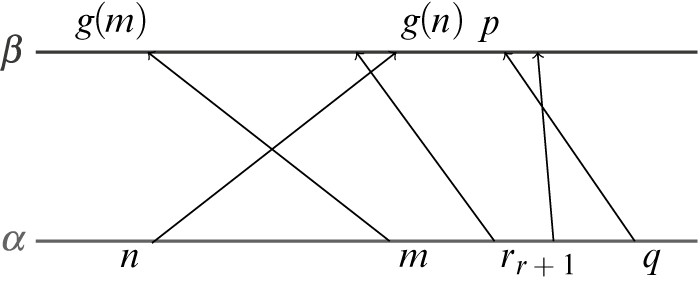
. Our goal is to find a lower bound for the constant D. We refer the reader to Figure 1 in order to follow the arguments below.
Small Cross Over Lemma.

In the list
 $g(m+1), g(m+2), \ldots $
, select the minimal integer p such that
 $p\geqslant g(n)+1$
, that is
 $p=\min (g([m+1,\infty )) \cap [g(n)+1, \infty ))$
. Define
 $q = \min (g^{-1}(p) \cap [m+1, \infty ))$
. So, we have
 $q\geqslant m+1$
and
 $p=g(q)$
. Then, since g is an
 $(A,B,C)$
-quasi-isometry we obtain
 $$ \begin{align*} d_{\beta}(g(n), p) & \geqslant \frac{1}{A} \cdot d_{\alpha}(n,q)-B \geqslant \frac{1}{A} d_{\alpha}(n,m)-B\\ & \geqslant \frac{1}{A} \cdot \frac{1}{A} (d_{\beta}(g(n), g(m))-B)-B\\ & = -\frac{D}{A^2} -\frac{(A^2+1)}{A^2} B. \end{align*} $$
We have
 $g([m,q]) \subset [0,g(n)] \cup [p,\infty )$
by our definition of p and q. Note
 $g(m)\in [0,g(n)]$
and
 $g(q)\in [p,\infty )$
. Hence, there exists
 $r \in [m, q-1]$
such that
 $g(r)\in [0,g(n)]$
and
 $g(r+1)\in [g(p),\infty )$
, which means
 $$ \begin{align*}d_\beta(g(n),p) \leqslant d_\beta(g(r),g(r+1)) \leqslant A + B. \end{align*} $$
From these two systems of inequalities we have the inequality:
 $$ \begin{align*}-\frac{D}{A^2} -\frac{(A^2+1)}{A^2} B \leqslant A+B. \end{align*} $$
So we have
 $$ \begin{align*}D\geqslant -(A+B)A^2 - \frac{A^2+1}{A^2} B \end{align*} $$
that was desired to be proved.
Note that the lemma states that the distance
 $g(m)-g(n)$
is uniformly bounded from below when n and m form a cross-over pair. Since g is a quasi-isometry, for all pairs
 $n<m$
that form a cross-over, the distance between
 $n-m$
is also universally bounded from below. This proves the second part of the lemma.
We note that the claimed constants D and
 $D^{\prime }$
are independent on any particular
 $(A,B,C)$
-quasi-isometry f; namely, D and
 $D^{\prime }$
depend on
 $(A, B, C)$
only.⊣
Corollary 2.2. There exists a computable function that, given quasi-isometry constants
 $A, B$
, C, computes constants D and
 $D^{\prime }$
stated in the lemma.
Consider an
 $(A,B,C)$
-quasi-isometry
 $\,f:\alpha \rightarrow \beta $
. Let
 $[x,y]$
be an interval in
 $\beta $
, where
 $x\leqslant y$
, and consider two values
 $M_{xy}= \max\, f^{-1}([x,y])$
and
 $m_{xy}= \min\, f^{-1}([x,y])$
. We would like to measure the size of the interval between
 $m_{xy}$
and
 $M_{xy}$
in terms of the length of the interval
 $[x,y]$
.
Lemma 2.3. For the
 $(A,B,C)$
-quasi-isometry
 $\,f:\alpha \rightarrow \beta $
there exist constants
 $A^{\prime }$
and
 $B^{\prime }$
such that for all positions
 $x, y\in \beta $
with
 $x\leqslant y$
we have
 $$ \begin{align*} (1/A^{\prime}) \cdot d_{\beta}(x,y) -B^{\prime} \leqslant d_{\alpha}(m_{xy},M_{xy}) \leqslant A^{\prime} \cdot d_{\beta}(x,y) +B^{\prime}. \end{align*} $$
Proof The inequality in the definition of
 $(A,B,C)$
-quasi-isometry for function f implies:
 $$ \begin{align*} (1/A)\cdot &d_{\beta}(f(n),f(m))-(B/A)\leqslant d_{\alpha}(n,m)\\ &\leqslant A\cdot d_{\beta}(f(n),f(m))+AB. \end{align*} $$
Therefore, we have
 $$ \begin{align*} d_{\alpha}(m_{xy},M_{xy}) &\leqslant A \cdot d_{\beta}(f(m_{xy}),f(M_{xy})) +AB\\ &\leqslant A \cdot d_{\beta}(x,y) +AB. \end{align*} $$
For the lower bound we have:
 $$ \begin{align*} (1/A)\cdot d_{\beta}(f(m_{xy}),f(M_{xy}))-(B/A)\leqslant d_{\alpha}(m_{xy},M_{xy}). \end{align*} $$
So, we need to rewrite the lower bound in terms of the length of the interval x and y. For this we use the quasi-isometry inequality twice:
 $$ \begin{align*} &d_{\beta}(f(m_{xy}),f(M_{xy}))\geqslant (1/A) d_{\alpha}(m_{xy}, M_{xy})-B\\ &\quad\geqslant(1/A) d_{\alpha}(\min\, f^{-1}(x), \max\, f^{-1}(y))-B \\ &\quad\geqslant(1/A)((1/A)d_{\beta}(x,y)-B)-B\\ &\quad=(1/A^2)d_{\beta}(x,y)-((A+1)/A)B. \end{align*} $$
All these give us the desired constants
 $A^{\prime }$
and
 $B^{\prime }$
.⊣
In terms of the last lemma, we note that we can tune our constants
 $A^{\prime }$
and
 $B^{\prime }$
using the Small Cross-Over Lemma. Indeed, consider the values
 $M^{\prime }_{xy}= \max ([x,y] \cap f(\alpha ))$
and
 $m^{\prime }_{xy}= \min ([x,y] \cap f(\alpha ))$
. Then due to the density condition of quasi-isometricity it holds that
 $d_{\beta }(y,M^{\prime }_{xy}) \leqslant 2C$
and
 $d_{\beta }(x,m^{\prime }_{xy}) \leqslant 2C$
. Also from Lemma 2.1 we have
 $$ \begin{align*} d_\beta(f(M_{xy}),M^{\prime}_{xy}) \leqslant \,-D \ \text{ and }\ \ d_\beta(f(m_{xy}),m^{\prime}_{xy}) \leqslant \,-D. \end{align*} $$
Hence, by the triangular inequality,
 $ d_{\beta }(f(m_{xy}),f(M_{xy})) \geqslant d_{\beta }(x,y) -4C+2D$
.
In summary, we have the following:
 $$ \begin{align*} (1/A)\cdot d_{\beta}(x,y)-(4C+B-2D)/A \leqslant d_{\alpha}(m_{xy},M_{xy})\leqslant A\cdot d_{\beta}(x,y)+AB. \end{align*} $$
Set
 $A^{\prime } = A$
and
 $B^{\prime } = \max \{(4C+B-2D)/A, AB\} $
.
We have the next immediate corollary (that can also be proved easily without the use of the lemmas above):
Corollary 2.4. Let
 $\,f:\alpha \rightarrow \beta $
be a quasi-isometry. There is a
 $C>0$
such that
 $|f^{-1}(y)|<C$
for all
 $y\in \beta $
.⊣
3 Algebraic properties of the order
$(\Sigma _{QI}^{\omega }, \leqslant _{QI})$

The partially ordered set
 $(\Sigma _{QI}^{\omega }, \leqslant _{QI})$
is an algebraic tool that allows us to study large scale properties of infinite strings and compare them. Proposition 1.6 already describes some of the elementary properties of this partial order. In this section we further embrace this partial order and derive some nontrivial properties of it.
3.1 Infinite chains and antichains
A natural question is if the partially ordered set
 $(\Sigma _{QI}^{\omega }; \leqslant _{QI})$
is infinite. We positively answer this question in two ways. On the one hand we show that the partial order has infinite chains, and on the other hand we show that the order has infinite antichains.
Theorem 3.1 (Infinite Chain Theorem)
The order
 $\Sigma _{QI}^{\omega }$
has a chain of the type of integers, that is, a collection
 $\{\alpha _n\}_{n \in \mathbb {Z}}$
of strings such that
 $[\alpha _n <_{QI} \alpha _{n+1}]$
for all
 $n\in \mathbb {Z}$
.
Proof Take two distinct elements in
 $\Sigma $
, say
 $0$
and
 $1$
, respectively. Define the following sequence
 $\{\alpha _n\}_{n\in \mathbb Z}$
of infinite strings from
 $\Sigma ^{\omega }$
:
 $$ \begin{align*} \alpha_n = \begin{cases} (01)^{2^n}(011)^{2^n}...(01^{2^k})^{2^n}... & (n\geqslant0), \\ (01)(01^{2^{2^{-n}}})...(01^{(2^k)^{2^{-n}}})... & (n<0). \end{cases} \end{align*} $$
The idea behind this definition is the following. The string
 $\alpha _0$
is of the form:
 $$ \begin{align*}(01) (011) (01111)\ldots (01^{2^k}) (01^{2^{k+1}})\ldots \end{align*} $$
Let us call the substrings
 $(01^{2^k})$
blocks of
 $\alpha _0$
. The above definition tells us that
 $\alpha _1$
is obtained from
 $\alpha _0$
by doubling each block of
 $\alpha _0$
. Similarly,
 $\alpha _{-1}$
is obtained from
 $\alpha _0$
by removing every other block. This process is propagated to all
 $\alpha _n$
's.
We show that
 $\alpha _n \leqslant _{QI} \alpha _{n+1}$
for all
 $n\geqslant 0$
. For negative n, the proof is similar. In
 $\alpha _n$
consider the segment of the form
 $$ \begin{align*}\underbrace{(01^{2^{k+1}})(01^{2^{k+1}})\ldots (01^{2^{k+1}})}_{2^n \text{ times}}. \end{align*} $$
We map this segment of
 $\alpha _n$
into the following segment of the string
 $\alpha _{n+1}$
:
 $$ \begin{align*}\underbrace{(01^{2^{k}})(01^{2^{k}})(01^{2^{k}})(01^{2^{k}})\ldots (01^{2^{k}})(01^{2^{k}})}_{2^{n+1} \text{ times}}. \end{align*} $$
The mapping sends the block
 $(01^{2^{k+1}})$
in
 $\alpha _n$
into
 $(01^{2^{k}})^2$
in
 $\alpha _{n+1}$
in an obvious injective way. This mapping can easily be seen to be a quasi-isometry from
 $\alpha _n$
into
 $\alpha _{n+1}$
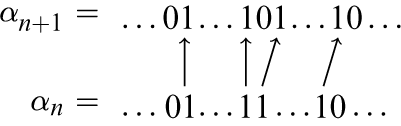
. We refer the reader to Figure 2.
The mapping from
 $(01^{2^{k+1}})$
-block in
 $\alpha _n$
into
 $(01^{2^{k}})(01^{2^{k}})$
-block in
 $\alpha _{n+1}$
.

Now we need to prove that there is no quasi-isometric mapping from
 $\alpha _{n+1}$
into
 $\alpha _n$
. For the sake of contradiction assume that g is an
 $(A,B,C)$
-quasi-isometry from
 $\alpha _{n+1}$
into
 $\alpha _n$
. Then using Lemma 2.3 and Lemma 2.1, one sees that g needs to be strictly monotone on all but finitely many positions of
 $\alpha _{n+1}$
with color
 $0$
; that is, we need to have
 $M \in \omega $
such that for all
 $m,m^{\prime }>M$
and
 $m>m^{\prime }$
we have if
 $\alpha _{n+1}(m) = \alpha _{n+1}(m^{\prime }) = 0$
then
 $g(m)> g(m^{\prime })$
.
We now show that we have a contradiction. Let
 $m_{i,n}$
and
 $m_{j, n+1}$
be the positions of the ith
 $0$
in
 $\alpha _n$
and jth
 $0$
in
 $\alpha _{n+1}$
, respectively. Now assume that
 $m_{i,n+1}> M$
and
 $g(m_{i,n+1}) = m_{j,n}$
. Then from monotonicity and injectivity of g on all positions colored
 $0$
in
 $\alpha _{n+1}$
, we should have
 $$ \begin{align*}d_{\alpha_n} (g(m_{i,n+1}),g(m_{i+k,n+1})) \geqslant m_{j+k,n} - m_{j,n}. \end{align*} $$
Together with the
 $(A,B,C)$
-quasi-isometry condition, this implies
 $m_{j+k,n} - m_{j,n} \leqslant A(m_{i+k,n+1} - m_{i,n+1}) + B$
and hence
 $$ \begin{align*} r(k) = \frac{m_{j+k,n} - m_{j,n}}{m_{i+k,n+1} - m_{i,n+1}} \leqslant A + \frac{B}{m_{i+1,n+1} - m_{i,n+1}} \quad (k \geqslant 1), \end{align*} $$
which in particular says the value
 $r(k)$
is uniformly bounded with respect to k. On the other hand, from the construction of
 $\alpha _n$
and
 $\alpha _{n+1}$
one can observe that the growth rate of
 $m_{k,n}$
with respect to k is much faster than that of
 $m_{k,n+1}$
; more precisely, one can verify that
 $m_{2^n \cdot k , n} = \mathcal O(2^k)$
holds for each
 $n \in \omega $
, and thus
 $m_{2^n \cdot k , n+1} = m_{2^{n+1} \cdot \frac {k}{2} , n+1} = \mathcal O(2^{\frac {k}{2}})$
holds when k is even. This implies
 $r(k)$
is unbounded, which is a contradiction.⊣
Theorem 3.2 (Infinite Antichain Theorem)
The partial order
 $\Sigma _{QI}^{\omega }$
has a countable antichain
 $\{\beta _n\}_{n \in \omega }$
.
Proof As above we assume that
 $0,1\in \Sigma $
. Consider the following sequence of strings
 $\beta _n$
,
 $n\in \omega $
:
 $$ \begin{align*} \beta_n = 010^{2^n}1^{2^n}0^{3^{n}}1^{3^{n}}...0^{k^{n}}1^{k^{n}}... \end{align*} $$
We claim that this sequence forms an antichain in
 $\Sigma _{QI}^{\omega }$
. Take any
 $n,m \in \omega $
and suppose
 $\beta _n \leqslant _{QI} \beta _m$
via an
 $(A,B,C)$
-quasi-isometry f. We will show that
 $n=m$
.
Let
 $A_{s,t}$
be the “tth block” of zeros in
 $\beta _{s}$
. We can represent
 $A_{s,t}$
as the interval
 $$ \begin{align*} A_{s,t} = [2\sum_{i=0}^{t-1}i^{s},2\sum_{i=0}^{t-1}i^{s}+(t)^{s}-1]. \end{align*} $$
Since f is a quasi-isometry, an easy argument shows that there exists
 $k,l \in \omega $
such that (1)
 $\,f(A_{n,k}) \subseteq A_{m,l}$
, and (2) for every
 $k^{\prime } \in \omega $
, we have
 $\,f(A_{n,k^{\prime }+k}) \subseteq A_{m,k^{\prime }+l}$
. Intuitively, these say that from some point the quasi-isometry f maps
 $\beta _n$
in the “block by block” manner without vacancy—one can easily verify that, without this property f generates unbounded distortions (and thus is not a quasi-isometry). Now note that we have:
 $$ \begin{align*}(1/A)|A_{n,k^{\prime}+k}|-B \leqslant |A_{m, k^{\prime}+l}| \leqslant A|A_{n,k^{\prime}+k}|+B. \end{align*} $$
Therefore, we should have a positive upper and lower bounds on the ratio
 $$ \begin{align*} \frac{|A_{n,k^{\prime}+k}|}{|A_{m,k^{\prime}+l}|} = \frac{(k^{\prime}+k)^n}{(k^{\prime}+l)^m} \end{align*} $$
with respect to
 $k^{\prime }$
. The only case that satisfies this condition is
 $n=m$
.⊣
The trivial large scale geometries
 $[0^{\omega }]$
and
 $[1^{\omega }]$
, as we noted, are minimal elements of
 $\Sigma _{QI}^{\omega }$
. The next theorem shows one way to build nontrivial minimal large scale geometries.
Theorem 3.3 (Minimal Elements Theorem)
Let
 $\{a_n\}_{n \in \omega }$
be a sequence such that
 $\lim _{n \to \infty } a_n = \infty $
. Then the large scale geometry of the string
 $\alpha = 0^{a_0}1^{a_1}0^{a_2}1^{a_3}...0^{a_{2k}}1^{a_{2k+1}}\ldots $
is a minimal element in any partial order
 $\Sigma _{QI}^{\omega }$
with
 $0,1 \in \Sigma $
.
Proof Suppose that
 $\beta \leqslant _{QI} \alpha $
via an
 $(A,B,C)$
-quasi-isometry f. Our goal is to show that
 $\alpha \sim _{QI} \beta $
. It suffices to show that there exists a constant D such that for every sufficiently large
 $y \in \alpha $
(i.e., for every
 $y \geqslant Y$
with some fixed constant Y) there exists an
 $x \in \beta $
with
 $|y-f(x)| \leqslant D$
and
 $Cl(x) = Cl(y)$
. Indeed, assuming such a condition we can construct a quasi-isometry
 $g:\alpha \to \beta $
as follows; for each
 $y \in \alpha $
,
-
1. if there exists
$y'\in \alpha $
such that
$|y'-y|\leqslant D$
for which there is
$x'\in \beta $
with
$\,f(x')=y'$
, then let
$g(y)=x'$
; -
2. otherwise, let
$x\in \beta $
be any position such that
$Cl(x) = Cl(y)$
, and let
$g(y) = x$
.


Here
 $g(y)$
is well-defined in case 2, as
 $\beta $
clearly contains both of
 $0$
and
 $1$
as its color. It is easy to verify that g is a quasi-isometry—recall the argument in Remark 1.5, and observe that the case 2 happens only for finitely many y’s.
Now we prove existence of the constant D. Enumerate all elements of the image of f as
 $\{y_n\}_{n\in \omega }$
, where
 $y_n < y_{n+1}$
for all n. Then by definition of
 $(A,B,C)$
-quasi-isometry, we have
 $y_{n+1} - y_n \leqslant 2C+1$
(as otherwise there is y between
 $y_n$
and
 $y_{n+1}$
that violates the density property). On the other hand, it is clear from the construction of
 $\alpha $
that every sufficiently large
 $y \in \alpha $
is a member of a single-colored interval I in
 $\alpha $
with the size greater than
 $2C+1$
. Thus for such a y, one can find
 $x \in \beta $
such that
 $|y-f(x)| \leqslant 2C+1$
and
 $Cl(x) = Cl(y)$
.⊣
By this result, the strings
 $\beta _n$
constructed in the Infinite Antichain Theorem are all minimal. Hence, we have the following corollary:
Corollary 3.4. The partially ordered set
 $\Sigma _{QI}^{\omega }$
possesses infinitely many minimal elements.⊣
3.2 Density theorem
Recall that a partial order
 $\leqslant $
is dense if for all
 $x, y$
the condition
 $x\leqslant y$
and
 $x\neq y$
implies existence of z such that
 $x\leqslant z\leqslant y$
and
 $z\not \in \{x,y\}$
. Since
 $\Sigma _{QI}^{\omega }$
has atoms, this order is not dense. However, the goal of this section is to show the density property for
 $\leqslant _{QI}$
is prevalent.
We start with the lemma showing that all
 $(A,B,C)$
-quasi-isometries between strings are bounded by one linear function; the function depends on the constants
 $A, B, C$
only and not the quasi-isometries.
Lemma 3.5. For given
 $A, B, C \in \omega $
, there is a constant
 $D^{\prime } \in \omega $
such that for all
 $(A,B, C)$
-quasi isometries
 $\,f: \alpha \to \beta $
and
 $n \in \omega $
we have
 $\,f(n) \leqslant An + D'$
.
Proof Let
 $\,f:\alpha \to \beta $
be an
 $(A,B, C)$
-quasi-isometry. The constant C tells us that there is
 $n_0 \in \omega $
such that
 $\,f(n_0) \in [0,C]$
. Thus, by the Small Cross Over Lemma there is a bound D (which is independent of the choice of f) such that
 $\,f(0) \leqslant D$
. Since f is an
 $(A,B, C)$
-quasi-isometry, we have
 $$ \begin{align*} f(n)\leqslant An+B+f(0) \leqslant An+(B+D). \end{align*} $$
So, we let
 $D'=B+D$
.⊣
For the density theorem we use the following standard notation. For string
 $\alpha $
, let
 $\alpha \hspace {-.4em}\upharpoonright _k$
be the string
 $\alpha (0)\ldots \alpha (k)$
, where
 $k \in \omega $
. Since we will be handling finite approximations to quasi-isometric mappings, we need the following definition.
Definition 3.6. Let
 $A, B, C \in \omega $
be quasi-isometry constants, and let
 $D \leqslant 0$
be the largest cross over bound for
 $(A,B,C)$
-quasi-isometries that is given by Lemma 2.1. A function
 $\,f: \alpha \hspace {-.4em}\upharpoonright _n \to \beta $
is possibly extendable to
 $(A,B,C)$
-quasi-isometry if it satisfies the following conditions:
-
1. f is color preserving.
-
2. For all
$k,m \in \mathrm {dom}(f)$
, we have
$$ \begin{align*}(1/A)\cdot d(k,m)-B < d(f(k),f(m))< A\cdot d(k,m)+B. \end{align*} $$
-
3. Let
$M_n = \max \{f(x) \mid x \in \mathrm {dom}(f)\}$
. If
$M_n> C-D$
, then for any
$y < M_n-{(C-D)}$
there exists an
$x < n$
such that
$d(y,f(x))\leqslant C$
.


Let
 $\alpha , \beta \in \Sigma ^{\omega }$
and
 $A, B, C \in \omega $
be quasi-isometry constants. Our goal is to construct a rooted tree
 $T(\alpha , \beta , A,B, C)$
with the following properties:
-
1. The tree
$T(\alpha , \beta , A,B, C)$
is finitely branching and computable in
$\alpha $
and
$\beta $
. In particular, if
$\alpha $
and
$\beta $
are computable then so is
$T(\alpha , \beta , A,B, C)$
. -
2. For any n one can effectively compute, with an oracle for
$\alpha $
and
$\beta $
, the number of nodes in the tree at distance n from the root. Note that Part (1) does not always imply Part (2). -
3. The tree
$T(\alpha , \beta , A,B, C)$
is infinite if and only if there exists an
$(A,B, C)$
-quasi-isometric map from
$\alpha $
into
$\beta $
. -
4. There is a bijection between
$(A,B, C)$
-quasi-isometric maps from
$\alpha $
to
$\beta $
and the set
$[T(\alpha , \beta , A,B, C)]$
of all infinite paths of the tree
$T(\alpha , \beta , A,B, C)$
.


The nodes of
 $T(\alpha , \beta , A,B, C)$
are finite partial functions that can possibly be extended to
 $(A,B, C)$
-quasi-isometric maps from
 $\alpha $
to
 $\beta $
. Here is a formal construction of the tree
 $T(\alpha , \beta , A,B, C)$
:
-
1. The root of the tree
$T(\alpha , \beta , A,B, C)$
is the empty set
$\emptyset $
, that is, nowhere defined partial function. -
2. Let x be a leaf of the tree
$T(\alpha , \beta , A,B, C)$
constructed so far, and
$\,f_x$
be the partial function associated with x. We identify x and
$\,f_x$
. We assume that-
(a) x is at distance n from the root, and
$\,f_x=\{(0,i_0), \ldots , (n, i_{n})\}$
. -
(b) The function
$\,f_x$
is possibly extendable to
$(A,B,C)$
-quasi-isometry. -
(c)
$i_n\leqslant An+D'$
, where
$D'$
is from Lemma 3.5.
-
-
3. List all possibly extendable extensions
$\phi $
of
$\,f_x$
such that the domain of
$\phi $
is
$\{0,1,\ldots , n, n+1\}$
. The children of
$\,f_x$
are all these functions
$\phi $
.


In Part 2 of the construction the number of extensions
 $\phi $
of
 $\,f_x$
is finite since these extensions must satisfy the quasi-isometry condition. If such extensions
 $\phi $
of
 $\,f_x$
do not exist, then the node x becomes a leaf. Finally, Lemma 3.5 guarantees that the root of the tree has finitely many children. Hence, the tree is finitely branching.
Lemma 3.7. The following are true:
-
1. There is a bijection between the set of all infinite paths of
$T(\alpha , \beta , A,B, C)$
and the set of all
$(A,B,C)$
-quasi-isometric maps from
$\alpha $
to
$\beta $
. -
2. The tree
$T(\alpha , \beta , A,B, C)$
is infinite if and only if there is an
$(A,B, C)$
-quasi-isometric map from
$\alpha $
into
$\beta $
.


Proof Let
 $\,f:\alpha \to \beta $
be an
 $(A,B,C)$
-quasi-isometry and let
 $\,f_n = f\hspace {-.4em}\upharpoonright _n$
. We show that
 $\,f_n$
satisfies the last condition of possibly-extendable function (i.e., the condition 3 in Definition 3.6); Conditions 1 and 2 of Definition 3.6 clearly hold. Assume the contrary, letting
 $y < M_n - (C-D)$
be an element such that no
 $x \in \{0,\ldots , n\}$
satisfies
 $\,f_n(x) \in \{y-C,\ldots , y+C\}$
. As f is an
 $(A,B,C)$
-quasi-isometry, there should be an
 $x'> n $
that satisfies
 $\,f(x') \in \{y-C,\ldots , y+C\}$
. But then, for
 $x'' \in f_n^{-1}(M_n)$
, we have
 $\,f(x') - f(x'') \leqslant (y+C) - M_n < D$
. This contradicts the Small Cross Over Lemma.
If
 $x_1, x_2, \ldots $
is an infinite path through the tree
 $T(\alpha , \beta , A,B)$
then the mapping f defined as the limit of the sequence
 $\,f_{x_1}, f_{x_2}, \ldots $
is an
 $(A,B, C)$
-quasi-isometry from
 $\alpha $
to
 $\beta $
.⊣
From Lemma 3.7 above we immediately have the following.
Corollary 3.8. Let
 $\alpha , \beta \in \Sigma ^\omega $
be given. If for each
 $k \in \omega $
there is a function
 $\,f:\alpha \hspace {-.4em}\upharpoonright _k \to \beta $
that is possibly extendable to
 $(A,B,C)$
-quasi-isometry, then there is an
 $(A,B, C)$
-quasi-isometry from
 $\alpha $
to
 $\beta $
.
Let
 $\alpha , \beta \in \Sigma ^\omega $
, and let
 $Cl(\beta )$
be the set of all colors of the string
 $\beta $
. Also let
 $w, v$
be finite strings over
 $Cl(\beta )$
respectively of lengths
 $n,m\in \omega $
. Define the following two strings obtained by changing the initial segments of
 $\alpha $
and
 $\beta $
:
 $$ \begin{align*}\alpha' = w\alpha(n)\alpha(n+1)\ldots \ \ \text{and} \ \ \beta' = v\beta(m)\beta(m+1)\ldots. \end{align*} $$
Also, assume that every letter present in one of these two strings occurs in both strings infinitely often. With these conditions, we have the following simple lemma that informally states that in quasi-isometries initial segments of strings do not matter.
Lemma 3.9. Under assumptions above
 $\alpha \leqslant _{QI} \beta $
if and only if
 $\alpha ' \leqslant _{QI} \beta '$
.
Proof If
 $\alpha \leqslant _{QI}\beta $
via
 $\,f:\alpha \to \beta $
, then take
 $n'\geqslant n$
such that for any
 $i\geqslant n'$
we have
 $\,f(i) \geqslant m$
. Define
 $\,f':\alpha '\to \beta '$
as follows. For all
 $j\leqslant n'$
, make
 $\,f'$
color preserving. For all
 $i> n$
set
 $\,f'(i)=f(i)$
. This is a quasi-isometry. The converse can be shown in a similar way.⊣
Theorem 3.10 (Density Theorem)
Let
 $\alpha , \beta \in \Sigma ^\omega $
be given. Assume
 $\alpha <_{QI} \beta $
, and every letter in
 $\alpha $
or
 $\beta $
occurs in both
 $\alpha $
and
 $\beta $
infinitely often. Then there exists
 $\gamma \in \Sigma ^\omega $
such that
 $\alpha <_{QI} \gamma <_{QI} \beta $
.
Proof Note that the assumption of the theorem (that letters that occur in
 $\alpha $
or
 $\beta $
must occur in both of these strings infinitely often) is important. For instance, no
 $\gamma $
exists such that
 $0^\omega <_{QI} \gamma <_{QI} 10^\omega $
.
Let
 $\alpha <_{QI} \beta $
via f. We can assume (if necessary, by taking
 $QI$
-equivalent strings
 $\alpha '\sim _{QI} \alpha $
and
 $\beta '\sim _{QI} \beta $
) that f is injective and monotonic. The reader can verify this (or the reader can refer to Theorem 4.11). So,
 $\beta $
is of the form
 $$ \begin{align*}\beta = \alpha(0) w_0 \alpha(1) w_1 \ldots, \end{align*} $$
where the length of finite strings
 $w_k$
are all uniformly bounded by a constant. By
 $p(n)$
we denote the position of
 $\alpha (n)$
in
 $\beta $
, that is,
 $p(n) = n+\sum _{i=0}^{n-1} |w_i|$
.
An informal idea of constructing
 $\gamma $
is the following. Initially
 $\gamma $
starts copying
 $\alpha $
until an initial segment of
 $\alpha $
such that no mapping from
 $\beta $
can possibly be extended to a
 $(1,1,1)$
-quasi-isometry into
 $\gamma $
built. From that point on,
 $\gamma $
switches to
 $\beta $
and copies
 $\beta $
until an initial segment of
 $\gamma $
is built such that no mapping from
 $\gamma $
can possibly be extended to a
 $(2,2,2)$
-quasi-isometry into
 $\alpha $
built. Then
 $\gamma $
switches to
 $\alpha $
and continues on copying
 $\alpha $
. Below is a formal description.
In what follows we inductively define the sequence
 $\gamma _k$
of infinite strings, where
 $k\in \omega $
. The strings
 $\gamma _k$
will always be of the form
 $\gamma _k = \alpha (0) u_0^{(k)} \alpha (1) u_1^{(k)} \ldots $
, where for each i and k, the string
 $u_i^{(k)}$
is either
 $w_i$
or an empty string.
Let
 $p_k(n)$
be the position of
 $\alpha (n)$
in the string
 $\gamma _k$
, that is,
 $p_k(n) = n+\sum _{i=0}^{n-1} |w_i^{(k)}|$
. Call a string
 $\delta $
an extension of a finite string w if it has w as its prefix (i.e.,
 $\delta = w\delta '$
for some
 $\delta '$
). Now we define the sequence
 $\{\gamma _k\}_{k\in \omega }$
as follows:
-
• Set
$\gamma _0 :=\alpha $
. -
• For given
$k \geqslant 1$
we proceed as follows.-
– Assume
$k-1$
is even. Find
$n_k \in \omega $
such that no mapping
$\,f: \beta \hspace {-.4em}\upharpoonright _{n_k} \to \gamma _{k-1}$
exists that can possibly be extendable to
$(k,k,k)$
-quasi-isometry. Such
$n_k$
exists because
$\beta \not \leqslant _{QI}\gamma _{k-1}$
(by inductive hypothesis). Take a sufficiently large s, say
$s = kn_k + D_k$
, where
$D_k$
is a constant in Lemma 3.5 for
$(k,k,k)$
-quasi-isometry constant, and set Note that any map from
$$ \begin{align*}\gamma_k = \gamma_{k-1}\hspace{-.4em}\upharpoonright_s\beta(s+1)\beta(s+2)\ldots. \end{align*} $$
$\beta \hspace {-.4em}\upharpoonright _{n_k}$
to any extension of
$\gamma _{k-1}\hspace {-.4em}\upharpoonright _s$
is not possibly extendable to a
$(k,k,k)$
-quasi-isometry. Note that, by Lemma 3.9, we also have
$\gamma _k \not \leqslant _{QI}\alpha $
.
-
– Assume that
$k-1$
is odd. Find
$n_k \in \text {range} (p_{k-1})$
such that no map
$\,f: \gamma _{k-1} \hspace {-.4em}\upharpoonright _{n_k} \to \alpha $
is possibly extendable to
$(k,k,k)$
-quasi-isometry; this is possible because
$\gamma _{k-1} \not \leqslant _{QI}\alpha $
. Let
$s = p_{k-1}^{-1}(n_k)$
(thus we have
$\gamma _{k-1} \hspace {-.4em}\upharpoonright _{n_k} = \alpha (0) u_0^{(k-1)} \alpha (1) u_1^{(k-1)} \ldots \alpha (s)$
), and just as above, set Note that, by Lemma 3.9, we have
$$ \begin{align*} \gamma_k = \gamma_{k-1} \hspace{-.4em}\upharpoonright_{n_k} \alpha (s+1)\alpha (s+2) \ldots. \end{align*} $$
$\beta \not \leqslant _{QI}\gamma _k$
.
-


Let
 $\gamma = \lim _{k\to \infty } \gamma _k$
. Now we show that
 $\gamma \not \leqslant _{QI} \alpha $
. Assume that
 $\gamma \leqslant _{QI} \alpha $
via a quasi-isometry. Select the smallest even k such that
 $\gamma \leqslant _{QI} \alpha $
via a
 $(k,k,k)$
-quasi-isometry g. Consider the construction of
 $\gamma _k$
. The string
 $\gamma _k$
has the prefix
 $\gamma _{k-1} \hspace {-.4em}\upharpoonright _{n_k}$
such that no map
 $\,f: \gamma _{k-1} \hspace {-.4em}\upharpoonright _{n_k} \to \alpha $
is possibly extendable to
 $(k,k,k)$
-quasi-isometry. By construction,
 $\gamma _{k-1} \hspace {-.4em}\upharpoonright _{n_k}$
is a prefix of
 $\gamma $
, that is,
 $\gamma \hspace {-.4em}\upharpoonright _{n_k}= \gamma _{k-1} \hspace {-.4em}\upharpoonright _{n_k}$
. Hence, g restricted to
 $ \gamma _{k-1} \hspace {-.4em}\upharpoonright _{n_k}$
is possibly extendable to a
 $(k,k,k)$
-quasi-isometry. Contradiction. Similarly, one can show that
 $\gamma \not \geqslant _{QI} \beta $
. Finally note that
 $\gamma $
is of the form
 $\alpha (0) u_0 \alpha (1) u_1 \ldots $
, where
 $u_i$
is either
 $w_i$
or an empty string for each i. This implies that
 $\alpha \leqslant _{QI} \gamma \leqslant _{QI} \beta $
.⊣
Corollary 3.11. Let
 $\alpha , \beta \in \Sigma ^\omega $
be given. Assume
 $\alpha <_{QI} \beta $
, and every letter in
 $\alpha $
or
 $\beta $
occurs in both
 $\alpha $
and
 $\beta $
infinitely many often. Then there is a countable antichain
 $\{\gamma ^{(n)}\}$
such that
 $\alpha <_{QI} \gamma ^{(n)} <_{QI} \beta $
for each
 $n\in \omega $
.
Proof Assume we have constructed
 $\gamma ^{(0)},\ldots ,\gamma ^{(n)}$
such that
 $\alpha <_{QI} \gamma ^{(i)} <_{QI} \beta $
for each
 $i\leqslant n$
. Then construct
 $\gamma ^{(n+1)}$
via the same construction of
 $\gamma $
in the proof of Theorem 3.10, but
 $n_k$
is a number such that
-
1. no map
$\,f: \beta \hspace {-.4em}\upharpoonright _{n_k} \to \gamma _{k-1}$
or
$\,f: \gamma ^{(i)} \hspace {-.4em}\upharpoonright _{n_k} \to \gamma _{k-1} (i\leqslant n)$
is possibly extendable to
$(k,k,k)$
-quasi-isometry; and -
2. if
$k-1$
is odd, then the finite string
$\beta (n_{k-1}+1)\ldots \beta (n_k)$
contains every color in
$Cl(\beta )$
.


Notice that the condition 2 is imposed to assure that any color in
 $\gamma ^{(n)}$
occurs in it infinitely often. This property of
 $\gamma ^{(n)}$
is required to apply Lemma 3.9 when we compare
 $\gamma _k$
and
 $\gamma ^{(n)}$
in the construction of
 $\gamma ^{(m)}$
,
 $m>n$
.⊣
The reader can easily notice that the proof of the Density Theorem can be carried out effectively. We state this as the next corollary.
Corollary 3.12. Let
 $\alpha $
and
 $\beta $
be computable strings such that
 $\alpha <_{QI} \beta $
via a computable quasi-isometry. Then there exists a computable string
 $\gamma $
such that
 $\alpha <_{QI} \gamma <_{QI} \beta $
.⊣
3.3 Ideals and filters in
$\Sigma ^{\omega }_{QI}$

Recall that a filter in the partially ordered set
 $\Sigma ^{\omega }_{QI}$
is any set X such that for all
 $x\in X$
and
 $x\leqslant y$
we have
 $y\in X$
. A filter X is principal if X has the least element. Similarly, a set Y is called an ideal if for all
 $x\in Y $
and
 $y\leqslant x$
we have
 $y\in Y$
. Our goal is to give several natural examples of filters and ideals in the partial order
 $\Sigma ^{\omega }_{QI}$
that give some insight into algebraic properties of the partial order
 $\leqslant _{QI}$
.
In this section the alphabet
 $\Sigma $
is
 $\{0,1\}$
. For alphabets of larger sizes the concepts and results of this section can easily be extended. Consider the string
 $$ \begin{align*}\alpha=0^{n_0}1^{m_0} 0^{n_1}1^{m_1}\ldots \end{align*} $$
from
 $\{0,1\}^{\omega }$
, where
 $n_i, m_i\geqslant 1$
. Call the substrings
 $0^{n_i}$
and
 $1^{m_i}$
the
 $0$
-blocks and
 $1$
-blocks, respectively. Define:
-
•
$\mathcal F(0)=\{[\alpha ]\mid $
there exists a constant B such that the lengths of
$0$
-blocks in
$\alpha $
are bounded by
$B\}$
, -
•
$\mathcal F(1)=\{[\alpha ]\mid $
there exists a constant B such that the lengths of
$1$
-blocks in
$\alpha $
are bounded by
$B\}.$


Theorem 3.13. The sets
 $\mathcal F(0)$
,
 $\mathcal F(1)$
are principal filters.
Proof We prove that
 $\mathcal F(0)$
is a filter. Let
 $\alpha \in \mathcal F(0)$
and
 $\alpha \leqslant _{QI} \beta $
through an
 $(A, B, C)$
-quasi-isometry f. We need to show that
 $\beta \in \mathcal F(0)$
. Assume, for the sake of contradiction, that the lengths of
 $0$
-blocks in
 $\beta $
are unbounded. Let B be the length of the largest
 $0$
-block in
 $\alpha $
. Now, take a
 $0$
-block
 $\beta (i)\ldots \beta (i+n_0)$
in
 $\beta $
, where
 $n_0$
is sufficiently large. We give bound on the value of
 $n_0$
below. Since f is a quasi-isometry, there exists a
 $\beta (i_0)$
that belongs to the block
 $\beta (i)\ldots \beta (i+n_0)$
such that
 $\beta (i_0)$
has a preimage
 $\alpha (j_0)$
and
 $\beta (i_0)$
is within distance C from the center of the
 $0$
-block
 $\beta (i)\ldots \beta (i+n_0)$
. The length of the block in
 $\alpha $
that contains
 $\alpha (j_0)$
is bounded by B. We conclude that the string
 $$ \begin{align*}\alpha(j_0-B-1)\ldots \alpha(j_0)\ldots \alpha(j_0+B+1) \end{align*} $$
must contain
 $1$
. The length of this string is
 $2B+2$
. There exists a constant D such that f-image of all intervals of length
 $2B+2$
is contained in the intervals in
 $\beta $
of length at most D. So, if
 $n_0=2D$
then the f-image of the interval
 $$ \begin{align*}\alpha(j_0-B-1)\ldots \alpha(j_0)\ldots \alpha(j_0+B+1) \end{align*} $$
must be inside of
 $\beta (i)\ldots \beta (i+n_0)$
. This implies that the original
 $0$
-block
 $\beta (i)\ldots \beta {(i+n_0)}$
contains
 $1$
since f preserves colors. It must be the case that
 $n_0\leqslant 2D$
. Hence,
 $\beta \in \mathcal F(0)$
. Finally, it is clear that
 $[1^{\omega }]$
is the least element in
 $\mathcal F(0)$
. Hence,
 $\mathcal F(0)$
is a principal filter. The same proof shows that the set
 $\mathcal F(1)$
is a principal filter.⊣
Now we define the following two sets:
-
•
$\mathcal I(u)=\{[\alpha ]\mid $
there is no universal bound on the lengths of both
$0$
-blocks and
$1$
-blocks in
$\alpha \}$
. -
•
$\mathcal F(b)=\{[\alpha ]\mid $
there is a constant B such that the lengths of both
$0$
-blocks and
$1$
-blocks in
$\alpha $
are bounded by
$ B\}$
.


Corollary 3.14. The set
 $\mathcal I(u)$
is an ideal.
Proof Let
 $\alpha \in \mathcal I(u)$
and
 $\beta \leqslant _{QI} \alpha $
. If there is a universal bound on the lengths of all
 $0$
-blocks in
 $\beta $
then from the theorem above we would have a universal bound on the lengths of
 $0$
-blocks in
 $\alpha $
. This is a contradiction. Similarly, there could not be a universal bound on the lengths of
 $1$
-blocks in
 $\beta $
.⊣
Corollary 3.15. The set
 $\mathcal F(b)$
is the singleton
 $\{[(01)^{\omega }]\}$
.
Proof Assume that
 $\alpha =0^{n_0}1^{m_0} 0^{n_1}1^{m_1}\ldots $
and there is a constant B such that
 $1\leqslant n_i, m_i\leqslant B$
for all i. Consider a mapping
 $\,f: (01)^\omega \to \alpha $
that maps the ith occurrence of
 $0$
and
 $1$
in
 $(01)^\omega $
to any position of the blocks
 $0^{n_i}$
and
 $1^{m_i}$
in
 $\alpha $
, respectively. Then f witnesses
 $(01)^\omega \leqslant _{QI} \alpha $
. Also the string
 $(01)^\omega $
is the greatest element of
 $\{0,1\}_{QI}^{\omega }$
, as shown in the proof of Proposition 1.6. Thus we have
 $\alpha \leqslant _{QI} (01)^\omega $
.⊣
The results above imply that the element
 $(01)^{\omega }$
is the least upper bound of any two elements
 $\alpha \in \mathcal F(0)$
and
 $\beta \in \mathcal F(1)$
.
Corollary 3.16. For all
 $\alpha \in \mathcal F(0)$
,
 $\beta \in \mathcal F(1)$
,
 $\gamma \in \Sigma ^{\omega }$
, if
 $\alpha \leqslant _{QI} \gamma $
and
 $\beta \leqslant _{QI} \gamma $
then
 $\gamma \sim _{QI} (01)^{\omega }$
.
One of the natural algebraic operations on strings is the join operation
 $\oplus $
. The join operation
 $\oplus $
, given
 $\alpha $
and
 $\beta $
, produces the string
 $\alpha \oplus \beta $
defined as
 $\alpha (0)\beta (0)\alpha (1)\beta (1)\ldots $
. This operation is used in computability theory and complexity theory to produce the least upper bounds for various computability and complexity theoretic reducibilities on sets.
Note that
 $\alpha \leqslant _{QI} \alpha \oplus \beta $
and
 $\beta \leqslant _{QI} \alpha \oplus \beta $
. So
 $[\alpha \oplus \beta ]$
is an upper bound for all
 $[\alpha ]$
and
 $[\beta ]$
. However, the operation
 $\oplus $
does not always produce the least upper bound. Indeed, consider the strings
 $$ \begin{align*}\alpha = 01\ldots(0)^{2^n}(1)^{2^n}\ldots \ \ \text{and} \ \beta = 10\ldots (1)^{2^n}(0)^{2^n}\ldots. \end{align*} $$
We can construct a quasi-isometry from
 $\alpha $
to
 $\beta $
by mapping the
 $(0)^{2^n}(1)^{2^n}$
-block in
 $\alpha $
to the
 $(0)^{2^{n+1}}(1)^{2^{n+1}}$
-block in
 $\beta $
; a quasi-isometry from
 $\beta $
to
 $\alpha $
can be also constructed in a similar way. So we have
 $\alpha \sim _{QI} \beta $
, and hence the least upper bound for
 $[\alpha ]$
and
 $[\beta ]$
is
 $[\alpha ]$
. However,
 $[\alpha \oplus \beta ] =[(01)^\omega ]$
, and
 $[(01)^{\omega }] \neq [\alpha ]$
,
 $[(01)^{\omega })] \neq \ [\beta ]$
, and
 $[\alpha ]=[\beta ]$
.
Even though the operation
 $\oplus $
is not well-behaved on the
 $\sim _{QI}$
-equivalence classes, the operation can still be useful in constructing counter-examples as shown in the next corollary.
Corollary 3.17. The filters
 $\mathcal F(0)$
and
 $\mathcal F(1)$
have infinite chains and infinite antichains.
Proof The chain constructed in Theorem 3.1 is in
 $\mathcal F(0)$
. Hence, both
 $\mathcal F(0)$
and
 $\mathcal F(1)$
have countable chains. Let
 $\beta _n$
,
 $n \in \omega $
, be the sequence from the proof of Theorem 3.2:
 $$ \begin{align*}\beta_n = 010^{2^n}1^{2^n}0^{3^{n}}1^{3^{n}}...0^{k^{n}}1^{k^{n}} \ldots. \end{align*} $$
Using this sequence, construct the following new sequence
 $\{\beta _n \oplus 1^\omega \}_{n \in \omega }$
. Each string
 $\beta _n \oplus 1^\omega $
belongs to the filter
 $\mathcal F(0)$
. In the same manner as in the proof of Theorem 3.2 one can show that
 $\{\beta _n \oplus 1^\omega \}_{n \in \omega } \subset \mathcal {F}(1)$
is an antichain. Similarly
 $\{\beta _n \oplus 0^\omega \}_{n \in \omega } \subset \mathcal {F}(0)$
is an antichain.⊣
Corollary 3.18. The ideal
 $\mathcal I(u)$
has an infinite antichain consisting of minimal elements. Moreover, the ideal does not have maximal elements.
Proof The minimal elements constructed in Theorem 3.3 are clearly in the ideal
 $\mathcal I(u)$
. For the second part we adapt the proof of the Density Theorem. Assume that
 $\alpha $
is a maximal element. We can represent
 $\alpha $
as follows:
 $$ \begin{align*}\alpha=0^{n_0} u_0 1^{n_1} u_1 0^{n_2} u_2 1^{n_3} u_3 0^{n_4} u_4 1^{n_4}\ldots, \end{align*} $$
where
 $n_0< n_1< n_2< \dotsb $
. Note that
 $\alpha <_{QI} (01)^{\omega }$
. If we apply the proof of the Density Theorem directly, then we might produce
 $\gamma $
such that
 $\alpha <_{QI} \gamma <_{QI} (01)^{\omega }$
with
 $\gamma \not \in \mathcal I(u)$
. To guarantee that
 $\gamma \in \mathcal I(u)$
we need to slightly change the proof of the Density Theorem. Namely, every time when
 $\gamma $
copies a part of
 $\alpha $
, it should include a
 $0$
-block and also a
 $1$
-block whose lengths are greater that the lengths of all
 $0$
-blocks and
 $1$
-blocks in
 $\gamma $
that has been built so far. It is clear that this condition can be satisfied. This puts
 $\gamma $
into the ideal
 $\mathcal I (u)$
.⊣
3.4 Quasi-isometry on eventually periodic strings
In this section we describe the isomorphism type of the partial order
 $\leqslant _{QI}$
restricted to the set of all eventually periodic strings of
 $\Sigma ^{\omega }$
. These are the strings that have a particularly simple structure:
Definition 3.19. A string
 $\alpha \in \Sigma ^{\omega }$
is eventually periodic if there are finite words
 $x, u\in \Sigma ^\star $
such that
 $\alpha =xuuu \ldots $
. We write such
 $\alpha $
as
 $xu^{\omega }$
. Call u the period of
 $\alpha $
. If x is the empty string then
 $\alpha $
is periodic.
Let
 $\alpha $
be a string (that can possibly be finite). Recall that
 $Cl(\alpha )$
denotes the set of all colors that appear in
 $\alpha $
, that is,
 $$ \begin{align*}Cl(\alpha)=\{\sigma\in \Sigma\mid \exists i (\alpha(i)=\sigma)\}. \end{align*} $$
One obvious quasi-isometry invariant of the string
 $\alpha \in \Sigma ^{\omega }$
is the set of all colors that appear in
 $\alpha $
. Namely, if
 $\,f: \alpha \rightarrow \beta $
is a quasi-isometry then
 $Cl(\alpha )\subseteq Cl(\beta )$
. This implies that if
 $\alpha \sim _{QI} \beta $
then
 $Cl(\alpha )=Cl(\beta )$
.
Theorem 3.20. For eventually periodic words
 $\alpha $
,
 $\beta $
we have
 $\alpha \leqslant _{QI} \beta $
iff there are
 $x,y, u, v \in \Sigma ^{\star }$
such that
 $\alpha =xu^{\omega }$
,
 $\beta =yv^{\omega }$
,
 $Cl(x)\subseteq Cl(y)$
, and
 $Cl(u) \subseteq Cl(v)$
.
Proof If
 $\alpha \leqslant _{QI} \beta $
then it is easy to select finite strings
 $x,y, u, v$
that satisfy the statement of the theorem.
Assume that there are
 $x,y, u, v \in \Sigma ^{\star }$
such that
 $\alpha =xu^{\omega }$
,
 $\beta =yv^{\omega }$
,
 $Cl(x)\subseteq Cl(y)$
and
 $Cl(u) \subseteq Cl(v)$
. Construct a quasi-isometry f from
 $\alpha $
to
 $\beta $
as follows. First, map the prefix x into the prefix y so that colors are preserved. Secondly, we consider the set
 $X=\{x_1,\ldots , x_k\}$
of all distinct colors that appear in u. Now map every
 $x_i$
-colored position in the kth copy of u in the string
 $\alpha $
into an
 $x_i$
colored position in the kth copy of v in the string
 $\beta $
. Set
 $A=\max \{|x|, |y|, |u|, |v|\}$
and
 $A=B=C$
. It is clear that f preserves colors and the quasi-isometry inequality between the distances
 $d(x,y)$
and
 $d(f(x), f(y))$
with quasi-isometry constants
 $A, B, C$
as required.⊣
Consider the following two sets:
 $$ \begin{align*} E_P=&\{[\alpha] \mid \alpha \text{ is eventually periodic string over } \Sigma\}, \text{ and }\\ &\quad P=\{[\alpha] \mid \alpha \text{ is periodic string over }\Sigma\}. \end{align*} $$
So, we have two partially ordered sets
 $\mathcal E_P$
and
 $\mathcal P$
obtained by restricting the order
 $\leqslant _{QI}$
on the sets
 $E_P$
and P, respectively.
Let
 $\mathcal X$
be the partially ordered set of all nonempty subsets of
 $\Sigma $
with respect to set-theoretic inclusion. Let
 $\mathcal Y$
be the partially ordered set
 $\mathcal X \times \mathcal X$
, where the order is component-wise order. We have the following corollary that fully characterize the isomorphism types of
 $\mathcal E_P$
and
 $\mathcal P$
.
Corollary 3.21. The following is true:
-
1. The partially ordered set
$\mathcal E_P$
is isomorphic to
$\mathcal X \times \mathcal X$
. -
2. The partially ordered set
$\mathcal P$
is isomorphic to
$\mathcal X$
.


Proof Let
 $A=\{a_1,\ldots , a_k\}$
and
 $B=\{b_1, \ldots , b_n\}$
be elements of
 $\mathcal X(\Sigma )$
. Associate with the pair
 $(A,B)$
the infinite string
 $a_1\ldots a_k (b_1\ldots b_n)^{\omega }$
. This establishes the mapping from
 $\mathcal X \times \mathcal X$
into
 $\mathcal E_P$
. By Theorem 3.20 this is an isomorphism from
 $\mathcal X \times \mathcal X$
onto
 $\mathcal E_P$
. The second part is proved similarly.⊣
Let
 $\,f:\alpha \rightarrow \beta $
be a quasi-isometric map., and let
 $\Phi $
be a property. Say that f is eventually
 $\Phi $
if there is an index i such that f restricted to the suffix
 $\alpha _i=\alpha (i) \alpha (i+1) \alpha (i+2)\ldots $
satisfies
 $\Phi $
. A quasi-isometry f does not need to be eventually order preserving map; neither f needs to be eventual embedding (that is, eventually injective map). Now we show that if
 $\alpha $
and
 $\beta $
are eventually periodic words, then f can be computable eventually order preserving injective map.
Theorem 3.22. For eventually periodic strings
 $\alpha $
and
 $\beta $
such that
 $\alpha \leqslant _{QI} \beta $
there exists a computable quasi-isometric map
 $\,f_{\alpha }:\alpha \rightarrow \beta $
which is eventually order preserving and eventually injective.
Proof Let
 $\alpha =xuuu\ldots $
and
 $ \beta =yvvv\ldots $
. Assume that
 $Cl(x)\subseteq Cl(y)$
and
 $Cl(u) \subseteq Cl(v)$
. Our desired mapping
 $\,f_{\alpha }$
maps x into y by preserving colors. This is where
 $\,f_{\alpha }$
need not be order preserving embedding. So, it suffices to construct a computable quasi-isometric embedding from
 $\alpha _1=u^{\omega }$
to
 $\beta _1=v^{\omega }$
. Let
 $X=\{x_1,\ldots , x_k\}$
be the set of all colors that appear in u, and hence in v. Let
 $a_i$
be the number of times that color
 $x_i$
appears in u. Clearly
 $a_i\geqslant 1$
. Consider the new string
 $v_1$
obtained by writing v exactly
 $a_1+\ldots +a_n$
times, that is,
 $v_1=(v)^{a_1+a_2+\ldots + a_n}$
. now it is easy to see that there exists an embedding
 $\,f'$
from u into
 $v_1$
that preserves colors and the order. We now easily propagate this mapping
 $\,f'$
to a color preserving embedding
 $\,f_{\alpha }$
from
 $\alpha _1$
into
 $\beta _1$
. The map
 $\,f_{\alpha }:\alpha \rightarrow \beta $
thus built is a desired quasi-isometry.⊣
4 Component-wise reducibility
In this section we recast the definition of quasi-isometry, and give an equivalent but intuitively clearer description of the
 $\leqslant _{QI}$
-reducibility. Our intuitively clearer description is called component-wise reducibility. A string
 $\alpha $
is component-wise reducible to string
 $\beta $
if we can partition
 $\alpha =u_1u_2\ldots $
and
 $\beta =v_1 v_2\ldots $
so that the sizes of the segments
 $u_i$
,
 $v_j$
are uniformly bounded, and for each i all colors present in
 $u_i$
are also present in
 $v_i$
. It is easy to see that if
 $\alpha $
is component-wise reducible to
 $\beta $
then there is a quasi-isometry from
 $\alpha $
to
 $\beta $
. We will show that the converse is also true. Our tool will be the decomposition theorem (which is interesting in its own right) that decomposes any quasi-isometric function
 $\,f:\alpha \rightarrow \beta $
into a finite sequence consisting of (1) more elementary quasi-isometric functions and (2) monotonic quasi-isometric embeddings.
4.1 Decomposing quasi-isometries
In this section we want to understand the quasi-isometric mappings syntactically. For instance, we want to know to what extend quasi-isometric mapping can be replaced by monotonic and/or injective quasi-isometries.
Lemma 4.1. Let
 $\,f:\alpha \rightarrow \beta $
be a quasi-isometry. We can decompose this map into a sequence
 $\alpha \xrightarrow {f_1} \gamma \xrightarrow {f_2} \beta $
of quasi-isometries such that
 $\,f_1$
is an injection and
 $\,f_2$
is a monotonic surjection. Moreover,
 $\gamma $
is quasi-isometric to
 $\beta $
.
Proof We define
 $\gamma $
using
 $\beta $
and the quasi-isometry f. For each position i in string
 $\beta $
consider
 $\,f^{-1}(i)$
. If
 $\,f^{-1}(i)=\emptyset $
then replace i with the position
 $(i, \emptyset )$
and color this position with
 $\beta (i)$
. Otherwise, let
 $j_{i,1}< \cdots < j_{i,k}$
be all f-preimages of i in the string
 $\alpha $
listed in their natural order. Replace the position i in
 $\beta $
with positions
 $$ \begin{align*}(i,1)< (i,2)<\cdots < (i,k), \end{align*} $$
and color positions in this interval by color
 $\beta (i)$
. Thus, we have defined the new string
 $\gamma $
. Let us map elements
 $(i,1)$
,
 $(i,2)$
,
 $\ldots $
,
 $(i,k)$
in
 $\gamma $
into the position i of
 $\beta $
. If i has no f-preimage then map
 $(i,\emptyset )$
on i. This determines the function
 $\,f_2$
stated in the lemma. Clearly,
 $\,f_2$
is a surjective quasi-isometry. The function
 $\,f_1$
is obtained from f as follows. For every
 $i\in \beta $
if
 $\,f^{-1}(i)\neq \emptyset $
, then map elements
 $j_{i,1}, \ldots , j_{i, k}$
on the elements
 $(i,1)$
,
 $(i,2)$
,
 $\ldots $
,
 $(i,k)$
, respectively. The mapping is an injective quasi-isometry from
 $\alpha $
into
 $\gamma $
. Finally, it is also easy to see that
 $\beta \leqslant _{QI} \gamma $
through the map
 $i\rightarrow (i, \emptyset )$
if
 $\,f^{-1}(i)=\emptyset $
, and
 $i\rightarrow (i,1)$
if
 $\,f^{-1}(i)\neq \emptyset $
.⊣
It is not too hard to see that the process described in the proof can be carried out uniformly on
 $\alpha $
,
 $\beta $
and f.
Corollary 4.2. There exists a procedure that given strings
 $\alpha $
,
 $\beta $
and a quasi-isometry
 $\,f: \alpha \rightarrow \beta $
produces the decomposition
 $\alpha \xrightarrow {f_1} \gamma \xrightarrow {f_2} \beta $
as in Lemma 4.1. In particular, if
 $\alpha $
,
 $\beta $
and f are computable then so is the decomposition.⊣
Lemma 4.3. Let
 $\,f:\alpha \rightarrow \beta $
be a quasi-isometry. We can decompose this map into a sequence
 $\alpha \xrightarrow {f_1} \gamma \xrightarrow {f_2} \beta $
of quasi-isometries such that
 $\,f_1$
is a surjection and
 $\,f_2$
is a monotonic injection. Moreover,
 $\gamma $
is quasi-isometric to
 $\beta $
.
Proof Let
 $\gamma $
be a string that is obtained by eliminating each position of
 $\beta $
that is not in the image of f, and construct
 $\,f_1$
and
 $\,f_2$
in an obvious way. It is clear that
 $\beta \leqslant _{QI} \gamma $
.⊣
We note that just as the corollary above, the uniform version of this lemma is also true.
Definition 4.4. We say that a map
 $h:\alpha \to \beta $
is an atomic crossing map if the following holds. We have a sequence (possibly finite)
 $(a_0,b_0), (a_1, b_1), \ldots $
of pairs of positions in
 $\alpha $
such that for some C and all i we have
 $(a_{i} < b_{i} < a_{i+1})$
and
 $(b_i - a_i \leqslant C)$
and
 $$ \begin{align*} h(a) = \left\{ \begin{array}{lll} b_i & \text{if }a = a_i, \\ a_i & \text{if }a = b_i, \\ a & \text{otherwise.} \end{array} \right. \end{align*} $$
Clearly, every atomic crossing map is bijective.
Definition 4.5. Let
 $\,f:\alpha \rightarrow \gamma $
be a quasi-isometry. The cross-over constant of f is the maximal
 $D_f$
that witnesses a cross-over. In other words, the value of
 $D_f$
equals to
 $$ \begin{align*}\max\{D \mid \exists n,m (n<m \ \& \ f(m)\leqslant f(n) \ \& \ D=f(n)-f(m))\}. \end{align*} $$
Note that if the cross-over constant
 $D_f$
equals
 $0$
then the quasi-isometry f is a monotonic nondecreasing function.
Lemma 4.6. Let
 $\,f:\alpha \rightarrow \gamma $
be an injective quasi-isometry such that
 $D_f> 0$
. We can decompose this map into a sequence
 $\alpha \xrightarrow {f_1} \gamma _1 \xrightarrow {f_2} \gamma $
of quasi-isometries such that
 $\,f_1$
is an injection,
 $D_{f_1}< D_{f}$
,
 $\,f_2$
is a finite composition of atomic crossing maps, and
 $\gamma $
is quasi-isometric to
 $\gamma _1$
.
Proof let us list all pairs
 $(a_0, b_0), (a_1, b_1), \ldots $
that constitute maximal crossings via f, that is,
 $a_i<b_i$
and
 $\,f(a_i) -f(b_i) = D_f$
. We list these pairs in the way that
 $b_i < a_{i+1}$
holds for each i, which is possible as we prove below. Without loss of generality let
 $a_i \leqslant a_{i+1}$
for each i. First we have
 $a_i \neq a_j$
for every
 $i \neq j$
, as otherwise we have
 $\,f(b_i) = f(b_j) = f(a_i) - D_f$
, which contradicts injectivity of f; in a similar way we can show
 $b_i \neq b_j$
for every
 $i \neq j$
. Next we have
 $\,f(a_i) < f(a_j)$
for each
 $i < j$
, as otherwise
 $\,f(a_i) - f(b_j)> f(a_j) - f(b_j) = D_f$
while
 $a_i < a_j < b_j$
, which contradicts the fact that
 $D_f$
is the cross-over constant of f; in a similar way we can show
 $\,f(b_i) < f(b_j)$
for each
 $i < j$
. Lastly we have
 $b_i < a_{i+1}$
for every i, as otherwise we have
 $\,f(a_{i+1})- f(b_i)> f(a_i)- f(b_i) = D_f$
while
 $a_{i+1} < b_i$
, again which contradicts the fact that
 $D_f$
is the cross-over constant of f.
Now we construct
 $\,f_1$
by “undoing” each maximal crossing in f. It is done by a function g that swaps the positions
 $\,f(a_i)$
and
 $\,f(b_i)$
in
 $\gamma $
for each i. Formally, we define g as the following function:
 $$ \begin{align*} g(a) = \left\{ \begin{array}{lll} f(b_i) & \text{if }a = f(a_i), \\ f(a_i) & \text{if }a = f(b_i), \\ a & \text{otherwise.} \end{array} \right. \end{align*} $$
Notice that g satisfies all conditions of atomic crossing maps except that the sequence that defines g, namely
 $(f(b_0), f(a_0)),(f(b_1), f(a_1)),\ldots \hspace {-.04em},$
may not satisfy
 $\,f(a_i) < f(b_{i+1})$
for some i. In what follows we decompose g into a finite composition of atomic crossing maps.
If the sequence
 $(f(a_0), f(b_0)),(f(a_1), f(b_1)),\ldots $
is finite, then an aforementioned decomposition of g is clearly possible. If it is infinite, then for each
 $k = 0,1, \ldots , D_f -1$
define a sequence
 $(a_0^{(k)}, b_0^{(k)}), (a_1^{(k)}, b_1^{(k)}), \ldots $
by
 $$ \begin{align*} (a_i^{(k)}, b_i^{(k)}) = (f(b_{i D_f +k}),f(a_{i D_f +k})). \end{align*} $$
As we have
 $\,f(b_{i+1})> f(b_i)$
for each i, we have
 $a_{i+1}^{(k)} \geqslant a_i^{(k)}+D_f = b_i^{(k)}$
; we also have
 $a_{i+1}^{(k)} \neq b_i^{(k)}$
because f is injective. Thus we have
 $a_{i+1}^{(k)}> b_i^{(k)}$
for each i, and the sequence
 $(a_0^{(k)}, b_0^{(k)}), (a_1^{(k)}, b_1^{(k)}), \ldots $
defines an atomic crossing map, say
 $g_k$
. Clearly, we have
 $g = g_{D_f-1} \circ \cdots \circ g_0$
.
Now let
 $\gamma _1$
be a string that is obtained by swapping each color of
 $\gamma $
at the positions
 $\,f(a_i)$
and
 $f(b_i)$
, and let
 $f_1 {{\kern-2.3pt}={\kern-2.3pt}} g {{\kern-2.3pt}\circ{\kern-2.3pt}} f$
and
 $f_2 {{\kern-2.3pt}={\kern-2.3pt}} g^{-1} {{\kern-2.3pt}={\kern-2.3pt}} g$
. Below we prove
 $D_{f_1} {{\kern-2.3pt}<{\kern-2.3pt}} D_f$
holds; all other desired properties of
 $f_1, f_2$
and
 $\gamma _1$
are easy to derive from their construction.
Below we prove
 $\,f_1(a) -f_1(b) < D_f$
for each pair
 $(a,b)$
of positions such that
 $a<b$
. The inequality holds if
 $(a,b) = (a_i,b_i)$
for some i, as every maximal crossing in f is undone by g. Otherwise we have
 $\,f(a) -f(b) < D_f$
, so it suffices to show
 $\,f_1(a) -f_1(b) < D_f$
for each
 $(a,b)$
such that
 $a<b$
and
 $\,f_1(a) -f_1(b)> f(a) -f(b)$
. Notice that we have
 $\,f_1(a) = f(b_i) < f(a)$
if
 $a = a_i$
,
 $\,f_1(a) = f(a_i)> f(a)$
if
 $a = b_i$
, or
 $\,f_1(a) = f(a)$
otherwise. From this observation, it suffices to verify the cases in which
 $b = a_j$
holds for some j, or
 $a = b_i$
holds for some i. We verify the former case as follows; the latter can be checked in a similar way.
-
• If
$a {{\kern-2.3pt}={\kern-2.3pt}} a_i$
for some i, then we have
$i{{\kern-2.3pt}<{\kern-2.3pt}}j$
and hence
$f_1(a) {{\kern-2.3pt}-{\kern-2.3pt}} f_1(b) {{\kern-2.3pt}={\kern-2.3pt}} f(b_i) {{\kern-2.3pt}-{\kern-2.3pt}} f(b_j) {{\kern-2.3pt}<{\kern-2.3pt}}0$
. -
• If
$a {{\kern-2pt}={\kern-2pt}} b_i$
for some i, then
$f_1(a) {{\kern-2pt}-{\kern-2pt}} f_1(b) {{\kern-2pt}={\kern-2pt}} f(a_i) {{\kern-2pt}-{\kern-2pt}} f(b_j) {{\kern-2pt}<{\kern-2pt}} f(a_i) {{\kern-2pt}-{\kern-2pt}} f(b_i) {{\kern-2pt}={\kern-2pt}} D_f$
. -
• Otherwise, we have
$\,f_1(a) -f_1(b) = f(a) - f(b_j)$
. Notice that
$a<b = a_j<b_j$
, and hence
$\,f(a) - f(b_j) \leqslant D_f$
holds; we also have
$\,f(a) - f(b_j) \neq D_f$
, as the equality holds only if
$(a,b_j) = (a_i,b_i)$
for some i. Thus we have
$\,f_1(a) -f_1(b) < D_f$
.⊣


Corollary 4.7. Let
 $\,f:\alpha \rightarrow \gamma $
be an injective quasi-isometry such that
 $D_f> 0$
. We can decompose this map into a sequence
 $\alpha \xrightarrow {f_1} \alpha _1 \xrightarrow {f_2} \gamma $
of quasi-isometries such that
 $\,f_1$
is a finite composition of atomic crossing maps,
 $\,f_2$
is an injection,
 $D_{f_2}< D_{f}$
, and
 $\alpha $
is quasi-isometric to
 $\alpha _1$
.
Proof Use a construction similar to the one from the proof of Lemma 4.6, but swapping colors of
 $\alpha $
rather than
 $\gamma $
.⊣
From the last lemma, we can construct a uniform procedure that decomposes an injective quasi-isometry into monotonic injective and bijective ones. Unlike Corollary 4.2, the procedure also depends on quasi-isometry constants.
Corollary 4.8. There exists a uniform procedure that given strings
 $\alpha $
and
 $\gamma $
, an injective quasi-isometry
 $\,f: \alpha \rightarrow \gamma $
and the quasi-isometry constants
 $(A,B, C)$
of f, produces a decomposition of f into a sequence
 $\alpha \xrightarrow {f_1} \gamma _1 \xrightarrow {f_2} \gamma $
of quasi-isometries such that
 $\,f_1$
is a monotonic injection,
 $\,f_2$
is a finite composition of atomic crossing maps, and
 $\gamma $
is quasi-isometric to
 $\gamma _1$
.
Proof First, compute an upper bound
 $\hat D_f$
of the cross-over constant
 $D_f$
. It can be computed from the quasi-isometry constants
 $(A,B, C)$
via Lemma 2.1. Then let
 $\gamma = \gamma _{\hat D_f}$
,
 $\,f = f_{\hat D_f}$
, and for each
 $k = \hat D_f, \ldots , 1$
, decompose
 $\,f_k$
into a sequence
 $\alpha \xrightarrow {f_{k-1}} \gamma _{k-1} \xrightarrow {g_{k-1}} \gamma _k$
as in the proof of Lemma 4.6 that is modified in the following way: at the beginning of the procedure, we list all pairs
 $(a_0, b_0), (a_1, b_1), \ldots $
such that
 $a_i < b_i$
and
 $\,f(a_i) - f(b_i) = k$
rather than
 $\,f(a_i) - f(b_i) = D_f$
. As
 $k \geqslant D_{f_k}$
holds for each k, the resulting list is either empty, or the same as the one via the original procedure. Notice that in the former case the modified procedure returns
 $\gamma _{k-1} = \gamma _k$
,
 $\,f_{k-1} = f_k$
and
 $g_{k-1} = \mathrm {id}$
. Through this we obtain the sequence
 $\alpha \xrightarrow {f_{0}} \gamma _{0} \xrightarrow {g} \gamma $
, where
 $g = g_{\hat D_f-1} \circ \cdots \circ g_0$
; this is a decomposition with the desired properties.⊣
From Corollary 4.7, we can obtain a decomposition procedure that corresponds to Corollary 4.8.
Corollary 4.9. There exists a uniform procedure that given strings
 $\alpha $
and
 $\gamma $
, an injective quasi-isometry
 $\,f: \alpha \rightarrow \gamma $
and the quasi-isometry constants
 $(A,B, C)$
of f, produces a decomposition of f into a sequence
 $\alpha \xrightarrow {f_1} \alpha _1 \xrightarrow {f_2} \gamma $
of quasi-isometries such that
 $\,f_1$
is a finite composition of atomic crossing maps,
 $\,f_2$
is a monotonic injection, and
 $\alpha $
is quasi-isometric to
 $\alpha _1$
.⊣
In Corollary 4.7, we have
 $\,f_1 = \mathrm {id}$
if f is bijective. Thus we have the following yet another corollary.
Corollary 4.10. Any bijective quasi-isometry can be decomposed into a finite sequences of atomic crossing maps.⊣
We combine the results above into the following theorem.
Theorem 4.11 (Decomposition Theorem)
There exists a procedure that given
 $(A, B, C)$
-quasi-isometry
 $\,f:\alpha \to \beta $
produces a decomposition of f into quasi-isometries
 $\alpha \xrightarrow {f_1} \gamma _1 \xrightarrow {f_2} \gamma _2 \xrightarrow {f_3} \beta $
with one of the following sets of properties (and each set of properties can be realized):
-
1.
$\,f_1$
is a bijection,
$\,f_2$
is a monotonic injection, and
$\,f_3$
is a monotonic surjection. -
2.
$\,f_1$
is a monotonic injection,
$\,f_2$
is a bijection, and
$\,f_3$
is a monotonic surjection. -
3.
$\,f_1$
is a bijection,
$\,f_2$
is a monotonic surjection, and
$\,f_3$
is a monotonic injection.


Proof The case
 $1$
and
 $2$
are derived from Corollary 4.2, 4.8 and 4.7. To show the case
 $3$
, first apply Lemma 4.3 and then Corollary 4.2 to the surjection; notice, from the construction, that Lemma 4.1 decomposes a surjection into a bijection and a monotonic surjection.⊣
From all of the above, we thus have the following corollary.
Corollary 4.12. If
 $\alpha \leqslant _{QI} \beta $
, then there is
 $\beta ' \sim _{QI} \beta $
so that
 $\alpha \leqslant _{QI} \beta '$
via strictly monotonic quasi-isometry.


4.2 Component-wise reducibility
In this section we formulate an equivalent more intuitive condition for quasi-isometry between colored metric spaces. Recall that
 $Cl(u)$
denotes the set of all colors present in the string u.
Definition 4.13. Say
 $\alpha $
is component-wise reducible to
 $\beta $
, written
 $\alpha \leqslant _{CR} \beta $
, if we can partition
 $\alpha $
and
 $\beta $
as
 $$ \begin{align*}\alpha=u_1u_2\ldots \ \text{and} \ \beta=v_1v_2\ldots \end{align*} $$
so that
 $Cl(u_i)\subseteq Cl(v_i)$
for all i and
 $|u_j|,|v_j|$
are uniformly bounded by a constant C. Call these representations of
 $\alpha $
and
 $\beta $
witnessing partitions and intervals
 $u_i$
and
 $v_i$
partitioning intervals. If the sequence
 $u_1$
,
 $u_2$
,
 $\ldots $
is computable then we call this a computable partitioning of
 $\alpha $
.
It is clear that
 $\alpha \leqslant _{CR} \beta $
implies
 $\alpha \leqslant _{QI} \beta $
: any color-preserving map that maps each interval
 $u_i$
in
 $\alpha $
to
 $v_i$
in
 $\beta $
is a quasi-isometry. Now our goal is to show that
 $\leqslant _{QI}$
implies
 $\leqslant _{CR}$
. One of the key lemmas is the following.
Lemma 4.14. Suppose
 $\alpha \leqslant _{QI} \beta $
via an atomic crossing map
 $\,f: \alpha \to \beta $
and
 $\beta \leqslant _{CR} \gamma $
. Then
 $\alpha \leqslant _{CR} \gamma $
.
Proof Let
 $\beta = v_1v_2\ldots $
and
 $\gamma = w_1w_2\ldots $
be witnessing partitions for
 $\beta \leqslant _{CR} \gamma $
. We initially partition
 $\alpha $
in the following way:
 $$ \begin{align*}\alpha = u_1u_2\ldots, \end{align*} $$
where
 $|u_n| = |v_n|$
for all n. In what follows we show that if we merge some
 $u_n$
’s and
 $v_n$
’s in a careful way, then we obtain witnessing partitions of
 $\alpha $
and
 $\beta $
. From these partitions we can then derive witnessing partitions of
 $\alpha $
and
 $\gamma $
.
Let
 $(a_1, b_1), (a_2, b_2), \ldots $
be the sequence of crossing pairs that define the quasi-isometric atomic crossing map
 $\,f: \alpha \rightarrow \beta $
. We can assume that no interval
 $u_i$
contains one of these crossing pairs. Indeed, if
 $u_i$
contains a crossing pair
 $(a, b)$
then we can simply change
 $\alpha $
by interchanging colors at positions a and b. Similarly, if
 $(a,b)$
is a crossing pair and
 $\alpha (a)=\alpha (b)$
we can change the map f be sending a to a and b to b. The output of the process described is a new atomic crossing map
 $\,f':\alpha ' \to \beta $
, where
 $\alpha ' \sim _{QI} \alpha $
is obtained from
 $\alpha $
by switching colors, and
 $\,f'$
is obtained from f by switching images in every crossing pair
 $(a,b)$
that belongs to some
 $u_i$
.
Assume that
 $(a,b)$
is a crossing pair such that
 $a\in u_i$
and
 $b\in u_{i+j}$
. In this case we say that
 $u_i$
contains the left-end of the crossing pair
 $(a,b)$
and
 $u_{i+j}$
contains the right-end of the crossing pair. If
 $j>1$
, we can replace
 $u_i$
with the segment
 $u_i u_{i+1}\ldots u_{i+j-1}$
and
 $v_i$
with
 $v_iv_{i+1}\ldots v_{i+j-1}$
. This changes the partition of
 $\alpha $
and
 $\beta $
but does not change the quasi-isometry map f. Also, the sizes of the new partitioning intervals are uniformly bounded. Thus, we can always assume that the partition
 $\alpha =u_1 u_2u_2\ldots $
is such that
 $|u_i|=|v_i|$
for all i, all crossing pairs occur between neighboring intervals only, and
 $\alpha (a)\neq \alpha (b)$
for all crossing pairs
 $(a,b)$
.
Starting from
 $n=1$
, we incrementally check if we should merge
 $u_n$
and
 $u_{n+1}$
(and thus
 $v_n$
and
 $v_{n+1}$
). To assure that they can be kept separated, we need to check the following conditions. Note that the second condition below is indispensable. Figure 3 illustrates a situation in which the lack of the condition causes a problem.
-
1. Let
$m<n$
be the largest number that is declared as a separated partition (i.e.,
$u_m$
and
$u_{m+1}$
are kept separated and
$u_{m+1}\ldots u_{n}$
are all merged). Then
$Cl(u_{m+1}\ldots u_{n}) \subseteq Cl(v_{m+1}\ldots v_{n})$
. -
2. If a crossing pair
$(a_k, b_k)$
belongs to
$u_n u_{n+1}$
, then
$Cl(b_k)$
appears in
$v_{n+1+i}$
for some sufficiently small i.


With the condition 1 only, we may have a problem.

This idea is realized as the following procedure which generates a merging policy
 $\varphi :\omega \to \{0,1\}$
: here,
 $\varphi $
indicates that
 $u_n$
and
 $u_{n+1}$
should be merged for each
 $n \in \varphi ^{-1}(0)$
, and should be kept separated for each
 $n \in \varphi ^{-1}(1)$
. For instance,
 $\varphi (n)=0$
,
 $\varphi (n+1)=0$
and
 $\varphi (n+2)=1$
means that
 $u_n, u_{n+1}, u_{n+2}$
are merged and
 $u_{n+2}$
is the last interval merged with
 $u_n$
.
-
1. Set
$n=1$
,
$i=0$
, and let
$\varphi :\omega \to \{0,1\}$
be a currently undefined function. Here n and i represent the following situation of the procedure: we have declared that
$u_{n-1}$
and
$u_n$
should be kept separated, and
$u_n,\ldots \hspace {-.04em},u_{n+i}$
should be merged. Formally, through the procedure it always holds that
$\varphi (n-1) = 1$
and
$\varphi (n) = \ldots = \varphi (n+i-1) = 0$
, and
$\varphi $
is defined over
$\{1,\ldots \hspace {-.04em} n+i-1\}$
. -
2. If no crossing pair exists between
$u_{n+j}$
and
$u_{n+j+1}$
for some
$j\in \{i, \ldots \hspace {-.04em}, i+|\Sigma | \}$
, then let
$\varphi (k)=0$
for each k such that
$n+i \leqslant k \leqslant n+j-1$
,
$\varphi (n+j)=1$
, and
$n=n+j+1$
,
$i=0$
. In other words, we declare that
$u_{n+i},\ldots \hspace {-.04em},u_{n+j}$
should be merged (together with
$u_{n},\ldots \hspace {-.04em},u_{n+i-1}$
, which have been already declared to be merged) while
$u_{n+j}$
and
$u_{n+j+1}$
should be kept separated. -
3. Otherwise, we check if
$$ \begin{align*}Cl(u_n \ldots u_{n+j}) \subseteq Cl(v_n \ldots v_{n+j}) \ \text{for all }j \in \{i, \ldots, i + |\Sigma|\} \ \ (\star). \end{align*} $$
-
4. If
$(\star )$
holds, then find a letter that occurs twice or more in positions
$b_{k}, \ldots , b_{k+|\Sigma |}$
, where
$b_k$
belongs to
$u_{n+i+1}$
. Let
$b_{k+\ell }$
be the earliest position among them, and set and
$$ \begin{align*}\varphi (n+i)=\ldots =\varphi (n+i+\ell-1)=0, \ \varphi(n+i+\ell)=1,\end{align*} $$
$n= n+i+\ell +1$
,
$i=0$
.
-
5. If
$(\star )$
does not hold, then take (say, the largest)
$j \in \{i, \ldots , i + |\Sigma |\}$
such that
$Cl(u_n \ldots u_{n+j}) \not \subseteq Cl(v_n \ldots v_{n+j})$
, let
$\varphi (n+i)=\ldots =\varphi (n+i+j)=0$
and let
$i= j+1$
. -
6. Go to 2.


Notice that, in step 4 of the procedure, the pigeonhole principle guarantees that it is always possible to find such multiple occurrences. Now collect all positions for which
 $\varphi $
in the above procedure eventually assigns
 $1$
, and let
 $\{n_k\}$
be its ordered enumeration. The following shows that the merging policy via
 $\varphi $
indeed gives us witnessing partitions.
Claim. The sequence
 $\{n_k\}$
is an infinite sequence
 $\{n_k\}_{k \in \omega }$
, and there is a bound D such that
 $n_{k+1} - n_k \leqslant D$
for all
 $k \in \omega $
. Furthermore we have
 $Cl(u_{n_{k-1}+1} \ldots u_{{n_k}}) \subseteq Cl(v_{n_{k-1}+1} \ldots v_{{n_k}})$
for all
 $k \in \omega $
, where we assume
 $n_{-1} = 1$
.⊣
The color inclusion part of the claim is immediate to show, as it is assured in the step 3 of the procedure. Thus it suffices to show that the condition checked in 3 is always true if
 $i \geqslant D'$
for some constant
 $D'$
.
For its proof, let n and i be given, where
 $n = n_k+1$
for some k, a crossing pair
 $(a_{l+j},b_{l+j})$
lies between
 $u_{n+j}$
and
 $u_{n+j+1}$
for each
 $j \in \{i, \ldots , i + |\Sigma |\}$
, and assume
 $Cl(u_n \ldots u_{n+j}) \not \subseteq Cl(v_n \ldots v_{n+j})$
for some
 $j \in \{i, \ldots , i + |\Sigma |\}$
. This holds only if either of the following is true: (1) there is a crossing pair
 $(a_h,b_h)$
that lies between
 $u_{n-1}$
and
 $u_n$
, and
 $\alpha (b_h)$
does not occur in
 $v_n \ldots v_{n+j}$
; or (2)
 $\alpha (a_{l+j})$
does not occur in
 $v_n \ldots v_{n+j}$
.
The case (1) occurs only if
 $j < |\Sigma |-1$
, as the choice of
 $n_k$
in step 4 of the procedure assures that
 $\alpha (b_h) = \alpha (b_{h+h'})$
for some
 $h' \leqslant |\Sigma |-1$
. The case (2) occurs only for finitely many j’s (indeed it’s up to
 $|\Sigma |-1$
times), as in such a case
 $v_n \ldots v_{n+j+1}$
should contain strictly more colors than
 $v_n \ldots v_{n+j}$
. The whole argument shows that the condition
 $(\star )$
in step 3 of the procedure above is always true if
 $i \geqslant |\Sigma |\cdot (|\Sigma |+1)$
holds; the case (1) does not occur if
 $i \geqslant |\Sigma | -1$
, and after that the case (2) occurs only up to
 $|\Sigma | -1$
times, where each occurrence increases i to up to
 $|\Sigma | + 1$
.
Theorem 4.15.
 $\alpha \leqslant _{QI} \beta $
implies
 $\alpha \leqslant _{CR} \beta $
.
Proof Let
 $\,f:\alpha \to \beta $
be a quasi-isometry. By Theorem 4.11 and Corollary 4.10, it can be decomposed into quasi-isometry maps
 $\alpha \xrightarrow {f_1} \gamma \xrightarrow {f_2} \beta $
, where
 $\,f_1$
is a finite concatenation of atomic crossing quasi-isometries and
 $\,f_2$
is monotonic. For any monotonic quasi-isometric map
 $g:\alpha '\to \beta '$
we easily have
 $\alpha '\leqslant _{CR}\beta '$
: Indeed, enumerate all elements of the image of g as
 $\{b_n\}_{n\in \omega }$
, where
 $b_n < b_{n+1}$
for all n, let
 $u_n = g^{-1}(b_n)$
and
 $v_n = [b_n, b_{n+1}-1]$
. Then
 $\alpha '= u_1u_2\ldots $
and
 $\beta '=v_1v_2\ldots $
are witnessing partitions. Hence we have
 $\gamma \leqslant _{CR}\beta $
, and Lemma 4.14 completes the proof.⊣
From the proofs of Theorem 4.15 and the Decomposition Theorem 4.11, we obtain the following corollary:
Corollary 4.16. Let
 $\alpha $
and
 $\beta $
be computable strings. Then there exists a computable quasi-isometry
 $\,f: \alpha \rightarrow \beta $
if and only if there exists a computable partition of
 $\alpha $
and
 $\beta $
witnessing component-wise reducibility of
 $\alpha $
to
 $\beta $
.
As an application of Theorem 4.15, we can provide an alternative proof for constructing minimal elements in the partial order
 $\Sigma ^{\omega }_{QI}$
:
Corollary 4.17. Let
 $\{a_n\}_{n \in \omega }$
be a sequence such that
 $\lim _{n \to \infty } a_n = \infty $
. Then the large scale geometry of the string
 $\alpha = 0^{a_0}1^{a_1}0^{a_2}1^{a_3}...0^{a_{2k}}1^{a_{2k+1}}\ldots $
is a minimal element in any partial order
 $\Sigma _{QI}^{\omega }$
with
 $0,1 \in \Sigma $
.
Proof Suppose
 $\beta \leqslant _{CR} \alpha $
, and let
 $\alpha = u_1u_2\ldots $
and
 $\beta = v_1v_2\ldots $
be witnessing partitions. Then for sufficiently large
 $N \in \omega $
we have the following: for each
 $i>N$
, if
 $Cl(u_i) = \{0,1\}$
then
 $Cl(u_{i-1})=\{0\}$
and
 $Cl(u_{i+1})=\{1\}$
, or vice versa. Now modify the witnessing partitions as follows: for each
 $i>N$
such that
 $Cl(u_i) = \{0,1\}$
, if
 $Cl(v_i) = \{0\}$
or
 $Cl(v_i) = \{1\}$
, then either move the boundary between
 $v_{i-1}$
and
 $v_i$
(respectively, between
 $u_{i-1}$
and
 $u_i$
) one position to the left, or move the boundary between
 $v_i$
and
 $v_{i+1}$
(respectively between
 $u_i$
and
 $u_{i+1}$
) one position to the right, depending on whether
 $v_{i-1}$
or
 $v_{i+1}$
contains the color missing in
 $v_i$
. Concatenating
 $u_1,\ldots ,u_{N-1}$
and
 $v_1,\ldots ,v_{N-1}$
we have witnessing partitions of
 $\alpha $
and
 $\beta $
.⊣
4.3 Refinement of component-wise reducibility
One could attempt to go further, namely say
 $\alpha $
and
 $\beta $
are color-equivalent if they are component-wise reducible to each other via the same witnessing partitions. A formal definition is this:
Definition 4.18. We say that
 $\alpha $
and
 $\beta $
are color-equivalent, written
 $\alpha \sim _{cl} \beta $
, if we can partition
 $\alpha $
and
 $\beta $
as
 $$ \begin{align*}\alpha=u_1u_2\ldots \ \text{and} \ \beta=v_1v_2\ldots \end{align*} $$
such that
 $Cl(u_i) = Cl(v_i)$
for all i and
 $|u_j|,|v_j|$
are uniformly bounded by a constant C. Call these presentations of
 $\alpha $
and
 $\beta $
witnessing partitions and intervals
 $u_i$
and
 $v_i$
partitioning intervals.
It is clear that
 $\alpha \sim _{cl} \beta $
implies that
 $\alpha \sim _{CR} \beta $
(and hence
 $\alpha \sim _{QI} \beta $
). A natural question arises if
 $\alpha \sim _{QI} \beta $
implies their color-equivalence. Below, we give a negative answer to this question.
Proposition 4.19. Suppose
 $|\Sigma | \geqslant 3$
. Then there are sequences
 $\alpha $
and
 $\beta $
such that
 $\alpha $
and
 $\beta $
are quasi-isometric via monotonic embeddings but
 $\alpha $
and
 $\beta $
are not color-equivalent.
Proof Consider a 3 letter alphabet
 $\{0,1, *\}$
. We define strings
 $\alpha ,\beta \in \Sigma ^\omega $
as follows. We first define
 $\beta $
by:
 $$ \begin{align*}\beta = 0 1 0 * \ \ 0 * 1 * 0 * * * \ \ \ldots \ 0 (*)^n 1 (*)^n 0(*)^{2n+1} \ \ldots \end{align*} $$
Thus, the nth-part of
 $\beta $
is the string
 $0 (*)^n 1 (*)^n 0(*)^{2n+1}$
. The string
 $\alpha $
is obtained from
 $\beta $
by omitting the second occurrence of
 $0$
in the nth-substring of
 $\beta $
. So,
 $\alpha $
can be written as
 $$ \begin{align*}\alpha=0 1 * \ \ 0 * 1 * * * * \ \ \ldots \ 0 (*)^n 1 (*)^n (*)^{2n+1} \ \ldots \end{align*} $$
Thus, the nth-substring of
 $\alpha $
is
 $0 (*)^n 1 (*)^n(*)^{2n+1}$
.
Building the desired monotonic injective quasi-isometry
 $\,f: \alpha \to \beta $
is straightforward. The function f maps the nth-part
 $0 (*)^n 1 (*)^n(*)^{2n+1}$
of
 $\alpha $
in injective and monotonic manner into the nth-substring
 $0 (*)^n 1 (*)^n 0(*)^{2n+1}$
of
 $\beta $
by simply omitting the second
 $0$
from its range.
Defining monotonic and quasi-isometric embedding
 $g: \beta \to \alpha $
needs a little bit more care. The function g maps the nth-part
 $0 (*)^n 1 (*)^n 0(*)^{2n+1}$
of
 $\beta $
by “stretching” it along
 $0 (*)^{2n} 1 (*)^{2n} (*)^{4n+1} \ 0 (*)^{2n+1} 1 (*)^{2n+1} (*)^{4n+2+1}$
, the
 $(2n)$
th- and
 $(2n+1)$
th-parts of
 $\alpha $
. More formally, g is defined as follows:
-
• g maps the initial segment
$0 (*)^n 1 (*)^n$
of the nth-part of
$\beta $
into the
$(2n)$
th-part
$0(*)^{2n}1 (*)^{2n} (*)^{4n+1}$
of
$\alpha $
. -
• g maps the rest of the nth-part of
$\beta $
, that is
$0(*)^{2n+1}$
, into the
$(2n+1)$
th-part
$0 (*)^{2n+1} 1 (*)^{2n+1} (*)^{4n+2+1}$
of
$\alpha $
(by omitting
$1$
from the range of the function g).


Clearly, the function g can be built such that we have
 $d(i,j) \leqslant d(g(i),g(j)) \leqslant 6d(i,j)$
for all positions
 $i, j$
in
 $\beta $
. Thus g is a witness for quasi-isometric monotonic embedding from
 $\beta $
into
 $\alpha $
.
Now we show that
 $\alpha $
and
 $\beta $
are not color-equivalent. Assuming the contrary, suppose there are partitions
 $\alpha =u_1u_2\ldots $
and
 $\beta =v_1v_2\ldots $
that witness color-equivalence of
 $\alpha $
and
 $\beta $
. Notice that the occurrence of
 $0$
and
 $1$
in
 $\alpha $
and
 $\beta $
become more and more sparse as n increases, while
 $|u_i|$
and
 $|v_i|$
are uniformly bounded. Thus for sufficiently large i, it holds that each of
 $u_i$
and
 $v_i$
contains at most one
 $0$
and/or
 $1$
.
Now suppose
 $0 \in Cl(u_i) \cap Cl(u_j)$
for
 $i < j$
with sufficiently large i, which implies
 $0 \in Cl(v_i) \cap Cl(v_j)$
. Then because of the construction of
 $\alpha $
and the observation above (i.e., each of
 $u_i$
and
 $u_j$
contains at most one
 $0$
and/or
 $1$
), there exists k such that
 $i<k<j$
and
 $1 \in Cl(u_k)$
. On the other hand, for such i and j, there can be a case that
 $1 \not \in Cl(v_l)$
for every
 $i<l<j$
; this is clear from the construction of
 $\beta $
, as the succession of its nth- and
 $(n+1)$
th-substrings looks like
 $$ \begin{align*} 0 * \ldots * 1 * \ldots * \underbrace{0 * \ldots * 0}_{\text{No occurrence of }1} * \ldots * 1 * \ldots 0 * \ldots *. \end{align*} $$
Here, again notice that each of
 $v_i$
and
 $v_j$
contains at most one
 $0$
and/or
 $1$
(in particular it does not contain multiple
 $0$
’s). Thus for the k that satisfies the property above, there can be a case that
 $Cl(u_k)\neq Cl(v_k)$
. This is a contradiction.⊣
We say that a mapping
 $\,f:\alpha \rightarrow \beta $
is an eventual embedding if there exists an n such that f restricted to the domain
 $\{n+1, n+2, \ldots \}$
is an embedding. One can ask if color-equivalence between
 $\alpha $
and
 $\beta $
implies that one can find quasi-isometries
 $\,f: \alpha \rightarrow \beta $
and
 $g: \beta \rightarrow \alpha $
such that f and g are eventual embedding. The next proposition gives an easy negative answer.
Proposition 4.20. There are color-equivalent strings
 $\alpha $
and
 $\beta $
such that no eventual embedding witnesses quasi-isometry from
 $\alpha $
into
 $\beta $
.
Proof Consider the following colored metric spaces over the alphabet
 $\{0,1\}$
:
 $$ \begin{align*}\alpha=001001^2001^3 \ldots 001^n \ldots \hspace{1mm} \text{and} \hspace{1mm} \beta=011 011^2 011^3 \ldots 011^n\ldots. \end{align*} $$
One can construct witnessing partitions of
 $\alpha $
and
 $\beta $
as follows, for example:
 $$\begin{align*} \alpha &= 001|001|1|001|1|1|001|1|1|1\ldots\\ \beta &= 011|011|1|011|1|1|011|1|1|1\ldots \end{align*}$$
We now prove that no eventual embeddings exist witnessing quasi-isometry from
 $\alpha $
into
 $\beta $
. Let
 $\,f:\alpha \rightarrow \beta $
be an eventual embedding with quasi-isometry constants A, B, and C. Let
 $i_n$
and
 $i_n+1$
be the sequence of consecutive positions in
 $\alpha $
with color
 $0$
. Since f is a quasi-isometry we have
 $$ \begin{align*}|f(i_n+1)-f(i_n)|\leqslant A |i_{n+1}-i_n| +B=A+B. \end{align*} $$
There must exist a position
 $i_n$
such that
 $\,f ({i_n})< f(i_n+1)$
and the number of consecutive
 $1$
’s between
 $\,f ({i_n})$
and
 $ f(i_n+1)$
in
 $\beta $
is greater than
 $A+B$
. Hence,
 $\,f(i_n+1)-f(i_n)> A+B$
. This is a contradiction.⊣
5 Büchi automata and large scale geometries
Let
 $L \subseteq \Sigma ^{\omega }$
be a language. To simplify our arguments we assume that
 $\Sigma =\{0,1\}$
. The notion of quasi-isometry leads us to consider the quasi-isometry types of strings from L. Formally, we give the following definition:
Definition 5.1. An atlas is a set of quasi-isometry types. In particular, the atlas of the language L is the set
 $[L]=\{[\alpha ] \mid \alpha \in L\}$
, where
 $[\alpha ]$
is the quasi-isometry type of
 $\alpha $
.
A question of a general character is concerned with understanding the set
 $[L]$
given a description of L. In particular, a natural question is if one can decide that
 $[L_1]=[L_2]$
given descriptions of languages
 $L_1$
and
 $L_2$
. In this section, we study the atlases defined by Büchi automata recognizable languages. We show that for Büchi automata recognizable languages
 $L_1$
and
 $L_2$
there is an efficient algorithm that decides if
 $[L_1]=[L_2]$
. We recall basic definitions for Büchi automata.
Definition 5.2. A Büchi automaton
 $\mathcal M$
is a quadruple
 $(S,\iota ,\Delta ,F)$
, where S is a finite set of states,
 $\iota \in S$
is the initial state,
 $\Delta \subset S \times \Sigma \times S$
is the transition table, and
 $F \subseteq S$
is the set of accepting states. The triples
 $(s,\sigma , s')\in \Delta $
are called transitions of
 $\mathcal M$
.
A run of the automaton
 $\mathcal M$
on string
 $\alpha =\sigma _0 \sigma _1 \dots \in \Sigma ^{\omega }$
is a sequence of states
 $r=s_0,s_1,\dots $
such that
 $s_0 = \iota $
and
 $(s_i,\sigma _{i},s_{i+1}) \in \Delta $
for all
 $i \in \omega $
. Note that
 $\mathcal M$
can have several (possibly none) runs on
 $\alpha $
. The run is accepting if the set
 $Inf(r)=\{s: \exists ^\infty i (s_i=s)\}$
has a state from F. The automaton
 $\mathcal M$
accepts the string
 $\alpha $
if the automaton has an accepting run on
 $\alpha $
.
Definition 5.3. The language accepted by the automaton
 $\mathcal M$
, denoted
 $L(\mathcal M)$
, is the set of all infinite words accepted by
 $\mathcal M$
. We call the atlas defined by the language
 $L(\mathcal M)$
Büchi recognizable atlas.
Example 5.4. Here we provide two examples.
-
1. Let L be the language
$\{\alpha \mid \alpha \text { has finitely many }1\text {s}\}$
. This is Büchi recognizable language. The atlas defined by L is a two-element set
$\{[0^{\omega }], [10^{\omega }]\}$
. The complement
$\bar {L}$
of L is also Büchi recognizable. The atlas defined by
$\bar {L}$
is
$[\Sigma ^{\omega }]-\{[0^{\omega }], [10^{\omega }]\}$
. -
2. Let L be the language
This is Büchi recognizable language. The atlas defined by L is
$$ \begin{align*} \{\alpha\mid \text{the length of any }0\text{-block in }\alpha \text{ is even}\}. \end{align*} $$
$[\Sigma ^{\omega }]$
. The complement
$\bar {L}$
of L is Büchi recognizable. The atlas of the complement
$\bar {L}$
is also
$[\Sigma ^{\omega }]$
.


We aim to describe the atlases defined by Büchi recognizable languages. For this we need to do some state space analysis of the automation
 $\mathcal M$
.
Let
 $\mathcal M=(S,\iota ,\Delta ,F)$
be a Büchi automaton. The state space S of the automaton
 $\mathcal M$
can naturally be considered as a directed labeled graph. Namely, we put a directed edge from state s to
 $S'$
and label the edge with
 $\sigma \in \Sigma $
if and only if
 $(s, \sigma , s')$
is a transition of
 $\mathcal M$
. So, we can apply the concepts of graph theory to the space S. A loop in
 $\mathcal M$
is a path L of states
 $s_1, \ldots , s_{n+1}$
in the state space S such that
 $s_1=s_{n+1}$
. We say that a word
 $\sigma _1\ldots \sigma _n$
labels the loop L if
 $(s_i, \sigma _i, s_{i+1})\in \Delta $
for
 $1\leqslant i \leqslant n$
. If all symbols
 $\sigma _i$
are
 $0$
only, then we say that the loop is a 0-loop. Similarly, if all symbols
 $\sigma _i$
are
 $1$
only, then we say that the loop is a 1-loop. In the loop L we do not require that the states are pairwise distinct. Any state in a loop is called a loop state.
By removing the labels from the edges in the space of transitions of S, we turn the state space S of the automaton
 $\mathcal M$
into a directed graph. Hence, we can write S as a disjoint union of its strongly connected components (sccs). Call a strongly connected component
 $X\subseteq S$
nontrivial if the cardinality
 $|X|$
of X is greater than
 $1$
. Thus, we write S as the union
 $$ \begin{align*}T\cup S_1\cup \cdots \cup S_k, \end{align*} $$
where T is the union of trivial strongly connected components and each
 $S_i$
is a nontrivial strongly connected component. Note that every successful run of the automaton
 $\mathcal M$
on every infinite string
 $\alpha $
eventually ends up in one of the strongly connected components
 $S_i$
of the automaton
 $\mathcal M$
. Consider Büchi automata
 $\mathcal M_1$
,
 $\ldots $
,
 $\mathcal M_k$
such that the initial states and the state diagrams of
 $\mathcal M_i$
all coincide with that of
 $\mathcal M$
but
 $F_i=F\cap S_i$
. It is clear that
 $$ \begin{align*}(\star) \hspace{1cm} L(\mathcal M)=L(\mathcal M_1) \cup \cdots \cup L(\mathcal M_k). \end{align*} $$
Hence, describing the atlas
 $[L(\mathcal M)]$
boils down to describing the atlases of
 $[L(\mathcal M_i)]$
,
 $i=1, \ldots , k$
.
Assume that a string
 $\alpha $
is accepted by
 $\mathcal M_i$
. Then we can write
 $\alpha $
as
 $v\alpha '$
so that an accepting run of
 $\mathcal M_i$
after reading v stays inside
 $S_i$
. Therefore, the large scale geometry
 $[\alpha ]$
of
 $\alpha $
is quasi-isometric to either
 $[0\alpha ']$
or
 $[1\alpha ']$
or both. Based on this observation, we can postulate the following assumption till the end of this section unless otherwise stated.
Postulate. The state space S can be written as
 $\{q_0\}\cup S'$
so that (1)
 $q_0$
is the only initial state and
 $q_0\not \in S'$
, (2)
 $S'$
is the only nontrivial strongly connected component of
 $\mathcal M$
, and (3) any transition from
 $q_0$
goes into
 $S'$
.
From now on, our goal is to describe atlases of Büchi recognizable languages accepted by automata that satisfy the postulate above.
Lemma 5.5. If
 $\mathcal M$
has a 0-loop and a 1-loop, then the atlas
 $[L(\mathcal M)]$
coincides with the atlas
 $[\Sigma ^{\omega }]\setminus X$
for some
 $X\subseteq \{[0^\omega ], [1^{\omega }], [10^\omega ], [01^{\omega }]\}$
.
Proof Assume that
 $L_0$
is a 0-loop and
 $L_1$
is a 1-loop. Let
 $\alpha $
be a string with infinitely many
 $0$
s and infinitely many
 $1$
s. Say,
 $\alpha =0^{n_0}1^{m_0}0^{n_1}1^{m_1}\ldots $
, where
 $n_i>0$
and
 $m_i>0$
for all i. We can build a string
 $\beta $
of the form
 $$ \begin{align*}u \ \ 0^{n_1^{\prime}} v 1^{m_1^{\prime}}w \ \ 0^{n_2^{\prime}} v1^{m_2^{\prime}} w \ \ 0^{n_3^{\prime}} v1^{m_3^{\prime}} w \ \ \ldots \ \ 0^{n_i^{\prime}} v1^{m_i^{\prime}} w \ \ \ldots \end{align*} $$
so that the following properties are satisfied:
-
1. The string
$\beta $
is accepted by
$\mathcal M$
. -
2. For all i we have
$n_i=n_i^{\prime }+c_i$
and
$m_i=m_i^{\prime }+c_i^{\prime }$
, where
$c_i<|S|$
and
$c_i^{\prime } <|S|$
. -
3. The string v labels a path from a state
$s_0$
in
$L_0$
to a state
$s_1$
in
$L_1$
. -
4. The string w labels a path from
$s_1$
to
$s_0$
. -
5. The string u is a string that labels a path from the initial state to
$s_0$
.


This implies that
 $\alpha $
and
 $\beta $
are
 $\leqslant _{CR}$
-reducible to each other. Hence
 $\alpha $
and
 $\beta $
are quasi-isometric.
Note that none of the strings
 $0^\omega $
,
 $1^{\omega }$
,
 $10^\omega $
,
 $01^{\omega }$
is quasi-isometric to a string with both infinitely many
 $0$
s and
 $1$
s. Also, these four strings are pairwise not quasi-isometric. Hence, the choice of X is dependent on whether or not
 $\mathcal M$
accepts some (or all) of these four strings. For instance,
 $0^{\omega }\in X$
iff
 $0^{\omega }$
is not accepted by
 $\mathcal M$
. We proved the lemma.⊣
Lemma 5.6. If
 $\mathcal M$
has no 0-loop and has no 1-loop, then the atlas
 $[L(\mathcal M)]$
equals the singleton atlas
 $[\{(01)^\omega \}]$
.
Proof Let
 $\alpha =\sigma _0 \sigma _1\ldots $
be a string accepted by the automaton
 $\mathcal M$
. Let
 $\rho =s_1, s_2, \ldots $
be an accepting run of
 $\mathcal M$
on
 $\alpha $
. Write
 $\alpha $
as
 $w_1 w_2\ldots $
so that
-
1. the length of each
$w_i$
is bounded by
$|S|$
, and -
2. the run
$\rho $
along each
$w_i$
has a loop; that loop within
$w_i$
contains both
$0$
and
$1$
.


This implies that
 $(01)^{\omega }$
and
 $\alpha $
are
 $\leqslant _{CR}$
-reducible to each other. Hence
 $\alpha $
and
 $(01)^{\omega }$
are quasi-isometric.⊣
Lemma 5.7. Suppose that
 $\mathcal M$
contains no 1-loop but has a 0-loop
 $L_0$
. Then the atlas
 $[L(\mathcal M)]$
coincides with one of the following atlases:
 $$ \begin{align*}[\{0^{\omega}\}], [\{10^{\omega}\}], [\{0^{\omega}, 10^{\omega}\}], [\{0^{n_1} 10^{n_2}10^{n_3}\ldots \mid n_i>0\}] \cup X, \text{ where }X\subseteq \{[0^{\omega}], [10^{\omega}]\}. \end{align*} $$
Proof The assumption of the lemma implies that if
 $\alpha $
is accepted by
 $\mathcal M$
then
-
1. The string
$\alpha $
contains infinitely many
$0$
s, and -
2. The length of any sequence of consecutive
$1$
s occurring in
$\alpha $
is bounded by
$|S|$
.


If
 $L(\mathcal M)=V0^{\omega }$
for some regular language
 $V\subseteq \Sigma ^\star $
, then the atlas
 $[L(\mathcal M)]$
is either
 $[\{0^{\omega }\}]$
or
 $[\{10^{\omega }\}]$
or
 $[\{0^{\omega }, 10^{\omega }\}]$
.
Thus, we assume that
 $\mathcal M$
accepts a string with infinitely many
 $1$
s’. Let
 $\alpha $
be any string of the form
 $0^{t_1} 10^{t_2}1\ldots $
, where all
 $t_i>0$
for all i. We can build a string
 $\beta $
of the form
 $$ \begin{align*}u \ \ 0^{n_1} v \ \ 0^{n_2} v \ \ 0^{n_3} v \ \ \ldots \ \ 0^{n_i} v \ \ \ldots \end{align*} $$
so that the following are true:
-
1. The string
$\beta $
is accepted by
$\mathcal M$
, -
2.
$t_i=n_i+c_i$
, where
$c_i<|S|$
for all i, -
3. v is a string that labels a path from a state
$s_0$
in
$L_0$
back to
$s_0$
, and -
4. The string v contains
$1$
.


The string
 $\beta $
is quasi-isometric to the string
 $\beta '$
obtained from
 $\beta $
by replacing all occurrences of v with
 $1$
and removing the prefix u. In turn
 $\beta '$
and
 $\alpha $
are
 $\leqslant _{CR}$
reducible to each other. Hence,
 $\alpha \sim _{QI} \beta $
.
Now suppose that
 $\beta $
is accepted by
 $\mathcal M$
and
 $\beta $
has infinitely many
 $1$
’s. Then
 $\beta $
is of the form
 $u0^{n_1}1^{m_1} 0^{n_2} 1^{m_2}\ldots ,$
where we have
 $n_i, m_i>0$
for all i. As noted above the numbers
 $m_i$
are uniformly bounded. The string
 $\beta $
is quasi-isometric to the string
 $\beta '$
obtained from
 $\beta $
by replacing every
 $1^{m_i}$
with just
 $1$
and removing the prefix u. Clearly
 $\beta '$
is of the form desired.
Note that
 $\mathcal M$
might also accept some (including none) of the strings quasi-isometric to either
 $[\{0^{\omega }\}]$
,
 $[\{10^{\omega }\}]$
, or both. Hence, the atlas
 $[L(\mathcal M)]$
coincides with
 $$ \begin{align*} [\{0^{n_1} 10^{n_2}10^{n_3}\ldots \mid n_i>0\}]\cup X, \end{align*} $$
where X is a subset of
 $\{[0^{\omega }], [10^{\omega }]\}$
.⊣
Obviously the next lemma follows from the above:
Lemma 5.8. Suppose that
 $\mathcal M$
contains no 0-loop but has a 1-loop
 $L_0$
. Then the atlas
 $[L(\mathcal M)]$
coincides with one of the following atlases:
 $$ \begin{align*} [\{1^{\omega}\}], [\{01^{\omega}\}], [\{1^{\omega}, 01^{\omega}\}], [\{1^{n_1} 01^{n_2}01^{n_3}\ldots \mid n_i>0\}] {{\kern-2pt}\cup{\kern-2pt}} X, \text{ where }X{{\kern-2pt}\subseteq{\kern-2pt}} \{[1^{\omega}], [01^{\omega}]\}. \end{align*} $$
We now remove our postulate put on the state space of Büchi automata. Using equality
 $(\star )$
given above, and the lemmas, we obtain the following characterization result:
Theorem 5.9 (Characterization Theorem)
Any Büchi recognizable atlas
 $[L]$
is a finite union of atlases from the following list:
-
•
$[\Sigma ^{\omega }]\setminus X$
, where
$X\subseteq \{[0^\omega ], [1^{\omega }], [10^\omega ], [01^{\omega }]\}$
, -
•
$[\{0^{n_1} 10^{n_2}\ldots \mid n_i>0\}] \cup X$
, where
$X\subseteq \{[0^{\omega }], [10^{\omega }]\}$
. -
•
$[\{1^{n_1} 01^{n_2} \ldots \mid n_i>0\}] \cup X$
, where
$X \subseteq \{[1^{\omega }], [01^{\omega }]\}$
. -
•
$[\{0^{\omega }\}]$
,
$[\{10^{\omega }\}]$
,
$[\{0^{\omega }, 10^{\omega }\}]$
,
$[\{(01)^\omega \}]$
, -
•
$[\{1^{\omega }\}]$
,
$[\{01^{\omega }\}]$
,
$[\{1^{\omega }, 01^{\omega }\}]$
.⊣


This theorem has a complexity-theoretic implication. Consider the following Atlas Equality Problem. Design an algorithm that given Büchi automata
 $\mathcal M_1$
and
 $\mathcal M_2$
decides if
 $[L(\mathcal M_1)]$
and
 $[L(\mathcal M_2)]$
coincide. Below we prove that the Atlas Equality problem is decidable in linear time. In comparison, the language equality problem for Büchi automata is PSPACE complete.
Corollary 5.10. There exists a linear time algorithm that, given Büchi automata
 $\mathcal A$
and
 $\mathcal B$
, decides if the atlases
 $[L(\mathcal A)]$
and
 $[L(\mathcal B)]$
coincide.
Proof Note that the running time is measured in terms of the sizes of
 $\mathcal A$
and
 $\mathcal B$
. So, let
 $\mathcal M$
be a Büchi automaton. We want to find atlases from the list provided in Theorem 5.9 such that the union of these atlases equals
 $[L(\mathcal M)]$
. For this, we decompose
 $\mathcal M$
into automata
 $\mathcal M_1$
,
 $\ldots $
,
 $\mathcal M_k$
as in the equality
 $(\star )$
, where each
 $\mathcal M_i$
satisfies the postulate. This decomposition can be done in linear time (e.g., using Tarjan’s algorithm that finds strongly connected components of directed graphs). Now for each
 $\mathcal M_i$
, we check the assumptions of Lemma 5.5 through Lemma 5.8.
As an example, the assumptions of Lemma 5.5 can be checked as follows. In order to check if
 $\mathcal M_i$
contains a 0-loop, we remove all transitions labeled with
 $1$
from the state diagram of
 $\mathcal M_i$
. This gives us a directed graph whose edges are transitions labelled with
 $0$
. This modified graph has a loop iff
 $\mathcal M_i$
has a 0-loop. Similarly, to check if
 $\mathcal M_i$
contains a 1-loop, we remove all transitions labeled with
 $1$
. This new directed graph has a loop iff
 $\mathcal M_i$
has a 1-loop. To find the set X from (the statement of) the lemma we just need to check which of the strings
 $0^{\omega }$
,
 $1^{\omega }$
,
 $10^{\omega }$
,
 $01^{\omega }$
is accepted by
 $\mathcal M_i$
. This is based on standard graph algorithms (such as the path problem that given two vertices s and t in a directed graph determines if there exists a path from s to t). All these can be done in linear time on the size of
 $\mathcal M_i$
.
The argument shows that we can find, in linear time on the size of
 $\mathcal M$
, the atlases from the list provided in Theorem 5.9 such that the union of these atlases is the atlas
 $[L(\mathcal M)]$
. Thus, given Büchi automata
 $\mathcal A$
and
 $\mathcal B$
we can decide in linear time if
 $[L(\mathcal A)]=[L(\mathcal B)]$
.⊣
6 The quasi-isometry problem
In this section our goal is two fold. The first goal is to give a computability-theoretic treatment of the quasi-isometry problem. The second goal is to study the complexity of quasi-isometric mappings from
 $\alpha $
into
 $\beta $
given that
 $\alpha \leqslant _{QI} \beta $
. We study both questions using the language of the arithmetical hierarchy. In particular we assume that the reader is familiar with basics of computability theory: the halting set,
 $\Sigma _n^0$
-sets,
 $\Sigma _n^0$
-complete sets, oracle computation, and the low basis theorem [Reference Jockusch and Soare8]. A standard enumeration of all computably enumerable (c.e.) sets is denoted by
 $W_0, W_1, W_2, \ldots $
. We also use a typical example of a
 $\Sigma _2^0$
-complete set, the set of indices of all finite sets; that is
 $FIN=\{i\mid W_i$
is a finite set
 $\}$
[Reference Rogers12].
Formally, the quasi-isometry problem (over the alphabet
 $\Sigma $
) is the set:
 $$ \begin{align*}QIP=\{(\alpha, \beta) \mid \alpha, \beta \in \Sigma^{\omega} \ \& \ [\alpha]\leqslant_{QI} [\beta]\}. \end{align*} $$
By restricting this set to computable sequences
 $\alpha $
and
 $\beta $
we have:
 $$ \begin{align*}QIP_c=\{(n, m) \mid W_n \ \text{and} \ W_m \ \text{enumerate }\alpha, \beta, \text{ respectively, and } \alpha\leqslant_{QI} \beta\}. \end{align*} $$
To achieve the first goal let us give an upper bound (in terms of the arithmetical hierarchy) for the set
 $QIP_c$
. Consider computable strings
 $\alpha $
and
 $\beta $
. Let
 $(A, B, C)$
be quasi-isometry constants. Consider the tree
 $T(\alpha , \beta , A,B, C)$
constructed in Section 3.2. By the Lemma 3.7 the tree is infinite if and only if
 $\alpha \leqslant _{QI} \beta $
. Thus,
 $\alpha \leqslant _{QI} \beta $
if and only if there exist
 $(A, B,C)$
such that the tree
 $T(\alpha , \beta , A,B, C)$
is infinite. Note that if
 $\alpha $
and
 $\beta $
are computable then the tree is also computable. Checking if the tree
 $T(\alpha , \beta , A,B, C)$
is infinite is a
 $\Pi _2^0$
-conditions. This implies that
 $QIP_c$
is a
 $\Sigma _3^0$
-set. At first glance, this bound seems to be a sharp bound. The theorem below, however, shows that
 $QIP_c$
is a
 $\Sigma _2^0$
-complete set. The theorem also (partially) answers our second question posed at the beginning of this section.
Theorem 6.1. The following statements are true:
-
1. The quasi-isometry problem for the pairs
$(\alpha ,\beta )$
of all computable strings is a
$\Sigma _2^0$
-complete set. -
2. If
$\alpha \leqslant _{QI}\beta $
, then there exists a quasi-isometry between
$\alpha $
and
$\beta $
computable in the halting set relative to
$\alpha $
and
$\beta $
. Furthermore, if
$\alpha $
and
$\beta $
are computable then there exists a low quasi-isometry from
$\alpha $
into
$\beta $
.


Proof For the first part of the theorem, let us start showing that
 $QIP_c$
is a
 $\Sigma _2^0$
-set. For arbitrary computable strings
 $\alpha $
and
 $\beta $
(given by c.e. indices i and j, respectively), and
 $(A, B, C)$
quasi-isometry constants, consider the tree
 $T(\alpha , \beta , A,B, C)$
and a node x at level n of the tree. The node x determines a partial mapping
 $\,f_x=\{(0,i_0), \ldots , (n, i_n)\}$
that can possibly be extended to an
 $(A, B,C)$
-quasi-isometry. The crucial point is that we can put a bound on
 $i_n$
that depends on
 $(A, B, C)$
. The bound is computable from
 $(A, B, C)$
only. Hence, the tree
 $T(\alpha , \beta , A,B, C)$
is such that given n we can compute the number of all nodes at level n of the tree. Therefore, the set
 $L=\{n \mid $
the tree
 $T(\alpha , \beta , A,B, C)$
has a node at level
 $n\}$
is computable. Hence, the set
 $$ \begin{align*}\{T(\alpha, \beta, A,B, C) \mid \text{ the tree }T(\alpha, \beta, A,B, C) \text{ is infinite}\} \end{align*} $$
is a
 $\Pi _1^0$
set. Thus,
 $\alpha $
and
 $\beta $
are quasi-isometric if and only if there are constants
 $(A,B,C)$
such that the tree
 $T(\alpha , \beta , A,B, C)$
is infinite. This implies that the quasi-isometry problem for computable strings is a
 $\Sigma _2^0$
-set.
Consider the following
 $\Sigma _2^0$
-complete set
 $FIN=\{i\mid W_i$
is finite
 $\}$
. We will reduce
 $FIN$
to
 $QIP_c$
. For each i we construct two infinite strings
 $\alpha _i$
and
 $\beta _i$
such that
 $W_i$
is finite if and only if
 $\alpha _i$
and
 $\beta _i$
are quasi-isometric. For this we start enumerating
 $W_i$
by stages
 $1$
,
 $2$
,
 $\ldots $
. At stage
 $0$
, we construct
 $\alpha _{i,0}$
and
 $\beta _{i,0}$
finite prefixes that can be extended to
 $(1,1,1 )$
-quasi-isometries and set
 $A_0=B_0=C_0=1$
. Assume that by stage
 $s>0$
we have built finite prefixes
 $\alpha _{i,s-1}$
(of
 $\alpha _i$
) and
 $\beta _{i,s-1}$
(of
 $\beta _i$
). At this stage we also assume that the strings
 $\alpha _{i,s-1}$
and
 $\beta _{i,s-1}$
have extensions that are
 $(A_{s-1}, B_{s-1}, C_{s-1})$
-quasi-isometric. If at stage s the enumeration of
 $W_i$
outputs a new element, then we extend
 $\alpha _{i,s-1}$
to
 $\alpha _{i,s}$
and
 $\beta _{i,s-1}$
to
 $\beta _{i,s}$
so there is no
 $(A_{s-1}, B_{s-1}, C_{s-1})$
-quasi-isometry between
 $\alpha _{i,s}$
and
 $\beta _{i,s}$
. This can easily be achieved by appending a long finite string of one color at the end of
 $\alpha _{i,s-1}$
and a long finite string of another color at the end of the string
 $\beta _{i,s-1}$
. Then we select constants
 $(A_s, B_s, C_s)$
such that the finite strings
 $\alpha _{i,s}$
and
 $\beta _{i,s}$
can be extended to an
 $(A_s, B_s, C_s)$
-quasi-isometry and
 $A_{s}>A_{s-1}$
,
 $B_s>B_{s-1}$
, and
 $C_s> C_{s-1}$
. If
 $W_i$
at stage s does not enumerate a new element then we extend
 $\alpha _{i,s-1}$
to
 $\alpha _{i,s}$
and
 $\beta _{i,s-1}$
to
 $\beta _{i,s}$
such that the new extended finite strings
 $\alpha _{i,s}$
and
 $\beta _{i,s}$
have
 $(A_{s-1}, B_{s-1}, C_{s-1})$
-quasi-isometric extensions and we set
 $A_s=A_{s-1}$
,
 $B_s=B_{s-1}$
,
 $C_s=C_{s-1}$
.
Thus, if
 $W_i$
is infinite then there is an infinite sequence
 $s_1$
,
 $s_2$
,
 $\ldots $
of increasing stages at which the enumeration of
 $W_i$
increases the size of
 $W_i$
. Hence, from stage
 $s_{i+1}$
on
 $\alpha $
and
 $\beta $
are not
 $(A_{s_i}, B_{s_i}, C_{s_i})$
-quasi-isometric. This implies that
 $W_i$
is infinite then
 $\alpha _i$
and
 $\beta _i$
are not quasi-isometric. If
 $W_i$
is finite then the sequences
 $\{(A_s, B_s, C_s)\}_{s\in \omega }$
stabilizes and
 $\alpha _i$
and
 $\beta _i$
built are quasi-isometric.
To prove the second part of the theorem, consider strings
 $\alpha $
and
 $\beta $
such that
 $\alpha \leqslant _{QI} \beta $
. The tree
 $T(\alpha , \beta , A,B, C)$
is computable with oracle for
 $\alpha $
and
 $\beta $
. Hence, there exists a quasi-isometry
 $\,f: \alpha \rightarrow \beta $
such that f is computable with an oracle for the halting sets for
 $\alpha $
and
 $\beta $
. Moreover, by the Low Basis theorem, if
 $\alpha $
and
 $\beta $
are computable then f can be chosen to be low. This proves the second part of the theorem.⊣
The isometry problem for colored computable metric spaces is a refined version of the quasi-isometry problem. In this sense, somewhat intuitively, one might expect that quasi-isometry is easier to detect than the isometry. However, the opposite is true. The isometry problem for computable colored metric spaces
 $\alpha \in \Sigma ^{\omega }$
is a
 $\Pi _1^0$
-complete set (which is not too hard to see) as opposed to
 $\Sigma _2^0$
-completeness of the quasi-isometry problem.
We conclude this section by referring an interesting related fact found by [Reference Lou10]. From Theorem 6.1 we know if
 $\alpha \leqslant _{QI} \beta $
and both
 $\alpha $
and
 $\beta $
are computable then there exists a quasi-isometry from
 $\alpha $
to
 $\beta $
which is computable in the halting set. Is this bound sharp, that is, are there computable
 $\alpha $
and
 $\beta $
such that
 $\alpha \leqslant _{QI} \beta $
but no computable function can witness the inequality? It is shown in [Reference Lou10] that the answer is positive.
Theorem 6.2 [Reference Lou10]
There exists a pair of strings
 $\alpha $
and
 $\beta $
that satisfies the following properties:
-
1.
$\alpha $
and
$\beta $
are computable. -
2.
$\alpha \leqslant _{QI} \beta $
holds. -
3. There is no computable quasi-isometry from
$\alpha $
to
$\beta $
.⊣


7 Asymptotic cones
Consider a colored metric space
 $\alpha \in \Sigma ^{\omega }$
. Let us zoom out this metric space further and further away. Formally, consider the following sequence of colored metric spaces:
 $X_{0,\alpha }=(\alpha , d_0)$
,
 $X_{1,\alpha }=(\alpha ,d_1)$
,
 $X_{2,\alpha }=(\alpha ,d_2)$
,
 $\ldots $
, where
 $d_n(i,j)=|i-j|/n$
. Intuitively, when n approaches infinity, the sequence produces a limit structure. This limit structure presents large scale properties of
 $\alpha $
. How do we formally define this limit structure? The notion of asymptotic cone gives one possible formalization of the limit structure.
7.1 Basic facts about asymptotic cones
Let
 $\mathcal F$
be a nonprincipal ultrafilter on
 $\omega $
. Recall that a nonprincipal ultrafilter on
 $\omega $
is a nonempty maximal (with respect to the set-theoretic inclusion) subset of
 $P(\omega )$
that satisfies the following properties:
-
1. No finite set belongs to
$\mathcal F$
. So,
$\mathcal F$
does not contain the empty set. -
2. For all
$A, B\in \mathcal F$
we have
$A\cap B\in \mathcal F$
. -
3. For all
$A, B\subseteq \omega $
if
$A\in \mathcal F$
and
$A\subseteq B$
then
$B \in \mathcal F$
.


Every ultrafilter
 $\mathcal F$
has the following two properties: (1) For every set
 $A\subseteq \omega $
, either
 $A\in \mathcal F$
or
 $\omega \setminus A\in \mathcal F$
. (2) For all pairwise disjoint sets
 $A, B\subseteq \omega $
if
 $A\cup B\in \mathcal F$
then either
 $A\in \mathcal F$
or
 $B\in \mathcal F$
.
Definition 7.1. A scaling factor is any strictly increasing monotonic function
 $s: \omega \rightarrow \omega $
such that
 $s(0)=1$
.
Let
 $\alpha \in \Sigma ^{\omega }$
. Define the following sequence of metric spaces:
 $$ \begin{align*}X_{0,\alpha, s}=(\alpha, d_0), \ X_{1,\alpha, s}=(\alpha,d_1), \ldots, X_{n,\alpha, s}=(\alpha, d_n), \ldots \end{align*} $$
where
 $d_n(i,j)=|i-j|/s(n)$
. Informally, with the scaling factor
 $s(n)$
, this sequence presents the zooming out process of the string
 $\alpha $
. For instance, in the metric space
 $X_{0,\alpha , s}$
the distance from
 $0$
to
 $s(n)$
equals
 $s(n)$
, while in
 $X_{n, \alpha ,s}$
the distance from
 $0$
to
 $s(n)$
is scaled down to
 $1$
. We assume that the domains of these metric spaces are pairwise disjoint:
 $X_{i,\alpha ,s}\cap X_{j,\alpha , s}=\emptyset $
for all
 $i\neq j$
.
Let
 $\mathbf {a}=(a_n)_{n\geqslant 0}$
be a sequence, where
 $a_n\in X_{n, \alpha , s}$
for each n. Call the sequence
 $\mathcal F$
-bounded, or bounded for short, if there is a constant L (that depends on a) such that the set
 $\{n \mid d_n(0, a_n) < L \}$
belong to the ultrafilter
 $\mathcal F$
.
We now define
 $\mathbf {B}(\mathcal F, s)$
to be the set of all bounded sequences
 $\mathbf {a}=(a_n)_{n\geqslant 0}$
. Say that two bounded sequences a and b are
 $\mathcal F$
-equivalent, written
 $\mathbf {a}\sim _{\mathcal F} \mathbf {b}$
, if for any
 $\varepsilon>0$
the set
 $\{n \mid d_n(a_n,b_n)\leqslant \varepsilon \}$
belongs to the filter
 $\mathcal F$
. This is an equivalence relation on the set
 $\mathbf {B}(\mathcal F, s)$
since
 $\mathcal F$
is an ultrafilter.
Definition 7.2. Define the asymptotic cone of
 $\alpha $
, written
 $Cone(\alpha , \mathcal F, s)$
, with respect to the function
 $s(n)$
and the ultrafilter
 $\mathcal F$
as the quotient set
 $$ \begin{align*}\mathbf{B}(\mathcal F, s) /{\sim}_{\mathcal F} \end{align*} $$
equipped with the following metric D and color
 $Cl$
:
-
1.
$D(\mathbf {a}, \mathbf {b} )=r$
iff
$\{n \mid r-\varepsilon \leqslant d_n(a_n,b_n)\leqslant r+\varepsilon \}\in \mathcal F$
for all
$\varepsilon>0$
. -
2.
$Cl(\mathbf {a})=\sigma $
iff
$\{n\mid a_n$
has color
$\sigma \}\in \mathcal F$
.


The definition implies the following. The metric space
 $Cone(\alpha , \mathcal F, s)$
with the metric D is isometric to the metric space
 $\mathbb R_{\geqslant 0}$
of all positive reals. So, we can simply refer to the elements a of the asymptotic cone as reals. In addition, since
 $\mathcal F$
is ultrafilter, the color function
 $Cl$
assigns to every real
 $\mathbf {a} \in Cone(\alpha , \mathcal F, s)$
at least one color. In particular, some elements of the asymptotic cone might have several colors. Also, note that asymptotic cones are dependent on ultrafilters
 $\mathcal F$
and the scaling factors s.
A key property of asymptotic cones construction is that quasi-isometry between
 $\alpha $
and
 $\beta $
implies bi-Lipschitz equivalence between the asymptotic cones
 $Cone(\alpha , \mathcal F, s)$
and
 $Cone(\beta , \mathcal F, s)$
. In other words, asymptotic cones are quasi-isometry invariants. The proof is standard with the difference that our metric spaces are colored. However, since our base metric space is a linear order
 $\mathbb \omega $
, the conclusion of our theorem is a little stronger as it implies order perseverance.
Theorem 7.3. If strings
 $\alpha $
and
 $\beta $
have the same large scale geometry then there are color-preserving and order preserving homeomorphisms
 $$ \begin{align*} &H:Cone(\alpha, \mathcal F, s)\rightarrow Cone(\beta, \mathcal F, s) \text{ and}\\ &\ \ G:Cone(\beta, \mathcal F, s) \rightarrow Cone(\alpha, \mathcal F, s), \end{align*} $$
constants
 $C_H$
and
 $C_G$
such that for all elements
 $\mathbf {a}, \mathbf {b} \in Cone(\alpha , \mathcal F, s)$
and
 $\mathbf {c}, \mathbf {d} \in Cone(\beta , \mathcal F, s)$
we have:
 $$ \begin{align*} &(1/C_{H} )\cdot D(\mathbf{a}, \mathbf{b})\leqslant D(H(\mathbf{a}), H(\mathbf{b}))\leqslant C_{H}\cdot D(\mathbf{a}, \mathbf{b}), \\ &\qquad\qquad\qquad\text{ and }\\ &(1/C_{G}) \cdot D(\mathbf{c}, \mathbf{d})\leqslant D(G(\mathbf{c}), G(\mathbf{d}))\leqslant C_{G}\cdot D(\mathbf{c}, \mathbf{d}). \end{align*} $$
Proof Let
 $h:\alpha \rightarrow \beta $
and
 $g:\beta \rightarrow \alpha $
be
 $(A_1,B_1, C_1)$
and
 $(A_2, B_2, C_2)$
quasi-isometries, respectively. These functions induce quasi-isometries between the colored metric spaces
 $X_{n, \alpha , s}$
and
 $X_{n, \beta , s}$
. In particular, for the function h and each
 $X_{n,\alpha , s}$
and
 $X_{n,\beta , s}$
we have:
 $$ \begin{align*}(1/A_1) \cdot d_n(i,j)-B_1/s(n)\leqslant d_n(h (i), h (j))\leqslant A_1 \cdot d_n(i,j)+B_1/s(n), \end{align*} $$
where
 $i,j$
and
 $h(i), h(j)$
are elements of the spaces
 $X_{n,\alpha , s}$
and
 $X_{n, \beta , s}$
, respectively. Hence, for
 $\mathbf { a}=(a_n)_{n\geqslant 0}$
and
 $\mathbf {b}=(b_n)_{n\geqslant 0}$
we have
 $$ \begin{align*}(1/A_1) {{\kern-2pt}\cdot{\kern-2pt}} |a_n-b_n|/s(n)-B_1/s(n){{\kern-2pt}\leqslant{\kern-2pt}} d_n(h(a_n), h(b_n)){{\kern-2pt}\leqslant{\kern-2pt}} A_1 {{\kern-2pt}\cdot{\kern-2pt}} |a_n-b_n|/s(n)+B_1/s(n). \end{align*} $$
Taking the limits and setting
 $H(\mathbf {a})=(h(a_n))_{n\geqslant 0}$
, we see that
 $$ \begin{align*}(1/A_1) \cdot D(\mathbf{a}, \mathbf{b}) \leqslant D(H(\mathbf{a}), H(\mathbf{b}))\leqslant A_1 \cdot D(\mathbf{a}, \mathbf{b}). \end{align*} $$
So, the desired
 $C_{H}$
is just
 $A_1$
. The function G is constructed the same way. Note that both H and G preserve colors. One thing that needs to be observed is that H is onto. This follows from the condition put on the quasi-isometry h: for every
 $a^{\prime }\in \beta $
there exists an
 $a\in \alpha $
such that
 $|a^{\prime }-h(a)|\leqslant C_1$
. Hence for any element
 $\mathbf { a}^{\prime }=(a_n^{\prime })_{n\geqslant 0}$
in
 $Cone(\beta , \mathcal F, s)$
there exists an element
 $\mathbf {a}=(a_n)_{n\geqslant 0}$
in
 $Cone(\alpha , \mathcal F, s)$
such that
 $D(H({a}), \mathbf {a}^{\prime })=0$
, that is,
 $H(\mathbf {a})=\mathbf {a}^{\prime }$
. Finally, Small Cross Over Lemma 2.1 guarantees that if
 $\mathbf {a}\leqslant \mathbf {b}$
then it must be the case that
 $H(\mathbf {a})\leqslant H(\mathbf {b})$
.⊣
The theorem naturally poses several questions. Do there exist nonquasi-isometric strings that have the same asymptotic cones? Do there exist quasi-isometric strings that can produce nonisometric asymptotic cones? Can asymptotic cones determine quasi-isometry types of strings from a specified class (of strings)? The rest of this section will answer all these questions.
Lemma 7.4. The set
 $\{ \mathbf {b} {{\kern-2pt}\in{\kern-2pt}} Cone(\alpha , \mathcal {F},s) \ | \ \sigma {{\kern-2pt}\in{\kern-2pt}} Cl(\mathbf {b}) \}$
is closed for every color
 $\sigma {{\kern-2pt}\in{\kern-2pt}} \Sigma $
.
Proof For
 $\sigma \in \Sigma $
, consider the set
 $\{ \mathbf {b} \in Cone(\alpha , \mathcal {F},s) \ | \ \sigma \in Cl(\mathbf {b}) \}$
. Let
 $\mathbf {a} = (a_{n})_{n \geqslant 0}$
be a limit point of this set, and let
 $\mathbf {a_m}= (a_{m,n})_{n \geqslant 0}$
be a point in
 $Cone(\alpha , \mathcal {F},s)$
of color
 $\sigma $
such that
 $D(\mathbf {a},\mathbf {a_m}) \leqslant 2^{-m}$
. Without loss of generality we can assume that every point in
 $\mathbf {a_m}$
has the color
 $\sigma $
; if not, the smallest position of
 $X_{n,\alpha ,s}$
with the color
 $\sigma $
can be substituted for each differently colored
 $a_{m,n}$
.
For each
 $n \in \omega $
, let
 $i_n$
be a number that satisfies
 $$ \begin{align*}d_n(a_n,a_{i_n,n}) = \min_{m\in \omega} d_n(a_n,a_{m,n}).\end{align*} $$
Now let us set
 $\mathbf {b} = (b_n)_{n\geqslant 0}$
, where
 $b_n = a_{i_n,n}$
. Each
 $b_n$
has the color
 $\sigma $
. We also have
 $\mathbf {a} \sim \mathbf {b}$
. Indeed, for each m we have
 $$ \begin{align*} \{n \mid d_n(a_n, b_n) \leqslant 2^{-m}\} \supseteq \{n \mid d_n(a_n, a_{m+1,n}) \leqslant 2^{-m}\} \in \mathcal{F}. \end{align*} $$
Here, the inclusion part is straightforward from the definition of
 $\mathbf {b}$
; and the membership part is true because
 $D(\mathbf { a},\mathbf {a_m}) \leqslant 2^{-m}$
holds, and thus for any
 $\varepsilon>0$
we have
 $$ \begin{align*} \{n \mid 2^{-(m+1)}-\varepsilon\leqslant d_n(a_n, a_{m+1,n}) \leqslant 2^{-(m+1)}+\varepsilon\} \in \mathcal{F}. \end{align*} $$
Now because
 $\mathcal F$
is upward closed, we have
 $\{n \mid d_n(a_n, b_n) \leqslant 2^{-m}\} \in \mathcal F$
, which proves
 $\mathbf { a} \sim \mathbf {b}$
. Thus
 $\sigma \in Cl(\mathbf {a})$
.⊣
7.2 Asymptotic cones and quasi-isometry types
The next theorem states that all asymptotic cones of quasi-isometric eventually periodic strings are isometric. In particular, these asymptotic cones fully characterize quasi-isometry types of eventually periodic strings.
Theorem 7.5. For an eventually periodic string
 $\alpha =uv^{\omega }$
, all asymptotic cones
 $Cone(\alpha , \mathcal F, s)$
equal the colored metric space
 $(\mathbb R_{\geqslant 0}; d, Cl)$
such that every real
 $r>0$
has colors of v and the real
 $0$
has colors of both u and v.
Proof Let
 $\mathcal F$
be any ultrafilter and
 $s:\omega \rightarrow \omega $
be a scaling factor. It is easy to see that
 $0$
has all colors of both u and v. Let r be a positive real number. We want to show that r has all colors present in v. So, let
 $\sigma $
be a color present in v. There is a sequence
 $(a_n)_{n\geqslant 0}$
such that
 $a_n$
is an element of
 $X_{n, \alpha }$
with the color
 $\sigma $
, and for every
 $\varepsilon>0$
there is an
 $N_{\varepsilon }$
such that for all
 $n>N_{\varepsilon }$
we have
 $|d_n(a_n,0)-r|\leqslant \varepsilon $
. Indeed, for each
 $n \in \omega $
such that
 $|u|/s(n) < r$
let
 $a_n$
be any element which has the color
 $\sigma $
and satisfies
 $(|u|+i|v|)/s(n)\leqslant d_n(0,a_n) < (|u|+(i+1)|v|)/s(n)$
, where i is the unique integer which satisfies
 $(|u|+i|v|)/s(n)\leqslant r < (|u|+(i+1)|v|)/s(n)$
. So, we have
 $|d_n(a_n,0)-r| \leqslant |v|/s(n)$
. This inequality implies the claim since every ultrafiler contains all co-finite sets.⊣
We now prove a theorem akin to a known result in geometric group theory stating that there are nonquasi-isometric groups that realize the same cones. For instance, in [Reference Dioubina and Polterovich1, Reference Dioubina and Polterovich2] it is proved that all asymptotic cones of nonelementary hyperbolic group are isometric.
Theorem 7.6. There are nonquasi-isometric strings
 $\alpha , \beta \in \{0,1\}^{\omega }$
, a scale factor
 $s(n)$
, and an ultrafilter
 $\mathcal F$
such that
 $Cone (\alpha , \mathcal F, s)=Cone(\beta , \mathcal F, s)$
. Moreover,
 $\alpha, {\beta \in \mathcal F(1)}$
.
Proof We consider the exponential function as the scaling factor:
 $s(n)=2^n$
. We need to construct strings
 $\alpha $
,
 $\beta $
and an ultrafilter
 $\mathcal F$
that satisfy the theorem. Let the string
 $\alpha $
be the characteristic function of the set of powers of
 $2$
, that is,
 $\alpha (i)=1$
if and only if
 $i=2^k$
for some
 $k\geqslant 0$
.
Let
 $\mathcal F$
be any ultrafilter. Consider the asymptotic cone
 $Cone(\alpha , \mathcal F, s)$
. Note that every co-finite set belongs to
 $\mathcal F$
. This implies that the asymptotic cone coincides with the colored metric space
 $(\mathbb R_{\geqslant 0}; d, Cl)$
, where d is the usual metric on reals, all reals have color
 $0$
, and real r has also color
 $1$
if and only if r is an integer power of
 $2$
or
 $r=0$
.
We need to construct a string
 $\beta \in \{0,1\}^{\omega }$
and an ultrafilter
 $\mathcal F$
such that
 $\alpha $
and
 $\beta $
are not quasi-isometric but the asymptotic cone
 $Cone(\beta , \mathcal F, s)$
coincides with the above colored metric space
 $(\mathbb R_{\geqslant 0}; d, Cl)$
.
Let
 $n_0, n_1, n_2, \ldots $
be an increasing sequence of positive integers. Assume that these integers satisfy the following order:
 $$ \begin{align*}n_0< n_1< n_1+1< n_2< n_2+1< n_2+2< \cdots < n_i< \cdots < n_i+i< n_{i+1}< \cdots \end{align*} $$
Let B be the set consisting of all the members of this sequence, that is,
 $$ \begin{align*}B=\{n_0, n_1, n_1+1,n_2, n_2+1, n_2+2, \ldots, n_i, n_i+1, \ldots, n_i+i, n_{i+1}, \ldots\}. \end{align*} $$
We define
 $\beta \in \{0,1\}^{\omega }$
as follows. The string
 $\beta $
has one at position i if and only if for some member
 $s\in B$
we have
 $i=2^s$
.
Let
 $\mathcal F$
be an ultrafilter that contains the set B. Consider the asymptotic cone
 $Cone(\beta , \mathcal F, s)$
. We can view the domain of this cone as the set
 $\mathbb R_{\geqslant 0}$
. Since
 $s(n)=2^n$
is the exponential scaling factor, in the cone
 $Cone(\beta , \mathcal F, s)$
every dyadic number of the form
 $q/2^i$
gets color
 $0$
. Since dyadic numbers are dense in
 $R_{\geqslant 0}$
, by Lemma 7.4, every real r gets color
 $0$
in the cone
 $Cone(\beta , \mathcal F, s)$
. Now we need to show that r gets color
 $1$
if and only if r is an integer power of
 $2$
. In what follows we prove the “if” part. The “only if” part is clear from the construction of
 $\beta $
; notice that
 $\beta $
is obtained by replacing some
 $1$
’s in
 $\alpha $
with
 $0$
’s.
So assume that
 $r=2^i$
for some integer i. Consider the colored metric spaces
 $X_{n_j+k, \beta , s}$
where
 $i\leqslant j$
and
 $0\leqslant k \leqslant j$
. Due to the definition of
 $\beta $
, the color of the point in
 $X_{n_j+k, \beta , s}$
at distance
 $2^i$
from
 $0$
with respect to
 $d_{n_j+k}$
is
 $1$
. The set
 $$ \begin{align*}\{n_{i}, n_{i}+1, \ldots, n_{i}+i, n_{i+1}, \ldots, n_{i+k}, n_{i+k}+1, \ldots, n_{i+k}+(i+k), \ldots \} \end{align*} $$
is obtained by eliminating finite number of elements in B, and hence it belongs to the ultrafilter. Hence, the real
 $2^i$
has color
 $1$
in the asymptotic cone
 $Cone(\beta , \mathcal F, s)$
.
To finish the proof, we just need to show that we can select the set B so that
 $\alpha \not \leqslant _{QI} \beta $
. This can be done, for instance, by letting
 $n_{k+1} = 2^{n_k}$
. Then one can show that
 $\alpha \not \leqslant _{QI} \beta $
by comparing frequency of occurrences of
 $1$
’s in
 $\alpha $
and
 $\beta $
(cf. the proof of Theorem 3.1). As a side note observe that
 $\beta \leqslant _{QI} \alpha $
.⊣
In contrast to the theorem above, we show that the same colored metric space can produce two asymptotic cones that are not (even) quasi-isometric. This is similar to the result in geometric group theory where one group can realize two non homeomorphic asymptotic cones [Reference Velickovic and Simon14].
Theorem 7.7. There exists a string
 $\alpha $
and scaling factors
 $s_0$
,
 $s_1$
such that for any ultrafilter
 $\mathcal {F}$
the asymptotic cones
 $Cone(\alpha , \mathcal F, s_0)$
and
 $Cone(\alpha , \mathcal F, s_1)$
are not quasi-isometric.
Proof We construct
 $\alpha $
and two scaling factors
 $s_0$
and
 $s_1$
such that in the asymptotic cone
 $Cone(\alpha , \mathcal F, s_0)$
all reals
 $r>1$
have color
 $0$
, and in the asymptotic cone
 $Cone(\alpha , \mathcal F, s_1)$
all reals
 $r>1$
have color
 $1$
only. These two metric spaces are clearly not quasi-isometric. The idea is to design
 $s_0$
and
 $s_1$
so that the filter
 $\mathcal F$
sees more and more
 $0$
colors as
 $s_0$
scales
 $\alpha $
down, and more and more
 $1$
colors as
 $s_1$
scales
 $\alpha $
down.
Define the natural numbers
 $p_n$
and
 $q_n$
inductively;
 $p_n$
will indicate the lengths of
 $1$
-blocks in
 $\alpha $
and
 $q_n$
will indicate the lengths of
 $0$
-blocks in
 $\alpha $
. We start by setting
 $p_1=q_1=1$
.
 $$ \begin{align*} p_{n+1} = n \sum_{i=1}^n (p_i + q_i) \ \text{ and } \ q_{n+1} = n \biggl( \sum_{i=1}^n (p_i + q_i) + p_{n+1} \biggr). \end{align*} $$
Now consider the string
 $\alpha = 0^{p_1} 1^{q_1} 0^{p_2} 1^{q_2} \ldots $
, and define the following two scale functions:
-
•
$s_0(n) = \sum _{i=1}^n (p_i + q_i)$
, and -
•
$s_1(n) = \bigl ( \sum _{i=1}^n (p_i + q_i) + p_{n+1} \bigr )$
.


Consider the sequence
 $\{X_{n, \alpha , s_j}\}_{n\in \omega }$
of metric spaces. Recall that the metric
 $d_{j,n}$
in the space
 $X_{n, \alpha , s_j}$
is defined as
 $d_{j,n}(x,y)= |y-x|/s_j(n) \ (j=0,1)$
. Then all points a in the metric space
 $X_{n, \alpha , s_j}$
such that
 $1 < d_{j,n}(0,a) < n $
have the color j. Hence for all
 $r>1$
and all ultrafilters
 $\mathcal F$
the color of r is
 $0$
in
 $Cone(\alpha , \mathcal F, s_0)$
and
 $1$
in
 $Cone(\alpha , \mathcal F, s_1)$
.⊣
7.3 Asymptotic cones of algorithmically random strings
In the last two decades the theory of algorithmic randomness has attracted the attention of many experts in computability, logic, complexity, and reverse mathematics. Many variants of algorithmic randomness and related notions for strings have been introduced and investigated. These include Martin-Löf tests, Schnorr tests, prefix-free complexity,
 $1$
-generic sets, K-triviality, martingales, connections to differentiability, Solovay and related reducibilities. The monographs by Downey and Hirschfeldt [Reference Downey and Hirschfeldt3] and by Nies [Reference Nies11] expose recent advances in the area.
Martin-Löf tests, that we write ML-tests for short, play a central role in the theory of algorithmic randomness for infinite strings. For completeness, here we define Martin-Löf randomness in the case of infinite binary strings. We view the set
 $\{0,1\}^{\omega }$
as an infinite binary tree. This is a Cantor space with the canonical topology generated by the cones
 $C( w)$
consisting of all infinite binary strings extending the finite string w. We can equip this space with Lebesgue measure induced by the following function
 $\lambda (C(w))=2^{-|w|}$
.
Let
 $V\subseteq \omega \times \{0,1\}^\star $
be a computably enumerable set. Given such V, consider its nth slice
 $V_n=\{v\in \{0,1\}^{\star } \mid (n,v)\in V\}$
, where
 $n \in \omega $
. Each
 $V_n$
describes the open set
 $\mathcal O_V(n)=\bigcup _{v\in V_n} C(v)$
.
Definition 7.8. The set V is a Martin-Löf test, or ML-test for short, if the measure of the open set
 $\mathcal O_V(n)$
is bounded by
 $2^{-n}$
for all n.
For the ML-test
 $V,$
the intersection
 $ \bigcap _{n} \mathcal O_V(n)$
is a set of measure zero. We call this intersection set the effective null-set generated by V.
Definition 7.9. Let V be an ML-test. An infinite binary sequence
 $\alpha \in \{0,1\}^{\omega }$
passes the
 $ML$
-test V if
 $\alpha $
does not belong to the effective null-set generated by V, that is
 $\alpha \not \in \bigcap _{n} \mathcal O_V(n)$
. The string
 $\alpha $
is Martin-Löf random, or ML-random for short, if it passes all Martin-Löf tests.
There are only countably many
 $ML$
-tests, hence the union of all null-sets given by tests is a set of measure zero. Therefore, the set of all
 $ML$
-random sequences has Lebesgue measure one.
For our theorem below, we need one more concept. Let
 $V\subseteq \omega \times \{0,1\}^{\star }$
be a computably enumerable set. We call V Solovay test if the sum of all measures of the open sets
 $\mathcal O_V(n)$
is bounded. String
 $\alpha $
passes the Solovay test V, if
 $\alpha \not \in \mathcal O_V(n)$
except for finitely many n’s. It turns out passing all Solovay tests is equivalent to passing all ML-tests. In other words, a string
 $\alpha $
is ML-random if and only if
 $\alpha $
is Solovay random (cf. Proposition 3.2.19 in [Reference Nies11]). We will use this fact in our next theorem. The theorem shows that all asymptotic cones of ML-random strings are isometric to each other, and thus they are independent on ultrafilters and scaling factors as long as the scaling functions are computable.
Theorem 7.10. If
 $\alpha $
is Martin-Löf random, then for all computable scaling factors s and ultrafilters
 $\mathcal F$
, the asymptotic cone
 $Cone(\alpha , \mathcal F, s)$
coincides with the space
 $(\mathcal R_{\geqslant 0}; d, C)$
, where all reals have all colors from alphabet
 $\Sigma $
.
Proof Suppose
 $Cone(\alpha , \mathcal {F}, s)$
does not have some color, say
 $0$
, at r. Below we prove that
 $\alpha $
is not Solovay random. First, we show that there exists
 $\varepsilon>0$
for which the following formula is valid:
 $$ \begin{align*} \exists^\infty n \in \omega \forall i \in \omega [r-\varepsilon \leqslant \frac{i}{s(n)} \leqslant r+\varepsilon \Rightarrow \alpha(i) \neq 0]. \end{align*} $$
Here,
 $\exists ^\infty n \in \omega [\varphi (n)]$
means that
 $\varphi (n)$
is true for infinitely many n’s. For its proof, assume the contrary and suppose for every
 $\varepsilon>0$
we have
 $$ \begin{align*} \forall^\infty n \in \omega \exists i \in \omega [r-\varepsilon \leqslant \frac{i}{s(n)} \leqslant r+\varepsilon \land \alpha(i) = 0]. \end{align*} $$
Here,
 $\forall ^\infty n \in \omega [\varphi (n)]$
means that
 $\varphi (n)$
is true except for finitely many n’s. Then we can construct an element
 $(a_n)$
of
 $Cone(\alpha , \mathcal {F}, s)$
such that
 $\frac {a_n}{s(n)} \xrightarrow {n \to \infty } r$
and
 $\alpha (a_n) = 0$
for each sufficiently large n. Hence
 $Cone(\alpha , \mathcal {F}, s)$
has the color
 $0$
at r (recall that any ultrafilter
 $\mathcal {F}$
contains every co-finite set), which is a contradiction.
Now let
 $\varepsilon $
be a positive real for which the formula above is valid, and consider the set
 $$ \begin{align*} G_n = \{X \in \Sigma^\omega \ | \ s(n)(r-\varepsilon) \leqslant i \leqslant s(n)(r+\varepsilon) \Rightarrow X(i) \neq 0 \}. \end{align*} $$
Without loss of generality we assume that r and
 $\varepsilon $
are rational numbers. The set
 $G_n$
can be described by the set
 $V_n \subseteq \{0,1\}^\star $
that consists of all finite strings in
 $\Sigma $
of length
 $s(n)(r+\varepsilon )$
whose terminal segments of length
 $2s(n)\varepsilon $
do not contain
 $0$
. Let V be a test of which nth slice is
 $V_n$
. Then V is computably enumerable, and the sum of the measures of
 $G_n$
is bounded, as the size of the interval
 $[{s(n)(r-\varepsilon)},{s(n)(r+\varepsilon )]}$
increases at least linearly with respect to n because s is a strictly increasing function that takes values in natural numbers. So, we produced a Solovay test V that the string
 $\alpha $
fails, that is,
 $\alpha \in G_n$
for infinitely many n. Hence
 $\alpha $
is not Solovay random.⊣
8 Open questions
There are several natural open questions and directions of research related to understanding quasi-isometries between infinite strings. One would, for instance, like to understand algebraic properties of the partial order
 $\Sigma _{QI}^{\omega }$
. For example, one might ask if this partial order is a semi-lattice. Another example is related to automorphisms of this partial order. In the case when
 $\Sigma =\{0,1\}$
, the structure
 $\Sigma _{QI}^{\omega }$
has an obvious automorphism that given
 $\alpha \in \Sigma ^{\omega }$
produces
 $\beta $
that is obtained by replacing
 $0$
with
 $1$
and
 $1$
with
 $0$
in
 $\alpha $
. Does the partial order posses any other nontrivial automorphism?
One can also study model-theoretic properties of the partial order
 $\Sigma _{QI}^{\omega }$
. For instance, one might want to describe relations of this structure definable in the first-order logic. One possible step towards this would be to investigate if the first-order theory of
 $\Sigma _{QI}^{\omega }$
decidable.
From perspective of computability theory, it is also interesting to investigate the properties of
 $\leqslant _{QI}$
either by restraining the class of infinite strings (e.g., by considering computable strings only) or by refining the relation
 $\leqslant _{QI}$
to computable quasi-isometries only. This direction is pursued by [Reference Lou10], where both of strings and quasi-isometries between strings are restricted to computable ones.
Acknowledgments
The authors thank Kazushige Terui for discussions. The first author thanks JSPS and RIMS of Kyoto University for support. The second author is supported by ERATO HASUO Metamathematics for Systems Design Project (No. JPMJER1603), JST.
This paper is an extended and corrected version of [Reference Khoussainov and Takisaka9] presented at proceeding of Thirty-Second Annual ACM/IEEE Symposium on Logic in Computer Science (LICS 2017).