


Interpolity transmission of ritual and hieroglyphic practice relied above all on the movement of people, especially of actors who transported objects and ideas surrounding those objects’ creation and use. Very little is known, however, about the interpersonal contexts in which rituals circulated through the Classic Maya world, or how that exchange intersected with knowledge transmission among scribes and other artists more broadly. The unique corpus of mat-formatted inscriptions hints at human mobility’s role in disseminating the concept and practice of woven writing, but we lack specific information about the persons involved in or the motivations for that exchange.
Hieroglyphic records from across the lowlands document instances in which dynastic representatives traveled to foreign, sometimes very distant polities to participate in a religious event. Inscriptions imply that ritual practice was a force for mobilizing people and ideas across the lowlands, but most provide little to no insight into the specific who, what, and where of ritual-hieroglyphic transmission. In a few instances, however, enough historical information survives to reconstruct specific interactions and to draw inferences about their influence on local dynastic identity and individual biographies. The same records attest to participation in a shared ritual tradition and to very direct, personal ties that often underpinned a ritual’s performance and subsequent material commemoration.
Viewed regionally, the ritual repertoire of Classic Maya kings, queens, and their associates was diverse. At the local level, however, individuals responded to their specific circumstances by selectively performing or emphasizing certain ritual practices. The two case studies presented in this chapter reflect a small slice of that variation. They also illustrate a two-fold investment that Classic Maya elites shared across polity lines: in divine kingship, as a sociopolitical institution founded on other-than-human relations, and in ritual, as a central tool for activating dynastic legitimacy. Many ritual performances were highly localized in participation and significance; others were carried out in the presence of, if not together with, visitors from elsewhere. The latter occasions would have been a particularly important context for religious exchange among ruling elites and for knowledge transmission among scribe-artists who worked with them.
Although the inscriptions are silent on the motivations for such travel, temporal coincidence and the frequency of hieroglyphic references suggest that rituals jointly conducted with nonlocal representatives were a common mode of interpolity engagement. Indeed, we only know about these encounters because they were important enough to either the traveling party or the host that they were commemorated in writing. That they were almost never documented from both perspectives, though, indicates that the significance attributed to them was imbalanced and shaped by historical context. As Simon Martin has argued, uneven references to interpolity patron–client relations in Classic Maya inscriptions signal that such relations were historigraphically more meaningful to the subordinate party.Footnote 1 Nonetheless, hieroglyphic records of cross-polity ritual performances do attest that visual and material production were as intertwined with ritual and political performance as Classic Maya elites were with each other.
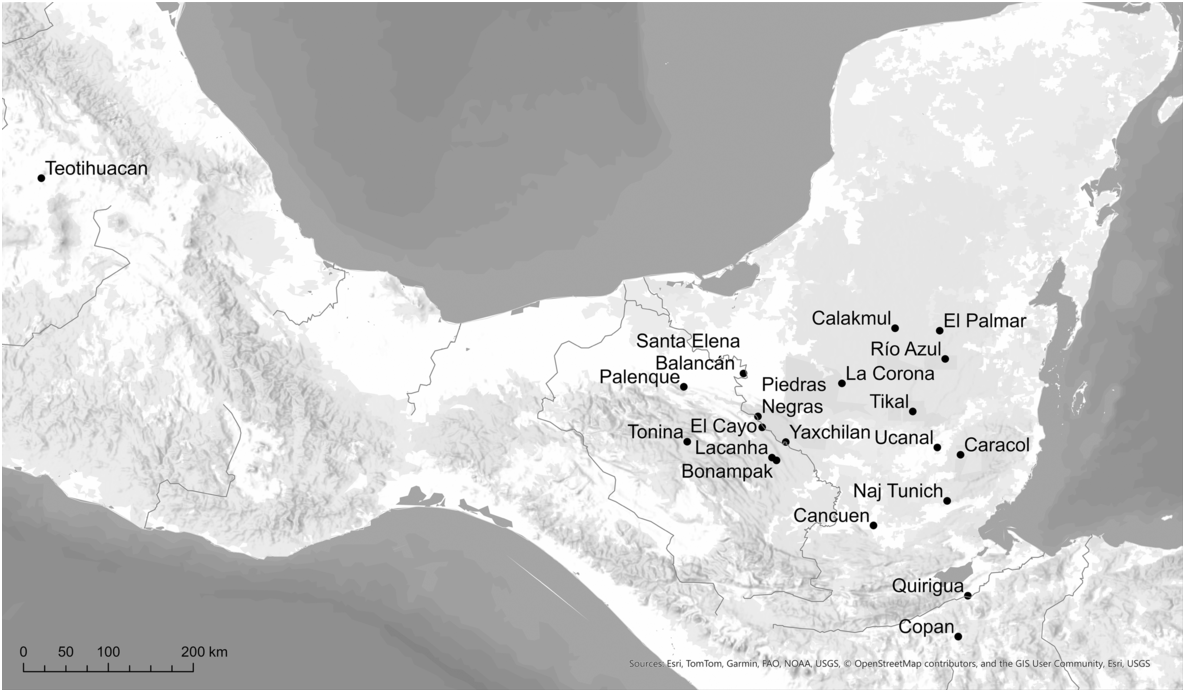
Drawing on two examples from different corners of the lowlands, I propose that elite ritual and scribal practice were disseminated through interactions that had concurrent or complementary religious and diplomatic functions. The first case concerns an unusual helmet that was introduced to the western Maya region from distant Teotihuacan in central Mexico (Figure 5.1). The arrival of representatives from that metropolis to the lowlands in the late fourth century marked a watershed in Classic Maya political and social history, and Teotihuacan’s cultural influence remained palpable for centuries after the far-away polity had itself declined by the mid-sixth century.Footnote 2 Initially adopted during the Early Classic period as an emblem of affiliation with the foreign power, the Teotihuacano headgear was eventually adapted by Late Classic kings to symbolize intra-Maya hierarchical relations – between polities, within a kingdom, or through dynastic succession. The artifact’s semantic transformation also coincided with its physical and symbolic dissemination, as artisans produced their own versions of the helmet locally and scribes innovated hieroglyphic spellings for denoting the object in text.
Teotihuacan in central Mexico and major Classic Maya sites in the western, central, and southeastern lowlands.
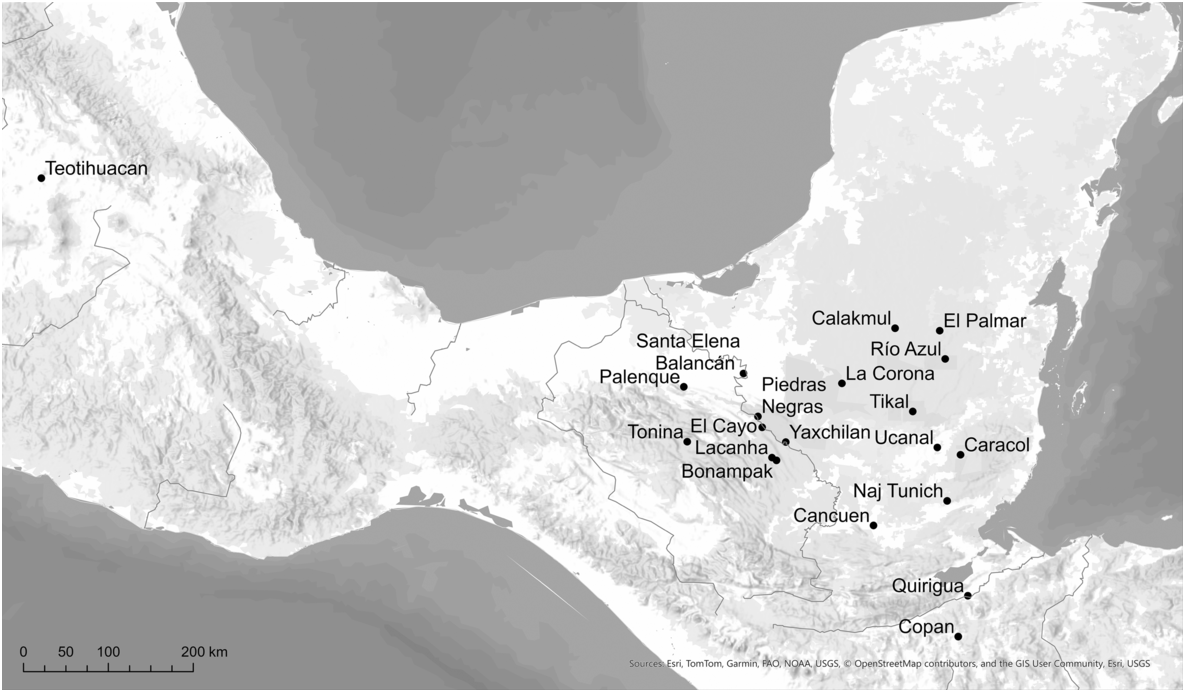
The second example involves a minor polity in the central lowlands, El Palmar, whose rulers dispatched sub-royal officials to perform rituals with representatives from other polities (Figure 5.1). Some El Palmar affiliates were involved in ceremonies conducted at the pilgrimage cave site of Naj Tunich in eastern Guatemala, where they interacted with pilgrims of distinct political backgrounds and witnessed at least one ritual that was likely foreign to their home polity. What distinguishes El Palmar’s participation in interpolity exchange, however, is the kingdom’s unique record of a local official’s journey to meet with the king of Copan. The official memorialized the diplomatic encounter upon his return home to El Palmar by commissioning a hieroglyphic stairway that documents his encounter not only with the southeastern polity’s sovereign but with its patron gods, too, whose identities are otherwise almost unknown outside of Copan. The format of the monumental stairway and details of its inscription suggest that, although some scribe-sculptors may have been part of the mission, others learned about the foreign gods and their king secondhand from members of the traveling party.
Together, the two instances of ritual diplomacy highlight the role that religion played in interactions that scholars so often couch in purely political terms, including the scribal transmission that these encounters surely facilitated. Such contexts can be characterized as instances of what I call “ritual diplomacy” within and between polities, borrowing from Mary Miller and Claudia Brittenham’s argument that Yaxchilan-based and trained artists went to work at other sites within the royal court’s sphere of influence in an exercise of “artistic diplomacy.”Footnote 3 Ritual diplomacy thus refers to interpolity exchanges that entailed joint participation in religiously salient practices, which may have included engaging local gods or observing a major calendric milestone. Regardless of whether ritual cooperation motivated the interpersonal encounter or was a byproduct thereof, the fact that it was documented in hieroglyphic writing indicates that it was, in hindsight, a defining experience for at least one participating party.
By bringing together affiliates of different dynasties for joint performance, ritual diplomacy facilitated circulation of knowledge about religion and hieroglyphic-material production among Classic Maya elites of diverse political affiliations. Although their names are omitted from hieroglyphic records of ritual diplomatic encounters, scribe-artists probably traveled as part of royal and sub-royal elite entourages on some interpolity journeys. Those who did not leave their home kingdom, in turn, would have profited from insights into other modes of writing, visual representation, and crafting by conversing with returnees or engaging objects brought back with them. Importantly, too, the case studies in this chapter intimate that cultural exchange was not necessarily dependent on the quality or longevity of interdynastic relations, such that ritual and scribal-artistic ties could outlast or supersede the political affiliation that initially facilitated them. This perspective certainly complicates our efforts to understand dynamics of ritual transmission. But it also opens the door to a more nuanced understanding of Classic Maya history, one that contests the precedence that politics is often afforded in our narratives despite its practical inseparability from religion.
Crowning Authority: Teotihuacan, Piedras Negras, and Palenque
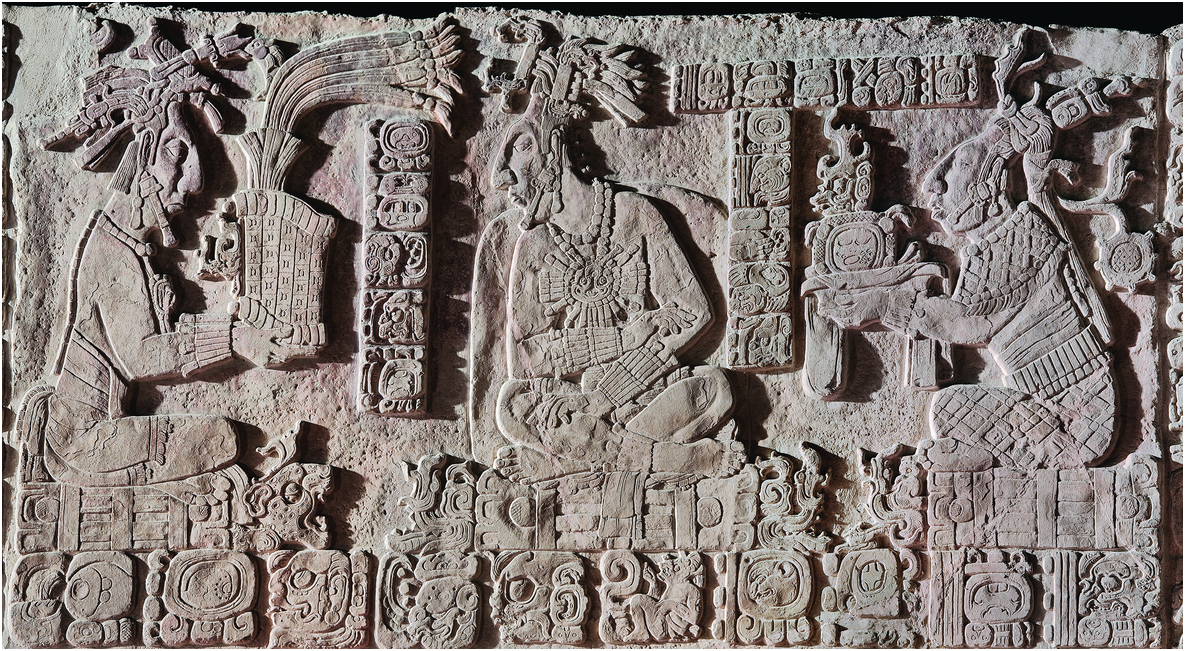
On 9.11.6.2.1 (October 22, 658), Itzam K’an Ahk III welcomed a cohort of prominent visitors to his royal court at Piedras Negras, Petén, Guatemala, where the 32-year-old had already been ruling for almost a full k’atun (Figure 5.1).Footnote 4 Under the watchful eyes of his patron gods, the Piedras Negras king “grasp[ed]” (ch’amaw) five helmets plated with shell mosaic in the style of far-off Teotihuacan.Footnote 5 The only surviving record of the event, a monument now known as Panel 2, does not explain what Itzam K’an Ahk III subsequently did with the distinctive pieces of headgear, a type known as ko’haw (Figure 5.2). Given the quantity of helmets, he may have distributed them as gifts among the patron gods or other attendees. Nor does Panel 2 record what else was said or done at the event, or who besides the gods was present.
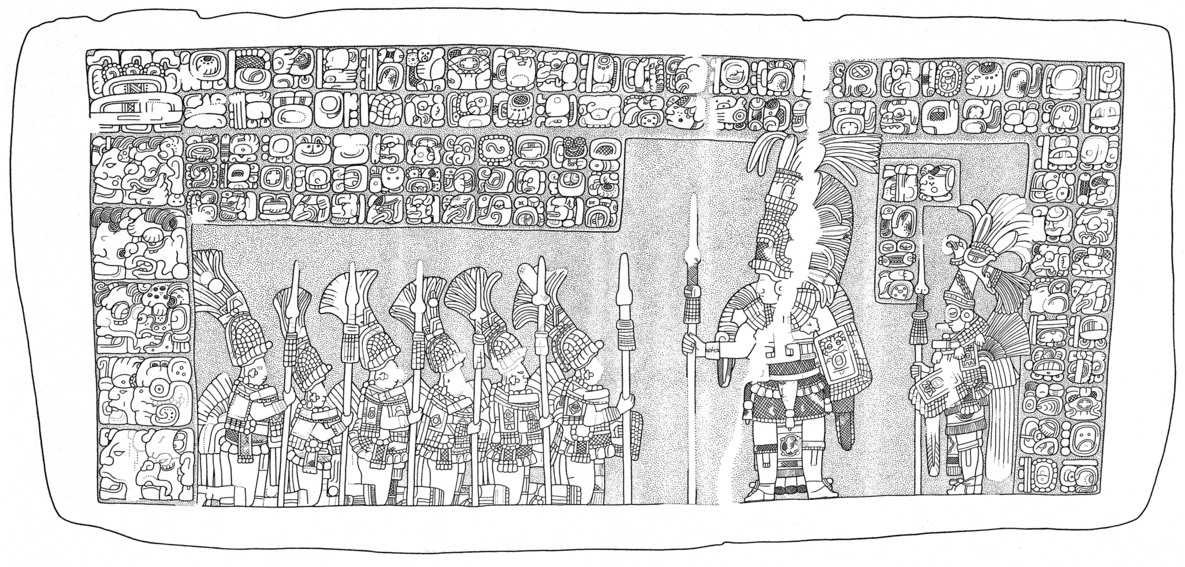
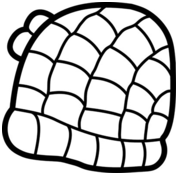
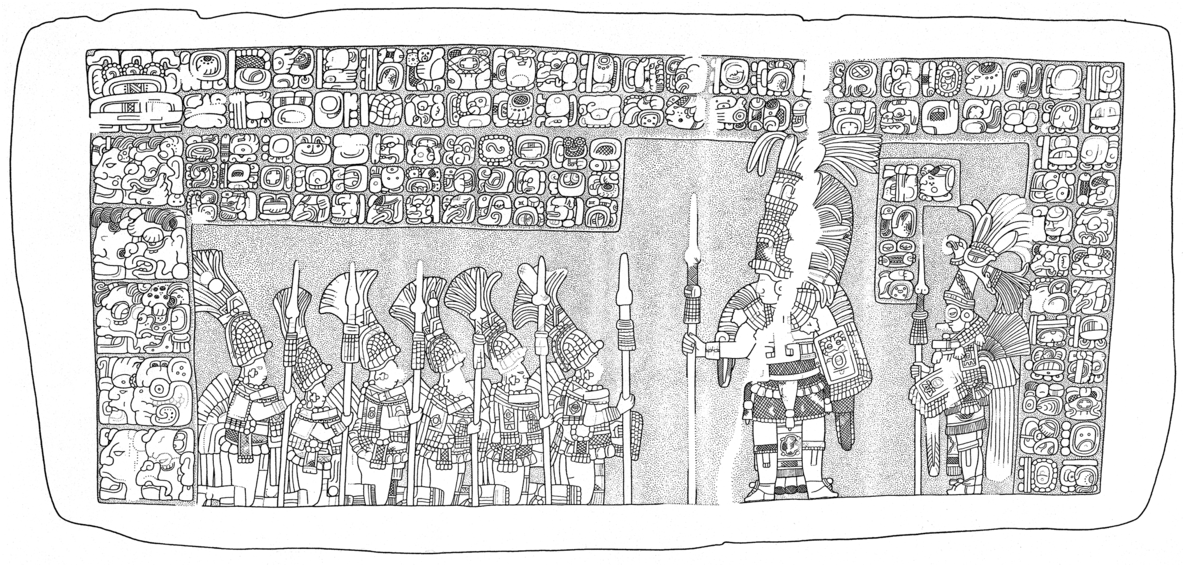
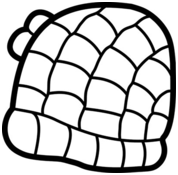
What the carved stone does indicate, however, is that with his actions, Itzam K’an Ahk III was following a ritual precedent set by a long-deceased predecessor who had received his own ko’haw almost a century and a half earlier, albeit under very different political circumstances. Retrospection was such a prominent component of Itzam K’an Ahk III’s performance that he commissioned the sculptors of Panel 2 to contextualize his own ko’haw-grasping within a prior iteration of the ceremony that had taken place on 9.3.16.0.5 (November 12, 510) (Figure 5.2). Thus, it is not Itzam K’an Ahk III but the early sixth-century Piedras Negras king Yat Ahk II who occupies the fore in Panel 2’s central image.Footnote 6 Adorned in a towering Teotihuacan-style headdress and draped in an ornate collar ringed with bright feathers and Spondylus shells, Yat Ahk II grasps a spear and shield as a sextet of representatives from Lacanha, Yaxchilan, and Bonampak kneel before him. All six visitors are similarly outfitted as warriors and sport helmets that, other than the apical feathers, are essentially identical to the logograph KO’HAW in the text above them (Figure 5.3).Footnote 7
The Classic Maya logograph KO’HAW (T0678st) as written on Piedras Negras Panel 2 (see block G2 in Figure 5.2).
Behind Yat Ahk II stands K’an Joy Chitaam, a ch’ok ajaw (“prince”) whose features are barely discernible underneath his ornate, adolescent-sized outfit (Figure 5.2).Footnote 8 Although lacking a ko’haw of his own, the youth wears large, round circles or “goggles” around his eyes, an accessory characteristic of Teotihuacan that evoked the central Mexican storm god.Footnote 9 K’an Joy Chitaam’s presence at the performance would seem to imply that he was Yat Ahk II’s intended heir, yet the boy is not mentioned again at Piedras Negras and may never have acceded to the throne (Figure 5.2).Footnote 10
From Teotihuacan to Piedras Negras
Panel 2 commemorates two ko’haw-grasping ceremonies at Piedras Negras that occurred over 140 years apart. Much more than simple presentations of military gear, the events were important ritual moments that confirmed the respective king’s dynastic authority. Yet the hieroglyphic narrative suggests that the source of that authority shifted over time. Yat Ahk II’s performance in 510 was witnessed by a powerful individual named Tajom Uk’ab Tuun, whom the text identifies as a kaloomte’, the highest-ranking title in the Classic Maya lowlands.Footnote 11 No more information is provided about the figure, who is named in the inscription but absent from Panel 2’s carved scene; however, the kaloomte’ label’s inclusion in the seventh-century text signals the bearer’s enduring status as a legitimating force for the Piedras Negras dynasty, even generations after his death.Footnote 12
Tajom Uk’ab Tuun’s influence at Piedras Negras was probably derived at least in part from his prestigious origin. The inscription on a wooden box found somewhere north of Piedras Negras in the state of Tabasco, Mexico, confirms that the ochk’in (“western”) designation prefixed to Tajom Uk’ab Tuun’s kaloomte’ title reflects his roots in distant Teotihuacan.Footnote 13 Tajom Uk’ab Tuun is also cited on another Piedras Negras monument, Panel 12, as having attended a scattering ritual on 9.4.0.0.0 (October 17, 514) performed by the local king, whom epigraphers have nicknamed Ruler C as long as his name remains undeciphered.Footnote 14 In a clear statement of political subordination, Panel 12 identifies Ruler C not as the k’uhul ajaw (“holy lord”) of Piedras Negras but as the yajaw (“vassal”) of the foreign ochk’in kaloomte’.Footnote 15 The fact that the Teotihuacan affiliate attended at least two royal rituals at early sixth-century Piedras Negras, in a span of less than four years, attests to the depth of his and more generally Teotihuacan’s impact on the western kingdom.
The original ko’haw-grasping ceremony at Piedras Negras in 510 was performed under the auspices of a powerful visitor representing far-off Teotihuacan. By 658, however, Itzam K’an Ahk III was confident enough in his political identity to conduct the same ritual before local patron deities whose role as witnesses – perhaps even as actors presenting the helmetsFootnote 16 – recursively drew upon and reinforced the king’s privileged relationship with them.Footnote 17 It is noteworthy, too, that Panel 2’s central scene of the sixth-century ritual does not feature a portrait of Tajom Uk’ab Tuun, although the surrounding text alludes that, as a witness, he played a more significant role in the ko’haw-grasping ceremony than the emissaries from Lacanha, Bonampak, and Yaxchilan. By deemphasizing the foreigner’s presence in their monumental comparison of Itzam K’an Ahk III’s act with Yat Ahk II’s earlier performance, the sitting king’s sculptor-scribes reoriented the historical narrative to center local dynastic sovereignty, even as the dress of the characters in Panel 2’s scene put Piedras Negras’s Teotihuacan connections on full display.Footnote 18
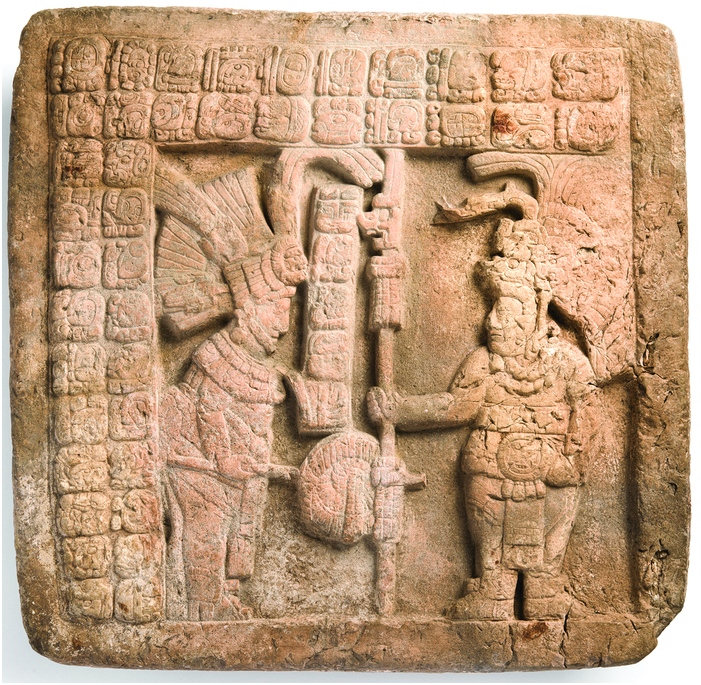
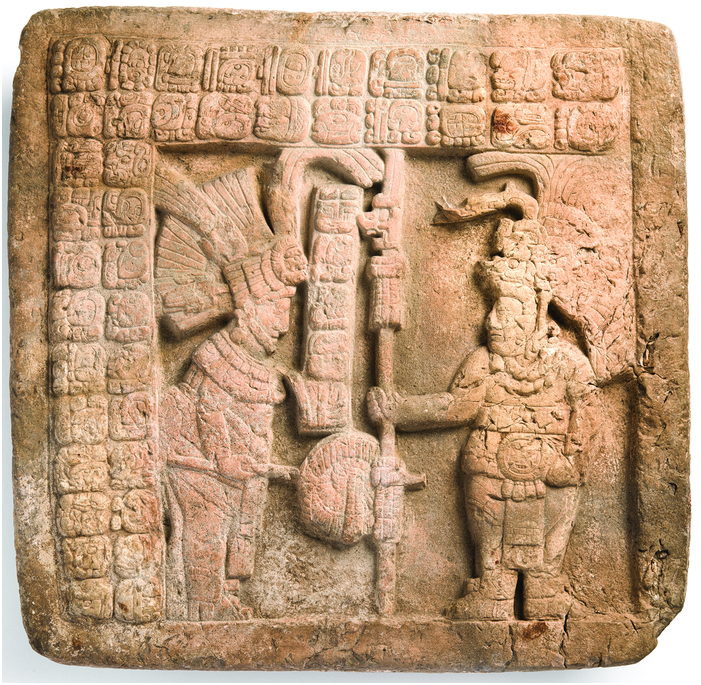
Symbolic domestication of the ko’haw is also evident in the only other known reference to the headgear from the Piedras Negras kingdom, written on an unprovenanced panel that was dedicated on 9.12.15.12.9 (December 17, 687) (Figure 5.4).Footnote 19 The limestone stab documents some sort of ceremony on 9.12.13.4.3 (July 14, 685) in which a warrior-representative of Yuknoom Ch’een II, the powerful Kaanul king at Calakmul, “adorned” (nahwaj) Itzam K’an Ahk III with a “pelt” (nuk) and a ko’haw.Footnote 20 In this case, however, neither the helmet – maybe one of the five that the Piedras Negras king had grasped more than two decades earlier? – nor its presenter appears in the central illustration. Instead, the scene shows Itzam K’an Ahk III with a sajal, K’an Xook, who was probably from El Cayo.Footnote 21 There is no reference on the panel, even indirectly, to Teotihuacan. Instead, the shell-plated helmet symbolizes authority conferred by one Classic Maya dynast upon another.
Itzam K’an Ahk III (right), king of Piedras Negras, and K’an Xook, a sajal probably from El Cayo (left), appear together on an unprovenanced limestone panel from the Piedras Negras region.
The introduction of the ko’haw-grasping ritual at early sixth-century Piedras Negras was one episode in what was clearly a more extended exchange among scribe-artists. The most visible outcome, however, was the proliferation of Teotihuacan-style imagery in local monumental sculpture. This phenomenon was not unique to Piedras Negras, although it did distinguish the kingdom from its neighbors in the western lowlands.Footnote 22 Even during the Late Classic period, sculptors integrated motifs of Teotihuacan origin into monumental representation to evoke collective memory of the once-powerful, distant civilization and to emphasize the militaristic component of local dynastic authority.Footnote 23 The conical ko’haw belonged to this larger iconographic program. However, the type of Teotihuacano plated headgear preferred among rulers at Piedras Negras, as at Copan, Tikal, and other major Classic Maya sites, featured the Teotihuacan war serpent, whose open jaws often framed the wearer’s face.Footnote 24 It is this war serpent helmet, in fact, that Yat Ahk II wears on Panel 2, in contrast to the feathered ko’haw crowning each kneeling visitor’s head (Figure 5.2).Footnote 25
Beyond the iconographic adaptations, Piedras Negras scribe-artists also developed hieroglyphic practices to accommodate the shell-plated helmet and rituals surrounding it. That exchange resulted in innovation of two strategies to record the foreign word, both of which appear in texts composed to document the “grasping” ritual in which the helmet was used. In most cases, scribes recorded the Teotihuacano artifact’s presence at the royal court phonetically as ko-(o-)ha-wa. The spelling’s unusual structure – with three to four syllabic signs in a row – and its relative frequency in the Piedras Negras area – at least three occurrences in two different texts – strongly hint that the word ko’haw, like the headgear that it denoted, was imported from outside the Maya region.Footnote 26 By the time of Panel 2’s dedication on 9.11.15.0.0 (July 26, 667), Piedras Negras scribes had also innovated a logograph KO’HAW that represented an icon of the object (Figure 5.3).
Then there is, of course, the ko’haw itself as a physical object. Likely brought to the Usumacinta River Valley all the way from Teotihuacan, the first shell-plated helmet presented to Yat Ahk II materialized the foreign culture’s presence and influence. It would have attested very literally to the technologies and materials with which it had been made, some of which may have been unfamiliar to artisans at Early Classic Piedras Negras. It is unclear whether, during the 658 event, Itzam K’an Ahk III grasped the original helmet inherited from his Early Classic predecessor or a newer iteration. Unlike other dynastic heirlooms that have been excavated from royal tombs at Piedras Negras,Footnote 27 there is no known archaeological correlate to the mosaic helmet portrayed in local imagery. Remains of a Spondylus shell–plated headdress have been recovered alongside other Teotihuacan-associated paraphernalia in royal tombs at Copan and Tikal, for example, but it is unclear whether they originally took the form of a ko’haw, a war serpent helmet, or something else.Footnote 28 Nonetheless, Panel 2’s inscription does suggest that no fewer than five headpieces – at least some of which were presumably local reproductions of a foreign original – were dispensed at Piedras Negras in 658. The monument’s portrayal of attendees at the 510 performance each wearing their own ko’haw hints that a similar distribution may have taken place in the past, too (Figure 5.2).
Long after direct contact with Teotihuacan had ceased, materials, practices, and ideas concerning the ko’haw continued to circulate throughout the Late Classic Maya lowlands. Other dynasties also integrated the helmet into their regalia, raising the possibility that artisans at Piedras Negras crafted and circulated their own iterations of it. Martin has suggested that the plated helmet that the king of Lacanha is shown wearing on his site’s Stela 7 in 593 may have been, if not the same one received by Yat Ahk II of Piedras Negras, a local creation modeled on that initial, foreign gift.Footnote 29 Similar gear appears on Monument 181 at Tonina, where it graces the head of a figure – likely a young K’inich Bahlam Chapaht, prior to his accession as Tonina’s king – seated at the feet of a local noble.Footnote 30 The scene retroactively commemorates the latter’s appointment under the prince’s supervision as ti’sakhu’n (“speaker of/for the white headband”), but the accompanying text does not indicate what role, if any, the ko’haw played in the ceremony, which took place sometime between 615–618.Footnote 31
A helmet of the same style is mentioned as far away as La Corona, Petén, Guatemala, where a syllabic spelling of uko’haw (u-ko-o-ha-wa) “his/her/its ko’haw” on the early to mid-eighth-century Hieroglyphic Stairway 2 denotes the object of an event whose main sign remains undeciphered.Footnote 32 There is no historical evidence for direct interaction between La Corona and Piedras Negras, and the fact that the La Corona rendering features an unusual ha syllable that was not used in the Piedras Negras kingdom before the late eighth century – and never appears in a ko’haw spelling there – hints that the central lowland scribes had not seen for themselves how their western counterparts wrote the foreign word.Footnote 33 A better candidate for transmitting the term ko’haw to La Corona is its long-time overlord Calakmul, given that a Kaanul dynastic representative had adorned Itzam K’an Ahk III with one such helmet a generation or two prior to the dedication of Hieroglyphic Stairway 2 at La Corona (Figure 5.4). Even if scribes there did not encounter the KO’HAW logograph, they acquired the foreign word, the syllabic strategy for spelling it, and perhaps even an image or actual exemplar of the Teotihuacan-style helmet that was better known in the western lowlands.
From Piedras Negras to Palenque
As an artifact and as a symbol, the ko’haw did not remain unique to Piedras Negras. By the early seventh century, the ruling dynasty at Palenque, Chiapas, Mexico, had also adopted the mosaic headgear (Figure 5.1). Most likely, the move was inspired by their rivals ninety kilometers to the southeast at Piedras Negras. That kingdom’s Stela 26 memorializes K’inich Yo’nal Ahk I’s capture of a captive from Palenque in 624, and the two polities clashed again in 662 over the strategically located settlement of Santa Elena Balancán in eastern Tabasco, a confrontation in which Piedras Negras enjoyed the backing of the powerful Kaanul dynasty.Footnote 34 There are few historical references to direct contact between the two kingdoms, yet their proximity and competing regional interests make it highly likely that members of one royal court would have been aware of major happenings in the other. High-ranking visitors from Palenque may have even witnessed the Piedras Negras king wearing his ko’haw or viewed references to it on Panel 2, although the location where the monument was originally displayed, prior to its late eighth-century resetting in Str. O-13, remains unknown.Footnote 35
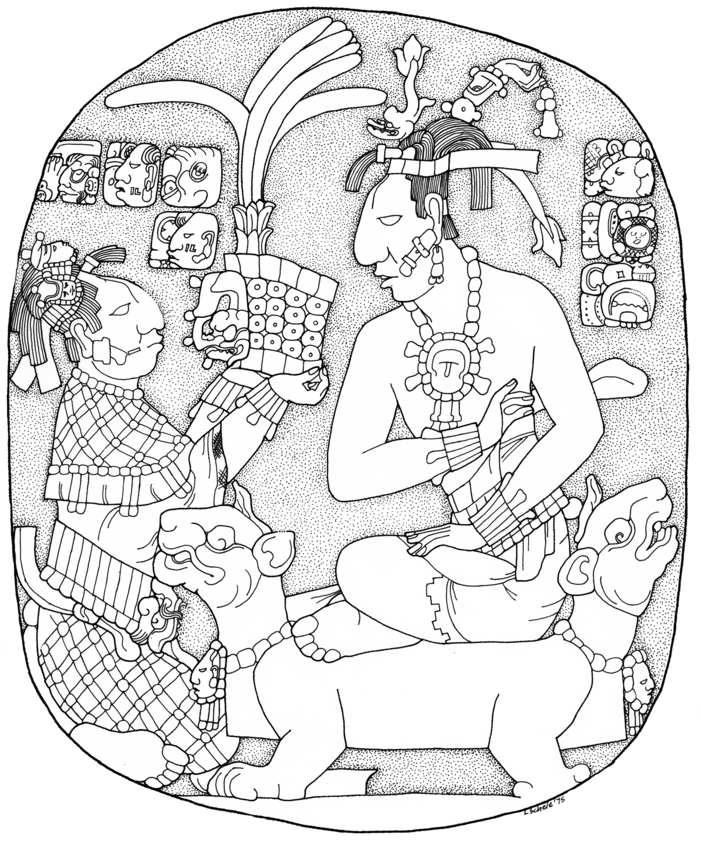
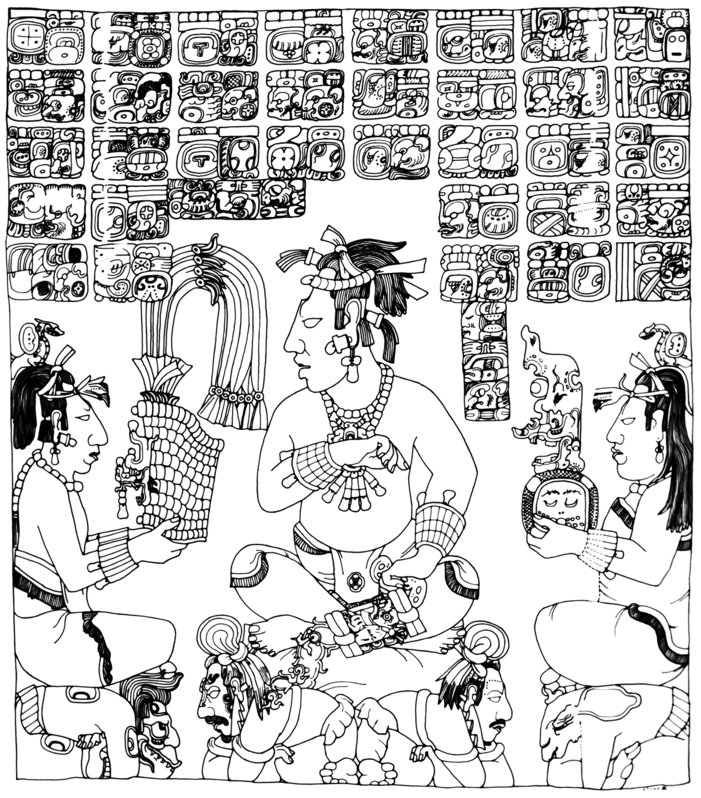
Around the same time that Palenque kings began incorporating the artifact into their dynastic rituals, scribe-artists at that center also adopted the logograph KO’HAW from their peers at Piedras Negras. At the latter site, the plated helmet is mentioned in several hieroglyphic inscriptions but seldom illustrated; the scene on Panel 2 is the only major exception (Figure 5.2). At Palenque, in contrast, a ko’haw features prominently in at least four monumental scenes, including three that show a king receiving emblems of rulership from one or both parents.Footnote 36 The earliest such illustration is carved on the Oval Palace Tablet, a retrospective, mid-seventh-century commemoration of K’inich Janaab Pakal I’s accession ceremony in 615, during which he received a mosaic-plated helmet topped with quetzal feathers from his mother, Ix Sak K’uk’ (Figure 5.5).Footnote 37 The headdress is embellished on one side with an ornament representing a fish-like, divine profile and features a domed rather than flat top; otherwise, however, the Palenque version is very similar in form and construction to the ko’haw represented at Piedras Negras.Footnote 38
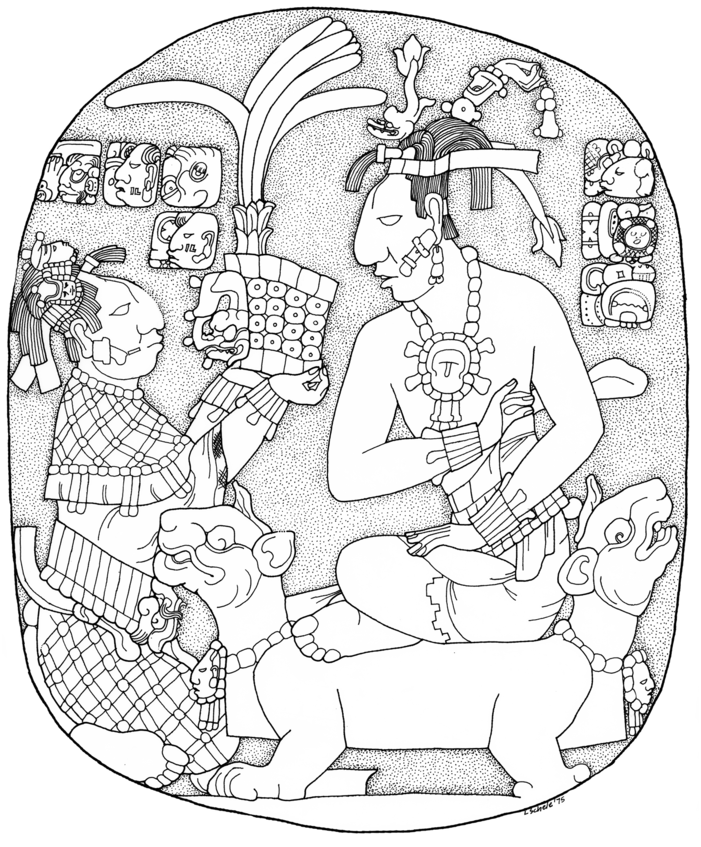
Unlike at Piedras Negras, the ko’haw is never mentioned in direct connection with an outside power at Palenque, where Teotihuacan imagery was also generally more muted.Footnote 39 By the end of K’inich Janaab Pakal I’s reign, the helmet had even been integrated into local mythology and linked to the dynasty’s primordial, expressly local origins. A lengthy narrative inscribed across three walls in the so-called Temple of the Inscriptions, K’inich Janaab Pakal I’s funerary pyramid that was dedicated on 9.12.11.12.10 (January 8, 684), includes a passage contextualizing the king’s biography with the Palenque patron gods’ actions in the deep past.Footnote 40 It describes a series of bundles (ikaatz), one for each of five patron deities, that held the respective god’s ornaments, including an earflare, a beaded necklace, a ko’haw, and the white paper headband worn by Classic Maya kings as a symbol of rulership.Footnote 41 The gods “give” (yak’aw) their ornaments in succession as part of a longer, intricate sequence of events that remains difficult to interpret.Footnote 42 In any case, the Teotihuacan-style headgear seems to occupy a special place among the accoutrements, since it is listed as the final piece of each god’s assemblage.Footnote 43 Moreover, the helmets are enumerated individually, one for each god, at the very beginning of the passage. This emphatic sequence is not reiterated for the other ornaments, which are only mentioned when they are distributed to the deities.
With the dressing ritual recounted along the inner walls of the Temple of the Inscriptions, Palenque’s patron gods had long ago laid the foundation for the Late Classic accession ceremonies of K’inich Janaab Pakal I and his descendants, during which the ko’haw and other material insignia were presented to the incoming sovereign.Footnote 44 Unlike at Piedras Negras, however, no one at Palenque is ever illustrated wearing the shell-plated helmet.Footnote 45 Instead, the headpiece may have been wrapped with other insignia of rulership in a sacred bundle that was opened only at the accession ceremony and on other ritual occasions.Footnote 46 Although the ko’haw is never explicitly mentioned in hieroglyphic texts in connection with a Palenque ruler, monumental imagery attests that it had become a local symbol of royal authority whose reception marked a new king’s ascent to the throne. The artifact itself may even have become something of an heirloom, with each ruler passing it down to the next generation. Scribe-artists, in turn, adapted innovations from Piedras Negras to document the plated helmets and their exchange in hieroglyph and image.
Another scene on the Palace Tablet, dedicated on 9.14.8.14.15 (August 11, 720), portrays K’inich Janaab Pakal I handing what was likely the same ko’haw that he had received several decades earlier to K’inich K’an Joy Chitaam II on the occasion of his accession on 9.13.10.6.8 (May 31, 702) (Figure 5.6).Footnote 47 K’inich Janaab Pakal I had been deceased for nearly twenty years at that point, but his presumed participation in his son’s ceremony reflects a long tradition at Palenque of rooting dynastic authority in godly and ancestral ties.Footnote 48 The Palace Tablet’s retroactive portrait emphasizes that the new king, at age fifty-seven, had finally received the emblems of dynastic authority – not from his older sibling and immediate predecessor, K’inich Kaan Bahlam II, but from their father and their mother, Ix Tz’akbu Ajaw.Footnote 49 In the robust program of texts and imagery commissioned by K’inich Kaan Bahlam II, in contrast, there is no indication that the elder brother ever received the same ko’haw.
K’inich K’an Joy Chitaam II (center) accepts a shell-plated ko’haw from his father, K’inich Janaab Pakal I (left), and flint blade and round shield from his mother, Ix Tz’akbu Ajaw (right), upon his accession as king. Detail from the Palenque Palace Tablet.
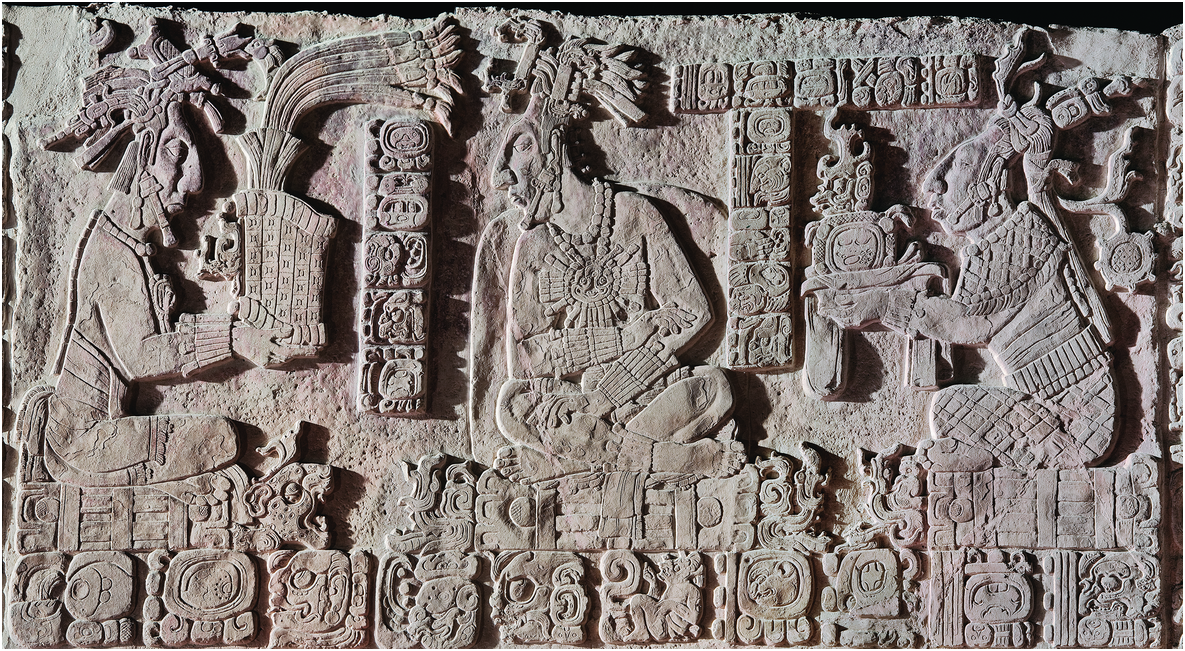
The single column of hieroglyphic text between K’inich K’an Joy Chitaam II and the ko’haw also records the primordial birth of the so-called Jester God or Ux Yop Hu’n, “the animate essence of paper” whose effigy pendant graces one side of the headdress in each of its four portraits at Palenque.Footnote 50 Affixing the ornament representing Ux Yop Hu’n’s profile to the ko’haw adapted the mosaic helmet – an originally Teotihuacano artifact – to Classic Maya political symbolism, given that the Jester God pendant represented divine kingship for many dynasties across the lowlands. It also integrated the shell-plated headpiece into local narratives at Palenque. There, dynasts put particular emphasis on Ux Yop Hu’n’s role in dynastic legitimation and commissioned a unique record of the other-than-human being’s birth and naming ceremony, events that offered a primordial template for the headband’s presentation at a Classic Maya accession.Footnote 51
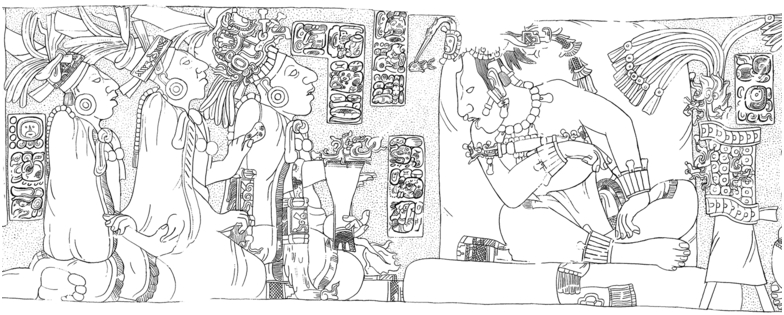
The ko’haw affixed with Ux Yop Hu’n’s pendant remained a symbol of dynastic continuity at Palenque for at least another generation after K’inich K’an Joy Chitaam II’s reign. The latest illustration of the helmet being presented to a ruler appears on the so-called Tablet of the Slaves, a monument dedicated on 9.14.18.9.8 (March 5, 730) that includes portraits of three seated figures below the hieroglyphic text (Figure 5.7). As in scenes of earlier accession ceremonies at Palenque, the incoming king, K’inich Ahkal Mo’ Nahb III, occupies center stage and is flanked by his mother and father, who pass him the standard emblems of local kingship.Footnote 52 His father, Tiwol Chan Mat, may have been a third son of K’inich Janaab Pakal I who never had a chance to take the throne before passing away in 680.Footnote 53 Still, the deceased prince not only joins but plays a critical role in the retrospective illustration of his son’s accession ceremony on 9.14.10.4.2 (December 31, 721).Footnote 54
A retrospective illustration on the Tablet of the Slaves at Palenque shows K’inich Ahkal Mo’ Nahb III (center) receiving a shell-plated helmet from his father, Tiwol Chan Mat (left), and a flint blade and round shield from his mother, Ix Kinuuw (right), upon his accession as king.
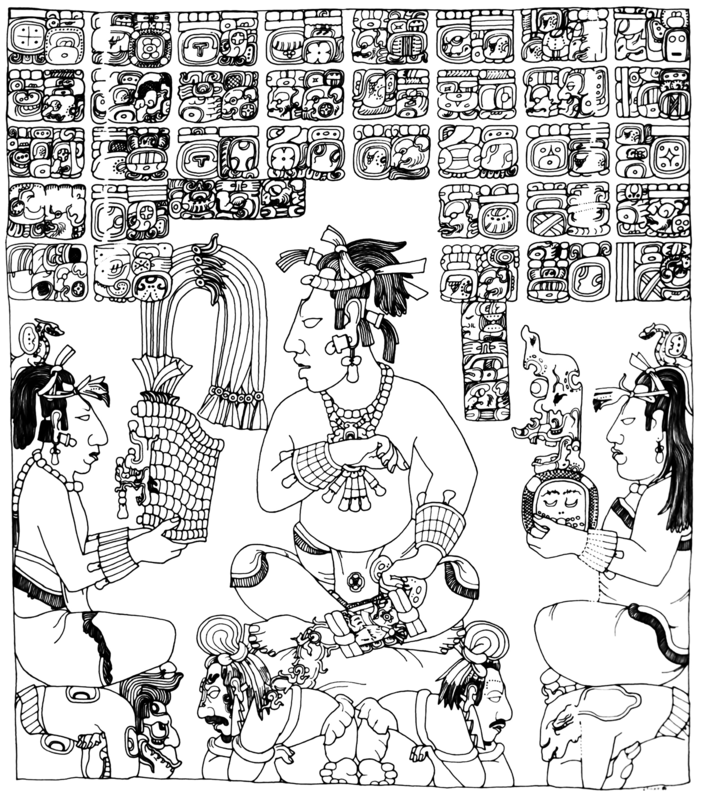
Tiwol Chan Mat’s place in his son’s accession scene suggests that K’inich Ahkal Mo’ Nahb III located his claim to the throne in his father’s heritage and especially with his paternal grandfather, K’inich Janaab Pakal I, rather than in the avuncular connection with his immediate predecessor, K’an Joy Chitaam II.Footnote 55 The plated helmet that Tiwol Chan Mat carries is, except for a small tassel dangling from the nose of the effigy pendant, essentially identical to the one that K’inich Janaab Pakal I and K’inich K’an Joy Chitaam II had previously received (Figure 5.7; compare Figure 5.6). Like earlier monumental illustrations of accession, the one on the Tablet of the Slaves signals that the object presented to K’inich Ahkal Mo’ Nahb III was the same one that his grandfather and uncle had received upon their own installations on the throne.
The royal ko’haw does make at least one more appearance at Palenque, however, in a scene carved into the south face of the Temple XIX platform to mark the 9.15.5.0.0 period-ending (July 23, 736) (Figure 5.8).Footnote 56 It illustrates another ceremonial stage in K’inich Ahkal Mo’ Nahb III’s accession that had taken place almost fifteen years earlier in 721.Footnote 57 In this scene, K’inich Ahkal Mo’ Nahb III impersonates a god known as GI, one of Palenque’s three most important patron deities and among those who had received his own ko’haw in the ancient past, according to the Temple of the Inscriptions narrative.Footnote 58 The Temple XIX platform text even narrates GI’s own enthronement in primordial times, creating an explicit parallel with K’inich Ahkal Mo’ Nahb III’s experience millennia later.Footnote 59
K’inich Ahkal Mo’ Nahb III (right) sits on his throne facing Janaab Ajaw (left), an attendant who presents him with the royal headband. Note the shell-plated ko’haw on a tripod stand at the far right, immediately to the king’s left. Detail from the south face of Temple XIX platform at Palenque.
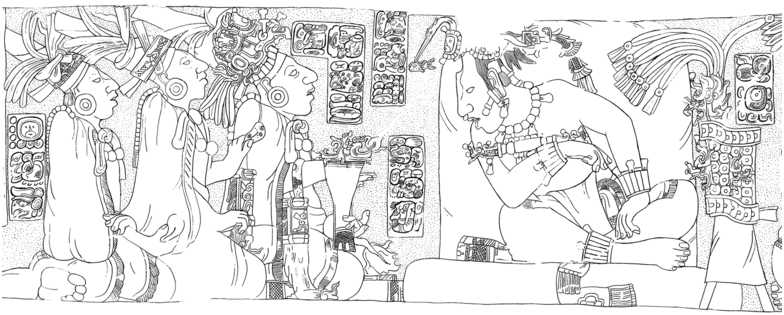
Instead of his (deceased) parents, however, K’inich Ahkal Mo’ Nahb III is surrounded on the Temple XIX platform panel by six attendants. One of them, a man named Janaab Ajaw who is impersonating God D and may be a cousin of the recently installed ruler, offers up the white paper headband of divine kingship (Figure 5.8).Footnote 60 This ritual apparently followed the ko’haw presentation recorded on the Tablet of the Slaves, given that K’inich Ahkal Mo’ Nahb III has already received the mosaic helmet, which sits on a tripod stand next to his throne. It thus seems that presentation of the headband was quite literally something of a crowning moment for the new king. The distinctive appearance of the ko’haw here supports this interpretation. Other than a handful of additional feathers on the top and a second fish-like pendant on the side, this helmet differs from those illustrated in earlier accession events by virtue of an additional Jester God pendant nestled at the base of the feathers.Footnote 61 The dynastic piece’s profile, like the king himself, faces toward the viewer’s left, in the direction of the analogous Jester God ornament on the headband that K’inich Ahkal Mo’ Nahb III is poised to receive (Figure 5.8).
Taken together, the four Palenque monuments represent three generations of dynastic rulership, with each transition symbolized by the passing of a shell-plated helmet between patrilineal generations. Introduced into the Maya lowlands from Teotihuacan, the ko’haw was initially adopted at Piedras Negras as an emblem of affiliation with a distant hegemon. Even in the seventh century, well after distant Teotihuacan’s collapse, the headpiece had not lost its foreign connotations. Those associations had retreated into the semiotic background, however, and been replaced by Late Classic Maya concerns about political legitimation within and between kingdoms. It was in this context that the ruling dynasty at Palenque, apparently beginning with K’inich Janaab Pakal I, integrated the ko’haw into the early stages of a royal accession ceremony that would become typical of, if not unique to, this western kingdom. There, the shell-plated helmet represented patrilineal succession in an accession ritual modeled on divine precedent, namely the ceremonial dressing of the local patron gods in primordial times.
Integration of the ko’haw into Palenque’s dynastic identity was also the work of scribe-artists who were tasked with representing the ritual object in word and image, not to mention the craftspeople responsible for making and maintaining the mosaic headpiece itself. Besides Piedras Negras, Palenque is the only place where the logograph KO’HAW is attested. As it appears in the central panel of the Temple of the Inscriptions text, the sign resembles the hieroglyph innovated at Piedras Negras much more closely than the more cylindrical helmet illustrated on Palenque’s monuments (Figure 5.3).Footnote 62 It thus provides compelling evidence that scribes at the latter center had acquired the novel logograph directly from peers at the former. Palenque scribes learned from and maintained mutual intelligibility with the existing hieroglyphic tradition of ko’haw documentation that had originated at Piedras Negras, even as artisans and their kings modified the material helmet to meet the Palenque dynasty’s ritual and symbolic needs.
Sharing Gods: El Palmar, Naj Tunich, and Copan
In the case of the ko’haw in the western lowlands, iconographic and epigraphic sources provide evidence of scribal and artistic exchange prompted by an object introduced from Teotihuacan – an object whose ritual presentation established relations of political and divine authority. Yet we are unable to reconstruct the moments or persons through which materials, symbols, and ideas surrounding the shell-plated helmet circulated between Piedras Negras, Palenque, and other Maya polities such as Calakmul and La Corona. The second example of ritually motivated travel is more complex, involving a wider range of religious contexts and actors. But in this case, we have a somewhat clearer picture of the who, where, and when of the co-exchange of ritual and scribal practice, even though there is comparatively little information about that exchange’s material implications.
El Palmar, a modest Classic Maya polity located in the southeastern corner of what is now the Mexican state of Campeche, was governed by a series of rulers who carried a simple ajaw title, without the “divine” (k’uhul) prefix, yet maintained contacts with some of the most powerful dynasties in the lowlands (Figure 5.1).Footnote 63 Much activity centered on relations with the Kaanul dynasty, which seems to have been El Palmar’s major associate or sponsor throughout the Late Classic period.Footnote 64 The first record of religious-political engagement with Calakmul dates to the reign of Yuknoom Ch’een II (636–686), who, according to the inscription on Calakmul Stela 12, participated in a dance with the local ruler at El Palmar.Footnote 65
Pilgrimage to Naj Tunich
By the seventh century, El Palmar was already integrated into the Kaanul orbit through ties negotiated in part through collaborative ritual performance. Its rulers were also sponsoring religiously motivated travel to more distant locales, most notably to the Naj Tunich cave complex, where an abundance of texts and imagery painted on its walls make it the epigraphically best-documented pilgrimage site in the lowlands (Figure 5.1).Footnote 66 Upakal K’inich, who governed El Palmar in the early eighth century, is one of only a few Classic Maya rulers whose name was recorded in the cave, and hieroglyphic records there and at El Palmar indicate that ritual diplomacy was an important component of cultural and political exchange during his reign.Footnote 67
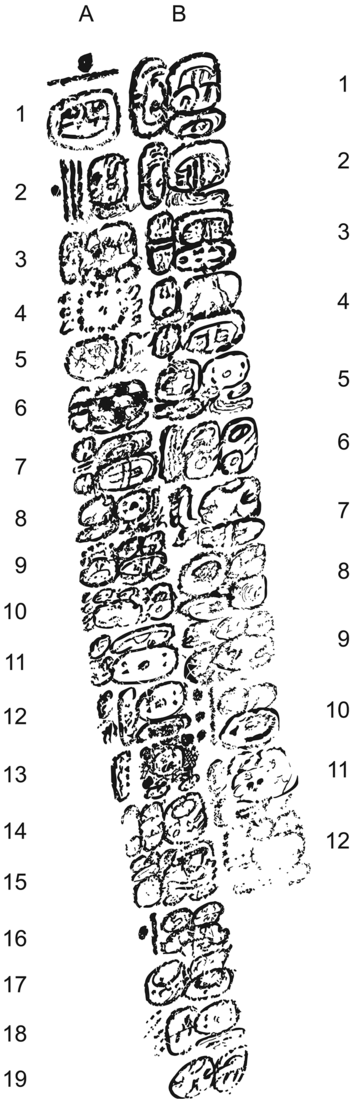
The earliest known presence of an El Palmar representative at Naj Tunich dates to the early eighth century, when two brothers affiliated with the modest kingdom “witness” (yiliw?) a mon pan ritual there on 9.14.7.11.3 (June 6, 719) (Figure 5.9).Footnote 68 The nature of the mon pan event is enigmatic, as is the translation of its name, although it may have involved “nurturing” or “cultivating maize sprouts” in conjunction with agricultural rites.Footnote 69 For our purposes, though, the most important details concern the two mon pan performers and the complex interpolity connections to which their presence attests.
Drawing 29 from Naj Tunich.
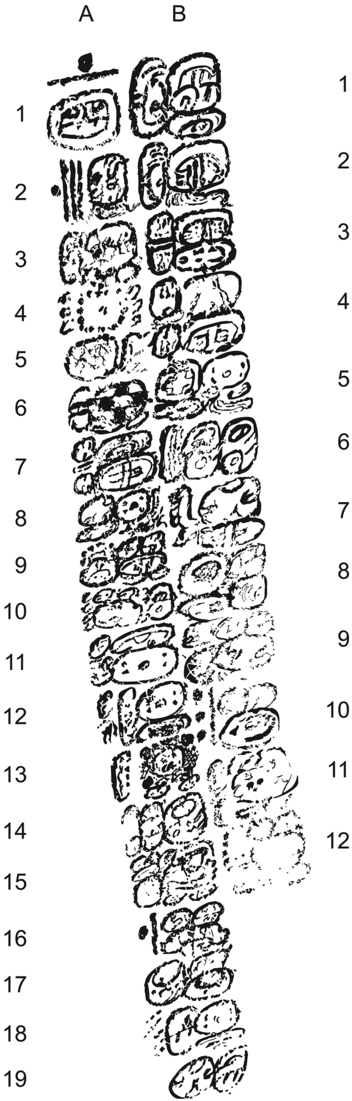
The participants’ connection to El Palmar runs through the elder brother, Chak Balaw Mayik K’an Biyaan, whom the text identifies as the “southern courtier” (nohol yanab) of Upakal K’inich (blocks A10–A14, Figure 5.9).Footnote 70 At the same time, Chak Balaw is named as the k’uhul ajaw of Yax, a polity that has not been identified archaeologically but was probably located near Caracol in the eastern lowlands (block A9, Figure 5.9; see Figure 5.1).Footnote 71 The second participant is Chak Balaw’s “younger brother” (yitz’in), Tz’itz’il Mayik K’an Biyaan, but his titles do not connect him to either Yax or El Palmar.Footnote 72 Instead, Tz’itz’il Mayik is designated as a chich winik (“spiritual guide”?) for the ajaw of Baax Tuun, a polity believed to be in the Naj Tunich area (blocks B6–B9, Figure 5.9).Footnote 73 That Baax Tuun lord, in turn, is described as the vassal of another k’uhul ajaw whose polity emblem is badly eroded but may belong to the Kaanul dynasty (blocks B11–B12, Figure 5.9).Footnote 74 Between them, then, the brothers embody ties to four different Late Classic kingdoms.
Whether Upakal K’inich was physically present at Naj Tunich for the 719 mon pan event is unclear; his mention only in the context of Chak Balaw’s titles would seem to imply that he was not a member of the visiting party. Yet the fact that Chak Balaw recorded his patron’s name suggests that the El Palmar ruler sponsored the visit and was personally invested in the pilgrim’s experience. Perhaps he had even commissioned the courtier to travel on his behalf. In any case, the inscription suggests that the consequences of the mon pan performance were political as well as ritual. The participation of two brothers with distinct and, in the case of Chak Balaw, multiple polity affiliations attests that Naj Tunich was more than a pilgrimage site where political contacts intersected, especially contacts within the wide-ranging network of the Kaanul dynasty.Footnote 75 As a place that attracted visitors from across the lowlands for ritual performance, Naj Tunich was an important node in the larger web of interactions through which religious knowledge circulated through the Classic Maya lowlands.
In this regard, it is notable that the two brothers, as something like ritual emissaries from their respective patrons, witnessed an event known almost exclusively from textual references at Naj Tunich.Footnote 76 Whatever the ritual’s nature, it seems that knowledge and practice of mon pan primarily circulated among those who either visited the cave complex themselves or interacted those who had.Footnote 77 It is unlikely, however, that Chak Balaw was the only El Palmar associate to visit Naj Tunich or even the only one to view the mon pan ritual. More than two decades after Chak Balaw and his brother’s experience, another yanaabil sak ook? (“white axe head? courtier”) attended an “arrival” (huli) event on 9.15.10.0.0 (June 27, 741).Footnote 78 Another individual with the sak ook? (“white axe head?”) title that has been linked to El Palmar “witnessed” (ilaj) an eroded event, possibly another mon pan ritual, on 9.15.8.9.4 (January 8, 740) in the company of someone from Ucanal.Footnote 79 At least three additional texts at Naj Tunich register sak ook? persons, among them a woman and another chich winik, although the contexts of the references are opaque.Footnote 80
Without supplementary names or titles, it is difficult to determine how many sak ook? people cited at Naj Tunich were affiliated with El Palmar, as opposed to the handful of other Late Classic dynasties that deployed the sak ook? title.Footnote 81 Nonetheless, the clear statement of Chak Balaw’s affiliation with Upakal K’inich of El Palmar in Drawing 29 indicates that his polity was among those represented among the many pilgrims whom Naj Tunich received (Figure 5.9). Chak Balaw and other El Palmar affiliates may even have visited the cave complex as a waypoint along a longer route down southward to the Motagua River region.Footnote 82 This scenario seems especially feasible given that El Palmar’s ritual diplomatic efforts extended to Copan at the far southeastern reaches of the Maya lowlands. And unlike at Naj Tunich, where there is little basis from which to interpret accompanying artistic transmission, the link between Copan and El Palmar offers clear evidence that interpolity travel facilitated simultaneous ritual and scribal exchange.
A Divine Audience at Copan
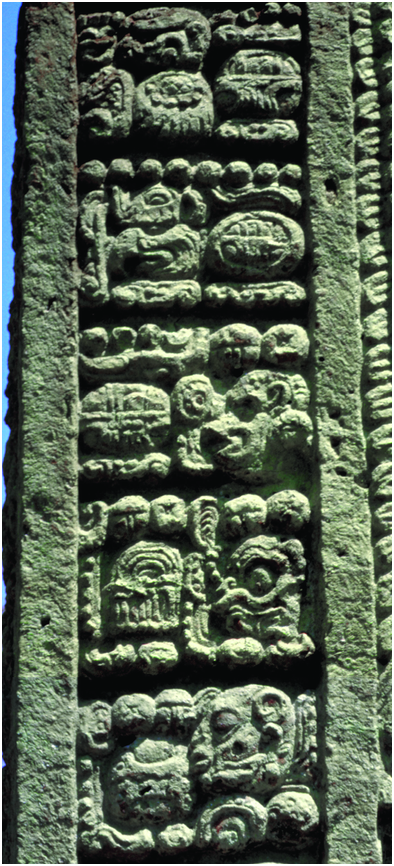
El Palmar’s tradition of ritual diplomacy extended beyond the reign of Upakal K’inich to his successor, Yunen, who also enlisted the services of elite delegates.Footnote 83 In 726, one of Yunen’s officials, a lakam (lit. “banner”) named Aj Pach’ Waal, traveled more than 350 kilometers south to meet with Waxaklajuun Ubaah K’awiil, king of Copan (Figure 5.1).Footnote 84 That he was apparently acting with the blessing of both Yunen of El Palmar and Yuknoom Took’ K’awiil of Calakmul underscores the regional political significance attributed to his mission, which may have been part of a larger Kaanul strategy of isolating the rival Mutul dynasty at Tikal by widening its own regional networks.Footnote 85 Less than five years after receiving Aj Pach’ Waal, in fact, Waxaklajuun Ubaah K’awiil dedicated Stela A at Copan (Figure 5.10). Its inscription lists the Kaanul dynasty alongside Copan, Tikal, and Palenque as the four political pillars of the Classic Maya lowlands and marks the only known mention of the Kaanul polity at Copan.Footnote 86
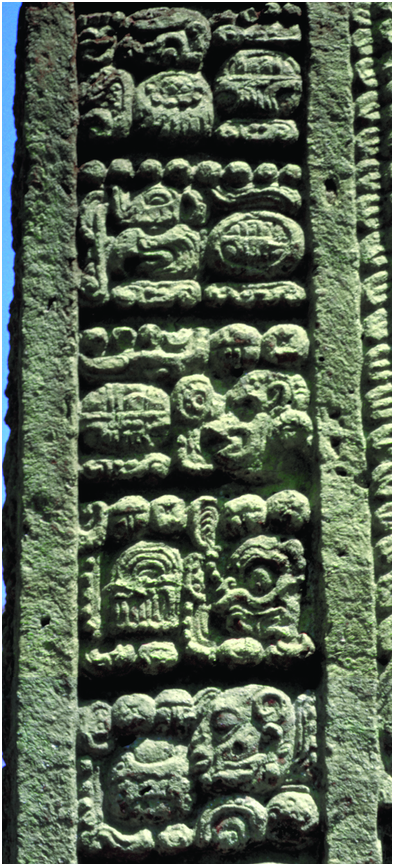
Detail of the inscription on the south side of Stela A at Copan, showing the emblem glyphs of Copan (block H4; third from bottom, right), Tikal (block G5; second from bottom, left), Calakmul (block H5; second from bottom, right), and Palenque (block G6; bottom left).
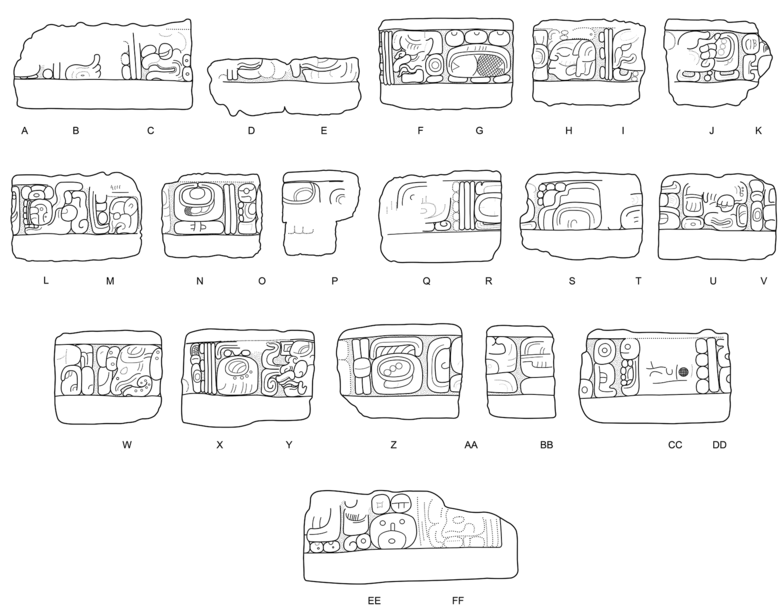
Whatever the El Palmar delegation meant to Waxaklajuun Ubaah K’awiil, it was clearly more salient for Aj Pach’ Waal. Upon returning to El Palmar, the lakam sponsored construction of a modest hieroglyphic stairway that contains the only surviving record of their encounter (Figure 5.11). Tellingly, the stairway’s inscription mentions that the local ruler was not the only significant contact that Aj Pach’ Waal made at Copan. On the night leading into 9.14.14.14.0 (June 26, 726), the El Palmar representative “ascended” (t’abiiy) to greet Waxaklajuun Ubaah K’awiil and at least four of the king’s patron gods (blocks S–FF, Figure 5.11).Footnote 87 The first three deities are named as Chan Te’ Ajaw, Baluun K’awiil, and K’uy Saak Ajaw.Footnote 88 The badly eroded block FF likely names a fourth, Mo’ Witz Ajaw, who is the only other patron god mentioned on Waxaklajuun Ubaah K’awiil’s hieroglyphic monuments at Copan (Figure 5.11).Footnote 89
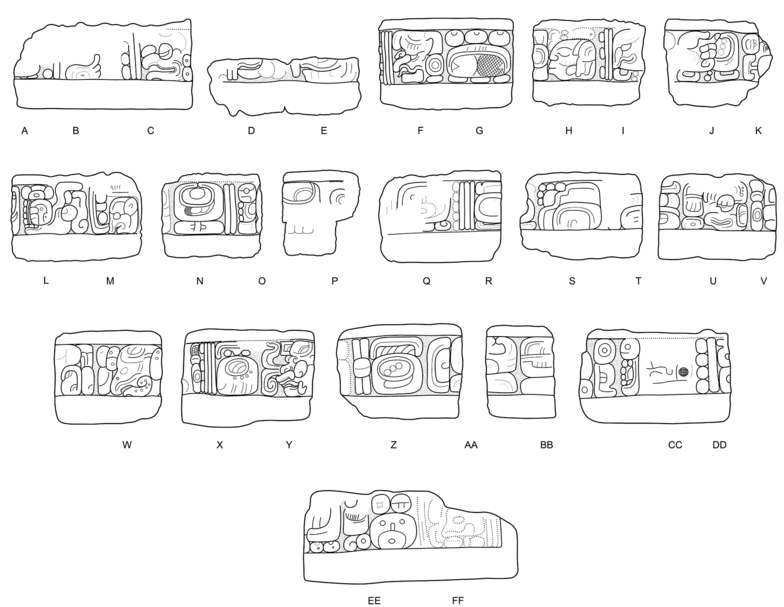
The hieroglyphic stairway at El Palmar is a highly unusual commission by an official who, upon returning from a foreign kingdom, dedicated a monument commemorating his meeting with its high-ranking king and tutelary deities. The text positions the divine beings, known at Copan as koknoom (“guardians”),Footnote 90 in a kind of sociospatial relation to the visitor and his host that the Classic Maya described as yichnal (“[in] front of him/her/it”) (block AA, Figure 5.11).Footnote 91 The deictic phrase does more than locate Aj Pach’ Waal and Waxaklajuun Ubaah K’awiil in the gods’ perceptual field; it also connotes “a reciprocal, heavily social context” in which the phrase’s referent, in this case the metapersons, are positioned physically and morally above those whom they observe.Footnote 92 In other words, the El Palmar inscription acknowledges that, however hospitably Waxaklajuun Ubaah K’awiil received the visiting entourage, it was the apotropaic quartet, not the king, who presided over their meeting.
The text offers no indication of what else occurred during Aj Pach’ Waal’s visit to Copan, nor does it register his motivations for undertaking the trip. However, the watchful, authoritative presence of Waxaklajuun Ubaah K’awiil’s sponsoring deities attests to the indistinguishability of political and religious concerns during encounters between representatives of different polities.Footnote 93 Citing foreign patron deities in conjunction with their affiliated polity or ruler was not common practice in Classic Maya inscriptions, probably due to the beings’ highly localized identities.Footnote 94 In fact, the references on Aj Pach’ Waal’s stairway seem to be the only mentions of the Copan gods outside of their home polity, with one notable exception: the late eighth-century Stela I at Quirigua, which commemorates the decapitation of Waxaklajuun Ubaah K’awiil on 9.15.6.14.6 (April 30, 738) and the destruction of his divine sponsors’ wooden effigies six days prior.Footnote 95 By drawing an explicit connection between the Copan king’s beheading and desecration of his patron gods, the inscription on Quirigua Stela I implies that the dethroned king’s political authority was inextricably tied to the divinities sponsoring his rule. Similarly, the prominent place that Aj Pach’ Waal gives the Copan gods in his narrative attests that he considered the journey a sort of pilgrimage to engage with the deities as much as with the foreign king over whom they watched.
The lakam’s visit to Copan resulted in direct communication of Waxaklajuun Ubaah K’awiil’s patron gods to the modest central lowland polity, and the hieroglyphic stairway made that information visible to literate visitors to El Palmar from Calakmul and other polities nearby. In keeping with local tradition at Copan, Waxaklajuun Ubaah K’awiil had retained his predecessors’ patron gods, Chan Te’ Ajaw and Baluun K’awiil, and added new ones to the roster, namely K’uy Saak Ajaw and Mo’ Witz Ajaw, when he assumed the throne.Footnote 96 Yet none of his monumental inscriptions refers to more than three tutelary deities at a time, whereas Aj Pach’ Waal’s stairway refers to at least four, and the trio of Chan Te’ Ajaw, Baluun K’awiil, K’uy Saak Ajaw recorded at El Palmar is not attested at Copan or even at neighboring Quirigua.Footnote 97 During his 726 visit, Aj Pach’ Waal may also have engaged a recent addition to the other-than-human roster whom Waxaklajuun Ubaah K’awiil had not yet incorporated into his monumental program. Whereas the Copan king’s other new patron, K’uy Saak Ajaw, is referenced on almost every inscription that the ruler dedicated beginning with Stela J (9.13.10.0.0; January 23, 702), Mo’ Witz Ajaw only appears on Stela B, which was installed to commemorate the 9.15.0.0.0 period-ending (August 19, 731).Footnote 98 If Mo’ Witz Ajaw is also named on Aj Pach’ Waal’s hieroglyphic stairway, it would be the earliest mention of the god in connection with Copan anywhere in the Maya lowlands.
In stating the deities whom he met alongside Waxaklajuun Ubaah K’awiil, Aj Pach’ Waal’s text simultaneously replicates and deviates from commemorative practices at Copan, which he probably witnessed during his visit in the form of the king’s stelae. Aj Pach’ Waal’s decision to memorialize his experience with a hieroglyphic stairway was surely no coincidence, either. Waxaklajuun Ubaah K’awiil had overseen completion of his own massive hieroglyphic stairway at Copan in 710. The unprecedented monument surely would have impressed the visiting lakam and probably inspired the smaller-scale construction that he dedicated back home at El Palmar on the period-ending 9.14.15.0.0 (September 14, 726), just a few months after his audience at Copan.Footnote 99 Still, the directness of this artistic transmission remains contested. Did El Palmar sculptors accompany the envoy to Copan and back? Or did they base their creation on information from others who had made the journey about the distant polity’s massive stairway, maybe even on images or models thereof?
The presence of the sak ook? title in sculptor signatures Yaxchilan, Cancuen, and Río Azul has prompted speculation that artisans from El Palmar were dispatched to these polities’ monumental workshops, perhaps in recognition of their skillfulness (Figure 5.1).Footnote 100 Strong evidence of such “artistic diplomacy” has been documented elsewhere in the (western) lowlands.Footnote 101 Moreover, the texts from Naj Tunich and Aj Pach’ Waal’s hieroglyphic stairway clearly demonstrate that long-distance travel was not unknown among El Palmar representatives. Nonetheless, as Stephen Houston cautions, the sak ook? title may represent a more general designation that is not exclusive to El Palmar or any other single polity, which would explain its distribution across such a wide swath of the lowlands.Footnote 102 Excepting the one reference at Naj Tunich (Figure 5.9), most sak ook? individuals cannot be confidently linked with El Palmar, including several scribes who signed their works with the title. At Cancuen, for instance, the sak ook? sculptor of Panel 3 is also identified as the local king’s baah chehb (“head quill”).Footnote 103 In addition to attesting to its bearer’s “cross-media skills” working with both stone and paint,Footnote 104 the latter title intimates that its bearer had stronger ties to the Cancuen dynasty than one would expect for a temporary interloper.
Even if El Palmar sculptors did participate in monumental production as far away as Yaxchilan or Cancuen, though, there are indications that not everyone involved in the stairway’s construction at El Palmar had visited the southeastern capital. Some input from Copan’s model was likely acquired directly from that kingdom, most notably the format of the monumental staircase.Footnote 105 The texts’ display on the El Palmar stairway’s risers only, excluding the treads, mirrors the composition of Waxaklajuun Ubaah K’awiil’s much larger hieroglyphic stairway, even if the bottom-to-top reading order at El Palmar contrasts with the top-to-bottom sequence of the text at Copan.Footnote 106 The spelling of Copan’s partially undeciphered emblem glyph largely conforms with conventions typical of that polity, in accord with observations that emblem glyph spellings tend to be quite consistent across polities (blocks V–W, Figure 5.11; compare block H4, Figure 5.10).Footnote 107 The El Palmar stairway text also features the earliest dated example in the central Petén of an uncommon hieroglyph for the syllable na that the scribes may have been learned at Copan, where that sign is first attested in stone in the mid-seventh century (block H, Figure 5.10).Footnote 108 Such hieroglyphic details were presumably learned at Copan by literate visitors who recalled or kept written records of what they had observed in local inscriptions and who shared that information upon returning to El Palmar.
However, other features of Aj Pach’ Waal’s inscription are atypical of scribal practices at the southeastern center and probably represent local interventions. For one, Waxaklajuun Ubaah K’awiil’s ajaw title lacks the usual k’uhul prefix in Aj Pach’ Waal’s text, a feature atypical at Copan proper that may reflect the Kaanul dynasty’s hegemonic influence at El Palmar.Footnote 109 The onomastic reference to the first patron god, Chan Te’ Ajaw, obviously was not copied from Copan sources, either. In fact, it is sufficiently unique – with the “sky” logograph instead of four dots to represent the word chan and a human head variant to indicate ajaw, rather than the more common, nonanimated logograph (blocks BB–CC, Figure 5.11)Footnote 110 – that it was probably composed by scribes who had not seen the god’s name written at Copan. Likewise, both references to Waxaklajuun Ubaah K’awiil deploy an aberrant spelling found only outside of the king’s home polity, with a syllabic hieroglyph ba standing in for the gopher-head logograph BAAH used so consistently to spell the middle component of his name at Copan (blocks X–Y, Figure 5.11).Footnote 111
At least some El Palmar sculptor-scribes most likely learned about the foreign sovereign, his monuments, and his other-than-human patrons from those who had visited and perhaps from images or written accounts brought back, without having made the journey there and back themselves. Certainly, there is no indication that Copan artisans accompanied Aj Pach’ Waal’s entourage back home to support construction of his own, more modest hieroglyphic stairway. Nonetheless, the lakam’s visit fostered direct transmission of specific hieroglyphic forms, knowledge about other-than-human figures, and even a format of monumental display between the southeastern and central lowlands. It is impossible to know how many other such instances of Classic Maya ritual diplomacy were not documented hieroglyphically for posterity. The only record of the meeting between Aj Pach’ Waal, a lakam from El Palmar, and Waxaklajuun Ubaah K’awiil, king of Copan, is found at the former, minor polity; none survives at Copan, if ever one existed. This imbalance hints that many acts of ritual diplomacy, conducted among kingdoms of varying sway, may not have survived because neither party cared to document it, or because the one that did lacked the resources to create a record as imposing and durable as Aj Pach’ Waal’s hieroglyphic stairway.
Ritual Diplomacy and Interdynastic Exchange
The two cases of ritual diplomacy presented here provide a rich first impression of the micro–macro dynamics of religious-scribal transmission that are the focus of this book. In each, highly local aspects of a historically documented ritual coexist with other components that were regionally shared, including objects of ritual relevance, knowledge about their production, use of sacred places, and modes of monumental representation. The ko’haw introduced to Piedras Negras from Teotihuacan initially represented an emblem of authority backed by a prestigious foreign power. By the seventh century, however, Piedras Negras kings were citing the plated helmet in hierarchical relations to assert local authority over other western polities or to claim affiliation with the hegemonic Kaanul dynasty. At the same time, the royal court at Palenque adopted the ko’haw, most likely from Piedras Negras directly, as a symbol of dynastic succession. In both kingdoms, scribes shared hieroglyphic representations of the ko’haw, and craftspeople produced their own versions of the headgear that circulated in the lowlands long after Teotihuacan’s sixth-century demise.
In the context of El Palmar, a sub-royal official’s journey to faraway Copan did not only result in a meeting with a foreign king and his patron gods. The experience was so momentous for the official that, upon returning to El Palmar, he commissioned a stone stairway whose form and hieroglyphic contents drew direct inspiration from Copan’s monumental landscape. That the construction employed individuals who had not accompanied him on the long trek – and thus required transmission within the El Palmar community of insights acquired from the foreign polity – is suggested by the unusual hieroglyphic rendering of key components of the meeting’s record, most notably the names of Copan’s king and his godly patrons. At the same time, the narrative emphasizes religious and political dimensions of the diplomatic encounter by couching the meeting between Aj Pach’ Waal and Waxaklajuun Ubaah K’awiil within the moral and physical aegis of the latter’s tutelary deities – perhaps in the form of the very effigies that Quirigua destroyed in the leadup to Waxaklajuun Ubaah K’awiil’s beheading a dozen years later.
More work remains to be done on ritually motivated travel among the Classic Maya and its consequences for scribal-artistic transmission. What more can be said, for instance, about the semantic transformation of the ko’haw from a symbol of Teotihuacan militarism at Piedras Negras to an emblem of dynastic authority at Palenque? How can we identify other pilgrimage sites in the lowlands beyond the Naj Tunich cave complex, and to what extent were religious practices such as the mon pan ritual tied to specific places? What other material attestations of ritually motivated travel have we perhaps overlooked in the archaeological record? Only by answering such questions can we systematically connect micro-level insights into local ritual events with macro-level interpretations of the relationship between religion and writing in the Classic Maya lowlands. Still, the examples of ritual diplomacy presented here offer some initial insights.
The first concerns the variable contexts in which Classic Maya elites engaged in ritual exchange with affiliates of foreign dynasties. Well aware that “their own ability to command others” depended upon “their service to or enlistment of … metaperson-others,”Footnote 112 kings and nobles were strategic in their ritual responses to local circumstances, including participation in ceremonies outside of their home polity. More research is needed to understand how motivations for and the conduct of ritual diplomacy changed over the Late Classic period, especially as divine kingship developed as a regional institution and eventually collapsed in the Terminal Classic period. Even within the two cases profiled here, however, the geographic extent of interpersonal contacts and shared practices suggests that ritual was crucial in bringing together Classic Maya elites across the lowlands. After all, there is no indication that the rulers of El Palmar, Piedras Negras, or Palenque were unique in using ritual to navigate relations with other kingdoms, or that their artists were alone in adopting and adapting knowledge entailed in a ritual’s performance.
Not all elites were equally committed to recording ritual encounters with representatives of other polities, however, or to recording them in an equally lasting form. Waxaklajuun Ubaah K’awiil does not seem to have left any hieroglyphic testament to the El Palmar embassy that he welcomed in 726. The king of the powerful southeastern kingdom may well have received many more visitors from across the lowlands who, unlike Aj Pach’ Waal, were unable or unwilling to create written records of their own encounter. Likewise, because of the variable preference for text and imagery in documenting ko’haw use in the Piedras Negras and Palenque kingdoms, respectively, each of those contexts is necessary for understanding the other. Without the syllabic spellings at Piedras Negras, we would not be able to phonetically read the KO’HAW logograph at Palenque, nor would we understand how its material referent was first introduced to the area. Accession scenes carved at Palenque, in turn, provide the most compelling evidence that the helmet’s symbolism, if not ko’haw headpieces themselves, circulated beyond Piedras Negras to other Classic Maya courts.
Finally, the episodes described in this chapter imply that no single ritual was fundamental to Classic Maya divine kingship as an institution. Late Classic kings at Palenque emphasized the centrality of ko’haw reception their accession ceremonies, for instance, whereas rulers at Piedras Negras are not known to have ever implemented this practice into their enthronement rituals. Rulers at other polities used their monuments to assert authority through references to the ballgame, conjuring, or deity concurrence, among other rituals that kings and queens practiced on behalf of their communities. Across the lowlands, ritual practice undergirded the dynastic office of (k’uhul) ajaw and provided a vital instrument with which holders of that office negotiated hierarchical relations. Yet the ritual performed at a given time and place was always selected from a larger, shifting repertoire of practices that, in some cases, were also accessible to those serving the person who occupied the dynastic throne.
Classic Maya kings and queens, with their semi-divine status and ritual obligations, were uniquely responsible for community well-being, but they did not have a monopoly over ritual practice. Dedication of Classic Maya stelae, altars, and other monuments was squarely centered on the person and office of the dynastic king, as were accession ceremonies affirming royal authority. Other practices, in contrast, were open to a wider range of actors whose involvement also contributed to co-circulation of scribal and ritual knowledge through the lowlands. Chapter 6 examines one such context that extended religious participation and exchange beyond the dynastic court, namely the tradition of other-than-human relations referred to in Classic Mayan as way and in modern Mexican and Central American Spanish as nagual.
The Classic Maya way tradition is commonly classified under the umbrella of “sorcery” or “magic” and thus distinguished, however implicitly, from dynastic-level religion.Footnote 113 Yet ethnohistorical and precolonial evidence suggests that the tradition’s practices of shape-shifting, cursing, and healing were active among ruling elites and nonelites alike, although the latter ultimately were more successful in preserving it under Spanish colonialism beginning in the early sixteenth century.Footnote 114 Although some way manifestations were affiliated with a particular dynasty, their distribution was not limited to texts or images from their home polities. Instead, knowledge about Classic Maya way circulated readily through the lowlands in the form of hieroglyphic references and imagery, which often appeared on portable objects that traveled within and beyond the royal court.

 Open access