INTRODUCTION
Religious participation, particularly attendance at worship services, is a robust correlate of physical and mental health (Miller & Thoresen, Reference Miller and Thoresen2003; Oman & Thoresen, Reference Oman, Thorensen, Paloutzian and Park2005; Norton et al., Reference Norton, Singh and Skoog2008). A meta-analysis of 40 independent samples showed a significant positive association between religious involvement and longevity (McCullough et al., Reference McCullough, Hoyt and Larson2000), with an advantage to those attending weekly worship services of seven additional years of life over those who never attend, controlling for other factors (Hummer et al., Reference Hummer, Rogers and Nam1999). Depression rates are lower overall among religiously involved persons, with the most benefit to religious participants experiencing high levels of life stress (Smith et al., Reference Smith, McCullough and Poll2003.)
Depression is prevalent among patients with serious illnesses (Gaynes et al., Reference Gaynes, Burns and Tweed2002). Patients with chronic obstructive pulmonary disease (COPD), congestive heart failure (CHF), and cancer report elevated levels of depression, with severe clinical and social implications (Friedman & Griffin, Reference Friedman and Griffin2001; Juenger et al., Reference Juenger, Schellberg and Kraemer2001; McClain et al., Reference McClain, Rosenfeld and Breitbart2003; Mikkelsen et al., Reference Mikkelsen, Middelboe and Pisinger2004; Stommel et al., Reference Stommel, Kurtz and Kurtz2004). At the same time, seriously ill patients consistently report that religious/spiritual issues are highly salient to their well-being, as they focus on coming to peace with God and making meaning of their lives (Steinhauser et al., Reference Steinhauser, Christakis and Clipp2000a, Reference Steinhauser, Clipp and McNeilly2000b; Daalmen et al., 2001; Idler et al., Reference Idler, Kasl and Hays2001). At the end of life, spiritual well-being offers protection against hopelessness and desire for a hastened death (McClain et al., Reference McClain, Rosenfeld and Breitbart2003).
Patients with serious illness are physically less able to continue public religious practices. Declines in attendance at worship were significantly correlated with functional decline in a large prospective, population-based sample of older persons (Hays et al., Reference Hays, Landerman and Blazer1998). Milstein and colleagues (Reference Milstein, Bruce and Gargon2003/2004) compared three groups of geriatric patients receiving visiting nursing services (VNS) according to whether they attended worship before and after admission to the program. Among the two-thirds who had attended worship regularly prior to receiving home care (n = 86), only one in four continued to attend. There was a linear, negative, and significant dose-response rate between attendance and depression across the three groups. Those with neither prior nor current attendance (n = 42) reported the most depression, and those with both prior and current attendance (n = 23) were the least depressed. Among the 63 who discontinued attendance, a small subset (n = 27) were visited by clergy or laity, and they reported similar levels of depressive symptoms as those not visited.
Given the positive effects of worship attendance and the declines in attendance during illness, can pastoral visits provide similar benefits to seriously ill patients who have difficulty attending religious services? The current study examined whether seriously ill persons who receive clergy or laity support in the home, including visits and assistance, receive any unique benefit to their mental health.
METHODS
Design and Sample
The study used cross-sectional baseline data from Pathways, an epidemiologic cohort study of patients with advanced serious disease. The full methods are detailed elsewhere (Steinhauser et al., Reference Steinhauser, Clipp and Hays2006.) Briefly, patients with three categories of advanced serious disease were recruited: (1) Stage IIIB or Stage IV metastatic lung cancer and Stage IV metastatic breast, colorectal, or prostate cancer; (2) New York Heart Association (NYHA) Class III or IV CHF where the most recent assessment and one earlier assessment within the prior 15 months was Class III or IV; and (3) COPD with hypercapnea where pCO2 had exceeded 45 mm Hg at least once within the prior 3 years, and at least one emergency department or hospitalization had occurred in the prior year in which COPD was indicated in the top four discharge diagnosis codes. Eligible patients lived within a 35-mile radius of Durham, North Carolina, and could be identified from patient databases at one of two local hospitals that served different populations (a tertiary care center for the Southeastern United States and a Veteran's Affairs Medical Center.) Patients were recruited through their primary physicians or specialists until there were 70 patients in each diagnostic group. The design was observational and naturalistic, i.e., not an intervention study or clinical trial. The study was approved by the Duke University and Durham Veterans Administration Medical Centers’ Institutional Review Boards.
Measures
The dependent variable was operationalized using the 10-item Center for Epidemiologic Studies — Depression (CES-D) scale (Andresen et al., Reference Andresen, Malmgren and Carter1994). Similarly to the long form, the short form measures symptoms of depression and includes items from each of its four dimensions (Radloff, Reference Radloff1977; Hays et al., Reference Hays, Landerman and Blazer1998).
The independent variable was operationalized as a four-level item that asked, “Since you have been ill, how much helpful support have you received from clergy or other persons from your church, temple, synagogue, or mosque – for example, through meals, visits, caring phone calls or cards to you?” The response set included None, A Little, Some, or Very Much. If respondents previously reported no religious group affiliation, the item was preceded by the phrase, “You mentioned you're not a member of a religious group; however…” For respondents who reported at least a little clergy–laity support, a follow-up question asked how much of the focus of the visit was religious in nature, e.g., praying, reading the scriptures, or taking communion (None, A Little, Some, or Very Much). If respondents previously reported no religious group affiliation and no private religious activities, these questions were skipped and coded as Not Applicable.
Demographic covariates were measured as race (White vs. Non-White), gender, and age in years. Diagnostic groups included cancer, COPD, and CHF. Functional status was measured as a 10-item instrumental activities of daily living (IADL) scale asking how much help the patient needed with activities such as using a telephone, driving a car, or traveling alone by bus or taxi, shopping, preparing meals, doing housework, taking medications, handling money, or walking city blocks or up stairs. The response set included needed no help (1), needed some help (2), or unable to do (3). Social network size summed the number of children, siblings, relatives, and close friends (Hays et al., Reference Hays, Landerman and Blazer1998.)
Religious covariates were measured as follows. Religious affiliation was self-assessed as Christian, Jewish, Muslim, Buddhist, Hindu, or Other. Public religiousness was measured as the frequency of attendance at religious services or meetings on seven levels from Never (1) to Daily (7). Private religiousness was measured as frequency of private or spiritual activities such as prayer, meditation, or reading, from Never (1) to Daily (7). Religiousness or spirituality was self-assessed from Not at all religious or spiritual (1) to Deeply religious or spiritual (4). Lifetime religious history was measured in three dimensions as amount of help received from God (10 items, e.g., Overall, God has answered my prayers), religious social support (4 items, e.g., for most of my life, my social life has revolved around my church), and difficulties with religiousness (3 items, e.g., At times my religious life has caused me stress.)
Analytic Strategy
Descriptive (mean, SD, or %) statistics are presented for all variables: depressive symptoms, clergy–laity support, and covariates. To test the bivariate associations between depressive symptoms and clergy–laity support, and between each of these and each covariate, we used correlation, χ2, t-tests, and analyses of variance, as appropriate.
For tests of the hypothesis, we estimated the main effect of clergy–laity support on depressive symptoms, adjusted for all covariates that were significantly associated with either the independent or dependent variable, using a general linear model. No assumption of group equivalency was made, and all models controlled for differences between groups. Using backwards elimination with significance of each variable's F-statistic set at p < 0.05, we estimated a reduced model that included only the significant variables associated with depression in this sample. All analyses were conducted with SAS v 9.1 (SAS Institute, Inc., Cary, NC).
RESULTS
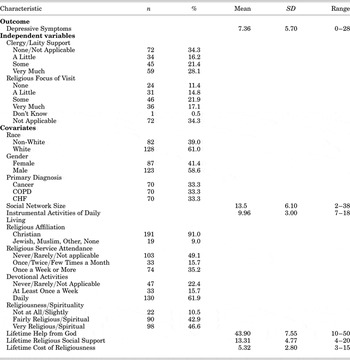
Patient characteristics are presented in Table 1. Their self-reported depressive symptoms represented marginally depressed states. The prevalence of clergy–laity support varied widely. About one in three received none, and about one in four received a lot of support. Most visits were at least partly, but not entirely, focused on religious issues.
Descriptive statistics of depressive symptoms, clergy/laity support, and covariates among seriously ill patients (n = 210)

On average, the social networks of the patients included just over a dozen family members and close friends. Their difficulties with IADLs were few; on average subjects needed some help with three activities.
The patients were primarily Christian. About half of them rarely or never attended religious services, and a third attended once a week or more often. Religious devotional activities were more prevalent; nearly two-thirds reported daily devotions. Most patients reported some degree of self-assessed religiousness or spirituality, with these split approximately equally between being fairly religious and very religious. Their reports of lifetime religiousness (help from God, social support from the religious community, and the cost of being religious) were all elevated, compared to population norms (Hays et al., Reference Hays, Meador and Branch2001.)
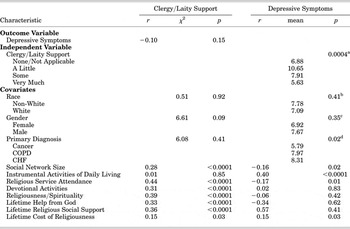
In bivariate relationships, clergy–laity support and depressive symptoms were significantly and inversely related in a non-linear pattern (Table 2). The most symptoms of depression were reported by patients who received only a little support from clergy or laity, compared to those receiving either none or a lot of support. Clergy–laity support did not distinguish patients by race, diagnostic group, or functional status. Clergy–laity support was greater among women than men and was positively related to social network size. In further analyses (untabled), network size increased across levels of clergy–laity support (mean sizeno support = 12, mean sizea little support = 13, mean size some support = 13, and mean sizea lot of support = 16). Clergy–laity support was also higher among patients who reported more current public and private religious activities, more religiousness or spirituality, and a more salient religious life history.
Bivariate relationships between covariates and depressive symptoms and clergy laity support among seriously ill patients (n = 210)

aBased on ANOVA: A little > None/NA and A little > Very Much; no other significant differences.
bBased on t-test/unequal variances.
cBased on t-test/equal variances.
dBased on ANOVA: CHF > Cancer; no other significant differences.
Depressive symptoms were also characteristic of those with smaller social networks and more IADL deficits. More depressed patients attended fewer religious services and reported more difficulties being religious over their lifetimes than did patients who were less depressed. Depressive symptoms did not characterize patients by gender, race, or on other dimensions of religiousness.
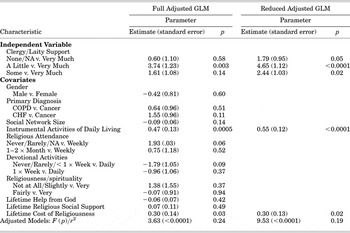
When estimates of depressive symptoms were fully adjusted (Table 3), clergy–laity support demonstrated a robust relationship to mood. Independent of demographic, health and function, social, and other religious variability, patients who received only a little support from clergy and laity reported significantly more depressive symptoms than those receiving no support or a lot of support. IADL deficits and a past history of personal difficulties in being religious were also associated with depression. The most parsimonious model of depressive symptoms among the seriously ill sample showed that depressed mood was strongly associated with having some or a little clergy–laity support (compared to a lot of support), more functional deficits, and a lifetime history of difficulties related to religious involvement.
Adjusted full and reduced general linear models (GLM) of depressive symptoms regressed over clergy/laity support and covariates (n = 210)

In further analyses designed subsequently to distinguish the effect of clergy–laity support from generic support (untabled), we examined the frequency of generic support from friends or family. One third of the sample (n = 70) received help once a month or less; 20% (n = 42) received help 3–6 times a month; and 47% (n = 98) received support every day. When depressive symptoms were regressed over both types of support in an unadjusted model, clergy–laity support was significantly (p = 0.0003) related to depression, as was generic support (p = 0.01). The least square means for depressive symptoms were highest for patients reporting generic support every 1–2 days (meanCESD = 8.95) and those reporting a little clergy–laity support (meanCESD = 10.25); the lowest mean depressive symptoms was for patients who reported very much clergy–laity support (meanCESD = 5.14). In a second unadjusted model, the interaction term between the two types of support was non-significant (p = 0.34), i.e., the effect of one type of support does not differ based on the level of the other type of support.
DISCUSSION
In this study, clergy–laity visits were significantly and inversely related to depression among seriously ill patients. As hypothesized, patients who were visited often by clergy and laity reported significantly fewer symptoms of depression than those visited only a little. Also contributing to depressive symptoms were a lifetime history of personal difficulties related to religion and impaired functional status.
Clergy–laity visits could reduce or prevent suffering because illness poses serious risk of depression among older persons (Smith et al., Reference Smith, McCullough and Poll2003). In the current sample of seriously ill adults, the prevalence of depressive symptoms was 64% higher (approximately three or more persistent symptoms) than in the sample of older HMO members described by Andresen and colleagues (1994). Krause and Wulff (Reference Krause and Wulff2005) have shown that friendship ties in religious organizations have a protective effect against depressive symptoms. Community religious activities are particularly protective in the presence of medical illness and other stressful life events (Koenig, Reference Koenig2007). The current study extends these findings to suggest that a specific intervention as simple as friendly visits in the home setting by religious clergy and congregants during serious illness may benefit patients’ mood.
Clergy–laity visits could substitute for religious attendance, a valued activity that declines among the seriously and terminally ill patients. Population-based studies in the geographical area represented by this study suggest that 55–60% of older men and women normally attend religious services at least once a week (Hays et al., Reference Hays, Landerman and Blazer1998). Weekly attendance among the current sample was 35%. Among clients newly admitted to VNS service in New York, 85% decreased their religious attendance, and 73% stopped attending services completely (Milstein, et al., Reference Milstein, Bruce and Gargon2003, 2004). Idler and colleagues (2001) showed that attendance declines significantly in the last year of life — a change that is attributable almost entirely to poor health — even as both feelings of religiousness and strength/comfort derived from religion remain stable or increase slightly. In lieu of worship attendance when people are sick, home visits by members of a patient's religious community may be an important antidote to religious isolation, while providing continuity of missing instrumental, emotional, and spiritual support.
Clergy–laity visits contribute to patients’ positive mood independently from generic social support from family and friends. The current findings extend the work of Smith and colleagues (Reference Smith, McCullough and Poll2003) who reported in a meta-analysis that the strongest negative relationships between religiousness and depression occurred among those undergoing significant stress. Our work adds evidence that a new dimension of religiousness, i.e., home-based support from co-religionists, is inversely and significantly related to depressive symptoms among patients with serious illness. Also extending the work of Krause and Wulff (Reference Krause and Wulff2005), the current findings suggest that not only are the ties of friendship within congregations negatively related to depression but also related to depression are the actions of those friends, specifically home visits during serious illness.
The findings contradict results from the only other study of patient outcomes of clergy–laity home visits, which found no effect of clergy–laity visits on depression among new VNS home care patients in suburban New York City (Milstein et al., Reference Milstein, Bruce and Gargon2003). That study compared depression levels among patients who had previously attended services at least yearly but had stopped entirely following VNS admission (n = 63). Only one-third of these had been visited by clergy or laity in the interim, with no effect of visitation on mood. In the current sample (N = 210), about half rarely or never attended services, and half attended regularly or sporadically. Two-thirds of the sample received clergy–laity visits, however, and these visits had a positive association with mood, regardless of frequency of service attendance. Differences in findings could be attributable to the samples representing a different mix of religious affiliation or geography (Catholic suburban New York versus Protestant North Carolina Piedmont) or diagnostic mix (typical VNS case load of including hip fractures, incident diabetes, and cardiac rehabilitation versus late-stage chronic illnesses).
The findings have implications for future research. First, they support the religious social interaction mediation hypothesis, i.e., that religious social support beyond what transpires in worship may be a potent protective factor for health and well-being among religiously engaged persons (Oman & Thoresen, Reference Oman, Thorensen, Paloutzian and Park2005). Further research is needed to explore which dimensions of the home visit most benefit patients’ mood. In the current study, 9 of 10 visits included at least some religious focus. We did not assess the importance of religious versus secular aspects of the visit nor patient preferences nor expectations of frequency or content of visits. It is of interest whether shared communion, group prayer, scripture reading, or other rituals bolster mood more than activities that are not explicitly religious (e.g., delivering a meal or general conversation). Evaluation of clearly described faith-based visitation programs would address the gaps in evidence recently described in the literature (DeHaven et al., Reference DeHaven, Hunter and Wilder2004.)
Another finding worth pursuing is the U-shaped effect of home visits on mood. Why was depression most strongly associated with little clergy–laity support, compared to the more modest effects among patients visited frequently or not at all? It may be that people who reported “a little” support actually wanted more support from their faith community but did not receive it. On the other hand, patients who reported no such support might not have wanted congregational support at all; therefore, a lack thereof was not related to depressive symptoms. Sporadic or inconsistent attention from a religious congregation may be only deleterious in the presence of preference for such. Therefore, future research should explore the interaction effects of patient preference with frequency and type of support.
These findings also have implications for best practice among clinicians and pastors. Physicians and nurses are encouraged to assess the religious and spiritual histories of patients (Kemp, Reference Kemp, Ferrell and Coyle2001; King et al., Reference King, Blue and Mallin2004; Tulsky, Reference Tulsky2005). When interacting with patients who are religious or for whom spiritual matters have importance, clinicians and clinical pastoral care staff should inquire whether the patient is a member of a religious community, whether the community is supportive, and what kind of support might the community provide after hospitalization or office visit (Koenig, Reference Koenig2006). At the end of life, clinicians may share in a more fluid, less role-bound process of co-creating with patients and members of their communities a holistic plan of spiritual care (Daaleman et al., Reference Daaleman, Usher and Williams2008). Based on the current findings, healthcare providers may encourage patients to receive congregational visits and support in order to improve mental health outcomes. Patients with negative associations with religion may be particularly likely to report depressive symptoms, and future research should address strategies for effective intervention to relieve their perceived distress.
Among pastors and congregations, outreach activities to seriously and terminally ill persons, especially those who are homebound, may be mutually beneficial. The patients benefit from improving feelings of well-being, and clergy and laity receive benefit from enhanced within-congregation interpersonal trust (Fillinson, Reference Fillinson1998; Catanzaro et al., Reference Catanzaro, Meador and Koenig2007; Norenzayan & Shariff, Reference Norenzayan and Shariff2008). Current findings suggest empirical support for faith communities involved in visitation of the sick and other ministries of “presence” with historical roots in ancient faith traditions (Hunsinger, 2006; Daaleman et al., Reference Daaleman, Usher and Williams2008; Evans, Reference Evans2008).
This study is limited by its cross-sectional design, which precludes absolute conclusions about causal order. Rather than clergy–laity visits protecting against depression, depression may discourage visits. Depression isolates individuals by altering their perception of others and themselves, their cognitive interpretation of interactions, and/or their performance of social skills (Tse & Bond, Reference Tse and Bond2004). However, in this study, patients reported overall network size in double digits across all levels of congregational support; therefore, there is little evidence of isolation or antisocial tendencies. As well, the time frame reference of clergy–laity support and mood differed: patients reported on support “since becoming ill” and depressive symptoms “in the past week.” Finally, the patients visited by family and friends most frequently were the most depressed, suggesting that the social network of patients is highly engaged with those reporting impaired mood. All of these considerations suggest that clergy–laity support influences mood rather than vice versa.
The current study contributes evidence to questions of how religion and health are related and how patients who value both may benefit from a particular type of interpersonal care. Home-based support from clergy and laity is an independent correlate of positive mood and may substitute for public religious participation when illness prevents such activity. The contribution to positive mood was in addition to that associated with general help from friends and family. Clinical and pastoral care providers now have empirical support for encouraging informal congregational visits to seriously ill persons. Researchers may extend these findings with additional studies of patient preference for types of visitation activities.