Introduction
Prospective memory (PM) can be defined as remembering to perform an intended action at an appropriate time or at the occurrence of a certain event in the future (Scullin, McDaniel, Shelton, & Lee, Reference Scullin, McDaniel, Shelton and Lee2010). It involves multiple cognitive processes related to retrospective memory or RM (e.g., forming associations between cues and intentions, remembering the content of the intention: Kliegel, Phillips, Lemke, & Kopp, Reference Kliegel, Phillips, Lemke and Kopp2005) and executive functions (e.g., dividing attention, monitoring the environment for the cue, interruption of the ongoing task, and retrieval and execution of the intention: McFarland & Glisky, Reference McFarland and Glisky2009).
PM is commonly divided into time-based (TBPM) and event-based (EBPM) types (McDaniel & Einstein, Reference McDaniel and Einstein2000). While TBPM involves remembering to perform an intended action at a specified time (e.g., remembering to phone a friend in half an hour), EBPM involves remembering to perform the action at the occurrence of a certain external event (e.g., remembering to buy bread when passing by a grocery store). Unlike EBPM where the cue to execute the intention is explicit, TBPM requires more cognitive effort as it places considerable demands on self-initiated monitoring and retrieval mechanisms and is therefore, assumed to be susceptible to poor performance due to lack of explicit external cues (Smith, Souchay, & Moulin, Reference Smith, Souchay and Moulin2011).
The neurobiological underpinnings of PM have been a recurrent topic of investigation in cognitive neuroscience. Neuroimaging studies assessing maintenance of intentions over a delay during engagement in the ongoing task have revealed activations in the rostral prefrontal cortex (PFC) and lateral PFC areas for both EBPM and TBPM (Burgess, Gonen-Yaacovi, & Volle, Reference Burgess, Gonen-Yaacovi and Volle2011; Burgess, Scott, & Frith, Reference Burgess, Scott and Frith2003; Okuda et al., Reference Okuda, Fujii, Ohtake, Tsukiura, Yamadori, Frith and Burgess2007). Successful PM intention retrieval and execution therefore, seem to hinge on the coherence of the frontal systems.
As most of our daily activities revolve around carrying out actions at the right moment, dramatic implications of PM failure under certain conditions (e.g., failure in remembering to take medication) have instigated exponential research toward PM functioning, especially in a variety of neuropsychological populations. Data comparing clinical populations to healthy controls have therefore, surmised PM performance to be impaired in older adults (Einstein, McDaniel, Manzi, Cochran, & Baker, Reference Einstein, McDaniel, Manzi, Cochran and Baker2000; Henry, MacLeod, Phillips, & Crawford, Reference Henry, MacLeod, Phillips and Crawford2004), patients with Mild Cognitive Impairment and dementia (van den Berg, Kant, & Postma, Reference van den Berg, Kant and Postma2012), Schizophrenia (Kumar, Nizamie, & Jahan, Reference Kumar, Nizamie and Jahan2005, Reference Kumar, Nizamie and Jahan2008; Wang et al., Reference Wang, Cui, Chan, Deng, Shi, Hong and Shum2009) and closed head injury (Schmitter-Edgecombe & Wright, Reference Schmitter-Edgecombe and Wright2004; Shum, Levin, & Chan, Reference Shum, Levin and Chan2011), with TBPM almost always compromised to a greater extent than EBPM.
Etiology of Parkinson's Disease and Subsequent Neuropsychological Findings
The neuropathological markers of Parkinson's disease (PD) include degeneration of dopaminergic cells in the basal ganglia (Yarnall, Archibald, & Burn, Reference Yarnall, Archibald and Burn2012) with utmost severity noted in the striatum (Owen, Reference Owen2004). Notably in PD, neuronal loss of dopaminergic neurons in the substantia nigra and surrounding areas reduce dopaminergic connections to the adjacent striatum, in turn impoverishing efferent connections to the frontal lobes (Owen, Reference Owen2004). This dopamine depletion in the fronto-striatal circuitry causes bradykinesia, tremors, rigidity, and postural instability, all of which are the cardinal motor-related clinical features of PD (Yarnall et al., Reference Yarnall, Archibald and Burn2012) as well as patterns of cognitive impairment resembling those of patients with frontal lobe damage (Cools, Reference Cools2006; Foster, McDaniel, Repovš, & Hershey, Reference Foster, McDaniel, Repovš and Hershey2009). Given damaged fronto-striatal routes, studies assessing cognitive functions in PD patients consistently report deficits in planning (Kliegel et al., Reference Kliegel, Phillips, Lemke and Kopp2005; Lewis et al., Reference Lewis, Cools, Robbins, Dove, Barker and Owen2003; Owen, Doyon, Dagher, Sadikot, & Evans, Reference Owen, Doyon, Dagher, Sadikot and Evans1998), set shifting and inhibition (Dujardin, Defebvre, Grunberg, Becquet, & Destée, Reference Dujardin, Defebvre, Grunberg, Becquet and Destée2001; Muslimovic, Post, Speelman, & Schmand, Reference Muslimovic, Post, Speelman and Schmand2005; Werheid, Koch, Reichert, & Brass, Reference Werheid, Koch, Reichert and Brass2007), working memory and attention (Lewis et al., Reference Lewis, Cools, Robbins, Dove, Barker and Owen2003, Muslimovic et al., Reference Muslimovic, Post, Speelman and Schmand2005), and PM (Katai, Maruyama, Hashimoto, & Ikeda, Reference Katai, Maruyama, Hashimoto and Ikeda2003; Kliegel, Altgassen, Hering, & Rose, Reference Kliegel, Altgassen, Hering and Rose2011), including other cognitive deficits such as bradyphrenia, perseveration, and visuo-spatial deficits (Bradley, Welch, & Dick, Reference Bradley, Welch and Dick1989; Sinforiani, Banchieri, Zucchella, Pacchetti, & Sandrini, Reference Sinforiani, Banchieri, Zucchella, Pacchetti and Sandrini2004).
With regard to RM, studies have noted PD patients to show impairments in this domain as well (Lezak, Reference Lezak1995; Higginson et al., Reference Higginson, King, Levine, Wheelock, Khamphay and Sigvardt2003). Evidence indicates that PD patients seem to perform better on recognition (Flowers, Pearce, & Pearce, Reference Flowers, Pearce and Pearce1984; however, see Whittington, Podd, & Kan, Reference Whittington, Podd and Kan2000; Whittington, Podd, & Stewart-Williams, Reference Whittington, Podd and Stewart-Williams2006; Davidson, Anaki, Saint-Cyr, Chow, & Moscovitch, Reference Davidson, Anaki, Saint-Cyr, Chow and Moscovitch2006) and cued recall tasks (Higginson et al., Reference Higginson, King, Levine, Wheelock, Khamphay and Sigvardt2003; Marinus et al., Reference Marinus, Visser, Verwey, Verhey, Middelkoop, Stiggelbout and van Hilten2003) than free recall tasks (Altgassen, Zollig, Kopp, MacKinlay, & Kliegel, Reference Altgassen, Zöllig, Kopp, MacKinlay and Kliegel2007; Drag, Bieliauskas, Kaszniak, Bohnen, & Glisky, Reference Drag, Bieliauskas, Kaszniak, Bohnen and Glisky2009; Dujardin et al., Reference Dujardin, Defebvre, Grunberg, Becquet and Destée2001; Green et al., Reference Green, McDonald, Vitek, Evatt, Freeman, Haber and DeLong2002; Higginson et al., Reference Higginson, King, Levine, Wheelock, Khamphay and Sigvardt2003; Lezak, Reference Lezak1995; Muslimovic et al., Reference Muslimovic, Post, Speelman and Schmand2005). These results suggest that PD patients may find less difficulty in retaining information in memory (as they are able to recognize learnt items using cues: Higginson et al., Reference Higginson, King, Levine, Wheelock, Khamphay and Sigvardt2003), than in retrieving information as seen in free recall performance (suggesting an executive deficit; see Bondi, Kaszniak, Bayles, & Vance, Reference Bondi, Kaszniak, Bayles and Vance1993). Altogether, these RM deficits have been suggested to be ‘secondary’ to conspicuous executive impairment seen in patients with PD (Davidson et al., Reference Davidson, Anaki, Saint-Cyr, Chow and Moscovitch2006).
Prospective Memory in Parkinson's Disease
As noted above, studies assessing PM in PD generally agree that PD patients find difficulty in retrieving the intention per se (Kliegel et al., Reference Kliegel, Phillips, Lemke and Kopp2005) despite accurately remembering contents of both simple and complex intentions (Altgassen et al., Reference Altgassen, Zöllig, Kopp, MacKinlay and Kliegel2007). For example, Kliegel et al. (Reference Kliegel, Phillips, Lemke and Kopp2005) found PD patients to be selectively impaired in forming detailed intentions and initiating them, though able to retain them in memory. Since both intention formation and initiation stages are representative of executive functions like planning and inhibition, failure in these steps suggests poor executive functioning in these patients (Kliegel et al., Reference Kliegel, Altgassen, Hering and Rose2011). It is not surprising that detrimental PM performance has also been ascribed to disrupted executive functions such as working memory (Altgassen et al., Reference Altgassen, Zöllig, Kopp, MacKinlay and Kliegel2007; Kliegel et al., Reference Kliegel, Altgassen, Hering and Rose2011; Raskin et al., Reference Raskin, Woods, Poquette, McTaggart, Sethna, Williams and Tröster2011), planning (Kliegel et al., Reference Kliegel, Phillips, Lemke and Kopp2005), and self-initiated retrieval (Katai et al., Reference Katai, Maruyama, Hashimoto and Ikeda2003), all of which are primarily mediated by the frontal lobe.
To better understand PM functioning in PD patients, we attempted to conduct a meta-analysis of studies assessing PM in PD. Furthermore, given the diversity in tasks used to assess various executive functions and RM in these studies, we did not attempt a meta-analysis of results for these cognitive functions. We, however, extracted findings on RM and executive functions from individual studies and discussed them in relation to PM in PD.
Method
Literature Search
A computer-based search between 1990 and 2013, involving PubMed, Science Direct, EBSCOhost, Web of Science, and Google Scholar for keywords: “prospective memory” or “remembering to remember” or “delayed intention” or “prospective remembering,” in combination with “Parkinson's disease,” in complete or shortened versions (with and without quotation marks) was conducted. Additionally, we scanned journals that publish on cognition in neurodegenerative diseases, using the keywords ‘memory’ and ‘neurodegeneration,’ to ensure inclusion of articles that may not have explicitly reported ‘prospective memory’ in their title or abstract. Reference lists of all retrieved articles were further scanned for potential eligibility. For inclusion in the quantitative analysis, few criteria were exercised: (1) the study had to be a journal article, original in nature, in full text, and not a review; (2) EBPM and/or TBPM had to be assessed using an experimental paradigm or a naturalistic setting optionally in conjunction to, but not solely using questionnaires; (3) If not reported directly, the study had to report enough statistics (mean, standard deviation, standardized difference) to calculate effect sizes. We attempted to contact the authors in case of insufficient statistical data.
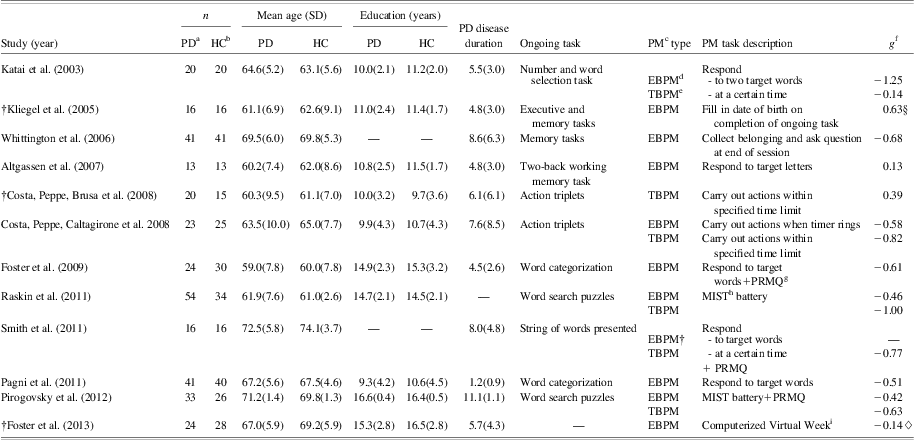
Where numerous variables were manipulated, performance on conditions closely resembling methodologies of other studies and/or traditional measures of PM were chosen to maintain uniformity. Studies that reported only F values had to be excluded from our statistical analysis, since we were unable to generate means and standard deviations to elicit comparison with other studies. This included two studies, namely by Costa, Peppe, Brusa et al. (Reference Costa, Peppe, Brusa, Caltagirone, Gatto and Carlesimo2008) and Foster, Rose, McDaniel, and Rendell (Reference Foster, Rose, McDaniel and Rendell2013). Similarly, unlike other studies involving response to the PM cue at multiple instances, the PM task by Kliegel et al. (Reference Kliegel, Phillips, Lemke and Kopp2005) was a single instance intention task (participants either initiated the response or did not) hence we did not include their χ2 value into our analysis. It should also be noted that Smith et al. (Reference Smith, Souchay and Moulin2011) who intended to primarily investigate meta-memory along with PM, reported percentage scores of performance on both PM tasks. However, they also reported an alternative TBPM score consisting of mean number of key presses (response to the PM cue); therefore, we included this particular statistic, and excluded their EBPM measure from our analysis. Altgassen et al. (Reference Altgassen, Zöllig, Kopp, MacKinlay and Kliegel2007) manipulated task importance between the PM and the ongoing task, therefore we included performance on the PM task where the focus was on the PM cue. Foster et al. (Reference Foster, McDaniel, Repovš and Hershey2009) altered focality of cues on the PM and the ongoing task as well as tested patients on and off medication, therefore, as advised by one of the authors (M. McDaniel, personal communication, February 26, 2013), we averaged performance across focal and nonfocal conditions for the PM task and chose performance on the “on” medication condition. Where the Memory for Intentions Screening Test (MIST; Raskin, Reference Raskin2009 - which consists of four TBPM and four EBPM tests to be completed in 30 min) was used, only summary scores for TB and EBPM tasks were used.
Results were computed using R Studio v2.13.1 (R Development Core Team, 2011) and its “meta” package (Schwarzer, Reference Schwarzer2010). For computing effect sizes, Hedges’ g was chosen as it corrects Cohen's d for a small sample size (McGrath & Meyer, Reference McGrath and Meyer2006). Negative effect sizes indicate better performance in controls. Performance on TBPM and EBPM were assessed separately and data were analyzed using a mixed-model analysis of which we chose the outcome of a fixed-effects model (as suggested by Field & Gillett, Reference Field and Gillett2010). Heterogeneity statistics reported are in concordance with recommendations of Higgins, Thompson, Deeks, and Altman (Reference Higgins, Thompson, Deeks and Altman2003).
Results
The literature search yielded 12 studies. Nine satisfied our inclusion criteria for quantitative analysis, of which four exclusively tested EBPM, and five tested both EBPM and TBPM.
Time-Based and Event-Based Prospective Memory Performance
An overall calculation of effect size for PM (TB and EBPM) across all included studies indicated an effect size of −0.61 (−0.76 to −0.46; Z = −8.07; p < .001). TBPM was assessed in five studies with an overall effect size of −0.71 (−0.96 to −0.46; Z = −5.56; p < .001) (see Figure 1). EBPM was assessed in eight studies with an overall effect size of −0.55 (−0.73 to −0.36; Z = −5.86; p < .001) (see Figure 2). The effect sizes on both TB and EBPM tasks indicate medium difference (d = 0.50) in performance between groups as per Cohen's nomenclature (Cohen, Reference Cohen1988). Tests of heterogeneity revealed that the Q-statistic was not significant for studies evaluating TBPM [Q = 5.05; p = .28; I 2 = 20.8% (0% to 66.4%)] or EBPM in PD [Q = 7.81, p = .34; I 2 = 10.4% (0% to 70.9%)], not greater than expected by sampling error (Higgins & Thompson, Reference Higgins and Thompson2002; Higgins et al., Reference Higgins, Thompson, Deeks and Altman2003). On comparing effect sizes for EBPM and TBPM, heterogeneity values did not achieve significance [Q = 13.91, p = .30; I 2 = 13.7% (0% to 52.9%)] suggesting that there was no difference in the impairment between these two measures. Publication bias using fail-safe N (Rosenthal, Reference Rosenthal1979) indicated that 10 and 19 unpublished studies for TBPM and EBPM, respectively, were necessary to render statistically non-significant results. We, therefore, acknowledge publication bias, since it is plausible for this small number of unpublished results to exist.
Comparison of time-based prospective memory (TBPM) performance between patients and controls. SMD indicates Hedges’ g effect size metric. Negative effect sizes indicate better performance in controls. The size of the square indicates weight given to each study, and the horizontal lines indicate 95% confidence intervals for the SMD. The diamond indicates the pooled effect size for the above studies.

Comparison of EBPM performance between patients and controls. SMD indicates Hedges’ g effect size metric. Negative effect sizes indicate better performance in controls. The size of the square indicates weight given to each study, and the horizontal lines indicate 95% confidence intervals for the SMD. The diamond indicates the pooled effect size for the above studies.
Correlations between PM and Performance on Other Neuropsychological Tests
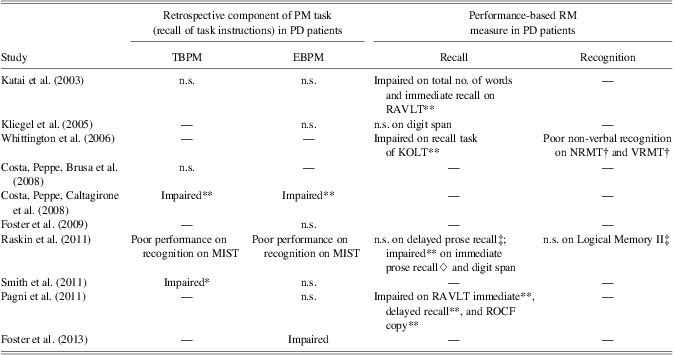
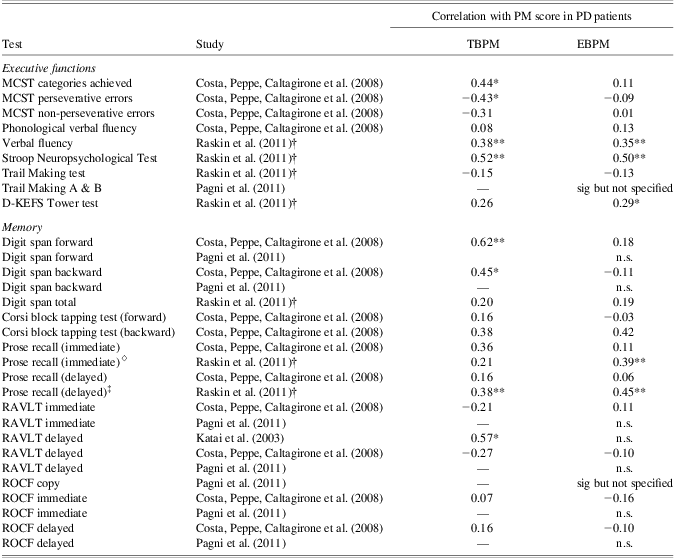
Findings concerned with RM (both retrospective component of the PM task and traditional measures of RM) from the considered studies were consolidated (Table 2). Four studies (Table 3) provided correlation values for PM performance and various tests of executive functions and memory in PD patients. No meta-analysis was conducted for these scores. The correlation values were small to moderate in size between overall PM (TB and EBPM) and executive functions (range = −0.43 to 0.52; median r = 0.12), PM and RM (range = −0.27 to 0.62; median r = 0.16), and PM and overall performance on neuropsychological tests (RM and executive functions) (range = −0.43 to 0.62, median r = 0.14). Approximately 47% and 15% of the correlations between PM and executive functions, and PM and RM respectively were significant.
Discussion
The present study involved a meta-analytic review of PM in patients with PD to understand the magnitude of impairment in these patients. A quick glance at the results reveals PM to be impaired (to a medium effect) in patients as compared to controls. As per heterogeneity statistics and Cohen's d cutoffs, the current results failed to document a significant difference between TBPM and EBPM, suggesting both measures to be impaired to a similar extent. The current results are in concordance with a few findings in the past that have failed to find a significant discrepancy between performance on TBPM and EBPM tasks in clinical populations (Costa, Peppe, Caltagirone, & Carlesimo, Reference Costa, Peppe, Caltagirone and Carlesimo2008; van den Berg et al., Reference van den Berg, Kant and Postma2012). Nevertheless, the current findings should be approached with caution. As noted elsewhere, evidence, even across clinical populations, has suggested TBPM to be more cognitively demanding than EBPM (Smith et al., Reference Smith, Souchay and Moulin2011) and this can be noted in studies investigating PM in PD (Table 1). In the present meta-analysis, a closer look at the results indicates TBPM to be compromised to a marginally greater extent than EBPM. However, similarity in the effect size bracket for both measures may be due to the following reasons. First, the number of studies evaluating both measures is unequal, additionally supported by publication bias documented. Therefore, there is possibility for TBPM to be “under-represented” in the current study. Second, there are differences in the sample size of studies that may have contributed to differential results. For instance, we see that of the five studies that found impaired TBPM in PD patients, the study with the largest sample size (33% of the total sample for studies included for the meta-analysis, which report TBPM in PD) (Raskin et al., Reference Raskin, Woods, Poquette, McTaggart, Sethna, Williams and Tröster2011) demonstrated the largest effect (Table 1). Surprisingly, this was not noted in EBPM; the two largest effects were noted in studies with a combined sample size of only 21% of the total sample for studies measuring EBPM in PD. Moreover, the smallest effect sizes (<0.30) in TBPM and EBPM were noted in studies by Katai et al. (Reference Katai, Maruyama, Hashimoto and Ikeda2003) and Altgassen et al. (Reference Altgassen, Zöllig, Kopp, MacKinlay and Kliegel2007), respectively, that typically recruited lesser than 40 participants. Therefore, such differences in sample sizes could also have contributed to comparable effect sizes for EBPM and TBPM in PD. It is worth mentioning that the effect size in the EBPM measure of Katai et al. (Reference Katai, Maruyama, Hashimoto and Ikeda2003) was the largest of its kind, possibly due to the relative ease of their TBPM over their EBPM measure. Similar variables that may have additionally contributed to distinct results are discussed below.
Summary of studies included in the meta-analysis
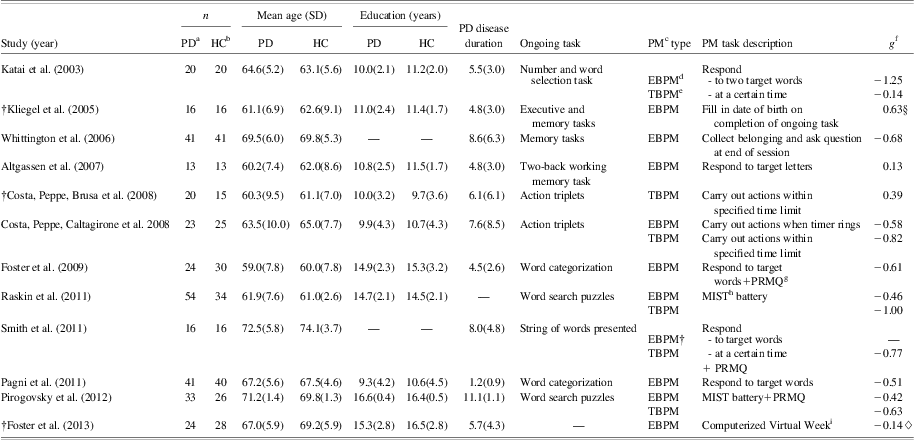
Note. † = excluded from quantitative analysis; § = calculated from chi-square value; ⋄ = eta-squared value a = Parkinson's Disease; b = Healthy Controls; c = Prospective memory; d = Event-based Prospective Memory; e = Time-based Prospective Memory; f = Hedges’ g (effect size metric; negative value indicates better performance in controls); g = Prospective and Retrospective Memory Questionnaire (Crawford et al. Reference Crawford, Smith, Maylor, Della Sala and Logie2003); h = Memory for Intentions Screening Test (Raskin, Reference Raskin2009) is a 30 minute 8-trial test in which the participant engages in a word search puzzle as the ongoing task, responds to certain cues and initiates actions at specified time periods; i = Desktop computer game involving intermittent response to PM cue amidst ongoing activities (Rendell & Henry, Reference Rendell and Henry2009).
It is suggested that different task paradigms will elicit results exhibiting differential impairment (Kliegel et al., Reference Kliegel, Altgassen, Hering and Rose2011). Unfortunately, while attempting to attain better experimental control, most laboratory-based experiments may accidentally weaken participants’ ability to perform normally on PM tasks. For instance, as Kliegel et al. (Reference Kliegel, Altgassen, Hering and Rose2011) note, in day-to-day life instead of remembering to take medication at a particular time, one may link the activity to an event such as post-dinner. In such natural settings, people use cues from the environment to remember for the future (see Kvavilashvili & Fisher, Reference Kvavilashvili and Fisher2007). Similarly, variation in PM task demand may also lead to variable performance. For example, Katai et al. (Reference Katai, Maruyama, Hashimoto and Ikeda2003) found EBPM to be impaired to a greater extent in patients, when their TBPM task and RM task were seemingly easy and could have resulted in ceiling effects. As Kliegel et al. (Reference Kliegel, Altgassen, Hering and Rose2011) note, the cues used by Katai et al. (Reference Katai, Maruyama, Hashimoto and Ikeda2003) were embedded in their EBPM task, whereas the cues used to initiate the EBPM action by Costa, Peppe, Caltagirone, et al. (Reference Costa, Peppe, Caltagirone and Carlesimo2008) were conspicuous (a timer ring), possibly prompting different retrieval strategies. It is thus necessary to consider such differences in methodologies.
Similarly, it is essential to investigate variables like motivation and task importance that regularly assist people in efficiently meeting prospective memory demands in naturalistic environments. Early support comes from findings by Kvavilashvili (Reference Kvavilashvili1987, Reference Kvavilashvili1998), who found tasks receiving more attention to benefit from enhanced performance. In the current context, Altgassen et al. (Reference Altgassen, Zöllig, Kopp, MacKinlay and Kliegel2007) deliberated on task importance and found patients to perform on par with controls, when instructed to weigh importance to successful planning and execution of the PM task over the ongoing task. This suggests that simply downgrading the importance of the ongoing task (McDaniel & Einstein, Reference McDaniel and Einstein2000) or enhancing cue-monitoring strategies (Raskin et al., 2011) may enhance performance on PM tasks in PD patients. In combination with reminders (Cook, Marsh, & Hicks, Reference Cook, Marsh and Hicks2005) and similar methods (Fish, Wilson, & Manly, Reference Fish, Wilson and Manly2010), adequate training to use such strategies may benefit patients with PD in improving execution of delayed intentions (McDaniel & Einstein, Reference McDaniel and Einstein2000; Kliegel et al., Reference Kliegel, Altgassen, Hering and Rose2011).
Relationship with RM
Deficits in episodic memory in PD patients may go undetected if the sole measure used to test RM is the recall of the RM component of the PM task (i.e., recall of PM cue/task instructions). This excessively simple measure may not impose as much cognitive load as a traditional task of RM, and may easily elicit ceiling effects. For instance, in the current study, we can note seven reports (Table 2) of comparable memory for recall of task instructions for the RM component of the PM task between patients and controls. However, studies focused on investigating the status of RM in PD have repeatedly reported impairments in episodic memory in these patients (Green et al., Reference Green, McDonald, Vitek, Evatt, Freeman, Haber and DeLong2002; Higginson et al., Reference Higginson, King, Levine, Wheelock, Khamphay and Sigvardt2003; Marinus et al., Reference Marinus, Visser, Verwey, Verhey, Middelkoop, Stiggelbout and van Hilten2003; Muslimovic et al., Reference Muslimovic, Post, Speelman and Schmand2005). In line with these reports, the same studies that did not find any impairment in the RM component of the PM task in PD patients, indicate these patients to show deficits in immediate and delayed recall and recognition on traditional measures of RM (Table 2), which interestingly also seem to be associated with their performance on PM tasks (Table 3). However, it is important to note that impaired recall of information in PD patients may be “secondary” to impaired executive functioning (especially working memory: Bondi et al., Reference Bondi, Kaszniak, Bayles and Vance1993; Cooper, Sagar, & Sullivan, Reference Cooper, Sagar and Sullivan1993; Davidson et al., Reference Davidson, Anaki, Saint-Cyr, Chow and Moscovitch2006; Higginson et al., Reference Higginson, King, Levine, Wheelock, Khamphay and Sigvardt2003) that has been noted in these patients (Green et al., Reference Green, McDonald, Vitek, Evatt, Freeman, Haber and DeLong2002). Moreover, the nature of these executive deficits may involve either poor working memory (Higginson et al., Reference Higginson, King, Levine, Wheelock, Khamphay and Sigvardt2003), difficulty in engaging specific semantic strategies to retrieve episodic information (Dujardin et al., Reference Dujardin, Defebvre, Grunberg, Becquet and Destée2001), or difficulty in self-initiated retrieval of information, all of which reflect in PM and RM performance, and are compliant with fronto-striatal deficits noted in PD.
Summary of findings on retrospective memory in studies assessing prospective memory in Parkinson's disease
Note. PM = prospective memory; TBPM = Time-based prospective memory; EBPM = Event-based prospective memory; RM = retrospective memory; PD = Parkinson's disease; RAVLT = Rey Auditory Verbal Learning Test; KOLT = Kendrick Object Learning Task; NRMT = Nonverbal Recognition Memory Task; VRMT = Verbal Recognition Memory Task; MIST = Memory for Intentions Screening Test; ROCF = Rey-Osterrieth Complex Figure.
† = n.s in early-PD group, but significant (p < 0.05 for NRMT hard level; p < 0.01 for VRMT) impairment in advanced-PD group; ‡ = WMS III Logical Memory II; ⋄ = WMS III Logical Memory I
*p < 0.05; **p < 0.01; n.s. = not significant.
Summary of correlations between PM and other neuropsychological tests as reported in considered studies
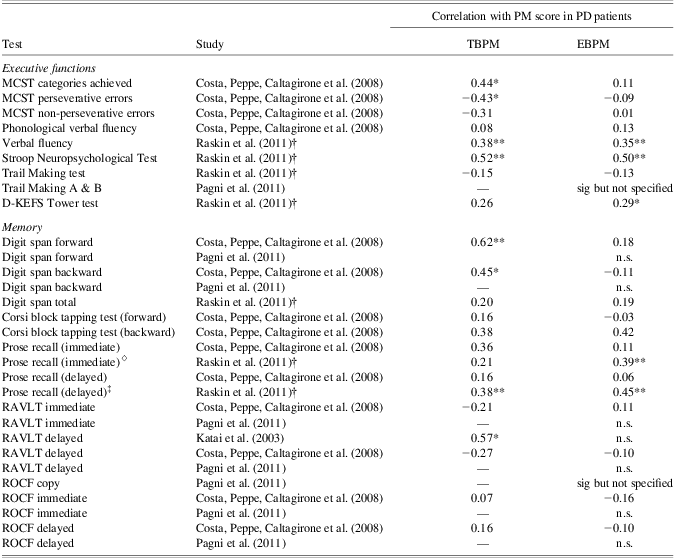
Note. Correlations reported are unadjusted Spearman's (rank) or Pearson's values extracted from studies.
⋄ = Wechsler Memory Scale-III Logical Memory I; ‡ = Wechsler Memory Scale-III Logical Memory II.
† = correlations reported by Raskin et al. (Reference Raskin, Woods, Poquette, McTaggart, Sethna, Williams and Tröster2011) derived from TBPM/EBPM subscales of the MIST; PM = Prospective memory; PD = Parkinson's disease; TBPM = Time-based prospective memory; EBPM = Event-based prospective memory; MCST = Modified Card Sorting Test; D-KEFS = Delis-Kaplan Executive Function System; RAVLT = Rey Auditory Verbal Learning Test; ROCF = Rey-Osterrieth Complex Figure Test.
*p < 0.05; **p < 0.01; n.s. = not significant.
PM and Other Executive Functions in PD
Since most lab-based PM engagements involve dual tasking, they impose requirements of competent working memory and cognitive flexibility on participants. Moreover, in TBPM, absence of an explicit association between cue and action requires efficient working memory to continuously switch between the ongoing task and monitoring time to execution of intention. In such cases, increasing the strategic demand and attentional monitoring on the PM task (from focal to nonfocal: as in Katai et al., Reference Katai, Maruyama, Hashimoto and Ikeda2003 and Foster et al., Reference Foster, McDaniel, Repovš and Hershey2009, Reference Foster, Rose, McDaniel and Rendell2013) would not only require additional working memory resources, but would affect performance in PD patients who have frontal impairments, even with presence of an external cue.
Of the studies considered in the meta-analysis, four reported correlations between PM performance and various tests of executive functioning (Table 3). In line with previous findings (Davidson et al., Reference Davidson, Anaki, Saint-Cyr, Chow and Moscovitch2006; Higginson et al., Reference Higginson, King, Levine, Wheelock, Khamphay and Sigvardt2003), PM performance correlated significantly with set shifting, verbal fluency, inhibition, and planning tasks. More importantly, results across five studies (Altgassen et al., Reference Altgassen, Zöllig, Kopp, MacKinlay and Kliegel2007, Costa, Peppe, Brusa, et al., Reference Costa, Peppe, Brusa, Caltagirone, Gatto and Carlesimo2008; Costa, Peppe, Caltagirone, et al., Reference Costa, Peppe, Caltagirone and Carlesimo2008; Foster et al., Reference Foster, McDaniel, Repovš and Hershey2009; Kliegel et al., Reference Kliegel, Phillips, Lemke and Kopp2005) indicated impaired working memory in PD patients and found it to explain a significant percentage (47% on nonfocal PM task: Foster et al., Reference Foster, McDaniel, Repovš and Hershey2009; 52%: Kliegel et al., Reference Kliegel, Phillips, Lemke and Kopp2005) of the variance of PM. These findings are consistent with evidence for reduced working memory capacity (Bondi et al., Reference Bondi, Kaszniak, Bayles and Vance1993; Lewis et al., Reference Lewis, Cools, Robbins, Dove, Barker and Owen2003; Weintraub et al., Reference Weintraub, Moberg, Culbertson, Duda, Katz and Stern2005) as well as impaired cognitive functions involving cognitive flexibility (i.e., planning, inhibiting, manipulating, all of which are also required in working memory: Zgaljardic et al., Reference Zgaljardic, Borod, Foldi, Mattis, Gordon, Feigin and Eidelberg2006) in PD patients that mediate PM performance. To add, these deficits in cognitive flexibility may arise from depleted dopamine levels in the PD brain (Cools, Reference Cools2006) and therefore, would likely hamper performance on tasks that involve time-estimation and flexibility of cognitive representation (Owen, Reference Owen2004; Cools, Reference Cools2006), both of which are essential in executing the PM cue. More evidence for deficits in working memory in PD patients come from reduced activity noted in the dorsolateral prefrontal cortex (responsible for planning, set shifting, working memory, and verbal fluency: Weintraub et al., Reference Weintraub, Moberg, Culbertson, Duda, Katz and Stern2005; Zgaljardic et al., Reference Zgaljardic, Borod, Foldi, Mattis, Gordon, Feigin and Eidelberg2006) and the anterior cingulate cortex (involved in response inhibition: Zgaljardic et al., Reference Zgaljardic, Borod, Foldi, Mattis, Gordon, Feigin and Eidelberg2006), both of which are also required in successful PM execution (Burgess et al., Reference Burgess, Gonen-Yaacovi and Volle2011) and are affected in PD (Higginson et al., Reference Higginson, King, Levine, Wheelock, Khamphay and Sigvardt2003; Owen, Sahakian, & Robbins, Reference Owen, Sahakian and Robbins1998; Owen, Reference Owen2004).
Everyday Functioning and PM in PD
It is important to realize that in our daily lives, PM challenges would not require us to press a button or tap the table whenever we see a certain word. Everyday demands would for the most part, necessitate using cues in the environment to bring the intention to mind. For instance, on assessing TBPM by having healthy adults call the experimenter after a 1-week delay, Kvavilashvili and Fisher (Reference Kvavilashvili and Fisher2007) found intentions to be “either triggered by incidental cues or periodically pop into one's mind without any apparent reason” (p. 118). Contrary to previous findings, self-initiated retrieval was reported in less than 10% of their sample, suggesting usage of more automatic attentional processes and external cues to operate in execution of TB intentions as well. PM deficits are, therefore, best witnessed and understood in such naturalistic settings in the presence of considerable environmental support, where factors like motivation have been noted to play a role (Kvavilashvili & Fisher, Reference Kvavilashvili and Fisher2007).
Functional decline in daily life due to impaired PM in PD patients has rarely been investigated. Only one of 12 available studies measured performance in PM tasks and its direct association to everyday functioning in PD patients. Pirogovsky, Woods, Filoteo, and Gilbert (Reference Pirogovsky, Woods, Filoteo and Gilbert2012) administered the MIST (Raskin, Reference Raskin2009) and the PRMQ (Crawford, Smith, Maylor, Della Sala, & Logie, Reference Crawford, Smith, Maylor, Della Sala and Logie2003) in addition to self-report measures of medication management efficacy, quality of life, activities of daily living and performance related measures of medication management and finance management. Only time-based MIST scores correlated significantly with medication management (both performance and self-report scores) and finance management. This association is of crucial significance to PM literature in that impaired TBPM has extended effects with regards to overseeing daily medication intake and financial activities. Admittedly, the inability to consistently monitor time to next dosage of medication would result in delayed or missed doses, which would be unfavorable to amelioration of cognitive deficits in the disease. However, since only one study has explored this concept, it is necessary to find consistent evidence for the same.
In summary, the current meta-analysis found PM to be impaired in PD patients, with TB and EBPM impaired to a similar extent. Also, PD patients seem to show deficits in RM as well as other executive functions such as working memory, which are essential in successful execution of the PM task. However, the relatively small number of studies in the present meta-analysis and lack of uniform measures of PM hinders generalization of results.