Introduction
Recent projections by the Food and Agriculture Organization (FAO, 2019, p. 2) and the United Nations (United Nations, 2015a) indicate that the global population is expected to increase to 9.1 billion by 2050 and 11.2 billion by the end of this century. At the same time, the world's average per capita income is expected to increase significantly. Although food security is central to human wellbeing (Reinert, Reference Reinert2015), the dynamics in world population and incomes translate into rising demand for food (Martin, Reference Martin2019). As a result, food demand pressures are building up across the world as Gouel and Guimbard (Reference Gouel and Guimbard2019) project an increase by 47% by 2050, while Valin et al. (Reference Valin, Sands, van der Mensbrugghe, Nelson, Ahammad, Blanc, Bordirsky, Fujimori, Hasegawa, Havlik, Heyhoe, Kyle, Mason-D'Croz, Paltsev, Rolinski, Tabeau, van Meijl, von Lampe and Willenbockel2014) stated that by 2050 the need for animal calories alone is expected to increase between 61 and 144%. On the food supply side, according to the Intergovernmental Panel on Climate Change (IPCC, 2020, p. 8), between 1961 and 2017, the total production of food (cereal crops) increased by 240%, while the World Bank statistics shows that the world's food production index rose from 51.8 in 1980 to 125.6 in 2014.
The food market pressures indicated above pose significant challenges to the modern agricultural system where the livestock sector alone supports about 1.3 billion producers and retailers and contributes to around 40% of the world's agricultural output (Herrero et al., Reference Herrero2016). The expansion of the modern agricultural production system will undoubtedly place significant threats and sustainability challenges to the world's natural environment through greenhouse gas emissions (GHGs) such as carbon dioxide, methane, nitrous oxide and fluorine compounds. According to the IPCC (2020, p. 10), agriculture, forestry and other land activities accounted for around 13% of carbon dioxide, 44% of methane and 81% of nitrous oxide emissions globally between 2007 and 2016, representing about 23% of total net anthropogenic emissions of GHGs, threatening global warming beyond the expected 1.5°C target. Further intensification of food production will impose additional undesirable consequences such as the rise in GHGs. The GHG-induced environmental degradation is a subject of an ongoing inquiry, for example, Flohre et al. (Reference Flohre, Hänke, Fischer, Geiger, Bengtsson, Berendse, Weisser, Emmerson, Ceryngier, Liira, Tscharntke, Winqvist, Eggers, Bommarco, Pärt, Bretagnolle, Plantegenest, Clement, Dennis, Palmer, Morales, Onate, Guerrero, Hawro, Aavik, Thies and Inchausti2011), Storkey et al. (Reference Storkey, Meyer, Still and Leuschner2012), Ripple et al. (Reference Ripple2013), Bajzelj et al. (Reference Bajzelj, Richards, Allwood, Smith, Dennis, Curmi and Gilligan2014), Jayet and Petel (Reference Jayet and Petel2015), Emmerson et al. (Reference Emmerson, Morales, Oñate, Batáry, Berendse, Liira, Aavik, Guerrero, Bommarco, Eggers, Pärt, Tscharntke, Weisser, Clement, Bengtsson, Dumbrell Alex, Kordas Rebecca and Guy2016) and Mora et al. (Reference Mora2018).
There is no doubt that human activities such as agricultural intensification for food production are not only the source of environmental degradation (air, water and soil contamination), but equally the source of climate change through the emissions of GHGs. Methane and nitrous oxide emissions are mainly generated through crop and livestock production (Gerber et al., Reference Gerber, Steinfeld, Henderson, Mottet, Opio, Dijkman, Falcucci and Tempio2013) for dietary requirements (Theurl et al., Reference Theurl, Lauk, Kalt, Mayer, Kaltenegger, Morais, Teixeira, Domingos, Winiwarter, Erb and Habert2020). The literature reveals that the highest GHG found in high ruminant meat demand, where the entire lifecycle of livestock contributes to approximately 14.5% of all human-related GHGs, methane, a byproduct of digestion (Gerber et al., Reference Gerber, Steinfeld, Henderson, Mottet, Opio, Dijkman, Falcucci and Tempio2013) contributing to climate change. On the other hand, croplands emit nitrous oxide through significant nitrogen fertilizer usage and heating and cooling systems (Golzar et al., Reference Golzar2019). According to a study by Dickie et al. (Reference Dickie, Streck, Roe, Zurek, Haupt and Dolginow2014), 40% of agricultural GHGs are produced by some of the world's large agricultural producers (China, USA, India and Brazil), and China and India are the key contributors to global GHG emissions (Liu et al., Reference Liu, Guo and Xiao2019).
Unfortunately, quantitative studies that estimate the impact of different food type (cereal and livestock) production on GHGs in a coherent modeling framework is surprisingly scant across countries in different stages of development. Investigation of the effect of global production of cereals and livestock on GHG emissions across countries on different development pathways is essential due to significant increases in food production-related emissions, as noted above from the IPCC (2020). Against this backdrop, this paper attempts to unfold the effects of cereal and livestock production on GHG emissions worldwide, with countries categorized in three different income levels: high, medium and low. Research that directly examines the impact of the production of different food types on GHG emissions, within an environmental empirical modeling framework that controls for the affluence of a nation, as well as other constituent effects, has not received an elevated level of research focus despite the extensive emphasis on global levels of GHG emissions. This study attempts to fill this research gap by analyzing the impact of food production type on GHG (methane and nitrous oxide) emissions in 132 countries, disaggregated by their per capita incomes from 2002 to 2016. Following Ehrlich and Holdren's (Reference Ehrlich and Holdren1971), Impacts by Regression on Population Affluence and Technology modeling framework, now known as STIRPAT, is employed. The empirical analysis uses the balanced panel-corrected standard errors framework estimation methodology to estimate separate equations for 27 high-income, 79 middle-income and 26 low-income countries.
This investigation makes a new contribution to the renewable agriculture and food systems’ literature by unfolding the magnitude of the different effects of the production of cereals and livestock on GHG emissions globally, with nations categorized in three different development trajectories based on per capita incomes. In doing so, this study is aligned with the broader framework of the United Nations (2015b) Sustainable Development Goals 12, 13 and 15 (sustainable consumption and production, climate action and life on land, respectively). Reducing GHG emissions from the agricultural and food production systems is fundamentally vital across the world. The greening of the food production systems and managing food demand for a growing population is essential in meeting the 2030 agenda for the Sustainable Development Goals mentioned above. This study also elevates the research attention to food production type and GHG emission linkages and their value in sustainable food production to minimize environmental damage. Roe et al. (Reference Roe2019) noted that transforming the agricultural sector could feasibly and sustainably contribute to about 30% of the global mitigation needed in 2050 to deliver the 1.5°C target. Within this long-term perspective of maintaining a sustainable environment, this study attempts to shed some light on bringing about greater awareness of GHG emission mitigation from the production of foods (cereals and meat) essential to dietary requirements.
Analytical model, variable justification and data
The analytical framework is based on the STIRPAT structural model, first formulated by Ehrlich and Holdren (Reference Ehrlich and Holdren1971), initially known as the ‘Impact by Population Affluence and Technology (IPAT)’. IPAT quantified the effects of population-induced economic activity on the natural environment. It unfolded the impact on the environment through three underlying variables: the size of the population, affluence and technology or the effect per unit of economic activity. IPAT was later reformulated to STIRPAT to enable the testing of hypotheses with greater rigor and strength, as shown by Dietz and Rosa (Reference Dietz and Rosa1994), Zhang and Lin (Reference Zhang and Lin2012) and Ji and Chen (Reference Ji and Chen2017). The general formulation of the STIRPAT model is shown in Equation (1):

Here, I, P, A and T represent environmental impact, population size, affluence and technology. φ is the constant, λ 1, λ 2 and λ 3 are the exponents of P, A and T, respectively, and ε denotes the error term.
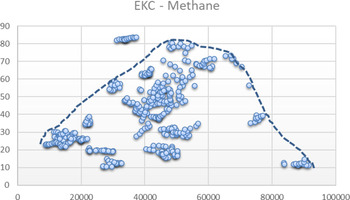
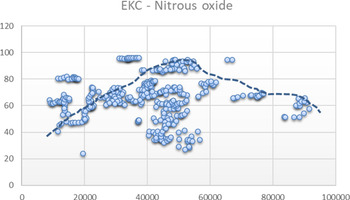
Previous scholars (Grossman and Krueger, Reference Grossman and Krueger1991; Holtz-Eakin and Selden, Reference Holtz-Eakin and Seldeon1995; Ozturk and Acaravci, Reference Ozturk and Acaravci2011; Ozturk et al., Reference Ozturk, Al-Mulali and Saboori2016; Sarkodie and Strezov, Reference Sarkodie and Strezov2019; Xiong, Chen and Huang, Reference Xiong, Chen and Huang2019) advocated that there exists an inverted ‘U’-shaped relationship between a countries per capita income as well as income-squared and its environmental performance, commonly known in the literature as the environmental Kuznets curve (EKC) effect. The EKC is an empirical phenomenon that reveals a hypothesized relationship between various contributors to environmental deterioration and per capita income. The EKC hypothesis states that as the emission of various pollutants (carbon dioxide, sulfur and nitrogen oxides) increase, the environmental quality worsens for nations in their early stages of economic development. However, when nations per capita incomes increase due to economic growth, their demand for cleaner environment increases as governments enact and implement environmental legislation for a cleaner environment; hence, the environmental quality will improve. This suggests that the environmental impacts or emissions are an inverted ‘U’-shaped function of per capita income. Although it is difficult to show a perfect EKC in two dimensions, there appears to be a crude inverted ‘U’ shape as depicted in Appendix Figures 1 and 2 for the sample of high-income countries forming part of the analysis in this study.
The EKC effect can be tested using the STIRPAT modeling framework. Given that the core variable of interest in this study is food production incorporating this together with the EKC measure and other potential influences on GHGs gives the extended STIRPAT model of the general form given in Equation (2):

Here, GHG captures the environmental quality measured by methane and nitrous oxide emissions. Food production includes total food production and two forms of food production: cereal and livestock production. The EKC measure is income and its quadratic term. The main control variables are the industry's size, the area under forests, trade, population density, education, government effectiveness and political stability. Incorporating these individual variables in Equation (2) gives the estimable form represented by Equation (3):

The coefficients β 1 to β 10 are the elasticities of GHGs with respect to the right-hand side variables. A finding that β 2 > 0 and β 3 < 0 would indicate an EKC exists. The next section describes the variable measures and data.
Variable measures
The sample includes 132 countries. Following the World Bank classification of countries by per capita incomes, the 132 countries are grouped into three categories: 26 low-income, 79 middle-income and 27 high-income (Organization for Economic Cooperation and Development) countries.
The sample of low-income countries is Afghanistan, Benin, Burkina Faso, Burundi, Central African Republic, Chad, Democratic Republic of Congo, Eritrea, Ethiopia, The Gambia, Guinea, Guinea Bissau, Haiti, Liberia, Madagascar, Malawi, Mali, Mozambique, Nepal, Niger, Rwanda, Sierra Leone, Tajikistan, Togo, Uganda and Yemen Republic.
The sample of middle-income countries is Albania, Algeria, Angola, Argentina, Azerbaijan, Bangladesh, Belarus, Belize, Bhutan, Bolivia, Bosnia and Herzegovina, Botswana, Brazil, Bulgaria, Cabo Verde, Cambodia, Cameroon, China, Colombia, Comoros, Congo Rep., Costa Rica, Cote d'Ivoire, Cuba, Dominica, Dominican Republic, Ecuador, Egypt, El Salvador, Eswatini, Gabon, Georgia, Ghana, Grenada, Guatemala, Guyana, Honduras, India, Indonesia, Iran, Iraq, Jamaica, Jordan, Kazakhstan, Kenya, Kyrgyz Republic, Lao PDR, Lesotho, Malaysia, Maldives, Mauritania, Mauritius, Mexico, Morocco, Myanmar, Namibia, Nicaragua, Nigeria, North Macedonia, Pakistan, Paraguay, Peru, Philippines, Romania, Russian Federation, Senegal, South Africa, Sri Lanka, Thailand, Timor-Leste, Tunisia, Turkey, Ukraine, Uzbekistan, Vanuatu, Venezuela, Vietnam, Zambia and Zimbabwe,
The sample of high-income countries is Australia, Austria, Belgium, Canada, Cyprus, Czech Republic, Denmark, Estonia, Finland, France, Germany, Greece, Hungary, Iceland, Ireland, Italy, Japan, Netherlands, New Zealand, Norway, Poland, Portugal, Spain, Sweden, Switzerland, United Kingdom and the United States of America.
The data used are annual, covering the years 2002–2016. Table 1 summarizes the variable measures and their sources.
Variable measures

Source: Authors compilation.
Variable justification
Dependent variables
Methane and nitrous oxide emissions are used to capture the food production effect as these gases are emitted through crop and livestock production (Gerber et al., Reference Gerber, Steinfeld, Henderson, Mottet, Opio, Dijkman, Falcucci and Tempio2013). Much of these GHGs are known to be produced from agricultural production systems (Dickie et al., Reference Dickie, Streck, Roe, Zurek, Haupt and Dolginow2014). Agriculture, together with forestry and other land activities, is responsible for over one-quarter of the world's GHG emissions, much of which is dominated by methane and nitrous oxide. The IPCC (2019) noted that the agri-food sector now creates a quarter of human-induced GHG emissions, expected to increase to half of all such emissions by 2050. According to Lynch et al. (Reference Lynch, Cain, Frame and Pierrehumbert2021), the global food system is responsible for 21–37% of annual emissions of these gases as agricultural activity overall generates over 50% of all anthropogenic methane emissions and over three-quarters of anthropogenic nitrous oxide. These are harmful gases with detrimental effects on human health and the climate. Methane is an extremely powerful GHG, responsible for an estimated 260,000 premature deaths and 775,000 asthma-related complications, as well as 25 million tons of crop losses (United Nations, 2021).
In terms of geographical distribution, the World Resources Institute notes that between 1996 and 2016, large producers such as China, followed by India, Brazil and the United States, were responsible for most emissions. In terms of the agricultural origins of GHGs, the leading direct sources include methane from ruminants and paddy cultivation and nitrous oxide from soils, fertilizer usage, manure and urine from animals (Ogle et al., Reference Ogle2014). These gases have high global warming impacts. According to the World Resources Institute, an estimated 70 billion animals reared annually, which is the most significant source of methane emissions, where enteric fermentation accounts for an estimated 40% of agricultural production emissions and a further 10% of agricultural production emissions is from rice cultivation and use of synthetic fertilizers. The FAO has recorded livestock alone, accounting for around 15% of the world's GHG annually.
Food production
Agricultural and food production systems are climate-dependent bio-diversity, and climate change is threatening it with increases in temperatures, rainfall variations, devastating floods, soil degradation and rise in pests and diseases. In particular, the low- and middle-income countries face significant challenges in adapting to food production systems for extreme weather conditions and constraints imposed on nations budgets. Commitment to climate change is also a constraint to increasing food production to feed the growing population. The agricultural sector is the primary domestic source of the food supply in most countries (Godfray and Garnett, Reference Godfray and Garnett2014), enhancing household caloric availability (Pauw and Thurlow, Reference Pauw and Thurlow2011). Although much of the global agricultural production has contributed to several countries economic prosperity and raised human wellbeing (Fritz and Koch, Reference Fritz and Koch2016), it has failed to fulfill the promise to secure food for the entire world population. According to the World Health Organization, an estimated 820 million people worldwide went hungry in 2018, expected to increase by many more millions in 2021 due to the COVID-19 pandemic. GHG emissions have inflicted damage to the natural environment and contributed to climate change. Agricultural intensification for food production uses large amounts of inputs such as chemical fertilizers and fossil fuels for energy that have contributed to GHGs (Pendrill et al., Reference Pendrill2019) and damaged biodiversity (IPCC, 2006).
Income
Theoretically, environmental dilapidation follows the EKC pattern with a rise in real output to a point as the environment is treated as a luxury good and demand superior environmental quality (Torras, Reference Torras2005). A decline follows with a rise in incomes as environmental improvement initiatives such as pollution control through improved technology foster better environmental outcomes (Aspergis and Ozturk, Reference Aspergis and Ozturk2015). The existence of the EKC effects have been confirmed in previous studies, for example, Holtz-Eakin and Selden (Reference Holtz-Eakin and Seldeon1995).
Industry
This study controls the effects of industrial expansion, both agricultural and non-agricultural, that have aggravated environmental quality. The industrial development of various forms throughout the world has contributed to a significant increase in demand for fossil energy (Wang et al., Reference Wang, Li, Fang and Zhou2016; Shahbaz et al., Reference Shahbaz, Sarwar, Chen and Malik2017). For example, the increase in the burning of coal and oil has had detrimental effects on the world's environmental quality (Sueyoshi et al., Reference Sueyoshi, Yuan and Goto2017). Furthermore, mechanized farming practices through the use of fossil fuel energy also increase GHG emissions.
Trade
Free trade and its interaction with the natural environment continue to be debated, with literature revealing that free trade can impose beneficial and detrimental effects on the environment. According to the Organisation for Economic Cooperation and Development (2021), economic growth resulting from free trade contributes to environmental degradation through unsustainable use of natural resources and export-led industries increasing pollution. At the same time, free trade leads to an increased economic activity with increases in energy (fossil) use resulting in the higher levels of GHG emissions (World Trade Organisation, 2021). On the contrary, free trade supports growth, brings in income, improves nations’ capacity to manage the environment more efficiently and less GHG emissions.
The empirical literature tends to support the effect of free trade on the environment in terms of its detrimental and beneficial effects. For example, according to Gale and Mendez (Reference Gale and Mendez1998), based on the sources of comparative advantage, environmental degradation (pollution) rises with a capital abundance of a country. Countries that favor capital intensive food production and non-food production for trade demand significant resources such as chemicals, fertilizers and fossil energy, resulting in production systems emitting large amounts of GHGs with negative consequences on the environment. Farhani and Ozturk's (Reference Farhani and Ozturk2015) study showed that free trade is hazardous to the environment. Similarly, Drabo's (Reference Drabo2017) study based in 136 countries for 1986–2010 revealed that the proportion of primary commodity export in agricultural production increased GHGs. On the contrary, other proponents of free trade, for example, Frankel and Rose (Reference Frankel and Rose2005), argued that free trade leads to a decline in pollution through technological improvements and the adoption of modern production methods.
Forests
Forests are another critical control variable in the estimation phase. There is ample scientific evidence that forests absorb carbon dioxide, support biodiversity and sustain climate change (The World Bank, 2013; Khuc et al., Reference Khuc2018). Much of the world's forest is now known to absorb carbon dioxide. According to the findings of the International Union of Conservation of Nature (IUCN, 2017), the world's forest cover absorb 2.4 billion tons of carbon dioxide every year. Therefore, any reductions in forest cover can harm the environment. On the other hand, deforestation is considered the second primary anthropogenic source of carbon dioxide emission. Van der Werf et al.'s (Reference van der Werf, Morton, DeFries, Olivier, Kasibhatla, Jackson, Collatz and Randerson2009) study revealed that approximately 20% of carbon dioxide is emitted due to forest degradation and deforestation.
Population density
Based on the United Nations Population Fund (https://www.unfpa.org/press/sustainable-development-and-population-dynamics-placing-people-centre) analysis, population dynamics (population growth, density, urbanization and migration) imposes rising levels of stress on biodiversity loss. This comes through increasing consumer demand for food, water and land. Population and settlement density are significant variables determining reduced emission levels (Ivanova et al., Reference Ivanova, Vita, Wood, Lausselet, Dumitru, Krause, Macsinga and EG2018). Hence, the rising human population is hypothesized to degrade the natural ecosystem resulting in the loss of environmental quality (Armenteras et al., Reference Armenteras, Guillermo, Nelly, Sonia and Milton2006; Weber and Sciubba, Reference Weber and Sciubba2019).
Education
Education does play an essential role in curbing GHG emissions. A study by Post and Meng (Reference Post and Meng2018) revealed beneficial pay-offs of knowledge on the environment. In particular, environmental education can improve attitudes toward the environment through awareness, respect and concern for avoiding damage to the world's natural environment. In their study, Chankrajang and Muttarak (Reference Chankrajang and Muttarak2017) observed that more years of schooling led to a higher probability of taking knowledge-based environmentally-friendly actions.
Government effectiveness
Political science theorists Holmberg et al. (Reference Holmberg, Rothstein and Nasirtousi2009) observed that nations with high-quality governments could reap the benefits of their economic growth, social progress and environmental policies. Capable governments can formulate and demonstrate sustainable environmental strategies that can mitigate damage to the environment. On the contrary, government ineffectiveness through complicated and convoluted bureaucratic processes can constrain governments’ environmental policy effectiveness and place governments in policy implementation deficit traps (Adam et al., Reference Adam, Knill and Fernandez-i-Marin2016).
Political stability
The stability of the political environment is fundamental to the prosperity of nations, while political instability can have detrimental consequences (North, Reference North1990). Stroup (Reference Stroup2006) has argued that countries with a democratic political system of governance create opportunities for people to freely voice their concerns that matters to them, such as minimizing GHG emission levels. In terms of environmental mitigation matters, the efficacy of the environmental rule of law is essential in compliance with environmental management. There is a meaningful linkage between aspects of governance, such as the rule of law and political stability and environmental effects (Wendland et al., Reference Wendland, Lewis and Alix-Garcia2014). Any deterioration in the political environment can translate into the weakening of rules and regulations that can adversely weaken sustainable environmental outcomes, among other things.
Findings
The empirical procedure involves the estimation of Equation (3) in two stages. The first-stage estimation investigates the effect of total food production on GHG emissions. In the second stage, Equation (3) is estimated with the food production type. It includes testing the impact of cereal yield and livestock production on GHG emissions. The variables and units of measures tested, reported in Tables 2–4, are the same as those listed in Table 1. Several diagnostic tests are conducted as part of the estimation, and the results are considered satisfactory, given the use of the balanced panel data.
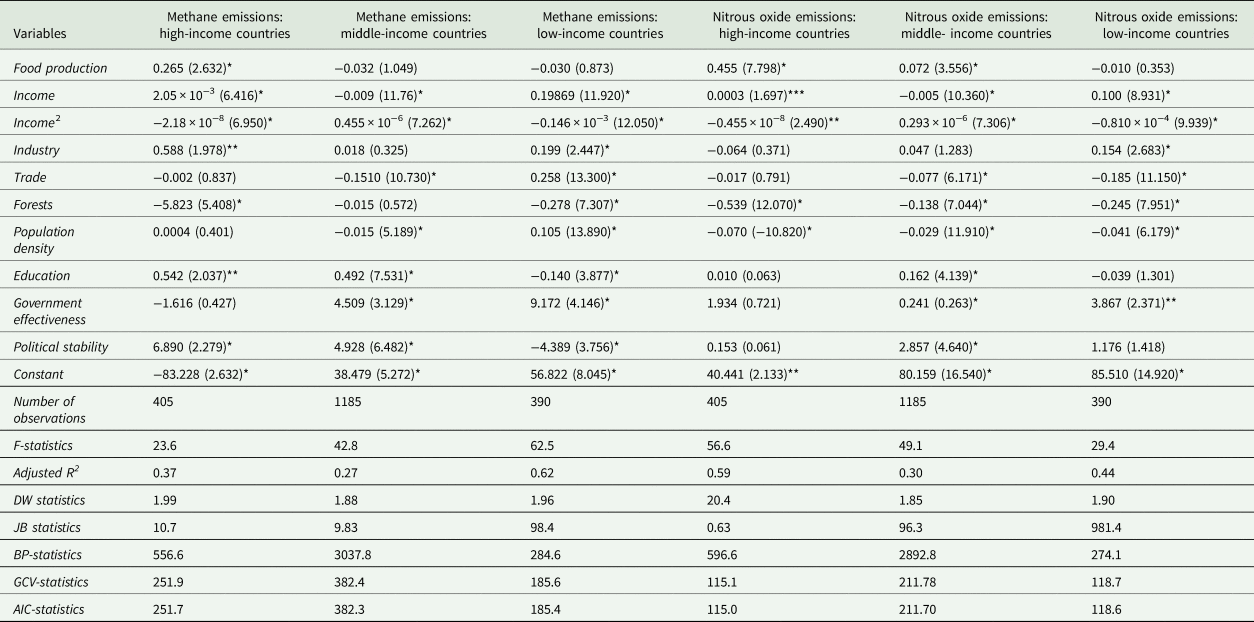
Table 2 includes the first-stage estimation results, where the prime variable of interest is food production. According to Table 2, the food production coefficient has the expected positive effect (β = 0.265 for methane and 0.455 for nitrous oxide) and statistically significant (ρ > 0.01) but only for the high-income group of countries. For middle- and low-income countries, food production coefficient has a negative sign and statistically insignificant for methane emissions. However, food production coefficient has the expected positive and significant effects (β = 0.072 and ρ > 0.01) on nitrous oxide emissions in the middle-income countries. When the impact of food production on nitrous oxide emissions is compared to the high-income countries, the magnitude of this is smaller in middle-income countries (β: 0.072 < β: 0.455) with ρ > 0.01. Overall, the empirical results of total food production provide reliable and sufficient confirmation that in the high-income countries, it contributes significantly to the degradation of environmental quality.
Effect of total food production (measured by food production index, 2004–2006 = 100) on methane and nitrous oxide emissions

Numbers in parentheses are t-statistics.
*P < 0.1, **P < 0.05 ***P < 0.01.
Having established the effect of food production on GHG emissions, the second stage in the estimation phase involved testing the impact of food production type on GHG emissions: Tables 3 and 4 present the estimations of cereal and livestock production on GHG emissions, respectively.
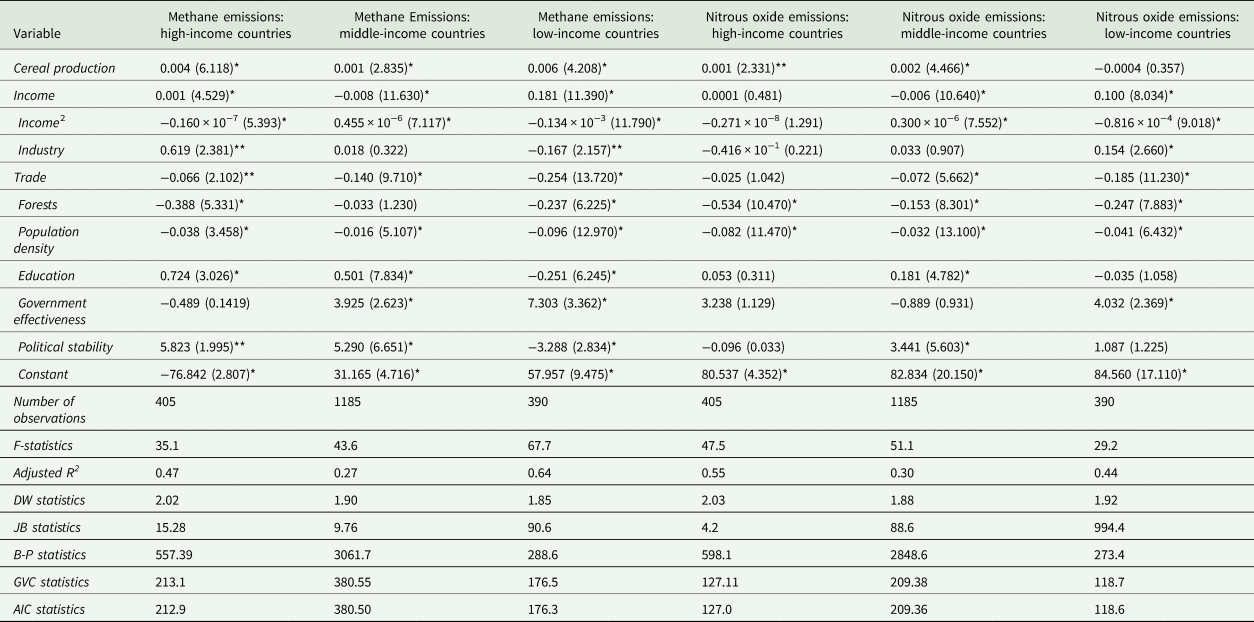
In Table 3, the prime variable of interest is cereal production. All other control variables and their measures are the same as listed in Table 1. According to the results in Table 3, the cereal production coefficient is as expected positive and statistically significantly correlated with methane emissions in the high-, medium- and low-income group of countries with β = 0.001 to 0.006 and ρ > 0.01 in all three income group of countries. Interestingly, the sign of cereal production coefficient effect on nitrous oxide emissions is as expected, positive and statistically significant for the middle- and high-income countries (β = 0.002 and 0.001 with ρ > 0.01 for both). These results provide reliable confirmation that cereal production in the high-, medium- and low-income countries contributes significantly to methane emissions. At the same time, its effect on nitrous oxide emission is strong only in high- and middle-income countries.
Effect of food type—cereal production (kg per hectare) on methane and nitrous oxide emissions

Numbers in parentheses are t-statistics.
*P < 0.1, **P < 0.05 ***P < 0.01.
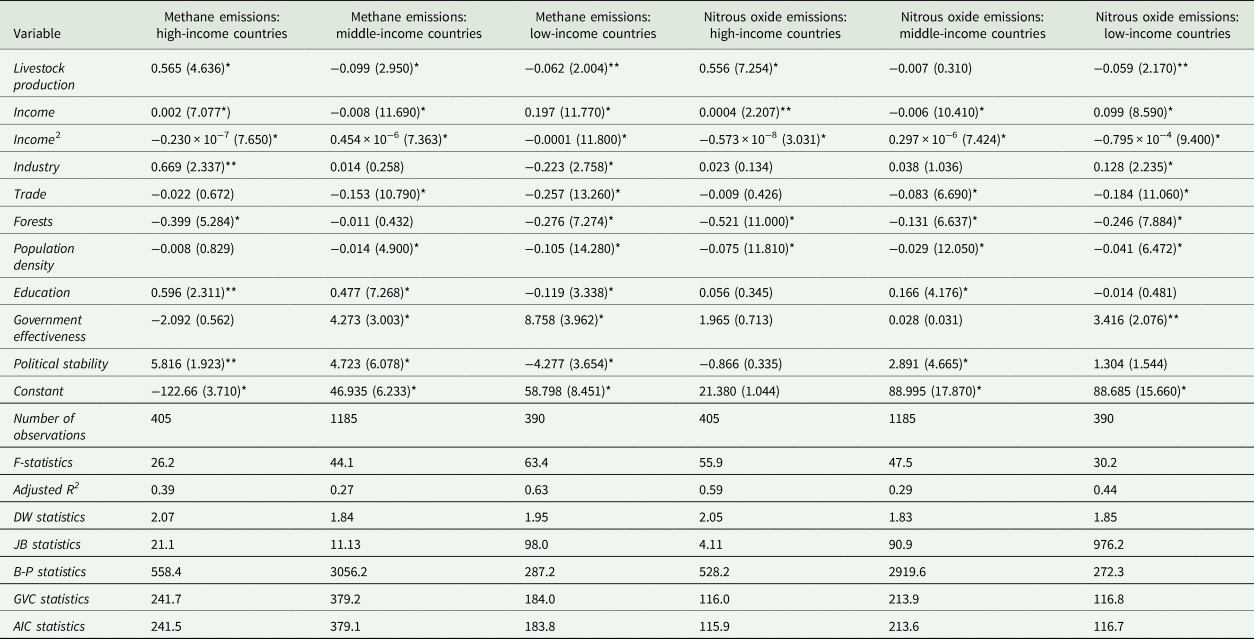
Having established the effects of cereal production on GHG emissions, an attempt was made to test the impact of livestock production (as part of food production) on GHG emissions. The results are presented in Table 4. In Table 4, the prime variable of interest is livestock production. All other control variables and their units of measure remain unchanged and are the same as those listed in Tables 1–3. According to the results in Table 4, livestock production coefficient is as expected positive and statistically significantly correlated with methane and nitrous oxide emissions only in the high-income group of countries with β = 0.565 and 0.556 respectively with ρ > 0.01. This result provides reliable confirmation that it is livestock production in high-income countries that contribute significantly to GHG emissions.
Effects of food type—livestock production (measured by livestock production index, 2004–2006 = 100) on methane and nitrous oxide emissions

Numbers in parentheses are t-statistics.
*P < 0.1, **P < 0.05 ***P < 0.01.
According to Table 4, livestock production is negatively and statistically significantly correlated with methane emissions in low- and middle-income countries. A possible line of explanation for these outcomes is that many low- and middle-income countries have adopted improved animal husbandry and livestock manure management practices since the late 1990s (United Nations Environment Programme, 2021). According to IDDRI (2019–2020), some of the low-income countries of Africa revealed success in methane efficiency of animal manure (transformation into biogas) that reduced emissions and provided carbon-free energy to sedentary pastoralists. Fernández-Amador et al. (Reference Fernández-Amador, Francois, Oberdabernig and Tomberger2020) also state that between 1997 and 2014, low- and middle-income countries engaged in methane efficiency in the agricultural sector through improvements in manure management as well as bringing about dietary changes to ruminants, small-scale farming and adopting farming systems with low-emission intensity such as poultry and egg production. In addition, Caro et al. (Reference Caro, Kebreab and Mitloehner2016) noted that livestock producers increased the efficiency of feed utilization by introducing small amounts of protein meal and providing molasses and urea blocks and improving the genotypes and better management and disease control.
Looking at the effects of control variables across Tables 2–4, the findings for total food, cereal and livestock production strongly confirm the EKC effect. An examination of data for 2002–2016 indicates that a wider group of high-income countries have shown signs of divergence: increasing per capita GDP while reducing emissions and managed to transit to a low-emission path. For example, the United States, United Kingdom, France, Spain and Italy have reduced GHG emissions while increasing GDP. This observation is also consistent with a study by Mikayilov et al. (Reference Mikayilov, Hasanov and Galeotti2018), who reported evidence favoring relative decoupling in eight out of the 12 European countries, providing evidence of European nations determination in adopting GHG reduction and compliance policies. Data for the low-income countries generally reveal low levels of per capita GDP and low levels of emissions. However, there are exceptions, such as the large developing economies such as Brazil, China and India, revealing rising GHG emissions with increasing per capita incomes.
The estimation results show that industrial expansion is strongly correlated with either methane or nitrous oxide emissions in all three income categories. There is no doubt that industrialization is essential for nations economic prosperity. However, industries also use substantial quantities of energy, primarily fossil fuels, the burning of which worsens environmental quality, consistent with the findings of Sueyoshi et al. (Reference Sueyoshi, Yuan and Goto2017) and Shahbaz et al. (Reference Shahbaz, Sarwar, Chen and Malik2017).
The results in Tables 2–4 reveal that forest cover coefficient is strongly inversely correlated with GHG emissions in the high-, medium- and low-income countries, consistent with the expectations. However, the findings for forest cover do suggest that nations maintaining and expanding on forest cover such as through afforestation is essential from a biodiversity perspective as trees absorb GHGs, sustaining the environment, consistent with Khuc et al. (Reference Khuc2018).
The population density coefficient consistently has negative sign and statistically significant in the high-, middle- and low-income countries in all cases tested, as revealed in Tables 2–4. However, these findings do not lend support to the adverse effect of population density on environmental degradation.
Similarly, trade coefficient is negative and statistically significant across most of the estimations in Tables 2–4, indicating that trade openness does not worsen environmental degradation. Thus, much of the empirical literature on the effect of trade on the environment is inconclusive. This finding is consistent with Frankel and Rose (Reference Frankel and Rose2005) and Jebli et al. (Reference Jebli, Youssef and Ozturk2016) as these researchers confirmed that openness to trade brings in environmental technology from developed countries which can improve environmental quality instead of having an adverse effect.
Education is found to have the expected strong effects only in the middle-income countries for methane emissions. In contrast, a negative but statistically insignificant impact is found for low-income countries. This finding confirms the importance of education as it is vital in curbing environmental degradation, given that schooling promotes environmental awareness and values. The outcome of this variable is also consistent with the results of Post and Meng (Reference Post and Meng2018) and Chankrajang and Muttarak (Reference Chankrajang and Muttarak2017).
In terms of institutional effect, only political stability is negatively correlated with GHG emissions in middle-income countries, suggesting that an improved and stable political environment can reduce GHGs.
GHG emissions from food production contribute to the deterioration of environmental quality, but human-induced climate change resulting from agricultural emissions (among other sectoral emissions) is also adversely impacting agricultural production and food supply. Climate change resulting from agricultural GHG emissions is already influencing agricultural yields. It threatens the sustainability of traditional and small scale agriculture and food supply, particularly in the low- and middle-income countries as millions of people continue to remain hungry. Porfirio et al.'s (Reference Porfirio, Newth and Finnigan2018) study indicates that cereal yields are likely to decline under high GHG emission scenario. Although other factors are contributing to the current state of hunger (with over 820 million people remaining hungry in 2018) other than food availability, meeting the nutritional needs for millions of hungry people globally is threatening the aspirations of the United Nations Sustainable Development Goals of ending world's hunger and achieving food security by 2030. The timely achievement of the Sustainable Development Goal of zero hunger will require mitigating climate change inputs on agricultural yields of cereals and animal sources of protein.
The long-term scenario is that given that the world's population is expected to reach 9.1 billion by 2050, agricultural products will continue to fulfill as much as possible the nutritional demands of the world's population. Hence, GHG emission mitigation policies have to be in place to balance the shift of agricultural production to a low carbon sector while raising agricultural productivity and output. A transition to a low GHG food production system means embarking on strategies to improve crops and grazing land management, water usage for cereal such as rice, livestock and manure management, agro-forestry, use of bio-energy for agricultural production and more distributed world food trading network that can sustain the growing nutritional demand while absorbing climate shocks.
Summary and concluding comments
The effect of food production type on GHG emissions is tested for the high-, middle- and low-income group of countries from 2002 to 2016 using the STIRPAT modeling framework. The findings showed that total food production is strongly correlated with methane and nitrous oxide in high-income countries and nitrous oxide emissions in middle-income countries. After disaggregating food production into food production type, the findings of this study revealed that cereal production is positively and statistically significantly correlated with methane emissions in the high-, middle- and low-income group of countries and with nitrous oxide emissions in the high- and middle-income countries. The findings also confirmed that livestock production positively and statistically significantly correlated with methane and nitrous oxide emissions in high-income countries. Other than confirming the EKC effect, industrial expansion, forest cover and education are other strong common determinants of GHG emissions in all three income categories of countries. Thus, the findings of this study confirm that food production is an essential source of GHG emissions. In addition, the results have some policy implications.
There is ample scientific evidence that methane breaks down quickly and effects are almost immediate, and mitigating actions taken by the food producers and consumers can reduce the GHG build-up and slow the rate of global warming and climate change. Markets have a fundamental role, and emissions from agricultural production can be addressed through market mechanisms. Food producers worldwide can transit from resources that contribute to GHGs, such as cleaner and sustainable inputs that can minimize detrimental effects on the environment. On the supply side, by boosting yields of crops and livestock and innovative farming technologies such as feed additives that minimize enteric fermentation among livestock can mitigate methane emissions. Introduction of lower emission food crop varieties that can reduce nitrous oxide emissions from chemical fertilizers improved livestock management in large developing countries with high food supply and demands such as China, India and other countries in the African and Asian continents can reduce GHG reductions and benefit the environment.
Food producers need to adopt sustainable production systems through fewer chemical inputs such as fertilizer, pesticides, insecticides and fossil fuels. Suppliers of food should transit toward lower industrialized food production systems and emphasize ecological production practices. Protection of the environment from the effects of GHGs requires awareness and understanding of human actions and their impact on the environment.
On the consumption side, behavioral changes among the population through reducing food losses and wastage and transiting to a diet from emission-intensive products such as red meat toward plant-based foods means reducing livestock production and methane emissions.
Food producers can also consider instituting an appropriate balance between cereal and livestock production from an environmental and ecological viewpoint. Increases in livestock stocking can have adverse impacts on the environment. Higher animal stocking numbers not only contributes to GHG emissions but also damages ecological conditions. The results obtained in this study have direct relevance to the debate about how food production can be used in developing efficient food-environment systems that minimize emission levels.
It is known that the agricultural sector is profoundly associated with the world's food security need. At the same time, agriculture has direct implications for the world's adaptation to climate change.
The international community has to initiate a collective action of the governance of agricultural food production that is not biased toward the ideology of free trade in food but effectively addresses problems that agricultural food production imposes on the environment, as shown by the evidence of food production GHG emissions in this study. Valuable international policy action is for countries to adhere to the norms of best practices of environmental governance, such as all parties to the Paris Agreement to commit to agricultural adaptations within the agricultural sector fully and broader climate action frameworks relating to agricultural production.
The protection of the environment from GHGs must be recognized in a market-driven production and management system. Hence, the adoption of sustainable agricultural production systems that mitigate GHGs can be rewarding in the long run and closely comply with the broader objectives of the United Nations Sustainable Development Goals 12, 13 and 15, relating to sustainable production, climate action and life on land, respectively.
Acknowledgements
The author is grateful to two anonymous reviewers for their insightful and highly valuable comments on an earlier draft. The author takes responsibility for all errors.
Financial support
There was no funding for this paper from any source.
Conflict of interest
The author declares that there is no conflict of interest.
Ethical standards
This research did not involve any human or animal subjects and therefore no ethical approval was sought for nor was any informed consent required.
Appendix
The EKC Effect for Methane Emissions.

The EKC Effect for Nitrous Oxide Emissions.