


Introduction
Referring to Cognitive Behaviour Therapy by its acronym – CBT – gives the appearance of a unitary therapy, but CBT is better seen as an increasingly diverse set of problem-specific interventions. These draw on a common base of behavioural and cognitive models of psychological disorders and utilise a set of overlapping techniques, but show significant variations in the way in which these techniques are applied. There is a trend towards developing interventions on the basis of hypotheses about the psychological processes that underpin specific presentations, explicitly linking models of disorders to their treatment. This appears to be a helpful development, and there is evidence that these more focused therapies demonstrate better efficacy over more generic approaches (e.g. Siev and Chambless, Reference Siev and Chambless2007).
While the increasing sophistication of CBT is welcome, it can make life more complicated for practitioners, trainers and commissioners alike. All of these parties need to characterize the knowledge and skills required to practise therapy in a competent manner. However, this exercise needs to meet two important challenges. If competences are defined too simply, or at too general a level, pretty much everyone meets the specification – all will have won and all will have prizes. Equally, if competences are defined too exhaustively very few people would reach criteria. Ideally, a competence structure needs to be just detailed enough to enable it to specify best practice, set out in a form that has utility as well as face validity for its users, and be capable of acting as an aid to practice.
This challenge comes alive when viewed from the perspective of commissioners of psychological treatment services, and has been given particular force in the UK by the development of the Improving Access to Psychological Therapies (IAPT) programme (Department of Health, 2007). This programme focuses on delivering psychological therapy for people with common mental health problems, with a particular emphasis on depression and anxiety disorders (because of their prevalence) and on the use of CBT as the most common intervention method. This reflects the fact that CBT has the most substantial evidence base supporting its effectiveness in the treatment of depression and anxiety (e.g. NICE, 2004a, 2004b, 2005a, 2005b), and in the area of anxiety disorders there is good evidence for the benefits of CBT over other psychological therapies (Roth and Fonagy, Reference Roth and Fonagy2005).
The IAPT programme is premised on a stepped-care model of service delivery, and includes both “low intensity” and “high intensity” interventions. In this context “high intensity” denotes a formal psychological therapy delivered by a psychological therapist. Low intensity interventions share an emphasis on self-help, but can be quite varied, including, for example, guided self-help delivered through books and leaflets, structured exercise, computerized forms of CBT, or brief interventions that retain a sense of self-help, albeit in the context of meetings with a relevantly-trained individual (for example, behavioural activation in depression, as in Lejuez, Hopko and Hopko, Reference Lejuez, Hopko and Hopko2001).
Identifying individuals with the skills to deliver the IAPT programme is important, but also a challenge. A wide range of professionals deliver psychological therapies in the NHS: there is no single profession of “psychological therapist”. Most practitioners have a primary professional qualification, with wide variations in training in psychological therapy in general, and CBT in particular. This means that proficiency is unlikely to be indicated by job title alone.
The importance of this diversity in training backgrounds, and the likely variation in competence that accompanies it, remains uncertain. Debate about the impact on outcome of these and associated factors has a lengthy and (from the point of view of clinicians) somewhat fraught history: a number of reviews have found at best moderate rather than strong evidence for the benefit of professional training, qualifications or experience (e.g. Stein and Lambert, Reference Stein and Lambert1995; Roth and Fonagy, Reference Roth and Fonagy2005). This could lead to the inference that training may not matter, but such nihilistic interpretations are probably premature. As is clear to most practitioners, neither qualifications nor experience are a proxy for competence. It makes more sense to look at what therapists actually do, rather than what they appear qualified to do, and a review of the impact of adherence to a model and of competence of delivery indicates at least some association between these variables and outcome (Roth and Pilling, in preparation). Inferences are limited both by the number of available studies, and an almost exclusive reliance on post-hoc analysis. This picture may change if researchers take a more direct interest in these factors, and as techniques such as multi-level modelling become more widely implemented.Footnote 1 Using this approach, recent research suggests that variation in therapist performance is a major contributor to outcome, particularly when implementing research-based therapies in routine settings (e.g. Brown, Lambert, Jones and Minami, Reference Brown, Lambert, Jones and Minami2005; Okiishi, Lambert, Eggert, Nilesen and Dayton, Reference Okiishi, Lambert, Eggert, Nilesen and Dayton2006).
Taken together these developments – the IAPT programme, the increased focus on process and therapist variables in determining outcome. and the increasing diversity of CBT – suggest that the formal specification of CBT competences is both timely and relevant.
Choice of methodology
From the outset the choice of methodology was seen as critical, especially because the lists that result need to be capable of describing current practice, and respond to the evolution of CBT theory and practice. A basic question is how to distinguish those competences that are central to the tasks of therapy from those that are peripheral or even irrelevant. This requires a filtering procedure that is both reliable and valid. There are many ways of doing this, but the approach taken here was to constrain competences to those that form part of treatment packages that have shown evidence of efficacy in clinical trials. This has several advantages. First, it directly links competence structures to the evidence-base, and means that it would be reasonable to expect that someone performing in line with the set of competences would benefit their clients. This is an important point because there is little value in promulgating a set of competences that have no impact – in fact this would be potentially unethical. Second, it constrains argument about which competences are to be privileged over others, an important benefit in a field where opinion about what works best can vary from practitioner to practitioner. Third, it has the potential to delineate best practice. This follows because clinical trials probably represent the most orderly delivery of specific models of practice; they are prototypical exemplars of what needs to be delivered in routine contexts. This observation is, of course, one of the common critiques of the generalizability of clinical trials (e.g. Shadish, Navarro, Matt and Phillips, Reference Shadish, Navarro, Matt and Phillips2000); in this context it is a positive advantage.
An alternative approach to identifying competences would be to examine what therapists actually do when they carry out a particular therapy, complementing observation with some form of commentary from the therapists in order to identify their intentions as well as their actions. The strength of this method – it is based on what people do when putting their competences into action – is also its weakness. In routine practice “pure” forms of therapy are often modified as therapists exercise their judgment in relation to their sense of the client's need. Sometimes this is for good, sometimes for ill, since these adaptations may or may not reflect the model they claim to be practising. This is not to prejudge or devalue the potential benefits of such variations, but it does make it risky to base conclusions about competence on the work done by practitioners, since this will pick up good, bad and idiosyncratic practice that it will not be possible to relate to outcomes.
The approach taken in here has the benefit of simplicity, but carries with it something of an Achilles heel. Manuals are packages of interventions, some of which are mutative, while others are less relevant. Because there are too few trials that directly contrast alternative or “dismantled” versions of therapy against each other, it is difficult to be sure which components actually make for change, and by what process. This means that manuals almost certainly specify both “wheat and chaff”: they set out a set of practices which, taken together, are likely to achieve their purpose, but there is rarely an empirical basis for sifting effective from potentially ineffective strategies. In addition, as the field moves on, practice shifts, influenced by a mix of clinical innovation and research. A good example is the de-emphasis on progressive muscle relaxation in the treatment of panic disorder, a procedure that used to be seen as fairly central (as is clear when comparing more recent (Barlow and Craske, Reference Barlow and Craske2007) with earlier manuals (Barlow and Cerny, Reference Barlow and Cerny1988). Its value has been questioned both by theory and research, resulting in a more focused therapy that no longer employs (what could be seen as) a redundant procedure. All of this means that there is a risk that competence lists could ossify practice, by treating manuals as a set of rigid prescriptions, all of which have to be treated as equally necessary and all of which must be applied.
Peer review of methodology and emerging product
Concurrent non-blind peer review was built into the methodology in order to ensure that obvious errors could be corrected at an early stage, and that expert consensus could be incorporated into the work as it developed. Clearly, this approach does not substitute for formal peer review, but it does act to keep the process on track.
An Expert Reference Group (ERG) was convened, comprising largely of individuals selected for their expertise in CBT research and/or training, with some additional representation from professional bodies. The group met twice (at the start of the project and again after 3 months), and was given material for review at various stages of the work.
Method
In outline, our method followed a set of simple and logical steps:
1) Identifying exemplar trials: The first task was to identify “exemplar” therapeutic CBT interventions – those with the strongest claims for evidence of efficacy, based on the outcomes achieved in randomized controlled trials.
2) Identifying descriptions of “best practice”: Almost invariably, the therapy delivered in these trials is based on a manual that describes the treatment model and associated treatment techniques. In this sense, the manual represents best practice for the fully competent therapist – the things that a therapist should be doing in order to demonstrate adherence to the model and to achieve the best outcomes for the client. Because research trials monitor therapist performance (by inspecting audio or video recordings) we know that therapists adhered to the manual, and this makes it possible to be reasonably confident that if the procedures set out in the manual are followed, there should be better outcomes for clients.
3) Extracting competences: Manuals were examined and the competences they describe “extracted” and collated.
4) Model building: A model of competence was developed that reflected the emerging set of competences, and helped to order them into an appropriate “architecture”.
Identification of exemplar trials
For the reasons set out in the introduction, the search for exemplar trials was limited to interventions for depression and anxiety disorders. Rather than identifying every variant of CBT, the aim was to narrow the focus to a set of CBT interventions with the greatest evidence of efficacy, giving preference to trials where treatment was contrasted to an active control. A further criterion was that the approaches should be widely applied in routine settings. This scoping exercise was undertaken jointly by ADR and SP using two primary sources of information:
a) Reviews of trials of CBT identified by NICE in developing its guidelines for treatments for depression and anxiety disorders;
b) Roth and Fonagy's (Reference Roth and Fonagy2005) review of research on the efficacy of psychological therapies.
There was considerable overlap between these datasets, which yielded a number of CBT approaches of demonstrated efficacy. The next stage was to identify a smaller number of exemplar trials – those that can be said to represent the main approach to a particular problem. There is no completely systematic way of doing this. A draft set of exemplar trials and approaches was derived on the basis of citation rates and evidence that the manual was used by other researchers. This list was reviewed by the ERG, and a consensus reached regarding the inclusion or exclusion of studies and of specific approaches. It is worth noting that a number of exclusions to the original sets of trials were agreed, as follows:
a) Problem Solving Therapy: This was originally included because a small number of trials (e.g. Mynors-Wallis, Gath, Day and Baker, Reference Mynors-Wallis, Gath, Day and Baker2000) have indicated evidence for efficacy, especially in relation to mild depression. The view of the ERG was that problem solving is best represented as a procedure within many forms of CBT rather than a stand-alone therapy.
b) Mindfulness Therapy: Although originally included because of evidence for its efficacy in reducing relapse among individuals with recurrent depression (Teasdale et al., Reference Teasdale, Segal, Williams, Ridgeway, Soulsby and Lau2000), the consensus view of the ERG was that this approach has clear value, but is over-specific in relation to the project scope.
c) Cognitive Behavioural Analysis System of Psychotherapy (CBASP): This was originally included because its efficacy has been demonstrated in a large-scale randomized trial (Keller et al., Reference Keller, McCullough, Klein, Arnow, Dunner, Gelenberg, Markowitz, Nemeroff, Russell, Thase, Trivedi and Zajecka2000). Although largely focused on CBT it contains a number of additional elements (including ideas drawn from both Psychodynamic Therapy and Interpersonal Psychotherapy). Because it is, at least to a degree, an integrative approach, the ERG considered that it should be excluded at this stage.
d) Cognitive Therapy approaches to OCD: Although the potential value of cognitive techniques in the treatment of people with OCD has been widely discussed (e.g. Frost and Steketee, Reference Frost and Steketee2002), to date there have been no published trials. On this basis it would have been inconsistent to include this approach.
Identifying exemplar low intensity interventions
There is some evidence indicating which low intensity methods are effective, but the focus of many research reports is usually on the delivery of a particular intervention (e.g. a particular form of bibliotherapy, or computerized CBT), with less information given about the skills of the workers who supported the intervention. The consequence is that the trials themselves (and associated manuals) are not always a useful source for deriving competences. Further, some trials specified an explicitly minimal role for the low intensity workers. A good example is Proudfoot et al. (Reference Proudfoot, Ryden, Everitt, Shapiro, Goldberg, Mann, Tylee, Marks and Gray2004), who demonstrated the efficacy of computerized CBT (CCBT) for people with depression, but restricted the role of the worker to helping the client operate the computer; active involvement in the client's difficulties was proscribed. While this may or may not be the way in which CCBT is implemented in the NHS, researchers involved in the trial confirmed this restricted role. Finally, rather few reports of low-intensity interventions are randomized trials, and they report many different job roles for their workers; without the anchoring of evidence it would be hard to know which of these roles, and hence what competences, to focus on. The position is further complicated in that some methods for the delivery of low intensity interventions combine elements of CBT interventions with other non-CBT interventions, which makes isolating the key CBT components of the intervention problematic (for example, enhanced care for depression involves both CBT and medication management protocols).
This is an important problem, because one aim of this project is to identify the competencies required by low-intensity workers, in order to develop appropriate job profiles and training pathways suited to the tasks they are expected to undertake. We recognized that a different strategy was needed from that adopted for high-intensity interventions, and that it would be more helpful to locate materials related to competence by identifying good-quality low-intensity training programmes, privileging programmes that have emerging data on effectiveness, though many of these come from studies that draw on an evidence base broader than CBT alone (e.g. Katon et al., Reference Katon, Von Korff, Lin, Walker, Simon, Bush and Ludman1995; Katzelnick et al., Reference Katzelnick, Simon, Pearson, Manning, Helstad, Henk, Cole, Lin, Taylor and Kobak2000). Following a similar procedure to that adopted for high-intensity interventions, the selected programmes were reviewed by the ERG to ensure that they were both appropriate and representative.
Identification of manuals and source materials
High intensity interventions
The exemplar clinical trials were examined for references either to manuals or to papers that describe the techniques employed. Some trials include references to manuals that fully explicated the therapy, others to papers that outline the approach. Some of these were very detailed, but others provided only an outline description; in these cases, authors of the papers were contacted and asked for references to fuller descriptions or to unpublished copies of the manuals employed in the trials.
In addition to these sources, it seemed sensible to incorporate the competences specified in the Cognitive Therapy Rating Scale. This was originally devised by Beck and colleagues, with the intent of monitoring the competence of CBT therapists. There are a number of different versions of this scale, reflecting efforts by various workers to overcome concerns about its reliability in research trials. The version used in this project is the revision by Blackburn, James, Milne and Reichelt (Reference Blackburn, James, Milne and Reichelt2001).
Low intensity interventions
As described above, the selection of manuals and training materials was guided by the identification of exemplar programmes. Appendix 1 shows the list of manuals and training materials for high and for low intensity interventions, from which competence lists were extracted.
Developing a schematic framework for organizing CBT competence
Unless competence lists have utility they are unlikely to be of practical use. To achieve this they need an “architecture” that structures competences in a way that is both understandable (in other words, is easily grasped) and valid (recognizable to CBT practitioners as something that accurately represents the approach, both as a theoretical model and in terms of its clinical application). In addition it was recognized that any model also needed to accommodate to two issues:
1) The role of common factors in psychological therapy: In line both with research and professional consensus, therapists of any persuasion would be expected to demonstrate common areas of skill (e.g. Lambert and Ogles, Reference Lambert, Ogles and Lambert2004). One area relates to generic skills – for example, all therapists need to be able to undertake a basic assessment, engage clients and form and maintain a good therapeutic alliance. A second area is very different and rather more abstract, but reflects the fact that therapy is more than the rote application of a set of disaggregated skills. Competent therapists are able to implement higher-order links between theory and practice in order to plan and to adapt therapy to the needs of the individual client. Although the actions that follow are observable, the intentionality of the therapist is not, reflecting as this does the use of procedural knowledge (e.g. Bennett-Levy, Reference Bennett-Levy2005).
2) The integrity of low intensity approaches: There is a risk that low intensity interventions could be seen as occupying the lower levels of a hierarchy of skilfulness. This would be unhelpful, since these interventions are best seen as intervention packages in their own right, rather than short forms of a “proper” intervention. This observation has particular force when it comes to describing the competences that underpin their implementation; workers will need a comprehensive set of competences, albeit some of which will be different and distinctive from those applied in high-intensity work.
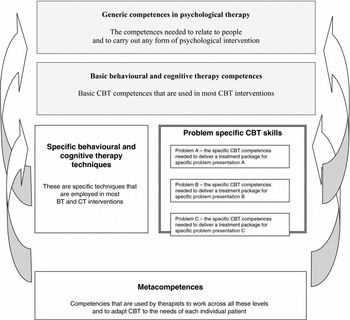
With these concerns in mind a schematic model was developed, and subjected to iterative peer review through the ERG. As shown in Figure 1 the model comprises five domains. These do not imply a hierarchy of skill. CBT interventions – at both high and low intensity - rest on the successful implementation and integration of competences across domains. These are:
Outline model for CBT competences

Generic competences
This domain encompasses activities that are employed in all therapies, such as working ethically, applying generic knowledge of mental health conditions, knowing about the model being applied, forming a good working relationship with the client, or conducting a generic assessment.
Basic behavioural and cognitive therapy competences
In essence “basic” competences establish the structure of the intervention, whether low or high intensity, and form the context for the implementation of specific behavioural and cognitive therapy techniques.
Specific behavioural and cognitive therapy techniques
To some extent the distinction between “basic” competences and “specific techniques” is pragmatic rather than conceptual. This domain contains the core technical interventions employed in most CBT applications.
Problem-specific competences
This domain sets out the competences that are described in CBT treatment manuals for specific disorders. These are the specific procedures for which there is evidence of benefit for particular problem presentations.
Metacompetences
As noted above, carrying out a skilled task requires the person to be aware of why and when something is (and as important, isn't) done. Metacompetences are the procedures used by therapists to guide practice, operative across all levels of the model. Although there is a sense that these are higher-order competences, it is important that these are not seen as the exclusive preserve of high-intensity interventions, since, to a greater or lesser extent, any intervention will require them.
Procedure for extracting competences and standardizing competence lists
Members of the project team and two additional researchersFootnote 2 were allocated manuals. Each person reviewed their allocated manual, creating an initial list of the competences referred to in the description of the intervention procedure. As these drafts started to emerge, discussion amongst the group was used to clarify and resolve difficulties and also to contribute to the refinement of the emerging structure of the competences framework.
An overriding aim was to make each competence description clear, behaviourally specific, as far as possible, and capable of standing alone without the need for a reader to cross-reference to other descriptors (unless it was clear that the competence being described was one among a number of activities that needed to be offered in tandem). This meant writing in a simple and synoptic style, ensuring that technical terms were used sparingly, and that the descriptors would make sense to the average reader (who we take to be slightly familiar with the field, but not necessarily conversant with problem-specific models of intervention).
At an early stage two potential problems became clear:
a) Because the authors of manuals use a different “literary” style, they sometimes describe examples of the same concept in ways that, superficially, look different. Carrying this over into the competence lists would be very misleading, for the obvious reason that stylistic variations need to be distinguished from genuine conceptual differences. Instances where this problem seemed to be emerging were identified and discussed to decide whether different usages were substantive (in other words, there was a good clinical or theoretical reason for the author's choice of terminology) or stylistic. This led to the development of a standard set of terminologies for use across all the competence lists.
b) Manuals and source materials come in a range of formats, with marked variation in terms of length, intent and structure. For example, some are written in the form of a protocol, indicating not only what should be happening in each of a circumscribed number of sessions, but also giving something close to a script to illustrate what the therapist could (or should) be saying. In contrast, other manuals are set out at a much more conceptual level, drawing attention to the elements of the intervention and to the management of common clinical issues and impasses, but clearly assuming that the manual is being read by an individual with prior clinical experience. This presented a challenge to the aim of producing a similar product for each problem area, and made competence extraction more demanding for some manuals than for others.
ADR took primary responsibility for editing the lists, in discussion with the person who generated them. In addition, list development was shaped by peer review from the ERG and from the innovators of the therapy (as described below).
Identifying competence lists for generic, basic and specific competences
Rather than prejudging the areas of competence that should come under each of these headers, we relied on the picture that emerged as problem-specific competences were extracted. Notwithstanding the observations in the paragraph above, it was clear that many manuals referred to common sets of competences that could be relocated into these categories. Two sources proved particularly useful. By no accident, Beck and colleagues' (Reference Beck, Rush, Shaw and Emery1979) original description of cognitive therapy for depression sets out many of the basic tenets of CBT and this proved a helpful stimulus to the pattern that emerged once other manuals were included. In addition, the Cognitive Therapy Rating Scale is designed to rate a basic set of competence areas in which CBT therapists should be proficient, again making it well-suited to this task.
Procedures for validating competence lists
1) At several stages of the project the ERG was asked to review competence lists from all domains. Feedback was both general (regarding the structure and organization of the lists) as well as specific (relating to their accuracy).
2) As problem-specific competence lists were finalized, they were sent for open peer review to the lead individual or individuals responsible for innovating the therapy being described in the manual (on the principle that they would have the best sense of whether the competence lists reflected their intent in describing the therapy and their understanding of the procedures they had developed).
Subsequent modifications to the competence lists were re-checked with peer reviewers, unless the suggested changes were obvious or obviously uncontroversial.
Deriving a map of CBT competences
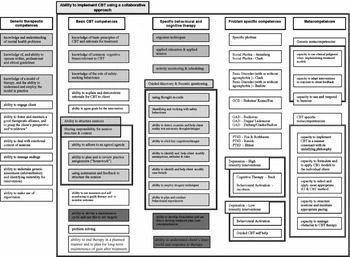
As competence lists were developed it became feasible to identify the activities that could be located under the various headers of “generic”, “basic”, “specific” or “metacompetences”. This was largely based on the repeated appearance of the same activities in different manuals, and hence the mapping exercise stayed close to the evidence-base. However, the process also involves making subjective judgments, and as the map emerged it was reviewed iteratively within the project team, by staff members on the UCL Doctorate in Clinical Psychology with expertise in CBT and by the ERG. As such, the map represents a consensus statement and shows the assembly of competences needed to deliver both high and low intensity interventions in a form that is fairly simple and (hopefully) easily graspable. The resultant map is shown in Figure 2. The map shows the activities that constitute each domain; each activity is constituted by a set of competencies. The full set of competences, along with companion documentation, are published on-line (www.ucl.ac.uk/CORE/).
The map of CBT competences for depression and anxiety disorders

Generic competences
The activities in this domain are almost invariably required to deliver CBT, just as they are for therapists of any persuasion.
Ability to work in a collaborative manner
All CBT techniques need to be conducted through the application of a primary competence – the ability to deliver these techniques in a collaborative manner. This is an assertion based on professional judgment rather than on direct evidence, but CBT is premised on the notion that therapists can best help clients by helping them to learn more about themselves, for themselves. To achieve this there is a strong emphasis on structuring therapeutic conversations in a way that ensures that the process of learning is one in which the client takes an active part. Almost without exception, this stance is stressed by treatment manuals, making this a critical feature of therapy delivery.
Basic behavioural and cognitive therapy competences
“Basic” is a good descriptor for two reasons: first, these are fundamental skills; second, and in many ways more crucially, taken together they describe the basic philosophical and practical orientation underpinning the CBT approach. CBT is characterized by a holistic framework: trying to capture this in a simple set of statements is not easy, but essentially CBT therapists need to establish a collaborative framework that stresses the shared responsibility of therapist and client and takes a collegial approach to the work of therapy. This is represented through a set of coherent activities, for example, establishing a mutually agreed agenda at the start of each session, encouraging clients to monitor their thoughts and behaviours, helping them to test out their ideas and observations using “practice assignments” or “homework” tasks, and making sure that there is an opportunity to reflect on what has been learned from homework in subsequent therapy sessions. While these aspects of basic CBT practice could be seen as a set of specific techniques, they are better seen as a set of coherent activities that are advocated because they achieve a higher-order aim, which is seen as basic to the delivery of effective therapy.
Specific behavioural and cognitive techniques are the major therapeutic techniques and strategies usually employed by CBT therapists. Not all of these would be employed for any one individual, and different sets of techniques would be employed for different problems. For example, exposure techniques are very relevant to the treatment of specific phobias, but because there is less evidence for the benefit of cognitive procedures, they would not usually be employed with this client group.
Problem specific competences are intended to be understood without explicit cross-reference to any of the foregoing competence listings (although effective delivery of these therapies obviously requires that these be employed). The reason for this is that the competence lists in this section work best if they can be read as a coherent description of the critical elements of, and pathways through, the therapy; in effect, scanning the competences should give a flavour of all the elements that, taken together, constitute the treatment “package”. This is especially important when standard CBT techniques are slightly modified to apply them to a particular disorder, and where the competence descriptions can be written in a way that alerts the reader to this nuance.
Metacompetences attempt to describe the procedural rules that enable therapists to implement therapy in a coherent and informed manner, and to apply an intervention in a manner that is responsive to the needs of an individual client. On the whole, these are more abstract competences than are described elsewhere, and there is little direct evidence for their importance. Despite this, there was clear expert consensus that metacompetences are relevant to effective practice. Most of these competences were extracted from manuals, with some emerging from discussion in the ERG. There are also instances where metacompetences reflect research-based evidence. For example, the “. . . ability to maintain adherence to a therapy without inappropriate switching between modalities when minor difficulties arise” reflects evidence that poorer outcomes are found when therapists are over-responsive to minor obstacles or diversions. Although the face validity of metacompetences appears to be good, their construct validity is less easy to judge, something that would require further research to establish.
Discussion
The competence framework presented here (and in full detail on-line) is intended to be comprehensive in scope, and to detail the specific competences that represent best practice in CBT for depression and for specific anxiety disorders, defining best practice as the activities described in manuals used in trials demonstrating the efficacy of CBT inter-ventions.
There are a number of ways in which the framework could be applied, as discussed in more detail in Roth and Pilling (Reference Roth and Pilling2007). Most obviously, it describes a potential curriculum for training, and mirroring this, a guide for supervision. Because it describes best practice, it can support clinical governance and the maintenance of quality in routine settings, linking everyday clinical work to the research base. Reflecting its origins in the IAPT programme, the framework acts as a guide for commissioning, because it specifies a set of competences that can be used to draw up specifications for a workforce.
There are a number of issues regarding the framework and its shortcomings, and as it is implemented no doubt more will emerge. At this stage some of the more obvious are as follows:
1) Are some competences more critical than others? As noted in the introduction, manuals and hence competence lists almost undoubtedly contain both wheat and chaff, and distinguishing between the two is not straightforward. Although process research can make a contribution here, it remains a considerable challenge to establish causal links between outcome and specific therapist activities, and only limited evidence has emerged from the post hoc analyses that characterize this field. One reasonably sound finding (though largely based on evidence from one research group) is that therapies in which therapists consistently pay regard to structuring CBT have better outcomes (DeRubeis and Feeley, Reference DeRubeis and Feeley1990; Feeley, DeRubeis and Gelfand, Reference Feeley, DeRubeis and Gelfand1999; Strunk, Brotman and DeRubeis, in preparation). Of course, this observation – which has obvious and helpful implications for practice – does not mean that these activities should be privileged in some way, or that other competences are less relevant. This is not only because the research base is rather narrow, which limits what can be said, but also because it is quite likely that competences act in concert, and attempts to disaggregate one set from another could be unhelpful.
2) Treatment formats: The way in which treatments are implemented (for example, the frequency or duration of sessions) is not discussed in the framework, but this is clearly an important issue. Attempts to implement therapies in formats that differ significantly from those adopted in research trials could undercut their effectiveness, especially if this involves offering a markedly reduced number of sessions.
3) Role of training and supervision: Training and supervision are integral to treatment delivery in research trials (see Roth, Pilling and Turner, in preparation, for a fuller discussion). Though there is no direct evidence that this, in itself, is critical to maintaining effectiveness, ignoring their role when implementing the therapy in routine settings runs the risk of reducing the quality of treatment, to the detriment of likely outcomes.
4) Generalization: By design the framework is restricted to interventions for depression and anxiety for working age adults. Although this is a limitation, it is not necessarily a major one, since many of the CBT techniques applied for other problems and disorders are recognizably rooted in those we describe; any specific differences lie at the level of problem-specific descriptors rather than the framework itself. This means that the framework could be extended to include further disorders (for example, to eating disorders and interventions for people with psychosis). However, the extent to which it applies to different client populations is less clear. On the one hand, it would need relatively little adaptation to apply to work with older adults, but the different clinical contexts associated with work with children and adolescents might require more adaptation in order to do them appropriate justice.
5) Restriction in the range of approaches: The decision to use the evidence base to limit the number of competing models and approaches led to the exclusion of some commonly applied techniques. From the perspective of the project these are necessary omissions, but this means that the phrase “best practice” should be carefully qualified. It does not mean that, for example, a focus on mindfulness, or the application of cognitive technique in OCD is inappropriate, or indeed poor practice. We have some confidence that these are areas where research will cast more light on their efficacy; as this evidence emerges it creates its own argument for revision and updating of the framework. This is a crucial point, since we are very aware that some of what is described in the framework rests on relatively recent research; if our work had been undertaken just a few years earlier it would look somewhat different. Since it is hard to imagine that the field will remain static, it would be a travesty if a competence framework were used to restrict practice when it was based on outmoded procedures. On this basis, the work described here will require updating. This should not present a major challenge, since the structure of the framework lends itself to adaptation and development.
6) Best practice and routine practice: Because the procedures described in the framework emerge from clinical trials, the familiar and well-explored gap between research and routine practice (Roth and Fonagy, Reference Roth and Fonagy2005) becomes relevant. There are good reasons to believe that there would be a limited correspondence between the framework and everyday practice. For example, Brosan, Reynolds and Moore (Reference Brosan, Reynolds and Moore2006) used the Cognitive Therapy Scale to examine the performance of 24 therapists, all of whom claimed to be CBT therapists. Their practice, as defined by this measure, was very variable, and in some cases poor. Though formal post-qualification training in CBT was associated with better adherence, it was clear that the competence of a number of therapists is some distance from that shown in clinical trials. By extension, it would be reasonable to suppose that the detailed specifications contained in the framework would be under-represented in routine practice. This has important implications; claims to practise an evidence-based therapy are empty and potentially meaningless unless the practitioner is willing to explore not only the outcomes they are achieving, and the means by which they are achieving them – in other words, that they are actually practising the same therapy as that employed in the trials whose claims they are proclaiming.
Sometimes clinicians claim that variations in practice are an appropriate response to the types of clients seen outside research settings, characterized by a level of comorbidity and complexity that makes it difficult to apply manualized approaches. This is clearly an issue, but not one that has been tested empirically. Stirman, DeRubeis, Crits-Christoph and Rothman (Reference Stirman, DeRubeis, Crits-Christoph and Rothman2005) examined the case profiles of 100 patients who had been excluded from randomized trials (on the assumption that this would result in a sample more characteristic of the usual outpatient population), in effect concluding that the majority could have been treated using one or more extant manuals. At one level this is reassuring, but the study drew on a population of individuals who had responded to advertisements for a university-based clinical trial, and these may not be equivalent to clients seen in publicly-funded healthcare systems.
Our experience of running an anxiety-management clinic in a standard NHS context may be instructive. The clinic was staffed by trainee clinical psychologists supervised by an experienced CBT therapist, receiving pre-screened referrals where an anxiety disorder was the predominant presentation. The intent was for trainees to apply a specified set of manualized approaches (by no accident, those described in this framework). While this was achieved in most cases, supervisory input proved critical to keeping casework on track and on model. Fairly consistently (and despite the screening of referrals) significant and relevant clinical and social issues emerged and needed to be responded to, but without losing focus. This was challenging but also achievable, reinforcing the importance of metacompetences in competent delivery, and the degree to which these can be represented in the person of the supervisor as well as the therapist.
An important observation is that this clinic set out to apply the framework; because adherence was strongly privileged, variations in practice were attempts to make the interventions tractable to the client. In contrast, there is some evidence that therapists are prone to change practice for a wide variety of reasons, often unplanned in the sense that these are responses to changes in their perception of the bond between them and their clients rather than the direct impact of the methods they are applying (Schulte and Eifert, Reference Schulte and Eifert2002). This review of a set of studies exploring how manualized CBT was applied found that therapists made surprisingly large numbers of changes to their initial plans, usually in response to their sense of pessimism or a lack of control over therapeutic direction, and that there was a significant negative correlation (−0.49) between outcome and the frequency of changes of method.
This raises a question about whether better outcomes are more likely to follow if therapists privilege the application of a specific therapeutic method. This would mean taking care to adapt practice and to be sensitive to the needs of each individual client, but also to be aware when this tips into inappropriate over-sensitivity and to reactance. The CBT framework has a role here, since it represents the practice that therapists need to follow if they are being adherent to a model, hence making drift away from the model more apparent.
Using the framework to track adherence and competence
It seems unlikely that in its present form the framework could be applied systematically to assess the adherence or competence of an individual therapist. The framework was not designed to undertake this task. It sets out detailed parameters for practice in the same way that a curriculum describes what should be covered by a course; monitoring of student progress utilises procedures that are designed to tap outputs from training, and that act as indicators that learning has taken place. In most cases this is an exercise in data-reduction – since it is not feasible to test each student on every element of a curriculum, a subset of items are chosen for their capacity to evaluate progression.
Following this analogy, appropriate and well-validated instruments for assessing adherence and competence already exist. In sharp contrast to the many pages of the framework, these contain a small subset of items – 25 items for the Cognitive Therapy Adherence and Competence Scale (CTACS: Barber, Liese and Abrams, Reference Barber, Liese and Abrams2003) and 14 for the Cognitive Therapy Scale (CTS: Blackburn et al., Reference Blackburn, James, Milne and Reichelt2001). These scales have appropriate levels of inter-rater reliability, something that is unlikely to be achieved with the framework – there are too many items, there is no expectation that all items are applied simultaneously, and items are not equally weighted.
This poses something of a dilemma, since implementing the framework implies its use as a standard against which practice is judged. Our suggestion for resolving this problem involves recognition that the framework best operates if used as a form of curriculum, whether this relates specifically to a training course, to supervision of practice, or as an aid to reflective practice for an individual practitioner. Probably the least effective way of using the framework would be to try to apply it as a whole; more effective would be to apply it in an iterative manner, focusing on subsets of the activities it identifies, and the specific competences that define this. At this point, the number of items under inspection becomes more manageable and more realistically appraised. In this sense it would be feasible to track adherence and competence to a specified subset of procedures, perhaps prioritizing some areas over others. Some basic competences are hard-won but critical – for example the ability to work collaboratively, to master the principles of Socratic questioning and engender guided discovery in its true sense, or to employ the set of activities associated with structuring sessions. In this context the specificity of the framework becomes a virtue rather than a problem, since it makes it possible to flag what should be present for routine practice to represent best practice, potentially helping to close the gap between the two.
Acknowledgements
The work described in this paper was sponsored by Skills for Health, the Care Services Improvement Partnership and the Centre for Outcomes, Research and Effectiveness (CORE).
Appendix 1. Manuals and publications used to extract competences
Depression
Beck, A. T., Rush, A. J., Shaw, B. F. and Emery, G. (1979). Cognitive Therapy of Depression. New York: Guilford Press.
Beck, J. S. (1995). Cognitive Therapy: basics and beyond. New York: Guilford Press.
Jacobson, N. S. et al. (2001). Behavioural activation treatment for depression. Clinical Psychology Science and Practice, 8, 255–270.
Lejuez, C. W. et al. (2001). A brief behavioural activation treatment for depression: treatment manual. Behavior Modification, 25, 255–286.
Martell, C. R. et al. (2001). Depression in Context: strategies for guided action. New York: Norton.
Manuals for training programmes for guided self-help as instituted through Islington PCT and in the Doncaster Pilot site for the IAPT programme.
Anxiety disorders
Generalized Anxiety Disorder
Beck, A. T. and Emery, G. (1985). Anxiety Disorders and Phobias: a cognitive perspective. New York: Basic Books.
Bernstein, D. A. and Borkovec, T. J. (1973). Progressive Relaxation Training. Champaign Il: Research Press.
Borkovec, T. D. and Sharpless, B. (2004). Generalized Anxiety Disorder: bringing cognitive behavioral therapy into the valued present. In S. Hayes, V. Follette and M. Linehan (Eds). New Directions in Behavior Therapy (pp. 209–242). New York: Guilford Press.
Borkovec, T. D. (unpublished). Combined Self-Control Desentization and Cognitive Therapy Manual.
Borkovec, T. D. (unpublished). Applied Relaxation Training and Self-Control Desensitazation.
Dugas, M. J. and Ladouceur, R. (2000). Treatment of GAD: targeting intolerance of uncertainty in two types of worry. Behavior Modification, 24, 635–657.
Dugas, M. J. (2004). Cognitive Behavioural Treatment of Generalized Anxiety Disorder. Concordia University: Unpublished Manual.
Ost, L.-G. (1987). Applied relaxation: description of a coping technique and review of controlled studies. Behaviour Research and Therapy, 25, 397–409.
Social phobia
Clark, D. M. (forthcoming). Cognitive Therapy for Social Phobia. Unpublished manuscript.
Clark, D. M. (2005). A cognitive perspective on social phobia. In W. R. Crozier and L. F. Alden, The Essential Handbook of Social Anxiety for Clinicians. New York: John Wiley and Sons.
Heimberg, R. (2002). Cognitive Behavioral Group Therapy for Social Phobia: basic mechanisms and clinical strategies. New York: Guilford Press.
Panic disorder
Barlow, D. H. (1988). Anxiety and its Disorders: the nature and treatment of anxiety and panic. New York: Guilford Press.
Barlow, D. H. and Craske, M. G. (2007). Mastery of Your Anxiety and Panic: therapist guide for anxiety, panic, and agoraphobia (4th ed). New York: Oxford University Press Inc.
Clark, D.M and Salkovskis, P. (forthcoming). Panic disorder. In K. Hawton et al., Cognitive Behaviour Therapy: a practical guide (2nd ed). Oxford: Oxford University Press.
Clark, D. M., Salkovskis, P., Hackmann, A., Wells, A. and Gelder, M. (1995). Patient materials for brief cognitive therapy for panic disorder (Unpublished).
Salkovskis, P. and Clark, D. M. (1991). Cognitive therapy for panic disorder. Journal of Cognitive Psychotherapy, 5, 215–226.
Zinbarg, R. E. et al. (1992). Cognitive behavioural approaches to the nature and treatment of anxiety disorders. Annual Review of Psychology, 43, 235–267.
PTSD
Ehlers, A. and Clark, D. M. (2000). A cognitive model of posttraumatic stress disorder. Behaviour Research and Therapy, 38, 319–345.
Ehlers, A. (unpublished draft). Manual for Cognitive Therapy for PTSD.
Foa, E. B. and Rothbaum, B. O. (1998). Treating the Trauma of Rape: cognitive behaviour therapy for PTSD. New York: Guilford Press.
Resick, P. A. and Schnicke, M. K. (1993). Cognitive Processing Therapy for Rape Victims: a treatment manual. Newbury Park, CA: Sage.
Resick, P. A., Monson, C. M. and Chard, K. M. (2007). Cognitive Processing Therapy: veteran/military version. Washington, DC: Department of Veterans' Affairs.
OCD
Kozak, M. J. and Foa, E. B. (1997). Mastery of Obsessive Compulsive Disorder: a cognitive behavioural approach therapist guide. New York: Oxford University Press.
Steketee, G. S. (1993). Treatment of Obsessive-Compulsive Disorder. New York: Guilford Press.
Specific phobia
Butler, G. (1989). Phobic disorders. In K. Hawton, P. M. Salkovskis, J. Kirk and D. M. Clark, Cognitive Behaviour Therapy for Psychiatric Problems: a practical guide (pp. 97–128). Oxford: Oxford University Press.
Craske, M. G., Antony, M. and Barlow D. H. (1997). Mastery of your Specific Phobia: therapist guide. New York: Oxford University Press.
Additional sources
Blackburn, I. M., James, I. A., Milne D.L and Reichelt F. K. (2001). Cognitive Therapy Scale – Revised (CTS-R).
Padesky, C. A. and Greenberger, D. (1995). Clinician's Guide to Mind over Mood. New York: Guilford Press.



Comments
No Comments have been published for this article.