INTRODUCTION
Successful remembering to take medication or keeping track of finances are two examples of instrumental activities of daily living (IADL) to signify functional independence in everyday life. Furthermore, these two tasks are also typical examples of prospective memory (PM) tasks in everyday life, which is the ability to remember and execute delayed intentions (Kliegel et al., Reference Kliegel, Ballhausen, Hering, Ihle, Schnitzspahn and Zuber2016). Importantly, PM failures are frequent in everyday life. Diary studies, where participants record daily all episodes of forgetting show that forgetting intentions and planned actions comprised between 50% to 80% of all reported memory problems in healthy adults (e.g., Crovitz & Daniel, Reference Crovitz and Daniel1984).
Furthermore, there are numerous studies that have shown marked impairment in PM in several neuropsychological populations (e.g., Parkinson’s disease: Foster, Rose, McDaniel, & Rendell, Reference Foster, Rose, McDaniel and Rendell2013; multiple sclerosis: Henry et al., Reference Henry, Phillips, Beatty, McDonald, Longley, Joscelyne and Rendell2009; traumatic brain injury [TBI]: Mioni, Rendell, Henry, Cantagallo, & Stablum, Reference Mioni, Rendell, Henry, Cantagallo and Stablum2013; Alzheimer’s disease: Shelton et al., Reference Shelton, Lee, Scullin, Rose, Rendell and McDaniel2016) as well as in healthy older adults (Kliegel et al., Reference Kliegel, Ballhausen, Hering, Ihle, Schnitzspahn and Zuber2016; Rendell & Craik, Reference Rendell and Craik2000; Rose, Rendell, McDaniel, Aberle, & Kliegel, Reference Rose, Rendell, McDaniel, Aberle and Kliegel2010).
Taken together, an increasing body of studies has both documented significant impairments in PM across many neuropsychological and aging populations and emphasized the crucial relevance of PM for a successful everyday life of those populations (e.g., Rendell & Henry, Reference Rendell and Henry2009). However, importantly for present purposes, so far, only three studies have empirically investigated the claim that PM and activities of daily living or quality of life are functionally related in older adults (Tierney, Bucks, Weinborn, Hodgson, & Woods, Reference Tierney, Bucks, Weinborn, Hodgson and Woods2016; Woods et al., Reference Woods, Weinborn, Li, Hodgson, Ng and Bucks2015; Woods, Weinborn, Velnoweth, Rooney, & Bucks, Reference Woods, Weinborn, Velnoweth, Rooney and Bucks2012).
In general, these studies showed a reliable link between self-reported activities of daily living and PM in healthy older adults. Moreover, in the first study, Woods et al. (Reference Woods, Weinborn, Velnoweth, Rooney and Bucks2012) found that PM measures predicted self-reported activities of daily living beyond executive functioning scores (e.g., cognitive control, attention, verbal fluency). This is especially interesting given the finding that executive functions are considered a strong predictor of IADL decline (Overdorp, Kessels, Claassen, & Oosterman, Reference Overdorp, Kessels, Claassen and Oosterman2016), and that the declines in executive functions and PM seem to be caused by similar age-related decrements in frontal brain regions (e.g., Braver & West, Reference Braver and West2008). Importantly, the study by Woods et al. (Reference Woods, Weinborn, Velnoweth, Rooney and Bucks2012) emphasized the incremental value of PM for predicting self-reported activities of daily living in older adults besides executive functions.
In a second study by Woods et al. (Reference Woods, Weinborn, Li, Hodgson, Ng and Bucks2015), the authors also revealed an interaction of PM and self-reported IADL problems that affected the quality of life in older adults. Lower PM performance was associated with reduced quality of life for those older adults who had multiple IADL problems; however, PM performance was not associated with quality of life for older adults with no IADL problems. In their third study, Tierney et al. (Reference Tierney, Bucks, Weinborn, Hodgson and Woods2016) showed that the association between PM and activities of daily living seems to be mainly related to the strategic demands of detecting the appropriate moment to execute the PM tasks.
Taken together, the general pattern of an association between PM and functional independence seems to emerge. However, an important general limitation of the existing literature on the assessment of functional independence has been the usage of self-report questionnaires for activities of daily living or cognitive functions such as PM. For example, rather than measuring PM with behavioral tests, previous studies have used among others the Prospective and Retrospective Memory Questionnaire (PRMQ; e.g., Crawford, Smith, Maylor, Della Sala, & Logie, Reference Crawford, Smith, Maylor, Della Sala and Logie2003) and, more importantly, for the assessment of functional independence, only self-reported activities of daily living scales have been used (Tierney et al., Reference Tierney, Bucks, Weinborn, Hodgson and Woods2016; Woods et al., Reference Woods, Weinborn, Li, Hodgson, Ng and Bucks2015, Reference Woods, Weinborn, Velnoweth, Rooney and Bucks2012).
In light of these perceived limitations, the present study investigated the association between PM and everyday life using performance-based measures for both PM and IADL. The major aim was to examine the relation between PM and real-life functioning in older adults and extend the findings of Woods et al. (Reference Woods, Weinborn, Velnoweth, Rooney and Bucks2012) by using established and validated performance measures of PM and IADLs.
METHODS
Participants
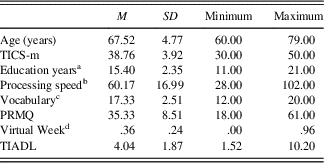
Fifty-eight older adults participated in this study (data were collected as part of a larger project on cognitive training), 21 males and 37 females, from 60 to 79 years with average 15 years of school education (see Table 1 for descriptive statistics of the demographic and performance measures). Participants were only included if they were native English speakers or were fluent in English, had normal or corrected-to-normal vision and hearing, did not have a history of a neurological or major psychiatric disorder, were not taking any psychoactive medication (e.g., anti-depressive, anxiolytics), and showed normal cognitive functioning (over 29 points on the Telephone Interview for the Cognitive Status-modified [TICS-M]) (de Jager, Budge, & Clarke, Reference de Jager, Budge and Clarke2003). The participants were recruited from the Research Volunteer database for the Rotman Research Institute of Baycrest Centre, and from respondents to a local newspaper advertisement. All participants provided written informed consent before the testings. The study was approved by the Research Ethics Board of the Rotman Research Institute at Baycrest Hospital.
Descriptive statistics of demographics and performance measures (raw scores)

Note. TICS-m=Telephone Interview for the Cognitive Status modified (maximum=50; cutoff=30); PRMQ=Prospective and Retrospective Memory Questionnaire (the sample mean corresponds to a T score of 55 based on Crawford et al. [Reference Crawford, Smith, Maylor, Della Sala and Logie2003], minimum=16 [T score=74], maximum=80 [T score=5]); TIADL=timed instrumental activities of daily living (assessed in time needed for completion in minutes including potential penalty time).
a Education years was the total number of years completed.
b Assessed with the Digit-Symbol test (number of items correctly copied; maximum=133).
c Assessed with the Shipley vocabulary test (number of correct answers; maximum=20).
d Accuracy rates.
Material
Prospective memory measures
Laboratory task
Participants performed the Virtual Week task (VW), which is a computerized board game to assess PM (for a review on the task, see Rendell & Henry, Reference Rendell and Henry2009; for a detailed description of the task version used, see Rose et al., Reference Rose, Rendell, Hering, Kliegel, Bidelman and Craik2015). Participants had to roll a die and move a token around the board, with one circuit around the board representing one day. Three consecutive virtual days were performed after a practice day explaining all relevant details of the game. During each virtual day, participants encountered a series of event cards that described plausible events appropriate to the virtual time of day (e.g., eating breakfast, going shopping, visiting the library) and participants had to make choices about the events (e.g., what to eat, what to buy, what to do at the library). The event cards were revealed in a pop-up window each time participants passed 1 of the 10 event squares. The choices participants made with each event card determined a dice rolling consequence (roll a set number, roll an odd or even number, vs. roll any number).
Along the way, participants were instructed to remember to perform different types of PM tasks. Some tasks were to be performed on all 3 days (regular tasks); instructions for these tasks were given at the beginning of the game and were not repeated. Other tasks had to be performed only once during the game (irregular tasks). Both the regular and irregular tasks varied according to the PM cue that triggered when the task was to be performed, either when a specific event occurred indicated by an appropriate event card or at a specific time of the virtual day indicated by a virtual time clock in the center of the screen that was calibrated to the position of the token on the board. To perform a task, the participant had to click on a button called “perform task” and to select the correct task out of a list of all the PM tasks for that day and four distractor tasks.
A third task type required the participant to monitor a timer set at the top of the screen that displayed the amount of real time (in minutes and seconds) that had elapsed since beginning the round for that virtual day (time-check tasks). When the timer reached a specific time (either 2 min and 0 s and 4 min and 0 s) the participant was to stop playing the game and perform a PM task by selecting the appropriate task from the perform task list.
Ten PM tasks were to be performed on each daily circuit including two time-check, four regular, and four irregular tasks. The proportion of PM tasks that were selected during the target event or time (i.e., before the next dice roll for virtual time-based tasks, or within 15 s for the time-check tasks) were scored correct. The average performance on all different tasks over the three rounds was used as an index of overall PM performance.
Self-report PM scale
We also administered the PRMQ (Crawford et al., Reference Crawford, Smith, Maylor, Della Sala and Logie2003). The PRMQ consists of 16 questions about prospective and retrospective memory failures in everyday life situations. Participants evaluated the frequency of each type of memory error on a 5-point scale (1=never; 5=very often); a sum score over all items was calculated.
Basic cognitive function measures
Processing speed
The digit-symbol-coding test is a subtest from the Wechsler Adult Intelligence Scale III (WAIS-III; Wechsler, Reference Wechsler1997) to assess information processing speed. The participants had to copy symbols to corresponding numbers as fast as possible during 2 min. The combination of the numbers 1 to 9 and the nine specific symbols were given on the top of the testing sheet and visible during the task. Performance was scored as the total number of correct items.
Vocabulary
We used the Shipley vocabulary test to assess vocabulary (Zachary, Reference Zachary1986). Participants had to find the synonym of a given word among four choices. Due to the training procedure, split-half versions of the test were created and the first assessment was used in the present study. Performance was scored as total of correct items (maximum of the split half version=20).
IADL measure
A modified version of the timed version of instrumental activities of daily living task (TIADL; Owsley, Sloane, McGwin, & Ball, Reference Owsley, Sloane, McGwin and Ball2002) was administered. Participants were required to complete five tasks: looking for a telephone number in a phone book, count out a certain amount of change in coins, read a specific set of ingredients on three cans of food, point out items on a shelf as if they were shopping in a store, and read the directions on two medicine bottles. The shelf was created in a cardboard box where different food boxes and cans were arranged next to each other (see Owsley et al., Reference Owsley, Sloane, McGwin and Ball2002, for a picture of a similar arrangement).
An experimenter read the instructions for all five tasks at the beginning of the test to the participant and the TIADL kit with all materials for the five tasks was presented. The participants were then given a summary of the tasks to review until they were ready before starting. They were encouraged to hold all the tasks in mind as they were completing them. Each time they needed to look at the instructions again during the task, 10 s were added to their total time to completion. The total amount of time to completion (in minutes) including potential penalty time was recorded and used as the outcome variable.
RESULTS
For all analyses, we used list-wise deletion of observations in case of missing values.
Correlational Analyses
In a first step, we analyzed bivariate correlations among performance on the TIADL, the cognitive, and the PM measures. Processing speed, vocabulary, and overall performance on VW correlated significantly with TIADL performance indicating faster performance in the TIADL with higher scores for processing speed (r(55)=−.30; p=.025), vocabulary (r(55)=−.44; p=.001), and VW (r(53)=−.49; p<.001). The PRMQ score did not correlate with TIADL performance (r(48)=−.11; p=.435). The full bivariate correlation matrix between all predictors and the outcome is provided as Supplementary Material.
Hierarchical Linear Regression
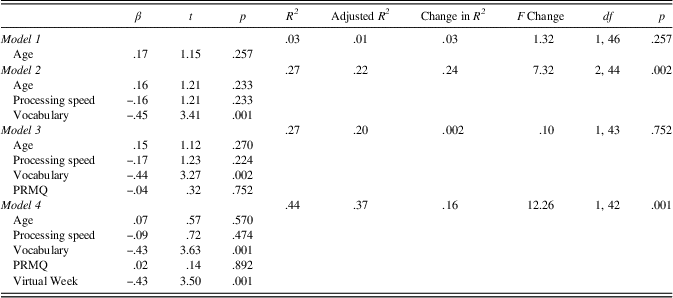
In a second step, we used hierarchical linear regression to analyze the predictive influence of the cognitive and PM measures on TIADL performance. In the first model, we included age as demographic predictor; in model 2, the two cognitive measures were added. For the third and fourth model, we also included the score of the PRMQ followed by the VW performance. Table 2 gives an overview of the results. There was only a significant change in R 2 for models 2 and 4, showing that only vocabulary and VW performance were significant predictors of TIADL performance, whereas processing speed and the PRMQ score had no meaningful influence on the outcome measure. Furthermore, there was a substantial increase in R 2 of 16.4% by adding VW performance in the final model, whereas the PRMQ score did not result in any change.
Summary of the hierarchical regression analyses with the Timed Instrumental Activities of Daily Living score (time needed for completion in minutes including potential penalty time) as criterion

Note. PRMQ=Prospective and Retrospective Memory Questionnaire.
DISCUSSION
The aim of the present study was to investigate the association between a validated, objective performance measure of PM and a performance-based measure of functional independence in everyday life because; to date, studies had only used self-reported measures of IADL. In our study, we used the VW task, a well-established computerized PM task, as well as the TIADL, a timed version to assess different IADLs. VW is a board-game-like computer task, where participants play a simulated week and have to execute different PM tasks. The task has been used repeatedly as a laboratory measure in healthy older adults as well as with different clinical populations, and shows good reliability and validity (for a review, see Rendell & Henry, Reference Rendell and Henry2009). The TIADL is a laboratory task where participants are required to perform everyday tasks, such as making change or finding a telephone number in a telephone book. Owsley et al. (Reference Owsley, Sloane, McGwin and Ball2002) showed that the focus on the timely completion of the tasks is a more sensitive measure than accuracy alone in examining everyday functioning.
Our results showed that TIADL performance was correlated with vocabulary and processing speed as well as with VW performance. However, we did not find a significant correlation between the PRMQ score and performance on the TIADL. Furthermore, hierarchical regression analyses showed that TIADL performance was mainly predicted by vocabulary and VW performance. In particular, VW explained a substantial amount of variance for the TIADL over and above the traditional neuropsychological measures of fluid abilities and crystallized intelligence. Thus, our findings support the widely stated but rarely proved notion that PM is an important cognitive ability for successful and independent everyday life.
We did not replicate the predictive value of the PRMQ for the IADL measure (as it had been shown by Woods et al., Reference Woods, Weinborn, Velnoweth, Rooney and Bucks2012; but see Tierney et al., Reference Tierney, Bucks, Weinborn, Hodgson and Woods2016, for a result similar to the present findings). One reason could be that we used a performance-based measure for activities of daily living, whereas Woods et al. (Reference Woods, Weinborn, Velnoweth, Rooney and Bucks2012) used a self-report questionnaire as the outcome measure. Additionally, the PRMQ did also not correlate with VW performance indicating discrepancies between self-reported and performance-based assessment tools in healthy older adults. This is in line with previous studies that show little or no overlap between self-reported and objective memory performance in general (e.g., Crumley, Stetler, & Horhota, Reference Crumley, Stetler and Horhota2014) and prospective memory in particular (e.g., Thompson, Henry, Rendell, Withall, & Brodaty, Reference Thompson, Henry, Rendell, Withall and Brodaty2015); yet future studies are clearly needed to further investigate this complex relation. Of interest, processing speed as a basic cognitive function did not predict TIADL performance either (for an opposite finding, see Owsley et al., Reference Owsley, Sloane, McGwin and Ball2002) indicating again that there is a specific contribution of PM and vocabulary to everyday functioning measured with the TIADL.
Follow-up questions to our results include the issue of which aspects of prospective remembering might especially contribute to everyday functioning. The VW task further offers the possibility to dissociate between more regular and irregular tasks or event- and time-based tasks. Future studies with larger samples could separate these different components and their contribution to everyday functioning. A first study by Tierney et al. (Reference Tierney, Bucks, Weinborn, Hodgson and Woods2016) looked into underlying processes of prospective remembering that contribute to everyday functioning. The authors showed that participants with lower scores on self-reported activities of daily living questionnaire also showed lower PM performance that was attributable to reduced strategic monitoring for the appropriate moment to execute the intentions. In general, it is widely confirmed that older adults’ decline in PM coincides with decrements in executive functions and the cognitive control processes that are necessary for strategic monitoring (e.g., Rose et al., Reference Rose, Rendell, McDaniel, Aberle and Kliegel2010). Future studies are needed to disentangle those mechanisms.
In conclusion, the present study confirms the important role of PM for everyday functioning in a novel way. The study shows, for the first time, that PM performance has an incremental contribution to predicting everyday functioning when using objective measures.
ACKNOWLEDGMENTS
The authors declare that there is no conflict of interest. This research was supported in part by grants from the Natural Sciences and Engineering Research Council of Canada (awarded to F.C.), Baycrest’s Centre for Brain Fitness (awarded to N.R.), the Australian Research Council (awarded to P.G.R), the Roland Ernst foundation (awarded to A.H.) and Swiss National Science Foundation (awarded to M.K.). Author Note: Alexandra Hering, Faculté de Psychologie et Sciences de l’Education, Université de Genève, Geneva, Switzerland; Matthias Kliegel, Faculté de Psychologie et Sciences de l’Education, Université de Genève, Geneva, Switzerland, Center for the Interdisciplinary Study of Gerontology and Vulnerability, Université de Genève, Geneva, Switzerland, and Swiss National Center of Competences in Research LIVES–Overcoming vulnerability: life course perspectives, Lausanne and Geneva, Switzerland; Peter G. Rendell, Cognition and Emotion Research Centre, Australian Catholic University, Melbourne, Australia; Fergus I.M. Craik, Rotman Research Institute of Baycrest, Toronto, Canada; Nathan S. Rose, Department of Psychology, University of Notre Dame, Notre Dame, USA.
SUPPLEMENTARY MATERIAL
To view supplementary material for this article, please visit https://doi.org/10.1017/S1355617718000152