INTRODUCTION
The Taranto seas, a semi-enclosed basin located in the Ionian Sea coast (South Italy), represent one of the most important sites for the colonization of non-indigenous species (NIS) along the Italian coast, and are a hotspot of NIS biodiversity in the Mediterranean (Occhipinti-Ambrogi et al., Reference Occhipinti-Ambrogi, Marchini, Cantone, Castelli, Chimenz, Cormaci, Froglia, Furnari, Gambi, Giaccone, Giangrande, Gravili, Mastrototaro, Mazziotti, Orsi-Relini and Piraino2011). In 2015, 44 NIS were recorded (Cecere et al., Reference Cecere, Petrocelli, Belmonte, Portacci and Rubino2015) in the Taranto seas; an ecosystem that seems to be favourable to species introductions and deserves a great amount of attention in NIS studies – various new records have been reported from there in the last few years (Brunetti & Mastrototaro, Reference Brunetti and Mastrototaro2004; Mastrototaro et al., Reference Mastrototaro, Petrocelli, Cecere and Matarrese2004; Mastrototaro & Brunetti, Reference Mastrototaro and Brunetti2006; Longo et al., Reference Longo, Mastrototaro and Corriero2007; Giangrande et al., Reference Giangrande, Cosentino, Presti and Licciano2012; Petrocelli et al., Reference Petrocelli, Cecere and Verlaque2013; Stasolla et al., Reference Stasolla, Riolo, Macali, Pierri and Crocetta2014). This could be explained by the presence of important anthropogenic activities in this area, such as the shipyard of the Italian Navy, the largest Italian mussel farms, as well as an expanding trade port – all important vectors for biological invasions (Gravili et al., Reference Gravili, Belmonte, Cecere, Denitto, Giangrande, Guidetti, Longo, Mastrototaro, Moscatello, Petrocelli, Piraino, Terlizzi and Boero2010; Cecere et al., Reference Cecere, Petrocelli, Belmonte, Portacci and Rubino2015). Moreover, it is well known that most NIS are facilitated to colonize harbours and marinas because of a high propagule pressure that leads to an increased probability of establishment success (Johnston et al., Reference Johnston, Piola, Clark, Rilov and Crooks2009).
Celleporaria brunnea (Hincks, Reference Hincks1884) is a bryozoan species naturally present in fouling communities along the north-east Pacific coasts (Soule, Reference Soule1961; Soule & Soule, Reference Soule and Soule1964), from British Columbia to Ecuador (O'Donoghue & O'Donoghue, Reference O'Donoghue and O'Donoghue1926; Hastings, Reference Hastings1929; Soule, Reference Soule1961; Soule & Soule, Reference Soule and Soule1964; Osman & Haugsness, Reference Osman and Haugsness1981; Keough & Downes, Reference Keough and Downes1982).
Out of its native range, C. brunnea was recently found in the Portuguese and French Atlantic coasts (Canning-Clode et al., Reference Canning-Clode, Souto and McCann2013a; André et al., Reference André, Corolla, Lanza and Rochefort2014) and in South Korea (Seo & Min, Reference Seo and Min2009). Finally, C. brunnea was recorded in the Eastern Mediterranean sea, along the coasts of Turkey (Koçak, Reference Koçak2007; Çinar et al., Reference Çinar, Katağan, Koçak, Öztürk, Ergen, Kocatas, Önen, Kirkim, Bakir, Kurt, Dagli, Açik, Dogan and Özcan2008), Lebanon (Harmelin, Reference Harmelin2014) and Italy (Lodola et al., Reference Lodola, Ferrario and Occhipinti-Ambrogi2015).
This study reports the presence of C. brunnea in the Gulf of Taranto, representing a further finding of the species along the Italian coasts, and provides some biological information about this new record.
MATERIALS AND METHODS
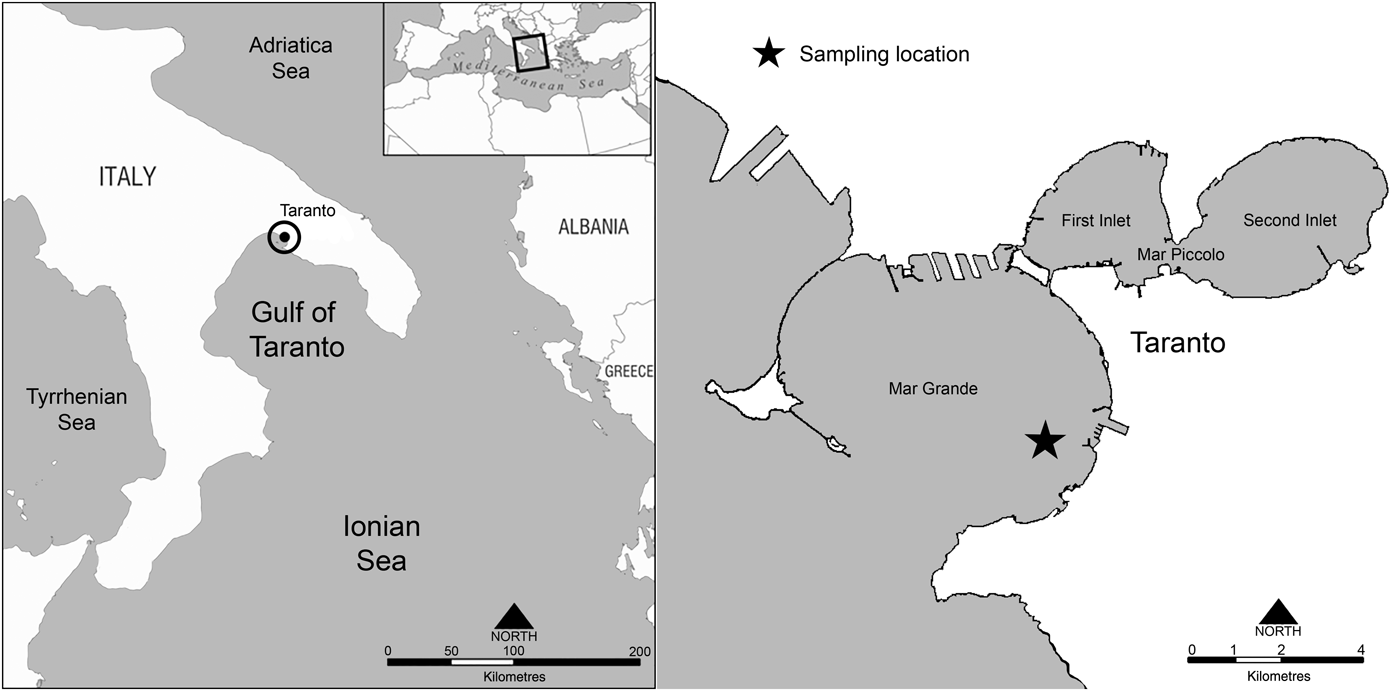
Specimens of Celloporaria brunnea were recorded during a one-year field survey (April 2013–April 2014) in the framework of a larger study on macrofouling recruitment and ecological succession, conducted at a site near an aquaculture facility in the Mar Grande of Taranto (40°25′56″N 17°14′19″E) (Figure 1). At the time of our study, the water temperature ranged from 13.3°C in January to 28.5°C in August. To observe the recruitment period of fouling taxa, PVC plates (15 × 15 cm) were used as collectors, following standard protocols (Crooks et al., Reference Crooks, Chang and Ruiz2011; Canning-Clode et al., Reference Canning-Clode, Fofonoff, McCann, Carlton and Ruiz2013b), mounted along cable and suspended vertically at 0.2, 3 and 6 m depths. For each depth, three replicates were immersed in April 2013, July 2013, October 2013, January 2014 and collected after 3 months of immersion (July 2013, October 2013, January 2014 and April 2014), for a total of 36 panels (4 collection times × 3 depth × 3 replicates). Once collected, the plates were brought to the laboratory and photographed to estimate species coverage using the image analysis software ImageJ (Abràmoff et al., Reference Abràmoff, Magalhães and Ram2004). Plates were then fixed in 4% formaldehyde for subsequent taxonomic analysis.
Study site.

Encrusting colonies of C. brunnea were identified with a stereomicroscope and photographed. Additional microphotographs were taken using an Axiocam ERC5S mounted on a microscope. Specimens of C. brunnea from the Taranto seas, preserved in 70% ethanol, were deposited at the Laboratory of Zoology, Salento University, under voucher number PCLZ-BRCL1. Morphometric data for length (L), width (W), orifices (Or) and avicularia (Av) are given in micrometres (µm).
RESULTS AND DISCUSSION
Material examined
Celleporaria brunnea (Hincks, Reference Hincks1884) Ionian Sea (Mar Grande of Taranto): (40°25′56″N 17°14′19″E), October 2013, 3 m depth.
Cellepora brunnea: Hincks, Reference Hincks1884; O'Donoghue & O'Donoghue, Reference O'Donoghue and O'Donoghue1926.
Holoporella brunnea: Hastings, Reference Hastings1929: Figures 7 & 108–110; Osburn, Reference Osburn1952: pl. 62, Figures 10–12; Soule, Reference Soule1961; Soule & Soule, Reference Soule and Soule1964, Figures 13 & 14.
Celleporaria brunnea: Winston, Reference Winston1986, Figures 19–22; Soule et al., Reference Soule, Soule, Chaney, Blake, Chaney, Scott and Lissner1995, Figure 101; Koçak, Reference Koçak2007, Figure 2A–D; Seo & Min, Reference Seo and Min2009, Figure 7. Canning-Clode et al., Reference Canning-Clode, Souto and McCann2013a; Lodola et al., Reference Lodola, Ferrario and Occhipinti-Ambrogi2015, Figure 4.
Celleporaria aperta (Hincks, 1882): André et al., Reference André, Corolla, Lanza and Rochefort2014.
Celleporaria sp. aff. brunnea: Harmelin, Reference Harmelin2014, Figures 6A–C.
The colony appears encrusting, grey–light-brown coloured (Figure 2A, B). Zoecia irregularly disposed with a smooth surface more or less punctuated in the margin. Orifice wider than longer (Or W, 169 ± 15 µm (150–191 µm, N = 12); Or L, 147 ± 13 µm (135–170 µm, N = 12)), having a rounded pseudosinus in the proximal margin delimitated by two denticular projections (Figure 2C). Two oral spines with brown basal joint present that can be lost and hidden by calcification (Figure 3A), three or rarely four spines (Figure 3B, C) only, near peripheral budding margin. Peristome raised perpendicularly to the frontal plane, which supports an avicularium on one side, close to the top (Figure 2D, F), denticulated in the distal rim. Large avicularia (Av L, 334 ± 55 µm (249–410 µm, N = 7); Av W, 114 ± 20 µm (96–138 µm, N = 7)) rare, with a spatulate mandible (Figure 2E). Ooecium widely open, frontal surface forming a narrow cap with uneven surface. Mandibles and opercula dark brown.
Stereomicroscope photographs of Celleporaria brunnea collected in Taranto, Italy. (A, B) Colony; (C) Primary orifice; (D, F) Suboral avicularium; (E) Interzooidal avicularia. Scale bars: (A) 2 mm, (B) 800 µm, (C) 150 µm, (D) 500 µm, (E) 190 µm, (F) 150 µm.
Stereomicroscope photographs of Celleporaria brunnea collected in Taranto, Italy. Close-up of (A) two spines from the central portion of the colony, (B) three and (C) four spines in budding margin of the colony. Scale bars: (A) 350 µm, (B, C) 400 µm.
Taxonomic remarks
The genus Celleporaria contains 89 species around the world (Bock, Reference Bock, Bock and Gordon2014), but the Mediterranean Sea is represented by seven NIS: Celleporaria brunnea (Hincks, Reference Hincks1884), Celleporaria aperta (Hincks, 1882), Celleporaria fusca (Busk, 1854), Celleporaria pilaefera (Canu & Bassler, 1929), Celleporaria labelligera Harmer, 1957, Celleporaria sherryae Winston, 2005 and Celleporaria vermiformis (Waters, 1909).
The specimens collected in Taranto closely agree with colonies from Turkey (Izmir Bay) (Koçak, Reference Koçak2007), Lebanon (Harmelin, Reference Harmelin2014) and Italy (Lodola et al., Reference Lodola, Ferrario and Occhipinti-Ambrogi2015) assigned to Celleporaria brunnea.
However, the identification of the Mediterranean specimens that were assigned to Celleporaria brunnea, L.M. Vieira (in Harmelin, Reference Harmelin2014) is considered disputable, due to some degree of morphological dissimilarity that was observed. The most evident differences pertain to the size of the pseudosinus, defined by Hincks (Reference Hincks1884) and Soule et al. (Reference Soule, Soule, Chaney, Blake, Chaney, Scott and Lissner1995: Figure 101C) as a small notch, which is wider and rounded in the Mediterranean specimens (Koçak, Reference Koçak2007; Harmelin, Reference Harmelin2014), and the interzooidal avicularia frequency and size, which are larger in the Californian specimens (Harmelin, Reference Harmelin2014). In this respect, the avicularia size of the Taranto seas specimens were similar to those of the Mediterranean described by Koçak (Reference Koçak2007), Harmelin (Reference Harmelin2014) and Lodola et al. (Reference Lodola, Ferrario and Occhipinti-Ambrogi2015) (Av L, 334 ± 55 µm), and differ to the California specimens identified by Osburn (Reference Osburn1952), which were larger (Av L, 500 µm). Harmelin (Reference Harmelin2014) suggests that a formal specific determination of the Mediterranean Celleporaria brunnea will require thorough comparisons with the Pacific material, including Hincks's type.
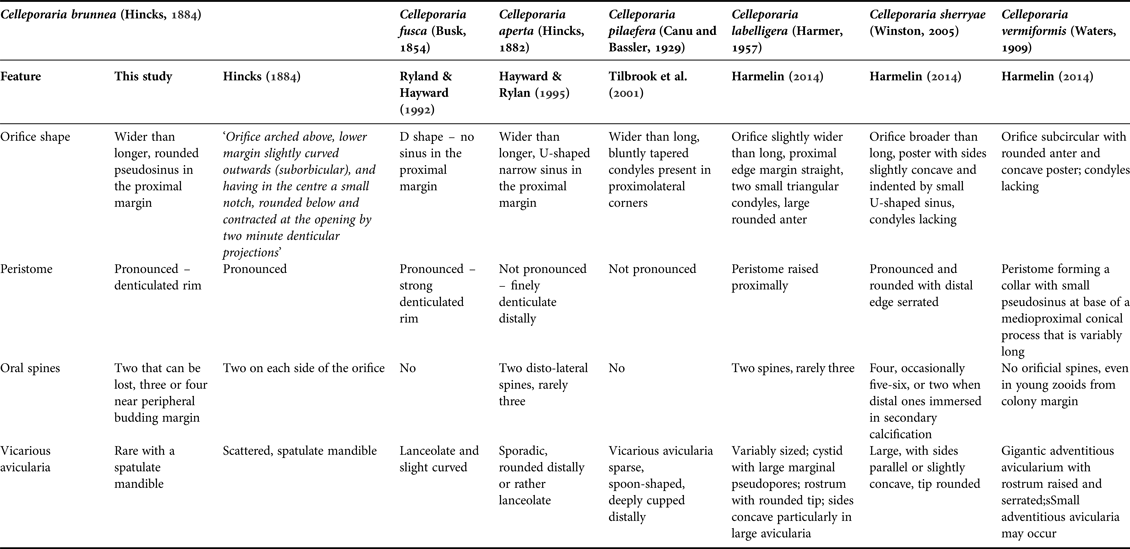
Celleporaria brunnea differs from the Celleporaria fusca because of the presence of a rounded pseudosinus in the proximal margin of the orifice and the presence of oral spines. In Celleporaria fusca, vicarious avicularia are lanceolate and slight curved. Celleporaria aperta differs from Celleporaria brunnea in the presence of a U-shaped narrow pseudosinus in the proximal margin of the orifice and non-prominent peristome. Celleporaria pilaefera differs from Celleporaria brunnea for the absence of peristome and spines, distally deeply cupped vicarious avicularia and the presence of a large pseudosinus in the orifice. Celleporaria labelligera differs from Celleporaria brunnea in having a straight proximal edge margin and in the shape of the vicarious avicularia. Celleporaria sherryae, in contrast to Celleporaria brunnea, has a U-shaped sinus, lacks condyles and has 4 or rarely 5–6 spines instead of 2. Celleporaria vermiformis differs from Celleporaria brunnea in the subcircolar shape of the orifice that lacks condyles, the absence of spines and the gigantic avicularia with serrated rostrum. These main identification features are resumed in Table 1.
Main features of the Mediterranean species of the genus Celleporaria.
Biogeographical remarks
Species recorded within the Mediterranean basin belonging to the Celleporaria genus are all of tropical affinity and considered NIS in the Mediterranean, although the presence of Celleporaria aperta and Celleporaria pilaefera is questionable (Sciberras & Schembri, Reference Sciberras and Schembri2007). Celleporaria aperta, Celleporaria pilaefera, Celleporaria labelligera and Celleporaria fusca have been described for the Indo-Pacific area and are present in the Red Sea (Ryland & Hayward, Reference Ryland and Hayward1992; Tilbrook et al., Reference Tilbrook, Hayward and Gordon2001; Ostrovsky et al., Reference Ostrovsky, Cáceres-Chamizo, Vávra and Berning2011). Celleporaria aperta was recorded in the Mediterranean (Egyptian coasts) in 1924 (Hastings, Reference Hastings1927). Subsequently, it was recorded in Maltese waters in 1975–1976 (Agius et al., Reference Agius, Schembri and Jaccarini1977), together with Celleporaria pilaefera. Lastly, Celleporaria fusca was recorded for the first time in Israel in 1974 (d'Hondt, Reference d'Hondt1988) and Celleporaria labelligera was recorded for the first time in Lebanon in 2000 (Harmelin, Reference Harmelin2014). Furthermore, Celleporaria sherryae Winston, 2005 and Celleporaria vermiformis (Waters, 1909), described for the Red sea and the Gulf of Mexico respectively, were recently recorded for the first time in Lebanon by Harmelin (Reference Harmelin2014).
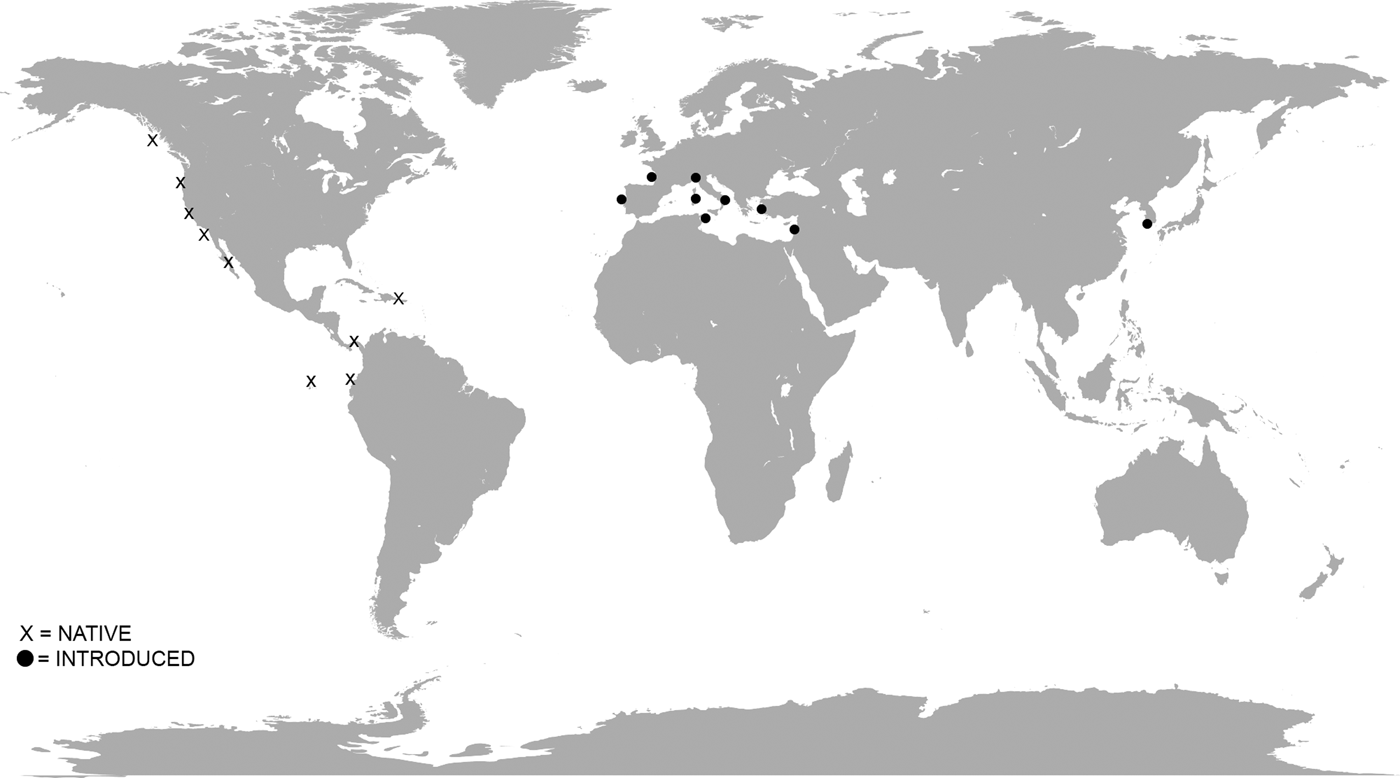
Celleporaria brunnea shows a wider distribution (Figure 4). It was described from the coast of British Columbia (Hincks, Reference Hincks1884), but most of the records for this species concern tropical areas. Celleporaria brunnea is one of the most abundant bryozoans occurring along the eastern Pacific coasts (O'Donoghue & O'Donoghue, Reference O'Donoghue and O'Donoghue1926; Hastings, Reference Hastings1929; Soule, Reference Soule1961; Soule & Soule, Reference Soule and Soule1964; Osman & Haugsness, Reference Osman and Haugsness1981; Keough & Downes, Reference Keough and Downes1982), also found in the western Atlantic coast, where it was first recognized as Holoporella vagans (Osburn, Reference Osburn1940) and later re-assigned to Celleporaria brunnea (Osburn, Reference Osburn1952). Further records from outside its native range occur in the eastern Atlantic along the Portuguese coast (Canning-Clode et al., Reference Canning-Clode, Souto and McCann2013a) and in the South Korean waters of Tongyeong (Seo & Min, Reference Seo and Min2009). Celleporaria brunnea was recently discovered in the Arcachon Basin, France, and recorded as Celleporaria aperta (André et al., Reference André, Corolla, Lanza and Rochefort2014). The first records of this species for the Mediterranean were made in the eastern basin of Izmir Bay, Turkey, in 2003 (Koçak, Reference Koçak2007; Çinar et al., Reference Çinar, Katağan, Koçak, Öztürk, Ergen, Kocatas, Önen, Kirkim, Bakir, Kurt, Dagli, Açik, Dogan and Özcan2008), along the Lebanese coast in 2003 (Harmelin, Reference Harmelin2014) and in Italy (Lodola et al., Reference Lodola, Ferrario and Occhipinti-Ambrogi2015). The present finding represents evidence for a further occurrence of Celleporaria brunnea along the Italian coast in the Gulf of Taranto.
World records of Celleporaria brunnea.
Biological information
Colonies of Celleporaria brunnea were only detected on the panel series immersed from July 2013 to October 2013 at all the examined depths. No significant difference in coverage was observed among panels immersed at different depths, with an estimated mean coverage of 1.5 ± 0.53%. No colonies have been observed on other panels immersed from April to June 2013, from October 2013 to January 2014 and from January 2014 to April 2014. Therefore, the recruitment of the species occurred only during warm periods.
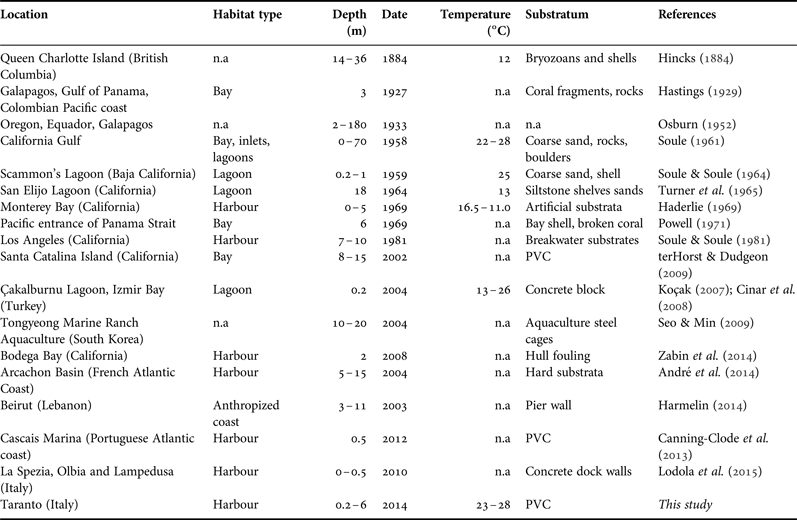
Although our data show that C. brunnea recruits in the summer time, during which, the temperature varies from 23°C to 28.5°C, data from its native range shows that it recruits all-year around, at temperatures ranging from 11.5°C to 16.5°C (Haderlie, Reference Haderlie1969). Moreover, the temperatures for C. brunnea ranged from 12°C to 28.5°C, and its bathymetric range was 0–180 m (Table 2).
Main ecological features of Celleporaria brunnea records. n.a: data not available.
In its native area, C. brunnea colonizes confined environments, such as lagoons (i.e. Isla Conchas Lagoon (Soule & Solue, Reference Soule and Soule1964), San Elijo Lagoon (Turner et al., Reference Turner, Ebert and Given1965)), bays and harbours (i.e. Los Angeles’ Long Beach Harbour (Soule & Soule, Reference Soule, Soule, Larwood and Nielsen1981), Monterey Harbour (Haderlie, Reference Haderlie1969), and Point Marina, Bodega Bay (Zabin et al., Reference Zabin, Ashton, Brown, Davidson, Sytsma and Ruiz2014)). There is little data on the species occurring out of its native range, and of the few records that do, they refer to areas degraded by human activity such as Izmir Bay in Turkey (Koçak, Reference Koçak2007), Beirut Airport in Lebanon (Harmelin, Reference Harmelin2014) and the Italian commercial harbours of La Spezia, Olbia and Lampedusa (Lodola et al., Reference Lodola, Ferrario and Occhipinti-Ambrogi2015). In Portugal, the species was found in a marina (Canning-Clode et al., Reference Canning-Clode, Souto and McCann2013a) and, in South Korea, in an aquaculture facility (Seo & Min, Reference Seo and Min2009). This is in accordance with the present finding, being that the Mar Grande of Taranto is a highly human-impacted environment.
The species was described as an encrusting bryozoan on shells and other bryozoans (Retepora) (Hincks, Reference Hincks1884), and it is reported for different substrata (e.g. coarse sand, boulders, rocks, coral fragments and various artificial substrata). Therefore, this species seems to not be highly selective. Moreover, in the environments in which it was introduced as a NIS (Izmir Bay, Portugal coast and South Korea, Beirut Airport and Taranto), it was found only in fouling community on artificial substrata (Table 2), which seems to be a common trait of NIS (Mineur et al., Reference Mineur, Cook, Minchin, Bohn, MacLeod and Maggs2012). Although C. brunnea can be easily transferred via hull fouling (Zabin et al., Reference Zabin, Ashton, Brown, Davidson, Sytsma and Ruiz2014), different source vectors may be responsible for its introduction, such as bivalve mussel aquaculture.
Our record of C. brunnea confirms an increase of NIS in the Taranto seas, raising the interest of the location in the framework of EU's Marine Strategy Framework Directive, in which marine NIS are a feature among the qualitative descriptors of good environmental status.