Implications
The manuscript describes the effect of three flavonoids on cattle stomach motility. Selected flavonoids are commonly ingested by cows either with pasture or as phytogenic feed additives. There is extensive data suggesting flavonoids’ beneficial effects on dairy cows but no records in regards to the possible impacts on gastrointestinal contractility. The identification of flavonoids effects on stomach motility may become an indication or contraindication of their usage in various motility disorders.
Introduction
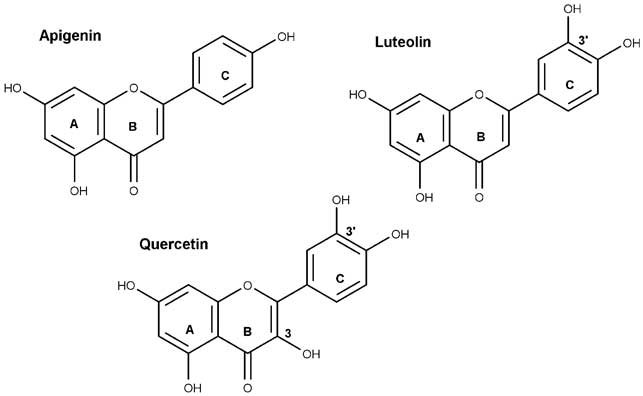
Apigenin, luteolin (flavones) and quercetin (flavonol) belong to a large group of phenolic constituents that are extensively distributed in plants present in ruminant diet (Besle et al., Reference Besle, Viala, Martin, Pradel, Meunier, Berdague, Fraisse, Lamaison and Coulon2010; Reynaud et al., Reference Reynaud, Fraisse, Cornu, Farruggia, Pujos-Guillot, Besle, Martin, Lamaison, Paquet, Doreau and Graulet2010). The structure of flavonoids is based on a common three-ring nucleus containing two benzene rings (A and B) linked via a heterocyclic pyrone ring (C) (Figure 1). Flavonoids are ubiquitous in plants, so that cows are exposed to them continuously. Besides, since the complete ban on antibiotic feed additives in the European Union in 2006 (EU Regulation No. 1831/2003), there have been numerous attempts of employing phytogenic feed additives to livestock nutrition. The idea of employing flavonoids as plant-derived feed additives results from the wide spectrum of their physiological and pharmacological effects (Harborne and Williams, Reference Harborne and Williams2000; Khayyal et al., Reference Khayyal, El-Ghazaly, Kenway, El-Nasar, Mahran, Kafafi and Okpanyi2001; Githiori et al., Reference Githiori, Athanasiadou and Thamsborg2006). Especially the antioxidant property of flavonoids and their ability to affect the activity of several metabolic enzymes are very promising in dairy cows, since they can experience oxidative stress during the peripartum period (Bernabucci et al., Reference Bernabucci, Ronchi, Lacetera and Nardone2005; Kobayashi et al., Reference Kobayashi, Miyazawa, Kamei, Abe and Kojima2010). Furthermore, flavonoid supplementation was shown to improve rumen fermentation parameters, limit the incidence of rumen acidosis (Balcells et al., Reference Balcells, Aris, Serrano, Serad, Crespo and Devant2012) and slightly increase the milk yield in dairy cows (Nielsen and Hansen, Reference Nielsen and Hansen2004; Gohlke et al., Reference Gohlke, Ingelmann, Nürnberg, Wolffram and Metges2011). The low toxicity of flavonoids in regards to acute and chronic exposure (Nijveldt et al., Reference Nijveldt, van Nood, van Hoorn, Boelens, van Norren and van Leeuwen2001) supports the idea of using them as feed additives. On the other hand, there is no data on flavonoids’ impact on bovine gastrointestinal (GI) motility, although abomasal motility disorders have been postulated as a precondition for various dysmotility problems in cattle (Doll, Reference Doll2007). According to a study carried out on rats, long-term exposure to quercetin leads to a wild distribution of this flavonoid to most of the organs (de Boer et al., Reference de Boer, Dihal, van der Woude, Arts, Wolffram, Alink, Rietjens, Keijer and Hollman2005). The presence of apigenin, luteolin and quercetin was confirmed in cow milk (Besle et al., Reference Besle, Viala, Martin, Pradel, Meunier, Berdague, Fraisse, Lamaison and Coulon2010). This data justifies the assumption that most flavonoids might reach the GI smooth muscle tissue. Based on the results of in vitro studies carried out on different smooth muscle tissues (Capasso et al., Reference Capasso, Pinto, Mascolo, Autore and Capasso1991a and Reference Capasso, Pinto, Sorrentino and Capasso1991b; Duarte et al., Reference Duarte, Pérez Vizcaíno, Utrilla, Jiménez, Tamargo and Zarzuelo1993; Morales et al., Reference Morales, Tortoriello, Meckes, Paz and Lozoya1994; Je et al., Reference Je, Kim and La2014) and in vivo observations (Di Carlo et al., Reference Di Carlo, Autore, Izzo, Mascolo, Viola, Diurno and Capasso1993 and Reference Di Carlo, Mascolo, Izzo and Capasso1994) it might be hypothesized that flavonoids present in ruminant diet affect bovine GI smooth muscle. Therefore, the aim of the study at hand was to evaluate the effect of selected flavonoids on the motoric activity of bovine isolated abomasum specimens. In anticipation of a myorelaxant reaction of flavonoids on smooth muscles preparations, the effect of apigenin, luteolin and quercetin was verified on acetylcholine-precontracted strips.
Molecular structure of flavonoids used in the study.

Material and methods
Chemicals and incubation medium
Acetylcholine chloride (ACh), dimethyl sulfoxide (DMSO), luteolin, quercetin (Sigma Chemicals Co, St. Louis, USA), apigenin (ChromaDex, Irvine, Canada), salts needed for the preparation of the incubation media: NaCl, KCl, CaCl2, NaHCO3, MgSO4, NaH2PO4 and glucose (Avantor Performance Materials, Gliwice, Poland) were used for preparing and conducting the experiments. Modified Krebs-Henseleit Solution (M K-HS) containing NaCl (123.76 mM), KCl (5 mM), CaCl2 (2.5 mM), MgSO4 (1.156 mM), NaHCO3 (14.5 mM), KH2PO4 (2.75 mM) and glucose (12.5 mM) was employed as an incubation medium in all performed experiments. M K-HS (pH 7.35 to 7.45) was continuously bubbled with carbogen (95% O2+5% CO2) and heated up to 37°C. Acetylcholine chloride was dissolved in M K-HS or DMSO (0.5%) for control treatment. All flavonoids were dissolved in DMSO (0.5%).
Abomasal strips isolation and preparation
The experiments were performed on tissues obtained from adult, healthy dairy cows that underwent routine slaughtering. The animals had no history of abomasal dysmotility problems. Specimens of the abomasal antrum were harvested 20 to 30 min after the animal was stunned. Whole thickness muscle preparations with mucosa were collected from the pyloric antrum of the abomasum, ~20 cm adoral to the pylorus. Next, the samples were dissected and the omentum was removed. Tissue samples were flushed and immediately immersed in the cooled M K-HS (4°C). Subsequently, the samples were transported (~60 min) to the laboratory. The tissue was gradually warmed up under laboratory conditions and pinned in a dissecting dish containing the M K-HS. Abomasal mucosa and serosa were removed. The preparations were then cut either parallel to the longitudinal muscle fibers (abomasum longitudinal smooth muscle strips – AL) or parallel to the circular fibers (abomasum circular smooth muscle strips – AC). Eventually muscle strips of 5 mm width and 20 to 25 mm length were obtained.
Registration of smooth muscle activity
Each muscle strip, AC or AL, was suspended in individual organ bath chambers of 5 ml volume each (Organ Schuler Bath, Hugo Sachs Electronik, March, Germany). The incubation chambers were filled with warm M K-HS and constantly bubbled with carbogen (95% O2 and 5% CO2). The preparations were distally connected to a hook and proximally to an isometric force transducer (F30, type 372, Hugo Sachs Electronik). All experiments were carried out under a load of 0.01 N. Isometric transducers were linked up to an analog-digital registration set (PowerLab; ADInstruments, Bella Vista, Australia) by a bridge amplifier (DBA, type 660; Hugh Sachs Electronik). Recordings of isolated AL and AC strips motoric activity were registered by Chart v7.0 program (ADInstruments). All the calculations and analyses were concluded with the Chart v8.1.1 program and Excel (MS Office XP Professional).
The sequence of experiments
Each experiment began with 75 min of preincubation required for strips’ equilibration. Through the preincubation the chambers were washed out every 15 to 20 min with fresh, warm M K-HS. The equilibrium included a 45 min period without tension, followed by a period of 15 min with 0.005 N tension and another 15 min of an additional 0.005 N tension. Next, the specimens underwent at least three control treatments with ACh applied in the reference dose of 10 μM. The specimens were flushed with fresh M K-HS after each ACh administration. Once the response of AC and AL to ACh application became repeatable, the preparations were used for further examinations, but only in case that the strips concurrently exhibited regular spontaneous motoric activity. Next, all strips were treated with ACh dissolved in DMSO (0.5%) in order to verify their response to the solvent. The reaction of preparations to ACh dissolved in DMSO (0.5%) was then considered as a control response. Once the spontaneous activity stabilized, flavonoids (apigenin or luteolin or quercetin) were applied in a non-cumulative manner in a concentration range of 0.001 to 100 μM on ACh-precontracted AC and AL preparations or the application of ACh was preceded by 5-min preincubation in the presence of one of the flavonoids. M K-HS was exchanged in the incubation chambers before each next administration of flavonoid. The succeeding flavonoid application was performed only after the spontaneous contractility had stabilized, that is the tension recovered to the level before the treatment. The effect of each phytochemical was tested in a separate set of abomasal specimens. Alternatively, the equilibration and control treatment (ACh dissolved in DMSO) were followed by a single application of only one flavonoid in a dose of 10 or 100 µM.
Each phytochemical was tested on six AL and six AC segments from six different animals.
Data calculation and statistical analysis
Registration of smooth muscle activity expressed as changes in the strips’ tension was performed throughout the whole experiment. The effect of all the examined substances was based on changes in the smooth muscle strips’ tension measured 5 min before and 5 min after the application of any substance and calculated as AUC (area under the curve). All results are expressed as percentage of the reaction caused by the reference substance, ACh, applied in the optimal dose (10 μM) at the beginning of the experiment. The contraction provoked by acetylcholine in the reference dose was defined as 100% (control).
The results are presented as the mean values. One-way ANOVA was conducted using StatSoft Inc. STATISTICA (data analysis software system), version 12. www.statsoft.com. The Dunnett test was used for pairwise comparison using the effect of ACh (10 µM) as a reference. Post hoc Tukey’s test was used to test multiple pairwise comparisons. P-value of <0.05 was considered significant.
Results
All tested flavonoids, apigenin, luteolin and quercetin, significantly affected the reactivity of abomasum circular and longitudinal smooth muscle. The character of the observed effects and their strength were dependent on particular flavonoids, the concentration of each one and the orientation of smooth muscle fibers in the strip. None of the involved flavonoids generated clear disturbances of the spontaneous motoric activity of bovine AC and AL preparation within 15 min after application (data not shown) but all of them altered the response of smooth muscle to the reference substance, acetylcholine. The vehicle solution (DMSO, 0.5%) neither changed the spontaneous contractility of abomasum strips nor modified the contraction induced by acetylcholine.
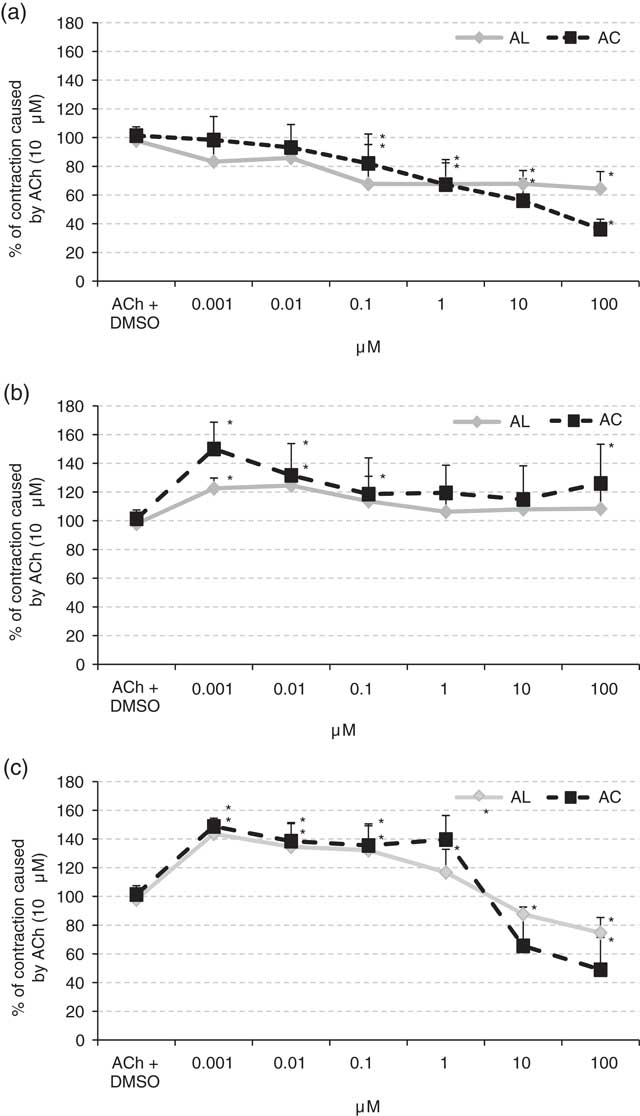
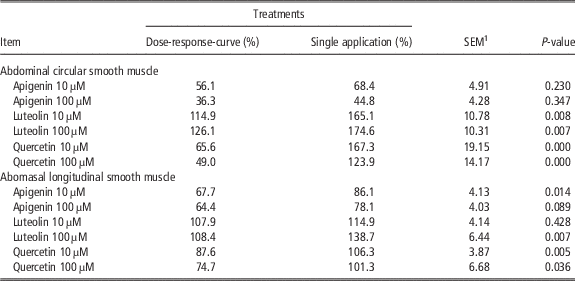
Apigenin (dissolved in 0.5% DMSO) caused a very clear and dose-dependent reduction of ACh-induced contraction’s force, if used in a concentration range of 0.1 to 100 μM (Figure 2a). While studying the dose-response relationship the maximal myorelaxant effect was noticed if apigenin was applied in a dose of 100 μM. It then amounted to 36.26±6.91% and 64.42±11.96% of ACh-evoked contraction (control treatment) for AC and AL specimens, respectively. However, if apigenin was tested only in a high dose (100 μM), the decrease of the size of the ACh-induced contraction was significantly less pronounced (Table 1).
The effect of apigenin (a), luteolin (b) and quercetin (c) on ACh-induced contraction of bovine isolated abomasum circular and longitudinal smooth muscle strips . The results are expressed as % of the contraction caused by acetylcholine applied in the reference dose of 10 μM. The results are expressed as mean of six independent experiments (±SD), *P⩽0.05 v. ACh (10 µM) followed by dimethyl sulfoxide (DMSO) (0.5%) application.

The comparison of the effect of apigenin, luteolin and quercetin used in high doses (10 and 100 μM) on bovine abomasal circular and longitudinal smooth muscle precontracted with acetylcholine (ACh 10 μM) in experiments aimed at testing the whole range of each flavonoid concentrations (dose-effect curve) and in experiments aimed at studying the effect of single doses of each flavonoid (single application)

The results are expressed as % of the contraction caused by acetylcholine applied in the reference dose of 10 μM.
1 Pooled SEM., n=6.
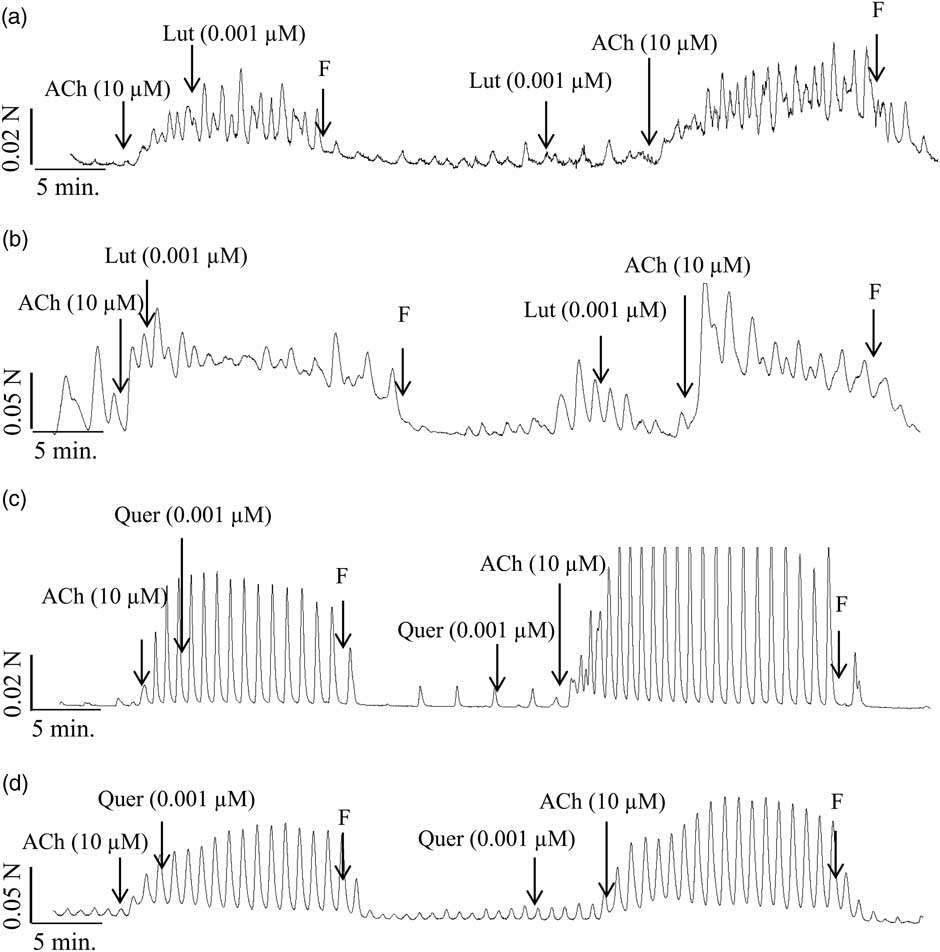
Luteolin (0.5% DMSO) used in a concentration range of 0.001 to 100 μM increased the force of the response of AC and AL to acetylcholine. However, in case of circular smooth muscle strips a significant rise of the contraction size was observed, if the flavonoid was applied in doses of 0.001, 0.01 and 100 μM (Figure 2b). The most pronounced contractile effect on AC was caused by luteolin administered in a concentration of 0.001 μM. It amounted to 150.05±18.62% of the ACh-evoked contraction. In case of specimens containing longitudinal smooth muscle only the use of the two lowest doses of luteolin, that is 0.001 and 0.01 μM, resulted in a substantial augmentation of ACh-induced contraction’s strength but the increase in contraction size was less distinct than in the case of AC smooth muscle. Irrespective of the origin of abomasal smooth muscle, all preparations reacted with stronger contraction to ACh, if they were preincubated with luteolin as compared to when flavonoid treatment followed ACh administration (Figure 3a and b). Besides, the contractile effect of high doses of luteolin was much stronger, if the flavonoid was directly applied (single-application studies) in a dose of 10 or 100 μM (Table 1).
Example recordings of bovine abomasum smooth muscle strips’ response to luteolin (a and b) and quercetin (c and d). (a and c) Circular smooth muscle specimens of abomasum, (b and d) longitudinal smooth muscle specimens of abomasum. ACh=acetylcholine (10 μM); Lut=luteolin; Quer=quercetin; F=flushing with Modified Krebs-Henseleit Solution (M K-HS).

Quercetin (0.5% DMSO) altered the reactivity of both abomasum specimens in all tested doses (Figure 2c). The use of quercetin in a concentration range of 0.001 to 1 μM generated a significant increase of the strength of ACh-induced contraction. The highest rise of contraction was recorded when the flavonoid was applied in the lowest dose (0.001 μM). It then amounted to 148.81±5.63% and 143.63±5.66% of ACh-induced control reaction for AC and AL, respectively. The contractile effect of quercetin used in low doses, that is 0.001 and 0.01 μM, was more pronounced, if abomasum specimens were preincubated in the presence of flavonoids for 5 min and then exposed to ACh as compared with flavonoid application on ACh-precontracted strips (Figure 3c and d). In the opposite, the administration of quercetin in high doses, that is 10 or 100 μM, to AC and AL strips resulted in a significant decrease of the force of ACh-evoked contraction (Figure 2c). The effect was different, if the flavonoid was directly administered in a high dose. Whenever the use of quercetin in a concentration of 10 or 100 μM was not preceded by the application of flavonoids in a wide range of lower doses (in a non-cumulative manner), the observed effect was contractile (Table 1) and in the case of abomasal circular smooth muscle strips comparable to the effect of quercetin used in the lowest dose in ‘dose-response curve’ experiments.
Discussion
The foremost finding of this study is that all tested flavonoids modify abomasal contractility in very low doses. Luteolin and quercetin increase the contractile effect of ACh, if used in low concentrations (0.001 to 0.1 and 0.001 to 1 µM, respectively), whereas apigenin dose-dependently causes myorelaxation. Interestingly, none of the tested flavonoids affected the spontaneous contractility of abomasal smooth muscle. Their spasmolytic or spasmogenic effects were revealed only on ACh-precontracted specimens. Analog findings were observed for apigenin before. It showed no significant effect on basal tension in rat vascular smooth muscle, although it inhibited pharmacologically induced contraction in the same model (Je et al., Reference Je, Kim and La2014). We found the results referring to the application of flavonoids in low concentrations are of main importance, since pharmacokinetic data indicates relatively low bioavailability of flavonols and flavones. In adult cows the bioavailability of flavonoids is higher, if they are administered in the form of glycosides, for example the absolute bioavailability of flavonols after single intraruminal application amounts to 0.1% and 0.5% for quercetin aglycon and rutin (quercetin glycoside), respectively (Berger et al., Reference Berger, Wein, Blank, Metges and Wolffram2012). However, quercetin in the form of aglycon is always the main metabolite found in plasma (Berger et al., Reference Berger, Wein, Blank, Metges and Wolffram2012). Unfortunately, there are no records describing flavonoids’ bioavailability in the case of chronic, multiple treatment and only this data could reflect the physiological situation when cows are continuously exposed to bioflavonoids present in pasture. The study presented here revealed that the magnitude and character of the effect evoked by all three flavonoids depend on the multiplicity of abomasum specimens’ exposure to each compound. The manifold treatment of abomasal smooth muscle with any of the three flavonoids (experiments aimed at testing dose-response dependence) ended up in a reaction caused by the flavonoid in the highest dose that differed from the response to the same compound in the same dose but applied as a single treatment (‘single application’ experiments) (Table 1). Interestingly, if flavonoids were directly used in high concentrations, their effects were comparable with those evoked by the same phytochemical but applied in the lowest dose.
The antispasmodic effect of quercetin (10 and 100 μM) observed when the specimens were exposed numerous times to this flavonoid (Figure 3b) and spasmolytic effect of apigenin (0.1 to 100 μM) on bovine abomasum are in general agreement with the relaxant activity described previously in various gut preparations, such as mice stomach (Amira et al., Reference Amira, Rotondo and Mule2008), guinea-pig ileum (Capasso et al., Reference Capasso, Pinto, Mascolo, Autore and Capasso1991a and Reference Capasso, Pinto, Sorrentino and Capasso1991b; Morales et al., Reference Morales, Tortoriello, Meckes, Paz and Lozoya1994), rat ileum (Hammad and Abdallal, 1997), rabbit jejunum (Ghayur et al., Reference Ghayur, Khan and Gilani2007) and the results of in vivo studies (Di Carlo et al., Reference Di Carlo, Autore, Izzo, Mascolo, Viola, Diurno and Capasso1993). Nevertheless, a dual effect of quercetin, spasmogenic in low doses and spasmolytic in high concentrations recalls analog observations. The contractile effect of quercetin used in low doses is similar to the effect of myriecetin, the related flavonol which potentiated the contraction induced by high KCl, noradrenaline and phorbol 12-myristate-13-acetate of rat aortic smooth muscle. Myriecetin showed contractile and myorelaxant effects if used in low doses and high doses, respectively. (Herrera et al., Reference Herrera, Zarzuelo, Jimenez, Marhuenda and Duarte1996). Possibly the contractile effect of quercetin and luteolin used in low doses was missed by some authors who studied the effect of those flavonoids on smooth muscle contractility only in the range of doses 1 to 100 μM (Capasso et al., Reference Capasso, Pinto, Mascolo, Autore and Capasso1991a and Reference Capasso, Pinto, Sorrentino and Capasso1991b; Hammad and Abdalla, Reference Hammad and Abdalla1997; Amira et al., Reference Amira, Rotondo and Mule2008). Still, the results presented herein that refer to the use of flavonoids in high concentrations are in general agreement with data collected by other authors (Capasso et al., Reference Capasso, Pinto, Mascolo, Autore and Capasso1991a and Reference Capasso, Pinto, Sorrentino and Capasso1991b; Ghayur et al., Reference Ghayur, Khan and Gilani2007; Amira et al., Reference Amira, Rotondo and Mule2008). Besides, plants’ extracts containing flavonoids may cause variable effects dependent on the applied dose. For example, the flower extract of Calendula officinalis generated a mild contractile reaction if used in low doses and significant myorelaxation if employed in higher concentrations (Bashir et al., Reference Bashir, Janbaz, Jabeen and Gilani2006).
Possibly the character and severity of interaction with abomasal smooth muscle depends on the structure of individual flavonoids, presumably due to differences in lipid solubility and the presence of different substitutions on the carbon atoms of the basic skeleton. The structure-activity relationship for flavonoids has already been reported for various biological activities including spasmolytic effects on gut smooth muscle (Capasso et al., Reference Capasso, Pinto, Mascolo, Autore and Capasso1991a; Hammad and Abdalla, Reference Hammad and Abdalla1997; Amira et al., Reference Amira, Rotondo and Mule2008). In case of vascular smooth muscle, it has been postulated that the relaxant activity depends on the number of hydroxyl groups in the moiety, the presence of C-2, C-3 double bond in the B ring and the presence of the 4-carbonyl group (Duarte et al., Reference Duarte, Pérez Vizcaíno, Utrilla, Jiménez, Tamargo and Zarzuelo1993; Herrera et al., Reference Herrera, Zarzuelo, Jimenez, Marhuenda and Duarte1996; Amira et al., Reference Amira, Rotondo and Mule2008). Indeed, the existence of the hydroxyl group at C-3 (B ring) in quercetin moiety (Figure 1) might be responsible for the inhibition of myorelaxant activity in this flavonoid. On the other hand, the presence of only one hydroxyl group at ring C of apigenin (C-4’) may explain its potent antispasmodic activity. On the contrary, luteolin and quercetin, both acting as contractile agents in low concentrations, possess two hydroxyl groups attached to ring C. The 4-carbonyl group and a double linkage C-2–C-3 of the benzopyran ring are required for vasodilatatory (Duarte et al., Reference Duarte, Pérez Vizcaíno, Utrilla, Jiménez, Tamargo and Zarzuelo1993; Herrera et al., Reference Herrera, Zarzuelo, Jimenez, Marhuenda and Duarte1996) and were postulated as required component for GI myorelaxant activity (Hammad and Abdalla, Reference Hammad and Abdalla1997). However, in the view of our study, the participation of C-2, C-3 double bound and 4-carbonyl group at B ring in the myorelaxant mechanism of flavonoids on abomasum is rather doubtful, since those structures are present in all three tested flavonoids and luteolin shows no antispasmodic activity, irrespective of the applied dose. The contrary effects of apigenin and luteolin, two similar flavones, are very surprising although there is some data indicating a different mechanism of their action. According to the research team of Duarte et al. (1993), the relaxant effects of luteolin in rat vascular smooth muscle was slightly potentiated by isoprenaline (suggesting cAMP involvement), while those of apigenin were increased by sodium nitroprusside (indicating nitric oxide (NO) involvement in the relaxing effect). Generally, the structure-activity relationship of flavonoids is also only partially understood. Unconditionally, flavonoids influence structure and permeability of cell membranes. The relative hydrophobicity of flavonoids and eventually their affinity to lipid bilayers depends on the number of hydroxyl groups (Hendrich, Reference Hendrich2006). It possibly explains the differences in the effects evoked by apigenin and luteolin which differ in the number of hydroxyl groups attached to C ring of the moiety. Besides, due to the fact that flavonoids interact with lipid bilayers as well as with membrane proteins, they influence also electrical properties of membranes and ions channels functionality, including Ca2+ influx (Dar and Channa, Reference Dar and Channa1999). It can eventually affect smooth muscle reactivity to contractile agents (like ACh) by increasing or diminishing expected responses. A calcium-antagonistic effect of flavonoids, including quercetin and apigenin, was assumed beforehand (Morales et al., Reference Morales, Tortoriello, Meckes, Paz and Lozoya1994; Gharzouli and Holzer, Reference Gharzouli and Holzer2004). Moreover, some polyhydroxylated flavonoids at ring A and B, including luteolin used in a high dose of 100 µM, were shown to be potent Ca2+ uptake inhibitors in liver plasma membrane (Thiyagarajah et al., Reference Thiyagarajah, Kuttan, Lim, Teo and Das1991) which confirms their ability to interfere with calcium homeostasis. The myorelaxant activity of flavonoids can also be explained by their ability to activate the large-conductance Ca2+-activated (BKCa) channels leading to cell hyperpolarization and subsequent decrease of Ca2+ influx via voltage-dependent calcium channels (Yang et al., Reference Yang, Pan, Zuo, Guo and Zhou2014). Since BKCa channels are widely distributed in GI smooth muscle cells (Vogalis, Reference Vogalis2000), this mechanism can be used to explain at least partially the results of flavonoids described herein.
According to the obtained data, the intensity of flavonoids-induced effects was mostly greater, if the application of flavonoids preceded the treatment with ACh (v. the reaction of flavonoids on ACh-precontracted strips) (Figure 3). It suggests that the interaction of apigenin, luteolin and quercetin with smooth muscle surface during preincubation was sufficient to alter cells’ reactivity to muscarinic agonist. The impact of extended exposure of smooth muscle to flavonoids was previously observed by Capasso et al. (Reference Capasso, Pinto, Mascolo, Autore and Capasso1991a) who reported an enhanced spasmolytic effect of quercetin and apigenin in case of prolonged preincubation of guinea-pig isolated ileum with those flavonoids. In the opposite, if the flavonoids were applied only after ACh treatment their ability to modify smooth muscle reactivity was less significant. The ability of flavonoids to interfere with cell membrane and to indirectly modify the responsiveness to contractile agents might also explain the differences between the results obtained from experiments aimed at studying dose-response dependence and those focused on analyzing the effect of only single application of a flavonoid used in one concentration (Table 1). If one abomasum specimen (AC or AL) was exposed to any of the compounds several times, it is possible that the first few applications caused alteration of smooth muscle membrane structure and eventually cells’ reactivity. Hence, the observed strips’ response to the subsequently applied highest doses (e.g. 10 and 100 µM) might have been influenced by previous treatments.
According to another hypothesis, the local myorelaxant effect of polyphenols, including quercetin could be explained by the interaction with dietary nitrite in the stomach and induction of a strong increase of nitric oxide (Rocha et al., Reference Rocha, Gago, Barbosa and Laranjinha2009). However, in cattle nitrite is expected to be converted to ammonium by ruminal microbes (Wang et al., Reference Wang, Garcia-Rivera and Burries1961), so its effect on GI smooth muscle can actually be excluded.
Taking into account limited bioavailability of flavonoids in adult cows due to ruminal degradation (Berger et al., Reference Berger, Wein, Blank, Metges and Wolffram2012) but also their potency to increase abomasal contractility (luteolin and quercetin) if used in low doses, it could be estimated that luteolin and quercetin would have an effect of increasing gastric motility. In a study on motility disorders associated with displaced abomasum (DA) in dairy cows, in left DAs and right DAs, the contractile activity was significantly inhibited during electrical stimulation (Geishauser et al., Reference Geishauser, Reiche and Schemnann1998). Since luteolin and quercetin are significant contractile agents, they could diminish the risk of motility disorders such as left or right DAs, if cows’ diet had been supplemented with these flavonoids.
In conclusion, flavonoids which are commonly present in ruminants’ diet, that is apigenin, luteolin and quercetin, are potent modifiers of bovine abomasal contractility. The consequences of abomasal smooth muscle treatment with tested flavonoids include both spasmolytic and spasmogenic effects. The character and magnitude of flavonoids’ induced reactions depend on the chemical structure of particular flavonoids and the frequency of tissue exposure to those compounds. Luteolin and quercetin can be expected to increase abomasal motility and secondarily reduce the risk of abomasal dysmotilities assuming their presence in pasture or supplementation in bovine nutrition. However, especially in case of quercetin, its effect under chronic exposure requires further verification.
Acknowledgments
The study was supported by a research grant from the National Science Centre Poland No. UMO-2012/05/D/NZ9/01610.