


Although Charles Lockyer—aboard of the Streatham of the East India Company (EIC hereafter) in 1710s Madras—advised that “A man of an honest character seldom wants money at Bottomree, or Respondentia to what port soever, (as) he is bound, on his own personal security,” captains and supercargoes in India borrowed on respondentia from the company for the remainder of the century (IOR/E/107,108,109—see the Appendix). They used the instrument to transfer profits and legacies back home and in private deals with South Asian lenders. Ebenezer Blackwell of Lombard St., partner of one successful London banker, Martin’s Bank Ltd. (in business since 1563), was still issuing respondentia loans in the 1780s to captains and chief mates of the company ships to the East Indies on their private capacity (Martin’s Bank, see the Appendix). Furthermore, Charles Magniac—the seed of Jardine Matheson & Co. issued respondentia bonds in China until the 1830s (GBR/0012/MS JM/F5/2,5,10,12). Henry Harnett of Calcutta—a company servant—lent at respondentia secured on ship cargoes (Harnett 1725–1729). Lockyer also detailed the rates of returns in Madras for lending to eleven Asian destinations ranging from 16–18% for Aachen and Bengal to 40–45% to China and Persia (Lockyer, Reference Lockyer1711, pp. 17–18). Apparently, as this essay argues and the contracts in the Appendix show, the rates had not changed much throughout the century.
The contract was not privy of the English; it was instrumental to subscribe the initial capital of the Compagnie Francaise des Indes Orientales in 1700 (Recueil ou collection des titres. 1775) and it was the vehicle to finance early Portuguese trade from Brazil in the seventeenth century, when sugar served as remittance (Strum, Reference Strum and E. A. Matthias2017; Mauro, Reference Mauro1960). In the 1630s, Dutch “peddlers” dealt rubies for textiles with Indian merchants in Burma (Dijk, Reference Dijk2001:15) and private merchants used it for remittances in the diamonds trade through the EIC hundred years later (IOR/M/fs 389–406). It also appeared in the businesses of private Dutch trade as in that of the Danish and Swedish companies, in the East Indies too. It showed up equally in the West Indies trade. Dutch merchants in Curaçao sent “sealed bags of Spanish silver” to Amsterdam via Albany, New York in the 1740s on respondentia with “a 10% agio” (McCusker, Reference McCusker1978, pp. 293–295), and North Americans—late comers to the East Indies—used it too in their deals in India and China in the 1800s (Porter, Reference Porter1937/Reference Porter1969). Why would Europeans use this contract instead of bills, which were already dominant in the intra-European trade?
This ubiquity is intriguing. Across national agents and colonial exchanges over the Mediterranean, the three oceans, and the South China Sea European’s long preference for respondentia over bills of exchange when dealing in extra-European markets stands out. This article examines respondentia and underlines its specific monetary aspects as the rationale for its widespread use. It argues that by prescribing the quality of the monies in the repayment of investments, the contract was convenient for private trade finance in maritime commerce involving different currencies and people with a long waiting time. Lacking both a cashless means of settlement and a common standard for precious metals across distant markets, maritime trade meant dealing with “foreign monies”; so, international commerce was susceptible to changes in both the exchange rate and the market values of metallic monies in tandem. Unlike bills that were denominated in domestic currency, respondentia allowed traders to mitigate the uncertainty of exchange. Arguably, it served well to hedge against uncertainty in future prices and to capture arbitrage gains.
The first section of this paper defines respondentia, discusses historians’ characterization of the instrument and establishes some differences with bills of exchange used at the same time in Europe. The second section describes the terms and nature of the contract, delving—particularly—into the determinants of the “interest rates” or praemium Footnote 1 and, it—roughly—compares trends in the rate across the eighteenth-century global commerce. The third section documents the global extent of the contract use in a comparative assessment to shed light on the drivers of this mode of trade finance. The fourth section underlines the exchange character of the instrument, looking into crucial issues embedded in long-distance trade conducted within a diverse monetary setting. It discusses views of money as a commodity—i.e., standardizing the intrinsic value of specie—highlighting the role of monies of account built out of the European case, which have limited the understanding of global exchanges in heterogeneous monetary settings. Without common standards for metallic monies—even a standard for coins as in China and public institutions performing with monies of account, trade with foreign coins created significant issues for commerce, e.g., marks-ups, the pricing of species and exchange rates which bills could not solve a similarly low cost. Thus, remittances in gold and silver persisted as respondentia lingered. The conclusions question the alleged inefficiency of respondentia over cashless alternatives that were booming in Europe at that time.
1. A contract for private trade finance, aside from the bill of exchange
As the contract mobilized capital to procure silver to further trade elsewhere, with a turnover in the order of several months or years, the contract resembles a venture capital. Yet, when looking into the currency component of the contract, e.g., the specification of the specie on which to be reimbursed, respondentia also looks more like a forward swap; it dealt with mark-ups, like spot and future prices of goods whose quality was difficult to price—like sugar and diamonds.Footnote 2 Irrespectively, the contract clearly was suitable to finance trade among economies performing with different cash means of payment and to obtain silver specie—i.e. money—in Mexico, in Cadiz or Manila—as shown by Lamikiz’ and Ruiz Stovel and Ruiz Moreno’ articles in the collection. In these regards, it was clearly an “importer” type of finance, that mitigated costs derived from exchange and currency risk and realized profit from arbitrage when dealing foreign specie within private money markets—as discussed below.
Looking into notarized contracts in the thirteenth-century Genoa and the twelfth- and thirteenth-centuries trade with pepper in Byzantium, De Roover (Reference De Roover, Postan, Rich and Miller1963, p. 54) identified three types of sea loans which superseded the long-established equity partnership commenda as maritime commerce expanded: one was the “ordinary” sea loan (foenus nauticum). This loan was “unsecured save for a general lien on the debtor’s property.” Another “called in medieval England the respondentia” was a loan in which the “principal and increment must be paid even though the ship perishes provided the cargo to be safe”; and a third type was the bottomry loan, which were usually secured by part or the whole of the ships or its freights subsequently. He also highlighted another contract that increasingly replaced the ordinary sea loan and was becoming popular by the thirteenth century: the cambium maritimum. In a later piece, De Roover (Reference De Roover1969) could not neatly establish whether this was an exchange or a credit transaction. If the latter, he argued as “transfer instrument it could serve as an international long-distance settlement” (p. 20); if the former, an operation to disguise a loan, it was then a credit instrument for trade”—although both were probably not mutually exclusive. More importantly for the argument on this essay, as de Roover pointed out, “It anticipates future developments in the money market” (p. 22).
Respondentia differed from any other contemporary commercial and financial instruments in one critical aspect, which economic historians often disregard. Insofar as there was a change (permutatio) of money (pecunia) it often hid the interest and true nature of the contract as a loan, so historians alleged that it was favored to avoid the usury laws. However, the covenant enabled long-distance exchanges of goods for money, by specifically establishing the species with which the capital was to be paid back. Therefore, respondentia, as a version of cambium maritimum, always involved an operation of exchange (Lo Basso, Reference Lo Basso2016b).Footnote 3 This made respondentia also very distinct from bills of exchange, which sought to minimize the use of bullion in settling international balances. Creditors’ persistent demand for specie (silver cash) in Asia and Europe, resulting from their intermediation in the world’s trade, affected the price and supply of bills. This made the band for the specie point consistently very wide indeed—i.e., little room for arbitrage with bills—so silver continued flowing East from America to Europe and from Europe to Asia, and bills took longer to serve as remittance instead (Flandreau, Reference Flandreau2004; Nogues, Reference Nogues and Battilossi2020; Irigoin et al., Reference Irigoin, Kobayashi and Chilosiforthcoming). Arguably, this made respondentia purposefully designed to carry an exchange transaction in bullion markets that were not (yet) integrated.
As an advance of money or goods, respondentia was a free private arrangement for trade finance among disparate mercantile agents in remote locations that dealt with foreign monies better than otherwise. A bit hesitantly, Denzel describes the préstamo marítimo as “not a classic bill of exchange transaction” but rather an «emprunt contracté», with a questionable negotiability … (an instrument) that served (alone?) to acquire money” (2010, xlvii; his emphasis). Thus, it was also a collateralized loan, though not a direct financing vehicle, which, in its form of debt for the full value of the contracts, served to acquire foreign exchange. It resembles a modern derivative, the foreign exchange or currency swaps—i.e., two parties exchange currencies at the current spot price and commit to reverse the exchange at some pre-agreed future date and price (the forward rate) in the established foreign currency (usually the USD dollar). It involves an implicit interest payment in the harder of the two currencies—which can be persistent and conform “puzzlingly” large extra expenses, justified by the “dominant currency status” of the foreign money as the preferred international currency of the time (Gopinath and Itskhoki, Reference Gopinath, Itskhoki, Gopinath, Helpman and Rogoff2022).Footnote 4 The silver coined in Spanish America enjoyed the status of dominant currency until the 1820s.
Unlike bills, respondentia had no usance (or not always) but a fixed customary period following the arrival at the port for the settlement, beyond which interest rates may be charged.Footnote 5 In principle, there was no balance left; lending was settled with the payment as the taker was bound to do it in full—and in cashFootnote 6—after the completion of the journey. There was no room for other transactions as re-change, although some contracts in a round trip over the Atlantic might have involved two distinct bonds with different types of money or rates for each leg.Footnote 7 Neither respondentia bonds were negotiable, or discounted, nor were they transferable or endorsed. Therefore, they made no real contribution to enhance liquidity in the market. There was no protest, however, if the borrower refused to pay the bond was not sent back to the issuer; it opened the path to execute the guarantee, or the guarantor agreed. It was a two-party-direct contract, so there were no additional costs—i.e., commissions paid for intermediation.Footnote 8 Like bills, they were also a foreign exchange transaction that indeed involved different monies, while respondentia did not conceive a conversion of currencies.
Bills involved two (or more) different currencies and monies of account as exchanges meant a deal with one another by each buying a bill in the local market and paying a sum denominated in a local money of account for the delivery in another market of an equivalent amount in the respective money of account. They were a draft, order or direction of one person addressed to another person requesting to pay a sum of money to a third person. In the case of foreign bills drawn in the currency of one country upon a person residing in another—hence performing with a different currency—yet to pay the third one who might (or might not) be in the same currency regime.Footnote 9 The negotiability of the bill involved different currencies and means of payment. That is a conversion of currencies to monies of account and vice versa. The bill was also for the absolute—unconditional—payment of a sum of money and not on goods or stocks “not to depend on any uncertainty or contingency.” It was too for the payment of money, but “it matters not that the denomination of money specified has, because the value of each kind can be ascertained.”Footnote 10 Respondentia instead, was a covenant between two parties that allowed the return in cash (specie) to be certain for the lender ab initio—less often it established the exchange rate at which the local currency was to be priced in the return; in either case, the contract also reduced the so-called exchange risk.
2. Terms, conditions, and rates
The idea of very high risks in long-distance trade has persuaded historians that the high “interest rates” charged on the principal were directly related to such hazards. Hence, the characterization of respondentia as a «high-profit/high-risk» investment. Rates of over 50 or even 70% were frequent in the seventeenth and early eighteenth century’ Peru trade as recorded by Quiroz (Reference Quiroz1993). However, the commercial risk distinctly fell on the borrower. As the rate—indeed, the premium or reward—was established ex ante with the initial capital outlay, the borrower must have been confident that the ventures would yield even higher returns, or enjoyed much better information, as Costa argues in her article in the collection. Arguably, the premium might also be considered the upper bound rate at which borrowers were willing to pay for working capital rather than an indication of risk or the opportunity cost of capital. Everywhere, premiums quoted were systematically much higher than the customary local interest rates (Flandreau et al., Reference Flandreau, Galimard, Jobst, Nogués-Marco, NEAL and Atack2009, appendix A, table 6A.1).Footnote 11
Historians tend to correlate rates with distance, so some see a time dimension of the cost of capital in it. Premiums, however, were very similar in the Cadiz-Veracruz and in the Acapulco-Manila voyages, despite different business organization and very different lengths of time at sea, as shown in the introduction to this special issue. In the 1660s, Genoa’ rates for Lisbon, Smyrna or Athens were 80% higher or double than those for Alicante or “coast of Spain,” despite comparable distances. Moreover, these rates pale before premiums for “New Spain” via Cadiz (Lo Basso, Reference Lo Basso, Giuffrida, Rossi and Sabatini2016a, pp. 155–58). Europeans (non-Spanish) charged 15–16% from Flanders and Amsterdam to Cadiz in the later seventeenth century, but rates jumped to 40 and 60% if capital continued to “the Indies” or the River Plate (Everaert, Reference Everaert1971, p. 5; Freeman, Reference Freeman2020). The difference persisted in the 1760s in loans from Nimes, which paid 18–20% for Cadiz and 30% for “America” (Chamboredon, Reference Chamboredon2016). In London, Blackwell lending charged fixed monthly rates for premium “and in proportion” for a maximum of 36 calendar months; but rates varied between five and 48 pounds a month for bonds of similar amount and terms for the delays to clear after arrival (Martin’s Bank 009–0057). Seemingly, premiums did not have a clear time component, and they appear to relate to expected returns at destination.
Additional—with clearly separate and timed structured rates—interest was charged for delays when the clearing went beyond the established time post arrival. Whereas this never applied in the liquid Manila market, surcharge rates appeared later in Cadiz—at a time when returns on the loans were falling. Clearing took longer in bonds to Mexico, once the fleet and the termed fairs ceased by the mid-eighteenth century. Individual arrivals carried smaller cargoes so had lower values. They were more irregular but also much more frequent, raising the risk of gluts in the rich but shallow colonial markets for demographic and geographical reasons; selling the goods required a longer time to settle. Thus, sales were often consigned to the next season to hedge against low spot prices and losses from overstocking as flows of similar goods from Acapulco and Cadiz kept pouring over. Postponements of the clearing added interests to the principal and premiums. Elsewhere, where additional interests were charged on such delays, higher premium rates bore no relation to the (approximate) current local rates for alternative investments. In Asia, these moved around 0.75% per month in Surat and Bombay (Chaudhury, Reference Chaudhury2015, p. 91; Haider, Reference Haider1996), 1.5% in Canton (Van Dyke, Reference Van Dyke2011: 45), or an annual 7–10% as in Macao (Dos Guimaraes Sa, Reference Dos Guimaraes Sa2003; Souza, Reference Souza2004, 186).Footnote 12 In Europe, rates were at a monthly 0.5–1% in Cadiz, 1.25% in Genoa, and 12% per annum in Flanders. Everywhere, much higher premiums seem independent from the local cost of money, so they cannot be an indication of its stock available.
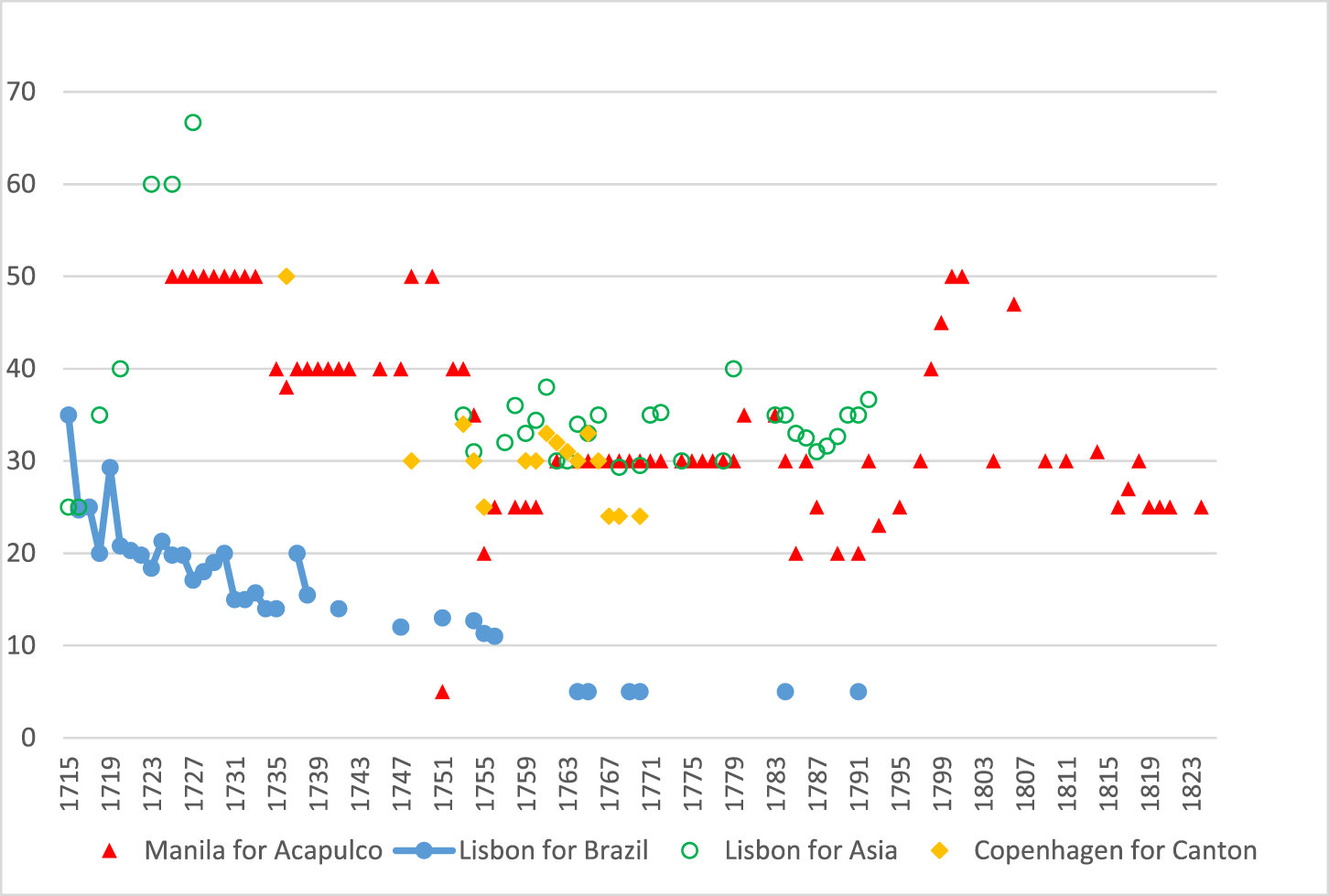
Historians point to rates overshooting during wars as the foremost risk to trade; however, the effects are ambiguous. In some cases, there were provisions for increasing premiums if there was a probable threat—as in the original subscription of the French Compagnie des Indes stock (Recueil …). A specific clause about «risk of (government) expropriation» appeared in 1640s Dutch bonds for (illegal) journeys to the River Plate; they seem highly unusual, and, in this case, the risk was passed explicitly on to the borrower (Freeman, Reference Freeman2020). It is unclear whether the risk seems more associated with the impact of war in Europe than at sea or overseas. This affected risk—and premiums—differently. Reporting to his clients François Tronchin, a broker based in Geneva, made very clear the direction of trade: prices—and naturally the expected rates of return—were heavily dependent on the relative abundance of silver at destination.Footnote 13 Thereby, the risk calculation was always to avoid glutting markets in America (Baskes, Reference Baskes2013). War effects are not visible in the case of Manila, shown above in Figure 1. Losing the Galleon Covadonga to British Admiral Anson near Manila in 1743—laden with 1.3-million-peso coins (c. 32 tonnes) and about 35 tonnes more in bars (Cushner, Reference Cushner1971)—ought to be a blow to lenders as correspondencia returns never arrived, creating a credit crunch.Footnote 14 Yet, rates did not change and jumped only once silver laden galleons returned. Therefore, premiums do not exactly capture risk from war incidents; if any, premiums seem directly related to the availability of silver.
Premiums in Atlantic, Pacific and Indian Oceans and China seas (1715–1823), in percentage.

There were means to mitigate the exposure to risk, however. Lenders apparently spread the bonds in many ships—even if sailing in a fleet—and in many small amounts. It was the same among lending to junk merchants in Canton (Van Dyke, Reference Van Dyke2011, p. 153), in the Genoese lending in the Mediterranean, as in the Spanish and French deals in the Atlantic (Carrasco-Gonzalez, Reference Carrasco Gonzalez1996 Appendix A-1; Chamboredon, 1995, pp. 704–707). Clearly, respondentia did not favor economies of scale. Similarly, the contract was non-negotiable nor transferable, so the contribution to liquidity was limited to «acquire money» as Denzel suspected. Without enhancing capital pooling and without increasing returns to scale, the contract does not seem effectively designed to favor productivity improvements.
Premiums neither did seem to bear a particular relation to the nationality of borrowers or the organization of the business. Frequently rates even varied for different transactions on board of the same ship (Carrasco Gonzalez, Reference Carrasco Gonzalez1996, p. 94, Lamikiz, Reference Lamikiz2023, p. 5). It is difficult to see a time component in the premiums, as interest were charged separately, so it cannot price the opportunity costs of capital. The round sail from Cadiz to Veracruz in Mexico took roughly six to eight months, and from Cadiz to Peru, the Acapulco galleon took over a year-long, non-stop round trip set by the Monsoon. Yet premium rates for main Mexican ports on the Atlantic and the Pacific—were very similar throughout the eighteenth century (Bernal, Reference Bernal1992; Ruiz Moreno, Reference Ruiz Moreno2023). Interestingly, both ports were also main outlets for Mexican silver. Lending at respondentia charged a premium ex ante defined as a fixed rate of return, which, being an advance of capital, suggests it was directly related to the expected profits from that trade.
Reportedly, premiums declined over the eighteenth century; the falling (non-coeval) trend over the century repeats in all cases of European commerce across the Atlantic by 1800, other than in trade with Asia through the Indian and Pacific Oceans. It is noteworthy to remember that China’s import of silver continued steadily until the mid-1820s (Irigoin, Reference Irigoin and Battilossi2020). Figure 1 charts a rare longitudinal data on respondentia rates in different long-distance routes of the time, e.g., the Manila lending for Acapulco, the Portuguese in the Atlantic and India trades, and the Danish trading in Canton—to outline the trend (data is too scattered to satisfactorily compare levels) that premiums followed in the respective routes.Footnote 15 As said it is not feasible to reconstruct any robust series of premium rates; however, the results are consistent with qualitative impressions from the literature.
Throughout the eighteenth century, rates remained high in the Indian and Pacific oceans while declining steadily over the Atlantic, clearly the most competitive of these trades (De Vries, Reference De Vries, Flynn, Giraldez and Von Glahn2003; Quiroz, Reference Quiroz1993, p. 100). The case of Lisbon confirms that they did not relate to the place where capital originated; rates for both “Indies” started at about the same level, but premiums diverged with the destination over time. Arguably, higher and sticky premiums for all contracts in Asia might reflect the persistent premium on silver cash there and the room for arbitrage gains in Asia.Footnote 16 Lastly, similar agents contracted capital at different rates depending on the returns of trade involved, somehow independently of the capital endowments available, the business model, the length and hazards of the journeys and even the “national/ethnic” origin of the parties.Footnote 17
3. Global use and foreign currencies
“For deals with profit in India as in the Levant, it should be done with the silver, either in bars or in coins, which would allow to coin the different species of rupees. Which is to say that the route to India goes through Cadiz” (Dermigny, Reference Dermigny1960, p. 124).
«Au XVIIIe siècle, au niveau des négociants, grosse aventure (respondentia) signifie, avant tout, Cadix». (Carriere, Reference Carriere1970)
The Japanese word for a similar contract—nagename—means (lit.) “trust in silver” because it was the specie involved in the exchange for silk in China in the seventeenth century. In November 1641, two Dutch VOC agents invested 300 (Spanish) “reals of 48 stuivers each” on a ship owned by a Chinese going from Batavia to Palembang—Sumatra. The loan was termed with the journey duration estimated in 3 months; the premium agreed was 30% plus 2% of interest on the total amount (principal and premium)—i.e., 390 reais—for each month in arrears after the arrival.Footnote 18 Therefore, the prevalence of respondentia in the Spanish overseas trade should not be a surprise. There was no larger «fountain of silver» for the world at the time than Spanish America’s—replacing Japan as a source of China’s silver imports after 1680, and even behind Dutch ventures in Asia. Spaniards used the same instrument in both the Atlantic and the Pacific routes to procure silver in Spanish America. Whether it was on the—allegedly safer—armed fleets on the Atlantic up to the 1740s, on individual ships thereafter, or on the single large galleon that made the Pacific line, cambio maríitimo or correspondencia (as the contract was known respectively) was their mode of trade finance (See appendix). Originally, capital advanced in European or Asian merchandize flowed to America, although by the later seventeenth century, domestic capital advanced in bullion and specie flowed from America to Europe, bypassing trade fairs at Portobello (Suarez, Reference Suarez1995; Quiroz, Reference Quiroz1993, pp. 101–111). A century later colonial merchants invested in respondentia themselves in Cadiz for Lima (Lamikiz, Reference Lamikiz2023) and for Mexico (Del Vallen Pavon, Reference Del Vallen Pavon2022). In all cases, deals were notarized to establish claims and cessions. Yet, respondentia was a fully private deal over the Atlantic and the remit of institutional lenders over the Pacific. Spaniards employed other instruments in their Atlantic trade (one-off companies—limited partnerships, book credits, consignments, direct sale by representative agents with powers of attorney, etc.) with foreigners or nationals, but always as second to respondentia which was the «only game in town» in the Pacific run (Ruiz Moreno, Reference Ruiz Moreno2023; Mesquida, Reference Mesquida2018). None of those instruments intended to substitute cash remittance, as indeed cash, i.e. coined silver, was the main Spanish American export at least until the 1790s, and the most valuable Asian import. Yet there were no fiduciary means of payment or exchange in circulation in Spanish America until the very late eighteenth century (Perez Herrero, Reference Perez Herrero1988; Lana Berasain, Reference Lana Berasain2016); and business with “riesgo de tierra” (overland bonds) were rare inside Spanish America.Footnote 19
Respondentia—in their own national variation and name—was also the instrument that other Europeans used in the re-export trade through Cadiz. Dutch private merchants used it in the River Plate trade in the 1660s (Freeman, Reference Freeman2020), Flemish and Genoese did it in Mexico and Peru later (Everaert, Reference Everaert1971) and so did the Portuguese in Brazil (Costa Freire, Reference Costa Freire2003). As Cadiz’s main trading partners, French houses brokered goods and capital into the Atlantic commerce on respondentia (grosse) throughout the eighteenth century. They used it in their own direct (and legal) trade to South American Pacific coast at the turn of the eighteenth century (1698–1725) (Lespagnol, Reference Lespagnol1992/1997, Malamud, Reference Malamud1986), and with India throughout. Prêt á la grosse—as the instrument was known in French—served to finance the re-export of linen and silk textiles to the Caribbean and South America (Chamboredon, Reference Chamboredon1995, Reference Chamboredon2016) where commerce procured piastres (silver coins) with which in turn to procure cotton and silk piece goods from India (Dermigny, Reference Dermigny1960). However, these houses used bills in returns for sales and investments within France.Footnote 20 This dual use of respondentia outside Europe and bills within was equally a practice of Catholic (e.g., the Magons of St. Malo) and Protestant (e.g., the Forniers of Nimes) merchants alike—which challenges the assumption of the contract’s special purpose of avoiding usury laws. More importantly, this stark distinction in the choice of instruments used in one and another trade by the same agents suggests a differentiated financial strategy.
The instrument was not confined to New World’ trade either. It was also abundantly present in European commerce in Asia, especially. Scholars of various trades repeatedly register its use, from the earlier case of Portuguese trade in Nagasaki until the 1630s, to business in Goa, Macao and India in the eighteenth century (Oka, Reference Oka2001, dos Guimaraes Sa, Reference Dos Guimaraes Sa2003; Souza, Reference Souza2004. European “country traders” and “peddlers” in Burma, India and China (Dijk, Reference Dijk2001; Tomlinson, Reference Tomlinson2002; Van Leur, Reference Van Leur1967; Steensgaard, Reference Steensgaard1974) too issued respondentia in their own businesses since the mid-seventeenth century, as Amoy’s merchants did in Siam (Viraphol, Reference Viraphol1977, pp. 126–27). Armenians and Malabari from Madras, at the service of the EIC (Arasaratnam, Reference Arasaratnam1979; Watson, Reference Watson1978) or in partnership with Dutch or French merchants, all they traded in Manila under respondentia in the eighteenth century (Quiason, Reference Quiason1966). French merchants from 1702, and Danish and Swedish from the 1730s, issued respondentia in their Canton trade (Morse, Reference Morse1926–29, vol. II, pp. 115, 149; Van Dyke, Reference Van Dyke2005). Even Boston’ houses with business in India in the 1800s (Porter, Reference Porter1937/Reference Porter1969, vol. I, pp. 53, 66, 593, 599, 602, 644, 672, 680, 686; vol. II, pp. 859, 907, 929, 1137) and British merchants did as late as the 1830s Shanghai. (GBR/0012/MS JM/F5/2,5,10,12).
Allegedly, most of the silver obtained through the large intra-Asia trade also eventually terminated in China (Cheong, Reference Cheong1970). The instrument was particularly suited to procure Spanish dollars at Manila, Mokha or Jeddah (Nadri, Reference Nadri2008:67–69) for further deals in India and Canton (Reference MorseMorse, 1926–29, vol. V, pp. 73, 111, 149). Private merchants in India advanced cash against respondentia bonds “redeemable upon maturity only in cash and only in Canton” (Cheong, Reference Cheong1971, p. 90; IOR/L/AG.1). They preferred it as means of remittance over Company bills of exchange on London when the exchange rate was not convenient (Furber, Reference Furber1948) so private bills did not fully replace respondentia (IOR/H/795 fs 14, 18, 32; Bowen, Reference Bowen2010, p. 465) until the 1830s.Footnote 21
A few relatively large institutional lenders of respondentia operated in Asia: the Jesuits, who early brokered silver from Japanese rulers’ trade in China for silk, and the EIC itself. The latter lent and borrowed under this contract—between September 1737 and July 1748Footnote 22 the company lent about a million-pound sterling at rates between 18% and 35% to her captains (IOR/H/449 fs 84,84 vta,101–03,245). In Portuguese Macao, an arrangement between the city Senate and the local Casa de Misericordia confraternity so funded private commerce in the Indian Ocean and China through the eighteenth century (Guedes Cosme, Reference Guedes Cosme2020; Subrahmanyan, Reference Subrahmanyan1995). A similar scheme was developed in Manila since the 1680s where legacy funds amassed large sums of coined silver and became, probably, the most specialized lender and largest provider of working capital for trade within Asia. There, the local Misericordia (House of Mercy) and religious orders, to a lesser extent, acted as investment funds channeling finance to the Acapulco commerce and subsidiary trades from China and Coromandel for re-exports to Mexico (Mesquida, Reference Mesquida2018; Yuste Lopez, Reference Yuste Lopez, Yuste Lopez and Pinzon Rios2019). Chinese traders, Armenians from Madras and even the EIC itself, tapped into such funds (IOR/H/606 1785–1798). Everywhere, the legal features of the contract binding lenders and borrowers into a limited partnership of sorts barely differed (see the Appendix). Likewise, (other than for Acapulco) the sums involved were relatively small, which lured all sorts of borrowers. This cross-cultural trade feeding into the intra-Asian commerce had different risks, transaction costs, and mostly different returns, so premiums varied among Asian destinations (Davies, Reference Davies2012, pp. 214–15; Prakash, Reference Prakash2007). Across trade in Asia, rates systematically appear to be higher when lending was for China. Roughly, in 1750s and 1760s’ Macao, the rate for China was 20–25% (Dos Guimaraes Sa, Reference Dos Guimaraes Sa2003, pp. 50–52) whereas was 16% for Calcutta (IOR/LG/AG.1). In Manila it was 25–30% for Canton or Amoy—for Spanish, Chinese or Danish Swedish borrowers alike (Van Dyke, Reference Van Dyke2005:154, Reference Van Dyke2011, pp. 44–45) but was 16% for Java (Ruiz Moreno, Reference Ruiz Moreno2023). These rates were significantly lower than what was paid for Acapulco ventures—in which silver was the return. It seems unlikely that premiums reflected the relative local availability of capital, but the expected returns given silver purchasing power in China, particularly.
Why would merchants with the same national/legal origin use dissimilar instruments in particular trades? Why merchants from different institutional backgrounds would use the same instrument in similar exchanges? Was a cashless system of payments necessarily a more “efficient” means of remittance when trade was in specie (gold/silver coins) as it was in the European trade with America and the East? Was the trade of silver a barter or an exchange transaction? As all cases of such trade share one common feature, namely, the contract stated the species of the return, the following pages will consider these monetary aspects.
4. Monetary nature of the bond for exchange
Financial historians consider silver as another commodity priced by a standardized weight and fineness—i.e. its intrinsic value (Esteves and Nogues, Reference Esteves, Nogues, Broadberry and Fukao2021); So, trading coined silver in foreign markets poses the question whether this was a barter of commodities priced according to supply and demand. Like cambium maritimum—as was known in the Mediterranean—the contract implied an exchange of currencies. In fact, by design, respondentia was an operation of change as mentioned in the introduction. Although premiums and principal were not always systematically distinguished in the contracts, in all cases there was a clear prescription of the monies or type of specie in the repayment. For example: “taes de prata de barras”; “Surat silver rupees of 30 heavy stuivers each,” “pesos Fuertes,” “piasters,” “pagodas at the exchange of 160 Spanish dollars per 100 star pagodas,” “after the rate of three taels in weight for the pound sterling” Footnote 23 (see the Appendix); while pesos minted in Mexico was the default in Manila deeds. Historians of the Spanish Atlantic trade, highlight a feature of the contract that allowed a further “33% (extra) gain” on top of the premiums agreed, as the exchange involved specie as remittance back to Spain. (Bernal, Reference Bernal1992, pp. 318–19; Reference Bernal2013). Despite the obvious implications for the balance of payments, and the dissemination of silver beyond Spain, studies confined to national cases have overlooked this issue.
The role of foreign specie for mark-ups in Asia (and the potential for arbitrage) was apparent for the EIC Council at St. George in Madras as early as 1628:
Should the Company determine to revive that trade (at Bantam), it would be advisable, instead of sending reals [Spanish silver coins] thither direct, to forward them, in the first instance, to Surat, where they might be invested in goods that would produce 100 per cent profit or more at Bantam. A ship should also be (dispensed) direct to Masulipatnam (as is done by the Dutch) to purchase goods and then go to Bantam; for upon these two factories will and must your southern trade be grounded, if ever you mean to reap profit thereby (The English Factories in India Foster, Reference Foster1618-69/1906) I 307. My emphasis]
The excerpt—one of many—showcases deals with foreign silver monies in India, and in Asia more generally, and the opportunities for arbitrage. The procurement of Chinese goods in Canton was a privilege of the Hong (guild of merchants) until the 1840s. Europeans advanced capital to them by using a combination of “at least 80%” silver specie and import goods, “or paid entirely of silver coins” (Van Dyke, Reference Van Dyke2011, p. 41 my emphasis). Prices clearly depended on the money of the advancement. Still in the 1800s, US merchant and Consul in Canton, Sullivan Dorr, reported that deals with silver coins would improve by 20% the price they ought to pay for teas in Canton. “Sometimes teas, silks and nankeens were not procurable on credit or by bartering with other goods … they were “cash goods.” Therefore, the correspondent advised: “loading ships only with (Spanish) dollars.” At the turn of the nineteenth century Dorr reckoned that “there was a premium on cash” for trade in Canton (Dorr, Reference Dorr1945:299 my emphasis). Still at the turn of the twentieth century, William Tate’ Modern Cambist reports that in China’s interior, principally in the tea districts where foreign (Mexican) dollars “formed a favorite medium of exchange,” they “circulated with a premium well above their intrinsic value” (Easton, Reference Easton1908, pp. 184–86). Hence, western nations coined their own “trade dollar” on the specifics of the Mexican coin to keep up trade with China between the 1870s and the 1900s (Irigoin et al., Reference Irigoin, Kobayashi and Chilosiforthcoming).
As foreign silver specie improved the terms of trade of Europeans in Asia, most of the deals involved cash. Asian economies performed with currencies of various metals, gold, silver, brass, or copper, which traded freely in markets and bazaars. Mughal India had free coinage and debasements were rare—at least through the seventeenth century—but recoinage was frequent. Multiple mints produced coins quite independently from each other, without coordination and with large differences in their output size.Footnote 24 Thus, the rate of exchange between currencies was sensitive to price tradable goods and returns. The intense intra-Asian commerce increased the variety of foreign coins in circulation, further creating uncertainties about future prices for price-taking European merchants (Deyell, Reference Deyell and Richards1987; Haider, Reference Haider1996).
Paper instruments (hundis) long existed in Mughal India, issued by sarrafs—money changers/lenders—and spread to North and West India. These private bankers issued and discounted convertible hundis, offering a means to transfer money over distant places (Habib, Reference Habib1971; Haider, Reference Haider2019). The exchange rate was determined by the balance of payments among these markets, so sarrafs—who “specialised in respondentia” (Haider, Reference Haider1996, 299), regulated it by changing the rate accordingly. Factors of the EIC and the VOIC borrowed from sarrafs, too, as they were mostly remitters because their trade balance with India was largely negative. Europeans were thus also «takers» in the exchange rate (Habib, Reference Habib1971:294). Hundis worked fairly well as a means of payment and contributed to other means of settlement like book credit, although it is unclear to what extent they substituted coins in remittances within India (Habib, Reference Habib1971, 300).Footnote 25 A study on the business of one of the largest Bengal bankers by mid-eighteenth century—and main lender to European Companies—shows that respondentia lending still generated more than a third of his earnings from financial assets, that included re-coinage, batta (currency exchange), tax farming, and other lending (Chaudhury, Reference Chaudhury2015, p. 91, table 1). Equally, merchants of Surat chose between bills and respondentia in lending to the English in the mid-1780s, according to the (current) “advantages of favourable exchange between Surat rupees and Spanish dollars needed for investment at Mokha.” (Nadri, Reference Nadri2008, p. 68).
Monetary diversity was especially high in South and South-East Asia, where sultans, rajas and princely states coined silver and copper. Foreign coins circulated by tale, and the exchange rate between coins fluctuated with private market prices. Arbitrage from regional differences in the price and exchange rates of silver coins was apparent for the EIC’ at Fort of St. Georges (Madras) in the mid-eighteenth century:
for the difference between the real exchange of rupees at the settlement and the price at which they are invoiced … the difference between these two exchanges is wrote off to Batta. so that a gain is made here of 68 rupees every 100 pagodas which is near 22 per cent. Footnote 26
Thus, in a trade where differences between exchange rates and current cash maybe large, pricing and returns faced additional costs from currency risk.
In the sixteenth century, Mughal tried to standardize the silver in circulation with the sicca rupee, but this was not complete as it entirely depended on imported silver. Along with cowrie shells and other commodity monies in Gujarat and Bengal, for instance, foreign silver coins like Shahis from Iran, Larins from Hurmuz and Basra, and Persian Abassi circulated with a premium. Regional chieftains also had access to coinage, so Gujarat remained using their Mahmudi (88 grains of silver) and even issued inferior coins under Mughal names (between 75 and 87 grains) (Haider, Reference Haider1999, Reference Haider1996, p. 345). With European trade at Surat, by the mid-seventeenth century, the Spanish real—the piece of eight—became the preferred silver coin from Mokha to Canton. Increasingly from the 1630s, Asia imported from Europe silver, mostly coined in the shape of reals and pesos, while Dutch Ducatoons were relatively more significant in the East Indies. (Chaudhuri, Reference Chaudhuri1963, Reference Chaudhuri1968, table 1; Glamann, Reference Glamann1949; Dermigny, Reference Dermigny1964).Footnote 27 This supply of foreign coins expanded together with the extraordinary growth in Spanish America silver coinage after the 1730s.Footnote 28
Within the great variety in Asian monetary settings, the case of China stands out. China used units of account for both silver—i.e. the tael which was a weight measure 37.565 (grams) which varied locally and with the purpose, and for copper—i.e. (weng) a string of 1,000 coins of theoretically the same quality. Because they held a notional fixed (and invariant) ratio of 1 silver tael to 1,000 weng, historians have assumed a bimetallic monetary system in place. However, copper was a provincial and private coinage prone to debasement and counterfeits (king, Reference King1965; Vogel, Reference Vogel1987), so string collated any kind of coin.Footnote 29 On the other hand, the empire never minted silver (or gold); thus China had no standard, mint parity or a par value, for silver. Indeed, China suffered a chronic shortage of means of payment of higher denomination, and from the mid-eighteenth century increasingly relied on the foreign coins coming to South China ports. “Silver (coins) was a public necessity in Asia”—and the “proof was in the price” (De Vries, Reference De Vries and Maxine2015, p. 24 my addition); and China had no bimetallic but a multiple monetary system.
This establishes a first difference of Asian monetary regimes with that of Europe; there gold and silver circulated by tale and sovereigns’ control over mintage was limitedFootnote 30; neither money markets nor coinage was centralized, and they relied on imported silver for their own coinage or on foreign coins as means of payment in domestic transactions. Without official par or mint values, even without a mint where individuals could bring the silver, there was no way or standard to trade silver weight for silver weight (or gold) in China, but coin for coin, whichever the metal. Thus, high-quality, most abundant Spanish American coins enjoyed a growing premium over their content in China. As measured in sterling and recorded by the High Admiralty Courts in the Mediterranean: in the 1640s the coin was priced at 52–54d in Alicante, 54–57d in Malaga, 54–60d in Livorno, 56d Genova, between 48 and 57d in Venice and 57d to 66d in Smyrna; it was worth 48d in Cadiz and between 48d and 52d in London (Blakemore, Reference Blakemore2017). Still in the 1780s’ Asia the silver peso quoted at 62d in Basra, 631/2 in Bombay and 50d in Batavia, at 57d in Malacca and 641/2d in Surat (An account of monies, 1789)—a range that meant 28% difference between Batavia and Surat and a similar premium over the intrinsic value of the coin.
Monetary historians considering metallic currencies as commodity monies—units of metal weight by the fineness—owe a lot to models conceived in the bimetallism of Europe (Velde et al., Reference Velde, Weber and Wright1999; Flandreau, Reference Flandreau2004; for a nuance Bignon and Dutu, Reference Bignon and Dutu2014), but their assumptions do not help to appraise monetary developments in extra-European economies. It does not help to understand Spanish America’s either. The assumption that silver and gold as commodities were minted in “relatively small” volumes—as in Europe—does not hold considering that between 1772 and 1800 (when reliable population data are first available) Mexico alone minted 110 grams of silver of .916-thousands fine—i.e., about 4 pesos per capitaFootnote 31—every year of the world’s “dominant currency” and most current coin (Irigoin, Reference Irigoin and Battilossi2020).
Although Indian rulers also cut coins—mostly of silver—they sourced the silver as return from exports. Rupees had a varying market value according to the year and mint of issue and their fineness varied greatly, including the coinage at the three ports controlled by the Company (see appendix 2, The Madras Commercial ..., 1818, pp. 129–133; 1833, pp. 169–172). There was not even consistency among these rupees—and it was hard for the Company to keep the relation between their own gold pagoda with the gold mohur of Bengal within the gold/silver ratio in balance (Furber, Reference Furber1948, p. 350). Foreign coins could be converted into rupees at the imperial mints but in fact, the sarraf (money changers) established their value in open money markets. So, there was not a silver standard in India for foreign trade either until 1835, when a new Company rupee was based on the pound sterling.Footnote 32 In China, foreign coins were priced by private shroffs (money changers) too according to their assay of weight and touch (fineness).Footnote 33 So, Europeans were also «takers» in the price of silver-until the Bogue (1843) and Tientsin (1858) treaties gave them a word on the rate at which foreign coins were converted in China (Irigoin et al., Reference Irigoin, Kobayashi and Chilosiforthcoming). Thus, instead of bimetallism in China, a complementary regime of metallic monies and a substitution of heterogeneous silver coins could happen simultaneously (Kuroda, Reference Kuroda2020, Reference Kuroda2008).
There were no “foreign coins” in Spain or Spanish America until the nineteenth century; and if at all, they were considered bullion. Until 1686, both metropolis and colonies performed with the same monetary unit with a similar name and denomination. Following wild debasement of copper (billon) in the 1640s, which brought considerable disorder to money markets, in the 1680s, Spain added a new lighter silver coin to the piece of eight—peso de 8 reals—minted in America. This debasement made the peso cut in Spain distinct from the “old” one minted in Spanish America; it was worth 10 silver reals or 15 reals 2 maravedis of billon, which depreciated the new coin in Spain by 331/3% to the old one. This gave way to a distinction of monies—physical and of account (or de cambio) in Spain and the colonies.
This separation of the monies in the metropolis and colonies ended with the specifications of gold, silver and monies of account—maravedis—established in the 1497’s royal Pragmática. Maravedis—an “imaginary moneyFootnote 34”—was the basic unit of account; 34 of which made a real, and as eight reals made the peso, thus the (old) silver peso was worth 272 maravedis until 1686. In Spain, merchants and the Treasury used it in their accounts so everything there was valued as a compound of maravedis; but they were unknown in Spanish America where peso and reals maintained their intrinsic content steady—and remained the unit of account and only physical coin until the 1820s. While the Spanish Indies never issued small change of copper.
On the other hand, commercial transactions inside Spain (and with Europe) used gold and silver units of account and exchange that were not linked to a physical coin, e.g. the doblon for gold, and the ducado of 375 maravedisFootnote 35 and, the peso of 128 cuartos of 512 maravedis for silver. The latter became the peso de cambio as a unit of exchange in bills. Its value declined relative to the base coin—of eight reals per peso (old silver) minted in America as more reals made a peso in Spain.Footnote 36 This difference between the price of the coin and that of the money of account permeated in foreign trade; with England for instance, whereas the par exchange value of the peso de cambio oscillated around 40d, the mint par value of the coin was 54d—making too a 33% premium on the coin in London. This difference in the valuation of the exchange with the price of the coin repeated in the European money markets after the 1640s and should be considered in the research on silver flows in and out of each European economy of the time.
In these regards, it is interesting to recall two features of the cambium maritimum as was used in the thirteenth century Genoa according to De Roover (Reference De Roover1969), which fittingly apply to respondentia.Footnote 37 First, De Roover says, the lender’s profit was determined by “undervaluing the foreign currency in which the loan was repayable” (p. 17) and “overvaluing it at the fair” (p. 20) or “determined by manipulating the exchange rates and setting arbitrary values” (p. 24). Second, being conditional on the ship’s arrival, the instrument “was rarely, if ever, used for the purpose of remitting funds to another country” (p. 23, my emphasis). Therefore, respondentia was indeed a means to bring in foreign money. In the eighteenth century, placing higher values on their own local currency than on the foreign one was only possible in some European countries—crucially this overvaluation drew silver money from the “first” to the “second receivers.”Footnote 38
Europeans had struggled to establish a uniform coinage throughout the seventeenth century (Van der Wee, Reference Van der Wee, Coleman and Postan1977-2008), as they were caught between the need to import precious metals for coinage and the increasing demand for silver to trade in the Baltic, the Levant and Asia at large. They had, however, different means to manage the monetary system away from private agents; Europeans “standardized” money and “centralized” money markets (Neal, Reference Neal2002) from a medieval multidenominational currency minted in different metals.Footnote 39 Along with their own coins, they developed monies of account (Spufford et al., Reference Spufford, Wilkinson and Tolley1986; Supple, Reference Supple1957)—i.e., a unit of measurement for metallic monies or an assigned quantity of weight of certain fineness like sterling—whose value tried to follow the market price of gold and silver, fixing the exchange rate in an «adjustable» number of their current monies. «Imaginary» monies (e.g. Venetian’ scudi d’or, the Genoese’ scudi de marche) developed as units of account that standardized payments and simplified the settlement of balances in foreign money in the exchange fairs. As a rule of thumb, current monies denominated in monies of account, tended to deliberately overvalue certain coins at home to avoid the melting of their own silver—already scarce—and to attract precious metals to their mints (Van der Wee, Reference Van der Wee, Coleman and Postan1977-2008: 297, 308).Footnote 40
In the 1640s, the Amsterdamse Wisselbank’ managed the supply of bullion to Dutch mints and to money markets. It used bank money as money of account and centralized transactions with shorter and more regular turnover of bills, fostering a cashless system of payment (Quinn and Roberds, Reference Quinn and Roberds2012; Quinn and Roberds, Reference Quinn and Roberds2024). Thereby, public banks replaced the Genoese fairs, which traded in their own monies of account (Van der Wee, Reference Van der Wee, Coleman and Postan1977-2008, pp. 290–94, especially)Footnote 41—expanding the international system of transfer payments that matured in the eighteenth century (Nogues, Reference Nogues and Battilossi2020). Its bank guilder became a unit of exchange for international deals within Europe and both Dutch Indies, trading in precious metals, i.e., buying it from West Indies and Europe and selling it to mints, and for exports to the East (Vand Dillen, Reference Vand Dillen and Van Dillen1934; Guillard, Reference Guillard2004). Amsterdam became the chief money market in Europe and the marketplace for American silver (Morineau, Reference Morineau1986). Monies of account helped to moderate the swings in the value (quality) of foreign coinage prone to debasements or enhancements in the seventeenth century; this intermediation allowed the domestic economy to decouple from uncertainties in international markets. Other banks—subsequently in London and Hamburg, too offered a cashless means to settle balances in an overseas trade that coevolved with the financial development. This “ledger money” became quasi fiduciary (Quinn and Roberds, Reference Quinn and Roberds2024) and the agio Footnote 42 worked as a “sluice gate” (Neal, Reference Neal2002) that allowed a flexible exchange rate to fend it off from withdrawal of coins in reserve. In Amsterdam, the agio, the premium between bank money over the currency, oscillated around three and half and five percent between 1640 and 1775 (McCusker, Reference McCusker1978, pp. 43, 44, 62; Quinn and Roberds, Reference Quinn and Roberds2012, p. 20) while Hamburg’ bank offered 20–30% premium for their reichsthaler banco (Pfister, Reference Pfister2017). In 1761, for example, the agio was 25% in Genoa, 18% in Venice, 22% in Frankfurt am Main and Hamburg (Itinerario, 1761. p. 19, 29, 40, 43).
However, while exchanges were priced in bank money or monies of account, even in Europe, commodities and merchandize were transacted in current monies, and different commodities were priced in different currencies in the same market (Posthumus, Reference Posthumus1946, vol. LX; McCusker, Reference McCusker1978, p. 44 for Amsterdam, p. 62 for Hamburg). In the West Indies, Europeans used the monies of account of their metropoles, but colonists set their own currencies on the most current Spanish American silver coin (piece of eight standard) and used it as numeraire and unit of account. Even French and English merchants in the Caribbean negotiated among themselves on the Spanish American peso (McCusker, Reference McCusker1978: 287). According to Denzel (Reference Denzel2010, p. xlvii), bills were ultimately “credit instruments for metropolitan merchants” only. In North America, local assemblies set and repeatedly “cried up” their monies value—and did it separately—so exchange rates in sterling diverged wildly (McCusker, Reference McCusker1978, pp. 125–229, 234–256; Mossman, Reference Mossman1993, pp. 48–50, 62–63). Eventually Queen Anne’ Act of 1704 (Parliament’ Act of 1707) undervalued the Spanish coin in the colonies at 72s—the “Proclamation Money”—a third below the mint par value the peso coin had in Britain (54d).Footnote 43 So did the French in their Caribbean colonies—and for the same 33 ½% (McCusker, Reference McCusker1978, p. 282) and in Canadian settlements (Chalmers, Reference Chalmers1893, p. 14); in Brazil the Portuguese “cried up” their current money too by 33% and more during the gold boom and the renewal of minting there in the 1710s (Cerqueira Lima and Martins De Souza, Reference Cerqueira Lima and Martins De Souza2017).Footnote 44 Even English coins were valued higher in the colonies: the silver crown was worth 60 pence in England, but it was rated at 75d by the Virginia Act of 1727 (Chalmers, Reference Chalmers1893, p. 13), 90d in 1759 Philadelphia and 96d in New York (Mossman, Reference Mossman1993, table, p. 75) and 81 in Massachusetts.Footnote 45
Monies of account were unknown in the Spanish Indies, her peso coin—called dollar in English in lieu of the (real) after the 1680s changes—was the currency and unit of account that served to price goods and exchange. As the coin enjoyed a steady intrinsic value throughout (albeit three minor debasements in 1732, 1772, and 1786), variations in the exchange were driven by devaluations elsewhere or changes (enhancements) in metropolitan monies of account. It was Spain—with a much less centralized coinage—that in the later eighteenth century counted twenty different types of “physical current” coins of silver, gold, and copper and various «imaginary currencies»—or monies of account—(Larruga y Boneta, Reference Larruga Y Boneta1787 vol. I, p. 73) Spain was the only one of the European powers with an undervalued domestic rate of exchange with her colonies currency.
The European companies in East Indies performed mostly with coins; the VOC largely shipped their own coins—even the small change—to Java and Batavia (Feenstra, Reference Feenstra2020)Footnote 46—whereas the English, who coined nearly no silver at home and run three mints in India, consistently re-exported foreign silver coins to Asia since the mid seventeenth century (Chaudhuri, Reference Chaudhuri1963, Reference Chaudhuri1968). Behind this difference, however, both companies alike undervalued the foreign coin in Asia to procure silver there and reduced shipments from Europe.Footnote 47 From 1664 to 1734, the Dutch company issued assignaties for 237 million florins—i.e., 4% interest-bearing bills (Pol, Reference Pol1985, p. 90). They were denominated in monies that priced lower than the silver ducatoon in Asia—e.g., at 78 stivers in Batavia (it went to 72 between 1732 and 1782) against 63 in Amsterdam (Gaastra, Reference Gaastra1994). These bills helped mobilize private capital to finance further imports of Asian goods, although they did not fully substitute for the export of silver (Gaastra, Reference Gaastra1994, fn5). This also afforded a 24% profit to private agents in the exchange rate difference between Batavia and Holland (Pol, Reference Pol1985, p. 141). Historians have thus underestimated the silver share of Dutch exports—particularly from within Asia—because coins were reckoned at a premium in money of account (Haider, Reference Haider1996, p. 321, Prakash, Reference Prakash1998/2008, pp. 88–89).
Having traded the Spanish American silver in Asia at 54d since 1619, over a mint par in London of 50d, from 1681 the East India Company invoiced the dollar coin at 60d per ounce sterling in their bills in Asia, adding transaction and transportation costs to the coins prime cost in London—at 54d after 1720 (Morse, Reference Morse1926–29, vol. I, p. 47). In the 1770s, EIC bills on Canton denominated in Spanish dollars now “at the exchange of the season”—a fixed but «adjustable» exchange rate—sought to procure specie in Asia for the China trade. Competition pushed up the exchange rates: the EIC further increased it to 62d and 66d, but the Danish and Swedish were offering both higher rates and shorter sight (Glamann, Reference Glamann1949). In 1787, the EIC started issuing 30-day sight bills on Bengal at 39 rupees per 100 dollars, a premium over the current exchange par of 41 ½ (Morse, Reference Morse1926–29, vol. II, p. 142). Bills in Spanish dollars went up to 66–68d after 1797’ suspension of the pound convertibility in England and during the French Wars jumped to 84d; the rate for rupee bills climbed to 42–43 per 100 dollars (Morse, Reference Morse1926–29, vol. II, pp. 358, 388) and paid up to 69–66d in 1801–02 and 1804–05 in London for the coins (Report, 1810, table 13, 168). There were even no purchases in 1809 and in 1810–11, extraordinarily, flows reverted, i.e. London imported silver dollars from China and India.
As in the Caribbean, in Asia the dollar/peso coin was too the “measure of all money, [the] universal basis for the exchange quotations (McCusker, Reference McCusker1978, pp. 280, 281).” However, the exchange par was determined by the purchasing power in private markets «free of regulations». As pointed out by Quinn and Roberds, the market price of coins commonly exceeded their legal value (Quinn and Roberds, Reference Quinn, Roberds, Neal and Atack2009, p. 36).Footnote 48 Thus, neither in the East or in West Indies, the ordinance value on the piece of eight/dollar did ever reflect the actual par of exchange at the commercial rate and far less the intrinsic value. As Roover pointed “the manipulation of exchange rates and setting arbitrary values” to coins at home and abroad, conceived in the cambium maritimum—and the respondentia—ultimately affected the flow of silver. Thus, bills did not circulate outside the companies (and without the bill of lading), other than as remittance of profits or for coins procured throughout Southeast Asia rather than of credit, and at a «certain» exchange rate.Footnote 49
Contrarily, respondentia contracts thrived in all European deals with China in Southeast Asia—at the peak of the trade in the 1780s (Van Dyke, Reference Van Dyke2011, pp. 41–48). Private bills appeared only much later in Asia when the standard of the silver dollars was collapsing. Sound coins were short, so the bills rate was at a more favorable rate from 65–66s in the 1800s, it went down to 51d in 1825 and further to 46d in 1828 (Greenberg, Reference Greenberg1951/1969, 160) when Chinese imports of silver nearly abated. They appeared in the Canton trade in the 1820s, mostly via US merchants drawing on London and British houses in India (Irigoin et al., Reference Irigoin, Kobayashi and Chilosiforthcoming).Footnote 50
As late as 1832, Mr. Palmer, then governor of Bank of England and partner in the Calcutta house of Palmers, Mackillop and Co, declared to Parliament:
“All exchange operations in bills have reference to the actual produce of the remittance in bullion in the country to which those remittances are sent (p. 107)… The company will at all-time order bullion to be transmitted, if bills are not procurable at the bullion rate (remitters calculated “the bullion rate by adding various costs for bullion shipping to its value). Bullion was remitted” (British Parlimanetay Papers, BPP hereafter 1831/32, pp. 107, 111, my emphasis).
Thus, in long-distance commerce bills could not be an efficient cash substitute beyond Europe, without some monetary authority or institutions capable to set and regulate the value to the foreign coins. In most of Europe, foreign silver coins were received by count and were priced in monies of account that tended to overvalue them. In Britain, however, they were priced by weight (e.g., in ounces) (Tate 1908, p. 318) at the ratio of the sterling standard—i.e., the mint par established in 1604 and restored in 1702 by Newton assay.Footnote 51 By 1779 in Canton, the Spanish dollar had already become current and had “acquired an imaginary value through convenience”; the Dutch were already “pass(ing) the silver coin by tale instead of weight” (Morse, Reference Morse1926–29, p. 280; Van Dyke, Reference Van Dyke2011, p. 43). Chinese assayers were pricing exports and imports of silver, including gold coins, in Spanish dollars. In 1796, the EIC followed suit. By then, the species was already trading at 9% premium over its intrinsic value (Morse, Reference Morse1926–29 II, pp. 41, 313). Still in the mid-1830s, the Canton General Price Current quoted prices of exports and imports in Spanish dollars. Within Europe, this monetary anchor enabled bills’ substitution of precious metals for a cashless means of payments—when prices fell within import/export bullion points) (Sperling, Reference Sperling1962; Irigoin et al., Reference Irigoin, Kobayashi and Chilosiforthcoming for the data). This was impossible in Asia, where cash had a premium determined by the demand—which moreover was increasing after the 1790s. Same as in America, the source of the cash had an overvalued currency driven by the very large Asian demand. In this context, Roberds’ argument for an exceptional monetary capacity of Europeans is more persuasive than those grounded on her political institutions (Roberds, Reference Roberds2016: 219; Karaman et al., Reference Karaman, Pamuk and Karaman2020).Footnote 52 Thus, Europeans chose respondentia to settle exports to the New World and to pay for their imports in Asia, while using bills in more “certain” money markets inside Europe only—or in exchanges within a “more convenient” rate the Companies occasionally offered, as Governor Palmer attested above.
5. Conclusions
The paper shows the global dimension of respondentia as an instrument of private trade finance in early modern global trade. Although bills of exchange were known in Europe for a long time already, the contract—that established the specie (currency) of the return—was preferred in commerce outside Europe. The instrument known in the early Mediterranean moved to the Atlantic and the Pacific to finance the procurement—i.e., «bring in»—of American silver. Asian and European economies depended on silver and gold imports for their coinage at home and further international trade. The former also lacked institutions to set the legal value of foreign coins or to establish a standard to their own coinage; their money markets were not centralized, they relied on foreign specie and performed with a huge diversity of currencies. Originally, the contract allowed a mitigation of the uncertainty in future returns of investments in contexts lacking common standards for metallic monies. With growing maritime trade that intermediated American silver to Asia, respondentia developed—in addition—as instrument for exchange over time. In so doing, it also allowed the capture of arbitrage profits.
Asian elastic demand for sound silver coins gave a growing premium to cash, overvaluing in turn the purchasing power of Spanish American silver. European intermediation found a means to deal with the resulting issues in prices and exchange rates. They designed (or adapted) instruments and institutions to manage variations in the international supply and demand of precious metals and buffered their own currencies from such changes. By using monies of account applied to prices, contracts, and accounting, Europeans economies decoupled their foreign exchange from the uncertainties of international trade. Furthermore, they set different prices and rates (or currencies) for their colonies than at home and managed exchange rates according to their international trade position. Whereas Spain uniquely undervalued her own currency against the stronger silver coin from her colonies; other Europeans intervened overvaluing their currencies at home by enhancing the value of their monies of account; they too had a dual monetary system in the metropolis and colonies with different valuations for the silver coin in one and another—with different capabilities and results. All these points point to the respective monetary capacities, that are naturally a political economic aspect, which is well outside the scope of this paper.
Monetary historians have considered silver as a commodity—probably as Britain priced foreign silver and gold as a weight proportion of the sterling standard of fineness re-established in 1702 by Newton. However, monies of account developed in Europe allowed the exchange of silver (and gold) by count. They set a price for foreign coins in current monies that was not directly affected by the results of trade and overvalued local monies to attract silver for coinage and for imports from Asia. Their use in exchange fairs and later by public banks worked well to clear international balances and to substitute the use of cash in Europe. Even Britain had one in the guinea of 21 shillings that did not agree with the unit of account worth 20s (and which lasted until 1816 when silver was finally demonetized). Monies of account allowed to trade gold and silver by count and avoided assaying the coins. As Supple put it, monies of account solved the “confusing abundance of coins” (1957, p. 240); in so doing, they also standardize their values and posed an intervention of sorts in money markets. Decoupling the price of precious metals from the market with institutions that could control the flows allowed a crucial tool of monetary policy. Such means and institutions did not exist in Asia or America, so private money markets were far more “open,” following raw variations in international trade. While the supply of high-quality coins continued flowing out of Spanish America, it met the near bottomless demand for sound money in Asia, and China in particular. Trade expanded in a Smithian way as the instrument was not designed to enhance productivity but to capture arbitrage, so respondentia lingered. Intermediaries could not keep the pace; the glut of American markets affected returns on capital under respondentia, and premiums started to fall, increasing the risks of overpricing the exchange. Similarly, greater competition for silver in Asia raised the exchange rate at which monopolistic intermediaries used to trade, eroding their rate of return. As trade grew over the eighteenth century, the worldwide currency of the Spanish American silver coin conformed an incipient system for international settlement, so respondentia moved from an instrument of exchange and trade finance to a vehicle for rent seeking. The Smithian growth so created brought competition to established intermediaries, reducing their rents; premiums fell steadily, and the exchange rates the companies paid for the silver increased with the commercial expansion, by the 1820s–1830s, the intermediation and the intermediaries had ended.
Acknowledgements
Visiting researcher in the Departamento de Historia Económica, Instituciones, Política y Economía Mundial—Universitat de Barcelona. The author wants to thank the referees for their comments and suggestions and to Lauren Herrmann for her research assistance. A previous version of this article was presented to the 2022’ congress of Asociación Española de Historia Económica in Bilbao and to the Penn Economic History Forum in Philadelphia on February 1, 2023.
APPENDIX
Sample of respondentia contracts
1. Macao for Nagasaki 17th century.
Summary of a contract a risco; Rodrigo Sanchez de Paredes, 7,500 taels of silver for Macao. Nagasaki. 17th century.
“I say that, I Rodrigo Sanchez de Paredes, married and resident of Macao, I took the respondentia from Mr. Suyetçugu Sotucu resident in Facata (Hakata/Fukuoka? In Japan) seven thousand five hundred taels of silver bars for the premium of thirty per cent, which will run from here to Macao, (as) the risk on the ship (capitana) Nossa Senhora da Guia being half, and the other half on the ship Conceição on board of which the Feitor do Povo (People’s Factor) travels, divided equally, and from Macao to this city of Nagasaki the risk will be divided equally on all the ships which the subsequent voyage will be made, and that several will depart from the port of Macao one day, and i will make or order to make prompt payment of the same and the respondentia; if he does not arrive because he is carrying me property and stores, and there is no voyage during the year due to some event i will pay him and additional one ten percent asi s customary and i declare that this silver will be delivered to the City (of Macao Senado) by way of feizodono (a factor named Suetsugu Heizo) and that if she takes it, order this payment to be made by the People’s factor with due punctuality, and the goods remaining in my possession, as such bind myself in faith of what i signed in this Nagasaqui today, five of November of 1627.
Ro. Sanchez de Paredes
S.20 Of seven thousand five hundred taels that Ro. Sanchez took to answer (Respondentia) Suyetcugu at a rate of Thirty Percent”.
Source Oka (Reference Oka2001) Mihoko Oka “A great merchant in Nagasaki in 17th century. Suetsugu Heizô II and the System of Respondência” Bulletin of Portuguese—Japanese Studies, no. 2, June, 2001, pp. 37–56, 41
2. Genoa 17th century.
Template of a contract—“Form of this Cambium Maritimum, according to the current use Genoa late 17th century”
“In Genoa à … [blank] days of the month of … [blank]of this present year of … [blank] the Skipper B., owner of the boat called N., of the size [burden] of … [blank] which is now in the present Port, voluntarily declares by this Instrument, that it shall be valid as if it were a Public Deed, [notarized] which he has received in cash money from F. herein present, and in the presence of the undersigned witnesses. [sum of]… [blank] scuddi, which he receives from the said F. by title, or cause of Cambium Maritimum, on the body, freight, harness, armament, and accoutrements of the said Boat, for the term of one year, which is to commence to run on … [blank] in which term, and with the said money, will to be able to sail on the said Boat to any part of the world, at the discretion, risk, and danger of the express F. by which the said party, that is, of Sea, Corsairs, and Fire, to the exclusion of damage (avaria) and jettison and leaving any other risk on account of the said master Skipper B., who promises to the said F. at the end of the year, provided that he is not on voyage, and if he is not, once the voyage is finished, and arriving at this Port, upon which he refers to the oath of the said F. to restore the capital to him, and also to pay him the premium of the Cambium Maritimum, which is agreed at … [blank] per cent as the rate for one year, and at the pro rata, for the length of time he takes to return, and this for his share of the profit in the employment, and cost of the risks he undertakes, and of any other thing that may belong to him, deducting any damages and expense which he may be incurred: from which profits the said F. promises, and agrees to earn the third part of four in four months, from when the risk shall be no longer on his account, but that of the said Patron B. who promises to fulfil what has been expressed, without contravening it, to which he binds himself to his person, hypothecating his present and future assets, and especially the said Boat, which he has, and possesses, on the name, and account of the said F. until he has fully complied with the foregoing, in return of which he shall sign this by his own hand his and others of the same kind, being witnesses P. A. and D. who shall sign the same. God keep her.
By offering to make such a notarial deed on clothes, or merchandise, or adding other covenants, this method shall be observed mutatis mutandis; and in order to avoid disputes, the covenant shall always be made, that in the event of misfortune (which God forbids) shall be made in regard to the existence of the merchandize, the said Master shall abide by oath of him who gave the money”.
Translation of the original in Italian Ponderazioni sopra la contrattazione marittima, Stamperia della Libertà, Génova, (first edition in Italian: 1692). Reproduced in Source: Carlo Tarda, Reflexiones sobre los contratos marítimos sacadas del derecho civil, y canónico, del Consultado del mar, y de los usos marítimos, con las fórmulas de los tales contratos, (Madrid, Imprenta de Francisco Xavier Garcia, 1753), fol. 106–108.
3. Surat for Batavia, Patta and Mombassa, 1749.
“Prepared for me C.L. Senff (sub-coopman) in the service of the General Inspected East Indian Comp: of the United Netherlands and as such secretary of the Board of Police of the Suart Directorate, expressly qualified for this purpose, present the following witnesses, Johannes Floeneus captain and Jacob chief mate of the gourab (vessel) De Hoop, who confessed and declared, do as they do, of the under ‘S E. Comp:s protection sijnde native cooppmen Mantjerje Gorseedje and Lala Chieuw Naran on Bodemerij and the right of Aventure of the Sea on the said bottom, for the risk of here after and of Barava, Patta and Mombaza, to have received in cash, a principal sum of three hundred Souratse silver ropijen (rupee coins) (128) of 30 heavy stuivers each, plus/ at a premium for the Aventure of the Sea of 15 1/4 per cent and under the following conditions, as follows:
1, That the risk will commence from the day that she anchor here on the dock/ road, and that in the event she will go under the aforesaid keel, and that this will last until the day that they will drop it again here at the dock.
2, That the 15 1/4 per cent of the bodemerij was taken for a period of four months, and that the said gourab (vessel) should remain longer than the proviso agreed period of: time, they will then pay three quarts per cent of interest for the remainder.
3, That they accept and promise 33 days after their return with the aforesaid gourab De Hoop, to return and pay the prescribed sum of 300 rupees with the premium and interest that may sometimes accrue thereon, to be repaid in the prescribed currency to the said creditors, order or heirs, and
4, off Last: That they submit to the custom of the European nations in view of the law of the sea as it is customary in this city.
For/To which the parties/ persons appearing optimally bind their persons and property, subjecting them to all rights and judge/judgements rights.
Thus done and passed in the Dutch Comptoir Souratta on the day, month and year mentioned above, in the presence of the Bookkeeper/accountant Willem Honingman and p[rincipa]l assistant Jan van der Does sworn clerk in this secretarial office as witness”.
Source Tamil Nadu State Archive, Chennai, India
No. 1644, doc.no. 32/pp. 127–129 Surat, February 10, 1749
Thanks Prof. Gulham A. Nadri for kindly sharing these sources with me.
4. France for Lima, 1755.
Account of the Interest taken on a Vessel destined for Lima, the capital of Peru in the South Sea
“This count and the one against me have been communicated to my in original by one of my relatives at Montpellier.
MESSRS. G.1. F. de MONTPELLIER, owe to G.F. C. de CADIZ-Rx. 12,301—For the amount and expenses of 1500 piastres that we have placed at risqué maritime on his order and on his account, in favour of Don CRISTOVAL RODRIGUEZ PICON, D. SANTOS ANTON MATHEY, Y D. JACOME JACOMINI PORATA, PORATA, jointly and mutually bound the Spanish Vessel the St. John the Baptist St. Anthony of Padua, formerly the Tuscan, of 409 tons burden, 30 guns and 200 of crew, captain led. D. SANTOS ANTON MATHEY Master ESTEVAN PENA; destined for the South Sea, making on 1000 Piastres at 70 per cent 1700 Piastres & on 500 at 75 Piastres 875, together Piastres 2575, included in a Contract of Piastres 1,061,464, which the said Messrs. granted on 24th of December last, in the presence of D. LORENSO PISSON, at the Register of D. JUAN Luis de VERGARA, Notary Public of this City, in the name of D. JUAN ALONSO GARCIA, payable in the City of Lima four months after the arrival of the said vessel, by the aforesaid, and in their absence by D. JUAN CALISTO de ALARÇON, in second by D. DOMINGO GRANADOS & in third by D. JUAN ANTONIO TAGLE, in Actual Piastres, or Pistoles de Poids [fuertes?], to D. PEDRO de ARIAGA, D. ANTONIO MIGUEL de ARIAGO Y D. MIGUEL de SARRALDE, jointly with D. CELEDONIO MARTINEZ de JONQUERA in his absence with D. JUAN de ECHEVERICA Y URIA & ANTONIO MIGUEL de ARIAGA, and in default of the three, with D, PEDRO DEL VILLAO Y ZUBIAUR; the risk indicated on all the Effects which they have loaded on the said Vessel included in two Invoices marked A. & B which are in the power of D. CRISTOVAL RODRIGUEZ PICON, with the exception of 95 bales (bundles?) 499 Wax Marquettes, and 8 Boxes and 39 Cinnamon Boxes [churlas] of various marks, with order to the said Messrs. Commissionaires, to deliver the net proceeds of the said contract, under register in the aforesaid species, in the name of the said D. JUAN ALONzo GARCIA, by the first Vessel, or Trusted Vessels, which shall present themselves and in default of the next opportunity by the return of the aforesaid. Vessel, TO KNOW
1. For the said 500 Piastres … to 8 Rs. RX 12,000
2. Expenses
3. For the Prorated Contract Fee… Rs 1
4. Half Percent Brokerage …………….. Rs 60
5. Commission at 2 per cent Rs 240
6. (sum) Rs 301
7. Total Rs 12,301
Which make 1537 Piastres Current of 8 Rs of Platte, in CADIZ on … January 1749-
Signed G. F. C.
Source P. Giraudeau (1769) Traité de l’achat des matières & espèces d’or & d’argent… in La Banque rendue facile aux principales nations de l’Europe. A la suite de quelle on trouve le. La Banque rendue facile aux principales nations de l’Europe. Troisième édition. (Lyon/Geneva 1769/1770) P. 82
5. Cadiz for the Indies 1764—France.
Une note d’un contrat à la grosse aventure enregistré à la Chancellerie du Consulat de France à Cadix en 1764
“On the day of today, the twelfth day of November, one thousand seven sixty-four, before noon, we, Jean-Baptiste Poirel, acting Chancellor of the Consulate of France in Cadiz,and resident in here (Cadiz), certify that at the request of Messrs Garnier Bonneval et Cie, French merchants established and resident in this city, rue de la Carne, parish of Sainte-Croix, and by virtue of the order from M. de Puyabri, consul of France in this said city, from the tenth of the current month, following the request of the said Messrs Garnier Bonneval et Cie on the same day, we being transported to the business house and domicile of the said Messrs Garnier Bonneval et Cie to proceed there to the verification of parts of several of the commercial books of the previous house of Garnier Mollet Dumas, one of the said books entitled “Loading Accounts and Returns of the Registers (navios de registro) for the Indies, Contracts a la grosse No. 1, marked CMD, from which we have extracted and copied literally “a la lettre” the leaflets on page 240; the following article
On the margin “extract from the book titled Loading Accounts and Returns of the Registers (navios de registro) for the Indies, Contracts a la grosse No. 1:
“1750
Don Nicolás and Don Pedro de Cañas
Note of a contract of Ps (piastres) 28,860 as principal given a la grosse to Don Nicolás Francisco and Don Pedro Joseph de Cañas Trujillo to pay to themselves and in their absence to Don Francisco Bordas or Don Anselmo Paulé, eight months after the arrival at the port of Callao upon Lima of the vessel named La Conception, alias the Victorioso, master Don Isidoro Comin, on the risk assigned to 18 boxes n° 9 (numbered) 33 to 43, 50 to 54 and AB and to 6 bales n° 44 to 49, marked RS, containing various merchandise loaded onto the said vessel by the above mentioned Don Nicolas, whose debtors have half and interest according to the contract signed before Mathias Rodríguez, notary, on the 22nd of October, 1750, in favour of Don Pedro Nicolas Tardy, our figurehead, and they are obliged to load the said sum free of all expenses in the Indies on the same vessel or, failing that, on the one which will return in its place as part of the Register (Navio de Registro) and on the consignment of the said Tardy, namely:
Piastres 28,860 … principalFootnote 53… to reals of 8 [Real de Plata] … Rte 230 880 [reals]
Piastres 14,430 … 50% fee-free premium
Piastres 43,290 … total receivable in Lima in physical (cash) Piastres
Freight; Brokerage.. at 1/2% … Rte 1154 3/8;
Contract fees … 20
[truncated document]“…
“Loading Accounts and Returns of the Registers for the Indies and Wholesale Contract No. 1 marked RD, is in conformity with the original article which is put in writing therein on the aforesaid sheet 240, by us initialled ne varietur, to which we have well and duly collated it and found it conforme in all respects, according to the same form and tenor, On the strength of which we have drawn up the present minutes for the purpose of serving and validating in so far as reason. In Cádiz, on the day and year aforesaid. Signed Poirel”
Source : CADN, Cadix, Registres de la Chancellerie, 12 novembre 1764, 136PO, carton 397
A note from a contract a la grosse aventure registered at the chancery of the consulate of France in Cadiz in 1764
Thanks to Arnaud Bartholomei for sharing this document with me.
6. London for China 1764.
Copy of letter enclosed to the bond of Capt. Saunders Bond dated December 20, 1764 payable in China on account of Chris. Baron, esq. and E.C.
London December 24, 1764
“To Messrs Fritzhugh, Garland and MackenzieFootnote 54
Gentlemen
I wrote you the 22 of last month by the Dutton Cap’ David Rice, and enclosed you his bond to me for £500, lent him at respondentia at 12 percent payable in 30 days after said ships arrival in China, at three Tales in weight: for each pound sterling duplicate of which letter, inclosing a second bond; I sent you by the Essex Capt. Read, one of which bonds being paid the other to be void. I now take the liberty to enclose you Capt. Of the Albions W. Larkins bond for £1500, also lent at respondentia at 12 percent: payable in 60 days after said ships arrival in China, to you, after the same rate as the former, which bond, you will find is for the joint account of Ebenezer Blackwell, and me.
I also send you Cap. David Saunders, of the Grosvenor bond to us for £1000, on the same terms of the last mentioned, which I must beg the favour of you to receive for us, and please to remit bills for the amount of both the last mentioned bonds, on the India Company in our Joint names at 90 days sight, and after the rate of 5s6d for the value of each Spanish milled dollar.
I also send you Cap. W. Larkins bond to me for £500 on the same terms, & conditions of the above mentioned, and before I close this I shall send you Cap. And: Rolfs, of the Ankerwick’s bond to me for £500, also on the same terms, conditions, as will be expressed in the several bonds, duplicate of this letter& the second bonds, will be sent you by different conveniences. The amount of those bonds in my names, you will please to send me bills for on the company, as before directed.
I hope you will excuse the trouble that I give you, in transacting this affaire for me, and be assured I shall be glad of an opportunity of returning the favour, with any thingin the power of
Gent
You most obed’ humble serv’
E. B. (Ebenzer Blackwell)
Copy, by the Albion, captain Larkins”
Source: Barclays Group Archives; Martin’s Bank Limited, 1563–1918 London, Liverpool, England Wales private bankers, joint stock bankers GB2044 BB25/3—leg 0009–0057 Enclosed to Bond of Captain David Saunders to be paid to Christopher Baron of Southampton Street Covent Garden and Ebenezer Blackwell
7. London for India, 1758.
Interest on a respondentia issued by East India Company to James Ekington and William Tyson in 1758
“/To the Honourable Directors of the United Company of Merchants of England trading to the East Indies, honoured Sirs
By bond or respondentia dated on December 13, 1758 James Elkington 3rd mate of the ship Denha, William Tyson commander, outward bound for East India Co in your service, became bound with another surety to me in £300 penalty with condition for payment to me of £198 (being the principal sum of £150, lent with £48, interest thereof added for 20 months certain and pro-rato to the end of 36 months or return of said ship to the port of London (First happening) which bond was to be void in case of utter loss of said ship in said voyage and time, and according to the usual form of such bonds: Now as the said ship was by order of the Company’s governor of Bencolen and burnt there; the said bond became void, according to the tenor of the Condition, I am therefore advised to apply to your Honours for payment of the said sum of £198 with interest from the end of the 20 months certain which according to the legal rate of 5%, but as to that interest bill paid I shall be content with 3% in like manner as if the said £198 had lain in India Bonds. I am with all due respects, your honours most humble and obedient servant, John Consoe/ Consae?? 12/08/ 1767
Memol . John Pensoe to be paid £198 with interests thereon being the amount of a respondentia bond. Committee of Lawsuits, head in CO(?) with Mr. Mulhall 12/08/1767”
Source IOR/ D: East India Company: Minutes and Memoranda of General Committees 1700–1858 IOR/D/148 Ff 213–214
8. Cadiz for Lima 1777—Spain.
Risk 6 Don Josef Retortillo vs. Don Juan Josef Espeleta
Seal Quarto, twenty maravedis, in the year one thousand seven hundred and seventy seven
“/1 Let Don Juan Josef Espeleta, a citizen and resident of this city of Cadiz, be known as I, Captain of the ship named the El Buen Consejo that is moored in this bay, and with a register [load] of clothes is suddenly ready to continue voyage to the port of Callao in Lima; I grant that I owe Don Josef Retortillo, merchant of this place, seven thousand and eighty pesos escudos of Old silver at one hundred and twenty-eight quarters each, which he has supplied to and lent me to make benefit][lit, to profit], and of the aforesaid I confess to have received in cash before this bestowal. Included in them [is] the premium [for] the risk he will run in the way expressed below here, which I declare are moderate according to those that at present are carried in this trade, the proof of which and of what they have become I release him [from declaring], and of the said amount, for the sake of abundamiento [plenty], I consider myself content and according to my will, at his risk
[2 r] As it is I hereby waived the exception of the non numerata pecunia laws of the delivery.
If… deception (…) of the two years and more in this case as contained therein, of which I give a receipt in form, and of these seven thousand and eighty pesos, the said Don Josef Retortillo, and with his will and consent, must run at risk from the bay of this city to the said port of Callao in the named vessel, on seventeen bundles numbered forty-three to fifty-nine, which with the mark of the margin, of my account and risk and to my consignment to deliver to me in the first place, to my brother Don Juan Francisco Espeleta in the second place, and to Don Juan Antonio Mergelin in the third place; which [bundles] I have put on board, the content of which I assure is of more [higher] value than that of this deed, and the risk must be of sea, wind, earth, fire, friends, enemies, and other unfortunate maritime events, (except barratry or change of route) that may befall the said vessel, with which (His Divine Majesty forbids) the said bundles maybe lost, that as the loss being in the whole the debt should be [illegible—considered paid]
[2 v]
/1 (…) pays this debt, and is … (illegible—the covenant?) broken and (…) in case they come to safety without any loss or damage to the contents I am to pay it in its entirety, and if the vessel where anything it were saved in part, my creditor is to enter into the participation for the amount of this entry and, I for amounts worth the costs and expenses made on his benefit, and what may remain liquid is to be divided prorate according to the covenant account [agreement] on which the person in charge [of the clearance] is to be trusted by his oath alone without any other justification that he will be relieved, and the risk began on the eleventh day [after] and that the aforesaid bundles were placed on the wharf of this city; and from there they were carried on board the said vessel, stayed in the bay and for the whole course of the navigation, entering, being, and leaving, to any port, parts and bars with or without cause, until it arrives at the said Callao and enters it and [the bundles] were put ashore safely, after which the risk of account of the said Don Josef Retortillo expires, and from that time I must remain, and constitute myself, liquid and plain debtor of these seven thousand and eighty pesos to pay as I will pay them, and without his power, order, or any other requirement than the copy of this entry and by virtue of giving the letter of payment as may be convenient, and to appear in court by reason of its collection, until I obtain all the requests, executions, apremios [obligations], writs and judicial and extrajudicial proceedings that may be required, to Don Manuel Ramos in the first place and with preference in his absence, death or other legitimate impediment, to Don Francisco Cortes in the second place, and by that of both to Don Juan García de Ponte in the third [place], all neighbours and residents in the said port of Callao, or to whom by this order has the power and right to [the same above] represent within the first six months following the arrival of said ship to the said port of Callao in the city of Lima, [to] under its jurisdiction and privileges, and in any other place wherever I may be asked for the title on my goods found [valued] in as many seven thousand and eighty double pesos of a new Peruvian stamp cash, or in gold doubloons of CordoncilloFootnote 55 that compose them of all goodness and law: that being punctual in the satisfaction I must be able to execute and [3r illegible] of the said my creditor, or of the (…illegible) 11 maybe (…) and were a legitimate party (…) deferred the proof of what has been said in compliance (…) and the term of the payment, which I did not make it even I left (…) and everything else that must be liquidated so that it is (… illegible) possible and has a prepared execution; without any other justification, even if by dominion it is required what I release him from. It is a condition and express covenant of this deed, by which the contract thereof has taken effect, that in the event of war, or hostilities being declared between this Crown, and any other maritime power of those which are now at peace, (except with Portugal) during the entry of the said vessel into this bay, or in the course of the journey, until reaching its destination, I am to be and am obliged to pay to the said Don Josef Retortillo, twenty per cent more than the six thousand pesos principal of this debt, but if the outbreak of war should occur during the period of six months indicated for payment, after the arrival at the said port of Callao, I am to pay the said twenty per cent in the part or the whole of the seventeen bundles which may remain without having been sold, this by reason [lit because] the insurance [cost] may rise in such a case, which I declare is moderate, usual and current in this commerce, taking [entendiéndome] that amount as the principal [as well] so that for it I can also be executed. To whose firmness and fulfilment I bind my person and present and future assets, and I give power to His Majesty justices of this city, to those of Callao de Lima, and any other parties who are with submission to all according to law, renunciation of my jurisdiction (…) of the law if Combenerit de Iurisdiccio ne Omnium Iudicum, the last pragmatics of submissions so that to all what is said [here] is compelling and compels me as by a judgment passed in res judicata, I renounce to the laws of my general favour and rights thereof, I give consent to the (…illegible) fulfilled the others are not valid, and so (…)
[4v]/1 granted in the city of Cadiz on the twentieth day of the month of December of one thousand seven hundred and seventy-seven years, and the grantor (to whom I, the Public Notary public, give faith I do know) signed it as witnesses”
Mr. Joseph Pérez, Mr. Manuel Cabal and Mr. Manuel Sáenz residents of Cadiz.
Juan Joseph de Espeleta.
Before me in this record
Antonio De Torres
Source: Archivo Histórico Provincial de Cádiz, Protocolos de Cádiz, leg. 3643, escribano Antonio de Torres (n/p)
Thanks to Xabier Lamixiz for sharing this document with me.
9. London for East India 1780.
John. J. Prince of London to Ebenezer Blackwell of Lombard St., London December 1, 1780
“KNOWN TO ALL MEN by these presents, That J. John Prince of London, Commander of the ship Latham in the service of the Hon. United East India Company
And held and firmly bound to Ebenezer Blackwell of Lombard Street, banker of London, the sum or penalty of One Thousand Pounds in LEGAL TENDER OF GREAT BRITAIN, to be paid to the said Ebenezer Blackwell or his certain Attorney, Executors, Administrators or Assigns; to which Payment well and truly I bind myself and any of my administrator firmly by these presents hereby. Sealed with my Seal dated the First Day of December, One thousand seven hundred and eighty, the Twenty-first Year of the Reign of our Sovereign Lord King George III.
WHEREAS, the aforesaid Ebenezer Blackwell hath, on the Day of the Date hereof, advanced and lent to the above bound John Prince, the Sum of Five Hundred Pounds upon Goods, Merchandizes, and Effects of that Value, laden or to be laden on board the said Ship or Vessel called Latham, burthen Five Hundred Tons, or thereabouts, now in the River Thames; now the condition of this obligation is such, that if the said Ship or Vessel do and shall with all convenient speed proceed and sail from and out of the said River Thames, on a Voyage to China or any other Port or Ports, Place or Places, in East India, Persia, China, or elsewhere beyond the Cape of Good Hope, and back to the said River Thames within the Thirty-six Calendar Months, to be accounted from the Date hereof, and that without Deviation (the Danger and Casualties of the Seas excepted) and if the above bounden John Prince and his Heirs, Executors, or Administrators, do and shall within Thirty Days next after the Arrival of the said Ship or Vessel in the River Thames from the intended Voyage, or at the End and Expiration of the Thirty-six Calendar Months, to be accounted as aforesaid, which of the said Terms shall first and next happen, wee and truly pay, or cause to be paid to the above named Ebenezer Blackwell, his Executors, Administrators, or Assigns, the Sum of Seven Hundred and Sixty-five Pounds of good and lawful money of Great Britain, together with Thirteen Pounds five Shillings of the like lawful money for every Calendar Month the said Ship shall be out of the said Voyage over and above Twenty Calendar Months to the expiration of thirty six calendar months, to be accounted as aforesaid; and so in proportion for a less time than a month, or if in the said Voyage, and within the said Thirty-six Calendar Months, to be accounted as aforesaid, an utter loss of the said Ship or Vessel by Fire, Enemies, or any other Casualty, shall unavoidably happen, and above bounden John Prince and his Heirs, Executors or Administrators shall, within Six Calendar Months after such Losses, do and shall within six calendar months next after such loss, pay and satisfy to the said Ebenezer Blackwell, his Executors, Administrators or Assigns a just and proportionate Average on all Goods, Merchandise and Effects, which the said John Prince shall carry out from England on board the said Ship or Vessel, and on all other Goods, Merchandizes, and Effects, which he may acquire during the said Voyage, and which shall not be unavoidably lost; then this Obligation shall be void, or else remain in full force.
Signed John Prince
Sealed and delivered, first duly stamped, in the Presence of [Below are two signatures reading: “Simson Levy” and “Wm Curtis”].
[On the right, a signature reads “John Prince”].”
Source: Barclays Group Archives; Martin’s Bank Limited, 1563–1918 London, Liverpool, England Wales private bankers, joint stock bankers GB2044 BB25/3—leg 009–0057 f.1
10. Surat for Batavia, 1790.
“Prepared for me Carolus Zijnis sub-merchant and secretaries of police of this Directorate hereby qualifies/ qualified for this purpose/present the following witnesses, by a handy missive of the [manhaften] Mr. Ditmer Smith Captain Lieutenant der Zee (of the Sea) in the service of the VOC Ed. Comp: now on board the (VOC) Comps’ ship Berkhout, and standing there after leaving Batavia, confesses to me, to have received from the hands of the bookkeeper and sworn clerk here Johannes Kuper, and to owe him the sum of five thousand, five hundred, and five rupees of thirty heavy stuivers each, which funds the comparant [taker] declared not to have engaged in trade with the E[nglish East India] Comp:, therefore reneging on the objection of uncounted money, and the same for the benefit of the bottom, and right adventure of the sea, on the keel of the aforesaid ship Berkhout for the outward voyage, which risk and adventure of the sea shall come to end as soon as they [lies anchor] at its destination, without the holder of this bottoming letter being subject, the damage which the bodem in due by fire, storm, arrest, war, robbers, or in any other way whatsoever may be befallen or inflicted,
He promises [the comparant (taker)] proviso: sum of rupees 5505 with that premium or buyer’s premium for the risk and adventure of the sea, at nine per cent in return making together the amounts of rupees 6000, to be deposited/and paid to the good Ed. Lord Andrus Cantebeen, chief merchant and head of surgeons in Batavia, having obtained his right, and that three weeks after his arrival there under the condition, that these pennies will be paid to the comparant Gen Kuper, here free of charge/in the month of August next, when the same should leave again after Souratta, so that the same will be paid to Gen Kuper here at cost and without compensation, in cash silver usual Sourat rupees are made, in case the comparant should remain in default, in order to pay the above: sum of rupees 6000 at the departure of the first ship or ships, from Batavia after/ to Souratta to [illegible] to reimburse Kuper free of charge cost and indemnify without compensation he undertakes to pay to the comparant f then to the said Cantebeen to make twenty-five per cents on the said six thousand rupees, making the sum of fifteen hundred rupees due to exchange loss of the funds that Gen. Kuper if then on Souratta will have to negotiate in payment of the land; In order to comply with the prescribed condition, the person/ partner first firstly binds his merchants to be embarked commits his merchants to be shipped, and secondly/furthermore generally, his person and other goods as follows.”
Source Tamil Nadu State Archive, Chennai, India
No. 1665
Doc.no. 123/ pp. 315–17. Surat, January 16, 1790
I acknowledge Prof Gulham Nadri for kindly sharing this source with me.
11. Manila for Acapulco, 1795.
Transcription of Correspondencia contract: between Juan de Zúñiga and his guarantors, receiving 7,000 pesos from the VOT of Saint Dominic,
“Deed for 7,000 pesos in correspondencia for the harbour of Acapulco in the kingdom of New Spain with the premia to be published by the Misericordia and the Venerable Orden Tercera [Venerable Third Order, VOT hereafter] of Saint Francis. Given By Don Juan de Zúñiga and his guarantors. In favour of the VOT of Saint Dominic” March 11, 1795.
“In the city of Manila on the 11th of March of 1795, in my presence the Most Excellent [notary public] and the below named witnesses, D. Juan de Zúñiga as principal, and D. Felipe Vélez Escalante, Juan Pablo Infante, and D. Vicente Vélez Escalante as his guarantors, all members of this citizenry [vecindad] and belonging to this commerce, [the “Ciudad y Comercio” of Manila] whom I certify are of my acquaintance, all together with one voice, and each for himself and for all in solidum, refusing as they expressly refused [to be placed under] the law de duobus rei debendi, and the present hoc ita codui de fide usuribus, and the benefits of the division, commonwealth, and bonds of whose effects they were informed, said = that they confirm and confess having received, as in fact they did, the quantity of 7,000 pesos counted to their satisfaction from the Most Reverend Father the Prior and the other members of the mesa (board) of the VTO of our Holy Father Saint Dominic, from the hand of its attorney, which quantity, not having been received in my presence, they [the principal and guarantors] renounced the exception of the non numerata pecunia, the laws of the delivery, proof, and settlement as expressed within it [the law non numerata pecunia]. The said quantity they have taken in correspondencia to the harbour of Acapulco, kingdom of New Spain, with the premium that may come out of the (Holy House of) Misericordia and VOT of Saint Francis, and in case they [the takers] are not satisfied, the average between the two numbers that they propose shall be taken [as the premium], the same [quantity of 7,000 pesos] shall be loaded in the Frigate San Andrés that will be despatched [to Acapulco] this present year to collect the situado for these islands, with leave of this citizenry [vecindario], and that is presently in the harbour of Cavite, from where it shall set sail for the said port of Acapulco under its captain Don Marcelo Ayanza, whose [the 7,000 pesos] risks on keel, sideboards, and general loss will be underwritten by the said VOT, and must be understood to be valid from the shore of the harbour in which the said frigate is anchored for its lading, until the shore of the water in the aforementioned harbour of Acapulco or any other harbour in which the said frigate may anchor to unload its cargo, then shall the risks of the departure trip be considered expired. And the risks of the return will likewise be considered as imposed on the same Frigate or whichever vessel that may return in its place in the same terms that applied to the departure trip, understood as running from the shore of the water in which the said frigate may be anchored until the shore of the water of the harbour of Cavite, or any other harbours of these islands where the said frigate San Andrés shall anchor, or any other vessel that may come in its place, [after] verifying the location of its unloading, and then shall the risks of the departure and the return trips be considered expired as declared by the Real Cédula of His Majesty of 9th July of the year of 1789, and confirmed by the Real Cédula of His Majesty signed in San Lorenzo on 6th October of 1792.
And fifteen days after its [the 7,000 pesos of correspondencia and the returns] arrival, shall the takers give and pay the said quantity of 7,000 pesos along with the amount of its due premium to the abovementioned VOT of Saint Dominic, or to whomever they legitimately assign, with simplicity and ease, without any litigation, together with the expenses of its collection in case of litigation. For which compliance they bounded their persons and their goods, with power and submission to the judges and justiciars of His Majesty [illegible].
Thus they agree and sign it, in the presence of the witnesses D. Pedro Alejandrino Flores, Francisco Bartolomé, y Juan Nepomuceno, of which I bear testimony.
1795
[Signatures of the principals and of the notary]”
Source: Escribano Miguel José Flores, 1795, National Archives of the Philippines (NAP), Protocolos de Manila, SDS-19,789 (1795), ff. 47a-48b.
Thanks to Juan Jose Rivas Moreno for sharing this document with me.
12. Madras for Penang, 1818.
FORM (template) OF RESPONDENTIA BOND
“Known all men by these presents, that I, A.B. of Madras Inhabitant, am held and firmly bound unto Capitan G.W. of the Hono’ble Company Ship Roe, in the penal sum of two thousand Sta Pagodas Current Money of Madras, to the true and lawful Payment whereof I do hereby bind myself, Heirs, Executors, Administrators and Assigns, firmly by these Presents. IN WITNESS whereof I have hereunto set my Hand and Seal in Madras, this twenty fifth day of March, in the Year of our Lord One Thousand Eight Hundred and Eighteen. WHEREAS the above bound A.B. hath taken up and received of the aforesaid Capt. G.W. the full and just sum of One Thousand Star Pagodas, which sum is to run at Respondentia on Goods on board the H.C. Ship Rosa, whereof Captain G.W. is now Master of Commander from this Port of Road of Madras to Penang, with liberty to touch at the intermediate Ports at a Premium of Eight per Cent for this voyage the principal and Premium to be paid at Penang by Messrs J.H. and C.H. my Agents at the Exchange of one hundred and sixty Spanish Dollars per Hundred Star Pagodas in consideration of which the usual Risk of the Seas, Rivers, Enemies, Fires, Pirates, &C. to be on account of the said Captain G.W. and for the further Security of the said Captain G.W. the said A.B. do hereby consent and agree for himself his Heirs, Executors, Administrators or Assigns to Mortgage and Assign over to him the said Captain G.W. the several Ware and Merchandize laden or to be laden on the said Ship Rose now riding in the Roads at Madras, as per margin, which said Goods, Wares and Merchandize, with their produce, are thus mortgaged and assigned over, and are to be delivered to no other use or purpose whatever, till payment of this Bond is made, with the Premium that may become due thereon.
BOTH the condition of this obligation is such, that if the above bound A.B. shall well and truly pay or cause to be paid unto the said Captain G.W. his Heir, Executors, Administrators, or Assigns, the full amount of this Bond, and the Premium due thereon, at the expiration of this Voyage, from Madras to Penang, after five days to be paid at Penang, by Messrs. J.H. and C.H. or in case of the loss of the said Vessel (which God forbid), such an average as by custom shall become due on the Salvage, then this obligation to be void & to no effect, otherwise to remain in full force and virtue. Having signed to two of the same tenor and date, one being accomplished the other stand void.
Signed, Sealed and Delivered, A.B.
(where no Stamp’d Paper is to be had) in the presence of
F.M and E.R. Witnesses”
Source: The Madras Commercial Ready Assistant [printed] (Madras 1818) p. 204