INTRODUCTION
In Western countries, an increasing proportion of patients in specialized healthcare contexts are older people living with incurable cancer as a chronic disease, requiring palliative care for shorter or longer periods of time (Norwegian Directorate of Health, 2013; Hall et al., Reference Hall, Petkova and Tsouros2011). Older people face different types of adversities than other age groups, including increased levels of multiple and life-threatening illnesses; loss of social influence and close relationships (Allen et al., Reference Allen, Haley, Harris and Resnick2011); and changes due to the aging process itself (Baltes et al., Reference Baltes, Lindenberger, Staudinger, Damon and Lerner2006). Older people's experiences of living with incurable cancer are thus manifold and complex. About half of all cancers in Norway are diagnosed in people aged 70 and older (Cancer Registry of Norway, 2014). This age group comprises the largest segment of hospitalized patients, and cancer is the second most frequent cause of hospitalization between the ages of 70 and 79 (Mundal & Thonstad, Reference Mundal, Thonstad and Ramm2013). This situation represents a major challenge for specialized healthcare in the years to come. Nevertheless, the quantity of research on older people in palliative care remains quite limited (Andersson et al., Hallberg & Edberg, Reference Andersson, Hallberg and Edberg2008; Evers et al., Reference Evers, Meier and Morrison2002; Goldstein & Morrison, Reference Goldstein and Morrison2005; Hammond et al., Reference Hammond, Teucher and Duggleby2012).
Experiences of Being Connected to Life
Patients with incurable cancer seem to have in common experiences of being connected to life. This is reported in research studies with patients ranging from age 20 and above, and with both shorter and longer life expectancies. Sand and colleagues (Reference Sand, Olsson and Strang2009, p. 19) employ the concept “links to life” identified as “togetherness, involvement, hope, and continuance.” Such links protect against the hurtful feelings connected with death. Similar findings are noted by Sæteren and coworkers (Reference Sæteren, Lindström and Nåden2010, p. 814), highlighting how hope, framed as “latching onto life a bit longer,” is the overarching theme with subthemes: “to live normal daily lives,” “to take care of next of kin,” “to achieve hope,” and “to experience personal growth.” The significance of hope for a life-oriented attitude is explored in several studies in palliative care (Benzein et al., Reference Benzein, Nordberg and Saveman2001; Devik et al., Reference Devik, Enmarker and Wiik2013; Maher & de Vries, Reference Maher and de Vries2011).
Continuity and the significance of close relationships are central themes when focused on daily living. Continuity includes undertaking the same normal and meaningful activities as before the illness occurred, and also maintaining the same framework in relation to meaning. Meaning is specified as belief, either in God or one's own capacity (McTiernan & O'Connell, Reference McTiernan and O'Connell2014). One metastudy on spirituality concludes that affirmative relationships constitute the most influential dimension in spirituality (Edwards et al., Reference Edwards, Pang and Shiu2010). A study with older patients aged 70–89 living at home concludes that involvement in the activities of daily life enables patients to focus on living despite a lower level of functioning (Svidén et al., Reference Svidén, Tham and Borell2010). La Cour and coworkers (Reference La Cour, Josephsson and Luborsky2005) find that engagement in creative activity strengthens daily life connections for older people aged 70–79 in nursing home contexts. Consequently, they engage more actively while facing the uncertainness about the outcome of the disease. In a study by Andersson et al. (Reference Andersson, Hallberg and Edberg2008), the main finding is that older people aged 75–100 in municipal care are turned inward during the final stage of life in order to come to terms with past and present. Simultaneously they are able to enjoy the small activities of daily life and feel important to others. Devik and coworkers (Reference Devik, Enmarker and Wiik2013) find that a life-oriented attitude is present despite the suffering in older people aged 71–75 receiving life-prolonging chemotherapy in specialized healthcare settings.
Experiences of Oscillatory Movement
Different types of oscillatory movements are reported to be frequently present in many patients with incurable cancer. This movement is described in various ways. First, it is described in existential terms: a pendulum between life and impending death (Sand et al., Reference Sand, Olsson and Strang2009), and between hope of good health and reconciliation with life and death (Benzein et al., Reference Benzein, Nordberg and Saveman2001). A second way is to relate the movement to health-related concepts such as illness and wellness. According to Lindqvist and colleagues (Reference Lindqvist, Widmark and Rasmussen2006), loss of wellness is provoked by bodily problems, also reminding the person about the fatal illness. Maher and de Vries (Reference Maher and de Vries2011) emphasize the psychological aspects of living in a pendulum of uncertainty. Third, this type of movement is understood as a comprehensive movement between health and suffering, where suffering disturbs the desire for wholeness and integrity (Sæteren et al., Reference Sæteren, Lindström and Nåden2010). The fourth way is to emphasize the emotional aspect. The emotional struggle might diverge from how one wants to behave, thus experienced as conflicting and causing turmoil (McTiernan & O'Connell, Reference McTiernan and O'Connell2014). Finally, the movement is described as a relational struggle. Older people strive toward dignity, which means to be as self-sufficient as possible in order to reduce the feeling of being a burden to others (Andersson et al., Reference Andersson, Hallberg and Edberg2008).
Resilience in Gerontology Research
In the last decades, increased attention in gerontological research has been given to growth, resilience, and subjective well-being in aging, while also taking the knowledge of decline and loss into account (Allen et al., Reference Allen, Haley, Harris and Resnick2011; Baltes et al., Reference Baltes, Lindenberger, Staudinger, Damon and Lerner2006; Clark et al., Reference Clark, Burbank, Greene and Resnick2011). Defining resilience is not easy, as different understandings are employed. The most common understanding views resilience as a “process of adaptation to adversity” (Allen et al., Reference Allen, Haley, Harris and Resnick2011, p. 2). Clark and colleagues (Reference Clark, Burbank, Greene and Resnick2011, p. 53) suggest a process-oriented framework called the “resilience repertoire,” understood as a “supply of skills and resources” in older people. These can be applied to reduce the negative consequences of difficult events. In some cases, this activation can even lead to positive growth and development. The activation of the “resilience repertoire” involves a dynamic interacting relationship between contextual factors and the individual over time. This leads to a multitude of ways of using the “repertoire” on an individual level. The variation is further influenced by some central factors that go into the “repertoire”: specific challenges such as a chronic illness, influences from one's life story, and meaning in life. A chronic illness such as incurable cancer involves negative and additive effects over time, which enhances the probability of decreased resilience. Influences from one's life story refer to a process where previous life experiences are ascribed to adversities in such a way that it enables continuity and constancy across a lifespan. Research on resilience and meaning in life shows that meaningful relationships with others, spirituality, and meaningful activities are key factors in the health and resilience of older people.
On this basis, Clark and coworkers (Reference Clark, Burbank, Greene and Resnick2011) argue that the “resilience repertoire” can be useful as a concept for understanding the process of how older people adapt to adversities, and how their responses may help to protect them from some of the difficulties inherent to aging. In addition, an understanding of the referred factors that go into the “repertoire” might clarify and suggest areas for possible interventions. Thus, the “resilience repertoire” may be supported and enhanced by the environment.
Resilience in Older People in Palliative Care Research
Resilience in older people has been examined in some palliative care studies from the United States. Pentz (Reference Pentz2008) applies a similar definition as Allen and coworkers (Reference Allen, Haley, Harris and Resnick2011) from gerontology research in a study of older people aged 65 and above living at home. Based on the finding that older people utilize their resources for the benefit of others, he recommends adding the possibility of growth to the understanding of resilience. Nakashima and Canda (Reference Nakashima and Canda2005) argue that a comprehensive understanding of resilience is needed in order to get a holistic overview of the process. They find that older people aged 65–103 hospitalized in a hospice unit apply knowledge derived from meeting demands in their life history as a part of the resilience process. A common feature in these two studies is that access to social and environmental resources and spirituality are central resilience factors. In hospice contexts, the identified environmental resources are stability, effective symptom management, and a strong dyad with the caregiver. In this connection “spirituality” is used in the broad sense, with subthemes such as the search for a sense of meaning and purpose in life (Nakashima & Canda, Reference Nakashima and Canda2005).
The Norwegian Context
The development of palliative care in Norway, as thoroughly documented by Strømskag (Reference Strømskag2012), has gone through major changes during the last 35 years. He describes the development as quite dramatic, moving from an idealistic and social movement toward a specialized field that has had some international influence. As a result, palliative care has been included in the public healthcare system (Haugen et al., Reference Haugen, Jordhøy and Engstrand2006; Norwegian Directorate of Health, 2013). This system, which is cost-free for all citizens, is divided into three levels. The first is primary healthcare, organized by and established in each community. The second level of specialized healthcare is located in somatic hospitals in each of the 19 national counties. The third level is highly specialized healthcare, which is organized in each of the five health regions in Norway.
Conceptual Clarification
The present study is placed within the overarching perspective described in the WHO definition of palliative care: “the prevention and relief of suffering by means of early identification and impeccable assessment and treatment of pain and other problems, physical, psychosocial, and spiritual” (WHO, 2014). The “biopsychosociospiritual” framework is used in relation to the daily experiences of older people with incurable cancer. The term has been applied both in palliative care research (Whitford et al., Reference Whitford, Olver and Petersson2008) and in such mental health fields as psychiatry (Josephson & Peteet, Reference Josephson, Peteet, Josephson and Peteet2004). In contexts such as that in Scandinavia, highly secular though with a Lutheran Christian cultural heritage, there is a clear need to define the category “spirituality” in a way that can be suitable for a broad spectrum of existential meaning expressions, ranging from traditional religiosity and personal belief-based spirituality to agnostic and atheistic expressions (Josephson & Peteet, Reference Josephson, Peteet, Josephson and Peteet2004). A culturally appropriate way of understanding existential information is to consider it as an applied framework. Everyone has some way of making meaning that goes to the core of what is, for that person, most meaningful and valuable in life. Existential meaning-making is therefore how we have defined and operationalized the term “spirituality” in this study (DeMarinis et al., Reference DeMarinis, Ulland and Karlsen2011; Ulland & DeMarinis, Reference Ulland and DeMarinis2014).
There is a gap between the already high and increasing number of older people receiving palliative care in specialized healthcare contexts and the limited amount of research on their daily experiences. This is the case in general and in particular in Norway. The aim of our study has been to contribute to addressing this gap through describing how older people with incurable cancer experience daily living while receiving palliative care in specialized healthcare contexts in southeastern Norway.
METHOD
A phenomenological method called “systematic text condensation” was employed as an analytical strategy for identification of themes from the interviews (Malterud, Reference Malterud2012). The method is based on Giorgi's descriptive phenomenology, modified for qualitative medical research in Norway (Giorgi, Reference Giorgi1985; Reference Giorgi2009).
Location
Our study was conducted at the second level of the healthcare system (specialized healthcare) in two counties in southeastern Norway. The recruitment sites had a broad understanding of the term “palliative phase,” which is in line with the latest WHO publication on palliative care for older people (Hall, Reference Hall, Petkova and Tsouros2011) and the Norwegian guidelines for palliative care (Norwegian Directorate of Health, 2013).
Participants
The recruitment sites included two oncological day clinics, two palliative care teams, a radiotherapy unit, and a medical unit with eight cancer beds. The palliative care teams were situated in each hospital. The inclusion criteria were as follows: older people aged 70+ including all cancer types; diagnosed with cancer in the palliative phase; being informed and having an understanding of the diagnosis; living at home; and not having reached the terminal phase. The medical team at recruitment sites were responsible for assessing whether the patients were cognitively and emotionally suitable for being interviewed. If cognitive functioning was questionable, the patients were not included. As far as possible, equal gender representation as well as some distribution regarding age and place of residence were preferred in order to obtain a range of participants.
Data-Gathering Process
The sample data were gathered between November of 2011 and June of 2012. In order to ensure a high degree of freely given consent, the initial parts of the study's information, both oral and written, were conveyed by the healthcare professionals at the respective clinical sites. The final sample included 19 outpatients from the oncological day clinics, and 2 inpatients from the medical unit who were temporarily hospitalized while receiving radiotherapy, due to concerns about distance from home. This number was approximately one third of invited patients. The two main reasons for abstaining from participation were poor health and low energy level. Four participants withdrew after inclusion because of a sudden worsening of their condition. Participants decided the setting for the interview: 14 at home, 6 in the hospital, and 1 on temporary stay in a nursing home.
The semistructured interview guide covered participant reflections on four time periods: life before illness; becoming sick; life at present; and future aspects. These were presented through openly stated how and what questions, for example: “How did you experience getting sick from cancer?” Each theme had subquestions with a broad range of issues for deeper exploration. In this connection, the guide functioned as a checklist. The specific issues covered were: comorbidity, experiences with palliative care, bodily reactions and changes, relational aspects, basic life attitudes, core experiences, and existential meaning-making. Three questions were asked in relation to existential meaning-making: “What is most important in your life/gives meaning right now?” “What was most important/gave meaning before you became sick?” “What do you associate with the concepts ‘existential’ and ‘spiritual’?” The guide was developed after a fieldwork period at the recruitment sites, focusing on patients' experiences, related to palliative care and their life situation, and healthcare professionals' experiences with this patient group.
Two researchers took part in the interviews. The primary researcher was responsible for conducting the interviews, while the second researcher, a skilled interviewer, took field notes and commented if something was overlooked. The interview approach was mainly inductive, aimed at revealing participants' experiences from his/her point of view. Listening carefully and allowing participants' reflections to lead the way through the semistructured interview guide were paramount. Interviews were recorded, lasting from 20 minutes to 1.5 hours, and transcribed verbatim by the primary researcher. Additional data including interview notes and reflections were also gathered.
Data Analysis
The authors collaborated on the phenomenological analysis. The strategy called “systematic text condensation” comprised four steps: getting a total impression of the field notes and transcripts, identifying content categories, condensing meaning from the categories, and synthesizing the meaning units into descriptions and concepts (Malterud, Reference Malterud2012). During this analysis, a summary from each of the four steps was discussed. The coding process continued until a high level of interrater agreement was reached. The qualitative data analysis program QSR NVivo (v. 10) was utilized.
Ethics
Our study was approved by the regional ethical committee for medical and health research ethics in southeastern Norway (reference no. 2011/920) and The Privacy Protection Department at Oslo University Hospital. Recruitment sites were responsible for follow-up on any participants who experienced psychological aftereffects of being interviewed. None of our participants indicated a need for such help. Written consent was obtained prior to the interviews.
Demographic Information
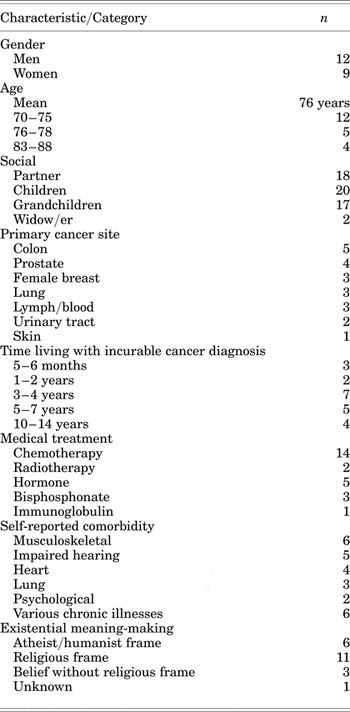
The information in Table 1 provides an overview of the 21 participants in our study (12 men and 9 women). Participants represented a range of ages, though the majority were between 70 and 75. There was a broad range of primary cancer sites as well as of indicated time for living with incurable cancer, ranging from 5 months to 14 years (at the time of the interview). Some 13 of 21 participants reported primarily somatic-related comorbidities, 6 of whom reported two or more additional illnesses. The majority (18) were in a partnered relationship. The existential meaning expressions (spiritual component) in the group ranged from having a Christian frame of reference to an atheistic frame.
Demographic data (N = 21)

RESULTS
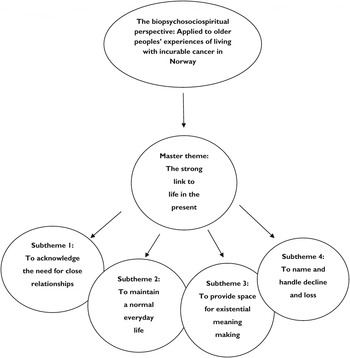
The results are illustrated in the thematic map depicted in Figure 1, containing the overarching biopsychosociospiritual perspective, grouped under one master theme and four subthemes. As we applied a phenomenological approach, we attempted to describe participants' experiences of living with incurable cancer from their point of view (Malterud, Reference Malterud2012).
Thematic map illustrating the overarching perspective, master theme, and four subthemes.

Master Theme: The Strong Link to Life in the Present
Some 15 of the 21 participants experienced a discernible worsening in his/her health condition during the last year. For the rest, the health condition had been more stable. In particular, there were noticeable changes in terms of reduced energy and initiative for doing outdoor activities. Consequently, their focus had been increasingly directed toward functioning at home. Nevertheless, the most prominent feature in the material for almost all participants (19) was a strong link to life in the present. This was found in certain phrases about attitudes to life. One example of such a phrase is “I have not sat down yet” (man, 74), referring to the opposite position to that of passivity and giving up on life. This attitude was also expressed as satisfaction with life, awareness of existing possibilities, and hope for the future. A couple (2) differed from the rest by expressing major difficulties in relating to life at present and a wish to go back in time. The opposite position to feeling quite well was also expressed by a few.
In general, participants expressed satisfaction with specialized healthcare contexts. They felt prioritized and trusted that they were receiving the best available treatment. The hope for life-prolonging effects was the most central motivation for enduring intensive and demanding treatment periods. On the negative side, a lack of information was the most dominant theme. It was related to experiences such as not getting proper information and meeting different doctors every time. In addition, several experienced how the results of examinations had been misplaced and had to be requested again. For some, this had delayed scheduled treatment.
Subtheme 1: To Acknowledge the Need for Close Relationships
Close relationships—especially to partner, children, grandchildren, and friends—were emphasized. For some, great-grandchildren were important as well. Experiences in daily life and activities with others were strong patterns throughout the reflections. A word frequency query in NVivo showed that close relationships had the highest rate of themes in the material. As Table 1 shows, the social factor was very important. Some 18 were still living with their partner, while only one was without children, and 17 talked about their grandchildren. Some 13 participants rated this subtheme as the most valuable and important aspect of their lives, both at present and looking back: “What gives meaning in my life is appreciation, love, compassion, whatever you may call it, whether it is in relation to my partner, friends, or grandchildren” (man, 88). Other terms to describe this significance were “trust, strength to live on, support, the very best in my life.”
The intergenerational perspective was a prominent factor. This included the importance of spending time with children, grandchildren, and relatives, and a future engagement in knowing what was happening to them over time. This last aspect was mentioned as something difficult to handle: “My family has always been most important to me. The fact that I won't be able to follow and support my grandchildren is really sad” (man 72).
Three clearly referred to loneliness, relating to loss of peers or to psychological problems stemming from childhood. Some remarked that their partner and children struggled more in dealing with their illness than they did themselves. Almost half (9) had a sick partner. A common feature for these was an emphasis on mutual support and assistance. One took care of a sick partner on a daily basis.
The contact with specialized healthcare was central in several ways. The importance of receiving detailed information and meeting the same doctor every time was emphasized. Similarly, the importance of a positive and friendly attitude among the staff was recognized: “It helps me. I get in a merry good mood” (man, 82). Several described the nurses as always running yet still taking good care of them. For some, a healthcare professional represented a significant relationship: “What has been most important after I got lung cancer is that my doctor hasn't given up on me yet. Hence, I still have hope for the future. In addition, she makes me feel safe when I can talk with her about small things” (woman, 83). In the opposite case, some (5) reported negative experiences with healthcare providers. This mainly concerned unfriendly attitudes.
Subtheme 2: To Maintain Activities of a Normal Daily Life
The attempt to maintain a normal daily life related especially to three areas: functioning at home, spending time on close relationships, and being involved in certain meaningful activities. To function at home was essential for all participants, and for some it was considered the most important part of their lives. Two typical citations were:
The most important aspect in my life is to live as normal a life as possible. I learned this in a crisis many years ago. It functioned then, and it functions now. (man, 74)
The main thing [about being] sick is to live as I used to, to be physically active and to be with family and friends. (woman, 71)
To continue with the things they used to do before was a recurring theme, such as housework, physical activity, and hobbies. Some (5) were involved in such volunteer work as aid, social, and political work. All these types of activities were talked about as meaningful. Several had reduced or ended their engagements due to health constraints, while still considering the experiences as good and meaningful. As can be seen from Table 1, 14 participants were undergoing chemotherapy when they were interviewed. These participants did not differ from the others in their emphasis on living as normal a life as possible. Despite the treatment's side effects (e.g., poor appetite, weakness, and fractures), they were still concerned about the meaningful activities of daily life: “Earlier this winter, I needed help with everything because of a fracture in my back. The pain experiences in this period have been more troublesome than the cancer illness and treatment periods. Now I appreciate being self-sufficient, doing many of the things I used to do in the house and in the garden” (woman, 72).
Subtheme 3: To Provide Space for the Spiritual Dimension: Existential Meaning-Making
The area of existential meaning-making was linked to a multitude of experiences: relational experiences, meaningful activities in daily life, health-related constraints, core experiences from life history, and, basic life attitudes. Having close relationships was the most valuable and important aspect in life for 13 participants. This was followed by certain expressions about belief and the aspect of meaningful activities in normal daily life. The area of belief was for the majority mainly in line with the content and process of meaning-making prior to the cancer. As can be seen from Table 1, three belief frames were identified: atheistic/humanistic, religious, and belief without a religious frame. The atheistic/humanistic belief frame was expressed in different ways. Some stated it clearly with critical statements about religion, basing their view on science or humanism. Others emphasized that humanistic values were in the foreground, such as relations and altruistic activities. A common feature was that they disapproved of religion. The religious frame was related to Christianity. The content was diverse, from viewing it as entirely private to wanting to share faith with others. Another variation was that of either regular engagement in a charismatic movement or attending a local church solely on special occasions such as weddings and funerals. Belief without a religious frame of reference also varied in its content, meaning New Age–inspired spirituality (woman, 73), “a special feeling of being taken care of” (woman, 76), and as “a kind of faith, but not on a deep level” (man, 70).
The participants (5) who were engaged in volunteer work were represented in all three types of existential meaning-making frames. Two examples of such involvement were typical: “I will soon write a newspaper article in order to shed light on a social problem in my community” (man, 75); and “I am involved in an aid project in India. Although I probably won't see it completed, I still feel very inspired and engaged” (woman, 73). The participants referred to various motivations for this type of engagement: to prevent health decline, to be active and engaged for its own sake, to help others in need, and, to receive a reward in the afterlife.
Subtheme 4: To Name and Handle Decline and Loss
Participants shared comprehensive narratives related to the process of decline and loss. Most of them (16) had lived with cancer for more than three years, implying that they had gone through several stressful treatment periods. The theme “enduring tough treatment periods in order to have life-prolonging effect” ran as a common thread through the narratives. One described the process in detail:
I become easily irritated if I have to concentrate hard on listening to others or when reading. The brain is working with the devilry all the time, so the illness is always in the back of my head. Therefore, and I have thought a lot about this, I have come to the conclusion that I need a certain capacity for dealing with the illness. This is why I become irritated so easily, and in this way I have changed. (man, 74)
One woman (83) stated a similar but even more absorbing experience: “The cancer illness requires all of me.” Another described a quite opposite experience: “Don't talk to me about being sick. I just feel fine, and the side effects of chemotherapy are almost not bothering me at all” (man, 73).
For the majority (16), previous life experiences were seen as helpful for handling these adversities. To describe this in more detail was seen as difficult, and a typical statement was: “It is hard to say how. I just know that my life experiences help me now” (man, 83). Some had clear expressions: “I lost my father to cancer when I was a young adult. This had been my worst experience in life. However, the equanimity I have now is surely inherited from him” (man, 72). “I have always been very close to my parents. Although they are dead, I still believe they are looking after me” (woman, 76). “The positive side of having lived in a difficult marriage for many years is that I believe I'll manage the future problems” (woman, 73).
For some (3), present difficulties put their own problems less in focus: “My daughter has been really sick. Although it hasn't been life threatening, this has been even worse to me than my own illness” (man 74). “My wife is also sick, and that helps me to pay less attention to my own situation” (man, 72).
The most difficult theme was how to relate to the future and to death. Some 11 of the 21 participants stated that they did not think about the future. The importance of taking one day at a time and not making future plans too far ahead were stated as ways of handling the situation. Some (4) expressed that they were afraid of becoming a burden to others: “I don't want anyone to feel that they have to take care of me, so I hope my last period will be short” (woman, 71).
Experiences of losses and/or difficulties were expressed by all participants, but they varied in scope and content. More than half (12) had dramatic life experiences such as childhood traumas and/or abrupt loss of close relations. Concerning bodily reactions, a low energy level and tiredness were the most reported symptoms. As shown in Table 1, many participants received chemotherapy and several had comorbid conditions. The reported side effects of chemotherapy varied from almost none to multiple and major and complex. For some (5), such sequelae of the cancer as stoma, fractures, and infection periods with hospitalization had been most troublesome. The complexity of symptoms was also prominent, with many finding it difficult to decide whether these originated in the cancer, in comorbid conditions, or due to the biological process of aging. Some (4) saw the process of decline and loss as natural because of their advanced age.
DISCUSSION
The main finding demonstrates that older people had both a wish and an ability to continue with life-oriented daily living. No participants expressed a desire for a hastened death. In fact, their main focus was on living as long and as well as possible in the midst of constraints. On this basis, our study showed that existential meaning-making and resilience were the overarching processes for these older people. Though a central subtheme in itself, existential meaning-making ran as a thread through all the subthemes, representing through very different expressions the centrality of belief frames and the core of what is most meaningful and valuable in life. Existential meaning content was characterized by continuation, being in line with what they considered as most meaningful and valuable before the time of the cancer diagnosis.
We also found that older people's responses to adversities while aging fit well with the conceptual framework “resilience repertoire” from gerontology research (Clark et al., Reference Clark, Burbank, Greene and Resnick2011). There are three main reasons for this. First, the framework includes a dynamic and comprehensive understanding of resilience. This view is supported by palliative care research with older patients (Nakashima & Canda, Reference Nakashima and Canda2005; Pentz, Reference Pentz2008). The relevance of this understanding is especially seen in relation to the complex dynamic between contextual factors, such as specialized healthcare contexts and older people, over time. For the older people in our study, specialized healthcare strengthened their link to life by prioritizing and providing person-centered palliative care. Having a healthcare system that is cost-free and available for all is of major importance in this connection. Second, the framework corresponds with the diversity of psychosocial and sociocultural resources among the participants on an individual level. On the basis of the biopsychosociospiritual perspective, this diversity was found in all four subthemes. By applying this perspective, the variety of resources was revealed. Third, the subthemes reflect and amplify the factors that go into the “resilience repertoire”: chronic and incurable illness, experiences from life history, and meanings in life (Clark et al., Reference Clark, Burbank, Greene and Resnick2011).
The first factor of chronic illness in our study included adjoining problems such as comorbid conditions, changes due to the aging process, various losses, crises, and dramatic life experiences. The complexity that emerged in our sample is well known in the literature (Allen et al., Reference Allen, Haley, Harris and Resnick2011). The main theme for participants was “to endure tough treatment periods in order to have a life-prolonging effect.” At the same time, the level of experienced difficulty varied: from viewing themselves as quite healthy to experiencing the illness as requiring every available resource.
This first factor was related to the oscillatory movement experiences, also characterized by variation. In palliative care research, this type of movement is reported to be frequently present in many patients. The content is described as experienced struggles in relation to the existential (Benzein et al., Reference Benzein, Nordberg and Saveman2001; Sand et al., Reference Sand, Olsson and Strang2009), physical (Lindqvist et al., Reference Lindqvist, Widmark and Rasmussen2006), psychological (Maher & de Vries, Reference Maher and de Vries2011; McTiernan & O'Connell, Reference McTiernan and O'Connell2014), and social domains (Andersson et al., Reference Andersson, Hallberg and Edberg2008). On the basis of the biopsychosociospiritual perspective in our study and the variation in the sample, this oscillatory movement was found in relation to all the referred domains. The struggles for participants involved every aspect and domain of life. This finding is supported by Sæteren and colleagues (Reference Sæteren, Lindström and Nåden2010). Despite the experienced knowledge of their incurable disease, participants were still hoping for a life-prolonging effect from treatment. Having this as a main point of departure, hope might have functioned as a central part of the resilience process by strengthening the connection between noticeable experiences of health decline and a life-oriented attitude. The significance of hope has been emphasized in several studies in palliative care research (Benzein et al., Reference Benzein, Nordberg and Saveman2001; Devik et al., Reference Devik, Enmarker and Wiik2013; Maher & de Vries, Reference Maher and de Vries2011; Sæteren et al., Reference Sæteren, Lindström and Nåden2010). However, it has not been related to the resilience process in these studies.
The second factor that influences the “resilience repertoire” is that of experiences from life history. A common feature among participants was that previous life experiences were seen as helpful for handling current adversities, though it was seen as difficult to describe in detail. In gerontology research, there is a growing interest in this field (Baltes et al., Reference Baltes, Lindenberger, Staudinger, Damon and Lerner2006; Clark et al., Reference Clark, Burbank, Greene and Resnick2011). Clark and colleagues (Reference Clark, Burbank, Greene and Resnick2011) describe a process where previous life experiences are ascribed to the adversities and incorporated in the lifelong development of self-identity in a way that enables continuity and constancy across the lifespan. Thus, by developing personal narratives in this way, they become resources in dealing with decline and loss. This aspect of continuation was found in all four subthemes in our study. Despite that, the skills and resources in the “resilience repertoire” were limited for most participants, and continuity seemed to be actively selected and prioritized. By organizing the skills and resources in relation to themes and values from one's life story, the very personal way of dealing with the incurable illness could be realized. The same pattern is found in similar studies on younger patients with incurable cancer (McTiernan & O'Connell, Reference McTiernan and O'Connell2014; Sand et al., Reference Sand, Olsson and Strang2009).
Meaning in life is the third factor influencing the “resilience repertoire.” Research has shown that meaning in close relationships, spirituality, and activities are key factors related to health and resilience (Clark et al., Reference Clark, Burbank, Greene and Resnick2011). These key areas correspond with the current study's subthemes of close relationships, activities in normal daily life, and existential meaning-making. These areas were at the core of what is most meaningful and valuable in life, thus helping older people deal with decline and loss and protect them from some of the difficulties of aging. The theme of close relationships was the most dominant, and especially to be together with a partner, children, or grandchildren. “Relationships” is also a common theme in palliative care research on patients' experiences (see, e.g., Benzein et al., Reference Benzein, Nordberg and Saveman2001; Sand et al., Reference Sand, Olsson and Strang2009; Sæteren et al., Reference Sæteren, Lindström and Nåden2010). Devik and colleagues (Reference Devik, Enmarker and Wiik2013) emphasize the same point by showing the consequence of an absence of relationships: loneliness causes suffering in older people living alone in rural areas in Norway.
The significance of activities in normal daily life has been emphasized in the research, (Svidén et al., Reference Svidén, Tham and Borell2010), and also related to continuity in the life story of patients (McTiernan & O'Connell, Reference McTiernan and O'Connell2014). However, existential meaning-making understood as a functioning frame of reference has been less explored in the literature. In our study, as with others in Scandinavia, these frames covered a broad range, from Christian to atheist (DeMarinis, Reference DeMarinis2008). Independent of type of frame, they were deeply interwoven with a multitude of experiences that influenced daily living. The frame functioned as a source of encouragement, strength, and guidance through difficulties, thus influencing how participants applied their psychosocial and sociocultural resources. The frame provided a functional value system, supporting a motivation for taking care of others or prioritizing certain hobbies such as music and sports. It also inspired engagement in aid, social, or political work across the spectrum of frames. In relation to difficulties such as having concerns for the future, the frame provided means for understanding conceptions and experiences of hope. By getting comprehensive access to this type of existential information from participants, we increased our understanding of how they adapt to the cancer illness, protect themselves against difficulties, and identify and utilize their resources.
On an overarching level, our study showed that the “resilience repertoire” in older people is influenced by factors linked to existential meaning-making. Consequently, for our participants resilience and existential meaning-making were interrelated concepts and processes. This interrelatedness was addressed in one study on resilience in older people in a hospice context, also emphasizing that significant relationships, the ability to confront mortality, and stability in environmental resources are additional resiliency factors (Nakashima & Canda, Reference Nakashima and Canda2005). Other studies have addressed similar aspects without ascribing them to resilience. La Cour and colleagues (Reference La Cour, Josephsson and Luborsky2005) addressed the interacting relationship between engagement in creative activities for older people in nursing homes and existential meaning-making—for instance, by bringing up new thoughts about the future and death. A corresponding finding emerged in a metastudy on spirituality, concluding that affirmative relationships constitute a dominant and integral part of spirituality (Edwards et al., Reference Edwards, Pang and Shiu2010). Related to palliative care research on patients' experiences, the main theme and subthemes showed that older people do not differ from younger age groups in their experiences of being strongly linked to life in the present. These findings are in agreement with similar findings around this theme focusing on living (Benzein et al., Reference Benzein, Nordberg and Saveman2001; Maher & de Vries, Reference Maher and de Vries2011; McTiernan & O'Connell, Reference McTiernan and O'Connell2014; Sand et al., Reference Sand, Olsson and Strang2009; Sæteren et al., Reference Sæteren, Lindström and Nåden2010).
Due to the increasing proportion of older people needing palliative care in specialized healthcare contexts, future research should pay more attention to this age group in general. More specifically, investigation of the complex processes of existential meaning-making and resilience in older people in order to identify and strengthen their own life resources is needed. As cultural contexts and their palliative care systems differ greatly, including a cultural analysis dimension in research would increase both the accuracy and comprehensibility of research findings.
METHODOLOGICAL CONSIDERATIONS
There were several conditions that influenced our research process. We assume that the collaboration with the second researcher reduced the influence of bias in the initial interpretation. To interview participants at home was different from interviewing them in the hospital. In the first case, the interviewer was more like a guest, meeting the participant on his/her premises. In the second case, the interviews were affected by the routines and work at the recruitment sites. Another variation was that for one fifth of participants a partner was present during the interview. Some partners gave supplementary comments, which led the dialogue in a certain direction. In qualitative research like this, there is a risk that participants underestimate, conceal, and/or ignore problems. This risk could have been reduced if participants had been interviewed twice, and thus allowed to give more thorough descriptions of problematic issues. However, this type of approach has its own problems. Some participants asked about the number, stating that they would refuse if there were more than one interview. This was due to the tough and full treatment schedule. In addition, several of the contacted patients abstained from participation, mainly because of a poor or worsened health condition. The social factor was high for participants, and with a lower level, the findings would have shown a different pattern. Although the sample was recruited from a large geographic region, it was still limited by the specificities of the sociocultural and palliative care contexts.
CONCLUSION
Viewing older people as frail and vulnerable is a common and recurring perception, especially in Western youth-driven cultures. This perception can also be reflected in specialized healthcare contexts. However, in our study, older people living with incurable cancer reported that the specialized healthcare contexts strengthened their link to life by providing and prioritizing person-centered care. This is seen as encouraging information for healthcare professionals. The knowledge that the potential for resilience remains despite aging and serious decline in health condition is considered a source of comfort for older people living with incurable cancer. Insights into the processes of existential meaning-making and resilience are seen as useful in order to increase our understanding of how older people adapt to adversity, and how their responses may help protect them from some of the difficulties inherent to aging. Healthcare professionals can make use of this information in treatment planning and in identifying the psychosocial and sociocultural resources that can support older people and strengthen their life resources.
ACKNOWLEDGMENTS
This study was funded by the Innlandet Hospital Trust of Norway, which also assisted with recruitment. Kari Kjønsberg took part in the interviews. We are grateful to the study participants. This research was partially supported by a grant awarded to the multidisciplinary research program Impact of Religion: Challenges for Society, Law, and Democracy, established as a Centre of Excellence at Uppsala University and funded by the Swedish Research Council (2008–2018). Dr. Valerie DeMarinis is a member of this Centre of Excellence.