





Introduction
The outbreak of the COVID-19 pandemic in late 2019 precipitated a global public health crisis that substantially increased mental health problems in the general population (Hossain et al., Reference Hossain, Tasnim, Sultana, Faizah, Mazumder, Zou, McKyer, Ahmed and Ma2020). While young children were less directly affected by the virus, they experienced significant indirect disruptions, such as lockdowns, limited peer interaction, increased caregiver stress, and interruptions in early childcare services (Joo & Lee, Reference Joo and Lee2022). Early childhood maladjustment can have lasting effects on socioemotional development into adulthood (Arslan et al., Reference Arslan, Lucassen, Van Lier, De Haan and Prinzie2021), making it critical to examine this population’s mental health during crises. A growing body of research has highlighted young children’s heightened vulnerability to internalizing and externalizing symptoms during the pandemic (Joo & Lee, Reference Joo and Lee2022; Levante et al., Reference Levante, Martis, Bianco, Castelli, Petrocchi and Lecciso2023; Li & Zhou, Reference Li and Zhou2021; Wang et al., Reference Wang, Yeung and Gao2021). Internalizing symptoms refer to behavioral patterns directed inward, such as depression, anxiety, withdrawal, and somatic complaints (Cosgrove et al., Reference Cosgrove, Rhee, Gelhorn, Boeldt, Corley, Ehringer, Young and Hewitt2011). Externalizing symptoms comprise outwardly disruptive and dysregulated behaviors, including aggression, defiance, and hyperactivity (Cosgrove et al., Reference Cosgrove, Rhee, Gelhorn, Boeldt, Corley, Ehringer, Young and Hewitt2011). Importantly, these symptoms do not emerge in isolation from children’s family contexts; family- and parenting-related factors have been linked to children’s internalizing and externalizing symptoms during the pandemic (Chen & Yeung, Reference Chen and Yeung2023a; Jiang & Fan, Reference Jiang and Fan2024).
However, children’s psychological responses to the pandemic have not been uniform. Some children have shown increased emotional and behavioral difficulties during the COVID-19 pandemic, whereas others have exhibited low symptom levels or experienced improvements (Cost et al., Reference Cost, Crosbie, Anagnostou, Birken, Charach, Monga, Kelley, Nicolson, Maguire and Burton2022; Kaman et al., Reference Kaman, Devine, Wirtz, Erhart, Boecker, Napp, Reiss, Zoellner and Ravens-Sieberer2024). Other studies reported limited or no substantial changes in children’s emotional and behavioral well-being relative to pre-pandemic levels (Romero et al., Reference Romero, López-Romero, Domínguez-Álvarez, Villar and Gómez-Fraguela2020; Vira & Skoog, Reference Vira and Skoog2021). These mixed findings suggest that focusing only on average changes may obscure substantial heterogeneity in children’s mental health responses. Identifying distinct symptom transition patterns and their predictors, such as demographic characteristics and family contexts, is therefore important for informing targeted support for children following crises.
Latent transitions in internalizing and externalizing symptoms
Although internalizing and externalizing symptoms differ in their manifestations, they frequently co-occur in childhood and may reflect shared or interacting vulnerabilities (Zhang et al., Reference Zhang, Liu, Ji and Zhang2022). This co-occurrence is well-documented among children and adolescents following stressful events (Sabri, Reference Sabri2012; Yang et al., Reference Yang, Huang, Wu and Zhou2023a). However, the levels of these two symptoms may vary across individuals, exhibiting heterogeneity. Person-centered approaches have identified several common symptom profiles of internalizing and externalizing symptoms, including consistent symptom levels (e.g., low, moderate, and high levels of both symptoms) (Eastman et al., Reference Eastman, Foshee, Ennett, Sotres-Alvarez, Reyes, Faris and North2018; Li et al., Reference Li, Zhu, Jiao, Sawada, Tanaka, Watanabe, Tomisaki, Zhu, Ajmal and Matsumoto2022; Ling et al., Reference Ling, Huebner, He and Zhong2016; Morales et al., Reference Morales, Melero, Tomczyk, Espada and Orgilés2021), as well as asymmetrical patterns such as low internalizing with high externalizing symptoms, and vice versa (Eastman et al., Reference Eastman, Foshee, Ennett, Sotres-Alvarez, Reyes, Faris and North2018; Morales et al., Reference Morales, Melero, Tomczyk, Espada and Orgilés2021). Thus, combined internalizing and externalizing symptom profiles can serve as a useful framework for capturing children’s overall patterns of emotional and behavioral adjustment.
It is noteworthy that internalizing and externalizing symptoms are not static; longitudinal studies have demonstrated that they often develop concurrently over time (Nivard et al., Reference Nivard, Lubke, Dolan, Evans, Pourcain, Munafò and Middeldorp2017; Papachristou & Flouri, Reference Papachristou and Flouri2020; Yang et al., Reference Yang, Huang, Wu and Zhou2023a). Latent transition analysis (LTA) provides a person-centered approach for estimating how individuals move between latent symptom profiles across time (Lanza et al., Reference Lanza, Flaherty, Collins, Schinka and Velicer2003). For instance, Willner et al. (Reference Willner, Gatzke-Kopp and Bray2016) identified comorbid, internalizing, externalizing, and well-adjusted profiles and found substantial stability, particularly in the comorbid group, as well as transitions from internalizing to well-adjusted profiles and from externalizing to comorbid profiles. Similarly, McElroy et al. (Reference McElroy, Shevlin and Murphy2017) reported four consistent latent symptom patterns across childhood and adolescence, revealing both heterogeneity in transitions and individual stability, with 80% of children showing no change over time. Individuals in the internalizing group tended to shift to a less severe class as time progressed.
However, less is known about how internalizing and externalizing symptom profiles evolve following major stressful events, such as the COVID-19 pandemic. This gap is important because stressful and traumatic events often deeply affect the developmental trajectories of children’s internalizing and externalizing symptoms (Leban, Reference Leban2021; Nivard et al., Reference Nivard, Lubke, Dolan, Evans, Pourcain, Munafò and Middeldorp2017), increasing the likelihood of symptom escalation for some children, while others may remain stable or improve. In addition, regular LTA may have difficulty separating genuine within-person changes over time from stable between-person differences, potentially leading to overestimation of profile stability. Random intercept latent transition analysis (RI-LTA) addresses this issue by incorporating a random intercept that accounts for stable between-person differences while estimating within-person transitions across time (Muthén & Asparouhov, Reference Muthén and Asparouhov2022; Wen & Zhu, Reference Wen and Zhu2021). Therefore, this study aimed to use RI-LTA to examine the latent transitions in internalizing and externalizing symptoms among children from pre- to during the COVID-19 pandemic.
Predictors of symptom transitions
Another important issue to consider is the factors influencing the transition patterns in internalizing and externalizing symptoms. First, empirical research has shown that demographic factors significantly impact children’s internalizing and externalizing symptoms (Ara, Reference Ara2016; Bodalski et al., Reference Bodalski, Joshua Bradley, Neger, Shi, Bridges and Flory2023; McLaughlin et al., Reference McLaughlin, Hilt and Nolen-Hoeksema2007). Ara (Reference Ara2016) noted gender differences, with males more likely to externalize and females to internalize behaviors. Co-occurrence of internalizing and externalizing symptoms is more common in females. Additionally, age also influences internalizing and externalizing symptom levels (Bodalski et al., Reference Bodalski, Joshua Bradley, Neger, Shi, Bridges and Flory2023), which may change as children grow (Gilliom & Shaw, Reference Gilliom and Shaw2004). Ethnicity could also serve as another factor that can shape the development of internalizing and externalizing symptoms, considering that different ethnic backgrounds often encompass diverse cultural values and varying coping mechanisms in response to environmental stressors (McLaughlin et al., Reference McLaughlin, Hilt and Nolen-Hoeksema2007).
Second, Prime et al. (Reference Prime, Wade and Browne2020) proposed a systemic model of COVID-19, emphasizing that pandemic-related social disruptions – such as changes in family work dynamics and financial stability – may significantly affect children’s adjustment. During the pandemic, disruptions to parents’ employment and household finances became widespread (Prime et al., Reference Prime, Wade and Browne2020). Parental work-related stress has been shown to predict internalizing and externalizing problems in children (Roche et al., Reference Roche, Huebner, Lambert and Little2022; Schneider & Harknett, Reference Schneider and Harknett2022), while family economic strain has been associated with increases in children’s emotional and behavioral difficulties (Anderson et al., Reference Anderson, Siciliano, Henry, Watson, Gruhn, Kuhn, Ebert, Vreeland, Ciriegio and Guthrie2022; Miller & Votruba-Drzal, Reference Miller and Votruba-Drzal2017). These findings suggest that pandemic-related disruptions to work and financial conditions may increase children’s risk of moving into more severe symptom patterns.
The systemic model of COVID-19 also highlights the role of family functioning and well-being in shaping children’s mental and behavioral health (Prime et al., Reference Prime, Wade and Browne2020). The pandemic introduced new parenting challenges, such as balancing remote work with caregiving responsibilities, which increased parenting stress and negative parenting practices (Adams et al., Reference Adams, Smith, Caccavale and Bean2021; Chung et al., Reference Chung, Lanier and Wong2022). These stressors have been linked to elevated internalizing and externalizing problems in children (Stone et al., Reference Stone, Mares, Otten, Engels and Janssens2016). Moreover, social distancing and confinement substantially altered family relational processes, including family relationships, communication, and time spent together. On one hand, increased time spent together could provide more opportunities for emotional support, shared activities, and positive communication, thereby strengthening family relationships and reducing the risk of children’s emotional and behavioral difficulties (Marks et al., Reference Marks, Dollahite, Kelley, Kimball and James2023). On the other hand, prolonged proximity under stressful conditions could also intensify conflict, reduce communication quality, and strain family relationships (Sinko et al., Reference Sinko, He, Kishton, Ortiz, Jacobs and Fingerman2022), potentially increasing children’s internalizing and externalizing symptoms. Thus, pandemic-related changes in family relational processes may help explain children’s symptom transitions.
Finally, families’ ability to cope with stress may also play an important role in children’s adjustment during crises. Effective family stress coping may help maintain a supportive environment and reduce conflict and promote children’s emotional and behavioral regulation, thereby supporting better mental health outcomes in children (Geçer & Yıldırım, Reference Geçer and Yıldırım2023; Yang et al., Reference Yang, Gao, Li, Wang, Wang and Wang2022). These family functioning factors have consistently been associated with children’s internalizing and externalizing problems (Lee et al., Reference Lee, Fosco and Feinberg2025; Mastrotheodoros et al., Reference Mastrotheodoros, Canário, Cristina Gugliandolo, Merkas and Keijsers2020). More importantly, evidence from Singapore further supports the importance of examining family dynamics during COVID-19 (Chen & Yeung, Reference Chen and Yeung2025), suggesting that pandemic-related family experiences may vary substantially across families and may help explain why children show different symptom transition patterns. Therefore, this study further examined how demographic factors (gender, age, ethnicity) and the pandemic’s impact on family work, financial conditions, and family function influence transitions in internalizing and externalizing symptom patterns in children.
The Singapore context
Since the onset of COVID-19 in early 2020, Singapore’s pandemic response evolved through several distinct phases, including a stringent lockdown in mid-2020 and a transition toward an endemic strategy by late 2021. These pandemic-related shifts disrupted family routines, employment and income, childcare arrangements, and family dynamics, making the pandemic a pervasive stressor for Singaporean families (Yang et al., Reference Yang, Chua, Khng and Yu2023b) and increasing the risk of mental health problems among Singaporeans (Subramaniam et al., Reference Subramaniam, Abdin, Shafie, Wang, Shahwan, Satghare and Chong2023). As a high-income, highly urbanized, and multi-ethnic Asian society, Singapore differs from many Western contexts in ways that are relevant to child and family adaptation. Its dense urban living environment may have made disruptions to home-based caregiving and limited social interaction especially salient for families with young children. At the same time, Singapore is characterized by strong family-centered caregiving, relatively common reliance on family and household support, and substantial government support during the pandemic (Chen & Yeung, Reference Chen and Yeung2025), providing a useful setting for examining how demographic and family-level factors shape young children’s adjustment during large-scale crises.
Prior studies have provided important evidence on how families and children in Singapore were affected by the pandemic. At the family level, Chen and Yeung (Reference Chen and Yeung2025) showed that Singaporean families experienced the pandemic heterogeneously, identifying distinct patterns of economic and relational resilience and demonstrating the importance of family socioeconomic status, work-life conflict, and quality family time in shaping family resilience during COVID-19. At the child level, Chen and Yeung (Reference Chen and Yeung2023a) found that pre-pandemic parental resources predicted fewer internalizing problems and less aggravation of internalizing problems among children during COVID-19, highlighting the role of family and parental resources in children’s emotional resilience. Together, these studies indicate distinct family-level experiences during COVID-19 and highlight that family resources provide an important context for understanding children’s adjustment during the pandemic. However, it remains unclear whether preschool children showed heterogeneous transitions in broader emotional and behavioral symptom patterns from before to during the pandemic and whether pandemic-related family disruptions predicted these symptom transitions.
The current study
Although numerous studies have demonstrated that COVID-19 heightened internalizing and externalizing symptoms in children (Li & Zhou, Reference Li and Zhou2021; Wang et al., Reference Wang, Yeung and Gao2021), much of this work has focused on average symptom changes, which may obscure heterogeneity in children’s psychological responses. It remains unclear how emotional and behavioral symptom patterns varied across children and changed from before to during the pandemic. This gap limits our understanding of young children’s complex psychological responses during the pandemic, especially in early childhood, a period marked by rapid socioemotional development and heightened vulnerability to environmental stressors (Popli et al., Reference Popli, Gladwell and Tsuchiya2013). Identifying distinct patterns and transitions in internalizing and externalizing symptoms before and during the pandemic can shed light on individual differences in vulnerability and inform more targeted post-pandemic interventions. Therefore, this study aimed to use a person-centered approach to identify heterogeneous transitions in preschool-aged children’s internalizing and externalizing symptom profiles before and during the pandemic in Singapore. It further investigated potential predictors of these transitions, including demographic factors (gender, age, and ethnicity) and pandemic-related impacts on work, financial conditions, and family functioning.
Methods
Participants and procedure
Data were drawn from two waves of the Singapore Longitudinal Early Development Study (SG-LEADS; Yeung & Chen, Reference Yeung and Chen2024), a nationally representative survey using multi-stage probability sampling. Wave 1 (T1) was conducted from November 2018 to September 2019, approximately 4–14 months before the COVID-19 outbreak. Wave 2 (T2) took place during the second year of the pandemic, from February 2021 to November 2021. Unlike the acute shock of the initial 2020 outbreak, this phase was marked by record-high vaccination rates and declining mortality, with most confirmed cases presenting as mild or asymptomatic in Singapore (Loo et al., Reference Loo, Thye, Law and Law2021). Despite this transition toward an endemic state, the period was characterized by protracted uncertainty and chronic stress. Recurrent restrictions on social gatherings and unpredictable shifts in public health policies led to a persistent disruption of family routines and social support networks. In the current study, the average interval between T1 and T2 was 24.56 months (SD = 3.17, range = 17–34). The primary aim of the study was to examine the risk and protective factors associated with children’s early development across contexts, including the home, out-of-home care institutions, the community, and the state. In-home, face-to-face interviews were conducted with caregivers of children aged 0–6, resulting in a baseline sample of 5,005 children; 4,352 were successfully followed up in Wave 2. The study received ethical approval from the Institutional Review Board of the implementing institution. Further details on the procedures are provided in Yeung and Chen (Reference Yeung and Chen2024).
In the present study, only children aged 3 years or older at baseline were included, as measures for internalizing and externalizing symptoms were exclusively available for the 3–6 age cohort within the original SG-LEADS database. Furthermore, to investigate the transition of symptom patterns across the study period, only participants who completed both waves were retained, resulting in a sample of 2,615 children. Among these children, 14 did not report any T1 internalizing or externalizing items; no missing data were observed for the remaining study variables. Given the minimal amount of missingness (<1%) and the complete absence of data on the key T1 measures for these cases, listwise deletion was applied. The final analytic sample consisted of 2,601 children. At Wave 1, the mean age of the children was 4.92 years (SD = 1.18), with girls comprising 50.17% of the sample. In terms of ethnicity, 63.32% of the children were Chinese, 24.22% were Malay, 9.80% were Indian, and 2.65% belonged to other ethnic groups.
To examine potential longitudinal attrition bias, we compared children retained in the final analytic sample (n = 2,601) with children who provided valid responses to the internalizing and externalizing symptom measures at T1 but did not participate at T2 (n = 352). Attrition analyses showed that children lost to follow-up were more likely to be male, χ 2 (1) = 4.25, p = .039. However, no significant differences were found between the two groups in ethnicity, χ 2 (3) = 2.55, p = .466, age, t = −0.42, p = .675, T1 internalizing symptoms, t = 0.58, p = .560, or T1 externalizing symptoms, t = 0.61, p = .541. More importantly, to account for the oversampling of low-income populations and attrition between waves, the Wave 2 child-level normalized sampling weight (child_weight_W2) from the SG LEADS dataset was used. In addition, to address the nesting of multiple children within the same household, all analyses adjusted standard errors for clustering.
Measures
Internalizing and externalizing symptoms
Children’s internalizing and externalizing symptoms were assessed before and during the pandemic using a caregiver-reported measure adapted from the Child Behavior Checklist (CBCL; Achenbach, Reference Achenbach1991; Peterson & Zill, Reference Peterson and Zill1986; Yeung & Li, Reference Yeung and Li2023). The scale consists of 30 items rated on a 3-point Likert scale (0 = not true, 1 = sometimes true, 2 = often true). Fourteen items represented internalizing symptoms (e.g., He/She is too fearful or anxious), with the sum of item scores indicating the severity of internalizing symptoms – higher scores reflect greater severity. The internalizing subscale demonstrated good internal consistency, with Cronbach’s α of 0.86 at T1 and 0.83 at T2. The externalizing symptoms subscale comprised 16 items (e.g., He/She cheats or tells lies), and the total score similarly reflected the severity of externalizing symptoms, with higher scores indicating greater severity. The externalizing subscale showed Cronbach’s α of 0.87 at T1 and 0.85 at T2.
The impacts of COVID-19 on work
At Wave 2, the study assessed the impact of COVID-19 on work using seven items. Primary caregivers were asked whether anyone in the household had experienced the following work-related changes since the onset of the pandemic: (1) an increase in or a transition to remote work; (2) experiencing a job loss; (3) business closure; (4) a reduction in wages or salary; (5) decreased working hours; (6) a change in occupation; and (7) altered work arrangements to accommodate childcare needs. Each item was coded as 1 if the event had occurred and 0 if it had not. The total score, calculated as the sum of these seven items, reflected the extent of the negative impact of the pandemic on work, with higher scores indicating greater adverse effects on work.
The impacts of COVID-19 on financial condition
The economic impact of the pandemic was measured at Wave 2 using ten items. Households were asked whether any member had experienced the following due to COVID-19: (1) cutting back on expenditures for non-essential items; (2) reducing spending on necessities; (3) relying on savings to cover daily living costs; (4) requesting a deferment on rent or mortgage payments; (5) arranging for deferred payments or an interest waiver on a credit card; (6) applying to obtain a new loan or credit card; (7) making an early withdrawal from savings in a term deposit; (8) seeking monetary support from friends or family; (9) requesting aid from government or community organizations; and (10) experiencing a loss of health insurance or related benefits. Each item was coded as 1 if the event occurred and 0 if it did not. The total score, obtained by summing these ten items, reflected the degree of negative economic impact on the household, with higher scores indicating greater adverse effects.
The impacts of COVID-19 on family function
At Wave 2, primary caregivers were asked how the pandemic had affected family life, focusing on five key domains: (1) parenting; (2) family members get along with each other; (3) quality of communication between family members; (4) the time spent together as a family; and (5) the ability to cope with stress. Each item was rated independently on a 5-point scale (1 = a lot better, 2 = a little better, 3 = no change, 4 = a little worse, 5 = a lot worse) and included separately in subsequent analyses. The higher the score, the greater the adverse impact of the pandemic on family function.
Demographic variables
At Wave 1, participants’ age, gender, and ethnicity were assessed. Age was treated as a continuous variable in all subsequent analyses. Gender was coded as a binary variable (1 = boys, 2 = girls). Ethnicity was a nominal variable categorized as Chinese (1), Malay (2), Indian (3), and others (4).
Data analysis
All statistical analyses were performed using SPSS 25.0 and Mplus 8.3. First, descriptive statistics and correlation analyses were conducted for the main variables. Subsequently, the longitudinal measurement invariance of internalizing and externalizing symptoms was tested separately before the formal analyses to ensure that these constructs had the same meaning across the pre- and during-pandemic periods. The results indicated that both internalizing and externalizing symptoms demonstrated strong measurement invariance across two time points (see Section 1 of the supplementary materials). Next, LPAs were conducted separately at T1 and T2 using internalizing and externalizing symptoms as indicators. Models specifying one to five classes were examined. To identify the optimal latent class solution, we evaluated a series of model fit indices. A better-fitting model was indicated by lower AIC, BIC, and aBIC values, in conjunction with higher entropy. Furthermore, we considered the ALMR-LRT, where significant p-values suggested that the current model was superior to a model with one fewer class.
Based on the optimal latent class solutions identified by the LPAs at T1 and T2, regular LTA was conducted to estimate the probabilities of individuals transitioning from one latent class at T1 to another latent class at T2 by regressing class membership at T2 on class membership at T1. However, because regular LTA has difficulty separating within-person changes over time from between-person differences, a RI-LTA was conducted next. RI-LTA imposes certain constraints on the model, such as setting factor loadings equal across latent classes and constraining the factor loadings of each observed indicator to be invariant across the two time points (Wen & Zhu, Reference Wen and Zhu2021). By introducing a random intercept, RI-LTA offers an advantage over regular LTA by reducing the risk of overestimating the probability that individuals remain in the same class over time. Model fit for LTA and RI-LTA analyses was evaluated using indices including AIC, BIC, aBIC, and entropy values. Given the variability in the time interval between the two assessment waves, the time interval was included as a covariate in both the LTA and RI-LTA models.
Finally, multinomial logistic regression was employed to examine factors that may differentiate transitions between latent classes. In the present study, the various types of transitions across internalizing and externalizing symptom profiles identified by RI-LTA served as the dependent variables. The independent variables included demographic factors (e.g., children’s gender, age, and ethnicity), as well as the impacts of COVID-19 on work, financial condition, and family function. An odds ratio (OR) greater than 1 indicated that higher levels of the predictor increased the likelihood of a given transition type compared to the reference category.
Results
Descriptive statistics and correlations among study variables
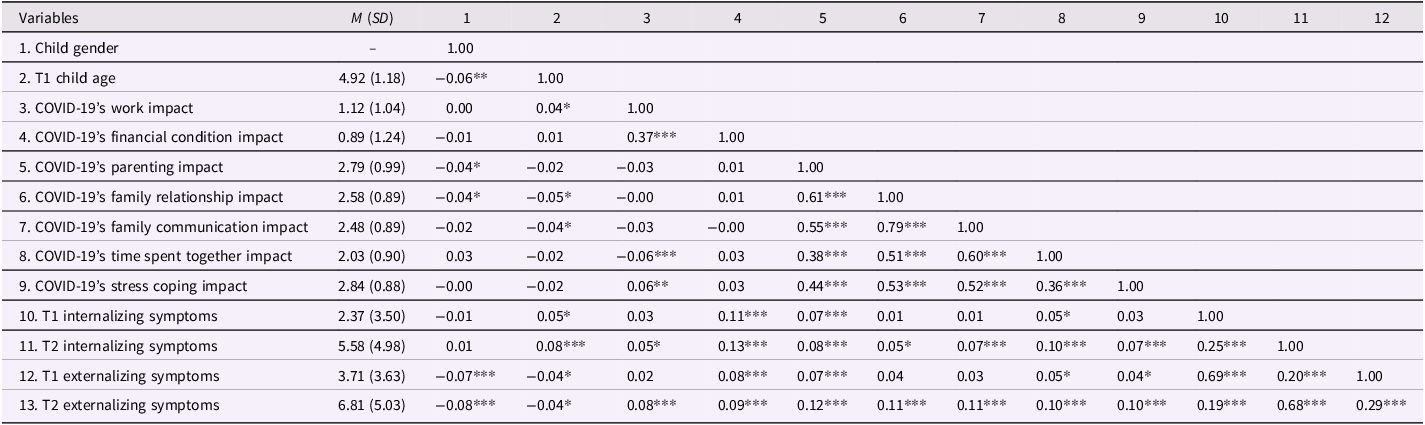
Table 1 presents the descriptive statistics and correlations among the main variables. The results indicated that child gender was negatively associated with externalizing symptoms at both T1 and T2. Child age was positively associated with internalizing symptoms at both T1 and T2 but negatively associated with externalizing symptoms at both T1 and T2. The negative impact of COVID-19 on work, financial condition, parenting, family relationships, family communication, time spent together as a family, and stress coping were all positively associated with children’s internalizing and externalizing symptoms at T2. In addition, the negative impact of COVID-19 on financial condition, parenting, and time spent together as a family was also positively associated with children’s internalizing and externalizing symptoms at T1. The negative impact of COVID-19 on stress coping was positively associated with children’s externalizing symptoms at T1. Moreover, internalizing and externalizing symptoms at T1 and T2 were significantly and positively correlated with one another.
Descriptive statistics and correlations among study variables
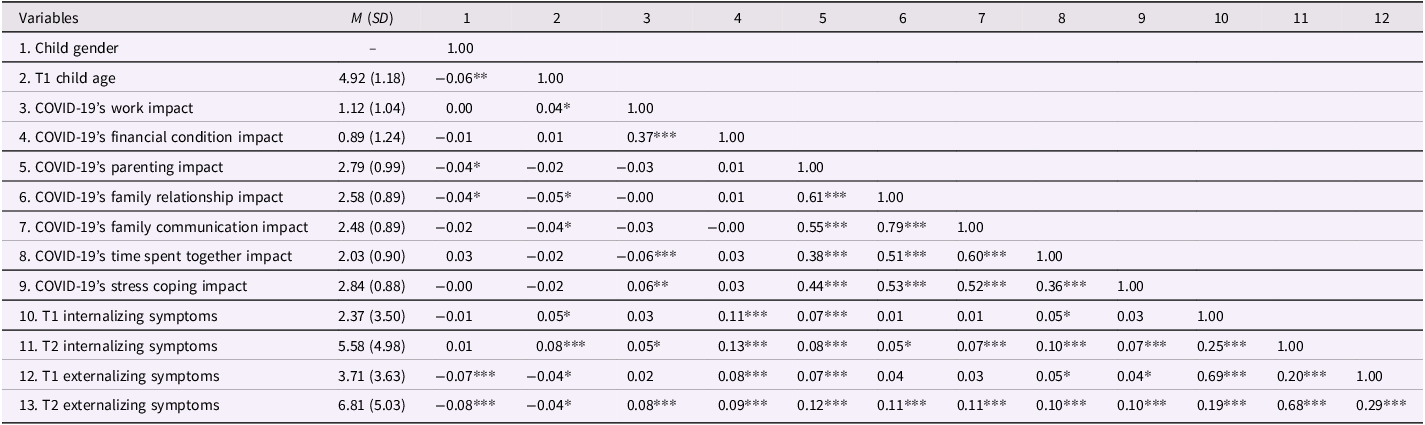
Table 1. Long description
The table presents descriptive statistics and correlations among main variables related to child gender, age, and the impact of COVID-19 on work, financial condition, parenting, family relationships, family communication, time spent together, and stress coping. It also includes internalizing and externalizing symptoms at two time points (T1 and T2). The table has 13 rows and 12 columns. Column headers are labeled as M (SD), 1, 2, 3, 4, 5, 6, 7, 8, 9, 10, 11, and 12. Row labels are 1. Child gender, 2. T1 child age, 3. COVID-19’s work impact, 4. COVID-19’s financial condition impact, 5. COVID-19’s parenting impact, 6. COVID-19’s family relationship impact, 7. COVID-19’s family communication impact, 8. COVID-19’s time spent together impact, 9. COVID-19’s stress coping impact, 10. T1 internalizing symptoms, 11. T1 externalizing symptoms, 12. T2 internalizing symptoms, and 13. T2 externalizing symptoms. Each row provides the mean (M) and standard deviation (SD) for each variable, followed by correlation coefficients with other variables. Notable trends include negative associations between child gender and externalizing symptoms at T1 and T2, positive associations between child age and internalizing symptoms at T1 and T2, and positive associations between the negative impact of COVID-19 on various aspects and children’s internalizing and externalizing symptoms at T1 and T2.
Note. *** p < .001, ** p < .01, * p < .05.
Latent profile analysis
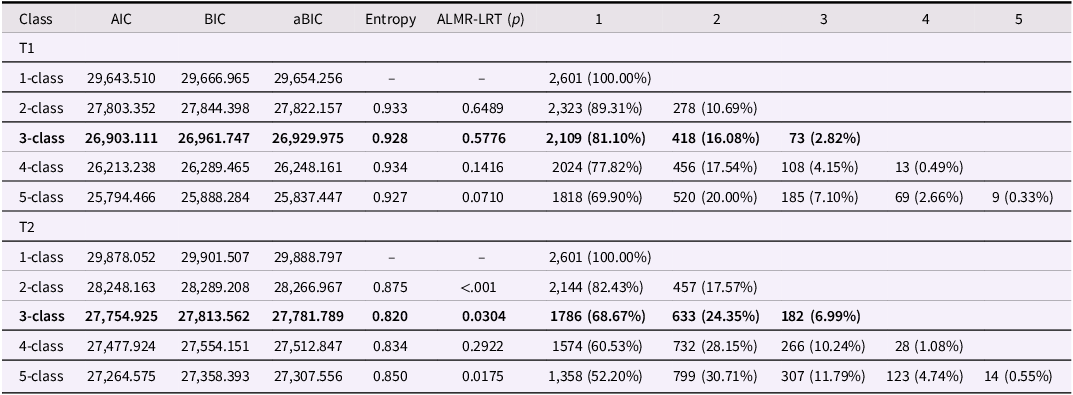
LPAs were conducted separately to explore distinct patterns of children’s internalizing and externalizing symptoms before and during the pandemic. The model fit indices for the tested models are presented in Table 2. During the pandemic, all multi-class models yielded entropy values greater than 0.80, indicating good classification quality. Furthermore, as the number of classes increased up to five, the values of AIC, BIC, and aBIC gradually decreased. The four-class model produced a non-significant ALMR-LRT value, suggesting that the four-class solution did not provide a better fit than the three-class model. More importantly, in both the four-class and five-class models, the smallest class accounted for less than 2% of the total sample. Ultimately, the three-class model was determined to be the optimal solution.
Model fit indices for latent profile analyses at T1 and T2
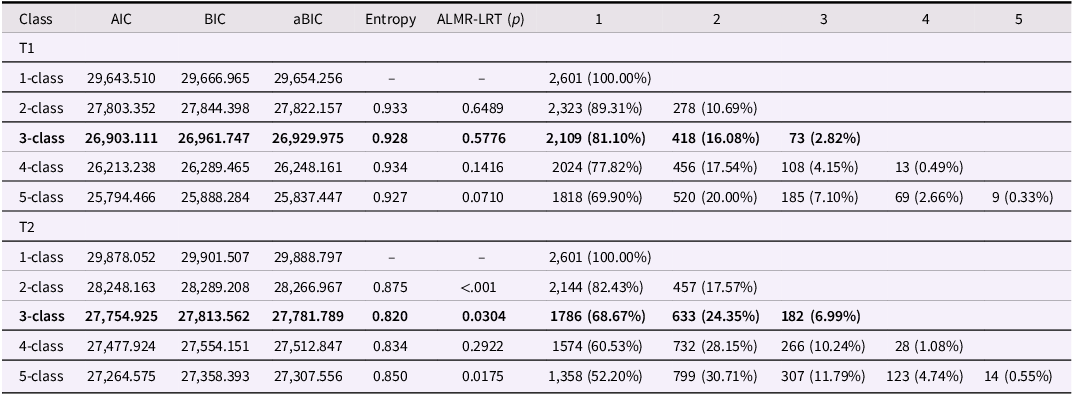
Table 2. Long description
The table presents model fit indices for latent profile analyses at T1 and T2. It includes columns for AIC, BIC, aBIC, Entropy, ALMR-LRT (p), and class distributions across five classes. Row labels indicate the number of classes (1-class to 5-class) for both T1 and T2. Each row lists the corresponding values for AIC, BIC, aBIC, Entropy, ALMR-LRT (p), and the distribution percentages for classes 1 to 5. Notable trends include decreasing AIC, BIC, and aBIC values as the number of classes increases, and varying entropy and ALMR-LRT (p) values across different class models.
Note. The optimal solutions were bolded.
Before the pandemic, all models’ entropy values were greater than 0.90. Although the ALMR-LRTs were not significant across all models, the AIC, BIC, and aBIC values decreased as the number of classes increased. However, the four-class and five-class models were discarded as their smallest classes contained an insufficient number of participants. To further determine the optimal structure, we conducted two LTAs to compare transitions based on a T1 two-class vs. a T1 three-class model (both transitioning to the T2 three-class model). The results indicated that the LTA based on the T1 three-class model provided a superior fit (AIC = 54,491.613; BIC = 54,644.068; aBIC = 54,561.458; entropy = 0.875) compared to the two-class solution (AIC = 55,417.859; BIC = 55,540.996; aBIC = 55,474.273; entropy = 0.867). Consequently, the three-class solution before the pandemic was selected for further analysis.
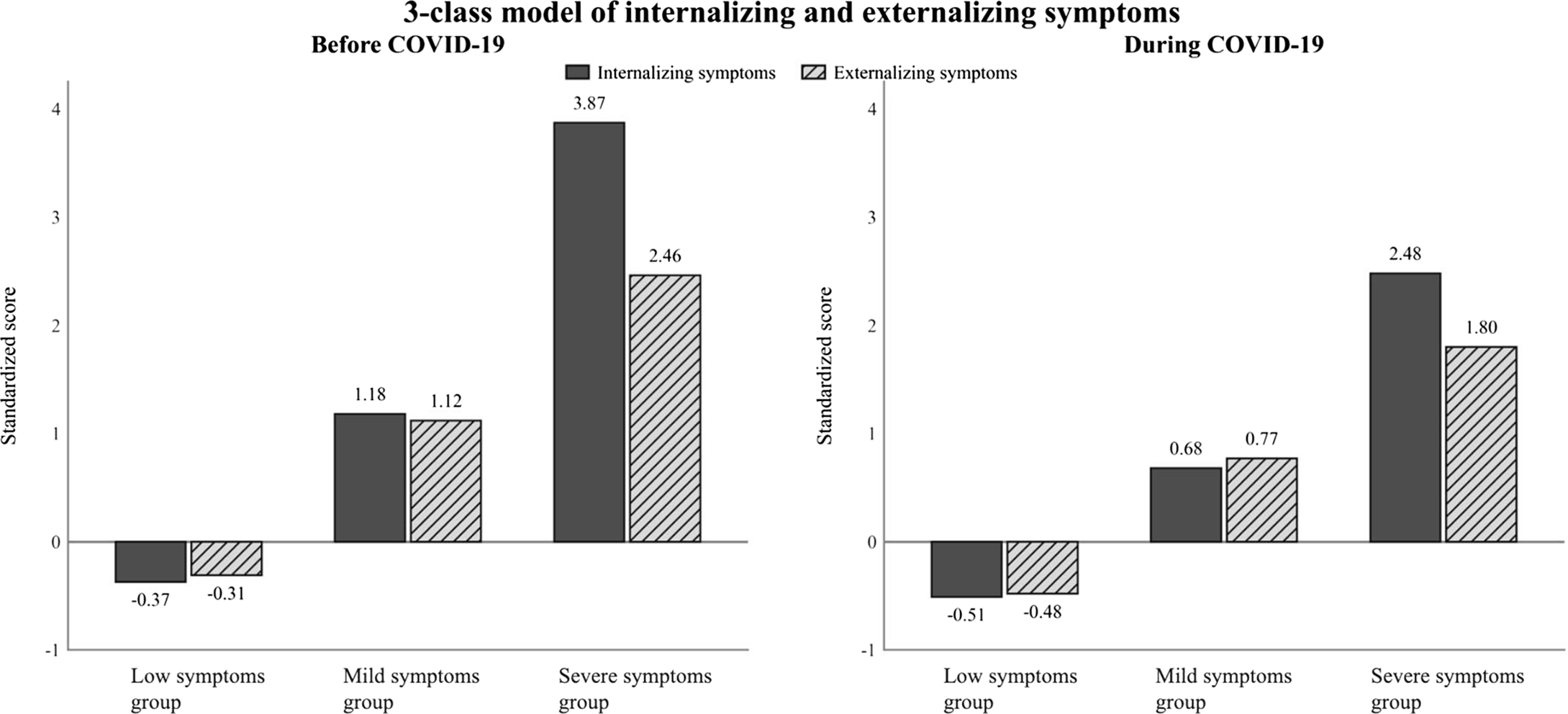
The three-class solutions identified before and during the pandemic exhibited similar profiles (see Figure 1). Based on the standardized scores, the classes were labeled as the low symptoms group (Class 1), mild symptoms group (Class 2), and severe symptoms group (Class 3). Children in Class 1 exhibited internalizing and externalizing symptom levels well below the mean, indicating low symptoms. This group comprised 81.10% of the sample before the pandemic, decreasing to 68.67% during the pandemic. Class 2 showed slightly above-average symptom levels, suggesting mild symptoms; the proportion of children in this group increased from 16.08% pre-pandemic to 24.35% during the pandemic. Class 3 included children with substantially elevated symptom levels, reflecting more severe symptoms. The percentage of children in this group rose from 2.82% before the pandemic to 6.99% during the pandemic.
Three-class profiles of internalizing and externalizing symptoms before and during the COVID-19 pandemic.

Random intercept latent transition analysis
Subsequently, an RI-LTA was performed to distinguish within-person changes from between-person differences by introducing a random intercept. The model fit indices for the RI-LTA were AIC = 54,264.856, BIC = 54,393.856, aBIC = 54,323.956, and entropy = 0.888. Compared to the regular LTA, the RI-LTA model demonstrated a better fit, as indicated by lower AIC, BIC, and aBIC values, as well as higher entropy. Therefore, subsequent analyses were based on the RI-LTA model. More importantly, we compared a constrained RI-LTA model (where class-specific item means were constrained to be equal across corresponding classes at T1 and T2) with a freely estimated RI-LTA model. The results indicated that the difference in BIC values between the two models was less than 10, providing support for structural comparability of the latent profiles over time.
The transition probabilities between latent profiles of internalizing and externalizing symptoms from before to during the pandemic, as identified by the RI-LTA, are presented in Table 3. The probabilities of remaining in the low symptoms group, mild symptoms group, and severe symptoms group were 0.739, 0.529, and 0.139, respectively. In total, nine potential transition patterns were identified across the two time points (see Section 2 of the supplementary materials). Among the participants, 69.97% showed stable symptom patterns, while 30.03% experienced changes in their internalizing and externalizing symptom profiles following the pandemic’s onset. Notably, the stable severe symptoms pattern was excluded from subsequent analyses because it involved a very small proportion of participants (0.35%). The remaining transition patterns were then grouped based on their similar trajectories. This resulted in the identification of four final transition patterns: stable low symptoms group (n = 1,649; 63.40%), stable mild symptoms group (n = 162; 6.23%), worsening symptoms group (n = 580; 22.30%), and improved symptoms group (n = 201; 7.73%).
Latent transition probabilities between symptom profiles in the RI-LTA model

Table 3. Long description
A table with three rows and four columns showing transition probabilities between latent profiles of internalizing and externalizing symptoms from before to during the pandemic. The columns are labeled Low symptoms group, Mild symptoms group, and Severe symptoms group for T2, with an additional column for T1 labels. The row labels are Low symptoms group, Mild symptoms group, and Severe symptoms group for T1. The values in the table are as follows: Row 1: Low symptoms group, 0.739; Mild symptoms group, 0.232; Severe symptoms group, 0.029. Row 2: Mild symptoms group, 0.414; Mild symptoms group, 0.529; Severe symptoms group, 0.057. Row 3: Severe symptoms group, 0.331; Mild symptoms group, 0.530; Severe symptoms group, 0.139.
Multinomial logistic regression
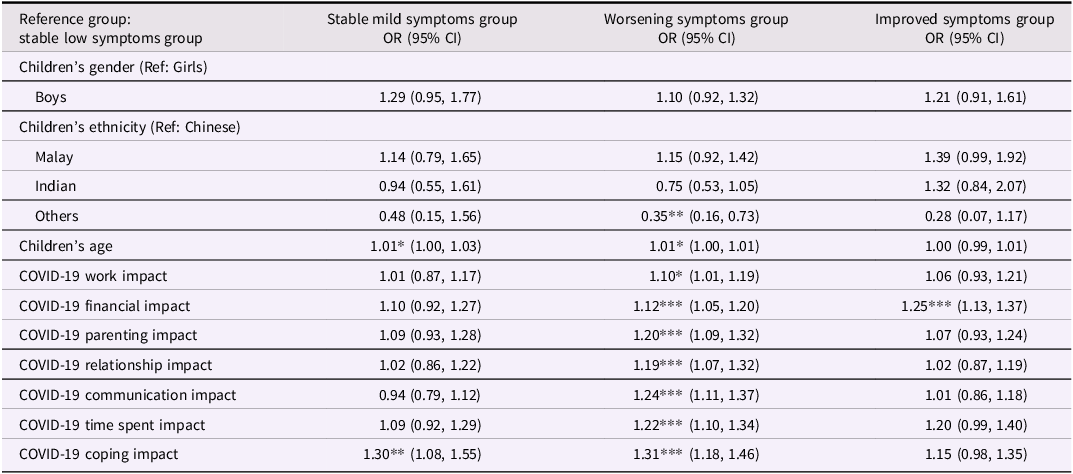
Multinomial logistic regression was conducted with the stable low symptoms group serving as the reference group, and the results are presented in Table 4. Compared with Chinese children, children in the ‘Others’ ethnic category had significantly lower odds of exhibiting the worsening symptoms pattern (OR = 0.35, p < .01). Child gender did not significantly predict membership in any of the latent transition patterns. Older age was associated with higher odds of being classified into the stable mild symptoms group (OR = 1.01, p < .05) and worsening symptoms group (OR = 1.01, p < .05). Greater negative impacts of COVID-19 on work (OR = 1.10, p < .05), parenting (OR = 1.20, p < .001), family relationships (OR = 1.19, p < .001), family communication (OR = 1.24, p < .001), and the amount of time spent together as a family (OR = 1.22, p < .001) were associated with increased likelihood of belonging to the worsening symptoms group. Furthermore, a greater negative impact on the ability to cope with stress was associated with higher odds of being in either the stable mild symptoms group (OR = 1.30, p < .01) or the worsening symptoms pattern (OR = 1.31, p < .001). Interestingly, the greater negative impact of COVID-19 on financial condition was linked to higher odds of being classified into either the worsening symptoms group (OR = 1.12, p < .001) or the improved symptoms group (OR = 1.25, p < .001).
Associations of demographic characteristics and COVID-19-related family disruptions with latent transition patterns
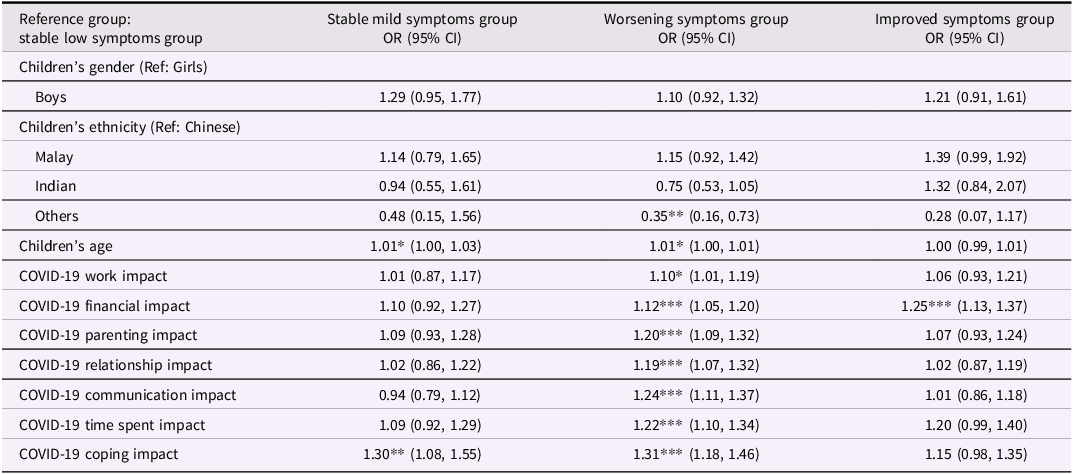
Table 4. Long description
A table with 11 rows and 7 columns. The columns are labeled: Reference group: stable low symptoms group, Stable mild symptoms group OR (95% CI), Worsening symptoms group OR (95% CI), Improved symptoms group OR (95% CI). The rows are labeled: Children’s gender (Ref: Girls), Children’s ethnicity (Ref: Chinese), Children’s age, COVID-19 work impact, COVID-19 financial impact, COVID-19 parenting impact, COVID-19 relationship impact, COVID-19 communication impact, COVID-19 time spent impact, COVID-19 coping impact. The table presents odds ratios (OR) and 95% confidence intervals (CI) for different groups and impacts.
Note. *** p < .001, ** p < .01, * p < .05.
Discussion
The present study examined heterogeneous transitions in preschool children’s emotional and behavioral symptoms before and during the COVID-19 pandemic in Singapore. Using a person-centered approach, we modeled internalizing and externalizing symptoms jointly to capture children’s overall symptom profiles and identified three profiles at both waves: low, mild, and severe symptoms. Across the pandemic period, children followed four major transition patterns: stable low symptoms, stable mild symptoms, worsening symptoms, and improved symptoms, with 30.03% shifting to a different symptom profile. Variation in these transitions was associated with child age, ethnicity, and COVID-related disruptions in work, financial conditions, and family functioning. Taken together, these findings highlight substantial heterogeneity in preschool children’s internalizing and externalizing symptom transitions from before to during the pandemic and identify potential predictors of these transitions.
Latent transition patterns of internalizing and externalizing symptom profiles
The results revealed three consistent co-occurring profiles of internalizing and externalizing symptoms among children before and during the pandemic: low, mild, and severe symptom groups. This three-profile structure aligns with previous research (Li et al., Reference Li, Zhu, Jiao, Sawada, Tanaka, Watanabe, Tomisaki, Zhu, Ajmal and Matsumoto2022; Ling et al., Reference Ling, Huebner, He and Zhong2016). In both periods, 68.67%–81.10% of children were classified into the low symptoms group, consistent with Basten et al. (Reference Basten, Tiemeier, Althoff, van de Schoot, Jaddoe, Hofman, Hudziak, Verhulst and van der Ende2016), who found that most preschoolers exhibited few internalizing and externalizing symptoms, with this group remaining stable over time. Additionally, 16.08%–24.35% of children fell into the mild group, and 2.82%–6.99% were in the severe group, which were also identified in the study by Ling et al. (Reference Ling, Huebner, He and Zhong2016). Notably, although the same three-profile structure was identified before and during the COVID-19 pandemic, the proportion of children in the low symptoms group decreased, whereas the proportions in the mild and severe symptoms groups increased during the pandemic period. This is consistent with prior evidence that children’s mental health difficulties generally increased during COVID-19 (Joo & Lee, Reference Joo and Lee2022; Levante et al., Reference Levante, Martis, Bianco, Castelli, Petrocchi and Lecciso2023) and suggests that the pandemic may have shifted more children into higher-symptom co-occurring profiles rather than producing a qualitatively different symptom structure.
However, it is noteworthy that the profiles identified in the current study primarily reflect differences in symptom severity rather than distinct symptomatic subtypes (e.g., pure internalizing or externalizing symptom groups), as identified in some prior studies (McElroy et al., Reference McElroy, Shevlin and Murphy2017; Morales et al., Reference Morales, Melero, Tomczyk, Espada and Orgilés2021). This finding may be attributed to the measurement properties of the CBCL, where the internalizing and externalizing domains are often highly correlated (Achenbach, Reference Achenbach1991). Such high co-occurrence aligns with the p-factor theory, which posits a general dimension of psychopathology that captures the shared variance among various symptoms (Caspi et al., Reference Caspi, Houts, Belsky, Goldman-Mellor, Harrington, Israel and Moffitt2014). Additionally, the specificity of the indicators used in latent profile analyses can influence the types of classes identified; in particular, studies using a wider range of indicators were more likely to identify qualitatively different symptom patterns (Petersen et al., Reference Petersen, Qualter and Humphrey2019). Moreover, the COVID-19 pandemic may have functioned as a generalized environmental stressor and a transdiagnostic psychological burden (Panda et al., Reference Panda, Gupta, Chowdhury, Kumar, Meena, Madaan and Gulati2021). Rather than impacting isolated domains, this systemic crisis likely exerted a broad influence on multiple areas of child adjustment simultaneously.
Furthermore, RI-LTA identified four transition patterns in internalizing and externalizing symptom profiles before and during the COVID-19 pandemic. Approximately 63.40% of children maintained consistently low levels of both symptoms, suggesting that most children demonstrated resilience and possessed effective coping strategies to manage stress during the pandemic (Cauberghe et al., Reference Cauberghe, De Jans, Hudders and Vanwesenbeeck2022). 22.30% of children exhibited worsening symptoms, and 6.23% had stable mild symptoms. Their underdeveloped cognition likely triggered excessive negative thoughts about illness or infecting others (Vasileva et al., Reference Vasileva, Alisic and De Young2021), thereby sustaining or intensifying behavioral issues. Moreover, disruptions to daily routines – reduced physical activity, increased screen time, and irregular eating and sleep – likely contributed to symptom exacerbation and maintenance (Gelir & Duzen, Reference Gelir and Duzen2022). Additionally, 7.73% of children showed improvement in internalizing and externalizing symptoms, a finding consistent with Cost et al. (Reference Cost, Crosbie, Anagnostou, Birken, Charach, Monga, Kelley, Nicolson, Maguire and Burton2022), possibly due to increased parent-child interaction and strengthened relationships during the lockdown period, which enhanced children’s adjustment (Woźniak-Prus et al., Reference Woźniak-Prus, Gambin, Sękowski, Cudo, Pisula, Kiepura-Nawrocka and Boruszak-Kiziukiewicz2024).
Demographic and family predictors of symptom transitions
Next, multinomial logistic regression analyses showed that, using Chinese children as the reference group, children in the ‘Others’ ethnic category had lower odds of being classified into the worsening symptoms group. One possible explanation is that Chinese children may be exposed to stronger expectations regarding self-regulation and emotional restraint (Chen & Yeung, Reference Chen and Yeung2023b; Rao et al., Reference Rao, McHale and Pearson2003), which may have made pandemic-related disruptions particularly stressful for Chinese children, thereby contributing to symptom worsening. However, because the ‘Others’ ethnic category was small and heterogeneous, this finding should be interpreted cautiously.
Results also indicated that older age was associated with higher odds of belonging to the stable mild symptoms group and the worsening symptoms group compared to the stable low symptoms group. One possible explanation is that, with increasing age, children encounter more complex developmental and social demands, which may predispose them to mild emotional and behavioral difficulties even during the pre-pandemic period (Gilliom & Shaw, Reference Gilliom and Shaw2004). During the pandemic, disruptions to daily routines and social environments may have reduced opportunities for symptom recovery, thereby contributing to the persistence of mild symptoms. Furthermore, older children may have been more sensitive than younger children to pandemic-related disruptions in daily routines (Vasileva et al., Reference Vasileva, Alisic and De Young2021), and some may also have experienced the transition to formal schooling across the two waves, which may have introduced additional academic and social challenges (Donaldson et al., Reference Donaldson, Moore and Hawkins2023), thereby contributing to worsening symptoms.
Additionally, greater negative work-related impacts of COVID-19 were linked to a higher likelihood of children belonging to the worsening symptoms group. Pandemic-induced job instability heightened parents’ psychological stress, which may have been transmitted to children (Liu & Doan, Reference Liu and Doan2020) and intensified their internalizing and externalizing symptoms. Lockdown measures also extended parents’ time working from home, making it harder to balance work and childcare, thereby elevating parenting stress (Chung et al., Reference Chung, Chan, Lanier and Wong2023). Consequently, children’s needs may have been overlooked, leading to their maladjustment.
Greater negative impacts of the pandemic on parenting, family relationships, communication, time spent together, and family stress-coping ability were linked to a higher likelihood of children being in the worsening symptoms group. In short, poorer family function was associated with escalating internalizing and externalizing symptoms in children, consistent with Lee et al. (Reference Lee, Fosco and Feinberg2025). Family function serves as a critical protective factor under stressful conditions (Sheidow et al., Reference Sheidow, Henry, Tolan and Strachan2014). Following the COVID-19 outbreak, deteriorations in parenting quality, strained family relationships and communication, reduced time together, and diminished coping capacity likely increased family chaos. This, in turn, weakened the family’s ability to provide emotional support and behavioral guidance during the crisis, contributing to the escalation of children’s internalizing and externalizing symptoms (Burlaka et al., Reference Burlaka, Wu, Wu and Churakova2019; Renner & Boel-Studt, Reference Renner and Boel-Studt2017; Vazsonyi et al., Reference Vazsonyi, Ksinan, Javakhishvili, Scarpate and Kahumoku-Fessler2022). Additionally, impaired family coping ability was also associated with a higher likelihood of membership in the stable mild symptoms group, relative to the stable low symptoms group. For children who already showed mild internalizing and externalizing symptoms before the pandemic, pandemic-related impairment in family coping may have reduced families’ capacity and resources to effectively mitigate their children’s pre-existing difficulties (Fogel et al., Reference Fogel, Sela and Hen-Herbst2022). As a result, these children may have been less likely to recover to a low-symptom profile, contributing to the persistence of mild symptoms across time.
Interestingly, greater negative financial impacts of COVID-19 were associated with a higher likelihood of children exhibiting either worsening or improved symptoms. According to the family stress model (Conger et al., Reference Conger, Martin, Reeb, Little, Craine, Shebloski, Conger, King and Maholmes2012), pandemic-related economic hardship may have increased parental distress and marital conflict, which could spill over into parenting and contribute to children’s emotional and behavioral difficulties (Neppl et al., Reference Neppl, Senia and Donnellan2016). Conversely, financial stress may have motivated families to seek external support – such as from friends, community networks, or government programs – which, in turn, strengthened family resilience during the pandemic (Viseu et al., Reference Viseu, Leal, de Jesus, Pinto, Pechorro and Greenglass2018) and helped mitigate children’s internalizing and externalizing symptoms. Future research should further explore the mechanisms behind these divergent outcomes.
Limitations and implications
Several limitations should be noted. First, the study relied solely on caregiver reports, which may have introduced reporting bias or reflected subjective perceptions rather than objective child behaviors. Using multi-informant approaches could improve validity. Second, a very small latent transition subgroup was excluded from multinomial logistic regression analyses, warranting caution in interpreting and applying the results. Third, because the study participants were from Singapore, the findings may be most relevant to societies with similar contextual features, such as high urbanization, multicultural populations, and a strong emphasis on family-centered caregiving and support. However, caution is needed when applying the findings to contexts that differ substantially in cultural, socioeconomic, or policy environments. In addition, attrition analyses showed that boys were slightly overrepresented among those lost to follow-up; therefore, the generalizability of the findings should be interpreted with some caution. Fourth, given the absence of a control group and the relatively long interval between waves, causal explanations of the findings should be made with caution. These observed transition patterns may have been influenced by alternative factors, such as natural developmental shifts or the transition into schooling. Finally, although the study identified predictors of transitions in co-occurring symptoms, the underlying mechanisms remain unclear. Future research should explore potential mediators or moderators to provide a more robust understanding of these longitudinal associations.
Despite its limitations, this study offers valuable insights into preschool children’s mental health during large-scale public health crises such as the COVID-19 pandemic. Using a person-centered longitudinal approach, this study identified heterogeneous transitions in children’s emotional and behavioral symptom profiles from before to during the pandemic, including stable low symptoms, stable mild symptoms, worsening symptoms, and improved symptoms. Rather than suggesting that the pandemic affected all children uniformly, the findings show that children followed distinct adjustment pathways. Importantly, these distinct transitions were associated with child age, ethnicity, and pandemic-related disruptions in work, financial conditions, parenting, family relationships, communication, time spent together, and family coping. These findings support and extend the COVID-19 systemic model (Prime et al., Reference Prime, Wade and Browne2020) by showing that children’s symptom transitions during the pandemic were closely linked to the family and socioeconomic contexts in which they were embedded.
The findings also offer practical guidance for post-pandemic interventions and future crisis responses. First, screening and support efforts should attend not only to children’s symptoms but also to family-level stressors, including work disruption, financial strain, parenting difficulties, family communication, and family coping capacity. Second, with more than one-fifth of children in the worsening symptoms group, early identification of children at risk for symptom escalation is important. Special attention may be warranted for older preschool children and for children from families experiencing greater pandemic-related work and family functioning disruptions. Third, family-based post-pandemic interventions should strengthen family protective processes, including supportive parenting practices, positive parent–child communication, and adaptive coping strategies for managing stress, to support children’s emotional and behavioral adjustment. Fourth, policy responses to future public health crises should recognize that children’s mental health is closely embedded in family and socioeconomic conditions. Policies that reduce work–family conflict, provide timely financial support, expand access to parenting and family counseling services, and strengthen community-based support for families may help prevent children from moving into more severe symptom profiles. Finally, the finding that some children improved during the pandemic suggests that large-scale crises may also activate protective family processes for some children. Future interventions should therefore not only reduce risk but also identify and reinforce the family conditions that support resilience among preschool children.
Conclusion
This study used a longitudinal, person-centered approach to examine transitions in preschool children’s internalizing and externalizing symptom profiles from before to during the COVID-19 pandemic in Singapore. Three symptom profiles – low, mild, and severe – were identified across both time points, revealing substantial heterogeneity. Subsequently, four distinct transition patterns emerged following the pandemic’s onset: stable low symptoms, worsening symptoms, stable mild symptoms, and improved symptoms. These patterns highlight the variability in children’s psychological responses to the pandemic – some are more vulnerable, while others show resilience. These transitions were associated with child age, ethnicity, and pandemic-related disruptions in work, financial conditions, and family functioning. In particular, older children and children from families experiencing greater work and family-functioning disruptions were more likely to show stable mild or worsening symptoms. These findings underscore the importance of family and socioeconomic contexts in supporting preschool children’s mental health following large-scale crises.
Supplementary material
The supplementary material for this article can be found at https://doi.org/10.1017/S0954579426101941.
Acknowledgements
The authors gratefully acknowledge the Singapore Longitudinal Early Development Study (SG-LEADS) research team for making the data available for this study and thank all participating children and families for their valuable contributions.
Funding statement
The authors received no financial support for the research, authorship, and/or publication of this article.
Competing interests
The authors declared no potential conflicts of interest with respect to the research, authorship, and/or publication of this article.
Ethical standards
The original SG-LEADS study was approved by the National University of Singapore Institutional Review Board, and informed consent was obtained from primary caregivers. The present study involved secondary analysis of de-identified data.
Pre-registration statement
This study was not pre-registered because it involved secondary analysis of an existing publicly available dataset.
Data availability statement
Availability of data: The current manuscript used the publicly available data from the Singapore Longitudinal Early Development Study (SG-LEADS), which can be accessed at https://sg-leads.org/.
Availability of code: The analysis code used to produce the reported results is available at https://doi.org/10.5281/zenodo.22090126.
Availability of methods/materials: Documentation for the SG-LEADS measures and data is available through the SG-LEADS study website. Additional methodological information is provided in the online supplementary materials.
Declaration of generative AI use
During the preparation of this work, the authors used ChatGPT to improve the language and readability of the manuscript. After using this tool, the authors reviewed and edited the content as needed and take full responsibility for the content of the published article.



 Open access

