I. Introduction: the enquiry
Within a sizeable body of legal consciousness literature, examinations of legal consciousness in government decision-making remain problematically sparse. The vast majority of legal consciousness studies focus on ordinary citizens (see, for example, Nielsen, Reference NIELSEN2000) and working-class Americans (see, for example, Merry, Reference Merry1990; Ewick and Silbey, Reference Ewick and Silbey1998; Hoffman, Reference Hoffman2003; Sarat, Reference Sarat1990). There are only a small handful of studies that consider legal consciousness in the context of government (Hertogh, Reference Hertogh and Adler2009); where it has been raised as an area of interest by two scholars in particular, Marc Hertogh (Reference Hertogh, Van Der Burg and Taekema2004b, Reference Hertogh and Adler2009) in the Netherlands, and Davina Cooper (Reference Cooper1995) in the UK.
Despite their neglect, legal consciousness in government studies may play an important role in clarifying understandings of bureaucratic consciousness, and expanding the ambit of legal consciousness studies more broadly. Where a prime player in the legal consciousness movement, Susan Silbey, has recently critiqued the future of the enterprise on the basis that legal consciousness studies are generally unlikely to discern generalisable truths in a fragmented post-modern age (Reference Silbey2005, p. 355) or achieve much more than satisfy the researchers’ empiricist gratifications to ‘reach out and touch’, (Reference Silbey2005, p. 357), she has left open the possibility that there is more to be done when it comes to understanding legal consciousness in relation to modern institutional settings such as that of government. For Silbey:
‘the most promising work seems to look at the middle level between citizen and the transcendental rule of law: the ground of institutional practices. In institutions cultural meaning, social inequality, and legal consciousness are forged. In institutions law both promises and fails to live up to its promises. One place to begin is the cultural industries where legal consciousness is most explicitly constructed. To describe the mechanisms by which legal schema are propagated, circulated, and received, we need institutional approaches that describe simultaneously the full range of social construction.’ (Silbey, Reference Silbey2005, p. 60)
Whether or not Silbey's broader critique of legal consciousness is accepted, the importance of legal consciousness in government studies – as with all socio-legal law in the books and law in action gap studies – can be revealed through the analogy of any person walking onto the street and meeting cold weather and wind chill (Hertogh, Reference Hertogh and Adler2009, p. 205). Whilst the thermometer may only read minus two degrees Celsius, the wind may be blowing at forty-five kilometres per hour so that the wind chill factor causes it to feel like it is minus ten degrees Celsius. For a true understanding of local weather conditions and its effects, one should take into account the objective and subjective elements (p. 205). The same holds true for understanding how law works in government. Reading decisions, or statutes, or policy documents, or training manuals will only tell us so much; for the rest of the picture, we must examine empirically the decision-makers themselves to better understand how law works in everyday administrative decision-making.
This study responds to this need, emphasising the connections between bureaucratic legal consciousness and decision-maker values.Footnote 1 Whilst the study of ideals has grown in legal theory since Ronald Dworkin's consideration of the ideal of integrity in Law's Empire (cited in Van der Burg and Taekema, Reference Van Der Burg and Taekema2004, p. 11), systematic treatment of the role of ideals in law, morality and politics has remained lacking (Reference Van Der Burg and Taekema2004, p. 11). The study of ideals can allow one to more clearly perceive positive and negative aspects of the social world: they are important in social reality; they need to be a central part of descriptive theories in order to understand the normative dimension of social reality; and they are helpful for the evaluation and guidance of practices in law, morality and politics (Reference Van Der Burg and Taekema2004, pp. 12–20). As Roger Cotterrell has outlined:
‘Empirical studies of the ways legal values are invoked outside lawyers’ practice are [therefore] of great value. And because values are part of legal doctrine, a sociology of morals (i.e. socially recognised values) must surely accompany a sociology of law.’ (Cotterrell, Reference Cotterrell2004, pp. 288–298)
Throughout this study, ideals are construed as ‘values, of a complex and dynamic nature, which are embedded in social practices’ (Taekema, Reference Taekema, Van Der Burg and Taekema2004, p. 39). Ideals are a desirable state of affairs that are difficultFootnote 2 to realise completely, but provide direction in problematic situations (2004, p. 39). They possess both an objective and subjective component – the objective stemming from their roots in social reality and the subjective found in the creativity necessary to imagine the desirable possibilities that can prompt desire into action (Taekema, Reference Taekema2003, p. 39). This conception of ideals builds on the pragmatist theories of John Dewey and Philip Selznick, and has been convincingly defended in legal theory elsewhere (Reference Taekema2003, p. 39).
The study's focus on decision-maker ideals draws on Sanne Taekema's conception of ideals, rejecting the Kantian notion that ideals are abstract and inherently unrecognisable, for a modified Aristotelean view that they are evident in natural and social reality and are capable of realisation in rudimentary forms of practice where practical obstacles that would otherwise prevent their disclosure are removed (Taekema, Reference Taekema, Van Der Burg and Taekema2004, pp. 39–55). This became apparent as the empirical research unfolded.Footnote 3 In doing so, it aligns itself with a pragmatism theory of ideals in its regard for ideals as aspects of concrete social phenomenon (Reference Taekema, Van Der Burg and Taekema2004, pp. 39–55; see also Selznick, Reference Selznick2008, pp. 5–7),Footnote 4 considering bureaucrats’ immanent ideals as aspects of daily governmental decision-making. The use of unstructured open-ended interviews that followed the participants down their chosen line of enquiry was paramount to achieve this goal. Unlike a study which might focus on rules or principles, this study of decision-maker ideals and legal identification locates how individuals construe what is desirable, but does not illuminate or prescribe particular consequences, procedures or outcomes that might flow from these ideals. In doing so, it begins the descriptive account that Van der Burg and Taekema (Reference Van Der Burg and Taekema2004) outline as a crucial building block for further normative sociology of law theorisations.
Departing from the small collection of previous legal consciousness in government studies, the paper examines the legal consciousness of government officials in relation to legal identification only,Footnote 5 addressing previous methodological limitationsFootnote 6 to clarify understandings of legal consciousness in government. Where previous studies have either conflated legal awareness with legal identification or explored both despite pervasive methodological limitations in ascertaining the former,Footnote 7 this study focuses on the ways government officials identify with law; digging deeper to unearth the broader meta-cognitive ideals that structure legal identification at the heart of government.
In exploring legal identification, definitions of ‘identification’ need some unpacking. Although legal identification has been utilised as one of the two components of legal consciousness (together with legal awareness) elsewhere (Hertogh, Reference Hertogh, Van Der Burg and Taekema2004b), it has not been explicitly defined. In this space, reference to the sociological and psychological literature on identification can clarify its intended meaning. As opposed to identity, which is thought of as the distinctive characteristics belonging to an individual or group and is therefore relational and contextual (Devod, Huyuh and Banaji, Reference Devod, Huyuh, Banaji, Leary and Tangney2003, pp. 162–163), identification refers to the act of classifying oneself in relation to distinct roles (Stets and Burke, Reference Stets, Burke, Leary and Tangney2003, p. 145), such that, whilst this classification takes place in a manner that is relational and contextual, the act itself is one of categorisation (Reference Stets, Burke, Leary and Tangney2003, p. 145) and is therefore functional or operational. Where a study considering the broader relationships between various social elements of the decision-makers’ background would consider bureaucratic legal identity, this study focuses on the way decision-makers classify, or identify, their relationship with law in a processual manner alongside the discussion of tasks involved in their everyday decision-making, paving the way for later considerations of the relationship between bureaucratic behaviour and decision-maker ideals at the level of administrative operationalisation, currently lacking from the socio-legal literature.Footnote 8
II. Situating the enquiry
In connecting decision-maker ideals with legal identification, this study can be broadly situated within legal consciousness studies. The history, development and growth of legal consciousness studies, which have been prominent within socio-legal studies since at least the 1980s (Halliday and Morgan, Reference Halliday and Morgan2013, p. 2), have been summarised numerous times and do not warrant repetition here (see Merry Reference Merry1990; Engel, Reference Engel, Garth and Sarat1998; Hertogh, Reference Hertogh, Van Der Burg and Taekema2004b; Cowan, Reference Cowan2004; Silbey, Reference Silbey2005). Despite varying descriptions of their precise starting dateFootnote 9 and their overall value,Footnote 10 these summaries unite in the description that legal consciousness has played a central role within socio-legal studies over at least the last thirty years (Hertogh, Reference Hertogh2004a; Silbey, Reference Silbey2005, Halliday and Morgan, Reference Halliday and Morgan2013). Whilst legal consciousness studies were originally, and are predominantly, US based (Harding, Reference Harding2006, p. 512), the theoretical frame is becoming increasingly popular in European socio-legal research (Reference Harding2006, p. 512). This is the first known study to empirically consider legal consciousness in the Australian context.
2.1 The fieldwork site
The government agency which took part in the fieldwork was the Refugee Review Tribunal of Australia (RRT). The RRT is responsible for hearing appeals from primary Department of Immigration and Citizenship (DIAC) refugee protection visa applications under the Migration Act 1958,Footnote 11 functioning as a review-level body within the Australian bureaucracy. In doing so, they conduct an administrative reconsideration of the primary-level case and operate as a merits review body within the same legislative framework as DIAC. Decisions are heard by a single member, where the member conducts a hearing with the asylum seeker applicant and subsequently makes a decision to affirm, vary, set aside or remit the primary decision. The core policy mandate of the tribunal is to reach decisions that are ‘independent, fair, just, economical, informal and quick’ (Australian Government, 2012–2013), and RRT members are selected from both legal and non-legal backgrounds, and are usually of a mature age with professional experience, to attempt to achieve these goals. Forty open-ended unstructured interviews with former RRT members were conducted, where participants were allowed to talk freely about their attitudes and experiences on the tribunal to generate unbounded legal consciousness insights.Footnote 12
The involvement of retired RRT members in the research was serendipitous (see Halliday and Schmidt, Reference Halliday and Schmidt2009, p.6) rather than contrived. Because the research – at this stage at least – aims to innovate legal consciousness theory rather than provide policy directions or improve particular normative outcomes for public administration, the involvement of RRT members in the research is attributable to ease of access and the researchers’ pre-existing knowledge and network base rather than a priori necessity (in that, another government department could have operated as the fieldwork site and proved equally as telling). It might be retrospectively noted, however, that the RRT has provided a rich fieldwork site for bureaucratic legal consciousness theory-building as the social and political sensitivity of refugee claims in this particular government department, as well as the age, wisdom, qualifications and dedication of RRT officials, have combined to produce clear, coherent and highly articulate legal identification narratives. Additionally, a high level of dedication to the job on the part of bureaucrat interviewees may have contributed to facilitating the expressed connections between broader moral valuations and legal identification, where on the other hand an official disconnected from their decision-making tasks would presumably express little association between their broader ideals and legal attitudes. This therefore departs from traditional studies of front-line bureaucracy, which focus on the standardised routine of government officials (see Mashaw Reference Mashaw1983; Maynard-Moody and Musheno, Reference Maynard-Moody and Musheno2003; Hertogh Reference Hertogh2004a, Reference Hertogh, Van Der Burg and Taekema2004b) to provide a fresh consideration of how legal identification is constructed and expressed at higher levels of government.
This departure does raise an interesting question as to whether those areas of public administration that are essentially standardised and less demanding and politicised than RRT decision-making correspond with narrow, detailed and merely descriptive identification narratives (refraining from connecting decision-making tasks with broader moral values or ideals), whilst individuals possessing high levels of education, professional experience and dedication to the field and their careers, such as those studied here, uniquely express higher-level deductive reasoning in their forging of connections between moral values and legal identification. Whilst such questions fall outside the scope of this research, they may require further empirical research in the future.
III. Prior studies of legal consciousness in government
In its most narrow sense, the study of the relationship between legal identification and decision-maker ideals builds on Cooper's (Reference Cooper1995) and Hertogh's (Reference Hertogh and Adler2009) legal consciousness in government studies.
Cooper (Reference Cooper1995) provides the first consideration of legal consciousness in government, discussing the relationship between the legal consciousness of British local government officials and juridification in the 1980s and 1990s. She draws on semi-structured interviews with approximately sixty local government actors (including councillors, officers and street-level workers) in education and corporate policy-making in four urban areas (Cooper, Reference Cooper1995, p. 507). As Cooper outlines in her study, juridification – the central concept which she relates to the legal consciousness of the government officials studied – can refer to many things: an expansion of legislation, new and significant litigation and judicial dicta, or the sudden prominence of particular legal norms (Reference Cooper1995, p. 507). Whilst, on any of these views of juridification, it had commonly been thought that such processes grant law a more prominent role within society (Reference Cooper1995, p. 511), Cooper outlines that such arguments do not allow us to understand what precisely this role is or when it might fluctuate or be hidden (Reference Cooper1995, p. 511). In other words, without understanding the officials’ attitudes towards juridification, we cannot achieve a complete picture of how the law works; the structure of the legal system alone will not provide the complete picture, as individual understandings will alter public officials’ reception and application of the law. Hence it is Cooper's goal to explore the complex and contradictory nature of legal consciousness and the over-determination of juridification depending on alterations in political ideology, affiliation and institutional role (Reference Cooper1995, p. 511). In her interviews with local government actors Cooper finds six different images of law: law as a colonising force; law as a game; law as a facilitator/resource; law as a discourse; law as an environmental nuisance and law as means for conflict resolution or social consensus (Reference Cooper1995, pp. 511–512). She finds, common across these varying images of law, that many of these municipal actors, including politicians and policy-makers, shared the same images of law as those of the everyday working-class poor (Reference Cooper1995, p. 521).
Cooper's study is revealing in its finding that local government officials display similar variations of attitude towards law to those of the everyday working class. Finding that ‘the legal consciousness of local government officials is not principally that of powerful subjects’ (Cooper, Reference Cooper1995, p. 521), she suggests that the same reasons for studying legal consciousness in relation to citizens might be invoked in relation to government officials also. Cooper's governmental subjects are complex individuals with views, biases and variations in attitude and socialisation that make their interpretation of, attitude towards, and application of, the law, far from stagnant or uniform.
Building on Cooper's study, Hertogh (Reference Hertogh and Adler2009) develops four normative profiles to explain government officials’ attitudes towards the justice system. His study of front-line officials in the Netherlands, and how these officials understand the Rechtsstaat (rule of law), constructs a series of bureaucratic normative profiles, arguing that bureaucrats can be divided between differing levels of legal awareness from the legalists (officials who are well aware of the law and also identify with the law); the loyalists (officials with little awareness of the law but strong support for it); the cynics (officials with high awareness of the law but correspondingly high scepticism for it); and the outsiders (officials with little knowledge of, and also little support for, the law) (Reference Hertogh and Adler2009, pp. 217–219).
In the study, Hertogh examines the extent to which the participant officials are correctly aware of the Rechtsstaat as it is understood in legal doctrine according to the values of legality, equality, fundamental rights, the separation of powers, and the right to an independent court (Hertogh, Reference Hertogh and Adler2009, pp. 209–210). He selects as his fieldwork site the ‘Indonesian quarter’ – a small, predominantly blue-collar neighbourhood in the town of Zwolle in the eastern region of the Netherlands – (p. 208), and bases his observations regarding the legal consciousness of front-line officials on empirical material gleaned from a six-month evaluation study of the Neighbourhood Intervention Team Zwolle (NITZ Team), as well as on material from local and national Dutch newspapers (Reference Hertogh and Adler2009, p. 208).
The study finds that ‘The NITZ Team was not oriented towards fitting their individual decisions into a system of general rules, but towards individual citizens and their unique circumstances’ (Hertogh, Reference Hertogh and Adler2009, p. 212). These officials demonstrated a ‘personalistic value orientation’ that was also reflected in their value towards equality (Reference Hertogh and Adler2009, p. 211). They were less inspired by the idea of ‘general justice’, which focuses on official rules and general norms, and more focused on the idea of individual justice, which emphasised the importance of individual solutions for specific problems (Reference Hertogh and Adler2009, p. 213).
IV. Extending the research
4.1 Extending our empirical understandings: bottom-up enquiry into legal consciousness in government at the appeal level
Despite their rich findings, both Cooper's and Hertogh's studies leave us with further questions. In response to Hertogh's more recent study we may question whether legalists, loyalists, cynics and outsiders are accurate ideal typologies when the awareness component of the legal consciousness equation has been tenuously ascertained. Whilst Hertogh maps the legal awareness of the official as one factor influencing legal consciousness and the legal identification of the official as the other, he is not explicit about the methods he uses to chart this awareness. Whilst he reveals that he conducted a six-month evaluation study and secondary data analysis of the NITZ officials, we are left in the dark as to how the officials’ awareness was ascertained through these endeavours. He does discuss the various officials’ attitudes towards the legal concept of Reechsstaat, and presumably utilises a consistent method for charting their awareness of these laws despite not revealing it, but such silence does give cause to ponder the broader question of whether accurately ascertaining legal awareness of government bureaucrats is even a real possibility.
As Hertogh himself outlines, Knowledge and Opinion of Law (KOL) studies have largely been considered limited since the 1970s, and mostly replaced by broader studies which avoid many of the methodological problems that the earlier KOL studies had encountered (Hertogh, Reference Hertogh and Adler2009, p. 205). Large-scale survey and questionnaire data analysis that drove early legal consciousness research have been abandoned for a more qualitative enquiry into attitudes towards law. Such methodological concerns form an important basis of this research, where attempts to ascertain the actualFootnote 13 legal knowledge of the participants is explicitly abandoned and the conceptual focus is on legal identification only. A detailed study of bureaucratic legal identification through direct conversations with the bureaucrats themselves can tell us much about the ways government officials think about law and can begin to chart the unexplored connections between such officials’ legal identification and their broader ideals.
Further, Cooper's and Hertogh's research provides only a very small picture of the scope of government officials’ legal consciousness in its confinement to one particular level of government: the front line. Whilst these studies undoubtedly provide an important starting point for legal consciousness in government research, they leave open the question of whether officials’ legal consciousness can be similarly understood when it comes to appeal-level decision-making, and at higher levels of government. Cooper's findings that front-line officials’ attitudes towards law did not mimic those of the ‘powerful’, but rather, those of the powerless and everyday citizens that formed the bulk of legal consciousness studies prior (Reference Cooper1995, p. 521), produces a series of questions, and paves the way for further analyses of legal consciousness in government beyond studies of front-line officials alone. If front-line officials reflect similar attitudes towards the law to those of powerless subjects, can the same be said of those at higher levels of government who may possess greater levels of power?
This is an important question, not just for revealing more information about this substratum of government, but also for clarifying our understandings of the conceptual relationship between notions of legal consciousness and individual power. As we know, legal consciousness studies emerged to address perceived issues of legal hegemony and understand the legal views of the ordinary and powerless (Silbey, Reference Silbey2005, pp. 324–335). If front-line government decision-makers, exercising small but at least greater amounts of power than those originally envisaged within the scope of such research, have been found to mimic the consciousnesses of the powerless (Cooper, Reference Cooper1995, p. 521), we might query whether these shared consciousnesses are a reflection of the relative powerlessness of front-line officials (in comparison to government officials at other levels of government), or in fact whether individuals at different levels of government and with greater power and influence reflect a similar range of consciousnesses towards law. Again, this motivation provides a departure point for the present study, which investigates the legal consciousness of government bureaucrats at the fresh appeal level – where decision-makers are typically educated and quasi-powerful professionals removed from the bulk of ordinary and mundane practices commonly attributed to the front line.
Empirical progress is also made in the present study in that, whilst Hertogh finds that his government officials do not value legality or equality, but responsiveness and material equality, discussing the ways that the ideal of the Rechtsstaat is constructivist, pluralist and pragmatic, he acknowledges that his case-study is by no means a thorough empirical analysis and outlines the importance of further enquiry on the topic (Hertogh, Reference Hertogh, Van Der Burg and Taekema2004b, p. 93). Given that Hertogh explicitly refrains from imposing his normative theorisations of the relationship between alternative values and the master ideal of the rule of law, explicitly attempting to remove his personal ideals from the study of the officials’ legal ideals, it seems paramount that Hertogh's study be based on sound empirical analysis. As such, this study continues Hertogh's affiliation with Donald Black's discussion of the empirical boundaries of legal sociology, where Black stated:
‘When legal reality is compared to an ideal with no identifiable empirical referent, such as the “rule of law” … the investigator may inadvertently implant his personal as the society's legal ideals. At this point social science ceases and advocacy begins … [I]t involves, perhaps unwittingly, moral judgment at the very point where it promises scientific analysis.’ (Black, 1973, p. 45, cited in Hertogh, Reference Hertogh, Van Der Burg and Taekema2004b, p. 75)
With this in mind, the study's clear and curtailed focus on that which is capable of empirical investigation (legal identification, but not knowledge)Footnote 14 through a means well known to provide the richest legal consciousness insights (the interview meeting)Footnote 15 tightens the empirical framework that Hertogh's earlier study falls short of, to improve the plausibility of later normative theorisations.
4.2 Extending our normative understandings: legal consciousness in government as a culmination of top-down values
This study also extends Ewick and Silbey's original legal consciousness typology that famously conceives of individuals as being either ‘before the law’, ‘with the law’ or ‘against the law’ (Ewick and Silbey, Reference Ewick and Silbey1998), which has thus far navigated the ambit of the legal consciousness enquiry (see Merry, Reference Merry1990; Cooper, Reference Cooper1995; Engel, Reference Engel, Garth and Sarat1998; Ewick and Silbey, Reference Ewick and Silbey1998; Cowan, Reference Cowan2004; Hertogh Reference Hertogh2004a, Reference Hertogh, Van Der Burg and Taekema2004b; Harding, Reference Harding2006; Hertogh, Reference Hertogh and Adler2009; Halliday and Morgan, Reference Halliday and Morgan2013), to include consideration not only of participants’ attitudes towards law, but also a fine-grained analysis of the moral values that structure these attitudes.
This is important in the sense that the study of bureaucratic legal consciousness can draw insights from the sociological jurisprudence of scholars who have emphasised the importance of ideals to understanding social reality (see Weber, Reference Weber, Shils and Finch1949; Taekema Reference Taekema2003; Selznick, Reference Selznick2008; Van der Burg and Taekema, Reference Van Der Burg and Taekema2004). How can one understand the world of bureaucrats without probing deeper into the ideals that drive their daily life? How can one understand the complex reasons why administrative decisions are made without understanding the sensitivities of those making those decisions? How can one say much about a bureaucrat's legal worldview without engaging further with the ideals that evoke and sustain it? Insights into what people value and strive towards can tell us much about how life is ordered. Any normative theory of what matters requires, at its core, a descriptive consideration of what people currently aspire to. We cannot know what to change without knowing what people consider important. A full account of bureaucracy requires a consideration of legal consciousness – broad attitudes towards law – as well as a breakdown of the ideals associated with these attitudes. Whilst previous studies have concentrated on attitudes towards law, the consideration of the way that moral values structure these legal attitudes is entirely new and, as the present study reveals, provides a telling explanatory framework of the broader ideals in which these legal identification narratives are embroiled.
V. Methods
5.1 Interview conversations for unbounded legal consciousness insights
Forty semi-structured interviews with former members of the RRT were conducted to provide understandings of the bureaucrats’ moral values and the connections between these values and their legal attitudes. Whilst the analysis of RRT reasons might have presented telling indications of decision-makers’ formal approach to legal and factual reasoning – whether, for example, they are a functionalist happy to flexibly interpret the law, or a formalist adhering to the importance of strict and literal interpretation – the conscious attitudes of members towards the law itself (their meta-analysis of the law, its function and its importance) are of course best ascertained through engagement with the decision-makers themselves.
The study's reliance on interviews shares affinity with many influential legal consciousness studies, where the semi-structured or unstructured interview is often selected in such studies for its ability to naturally reveal information that may not be provided through the narrower fully structured interview format, or even more structured methods such as surveys. It might be likened to Laura Beth Nielsen's approach in her study of the relationship between individuals’ experiences with offensive public speech and their legal consciousness (Nielsen, Reference NIELSEN2000). Nielsen asks individuals about their experiences with and understandings of racist speech, sexually suggestive speech and begging in public areas, allowing respondents to discuss and define for themselves what they consider to be offensive or problematic (Nielsen, Reference NIELSEN2000, p. 1058). She identifies that she follows in the footsteps of Patricia Ewick and Susan Silbey, whose earlier work sought to provide a critical overview of legal consciousness typologies resulting from four hundred interviews, where they asked respondents general questions about their everyday lives and the problems that they faced in their schools, workplaces and communities, allowing them to elaborate whether and in what ways they perceived the law to be important in these spaces (Reference NIELSEN2000, p. 1058). Nielsen reiterates the importance of this approach, employing it herself for the manner in which it allowed the subjects to articulate their understanding of the law and the role that the law may play in various disputes, facilitating the organic exploration of legal consciousness, rather than narrowing it to the researchers’ own definition (Reference NIELSEN2000, p. 1060). My own pilot interviews reiterated the importance of the approach that Ewick and Silbey and Nielsen employ, where my narrow range of hypotheses became broadened and, simultaneously, more concrete and astute, as the conversations took on a life of their own and the true attitudes of the participants towards the law and the moral values that enveloped these attitudes emerged.
5.2 The heuristic
After conducting ten pilot interviews with former members of the RRT, I formed a heuristic of factors that explained the then expressed values that correlated with the participant's legal identification. It was clear from this early stage that individuals were divided in their enthusiasm or respect for the law; separated in the extent to which they believed that the law should play a central role in regulating their decision-making. Whilst some expressed that the law as found in case-law, statute and (to some, not others) international convention and treaty was the central guiding framework for conducting the refugee status assessment, others demonstrated unwavering scepticism for the law and its importance, commonly positing that the law itself was a fallible construct that was intrinsically ill-equipped to provide a decision-maker with knowledge to decide who is and who is not a refugee. And many oscillated between the two beliefs at various points in the interview conversations.Footnote 16
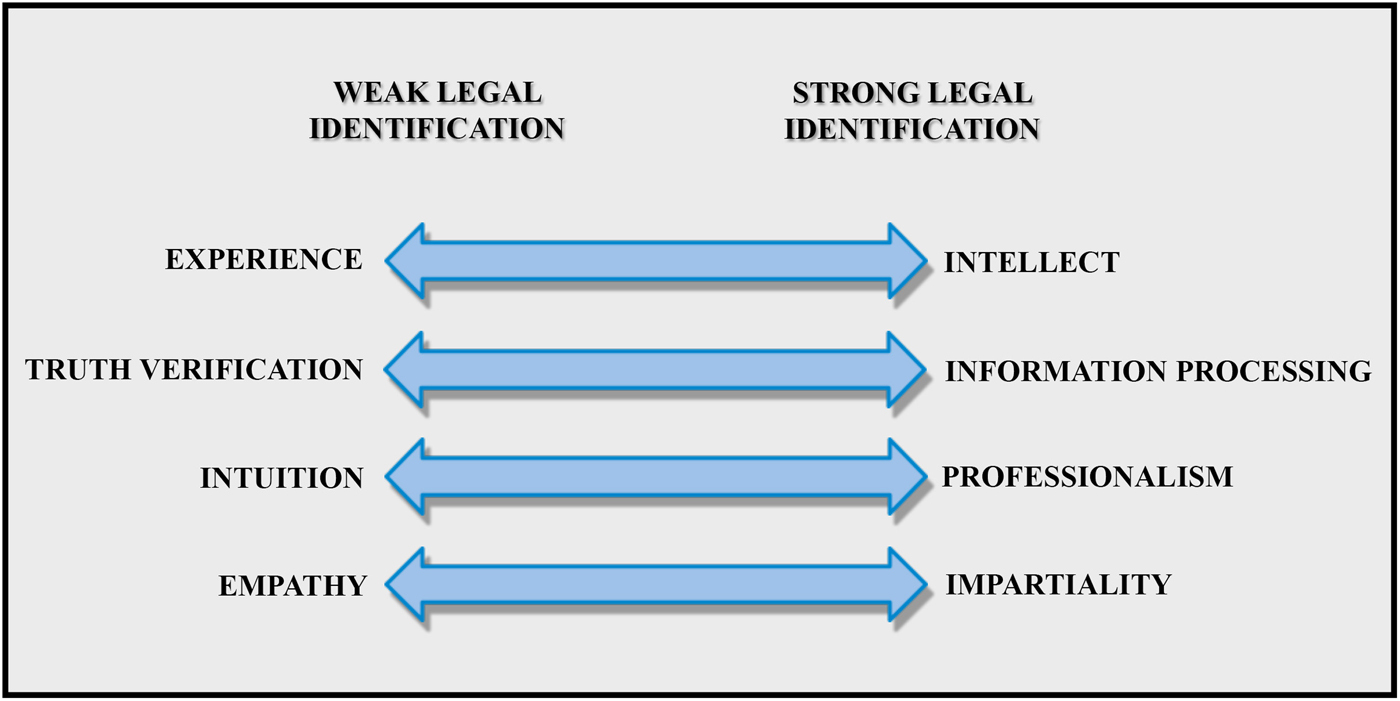
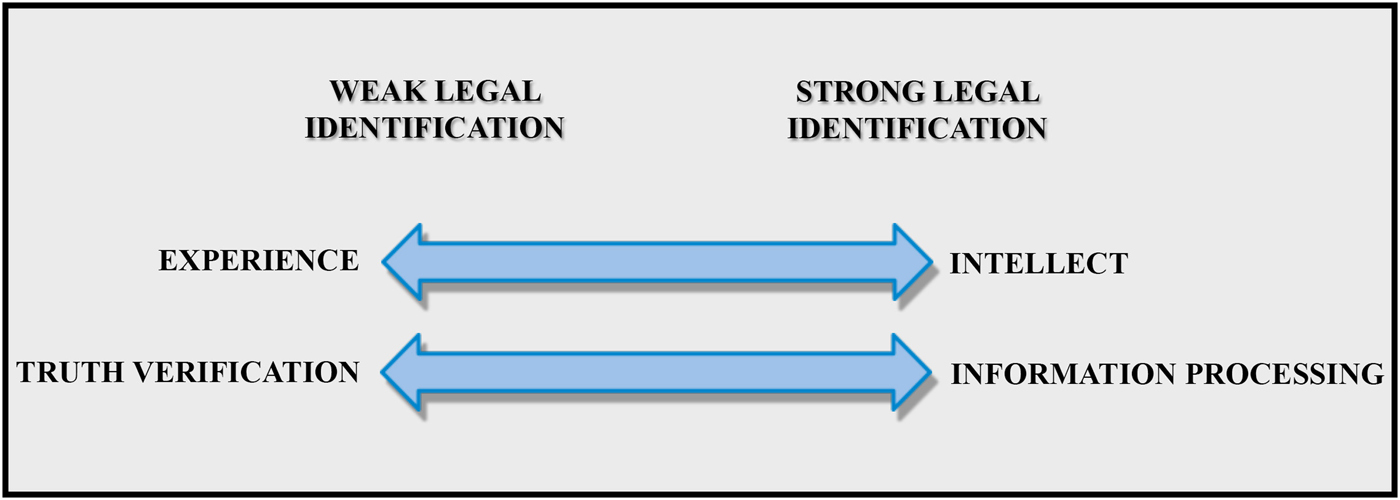
After a further thirty interviews were conducted,Footnote 17 the initial heuristic was revised to reflect the nuances revealed in the main study. What the pilot study and the main study commonly demonstrated was that whilst the legal identification of the bureaucrats was shifting, the ideals expressed in conjunction with each variation in legal identification remained the same at each point across the two studies. What changed from the pilot study to the main study was the ambit of concrete values that the decision-makers expressed. Figures 1 and 2 pictorially represent this shift from the connections drawn in the pilot to those then modified through the main study.
Legal identification and bureaucratic ideals; the pilot

Legal identification and bureaucratic ideals; main study

As Figure 1 shows, the initial pilot suggested that as identification with law increased, so too did idealisation of intellect. On the other hand, as bureaucrats discussed the importance of experience, their conviction in the importance of law decreased. Further, as bureaucrats discussed conceptions of information processing, their identification with law increased, and conversely, as they expressed an idealisation of truth verification, their identification with law decreased. The same relationships were observed when it came to conceptions of professionalism versus intuition, and impartiality versus empathy. As the bureaucrats expressed a belief in the importance of acting professionally, they also discussed the place and importance of law; on the other hand, when they discussed the importance of acting not according to a shared professional collegial code but according to an innate personal instinct, relying on their own intuition, their emphasis on the place and importance of law decreased. Similarly, as the bureaucrats expressed a belief in the importance of acting in an impartial manner, they expressed a correspondingly strong regard for the law, and conversely, when they demonstrated a belief in the importance of acting out of care, concern and understanding, they demonstrated a correspondingly low identification with law.
However, where it was initially evident from the pilot that decision-makers expressed valuation of intellect, information processing, professionalism and impartiality in conjunction with strong identification with law, the concrete values evident in the main interviews were limited only to intellect and information processing; there was very limited discussion of professionalism and impartiality, rendering these values unrealisable from the interview data. At the same time, where it was initially evident from the pilot interviews that decision-makers expressed valuation of experience, truth verification, intuition and empathy at the same time as expressing weak identification with law, the concrete values evident in the main interviews were limited to reflections on experience and truth verification, again rendering the decision-makers’ valuations of intuition and empathy unrealisable from the main interview conversations. This reduction in realisable values is evident from Figure 2.
In order to bolster validity, a broad heuristic based loosely on pilot interviews prior to the main study was constructed, whereby a range of values even sparsely revealed in the pilot were able to be considered in the main study, effectively broadening the potential scope of the latter study to capture the full range of values evident. The finding that only two of these values were in fact evident across the main study allows us to say with confidence that these values were inductively correlated with the participants’ legal identification, and further reliability may be bolstered in future empirical studies.Footnote 18
In discussing the heuristic, the terminology ‘strong’ and ‘weak’ identification is employed to reflect the gradational nature of the participants’ legal consciousness. Just as one might expect that multiple individuals ordering ‘strong coffee’ would differ in their attitude towards precisely how many teaspoons of coffee would constitute ‘strong’, individuals commonly grouped as expressing ‘strong’ legal identification may not share views on exactly how many teaspoons of law constitute good decision-making. The empirical data analysed reflects the ideals that the decision-makers espouse in the sense that they reflect the normative goals that the decision makers aspire to in contradistinction from presenting solely descriptive reflections on their decision-making.
Further, as with legal consciousness studies more broadly (Ewick and Silbey, Reference Ewick and Silbey1998, pp. 50–52), these ideals were expressed on a sliding scale, where no individual could be boxed as possessing a pervasive expression of any one ideal. Rather, the bureaucrats oscillated in the extent to which they clung to these ideals. But what was consistent across the interviews was that clinging to these ideals at each point on the scale corresponded with the bureaucrats’ level of legal identification. In this sense, the study adds further support for Ewick and Silbey's finding that ‘legal consciousness is neither fixed nor necessarily consistent; rather, it is plural and variable across contexts’ (Ewick and Silbey, Reference Ewick and Silbey1998).
What follows is an analysis of bureaucratic legal consciousness through a consideration of the first core ideal that corresponds with the varying points of the legal identification spectrum. Through this analysis we can begin to understand which ideals bureaucrats aspire to in their decision-making, and how these ideals correspond with attitudes and understandings about law. The remainder of this paper begins this project through a detailed consideration of the first component of the heuristic: the relationship between experience, intellect and bureaucratic legal identification.
VI. Experience, intellect and bureaucratic legal consciousness
6.1 Weak identification with law and strong regard for personal experience
Interview conversations revealed that participants expressed a weak identification with law in conjunction with expressions of a strong regard for personal experience. They expressed conjoined cynicism in the capacity of law to guide good decision-making and optimism in the notion that personal experience would instead guide good decision-making; discussing the possession of personal experience as a desirable state of affairs inversely proportional with the importance of the law.
Participant A expressed a consistently weak identification with law, and a correspondingly consistently strong idealisation of the personal experience of the decision-maker. He asserted:
‘I very rarely cited precedent because I wasn't comfortable in doing so. Look this is a different culture … We are aware that we couldn't escape the legal framework so we were absolved from the rules of evidence – whatever they are. (Interview A, RRT)
When asked about an influential and well-known case, Chan Yee Kin ((1989) 169 CLR 379)Footnote 19 and the effect that it had on his decision-making, he responded:
‘Well I suppose that you go back to your own expertise. Real chance, many cases being, was here is the country information, here are these claims usually made in fairly dramatic and sometimes extreme terms, how do I read the country information/the circumstances that this person would go back to? Because that's really the bottom line. At the end of the day are you going to send them back or not? And so the real chance test is really just a very handy cluster of considerations to me about if the applicant's sent back is there a real chance of serious harm? and that was a – I mean, you can think of it in terms of eccentric circles, there is a context that you know that is pretty unsatisfactory in itself; if you've done twenty years of international relations you've got a pretty good idea of what it is.’ (Interview A, RRT)
For this participant, personal experience equipped one to be a good decision-maker, above a correct understanding of the law. Personal experience of the context in which the applicant lived or fled was the most desirable attribute for understanding the rule that was to be applied. The participant viewed the legal case discussed as a ‘handy cluster of considerations’ that could be illuminated through the ‘eccentric [presumably meaning concentric] circles’ of the decision-maker's life experience. His statement that ‘we were absolved from the rules of evidence – whatever they are’ encapsulates this decision-makers’ apathy towards unearthing the legal rules and, when read alongside the previous excerpts, attests to his simultaneous belief in the importance of applying one's own personal experience to the role.
But it was not only those from legal backgrounds who conceptualised the role of law in decision-making as distinct from the role of personal experience, and who demonstrated weak legal identification and high regard for personal experience in union. Individuals from both legal and non-legal backgrounds constructed a dichotomy between law on the one hand and life experience on the other, and continually referred back to the role of decision-maker experience when either the decision-maker's ability to reason the law, or the reason inherent in the law itself, (allegedly) ceased.
Participant F, coming from a legal background, asserted that:
‘It was very important to be able to empathise with people. If you didn't have experience of some sort I think you would struggle. Having said that there were people there who were very much black letter lawyers who were there and um they had their own hired hand to do things. It's not how I would have approached things, you know, there were some people who didn't do well and I just don't know how they would have coped. I think you have to have a degree of empathy that comes from, you know, life experiences from people who had various experiences in life umm yes and whether that comes through travel or volunteering in various areas or whatever.’ (Participant F, RRT)
Similarly, Participant D reflected on the desirability of life experience to guiding good decision-making, commenting that:
‘I wouldn't discount a legal background as useful; but it's got to be more than just legal. It's got to be experience. And that's why you wouldn't want to appoint anyone on the tribunal who hasn't had life experience. You want someone who's done a few different things; who's been around; who's travelled.’ (Participant D, RRT)
For Participant E, this limitation of law was reflected in court decisions, which ‘don't really know how the system really works from the inside’:
‘The courts are much more narrow in a way … what I'm trying to say is this. They give members too broad a brush to write sloppy decisions in some instances where they read them beneficially … that's my view of these Federal Court and Federal Circuit decisions because they don't know how the system really works from the inside.’ (Participant E, RRT)
Like these participants, Participant F reflected that what was often more desirable to influence good decision-making than an understanding of the law was personal experience; placing this ideal of experience on a pedestal. When asked whether legal understandings were sufficient to equip decision-makers to make good decisions, Participant F responded:
‘No – you need life skills. It's not a young person's game. No disrespect intended to the younger generation! But you need some life experience about how people react to you; how they look at you; whether they are looking up at the sky; whether they are fidgeting.’ (Participant F, RRT)
Such experience was also paramount for Participant G, who demonstrated consistently low identification with law and consistently strong regard for personal experience simultaneously. When asked generally about the ideal composition of the tribunal, Participant G responded:
‘[if there were a multi-member panel] It would be good to have at least one member of the multi-member panel who's got some knowledge of life outside Australia. I mean there are many people on the tribunal who are not diplomats and who have not lived in a third world country. And it really is very different. You can't imagine how different it is living in a third world country to living in Australia. Even in a relatively advanced third world country. And to understand the culture of other countries – but to really understand, not just read a book or understand the legal reasons – but to know the people, to have talked to them; to have been in their homes and sort of know they way that they think and live and what it's like. I was talking to a client yesterday from Iran. She has an uncle here who's giving her lots of advice and she said “the problem is he hasn't been back to Iran for thirty years; he doesn't know what it's like there”. And he's Iranian. Now how much more difficult is it for an Australian who's never been to Iran. See. And it is so important.’ (Participant G, RRT)
When asked how RRT decision-making could be improved, Participant G, who was not a lawyer but described himself as ‘if anything, a historian and an economist’ (recounting that he told the head of staff when he began his appointment: ‘I hope the department doesn't think that I'm a lawyer’), responded that:
‘When I first joined the tribunal there were a lot of ex foreign affairs officers on the tribunal … They had a very good ability to analyse the situation in foreign countries. They understood third world countries; they'd lived in third world countries. I think there is a tendency now to increase the number of lawyers on the tribunal and I think there are comparatively few ex foreign affairs officers or people with overseas experience. And I think decision making has deteriorated as a result. Which may not be what you want to hear … but I think it's a problem that … I think you really do need on the tribunal like the refugee review tribunal for members to be multiskilled … you need to have a capacity for members to understand foreign countries; foreign cultures, and to really hear very carefully what the person is saying to you and to understand that um their background … and if you've never lived outside Australia, it doesn't matter how smart you are … it's going to be more difficult for you.’ (Participant G, RRT)
Participant T, whose background was in the medical field rather than law, spoke about issues of bias confrontation that she had previously learnt in the medical field, that she believed were lacking in practice in the ‘legalistic’ RRT environment, which she said obscured the practice and outcome of refugee credibility assessments. She reflected on her former experiences in the sexual health field, where she was taught values clarification and to confront her biases when it came to better understanding HIV patients from illicit sexual backgrounds – whom she was initially unable to understand or respect – and identified the development of values through these experiences as central to conducting refugee status determinations.
Likewise, when asked what skills were important to conducting a credibility assessment – and how she herself conducted her assessments on the tribunal – Participant A2, again from a non-legal background, discussed the centrality of acquiring detailed understandings of various countries and situations and the way personal experiences facilitate this understanding, claiming ‘The really good people, their experience of country is really important. So I think that experience of country is as important: more important than anything else’.
As with Participant T having acquired knowledge of different cultures in the medical field, Participant A2 drew on her past experience on charity boards in facilitating her understanding of other countries to inform good decision-making in conjunction with expressions of little regard for the role of law in the area.
Participants O, C2 and D2 similarly reflected on their personal experiences and the primary role that these played in making good credibility assessments. They referred to their previous work as foreign affairs officers and the impact of this work on better understanding the situation in non-Western cultures, from which the vast majority of applicants flee. They continually reiterated the importance of personal travel; personal exposure to Third-World living conditions, including political instability, non-Western approaches to narrative reconstruction (which they identified as much less formalised than those commonly understood by Western decision-makers and in mainstream Australian culture), and understanding non-Western approaches to place and space across a range of cultural contexts. The emphasis throughout these interviews on the participants’ notions of good decision-making amounts to more than descriptive summaries of the way that their personal experiences played a role in their decision-making: they explicitly reflect on the desirable nature of utilising personal experiences to come to good credibility assessments, and in doing so conceptualise wide personal experience as a normative ideal for good decision-making.
Likewise, Participant L, having practised as a lawyer for many decades before taking up the position with the tribunal, was explicitly asked whether knowledge of law equipped the individual to be a good decision-maker. She responded:
‘I don't think so. I mean the sorts of things … if somebody's making a claim about, you know, something that's happened at their home or I don't know, let's say China people talk about the police coming round or the neighbourhood committee or how they couldn't do anything privately without say the neighbourhood committee knowing. Now if you have never been to China, which I haven't, and you are trying to picture what it's like, it's hard to assess people. They would say “oh well we would have underground church services in their home so that they were secret and nobody ever knew about them” and you might think sometimes mmmm is that really likely that you were able to do that; that you would have all these people arriving in your house and that nobody noticed? When you haven't been somewhere, you can't even really picture what it might be. And I always found that one of the biggest challenges.’ (Participant L, RRT)”
Participant P, who had practised as a barrister for many years and performed a number of senior legal and political roles within Australia and internationally, when asked whether knowledge of the law was sufficient for good decision-making responded:
‘I'll give you an example, often people from India would claim that it was completely lawless and they were being sort of fronted by packs that would roam the street and that the police were corrupt and because the police couldn't protect you that the packs would just sort of come after you … Now having travelled to India I didn't necessarily believe that, but there was a decision of Justice Kirby's in one case where he said that he had been to India on quite a number of occasions and it has a strong judiciary, police corruption no more observable than any other country that follows the rule of law, and he was quite strong on that. Now that didn't always come across in the material, but I just think; well I think obviously you need to – my personal knowledge of India isn't as great as someone who has spent their life studying in India – but when someone is presenting their picture of the Wild West and you've been there, I think it puts you on notice to enquire a little more deeply and be a little cautious about their evidence.’ (Participant P, RRT)
Participant B2, also with extensive legal experience, and having worked in numerous other legal and human rights positions, repeatedly conceptualised the limitations of law as connected to its inability to fully capture those things gained from personal experience. He outlines that:
‘It's hard to explain it because meeting someone from Afghanistan in one moment and the next person from Somalia and the next person from Mali or wherever they come from, that rich tapestry of human connection means that you were equipped to understand. You have that sense of humanity, which allows you to assess what someone is telling you. Of course, what's also sad is that because of your rich background a lot of the time you were also in a better position to determine the issues of credibility about the mother's religion to particular countries and particular environments. So that was sometimes something that weighed against applicants. Because if you did a diplomatic post in Nigeria, or Ghana, or Somalia or many aspects of the European world; if someone is talking about conditions in that country and you know a lot about conditions and particularly the political conditions it is not usually in the applicant's favour because most of the time – and I hate to put it crudely – but most of the time applicants were not particularly truthful, but the reason why they are not truthful is not because some have conditioned them to be untruthful. Because the way in which our refugee system is set up simply pushes applicants to try hard to avoid certain issues. I don't want to say that it pushes them to be untruthful, but it pushes them not to be truthful. It's a very difficult situation to explain and the law doesn't show that. For instance, I examined one situation – you ask an applicant “have you been writing home?” Now, because they know you are going to ask them that you produce lots of letters. Some of them are not even opened yet. The truth is that in the modern day nobody writes letters. People write emails or they use phonecards to call home. But the system is such that you are forced to ask them about letters and so they pretend that they write letters. It doesn't make sense. Now the refugee system pushes them to shape their stories to fit the template. It's a sad reality. Somehow your background equips you better.’ (Participant B2, RRT)
Participant B2's contention that ‘it's a very difficult situation to explain and the law doesn't show that’ epitomises the conjoined scepticism of participants towards the law and a strong regard for personal experience. For the participant bureaucrats, law cannot fully capture the complexities of life that are learnt through ones ‘background [which] equips you better’.
6.2 Strong identification with law and strong regard for intellect
Whilst individuals expressed weak identification with law with strong appreciation for personal experience simultaneously, they conversely expressed strong appreciation for intellect with strong identification with law.
When asked what the crux of making a refugee credibility assessment involved and what the core skills to conduct this assessment were, Participant C responded:
‘As lawyers, we're beginning to see decisions that are not able to stand the scrutiny of the courts or the public. Yes, RRT decision making is probably the most difficult intellectual task that I have ever undertaken personally. I've got an LLM. And to be honest with you I know very very clearly that every time I was writing a decision I actually felt like I was writing a thesis. The intellectual rigour was just so complex. And you had to know so much. I thoroughly enjoyed it because it is just such a good way of exercising your brains. But it is very difficult as well because you are writing about the merits obviously, but you also have to write a lawful decision; a, you know, decision that can be understood by your audience as much as you can. You know, to not contain legal errors.’ (Participant C, RRT)
Through connecting reason with the ability to make a decision that can stand the ‘scrutiny of the courts’, Participant C identifies the ability to possess and apply distinct intellectual traits as the core feature of conducting a refugee status assessment, simultaneously revelling in the intellectual complexity of the law.
Like Participant C, Participant D identified the possession and application of personal intellect and analytical skills as a crucial factor impacting refugee credibility assessments, and expressed strong identification with law simultaneously, claiming that:
‘Yes, can I say to you I think it is far better for a member to have a legal background in general, or at least those analytical and reasoning skills that we learn as lawyers. And it is better for them to understand the statute, interpretation, understand case-law or whatever. In my experience there are some non-lawyers who have it but it is those analytical skills.’ (Participant D, RRT)
This statement again reflects a strong identification with law – discussing its importance in refugee tribunal decision-making – but acknowledges that whilst such skills might be learnt through a legal or non-legal background, such a background is not necessarily crucial for the possession of the broader reasoning skills that are embodied, for this participant, in the legal training that lawyers obtain.
A strong regard and appreciation for law was also recurrently expressed by Participant F, who, in her expressions of strong identification with law, again expressed a broader valuing of intellect simultaneously. Whilst discussion in the previous section revealed that at many points of the interview conversation Participant F expressed low legal identification in conjunction with a strong regard for personal experience,Footnote 20 here the same individual expresses strong legal identification in conjunction with a broad idealisation of intellect, priding herself in her legal skills by claiming:
‘I probably had one of the most successful appeal rates when I was there – I think when I was there I had seventeen appealed over three years, and I think only one went against me. So, you know, I think I did the law right.’ (Participant F, RRT)
When asked what it was that assisted in getting ‘the law right’, Participant F responded that it was partially her legal background, but not exclusively so, and discussed the way in which individuals could also get ‘the law right’ even if they were not legally trained:
‘I can't remember how many of my cohort I was in were legally trained. Probably about half. Yes it is about going back and not making assumptions, which is not necessarily only taught in law school. Other people who were good were ex doctors who didn't make assumptions – don't assume, reason, test.’ (Participant F, RRT)
For Participant F, as for each of the thirty participants interviewed, legal training was not crucial to conducting the refugee status determination,Footnote 21 but it tended to provide a solid basis for the provision of broader intellectual skills required to understand and apply the law.
When asked to elaborate on the role that a legal background played in shaping decision-making, Participant F responded:
‘I saw people who didn't have a legal background struggle. I saw people who didn't have a legal background churn out decisions willy nilly … And they also may not have been willing to explore the evidence that might test people. You know, you had to approach everything with an open mind every time. You do form a view and you're thinking “well, I've got some questions here” but you had to go back and suspend judgment and start from the first principles again and really be smart about it and build up a legal case in your mind about it all.’ (Participant F, RRT)
For Participant F, going back to ‘first principles’ was associated with constructing a legal case and applying the law to arrive at a correct decision. People without a legal background generally struggled because they could not suspend judgment and return to the first principles that, according to F, the law inherently recognised.
Participant H, who did not come from a legal background, expresses this correlation between strong legal identification with strong regard for intellect when she discusses:
‘I was helped in a really practical way early on by the deputy senior member who said “you've got to stop thinking like that” [moves hand vertically down in a straight line] and she said “OK, when you are writing decisions you don't go like that [moves arms down in straight line]; you go like that [moves arms around in a circle]. And once I started being smart about it and seeing those little tricks of logic, and seeing you know whether people fitted the legal framework of the definition, that was pretty easy actually”.' (Participant H, RRT)
Participant H's illustration of the elliptical circles of legal reasoning that one understood when they ‘started being smart about it’, as opposed to the everyday chronology of story-telling, again reflects the correlation between strong legal identification and an inherent idealisation of intellect, where law is perceived as containing a logical circle of tricks that will lead the decision-maker to a correct decision. As with the other interview conversations, it is the perception of this connection between intellect and the law, rather than the reality, that is captured here; and contained within this perception is the concurrently expressed high regard for the individual who taught the participant (the ‘deputy senior member’) to adopt the former to understand the latter. A clear idealisation of intellect marked this participant's reflections, as they spoke not of the neutral descriptive manner in which intellect and the law were correlated but made normative reflections of the way in which ‘logic’, ‘being smart’ and understanding the ‘legal framework’ assisted their decision-making.
VII. Conclusions: limitations and future directions
Government officials’ identification with law closely corresponds with their idealisation of particular moral values. This is epitomised through the discussion here of the relationship between experience, intellect and bureaucratic legal consciousness, where an official expressing weak identification with law will express a concurrent valuing of experience, whilst an official expressing strong identification with law will express a concurrent valuing of intellect.
Where it is clear that certain ideals closely correspond with legal identification, we might pause to qualify the way that this has been observed to operate. First, we may query whether the relationship between these ideals and legal identification is one of correlation, or in fact one of causation. Are experience and intellect merely coincidentally correlated with legal identification? Or, if there is in fact a relationship of causation rather than coincidental correlation, do fundamental beliefs in the importance of intellect and experience result in correspondingly strong (intellect idealisation) or weak (experience idealisation) identification with law, or do fundamental levels of identification with law result in corresponding values of intellect and experience?
The findings would suggest that decision-maker ideals and legal identification are more than coincidentally correlated. Participants were not asked to answer pre-meditated questions through a binary response – they were allowed to talk, freely, about their role as government bureaucrats, and in these open conversations the posited binary emerged. Whilst more concrete quantitative tests that isolate other factors as causative of the connection and assess statistical significance cannot be run where sample size of respondents was a practical barrier, interviews provided rich data to generate clear ideal typologies connecting legal identification with decision-maker ideals as a rich sociological jurisprudence would encourage.
Of course, it is difficult to ascertain which value (moral ideal or legal identification) might drive the expression of the other. There was nothing in the interview conversations to clearly and consistently demonstrate which may have come first in the minds of the bureaucrats. Though this might be qualified in future studies when we adopt a pragmatist belief that ideal identification is possible in the first place when practical barriers are controlled (Van der Burg and Taekema, Reference Van Der Burg and Taekema2004, p. 55), perhaps the answer might go no further than the initial observation that they are conjoined – perhaps this is a situation where practical barriers cannot be sufficiently removed to explore causation in these relationships further; though as far as this study is concerned, this remains an open question.
A further question for consideration is whether such findings would hold outside the specific empirical context in which they have been observed, and if so, whether, in fact, they would hold in much broader contexts than just those of government officials. The RRT setting may be critiqued as providing a very specific context for enquiry. On the face of it, perhaps this relatively small sample, in this relatively small jurisdiction, in this relatively small nation, might produce unique results that would not be generalisable across other contexts. The likelihood, however, is that results would be replicated across other jurisdictions, given the breadth of the enquiry that has not hinged in any manner on jurisdictional specificities.
One final question of interest is the extent and manner in which such findings regarding bureaucratic identification connect with bureaucratic behaviour. Of course, that question has not been answered within the scope of this paper, where the enquiry has for now been conducted in a manner that focuses on bureaucratic identification only, in order to build more concrete working definitions to further previous legal consciousness in government studies (Hertogh, Reference Hertogh, Van Der Burg and Taekema2004b; Cooper, Reference Cooper1995). Sociological models might be utilised further in the future, where Charles Carver and Michael Scheider (Reference Carver and Scheider1998), for example, have devised that the self is made up of four levels of existence – the highest level is the ‘ideal’ or system concepts level where the individual imagines their ideal self, moving down through the principles level where the individual devises what they would like to ‘be’ to achieve these ideals (for example they might ‘be happy’ or ‘be friendly’ to achieve their ideal self), moving again down through the programme's level to devise what the individual must ‘do’ to achieve their system and principle level goals (for example, they might practice yoga or eat nice food to be happy and achieve their ideal self), and moving finally down to the sequence level where the individual devises motor control tasks to achieve their programme-, principle- and system-level goals (for example, they might move their fork towards their mouth to eat nice food to be happy to achieve their ideal self).
There is certainly purchase for more detailed consideration of this model for bureaucratic ideals and legal identification in the future, where this study has focused on the connections between bureaucratic ideals and legal identification on the ideal, principle and systems levels only. Whilst we know that the idealisation of the application of law on the systems level corresponds with bureaucratic valuing of being intelligent and able to process information, and the idealisation of working outside the bounds of the law on the systems level corresponds with bureaucratic valuing of being experienced and able to verify the truth on the principle level, we have not yet considered how these levels might connect with lower-level programme and sequence bureaucratic functions and behaviours. The study has also provided a higher-level examination of higher-level bureaucrats, leaving room for future comparison between those operating at higher and lower levels of government to consider similarities and differences between system, principle, programme and sequence connections on these different levels. Such consideration might provide further insight for socio-legal public administration theory and practice alike, adding nuance to understandings of how government bureaucrats live out legal identification in daily decision-making – a precursor for attempting to fit these goals within the even broader system goals of public administration.
For now, what is clear is that government officials’ legal identification closely correlates with their meta-cognitive idealisation of broader moral values. Whilst legal education and training has not been indicative of whether government officials will identify with law – as participant bureaucrats, from legal and non-legal backgrounds alike, oscillated in the extent to which they identified with law at various points in the interview conversations – their identification with law closely corresponded with their broader moral values. As Philip Selznick asserts, law is essentially characterised by an orientation to ideals (Selznick, 1961, pp. 84–108, cited in Van der Burg and Taekema, Reference Van Der Burg and Taekema2004, p. 18). If we do not take these into account, we cannot understand the point of law – as either participants, or external observers (Van der Burg and Taekema, Reference Van Der Burg and Taekema2004, p. 18). Just as the practices of law only get their meaning if we acknowledge that law is oriented towards the master ideal of legality (Selznick, 1961, pp. 55–56, cited in Van der Burg and Taekema Reference Taekema, Van Der Burg and Taekema2004, p. 18), the attitudes higher-level bureaucrats form towards law can only begin to assume meaning if we acknowledge them as overarching concepts driving the decision-maker's pursuit of particular moral values.