Mexico is well into its second decade as an electoral democracy. Since Vicente Fox, representing the National Action Party (PAN), won the landmark presidential election in 2000, scholars and citizens alike have expressed expectations about the country’s transition to a functional democracy, where public institutions are subject to greater scrutiny, including accountability, transparency, and the rule of law. The fulfillment of those expectations requires an assessment of policies introduced by post-2000 governments, and more important, the effective implementation. One potential source of altered policy preferences, and a willingness to implement those same public policies, can be attributed to qualities characterizing Mexican leadership. One way to measure the extent of Mexico’s democratic political transition is to examine the democratic electoral model’s impact on the national executive branch.
Mexicanists have been deeply interested in assessing these changes in the last decade, which witnessed a significant revival of interest in Latin American political elites. Studies in Mexico, focusing on the post-2000 era, have explored local, state, and national leadership for fresh insights (Reference Saavedra-HerreraSaavedra-Herrera 2013; Reference Ingram and ShirkIngram and Shirk 2010). Alterations have occurred in the institutional influence exercised by several branches of government since the late 1990s. For example, the Supreme Court has achieved judicial independence in terms of how judges are selected and in their willingness to contradict executive branch decisions; and the legislative branch, which expanded its influence in initiating legislation and crafting reform policies, will probably enhance its role in the policy process when its members can be re-elected for 12 years in 2018, enhancing their policy expertise (Reference NacifNacif 2012; Carta Paramétrica 2013).
Despite significant institutional changes attributed to competitive electoral politics, the executive branch remains the most influential policymaking body. A recent examination of the presidency clarifies the relationships among cabinet members and Mexico’s president during the Calderón administration, suggesting the extent of their policy influence (Reference JoyceJoyce 2015a; Reference LehoucqLehoucq 2005; Reference Escobar-Lemmon and Taylor-RobinsonEscobar-Lemmon and Taylor-Robinson 2016). An analysis focused on the cabinet leadership since the Institutional Revolutionary Party (PRI) won back the presidency in 2012 tests in unique ways the extent to which electoral democracy has altered representatives of the party that controlled the executive branch from 1929 to 2000. Furthermore, an analysis of cabinet leadership in Mexico has always provided insights into political recruitment trends for leading national policymakers (Reference VernerVerner 1973). Although the comparative literature is limited (Reference CzudnowskiCzudnowski 1982), some of the observations and findings in our exploration of Mexican cabinets mirror some specific findings in earlier studies of Guatemala, India, Japan, Spain, and the United States (Reference CzudnowskiCzudnowski 1982; Reference VernerVerner 1970; Reference NicholsonNicholson 1975; Reference ChangChang 1974; Reference LewisLewis 1972; Reference CampCamp 1971).
Mexican cabinet leaders have exerted a tremendous influence on formal and informal characteristics of government officials for decades. One only has to look back at the rise of Latin American technocratic leadership, and Mexico’s own special version in the 1980s and 1990s (Reference CampCamp 1985, Reference Camp2010). Even before technocrats engineered unique changes in the executive branch, scholarship demonstrated that as far back as Miguel Alemán’s administration (1946–52), cabinet officials, as a result of their own generational recruitment practices, established dominant institutional and cultural patterns, which persisted until the latter era. As I have written elsewhere, “Mexico can be described as passing through three technocratic generations. This first is represented by the Alemán generation. The second is represented by the Salinas and Zedillo generation, and the third, currently under transition, is represented by Felipe Calderón’s generation” (Reference CampCamp 2011, 472). Those initial two groups imprinted many distinctive patterns on national politicians, some of which continue in the present (Reference AlexanderAlexander 2016).
An analysis of the present cabinet from 2012 through 2016 is valuable for four reasons. First, it is reasonable to hypothesize that a democratic electoral process, following decades of a one-party system, would impact the compositional patterns of Mexico’s most influential policymakers. In the two preceding administrations, led by presidents from the opposition PAN, one would expect their leadership to be substantially different from cabinet members emerging from a party controlling the executive branch for six decades. A contrary hypothesis is that leading figures from the incumbent PRI have been affected by the same democratic variables that influenced the composition of opposition leaders, and therefore should produce similar consequences for the longtime incumbent party cabinet appointees.
Second, it can also be hypothesized that the return of the PRI in 2012 reflects short-term, altered patterns established by the last two PRI presidential cabinets, those of Carlos Salinas de Gortari (1988–94) and Ernesto Zedillo (1994–2000), rather than features attributed to the two recent National Action Party administrations.
Third, it can be argued that if all three administrations share significant patterns among their appointees, electoral democracy has become more influential than partisan, institutional qualities associated with specific parties and their electoral histories.
And fourth, it can be hypothesized that given the public’s low evaluations of the performance of President Peña Nieto’s administration, along with his political origins as a governor, the most influential cabinet figures under his presidency should reestablish their longstanding dominance as leading contenders for their party’s presidential candidacy in 2018. José Antonio Meade, the secretary of the treasury, did become the party’s presidential nominee.
This essay analyzes the backgrounds of the 36 cabinet secretaries and directors of influential cabinet-level agencies, and the president, from 2012 to 2016, comparing them with an extensive pool of equivalent leaders from three prior presidential periods. Those periods consist of the cabinet members from the predemocratic era, 1935–88; the democratic transition era, 1988–2000; and the democratic era, 2000– 2012. This analysis collectively examines 517 individuals who have held these positions, many multiple times in more than one administration, out of 3,009 prominent national politicians. The data come from the Mexican Political Biographies Project, 2009, 2013, and 2016. Only eight individuals (1.6 percent) who qualified for inclusion were omitted from our analysis for a lack of information.
A Democratic Geography
Regionalism exercises a deep and persistent influence in Mexican political history. Certain geographical locations have exerted a great impact on critical political events. Many scholars believe that as a political system moves away from an authoritarian to a highly competitive, national political model, in which party incumbency is atypical, individual states will be more fairly represented.
Therefore, one of the most important background characteristics of Mexican cabinet officials is their geographic origin. Today, the national census classifies 70 percent of Mexican municipalities as urban, 10 percent as mixed, and 20 percent as rural. Even more important than the rapid progression from a rural, agricultural economy to that of an urbanized population in explaining leadership patterns is the demographic distribution by state.
The most consistent pattern among national politicians’ birthplaces for the twentieth century is the overrepresentation of Mexico City, the nation’s capital. Cabinet members are no exception; their birthplaces help to explain the regional distribution of other national politicians. Most assistant secretary positions in the top federal agencies are appointed by their superiors, and a large percentage of those individuals come in contact with their bosses through prior contact in the federal bureaucracy, educational institutions, and personal ties. Where one is born, grows up, attends school, and begins his or her profession reinforces their career pattern. When all these experiences occur in Mexico City, the pattern is replicated extensively in the backgrounds of other politicians.
For example, 43 percent of men and 67 percent of women who served as cabinet secretaries from 1964 to 2000 were born in Mexico City. Among assistant secretaries for the same period, 48 percent of men and 62 percent of women came from the capital (Reference BeerBeer 2012). Over the years, and especially during the pre-1994 PRI, some assistant secretaries were appointed directly by the president, who required his cabinet appointee to accept his choice. The most common explanation for presidential intervention was either as a means of keeping a closer watch over a cabinet appointee, or as a favor to the appointed assistant secretary. This assertion is based on numerous interviews with assistant secretaries and cabinet secretaries (Reference CárdenasCárdenas 2006; Reference Beezley and CampBeezley and Camp 2016).
Collectively, during the predemocratic era (1935–88), nearly a fourth (23 percent) of all politicians came from Mexico City. Many were born at the end of the nineteenth century or during the first decade of the twentieth century. What is astonishing is that in the last two administrations of the twentieth century, 44 percent of cabinet secretaries came from the capital. Mexico’s shift from a semiauthor-itarian and presidentially dominated political model to that of an electoral democracy has not altered this significant twentieth-century trend.
Most of the cabinet members in the two administrations (2000–2012) were born in Mexico City when it accounted for only 8 percent of the total population. After the National Action Party won the 2000 election, given that Vicente Fox emerged from a largely nonpolitical career and gained much of his political experience in Guanajuato, it was expected that Mexico City’s prominence in cabinet secretaries’ birthplaces would decline. Instead, combined with Calderón’s appointees, cabinet secretaries from the capital actually increased to nearly half.
When Enrique Peña Nieto won the 2012 presidential election, he shared one characteristic with President Fox: most of his political experience was confined to his home state, México. Whereas Fox served one term in the Chamber of Deputies, gaining brief national political experience, Peña Nieto became the first Mexican president since 1929 without federal government experience. Consequently, one of the most interesting characteristics of Peña Nieto’s colleagues is that many of his closest collaborators were attached to the president’s political career in the state of México.
Peña Nieto built his reputation as a national politician during his administration as governor. As president, he enhanced the pattern characterizing cabinet appointees in the last two PRI administrations and that of its PAN successors, increasing Mexico City birthplaces to 53 percent, from 44 percent in 1988–2000. His cabinet collaborators’ regional backgrounds demonstrate that except for México, Hidalgo, Veracruz, Querétaro, and Coahuila, no other state boasts more than one native son or daughter in the cabinet, and many of the politically influential states, including Jalisco, Puebla, Guanajuato, and Baja California, were not represented.
Generational Representation of Cabinet Secretaries: Decade of Birth (percent)

Note: The remainder of the cabinet secretaries in the democratic transition and democratic periods were born in earlier decades. The percentages for Peña Nieto’s cabinet do not add up to 100 due to rounding.
Source: Mexican Political Biographies Project 2013, 2016.
In certain respects, a more important demographic is the evidence suggesting the overwhelming importance of influential cities in cabinet members’ backgrounds. Most other cabinet members, who are not from Mexico City, come from state capitals. Of the 35 individuals whose birthplace has been identified, only six are from less prominent communities. Peña Nieto is from Atlacomulco, México, a community that produced four generations of influential politicians. Ninety percent of the remaining cabinet members were born in their state’s most politically influential cities. The benefits of growing up in a state capital, while not as significant for a political career as Mexico City, does provide some of the same favorable conditions. If governors continue to become likely presidential candidates of the four (including Morena) major political parties, such birthplaces are even more significant. One would expect electoral democracy to contribute to a decentralization of political careers, but that has not been the actual outcome in Mexico (Reference WilliamsWilliams 1990).
Generational Influences
Another revealing variable in understanding leadership patterns is politicians’ generational background (Reference González y GonzáGonzález y González 1984; Reference CampCamp 1995). Three generations have dominated top Mexican leadership since 1988: the 1940s, 1950s, and 1960s (see table 1). These officials, including presidents, tend to appoint colleagues who are relatively close to their own age. This is due partly to close friendships that began at a young age.
Recent cabinet appointees tend to be the same age or one generation older than the president. For example, Salinas was born in 1948 and Zedillo just 3 years later, but the two dominant generations among their appointees were equally the 1940s and 1950s. For Fox and Calderón, a different pattern emerges because Fox uncharacteristically was much older (b. 1942) than his predecessors, and Calderón was unusually young (b. 1962). Consequently, nearly half of their cabinet secretaries were from the 1950s generation. Peña Nieto, on the other hand, was extremely young, having been born four years later than Calderón. That fact explains why all three generations account for four-fifths of his appointees.
Dominant Democratic Credentials: Gender, Entrepreneurial, Electoral, Militancy?
One of the most dramatic changes taking place among leading Mexican politicians can be found in an examination of their career backgrounds. There are three important patterns, which have shifted over time, suggesting alterations in the pool of individuals who are likely to enter politics: the impact of electoral politics on the type of skills and therefore the political career of future political figures, the degree to which influential politicians are products of local versus national careers, and the increased emphasis of nontraditional careers in politicians’ backgrounds. Each of these patterns is linked to electoral democracy.
Two pools of individuals exist that traditionally have not been well represented at the highest levels in Mexican politics. The more influential of the two pools is women. Typical of women political figures throughout Latin America, women in Mexico are much better represented in the legislative branch; in fact, they are far ahead of the United States in terms of gender equality in the political workplace. Although female supreme court justices are not better represented on the current court, they have served in that capacity since 1961, long before a female justice reached that post in the United States. Peña Nieto has not altered Mexico’s pattern at the highest levels of the executive branch; only five women have been appointed to his cabinet through 2017, behind President Calderón, who selected seven women secretaries during his administration. However, Peña Nieto did add to the list two cabinet-level agencies where a woman has achieved the top post: the Ministry of Health and the Attorney General’s Office.
The current patterns do not augur well for women in national politics, nor are they responsive to Mexican voters, the majority of whom are women. With the exception of Foreign Relations, Peña Nieto’s female appointees have served in less prestigious ministries: Health and Welfare, Tourism, Social Development, and the Office of the Attorney General. In Latin American cabinets, women are better represented than men in social welfare–oriented agencies (Reference Escobar-Lemmon and Taylor-RobinsonEscobar-Lemmon and Taylor-Robinson 2016). Female representation in the legislative branch from 2015 to 2018 is at the highest level ever: 42 percent of deputies (211 women in the Chamber of Deputies) and 34 percent of senators (43 in the Senate). All four of the women cabinet appointees in our study, Dr. Mercedes Juan López, Rosario Robles Berlanga, Claudia Ruiz Massieu, and Arely Gómez González, have had extensive careers in public service. Both Fox and Calderón placed several women in influential political agencies, including Foreign Relations, Labor, and as attorney general.
One of the dramatic changes that have taken place in Mexican politics in the last 16 years is the increased involvement of prominent business leaders, at both the local and state as well as the national level (Reference MizrahiMizrahi 1994). Vicente Fox is responsible for transferring a pattern to the federal executive branch that began among mayors in the late 1990s, followed by governors in the first decade of the twenty-first century. By 2000, 16 percent of governors either owned significant businesses or held senior executive positions in various enterprises, a threefold increase from the predemocratic era (Reference CampCamp 2010, 260). In just ten years, that figure increased to one-fifth of all governors. Since former governors have dominated the presidential candidacies of the three major parties in the last three elections, this position has become an upwardly mobile ladder to the executive branch.
The PAN emphasized recruiting politicians regionally and nationally who were from the business community, encouraging them to run for office. In fact, during the crucial democratic transition period from 1997 through 2004, a whopping 56 percent of PAN governors pursued business careers, and four out of ten led influential business organizations. During that period, regardless of party affiliation, one in three came from a business background (Reference CampCamp 2008, 309). Many voters, disenchanted with professional politicians, cast their ballots for local entrepreneurs. The PRI, witnessing the success of such PAN candidates, began emulating its opponent. Fox, who essentially spent his entire career in the private sector until the last decade before he ran for the presidency, used his contacts and friendships to recruit prominent business figures directly into his administration. For the first time since the Alemán administration, a president appointed to his cabinet a prominent businessman, Ernesto Martens Rebolledo, the former director-general of Vitro, a major international corporation located in Monterrey. Forty percent of Fox’s cabinet members had owned their own businesses or held top management positions. Calderón continued this pattern among his cabinet choices, but not to the level of his predecessors.
Not surprisingly, Peña Nieto’s cabinet choices do not well represent business backgrounds. Only one individual, Juan José Guerra Abud, his secretary of environment and natural resources, could claim any extensive experience as a director general or CEO of a major company. A comparison to Peña Nieto’s PRI and PAN predecessors demonstrates a significant reversal in the presence of businessmen in his cabinet. Although seven of Peña Nieto’s cabinet members were governors, they represent traditional, professional politicians. Nearly two-thirds of Peña Nieto’s appointees served in multiple federal agencies, a significant return to the predemo-cratic dominance of career politicians and federal government bureaucrats.
As expected, the democratic transition and the democratic periods reveal a significant increase of electoral careers, especially those originating from local and state levels. The most pronounced example of this change is the growing influence of governors (Reference Hernández RodríHernández Rodríguez 2008; Reference LangstonLangston 2010). Governors have become significant in Mexico’s political transition for two reasons. First, as the electoral system became more competitive, the pool from which likely governors were drawn, both in terms of different career experiences and affiliations with what had been opposition parties, expanded rapidly. Each of the three political parties represented different biases in those career experiences. Ambitious politicians are using the governor ship as a potential steppingstone to national public office, specifically as presidential candidates and cabinet members. Furthermore, governors influenced the selection of representatives to the Chamber of Deputies from their home states, exerting indirect influence on a presidential administration’s legislative success (Reference LangstonLangston 2017, 130–31). Governors became a critical source of PRI presidents or presidential nominees from 2000 to 2012, allowing the PRI to produce future national politicians while retaining significant grassroots support in half or more of the states.
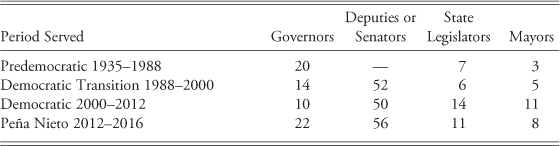
Political Careers in the Backgrounds of Mexican Cabinet Members (percent)

N = 517
Source: Mexican Political Biographies Project 2013, 2016.
The data in table 2 suggest several important patterns introduced by competitive electoral politics. In two of the four patterns, Peña Nieto’s choices have accentuated the importance of specific career experiences. The importance of local elective office, specifically mayor and state legislator, more than doubled between the democratic transition era and the post-2000 era. While Peña Nieto essentially has chosen fewer cabinet appointees who were mayors and state legislators than Fox or Calderón did, his cabinet secretaries still were more likely than their counterparts before 2000 to share in those career experiences.
The change in former governors’ representation in Peña Nieto’s cabinet is even more dramatic, after reaching a low figure of one in ten in the democratic era. That drop can be explained by the fact that as an opposition party, the PAN had elected its first governor only in 1989, consequently having only a brief period to develop a pool of such available governors. The decline in governors between the pre-1988 cabinets and the 1988–2000 group can be explained in part by the preference of both Salinas and Zedillo for highly trained technocrats and policy experts, rather than traditional politicians. Former governors increased to a fifth in Peña Nieto’s cabinet, mirroring their level of representation in the predemocratic era. The argument can also be made that after 12 years without controlling the executive branch, the PRI itself, similar to the PAN, had to rely more heavily on governors, the most important office its members typically could reach from 2000 to 2012.
Two-thirds and two-fifths of governors since 2000 were, respectively, senators or deputies. Consequently, those cabinet members from 2012 to 2016 with such a background also increased significantly, accounting for more than half of Peña Nieto’s appointees. By comparison, cabinet members with similar legislative experi ence increased significantly in Brazil from the authoritarian military regime to the democratic administration (Reference Power and MochelPower and Mochel 2008, 226–27). The majority of the current cabinet not only has held elective office but has participated in the policy process in the legislative branch at the federal or state level. What is unique about the president’s career compared to those of his counterparts in the cabinet is that he has never held a national political post in any branch of the government, something true of all his collaborators and every president since 1920.
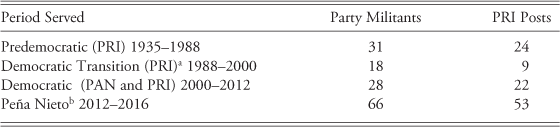
Party Militancy Among Presidential Cabinet Members (percent)

N = 517
a One member from PAN.
b One member from PRD, one from the Green Party.
Source: Mexican Political Biographies Project 2013, 2016.
The democratic electoral process has increased partisan militancy among national leaders, reflected in the positions they have held in their respective parties. During the predemocratic period, when only one cabinet minister was attached to an opposing party, only a third of cabinet members could be described as active party members, having held positions at the local, state, or national level. When all the important national politicians before 1988 are considered using the same criteria, fewer than half were active PRI members (Reference CampCamp 2010, 66).
Not surprisingly, with the advent of intense electoral competition, political skills emphasized by parties, including directing successful campaigns at all levels, became essential to an increasing percentage of politicians. It would be expected that such experiences would be far less common among cabinet secretaries than among all other politicians, and they declined during the 1980s and 1990s, when technocrats reached their apex in Mexican cabinets. During the two PAN administrations, party militants were as common as in the predemocratic era (table 3). The higher figures for the predemocratic era reflect the importance of electoral posts as governors or members of the legislative branch in the backgrounds of every president from 1935 through 1976. Peña Nieto’s appointments dramatically reflect the rise of political party experiences among top officials in the executive branch, who achieved those posts during the competitive electoral process from 2000 to 2012. Many of these individuals served on the PRI’s National Executive Committee and as regional party presidents.
Peña Nieto’s experience is atypical of militant party members, having been an active participant in three PRI gubernatorial campaigns and the head of the PRI delegation to the state legislature rather than in charge of a party post. Party militancy among all three parties’ representatives in the executive branch has increased. One-fifth of the PAN’s cabinet officers from 2000 to 2012 were National Executive Committee secretaries, and 29 percent held other party posts. Half of all cabinet members in those two administrations held party posts, the highest level among cabinet officers before 2012. Most influential PAN members eked out their political careers opposing the incumbent PRI in the executive branch, competing for elective legislative offices, or serving as governors or mayors in their home states. Their success in obtaining nominations and winning elections typically required active participation in the party locally and nationally.
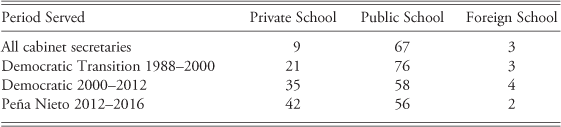
Undergraduate Training of Mexican Cabinet Secretaries (percent)

N = 517
Note: Some rows do not total 100% because figures refer only to those individuals who graduated from college.
Source: Mexican Political Biographies Project 2013, 2016.
The Education Variable
Where leading politicians are educated and the level of their educational achievement have not attracted much attention in the analysis of elite U.S. politicians. In Mexico, however, examination of recruitment trends among the national political leadership has demonstrated that throughout the twentieth century, cabinet-level secretaries’ credentials are prescient predictors of future leadership patterns. Such individuals often are in charge of the gatekeeping functions of political leadership (Reference CampCamp 1995, 105–9). We also know from previous examinations of Mexican leadership that political mentors tend to replicate their own characteristics among their disciples. No single area in the credentials of leading executive branch politicians illustrates this phenomenon more clearly than higher education (Reference CampCamp 2002). The level, location, and type of education that future cabinet secretaries received influenced their values, their skills, their recruitment, and even how they found their initial mentors.
The long-term pattern marking the type of educational institution cabinet secretaries attended is the presence of private schools (table 4). Two out of five cabinet members typically are graduates of a small number of prestigious schools. Those institutions are the Autonomous Technological Institute of Mexico (ITAM), the Ibero-American University, and the Monterrey Institute of Higher Studies (ITESM). Peña Nieto’s colleagues have replicated this pattern. Fifteen individuals spent their undergraduate years in private schools.
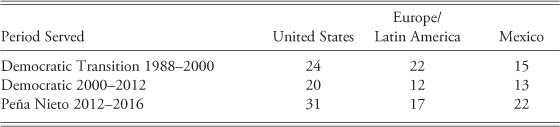
Graduate Studies Among Cabinet Secretaries (percent)

Source: Mexican Political Biographies Project 2013, 2016.
All three presidents since 2000 attended private undergraduate programs, reinforcing this trend among cabinet secretaries: Fox, Ibero-American University (Jesuit); Calderón, the Free Law School; and Peña Nieto, the Pan-American University (Opus Dei), reflecting the changing socioeconomic backgrounds of presidents, the presence of PAN politicians in the presidency, and the increasing prestige of private universities, especially in the economics discipline. No other presidents since 1934 have graduated from private undergraduate institutions.
The increasing pattern of cabinet secretaries’ obtaining graduate degrees abroad (46 percent) during the two PAN administrations declined from that of the Salinas and Zedillo administrations (61 percent). The higher figures from 1988 to 2000 also can be attributed to the apex reached by technocrats during both PRI administrations. Peña Nieto’s appointments, however, clearly indicate a significant increase in graduate studies generally, but especially in the United States and Mexico (table 5). One in three cabinet secretaries obtained a graduate degree from a U.S. university and one in five from a Mexican institution. These figures mark a 61 percent increase in the combined graduate degrees from U.S. and Mexican institutions compared to the two previous presidential administrations. Cabinet members with postgraduate degrees from the United States are strongly represented in the field of economics, which was also the case in the democratic and democratic transition eras.
Certain foreign graduate schools have dominated cabinet members’ education, especially in economics. Why is it that U.S. East Coast universities, and Ivy League schools specifically, continue to predominate among their graduate education choices? In fact, only rarely can one encounter a graduate degree from a West Coast institution in the United States. The explanation for the geographic distortion, from an examination of more than two generations of top executive branch officials, is that recent cabinet members have graduated from the same schools as their political mentors, reinforcing the importance of identifying where future politicians go to school. The most direct example of a mentor influencing a student was the effort of Pedro Aspe, secretary of the treasury under President Salinas, who chaired the ITAM Economics Department in 1994, after he left office. He recommended Luis Videgaray, a graduate of that program, to Professor Rudi Dornbusch, an influential economics professor at MIT, who became Videgaray’s dissertation adviser.
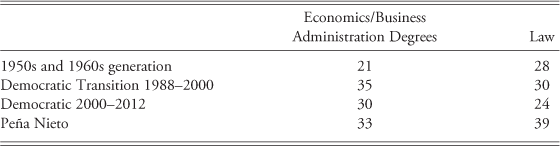
Undergraduate Economics and Law Degrees Among Cabinet Members (percent)

Note: Figures refer only to graduates in these two fields, which have dominated higher education degrees among Mexican politicians generally and cabinet secretaries specifically.
Source: Mexican Political Biographies Project 2013, 2016.
The importance of obtaining a graduate degree from such institutions was not lost on successful public figures in Mexico who had ambitions to reach cabinet positions. Recent cabinet members have taken great pride, even in their official biographies, in highlighting their graduate education abroad. The best example in Peña Nieto’s cabinet is his former chief of staff, Aurelio Nuño Mayer, appointed secretary of public education in 2015, who graduated from St Antony’s College, Oxford University with a master’s degree in Latin American studies. He has proudly noted that he studied under Professor Alan Knight, a leading historian and student of Mexico (Wikipedia).
An analysis of the two most influential undergraduate disciplines among cabinet figures suggests that Peña Nieto not only has emphasized once again the importance of graduate education, especially in the United States, but has revived the importance of economically trained politicians at the highest levels, equal to the technocratic domination of the 1990s.The major economic policy consequences of their educational backgrounds at U.S. graduate schools have been fully documented (Reference GolobGolob 1997; Reference BabbBabb 2001). However, law degrees, more typical among politicians with elective backgrounds, which had declined since 1988, also increased significantly among his cabinet choices (table 6).
An important reason for this dramatic increase in law degrees is not only the change from a PAN to a PRI administration but also Peña Nieto’s appointment of a number of figures who are older and whose careers represent “traditional” PRI politicians, often former governors, who attended public institutions in their home state. For example, Jesús Murillo Karam (b. 1948), the attorney general, is a graduate of the University of Hidalgo in Pachuca; Emilio Chuayffet Chemor (b. 1951), Peña Nieto’s first secretary of public education, who was governor of the state of México, graduated from UNAM’s National School of Law in 1974. Nevertheless, many of Peña Nieto’s younger appointees also completed undergraduate law degrees.
Yet another component of the educational backgrounds shared by cabinet members, including members of Peña Nieto’s cabinet, is contact with their professors. These cabinet secretaries, like many of their mentors, have taught at their alma maters or other leading institutions. Peña Nieto’s appointee to direct Pemex, the government oil industry, Emilio Lozoya Austin, is another former student of Pedro Aspe. He has credited Aspe with helping him and many other students to study abroad, often at Ivy League institutions (he went to Harvard), including Aspe’s own Ph.D. alma mater, MIT.
Luis Videgaray, whom Aspe helped to enter MIT, became an adviser to Aspe while still an undergraduate student at ITAM, from 1992 to 1994, when Aspe was secretary of the treasury. Later, from 1998 to 2005, Videgaray worked for Aspe’s consulting firm, Protego, where Peña Nieto met him, and he eventually became an adviser to Peña Nieto and a key figure in his presidential campaign.
Teachers as mentors to future prominent public figures have long been critical gatekeepers among executive branch leaders. This pattern increased significantly under President Miguel Alemán, who recruited an extraordinary percentage of his cabinet from both his National Preparatory School class and his National University Law School class. Most Mexican presidents have spent time in college classrooms as teachers, as have a large percentage of cabinet members. At least 50 percent of Peña Nieto’s cabinet appointees have taught at the college level. The president himself taught at the Panamerican University, his alma mater.
Family Ties in Cabinet Politics
The rise of Peña Nieto’s candidacy in the media, long before the election, prompted much speculation about the personal linkages between the likely PRI candidate and notable politicians from the past. After he won the election and appointed his presidential transition team, further speculation abounded about his future cabinet appointees and their relationships with the candidate and other political figures, as a means of identifying the potential impact of established politicians on future leadership trends, as well as on policy preferences.
Two-fifths of Peña Nieto’s eventual choices are known to have influential family political ties, compared to nearly three out of ten of all cabinet members in the democratic era. Both represent a decline from the past, when nearly half of all cabinet secretaries were known to be related to nuclear family members in the democratic transition, 1988–2000.
This pattern holds for other countries as well. Recent research in Italy, for example, demonstrates empirically that individuals with prior family ties have a “substantial advantage at the start of their political career . . . and are significantly more likely to be elected as mayor” than local politicians without such linkages (Reference Gianmarco and GeysGianmarco and Geys 2014, 24). Cabinet members in Japan are also more likely to have significant family connections (Reference JoyceTaniguchi 2008).
No president in recent memory can claim the extensive personal political linkages attributed to Peña Nieto himself. The president is correctly identified with the Atlacomulco Group, consisting of three generations of politicians extending back to the 1940s. Peña Nieto, a native of that city in the state of México, is related to five prominent governors of his home state, beginning with Alfredo del Mazo Vélez, whose great-grandfather, grandfather, and father were mayors of that city. Del Mazo Vélez was a nephew of Isidro Fabela, interim governor from 1942 to 1945.
A close friend of Adolfo López Mateos, president of Mexico from 1958 to 1964, Del Mazo Vélez served as secretary of hydraulic resources in López Mateos’s cabinet, after serving as governor of México State from 1945 to 1951. His son, Alfredo del Mazo González, governed México from 1981 to 1986 and joined Miguel de la Madrid’s cabinet (1982–88) as secretary of energy, becoming one of the leading contenders for the PRI nomination in 1988. Del Mazo González is Peña Nieto’s second cousin. The president’s father served in his gubernatorial administration (El Universal 2005).
Peña Nieto also is related, through his mother, to Salvador Sánchez Colín (another Atlacomulco native), who followed Del Mazo Vélez as governor from 1951 to 1957. Furthermore, the president is related to Arturo Montiel Rojas, whose father also was mayor of Atlacomulco, and who himself was governor of México from 1999 to 2005 (Diario de Yucatán 1999; El Universal 2005).
Peña Nieto personally is the most dramatic example among his cabinet members of someone related to his political mentor. He was the member of a group of young politicians who were known popularly in political circles as the Golden Boys, and who included his later confidant and campaign coordinator, Luis Videgaray. The future president served in Montiel’s gubernatorial campaign in 1999 as an assistant secretary of finance. As governor, Montiel appointed Peña Nieto assistant secretary of government, the most important political agency at the state level, and in 2000, secretary of administration (Reference VillamilProceso 2012).
Several cabinet members also are products of distinguished political families, but in most cases, they are not direct disciples of their relatives in their political careers. What is most striking about familial political connections among Peña Nieto’s cabinet is the number of appointees who are linked through family ties to former president Carlos Salinas (Reference Aragón FalomirAragón Falomir 2012). Emilio Lozoya Austin falls into this category, in what can be described as a multigenerational family political tree (although mentored by Pedro Aspe). His grandfather, General Jesús Lozoya Solis, was interim governor of Chihuahua in the 1950s, and more important, served as a personal physician to the Salinas family (Excélsior 1996). His father, Emilio Lozoya Thalmann, who attended Harvard with Salinas, served as secretary of energy at the end of Salinas’s administration. Claudia Ruiz Massieu Salinas also falls into this category, since she is the niece of President Salinas, whose sister is her mother. Another appointee, José Antonio González Anaya, served as director-general of the Mexican Social Security Institute, 2012–16, and then director-general of Pemex, 2016. He is related to Salinas through his stepmother, the sister of the former president’s wife.
President Peña Nieto’s cabinet also reflects a longstanding feature of cabinet appointments, which can be described as “reverse mentorship.” Many prominent political figures have been appointed by their original disciples to influential public offices. As mentioned previously, Guerra Abud was the president’s first supervisor in his public administration career. In return, the president appointed his early mentor as secretary of the environment and natural resources in 2012. Peña Nieto repeated this pattern when he appointed Emilio Chuayffet Chemor as his secretary of public education. He had worked for Chuayffet on his successful campaign for governor of México in 1993.
Institutional Change: The Role of the Transition Team
It can be argued that President Peña Nieto introduced a significant institutional change in the formation of his cabinet, active participation on the transition team from Calderón’s to his administration. The credit for this lies largely with President Calderón. Calderón explained in an interview that he offered to help Peña Nieto’s transition to the presidency. Not only did he make clear to his successor that he welcomed the opportunity to assist in this critical transition, but he ordered all his agency directors to identify briefly those issues they considered to be most critical in their respective policy arenas, and aspects of each policy that required the attention of the incoming administration (Reference Beezley and CampBeezley and Camp 2015).
Calderón believed strongly in encouraging such a positive relationship because his predecessor, Vicente Fox, did not offer any assistance in his transition. Instead, boxes of reports hundreds of pages long were delivered to his representatives “when Calderón took office in 2006. The lengthy reports created difficulties because planners for the incoming government did not have enough time to read them thoroughly before they had to make important decisions” (Reference JoyceJoyce 2015a).
As the interviews in Roberto Joyce’s valuable studies make clear, many of President Calderón’s closest advisers agreed that it was impossible “to achieve definitive success on major national problems” in a presidential term, and that “the big things you start, you don’t finish as president. You have to be very lucky that the former president gives you something for you to give to the people” (Reference JoyceJoyce 2015a). What is also remarkable about Calderón’s efforts is that a year before his administration ended (without knowing the results of the election), he requested that each of these cabinet-level agencies “prepare reports documenting ongoing projects, policies, and office organizational structures in order to brief the incoming president and Cabinet, whichever party won. The direct instruction of the president was to give the next government everything no matter if the government was the PRI or the PAN” (Reference JoyceJoyce 2015b).
Peña Nieto introduced two institutional developments in the credentials of successful members of his cabinet. The first of these career experiences consists of having served as one of 35 policy coordinators on the presidential transition team. The second is previous career experience at the state level, specifically in the state of México, often in comparable positions. Forty-three percent of those coordinators joined the president’s cabinet between 2012 and 2016. In addition to the 15 individuals who held cabinet positions, 9 additional coordinators served as assistant secretaries in these agencies. In one case, that of the Secretariat of Government, led by Miguel Ángel Osorio Chong, the general coordinator of politics and security, 4 other members served as assistant secretaries: Roberto R. Campa Cifrián, Paloma Guillén Vicente, Luis Felipe Puente Espinosa, and Felipe Solís Acero, all of whom served as coordinators in the Politics and Security Section.
The argument can be strongly made that being chosen to serve on the transition team overwhelmingly was a steppingstone to the most influential positions in cabinet agencies. Not surprisingly, most of these individuals served in agencies responsible for the policy issues they were charged with on the transition team. It remains to be seen if the next president-elect of Mexico will follow in Peña Nieto’s footsteps in emphasizing linking transition team experience to cabinet-level appointments. But the collaboration between the officials from Calderón’s government with the extensive numbers of incoming top officials of Peña Nieto’s government also played a critical role in the creation of the bipartisan Pacto por México, an agreement that allowed the president’s administration to introduce the most significant policy reforms since the 2000 presidential election. The president and the presidents of the three major parties signed this agreement, which lasted 14 months.
We have noted previously that Peña Nieto was the first individual since 1929 to have had no experience in the federal government before becoming president. His entire public career, elective and appointive, was confined to his home state of México. Although it is possible that future presidential candidates who are or were governors might replicate this new career pattern in the backgrounds of their cabinet appointees, it is not likely, because governors who achieve the level of political prominence to successfully obtain their party’s nomination for president typically have national political experience.
Conclusions
The most dramatic change in the characteristics of the present cabinet, including President Peña Nieto personally, that can be attributed to democratic change is the continuation of a significant increase in electoral offices, legislative and executive, and party militancy and offices, in the backgrounds of top decisionmakers in the federal government. Studies of the Brazilian cabinet during periods of democratic governance confirm a similar significant increase in legislative experience, local and national, among ministers.
This pattern in Mexico was accentuated during the previous two PAN administrations. It resulted from the importance of electoral politics and the fact that the entire careers of leading PAN politicians before 2000, with the exception of a handful of individuals, were concentrated in elective office, beginning with the state legislature and the national Chamber of Deputies, followed by mayoralty posts and governorships beginning in the late 1980s and increasing rapidly through the 1990s. The composition of those cabinets clearly supports the argument that electoral democracy exerted a significant impact on cabinet members’ careers, since to win those offices they needed to be active party militants and to be involved in local and national party organizations.
As I have argued elsewhere, PRI militants were not immune to these systemic changes. In other words, there is no question that the altered political context emanating from a fair electoral process produced intensive electoral competition at the local, state, and federal levels, reinforcing the importance of all political parties, and the politicians who shared in those party and elective experiences, as a likely vehicle for achieving the presidency and appointive posts at the cabinet level.
The president himself highlights this change. His first political experience occurred when he was a teenager, as a propagandist in his cousin’s 1981 campaign for governor of the state of México (Reference VillamilVillamil 2012; El Universal 2005). In 1990, he served as a secretary to the Citizens’ Movement at the regional level for the National Federation of Popular Organizations, the most influential sector affiliate of the PRI. Three years later, he worked on Emilio Chuayffet’s gubernatorial campaign. He even taught as an instructor at a PRI electoral training center. His entire political experience from 1981 to 1993 occurred in the electoral political arena.
What is striking about Peña Nieto’s cabinet, however, is the increase in their electoral gubernatorial offices (table 2) and in party militancy and party positions (table 3) compared to the two previous administrations: a 120 percent increase among those who were governors, as well as a 136 percent increase in party militancy and a 141 percent increase in political party posts. The extent of these dramatic changes overall has not occurred previously. Thus, these figures reinforce the notion that if governors continue to play a decisive role in the formation of top-level executive branch leadership, these frequent career trajectories in electoral and party posts will also continue.
This pattern can also be explained by the fact that during the years 2000–2012, most ambitious politicians affiliated with the PRI were largely limited to winning governorships and positions in the legislative branch, rather than joining the cabinets dominated by PAN members or independents. Given that seven of the nine leading presidential candidates of the three major parties in 2000, 2006, and 2012 were former governors, this historical pattern encouraged politicians with presidential ambitions to seek gubernatorial offices. It is too soon to know all of the candidates for the next presidential elections in 2018, but of the three candidates from the National Regeneration Movement (Morena), the PRD, and the PRI, two have been governors of the Federal District and none were members of the Chamber of Deputies (Carta Paramétrica 2017). The final argument is only partially supported by the fact that the presidential candidate from the PRI for 2018, Treasury Secretuary José Antonio Meade, is a cabinet member, which is the source of his national recognition.
Another important insight comes from the composition of the Peña Nieto cabinet beyond the four suggested hypotheses, consisting of a major change in the career experiences of his economic cabinet, a decisively new technocratic hybrid. A more detailed analysis of the two key officials, his initial secretary of the treasury and secretary of the economy, clearly demarcates a departure from past government economic leadership. Luis Videgaray represents an established policy continuity in macroeconomic philosophy from the Salinas-Zedillo eras through the Fox and Calderón period. Of the seven treasury secretaries who preceded him from 1988 to 2012, only one, Meade, had ever held an elective political office. Videgaray not only served in the Chamber of Deputies from 2009 to 2011 but was president of the PRI in the state of México, a national political adviser to the PRI, and a key player in Peña Nieto’s presidential campaign. He joined the PRI Revolutionary Youth Front at 19. Videgaray resigned from the Treasury in 2016 and was replaced by Meade, who had held that same post in the Calderón administration. Three months later, on January 4, 2017, Videgaray was appointed secretary of foreign relations.
Moreover, if we combine the leadership of the treasury secretariat with the 8 previous secretaries of economy, only 3 of those 16 cabinet figures had held elective office. Ildefonso Guajardo Villarreal, the current economy secretary, also reveals extensive elective and party experiences as a deputy to the state legislature and coordinator of the PRI delegation, a two-time federal deputy in the last decade, the coordinator of international relations for the National Executive Committee of the PRI, and an assistant secretary-general of the party. His elective and campaign experiences are extensive.
These changes reflect two influential patterns. First, Mexico’s economic leadership in this presidency does not emanate solely from the federal bureaucracy, as in the past. Second, the new economic leadership can claim to have developed proven political skills, well beyond those necessary to succeed inside a large bureaucratic structure, and broader political abilities, which may be helpful in their relationships with the legislative branch, relying on negotiation and compromise. These appointments establish a benchmark for these two economic cabinet positions. It remains to be seen whether or not the combination of their economic training and political experience will be valued throughout Peña Nieto’s administration and beyond.