Non-invasive methods of brain stimulation are being increasingly investigated for the treatment of major depressive disorder (MDD). Transcranial direct current stimulation (tDCS), a promising treatment in which weak, constant, direct electric currents modify brain excitability by neuronal modulation of membrane resting potential and secondary synaptic changes, has shown encouraging results Reference Zaghi, Acar, Hultgren, Boggio and Fregni(1). To date, three randomised clinical trials using current tDCS methodology (Reference Fregni, Boggio, Nitsche, Marcolin, Rigonatti and Pascual-Leone2–Reference Loo, Sachdev and Martin4), and some open trials Reference Rigonatti, Boggio and Myczkowski(5,Reference Ferrucci, Bortolomasi and Vergari6), have tested the efficacy of tDCS for treatment of MDD. These trials have mixed results, thus promoting further research in the field.
In the context of tDCS clinical development, there are other equally important issues such as safety and potential adverse effects that need to be addressed. Because some adverse effects are rare and therefore not detected in small trials, it is important to report and discuss moderate or severe side effects such as hypomania. Recently, Arul-Anandam et al. Reference Arul-Anandam, Loo and Mitchell(7) reported treatment-emergent hypomania during tDCS treatment. Here, we report a patient who also presented with hypomania after tDCS; however, unlike in Arul-Anandam et al.'s case study, our patient sustained hypomania for a longer period of time. And, we discuss the clinical and research implications of tDCS inducing hypomanic episodes in patients with mood disorders.
A 58-year-old man who was referred to our team as a result of the symptoms of depression during the last 14 months. He was a suitable candidate for non-invasive stimulation therapy, as he recently had surgery for gastric cancer and could not tolerate antidepressants because of gastrointestinal effects. He was enrolled in the pilot phase of a larger, ongoing clinical trial of tDCS for MDD (8), which was approved by the Ethics Committee at Sao Paulo University (Hospital Universitario). Following the approved protocols, the anode electrode was placed over the left dorsolateral prefrontal cortex (DLPFC) located at F3 (according to the International EEG system 10-20) and the cathode over the right DLPFC (F4). The rubber electrodes consisted of 7 × 5 cm saline-soaked sponges fixed with a headband. Two milliamperes of current (current density = 0.6 A/m2) was applied for 30 min. Initially, we planned to apply stimulation for 10 consecutive workdays, but, as we shall discuss, it was applied only for 5 days.
We used a Portuguese-validated version of the Mini-International Neuropsychiatric Interview (M.I.N.I.) Reference Sheehan, Lecrubier and Sheehan(9) to assess and confirm the following diagnoses: (a) an acute, 14-month-long depressive episode, in which the patient used sertraline 50 mg/day for 1 year and (b) six previous depressive episodes, as follows: (i) at age 21, lasting 8 months, no medications used; (ii) at age 34, lasting 1 year, used imipramine 75 mg/day for 2 months; (iii) at age 40, lasting 6 months, used fluoxetine 20 mg/day; (iv) at age 46, lasting 8 months, no medications used; (v) at age 52, lasting 3 months, no medications used and (vi) at age 54, lasting 6 months, used sertraline 50 mg/day.
We did not confirm prior hypomanic episodes using DSM-IV criteria, which require at least three elation/expansiveness symptoms (or four if only irritable mood occurs) for more than 3 days. Instead, he had several episodes (about two per year since he was 18) lasting less than 48 h, in which he presented with dysphoric mood, insomnia, grandiose ideas and increased energy and activity. In addition, he had some periods lasting less than 1 week in which he presented with only increased irritability and energy. Importantly, he also reported the emergence of hypomanic symptoms after using imipramine, which was his first use of antidepressants. However, at that time (1985), his psychiatrist did not investigate whether he fulfilled the criteria for a hypomanic episode.
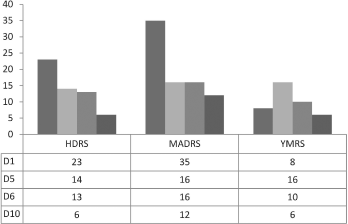
His Hamilton (HDRS) and Montgomery-Asberg (MADRS) depression baseline severity scores were 23 and 35, respectively, suggesting a moderate-to-severe depressive episode. He had a Young Mania Rating Scale (YMRS) of 8, below the threshold of 12 that represents mania (see Fig. 1) Reference Vilela, Crippa, Del-Ben and Loureiro(10).
Scale scores for Hamilton Depression Rating Scale (HDRS), Montgomery-Asberg Depression Rating Scale (MADRS) and Young Mania Rating Scale (YMRS) from baseline to endpoint. On the x-axis, ‘D1’ represents the first day of stimulation; ‘D5’ represents 7 days after treatment onset – the fifth treatment day, when hypomanic symptoms were detected, sertraline was discontinued and tDCS was postponed; ‘D6’ represents 12 days after – the sixth treatment day, when tDCS was resumed and ‘D10’ represents 21 days after treatment onset – the tenth treatment day.
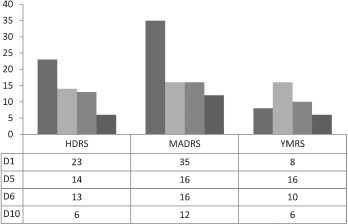
Five days after the onset of treatment, HDRS and MADRS scores substantially decreased, while YMRS increased (8–16). In fact, although he reported that he was sleeping better, had no more suicidal thoughts and had more energy, he felt distressed, angry and explosive, and he had increased sexual arousal and racing thoughts. He also spontaneously described his feelings and behaviours as in the same way when I was on Imipramine.
Afterwards, sertraline was discontinued and neurostimulation was postponed for 1 week while the patient was re-evaluated and, because of remission of hypomania, tDCS was resumed at a lower current (1.5 mA instead of 2 mA). The patient's endpoint scores showed remission of both depressive and manic symptoms (Fig. 1). One month after tDCS treatment, J. S. had sustained remission and lamotrigine was introduced 50 mg/day as a maintenance treatment for bipolar disorder not otherwise specified. Since then J. S. had presented no more manic or depressive symptoms (for 5 months).
We reported a patient with depressive symptoms and no prior formal episodes of mania or hypomania, who developed a tDCS-induced transient hypomanic episode, which reverted only after discontinuation of treatment. Here, we discuss possible relationships between the hypomanic episode and tDCS use, as well as implications for tDCS safety and future trials. In addition, although the risk of treatment-emergent mania after transcranial magnetic stimulation (TMS) seems to be low (<1%) according to a recent meta-analysis in unipolar and bipolar depression Reference Xia, Gajwani and Muzina(11) and a clinical trial in bipolar depression Reference Nahas, Kozel, Li, Anderson and George(12), it should be noted that TMS and tDCS have different mechanisms of action Reference Brunoni, Fraguas and Fregni(13); therefore, a comparison is not straightforward.
One important issue is whether the induction of hypomania is related to the potency of our intervention, as more potent antidepressants such as tricyclics (vs. non-tricyclics) and venlafaxine (vs. bupropion) are associated with a higher risk of hypomanic induction Reference Post, Altshuler and Leverich(14,Reference Koszewska and Rybakowski15). Therefore, it may be speculated that the combination of tDCS with sertraline might induce hypomania similar to potent antidepressants. Future trials could explore whether combined therapies induce more adverse effects. Finally, it is possible that hypomania in this case might have been spontaneous, i.e. not associated with the intervention (tDCS). Although this is unlikely because of the patient's past psychiatric history, this is a potential limitation of this case report.
Along these lines, it is important to disentangle whether the patient presented with a spontaneous mood elevation or a genuine tDCS-triggered hypomania. Indeed, he presented with past episodes of mood elevation twice a year throughout his life. On the other hand, they were very brief and not sufficient to characterise hypomania. In fact, he had never been diagnosed with bipolar disorder hitherto. In addition, he presented significant hypomanic symptoms after using imipramine, suggesting, along with his past history, a ‘bipolar diathesis'. Therefore, although our case report's limitations hinder us in inferring causality between tDCS stimulation and treatment-emergent hypomania (vs. a spontaneous mood swing), the temporal relationship between the intervention and the symptoms, as well as the phenomenology of the current versus the past episodes, allows us to suggest that such an association is plausible.
Another case report Reference Arul-Anandam, Loo and Mitchell(7) also illustrated a tDCS-induced episode of mania. In both studies (ours and Arul-Anandam's), patients had the same baseline characteristics (age, gender, duration and severity of disease) and had also presented with prior hypomanic symptoms (rather than episodes). On the other hand, our patient was on sertraline and received higher tDCS doses: 2 mA for 30 min versus 1 mA for 20 min. We also used a different tDCS set-up, bilateral prefrontal tDCS, while Arul-Anandam et al. placed the cathode over the right supra-orbital area. Finally, we were able to measure hypomania using the YMRS, whereas Arul-Anandam et al. did not use any specific scale.
In summary, considering our report limitations, we theorise that the delivery of a higher and more potent tDCS dose than typically used in studies, combined with antidepressant drug treatment in a patient with a ‘bipolar diathesis', could have induced transitory hypomania. The implications of this preliminary report is that further tDCS clinical research should (a) explore ‘bipolar diathesis' using general, structured questionnaires such as the Structured Clinical Interview for DSM (SCID) or M.I.N.I., as well as specific affective questionnaires such as the mood disorder questionnaire Reference Hirschfeld(16); (b) evaluate treatment-emergent hypomania not only clinically but also using specific rating scales such as the YMRS; (c) explore whether different tDCS parameters (regarding electrode placement and amount of current delivered) are associated with increased hypomania emergence and (d) explore a possible role for mood-stabiliser drugs in specific subgroups of depressed patients during tDCS therapy.