Introduction
For centuries, nature has provided inspiration for man in the design and manufacture of structural materials. Many natural materials display fascinating physical and mechanical properties that, until recently, have been hard to replicate in artificial materials and structures. These include high stiffness and low density, Reference Liu, Jiao, Meyers and Zhang1 strong adhesion and easy detachment, Reference Yao and Gao2 self-sharpening, Reference Killian, Metzler, Gong, Churchill, Olson, Trubetskoy, Christensen, Fournelle, De Carlo, Cohen, Mahamid, Scholl, Young, Doran, Wilt, Coppersmith and Gilbert3 self-healing, growth, and adaptive tissue organization, water-repellence, self-cleaning, and superhydrophobic or superhydrophilic behaviors. Reference Tian and Jiang4,Reference Meyers, Chen, Lin and Seki5 All of these properties are usually related to complex multiscale structural arrangements of different constituents, from the nano- to the macroscale, involving material mixing and grading, interaction between constituents, and, most importantly, hierarchy, intended as the property whereby a material exhibits structure on more than one length scale. Reference Ji and Gao6–Reference Gupta, Seto, Wagermaier, Zaslansky, Boesecke and Fratzl8
In the study of bioinspired materials, the focus is on the link between material properties and the emergence of specific functions across all relevant scales. The main lesson from nature is that complex behavior and functionality derives from structure, hierarchy, and optimal organization of simple basic components. This is in stark contrast to many engineered materials that exploit the properties of exotic metals or polymers, with associated high production and environmental costs. Nature has successfully done more with less, in terms of material design and production. This paradigm could, in principle, also apply to synthetic materials, and can be transposed to many fields in engineering, with the potential to do even better than nature, in the absence of limiting biological constraints.
Experimental tests and measurements on hierarchical materials can be difficult to rationalize due to high uncertainties and statistical dispersion at the nanoscale, difficulties in sample manipulation and characterization, problematic reproducibility of boundary conditions and, in some cases, the impossibility of direct experimental verification at all the different size scales. Thus, due to the complexity and cross-scale interaction of the physical phenomena involved, further progress requires comprehensive numerical modeling. The challenge is to integrate multiple length scales and physical phenomena within the same simulation framework, since in hierarchical structures, a piecewise understanding of individual parts cannot simply be assembled or superimposed: the whole is greater than the sum of the individual parts. Reference Cranford9,Reference Cranford, de Boer, van Blitterswijk and Buehler10
Numerical modeling of biological and bioinspired material properties
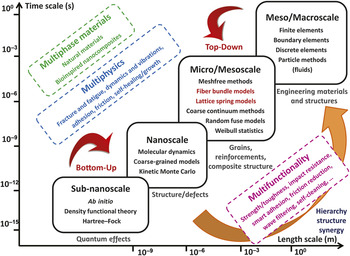
Computational methods to model the mechanics of hierarchical materials need to span the various size and time scales of the problems involved. These can be divided schematically into three broad categories: (1) nanoscale—methods like density functional theory or molecular dynamics (MD) to achieve characterization of the basic constituents of hierarchical composites; (2) micro-/mesoscale—fiber bundle model (FBM), lattice spring model (LSM), discrete and meshless methods to reconstruct the role of hierarchy and material mixing in characteristic mechanical properties of composites; and (3) macroscale—finite element methods (FEMs) and discrete or boundary element methods to model complex mechanical problems at the continuum level for solids, and particle methods for fluid mechanics, based on Navier-Stokes or Boltzmann equations. Figure 1 depicts the overall scenario of these multiscale analysis techniques.
Multiscale approaches to model hierarchical materials, including the region of applicability in spatial and time scales. Adapted with permission from Reference Reference Buehler and Ackbarow65. © 2007 Elsevier.

Computational methods can provide new insights for understanding fracture mechanisms in heterogeneous/hierarchical/multiscale structures, starting from the nanoscale. Various multiscale models have been developed to capture the mechanisms involved in the optimization of global material mechanical properties. Reference Olson11–Reference Mishnaevsky and Dai13 One example is represented by the FBMs, Reference Pradhan, Hansen and Chakrabarti14 which are particularly appropriate for the simulation of fibrous materials, often occurring in biomaterials. Here, material structure at a certain size scale is modeled as a network of fibers arranged in parallel and in series subjected to uniaxial tension, with statistically Weibull-distributed yield and fracture strengths or strains. Usually, an equal-load-sharing hypothesis is adopted, Reference Pradhan, Hansen and Chakrabarti14 whereby when fibers fracture, stresses are redistributed uniformly among the remaining fibers in the bundle. Multiphase media are modeled by assigning different mechanical properties to the fibers of each bundle.
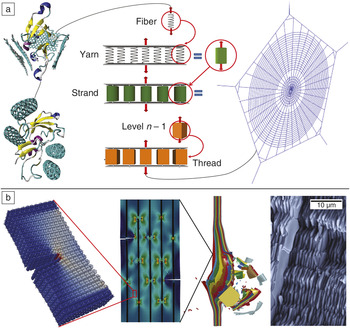
We introduced a hierarchical extension of this approach (i.e., the hierarchical fiber bundle model [HFBM]), whereby the input mechanical behavior of a subvolume or “fiber” at a given hierarchical level is statistically inferred from the average output deriving from repeated simulations at the lower level, down to the lowest hierarchical level Reference Pugno, Bosia and Abdalrahman15 ( Figure 2a). Results from this and other implementations of HFBM show that specific hierarchical organizations can lead to increased damage resistance (e.g., self-similar fiber-reinforced matrix materials) Reference Mishnaevsky16 or that the interaction between hierarchy and material heterogeneity is critical, since homogeneous hierarchical bundles do not display improved properties. Reference Bosia, Abdalrahman and Pugno17 The effect of defects at the nanoscale can also be accounted for, and the HFBM has been used to estimate the strength and stiffness of macrostructures such as the futuristic nanotube-based space elevator cable, highlighting the defect-related decrease in performance with respect to estimations based on ideal defect-free materials. Reference Pugno, Bosia and Carpinteri18
Examples of multiscale structure and simulations on the strength and toughness of hierarchical biological and bioinspired materials. (a) The mechanical behavior of nanoreinforced “bionic” silk Reference Lepore, Bonaccorso, Bruna, Bosia, Taioli, Garberoglio, Ferrari and Pugno64 is modeled using molecular dynamics simulations to derive the statistical distribution of material properties for native silk proteins mixed with carbon nanotubes or graphene at the nanoscale. These distributions are then used as inputs in a hierarchical fiber bundle model, Reference Bosia, Abdalrahman and Pugno17 where hierarchical organization is modeled for the strands at various hierarchical levels up to the web structure that can be modeled within a finite element method (FEM) framework. (b) Modeling of artificial multilayer nanocomposites inspired by nacre by means of a hierarchical lattice spring model. Reference Brely, Bosia and Pugno21 The results yield material constitutive laws that are fed into FEM impact simulations. Reprinted with permission from Reference Reference Lin, Li, Ortiz and Boyce43. © 2014 Elsevier.

Similar approaches, appropriate for two-dimensional (2D) or three-dimensional (3D) simulations, are based on LSMs Reference Gavin, Christopher and Douglas19 or random fuse models, Reference Zapperi, Vespignani and Stanley20 which provide a discrete description of continuous media through a network of discrete elements (springs or “resistors”). These have been used to simulate plasticity, damage propagation, and statistical distributions of “avalanches” of fracture events in heterogeneous materials. Reference Zapperi, Vespignani and Stanley20 Similar to the procedure adopted for HFBM, we recently introduced the hierarchical lattice spring model (HLSM), extending the classical LSM Reference Brely, Bosia and Pugno21 (Figure 2b). Other analytical theories such as our quantized fracture mechanics Reference Pugno and Ruoff22 (QFM) or atomistic methods such as MD can be integrated in these multiscale approaches, for instance, to determine constitutive laws at the lower scale as a function of atomic structure, defect content, or molecular organization.
Other computational approaches that can also be used to model fracture propagation in a multilevel scheme include 3D mesh-free models, useful for simulating complex 3D heterogeneous media with nonlocal effects. Reference Yang, Budarapu, Mahapatra, Bordas, Zi and Rabczuk23,Reference Barbieri and Meo24 These methods have also been implemented in a multiscale scheme. Reference Zhang, Liu, Li, Qian, Hao, Griebel and Schweitzer25 Standard FEM approaches based on erosion algorithms are pushed to their limits when dealing with fracture nucleation and propagation. Therefore, various alternative strategies have been adopted, such as adaptive refinement of the mesh along the model solving the use of cohesive zone model (CZM)-based elements, or extended FEM (X-FEM). Reference Song, Wang and Belytschko26 Peridynamics is a meshless method whose nonlocal response represents an ideal bridge between atomistic (MD) and continuum methods. Reference Silling27 This novel approach is based on a nonlocal and integral reformulation of the standard continuum theory of solid mechanics, which is applicable even when cracks and other singularities appear in the deformation field. Since peridynamics models continuous media, discrete particles, and defects using the same set of equations, it provides a means to couple different length scales. Reference Silling27
Applications of modeling biomaterials
Both theoretical models and numerical methods such as those previously described have shown that reinforcement organization in biological or bioinspired composite materials can increase damage tolerance, avoiding direct crack path propagation and drastically improving the global response. Reference Sen and Buehler28 Studies have focused on the influence of the structure, reinforcement shape, aspect ratio, dispersion, organization, and of mechanical properties of the constituents at various scale levels, iteratively deriving higher scale mechanical properties from lower ones, until a global material response is obtained. Reference Zhang, Zhang and Gao29
As an example, the macroscopic nonlinear (stiffening) constitutive behavior of spider silk derived from atomistic simulations (Figure 2a) have been shown to play an essential role in the macroscopic robustness of spiderwebs, Reference Cranford, Tarakanova, Pugno and Buehler7 since simulations demonstrate that the same type of impact would cause more widespread damage for linear elastic and elastic-perfectly plastic counterparts. Another example of how an integrated framework can synergistically combine scalable modeling using coarse-graining with mesoscopic dissipative particle dynamics simulations for bioinspired design can be found in studies on silk spinning. Reference Lin, Ryu, Tokareva, Gronau, Jacobsen, Huang, Rizzo, Li, Staii, Pugno, Wong, Kaplan and Buehler30 The combined multiscale use of different computational techniques such as HFBM and HLSM has also proved to be successful in reproducing the macroscopic behavior of artificial nanocomposites such as gelatin-graphene oxide fibers. Reference Panzavolta, Bracci, Gualandi, Focarete, Treossi, Kouroupis-Agalou, Rubini, Bosia, Brely, Pugno, Palermo and Bigi31 Mesoscale models allow the design of composite materials exhibiting tailored fracture properties, drawing inspiration from mineralized biological composites. Reference Dimas, Bratzel, Eylon and Buehler32
Another biomaterial property that has been studied and simulated in recent years is self-healing, and its effects on the elastic, fracture, and fatigue properties of materials. Reference Balazs33 Self-healing is incorporated in HFBM/HLSM models by replacing fractured fibers or springs with intact ones (the process of healing) having appropriate mechanical properties, volume fractions, replacement rates, and locations as damage evolves during simulations. The main control parameter is the “healing rate,” defined as the ratio of the number of healed and fractured fibers in a given fixed time interval. Both “distributed” and “local” healing processes can be simulated, whereby fractured fibers are replaced either over the whole structure or at concentrated locations where damage is accumulated, respectively. Reference Bosia, Abdalrahman and Pugno34 It has been found that a hierarchical structure increases the efficiency of self-healing, leading to increased toughness with respect to the corresponding nonhierarchical case and fatigue resistance, for example, in tendons. Reference Bosia, Merlino and Pugno35
The problem of simultaneous optimization of strength and toughness in materials also appears in the field of high-energy shock loadings (e.g., impacts and blasts). Indeed, energy dissipation must occur in a limited volume of material in these cases, since heavy structures are generally undesirable, such as in body armors, helmets, and crashworthy components for automotive or aerospace applications.
Extreme specific impact toughness may be pursued, for example, through the adoption of graphene-based nanocomposites Reference Lee, Loya, Lou and Thomas36,Reference Yoon, Ostadhossein and van Duin37 or through smart bioinspired structural solutions. Dermal armors of various animals, such as the Arapaima gigas fish scales and many species of beetles, have several common characteristics, such as hard and patterned front layers Reference Patek and Caldwell38,Reference Kundanati and Gundiah39 and a backing sequence of softer layers, Reference Patek and Caldwell38,Reference Yang, Chen, Gludovatz, Zimmermann, Ritchie and Meyers40 with overall flexibility of the armor (when required for locomotion) guaranteed via discrete systems of interconnected scales. Reference Patek and Caldwell38,Reference Yang, Chen, Gludovatz, Zimmermann, Ritchie and Meyers40,Reference Yao, Dao, Imholt, Huang, Wheeler, Bonilla, Suresh and Ortiz41 All of these features are generally synergistically coupled with hierarchical assembly, which optimizes layer thickness strength and stiffness. Reference Patek and Caldwell38,Reference Ritchie42
The large variety of parameters to be considered in the study of these biological systems due to heterogeneity, the numerous levels of hierarchy, and the complexity of the constitutive laws (often strain-rate dependent) make experimental tests scarcely viable, and computational techniques are needed for the study of toughening mechanisms and for the design and optimization of bioinspired armors. Today, commercial software offers robust nonlinear FEM tools for the analysis of these types of large-scale problems at an acceptable computational cost. HFBM and HLSM are useful in providing an advanced constitutive response to be used as input in FEM simulations, which can be limited to details at the upper scale (Figure 2b). Thus, a series of parametric studies, each replicating thousands of experiments, can be performed. For example, the relationship between specific energy absorption in multilayer armors and the interface strength between layers, which could be tuned via different adhesive materials or with bioinspired hierarchical structuring of surfaces, Reference Lin, Li, Ortiz and Boyce43 has been rationalized and explained through a FEM study on composite multilayer structures. Reference Signetti and Pugno44
Modeling of impacts naturally involves friction. One of the main challenges is multiscale modeling of hierarchical rough surfaces that emerge at the microscale or from biological optimized solutions. Reference Baum, Kovalev, Michels and Gorb45,Reference Arndt, Moore, Lee and Ortiz46 Explicit numerical modeling of rough surfaces features a wide range of significant length scales and would be prohibitively expensive. Because of this, a central ingredient of a multiscale approach becomes homogenization, so that macroscale friction coefficients are derived from the solution of a microscale boundary-value problem based on the smallest representative volume element of the rough profile. Reference Wriggers47 Alternatively, isogeometric analysis, Reference Hughes, Cottrell and Bazilevs48 which exploits computer aided design of interpolating functions (splines) both as geometry descriptors and element basis functions, is especially attractive for the analysis of complex contact geometries. This can be exploited in the analysis of armors, for instance, such as those inspired by the bombardier beetle, whose reaction chamber for the production of a defensive fluid is enclosed in undulated walls for greater energy dissipation and structural resistance. Reference Arndt, Moore, Lee and Ortiz46
Another field in which multiscale FEM simulations are required is the modeling of dry adhesion in biological organisms, such as geckos, which is optimized using various strategies at different scale levels. Studies have shown how contact splitting (i.e., when a single contact is split into many smaller ones) is used effectively by animals such as geckos and insects to increase the total peeling line (i.e., the sum of the width of the contacts) and adhesion force. Reference Varenberg, Pugno and Gorb49,Reference Kamperman, Kroner, del Campo, McMeeking and Arzt50 This is combined at the microscale with tapering of contact units or gradation in mechanical properties to increase adhesion efficiency. Reference Varenberg, Pugno and Gorb49,Reference Peisker, Michels and Gorb51
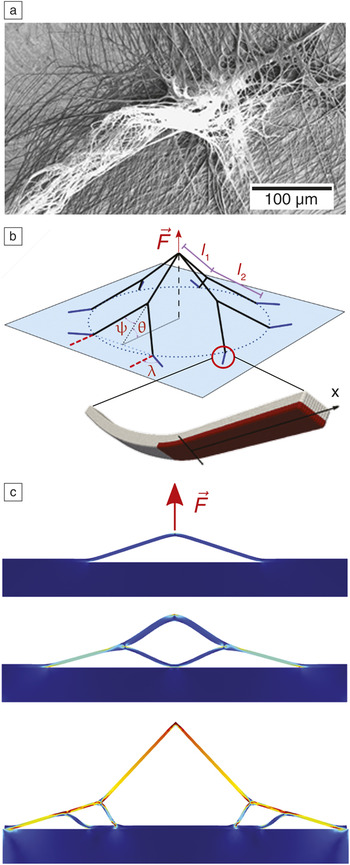
Structures such as the anchorages of spiderwebs to external structures ( Figure 3 ) exploit hierarchical structure together with nonlinear constitutive material properties to improve resilience and to achieve tunability in adhesion/detachment characteristics. Reference Sahni, Harris, Blackledge and Dhinojwala52 These mechanisms can be modeled using numerical implementations of our multiple peeling theory Reference Pugno53 or CZM formulations within a FEM-based framework. Such computational studies have revealed how, through hierarchical structure, contact splitting and adhesion can be maximized, Reference Bosia, Colella, Mattoli, Mazzolai and Pugno54 tunability achieved, Reference Brely, Bosia and Pugno55 and microcontacts optimized for improved performance. Reference Sauer and Holl56 These results can be of great value in the design of bioinspired micropatterned adhesive surfaces. Reference Carbone, Pierro and Gorb57
Application of the theory of multiple peeling Reference Brely, Bosia and Pugno55 and cohesive zone model (CZM)-based Reference Bosia, Colella, Mattoli, Mazzolai and Pugno54 finite element method (FEM) simulations to the problem of adhesion of spiderweb anchorages: (a) scanning electron microscope image of a spiderweb anchorage showing hierarchical multiple contact splitting, (b) schematization of hierarchical configuration in a multiple peeling simulation of the anchorage described by contact and split angles (φ, θ, λ) and thread lengths (l i), subjected to a peeling force F. (c) CZM-based FEM models are used to investigate the role of fibril shape, elasticity, and multiple splitting in delamination simulations. Reference Bosia, Colella, Mattoli, Mazzolai and Pugno54 (a) Adapted with permission from Reference Reference Sahni, Harris, Blackledge and Dhinojwala52. © 2012 Macmillan Publishers.

Another topic of interest is the study of the vibrations and wave propagation in biological or bioinspired structures, such as in the bombardier beetle’s undulated reaction chamber. The role of hierarchy in the dynamic behavior of these structures remains largely unexplored to date. Studies have highlighted the possibility of enhanced vibration damping through branching, including in bioinspired slender structures. Reference Theckes, Langre and Boutillon58 In the fields of phononic crystals and acoustic metamaterials (i.e., periodic structures exhibiting frequency bandgaps in which wave propagation is inhibited, or other exotic effects like focusing and cloaking), some theoretical investigations of 2D lattices with nonself-similar Reference Xu, Tian and Chen59 or self-similar Reference Lim, Wang, Koh, Khoo and Bertoldi60,Reference Mousanezhad, Babaee, Ebrahimi, Ghosh, Hamouda, Bertoldi and Vaziri61 hierarchical topologies have been performed. Preliminary numerical studies have shown that hierarchy can help create wider bandgaps at multiple frequency scales compared to simple periodic structures, Reference Miniaci, Krushynska, Bosia and Pugno62 and to tune the bandgaps and directionality of phononic crystals. Reference Mousanezhad, Babaee, Ghosh, Mahdi, Bertoldi and Vaziri63
Outlook
As discussed in this article, hierarchical design down to the nanoscale, where increased surfaces forces and material toughening mechanisms can be exploited, could be the breakthrough solution for a new generation of high-performance, multifunctional, and environmentally friendly materials. For this purpose, novel multiscale and multiphysics computational tools, such as HFBM and HLSM discussed here, need to be further developed, bridging traditional methods that deal with distinct scale ranges and enabling engineers and scientists to tailor and optimize structural mechanisms in multiphase, multiscale, and multifunctional materials. To make this possible, the aim of computational scientists is to broaden the overlap regions in scale and time between different simulation techniques, relying on the availability of ever more powerful computational resources and, whenever possible, to enable their integration within the same computational multiscale framework.
Acknowledgments
N.M.P. is supported by the European Research Council (ERC StG Ideas 2011 BIHSNAM No. 279985 and ERC PoC 2015 SILKENE No. 693670) and by the European Commission under the Graphene FET Flagship (WP14 “Polymer Composites” No. 696656). S.S. and F.B. acknowledge support from BIHSNAM.