



Temperamental exuberance or surgency is characterized as a relatively stable disposition to exhibit high levels of approach to novelty, anticipatory pleasure, and activity (Stifter & Dollar, Reference Stifter, Dollar and Cicchetti2016). Some studies have shown that children who are high in exuberance during the toddler and preschool years are at greater risk for concurrent and subsequent externalizing problems during middle childhood (e.g., Stifter & Dollar, Reference Stifter, Dollar and Cicchetti2016; He et al., Reference He, Li, Wu and Zhai2017; Morales et al., Reference Morales, Pérez-Edgar and Buss2016). However, the risk associated with exuberance tends to be modest and inconsistent (Nielsen et al., Reference Nielsen, Olino, Dyson and Klein2019), particularly in multi-method or multi-informant investigations of its role as a prospective predictor of children’s externalizing symptoms (Degnan et al., Reference Degnan, Hane, Henderson, Moas, Reeb-Sutherland and Fox2011; He et al., Reference He, Li, Wu and Zhai2017; Morales et al., Reference Morales, Miller, Troller-Renfree, White, Degnan, Henderson and Fox2020). Moreover, analyses of the association between exuberance and externalizing symptoms have produced null findings when examined in broader multivariate models with several predictors or covariates (e.g., McDoniel & Buss, Reference McDoniel and Buss2018; Tsotsi et al., Reference Tsotsi, Broekman, Sim, Shek, Tan, Chong, Chen, Meaney and Rifkin-Graboi2019; Zhou et al., Reference Zhou, Morales, Youatt and Buss2022). Thus, the pattern of findings collectively highlights the value of identifying intervening factors that may elucidate the complex relation between temperamental exuberance and externalizing symptoms.
As a critical next step, developmental psychopathology models have underscored the utility of advancing beyond the delineation of risk to identify the mechanisms and conditions underpinning the association between children’s temperament and their psychopathology (Stifter & Dollar, Reference Stifter, Dollar and Cicchetti2016). To meet this objective, a growing corpus of studies have examined family (e.g., parenting practices) and child (e.g., processing threat, emotion regulation, physiological reactivity to stress) attributes as moderators of the link between temperamental exuberance and children’s externalizing symptoms (Brown et al., Reference Brown, Pérez-Edgar and Lunkenheimer2022; He et al., Reference He, Li, Wu and Zhai2017; McDoniel & Buss, Reference McDoniel and Buss2018; Stifter et al., Reference Stifter, Putnam and Jahromi2008; Zhou et al., Reference Zhou, Morales, Youatt and Buss2022). However, the inconsistent and modest nature of the risk experienced by children who are high in exuberance may also be a product of cascades of mediating mechanisms. That is, exuberance may gradually and cumulatively alter child and family processes that, in turn, serve as more proximal precursors of children’s externalizing symptoms. However, relatively little is known about intervening mechanisms that ultimately link exuberance with greater risk for developing externalizing problems. To our knowledge, the only published study to identify mediators of the sequelae of exuberance did not find evidence for children’s effortful control as an explanatory mechanism in the association between their exuberance in early childhood and their externalizing symptoms in elementary school (Morales et al., Reference Morales, Pérez-Edgar and Buss2016). In addition, there is little in the way of process-oriented conceptualizations on the mechanisms underpinning the risk experienced by exuberant children. For example, although Morales et al. (Reference Morales, Pérez-Edgar and Buss2016) called for more systematic exploration of the mediators of exuberance, the specific candidate mechanisms that may account for the heightened vulnerability of exuberant children were not discussed.
To address this gap, the goal of this study was to identify the processes mediating the vulnerability of exuberant children. Guided by conceptualizations of temperament (Rettew & McKee, Reference Rettew and McKee2005; Scaramella & Leve, Reference Scaramella and Leve2004), we specifically examined whether children’s negative internal representations of the family, hostile reactivity to family adversity, and exposure to family difficulties mediated the association between their exuberance during preschool and their externalizing symptoms in the early elementary school years. We focused on this developmental period for several reasons. First, research has repeatedly shown that exuberance during preschool is a risk factor for subsequent externalizing problems during the elementary school years (e.g., He et al., Reference He, Li, Wu and Zhai2017; Vogel et al., Reference Vogel, Jackson, Barch, Tillman and Luby2019). Second, based on empirical documentation of its temporal consistency as a temperamental attribute during early childhood (Stifter & Dollar, Reference Stifter, Dollar and Cicchetti2016), we posited that children’s exuberance would serve as a potent developmental base for eliciting family difficulties and progressively altering their representations and reactivity to the family conflict. Third, increasing demands during the transition to elementary school require children to successfully manage impulses and regulate emotions to meet increasing expectations for conduct in multiple social (e.g., classroom) settings (e.g., Stifter et al., Reference Stifter, Putnam and Jahromi2008). Thus, children’s negative internal representations and difficulties coping with family adversity may compound these already formidable challenges and, as a result, amplify their externalizing symptoms. Finally, models have proposed that this developmental period is a window of susceptibility for children due to their dependency on the family and sensitivity to socialization characteristics (e.g., Del Giudice et al., Reference Del Giudice, Angeleri and Manera2009; Shonkoff & Phillips, Reference Shonkoff and Phillips2000). Thus, the transition to school may also be a sensitive period for powerfully testing whether family difficulties mediate the association between children’s exuberance and their externalizing symptoms.
Family adversity as an evocative risk mechanism
In the context of limited theory and research on mechanistic models of exuberance, we utilized process-oriented conceptualizations of broader temperament models as guides in our search for mechanisms accounting for links between exuberance and externalizing problems. More specifically, multiple models have raised the possibility that various attributes of “difficult” or “undercontrolled” temperament may confer risk through “reactive covariance” or “evocative” environmental processes (Nigg, Reference Nigg2006; Scaramella & Leve, Reference Scaramella and Leve2004; Wachs, Reference Wachs2006). According to these conceptualizations, the stressful nature of responding to children’s challenging temperament attributes evokes greater parental disengagement and harshness which, subsequently increase children’s vulnerability to externalizing symptoms. However, these models define difficult or challenging temperament in ways that do not directly correspond with exuberance. For example, Scaramella and Leve (Reference Scaramella and Leve2004) propose that difficult temperament “characterized by resistance to control, lack of persistence, quick and intense negativity, difficulty soothing, low positivity, difficulty focusing and sustaining attention, and/or impulsivity (p. 94)” is a central precursor to increases in parenting difficulties. Likewise, Wachs (Reference Wachs2006) posited that this negative escalating interaction process may be particularly pronounced for children who are high in negative emotionality or difficult temperament.
The limited research on the mediational interplay between exuberance and parenting in the prediction of child behavior problems further highlights this gap. Empirical evidence indicates that child confederates who exhibited disruptive (i.e., attention-deficit/hyperactivity disorder and oppositional defiant disorder symptoms) behaviors evoked more negativity between adult couples in their own interactions and their interactions with their children relative to confederates who enacted more typical behaviors (Lang et al., Reference Lang, Pelham, Atkeson and Murphy1999; Wymbs & Pelham, Reference Wymbs and Pelham2010). However, many of the confederate behaviors extended beyond exuberant attributes (e.g., bossy, defiant). Moreover, studies more directly examining child exuberance as a precursor of parenting and family difficulties have yielded inconsistent support for the evocative pathway. For example, parent reports of exuberance in infancy were related to decreases over time in sensitive responsiveness during play for mothers but not fathers (Planalp et al., Reference Planalp, Braungart-Rieker, Lickenbrock and Zentall2013). Conversely, findings indicated that parent reports of infant exuberance predicted greater paternal, but not maternal, acceptance of parental aggressive acts directed toward children (Wittig & Rodriguez, Reference Wittig and Rodriguez2019). Likewise, studies have yet to examine the entire evocative pathway whereby any increases in parenting or family difficulties that follow from exposure to exuberant children, in turn, serve as predictors of children’s subsequent externalizing problems. To address the paucity of theory and research on exuberance as an evocative process, we examined for the first time whether changes in parenting and family difficulties mediate the prospective association between children’s exuberance and their externalizing symptoms.
Children’s responses to family stress as risk mechanisms
For the second class of pathways, conceptualizations have also posited that temperament attributes may alter the way children process and respond to stressful events in ways that increase their vulnerability to behavior problems (Lemerise & Arsenio, Reference Lemerise and Arsenio2000; Rettew & McKee, Reference Rettew and McKee2005; Rueda & Rothbart, Reference Rueda and Rothbart2009). In the domain of behavioral reactivity to stressors, Nigg (Reference Nigg2006) specifically proposed a pathway in which appetitive approach tendencies underlying exuberance increase children’s vulnerability to externalizing problems through their tendency to respond in hostile, coercive, and domineering ways in stressful contexts. Research has provided some indirect, piecewise support for the hypothesized cascade. In reflecting the first link in the pathway, studies have revealed that high exuberance during the preschool and early school years is concurrently and prospectively related to greater irritability and negative affect dysregulation (Dennis et al., Reference Dennis, Hong and Solomon2010; Vogel et al., Reference Vogel, Jackson, Barch, Tillman and Luby2019). Of relevance to the second link in the proposed cascade, children’s irritable, coercive reactivity to family adversity has been documented to be a predictor of subsequent increases in their externalizing problems (e.g., Hails et al., Reference Hails, Reuben, Shaw, Dishion and Wilson2018; Schermerhorn et al., Reference Schermerhorn, Cummings, DeCarlo and Davies2007). However, studies have yet to simultaneously test the full cascade (Nigg, Reference Nigg2006). To address this gap, we specifically examined whether children’s coercive, domineering responses to family adversity mediated the prospective association between their exuberance and their externalizing problems over time.
As a complementary pathway, we also tested the possibility that children’s negative appraisals or representations of stressful events may operate as a mediating mechanism in the association between their exuberance and externalizing symptoms. In support of its hypothesized role as a risk mechanism, research has shown that children’s negative internal representations of family relationships are concurrent and prospective predictors of children’s externalizing problems (e.g., Fernandes et al., Reference Fernandes, Verissimo, Santos, Fernandes, Antunes and Vaughn2019; Madigan et al., Reference Madigan, Brumariu, Villani, Atkinson and Lyons-Ruth2016; Parry et al., Reference Parry, Davies, Sturge-Apple and Coe2020). However, the lack of research on exuberance as a precursor of negative family representations raises questions about whether internal representations mediate the risk conferred by exuberance. Conceptual models have posited that temperamental regulatory difficulties (e.g., distractibility) bias children’s processing of information in ways that promote negative and chaotic representations of social relationships (Bassan-Diamond et al., Reference Bassan-Diamond, Teglasi and Schmitt1995; Lemerise & Arsenio, Reference Lemerise and Arsenio2000). If disinhibited, intense, labile expressions of positive affect reflect exuberant children’s underlying difficulties regulating emotion as previous work suggests (e.g., Aksan & Kochanska, Reference Aksan and Kochanska2004; Dollar & Buss, Reference Dollar and Buss2014; Gatzke-Kopp, Reference Gatzke-Kopp2011), it generates the novel hypothesis that the dysregulating nature of exuberance increases children’s tendencies to develop negative representations of family relationships and, in turn, their externalizing symptoms. Accordingly, the third aim of this study was to examine whether children’s negative representations mediated the relation between their exuberance and their subsequent externalizing symptoms.
The present study
In summary, the current investigation was designed to break new ground by testing family adversity and children’s hostile representations and response patterns to family difficulties as mediators of the association between their temperamental exuberance during preschool and their externalizing symptoms in the early elementary school years. To maximize the rigor of analytic tests, we specifically followed quantitative recommendations of conducting mediational analyses within a prospective lagged design over three annual measurement occasions (e.g., Maxwell & Cole, Reference Maxwell and Cole2007). A temporally and contextually stable measure of children’s exuberance at Wave 1 derived from multiple temperament tasks across two visits was specified as a predictor of residualized changes in trained observer ratings of family discord, children’s negative representations of the family, and their hostile reactivity to family conflict across a 1-year period. In turn, family discord, child representations, and child hostile reactivity were examined as predictors of multi-informant (i.e., teacher, mother, partner) reports of externalizing symptoms 1 year later after controlling for previous levels of externalizing symptoms. Although we formulated predictions on the three proposed mediators prior to conducting analyses, we did not pre-register our priori hypotheses due to the early stages of research on the risk mechanisms underlying exuberance. Therefore, the present study falls in the middle range of the continuum from purely exploratory to purely confirmatory investigations.
Method
Participants
Participants included 243 families (i.e., mother, partner, and preschool child) from a moderately sized metropolitan area who were recruited through multiple agencies including county-wide pre-K programs, local preschools, and public and private childcare providers. The mean ages of children at each annual wave were 4.64 years (SD = 0.44) at Wave 1, 5.75 years (SD = 0.48) at Wave 2, and 6.81 years (SD = 0.48) at Wave 3. Approximately 56% of the sample consisted of girls. Median household income of the families was $36,000 per year (range = $2,000–$121,000), with most families (69%) receiving public assistance. Approximately 19% of the parents did not earn a high school diploma or educational equivalent, with the median education for the sample consisting of a high school diploma. Almost half of the families were Black or African American (48%), followed by families who identified as White (43%), multi-racial (6%), or another race (3%). Approximately 16% of the sample identified as Latinx. At Wave 1, 99% of the mothers and 74% of their partners were biological parents. Parents had lived together with the target child an average of 3.36 years. Approximately half of the parents (47%) were married. Parents lived together an average of 5.78 years and had, on average, daily contact with each other and the child over the past year (range = daily to 2 or 3 days a week). The longitudinal design consisted of three annual measurement occasions beginning when children were in their last year of preschool. Retention rates across contiguous waves of data collection were 97% and 94%.
Procedures and measures
Parents and children participated in two visits to a research center laboratory at each of the three waves of data collection. Visits within each wave were spaced within 1 week of each other. Mothers and children participated in both visits at each wave. To address the common challenges of recruiting and retaining maternal partners in studies, partners only accompanied the mothers and children to the first visit at each wave. All research procedures were approved by the Institutional Review Board at the University of Rochester prior to conducting the study (Title: “Children’s Development in the Family,” Approval #: 00030261). At each wave, mothers and partners provided informed consent to participate during the initial part of the first visit to our laboratory. During that time, parents also provided consent for their children to participate. Families and teachers were compensated monetarily for their participation and children received small toys at each visit.
Children’s temperamental exuberance
To obtain an assessment of children’s exuberance that was consistent across time and context, we administered two temperament tasks at each of the two visits in Wave 1. During the first visit, children participated in the Gift Delay Task (Kochanska & Knaack, Reference Kochanska and Knaack2003) and the Surprise! Task from the Temperament Assessment Battery (Lab-TAB; Goldsmith et al., Reference Goldsmith, Reilly, Lemery, Longley and Prescott1999). In the Gift Delay Task, the child was instructed to stay seated and wait to open a bag containing a gift while an experimenter returned with a bow. After returning 3 min later, the experimenter invited the child to open the gift. For the Surprise! Task, the experimenter showed the child how to use a trick can of peanuts containing a spring-loaded toy snake that popped out when it was opened. After divulging the plan to surprise a friend, the experimenter re-entered the room with the other research assistant so that the child could offer the adult the can of peanuts to open. The task ended 60 s after the research assistant first opened the can.
During the second visit, exuberance assessments were obtained from the Lab-TAB Transparent Box (Goldsmith et al., Reference Goldsmith, Reilly, Lemery, Longley and Prescott1999) and the Black Boxes (e.g., Davies et al., Reference Davies, Hentges and Sturge-Apple2016) tasks. In the Lab-Tab Transparent Box episode, children were prompted to retrieve an attractive toy gift locked inside a transparent box after receiving the wrong set of keys from an experimenter who was no longer in the room. After 4 min, the experimenter returned to the room to give the child the correct key to open the box. The aim of the Black Boxes procedure was to identify objects that were concealed from view in three black boxes based only on touch. Children were instructed to approach each box in a fixed order during the first pass through the game but were free to do it at their own pace and could revisit the boxes in any order after the first pass. The boxes contained, in sequential order: a prickly head of a broom; a plastic pterodactyl that shrieked when touched or moved; and a dish filled with Floam®, a water-soluble, Styrofoam substance that feels slimy.
Consistent with previous coding schemes that used a similar diverse set (e.g., reward, mixtures of reward with risk or frustration) of temperament tasks to obtain a comprehensive characterization of exuberance (e.g., Davies et al., Reference Davies, Hentges and Sturge-Apple2016; Dougherty et al., Reference Dougherty, Bufferd, Carlson, Dyson, Olino, Durbin and Klein2011; Putnam & Stifter, Reference Putnam and Stifter2005), separate teams of trained coders rated videotaped records of each of the four temperament tasks along two nine-point scales designed to assess activity and approach. First, the Activity code assessed the amount of motor activity based on duration, frequency, and intensity. Negligible (“1”) levels of activity reflected that children are almost completely still the entire segment with only minimal or fine motor movement that is largely due to the demands of the task. In contrast, intense (“9”) activity was characterized by several, prolonged intense gross motor movements (e.g., running around the room, jumping up and down) throughout the task. Second, the Approach code was defined by children’s tendencies to quickly and actively approach novel objects, people, or situations with behavioral displays that reflect high expectations of reward (e.g., excitement, anticipatory pleasure, intense positive affect) in the task. At one extreme (“1”), no approach was defined as little or no positive interest, excitement, or movement toward the activity or stimuli in the task. At the other extreme (“9”), intense approach reflected children’s unbridled enthusiasm, exuberance, and tendencies to quickly approach the stimuli (e.g., pulling gift out of bag in gift delay task) or activity (e.g., excitedly tricking the experimenter in the Surprise! task). For purposes of calculating reliability, overlap on rating videos between each pair of coders for each task were as follows: 100% for Gift Delay and Surprise!, 31% for Black Boxes, and 20% for Lab-TAB Transparent Box. Intraclass correlation coefficients (ICCs) indexing interrater reliability across the four tasks ranged from .81 to .87 (M = .84) for Approach and .77 to .93 (M = .86) for Activity. For parsimony in analyses, we averaged the Approach and Activity ratings within each task to create exuberance composites for Black Boxes (r = .55, p < .001), Transparent Box (r = .59, p < .001), Surprise! (r = .62, p < .001), and Gift Delay (r = .71, p < .001) tasks. The resulting four composites, in turn, were specified as manifest indicators of a latent construct indexing children’s exuberance.
Children’s negative family representations
At Waves 1 and 2, children’s negative internal representations of the family were assessed through the revised version of the MacArthur Story Stem Battery (MSSB-R; Davies et al., Reference Davies, Coe, Hentges, Sturge-Apple and van der Kloet2018). MSSB-R is a narrative storytelling technique consisting of six stories designed to assess children’s representations of family relationships in the context of stressful events in parent-child (e.g., child burns hand on pan of hot cookies after being told by the mother to wait until they cooled) and interparental (e.g., conflict between adults in the family about a messy kitchen) relationships. To facilitate engagement in the task, experimenters used animated voices, various toy props, and family action figures matching the child’s sex and race. After the experimenter presented each story stem, children completed the task with the assistance of the action figures, props, and experimenter probes.
Trained coders rated the videotaped records of each of the six MSSB-R story narratives along three scales assessing children’s representations of the impact of the family stressors on the welfare of the child and family. Ratings on each of the scales ranged from 1 (negligible) to 7 (high). First, the Antagonistic Relationship Quality code assessed the degree to which children characterized the relationship featured in the story as hostile, angry, and aggressive. Second, the Child Competence code was characterized by the degree to which the children portrayed themselves as competent and efficacious figures in coping with the family challenges depicted in the story stem. Third, the Child Overall Insecurity code measured children’s collective portrayals of the family as a source of threat (rather than support) to their safety and welfare (Davies et al., Reference Davies, Coe, Hentges, Sturge-Apple and van der Kloet2018). At each wave, ratings for each scale were averaged across the six stories to obtain single composite variables of Antagonistic Relationship Quality (Wave 1: α = .62; Wave 2: α = .74), Child Competence (Wave 1: α = .66; Wave 2: α = .69), and Child Overall Insecurity (Wave 1: α = .82; Wave 2: α = .78). To assess interrater reliability at each wave, trained coders independently overlapped on their ratings of over 20% of the MSSB-R interviews. ICC values at Waves 1 and 2 ranged from .80 to .97 for Antagonistic Relationship Quality, Child Competence, Child Overall Insecurity codes across the two waves. We specified the three measures at each measurement occasion as manifest indicators of latent constructs of children’s negative family representations at Waves 1 and 2.
Children’s hostile reactivity to conflict
To obtain observational assessments of children’s hostile reactivity to parental conflict at Waves 1 and 2, mothers and their partners participated in an interparental interaction task in which they discussed common, problematic disagreements in their relationship. Following other interparental interaction tasks (Gordis et al., Reference Gordis, Margolin and John2001), parents were aware that their children would join them in the room as they discussed the issues. After parents selected the conflict topics, the experimenter escorted the child into the room and introduced them to a set of toys. The parents then engaged in the interaction for 10 min. after the experimenter left the room. To assess children’s hostile reactivity to parental conflict, trained raters coded the videotaped records of the interaction along three molar scales, each ranging from 1 (not at all characteristic) to 9 (mainly characteristic). First, the Coercive Control code was reflected in protecting, complaining, and expressions of disapproval that are aversive, bossy, or controlling. Thus, at high levels, Coercive Control commonly involves direct challenges to the parental authority through repeated dictatorial demands (e.g., challenging or arguing with one or both parents, insulting parents). Second, the Hostility code was defined as children’s overt facial, postural, or verbal expressions of anger, irritation, and aggression. Whereas high levels of Hostility commonly reflect more aggressive displays (e.g., insulting or mocking parents, throwing toys), milder levels are typically expressed through facial or postural forms of frustration and irritation. Third, the Dominant Reactivity code assessed a pattern characterized by minimal expressions of vulnerability (e.g., fear, worry, and sadness), high vigilance to the conflict, and the enactment of aggressive, angry, and domineering efforts to undermine parental authority. Different trained coders rated the videos at each wave. For purposes of calculating reliability, another coder rated 20% of the videos at each wave. ICCs, indexing interrater reliability ranged from .85 to .97 across the three codes at the two measurement occasions. The three measures of hostile reactivity at each wave were utilized as manifest indicators of latent constructs of children’s hostile reactivity to conflict at Waves 1 and 2.
Family adversity
At Waves 1 and 2, family adversity was assessed by observational ratings from family interaction tasks involving the mothers, partners, and children (see Coe et al., Reference Coe, Davies, Hentges and Sturge-Apple2020). The tasks at each wave were designed to be comparable to one another in capturing individual differences in parenting during challenging tasks that were very difficult to complete within the allotted time. At Wave 1, families were given 10 min to work together to build a model house out of LEGO blocks based on a picture provided. At Wave 2, families were asked to work together for 6 min to build a tower out of blocks that exceeded the height of a very difficult to achieve record tower. No further instructions or structure were provided to maximize the likelihood that parents would adopt characteristic ways of interacting with their children.
Different primary coders rated the videotaped interactions for three domains of family adversity at each wave. For the first two forms of adversity, coders separately rated maternal and partner parenting behaviors along the following five 9-point scales (1 = Not at all characteristic; 9 = Mainly characteristic) that were adapted from the Iowa Family Interactions Scales (Melby & Conger, Reference Melby, Conger, Kerig and Lindahl2001). Codes included: (1) Sensitivity: defined by parental responsiveness to their children’s needs, emotional states, and abilities; (2) Disengagement: assessed the extent to which the parent is emotionally detached, apathetic, and withdrawn in a way that conveys clear disinterest and withdrawal from the child; (3) Warmth: characterized by the degree to which the parent expresses liking, appreciation, care, or concern through verbalizations (e.g., compliments, words of encouragement), facial expressions (e.g., winking, genuine smiles), gestures (e.g., thumbs up sign), and behaviors (e.g., hugs); (4) Anger: indexed as facial, postural (e.g., tightly folded arms), or verbal displays of anger, irritation, or frustration; and (5) Aggression: defined by harmful verbalizations (e.g., insults) or behavioral (e.g., abruptly pulling the block out of the child’s hands) displays. ICCs, based on independent coders overlapping on over 20% of the videos, ranged from .80 to .93 for mothers and .71 to .96 for partners. After reverse scoring the Sensitivity and Warmth scales, the five ratings of each partner were averaged to form Waves 1 and 2 composites of maternal difficulties (α = .81 at Wave 1; α = .84 at Wave 2) and paternal difficulties (α = .81 at Wave 1; α = .85 at Wave 2).
For the third form of family adversity, coders rated the quality of family interactions at both waves using the Negativity and Conflict and Positive Affect scales of the Coding Interactions and Family Functioning (Lindahl & Malik, Reference Lindahl, Malik, Kerig and Lindahl2001). Each code was rated along a five-point (1 = very low; 5 = high) scale. The Negativity and Conflict scale was designed to assess the overall level of tension, anger, and irritation in the family interaction. The Positive Affect scale indexed happiness, enthusiasm, or affection manifested in verbalizations, tone of voice, facial expressions, or body language during the interactions. ICCs, based on independent coders overlapping on over 20% of the videos, ranged from .83 to .97 for the codes across the waves. After reverse scoring the Positive Affect scale, the two scales were averaged together to form a family-level difficulties composite at Waves 1 (α = .85) and 2 (α = .77). Maternal parenting, partner parenting, and family-level difficulties composites were used as manifest indicators of a latent family adversity construct at Waves 1 and 2.
Children’s externalizing symptoms
To obtain multiple informant measures of children’s externalizing symptoms at Waves 1 and 3, mothers, partners, and teachers (i.e., preschool teachers at Wave 1; elementary school teachers at Wave 3) completed the Externalizing Scale from the well-established MacArthur Health and Behavior Questionnaire (HBQ; Ablow et al., Reference Ablow, Measelle, Kraemer, Harrington, Luby, Smider, Dierker, Clark, Dubicka, Heffelfinger, Essex and Kupfer1999). Parents completed the HBQ during the visits to the lab and teacher reports were collected through postal mail. The HBQ externalizing scale consists of four smaller scales including the Oppositional Defiant (9 items; e.g., “Has temper tantrums or hot temper”), Conduct Problems (11 items; “Lies or cheats”), Overt Hostility (4 items; “Kicks, bites, or hits other children”), and Relational Aggression (6 items; “Tries to get others to dislike a peer”) subscales. Response choices for each scale were: 0 (Never or not true), 1 (Sometimes or somewhat true), and 2 (Often or very true). The four subscale scores were summed together to form maternal, partner, and teacher reports of externalizing symptoms at the two waves. Internal consistencies for maternal, partner, and teacher reports on the Externalizing scale across the two waves ranged from .90 to .95. We specified maternal, partner, and teacher reports as manifest indicators of latent externalizing symptoms constructs at Waves 1 and 3.
Demographic characteristics (covariates)
Two demographic covariates, derived from a maternal interview at Wave 1, consisted of: (1) children’s gender (1 = girls; 2 = boys), and (2) household income per capita (i.e., total income divided by number of individuals in the household).
Results
Table 1 depicts the means, standard deviations, and ranges of the primary variables, whereas Table 2 provides the correlations between variables in our analyses. Analyses of associations between rates of missing data in the study and the 30 primary variables and covariates yielded six significant results. Higher levels of missing data were associated with lower income per capita at Wave 1 (r = −.13, p = .048), higher levels of children’s representations of their competence at Wave 1 (r = .14, p = .03), greater maternal parenting difficulties at Waves 1 (r = .24, p < .001) and 2 (r = .23, p = .001), more paternal parenting difficulties at Wave 1 (r = .21, p = .001), and higher family-level difficulties at Wave 1 (r = .22, p = .001). Missing data in our study were modest (i.e., 8.8%). Given that full-information maximum likelihood methods for estimating data successfully minimize bias in regression and standard error estimates for all types of missing data when the amount of missing data is less than 20% (Schlomer et al., Reference Schlomer, Bauman and Card2010), we used full-information maximum likelihood to retain the full sample for all subsequent analyses.
Means, standard deviations, ranges, and sample sizes for the variables in the primary analyses

Correlations between the variables in the primary analyses
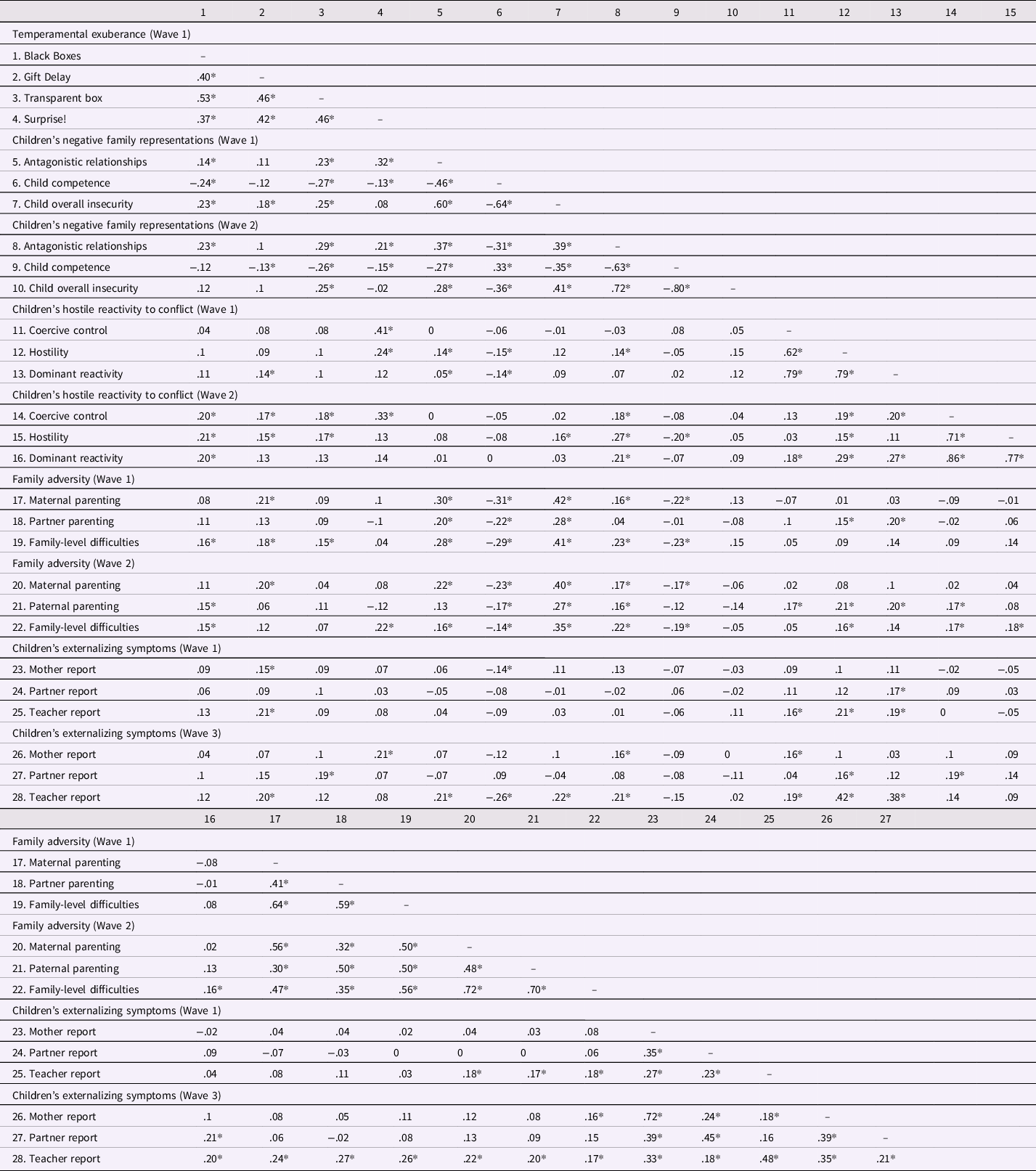
Note. *p < .05.
Primary findings
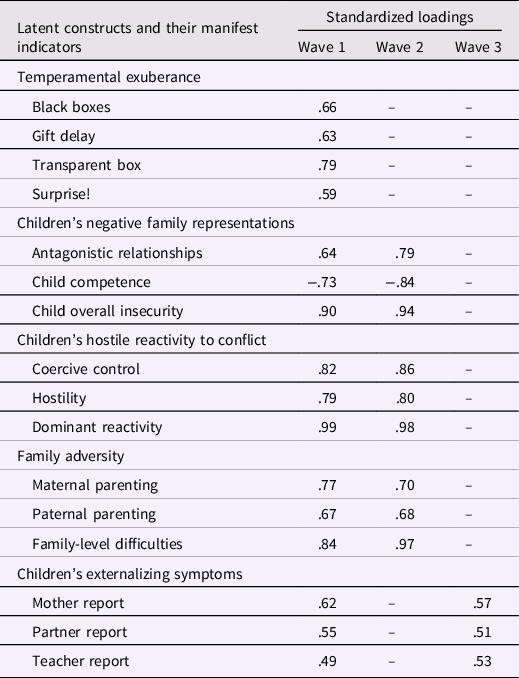
We tested our mediational hypotheses using structural equation modeling analyses with Amos 25.0 software (Arbuckle, Reference Arbuckle2017). In this analysis, we used the multiple indicators in our measurement battery to create latent constructs of temperamental exuberance at Wave 1, the three proposed mediators (i.e., children’s negative family representations, children’s hostile reactivity to conflict, family adversity) at Waves 1 and 2, and children’s externalizing problems at Waves 1 and 3. As denoted in Table 3, the strength of loadings of the manifest variables onto their latent constructs were moderate to high in magnitude (range = .49–.99; M = .74), with all p values < .001. For the structural part of the model, we specified Wave 1 exuberance as a predictor of the Wave 2 mediators (i.e., children’s negative family representations, children’s hostile reactivity, and family adversity) and the proposed outcome of children’s externalizing symptoms at Wave 3. In addition, we estimated autoregressive paths for the endogenous variables using the Wave 1 assessments of the mediators and outcome. The three proposed mediators at Wave 2, in turn, were estimated as predictors of children’s externalizing problems at Wave 3. To take into account the possibility that the role of exuberance as a predictor was an artifact of its concurrent association with children’s externalizing symptoms, the Wave 1 latent construct of externalizing symptoms was specified as a predictor of children’s negative family representations, their hostile reactivity, and family adversity at Wave 2. Correlations were also specified between (1) all pairs of exogenous variables in the model; and (2) the pairs of residuals for the three mediators at Wave 2; and (3) to account for informant variance, the error terms for the same manifest indicators of children’s externalizing problems across Waves 1 and 3.
Standardized loadings of the manifest indicators onto their latent constructs for the primary analysis
We conducted two additional sets of analyses prior to our final model specifications. First, we tested the measurement invariance for the repeated measures of the latent variables (i.e., three mediators and children’s externalizing symptoms) by comparing the fit of a model in which the same indicators of each latent variable over time were constrained to be equal with a model in which the factor loadings were permitted to vary freely across the waves. Based on analytic recommendations (Schwartz et al., Reference Schwartz, Des Rosiers, Huang, Zamboanga, Unger, Knight, Pantin and Szapocznik2013), at least two of the following three conditions must be satisfied to accept the constrained model over the free-to-vary model: (a) Δ chi-square is not significant; (b) Δ CFI < .01; and (c) Δ RMSEA < .01. Although the chi-square difference between the models was significant (Δ χ 2 = 20.25, df = 8, p = .009), the other two conditions were met (Δ CFI = .004; Δ RMSEA = .001). Therefore, we adopted the more parsimonious, constrained measurement model for the primary analyses. Second, our preliminary analyses included household income per capita and child gender as covariates predicting all of the endogenous variables in the model. However, the covariates did not predict any of the endogenous variables and their inclusion did not alter the pattern of significant findings in the analyses. Thus, to maximize parsimony, we excluded them from our final analysis.
The final model, which is depicted in Figure 1, provided a satisfactory representation of the data, χ 2 (328, N = 243) = 505.93, p < .001, RMSEA = .05, CFI = .94, and χ 2 /df ratio = 1.54. Autoregressive paths were significant for all of the endogenous variables, including: children’s negative family representations, β = .42, p < .001; hostile reactivity to parental conflict, β = .25, p = .001; their externalizing symptoms, β = .81, p < .001; and family adversity, β = .66, p < .001. Although children’s exuberance was significantly related to their externalizing problems at Wave 1 (r = .31, p = .003), it did not predict their Wave 3 externalizing problems in the model with the mediators and autoregressive paths. In addition, the results did not support the role of family adversity as a mediator of exuberance. More specifically, the prospective paths were negligible between: (1) Wave 1 exuberance and Wave 2 family adversity, β = −.06, p = .41, and (2) Wave 2 family adversity and Wave 3 children’s externalizing symptoms, β = .10, p = .17.
A structural equation model examining children’s exposure to family adversity, hostile reactivity to parental conflict, and negative family representations as mediating mechanisms in the prospective association between temperamental exuberance and externalizing symptoms across three annual waves of data. All path coefficients are standardized. *p < .05.

However, even with the estimation of multiple pathways in the analyses, the remaining two mediational pathways were significant. First, Wave 1 exuberance was a significant predictor of children’s negative family representations at Wave 2, β = .19, p < .02. Wave 2 negative family representations, in turn, predicted children’s externalizing symptoms 1 year later at Wave 3, β = .17, p = .03. To examine whether the indirect or mediational path was significant, we also conducted asymmetrical confidence interval analyses (Preacher & Hayes, Reference Preacher and Hayes2008). In supporting mediation, the results indicated that the indirect path for Wave 1 exuberance, children’s negative representations at Wave 2, and their externalizing problems at Wave 3 was significant, 95% CI [.01, .45]. Second, children’s exuberance at Wave 1 significantly predicted their hostile reactivity to conflict at Wave 2, β = .19, p < .03. Wave 2 hostile reactivity, in turn, was prospectively related to higher levels of children’s externalizing symptoms at Wave 3, β = .21, p < .009. Asymmetrical confidence interval analyses further indicated that the indirect path involving Wave 1 exuberance, Wave 2 hostile reactivity to conflict, and Wave 3 externalizing problems was significant, 95% CI [.02, .54].
Follow-up analyses I: tests of exuberance as a predictor of externalizing symptoms
Because children’s exuberance at Wave 1 did not significantly predict Wave 3 externalizing symptoms in the primary analyses, we further examined whether this was attributable to the operation of the mediators in the findings. Therefore, the model specifications for this analysis were identical to the primary analysis with three exceptions: the structural paths between each Wave 2 mediator and the latent assessment of Wave 3 externalizing symptoms were constrained to 0. The resulting model provided a satisfactory representation of the data, χ 2 (331, N = 243) = 523.74, p < .001, RMSEA = .05, CFI = .93, and χ 2 /df ratio = 1.58. Consistent with the results of the full mediational analyses in Figure 1, children’s temperamental exuberance at Wave 1 did not predict their Wave 3 externalizing symptoms, β = −.01, p < .89, while simultaneously controlling for Wave 1 externalizing symptoms, β = .84, p < .001. To further increase the comparability of our analyses with previous longitudinal studies that have examined single, snapshot assessments of externalizing symptoms, we specified another follow-up test that also constrained the autoregressive path from Wave 1 to Wave 3 child externalizing symptoms to 0. The model still generally provided a fair representation of the data, χ 2 (332, N = 243) = 558.98, p < .001, RMSEA = .05, CFI = .92, and χ 2 /df ratio = 1.58. In contrast to the first follow-up analysis, children’s exuberance at Wave 1 significantly predicted their Wave 3 externalizing symptoms when the autoregressive path involving Wave 1 externalizing symptoms was constrained to 0, β = .47, p = .003. Thus, Wave 1 temperamental exuberance was associated with Wave 3 externalizing symptoms through its common variance with Wave 1 externalizing symptoms.
Follow-up analyses II: additional tests of family adversity as a mediator
We also conducted follow-up analyses to determine if the null finding for family adversity as an “evocative” mediator may be attributable to two specifications in our primary analyses. First, because family adversity shared significant variance with children’s internal representations and their hostile reactivity at Wave 2, it is possible that the simultaneous inclusion of multiple risk mechanisms in our primary analyses may be diluting the power of family adversity as a mediator. To examine this possibility, we re-ran the model in Figure 1 after excluding the two other mediators from the analyses. The model provided a satisfactory fit with the data, χ 2 (96, N = 243) = 172.05, p < .001, RMSEA = .06, CFI = .93, and χ 2 /df ratio = 1.79. Inspection of the structural paths revealed that Wave 2 family adversity significantly predicted children’s externalizing symptoms at Wave 3, β = .16, p = .02, with the inclusion of the autoregressive path. However, the path between Wave 1 exuberance and Wave 2 family adversity was still negligible, β = −.05, p = .48.
Second, it is also plausible that the aggregate assessment of maternal parenting, partner parenting, and family-level difficulties may be masking an evocative process that only operates selectively through a more specific family characteristic. To test this possibility, we conducted three successive mediational models in which Waves 1 and 2 latent constructs indexing family adversity were replaced by Waves 1 and 2 manifest composites of: (1) maternal parenting; (2) partner parenting; and (3) family difficulties. The three models fit the data well: χ 2 (47, N = 243) < 65.00; p > .05, RMSEA < .04, CFI > .97, and χ 2 /df ratio < 1.40. Consistent with the first follow-up analyses, Wave 3 externalizing symptoms were predicted by Wave 2 family-level difficulties (β = .17, p = .01) and Wave 2 maternal parenting difficulties (β = .21, p = .002). However, as with the first set of follow-up analyses, the findings for each of the three models did not support a significant association between Wave 1 exuberance and Wave 2 measures of family-level adversity (β = .01, p = .90), maternal parenting difficulties (β = .02, p = .78), or partner parenting problems (β = .07, p = .28). Thus, alternative specifications of the primary analyses did not yield support for the role of family adversity as a mediator of the association between temperamental exuberance and children’s externalizing symptoms.
Discussion
Although studies have documented that children’s exuberance in early childhood is a predictor of their externalizing symptoms, the risk it poses varies widely across studies (e.g., Nielsen et al., Reference Nielsen, Olino, Dyson and Klein2019). Consistent with the state of the literature, our findings indicated that exuberance significantly predicted a static assessment of children’s externalizing symptoms 2 years later (He et al., Reference He, Li, Wu and Zhai2017; Morales et al., Reference Morales, Miller, Troller-Renfree, White, Degnan, Henderson and Fox2020; Zhou et al., Reference Zhou, Morales, Youatt and Buss2022). However, in accord with previous studies (Berdan et al., Reference Berdan, Kean and Calkins2008; Nielsen et al., Reference Nielsen, Olino, Dyson and Klein2019), the results further indicated that exuberance was no longer a significant risk factor in more rigorous analyses as a predictor of subsequent change in externalizing symptoms. These empirical inconsistencies may reflect the operation of developmental cascades whereby exuberance indirectly increases children’s vulnerability to externalizing symptoms through its role in cumulatively altering intermediary child and family mechanisms. However, there is a paucity of empirical work focused on delineating these mediational cascades. Guided by developmental models of undercontrolled temperamental attributes (Nigg, Reference Nigg2006; Rettew & McKee, Reference Rettew and McKee2005; Scaramella & Leve, Reference Scaramella and Leve2004), our primary goal was to examine, for the first time, whether exuberance increases children’s risk for externalizing problems through three mechanisms: (1) increased exposure to family adversity; (2) their hostile reactivity to family conflict, and (3) their negative internal representations of the family. Our results provided inconsistent and weak support for the documentation of a direct path between exuberance and children’s subsequent externalizing symptoms 2 years later.
Although we found no evidence for the mediational role of increased family adversity as a mediator, the longitudinal findings supported the two remaining mediational pathways. Observational assessments of children’s exuberance during preschool specifically predicted residualized increases in children’s hostile reactivity to family conflict and their negative internal representations of the family 1 year later. Children’s hostile reactivity and negative family representations, in turn, significantly predicted subsequent multi-informant assessments of their externalizing symptoms 1 year later after controlling for prior externalizing symptoms.
Children’s hostile reactivity to family conflict as a mediator of exuberance
Our study was novel in its documentation of children’s hostile reactivity to parental conflict as a distinct mediator in the prospective pathway between exuberant temperament and externalizing symptoms. Previous research has shown that children who are exuberant and excitable are more prone to experiencing irritability, emotional lability, and dysregulated negative emotions both concurrently and prospectively (Dennis et al., Reference Dennis, Hong and Solomon2010; Vogel et al., Reference Vogel, Jackson, Barch, Tillman and Luby2019). Agitation and coerciveness exhibited by exuberant children have been posited to be particularly pronounced in aversive contexts (Dennis et al., Reference Dennis, Hong and Solomon2010; Kiff et al., Reference Kiff, Lengua and Zalewski2011). Consistent with this work, our results of the first link in the proposed cascade revealed that exuberance predicted residualized increases children’s hostile reactivity to parental conflict over a 1-year period. Although questions remain as to why exuberance predicts subsequent hostile responses to stressors, challenges in successfully employing top-down regulation of emotional impulses may be a key process underpinning the association. Consistent with this explanation, children who exhibit exuberant behaviors (e.g., high approach and activity) are more likely to have difficulties in executive function abilities, including inhibitory control, problem-solving, planning, and sustained attention (e.g., Aksan & Kochanska, Reference Aksan and Kochanska2004; Vogel et al., Reference Vogel, Jackson, Barch, Tillman and Luby2019). In turn, problems employing executive functions in aversive interpersonal contexts may increase children’s tendencies to reflexively respond in coercive, hostile ways (Granvald & Marciszko, Reference Granvald and Marciszko2016; Rohlf et al., Reference Rohlf, Holl, Kirsch, Krahé and Elsner2018). Supporting a neurobiological basis for this explanation, evidence indicates that lower dopamine activity in the mesocortical system (i.e., circuit projecting from the ventral tegmentum in the midbrain to the frontal cortex) is related to top-down emotion regulation difficulties experienced by children with high approach dispositions and is posited to subserve aggressive and domineering behaviors (e.g., Schriber & Guyer, Reference Schriber and Guyer2016).
In drawing on complementary, bottom-up models of emotional reactivity (Moore & Depue, Reference Moore and Depue2016; Schriber & Guyer, Reference Schriber and Guyer2016), it is also possible that the highly changeable, intense emotional reactivity experienced by exuberant children may overwhelm their abilities to cope with stressors even if they have intact top-down regulation abilities (Scaramella & Leve, Reference Scaramella and Leve2004). Thus, intense levels of emotional reactivity may supersede any capacities to modify the emotional expressions and, in turn, intensify reflexive responses to stressful events. In building on this premise, neurobiological models of emotional reactivity propose that the mesolimbic system connecting the midbrain (e.g., ventral tegmental area) with regions of the limbic system (e.g., basal ganglia, amygdala, nucleus accumbens, hippocampus, hypothalamus) play a significant role in responding to both rewarding and aversive stimuli (Moore & Depue, Reference Moore and Depue2016; Schriber & Guyer, Reference Schriber and Guyer2016). Low dopaminergic tone in this circuit has been linked with greater reward sensitivity (e.g., exuberance). Although more speculative at this early stage of research, hypodopaminergic activity in the mesolimbic circuit has also been posited to be part of a broader neurobiological system that is calibrated to be highly reactive to threat (see Moore & Depue, Reference Moore and Depue2016). Moreover, there are bases for expecting that this high reactivity may be manifested in hostile responses to aversive stimuli. For example, dampened dopamine activity in the mesolimbic system is posited to undermine fear conditioning and, as a result, increase bold, fearless, and risky responding (e.g., Gatzke-Kopp, Reference Gatzke-Kopp2011). Thus, the dampened fear and reticence in the threatening family contexts (i.e., parental conflict) may engender coercive, aggressive responses to interparental conflict that directly engage the source (i.e., parents) of threat.
Analyses of the second link in the proposed mediational cascade further revealed that children’s hostile reactivity to parental conflict predicted higher levels of their externalizing symptoms 1 year later even after controlling for prior levels of externalizing symptoms and the predictive paths for the other two mediators. In accord with our results, studies have delineated disruptive behavior problems as common sequelae of children’s hostile and coercive ways of responding to family (e.g., interparental, parent-child) conflict (Davis et al., Reference Davis, Hops, Alpert and Sheeber1998; Kochanska et al., Reference Kochanska, Barry, Stellern and O’bleness2009). Moreover, according to social learning and family system theories, hostile and defiant ways of responding to parental conflict may broaden and intensify into externalizing problems over time because they function to reduce or eliminate the aversive nature of the parental conflict for the family (Davis et al., Reference Davis, Hops, Alpert and Sheeber1998; Emery, Reference Emery1989). As another explanation, the revised version of emotional security theory has proposed that children who exhibit coercive patterns of responding to conflict are at higher risk for experiencing externalizing problems because they tend to defensively downplay the significance of close relationships and develop increasingly callous orientations toward others (Davies & Martin, Reference Davies and Martin2013). Thus, despite the patchwork of theory and research on the hypothesized mediational cascade, the existing work collectively offers plausible explanations for why hostile reactivity to parental conflict may be a distinct mechanism underpinning the risk associated with exuberance.
Negative family representations as a mediator of exuberance
To our knowledge, the only study to examine the family representations of exuberant children reported that parent reports of exuberance were concurrently related to more insecure representations of parent-child attachment and externalizing symptoms during the early school years (Forslund et al., Reference Forslund, Brocki, Bohlin, Granqvist and Eninger2016). Against this backdrop, our longitudinal findings are the first to provide support for negative family representations as a mediator of the prospective association between children’s exuberance and their externalizing symptoms. In the first part of the mediational analyses, our results showed that children’s exuberance during preschool was associated with increases in children’s negative family representations over a 1-year period. These negative representations were specifically characterized by portrayals of interparental and parent-child challenges as proliferating into antagonism and aggression and posing significant threats to their ability to cope effectively in ways that preserve their safety. In the second part of the mediational chain, children’s negative representations predicted their externalizing symptoms 1 year later even after controlling for prior levels of externalizing symptoms.
Why might children’s negative family representations mediate the association between their temperamental exuberance and externalizing symptoms? One possible explanation is that exuberant children’s tendencies to experience strong irritable emotions in stressful social contexts may heighten their negative representations of interpersonal relationships. At a theoretical level, mood congruent models have posited that children’s negative emotions (e.g., anger, irritability) serve as filters that heighten their encoding of negative emotion cues and hostile interpretations of social relationships (e.g., Lemerise & Arsenio, Reference Lemerise and Arsenio2000). In support of this hypothesis, correlational and experimental studies have shown that children’s angry moods are related to greater negative evaluations of social relationships (e.g., Orobio de Castro et al., Reference Orobio de Castro, Merk, Koops, Veerman and Bosch2005; Zalewski et al., Reference Zalewski, Lengua, Wilson, Trancik and Bazinet2011). Likewise, the prospective association between exuberance and children’s negative family representations may develop, in part, from self-regulatory difficulties. For example, emotion dysregulation and distractibility, which are characteristics of children’s exuberance, have been posited to heighten negative biases in the children’s representations of social experiences (Bassan-Diamond et al., Reference Bassan-Diamond, Teglasi and Schmitt1995). Finally, some studies have shown that family adversity is related to facets of exuberance (e.g., reward sensitivity; Sturge-Apple et al., Reference Sturge-Apple, Davies, Cicchetti, Hentges and Coe2017). Thus, it is possible that family discord may be linked with higher exuberance and also increase children’s negative representations of their families. However, the viability of this explanation is diminished by the null associations among exuberance and family adversity at Waves 1 and 2 in the primary analyses.
In reflecting the final part of the mediational cascade of exuberance, our documentation of children’s negative representations of the family as a predictor of their externalizing symptoms 1 year later was consistent with previous research. For example, studies have repeatedly identified children’s negative family representations as precursors of their externalizing symptoms (Cummings et al., Reference Cummings, Schermerhorn, Keller and Davies2008; Fernandes et al., Reference Fernandes, Verissimo, Santos, Fernandes, Antunes and Vaughn2019; Mueller et al., Reference Mueller, Jouriles, McDonald and Rosenfield2015). Our results also correspond with process-oriented conceptualizations of the sequelae of children’s representations. According to schema-congruent models (e.g., Johnston et al., Reference Johnston, Roseby and Kuehnle2009), children’s negative family representations serve as templates for scanning new and potentially threatening interpersonal contexts for old dangers. Thus, children’s reliance on these negative representations may engender externalizing symptoms by sensitizing them to encode threat, attribute malevolent intent to others’ behaviors, and generate aggressive responses to the numerous challenges and stressors of the early school years (e.g., navigating peer spaces, contending with new academic responsibilities, engaging in expanding extrafamilial activities) (e.g., Dodge, Reference Dodge2006; Granot & Mayseless, Reference Granot and Mayseless2012).
Limitations and qualifications
Limitations and qualifications of our study also warrant discussion. First, although children in our sample were relatively diverse in racial and demographic backgrounds, it is unclear whether the findings are generalizable to other samples of children (e.g., economically privileged children). For example, most of the families in the sample had limited access to socio-demographic (e.g., income, parent education) resources. Thus, relative to their peers in higher resource environments, children’s greater exposure to stressors in our sample may have intensified the impulsive, irritable, and emotionally labile facets of exuberance. In turn, it is possible that these more challenging behavioral facets may have amplified the prospective associations among exuberance and children’s negative family representations and hostile reactivity to family adversity. However, in comparison to prior studies aiming to characterize childhood exuberance in higher resource contexts (e.g., income and parent education levels), our sample more closely approximates the incidence of adversity and impoverishment faced by the majority of children in the world (Crittenden, Reference Crittenden1999). Thus, it is also possible that are findings are more generalizable than prior studies of exuberance focused on children from higher resource backgrounds.
Second, in further considering the bounds of generalizability, the mediational findings may vary with the adoption of different measurement approaches. Some of the temperament tasks in our paper may be specifically skewed toward detecting individual differences in some of the more pathogenic facets of exuberance. For example, high activity and approach in the Gift Delay task may be weighted toward capturing indices of poor effortful control, whereas the Lab-TAB Transparent Box task may be particularly effective in eliciting individual differences in irritability. However, consistent with conceptualizations of temperament as reflecting behavioral dispositions that are relatively consistent across time and context (see Stifter & Dollar, Reference Stifter, Dollar and Cicchetti2016), our assessment battery of diverse tasks was designed to capture consistent individual differences in exuberance across diverse situations. In addition, our approach is consistent with common procedures for assessing exuberance across tasks containing novelty, risk, rewards, reward delays, and challenges (e.g., Dollar & Buss, Reference Dollar and Buss2014; Nielsen et al., Reference Nielsen, Olino, Dyson and Klein2019; Stifter et al., Reference Stifter, Putnam and Jahromi2008). Moreover, our specification of a latent variable to capture common variance in exuberance across time and tasks was designed to minimize the inclusion of task-specific variance (e.g., high activity resulting from irritability in the Transparent Box Task) in our measurement. At a broader level, integrating questionnaire or naturalistic observational procedures with lab-based observational paradigms is also an important future direction that may increase the ecological validity of exuberance assessments (Stifter & Dollar, Reference Stifter, Dollar and Cicchetti2016).
Third, the null findings on family adversity as a mediator of the relation between exuberance and externalizing symptoms does not rule out the possibility that evocative family processes may operate as risk mechanisms. For example, our assessments of parenting and family difficulties were based on family cooperation and play activities. As a result, it is possible that the unbridled positivity and activity exhibited by exuberant children may elicit greater parent and family negativity in more stressful (e.g., discipline) contexts (Scaramella & Leve, Reference Scaramella and Leve2004). In addition, evocative family processes emerging from interactions with exuberant children may be more salient in other developmental periods (e.g., toddlerhood as parents grapple with increasing demands for exploration and autonomy) or may operate within smaller time scales (e.g., minutes, days) than our measurement of change in family functioning over a 1-year period. Alternatively, family adversity may serve as a moderator and potentiate the risk conferred by exuberance (Stifter & Dollar, Reference Stifter, Dollar and Cicchetti2016).
Finally, there are additional conceptual and analytic issues to consider in interpreting the findings. For example, even though our staggered mediational analysis of longitudinal data provided a relatively rigorous test of the hypotheses, the non-experimental design does not rule out the operation of all potential third variables. Likewise, although our targeted aim centered on identifying the mechanisms underpinning the maladjustment sequelae of exuberance, it is important to recognize that children high in exuberance are also more likely to exhibit healthy outcomes in some (e.g., sociability, peer competence) domains (e.g., Degnan et al., Reference Degnan, Hane, Henderson, Moas, Reeb-Sutherland and Fox2011; Kravitz et al., Reference Kravitz, Walker and Degnan2022). Therefore, delineating the processes that also account for some of the healthy or benign outcomes of children with high exuberance is an important future direction.
Conclusions
In conclusion, our goal in this multi-method, multi-informant paper was to advance an understanding of why exuberance increases children’s vulnerability to externalizing problems by examining their hostile reactivity to parental conflict, their negative family representations, and their exposure to family adversity as mediating mechanisms. Although the findings did not support the role of child exposure to family adversity as a mediator, children’s negative family representations and hostile reactivity to parental conflict were significant explanatory mechanisms in the prospective link between their exuberance and their externalizing problems. Although replication and extension of our findings will be necessary before any definitive translational recommendations can be offered, the results have the potential to guide future public health initiatives. Because exuberance has also been identified as a precursor to some benign or healthy forms (e.g., sociability, lower internalizing symptoms) of functioning (e.g., Dougherty et al., Reference Dougherty, Bufferd, Carlson, Dyson, Olino, Durbin and Klein2011), it may not be feasible or desirable to alter children’s natural enthusiasm or interest in novel situations. However, the identification of negative family representations and hostile reactivity to family adversity as risk mechanisms may offer new domains for interrupting the pathogenic cascades. For example, components of therapeutic and psychoeducational programs are designed to facilitate children’s coping strategies to more effectively manage their emotional reactivity to family adversity and their open processing of emotional events in ways that promote more balanced internal representations of social relationships (e.g., Johnston et al., Reference Johnston, Roseby and Kuehnle2009).
Acknowledgements
The authors are grateful to the families who participated in this project. We would also like to thank Mike Ripple and Mt. Hope Family Center Staff who assisted with the study.
Funding statement
This study was supported by a grant from the Eunice Kennedy Shriver National Institute of Child Health and Human Development (R01 HD065425) awarded to Patrick T. Davies and Melissa L. Sturge-Apple. The study was conducted at Mt. Hope Family Center, University of Rochester.
Conflicts of interest
None.



