A Theatrical Revolution
In January 1921, Moscow Kamerny Theatre director Alexander TairovFootnote 1 scathingly criticized Vsevelod Meyerhold's controversial production of Émile Verhaeren's The Dawn, which had opened on 7 November 1920 to commemorate the third anniversary of the October Revolution. In a lecture, entitled “The Twilight of The Dawn,” Tairov also articulated his views on the role of theatre and of the actor in post-Revolutionary Russia:
[The Dawn] was staged not as a theatrical presentation, but as a rally. Here the actor was deprived of the opportunity to create his own character…. [I]nstead of a performer [Meyerhold] should have put an agitator on the stage. This would have been only logical and would have been twice as effective, laying bare, first of all, the theatrically reactionary essence of this pointless undertaking and eliminating the intolerable falsity that became the leitmotif of this entire quasi-theatrical production.Footnote 2
Aside from hinting at the rift between the two directors that had become evident after their failed 1918 collaboration on Claudel's The Exchange, Tairov's criticism of Meyerhold's The Dawn reveals a widening gap in the two directors’ fundamental conceptions of the purpose of theatre in the wake of the Revolution. Meyerhold famously declared “October in the theatre” after becoming head of the Theatre Department of Narkompros (the Commissariat of Enlightenment) in the fall of 1920; he attempted to liquidate the Moscow state academic theatres, of which the Kamerny was one, and to require that all theatres stage revolutionary works using the radical methods of “cubism, futurism and suprematism.”Footnote 3 Although Tairov had experimented with cubist designs, he had spent his immediate post-Revolutionary years defending theatre as an autonomous art form that should express universal truths rather than being a vehicle for topical content, declaring, “A propagandist theatre after a revolution is like mustard after a meal.”Footnote 4
Tairov did not oppose the Revolution; he welcomed the opportunities it initially provided for creative freedom, especially in the period following the 1917 February Revolution. Alisa Koonen, Kamerny lead actress and Tairov's future wife, recalled those early days “as a time of deep, free breathing and great spiritual uplift.”Footnote 5 Though Tairov was largely apolitical, apart from having been in a Marxist club while a student, he believed himself to be conducting an artistic revolution that paralleled the political one. In his lecture on The Dawn he stated, “The Kamerny Theatre is truly revolutionary…. Of course it is not poster revolutionary, of course it is not agitationally revolutionary, of course it is not politically revolutionary, but it is revolutionary in its theatrical essence.”Footnote 6
In the 1917 pamphlet Proclamation of an Artist, Tairov wrote about the opportunities he hoped the Revolution would provide to free the artist to express an individual artistic vision. For him, this vision included a striving for beauty that could be shared with all lovers of art. He argued that there was therefore no need for a strictly proletarian theatre:
Since the end of March, posters have begun to appear on the streets about special performances and concerts “for the people,” while a whole series of speeches have examined the question of what kind of art can be understood by the people, what kind of art the people need…. Is art really a train with sleeper cars for the “clean” public and with cattle cars for the people?
No…. Art is for all those in whose souls there is either a conscious or unconscious thirst for beauty. Everything that is created with human talent, everything that bears the true stamp of creativity, all this is included in the notion of art as such—all this and only this is the object of the democratization of art.”Footnote 7
One of the central debates in post-Revolutionary theatre was, of course, how it should serve the proletariat. Among the plurality of opinions, two main viewpoints emerged: the theatrical Left advocated for a rejection of the bourgeois past in favor of proletarian-generated forms, while others, Lenin among them, felt that the worker should be elevated to the heights of the greatest achievements of the past so that other Russians could learn and ultimately draw from them. Anatoly Lunacharsky was the head of the Commissariat of Enlightenment, the Soviet organization responsible for bringing education and enlightenment (one word has both meanings in Russian) to the largely illiterate Russian people through schooling and the arts. He subsidized both Proletkult, a proletarian arts organization comprising hundreds of amateur groups, and the futurists, despite his doubts about their extreme methods. However, he supported more traditional theatres with equal vigor and larger subsidies, believing that “the proletarian theatre would be created through … mastery and development of traditional forms” rather than “through rejection of the past.”Footnote 8 It was his hope that the established theatres would gradually incorporate revolutionary content into their repertoires on their own.
Tairov did not agree entirely with either Lunacharsky or the theatrical Left; instead, he asserted that the theatre needed to remain an autonomous art form. The theatre was, he argued, fundamentally a place for human beings to express and experience the beauty and joy of creation. It was to achieve this by pursuing virtuosity, by nurturing the central creative role of the actor in the art of the stage, by using techniques from professional popular entertainments to rejuvenate itself, and by creating performances that would elate its audiences, regardless of whether plots were tragic or comic.
Several months before Meyerhold's “October in the theatre” decree provoked a resurgence in the ongoing debate between artistic leftists and traditionalists, Tairov staged one of the Kamerny's landmark productions, Princess Brambilla, A Capriccio of the Kamerny Theatre, after Hoffmann. One observer referred to the production as “one of the most brilliant spectacles one has ever seen.”Footnote 9Brambilla, a colorful and boisterous theatrical adaptation of a century-old E. T. A. Hoffmann novella, premiered at the Kamerny on 4 May 1920, marking the culmination of more than a decade of intense Russian theatrical interest in the writer and in the commedia dell'arte world his novella depicted.
Virtually all of the scholarship on Brambilla has discussed the production primarily in aesthetic terms, which is not surprising considering the emphasis Tairov himself placed on theatre's artistic goals. Clayton, Torda, and Worrall have each written vivid descriptions of the production's design and movement and its integration of pantomime and commedia dell'arte–inspired techniques.Footnote 10 However, Brambilla's significance extends beyond its ability to entertain full houses with stunning theatrical fireworks. Although many of the Kamerny's early productions, ranging from Wilde's Salomé to Scribe's Adrienne Lecouvreur, had similar goals in terms of celebrating a theatricalized theatre, monumental “emotional gestures,” and the virtuosic Über-actor, Brambilla also operated as part of the polemic regarding the place of theatre in the new Russia. It is a fascinating example of performance as theory, a staged precursor to Tairov's only book-length theoretical treatise, Notes of a Director, published the following year.
This article will demonstrate that Tairov used Hoffmann, a writer who was temporally and physically distant from Russia, to comment on the Kamerny's theatrical agenda in the context of the uncertainty over the future of Soviet theatre. This is especially apparent from the production promptbook, which has never been discussed in English-language scholarship and which provides an invaluable and underexplored window into Brambilla's intellectual foundations.Footnote 11 Drawing on the principle of Romantic irony, this performance text metatheatrically placed the principles most central to the Kamerny's view of the theatre on the lips of the actors as they performed their roles. As theory was introduced in the promptbook, it was applied in production. While the characters discussed how the theatre should be revolutionized, the actors not only showed that revolution in progress but jubilantly declared its role in defining the theatre of the future.
The Kamerny Theatre, 1914–1920
Alexander Kornblit (1885–1950), better known as Alexander Tairov, founded the Kamerny (Chamber) Theatre in 1914 with lead actress Alisa Koonen (1889–1974) in revolt against the aesthetic foundations of virtually all of the theatre of their day.Footnote 12 In her memoir, Koonen recalls Tairov's very first lecture to the company, in which he stated: “Our platform consists of searching for new paths in the theatre, of experimenting. Our program will be a struggle. A struggle with the evils that have maimed the theatre and led it to an impasse.”Footnote 13
Opposed in particular to what he viewed as the two predominant trends in the Russian theatre, the “naturalistic theatre” and the “conventionalized theatre,” Tairov advocated instead for an actor-centered, actor-generated theatre that would rely not on literature or on painting as its point of origin but on the creativity of the master actor, “someone armed with rhythmical and musical sensibility and capable of handling all dramatic genres from tragedy to operetta and pantomime.”Footnote 14 He thought of his ideal performer as an “Über-actor,” partly in reaction to Edward Gordon Craig but more so against Meyerhold, who, Tairov believed, insufficiently valued the actor's central place in the theatre.Footnote 15
Tairov strove to create “synthetic,” or synthesized, theatre, a Gesamtkunstwerk (though inspired by Hoffmann and by Mardzhanov's Free Theatre rather than by Wagner) of forms that previously had been considered separate disciplines: visual art, fairground performance, music, circus, opera, literature, pantomime, and dance. He claimed to have taken this notion further than his contemporary Feodor Komisarjevsky by merging the disciplines in a single work instead of merely presenting separate contrasting events in the same season. Tairov achieved this synthesis through a consistent emphasis on beauty and on musical rhythm as a unifying principle for both movement and speech. He was interested in helping the actor look good, to the point where Meyerhold and others accused the Kamerny “dandies” of excessive prancing in their attempts to achieve rhythmical, synthetic movement.Footnote 16
In general, Tairov divided theatre into two categories: the harlequinade (similar in function to comedy) and the mystery (parallel to tragedy). These basic genres represented two theatrical poles in which “the joy of laughter is provided by the harlequinade, and the joy of transformation is provided by the mystery play.”Footnote 17 Tairov sought to balance these theatrical oppositions by generally staging one of each per season. He worked increasingly with mixed genres in the 1920s, in keeping with his notion of synthetic theatre, but retained an interest in monumental binaries and in the joyfulness of the theatre for his entire career. The synthesis of opposites was also reflected in the structure of the theatre itself; Koonen's major artistic contribution to the theatre as its leading actress served as a counterpoint to Tairov's directorial voice.
Tairov advocated repeatedly for theatre as an independent art form rather than as a vehicle for literature or ideology, arguing in his Notes of a Director that the theatre had no business trying to create a faithful interpretation of plays, even by great authors such as Shakespeare and Molière. He stated that the theatre's ultimate goal should be to move away from literature altogether, for its autonomous mission was “to create its own, new work of art to be valued in and of itself.”Footnote 18 Tairov preferred nondramatic to dramatic literature, feeling that the latter was “too confining for our scenic constructions,” though by the end of his career he had staged more dramas than adaptations of novels or short stories.Footnote 19 At least initially, he hoped to use works of fiction from “geniuses” such as Hoffmann until his actors were skilled enough to create autonomously; he treated these literary sources as malleable raw material.Footnote 20 Hoffmann's Princess Brambilla was ready fodder for this approach.
Tairov and Hoffmann
Tairov was in frequent conversation with the theatre of his day. Not only did he give speeches and publish articles but he also sometimes responded to the work of others by deliberately mounting his own production of a play recently staged by another director. He staged Schnitzler's Pierrette's Veil in 1913 and 1916 in the wake of Meyerhold's 1910 production of the same pantomime (retitled Columbine's Veil) and its 1916 revival. The Kamerny staged Wilde's Salomé partially in response to Nikolai Evreinov's and Max Reinhardt's productions of the play.Footnote 21 Thus, while Tairov felt a close artistic kinship to Hoffmann, staging Brambilla also provided the opportunity to clarify his theatrical approach.
If it seems like Tairov's aesthetic was a product of the pre-Revolutionary modernist theatre, it is because it was. His interest in the Über-actor was a tribute to Craig as much as it was a divergence from him, and Tairov's pantomimes were among the seemingly infinite Russian variations on commedia dell'arte. His contribution to the theatre lies not in his originality in identifying the problems that faced the theatre of the day but in his solutions to those problems. For example, while Evreinov's theatricality recalled childhood play and Meyerhold's included a healthy dose of Romantic irony, Tairov used the word “theatricality” to indicate his belief that theatre was autonomous from the other arts and that the actor was the theatre's starting point. In staging Princess Brambilla, Tairov used a familiar source to assert the independence of his vision from that of other innovators.
German Romantic writer Ernst Theodor Amadeus Hoffmann (1776–1822) profoundly influenced the arts in Russia in two waves: Russian literature in the nineteenth century and Russian theatre in the early twentieth. One historian claims that there were more attempts to apply Hoffmann's theatrical advice and to stage his works in Russia than in any other nation.Footnote 22 Another calls the frenzy of activity inspired by the German writer a “cult” of Hoffmann.Footnote 23 Sergei Ignatov, in his 1914 monograph E. T. A. Hoffmann: Life and Works, was one of the first to advocate for the practical use of the theatrical theories embedded in Hoffmann's short stories and novellas.Footnote 24 However, Meyerhold and his followers were some of the most vocal enthusiasts throughout the 1910s, famously publishing a “Hoffmaniana [sic]” column in the journal Love for Three Oranges: The Journal of Doctor Dappertutto and experimenting with a Hoffmann- and Callot-inspired theatrical grotesque at his Studio on Borodinskaia Street in Petrograd. For his studio and after-hours experiments, Meyerhold operated under the Hoffmannic pseudonym Doctor Dappertutto (from “A New Year's Eve Adventure”) beginning in 1910 for most of the decade leading up to Tairov's Brambilla. Eisenstein, too, identified with a Hoffmann character, using the pseudonym Peregrinus Tyss (from Master Flea) for his theatrical work in the War Construction Project as an actor, artist, and director.Footnote 25
By 1920, Brambilla had been part of the Russian modernist debate over theatrical reform for several years. In the wake of a 1915 Russian translation of Princess Brambilla, an argument had developed between Dmitry Filosofov (Diaghilev's cousin and the literary editor of the World of Art journal) and several contributors to Love for Three Oranges over the merits of the tale and the appropriateness of Hoffmann as a theatrical teacher. Perhaps in response to this debate, Tairov commissioned L. Krasovskii to create a theatrical adaptation of Hoffmann's tale in 1915 (verse epilogue by P. Antokolskii); this adaptation was the foundation for the 1920 production.Footnote 26
For several seasons, Tairov put off mounting this adaptation because he felt that the young and inexperienced troupe did not yet have sufficient training for such an undertaking.Footnote 27 By the end of 1920, however, the troupe had staged Adrienne Lecouvreur, which helped establish Koonen's reputation as the premier tragédienne of the Russian stage, and Princess Brambilla, which demonstrated the virtuosity of the Kamerny's corps de drame,Footnote 28 and Tairov declared that “the first period of the Kamerny Theatre, the period of seeking its own way[,] is ended.”Footnote 29 Hoffmann's calls in Brambilla for theatrical reform, for the eradication of theatrical mediocrity, for an actor-centered theatre based on skilled improvisation, and for the theatre as a necessary artistic mirror with which to interpret the world were especially appealing to Tairov; Hoffmann's material illustrated what he, too, was trying to achieve.
Princess Brambilla: A Capriccio in the Style of Jacques Callot
In 1820, Hoffmann was given a set of French engraver Jacques Callot's (c. 1592–1635) Balli di Sfessania. The novella Prinzessin Brambilla: Ein Capriccio nach Jakob Callot, written later that same year, is the only story Hoffmann based so literally on Callot's work, though he had earlier articulated his fascination with Callot's visual grotesque in his preface to the first volume of Fantasiestücke in Callots Manier (1814). Hoffmann used eight of the twenty-four balli to compose the action for Princess Brambilla's carnival scenes and to create detailed descriptions of the central character pairs.Footnote 30
Hoffmann's Princess Brambilla conflated Callot and carnevale, Gozzi and the grotesque in a multidimensional theatrical parable aimed at reforming the theatre. Hoffmann viewed the theatre as a mirror that could reflect and interpret the world at large, one reason why many of his tales feature doppelgängers who serve both as reflections and distortions of the stories’ heroes. In Brambilla, Hoffmann gives the theatre itself a doppelgänger: the commedia dell'arte, a temporal reflection that reveals the inadequacies of the theatre of Hoffmann's day and promises to rejuvenate the stage. Hoffmann's Brambilla is a series of three interwoven stories that depict allegorically how this rejuvenation should take place.
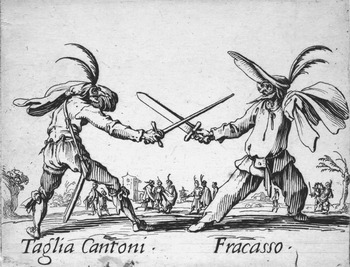
The central allegory of Brambilla is the tale of Giglio Fava, who, though he is a matinee idol, is a vain and uninspired tragic actor. As he searches for his doppelgänger and true self, Prince Cornelio Chiaperri, who metaphorically represents the commedia dell'arte, Giglio is guided through the bewildering twists and turns of carnevale by the ultimately benevolent charlatan Celionati. At Celionati's prompting, Giglio wears a series of exaggerated costumes, à la Callot's version of commedia, that help him find his alter ego.Footnote 31 Giglio is in love both with a humble seamstress named Giacinta Soardi and with Princess Brambilla, who turn out to be one and the same. Giglio's royal commedia self vanquishes his hack-actor self in a duel, the details for which come from one of the balli (see Fig. 1). Finally, after gazing into the mirror of Urdar, Giglio and Giacinta discover that they have become a theatrical prince and princess, having discovered the true theatre and their real selves through commedia.
Jacques Callot, “Taglia Cantoni and Fracasso,” plate from Balli di Sfessania (ca. 1621). Harvard Art Museum/Fogg Museum, Gray Collection of Engravings Fund, by exchange, S4.28.2. Photo: Allan Macintyre © President and Fellows of Harvard College.

Parallel to this parable of Hoffmann's vision for the theatre of his own time is an indirect recreation of the battle between Carlo Gozzi and erstwhile Jesuit Pietro Chiari. Gozzi's other rival, Carlo Goldoni, is not mentioned, but Chiari figures in the novella as the hack playwright Abbate Chiari who brings about the downfall of the old Giglio by metaphorically overstuffing the actor's belly with the indigestible roles of insipid plays. Gozzi is featured indirectly in the frequent mentions of his fiabe teatrali, which form the basis for the new repertoire at Giglio's theatre after the actor is fired.
Lastly, there is a mystical tale within the larger framework of Hoffmann's Brambilla: the charlatan Celionati tells a group of German students a story about the kingdom of Urdargarten. At first, the account of the hopelessly unhappy King Ophioch and the disturbingly merry Queen Liris seems unrelated to the main plot. At story's end, however, the magus Hermod turns his prism into the spring of Urdar, which fills the mirror-clear lake of Urdar into which the royals then gaze and are freed by seeing their true selves. At the end of Brambilla, the reader realizes that Hoffmann views the theatre as this mirror; without it, we cannot understand ourselves or the world.
Brambilla's narrative style is indirect, at times confusing, recreating in the reader the confusion Giglio feels. In keeping with Hoffmann's description of the work as a capriccio, a musical or artistic work that emphasizes untrammeled flights of fantasy,Footnote 32 many of the events are stream-of-consciousness and improbable, such as the story that Prince Cornelio was small enough to fit in a candy box when he was born.
Celionati, actually Prince Bastianello di Pistoja disguised as a charlatan, is a corporeal manifestation of fate who invisibly controls the events of the lives of Giglio and Giacinta. He is Giglio's puppetmaster, a role reinforced by the fact that Giglio's vain self is referred to repeatedly as a puppet. Celionati also manipulates the vision of characters in the story. This manipulation and distortion of vision is a recurrent theme in Hoffmann, one that the writer also explored in “The Sandman” (1816). Celionati not only sells Giglio spectacles to help him find his princess, but he also seems to control the phantasmagorical appearances of Brambilla and her entourage. He is also instrumental in keeping Giglio's vision clouded until the new Giglio and his bride recognize themselves in the mirror of Urdar.
Thus, Hoffmann's Brambilla operates on multiple levels: as a literary transposition of Callot's etchings; as a fairy-tale version of the process through which Hoffmann hoped the theatre of his day would pass; as an account of an idealized past when the commedia dell'arte triumphed; and as a philosophical allegory of the purpose of theatre and its profound potential. Brambilla's motifs— the ideas of commedia dell'arte as the true theatre, of guiding the actor back to a more ideal state, of manipulated vision, of the false self confronted by the true self, and of an omniscient force who is able to orchestrate the action—were all retained in the Kamerny adaptation. All this is related in bewildering images that are explained at the story's end as the action returns to an improved reality. Tairov featured each of these themes in his production of Hoffmann's tale.
The Brambilla Promptbook
The 1920 production promptbook, replete with corrections and cues, provides a useful window into the intersections between theory and performance in the Kamerny Brambilla.Footnote 33 In this text, which is housed at the Russian State Archive of Literature and Art (RGALI), and in the performance of Brambilla, Tairov evoked a world where inspirations from Hoffmann and commedia converged with Tairov's vision of an ideal theatrical future where actors not only speak but also dance and tumble; where excellence, improvisation, and theatricality become the ideals; where art explores universal themes through metaphor; and where the audience is drawn into a breathless, joyful theatrical experience.
The RGALI promptbook is a straightforward rendition of Hoffmann's story with the abstract and mystical elements removed. According to Tairov, the most serious “operation” the Kamerny performed on Brambilla was the complete elimination of the mystical portions of the story. Krasovskii's adaptation eliminated two of the three plot lines in its restructuring of Brambilla for the Kamerny stage. Tairov was far more interested in preserving and interacting with Hoffmann's ideas than he was in maintaining fidelity to plot or structure. The structure of the play, as in Hoffmann, is cyclical: it begins in a realistic setting, quickly shifts to a phantasmagorical realm, and then returns to an improved reality for the final scene.Footnote 34
The most significant feature of the Brambilla promptbook is its metatheatrical presentation of the Kamerny's theories of theatrical reform. The theme Hoffmann's theatrical advice most consistently reiterates is that the bygone techniques of the commedia dell'arte combined with an altered way of viewing the world will give birth to true theatre. In Act 2, Tableau 1, Scene 4, the charlatan Celionati gives Giglio advice about how to find the elusive Princess Brambilla:
But don't think that you can enchant her with a beautiful costume. On the contrary: the more strange, the more outlandish it is, the sooner you will draw attention to yourself. But most important are the spectacles. Spectacles and a big nose to hold them up.Footnote 35
Although this description of Giglio's costume follows Hoffmann's original, which in turn was based on one of Callot's balli, the symbolic significance of the combination of an exaggerated commedia nose and clarified vision is undeniable; it is a metaphor for Tairov's call to draw from professional popular traditions such as commedia and the circus to create a theatre that would provide a unique artistic perspective on its world.
Altered Vision
The theme of vision recurs frequently in Brambilla, but it has three major manifestations in the promptbook: Giglio's need for altered vision, aided by spectacles; Giglio's real and metaphorical blindness; and the lucidity of vision that comes to individuals when they peer into the mirror of Urdar. In each case, the promptbook emphasizes that it is necessary to distort an individual's vision so that he or she can later see clearly. In other words, artistic distortion reveals inner truth. In the Kamerny production, Giglio is a general metaphor for the actor, a more pointed metaphor for the contemporary Soviet theatre that cannot see its own shortcomings, and, after Giglio's transformation, a specific metaphor for the actor-creator that Tairov cultivated.
Act 2 opens with Celionati setting up his charlatan's booth and trying to sell snake oil and jars of Adam's tears to the crowd. Princess Brambilla and her entourage process across the stage, after which the charlatan tells the crowd the story of Brambilla and her search for her elusive lover, Prince Cornelio Chiaperri, and attempts to sell magic spectacles as aids to individuals who wish to join in the search. These, at first, seem no different from Celionati's other hoaxes:
But don't think you'll be able to detect Prince Chiaperri with your bare eyes, or that you will recognize Princess Brambilla among the masks. <You must also have magic spectacles.> Any takers? (The throng rushes to buy the spectacles. They crowd forward and shout. A general scuffle begins.) Footnote 36
Celionati suddenly reveals himself to Giglio as an omniscient magician who inexplicably knows a great deal about the actor. Giglio reluctantly purchases spectacles, and Celionati tells him:
You will not be able to find your dream right away. To do this the noble prince himself must kill the pitiful actor. This is difficult…. However, take them and try. (Gives him the spectacles.) Footnote 37
Having donned the spectacles, Giglio glimpses Brambilla through the nearby palace's walls, which have become transparent, but Celionati emphasizes that this kind of charmed vision is effective only if one awakens the true artist within, and Giglio's temporary clarity fades.
Giglio frequently experiences such fleeting visions; in fact, he is in a fog of clouded vision throughout the play. For example, in Act 3, Tableau 1, Scene 6, Celionati helps Giglio see Giacinta, to whom he has been blind even while searching for her.Footnote 38 The symbolic significance of this lack of vision is that Giglio cannot see his shortcomings as an actor:
Giglio: You dare to consider me a bad actor, me, the idol of all Rome?
Celionati: Oh, you little poppet…. This is only your imagination and nothing more…. True, you sometimes have flashes of inspiration, when you have not merely played princes, but when you were externally acknowledged as a prince. For in each of us lives an embryonic prince, but not everyone is able to discover it within his soul. But right now you play not for yourself, but for success, for the crowd, for the fanfare…. The prince has died within you.Footnote 39
Celionati's description here of the “embryonic” prince replaces Hoffmann's more far-fetched birth of a minuscule Prince Cornelio, but the message remains the same: actors have yet to realize their own potential.
The mirror-lake of Urdar finally provides Giglio and Giacinta with permanent clarity. Here, Celionati's magician ally Ruffiamonte holds up a mirror, reflecting the pair as representatives of a future theatrical world:
Ruffiamonte: To know yourself is very hard, and not many can do it. But I have a magic mirror that shows a person his real face, reveals to him his true essence. Here it is. Take off your masks and look into it.
[(]Giglio and Giacinta[,] taking off their masks and looking into the mirror)
Giglio: (exclaiming joyfully) Giacinta.
Giacinta: Giglio.
Giglio: Oh, my beautiful dream, my princess.
Giacinta: Oh, my prince. (They joyfully look at each other, then throw themselves into each other's arms.) Footnote 40
After a final pantomime, reality returns as Giglio and Giacinta assume their rightful roles as comic improvisatory commedia dell'arte actors in the local theatre—La Scala in Tairov's production.
Rejuvenating Bygone Techniques
If vision represents the artist's ability to recognize how the theatre needs reform, commedia dell'arte was the means by which the actors implemented this reform. The promptbook emphasizes the importance of commedia in two major ways: Giglio's outlandish but effective commedia-inspired costume, which contrasts with his pompous actor's getup, and the duel between Giglio and his double.
At Celionati's prompting, Giglio attends the carnival in a costume à la Callot, hoping that he will be noticed by Princess Brambilla:
([Giglio] [e]nters wearing a long, glued-on nose and enormous spectacles, dressed in an incredibly strange and caricatured outfit. On his head there is a red cap with rooster feathers; at his waist is a broad wooden sword.) Footnote 41
This is in stark contrast to a costume the still-vain Giglio later chooses. A description in Act 3 of Giglio outside Brambilla's palace reads:
(In the window stands a gilded cage and in it sits Giglio. He is in a blue and gold caftan, red vest, and yellow trousers, and from a distance is reminiscent of a parrot.) Footnote 42
Giglio's entrapment in a cage as a result of this second costume (which Giglio mistakenly thought would make him more attractive to Princess Brambilla) helps him realize that his real virtue as an actor lies in his ability to assume the identity of one of the commedia masks and thus discover his creative self. It also illustrates Tairov's condemnation of costumes that merely decorate the actor instead of serving as a “second skin” that “enrich[es] the expressiveness of the actor's gesture.”Footnote 43 As he sits in the cage, having been mistaken for a parrot, he muses:
[W]hy did I deck myself out in this idiotic costume? Why did I have to part with my dear masquerade costume that caused such a commotion on the Corso? … Oh, it's lying there, the poor thing, at home, like a hide that has lost its body…. [M]y “self” is lying there without a body, and my body is sitting here deprived of its “self.”Footnote 44
Giglio finally realizes that the actor's costume “is a means of making the whole body, the whole figure of the actor, more expressive and vibrant.”Footnote 45
In the duel scene between Giglio and his doppelgänger, Prince Chiaperri, Giglio is ready to destroy his hack-actor self once and for all. This scene was universally acknowledged as the most striking in the production and therefore is worth reproducing at length:
Giglio: This is amazing. I am fighting my own self…. For I have split in two, and here my two “selves” stand facing one another. But if this first “me” (points to himself) is an actor and a performer, then who are you, my second “me”?
Doppelgänger: (proudly) I am a prince. Yes, I am a prince. But let us continue.
Giglio: I am ready, my prince.
Doppelgänger: ( Thrusts the sword into Giglio's chest. The latter falls on his back. His mask falls off, and he is recognized.)
Voices: Why that's Giglio Fava. Bravo! Giglio Fava! Bravo!
Giglio: Oh, I am dying…. (raising himself on an elbow) Oh, he poisoned me with his roles, that cursed Abbate Chiari. (Shakes the rolled-up scripts out of his pockets.) Here they are … look, more and more of them…. Oh, save me. Save me. Empty me out quickly, or I'll die of a bloated belly.
Masks: (guffawing) Bravo, Giglio Fava. To hell with Abbate Chiari. Ha, ha, ha.
Giglio: But no, nothing can save me now. Too late…. I'm dying…. Such a great actor is perishing. (Lies on his back and dies.)
Mask in black: Signori, here before us is the body of a great player. But the prince is alive.
Masks: Long live Prince Cornelio Chiaperri.
Doppelgänger: (proudly) No need for congratulations. (Puts the sword back in its sheath and, with head raised proudly, walks through the crowd.)
Mask in black: Now, signori, with honor let us return to the earth the body of the renowned actor, who died just as he lived: playing a role until his last gasp.
(They place Fava on a cape and carry him with heart-wrenching song. 〈De profundis.〉 The torch-lit procession moves away slowly; the stage empties.) Footnote 46
Giglio's “death by bad play” was a statement not only about Gozzi's theatrical rival Chiari but also about the contemporary theatre, which, Tairov felt, overemphasized dramatic texts to the point of artistic bankruptcy. It was perhaps also an implied statement about the new Soviet repertoire, which was in its infancy in terms of artistic merit. The counterpoint to Giglio's vain, hack-actor self was the master actor who uses the body as an expressive vessel filled not with plays but with the “ego, a creative personality who conceives and translates … reality into a work of art.”Footnote 47
Significantly, all the work's major themes converge in the duel scene. The battle of the two selves in Act 3 foreshadows the hero and heroine gazing into the mirror-lake of Urdar in Act 4, and the Kamerny production's themes of commedia and seeing are united: Giglio sees his true self as he lets go of his false self, represented by a puppet stuffed with roles devoid of content. The power of actor-generated theatre is again affirmed in the final scene as Giglio and Giacinta jubilantly discuss their success; they have become actors who are able to use their creative egos, improvise on stage, and become artists in their own right.
Brambilla on the Stage
In production, Tairov transformed Brambilla’s intellectual foundations into vivid spectacle. The underlying theory was an essential part of the script, but artistic moralizing was deliberately overwhelmed by gaiety and color. In fact, Tairov wanted his audiences to absorb the production primarily with their senses; his comments on Brambilla express the same sentiment as his later review of The Dawn: “Is art really a platform for philosophy? Is the stage really a lesson in logic? Absolutely not…. The stage is the art of theatrical action. Only thus … should it create an impression … for the whole charm of art is in the incomprehensible.”Footnote 48
Tairov retained enough of Hoffmann's twists and turns to make the story difficult to follow, and he intentionally compounded this with the addition of incessantly shifting pantomime and carnival scenes. Abram Efros mused:
Was there a plot in what we saw? I don't remember, maybe! Were there heroes? Probably, in the director's notes! … There were spinning, singing, sparkling, fleeting appearances of dozens of mask-people, cloak-people, nose-people, sword-people, banner-people, changing with unheard of tempos and lightning-fast regroupings.Footnote 49
Tairov's goal of sensorially bombarding his audience appears to have been met, as he commented with satisfaction that a portion of the audience left the theatre with headaches.Footnote 50 The production motifs were, however, backed by careful and consistent choices.
The design served two main functions, both linked to themes from the promptbook: it relayed theatre's altered/altering perspective through a swirling, phantasmagorical approach to the design, as if each element was refracted and multiplied through a kaleidoscope. Likewise, the script's praise of actor-based, professional popular theatre traditions was reflected in the performer-centered stage space and costume design and in actor-generated solutions to technical challenges.
Tairov used several words to describe Brambilla's style, including fantastical and chimerical. Most often, however, he used the word phantasmagorical: “We believe that namely in this performance presented by the Kamerny Theatre … here is that spirit of phantasmagoria, that spirit of transformation, that spirit of the real mixed with the unreal, the material with the immaterial, that produces the skill of an author like Hoffmann.”Footnote 51 In addition to employing “the spirit of phantasmagoria” to justify his actors’ theatrical hocus-pocus, Tairov used its bewildering and rapidly shifting images. Perhaps anticipating Tairov's later productions of O'Neill and Treadwell, Torda calls the Kamerny's brand of Hoffmannic distortion “consciously expressionistic,” noting its use of “exaggeration … surrealistic scenery … boldly defined shapes … episodic structure … dream-adventures … as if the performance took place in the mind of Giglio as reflected through the imagination of Hoffmann.”Footnote 52
Design: The Spiral and the Kaleidoscope
In Russia, Hoffmannic artistic distortion was often described using optical metaphors: the prism, the phantasmagoria, the chimera, the magic lantern, the “distorting mirror,” and the kaleidoscope. Tairov's production of Princess Brambilla capitalized on most of these visual effects but owes the greatest debt to the kaleidoscope, as the director sought to portray his theatrical world though a fragmentation of stage space and dramatic structure and a unification of seemingly disparate elements to create an overall impression of multihued synthesis.
In Act 3, Giglio complains that Celionati has taken him on an indirect journey: “Instead of taking the straight path, this crazy charlatan throws me upside down into a whole sea of madness and tomfoolery.”Footnote 53 Although this oblique approach was especially evident in Princess Brambilla, Rudnitsky notes that the spiral was characteristic of Tairov's blocking in general. For example, the set and blocking for one of his notable later productions, An Optimistic Tragedy, both used spiral patterns to show the progress of humanity from disorder to order.Footnote 54 In Brambilla, the spiral reinforced allusions in the promptbook text to spinning, whirlwinds, and dizziness and emphasized the theme of subjective vision.
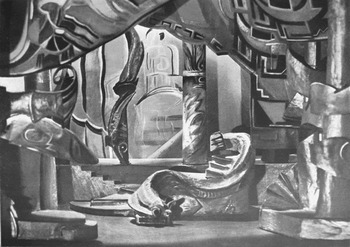
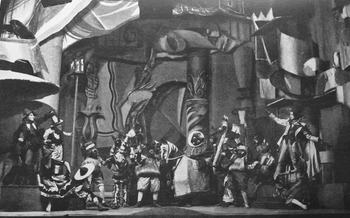
Georgii Iakulov's fantastical scenic design created a sense of impermanence and theatrical magic. The set, which has been described as “a spiral construction of Cubist-Baroque forms,”Footnote 55 was characterized by what one reviewer called “a plethora of curlicues”Footnote 56 in vivid colors meant to be reminiscent of the Roman sunset. The Pistoja Palace was represented by a central column from which an undulating spiral staircase spilled down onto the main platform (see Fig. 2). In addition to providing the actors with a rhythmic “keyboard”Footnote 57 for their carnival antics, Iakulov saw this palace as conveying “the unreliability of the images of the Pistoja Palace, their fluidity and kaleidoscopic quality.”Footnote 58
Georgii Iakulov, maquette for scene design, Princess Brambilla, Kamerny Theatre, Moscow, 1920. Russian State Archive of Literature and Art (RGALI), Moscow.

Iakulov's set created a fragmenting effect by making it possible for the audience to see objects from multiple perspectives. Efros called Iakulov's style a kind of “simultaneity” in which “the object appears from every side at once, in the displacements created by the rotation around an axis.”Footnote 59 Ignatov commented on the “splintering” of the stage space, stating: “It was as if the artist was trying to divide … the very stage floor into its fine component parts. In this subdivision of parts he saw the dynamics of rhythms.”Footnote 60 The large downstage center area was kept open, and the sides and rear both had individual platforms from which characters could observe the action, in order to prevent the actor from being upstaged by the design. Iakulov had originally intended that the set occupy much more of the stage floor, but Tairov insisted on maintaining adequate open space for actors.
The shifting scenery and the lighting techniques also created an impression of unified fragments. Actors manipulated screens and banners, similar to portable scenic elements in productions by other directors (Craig, Komisarjevsky, and Evgeny Vakhtangov, in particular), causing each scene to blend seamlessly into the next and to complement “emotional [and] rhythmic changes in the action.”Footnote 61 Theatrical lighting served as a visual extension of emotion, particularly in the duel scene. As Giglio's false self died, “a shaft of purple light [was] thrown upward from the prompter's box, casting enormous shadows on the backdrop…. The figures … move from the dim green of the sides into this central shaft of purple and out again.”Footnote 62 In another scene, carnival dancers were “illuminated by burning torches, juggled by one of the revellers [sic] into phantasmagoric patterns.”Footnote 63
If the scene design evoked a shifting atmosphere while providing a rhythmic performance space, the costumes served a similar purpose. Konstantin Derzhavin observes that the costumes were designed both to allow the actors the greatest possible range of movement and to convey a sense of masquerade.Footnote 64 Although the whirlwind atmosphere was multiplied in carnival scenes full of whirling capes, the actors’ freedom of movement was of utmost importance. The costume for Harlequin, for example, “closely fitted the actor's body like a glove and provided him with the possibility for plastically reflecting his sensations in gesture.”Footnote 65
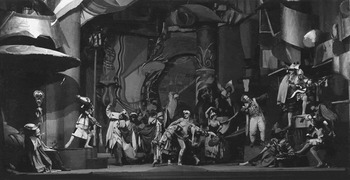
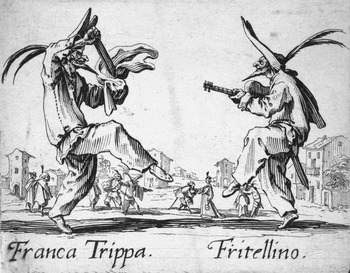
Iakulov, after Hoffmann, based a number of costume designs on Callot's Balli. Nikolai Bykov, an actor in Brambilla, recalled in an unpublished memoir that “Callot's drawings were brought in as models; they infected … Iakulov and he created wonderful sketches of carnival costumes and masks.”Footnote 66 Several of Iakulov's carnival figures recall Callot in their exaggerated abandon. More important, it is clear from production photographs that Callot's originals were also used as inspiration for movement and blocking. In one photograph (see Fig. 3), the carnival masker on the far right is in a position inspired by Franca Trippa's pose in the etching with Fritellino (see Fig. 4).
Carnival scene, Princess Brambilla, Kamerny Theatre, Moscow, 1920. Russian State Archive of Literature and Art (RGALI), Moscow.

Jacques Callot, Franca Trippa and Fritellino, plate from Balli di Sfessania (ca. 1621), Harvard Art Museum/Fogg Museum, Gray Collection of Engravings Fund, by exchange, S4.29.4. Photo: Allan Macintyre © President and Fellows of Harvard College.

Another significant design element was the production's use of masks and puppets. In his quest for synthetic theatre, Tairov intermingled puppets with live actors. The masks and puppets were created by the Kamerny's puppetry division, which had been established in February 1920 and was run by Vladimir Sokolov, a puppeteer and actor who later performed for Reinhardt and in Hollywood.Footnote 67 Actors were dressed as “giants, camels and ostriches,”Footnote 68 but the puppetry division also likely created other figures. In one photograph, probably of Brambilla's initial procession, a puppet horse is ridden by a distorted figure with exaggeratedly round eyes and mouth. This pair is surrounded by squat, masked figures with sagging potbellies, ringed in turn by unmasked onlookers (see Fig. 5).Footnote 69
Carnival procession, Princess Brambilla, Kamerny Theatre, Moscow, 1920. Russian State Archive of Literature and Art (RGALI), Moscow.

The puppets and masks in this production are metaphorical depictions of multiple planes of reality. In the most realistic scenes, characters wore no masks at all; in carnival scenes, small black half-masks covered the eyes of revelers, who expressed character and environment corporeally. Giglio, his rival, and some members of the main pantomime appear in grotesque versions of commedia masks, usually with ridiculous noses. By far the most exaggerated masks were worn by the exotic members of Brambilla's entourage. The integration of actors and puppets was a practical implementation of Tairov's belief that separate kinds of performance could be merged in synthetic theatre.
Music and Movement
The Kamerny production used masks in a metaphorical sense as well. For Tairov, the rigorous training of actors served as a mask that unleashed the individual creative self. Tairov viewed commedia as an actor-centered, actor-generated theatre that was a practical way to prepare actors to use their bodies as creative instruments; he emphasized acrobatics, dance, and circus skills, inspired in part by figures from Callot's Balli di Sfessania. It was in conjunction with the training for Brambilla that an acting school began to be developed at the Kamerny, though it did not receive official status until 1923. According to Bykov, he and his fellow actors received eight months of acrobatic training in preparation for Brambilla, but they also studied the history and technique of commedia as well as juggling, fencing, and Italian dance, especially the tarantella.Footnote 70
As reviewers and scholars have noted, music and dance were essential to Brambilla's synthetic nature; these unifying rhythmic elements permeated every scene. Tairov worked closely with composer Henri Forterre, bringing him in to write the music for each scene after the work was already well along; the music was written to fit specific needs and to complement the action.
Dance became the unifying principle of the movement in the production. Tairov used the tarantella (his counterpoint to Hoffmann's capriccio) both to reinforce a whirlwind atmosphere and to help actors perform with physical precision. Hoffmann scholar and theatre critic Sergei Ignatov observed in an unpublished article about the production that dance imbued its rhythm into individual scenes (the duel scene in particular) as well as the ensemble pantomimes: “We do not find a single movement in [the performance] that is not subordinated to the rhythm and that simultaneously does not emerge as an element of dance or acrobatics.”Footnote 71
Acrobatic elements were similarly integrated into the movement of the characters, Celionati in particular. According to Ignatov, “[The actor's] every movement was subordinated to the overarching concept, and in his leaps about the whole stage and in his distorted poses there is a grotesqueFootnote 72 that always impresses the crowd, never becoming caricature…. He has exceptional control over his limber, wonderfully trained body.”Footnote 73 This emphasis on movement is a direct application of Giglio's discovery of the power of the mask. Here, the performers submitted to their roles on one level; but to an even more profound degree they submitted to the character of the collective atmosphere, manifested in the celebratory musical pulse that dictated the action.
The promptbook's declaration of the power of commedia to rejuvenate the theatre should, of course, be understood metaphorically. Although commedia was one style the Kamerny actors learned, Tairov made no attempt to reproduce faithfully the Italian comedy of masks on his Moscow stage. As Clayton has demonstrated in Pierrot in Petrograd, Russian renditions of commedia were as different from the traditional comedy of masks as they were from each other. According to Derzhavin, Tairov's approach in Brambilla was drawn more loosely from “the theatrical tricks of itinerant cabotinage, which found their last refuge in circus clown routines [and] in the performances of conjurers and prestidigitators.”Footnote 74Brambilla was a glorification of Tairov's view of the legacy of commedia: a fresh approach to character and improvisation, a tradition that was both popular and professional, and an actor-centered theatre for theatre's sake.
Pantomime and the Master Actor
In the Kamerny production, pantomime was the most significant manifestation of this metaphorical commedia dell'arte. Amiard-Chevrel identifies twenty-one scenes that contained elements of pantomime; ten of these, composed entirely of pantomimic action, had no direct parallel in Hoffmann's original.Footnote 75 Tairov boasted that the pantomime scenes comprised a full fifty minutes of the two-and-a-half hour production.
From the beginning of the rehearsal process, pantomime was the major element in the production that actors improvised.Footnote 76 The director expected his actors not only to create the scenes collaboratively but also to work out technical challenges physically, eliminating stage machinery entirely in a production that was filled with theatrical magic and, hence, technical challenges. He argued that their task
consists of transferring the entire burden of creating the performance, … the entire burden of conveying Hoffmann's phantasmagoria—and laying this entire burden on the shoulders of the actor.
Take away all the mechanics, take away everything that is done by machine in the theatre, reduce all the involvement of electro-technology, of technology, of every possible theatrical machine to zero.Footnote 77
This notion of the actor as more skilled than the machine was one of the founding principles of the Kamerny Brambilla. It may also have been an indirect attempt to comment on the omnipotence of the proletariat, though Tairov was far more interested in workers in theatres than in workers in factories. Although the actors replaced stage machinery throughout the production, this low-tech approach was most evident in the central pantomime scene.
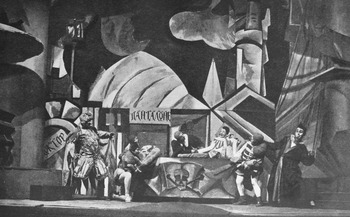
Brambilla's main pantomime, a full eighteen minutes long, takes place at the end of Act 2. In the promptbook, this pantomime follows Hoffmann's original.Footnote 78 It is clear from contemporary accounts, however, that it was performed quite differently. Tairov's final scenario was based on a recurrent plot in nineteenth-century Russian fairground pantomimes, brought to Russia in turn by the Ravels: the dissection of Harlequin. In the Kamerny production, Columbine's jilted lovers seize Harlequin when he is not looking, lay him on a table, and saw him into pieces, scattering his body parts about the stage. Columbine is disconsolate until a good fairy gives her a magic wand with which she can put the pieces together again, and the lovers are reunited.Footnote 79 Koonen recalls that in the sensational finale the actors, dressed as dwarves, giants, camels, and ostriches, performed in a wild, joyful rhythm as they “dance[d], tumble[d], juggle[d] flaming torches, and cross[ed] the stage on stilts.”Footnote 80
As Rumnev, the actor who played Harlequin, described it, Harlequin's rivals laid him on a large trunk with high wooden sides, brandishing an alarmingly large knife over him (see Fig. 6). They threw a white cloth over Harlequin's body while discussing the operation. While the cloth was airborne, the trunk lid swiveled, replacing the living actor with a dummy assembled from seven parts. Once the cloth was removed, the audience took the dummy for the real actor, gasping as he was cut into bits. After the procedure was finished, the trunk was carried backstage and the actor climbed out to prepare for the second half of the trick.Footnote 81
Main pantomime scene, Princess Brambilla, Kamerny Theatre, Moscow, 1920. Russian State Archive of Literature and Art (RGALI), Moscow.

As Harlequin's pieces were reassembled into an upright empty silhouette ready to receive the severed limbs, Rumnev imperceptibly replaced each of the dummy parts with a portion of his own body, beginning with his legs, then his torso, his arms, and finally his head. This trick required immense flexibility, according to Tairov: “Harlequin … controlled his body to such a degree that he was able to fit through an aperture that nobody else could have passed through; he was able to assume poses that nobody else could hold, and he gradually revealed his body to the audience.”Footnote 82 As Harlequin was cut into pieces and reborn, so Giglio's vain paper-and-cardboard self would be dissected and his true self reincarnated as a commedia dell'arte performer and theatrical prince. The pantomime scene, a thematic microcosm of the production, was a declaration that the Kamerny had struggled and succeeded in its intended revolution.
At the end of the Kamerny's Brambilla, Giacinta compliments Giglio on a commedia performance they have just finished. Giglio replies: “Yes, that is what our Italian comedy of masks is so good at: at providing room for the creative work of the actor.”Footnote 83 In the promptbook, “our Italian comedy of masks” has been crossed out and replaced by the words “our theatre.” This change is significant, as it expresses the Kamerny's fundamental approach to its inspirations. Tairov was not interested in reconstructing the past; he used Hoffmann and commedia as creative fodder in order to absorb from them what he found useful in creating a new work of art.
Tairov exhibited a recurrent fascination with synthesizing theatrical and universal opposites. Whereas Meyerhold used unresolved disjunction as an artistic response to his chaotic times, Tairov treated opposing types in a Hegelian sense. But in Tairov's productions, the thesis and antithesis resulted in ultimate beauty and unity rather than a new thesis. Hence, as Tairov adapted Hoffmann for the Russian stage, commedia became the thesis, the Russian theatre the antithesis, and their union a “third thing,” a new work of art full of joy and celebration, a declaration that the art of the future would triumph.
Brambilla in Its Time
In the many laudatory reviews of Princess Brambilla, one of the things critics complimented most often was the production's timeliness. The fact that Brambilla was removed from the repertoire after only two and a half years (but over a hundred performances) indicates even more strongly its appropriateness in a very specific context.
Several critics described Hoffmann's work as especially suitable material; some saw the writer as more relevant than many native Russian authors, especially during the war years. Koonen wrote: “The fantastical Romantic Hoffmann was somehow astonishingly consonant with the entire atmosphere that reigned at that time in art.”Footnote 84 Similarly, Pavel Markov observed: “His ‘constructivist’ boldness and grotesque ingenuity are consonant with the art of our era. It so happens that the most fantastical and most subjective poet of Germany, a dreamer and a fairy-tale writer, has remained comprehensible and close in the years of war and revolution.”Footnote 85
However, Hoffmann's style was but one element of the production's cumulative effect: Brambilla was timely in its message of hope for the future; in its declaration of the power of art; in the need for art to survive in the most difficult of economic circumstances; in its celebration of the Kamerny Theatre's virtuosity, gained from six years of experimentation and hard work; and in its statement about the importance of preserving the professionalism and artistic autonomy of the theatre.
In his lecture on Brambilla, Tairov referred repeatedly to his attempts to create joyful theatre, stating: “In both [the harlequinade] and the [mystery play], joy should arise within the audience as a result, for … that theatre which leaves the audience jaded, shaken, rather than renewed and joyful, is not a true work of art.”Footnote 86 Although this differed from Meyerhold's view of Hoffmann, as Clayton observes, it is reminiscent of an article in Love for Three Oranges: Zhirmunskii's “Comedy of Pure Joy.”
Zhirmunskii had argued that Gozzi's fiabe appealed to the Romantics because of their love of pure play, that they depicted a “world of another order, more exalted, joyful, and resplendent than the one that surrounds us.”Footnote 87 Zhirmunskii later added: “What is depicted on the stage is not solid, material reality, but only a merry game, only a spectacle invented to amuse the spectators.”Footnote 88 Both these statements resemble Tairov's description of Brambilla: “Despite the shock that Giglio … undergoes, despite all this, Hoffmann wants to convey a general, great joy, a great affirmation and acceptance of life…. Living laughter and living joy: this is the task of the production Princess Brambilla.”Footnote 89
Like many other modernist Russian artists, Tairov had a fundamental faith in the transformative power of art. As Worrall has observed, he believed that awakening “great love” and “creative enthusiasm” helped individuals “overcome the insuperable.”Footnote 90 He was not the only director of the period who wanted to have audiences leave the theatre feeling revitalized; Vakhtangov's similar love of celebratory play was evident in his 1922 Princess Turandot, which exuded jubilant creativity despite the fact that the director was dying even as he staged it.
The first six years of the Kamerny Theatre's existence were, of course, marked by an extended period of warfare: the Great War overlapped with the February and October Revolutions, which were followed by the Russian Civil War. Serious widespread famine began in 1918 but peaked in 1921–2, resulting in roughly five million deaths nationwide.Footnote 91 Tairov's repeated emphasis on joyful theatre should be read two ways: that the theatre can and should effect positive transformation, and that the theatre is a place to celebrate art's contribution to life. The greater life's difficulties, the greater the need for theatre that is life-affirming and art-affirming. A reviewer from Izvestiia concurred:
This soundly assembled artistic collective doesn't care one whit: not about our economic ruin, nor about the difficulty in obtaining necessities—in the turbulent whirlwind of carnival, the symphony of paint, silk, canvas and admirably trained human bodies astonishes, startles, and, finally, enthralls the spectator, who knows perfectly well, incidentally, that all the brilliance and sumptuousness of the production is achieved with a minimal expenditure of resources, with a purely theatrical approach.Footnote 92
This description succinctly captures what it was about Brambilla that was so appealing: that the Kamerny, with a little paint and a great deal of training, infectiously conveyed the joie de vivre that sustained many of those who survived the difficult Civil War years. Brambilla was imbued with hope for the future of theatre and, indirectly, for the future of Revolutionary Russia: Giglio's world is one that is warped and confusing, but his world inevitably resolves into a new and better one.
The repeated emphasis on joy in Brambilla was also a celebration of the ability of the Kamerny itself to survive. Since its opening shortly after the outbreak of World War I, the new theatre had struggled with everyone else against famine and cold; but, as Koonen chronicles in her memoirs, the Kamerny had additional challenges, as they were a young and relatively inexperienced troupe with significant financial troubles. In addition, the company lost its original theatre space and endured landlords who refused to heat the theatre adequately even when there were not fuel shortages.Footnote 93 However, the troupe was extremely dedicated to its work; Koonen recalls that they all voluntarily worked without pay and other comforts in order to keep the theatre afloat,Footnote 94 while Bykov relates that he couldn't seem to keep away from rehearsals: “Rehearsals for Brambilla were long and hard. I loved these rehearsals so much that I walked to them even when I wasn't in one scene or another. The word ‘walked’ should be interpreted literally, as the trams weren't running in Moscow during those years.”Footnote 95
The ebullient spirit of Brambilla was a declaration of the Kamerny's ability not just to survive but to succeed. In 1919, the Kamerny had given a command performance of Salomé for Anatoly Lunacharsky; the Commissar of Enlightenment was impressed enough to return the company to their original theatre at 23 Tverskoi Boulevard. He also released them from any obligation to pay rent, granted them a generous subsidy, and, by the beginning of 1920, included them among the comparatively autonomous “state academic” theatres that were not (yet) required to include revolutionary content in their repertoires.Footnote 96 Koonen recalls that Lunacharsky also offered to give the theatre funds to expand the size of its auditorium to eight hundred seats in order to accommodate its swelling audiences.Footnote 97
Tairov actively participated in the debate over the future of Soviet theatre, his confidence perhaps boosted by the popularity of the theatre, the skill of his actors, and Lunacharsky's approval. Each of Brambilla's declarations of an ideal theatrical future was related to some degree to this debate. Tairov expressed these themes primarily as universal truths to be applied in multiple contexts. Tairov's call for an actor-centered theatre was a condemnation of the methods of both Stanislavsky and Meyerhold, whom he felt limited the actor's potential in different ways. His disdain for theatrical hacks may have been a subtle criticism of the embryonic Soviet repertoire and his call for virtuosity a reaction against the surge of amateur revolutionary theatres under the umbrella of Proletkult. The choice of Hoffmann was a deliberate continuation of the pre-Revolutionary interest in a writer who also happened to have written during a period with a similar degree of unrest—the time of the Napoleonic Wars.
Above all (even as he accepted state support), Tairov defended the artistic autonomy of the theatre, both in Brambilla and in his Notes of a Director. The metaphorical commedia and applied pantomime sequences in Brambilla were self-generated and highly skilled, demonstrating the actor's self-reliance and earned right to create. Tairov believed that theatre could interpret life, process life, and capture the ineffable essence of life but that it should not reproduce life or be stilted by an overreliance on other arts. He concluded his Notes of a Director thus:
A whole series of arts already have their own science, or at least some firm beginnings of it.
Now it is the theatre's turn.
But in order that this science have a suitable base for its construction and development, it is necessary that theatre art at last get an accurate picture of itself and dissociate itself from all attendant elements, it is necessary to carry out resolutely and completely the theatricalization of the theatre.;>Theatre is theatre.
It is high time we learned this simple truth once and for all.Footnote 98
Torda has commented on Tairov's profound influence on Russian and Western theatre during his lifetime, observing that “by 1935, more than 5,000 articles had been written” in a plethora of languages “on the art of the Kamerny Theater.”Footnote 99 Yet, with several notable exceptions, the Kamerny's work remains relatively underexplored.Footnote 100 Worrall has proposed that this is due, in part, to the lack of an archive, which we now know exists. Clayton cites Tairov's “pure, unintellectualized theatricality” as a reason.Footnote 101 However, Tairov's work, though theatrical, was not unintellectual. I believe Dasha Krijanskaia comes the closest to the heart of the matter when she states: “The fact that Tairov was alien to both of the mainstream traditions of Russian theatre … prompts scholars to view Tairov's art as peculiar and extraneous offspring,” adding that Tairov's “formal aesthetics” fell out of favor during the socialist realist period.Footnote 102
Despite excellent scholarship that has attempted to correct the oversimplified view of early Russian directors, there is still a lingering misperception that Stanislavsky and Meyerhold represent two theatrical poles, while other directors, Vakhtangov, for example, fall neatly between them, a model that gives the impression that all Russian modernist directors can be found somewhere along a single continuum. I would argue that there are many possible trajectories, some closer, some further away from their points of origin but each unique in its own way. Tairov was so varied in his taste and yet so consistent in his goals that he dispels this notion of theatrical linearity.
Criticisms of Tairov in the 1930s have also had a lasting impact on his reputation. Soviet critic and historian Pavel Markov, who spoke glowingly of Hoffmann and Tairov in the early 1920s, wrote that by the mid-1930s Tairov “looked upon the stage as a field for conventional acting that had nothing whatever to do with real life and naturalistic imitation, acting that led into a world of extraordinary people and exquisite feelings” and that he practiced “aestheticism … carried to the point of abstraction.”Footnote 103 This subtle admonishment, echoed by other writers and written during the same period that socialist realism became mandated and nonconformists increasingly were accused of “formalism,” makes it seem, falsely, that Tairov rejected the idea of infusing his productions with an intellectual message in favor of an empty theatricality.Footnote 104
Princess Brambilla is but one of many Kamerny productions that demonstrates that Tairov was deeply aware of his milieu.Footnote 105 He chose much of his early repertoire as a deliberate comment on or, often, counterpoint to his times, both as an extension of his interest in synthesizing opposites and as a defense of artistic autonomy. As Worrall observes: “The story of Tairov's theatre in the 1920s consists of a struggle with its critics and a courageous attempt to pursue an independent artistic course.”Footnote 106 Many of the experiments he conducted while pursuing this course remain applicable to the theatre of today: the training of actors in multiple artistic vocabularies, an actor-centered rather than an autocratic approach to directing, consistently strong roles for women, an emphasis on visual and corporeal as well as spoken texts, and the conviction that theatre is a necessary expression of the creative soul.