1 Introduction
When unique intonation patterns are found in languages of wider communication, influence from indigenous languages is often cited as the source. This association has been made for several varieties of Latin American Spanish, which may differ with respect to intonation from Peninsular Spanish. For example, the intonation of Spanish as spoken in central Mexico has been attributed to Nahuatl origins (Henríquez Ureña Reference Henríquez Ureña1938), the intonation in Chilean Spanish has been attributed to possible Araucan origins (Alonso Reference Alonso, Alonso and Lida1940), and some intonation patterns in Argentine Spanish have been attributed to influence from Guaraní (Malmberg Reference Malmberg1948). However, what is oftentimes absent from these assertions is an analysis of the prosodic system of the indigenous language, as indicated by Lope Blanch (Reference Lope Blanch1987: 39): ‘I do not know of – nor believe there exist – detailed descriptions of Yucatec Mayan intonation nor of the Spanish of this area; establishing dependencies between them does not, for the moment, go beyond speculation at the “level of intuitive reaction”’ (my translation).Footnote 1, Footnote 2
Research on the intonation systems of indigenous languages as spoken in the Americas offers the possibility of addressing several issues related to language contact and language typology. By developing adequate descriptions of intonation patterns found in indigenous languages, synchronic and diachronic comparisons between indigenous languages can be made which may respond to the following broader research questions: Are there typical intonation features that can be considered ‘pan-American’ amongst these indigenous languages? Do areal features emerge amongst genetically related and unrelated languages which may reflect cases of contact? Can existing intonation patterns be used to help reconstruct previous patterns that existed at earlier stages through cross-linguistic and cross-dialectal analysis? Examples of intonation research on language contact and language typology include Hualde (Reference Hualde2003b) and Simonet (Reference Simonet2008). Simonet (Reference Simonet2008) offers an analysis of intonation contact between Majorcan Catalan and Spanish in which intonation patterns undergo borrowing from the L2 to the L1 in addition to the transfer of traits through substratum interference from the L1 to the L2. Also, Hualde (Reference Hualde2003b) provides an example of diachronic reconstruction of Proto-Romance intonation through the analysis of Occitan as a bridge language between southern Romance languages and French.
In this paper, I provide a summary of the findings gathered from the instrumental analysis of Quechua as spoken in Cuzco, Peru. Recordings of read utterances were made of native Quechua speakers. This research on Cuzco Quechua can be applied in future studies to the analysis of Quechua intonation in contact with both indigenous and non-indigenous languages, such as Aymara and Spanish. Additionally, knowledge of how Cuzco Quechua intonation is employed may allow for subsequent research on variation across dialects of Quechua. In order to begin to address these issues, the scope of this paper is limited to presenting some of the basic features of intonation found within Cuzco Quechua declaratives. Also, observations are made regarding how one particular feature of the Quechua contour, peak alignment, may begin to show influence from Spanish for some of these Quechua speakers.
1.1 Quechua in Peru: varieties, status and shift
The Quechua language family can be divided into two large groups, Central and Peripheral Quechua (Mannheim Reference Mannheim1991). One of the Peripheral varieties, Southern Peruvian Quechua, includes Cuzco Quechua, which forms the basis for this study. According to the 1993 census, the most widely-spoken variety in Peru is Southern Peruvian Quechua, accounting for 75% of the Quechua speakers polled (Chirinos Rivera Reference Chirinos Rivera2001).
The official political status of Quechua in Peru has varied over the years. As a result of the Peruvian Revolution, in 1975 Quechua was declared an official language. However, by 1979 the new constitution changed Quechua to be the language of ‘official use’ only in those regions where Quechua was predominantly spoken (Hornberger Reference Hornberger1987: 207).Footnote 3 This legal status has affected how Quechua is employed in the educational system. While bilingual programs may be found in Peru today, many follow a transitional model that uses Quechua in the lower grades with a goal towards full use of Spanish in the classroom at the upper levels.Footnote 4
In terms of language maintenance, Chirinos Rivera (Reference Chirinos Rivera2001) uses census data to provide an ‘Index of Linguistic Substitution’ (ISL), which indicates the percentage of speakers between ages 5 and 14 years who are expected to speak Quechua compared to the percentage of Quechua speakers in the general population. In the Department of Cuzco, 57% of the 5–14-year-olds speak Quechua compared to 63% overall, giving a rate of shift at 10%; within the District of Cuzco encompassing the city itself, the index for shift to Spanish is greater than 50%. Therefore, while Southern Peruvian Quechua has the largest number of speakers and has maintained official legal status within the region, there is still a shift towards the use of Spanish, especially as speakers migrate from rural areas within the Department to more urban areas such as the District and City of Cuzco. For the present study, given its prominence among Quechua dialects, its status within Peru, and the number of speakers who continue to use the variety, Cuzco Quechua has been chosen to be analyzed. Nonetheless, the native Quechua speakers in this study may be experiencing influence from Spanish, either through their own daily interactions in Spanish as bilinguals or through contact with Quechua speakers who have already shifted more quickly to Spanish and to Spanish-like patterns.
1.2 Stress in Quechua
Quechua is described as an agglutinative language with some polysynthetic characteristics (Cerrón-Palomino Reference Cerrón-Palomino1987: 261–263). For many varieties of Quechua, including that found in Cuzco, the penultimate syllable carries primary stress in nearly all words with the exception of some suffixes that attract stress on the last syllable (Calvo Pérez Reference Calvo Pérez1993: 49).Footnote 5 When suffixes are added, stress continues to be realized on the penultimate syllable (e.g. [ˈwa.si] ‘house’, [wa.ˈsi.pi] ‘in the house’). Exceptions are found with words containing exclamatory or emphatic suffixes, which demonstrate a shift to the last syllable (e.g. [ha.ˈmun.qa] ‘he will come’ → [ha.mun.qa.ˈtʃa] ‘he will probably come (emphatic)’); if a word contains more than three syllables, a slight secondary stress may be observed on the first syllable (Cerrón-Palomino Reference Cerrón-Palomino1987: 258–259).
1.3 Previous descriptions of Quechua intonation
While descriptions of the segmental characteristics of the peripheral varieties of Quechua do appear in the literature, information regarding Quechua suprasegmental features has been found to be minimal. There are four basic descriptions, which appear in the analysis by Parker (Reference Parker1969) of Ayacucho Quechua, in the work by Cole (Reference Cole1982) on Imbabura Quechua as spoken in Ecuador, and in the grammars by Cusihuamán (Reference Antonio1976, Reference Antonio2001) and Samanez Flórez (Reference Samanez Flórez1996) of Cuzco Quechua. However, all four descriptions appear to be based on knowledge of the language and speaker intuitions rather than being founded in acoustic analysis. In fact, Cerrón-Palomino (Reference Cerrón-Palomino1987: 128) notes that Quechua intonation is one of the areas that has been least explored: ‘The phenomena of accent, rhythm and intonation are the least understood points within Quechua phonology. In this sense, the existing studies do not provide sufficiently exhaustive data from which one can postulate the originating suprasegmental features. Of the prosodic elements mentioned, only stress has received greater attention, due to its relatively discreet character’ (my translation).Footnote 6 However, in a recent acoustic analysis of stress in South Conchucos Quechua, a Central Peruvian variety, Hintz (Reference Hintz2006) finds fundamental frequency to be the most reliable cue for native speakers in determining levels of stress, followed by intensity and duration.
The following is a brief summary of the general assertions made regarding Southern Peruvian Quechua statement intonation. First, declaratives are shown to have a final peak that is followed by a fall towards the bottom end of the pitch range for the utterance. In Cusihuamán (Reference Antonio1976, Reference Antonio2001) and Samanez Flórez (Reference Samanez Flórez1996), the height of the peak in Cuzco Quechua is assigned a numeric level of 2, which then drops to 1 by the end of the utterance. Similarly, Parker (Reference Parker1969) analyzes Ayacucho Quechua statements as exhibiting a /231↓/ contour. Second, the schematizations in Cole (Reference Cole1982) and Samanez Flórez (Reference Samanez Flórez1996) show a low, relatively flat contour prior to the final rise at the end of the utterance. However, no information is provided regarding multiple peaks within an utterance even though examples in both Cole (Reference Cole1982) and Samanez Flórez (Reference Samanez Flórez1996) show contours for statements with more than one word. Therefore, it is not known what the height relationship is between subsequent peaks for declaratives. Third, Cole (Reference Cole1982) shows the final peak occurring on the last stressed syllable of the utterance. In other descriptions, a tune-to-text relationship is not given, with the result that the temporal location of tonal events in an utterance is not specified.
2 An instrumental analysis of Cuzco Quechua
2.1 A summary of the autosegmental-metrical model
This research adopts the autosegmental-metrical (AM) approach employed by Pierrehumbert (Reference Pierrehumbert1980) for the analysis of English intonation and subsequently applied to intonation studies of several other languages, the number of which continues to grow (see e.g. the edited volume by Jun (Reference Jun2005) for a cross-section of languages analyzed using this framework). Within this model, pitch targets are considered the significant features of intonation, as opposed to movements, such that tones are specified as highs (H) and lows (L). This approach is in contrast to the British school described in Ladd (Reference Ladd1996) as a ‘proto-phonological’ or ‘impressionistic’ approach which takes the pitch curve as the basic unit with a specific internal structure, including a head, nucleus and tail. In the AM model, the tone associated with the stressed syllable is marked with an asterisk (*), which is considered the ‘pitch accent’ (either H* or L*). Pitch accents can also be bitonal, that is, with two tonal specifications. In these cases, the actual tone more strongly related to the stressed syllable is marked with the asterisk (*) whereas the tone which is not as strongly associated is considered to be either ‘trailing’ or ‘leading’ (e.g. L*+H or H+L*). Within the tradition of the British School, the last pitch accent in the utterance, considered to be the most prominent, is termed the ‘nuclear’ pitch accent while any prior pitch accents are described as ‘pre-nuclear’ pitch accents (Ladd Reference Ladd1996). However, since degrees of perceived prominence are not examined in this study, the terms ‘final’ and ‘non-final’ will be used instead to refer to the location of pitch accents within the utterance. In order to establish the nuclear status of utterance-final peaks in Quechua, other properties in addition to fundamental frequency would need to be examined, including duration and intensity.
Last, tones appearing at the end of an utterance before a long pause are marked provisionally as (%), using the notation for an intonational phrase; tones within an utterance that appear to be part of a smaller phrase and not followed by a pause are marked provisionally as (−), using the notation for intermediate phrase boundary tones (e.g. either L− or H−). Since a considerable amount of work is still needed to determine the number of levels of phrasing present in Cuzco Quechua, the above notation is used as a first approximation. An alternate analysis would be to simply describe Cuzco Quechua as having higher and lower levels of phrasing, and to state that the number of levels and their relationship have yet to be determined.
It is important to note that the study presented in this paper adopts a phonetic approach at first and then turns to a phonological approach. Following work by Prieto, Shih & Nibert (Reference Prieto, Shih and Nibert1996) and Atterer & Ladd (Reference Atterer and Ladd2004), the notation of H and L is employed in a phonetic sense of the fundamental frequency (F0), specifically the F0 maximum and F0 minimum. The ‘peaks’ and ‘valleys’ are marked as H and L in the pitch contours provided. Likewise, the initial and final F0 heights (iT and fT respectively) are marked. In this way, the phonetic behavior is analyzed prior to proposing a phonological analysis of pitch accents and boundary tones using the additional notation described above (* for association with the stressed syllable, + for a bitonal pitch accent, − for phrase tone, and % for a boundary tone).
2.2 Methodology
2.2.1 Data collection, transfer and extraction
Participants were recorded using a head-mounted boom microphone and a high-quality minidisc recorder. After the recording, participants completed a four-page questionnaire in Spanish detailing their personal linguistic history, including their experience with Spanish and Quechua and their language use with family and community members. Upon completion of the experimental session, which lasted approximately 45 minutes, speakers received a nominal remuneration for their participation in the study. Recording sessions were conducted in Cuzco, Peru, at the Centro Bartolomé de las Casas (CBC), in a quiet room, removed from excessive noise from the outside.
Recordings were then transferred to a computer using a 44.1 kHz sampling rate (16 bit). Analysis of the recordings was performed with the software program Praat (Boersma & Weenink Reference Boersma and Weenink2008) using an autocorrelation method to extract the fundamental frequency (F0) contour. Syllable and word boundaries were determined by examining the F0 pitch track along with the waveform, spectrogram, and intensity, as well as by auditory inspection. Measurements of ‘horizontal location’ of tonal events (i.e. the temporal alignment of peaks and valleys) and other points along the contour, such as the beginning and end of words, were made in seconds (s). Similar measurements of ‘vertical location’ (i.e. the tonal height) were made in Hertz (Hz).
2.2.2 Recording task and declaratives data set
Participants were asked to read aloud a series of question-and-answer pairs written on index cards. The cards were viewed one-by-one and were pseudo-randomized. Each participant read the cards through one time and then a second time in reverse order. The answers, which are the focus of this study, were all verb-final declaratives since the canonical word order in Quechua is generally described as SOV (Cerrón-Palomino Reference Cerrón-Palomino1987: 289). Likewise, Cuzco Quechua in particular is described as having the order subject, object or complement, and verb which may be followed by additional adverbial information (Cusihuamán Reference Antonio2001: 78). Therefore, the answers followed the structure SXV in which S, X and V represent initial, medial and final positions of subject, object (or other complement or adjunct) and verb, respectively.
A total of 140 utterances have been compiled for this declaratives data set. In some cases a break in the F0 contour appears in conjunction with voiceless consonants. Since there are only eight voiced consonants in Cuzco Quechua (/m n ɲ ɾ l ʎ ʝ w/), aside from borrowed voiced consonants from Spanish (/b d g/), and seventeen voiceless consonants, interruption of the intonation contour was to be expected. However, utterances containing multiple pauses, hesitations or disfluencies have not been included in the present analysis. Of the 140 declaratives, 109 utterances with the structure SXV were used in the quantitative analysis in section 3.2. The remaining 31 utterances were non-SXV sentences used in the general qualitative characterization as appears in section 3.1 (for example, utterances containing simply a finite verb or an adverb and a finite verb). Additionally, some utterances with the SXV word order have been included in section 3.1 as part of the qualitative description. Each speaker has a minimum of 20 utterances included in the quantitative analysis. Note that the first participant has a greater number of tokens since that speaker produced more declaratives without multiple pauses utterance-internally. For each utterance, the following measurements were taken:
- (1)
iT = initial tonal F0 height at the beginning of the utterance
L = F0 minimum valley associated with the stressed syllable
H = F0 maximum peak associated with the stressed syllable
i = F0 height at the beginning of the vowel in the first syllable of the word
v = F0 height at the end of the vowel following the stressed syllable
fT = final tonal F0 height at the end of the utterance
In addition to the initial and final tonal heights of the utterance (iT) and (fT) noted above, individual measurements were taken in initial, medial and final positions for the subject (S), complement/adjunct (X), and verb (V). That is, the measurements for the subject were LS, HS, iS and vS; the measurements for the complement/adjunct were LX, HX, iX and vX; and the measurements for the verb were LV, HV, iV and vV. For these measurements, the term ‘tonic-aligned’ is used to describe tonal events (for example, a peak ‘H’) appearing during the stressed syllable whereas ‘post-tonic’ is used to describe tonal events occurring after the offset of the stressed syllable.
2.2.3 Quechua orthography and transcription
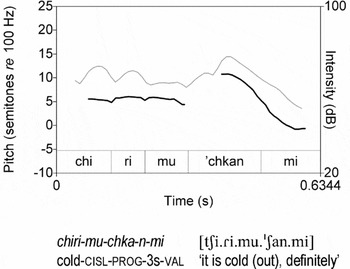
The orthography adopted for presentation of the Quechua utterances in this corpus follows that described in Cerrón-Palomino (Reference Cerrón-Palomino1994). That system of orthography is in turn based on the Peruvian Quechua alphabet, which was made official in 1985, and the official Bolivian Quechua alphabet from 1984. The verbal progressive suffix has been written as -chka, which in its most conservative form is pronounced as [tʃka], as in some Peruvian and Bolivian varieties of Quechua (Cerrón-Palomino Reference Cerrón-Palomino1994: 50). In the majority of the cases, the Cuzco Quechua speakers interviewed for this study produced [ʃa] (e.g. as in figure 1 and figure 5 below), with only a few instances of [sa]. Additionally, although not part of the official alphabet, stops [b d g], fricative [f], and mid-vowels [e o] appearing in names borrowed from Spanish are included since these sounds enter into the pronunciation of Quechua speakers to varying degrees depending on levels of bilingualism as well as other geographical and social factors. A broad phonetic transcription is provided in the examples given. While some more fine-grained phonetic differences may be present in the recordings, such as a fricative realization of the uvular occlusive /q/, assibilation of word-initial /ɾ/, or a velarization of the nasal or other assimilation in coda position, these differences do not affect the intonation analysis given and therefore have not been represented.
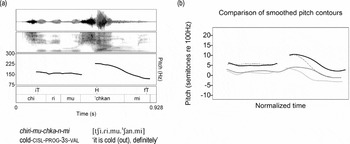
(a) Verb in utterance-final position with relatively low F0 prior to the peak (H); NQS-1. (b) Time-normalized productions by four speakers, in semitones. Black line: NQS-1; light grey line: NQS-2; dark grey line: NQS-3; black dashed line: NQS-4.

2.2.4 Participants
The participants included in the study are described in this section according to their origin, gender, age, level of education and languages spoken. Quechua speakers were recorded in the city of Cuzco, Peru. All speakers were born in the Department of Cuzco, specifically in the Province of Calca, and had parents of the same provincial origin. The present analysis is based on recordings collected from male speakers who ranged between 20 and 34 years of age. In terms of level of education, the participants reported completion of or enrollment in a post-secondary education program.
Regarding languages spoken by the participants, recordings have been analyzed of four native Quechua speakers (NQS), i.e. those who spoke only Quechua before beginning school at age five. For identification purposes, these four speakers are referred to as NQS-1, NQS-2, NQS-3 and NQS-4.Footnote 7 Three of the speakers (NQS-2, NQS-3 and NQS-4) reported having parents who spoke only Quechua, while speaker NQS-1 reported having parents who spoke both Quechua and Spanish. Using a self-rating scale of speaking ability, two of the four participants identified themselves as being equally fluent in both Quechua and Spanish, speaking both languages ‘without a problem = 5’ (NQS-1 and NQS-2). The other two participants identified differences in language ability: one speaker reported speaking Spanish ‘without a problem = 5’ and Quechua ‘somewhat well = 3’ (NQS-3), while another reported speaking Quechua ‘without a problem = 5’ and Spanish ‘somewhat well = 3’ (NQS-4).
3 Declarative intonation in Cuzco Quechua
The analysis of Cuzco Quechua declarative intonation is organized as follows. First, several initial qualitative observations are made in section 3.1 regarding the general shape of the contour, citing sample tokens from the recordings for each of the speakers. Then, in section 3.2 a more detailed, quantitative analysis is offered of peak alignment and peak height using sentences containing a subject, complement or adjunct, and verb. Intermediate phrase tones and post-tonic peaks are also discussed, followed by a composite analysis of tonal targets of all SXV tokens produced by each speaker. Finally, the overall findings are summarized in section 3.3.
3.1 A general overview of the Cuzco Quechua declarative contour
In this section, we consider the overall shape of the declarative contour by focusing on the F0 maximum and minimum (peaks H and valleys L) related to the stressed syllable as well as the height of the fundamental frequency (F0) at the beginning and end of the utterance (initial and final tonal height, iT and fT respectively). In many cases, the F0 remains relatively low before the realization of the peak related to the stressed penultimate syllable. As seen in figure 1a, the F0 during the pre-tonic syllable [mu] is low followed by a high peak (H) on the stressed syllable [ʃan].Footnote 8 Figure 1b shows this same behavior for all four speakers. When voicing is present throughout the stressed syllable, a valley low (L) is also observed, as in [mun] in figure 2a.
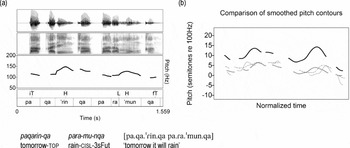
(a) Verb in utterance-final position with relatively low F0 prior to the peak (H); valley minimum (L) at stressed syllable onset; non-final word with peak; NQS-3. (b) Time-normalized productions by four speakers, in semitones. Black line: NQS-1; light grey line: NQS-2; dark grey line: NQS-3; black dashed line: NQS-4.

Note that pitch contours are smoothed using Praat, which adjusts the bandwidth of the analysis window in order to minimize the effects of microperturbations and other sensitivity to noise in the signal. When multiple utterances are compared, a script has been used which normalizes utterances, such that the total duration for the utterance is taken as 100%. In this way, each utterance is graphed from beginning to end along the same axis so that sentences with different durations can be compared (Lennes Reference Lennes2006).
Utterances with more than one content word are shown in figures 2 and 3. In figure 2a we can observe the relationship between a non-final peak (on [ɾin]) and a final peak (on [mun]).
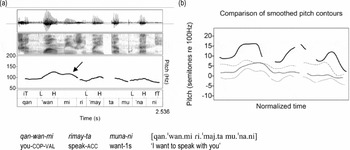
(a) Tonic-aligned peaks in utterance-final and non-final positions; NQS-2. (b) Time-normalized productions by four speakers, in semitones. Arrow indicates the maintenance of a relatively high F0 height in the post-tonic syllable prior to beginning the next word. Black line: NQS-1; light grey line: NQS-2; dark grey line: NQS-3; black dashed line: NQS-4.

In figure 3a we can observe the relationship between two non-final peaks ([wan] and [maj]). Similar to words in utterance-final position, non-final words show a peak which is aligned during the stressed syllable. Later peaks also tend to be lower: the final peak is lower than non-final peaks (compare final [na] with non-final [wan] and [mun] in figure 3a); likewise, the height of successive non-final peaks is often lower than previous peaks (compare non-final [wan] with following non-final [maj] in figure 3a). In some cases the F0 remains high after the stressed syllable until the end of the word before dropping at the beginning of the next word, as can be seen in figure 3a at the end of the word [qan.ˈwan.mi] ‘with you’.
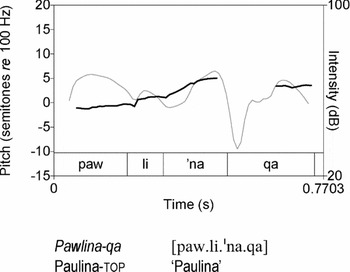
For some tokens of four syllables or more, the placement of secondary stress on the first syllable of the word may be aurally perceived. However, a distinct peak does not appear on the initial syllable. Other acoustic correlates may need to be measured, such as duration and intensity, in order to determine how prominence-lending features are assigned to this initial position. In figures 4 and 5 we can see the higher degree of intensity (shown as a grey line) on the initial syllable of the word compared to one and two intervening stressed syllables prior to the stressed syllable.
F0 contour (black line) with intensity contour (grey line) showing higher intensity on initial syllable of utterance (compared to second syllable); NQS-2.

F0 contour (black line) with intensity contour (grey line) showing higher intensity on initial syllable of utterance (compared to second and third syllables); NQS-4.

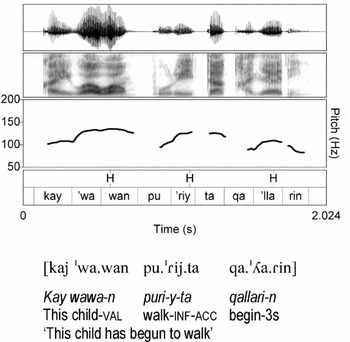
Last, in some declarative tokens, there are words that appear without a peak on the syllable that would be stressed when the word is pronounced in isolation. Examples of the function word kay ‘this’ without a peak and with a peak are shown in figures 6 and 7, respectively. One factor that may affect how a demonstrative is marked using intonation may be if it appears in conjunction with an evidential or validation marker (as in wawa-n), in which case the emphasis is on wawa ‘child’, or if it appears with a topic marker (as in wawa-qa), in which case a peak is observed on the demonstrative kay ‘this’.Footnote 9 Another factor may be the close proximity of the following stressed syllable. While in figure 6 the next syllable after kay is stressed (in which case kay shows no peak), in figure 7 there is one intervening unstressed syllable after kay (in which case kay does show a peak).
Without peak on demonstrative kay; NQS-2.

With peak on demonstrative kay; NQS-2.

Issues such as these related to tonal crowding and accentual clash are areas that need to be explored. On the other hand, with even more spacing between stressed syllables, there are still instances of tonic-aligned peaks, so that the presence of more intervening syllables does not necessarily correspond to later, post-tonic peaks (e.g. figure 7 shows two intervening unstressed syllables between the peak on [ˈwa] and the peak on [ˈɾij]).
To summarize, the general characterization of intonation in Cuzco Quechua declaratives with one content word is a relatively flat contour with a peak during the penultimate syllable, which ends in a final low F0 at the end of the utterance. In utterances with more than one content word, the pattern is similar, with the additional maintenance of a high F0 after the stressed syllable to the end of word (in many cases), which then swiftly drops at the beginning of the next word. To examine the contour in more detail, the behaviors related to tonal alignment, and tonal height will be examined in the following section.
3.2 A quantitative analysis of Cuzco Quechua declarative intonation
3.2.1 Peak alignment
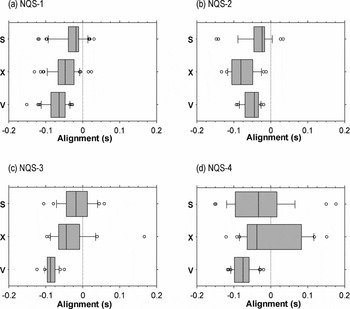
In this section, the subset of 109 utterances containing three content words has been analyzed. The word order in each case is subject, object (or other complement or adjunct), and verb (abbreviated as SXV). As seen in the examples above, verbs in utterance-final position show peaks that are aligned within the tonic syllable. Similarly, peaks associated with words in non-final position also appear aligned within the stressed syllable. The alignment of peaks related to stressed syllable offset (taken as time 0) is shown in figure 8a–d for each of the speakers. Post-tonic peaks appear to the right of the offset, whereas tonic-aligned peaks appear to the left of the offset.
Alignment of F0 maximum peaks related to stressed syllable offset (indicated as time 0 with vertical dashed line). The horizontal axis shows time in seconds (s). The vertical axis shows the position of the peak within the utterance: S = Subject peak in initial position; X = Complement/adjunct peak in medial position; V = Verb peak in final position.

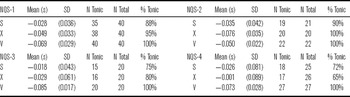
A tabulation of the alignment of peaks is found in table 1. All peaks associated with words in utterance-final position are aligned within the penultimate syllable (100%). Likewise, the majority of non-final peaks are aligned within the penultimate syllable (72%–90% for initial, subject position, 65%–100% for medial, complement/adjunct position). Measurements were taken of the tonal events related to the penultimate syllable because this syllable almost always receives primary stress, as discussed in section 1.2 above.
Alignment of F0 maximum peaks in declaratives.

Tonic = peak during the stressed syllable; position of the peak in the utterance: S = Subject peak in initial position,
X = Complement/adjunct peak in medial position, V = Verb peak in final position
A separate one-way ANOVA was conducted on all items produced by each speaker. Peak alignment in seconds relative to the stressed syllable offset was taken as the dependent variable while position within the utterance (S, X or V) was taken as the independent variable. In this way, the ANOVA for each speaker is based on a between-items factor analysis. Significant differences were observed: for speaker NQS-1, F(2,117) = 15.4, p < .0001; NQS-2 F(2,60) = 7.8, p = .0010; NQS-3 F(2,57) = 13.9, p < .0001; NQS-4 F(2,75) = 7.2, p = .0014. Post-hoc comparisons using the Tukey-Kramer test show significant differences in peak alignment at the 0.05 level between initial and final peaks (S–V pair) for three speakers (NQS-1, NQS-3 and NQS-4), between medial and final peaks (X–V pair) for all speakers, and between initial and medial peaks (S–X pair) for two speakers (NQS-1 and NQS-2).
The calculations shown here give a strong indication that tonic alignment is common for words in both non-final and final position within the utterance. However, for three of the four speakers, the alignment of both non-final peaks is significantly later than that of final peaks, which may suggest the use of a distinct underlying pitch accent at the phonological level (e.g. L*+H for non-final peaks and L+H* for final peaks; see section 3.2.5 below for discussion). For this analysis of alignment, no differentiation has been made regarding syllable structure although tonic-aligned non-final peaks are observed for both open and closed syllables.
3.2.2 Peak height
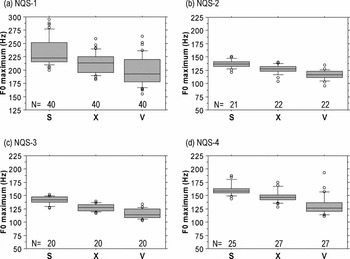
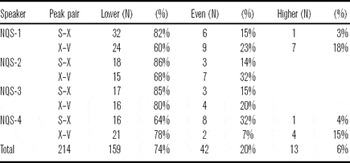
Another intonation feature to be explored with Cuzco Quechua declaratives is the relationship between the height of a peak and subsequent peaks. For this analysis, a peak is considered to be ‘lower’ or ‘higher’ if there is a difference of 7 Hz or more between neighboring peaks, and relatively ‘even’ if the difference is less than 7 Hz.Footnote 10 Of the 214 peak pairs analyzed in this Quechua declaratives corpus, lower peaks are the most frequent (75% of the pairs observed; see example in figure 9). There are other examples of peaks which appear to be even in height (20%; see figure 10); there are also some instances of a higher peak (6%; see figures 11–12). A summary of the findings of peak height for all speakers is given in figure 13.
Declarative utterance with lower subsequent peaks between both non-final and final peaks; F0 values in Hz; NQS-1.

Declarative utterance with relatively even non-final peaks; F0 values in Hz; NQS-2.

Declarative utterance with higher non-final peak in pananwanmi; F0 values in Hz; NQS-4.

Declarative utterance with higher final peak in puriran compared to previous peak; F0 values in Hz; NQS-1.

The vertical axis shows the height of F0 maxima peaks (shown in Hz). The horizontal axis shows the position of the peak within the utterance: S = Subject peak in initial position within the utterance; X = Complement/adjunct peak in medial position; V = Verb peak in final position. NB Scaling for all speakers is the same; speaker NQS-1 shows a higher range (125–300 Hz) on the y-axis than the other three speakers (50–225 Hz).

The calculation of relative peak height is given in table 2. For non-final peak pairs (S–X), and non-final to final peak pairs (X–V), the second peak is most frequently lower for each speaker (ranging from 60% to 86% of the time). Some instances of even peaks are observed (7%–32% of the time), while higher peaks are least frequent (4%–18% of the time for the two speakers showing higher peaks). A separate one-way ANOVA was conducted on all items produced by each speaker with peak height in Hz as the dependent variable and position in the utterance (S, X and V) as the independent variable. This between-items ANOVA shows significant differences between positions for each of the speakers: for speaker NQS-1, F(2,117) = 22.5, p < .0001; NQS-2, F(2,62) = 32.5, p < .0001; NQS-3, F(2,57) = 50.7 p < .0001; and NQS-4, F(2,76) = 28.2 p < .0001. A post-hoc Tukey-Kramer analysis indicates that all peak pairs were significantly different at the 0.05 level for each of the speakers. That is, final peaks were significantly lower than non-final peaks (i.e. in S–V pairs and X–V pairs); in addition, later non-final peaks were significantly lower than the previous peak (in S–X pairs).
Percentage of peak height relationship types (lower, even and higher) according to peak pair.

S = Subject peak in initial position; X = Complement/adjunct peak in medial position;
V = Verb peak in final position
Given the relatively fewer number of tokens of even and higher peaks observed in this data set, the reason for their use needs to be further explored. Cruttenden (Reference Cruttenden1997: 122) notes that lower or ‘downstepped’ peaks may be more emphatic, for example in English. On the other hand, Gussenhoven (Reference Gussenhoven2004: 108) indicates that higher or ‘upstepped’ peaks may function to increase the contrast between surrounding tonal targets, such as a preceding low. Other factors affecting tonal height may also need to be considered for Cuzco Quechua, including overall declination and final lowering.Footnote 11
In the present data set, we can already observe some commonalities in tonal height between intonation contours. Figures 10 and 11 demonstrate utterances with the same placement of a topic marker (-qa) on the subject followed by a validator (-mi) which may assign a focus or emphasis in sentence-medial position. In figure 10 the adjacent non-final peaks are relatively even while in figure 11 the second peak is actually higher. When the validator (-n) is placed on the subject, as in figures 9 and 12, the medial peak is lower. In the latter case, this presence of a validator at the beginning of the utterance does not eliminate the possibility of the final peak being higher, as in figure 12. Based on the comparison of these figures and other tokens in the data set, the word containing the validator appears to have the highest peak (lending greater prominence). However, there does not seem to be any post-focal ‘deaccenting’ or absence of peaks after the validator itself. Since the descriptions of Quechua intonation found in the literature only characterize the last peak in an utterance, this section is offered as an initial description of peak height relationships in Quechua declaratives.
3.2.3 Intermediate phrase tone
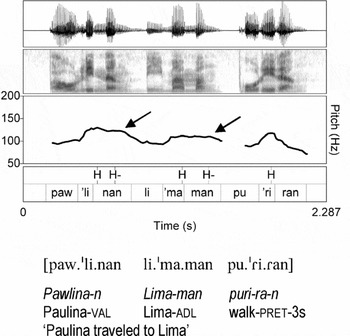
As noted previously in section 3.2.1 and table 1, the majority of non-final peaks were aligned within the stressed syllable, while an average of 17% of non-final peaks occurred after the stressed syllable. In particular, speakers NQS-3 and NQS-4 showed a higher percentage of post-tonic peaks for both initial position (25% and 28%, respectively) and medial position (20% and 35%, respectively). As can be seen in figure 14, there are instances in which the non-final peak appears after the offset of the stressed syllable. On the other hand, in figure 15, the medial non-final word shows a peak that is realized during the stressed syllable. However, the fundamental frequency remains relatively high, suggesting a high intermediate phrase boundary tone (H−) with a high F0 maintained throughout the post-tonic vowel before dropping during the coda consonant at the end of the word.
Declarative utterance with post-tonic non-final peak (H) on [nan] and [man]; NQS-4.

Declarative utterance with tonic non-final peak (H−) on [ma] with intermediate phrase boundary tone (H-), indicated with arrows; NQS-2.

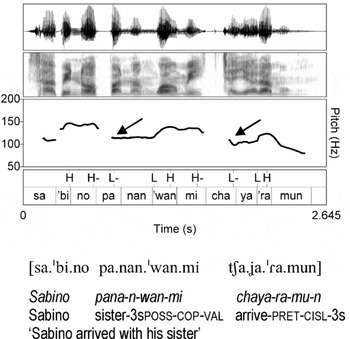
In some cases, the fundamental frequency appears to be even higher at the end of the word even though a peak is reached during the stressed syllable, as appears with the post-tonic syllable [mi] in figure 16. Additionally, an initial low boundary tone (L−) may be present at the beginning of the word since the F0 drops to a low level prior to the stressed syllable and remains low until the rise to the peak related to the stressed syllable (see word-initial syllables [pa] an [tʃa] in figure 17). In this way, both the high and low phrase tones may serve to distinguish between constituents.
Declarative utterance with tonic non-final peak (H) with possible intermediate phrase boundary tone (H−) indicated with arrows; NQS-1.

Declarative utterance with possible word-initial intermediate phrase boundary tone (L−) indicated with arrows; NQS-2.

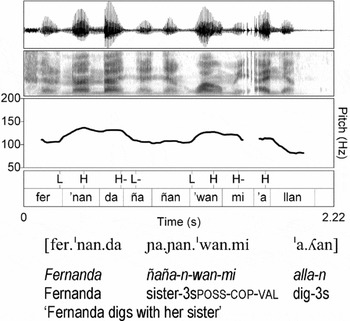
There are other instances in which the end of the word is not realized with a high pitch (compare figure 9 showing non-final words ending in a lower pitch with figure 14 showing non-final words ending in a higher pitch); in either case subsequent words begin with a low F0 level. In terms of tonal crowding, if the tonic syllable is the first syllable of the word, a word-initial drop to a low pitch level does not occur (due to the lack of space to realize the low phrase tone), as shown in the first syllable of the final word [ˈa.ʎan] ‘digs’ in figure 18 and [ˈɾi.ɾan] ‘he went’ in figure 19. More work in this area is needed to investigate the linguistic environment in which these utterance-internal intermediate phrase tones appear, including the pragmatic meaning that is assigned.
Declarative utterance without a drop to low F0 on final word allan prior to peak (compared to beginning of medial word ñañanwanmi); NQS-2.

Comparison of final contours for words with 0, 1 and 2 syllables prior to the stressed syllable shows lack of a distinct word-initial phrase tone (L−) in riran compared to qallariran; NQS-3.

3.2.4 Post-tonic peaks and contact with Spanish
Previous research has shown that the alignment of peaks in one language may be influenced by contact with another language. For example, non-final peaks typically have been described as post-tonic or ‘late rises’, in several varieties of Spanish, including Peninsular Spanish (Garrido et al. Reference Garrido, Llisterri, de la Mota, Marín, Ríos, Elejabeitia and Iribar1995, de la Mota Gorriz Reference de la Mota Gorriz, Botinis, Kouroupetroglou and Carayiannis1997), Madrid Spanish (Face Reference Face2001), and Dominican Spanish (Willis Reference Willis2003). However, ‘early rises’ with tonic peak alignment have been found, including Lekeitio Spanish in contact with Northern Bizkaian Basque (Elordieta Reference Elordieta2003) and Buenos Aires Spanish in contact with Italian (Sosa Reference Sosa1999, Colatoni & Gurlekian Reference Colantoni and Gurlekian2004). Nonetheless, not all cases of contact result in tonic-aligned peaks. For example, in Majorcan Catalan and Spanish, both varieties show post-tonic peaks in non-final position (Simonet Reference Simonet2008).
In the case of Spanish influence on Cuzco Quechua, the instances of Quechua post-tonic peaks in non-final position observed in section 3.2.1 may be due to language contact. That is, the ‘late rises’ from Spanish non-final peaks may be influencing the use of post-tonic peaks in Cuzco Quechua. The Quechua speakers themselves may be exposed to a range of non-final peak alignments. In an analysis of read declaratives in Peruvian Spanish, O'Rourke (Reference O'Rourke2005) showed that speakers of Lima Spanish employ post-tonic alignment of non-final peaks whereas Cuzco Spanish monolingual and bilingual speakers demonstrate a variety of behaviors ranging from post-tonic alignment of one or both non-final peaks to tonic alignment of both. Since the speakers in the present study received schooling in Spanish and are accustomed to reading in Spanish, the use of post-tonic peaks may be due in part to the use of a general reading style in Quechua adopted from Spanish.
This type of intermingled use of systems is described by Queen (Reference Queen1996), who observed that bilinguals fluent in both Turkish and German may employ a mixed intonation system that incorporates elements from both languages. On the other hand, Cruttenden (Reference Cruttenden2007) notes the presence of a type of intonational diglossia in Glasgow between the use of Urban Northern British intonation in conversation but a Received Pronunciation intonation in a reading task. In the case of Quechua declaratives, the Quechua-like ‘early rise’ system may intermix with the more Spanish-like ‘late rise’ system: if the maximum F0 for the word is post-tonic and no other peak is apparent, then the F0 may be interpreted as a post-tonic peak as opposed to marking the end of the word (i.e. an intermediate phrase boundary, as in figure 14). Note that of the four speakers, the two who showed higher instances of late peaks were actually the ones who reported an imbalance in their bilingual abilities: speaker NQS-3 reported greater ability in Spanish while NQS-4 reported greater ability in Quechua. This type of re-interpretation of tonal events has been previously observed for Basque (Hualde Reference Hualde, Fikkert and Jacobs2003a): in one variety, a non-accentual initial rise is realized by Basque–Spanish bilinguals as a rise related to the stressed syllable (like Spanish) whereas in another variety the rise is eliminated.
3.2.5 A composite analysis of phonological structure of Cuzco Quechua declarative intonation
In this section, the overall declarative contour in Cuzco Quechua is examined in order to suggest a phonological structure. To do so, all productions from one speaker are superimposed in order to make some basic claims. Then the mean realizations of all measurements are graphed for each speaker in order to gain a more general overview. Finally, using these observations as well those from previous sections, a phonological structure is suggested for declarative utterances containing three content words.
First, an overlay of the utterances produced by speaker NQS-1 can be found in figure 20. As can be seen, there is variation in the higher level of pitch at the end of the word for initial and medial position, a return to a lower pitch at the beginning of the new word in medial positions, and a low F0 height at the end of the utterance in final position. Next, the mean realizations for each speaker are shown in figure 21 for the measurement points along the contour defined previously in section 2.2.2. The measurement of the post-tonic vowel (vS and vX) demonstrates the realization of the high intermediate phrase boundary tone (H−), whereas the measurement of the word-initial vowel (iX and iV) shows the low word-initial boundary tone (L−). Note that the difference between the F0 height at the end of the word (vS and vX) and the F0 height at the beginning of the next word (iX and iV respectively) is more abrupt for speakers NQS-1, NQS-2 and NQS-4, whereas the difference is more gradual for speaker NQS-3.
Normalized pitch contours for initial (S), medial (X) and final (V) positions for speaker NQS-1, shown in semitones. Note the sustained higher levels word-finally in initial and medial positions (indicating use of H−), a lower pitch word-initially in medial position (indicating use of L−) and the lower pitch level at the end of the utterance (indicating L% final boundary tone).

Mean realization and standard deviation of tonal events for subject (S) complement/adjunct (X) and verb (V). iT and fT represent the initial and final tonal (F0) height at the beginning and end of the utterance; L and H represent the valley and peak related to the stressed syllable of the word; iX and iV represent the initial tonal height at the beginning of the word; vS, vX and vV show the height at the end of the post-tonic vowel in word. F0 values shown in Hz.

Given the data in figures 20 and 21 and in previous sections, the general characterization of pitch accents and boundary tones for Cuzco Quechua declaratives is as follows. First, pitch accents associated with stressed syllables appear to be bitonal (L+H). Since non-final peaks have been shown to be significantly later than final peaks, the non-final pitch accent is considered to be (L*+H) whereas the final pitch accent is considered to be (L+H*).Footnote 12 In this way, the peak in L*+H may still function as a trailing tone, i.e. as a tone that is not as strongly associated to the stressed syllable, allowing for the possible realization of post-tonic peaks which were only observed in non-final position.
An intermediate phrase level has been suggested, which is marked at the beginning with a low phrase tone (L−) and optionally at the end by a high phrase tone (H−) for non-final words and (L−) for final words.Footnote 13, Footnote 14 The term ‘intermediate phrase’ is used since some speakers showed a peak on function words such as kay ‘this’ (as opposed to an ‘accentual phrase’ which tends to have only one pitch accent present).Footnote 15 Last, all utterances appear to end in a low F0 level, suggesting the use of a low intonational phrase boundary tone or L%. For utterances with a subject (S), complement or adjunct (X), and verb (V) phrase containing one content word each, the sequence of tones would be: L*+H (H−), (L−) L*+H (H−), (L−) (L)+H* (L−) L% where items in parentheses may or may not be realized, e.g. depending on the amount of segmental material available.Footnote 16 A schematic representation of this realization is shown in (2):
(2)


3.3 Summary of declarative intonation in Cuzco Quechua
In the current analysis of Cuzco Quechua declarative intonation, the following observations have been made. First, tonic alignment of final peaks is a common feature shared by all speakers. Similarly, the alignment of non-final peaks within the stressed syllable is a readily-observed phenomenon in Cuzco Quechua declaratives. However, the presence of some tokens with post-tonic peaks suggests that other variables affecting peak alignment may need to be identified (e.g. the function of the stressed word or the presence of a high intermediate phrase boundary tone). Second, peaks later in the utterance were shown to be lower in these Cuzco Quechua declaratives. However, there are instances in which later peaks either remain at an even height or are higher than earlier peaks. Further examination of the scaling of peaks and other tonal targets (such as boundary tones) may provide insight into the prosodic levels present.Footnote 17 Third, Quechua declaratives in this data set generally end in a low F0 pitch height (analyzed as a low boundary tone L%). These data support the impressionistic descriptions in the literature for peripheral Quechua varieties as well as the acoustic analysis by Hintz (Reference Hintz2006) for Central Quechua, which indicate a final fall to the lower portion of the speaker's range for the utterance.
4 Conclusions
The goal of this paper has been to examine the intonation patterns in Cuzco Quechua declaratives. To do so, recordings were made with male native Quechua speakers who later learned Spanish. Future analysis which includes both Quechua speakers who are early-learners of Spanish and also monolingual Quechua speakers would allow for a broader view of which intonation patterns are employed in Quechua as well as the pragmatic meaning assigned. Nonetheless, the observations described above offer instrumental support for the impressionistic claims in the literature. In addition, the present study provides detailed information regarding the alignment and height of subsequent peaks within an utterance in Cuzco Quechua, contributing to the characterization of Quechua intonation in general. Contact with Spanish is a potential factor with respect to peaks realized after the stressed syllable in non-final position.
Several features of Quechua intonation remain to be analyzed, including the role of focus markers, the role of word order, differences in modality (e.g. imperatives) as well as other acoustic correlates such as intensity and duration. Additionally, a more in-depth analysis of declaratives (and interrogatives) in both Cuzco and other varieties of Quechua is needed, e.g. an analysis of peak alignment in both open and closed syllables, or an analysis of the intonation contours used with compound words and other longer constituents containing more than one content word. Likewise, this study may serve as a point of comparison with research on the intonation of other indigenous languages.
Acknowledgements
I would like to thank José Ignacio Hualde for helpful comments on an earlier version of this paper. In addition, I would like to acknowledge the following people in alphabetical order for their advice and feedback during the development of this research project: Jennifer Cole, Anna María Escobar, Zsuzsanna Fagyal, José Ignacio Hualde, Chilin Shih and Clodoaldo Soto Ruiz. I am also grateful to three anonymous reviewers for their valuable insight and requests for clarification. However, any error in content or analysis remains the sole responsibility of the present author. Support for this research was received from the University of Illinois at Urbana–Champaign Dissertation Field Research Grant and the Center for Latin American and Caribbean Studies (CLACS) Summer Field Research Grant.