INTRODUCTION
The importance of diversity of habitats for fish communities is recognized and discussed by several authors. Habitat features such as its size, topography, spatial heterogeneity and substrate can influence the distribution, abundance, richness and diversity of fish (Anderson et al., Reference Anderson, Demartini and Roberts1989; Kramer et al., Reference Kramer, Rangeley, Chapman and Godin1997). Thus, identifying and protecting specific habitats is crucial in order to understand fish communities and has practical applications for species conservation and management activities (Steimle & Zetlin, Reference Steimle and Zetlin2000).
Despite some previous discussion of the importance of the habitat use information, it was only in the 1990s that researchers began focusing on the identification of essential fish habitats, critical habitats and marine protected areas. There are relatively few studies concerning the habitat use of sharks, skates and rays, and nursery areas are by far the most investigated locations (Simpfendorfer & Heupel, Reference Simpfendorfer, Heupel, Carrier, Musick and Heithaus2004).
The southern stingray Dasyatis americana Hildebrand & Schroeder, 1928, is a benthic ray often found in coastal shallow waters. This species is common in tropical and subtropical waters of the Western Atlantic and occurs from New Jersey (USA) to São Paulo (Brazil) (Menni & Stehmann, Reference Menni and Stehmann2000). It is also frequently observed around some tropical oceanic islands, such as the Fernando de Noronha Archipelago (Soto, Reference Soto2001). There are few recent studies on D. americana, focusing on its reproductive behaviour (Henningsen, Reference Henningsen2000; Chapman et al., Reference Chapman, Corcoran, Harvey, Malan and Shivji2003), feeding biology (Gilliam & Sullivan, Reference Gilliam and Sullivan1993), and interspecific associations (Snelson et al., Reference Snelson, Gruber, Muru and Schmid1990; Strong et al., Reference Strong, Snelson and Gruber1990).
It is critical to better understand the D. americana's habitat use in Brazilian waters when taking into account that this species was listed as ‘in risk of decline’ at the northern and north-eastern regions by the Brazilian National Plan of Action (NPOA—Sharks) (SBEEL, 2005). According to the International Plan of Action for Sharks (IPOA—Sharks), the conservation of chondrichthyan populations depends—among other recommendations—on determining and protecting critical habitats such as nursery areas and feeding grounds (Walker, Reference Walker2000).
In the context of these latter statements, the present study aims to analyse the distribution of Dasyatis americana individuals of different size-classes in distinct habitats at the Fernando de Noronha Archipelago.
MATERIALS AND METHODS
Study area
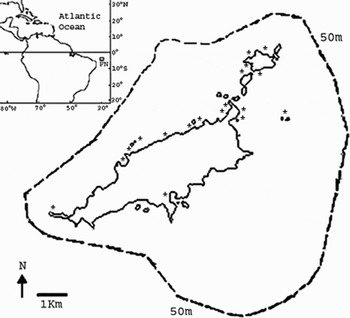
The oceanic Fernando de Noronha Archipelago (3°54′S 32°25′W) is located approximately 345 km off the coast of north-eastern Brazil, tropical West Atlantic (Figure 1). The archipelago is composed of 21 islands and comprises a 26 km2 area. The insular shelf reaches a diameter of 10 km down to 100 m isobath. The archipelago is under the influence of the South Equatorial and the Sub-Atlantic Equatorial Currents. The water temperature ranges from 24° to 28°C and the salinity is around 36‰. The southern and south-eastern shores of the area are washed by strong wave action during most of the year, and are characterized by rocky faces and extensive barriers of calcareous algae. Along the northern side, the edges usually have gradual inclinations, with rocky faces and great stones embedded in sand (Eston et al., Reference Eston, Migotto, Oliveira-Filho, Rodrigues and Freitas1986). Waters of this side of the archipelago are relatively calm from March to November (Teixeira et al., Reference Teixeira, Cordani, Menor and Linsker2003).
Map of the study sites at Fernando de Noronha Archipelago. Traced line indicates the 50 m isobaths. FN, Fernando de Noronha Archipelago; *sample locations.

Underwater survey
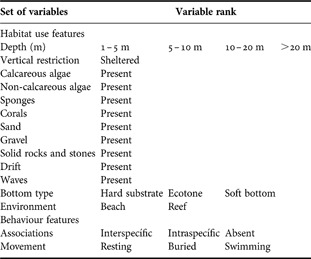
Underwater visual observations of D. americana individuals were performed through snorkelling (mainly in beach areas up to 12 m in depth) and SCUBA diving (reef environments deeper than 12 m) in May, July and September 2004. The observations (6791 minutes) were carried out during the daytime, from morning (7:30 h) to afternoon (19:50 h), and distributed among 18 different sites throughout the archipelago's north-western and south-eastern coasts (Figure 1). Through an intensive search, the diver performed a roving transect covering a non-overlapping path at constant speed and lasting from 20 to 60 minutes. During the underwater surveys, all D. americana sightings were described according to a standard protocol that included characteristics related to the individual and its habitat (protocol variables were chosen during preliminary field observations and modified from La Mesa et al., Reference La Mesa, Louisy and Vacchi2002) (Table 1). All data were recorded on underwater PVC notebooks.
Standard protocol (modified from La Mesa et al., Reference La Mesa, Louisy and Vacchi2002). Summary of variables used in describing habitat use by Dasyatis americana at Fernando de Noronha Archipelago.

The individual identifications were based on estimated size, gender and natural marks (Castro & Rosa, Reference Castro and Rosa2005). These identifications aimed to prevent pseudo-replication. The individual size is indicated by the disc length (DL), measured from the tip of the snout to the posterior margin of the pectoral fin, with a T-shaped ruler (50 cm of length and graduated in 5 cm intervals). Information concerning movement of stingrays and presence of associations were recorded as ‘behavioural’ context of sightings.
The habitat description was based on type of environment, bottom depth, hydrodynamics, and substrate morphology, type of sediment and dominant sessile fauna and flora. Moreover, the ‘restriction’ of a site was defined on the basis of the presence of vertical rocky walls.
Data analysis
The relationship between individuals of different disc lengths and habitat use features was described by the correspondence analysis (CA), through Statistica 7.0 applicative (Statsoft, Inc). Only the variables related to the habitat characteristics were considered in the analysis. Although behavioural components were also recorded, such data were used only as supplementary variables. Moreover, data from individuals of the extremes of body size-range were clustered as ‘under 25 cm DL’ and ‘over 90 cm DL’.
A first analysis was performed on a contingency table formed by the frequencies of individuals of each size observed for every descriptive variable. The next step was to carry out a second CA considering all the sampled individuals on a contingency table formed by the binary data (presence or absence of individuals for each descriptive variable, represented by DL). Each individual's coordinates, plotted on highly variable (inertia) axis 1, were used in the Kruskal–Wallis test and in the test of Multiple Comparisons of Mean Ranks for All Groups. These tests were used to identify which DLs had significant differences in distribution. Additionally, the Chi-square test was applied to the distribution of each DL on the first axis in order to verify whether this axis is actually a determinant factor on the distribution of the different sizes or if this occurs randomly. The significance level adopted for all mentioned tests was of 5% (α = 0.05).
RESULTS
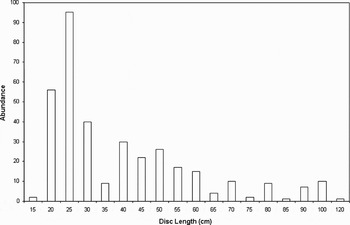
Throughout the study, 356 individuals were sighted, with DLs between 15 and 120 cm; the greatest abundance was found in the 25 cm DL size-class (Figure 2).
Abundance of individuals sighted per disc length (cm) during the study period.

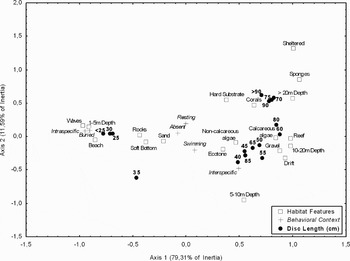
The distribution patterns of the stingrays of different DLs and habitat use features are given in Figure 3. The Axis 1 synthesizes a gradient of depth and environmental conditions: the variables located on the negative side are found predominantly at shallow beaches, while the positive variables are related to deeper reef environments. Also this axis showed individuals under 40 cm DL occurring mainly at beach areas with shallow waters and presence of waves. Moreover, results demonstrate that smaller individuals are strongly linked to the supplementary variables intraspecific and buried which indicates that these individuals are frequently gathered and buried. On the opposite of Axis 1, individuals with greater DLs were more related to deeper reef environment (over 10 m depth) with presence of vertical restriction, drift and bottom covered by sponges, gravel, calcareous algae and coral.
First correspondence analysis applied: frequency projections for the different disc lengths of Dasyatis americana and for the habitat use features on factorial axes 1 and 2. Habitat use variable ranks as in Table 1.

Although not as clear as on the first axis Axis 2 showed a separation between individuals with greater DLs (70, 75, 90 and >90 cm) and the remaining sizes. The Axis 2 represents the deepest and protected reef environments (caves and cavities) with hard substrate that were occupied by larger individuals (Figure 3).
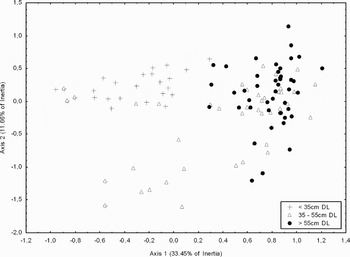
The distribution patterns of all D. americana individual sightings resulted from the second CA are presented in Figure 4. The Kruskal–Wallis test showed a significant difference in distribution among DLs on the first axis (P < 0.0001). The significant differences occurred between the individuals with smaller DLs (<25, 25 and 30 cm) and the individuals with DLs of 40 cm or more (P < 0.0005). The Chi-square test showed that the Axis 1 had significant influence on the distribution of individuals with almost every DL, excluding 40 and 45 cm (P < 0.02). Neither the Kruskal–Wallis nor the Chi-square tests found significance (P > 0.05) for individuals with 65, 75 and 85 cm DLs probably due to the low ‘N’ sampled for these size-classes.
Second correspondence analysis applied: projection of the individuals of Dasyatis americana of the different DLs on factorial axes 1 and 2. DL, disc length.

DISCUSSION
The study revealed an ontogenetic change in the habitat use by Dasyatis americana at the Fernando de Noronha Archipelago. Smaller animals occupy mostly shallow beach areas with sandy bottom, while larger individuals occur in deeper waters with reef characteristics. Additionally, individuals ranging between 35 and 45 cm DLs are found randomly in both environments, thus indicating that they possibly belong to an intermediate size-class in which habitat shifting occurs.
Spatial segregation between juveniles and adults is highlighted in the literature as a common feature for both bony fish and elasmobranch populations (Castro, Reference Castro1993; Simpfendorfer & Milward, Reference Simpfendorfer and Milward1993; Jones & McCormick, Reference Jones, McCormick and Sale2002). Among such cases, commonly the younger and smaller individuals seek protected environments against predators and with greater food availability, known as nursery areas (Jones & McCormick, Reference Jones, McCormick and Sale2002; Wetherbee et al., Reference Wetherbee, Gruber and Rosa2007).
The use of shallow beach regions of the archipelago by juvenile southern stingrays may be related to nursery areas that serve as shelter against predators. Juveniles of D. americana mainly occupy beaches with less than 5 m in depth, a distribution pattern that might make difficult their access to predators such as sharks. This assumption is supported by the fact that stingrays are recognized as common preys of great sharks (e.g. Strong et al., Reference Strong, Snelson and Gruber1990; Chapman & Gruber, Reference Chapman and Gruber2002), as well as by the occurrence of several large shark species in the study area, such as the reef shark, Carcharhinus perezi, the lemon shark, Negaprion brevirostris, the nurse shark, Ginglymostoma cirratum and hammerhead sharks, Sphyrna spp. (Garla, Reference Garla2003).
Additionally, the characteristic behaviour of the young D. americana to occur frequently gathered and buried, may also contribute for the anti-predator use of the shallow beach areas. The aggregation behaviour is viewed as beneficial against predation because it favours an increased visual awareness for the detection of predators, as well as reducing the chances of an individual capture when the predator invests against numerous preys (Stamps, Reference Stamps1988; Rangeley & Kramer, Reference Rangeley and Kramer1998). Moreover, the burying behaviour permits the young southern stingrays to hide from predators by camouflaging in the sand.
Few exceptions of the suggested distribution pattern were observed in the present study, represented by the occasional presence of adult individuals of D. americana in shallow environments of the archipelago. Nevertheless, we believe that the occupation of shallow areas by these larger individuals is linked to their foraging strategy, since they were sighted in areas where fish are discarded and/or areas with great abundance of octopuses (one of the species' common prey; Gilliam & Sullivan, Reference Gilliam and Sullivan1993).
Spatial segregation between juvenile and adult individuals has also been previously identified for other Dasyatis species. Ebert & Cowley (Reference Ebert and Cowley2003) indicated that D. crysonota occupies different habitats along its life cycle. Snelson et al. (Reference Snelson, Williams-Hooper and Schmid1989) described that only the young of the year and small juveniles of D. sayi were regularly observed in shallow water, while adults were rarely seen in shallow seagrass beds, but often in waters deeper than 1 m. Thorson (Reference Thorson1983) also described the spatial segregation among individuals of different age-classes of D. guttata, but related it to salinity variation in the environment. The same pattern also was observed for D. americana at another oceanic island off Brazil, Atol das Rocas, where juveniles of the southern stingray often gather on the shallow sandy bottoms of the inner lagoon, while adults occur in the deeper portions of the lagoon and at the reef front (R.S. Rosa, personal observation).
Some authors point out that habitat segregation directly influences feeding habits of many elasmobranch species, including a species of Dasyatis (e.g. Castro, Reference Castro1993; Simpfendorfer & Milward, Reference Simpfendorfer and Milward1993; Ebert & Cowley, Reference Ebert and Cowley2003). Changes in diet that occur as these animals move from nurseries to deeper areas possibly diminish the intraspecific competition for food in different life stages (Lowe et al., Reference Lowe, Wetherbee, Crow and Tester1996). Therefore, the ontogenetic shift in the habitat use observed for the D. americana population in Fernando de Noronha Archipelago probably results in changes in feeding habits and foraging strategies and, consequently, might hinder competition for food between juveniles and adults. Nevertheless, the knowledge about the biological aspects of feeding in D. americana remains rudimentary, and future studies are needed to corroborate this later assumption.
Although the evidence is preliminary, Fernando de Noronha Archipelago shallow beaches may be regarded as nursery areas for local young D. americana individuals, while adults and sub-adults are spread over deeper reef areas. Since the archipelago is a well-known tourist site, the shallow beach areas receive high visitation by bathers, divers, as well as by boats. Therefore, considering that D. americana was listed as ‘in risk of decline’ for the Brazilian northern and north-eastern regions and that there is a strong appeal for protecting critical habitats such as nursery areas (Walker, Reference Walker2000; SBEEL, 2005), we stress the need for a further population monitoring programme for the southern stingray in the archipelago, as well as effective protection measures of its critical habitats.
ACKNOWLEDGEMENTS
This study was funded in part by grants from the PADI's Project Aware, the Brazilian federal agency CAPES/MEC and Fundação de Apoio a Pesquisa do Estado do Rio de Janeiro/FAPERJ. We are grateful to IBAMA, PARNAMAR Fernando de Noronha, APA Fernando de Noronha and Administração do Distrito Estadual de Fernando de Noronha for field travel support and for issuing permits to allow us to work at Fernando de Noronha Archipelago; to the Dive Centers Noronha Divers, Atlantis Divers and Águas Claras for the operational dive support; to A. Cavalcanti, P. Curbelo, P. Galvão and J. Ruffin for their support in the 2003–2004 field work. CNPq supports R.S.R. with a research grant for elasmobranch studies. This paper is part of the first author's MS thesis defended at Universidade Federal da Paraíba and supported by CAPES.