Introduction
The family Allocreadiidae (Trematoda: Gorgoderoidea) is a widely distributed group of digenean parasites of freshwater fishes. The family has a complicated taxonomic history and a rich research background in various fields of biological research, including phylogeny (Atopkin et al Reference Atopkin, Sokolov, Shedko, Vainutis and Orlovskaya2018, Reference Atopkin, Sokolov, Vainutis, Voropaeva, Shedko and Choudhury2020; Aydogdu et al Reference Aydogdu, Vainutis, Voronova and Aydogdu2023; Petkevičiūtė et al Reference Petkevičiūtė, Stunžėnas and Stanevičiūtė2023; Vainutis Reference Vainutis2020, Reference Vainutis2024; Vainutis et al Reference Vainutis, Voronova and Urabe2021, Reference Vainutis, Voronova, Urabe and Kazarin2023), karyology (Petkevičiūtė et al Reference Petkevičiūtė, Stunžėnas and Stanevičiūtė2012), spermatology (Quilichini et al Reference Quilichini, Foata, Orsini and Marchand2007), ecology (Kuhn et al Reference Kuhn, Kristoffersen, Knudsen, Jakobsen, Marcogliese, Locke, Primicerio and Amundsen2015), and scanning electron microscopy (Franceschini et al Reference Franceschini, Aguiar, Zago, de Oliveira Fadel Yamada, Bertholdi Ebert and da Silva2021; Perez-Ponce de Leon et al Reference Perez-Ponce de Leon, Pinacho-Pinacho, Mendoza Garfias, Choudhury and Garcia-Varela2016; Vainutis et al Reference Vainutis, Voronova, Urabe and Kazarin2023; Zdarska and Nebesarova Reference Zdarska and Nebesarova2004). Molecular studies of allocreadiids have primarily utilised mitochondrial (cox1) and nuclear (internal transcribed spacer (ITS) region, 28S ribosomal RNA (rRNA)) sequences for phylogenetic reconstructions. Secondary structures of ribosomal RNA are not only important for understanding ribosomal function and evolution but also provide valuable information for phylogenetic reconstruction and species delimitation. Unfortunately, molecular-structural analyses of allocreadiid nuclear ribosomal DNA remain scarce. To date, the only attempt to reconstruct ITS2 secondary structures for an allocreadiid was made by Athokpam et al (Reference Athokpam, Jyrwa and Tandon2014), who presented structures for Polylekithum sp. However, morphologically, this genus is highly distinct from typical allocreadiids. Recent phylogenetic analyses by Knudson et al (Reference Knudson, Curran, Truong, Dutton and Bullard2023) placed Polylekithum within Encyclometridae, a family that shares with Allocreadiidae only the superfamily Gorgoderoidea, but is not closely related to it. Consequently, the ITS2 secondary structures reported by Athokpam et al (Reference Athokpam, Jyrwa and Tandon2014) for Polylekithum sp. cannot be considered representative of Allocreadiidae, and no reliable taxonomically up-to-date structural data are currently available for the family as a whole.
Internal transcribed spacer 2 (ITS2) is one of the most commonly used markers for trematode systematics, and its secondary structure has been shown to be highly conserved across wide taxonomic ranges, typically forming a four-domain conformation (domains A, B, C, and D; Schultz et al Reference Schultz, Maisel, Gerlach, Müller and Wolf2005; Athokpam et al Reference Athokpam, Jyrwa and Tandon2014). Comparative analysis of ITS2 secondary structures can reveal conserved structural motifs, compensatory base changes, and lineage-specific structural innovations that are not evident from primary sequence alignment alone. The ITS2 region contains various types of repetitive elements. Tandem repeats within ITS2 can serve as protein-binding sites and recombination hotspots. Dinucleotide repeats of the (GT)n type affect promoter activity regardless of their orientation (Stallings et al Reference Stallings, Ford, Nelson, Torney, Hildebrand and Moyzis1991). Repeats such as GT, CA, CT, GA, GC, and AT may be involved in recombination due to their ability to form Z-DNA or other non-canonical structures. Analyses of tandem repeat distribution in the genomes of closely related and distant organisms can help elucidate genome evolution and suggest novel evolutionary mechanisms (Boeva et al Reference Boeva, Regnier, Papatsenko and Makeev2006). Within the framework of the present study, we searched for repeats with a defined periodicity in the primary ITS2 sequences and subsequently mapped them onto the reconstructed secondary structures. This allowed us to assess whether tandem repeats influence structural conformation, in particular, whether they contribute to the formation of loops and hairpins (Makeev et al Reference Makeev, Lifanov, Nazina and Papatsenko2003). The aim of this study was to perform comparative Bayesian phylogenetic analysis of the ITS2 sequence and structural data for allocreadiids, including degenerate repeats and regulatory motifs.
Materials and methods
DNA sampling, amplification, and sequencing
We used original genomic DNA samples extracted from 68 adult specimens representing 12 species from five allocreadiid genera, as well as from seven larval (metacercariae) specimens of Crepidostomum metoecus. These samples were obtained and published in several earlier studies (Vainutis Reference Vainutis2020; Atopkin et al Reference Atopkin, Sokolov, Shedko, Vainutis and Orlovskaya2018, Reference Atopkin, Sokolov, Vainutis, Voropaeva, Shedko and Choudhury2020; Vainutis et al Reference Vainutis, Voronova and Urabe2021; Table 1). To amplify the complete ITS region, we used the forward primer 1/F (5′-CACACCGCCCGTCG-3′) (Krieger et al Reference Krieger, Hett, Fuerst, Birstein and Ludwig2006) and the reverse primer 28S1R (5′-AAGTATTTAGCCTTGGATGGAGTTT-3′) (Shumenko et al Reference Shumenko, Tatonova and Besprozvannykh2017). The initial polymerase chain reaction (PCR) was carried out in a total volume of 20 μl. Each reaction contained 0.25 mM of each primer, DreamTaq buffer (containing KCl, (NH₄)₂SO₄, and 20 mM MgCl₂), 1.25 mM deoxynucleoside triphosphate (dNTP), 1 unit of DreamTaq DNA Polymerase, and 1 μl of DNA template. Amplification was performed under the following conditions: initial denaturation at 95°C for 3 min; 30 cycles of 95°C for 30 s, 54°C for 30 s, and 72°C for 2 min; and a final extension at 72°C for 7 min. Each PCR run included negative and positive controls, using both primers to detect possible contamination.
Original sequence data of the complete ITS1-5.8S-ITS2 rDNA region obtained for 12 allocreadiid species were used for phylogenetic reconstruction based on the complete 5.8S-ITS2 region and for prediction of the secondary structures of the complete ITS2 region

Table 1. Long description
The table is organized into three columns: Species name, Number, and Accession number. It is divided into taxonomic sections:
* Allocreadium section:
- Allocreadium hemibarbi: 3 samples, M W 4 8 0 0 2 8 to M W 4 8 0 0 3 0.
- Allocreadium anastasii: 2 samples, M W 4 8 0 0 3 1 to M W 4 8 0 0 3 2.
- Allocreadium khankaiense: 9 samples, M W 4 8 0 0 3 3 to M W 4 8 0 0 4 1.
* Bunodera section:
- Bunodera acerinae: 8 samples, M W 4 8 0 0 4 2 to M W 4 8 0 0 4 9.
- Bunodera luciopercae: 3 samples, M W 4 8 0 0 5 0 to M W 4 8 0 0 5 2.
- Bunodera mediovitellata: 2 samples, M W 4 8 0 0 5 3 to M W 4 8 0 0 5 4.
- Bunodera vytautasi: 4 samples, M W 4 8 0 0 5 5 to M W 4 8 0 0 5 8.
* Acrolichanus section:
- Acrolichanus species: 2 samples, M W 4 8 0 0 5 9 to M W 4 8 0 0 6 0.
* Crepidostomum sensu lato section:
- Crepidostomum chaenogobii: 2 samples, M W 4 8 0 0 6 1 to M W 4 8 0 0 6 2.
* Stephanophiala section:
- Stephanophiala farionis: 7 samples, M W 4 8 0 0 6 9 to M W 4 8 0 0 7 5.
* Crepidostomum sensu stricto section:
- Crepidostomum achmerovi: 2 samples, M W 4 8 0 0 8 1 to M W 4 8 0 0 8 2.
- Crepidostomum metoecus: 48 samples, M W 4 8 0 0 8 3 to M W 4 8 0 1 3 0.
PCR products were sequenced directly using the Nimagen Bright Dye Terminator Cycle Sequencing kit (following the manufacturer’s instructions) and internal sequencing primers: BD1 (5′-GTCGTAACAAGGTTTCCGTA-3′) (Luton et al Reference Luton, Walker and Blair1992), BD2 (5′-ATCTAGACCGGACTAGGCTGTG-3′), and 3S (5′-GGTACCGGTGGATCACTCGGCTCGTG-3′) (Bowles et al Reference Bowles and McManus1993). The sequencing was carried out using an ABI 3130 genetic analyser at the Federal Scientific Centre of East Asia Terrestrial Biodiversity, Far Eastern Branch of the Russian Academy of Sciences.
Reconstruction of secondary structures
We reconstructed the secondary structures of the complete ITS2 for 45 allocreadiid species. Secondary structures were not reconstructed for the genera Megalogonia, Martorellia, and Wallinia, because their ITS2 sequences were unavailable in GenBank. Consensus structures for aligned ITS2 sequences were computed using RNAalifold (Bernhart et al Reference Bernhart, Hofacker, Will, Gruber and Stadler2008). Folding of individual ITS2 sequences into putative secondary structures was performed with RNAfold (Hofacker et al Reference Hofacker, Fontana, Stadler, Bonhoeffer, Tacker and Schuster1994). For several species, ambiguous structures obtained with RNAfold were verified using Mfold (Zuker Reference Zuker2003). RNA folding was performed at a fixed temperature of 25°C. The selected models from different output files had branching structures homologous to those previously published for other digeneans (Morgan and Blair Reference Morgan and Blair1995; Voronova et al Reference Voronova, Chelomina, Besprozvannykh and Tkach2016). The individual secondary structures obtained by computing the thermodynamically most favourable folding in RNAfold were consistent with their consensus predictions using RNAalifold. CpG islands were searched using the online software CpGPlot (Polanco and De La Vega Reference Polanco and De La Vega1994).
Alignment and phylogenetic analysis
Nucleotide sequences were assembled and aligned using the MEGA X alignment explorer with default options (Kumar et al Reference Kumar, Stecher, Li, Knyaz and Tamura2018). Genetic divergence was estimated using uncorrected p-distances, including all substitution types, calculated with MEGA X. Phylogenetic analyses were conducted using Bayesian inference (BI) (Huelsenbeck et al Reference Huelsenbeck, Ronquist, Nielsen and Bollback2001). The best-fitting nucleotide substitution model (TPM3uf+G) was selected using jModelTest version 2.1.5 (Darriba et al Reference Darriba, Taboada, Doallo and Posada2012). The Markov chain Monte Carlo (MCMC) algorithm was run with two independent runs for 1,000,000 generations (the average standard deviation of split frequencies was <0.01). The first 25% of generations were discarded as burn-in. All analyses were performed in MrBayes v. 3.1.2 (Huelsenbeck et al Reference Huelsenbeck, Ronquist, Nielsen and Bollback2001).
Results
Secondary structures
The complete ITS1-5.8S-ITS2 region of the 46 species analysed ranged from 934 to 1133 bp in length. The complete 5.8S gene was 157 bp long, and the ITS2 region ranged from 265 to 287 bp. The ITS2 secondary structures of 39 species exhibited four clearly expressed domains (A, B, C, and D), each originating from a common internal loop – ‘palm with four fingers’ (Figures 1–4).
The secondary structures of the ITS2 rRNA reconstructed for 12 Palearctic species from the genera Bunodera (a–d) and Allocreadium (e–l). UGCA-based and GUGCAU-based palindromic motifs are highlighted by red frames. For each species, the genus-specific palindrome is shown: UGCA in Bunodera spp. and GUGCAU in Allocreadium spp.

Figure 1. Long description
A multi-panel figure containing 12 secondary structure models of I T S 2 r R N A. Panels a through d represent Bunodera species, and panels e through l represent Allocreadium species. Each structure originates from a central open loop where the 5 prime and 3 prime ends meet.
* Structural Layout: Four main helices extend from the central loop, labeled A, B, C, and D. Helix A is the shortest, located at the bottom left. Helix B extends to the far left. Helix C is the longest, extending toward the top right, often branching into sub-helices C-I, C-II, and C-III as seen in panels a and l. Helix D is a small hairpin located to the right of the central loop.
* Palindromic Motifs: Red oval frames highlight specific sequences. In Bunodera panels a through d, the U G C A motif is highlighted near the base of helix D. In Allocreadium panels e through l, the G U G C A U motif is highlighted in the same region.
* Detailed Insets: Several panels include magnified callouts (labeled a1, b1, f1, g1, etc.) showing the nucleotide sequence of the central loop or specific motifs. For example, panel f1 shows a sequence including U U A A U U and panel g1 shows a sequence including U U A U U A U C.
* Thermodynamic Data: Each panel lists a Delta G value in kilocalories per mole, ranging from negative 86.60 in panel d to negative 102.30 in panel f.
* Species List:
a. Bunodera acerinae
b. Bunodera luciopercae
c. Bunodera vytautasi
d. Bunodera mediovitellata
e. Allocreadium khankaiense
f. Allocreadium neotenicum
g. Allocreadium isoporum
h. Allocreadium crassum
i. Allocreadium hemibarbi
j. Allocreadium anastasii
k. Allocreadium sp. 3
l. Allocreadium sp. 2
The secondary structures of the ITS2 rRNA reconstructed for seven Palearctic species from the genera Acrolichanus (a), Crepidostomum (b–e); Stephanophiala (f, h); four Nearctic species of Crepidostomum sensu lato (g, i–k); Creptotrema funduli (l).

Figure 2. Long description
A multi-panel figure containing 12 secondary structure models of I T S 2 r R N A labeled a through l. Each panel includes the species name, a Delta G value in kcal/mol, and a structural diagram with helices labeled A, B, C, and D.
* General Structure: Each model features a central multi-branched loop from which four main helices radiate. Helix A is the shortest, located at the bottom near the 5 prime and 3 prime ends. Helix B extends to the left. Helix C is the longest, extending diagonally toward the top right. Helix D is a shorter branch extending to the bottom right.
* Color Coding: Nucleotides are represented by colored circles. Green indicates paired bases in stems, while red, orange, and blue circles typically represent unpaired bases in loops or bulges.
* Panel Details:
- a: Acrolichanus species, Delta G equals minus 100.60. Includes inset a1 showing a detailed view of a loop in Helix B.
- b: Crepidostomum chaenogobii, Delta G equals minus 99.90. Inset b1 shows a loop detail.
- c: Crepidostomum metoecus, Delta G equals minus 96.70. Inset c1 shows a loop detail.
- d: Crepidostomum brinkmanni, Delta G equals minus 97.30. Inset d1 shows a loop detail.
- e: Crepidostomum oschmarini, Delta G equals minus 96.80. Inset e1 shows a loop detail.
- f: Stephanophiala farionis, Delta G equals minus 104.30. Inset f1 shows a loop detail.
- g: Crepidostomum affine, Delta G equals minus 93.40. Inset g1 shows a loop detail.
- h: Stephanophiala pseudofarionis, Delta G equals minus 103.20. Insets h1 and h2 show loop details.
- i: Crepidostomum illinoiense, Delta G equals minus 92.80. Inset i1 shows a loop detail.
- j: Crepidostomum cornutum, Delta G equals minus 91.70. Inset j1 shows a loop detail.
- k: Crepidostomum auritum, Delta G equals minus 91.40. Inset k1 shows a loop detail.
- l: Creptotrema funduli, Delta G equals minus 100.30. This structure differs slightly with Helix B divided into sub-regions B-I, B-II, and B-III. Inset l1 shows a detail of Helix D.
The secondary structures of the ITS2 rRNA reconstructed for 12 Neotropical species from the genera Margotrema (a, b), Pseudoparacreptotrema (c, d), Paracreptotrema (e, f), Paracreptotrematoides (g), Creptotrema (h–j), and Creptotrematina (k, l).

Figure 3. Long description
A collection of 12 secondary structure models of I T S 2 r R N A arranged in a 6 by 2 grid. Each panel includes a species name, a Gibbs free energy value (Delta G) in kilocalories per mole, and a structural diagram.
General structural layout for all panels:
Each model originates from a central ring containing the 5 prime and 3 prime ends. From this core, four main helical domains extend outward, labeled A, B, C, and D. Domain C is consistently the longest, extending toward the top right with multiple internal loops and a terminal hairpin loop. Domains A and D are shorter, while Domain B extends to the left.
Specific panels and Delta G values:
a. Margotrema bravoae, Delta G equals minus 91.00.
b. Margotrema resolanae, Delta G equals minus 90.30.
c. Pseudoparacreptotrema profundulusi, Delta G equals minus 94.50.
d. Pseudoparacreptotrema macroacetabulata, Delta G equals minus 92.30. This panel features two callout boxes, d 1 and d 2, highlighting specific base pairings.
e. Paracreptotrema blancoi, Delta G equals minus 88.90.
f. Paracreptotrema rosenthali, Delta G equals minus 92.60. Callout f 1 shows a detailed view of the junction between the central ring and Domain C.
g. Paracreptotrematoides heterandriae, Delta G equals minus 96.90.
h. Creptotrema astyanace, Delta G equals minus 89.70. Callout h 1 details a section of Domain B.
i. Creptotrema totonacapanense, Delta G equals minus 93.80. Callout i 1 details the base of Domain B.
j. Creptotrema lobata, Delta G equals minus 89.50. Callout j 1 details the base of Domain B.
k. Creptotrematina aguirrepequenoi, Delta G equals minus 98.90. Callout k 1 details the base of Domain B.
l. Creptotrematina batalhensis, Delta G equals minus 99.90.
Color coding indicates nucleotide types: green for Guanine and Cytosine pairs, and red or orange for Adenine and Uracil pairs. Dashed lines represent hydrogen bonds between bases.
The secondary structures of the ITS2 rRNA reconstructed for four species of Allocreadium (a–d); Mesoamericatrema magnisacculus (f); three species of Creptotrema (e, g, h); Pseudoparacreptotrema yaguezani (i).

Figure 4. Long description
A multi-panel layout showing secondary structures of I T S 2 r R N A for nine species. Each panel includes the species name, a Delta G value in kcal forward slash mol, and a structural map with domains labeled A, B, C, and D.
* Panel a. Allocreadium dogieli. Delta G equals minus 102.45. Features a large central loop with four branching helical arms. Domain C is the longest, extending toward the top right.
* Panel b. Allocreadium papilligerum. Delta G equals minus 106.55. Similar four-arm branching from a central loop with 5 prime and 3 prime ends marked at the base.
* Panel c. Allocreadium transversale. Delta G equals minus 100.12. Structural arrangement shows a prominent domain C with multiple internal bulges.
* Panel d. Allocreadium schizothoracis. Delta G equals minus 98.79. Distinctive for having an additional large internal loop within the branching structure.
* Panel e. Creptotrema ocloya. Delta G equals minus 98.67. Shows a more horizontal orientation of the branching arms.
* Panel f. Mesoamericatrema magnisacculus. Delta G equals minus 92.30. Features a long, relatively straight domain C.
* Panel g. Creptotrema conconae. Delta G equals minus 96.42. Domain B and C show distinct terminal loops.
* Panel h. Creptotrema megacetabularis. Delta G equals minus 101.26. Domain B is bifurcated at the tip.
* Panel i. Pseudoparacreptotrema yaguezani. Delta G equals minus 95.04. Located at the bottom center, showing a large central ring with domain C extending distally with two internal loops.
The 5′-end of the ITS2 region began with a ten-nucleotide fragment that occurred in two variants:
-
• UAUAAACUAU – found in 12 species of Allocreadium, four species of Bunodera, Crepidostomum chaenogobii, and two species of Stephanophiala;
-
• UAUAAAUUAU – found in Acrolichanus sp., two species of Creptotrematina, Creptotrema sensu lato (C. funduli), six species of Creptotrema sensu stricto, two species of Paracreptotrema, Paracreptotrematoides heterandriae, three species of Pseudoparacreptotrema, Mesoamericatrema magnisacculus, two species of Margotrema, four species of Crepidostomum sensu stricto, and four species of Crepidostomum sensu lato.
Several types of transitions between the A and B domains were observed in Eurasian species, with the exception of two species of Stephanophiala, the amphi-Pacific Bunodera mediovitellata, and North and South American species, which lacked any such transitions. A mononucleotide C-transition was present in Acrolichanus sp., B. vytautasi, and four Eurasian species of Crepidostomum. A trinucleotide CUU-transition was found in B. luciopercae and seven species of Allocreadium. Among South American species, Paracreptotrematoides heterandriae and Pseudoparacreptotrema profundulusi also exhibited a C-transition.
We observed seven types of transitions between the B and C domains. Among these, the AUC transition was the most frequent, occurring in Bunodera mediovitellata, four species of Nearctic Crepidostomum sensu lato, and 12 species from the Neotropical genera Margotrema, Paracreptotrema, Creptotrema, Creptotrematina, and Mesoamericatrema.
In all cases where the structure had the canonical four-domain conformation, both types of transitions were located immediately after the 32nd nucleotide. Consequently, the A domain ended at the 32nd nucleotide in all such structures.
The CCG motif, which is responsible for the formation of CpG islands in genomes, was repeated three to six times within a fragment spanning the 3′-end of 5.8S and the 5′-end of ITS2, depending on the species. The only palindrome observed, UGCA, was found in the D domain of 32.6% of all 46 species. Palindromic fragments of ITS2 were highlighted with a red frame in Figure 1 using representative species of the genera Bunodera and Allocreadium. The palindromes were genus-specific. The UGCA-based palindrome was found in domain D of three Bunodera species (B. mediovitellata, B. acerinae, B. vytautasi) (Figure 1a, c, and d). The GUGCAU-based palindrome was observed in domain D of six Allocreadium species (A. isoporum, A. crassum, A. neotenicum, A. khankaiense, A. anastasii, and Allocreadium sp. 3) (Figure 1e–h, j, and k). In A. hemibarbi, the GUGCAU sequence was also present, but part of it formed a bulge loop consisting of A and U nucleotides in domain D (Figure 1i). Neither palindrome was found in Bunodera luciopercae or Allocreadium sp. 2.
Phylogeny
A phylogenetic tree was reconstructed based on the complete 5.8S gene and the complete ITS2 region using BI. Among the 46 species for which phylogenetic relationships were inferred, 13 species exhibited a 5.8S sequence differing from other species by 0.64–3.21%. These 13 species belonged to six genera: Allocreadium sp. 3, A. crassum, A. dogieli, A. papilligerum, A. transversale, A. schizothoracis, Mesoamericatrema magnisacculus, Crepidostomum illinoiense, Pseudoparacreptotrema profundulusi, Creptotrema lobatum, C. conconae, Margotrema bravoae, and M. resolanae. The divergence among these species ranged from 0 to 4.49%. The remaining 33 species had identical 5.8S sequences (0% interspecific divergence). Regarding the ITS2 region, the divergence of the 13 species mentioned above (0.71–20%) covered the overall divergence of the 46 analysed species (0–26.81%). The highest divergence values were observed between Eurasian and North, Central, and South American species (8.16–26.81%), the lower end of which overlapped with the upper range of divergence among American species (0.35–11.15%).
The gorgoderoid families Chelatrematidae, Gorgoderidae, and Callodistomidae were selected as outgroups, with Paracreptotrematina limi (Chelatrematidae) serving as the rooting taxon (Figure 5). The analysed ingroup comprised 46 species from 12 genera of the family Allocreadiidae. Within the ingroup, a subclade containing Stephanophiala was nested basally to the other allocreadiids. The next subclade formed a trichotomous polytomy consisting of three branches: the first branch contained Acrolichanus; the second branch contained Crepidostomum chaenogobii; and the third branch led to another subclade, which itself formed a trichotomous polytomy. This final subclade included Allocreadium, Bunodera, and a combined branch of eight genera from the Palearctic, Nearctic, and Neotropical realms.
Bayesian phylogenetic tree of Allocreadiidae based on complete 5.8S and ITS2 sequences (46 species, 12 genera). Outgroups: Chelatrematidae, Gorgoderidae, Callodistomidae, rooted with Paracreptotrematina limi. Posterior probabilities are shown above the branches.

Figure 5. Long description
The tree is rooted at the bottom left with Paracreptotrematina limi. Moving upward and rightward, the outgroups are positioned at the bottom: Chelatrematidae, Gorgoderidae, and Callodistomidae. The main large clade, enclosed in a dashed line, represents Allocreadiidae. Within this clade, the branches are organized into several color-coded groups from top to bottom.
At the top, a red-shaded clade contains Bunodera species, including B. mediovitellata, B. vytautasi, B. acerinae, and B. luciopercae.
Below this is a large olive-shaded clade labeled Crepidostomum sensu lato A, containing various species of Creptotrematina, Creptotrema, Paracreptotrema, and Margotrema.
Next is a small orange-shaded clade for Crepidostomum, including C. metoecus and C. achmerovi.
Below that is a large blue-shaded clade for Allocreadium, containing species such as A. hemibarbi, A. khankaiense, and A. anastasii.
At the bottom of the Allocreadiidae group are three smaller clades: a pink-shaded clade for a newly suggested genus containing Crepidostomum chaenogobii; a yellow-shaded clade for Acrolichanus sp.; and a green-shaded clade for Stephanophiala farionis.
Posterior probabilities are indicated as decimal values above each node, with many nodes showing a value of 1. A scale bar at the bottom left indicates a genetic distance of 0.04.
Discussion
The first data on the ITS1 and ITS2 regions for the family Allocreadiidae were provided by Petkevičiūtė et al (Reference Petkevičiūtė, Stunžėnas, Stanevičiūtė and Sokolov2010). Subsequently, numerous sequence data have accumulated for various allocreadiid species. However, the first complete sequences of both spacers were deposited for Creptotrema funduli by Curran et al (Reference Curran, Pulis, Hugg, Brown, Manuel and Overstreet2012), for Crepidostomum spp. by Tkach et al (Reference Tkach, Curran, Bell and Overstreet2013), for two species of Margotrema by Martínez-Aquino et al (Reference Martínez-Aquino, Ceccarelli and Pérez-Ponce De León2013), and for Creptotrematina aguirrepequenoi by Razo-Mendivil et al (Reference Razo-Mendivil, de León and Rubio-Godoy2014). The present study provides new complete ITS1 and ITS2 sequences for allocreadiids, namely nine species from the genera Acrolichanus, Allocreadium, Bunodera, Crepidostomum, and Stephanophiala.
Secondary structures of trematode ITS2
The use of ITS2 secondary structures for phylogenetic inference in trematodes is well established. Morgan and Blair (Reference Morgan and Blair1998) demonstrated that ITS2 structures of trematodes and monogeneans support a common four-domain model (domains A, B, C, and D). Our study confirms that most allocreadiid species (32 out of 39 with canonical structures) follow this conformation (Schultz et al Reference Schultz, Maisel, Gerlach, Müller and Wolf2005; Athokpam et al Reference Athokpam, Jyrwa and Tandon2014). More recently, Shylla et al (Reference Shylla, Ghatani, Chatterjee and Tandon2011) reconstructed ITS2 secondary structures for five species of amphistomes (Gastrothylacidae) and identified the conservative motifs GACGAGGGUG and GCGGUAGAGUC in helix III. Ghatani et al (Reference Ghatani, Shylla, Tandon, Chatterjee and Roy2012) further showed that combining sequence and structural data improved phylogenetic resolution compared with using sequences alone. In our analysis, the C-domains of Bunodera acerinae and Allocreadium sp. from Ukraine were divided into three branches, while two species (Creptotrema funduli, Pseudoparacreptotrema macroacetabulata) showed unique conformations with unusually variable A and B domains. The 5′-end of the ITS2 region began with a ten-nucleotide fragment that occurred in two variants: UAUAAACUAU (found in 12 species of Allocreadium, four species of Bunodera, Crepidostomum chaenogobii, and two species of Stephanophiala) and UAUAAAUUAU (found in Acrolichanus sp., two species of Creptotrematina, six species of Creptotrema sensu stricto, and others). This variation may correlate with phylogenetic relationships within the family.
Towards a structural morphology of molecular data
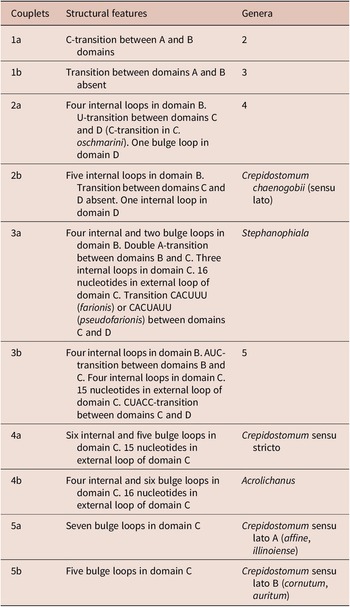
The dichotomous key based on ITS2 secondary-structure features presented in this study transforms molecular data into a system of formal diagnostic characters. While BLAST indicates degrees of similarity and phylogenetic trees visualise hypotheses of relationships, our key provides an annotation-independent method based on conserved biological structures, enhancing identification reliability. This is particularly relevant given that GenBank annotations may contain errors or reflect outdated taxonomy (Shen et al Reference Shen, Chen and Murphy2013; Vilas et al Reference Vilas, Criscione and Blouin2005). The key offers a flexible and efficient tool for working with data of varying completeness, allowing identification based on individual, local structural features (e.g., the presence or absence of a specific transition between domains) (Lahr and Katz Reference Lahr and Katz2009; Porter and Hajibabaei Reference Porter and Hajibabaei2018). Just as classical taxonomy operates with morphological apomorphies (Caira and Bogéa Reference Caira, Bogéa, Jones, Bray and Gibson2005; Brooks and McLennan Reference Brooks and McLennan1991), our key identifies and codes evolutionarily significant structural apomorphies in the RNA molecule (Table 2). This deepens our understanding of evolution not merely in terms of ‘branches on a tree’ but in terms of changes in specific characters, thereby providing an independent line of evidence in support of phylogenetic hypotheses (Sokolov et al Reference Sokolov, Atopkin and Urabe2019). The structural characters identified here (e.g., domain transition types, loop composition) are not randomly distributed across the ITS2 topology but show a clear association with major allocreadiid lineages (Table 2). This supports the view that these features are phylogenetically informative and can serve as diagnostic markers at the genus level.
Dichotomous key for the identification of Crepidostomum-like allocreadiid genera based on the predicted structure and loop composition of ITS2 rRNA

Table 2. Long description
The table is organized into three columns: Couplets, Structural features, and Genera.
- Couplet 1a: C-transition between A and B domains leads to Couplet 2.
- Couplet 1b: Transition between domains A and B absent leads to Couplet 3.
- Couplet 2a: Four internal loops in domain B, U-transition between domains C and D (C-transition in C dot oschmarini), and one bulge loop in domain D leads to Couplet 4.
- Couplet 2b: Five internal loops in domain B, transition between domains C and D absent, and one internal loop in domain D identifies Crepidostomum chaenogobii (sensu lato).
- Couplet 3a: Four internal and two bulge loops in domain B, double A-transition between domains B and C, three internal loops in domain C, 16 nucleotides in external loop of domain C, and transition C A C U U U (farionis) or C A C U A U U (pseudofarionis) between domains C and D identifies Stephanophiala.
- Couplet 3b: Four internal loops in domain B, A U C-transition between domains B and C, four internal loops in domain C, 15 nucleotides in external loop of domain C, and C U A C C-transition between domains C and D leads to Couplet 5.
- Couplet 4a: Six internal and five bulge loops in domain C, and 15 nucleotides in external loop of domain C identifies Crepidostomum sensu stricto.
- Couplet 4b: Four internal and six bulge loops in domain C, and 16 nucleotides in external loop of domain C identifies Acrolichanus.
- Couplet 5a: Seven bulge loops in domain C identifies Crepidostomum sensu lato A (affine, illinoiense).
- Couplet 5b: Five bulge loops in domain C identifies Crepidostomum sensu lato B (cornutum, auritum).
Phylogenetic implications
Among the entire dataset, 92 sequences from 12 species and five genera are reported here for the first time. The phylogenetic analysis included 68 complete ITS2 rDNA sequences from 51 trematode species, including 46 allocreadiid species from 12 genera (Figure 5). The phylogenetic tree reconstructed in this study, based on the complete 5.8S gene and the complete ITS2 region using BI, showed that among the 46 species analysed, 22 American species exhibited ITS2 sequences differing from that of the Eurasian species by 8.16–26.81%. Within the ingroup, a subclade containing Stephanophiala was nested basally to the other allocreadiids. The next subclade formed a trichotomous polytomy consisting of three branches: the first branch contained Acrolichanus; the second branch contained Crepidostomum chaenogobii; and the third branch led to another subclade, which itself formed a trichotomous polytomy. This final subclade included Allocreadium, Bunodera, and a combined branch of eight genera from the Palearctic, Nearctic, and Neotropical realms.
It is noteworthy that the topology obtained from ITS2 data differs substantially from that based on the 28S rRNA gene. In the 28S-based phylogeny (Bogatov and Vainutis Reference Bogatov and Vainutis2022), the basal position was occupied by Acrolichanus (parasites of sturgeon fish, considered an ancient lineage of actinopterygian fishes), followed successively by Stephanophiala, Bunodera, Allocreadium, and Crepidostomum. In contrast, our ITS2 tree places Stephanophiala basally, with Acrolichanus and Crepidostomum chaenogobii forming a separate polytomy branch, while Crepidostomum sensu stricto appears in a derived position. This discrepancy highlights the importance of using multiple markers for phylogenetic inference in Allocreadiidae and demonstrates that ITS2, with its faster evolutionary rate, may provide a complementary perspective on relationships within the family, particularly at shallower nodes. However, we acknowledge the known limitations of ITS data for resolving deeper phylogenetic relationships, including alignment uncertainty, homoplasy, and the risk of obscuring ancient divergences. Therefore, we interpret the ITS2 topology as a hypothesis that complements the 28S-based framework rather than replacing it. The topology presented here nevertheless offers new insights into allocreadiid phylogeny based on ITS data, especially given that the recent study by Petkevičiūtė et al (Reference Petkevičiūtė, Stunžėnas and Stanevičiūtė2023) did not include ITS sequences of C. chaenogobii, Acrolichanus sp., or the South American genera.
The issue of Crepidostomum-like allocreadiids
Former Crepidostomum allocreadiids have been reassessed morphologically and phylogenetically using several genetic markers and shown to represent Crepidostomum sensu lato (Atopkin et al Reference Atopkin, Sokolov, Vainutis, Voropaeva, Shedko and Choudhury2020; Bogatov and Vainutis Reference Bogatov and Vainutis2022; Petkevičiūtė et al Reference Petkevičiūtė, Stunžėnas, Zhokhov, Poddubnaya and Stanevičiūtė2018; Vainutis et al Reference Vainutis, Voronova and Urabe2021). Among them, C. auriculatum and C. farionis were redesignated as Acrolichanus auriculatus and Stephanophiala farionis, respectively (Atopkin et al Reference Atopkin, Sokolov, Vainutis, Voropaeva, Shedko and Choudhury2020; Vainutis et al Reference Vainutis, Voronova and Urabe2021). Earlier, we proposed that the species C. chaenogobii, C. affine, C. illinoiense, C. cornutum, C. auritum, and C. cooperi should also be considered as Crepidostomum sensu lato (Vainutis et al Reference Vainutis, Voronova and Urabe2021). Phylogenetic reconstructions based on 28S and cox1 genes have consistently revealed the distant position of Crepidostomum chaenogobii relative to other Crepidostomum spp. (Aydogdu et al Reference Aydogdu, Vainutis, Voronova and Aydogdu2023; Bogatov and Vainutis Reference Bogatov and Vainutis2022; Vainutis Reference Vainutis2024; Vainutis et al Reference Vainutis, Voronova and Urabe2021, Reference Vainutis, Voronova, Urabe and Kazarin2023). Vainutis et al (Reference Vainutis, Voronova and Urabe2021) suggested a combination of morphological features as diagnostic traits to distinguish C. chaenogobii from Crepidostomum sensu stricto (i.e., C. metoecus, C. nemachilus, C. oschmarini, C. achmerovi, C. brinkmanni). Here, we propose a new taxonomic perspective for the Crepidostomum-like allocreadiids, namely the reconsideration of the generic affiliation of C. chaenogobii.
Regulatory motifs and tandem repeats in trematodes
Eukaryotic genomes contain a large diversity of regular structures, a significant part of which are tandem repeats. These are subdivided into microsatellites (1–10 nucleotides) and minisatellites (>10 nucleotides). Together with interspersed repeats (remnants of transposable elements), they constitute the repetitive fraction of genomes. Tandem repeats are evolutionarily relevant due to their instability: they mutate at rates of 1033 - 10-3; 106 - 10-6 per cell generation, i.e., up to ten orders of magnitude higher than point mutations (Gemayel et al Reference Gemayel, Cho, Boeynaems and Verstrepen2012).
The presence of regulatory motifs in the internal transcribed spacers of flatworms has been documented by Van Herwerden et al (Reference Van Herwerden, Caley and Blair2003). Investigating ITS1 in three trematode genera (Paragonimus, Schistosoma, and Dolichosaccus), these authors found sequences identical to known enhancer motifs, with the probability of random occurrence being less than 5% in 12 of 14 species. Given the ancient evolutionary divergence of the flatworm lineages, the distribution of these motifs in the rapidly evolving ITS1 region is unlikely to be explained solely by shared evolutionary history. Instead, these observations suggest a functional role in regulating tissue- or stage-specific transcription of ribosomal genes. Although the study by Van Herwerden et al (Reference Van Herwerden, Caley and Blair2003) focused on ITS1, it is plausible that similar motifs exist in ITS2, and our data provide indirect support for this hypothesis. Primary ITS2 can be viewed as an immature hub-DNA product that stores and integrates regulatory information. The observed correlation between phylogenetic position and the presence/absence of specific motifs (e.g., the ten-nucleotide 5′-end variants, or the CUU vs. C transitions between A and B domains) suggests that the evolutionary history of the species is reflected not only in the primary sequence but also in the architecture of these regulatory elements. We suggest that the accumulation of motifs and palindromes in spacers occurs indirectly: as species diverge, their unique epigenetic landscapes favour the retention of different sets of regulatory elements, which in turn reinforce the divergence by shaping RNA secondary structure and, potentially, transcription efficiency. Thus, the phylogenetic signal in ITS2 is not merely a consequence of neutral mutation accumulation but may be mediated by the functional constraints imposed by these motifs. If this holds true, similar hub-regions may exist in other non-coding parts of the genome, where repeats and palindromes act as reservoirs of evolutionary and regulatory information. The presence of regulatory motifs in both ITS1 and ITS2 of trematodes adds to the growing body of evidence that internal transcribed spacers are functionally significant regions of the genome, a view that is now widely accepted in eukaryotes (e.g., Van Herwerden et al Reference Van Herwerden, Caley and Blair2003; Gemayel et al Reference Gemayel, Cho, Boeynaems and Verstrepen2012; and references therein). The notion of ITS as ‘junk DNA’ has long been superseded by findings that these spacers contain regulatory elements, binding sites, and motifs involved in transcription and RNA processing.
Tandem repeats have also been documented in trematode genomes. For example, a 192 bp tandemly repeated DNA sequence was characterised in Echinostoma caproni (Hertel et al Reference Hertel, Haberl, Hamburger and Haas2003) and successfully used for PCR-based detection of the parasite in snail and plankton samples. The existence of such tandem repeats in the trematode genome confirms that repetitive elements are an important part of their genomic architecture. More recently, transposable elements (TEs) were shown to be transcriptionally active throughout the life cycle of Fasciola hepatica, with stage-specific expression patterns suggesting regulatory roles in life cycle transitions.
Most authors have noted that eukaryotic genomes are generally depleted of CG-containing repeats, which are prone to mutations. An interesting exception is the CCG repeat, which is relatively common in vertebrate genomes. CCG repeats can contribute significantly to the formation of CpG islands. In allocreadiids, the CCG motif is repeated three to six times within a fragment containing the 3′-end of 5.8S and the 5′-end of ITS2, depending on the species. Only two species of Allocreadium (A. papilligerum and A. transversale) and one species of Bunodera (B. acerinae) had the CCG motif repeated six times in both 5.8S and ITS2. In ITS2, a common CCG motif at positions 121–123 bp in all allocreadiid species serves predominantly as a binding element between the major loop and the C domain (27 species) or is located at the beginning of the C domain (18 species). The only palindrome observed, UGCA, was found in the D domain of 32.6% of all 46 species. While CpG islands have been extensively studied in vertebrate genomes in the context of gene regulation and methylation, their occurrence and potential functional significance in trematode ribosomal DNA have not been previously reported.
Variation within Allocreadiidae: the case of Crepidostomum
Among all species studied, the most variable were Crepidostomum metoecus and C. achmerovi, which exhibited variable numbers of ‘GA’ repeat units in the ITS1 region. Specimens of C. metoecus from Japan (43 individuals) outnumbered those from Primorye (seven individuals, metacercariae from Gammarus sp. amphipods). Japanese specimens, infecting different salmonid fish species, were the most variable in ITS1 structure. Specimens grouped into nine sets based on the number of ‘GA’ repeat units fell within a single range of minimum free energy (MFE: from –305.79 to –276.52 kcal/mol). Specimens with unique single-nucleotide substitutions and unique numbers of ‘GA’ repeat units also fell within a single energy range (–196 to –180 kcal/mol). The variation in repeat copy number among individuals and populations mirrors the repeat-associated variability described for other trematodes and, together with the evidence summarised above, supports the hypothesis that such repeats may be functionally significant.
Conclusions
In this study, we have provided the first comprehensive dataset on ITS2 secondary structures for the family Allocreadiidae, encompassing 46 species from 12 genera. Our analysis revealed that most allocreadiid ITS2 structures conform to the classical four-domain model, but we also documented unique conformational variants, including a three-branched C-domain in Bunodera acerinae and an atypical organisation of A and B domains in Creptotrema funduli and Pseudoparacreptotrema macroacetabulata. The identification of conserved 5′-end variants (UAUAAACUAU vs. UAUAAAUUAU), domain transition types (C-transition, CUU-transition, and AUC transition), and the distribution of CCG motifs and UGCA palindromes across the family provide a set of novel, phylogenetically informative characters. We have developed the first dichotomous key for the identification of allocreadiids based on ITS2 secondary-structure features. This key translates molecular data into a formal system of diagnostic apomorphies, providing an annotation-independent, reproducible, and efficient tool for taxonomists and ecologists. Phylogenetic analysis based on ITS2 data places Stephanophiala basally, with Acrolichanus and Crepidostomum chaenogobii forming a separate branch, while Crepidostomum sensu stricto appears in a derived position. However, we acknowledge the limitations of ITS for resolving deep relationships and interpret this topology as a hypothesis complementary to 28S-based frameworks. The relationships among the families analysed here confirm earlier statements (Bakhoum et al Reference Bakhoum, Miquel, Ndiaye, Justine, Falchi, Bâ, Marchand and Quilichini2017; Littlewood et al Reference Littlewood, Bray, Waeschenbach, Morand, Krasnov and Littlewood2015) that Allocreadiidae belongs to the superfamily Gorgoderoidea and shares common life-history traits with other members of this superfamily. We propose that the ITS2 region functions as a primary hub-DNA product that accumulates regulatory motifs and palindromic elements, which may influence RNA folding, stability, and potentially transcription efficiency. This view is supported by the non-random distribution of these elements across the phylogeny of Allocreadiidae and by previous reports of enhancer-like motifs in the ITS1 of other flatworms (Van Herwerden et al Reference Van Herwerden, Caley and Blair2003).
Acknowledgements
We are grateful to Prof. Takeshi Shimazu for providing material of Crepidostomum metoecus and Stephanophiala farionis from Hokkaido, which was used for the molecular-genetic analyses.
Financial support
The research was carried out within the state assignment of the Ministry of Science and Higher Education of the Russian Federation, Federal Project No. 124021900011-9 ‘Biodiversity of the World Ocean: taxonomy and evolution, reproductive biology, biogeography, and bioinvasions’.
Competing interests
The authors declare no competing interests.
Ethical standard
No ethical approval was required, as this study did not involve clinical trials or experimental procedures. During the study, no treatments or experiments were carried out on live animals.