


Circulation means advertising, and advertising means money, and money means independence.
—Joseph Pulitzer, as cited in Starr (Reference Starr2004, 257)Media sponsored by influence groups often report distorted information to their audiences. Independent media tend to provide more objective coverage, promote electoral accountability, reduce corruption, and restrict managerial diversion.Footnote 1 How can such independent media emerge? According to both historical accounts (Baldasty Reference Baldasty1992, 128–34; Smythe Reference Smythe2003, 49–70; Starr Reference Starr2004, 395–96) and theoretical models (Besley and Prat Reference Besley and Prat2006; Gentzkow, Glaeser, and Goldin Reference Gentzkow, Glaeser, Goldin, Glaeser and Goldin2006; Petrova Reference Petrova2010), the growth of an advertising market is an important factor in the development of independent media. So far, however, there is no systematic empirical evidence to validate this claim. Hamilton (Reference Hamilton2004, 38–70) and Gentzkow, Glaeser, and Goldin (Reference Gentzkow, Glaeser, Goldin, Glaeser and Goldin2006) provide an empirical analysis of newspapers in the nineteenth-century United States that shows that there were more independent newspapers in places with faster population growth. This could be taken as a starting point as suggestive evidence in favor of the hypothesis.
Recent literature highlights the fact that independent media outlets affect the quality of governance. Free and competitive media promote accountability of elected politicians (Larcinese, Puglisi, and Snyder Reference Larcinese, Puglisi and Snyder2011; Puglisi and Snyder Reference Puglisi and Snyder2011; Strömberg and Snyder Reference Snyder and Strömberg2010), whereas uninformative media prevent accountability mechanisms from working (Besley and Prat Reference Besley and Prat2006; Besley and Burgess Reference Besley and Burgess2002; Strömberg Reference Strömberg2004a; Reference Strömberg2004b). Similarly, countries with little media freedom are more prone to corruption (Adserà, Boix, and Payne Reference Adserà, Boix and Payne2003; Brunetti and Weder Reference Brunetti and Weder2003),Footnote 2 have a lower level of social spending (Petrova Reference Petrova2008), and have less efficient bureaucracies (Egorov, Guriev, and Sonin Reference Egorov, Guriev and Sonin2009). Moreover, independent media outlets are important to prevent corrupt and incompetent governments from staying in power. For example, McMillan and Zoido (Reference McMillan and Zoido2004) show that in Peru a small independent television channel created the opportunity for the country's citizens to overthrow the corrupt government.Footnote 3
This article uses data on American newspapers from 1880 to 1885 to show that the growth of an advertising market promotes media independence from political influence groups, even taking population growth into account. Several theoretical explanations underpin this argument. First, as shown formally in Besley and Prat (Reference Besley and Prat2006) and Gentzkow, Glaeser, and Goldin (Reference Gentzkow, Glaeser, Goldin, Glaeser and Goldin2006) and discussed in Baldasty (Reference Baldasty1992, 129–30) and Smythe (Reference Smythe2003, 49–70), if the profitability of advertising is high, then it is costly for media outlets to distort their news coverage in the direction desired by a subsidizing group. Any deviation from the coverage that maximizes audience means the loss of audience and the loss of corresponding advertising revenues. Second, market expansion increases variety, and independent media can fill a gap that had not been served by sponsored media.Footnote 4 Finally, as argued in Gabszewicz, Laussel, and Sonnac (Reference Gabszewicz, Laussel and Sonnac2001), the growth of advertising allows media outlets to choose the same politically neutral reporting because incentives to compete by product differentiation become weaker.Footnote 5
In 1880–85, during the Gilded Age era, the majority of newspapers were affiliated with major political parties. As discussed in the Background section, the main difference between partisan newspapers (newspapers affiliated with the Democratic or Republican party) and independent newspapers was not the size of the bias but rather the extent of control a party had over the newspaper's news coverage. Editors of independent newspapers could print whatever they wanted, whereas editors of partisan newspapers were restricted in their decisions.
This article tests whether there is a positive relationship between the growth of the advertising market and the growth of independent media. The empirical evidence is consistent with the commercialization hypothesis: Even in specifications with newspaper fixed effects, there was a significant positive correlation between local advertising rates and independent affiliation of newspapers. The results also hold for data aggregated by city.
More importantly, the article also presents evidence in favor of a causal relationship between local advertising rates and newspapers' independence. It addresses potential endogeneity problems by using instrumental variable estimation. For the state of Massachusetts, it reports the results using local regulation of outdoor advertising, and of newspaper and handbill distribution, as instruments for local advertising rates. These restrictions were triggered after the 1873 scandal involving the advertisement of a patent medicine, “S T 1860 X,” which was painted on a rock near Niagara Falls (Taylor and Chang Reference Taylor and Chang1995), an event plausibly orthogonal to the development of an independent press in Massachusetts. The results are consistent with results for the fixed-effect estimations.
In addition, there is other evidence consistent with the paper's main argument. To avoid the problem that advertising rates could be chosen as a result of strategic interaction among the newspapers in a market, I look at the entry of new newspapers. The analysis shows that new newspapers were more likely to be independent in the markets with higher advertising rates per reader and thus higher profitability of advertising. I also use the precise timing of major changes in advertising rates to identify the effect of advertising on the entry of new independent newspapers. The analysis of pre-trends demonstrates that there were no effects of future changes in advertising rates, whereas there was a large positive “on-impact” effect of contemporaneous change in advertising rates of preexisting newspapers.Footnote 6
Finally, empirical evidence suggests that economic development was not the only cause of the development of an independent press, as some authors have suggested (e.g., Baldasty Reference Baldasty1992, 128–34, 139–46; Gentzkow, Glaeser, and Goldin Reference Gentzkow, Glaeser, Goldin, Glaeser and Goldin2006; Hamilton Reference Hamilton2004, 7–70). The structure of political power in a city played an important role. In particular, in county seats (administrative capitals of counties, which often had their own legislative bodies), where there were more opportunities for political parties to influence local newspapers, there were fewer independent newspapers, despite the fact that the county seats were, on average, more populous and more developed and had higher advertising rates than other cities in the same countries.Footnote 7 Also, there were fewer independent newspapers entering the market in 1880 and 1884, the years of presidential elections, when presumably the control of newspapers was more attractive for parties.
Why was newspaper independence important? Dyck, Moss, and Zingales (Reference Dyck, Moss and Zingales2008) argue that independent newspapers restricted the relative power of special interest groups and made it possible to adopt the Progressive Era reforms. Menes (Reference Menes, Glaeser and Goldin2006) suggests that independent newspapers helped to combat political machines in American cities. Kaplan (Reference Kaplan2002, 190–97) points out that press independence facilitated and broadened public discussion of policy issues, and allowed voices other than those of the two dominant parties to be heard. Gentzkow, Glaeser, and Goldin (Reference Gentzkow, Glaeser, Goldin, Glaeser and Goldin2006) show that the content of newspapers was becoming less biased and more objective as the number of independent newspapers was increasing and the extent of corruption was decreasing.Footnote 8
I focus on the nineteenth-century United States for several reasons. First, the newspaper market was very dynamic then: Newspapers entered and exited the market every year, and advertising rates exhibited significant variation over time and space. As a result, it is possible to use state, county, city, newspaper, and year fixed effects in the analysis. Second, at that time newspapers had self-reported political affiliations (Republican, Democratic, Independent), which provides a convenient proxy for control by political parties. The Background section discusses different mechanisms that the parties used to exercise such control. Third, a major advertising agency published newspapers advertising rates and political affiliations during this time period, so there are data that can be used to test the outlined hypotheses. Fourth, during this time period an unexpected event triggered a wave of local regulations on advertising, which permits the use of instrumental variable (IV) analysis. Finally, the institutional environment in the United States in the 1880s (the “Gilded Age”) was similar to that of many modern middle-income countries with weak institutions, such as Russia or Mexico (Shleifer and Treisman Reference Shleifer and Treisman2005). Thus, the results of this article are not necessarily specific to the unique path of political development of the late nineteenth-century United States, but may be extended, with caution, to media systems in developing countries in our time.
This article is related to previous empirical work on the development of media independence in the United States by Gentzkow, Glaeser, and Goldin (Reference Gentzkow, Glaeser, Goldin, Glaeser and Goldin2006) and Hamilton (Reference Hamilton2004, 37–70). Hamilton provides an empirical analysis of the political affiliation of newspapers in the largest U.S. cities and shows that there were more independent newspapers in more populous cities and cities with smaller foreign-born and African-American populations. Gentzkow, Glaeser, and Goldin (Reference Gentzkow, Glaeser, Goldin, Glaeser and Goldin2006) show that there is a correlation between the population of large cities and the share of readership of independent newspapers in those cities. My article contributes to this literature because it (1) presents evidence of a positive relationship between local advertising rates and independence, controlling for population size and other observables; (2) shows why this relationship may be interpreted as causal; and (3) provides empirical arguments about political factors, in additional to economic ones, that contributed to the growth of independent newspapers.
The rest of the article is organized as follows. Section 2 is a brief overview of the related literature; Section 3 presents basic background information on American newspapers in the nineteenth century and their relationships with political parties; Section 4 contains the empirical results; and Section 5 concludes.
LITERATURE
This article describes the growth of independent newspapers in the United States in the nineteenth century. In the literature, one of the most common explanations for this growth is that improving economic conditions stimulated the change from partisan to independent media. Baldasty (Reference Baldasty1992, 52–146) argues that the commercialization of news production and the movement towards an advertising-sponsored model of a newspaper was key in this development. Starr (Reference Starr2004, 76–82, 87–92, 261–68) argues that politics and, as a consequence, a liberal legal environment in the United States (e.g., free speech protections, no strict libel laws), together with government-mandated discounts for newspaper postage, was one of the main vehicles for this growth. Smythe (Reference Smythe2003, 49–202) chronicles the rise of independent newspapers during the Gilded Age, arguing that high advertising and subscription profits allowed many editors to break their ties with political parties. There are also other explanations. For example, Lippmann (Reference Lippmann1931) and Park (Reference Park, Park, Burgess and McKenzie1925) write about the “natural,” “not wholly rational” transition from politically biased news more objective reporting, which all media systems necessarily experience. Other scholars argue that such a transition could happen because of various social or technological changes: increased egalitarianism (Schudson Reference Schudson1978, 3–159), higher literacy rates (Mott Reference Mott1941, 107, 158), or innovations in printing (Douglas Reference Douglas1999, 1–156) or in telegraphy (Thompson Reference Thompson1947, 1–544).
The question of press independence is important, as newspapers and other types of media can significantly influence public opinion and political discourse. Though classic studies, such as Lazarsfeld, Berelson, and Gaudet (Reference Lazarsfeld, Berelson and Gaudet1944, 1–178) and Berelson, Lazarsfeld, and McPhee (Reference Berelson, Lazarsfeld and McPhee1986, 3–326) find only minimal media effects and argue that the main role of media is to reinforce people's predispositions and existing preferences, more recent political communication literature highlights that mass media can affect public opinion through agenda setting (Dearing and Rogers Reference Dearing and Rogers1996, 1–99; McCombs Reference McCombs2004, 1–145; McCombs and Shaw Reference McCombs and Shaw1972), priming (Iyengar and Kinder Reference Iyengar and Kinder1987, 1–135), and framing (Scheufele Reference Scheufele1999; Zaller Reference Zaller1992, 6–332). Public opinion, in turn, is important for policy outcomes (Bartels Reference Bartels1991; Kernell Reference Kernell1997, 10–236; Page and Shapiro Reference Page and Shapiro1983).
HISTORICAL BACKGROUND
This article focuses on the end of the Reconstruction Era, when many (but not all) counties in the South become overwhelmingly Democratic after being overwhelmingly Republican, and local politics, overall, was becoming less competitive. Local parties were often organized into political machines, composed of hierarchical organizations of loyal supporters, headed by local bosses (Ackerman Reference Ackerman2005, 1–152; Summers Reference Summers2003, 3–82). A patronage system allowed them to distribute public jobs, and many government jobs went to the mayor's appointees, though civil service reform was already being introduced in New York (1883) and Massachusetts (1885) (Folke, Hirano, and Snyder Reference Folke, Hirano and Snyder2010; Riordon Reference Riordon2004, 3–61). The absence of a secret ballot magnified corruption, enhanced party control, and diminished the probability that new voices would be heard (Argensinger Reference Argersinger1985–86; Cox and Kousser Reference Cox and Kousser1981). At the same time, there was an end of one-party dominance in national politics, with Grover Cleveland being the first Democratic President elected since the Civil War. The Greenback party was losing its support, whereas the Prohibition movement was gaining strength (Kleppner Reference Kleppner1979, 240–64; Sundquist Reference Sundquist1983, 112–15).
At that time, most American newspapers were partisan; i.e., they were officially affiliated with either the Republican or the Democratic Party (Ayer and Son Reference Ayer1881–86; Mott Reference Mott1941, 167–208, 411–513; Schudson Reference Schudson1978, 4–57; Smythe Reference Smythe2003, 1–70). Newspapers were parts of the political machines, as they ensured that information flows were controlled by faithful party members. For a newspaper, affiliation with a political party had both benefits and costs. The benefits included direct and indirect subsidies from political parties and better access to political information. The costs included restrictions on the content of the newspaper, i.e., a lack of control, and the inability to address a broad audience with diverse political preferences (Baldasty Reference Baldasty1992, 128–34; Kaplan Reference Kaplan2002, 55–68; Smythe Reference Smythe2003, 49–70; Starr Reference Starr2004, 395). Parties required their affiliated newspapers to support all of their official decisions, prohibited them from covering conflicting points of view, and restricted their content overall.Footnote 9
Several mechanisms for subsidizing newspapers were available to political parties. Parties frequently used budget money to sponsor newspapers with which they were affiliated (Baldasty Reference Baldasty1992, 128–34; Kaplan Reference Kaplan2002, 58–59, 63; Lee Reference Lee2007, 406; Starr Reference Starr2004, 92–94). By law, all new local laws, ordinances, and regulations had to be published in local newspapers, and the newspapers were paid from budgets for publications. These newspapers were chosen by the members of city councils or boards of aldermen—that is, by people usually affiliated with political parties.Footnote 10 Ordinances often explicitly required chosen newspapers to represent the interests of one of the two major parties. For example, Ithaca's charter of 1897 stated “ordinances . . . should be published in at least two official newspapers. . .. The members of the common council . . . should designate, in writing, a paper fairly representing the political party to which they respectively belong.”Footnote 11 The amount of money distributed through this channel was fairly large. A Brooklyn, NY, ordinance, for example, required that this amount be capped at $100,000, paid to four official partisan newspapers, for publishing new municipal acts and ordinances.Footnote 12 This corresponds to approximately $1.5 million in 2000 dollars.
There were also indirect perks that partisan newspapers, unlike independent newspapers, enjoyed. Political parties facilitated gathering political information and news reporting for affiliated newspapers. All partisan newspapers could gain access to state congressional hearings and to the party's caucuses (which was problematic for independent newspapers). Newspapers affiliated with parties used party officials as a primary source for their information (Starr Reference Starr2004, 141).
Finally, the party members were obligated to support the local partisan newspapers, even if the price was relatively high. Party officials insisted that subscribing to a partisan newspaper was a necessary duty of any devoted party member (Kaplan Reference Kaplan2002, 22–23). The political parties generated the audience for these newspapers and, in turn, enjoyed their enthusiastic support.Footnote 13
The mechanism described above was more prevalent in county seats. As discussed in Baldasty (Reference Baldasty1992, 128–34), county seats were especially prone to newspaper patronage, because they could reward newspapers in cash through county-level printing contracts.
In sum, partisan newspapers—newspapers officially associated with political parties—were different from independent newspapers. As a result, the presence (or absence) of political affiliation implied a particular organizational structure of a newspaper, its news coverage, and the way it was financed.
EMPIRICAL EVIDENCE
Argument and Hypotheses
In this article I argue that higher profits from advertising allow newspapers to break their affiliation with political parties and to declare themselves independent. Several theoretical models are related to this idea. In Besley and Prat (Reference Besley and Prat2006) and Gentzkow, Glaeser, and Goldin (Reference Gentzkow, Glaeser, Goldin, Glaeser and Goldin2006), newspapers are less likely to be pro-government or supportive of the agenda of an interest group if advertising revenues per reader are high, because the newspapers are becoming afraid of losing their audience. Gabszewicz, Laussel, and Sonnac (Reference Gabszewicz, Laussel and Sonnac2001) show that an increase in advertising revenues per capita makes competition less important, thus creating conditions for competing newspapers to choose the same politically neutral ideology. In Gehlbach and Sonin (Reference Gehlbach and Sonin2010), the growth of advertising creates an incentive for the government to nationalize media outlets, because the government can benefit from the associated profits.Footnote 14
Petrova (Reference Petrova2010) analyzes the effects of falling marginal costs, or rising marginal revenues, on distortions in media coverage. She shows that, depending on the situation, three types of effects are possible. If people are sensitive to the type of coverage, or if special interest groups face budget constraints, then the effect of the growth of advertising on distortions in coverage is negative (i.e., coverage becomes more objective). If people do not pay attention to the distortions in coverage, or if the size of circulation is very important for the interest group, then the direct effect of the growth of advertising is counterbalanced by its indirect effect, because the price for a media product goes down and the valuable media audience expands. As a result, the aggregate effect of the growth of advertising may become positive. Finally, if markets are fully covered, and all consumers buy one unit of the media product, then the extent of distortions in media coverage does not depend on marginal advertising revenues.
Despite all of the theoretical complications, it is possible to sketch a simple model that relates local profitability of advertising to newspapers' choice of political affiliation. Assume that newspapers receive profits either from advertising revenues (if they are independent) or from subsidies from political parties (if they are partisan). Newspaper readers have their preferred type of newspaper, but still can choose another type with some probability, depending on the relative numbers of independent and partisan newspapers in a city. In such a setup, a change in advertising revenues per capita might affect both the entry of independent newspapers and the switch of affiliation from being partisan to being independent. The determination of an optimal choice depends on the cost of entry and the cost of switching. See the Appendix for more details.
Note that it is theoretically possible that parties could have increased subsidies offered in locations where advertising profitability was higher. This could offset the increase in advertising rates, especially in places with many undecided voters and high political competition.Footnote 15 The question of the relative importance of advertising revenues for media independence is therefore mainly empirical.Footnote 16 The goal of this article is to test this argument empirically. The main hypothesis is that the local profitability of advertising has increased the number of independent newspapers; i.e., it has created incentives for media outlets to become independent of political parties.
Hypothesis 1. In places with higher advertising profitability, there was a greater likelihood that a newspaper was independent.
We can also look separately at the effect of advertising on entries and its effect on changing political affiliation. In particular, it is important to establish whether newspapers that moved from partisan to independent were more likely to do so in places with faster growth in advertising.
Hypothesis 2. In places with higher advertising profitability, there was a greater likelihood that a newspaper switched from being partisan to being independent.
Finally, any causal mechanism to link advertising and newspaper independence should be applicable not only to newspapers that coexisted in the market at any given point of time, but also to new newspapers just entering the market. Although new entrants will not confront issues of reputation and established political relationships, as will their established competitors, all of the potential costs and benefits discussed earlier should be of particular importance to new newspapers.
Hypothesis 3. In places with higher advertising profitability, there was a higher probability that newly created newspapers chose to be independent.
Data Description
The main source of the data is Ayer's Directory of Newspapers Reference Ayer1881–1886, an annual catalog of newspapers and magazines that was published by the advertising agency N.W. Ayer and Sons Company.Footnote 17 For each newspaper, the directory reports the prevailing advertising rate that this newspaper charged. In addition, the directory provides information on the political affiliation of each newspaper, its circulation, and its geographical location (i.e., the main city where the newspaper was distributed). The purpose of the directory was to provide information to potential advertisers.
In the dataset, I include only those newspapers that were published at least once per weekFootnote 18 and with a clear political affiliation: Democratic, Republican, or Independent. I exclude magazines, scientific journals, travel almanacs, advertising catalogs, and religious newspapers. For each newspaper, I created the dummy variables Independent, Republican, Democratic, equal to one if the political affiliation of the newspaper was Independent, Republican, or Democratic, respectively, and zero otherwise. In the dataset, there are 2,243 Independent, 2,868 Democratic, and 2,698 Republican newspapers.Footnote 19
Plain advertising rates come from Ayer's Newspaper Annuals, given as prices of ten lines of advertising published for one month. Note that advertising rates published by Ayer were just first proxies for advertising rates in actual advertising contracts.Footnote 20 Newspapers and advertisers, with N.W. Ayer and Son as intermediary, could afterward negotiate other mutually beneficial terms if advertisers were eager to do that. Advertising rates in Ayer's catalogs were based on N.W. Ayer and Son's perception of profitability of advertising in a given newspaper. The variation in advertising rates in locations with similar demographic and similar newspaper circulation was to a large extent driven by demand for newspaper advertising, as observed by N.W. Ayer and Son. So these advertising rates can be viewed as exogenous estimates of the profitability of advertising, which could endogenously be changed at a newspaper's and an advertiser's discretion.
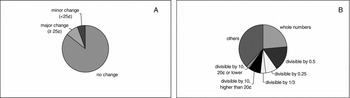
The distribution of changes in newspapers' advertising rates is shown in Figure 1. Panel A suggests that N.W. Ayer and Son changed advertising rates quite infrequently: In 86% of observed newspaper-years, they were not changed at all. If they were changed, however, most of these changes were major; i.e., the change was at least 25¢, with a median advertising rate being $2.09 per 10 lines for 1 month. This frequency of changes suggested the existence of some menu costs that prevented N.W. Ayer and Son from changing the prices on a yearly basis. Panel B suggests that these changes were quite large. The fact that most changes in advertising rates were major but infrequent allows us to use the precise timing of these changes to estimate this effect (for more detail, see section on Newspaper Entries and Pre-trends below).
Yearly Changes in Advertising Rates: (A) Whole Sample; (B) Nonzero Changes

Because the demand for independent versus partisan newspapers may depend on the population's political preferences, I control for changing political preferences using data on county-level electoral results in presidential and congressional elections from the Clubb, Flanigan, and Zingale (Reference Clubb, Flanigan and Zingale2006) dataset provided by the Interuniversity Consortium for Political and Social Research (ICPSR). I also use data on county seat locations from the Sechrist (1986) dataset (ICPSR Study 8159). Finally, I rely on the census data on income and population from Haines (Reference Haines2005). The construction of the dataset is described in more detail in the Appendix.
Market Structure
For political newspapers, the market structure varied significantly across cities. Some were the only newspaper in a city; others were in duopolistic markets. Only 5% were in markets with more than five newspapers. In the entire sample, 4,087 were in single-newspaper cities, 2997 in two-newspaper cities, 1,513 in cities with three newspapers, 858 in cities with four or five newspapers, and 358 in cities with more than five newspapers.
The market for newspapers operated primarily at the city level. Local newspapers used to write about local news, and subscription—the primary source of distribution of smaller newspapers—was often available only to city residents. Only the weekend editions of high-circulation newspapers in Boston, New York, and Washington were distributed more broadly.Footnote 21 Overall, during that time period the newspapers located in different cities did not directly compete with each other.
The changes in market structure consist of 2,992 entries (that is, new newspapers that entered the market), 2,834 exits (old newspapers that exited the market), 515 changes (newspapers that changed their political affiliation), and mergers and acquisitions (which Ayer's catalogs do not report). During 1880–1885, 280 newspapers went from being partisan to being Independent and 259 from being Independent to being partisan. 32 newspapers even went from being Democratic to Republican and 25 from being Republican to Democratic. Not all of these newspapers were located in the South and changed their political affiliation because of partisan realignment following the end of Reconstruction (in the South the number of switchers was 7 and 6, respectively). Some newspapers even changed their affiliation more than once.Footnote 22
Methodology and Empirical Results
Newspaper-level Results, Fixed Effects. Hypothesis 1 predicts a positive relationship between the local profitability of advertising and newspapers' independence. To test this hypothesis, I estimate the following fixed effects model:

Here Ait is some proxy for the local profitability of advertising, computed for the newspaper i in the year t. Xit is a vector of controls for newspaper i in year t, γc is a county dummy variable, and δt is a time dummy variable. Control variables Xit consists of time-varying county characteristics, including income, county population, electoral returns in the last presidential and congressional elections, and city-specific variables, including city population and a dummy for the city being a county seat. To estimate Equation (1), I use a linear probability model.Footnote 23 Standard errors are clustered by city, i.e., at the primary market level.
I use local circulation-adjusted advertising rates (the ratio of the newspaper's advertising rate to its circulation) to construct a proxy for the profitability of advertising, Ait. For the benchmark model, the measure of A is an average circulation-adjusted advertising rate computed for a city. Circulations are logged because otherwise the distribution of the corresponding variable would be substantially skewed to the left.
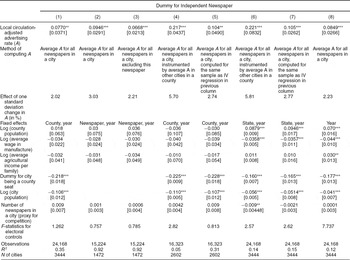
Table 1 contains the results of the estimation of Equation (1). The significant coefficient for A in column (1) implies that a single–standard deviation increase in the local profitability of advertising made local newspapers 2.4 percentage points (p.p.) more likely to be independent in a given year. This effect seems small, but if multiplied over time as local advertising rates grow, it can explain a significant part of the massive transformation of newspapers in the United States in 1870–1920 from mainly partisan to mainly independent. For example, the in-sample calculations imply that within-county growth of advertising rates explains 32% of the growth of independent newspapers from 1880 to 1885.Footnote 24
Profitability of Advertising and Independent Newspapers: Basic Results

Note: Linear probability OLS regressions. Standard errors are clustered by city. Electoral controls include percentage of votes for Republicans, Democrats, Greenbacks, and other parties in the most recent presidential and congressional elections, and voter turnout in these elections. In column (5) with IV specification, χ2 statistics for electoral variables are reported instead of F-statistics. In all specifications, coefficients for circulation-adjusted advertising rates computed with fixed effect logit (not reported here) have the same or greater level of significance.
Robust standard errors, clustered by city, are in brackets.
*Significant at 10%.
**Significant at 5%.
***Significant at 1%.
Column (2) presents the results of estimating model (1) with newspaper fixed effects. In fact, it tests Hypothesis 2 about switchers. The coefficient implies that the marginal effect is similar in magnitude to the effect in column (1). The sample size goes down, as newspapers in one-newspaper towns are excluded, to make these results comparable with results in the next column.
The main drawback of the specifications discussed so far is potential endogeneity, because independent newspapers, on average, might have higher advertising revenue per reader than partisan newspapers. Also, in the same market (city) advertising rates of newspapers may be the best responses to each other's advertising price. One way to solve this problem is to compute the local profitability of advertising using the circulation-adjusted advertising rates of all newspapers in the city except this one. Column (3) reports this specification. With this method, the effect of a single–standard deviation change in A is slightly less than the magnitudes shown in the previous columns. The results are consistent with Hypotheses 1 and 2.
Another potential solution would be to predict average circulation-adjusted advertising rates in each city by the average adjusted advertising rates in other cities in a county, or in other counties in a state. The idea is that advertising rates in each city should be positively correlated with advertising rates in other cities in a county because of common trends, but that advertising rates in other markets could not be a basis for a best-response strategy of newspapers in this market.Footnote 25 The results using other cities in a county are presented in column (4). The magnitude of the effect is quite large as compared with all of the previous estimates. The results of the corresponding OLS regression for the same sample are shown in column (5). Similarly, column (6) shows IV estimation in which the advertising rate is predicted by advertising rates in other counties in a state; column (7) shows the corresponding OLS specification. The direction and magnitudes of the effects are similar.
Overall, the results of Table 1 can be summarized as follows: Local profitability of advertising had a significant positive effect on the probability that a given newspaper was independent. A single standard deviation change in the local profitability of advertising led to a 2.2 to 5.8 p.p. increase in the probability of being independent, depending on the specification. These results are consistent with Hypotheses 1 and 2.
City-level Analysis. It is important to test whether the relationship between local advertising rates and a newspaper's independence still holds for data collapsed by city, because otherwise the results could be attributable to complex patterns of correlation between newspapers interacting within the same market.Footnote 26
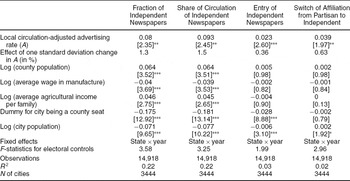
Table 2 investigates city-level relationships in more detail. It shows how average circulation-adjusted advertising rate affected (1) the fraction of newspapers that were independent in a city, (2) the share of circulation of independent newspapers, (3) the probability that at least one independent newspaper would enter the market in a given city-year, and (4) the probability that at least one partisan newspaper would switch to being independent in a given city-year. All specifications include state-year fixed effects. Standard errors are clustered by city.
Local Advertising Rates and Independent Newspapers: City-level Results

Note: All newspaper-level variables are averaged by city. Electoral controls include percentage of votes for Republicans, Democrats, Greenbacks, and other parties in the most recent presidential and congressional elections, and voter turnout in these elections.
Robust standard errors, clustered by city, are in brackets.
*Significant at 10%.
**Significant at 5%.
***Significant at 1%.
In all specifications, local circulation-adjusted advertising rates had a positive and significant effect on respective dependent variables. The magnitudes of the effect are especially large for the probabilities of entry of independent newspapers and of switching from partisan to independent.Footnote 27
In sum, the results in Table 2 are consistent with those in Table 1. In cities with higher advertising rates there were, on the average, more independent newspapers, they had larger shares of circulation, they had a higher probability of entering as independents, and they had a higher probability of switching from being partisan to being independent.
Entry of New Newspapers. To test Hypothesis 3, I estimate Equation (1) for the subsample of new newspapers. The precise hypothesis is that new newspapers were more likely to start as independents in places with higher local advertising profitability A. Looking only at new entries allows us to solve a potential endogeneity problem arising because the newspapers in the same market can choose their advertising rates as best responses to each other's strategy.
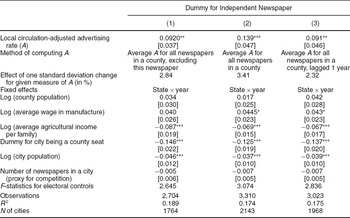
Table 3 shows the results of this analysis. Standard errors are clustered by city. Column (1) presents a baseline model with the average circulation-adjusted advertising rate computed for all newspapers in a county excluding this particular newspaper. The magnitude of the effect is similar to those obtained before: a 2.7 p.p. increase in the probability of starting as an independent newspaper following a one standard deviation increase in the local circulation-adjusted advertising rate. Column (2) presents similar results with the average circulation-adjusted advertising rate being computed for all newspapers in a county. Column (3) shows that the effect remains positive and significant even if we take the lag of local advertising profitability rather than its present value, but the magnitude of the effect decreases to 1.9 p.p.
Local Advertising Rates and Entry of Independent Newspapers: Only Newly Created Newspapers Are Included in the Sample

Note: Linear probability OLS regressions. Electoral controls include percentage of votes for Republicans, Democrats, Greenbacks, and other parties in the most recent presidential and congressional elections, and voter turnout in these elections. Note that the number of observations per county does not allow estimation with county fixed effects, so state effects are used instead, and the average profitability of advertising is computed at the county level.
Robust standard errors, clustered by city, are in brackets.
*Significant at 10%.
**Significant at 5%.
***Significant at 1%.
Overall, the results shown in Table 3 imply that in places with higher local advertising rates, new newspapers were more likely to enter the market as independents. A single–standard deviation change in the local profitability of advertising led to a 1.9 to 5.8 p.p. increase in the probability of being independent, depending on the specification. The results are consistent with Hypothesis 3.
Entry of New Newspapers, Analysis of Pre-trends. This section is different from the rest of the article as it looks at the effect of major changes in advertising rates in a city and relates it to entries of new independent newspapers. Such an approach is a way to establish causality from precise timing of events. The methodology used here follows that of Gentzkow, Shapiro, and Sinkinson (n.d.). In this setup, a discontinuous change in the independent variable leads to a discontinuous change in the dependent variable, whereas all other variables in the analysis remain continuous. If the relationship between major changes in advertising rates, Δact, and entries of independent newspapers, ind_entryct in a city, comes from a casual effect, Δact should not be correlated with past values of ind_entryct.
To identify the impact of major changes on the entries of independent newspapers, I estimate the following equation:

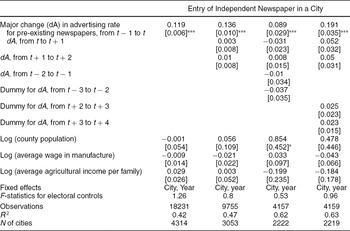
Here Δa c,t−k is a dummy variable for a major ($0.25) positive change in advertising rate for at least one preexisting newspaper in city c from t−k−1 to t−k. Xct is the set of county-level controls, γc is city fixed effect, and δt is time fixed effect. The unit of observation is city-year. The hypothesis that a major change in a causes an increase in the entry of independent newspaper implies that β1,0 should be positive and significant, whereas all β1,k for k>0 should not be significantly different from 0.
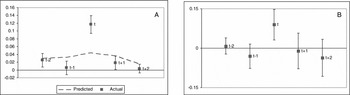
Table 4 shows the results of this estimation for k changing from 0 to 2, from −2 to 2, and from −4 to 0.Footnote 28 All specifications imply that there is a large “on-impact” effect of a major change in advertising rate on the entry of a new independent newspaper in a city. A major change in local advertising rates increases the probability of the entry of independent newspaper by 8.9–19.1%, depending on the specification. For all k≠0, the coefficients for leads and lags of Δact are not significant and are at least four times lower than a corresponding coefficient for Δact. Figure 2 illustrates these results.Footnote 29 Overall, the results of this section are consistent with the hypothesis that major changes in local advertising rates have causal effect on the entry of independent newspapers.
Entry of Independent Newspapers and Major Changes in Advertising Rates: Pre-trends and Post-trends Included

Note: Linear probability OLS regressions. Electoral controls include percentage of votes for Republicans, Democrats, Greenbacks, and other parties in the most recent presidential and congressional elections, and voter turnout in these elections.
Robust standard errors, clustered by city, are in brackets.
*Significant at 10%.
**Significant at 5%.
***Significant at 1%.
Entries of Independent Newspapers and Major Changes in Advertising Rates: Actual and Predicted Average Entries of Independent Newspapers in a City

Newspaper-level Analysis, Instrumental Variable Estimation. To deal with potential endogeneity, I also present evidence that unobserved heterogeneity or reverse causality is not driving all the results for Massachusetts. This evidence is based on IV estimation, in which different regulations related to advertising instrument for the profitability of advertising on the city level.
For this part of the analysis, I collected data on local ordinances regulating outdoor advertising and newspaper and handbill distribution. For each city for which I was able to find data,Footnote 30 I recorded whether it had legal restrictions on these activities in a given year. I only use sources that indicate when a particular piece of legislation was adopted. Most of these regulations stated that outdoor advertising or handbill distribution required permission of the mayor or city council, or that there should be a license for outdoor advertising. Some also regulated the size of advertising placards and their position on the street, or whether the distribution of newspapers, circulars, or advertising handbills in the streets was allowed.
Why would these regulations affect the local profitability of advertising? Outdoor advertising was the main competitor of newspaper advertising, so any restriction on outdoor advertising should increase the attractiveness of newspaper advertising for all newspapers, both partisan and independent alike. In contrast, the restrictions on handbill and newspaper distribution should decrease the profitability of newspaper advertising for all newspapers.Footnote 31
The exclusion restriction could be violated if the regulations that encourage newspaper advertising were adopted as a response to lobbying from independent newspapers, which benefited the most from these regulations. There are at least two arguments against this story. First, a wave of these ordinances was triggered by a scandal involving the advertisement of a patent medicine, “S T 1860 X,” which was painted on a rock near Niagara Falls (Taylor and Chang Reference Taylor and Chang1995)—an event plausibly orthogonal to the development of an independent press in Massachusetts. Second, it is not clear whether the partisan newspapers had any incentives to lobby against outdoor advertising regulations and for newspaper distribution regulations, which were harmful for them as well.
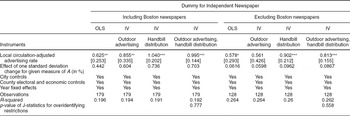
Table 5 shows the results of the estimation of Equation (1) with IV and OLS for the same sample.Footnote 32 I use as instruments either the two regulations together or each regulation separately. Standard errors are clustered by city. Columns (1)–(4) show the results with Boston included, and, as Boston is a big outlier in the sample, columns (5)–(8) show the results with Boston excluded. In most specifications, the coefficient for the profitability of advertising is positive and significant. The IV coefficients are larger than the OLS coefficients, probably because of measurement error.Footnote 33 The results of the Hansen overidentification test for the specification with two instruments (reported in the last row of Table 5) suggest that the instruments are valid. Overall, the results of IV estimation reported in Table 5 provide evidence of a causal relationship between the local profitability of advertising and the newspaper's independence, which is consistent with Hypothesis 1.
Local Advertising Profitability and Independence of Newspapers, City-level, Massachusetts: OLS and IV Estimates

Instrumented variable: local circulation-adjusted advertising rate.
Instruments: dummies for the presence of restrictions for outdoor advertising and handbill distribution, as regulated by local municipal ordinances.
Notes: Linear probability OLS and IV regressions. Average circulation-adjusted advertising rate, a measure of A, is computed circulation-adjusted advertising rates for all newspapers in the city. In columns (2) and (4), circulation-adjusted advertising rate in a city is instrumented by dummies for the presence of restrictions for outdoor advertising and handbill advertising, as regulated by local municipal ordinances. List of sources is presented in Table 4. City controls include log of city population and dummy for being county seat. County controls include county population, log of average wage in manufacture, log of average agricultural income per family, and 10 electoral controls (percentage of votes for Republicans, Democrats, Greenbacks, and other parties in the most recent presidential and congressional elections, and voter turnout in these elections). Only Republican, Democratic, or Independent newspapers are included in the sample. Note that numerical coefficients in the sample with Boston and without Boston are quite stable across the samples, for both OLS and IV specifications, and, therefore, the difference in marginal effects is driven mainly by the difference in standard deviations of A between samples.
Robust standard errors, clustered by city, are in brackets.
*Significant at 10%.
**Significant at 5%.
***Significant at 1%.
Newspapers and Parties: A Political Channel
This article not only presents evidence in favor of an economic explanation of the commercialization of the news and the development of an independent press, but also is consistent with political economy considerations behind this development. It implies that a model focused only on economic development cannot explain the whole story. The data are consistent with the hypothesis that political parties had some control over the partisan newspapers and slowed down the development of independent press in some places.
First, the results in Tables 1–3 imply that the newspapers in county seats, cities that were richer and provided more opportunities for political patronage, were less likely to be independent. On average, county seats were more developed and more populous cities than noncounty seats, and they should have more independent newspapers, according to the results of Gentzkow, Glaeser, and Goldin (Reference Gentzkow, Glaeser, Goldin, Glaeser and Goldin2006) and Hamilton (Reference Hamilton2004, 37–70). However, it was easier for political parties to subsidize partisan newspapers in these places. The corresponding coefficients in Tables 1–3 imply that the effect of being located in a county seat is similar in magnitude to the effect of a single–standard deviation change in A.Footnote 34
The second piece of evidence comes from the year fixed effects. To save space, most of the tables in the article do not show year fixed effects, but they are presented in Table A5 in the supplemental online Appendix (available at http://www.journals.cambridge.org/psr2011015). These results imply that the years in which the newspapers were less likely to be independent were 1880 and 1884, both Presidential election years, when it was more important for political parties to have partisan newspapers (the idea was discussed, but not tested, in Kaplan (Reference Kaplan2002, 22–54)). The pure economic story would say that independent newspapers should grow faster following years of economic growth. The real growth of the American economy, however, was faster in 1880–81 than in later years.Footnote 35 At the same time, there were significantly fewer independent newspapers in 1880 and 1884, which is more consistent with a political story.
Finally, it can also be shown that in places with higher vote margins, there were fewer independent newspapers (these results are reported in Table A11 in the supplemental online Appendix). These findings are, again, consistent with the idea that independent newspapers emerged in places in which parties did not have strong incentives or the capabilites to support partisan newspapers.
Overall, the evidence in this section might explain why the growth of the advertising market need not guarantee the growth of press independence. If politicians' incentives to intervene in media markets are strong enough, they will undermine the positive effect of economic development on media freedom. The theoretical underpinnings of this effect are analyzed in Gehlbach and Sonin (Reference Gehlbach and Sonin2010) and Petrova (Reference Petrova2010).
Alternative Explanations and Robustness Checks
Nonlinear Relationship between Advertising Rates and Circulation. Throughout the article, I used advertising rate adjusted by circulation as the key independent variable. The theoretical justification for this choice of a functional form is that corresponding models use advertising revenue per reader as the main variable of interest (e.g. Besley and Prat Reference Besley and Prat2006; Gabszewicz, Laussel, and Sonnac Reference Gabszewicz, Laussel and Sonnac2001; Gentzkow, Glaeser, and Goldin Reference Gentzkow, Glaeser, Goldin, Glaeser and Goldin2006). Empirically, I checked if the results of Table 1 still hold if the main variable of interest is an unadjusted local average advertising rate and if we control for logged circulation. In all specifications, the sign of the variable of interest remains positive, and the level of significance remains the same or increases. I also checked that the results hold controlling for logged circulation or for a polynomial function of circulation raised from 1/2 to 1/5 degree.Footnote 36
Third Variable Explanation. The results are robust if controls are included for all available city/county characteristics interacted with year dummies and base year circulation interacted with year dummies.
It is also possible to use the matching technique, conditional on observables. In particular, I divide the whole sample into two large groups: newspapers located in cities with average advertising rates above and below the median value in a state. The results of the nearest neighbor covariate matching (Abadie et al. Reference Abadie, Drukker, Herr and Imbens2004) with exact matching by state and year are consistent with Table 1.
Changing Political Preferences. One alternative explanation of the results in Table 1 is that in counties with the fastest growth of advertising rates, political preferences were becoming more centrist; and, as a result, people increasingly preferred reading independent newspapers. This may not necessarily be reflected in the electoral returns, which are included as controls. To address this issue, I use the data on roll call votes as a proxy for the preferences of the electorate.Footnote 37 In theory, roll call votes in Congress reflect the individual preferences of the members of Congress, the preferences of their party and special interest groups, and the preferences of their constituency. If we assume that the preferences of parties and special interest groups remained relatively constant, then changes in the pattern of roll call votes should correspond to changes in the preferences of their constituency, plus some noise. As a measure of the preferences of the members of Congress, I use DW-NOMINATE data from Poole and Rosenthal (Reference Poole and Rosenthal1997, 12–311). I checked that as long as congressional districts and year fixed effects were being controlled for, it was not the case that in places with higher advertising rates their representatives were becoming less extreme. I also checked whether the results of Table 1 were not significantly affected by the inclusion of DW-NOMINATE scores as control variables. The results are generally consistent, although the level of significance of advertising variables changes in a couple of specifications.
Migration and African-Americans. Another potential explanation for the results in Table 1 is migration. It could be that the counties with faster profitability growth in advertising were counties with a larger inflow of immigrants who were not interested in partisan politics and preferred to read independent newspapers. I checked that immigration (measured as the fraction of foreign-born population) was not associated with a higher local advertising rate or a higher fraction of independent newspapers. I also find no indication that the changes in the fraction of African-Americans in the population caused advertising rates and independent newspapers to grow. Finally, I find that the results of Table 1 are robust to the inclusion of the fraction of immigrants or the fraction of African-Americans in the regressions.
Changing Political Competition. It could also be the case that changing political competition in a county can explain the coevolution of advertising rates and the independence of local newspapers. For example, an increase in political competition can increase the demand for independent newspapers as voters, in order to be able to make an informed choice, increasingly will prefer to have less biased information about politicians from different parties. At the same time, advertising rates might go up as places with growing political competition might be growing economically as well. To test these alternative explanations, I control for vote margins as a proxy for political competition in a county. Main results in the article remain robust to this modification.
Other Robustness Checks. Note that newspapers with larger audiences could be more influential. To address this possibility, all specifications in Table 1 are estimated with weights proportional to the newspapers' circulation. I also try to reduce the sample to newspapers with circulation larger than 250, 500, 750, or 1,000 (note that 60% of newspapers in the sample have circulation of 1,000 or below). The results of these estimations are consistent with Table 1 and 5.
Unfortunately, I was not able to find education or literacy data on a county level for that time period. In the ICPSR dataset, census data for literacy are available on a state level only for 1880 and 1900. Moreover, the Census of 1880 reports if people over age 10 could read, whereas the Census of 1900 reports the percentage of literate males over age 21, so it is not clear how to construct a single variable capturing literacy in 1880–1900. However, I checked that the results are robust to the inclusion of state × year fixed effects. This would imply that the results are also robust to the inclusion of any state-level literacy index based on interpolation of the 1880 and 1900 variables.
Finally, I checked whether the results still hold when Southern states are excluded. The coefficients for advertising rates remain positive and significant and are similar in magnitude even for the specification with newspaper fixed effects. This suggests that the results are not driven by some kind of sample selection.
CONCLUSION
In the middle of the nineteenth century, most U.S. newspapers were partisan, just like many media outlets around the world at the beginning of the twenty-first century. Sponsored by political parties, their news and editorials represented the interests of the politicians. However, between 1865 and 1920, U.S. newspapers experienced a great transformation, from being overwhelmingly partisan to being mostly independent. What explains this transformation? And, what conditions made it possible? These questions have no unambiguous answer in the literature.
Although economic arguments have been discussed, there have been few attempts to find systematic empirical evidence for the claim that market conditions, and in particular the growth of newspaper advertising, explain the political independence of the media. In this article, I present such evidence using data on American newspapers in the 1880s. Newspapers' independence was positively related to the local profitability of advertising. In the areas with faster-growing advertising markets, newspapers were more likely to be independent. The effect of advertising worked both through the entry of new newspapers and through changes in the affiliation of existing newspapers. The results of IV estimation and of the analysis of pre-trends suggest that the direction of causality goes from the profitability of advertising to independence, not vice versa.
The results further suggest that it was not only economic development that affected the growth of an independent press. Political factors also played a role. In particular, the empirical evidence implies that there were fewer independent newspapers in county seats, where parties could more easily subsidize the press through mandatory printing contracts. Also, fewer independent newspapers were created during the presidential election years, which is consistent with the idea that an increase in demand for a partisan press made being a partisan newspaper more attractive and resulted in more partisan newspapers at equilibrium. Despite the fact that parties could fully offset the growth of advertising by the growth of subsidies, they did not do so in most cases, though in some places, e.g., in county seats, they responded more aggressively.Footnote 38 In sum, this article suggests that economic development alone does not guarantee freedom of the press, because powerful political actors can counteract the incentives of media outlets to become independent by sponsoring partisan outlets.
This also suggests some implications for developing countries in modern times. First, it suggests that in some countries, advertising markets might be too small to sustain media outlets that are independent from sponsors.Footnote 39 In these countries, funding from large international organizations or NGOs might decrease local media dependence on governments or business groups. Second, one can interpret these results as a possible additional argument for economic liberalization before political liberalization. Without economic liberalization, the mass media, an institution that is inherently important for representative democracy, might find it too difficult to be independent from political influence and to provide objective news coverage. Finally, the results imply that financial crises, and an associated fall in advertising revenues, might create a threat to media independence, especially in the presence of powerful sponsoring groups and in situations in which an array of mechanisms of media control is available for them.Footnote 40
Further empirical research is needed to see whether the results in this article hold for other times and places.
APPENDIX
Dataset Construction
As a main source of information about newspapers, I use N. W. Ayer & Son's American Newspaper Annuals from 1881 to 1886. Scanned images of these catalogs were accessed online at the Digital Library of Congress at http://www.loc.gov/rr/news/news_research_tools/ayersdirectory.html.Footnote 41 To convert these images to machine-readable text, I used ABBYY FineReader 8.0 image-recognition software. The embedded neural network was trained specifically to recognize Ayer's fonts. I then used a Perl script to translate the output sheet to formatted text and correct possible mistakes of image recognition.
Among all newspapers and magazines in the directory, only newspapers published at least once a week are included. Among the rest, only newspapers with clearly stated political affiliation, i.e., “Independent,” “Democratic,” or “Republican,” are included. Other newspapers and magazines, such as “Financial,” “Real Estate,” “Legal,” “Scientific,” and other types of publications that are unlikely to emphasize political news are excluded.Footnote 42 I exclude all newspapers in the District of Columbia to avoid major outliers. In addition, most DC papers were distributed in several states, so for them the assumption that the city was a primary market level was certainly not fulfilled.
To cope with potential errors of image recognition, I used two approaches. First, I manually checked all large newspapers with advertising rates higher than $10 per 10 lines per month or with circulation larger than 20,000. Second, I used automated scripts to find and correct mistakes. I also used random audits to detect remaining errors. In the end, the error rate was less than one newspaper record (about 50 characters) per 100 records. In addition, I checked manually for inconsistencies all major changes of affiliation (i.e., Republican to Democratic and vice versa) and half of the other changes (i.e., Independent to partisan and vice versa). Also, I exclude all newspapers for which county names did not match county names in census files. Overall, the dataset contains 24,168 observations on 7,319 newspapers in 3,444 cities in 1,599 counties.
I used census data on population and income from the dataset reconstructed by Haines (Reference Haines2005). As a measure of the share of urban population, I used population in cities larger than 25,000 divided by total population. Average wage in manufacture is equal to total annual wages in manufacture divided by the number of people employed in manufacture. Average agricultural income per family is equal to total income in agricultural sector divided by the number of families in agriculture. For the years 1880–85 (that is, between the 1880 and 1890 censuses), I use linearly interpolated data. Data on city population come from Ayer's catalog and are reported on the basis of detailed census data or population estimates.
Data on county-level electoral results are from the Clubb, Flanigan, and Zingale (Reference Clubb, Flanigan and Zingale2006) dataset (ICPSR study 8611). In particular, voting variables include the percentage of votes for Republican, Democratic, and other party candidates, as well as the turnout from the most recent presidential and congressional elections. Data on county seat locations come from the Sechrist (1986) dataset (ICPSR study 8159). Congressional districts were matched to counties using the Clubb, Flanigan, and Zingale (Reference Clubb, Flanigan and Zingale2006) dataset.
Model
Consider a single market in which there are two types of readers: Independents (fraction πI) and partisans (fraction 1−πI). Independent readers choose to purchase one of the Independent newspapers with probability  , where this market share is increasing in the number of Independent papers (NI) and is decreasing in the number of partisan papers (NP) along with the parameter θ∈[0; 1], which can be interpreted as the willingness of readers to substitute between partisan and Independent papers. Assuming that this market share is evenly split between the NI papers, the market share for a single Independent paper among Independent readers is thus given by
 . Likewise, Independent readers choose to purchase a partisan newspaper with probability
 . Similarly, partisan readers purchase a partisan paper with probability
 and an Independent paper with probability
 .
In terms of the supply side, assume that Independent newspapers are financed by advertising, at a rate a per reader, and that partisan newspapers are financed via per-reader transfers t from parties. Both types of papers have a marginal production cost of c and a fixed production cost F.
The newspaper market is competitive, and the entry of newspapers occurs until profits have been exhausted. The no-profit conditions for representative Independent and partisan newspapers are then given by

These two equations pin down equilibrium numbers of independent newspapers N*I and partisan newspapers N*P. Denote x=NI+θNP and y=θNI+NP. From the implicit function theorem it follows that

which is higher than 0 as long as θ<1.Footnote 43 Similarly,  .
Now, what happens if there are N*I and N*P already in the market, and a goes up? Assume that there are some random costs F entry of entering the market and F switch of switching political affiliation. The timing is such that first existing newspapers decide whether they want to switch, and then potential entrants decide whether they want to enter. A partisan newspaper compares lifetime value of staying a partisan newspaper,  (here δ is discount and VP is partisan paper's continuation value), with
 . Note that
 because of competition. As a result, a partisan newspaper decides to switch if
 , and, as VI(a) is an increasing function of a and VI(a) is a nonincreasing function of a, the probability of switching from partisan to independent is an increasing function of a. Similarly, a potential entrant compares
 with 0, and the probability of entry of independent newspaper is an increasing function of a.




Comments
No Comments have been published for this article.