




No CrossRef data available.
Article contents
- Abstract
- INTRODUCTION, HYPOTHESIS, AND PREDICTION
- THE COMMUNITY
- INTERVOCALIC (d)
- WORD-FINAL (s) AND DIRECT QUOTATION STRATEGIES
- A RETURN TO THE HYPOTHESIS AND SOME QUESTIONS
- SOME ANSWERS TO SOME QUESTIONS
- OTHER STUDIES: PARALLEL, PARTIALLY PARALLEL, OR NOT PARALLEL
- ANOTHER PATTERN, ANOTHER TYPE OF VARIABLE
- A SECOND RETURN TO THE HYPOTHESIS
- CONCLUSION
- References
Aging and gendering
Published online by Cambridge University Press: 01 January 2005
Article contents
- Abstract
- INTRODUCTION, HYPOTHESIS, AND PREDICTION
- THE COMMUNITY
- INTERVOCALIC (d)
- WORD-FINAL (s) AND DIRECT QUOTATION STRATEGIES
- A RETURN TO THE HYPOTHESIS AND SOME QUESTIONS
- SOME ANSWERS TO SOME QUESTIONS
- OTHER STUDIES: PARALLEL, PARTIALLY PARALLEL, OR NOT PARALLEL
- ANOTHER PATTERN, ANOTHER TYPE OF VARIABLE
- A SECOND RETURN TO THE HYPOTHESIS
- CONCLUSION
- References
Abstract
Unlike class or ethnicity, gender-based differences are assumed to result from social difference, not distance, yet across multiple societies, researchers find that gender separation is practiced to varying degrees. Such separation creates distance. Preference for same-gender affiliations emerges around age three, peaks in middle childhood, and lessens during the teen years, yet persists in the workplace and later life. Though reasons for this are many, Thorne (1993:51) identified one finding in these terms: “Where age separation is present, gender separation is more likely to occur.” Because age segregation varies with stage of life, one may predict that gender segregation would wax and wane across the lifespan. This study investigates this prediction with three sociolinguistic variables of Puerto Rican Spanish. In turn, it explores the prediction across other varieties of Spanish, German, and English, focusing on variables that are stable, undergoing change, or in the end stage of loss.I want to send very special muchísimas gracias to Miriam Meyerhoff and William Labov for critical, insightful, and engaged readings of an earlier version of this research. Over the past two years, I have presented portions of this research at various conferences. In these contexts, on more than one occasion, Greg Guy, Gillian Sankoff, and Shahrzad Mahootian have provided both critical and supportive comments. I admire and love all these people. Finally, I thank Jane Hill and the two reviewers whose very useful comments called for clarification and qualification. I appreciate their attention very much. None of these individuals is responsible for shortcomings in the research. I hope any shortcomings here will stimulate long-term research elsewhere. Besos a Diana González-Cameron, mi esposa.
Information
- Type
- Research Article
- Information
- Copyright
- © 2005 Cambridge University Press
INTRODUCTION, HYPOTHESIS, AND PREDICTION
In their influential review of research into the interactions of language and gender1
I use the term “gender” here as shorthand for what Bucholtz (2000:80) terms “social gender” to underscore the difference among grammatical gender, biological sex, and the social behaviors that result from and contribute to social constructions of gender identity or identities. Entwistle 1998 provides an accessible overview and critique of the distinction between “sex” and “gender.” For another useful critique of this terminology and accompanying assumptions, see Maccoby (1988:755). See Harding (1998: 8–20) for a related discussion of “essentialism” versus “constructionism.”
It may be true that females and males are not separated from one another as are socioeconomic or ethnic groups, where ethnicity also maps onto economic distinctions of importance for a community. Such separation clearly is both psychological and physical. The psychological side is hinted at by research into the naming of best friends (Gilbert 1998:131–33). Best friends tend to come from within an individual's socio-occupational level.2
Gilbert (1998:131–39) reviews work on friendships and affiliations across socioeconomic groupings based on occupational hierarchies, a common method of establishing class in variationist sociolinguistics. Of particular interest are the findings, based on Laumann 1966, that among the top professionals and the lowest semiskilled or unskilled laborers, the majority of named friendships are from these same groups. In the middle groups, or those occupations within the hierarchy, one finds a greater degree of friendships across occupations. In effect, one may infer a greater degree of significant friendships across socioeconomic groups in the middle-class groups. One may infer a smaller degree of significant friendships across socioeconomic groups in the two endpoints of the occupational hierarchy. For those familiar with Milroy & Milroy's (1992) discussion of the curvilinear class pattern in language change as a function of network differences across social classes, the data from Gilbert and Laumann will be of interest.
Nonetheless, a persistent finding across multiple societies is this: Females and males, both as children and as adults, will segregate or separate themselves or will be segregated or separated to varying degrees. In other words, females and males are formed into or will form same-gender groups. Such segregation or separation results in distance.
The tendency to prefer same-gender affiliations emerges early in life, around age 3 or 4 (Harkness & Super 1985, La Freniere et al. 1984, Maccoby 1988). The segregation peaks in early adolescence or middle childhood, followed by a relative lessening of segregation in the teenage years (Hartrup 1983, Larson & Richards 1991, Thorne 1993). In their study of children's patterns of interaction and affiliation across six different cultures, Whiting & Edwards arrived at this frequently quoted finding: “In sum, our findings taken together with those from other studies suggest that the emergence of same-sex preferences in childhood is a cross-culturally universal and robust phenomenon” (1988:81).
However, gender segregation continues beyond childhood as a characteristic of the adult workplace3
Gender segregation also characterizes research into gender, at least language-oriented research. In such important and useful collections as Bergvall et al. 1996, Bucholtz et al. 1999, or Hall & Bucholtz 1995, the authors and editors are either exclusively or predominantly female. See also Benor et al. 2002.
Why and how these preferences for same-sex affiliation emerge is the object of considerable debate. Some researchers articulate psychological and biological motives (Maccoby 1988, 1998), whereas others explore activity, situational, institutional, or cultural influences (Harkness & Super 1985, Richer 1990, Thorne 1993). Whatever the reasons, and there are multiple reasons, one factor does emerge sporadically across the literature. This is age segregation. Thorne succinctly stated this finding: “… where age separation is present, gender separation is more likely to occur” (1993:51).
These findings have clear implications for quantitative dialect research. The implications may be identified if we first recall Leonard Bloomfield's assertion that “density of communication,” meaning differing degrees of spoken interaction, results in the “most important differences of speech” (1933:46) within a community. If females and males tend to separate or be separated from one another in peer groups, their spoken cross-gender interactions will not be as frequent as their interactions with members of the same sex. If less frequent, in line with Bloomfield, one could predict “important differences.” Such hypothesized differences would not emerge as a result of females' and males' consciously differentiating themselves from one another, though such difference can be drawn on for social constructions to the extent that awareness of difference exists (Barrett 1999, Liang 1999, McCloskey 1999). The differences here would result, at least partially, from a relative preponderance of same-gender interactions and from a relative infrequency of cross-gender interactions among peers.
This implication does not seem controversial. Eckert & McConnell-Ginet note, “People tend to develop and regulate their linguistic repertoire through contact with language used by those they speak with regularly” (1992:468). More to the point is Weinreich's forceful statement on the effects of contact: “Contact breeds imitation and imitation breeds linguistic convergence. Linguistic divergence results from secession, estrangement, loosening of contact” (1953: viii).
However, gender segregation differs from socioeconomic segregation in that gender segregation is mixed with gender intimacy. In effect, such segregation is rarely complete. Also, the degree of gender segregation appears to fluctuate across the lifespan. It does so, if Thorne is correct, in tandem with the fluctuations of age segregation.
How could variationists respond to this implication? Notice that we speak here of differences in degree of same-gender affiliations not as absolutes, but as statistical tendencies that are characteristic of groups.4
Because the objects of investigation are groups and because the scope is macrosociological, we cannot say anything direct about specific individuals per se. This does not mean, of course, that individuals or subgroups cannot diverge from typical patterns of the larger group's behavior, as Thorne 1993 amply shows. Also see Chambers (1995:84–91) on interlopers and insiders, and Cameron (2000:274–75) on the divergent stylistic patterning of quotation strategies for adults and children in the Spanish of San Juan, Puerto Rico.
The implication may be stated as a working hypothesis consisting of three sets of propositions:
(A) The degree of difference in frequency, index, or probability values for sociolinguistic variables between female and male speakers will wax and wane across the lifespan.
(B) When sex segregation or separation is greatest, the degree of quantitative difference will be the greatest. This will occur when age segregation or separation is also strongly practiced or enforced.
(C) When sex segregation or separation is smallest, the degree of quantitative difference will be the smallest. This will occur when age segregation or separation occurs to a lesser extent.
Implicit in this formulation of the hypothesis are the following assumptions. First, the speakers will be members of the same dialect community.5
I recognize the ambiguity and controversy in the term “dialect community.” See Santa Ana & Parodi 1998 for an excellent treatment.
This assumption is close to the concept of convergence within Accommodation Theory (Beebe & Giles 1984:8; Meyerhoff 1998), but it differs in the following points. I will further assume that the quantitative effects of convergence among same-gender groups entail socially situated probability matching (Labov 1994:580–83). This probability matching may result from conscious monitoring and intentional though variable performance (Schilling-Estes 1998). However, not all convergence need be motivated by conscious and intentional identity display or alignment. This may also result from inter-speaker and intra-speaker priming or perseveration6
Researchers use a variety of terms to refer to statistically identifiable patterns of repetition. These terms include “priming,” “persistence,” “perseverance,” “perseveration,” or “birds of a feather” effect (Pereira Scherre & Naro 1991). I alternate between “priming” and “perseveration” as a reflex of the field. I intend them both to refer to patterned repetition. See Cameron & Flores Ferrán 2004 for more discussion relevant to variation.
The degree and nature of the awareness required for implicit learning is subject to debate. The debate covers both definitions of what counts as awareness, the amount required for different tasks, and whether implicit learning may be conceived of as automatic, in cognitive science's sense of not being subject to intentionality and control. If automatic, or automatic to a degree, it may be the case that implicit learning is subject to influence from other, more explicit processes of learning or cognition. See Seger (1994:174–79) for these issues.
A discussion of convergence and divergence as motivations in dialect formation is found in Hinskens et al. 2000.
This working hypothesis may be supported if and only if the frequency, index, or probability values for individual speakers' use of sociolinguistic variables actually can change across the lifespan beyond the early years of language acquisition. Two studies indicate that such change may occur. These include Baugh's (1996) real-time study of four African American males, and the research of Sankoff et al. 2001 into postcritical period change among adult speakers of Montreal French, both male and female. In the absence of real-time, long-term studies of individuals across the lifespan, our hypothesis could be tested if we may infer the behavior of individuals throughout their lifetimes by studying groups of individuals classified by chronological age and gender, as is done in Apparent Time studies of language change.
Support for the hypothesis would have at least the following characteristics.
- Among children prior to the teen years, we should find the greatest
degree of difference between females and males. This is in keeping with
the general finding that the tendency to prefer same-gender
affiliations emerges early in life around age 3 or 4 and peaks in early
adolescence or middle childhood.9
Actually, if we had a sufficient number of talkative and tape-recorded preteen children from the ages of 3 to 12, we could roughly predict a peak around the age of 10 or 11, relative to the youngest children. One reviewer of this research correctly pointed out that linguistic differences between a child of 5 and one of 11 may dwarf those between an adult of 25 and one of 45. I agree. However, I do not have data from a sufficient number of preteen children to tease out this particular pattern, if the pattern is to be teased out. Therefore, I make a general and gross prediction about the preteens. Among the preteen Puerto Rican children I have studied and on whom I report on in this article, these are the ages represented:

The 5-year-old girl and 6-year-old boy were interviewed in a small group with 8- and 9-year-olds. These groups were either boys only or girls only. One 10-year-old girl and one 11-year-old girl were interviewed individually. The 11-year-old was interviewed in her home with the intermittent presence of her younger sister, who was not directly recorded. The other 11-year-old children were interviewed in groups of three children at a time. Future researchers may specifically target this age group in larger numbers to see if the predicted differences emerge.
- This degree of difference should decrease somewhat during the teen years. This is in keeping with the general finding that gender segregation lessens somewhat, relative to earlier childhood, during the teen years. However, gender segregation is still quite pronounced among many teenagers. As such, support for the hypothesis would emerge if it is the case that teens, relative to middle age groups, show a greater degree of difference between females and males.
- At subsequent stages of the lifespan, we could expect a further
decrease in the degree of difference. In particular, during the years
of active work life, say from 20 to 60 or 65, we would expect less
gender segregation because the workplace, though subject to varying
degrees of gender segregation across differing occupations (Petersen & Morgan 1995), shows less age
segregation than occurs during the childhood years, when schooling
enforces age separation. In effect, the workplace and the working years
of adulthood provide, relative to school, more multi-age environments
for interaction.10
Owing to the macro-sociological nature of this assertion, individual and group divergences, as well as cultural divergences, are not addressed. See note 4 for similar point. Thus, the generalizability of the claim about the multi-age workplace and working stage of life, relative to school, can and should be questioned and tested. Both reviewers of this research noted that certain professions are simultaneously age- and gender-segregated, such as professional athletics or stock exchange work. No professional athletes or stock exchange workers are included in the Puerto Rican sample. Nonetheless, the hypothesis as formulated permits yet another prediction here. Professional athletes and stock exchange workers will differ more from members of the opposite sex than will working individuals of the same age group who work in environments that are less age- and gender-segregated. The reviewers also noted that Thorne's question (1993:108) about “which boys or girls, where, when, and under what circumstances” applies to this period of life as well. I agree. Indeed, Thorne's question may be applied to any social group, however the group is defined. I discuss the relevance of Thorne's question in a subsequent portion of the article, where I use this particular question as an organizing principle of the research presented here.
- Beyond the active working years, say 65 and higher, we could expect that quantitative differences between males and females would expand relative to the middle-aged groups. One does not find as much research that clearly documents the daily interaction and friendship patterns of the elderly in ways that researchers have done for children. However, some research demonstrates a preference for same-gender friends and affiliations in late life and indicates that these friendships, not work relationships, become sites of increased spoken interaction (Jerrome & Wenger 1999, Matthews 1986). Moreover, researchers do report that both age and gender segregation occur commonly among those beyond age 60 or 65 in Western countries. For instance, Rawlins asserts, “The elderly tend to be friends with age contemporaries with similar life styles, values, and experiences, the same gender and marital status” (1992:223). He adds that “age similarity is defined more broadly in later life than at earlier points.” Similar points emerge independently in Jerrome (1981:178). In later work, Jerrome (1992:16) also argues that such segregation or separation “is often in the interests of older people.” Why? They seek out others with similar experiences that come from being of the same age. The degree of age segregation, and hence of gender segregation, in later life could vary across cultures depending on residence patterns and the preference or not for multi-generational homes. Wenger notes that the “three-generation household is a widespread norm” (2001:539) in the Middle East, Africa, and the Pacific. Of course, a lack of age segregation at home does not entail a lack of age segregation in other domains of life. Indeed, a degree of gender segregation in later life is also a consequence of the following brute fact. To quote Arber & Ginn, “Later life is primarily an experience of women” (1991:vii). In short, as we age, men tend to die before women. Two relevant consequences follow from this. In later life, proportionately more men remain in contact with women than women do with men. A second consequence of this is that women, in later life, can be drawn to one another for friendship and support in the absence of men. This relative absence of men of the same age cohort, then, results in de facto gender segregation. Considering the cited research, which indicates the presence of both age and gender segregation among the elderly, we should find that quantitative differences between males and females expand relative to the middle-aged groups.
These predictions amount to an irregular U-shaped pattern of gender divergences across the lifespan. The greatest degree of difference will be in early childhood, the teenage years, and the post-workplace years of later life. The least degree of difference will occur in the middle years of participation in the workplace. Note that this predicted U-shaped pattern is formally similar to the pattern discussed by Downes (1998:224) and Cheshire (1987) for the variable expression of some, though not all, nonstandard variants of stable sociolinguistic variables across the lifespan.
Aside from the implications for variationist sociolinguistics, the hypothesis developed here could have implications for the Dual Culture model of gendered discourse styles (Maltz & Borker 1982, Tannen 1994). This model, however, is much criticized. Thorne (1993:89–109), in particular, has provided a nuanced, careful, and compelling critique of it. At the end of her discussion of this issue, she advocates “examining gender in context rather than fixing binary abstractions like ‘boys emphasize status and girls emphasize intimacy.’ ” Instead, we should ask “which boys or girls, where, when, and under what circumstances” (1993:108). I have attempted to respond to Thorne's arguments by intersecting gender and age with age differences providing a series of contexts across the lifespan. Thus, one answer to Thorne's question “Which boys or girls?” is this: boys or girls at different moments of the lifespan when these moments are indicated by chronological age differences.
Thorne's multiple wh-question may also be seen as presupposing a few fundamental propositions that may very well be central to current gender research. First, the range of social experiences and constructions of gender identity cannot be categorized adequately into a strict binary division that a Dual Culture model may assume. In short, there are more different gender experiences across and within cultures than there are biological types, which are only two – female and male. Indeed, a realistic account of the range of biological types also needs to go beyond two. Fausto-Sterling (2000:78–114), for instance, has argued that there may be, minimally, five types of biologically based sexes among humans. Second, gender as a social category of experience, action, and opportunity is not clearly isolable from other social categories. The experience and construction of gendered behaviors varies in content, manner, relevance, and degree of salience across contexts of situated, co-constructed, moment-to-moment talk-in-interaction, and across categories of social membership such as age, class, club, community, country, education, ethnicity, health, language, sexuality, or sport 11
11A third point, perhaps an entailment of the second, could be added here. Deborah Cameron (1998:947) identifies this as “the progressive abandonment in feminist scholarship of the assumption that ‘women’ and ‘men’ can be treated as internally homogenous groups.” If the experiences and constructions of being “women” and “men” vary across micro-sociological contexts of emergent talk-in-interaction and macro-sociological contexts of country, class, ethnicity, or age, then it follows that “women” and “men” cannot be treated as internally homogenous. Related to this is the suggestion that differences within groups of females or differences within groups of males may actually dwarf differences between females and males (Eckert 1989:254; Ostermann 2003; Nichols 1983:59).
Given that gender practice and experience may vary widely, it is also important to point out what our working hypothesis does not address. To begin, the hypothesis is macro-sociological in scope and, as such, is subject to overgeneralization in the face of micro-sociological diversity. In other words, as in epidemiological studies of “social aggregates” (Cockerham 1998:16), smaller group or specific individual divergences are not directly accounted for nor directly investigated. In addition, gender separation is but one aspect of gender practice and experience. As a consequence, the hypothesis does not provide a basis for discussing, at least directly, why females or males choose the variants they do. What we are asking is whether degrees of difference between groups of females and males from the same dialect community fluctuate across the lifespan in a pattern or patterns that we can account for, completely or partially, within the framework of the gender segregation hypothesis. In other words, the hypothesis does not directly address such potentially mediating issues as prestige, status, power, expressiveness, conflict within or across gender groupings, vernacular ideologies, sensitivity to symbols, different meanings of variables for the genders, the time course of change in which sociolinguistic variables may be involved, or other related issues. Many of these topics emerge around the question of why female speakers, relative to males, more frequently favor standard variants of stable variables yet also favor the innovative, hence possibly nonstandard, variants of unstable variables (Cheshire 1998; Eckert 1989; Haeri 1996:91; Labov 1990, 2001:261; Nichols 1983; Trudgill 1972). The hypothesis also does not, as formulated, address the potentially mediating effects of personal development and language acquisition in early and middle childhood, nor linguistic and cognitive change among the elderly (Chevrot et al. 2000, Kemper 1992, Roberts 1997). Both Chambers 1992 and Trudgill 1983 have shown that the ability or desire to converge or diverge may diminish or vary across the lifespan, and that this ability is mediated by the type of sociolinguistic variable involved. Finally, owing to limitations in the data, both mine12
It is very difficult to establish a fully balanced set of female and male speakers across all age groups and occupational categories when doing urban dialect work of this sort. However, the data for the Puerto Rican speakers is somewhat balanced in this respect. If we further classify the speakers by two school types and four categories of occupation, as found in Cameron (2000:273, 1992:67–76), we find the following:

In the research presented here, I will initially explore the predictions of the gender and age segregation hypothesis by identifying patterned degrees of difference between female and male speakers of Puerto Rican Spanish across the lifespan, using an Apparent Time type of data organization. I will do this by focusing on three sociolinguistic variables, two phonological and one that straddles the boundaries of syntax and discourse. The phonological variables include intervocalic (d) and word-final (s), both of which have been investigated extensively in Spanish dialects (Lipski 1994). The other variable involves direct quotation strategies (Cameron 1998, 2000). For each variable, I will first provide some orienting information on the set of variants, the resulting data, and the patterning of degrees of difference across the lifespan. In turn, I will discuss results and identify the extent to which the hypothesis is supported or rejected. This discussion results in questions which may be answered within the framework of the hypothesis, as well as questions which lead me to consider other intersecting factors and to look at other languages, communities, and variables. Thus, I will turn next to research in other dialects of Spanish as well as in German and English. Here I will focus on both stable and unstable variation at various points in the time course of change, relying heavily, though not exclusively, on Labov 2001. Subsequently, I will return to Puerto Rican Spanish to consider the variable of the fronting of subject noun phrases in wh-questions (Lizardi 1993). Like a few other variables, this involves a loss or recession of form, rule, or constraint (Chambers & Trudgill 1980:94). Some of this work will diverge considerably from the Puerto Rican data patterns. Other research follows quite closely. Overall, I find more parallels to the early parts of the Puerto Rican lifespan patterns than to the later parts. Some patterns of differences between females and males are clearly tied to the type of variable involved or to its status as a new and vigorous change in progress. Given these findings, I will argue that, just as other categories of social membership mediate gender expression, so does language mediate gender expression. In other words, we will see that language enables gender expression while simultaneously constraining it, a concept in line with Giddens's (1984:172–74) revision of Durkheim's social facts as involving both “constraint” and “enablement.”
THE COMMUNITY
The Puerto Rican data come from fieldwork which I carried out in San Juan during 1989. Because I have written at some length about the community and data gathering in Cameron 2000, 1996, and 1992, I will limit my comments here to select demographics of the speaker data base that are relevant to the current research on aging and gendering. During October 1989, I interviewed a total of 76 speakers. From this total, I selected 62 – 30 males and 32 females. These 62 speakers were interviewed in primarily two types of interview configurations: small groups and individually. Of a total of 38 interview sessions, 20 were done with individual speakers. The remaining 18 interviews, with a total of 42 people, were done in small groups of 2 to 5 speakers.
In terms of age, the youngest speaker was 5 years old, and the oldest was 84. As shown in Table 1, 29 of those interviewed were children, either preteens or teenagers. The remaining 33 were adults beyond the teen years. Because I investigate the intersections of aging and gendering here, I will not comment on occupational and education information. For more on that, see Cameron 2000, 1996, and 1992.
Number of speakers by age and gender

As seen in Table 1, speakers are organized into the following groups: preteens, or children from the ages of 5 to 11; teenagers or children of the ages, 14 to 17; adults, the age-based groups of individuals of the ages 20 to 39, 40 to 59, and 60 and higher. The last group, 60 and higher, ranges from 61 to 84. When I discuss direct quotation strategies, I collapse this group with group 40–59 because the oldest males did not provide any tokens of one of the strategies. One may wish to subdivide the preteens further on the ground that 5-year-olds differ dramatically from 11-year-olds in terms of cognitive and language development. However, owing to the group format of the child interviews and the relatively small number of speakers, I have grouped them together. Moreover, as noted, research indicates that the degree of gender segregation among preteens on the whole is higher than among those of subsequent age groups.13
See note 9 for more discussion of the issue of the preteen children. Further divisions could also be made among those between 60 to 85. However, I do not have sufficient numbers of speakers to do this. Gerontologists prefer to see later life as having at least two general stages, with the second stage beginning sometime after 85. See references in Arber & Ginn (1991:3) as a starting point for this issue.
INTERVOCALIC (d)
Intervocalic (d) in Spanish is frequently cited as a straightforward illustration of allophonic variation. Goldsmith writes that /d/ and other voiced stops in Spanish “are predictably stops or spirants, depending on phonological context” (1990:70). If intervocalic, stops become spirantized into fricatives. Elsewhere, they retain their stop status. Variationists, however, have noted that the variable of intervocalic (d) has two or possibly three variants. López Morales (1983:124) and Samper Padilla (1990:261) identify three variants, two of which are distinguished as +/− relajada ‘relaxed’ fricatives. The third variant is a null or deleted form. Cedergren (1973:94) identifies a set of three variants which includes a devoiced dental stop, a fricative, and a null or deleted form. Other researchers, such as Ma & Herasimchuk 1975, identify only two variants: (inter-)dental fricative and deletion.
Like Ma & Herasimchuk, I have been able to detect only two variants of intervocalic (d): a voiced fricative or spirantized variant of [d], close to

, and the deleted or null form which I represent as [0]. Therefore,

or [0]/V__V. In pursuit of identifying where variation was possible, I have excluded certain intervocalic contexts. These include contexts where the following vowel is stressed, as in such words as ciudad ‘city’, madera ‘wood’, or me quedé ‘I stayed’. Also, some English borrowings appeared not to exhibit variation, including sliding doors and videocassette. A small set of words in Spanish also exhibited no noticeable variation and were thus excluded: SIDA (Spanish acronym for ‘AIDS’), radio, and alrededor ‘around’. In these words, the intervocalic (d) was never deleted. In contrast, the vernacular form bofetá from bofetada ‘slap’ was also invariant, never being produced as bofetada. Also excluded were tokens overlapped by laughter or coughing, a breathy inhale or exhale of air, or where extraneous noise obscured the sound quality. (Roosters and passing buses were frequent culprits.) I included the words todo ‘all’ and nada ‘nothing’, which may show three variants, two of which involve deletion. For instance, todo may be expressed as

with a long vowel due to coalescence, or [to] with no extra length noticeable. Both [to:] and [to] counted as cases of deletion.
From each speaker interviewed individually, I gathered 50 tokens. With one exception, from each adult interviewed in small groups of two or three, I also gathered 50 tokens. One adult female speaker, interviewed with two friends, provided only 27 tokens. For children, both preteens and teens, interviewed in small groups, I gathered 50 tokens from the group as a whole, not from each individual. I selected 50 tokens following the practice of Eckert 2000 in her work on the Northern Cities vowels. It also turned out that intervocalic (d) does not occur with a frequency comparable to other phonological variables. Thus, with 50 tokens alone I often gathered all tokens available within 45 to 50 minutes of transcribed tape. In total, 2,227 tokens of intervocalic (d) were analyzed. Turning to Table 2, we find both frequency and Varbrul weights.
14Varbrul is a form of logistic regression used for multivariate analysis (Paolillo 2002). I have chosen to use Varbrul here for various reasons. First, in previous research (Cameron 2000, 1998) I used the TVARB version of Varbrul for the analysis of word-final (s) and the direct quotation strategies. It was in Cameron (2000:281–82), on the basis of TVARB, that I initially discovered the zigzagging pattern of divergences between females and males for word-final (s) and the quotations, though I then had no basis for accounting for it. Hence the current work. Upon investigating intervocalic (d), I assumed that further comparison would be best if the basis for comparison were also Varbrul data. Second, the IVARB version of Varbrul permits elimination of factor groups through the Step-Up and Step-Down program. During the Varbrul analysis of intervocalic (d), I submitted a set of six independent factor groups: the intersections of (1) age and gender, (2) upper/lower class and gender, (3) adult occupation and gender, (4) children's public/private school and gender, and then (5) adult occupation only, and (6) children's public/private school only. The Step Up program selected the factor groups (1) age/gender and (3) adult occupation/gender as significant. The Step Down program threw out all other factor groups. However, upon running Varbrul again, it became apparent that the factor groups (1) age/gender and (3) adult occupation/gender overlapped to some extent. Adults include the age groups 20/30, 40/50, and 60 and higher. Thus, I ran Varbrul on intervocalic (d) with factor group (1) age/gender only. One reviewer of this research has questioned the use of Varbrul here because Varbrul assumes independence of factor groups. However, the point of this research is the lack of independence between age and gender. The assumption of independence in Varbrul is between independent factor groups, however they are defined. Thus, if age and gender were coded within the Varbrul analysis as separate independent factor groups, one would expect interaction. Vogt defines interaction as an effect that occurs “when independent variables not only have separate effects but also have combined effects on a dependent variable” (1993:122). By combining age with gender into one factor group, I avoid interaction, a strategy common to Varbrul analysis (Paolillo 2002:89). And recall, Varbrul selected the combined factor group (1) age/gender as significant. I did not investigate internal linguistic nor stylistic constraints on intervocalic (d), as I have done for word-final (s) and direct quotation strategies, because the object of interest is the social patterning.

of the variable.
Intervocalic (d) by age and gender (frequencies, weights, degrees of difference)

To derive the degree of difference between females and males, we subtract the male Varbrul weight from the female. Thus, the degree of difference between females and males in the preteen group is 20 points; among the teens, it is 51 points; and so forth. If we plot these degrees of difference on a graph, we find the pattern of degree of difference between the genders across the lifespan that is depicted in Figure 1.

Degrees of difference between females and males across the lifespan for intervocalic (d).
A few points immediately become clear. First, across the five age groups, we find a consistent and repeated favoring of the spirantized variant

by the female speakers. Second, with respect to frequency data, the null variant is not dramatically high. Third, the greatest degree of difference is found in the teen years. This is followed by a sharp decrease in the middle years, with the dip being lowest between ages of 40 and 59. After this, the degree of difference between females and males in the oldest group increases until it is more than, but close in value to, the degree of difference found in the preteens. This pattern of waxing and waning is found also by using the frequency data. I will reserve discussion of how the data fit the hypothesis until the discussion section, but I will add here that when we turn to word-final (s) and direct quotation strategies, we will find strikingly similar zigzagging patterns across the lifespan.
WORD-FINAL (s) AND DIRECT QUOTATION STRATEGIES
The data presented here were initially reported in Cameron 2000. Because this earlier work involved a comparison of word-final (s) and direct quotation strategies, I will combine these two variables into one discussion here. The data for (s) were initially derived for research into the functional compensation hypothesis (Cameron 1996). As with intervocalic (d), tokens of (s) were included in the analysis if they did not appear in contexts of phonetic neutralization or in contexts where extraneous noise made it impossible to hear clearly. Other features of the envelope of variation are found in Cameron 1992. Word-final (s) consists of three variants: a full alveolar fricative [s], a reduced glottal aspirate [h], and a phonetically null version which I will mark as [0]. With the exception of one adult male who provided fewer than 200 instances of word-final (s), I minimally analyzed 200 tokens of word-final (s) for all individual adult speakers and for all children interviewed individually. For children interviewed in small groups, I analyzed the group together for 200 tokens. In total, I will report on 9,359 instances of word-final (s).
Like the variable (s), the direct quotation variable may also be analyzed as consisting of three variants: a full, a reduced, and a null variant. In order to illustrate these, consider the following examples, initially reported in Cameron (1998:49).

Example (1) presents two variants of the direct quotation variable. In line 1, the quote is framed by a verb of report consisting of a finite verb plus the subject NP. I identify this variant as a verb of direct report (henceforth VDR). Because Spanish is a null subject language, the subject NP of these finite verbs may be variably expressed. Hence, the VDR strategy includes finite verbs with either lexically expressed or null subjects. Within this variant are included all verbs of direct report. In (1), line 2, we find a second strategy. Here, the quote is introduced by a bare subject NP lacking a finite verb. I refer to this as Y NP, where Y stands for the Spanish conjunction, y ‘and’, which frequently accompanies the bare NP.
Example (2) presents the third strategy. From line 4 to line 7, four direct quotes are performed, though none is framed by a preceding VDR or Y NP. Following Clark & Gerrig (1990:772), I term this the freestanding strategy of direct quotation.
As happens with syntactic or discourse variables, direct quotations occur much less frequently than word-final (s) or intervocalic (d). In total, I will report on 1,249 instances of direct quotation. Finally, in contrast to both (s) and (d), there is some evidence, perhaps controvertible, that the variable of direct quotation strategies is undergoing a change in progress from below (see Cameron 2000 for discussion).
In the analysis that follows, I will focus on degrees of difference that may be derived by using the results of TVARB. The TVARB program provides probabilistic weights for a sociolinguistic variable consisting of three variants. In the binomial IVARB program, as used for intervocalic (d), a lack of effect of a constraint is identified with a value of .50. A favoring effect of a constraint is indicated by values above .50, with a disfavoring effect indicated by values less than .50. In the trinomial program of TVARB, a favoring effect is indicated by weights above .33. Values less than .33 indicate a disfavoring effect, and a value of .33 indicates no effect. In deriving degrees of difference, then, from a variable submitted to TVARB, one must subtract the smaller values from the larger values for each variant within a factor group. In turn, these three differences are summed to give the total degree of difference. For instance, among the preteens, for the variable of word-final (s), we subtract the male value for the variant [s] from the female value (= 5 points), the male value for [h] from the female value (= 19 points), and the female value for [0] from the male value (= 23 points). In turn, we add these three results for a final number of 57 points, which represents the summed degree of difference between preteen female and male speakers. This procedure was applied to all age groups depicted for both word-final (s) and for the direct quotation strategies. The results were then plotted on a graph.
Turning to Table 3, we find Varbrul weights for each variant. If we derive the degree of point differences between females and males for each of the age groups reported, we may then use the numbers to plot the pattern of difference (see Figure 2).
Word final (s) and direct quotations strategies by age and gender (weights, degrees of difference)* (TVARB weights)


Degrees of difference between females and males across the lifespan for word-final (s).
As with intervocalic (d), a few points become immediately clear. First, unlike intervocalic (d), for word-final (s) the female favoring of the standard variants [s] and [h] is not fully consistent, because in the age group of 40s and 50s, males have a higher probability of [s]. However, as with intervocalic (d), males relatively favor the null form not only for word-final (s) but also for the direct quotation strategies (see Figure 3). This is consistent across all age groups. Second, as discussed in Cameron 1998 and 2000, the direct quotation strategies show a shift of gender favoring across the lifespan for both the VDR and the Y NP variants. Third, also similar to intervocalic (d) is a zigzagging pattern across the lifespan. The greatest degree of difference for both word-final (s) and direct quotation strategies is found in the teenage years. This is followed by a sharp decrease in the middle years, with the dip being lowest between the ages of 20 and 39. After this, the degree of difference between females and males increases with age until it is more than or close in value to the degree of difference found in the preteens or the youngest group. This is similar to the pattern for intervocalic (d) though it differs slightly in location of the lowest dip in values. Also, note that for word-final (s), the degree of difference between female and male speakers in the oldest group is quite close to the degree of difference among the teenagers. Among the oldest, the degree of difference is 54 points, among the teenagers, 57, and among preteens, 47. For the direct quotation strategies, the degree of difference among the oldest group is closer to the degree of difference among the youngest group than it is to the degree found among the teenagers. This is also true of the pattern for intervocalic (d). In short, despite slight pattern divergences for all three variables, we find a similar waxing and waning pattern across the lifespan.

Degrees of difference between females and males across the lifespan for direct quotation strategies.
A RETURN TO THE HYPOTHESIS AND SOME QUESTIONS
Given these patterns, I now return to the hypothesis with the following observations. Overall, the hypothesis is partially supported and partially rejected in the same way for each of the three variables represented. Examining each sub-proposition, I can say the following:
(A) The degree of difference in frequency, index, or probability values for sociolinguistic variables between female and male speakers will wax and wane across the lifespan. (A) is supported by the zigzagging pattern of differences between the groups across the lifespan for each of the three variables.
(B) When sex segregation or separation is greatest, the degree of quantitative difference will be the greatest. This will occur when age segregation or separation is also strongly practiced or enforced. (B) is rejected for the preteens but accepted for teenagers and for the oldest group. Recall that the oldest group shows an increased degree of difference, relative to middle age groups.
(C) When sex segregation or separation is smallest, the degree of quantitative difference will be the smallest. This will occur when age segregation or separation occurs to a lesser extent. (C) is supported by the relative decrease in degree of difference between the genders in the middle years.
At this point, we can ask additional interrelated questions which our explorations of the hypothesis and the data make possible. I will first ask questions that we can answer within the framework of the hypothesis as formulated. Then, we will turn to questions that push us beyond the hypothesis and the data.
Questions answerable within the framework of the hypothesis include the following three:
(i) Why do teenagers, relative to the middle age group, show a greater degree of difference between females and males for their values for the sociolinguistic variables?
(ii) Why do the middle age groups overall show the least degree of difference between females and males for their values for the sociolinguistic variables?
(iii) Why does the degree of difference between females and males increase in the oldest group relative to the middle age groups?
Questions that go beyond the hypothesis include the following :
(i) Why is the degree of difference smaller between preteen females and males, contrary to expectation, than between female and male teenagers?
(ii) Why does the degree of difference between females and males increase among the teenagers relative to the preteens? Also, for two out of the three variables, the degree of difference between females and males is highest overall among the teenagers. Why is this so?
(iii) Do these zigzagging patterns show up in variables from other languages and communities as well as in other variables of Puerto Rican Spanish?
(iv) Would these zigzagging patterns show up in the same way in variables at different stages of change? For instance, how would the waxing and waning of gender differences pattern in variables that are new and vigorous versus those that are nearly completed?
SOME ANSWERS TO SOME QUESTIONS
The three questions in the first set are directly answerable within the framework of the hypothesis. On the assumption that age and gender segregation are more strongly practiced or enforced during the teenage years and during the post-workplace years, the greater degree of difference between females and males in these groups, relative to the middle age groups, follows from this separation. During the working years of the middle age groups, age separation and, consequently, gender separation are relaxed. Thus, the reduction in degree of difference stems from increased cross-age and cross-gender interaction. With increased cross-gender interaction comes convergence between female and male speakers. This convergence, in quantitative terms, is revealed in the decreased degree of difference between females and males of the middle age groups.
Any exploration of the second set of questions falls outside the predictions made by the original working hypothesis. Therefore, my answers will, of necessity, be speculative. I begin with the small degree of difference between the preteen girls and boys, contrary to my prediction. First, note that although the degree of difference is relatively small, statistical gender differences among these children do emerge. This should not surprise us, given the findings of Fischer 1958, Meditch 1975, and Ladegaard & Bleses 2003. However, research by Roberts 1996 on preschool children demonstrates that, early on, children do not directly acquire the gendered patterns of variation that characterize later age groups. For instance, Roberts found that for English (ing), there were no significant differences between the genders (1996:162). For (-t,d) deletion, contrary to expectations, the girls showed a greater probability of deleting than the boys (p. 116). Therefore, the very early gendered variable behavior of children may not initially match the gendered variable behavior of teenagers or adults. The children must acquire these behaviors and, like all acquisition, this occurs in stages. Yet such acquisition is not the only type of acquisition that is occurring for preteens. As Guy & Boyd 1990 and Kerswill 1996 also illustrate, children are simultaneously busy acquiring internal grammatical constraints on variation, the acquisition of which may be constrained by critical-period issues in ways that the acquisition of gender constraints on variation are not. Apart from grammatical constraints, children may also be acquiring the social meanings associated with sociolinguistic variables. In Ladegaard & Bleses's study of 4- to 6-year-old speakers of Danish, they suggested that children this young “are unaware of the social connotations” (2003:228) of sociolinguistic variables. Hence, young children, unlike all other age groups, are engaged in the simultaneous acquisition of multiple types of constraints on variation, one of which is gender. And, with respect to gender, there are also many other things to learn in addition to gendered variation (Eckert & McConnell-Ginet 2003:15–32; Fausto-Sterling 2000:243–55). If some things must be learned before others, owing to limited mental resources, cognitive development, biological programming, or attention to other aspects of learning, it may simply be that certain gender constraints on variation are not fully learned until the later years of childhood. Hence, the smaller degree of difference between boys and girls, relative to other age groups, could be interpreted as a function of their stage in the acquisition of gendered variation.
Next, we turn to the question of why the degree of difference between girls and boys expands as we go from preteens to teenagers. One may initially identify this expanding degree of difference as a function of continuing acquisition of gendered variation. This is true, yet incomplete because it fails to answer why the increase is so sharp in two of the three variables. Thorne has observed that as children leave the preteen period and become teenagers, the process of transition is “uneven and fluctuating, the focus of negotiation and occasional conflict” (1993:154). Moreover, as children become teenagers, they will increasingly engage in what Thorne calls “borderwork” or “interaction based on and even strengthening - gender boundaries” (p. 64). The frequency of such interaction, which goes to the strengthening of gender boundaries, would increase if such gender boundaries were important. Eckert has claimed that teenagers “are at a life stage in which the issue of gender roles becomes crucial” (1989:257). If this is true, and if borderwork is one place where the construction of gender boundaries and gender roles is worked out, then we would expect more of it. Also, as pointed out by Larson & Richards (1991:295), gender segregation decreases in the teen years, thereby providing more opportunities for borderwork.
Now, as Thorne also proposed, among preteens on the playground, such borderwork can often “carry extra perceptual weight because they are marked by conflict, intense emotions, and the expression of forbidden desires” (1993:85). One element of human behavior that could contribute “extra perceptual weight” is extra variation or, more precisely, an extra degree of difference in patterns of variation, which Speech Accommodation theorists would call “divergence” (Beebe & Giles 1984:8). The extra perceptual weight and the presence of divergence may be inferred from the fact that the widest degree of statistically marked gender differentiation is found among the teens.
In addition, it seems reasonable to assume that incidents of borderwork, like other social interactions, may have both frontstage and backstage dimensions. Here I borrow from Goffman's (1959:112) original use of the term “backstage.” Frontstage borderwork would include those moments when cross-gender interaction actually occurs. Backstage borderwork would occur when individuals discuss and rehearse, with friends, their experiences of crossing the gender divide. Given that discussions and rehearsals with friends, at this point, usually means friends of the same gender, we see that the extra perceptual work of borderwork may extend from the talk-in-interaction that constitutes the borderwork to talk-in-interaction about the borderwork. This is merely a technical way of noting that children will interact with members of the opposite sex and then may intensely discuss their experiences of a specific individual or of a generic set, either truthfully or not, with friends of their own sex. In either case, the enactment of gender identities emerges. Also, the backstage discussions of borderwork would seem, of necessity, to involve both convergence among same-gender friends and constructed moments of divergence in which the original borderwork is recalled or reconstructed. Notice that this account of the sharp degree of difference between teenage girls and boys draws on a few key elements: the continuing presence of gender and age segregation in the teen years, which may contribute to same-gender convergence; and the increasing crossing of the gender divide through borderwork, which may contribute to cross-gender divergence. Eisikovits's (1987) study of Sydney adolescents is relevant here. The girls converged toward Eisikovits, the female interviewer, whereas the boys diverged.
In brief summary, I suggest that the increased degree of difference between teenage female and male speakers here is a consequence of the following factors. They are entering a final stage of language acquisition, part of which involves fine-tuning the acquisition of gendered variation. As they do, they also engage more frequently in the perceptually heightened acts of borderwork and backstage discussions of borderwork at a point in life when gender identity acquires an acute importance. This degree of heightened difference also occurs at a time of what Chambers terms “adolescent linguistic extremism” (1995: 184). In effect, the teenage years appear to be a period of relatively heightened sensitivity to symbolic displays of self. These are also the years when the most advanced variants of linguistic changes in progress may be most frequently expressed (Guy 1990). Labov reports teenage peaks in the use of advanced variants for many, though not all, of the vocalic variables in the process of change (2001:458–59) as well as those for nonstandard variants of such stable variables as (dh) and (neg) (pp. 102, 110–11). Among these speakers of Puerto Rican Spanish, we find a teenage peak15
See Cedergren (1973:72–75) and Guy et al. 1986 for similar findings.
The ideas put forth here may lead to an inference, the content of which I would like to identify and then modify. In order for extra perceptual weight to be assigned, speakers must have linguistic objects onto which perception can latch. This is similar to the assertion I made earlier, inferred from the work of Barrett 1999, Liang 1999, and McCloskey 1999, that difference among the genders may be drawn on by social actors for social constructions, to the extent that awareness of difference exists – or, if not accurate awareness, at least a belief that difference exists and that certain linguistic forms are associated with this difference.16
My point here is that we may feel aware of differences between females and males, and we may consciously and strategically use these perceived differences as part of our gender toolbox (Eckert & McConnell-Ginet 2003:305). Yet the content of this awareness can be inaccurate or false. See Trudgill 1983 for an illustration of how perception and production may not match reality in the Beatles' early singing pronunciation of syllable-final English (r).
The three Puerto Rican variables discussed here, intervocalic (d), word-final (s), and direct quotation strategies, are all markers. The direct quotation strategies, however, are not clearly markers for the entire San Juan community; the data suggest indicator status for adults but marker status for children (Cameron 2000:274–75). For stylistic information on intervocalic (d), see Cedergren (1973:100).
In Hindle's (1979) study of the situated patterns of vowel variation in the speech of Carol Myers, it was among female friends playing cards that Myers showed the most advanced variants of vowels undergoing change in progress in the Philadelphia vowel system. Moreover, many of these vowels may best be termed “indicators” because they show little to no stylistic sensitivity in the Labovian sense of style. Therefore, in keeping with these findings, I propose that variably informed social constructions of gender do not draw only on sociolinguistic variables that are associated with performative or speaker-design style shifting, in the sense of Schilling-Estes 1998. Because some aspects of the constructions involve variables that are below the level of consciousness and are not subject to style shifting, not all variationist construction of gender is conscious, nor clearly a function of intention, nor clearly subject to overt speaker control.
This also follows from our earlier assumption that convergence among same-gender groups entails socially situated probability matching, which may involve both conscious monitoring and inter-speaker and intra-speaker priming or perseveration effects. Recall that Chang et al. 2000 suggest that the priming or perseveration effects may result in implicit learning, which they identify as the “incidental learning of complex, abstract relations during the performance of a task” (p. 200). The complex and abstract relations relevant to our purpose here would involve a matching of frequency or probabilities of variants of sociolinguistic variables relative to a socially situated task. The task is the construction and display of gender identity or affiliation during same-gender interactions in which friendship is also constructed and negotiated. In short, individuals will acquire patterns of covariation between variant frequency or probability, and gender construction and friendship construction. Such covariation learning is one type of implicit learning identified by Seger (1994:174), and, like other types of implicit learning, the learner need not be conscious of the content of covariation, even though the resulting behavior is systematic. Therefore, it follows that indicators may be used for social constructions of gender because they show systematic covariation even in the absence of speaker's awareness.
OTHER STUDIES: PARALLEL, PARTIALLY PARALLEL, OR NOT PARALLEL
Earlier, I posed two questions. I repeat them here: Do these zigzagging patterns show up in variables from other languages and communities as well as in other variables of Puerto Rican Spanish? Would these zigzagging patterns show up in the same way in variables at different stages of change? The answers include a resounding “yes” and a resounding “no.” The parallels often are not complete, because the age groupings reported across studies do not always directly match the age groupings we have provided for the speakers from San Juan. Recall that the Puerto Rican lifespan that we are working with contains at least the following three points of transition: preteen to teenager, teenager to middle age groups, and middle age groups to the oldest groups.
One striking parallel of an increased degree of difference between females and males as one travels from preteens to teenagers is provided by Eisikovits 1998 in her study of Australian adolescents. In this case, the transition is more accurately one from early teen to middle teen years. Eisikovits reports on three variables in this variety of English: nonstandard past tense forms, multiple negation, and invariable don't. The children are classified as female or male and are further divided into two age groups. The younger group averaged 13 years and 11 months, the older group averaged 16 years and 1 month. The older group also consisted of a few children who had initially been interviewed for the younger group. Thus, a degree of developmental data is involved. Of the three variables, two showed an increasing degree of difference between the female and male speakers with the transition from the younger to the older group. For multiple negation, the younger group difference is 1.8 frequency points, and the older group, 22.4. For invariable don't, the younger females and males differ by 11.9 points, whereas in the older group they differ by 45.2 points. This parallels the Puerto Rican data. However, for the variable of nonstandard past tense forms, we find a reverse pattern: The younger females and males differ by 13.9 points, compared to the older children who differ by 5 points. This suggests that such patterns depend, to an unspecified extent, on the type of sociolinguistic variable involved. One difference between the nonstandard past tense forms and the other two variables is that among the younger group, females show a higher frequency of use than males. This is reversed dramatically by the older group. For the variables of multiple negation and invariable don't, males show a higher frequency of nonstandard use in both the younger and older groups.
A pattern quite similar to the findings of Eisikovits is reported by Labov (2001:267–69, Figure 8.3) for the stable Philadelphia English variable of (dh). Labov provides data for the age groups 8–12, 13–15, 16, 17–19, and 20–29. As one reads the graph of regression coefficients for female and male speakers, the degree of difference is small between the two youngest groups. It increases among the 16-year-olds, and then even more among the 17- to 19-year-olds. In the next group, 20–29, the degree of difference diminishes relative to the teenagers but is still slightly larger than the two youngest groups. This is a straightforward parallel to the Puerto Rican patterns as we go from the preteens to the teens and then to the group 20–39.
Another parallel of the transition from preteens to teenagers is found in the work of Silva-Corvalán 1981 on Chilean Spanish. Specifically, she investigates a syntactic variable which involves repetition or not of object clitics within a finite verb phrase. For instance, variation could occur between Se la estoy pasando ‘I am giving it to him’ or Se la estoy pasandosela. The clitic pronouns se and la may be marked once, as in the first example, or twice, as in the second. Across four age groups, Silva-Corvalán reported the following degrees of difference in the frequencies of clitic duplication for female and male speakers.18
The numbers I use here were given to me by Carmen Silva-Corvalán by e-mail. The data presented in her 1981 article depict them in a graph without directly reporting the numbers. Gracias, Carmen.
Another parallel, this one covering teenagers to the elderly, is found in Holmquist's (1985) study of vowel raising in a Spanish village. The variable is word-final (o) in such words as pozo ‘well’ that may variably raise to [u]. Owing to the scalar quality of such raising, Holmquist uses index values to calculate the mean for the closure value of word-final (o). Although the age groupings differ from those I have reported for San Juan, we find a roughly similar dip in the middle years, after the teens and early 20s, with a rather dramatic increase in degree of difference among the oldest groups. Basing my analysis on Holmquist's Table 4 (1985:199) I find the following degrees of difference. Among the age group 13–24, the degree of point difference in the mean closure value for (o) is 54 index points. Among the females and males aged 25–49, this difference drops sharply to 2 points. Between females and males aged 50–74, the difference increases to 30 points. Finally, in the oldest group, 75 years or older, females and males differ by the largest margin, 74 points. Thus, I find a pattern that parallels the Puerto Rican pattern across the post-adolescent lifespan, with one difference. The difference between Holmquist's findings and those I reported for the Puerto Rican community is the greater degree of difference among the oldest groups. What is missing, of course, is a preteen group and a teenage group separate from those in their early 20s. This collapsing of the teens with speakers in their early 20s may have obscured the degree of difference between teenage girls and boys. Nonetheless, a general parallel of the post-adolescent lifespan does emerge. Moreover, the formal patterning of these differences is the predicted irregular

-shaped pattern of gender divergences across the lifespan.
Next, I turn to another partial parallel, derived from Lippi-Green's (1989) investigation of the alternation between

and [a] in a dialect of Austrian German. This particular vowel alternation shows signs of a change in progress, with the direction of change being from

. Lippi-Green (1989:223, Table 2) organizes her speakers into female and male categories, and further into four age groups. For each gender by age category, she reports the frequency of innovative variant use. Among the age group 17–20, we find a degree of difference between females and males of 13.7 frequency points. This drops sharply in the next age group, 23–30, where the degree of difference is but 1.1. The degree of difference increases to 7.6 among those aged 35–46. So far, we find a clear parallel to the Puerto Rican patterns. However, among the oldest group, aged 51–79, the degree of difference drops to a mere .9. So again, we find a partial parallel to the Puerto Rican data. The partial parallel includes the transition from the teen years to the next age group, with a beginning rise in the age group that follows. The difference is found in the oldest group.
Finally, we turn to Labov's (2001) very complete study of Philadelphia English vowels. Labov provides data on vowels in various stages of change across a finely calibrated age continuum.19
The graphs for these vowels in Labov 2001 do not directly supply the actual values in numerical form. Therefore, my analysis is based on close inspection of the graphs themselves. The reader is referred to the cited pages to see if my interpretation of the graphs is correct.
New and vigorous changes in progress: (aw), p. 304; (eyC), p. 306; and (ay0), pp. 317, 461.
Mid-range changes in progress: (owF), p. 310; (owC), p. 311; (uwF), p. 312; and (uwC), p. 313.
Nearly completed changes:

, p. 310.
The age continuum used for the vowels consists of the following groups:
Under 20 / 20–29 / 30–39 / 40–49 / 50–59 / 60+
The under 20 group consists of children aged 8–18. This collapsing may cause problems for the analysis in that it averages out the differences that obtain between the preteens and teenagers, possibly diminishing the degree of difference between females and males relative to subsequent age groups.
Based on the Puerto Rican patterns, broadly speaking, here is what we could predict. Across the lifespan, we will find the irregular

-shaped curve of the degree of difference between females and males. The under 20 group will show a greater degree of female/male difference relative to subsequent age groups between, at least, 20 and 49. In the later portion of this continuum, the degree of difference may increase slowly. In the oldest group, 60+, we will find a greater degree of difference than that which holds between females and males in the middle age groups.
Because the data provided on the vowels involve regression analysis, both expected values and regression lines are provided. Across all vowels, if we base our analysis on the slope of the regression line for females and males across the lifespan, by and large, the degree of difference between females and males for all age groups is roughly the same. For the variables (eyC) (p. 306), the degree of difference increases very slightly with age. For (owF) (p. 310), the degree of difference sharply increases with age. For (ay0), a male-dominated change, the degree of difference decreases with age. The regression line analysis provides clear support for the claim that changes in progress show a monotonic increase across age groups even as the different genders proceed at different rates. The monotonicity of age occurs at the same time that the change in progress across social classes reveals a curvilinear pattern (p. 303). However, my analysis is not based on regression lines. When we turn to the expected values, a different portrait emerges.
For all three of the new and vigorous changes, we initially find a smaller degree of difference among the under 20 group than in the next age group, 20–29 (Labov 2001:304, 306, 317) . Subsequent to this, difference in values waxes and wanes in patterns that do not follow the expected dip in the middle age groups with an increase in the oldest group. Labov also provides a reanalysis of (ay0) (p. 461, Figure 14.11) in which he extends the analysis by subdividing the under 20 group into under 13 and 13–16, then regroups as 17–29, 30–39, 40–49, 50–59, and 60+. In this analysis, the under 13 group shows a greater degree of difference between the genders than do all subsequent groups until 60+. The degree of difference in the oldest group appears to be similar to that of the youngest group. Starting in the age groups 40–49 and older, each group shows a slight increase in the degree of difference. Thus, we find a

-shaped curve in the degree of difference between females and males across the lifespan, with one difference when compared to the Puerto Rican pattern. The greatest degree of difference is exactly where our original hypothesis of gender segregation predicted, among the preteens and not the teens. There is also a curious parallel between the early lifespan sections of this variable and the variable of nonstandard past tense forms reported by Eisikovits (1998:44). For both (ay0) and the nonstandard past tense forms, in the youngest age group, females lead the males. In the next age group, 13–16 for (ay0) and 16 years for the nonstandard past tense forms, males lead females. Thus, Labov's reanalysis of (ay0) provides partial replication of the Puerto Rican data. The oldest group shows a greater degree of difference between females and males than do the middle age groups, as predicted. However, the peak of differences occurs among the preteens, not the teens.
For the mid-range changes in progress, we find partial replication of the Puerto Rican pattern at the beginning, but not the end of the lifespan. As one goes from the under 20 group to 20–29, the degree of difference between female and male speakers decreases. After 20–29, the degree of difference shows slightly different patterns for two sets of variables. For (owF) and (owC), the degree of difference increases up to the oldest group, where it decreases slightly, as we also saw in the data from Lippi-Green 1989. For (uwF) and (uwC), the degree of difference remains roughly the same for the middle age groups, with a slight decrease again in the oldest group. Thus, a

-shaped pattern of degrees of difference occurs across the lifespan but is contradicted, or stopped, at the oldest group.
For the nearly completed change in progress of

, we find a partial replication of the Puerto Rican patterns at the end, but not the beginning of the lifespan (Labov 2001:310). The degree of difference among the 20–29 group increases considerably relative to the under 20 group. The degree of difference diminishes between ages 30 and 59 and then increases among the 60+ group, such that the degree of difference among the oldest group is greater than the degree of difference found among the immediately preceding middle age groups, 30–59.
Though we do not find complete parallels with the Puerto Rican data, the data provided by Labov do offer partial parallels. Among the new and vigorous changes, we fail to find parallels in the variables of (aw) and (eyC). The variable of (ay0) shows a parallel at the end of the lifespan, with a peak of difference also occurring in the youngest group. Among the mid-range and nearly completed changes we find partial parallels, with the mid-range paralleling the beginning and the nearly completed changes paralleling the end of the lifespan pattern found for the three Puerto Rican variables.
The overall picture that results from reviewing the work of Eisikovits, Silva-Corvalán, Holmquist, Lippi-Green, and Labov is one of partial parallels, some more complete than others, and some outright contradictions.
20Because our focus is on the intersection of aging and gendering, I do not review here the potentially relevant work of Macaulay 1977 on Glasgow English. Macaulay reports frequency values for one sociolinguistic variable and index values for four others across sets of Glasgow speakers grouped as adults, 15-year-olds, and 10-year-olds. These age groups are further classed according to gender and then according to four class levels. Working through his data suggests that the general patterns we have established of fluctuating degrees of difference between females and males across the lifespan may not occur for all social classes nor for all types of sociolinguistic variables. However, aside from Macaulay, I cannot find data sets in the variationist literature that represent the three-way intersection of age with gender with social Class. Thus, I postpone such work for future research.

, a significant gender constraint is found.
Overall, more parallels are found for the earlier parts of the lifespan than for the later parts. Parallels to the transitions from preteen to teens to individuals between 20 and 40 emerge in Eisikovits, Silva-Corvalán, Holmquist, Lippi-Green and Labov's discussion of stable (dh) as well as the set of mid-range changes. Parallels to the transitions from the middle of the lifespan to the oldest stage are found in Holmquist and in Labov's new and vigorous change of (ay0) and in the nearly completed change of

, but not in Silva-Corvalán, Lippi-Green, nor Labov's mid-range changes. Given the range of these findings, I am in a position to make two cautious generalizations.
First, the overall Puerto Rican patterns for intervocalic (d), word-final (s), and direct quotation strategies are not universal patterns that apply to all communities and all sociolinguistic variables. Where similarities with other communities and variables occur, the similarity may more likely occur in the earlier parts of the lifespan than in the later parts of the lifespan. This will include an increase in the degree of gender differentiation among the teenagers relative to preteens.
Second, I noted at the outset that gender is not clearly isolable from other social categories. To make such a claim entails that gender expression and experience either mediates or is mediated by other social categories. Given the range of my findings here across different sociolinguistic variables, I may add that gender expression is also mediated by the sociolinguistic variables that enable this expression. In short, the manner, relevance, and salience of gender differences are mediated not solely by other social categories but also by the linguistic means available to speakers in their communities. We have some sense for what types of variables enable this expression, but it seems quite clear that we have much to learn about this. For one additional illustration of a type of enabling and constraining sociolinguistic variable, perhaps close in effect to the nearly completed change in progress of

in Labov (2001:310), I turn to the work of Lizardi 1993, Clarke 1990, and Milroy & Milroy 1978.
ANOTHER PATTERN, ANOTHER TYPE OF VARIABLE
Labov anticipates an important qualification of the monotonic age function of changes in progress. He writes: “In chapter 14 … it will become apparent that monotonic age functions are in fact impossible, and that every change must show a decline among younger speakers to some extent” (2001:311). A handful of changes, at times identified as a loss or recession of form, rule, or constraint, support Labov's point here. For instance, Chambers & Trudgill (1980:94) review the distribution of Norwich (ir) by age and style. In this case, a “particular relic form” or local pronunciation of the vowel of bird, further, fern is diminishing. Among the oldest group depicted, 70 and above, we find clear evidence of style shifting between the local relic form and Received Pronunciation-like pronunciation. As one travels from the oldest to the youngest groups, the frequency of the local relic pronunciation, and the presence of stylistic variation, drops to nearly nothing.
However, Chambers & Trudgill do not report figures for female and male speakers separately. Lizardi (1993:85) does provide figures for female and male speakers, across the lifespan, for a sociolinguistic variable in Puerto Rican Spanish which shows a similar decline in use in apparent time. As one goes from the oldest to the youngest, not only does the frequency of the original variant decrease, so does the degree of difference between females and males diminish to nearly nothing among preteens and teenagers.
Lizardi investigates the variable position of expressed pronominal and lexical noun phrase subjects within questions introduced by Spanish wh-questions. Specifically, the alternation is between preverbal and postverbal subject positions when the wh-question word is an argument of the verb. Thus, in a question like ¿Qué tú dijiste? ‘What did you say?’, the subject pronoun tú occurs preverbally even though the interrogative wh-word Qué is an argument of the verb decir. By combining the frequency of preverbal expressed subject noun phrases, pronominal or otherwise, with the frequency of null subjects in these wh-questions, and then contrasting this overall frequency of occurrence against the frequency of postverbal subject noun phrases, Lizardi is able to trace a change across the generations. The change emerges as a decreasing frequency of postverbal expressed subject noun phrases and an increasing frequency of preverbal and null expressed subject noun phrases within the frame of wh-questions. Overall, for speakers under age 50, Lizardi (1993:80) reports a frequency of postverbal subjects in wh-questions of 10%. For speakers over age 50, this frequency is 28%. In turn, Lizardi (1993: 85) presents comparative frequencies, in graph form, for female and male speakers across the following age groups: 3–18 years, 19–35, 36–49, and 50 and higher. Judging from the graph information, the degree of difference between female and male speakers for each group is approximately the following. Among the group 3–18 years of age, there is no difference at all. Among the group 19–35, one finds 2 points of difference. Among the group 36–49, females and males are separated by 3 points of difference. But in the oldest group, 50 and higher, females and males show 17 points of difference. Thus, we find not only a decline among young speakers of postverbal subject placement, but across the lifespan we also find a parallel loss of the degree of difference between female and male speakers for this sociolinguistic variable.
Similar patterns are reported in two different studies, Clarke 1990 and Milroy & Milroy 1978. Clarke provides data that indicate the ongoing loss of monophthongal (o) in the English of St. John's, Newfoundland. She gives data for four age groups: 15–19, 20–34, 35–54, and 55 and higher (1990:115). A comparison of the degree of difference between males and females in the oldest age group with that in the youngest shows that, whereas 22 frequency points separate the females and males in the oldest group, among the teenagers we find but 2 frequency points separating the sexes. The Milroys present data from a study of Belfast English focusing on the progressive loss of the dentalilty of (t) either in word-initial clusters with [r], as in train, or elsewhere in words but close to [r], as in water. They depict a degree of difference between female and male speakers in two age groups: 42–55 and 18–25 (1978:36). Within the older group, the frequency difference between females and males for the recession of dentality of (t) is approximately 40 points. Within the younger group, there is no difference. Like that of Lizardi, the work of Clarke and of the Milroys points to communities in which an older group of females and males distinguished themselves through sociolinguistic variation in ways not accessible to the females and males of the younger generations.
These studies, then, clearly contradict the finding of a teenage peak in degree of difference between females and males. Unlike the other studies I have reviewed, the variables here are rather straightforwardly characterized as involving a loss of form, rule, or constraint in which the loss has come to a close, ending in stability. At the point of stability, we find very little, if any, degree of difference between females and males, even as a slight degree of variation remains.
It is worth pointing out one contrast between the acquired stability of these losses of form, rule, or constraint and such stable sociolinguistic variables as intervocalic (d) and word-final (s) in Puerto Rican Spanish. These losses result in an absence or a massive reduction of options for speakers. If no options exist for the speakers, no gender can be constructed. Stable variables, which show no sign of change across apparent time, provide options for speakers.
Given that gender differences were once expressed through these variables, we find more evidence to support our previous generalization that the manner, relevance, and salience of gender expression is mediated not solely by other social categories but also by the linguistic means available to speakers in their communities. Moreover, as the linguistic means change over time, the linguistic means taken up or available for gender expression will change as well. Thus, the linguistic manner of gender expression may be said to vary not solely across the time-bounded moments of talk-in-interaction nor solely across the time-bounded lifespan, but also diachronically as language changes over multiple lifetimes.
A SECOND RETURN TO THE HYPOTHESIS
At this point, we have reviewed research from Spanish, English, and German. We have looked at variables that clearly are stable, including Puerto Rican intervocalic (d) and word-final (s), English multiple negation, invariable don't, and word-initial (dh). We have looked at variables that are perhaps undergoing change, including Puerto Rican direct quotation strategies, Spanish word-final (o) raising, Austrian German change of

to [a], and the Chilean Spanish variable of clitic duplication. These changes, however, are not identified as to their points in the process of change. For variables with that degree of analysis, we turned to Labov's studies of Philadelphia vowels that are new, mid-range, and nearing completion. Finally, we looked at variables that appear to be in the endpoints of a change involving the loss of form, rule or constraint, such as Puerto Rican fronting of subject noun phrases in wh-questions, and the English loss of monophthongal (o) or the recession of the dentality of (t).
Where does this leave us in regard to the original working hypothesis? With respect to the first three Puerto Rican variables, I accepted that waxing and waning of degrees of difference between females and males would occur across the lifespan. This is supported throughout most, if not all, of the variables I have looked at. However, the hypothesized correlation between degree of gender and age segregation and degree of difference between female/male values for sociolinguistic variables clearly is untenable for some variables. For stable variables, it may be the case that, by and large, the correlation may be maintained, as discussed earlier for the first three Puerto Rican variables. But, when we turn to changes in progress, the hypothesis is more difficult to maintain. Two of the new and vigorous changes do not show any clear parallels to the original Puerto Rican patterns for which the hypothesis provides some account. The mid-range changes show partial overlaps at the beginning of the lifespan but not the end, and the nearly completed changes, or changes involving a loss of form or rule, show partial overlap at the end of the lifespan but not the beginning. For these variables, such as Northern Cities English

or Puerto Rican subject fronting in wh-questions, it may be that the degree of difference between females and males in the oldest group does result, partially, from gender segregation at that time of life. However, the variable is clearly unavailable for gender constructions in the youngest group, ages 3–18, where gender segregation and separation is most pronounced. Thus, the hypothesis fails where we most expect it to work. But it fails precisely for a type of sociolinguistic variable that involves a loss of options. Options are necessary for gender constructions to emerge. Therefore, these variables are unavailable as resources for gender construction for younger generations of speakers.
If this is so, when and where does the hypothesis seem to apply? Tentatively, it appears that the hypothesis applies to stable variation and unstable variation of the mid-range to nearly completed changes. For mid-range changes, the first half of life is expected to show evidence of the effect of gender segregation. For nearly completed changes, the effect is seen in the second half of life. However, there will be exceptions to these effects. In short, the effects, like the objects they influence, are subject to biases or constraints.21
That the effects of gender segregation or separation are subject to biases or constraints also supports the proposal that same-gender probabilistic convergence is a form of implicit learning. Such learning, according to Seger (1994:181–83), is also subject to biases and constraints. Indeed, there are parallels here among implicit learning, priming or perseveration, and sociolinguistic variation. They all involve statistical behavior, though implicit learning need not completely be conceived in this fashion. Moreover, the statistical behavior shows constraints, or what are referred to as “biases” or “dissociations” in the psycholinguistic literature.
CONCLUSION
Variationist approaches to gender identity have been criticized in social constructionist terms for disregarding the situated, socially constructed, and fluid nature of gender expression, as well as for taking difference between male and female speakers as primary (Ehrlich 1997). However, by focusing on degrees of difference between males and females at different stages of life, I have revealed striking, systematic zigzagging in degree of gender differences across the lifespan. Where a social constructionist approach would focus on situations as contexts, I have taken different stages of life, loosely indicated by chronological age, as contexts. The zigzagging patterns suggest that gender expression is fluid not only within the situated, co-constructed, and bounded moments of talk-in-interaction, but also across different life stages and, in the case of diachronic change, across lifetimes. Hence, gendering and aging may be said to co-articulate, even as they co-constrain. But it is not enough to say that gender and age mutually influence each other. Among the many influences that may be cited, I would add here the effects of gender segregation as it is mediated by language acquisition, borderwork between the genders, and access to or participation in the multi-age workplace. Moreover, gender segregation may be either mediated or nullified by the types of sociolinguistic variables that are drawn upon in the multifaceted act of gender construction. In effect, we may say that although language enables gender expression, it simultaneously constrains it, a concept in line with Giddens's (1984:172–74) restatement of Durkheim's “social facts” as involving both “constraint” and “enablement.” This last point, indeed, may be made only by a variationist study that does attend to issues of gender difference and differences of linguistic form.
References
REFERENCES
Arber, Sara, &
Ginn, Jay
(1991).
Gender and later life: A sociological analysis of resources and
constraints.
London:
Sage.
Bailey, Guy;
Wikle, Tom;
Tillery, Jan; &
Sand, Lori
(1993).
Some patterns of linguistic diffusion.
Language Variation and Change
5:359–90.Google Scholar
Barrett, Rusty
(1999).
Indexing polyphonous identity in the speech of African America
drag queens. In
Bucholtz
et al.,
313–31.
Baugh, John
(1996).
Dimensions of a theory of econolinguistics. In
Gregory Guy
et al. (eds.),
Towards a social science of language: Papers in honor of William
Labov: Volume 1: Variation and change in language and society,
397–419.
Philadelphia:
John Benjamins.
Beebe, Leslie, &
Giles, Howard
(1984).
Speech-accommodation theories: a discussion in terms of
second-language acquisition.
International Journal of the Sociology of Language
46:5–32.Google Scholar
Benor, Sarah,
Rose, Mary,
Sharma, Devyani,
Sweetland, Julie, &
Qing Zhang
(2002) (eds.).
Gendered practices in language.
Stanford:
CSLI.
Bing, Janet, &
Bergvall, Victoria
(1996).
The question of questions: Beyond binary thinking. In
Victoria Bergvall
et al. (eds.),
Rethinking language and gender research: Theory and practice,
1–30.
London:
Longman.
Bloomfield, Leonard
(1933).
Language.
Chicago:
University of Chicago Press.
Bock, Kathryn, &
Griffin, Zenzi
(2000).
The persistence of structural priming: Transient activation or
implicit learning?
Journal of Experimental Psychology: General
129:177–92.Google Scholar
Bucholtz, Mary
(1995).
From mulatta to mestiza: Passing and the linguistic reshaping of
ethnic identity. In
Hall &
Bucholtz,
351–373.
Bucholtz, Mary;
Liang, A.C.; &
Sutton, Laurel
(1999) (eds.).
Reinventing identities: The gendered self in discourse.
New York:
Oxford University Press.
Cameron, Deborah
(1998).
Gender, language, and discourse: A review essay.
Signs: Journal of Women in Culture and Society
23:945–73.Google Scholar
Cameron, Deborah, &
Kulick, Don
(2003).
Language and sexuality.
Cambridge:
Cambridge University Press.
Cameron, Richard
(1992).
Pronominal and null subject variation in Spanish: Constraints,
dialects, and functional compensation.
Dissertation,
University of Pennsylvania.
Available through Institute for Research in Cognitive Science, University of Pennsylvania, IRCS Report No. 92-22.
Cameron, Richard
(1996).
A community-based test of a linguistic hypothesis.
Language in Society
25:61–111.Google Scholar
Cameron, Richard
(1998).
A variable syntax of speech, gesture, and sound effect: Direct
quotations in Spanish.
Language Variation and Change
10:43–83.Google Scholar
Cameron, Richard
(2000).
Language change or changing selves?: Direct quotation strategies in
the Spanish of San Juan, Puerto Rico.
Diachronica
17:249–92.Google Scholar
Cameron, Richard, &
Flores Ferrán, Nydia
(2004).
Perseveration of subject expression across regional dialects of
Spanish.
Spanish in Context
1:41–65.Google Scholar
Cedergren, Henrietta
(1973).
The interplay of social and linguistic factors in Panama.
Dissertation,
Cornell University.
Chambers, J. K.
(1995).
Sociolinguistic theory.
Oxford:
Blackwell.
Chambers, J. K., &
Trudgill, Peter
(1980).
Dialectology.
Cambridge:
Cambridge University Press.
Chang, Franklin;
Dell, Gary;
Bock, Kathryn; &
Griffin, Zenzi
(2000).
Structural priming as implicit learning: A comparison of models of
sentence production.
Journal of Psycholinguistic Research
29:217–29.Google Scholar
Cheshire, Jenny
(1987).
Age and generation-specific use of language. In
Ulrich Ammon
et al. (eds.),
Sociolinguistics: An international handbook of the science of
language and society,
760–67.
Berlin:
Walter de Gruyter.
Cheshire, Jenny
(1998).
Linguistic variation and social function. In
Jennifer Coates (ed.),
Language and gender: A reader,
29–41.
Oxford:
Blackwell.
Chevrot, Jean-Pierre;
Beaud, Laurence; &
Varga, Renata
(2000).
Developmental data on a French sociolinguistic variable:
Post-consonantal word-final /R/.
Language Variation and Change
12:295–319.Google Scholar
Clark, Herbert, &
Gerrig, Richard
(1990).
Quotations as demonstrations.
Language
66:764–805.Google Scholar
Clarke, Sandra
(1990).
Phonological variation and recent language change in St.
John's English. In
Jenny Cheshire (ed.),
English around the world: Sociolinguistic perspectives,
108–22.
Cambridge:
Cambridge University Press.
Cockerham, William
(1998).
Medical sociology.
Upper Saddle River, NJ:
Prentice-Hall.
Crompton, Rosemary
(1998).
Class and social stratification: An introduction to current debates.
2nd ed.
Cambridge:
Polity.
Deaux, Kay, &
Major, Brenda
(1987).
Putting gender into context: An interactive model of gender-related
behavior.
Psychological Review
94:369–89.Google Scholar
Downes, William
(1998).
Language and society.
2nd ed.
Cambridge:
Cambridge University Press.
Eckert, Penelope
(1989).
The whole woman: Sex and gender differences in variation.
Language Variation and Change
1:245–67.Google Scholar
Eckert, Penelope
(1997).
Age as a sociolinguistic variable. In
Florian Coulmas (ed.),
Handbook of sociolinguistics,
151–67.
Oxford:
Blackwell.
Eckert, Penelope
(2000).
Linguistic variation as social practice.
Oxford:
Blackwell.
Eckert, Penelope, &
McConnell-Ginet, Sally
(1992).
Think practically and look locally: Language and gender as
community-based practice.
Annual Review of Anthropology
21:461–90.Google Scholar
Eckert, Penelope,
McConnell-Ginet, Sally
(2003).
Language and gender.
Cambridge:
Cambridge University Press.
Eisikovits, Edina
(1987).
Sex differences inter-group and intra-group interaction among
adolescents. In
Anne Pauwels (ed.),
Women and language in Australian and New Zealand society,
45–58.
Sydney:
Australian Professional Publications.
Eisikovits, Edina
(1998).
Girl-talk/Boy-talk: Sex differences in adolescent speech. In
Jennifer Coates (ed.),
Language and gender: A reader,
42–51.
Oxford:
Blackwell.
Ehrlich, Susan
(1997).
Gender as social practice: Implications for second language
acquisition.
Studies in Second Language Acquisition
19:421–46.Google Scholar
Entwistle, Joanne
(1998).
Sex/gender. In
Chris Jenks (ed.),
Core sociological dichotomies,
151–65.
London:
Sage.
Fausto-Sterling, Anne
(2000).
Sexing the body: Gender politics and the construction of sexuality.
New York:
Basic Books.
Fischer, John
(1958).
Social influences on the choice of a linguistic variant.
Word
14:47–56.Google Scholar
Giddens, Anthony
(1984).
The constitution of society.
Berkeley:
University of California Press.
Gilbert, Dennis
(1998).
The American class structure in an age of growing inequality.
5th ed.
Belmont, CA:
Wadsworth.
Gilmore, David
(1990).
Men and women in southern Spain: “Domestic power”
revisited.
American Anthropologist
92:953–70.Google Scholar
Goffman, Erving
(1959).
The presentation of self in everyday life.
New York:
Doubleday.
Goldsmith, John
(1990).
Autosegmental and metrical phonology.
Oxford:
Basil Blackwell.
Guy, Gregory
(1990).
The sociolinguistic types of language change.
Diachronica
7:47–67.Google Scholar
Guy, Gregory, &
Boyd, Sally
(1990).
The development of a morphological class.
Language Variation and Change
2:1–18.Google Scholar
Guy, Gregory;
Horvath, Barbara;
Vonwiller, Julia;
Daisley, Elaine; &
Rogers, Inge
(1986).
An intonational change in progress in Australian English.
Language in Society
15:23–52.Google Scholar
Haeri, Niloofar
(1996).
The sociolinguistic market of Cairo: Gender, class, and education.
London:
Kegan Paul.
Hall, Kira, &
Bucholtz, Mary
(1995) (eds.).
Gender articulated: Language and the socially constructed self.
New York:
Routledge.
Harding, Jennifer
(1998).
Sex acts: Practices of femininity and masculinity.
London:
Sage.
Harkness, Sara, &
Super, Charles
(1985).
The cultural context of gender segregation in childrens's peer
groups.
Child Development
56:219–24.Google Scholar
Hartrup, Willard
(1983).
Peer relations. In
Paul Mussen &
E. Mavis Heatherington (eds.),
Handbook of child psychology, Volume 4: Socialization, pesonality,
and social development,
103–96.
New York:
Wiley.
Hazen, Kirk
(2002).
Identity and language variation in a rural community.
Language
78:240–57.Google Scholar
Herdt, Gilbert
(1990).
Mistaken gender: 5-Alpha reductase hermaphroditism and biological
reductionism in sexual identity reconsidered.
American Anthropologist
92:433–46.Google Scholar
Hindle, Donald
(1979).
The social and situational conditioning of phonetic variation.
Dissertation,
University of Pennsylvania.
Hinskens, Frans;
Kallen, Jeffrey; &
Taeldeman, Johan
(2000).
Merging and drifting apart: Convergence and divergence of dialects
across political boundaries.
International Journal of the Sociology of Language
145:1–28.Google Scholar
Holmquist, Jonathan
(1985).
Social correlates of a linguistic variable: A study in a Spanish
village.
Language in Society
14:191–203.Google Scholar
Jerrome, Dorothy
(1981).
The significance of friendship for women in later life.
Ageing and Society
1:175–97.Google Scholar
Jerrome, Dorothy
(1992).
Good company: An anthropological study of old people in groups.
Edinburgh:
Edinburgh University Press.
Jerrome, Dorothy, &
Wenger, G. Clare
(1999).
Stability and change in late-life friendships.
Ageing and Society
19:661–76.Google Scholar
Kemper, Susan
(1992).
Language and aging. In
Fergus Craik &
Timothy Salthouse (eds.),
Handbook of aging and cognition,
495–551.
Hillside, NJ:
Lawrence Erlbaum.
Kerswill, Paul
(1996).
Children, adolescents, and language change.
Language Variation and Change
8:177–202.Google Scholar
Kiesling, Scott
(1998).
Men's identities and sociolinguistic variation: The case of
fraternity men.
Journal of Sociolinguistics
2:69–99.Google Scholar
Kulick, Don
(1997).
The gender of Brazilian transgendered prostitutes.
American Anthropologist
99:574–85.Google Scholar
Labov, William
(1990).
The intersection of sex and social class in the course of
linguistic change.
Language Variation and Change
2:205–54.Google Scholar
Labov, William
(1994).
Principles of linguistic change: Volume 1: Internal factors.
Malden, MA:
Blackwell.
Labov, William
(2001).
Principles of linguistic change: Volume 2: Social factors.
Malden, MA:
Blackwell.
Ladegaard, Hans, &
Bleses, Dorthe
(2003).
Gender differences in young children's speech: the acquisition
of sociolinguistic competence.
International Journal of Applied Linguistics
13:222–33.Google Scholar
La Freniere, Peter;
Strayer, F. F.; &
Gauthier, Roger
(1984).
The emergence of same-sex preferences among preschool peers.
Child Development
55:1958–65.Google Scholar
Larson, Reed, &
Richards, Maryse
(1991).
Daily companionship in late childhood and early adolescence:
Changing developmental contexts.
Child Development
62:284–300.Google Scholar
Laumann, Edward
(1966).
Prestige and association in an urban community.
Indianapolis:
Bobbs-Merrill.
Liang, A. C.
(1999).
Conversationally implicating lesbian and gay identity. In Bucholtz
et al. (eds.),
293–310.
Lippi-Green, Rosina
(1989).
Social network integration and language change in progress in a
rural alpine village.
Language in Society
18:213–34.Google Scholar
Lipski, John
(1994).
Latin American Spanish.
London:
Longman.
Lizardi, Carmen M.
(1993).
Subject position in Puerto Rican WH-questions: Syntactic,
sociolinguistic, and discourse factors.
Dissertation,
Cornell University.
López Morales, Humberto
(1983).
Estratificación social del Español de San Juan de
Puerto Rico.
México, D.F.:
Universidad Nacional Autónoma de México.
Ma, Roxana, &
Herasimchuk, Eleanor
(1975).
The linguistic dimensions of a bilingual neighborhood. In
Joshua Fishman
et al. (eds.),
Bilingualism in the barrio,
2nd ed.,
347–479.
Bloomington:
Indiana University Press.
Macaulay, Ronald K. S.
(1977).
Language, social class, and education.
Edinburgh:
Edinburgh University Press
Maccoby, Eleanor
(1988).
Gender as a social category.
Developmental Psychology
24:755–65.Google Scholar
Maccoby, Eleanor
(1998).
The two sexes: Growing up apart, coming together.
Cambridge, MA:
Harvard University Press.
Maltz, Daniel, &
Borker, Ruth
(1982).
A cultural approach to male-female miscommunication. In
John Gumperz (ed.),
Language and social identity,
196–216.
Cambridge:
Cambridge University Press.
Matthews, Sarah
(1986).
Friendships through the life course.
London:
Sage.
McCloskey, Deirdre
(1999).
Crossing: A memoir.
Chicago:
University of Chicago Press.
Meân, Lindsey
(2001).
Identity and discursive practice: Doing gender on the football
pitch.
Discourse and Society
12:789–815.Google Scholar
Meditch, Andrea
(1975).
The development of sex-specific speech patterns in young children.
Anthropological Linguistics
17:421–31.Google Scholar
Meyerhoff, Miriam
(1996).
Dealing with gender identity as a sociolinguistic variable. In
Victoria Bergvall
et al. (eds.),
Rethinking language and gender research: Theory and practice,
202–27.
London:
Longman.
Meyerhoff, Miriam
(1998).
Accommodating your data: The use and misuse of accommodation theory
in sociolinguistics.
Language and Communication
18:205–25.Google Scholar
Milroy, James, &
Milroy, Leslie
(1978).
Belfast: Change and variation in an urban vernacular. In
Peter Trudgill (ed.),
Sociolinguistic patterns in British English,
19–36.
Baltimore:
University Park Press.
Milroy, James, &
Milroy, Leslie
(1992).
Social network and social class: Toward an integrated
sociolinguistic model.
Language in Society
21:1–26.Google Scholar
Nanda, Serena
(2000).
Gender diversity: Crosscultural variations.
Prospect Heights, IL:
Waveland.
Nichols, Patricia
(1983).
Linguistic options and choices for Black Women in the rural
South. In
Barrie Thorne
et al. (eds.),
Language, gender, and society,
54–68.
Rowley, MA:
Newbury.
Ostermann, Ana Cristina
(2003).
Communities of practice at work: Gender, facework and the power of
habitus at an all-female police station and a feminist crisis
intervention center in Brazil.
Discourse and Society
14:473–505.Google Scholar
Paolillo, John
(2002).
Analyzing linguistic variation: Statistical models and methods.
Stanford:
CSLI.
Petersen, Trond, &
Morgan, Laurie
(1995).
Separate and unequal: Occupation-establishment sex segregation and
the gender wage gap.
American Journal of Sociology
101:329–65.Google Scholar
Pereira Scherre, María, &
Naro, Anthony
(1991).
Marking in discourse: “Birds of a feather”.
Language Variation and Change
3:23–32.Google Scholar
Perren, Kim;
Arber, Sara; &
Davidson, Kate
(2003).
Men's organisational affiliations in later life: The influence
of social class and marital status on informal group membership.
Ageing and Society
23:69–82.Google Scholar
Popielarz, Pamela
(1999).
(In)Voluntary association: A multilevel analysis of gender
segregation in voluntary organizations.
Gender and Society
13:234–50.Google Scholar
Pujolar i Cos, Joan
(1997).
Masculinities in a multilingual setting. In
Sally Johnson &
Ulrike Hanna Meinhof (eds.),
Language and masculinity,
86–106.
Oxford:
Blackwell.
Pyke, Karen
(1996).
Class-based masculinities: The interdependence of gender, class,
and interpersonal power.
Gender and Society
10:527–49.Google Scholar
Rawlins, William
(1992).
Friendship matters: Communication, dialectics, and the life course.
New York:
Aldine de Gruyter.
Richer, Stephen
(1990).
Boys and girls apart: Children's play in Canada and Poland.
Ottawa:
Carleton University Press.
Roberts, Julie
(1996).
Acquisition of variable rules: (-t,d) deletion and (ing) production in
preschool children.
Dissertation, University of Pennsylvania dissertation.
Available through The Institute for Research in Cognitive Science,
University of Pennsylvania, IRCS Report No. 96-09.
Roberts, Julie
(1997).
Hitting a moving target: Acquisition of sound change in progress by
Philadelphia children.
Language Variation and Change
9:249–66.Google Scholar
Samper Padilla, José Antonio
(1990).
Estudio sociolingüístico del Español de Las
Palmas de Gran Canaria.
Las Palmas:
Caja de Canarias.
Sankoff, Gillian;
Blondeau, Hélène; &
Charity, Anne
(2001).
Individual roles in a real-time change: Montreal (r > R)
1947–1995. In
Hans Van de Velde &
Roeland van Hout (eds.),
R-atics: Sociolinguistic, phonetic, and phonological
characteristics of /r/,
141–57.
Brussels:
Études et Travaux.
Santa Ana, Otto, &
Parodi, Claudia
(1998).
Modeling the speech community: Configuration and variable types in
the Mexican Spanish setting.
Language in Society
27:23–51.Google Scholar
Schilling-Estes, Natalie
(1998).
Investigating ‘self-conscious’ speech:
The performance register in Ocracoke English.
Language in Society
27:53–83.Google Scholar
Sherman, D. George
(1987).
Men who are called “women” in Toba-Batak: Marriage,
fundamental sex-role differences, and the suitability of the gloss
“wife-receiver.”
American Anthropologist
89:867–78.Google Scholar
Sidnell, Jack
(2002).
‘Badboy/Badman’: Variation and social categories.
In
Benor
et al. (eds.),
375–87.
Silva-Corvalán, Carmen
(1981).
Extending the sociolinguistic variable to syntax: The case of
pleonastic clitics in Spanish. In
David Sankoff &
Henrietta Cedergren (eds.),
Variation omnibus,
335–42.
Edmonton:
Linguistic Research.
Stokoe, Elizabeth, &
Smithson, Janet
(2001).
Making gender relevant: conversation analysis and gender categories
in interaction.
Discourse and Society
12:217–44.Google Scholar
Tannen, Deborah
(1994).
Gender and discourse.
Oxford:
Oxford University Press.
Thorne, Barrie
(1993).
Gender play: Girls and boys in school.
New Brunswick, NJ:
Rutgers University Press.
Trudgill, Peter
(1972).
Sex, covert prestige and linguistic change in the urban British
English of Norwich.
Language in Society
1:179–95.Google Scholar
Trudgill, Peter
(1974).
Sociolinguistics: An introduction.
Harmondsworth:
Penguin.
Trudgill, Peter
(1983).
Acts of conflicting identity: The sociolinguistics of British
pop-song pronunciation. In his
On dialect: Social and geographical perspectives,
141–60.
Oxford:
Blackwell.
Valiente, Celia
(2002).
An overview of research on gender in Spanish society.
Gender and Society
16:767–92.Google Scholar
Vogt, Paul
(1993).
Dictionary of statistics and methodology: A nontechnical guide for
the social sciences.
Newbury Park, CA:
Sage.
Weinreich, Uriel
(1953).
Languages in contact: Findings and problems.
The Hague:
Mouton.
Wenger, G. Clare
(2001).
Introduction: Intergenerational relationships in rural areas.
Ageing and Society
21:537–45.Google Scholar
Whiting, Beatrice, &
Edwards, Carolyn
(1988).
Children of different worlds: The formation of social behavior.
Cambridge, MA:
Harvard University Press.
Wright, Erik O.
(1997).
Class counts: Comparative studies in class analysis.
New York:
Cambridge University Press.

Number of speakers by age and gender
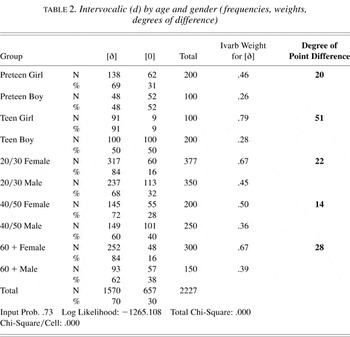
Intervocalic (d) by age and gender (frequencies, weights, degrees of difference)
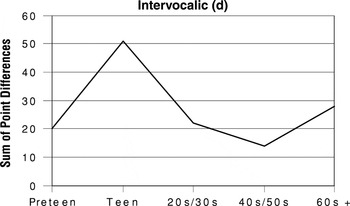
Degrees of difference between females and males across the lifespan for intervocalic (d).

Word final (s) and direct quotations strategies by age and gender (weights, degrees of difference)* (TVARB weights)
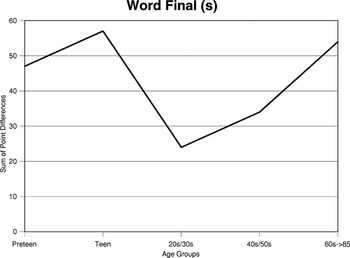
Degrees of difference between females and males across the lifespan for word-final (s).
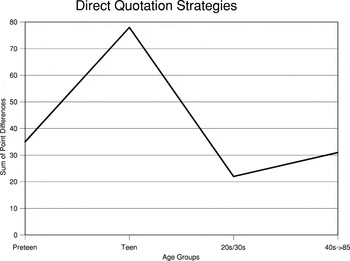
Degrees of difference between females and males across the lifespan for direct quotation strategies.
 You have
Access
- 27
- Cited by