Implications
Boar taint is the main reason that is preventing the production of entire male pigs in most countries. Across Europe, the majority of male piglets intended for pork production are surgically castrated to avoid potential consumer dissatisfaction because of boar taint. There is, however, a growing ethical concern about the unfavourable effects of surgical castration on animal health and welfare. This has resulted in legal conditions being imposed on the practice of castration in a number of European countries, and an increasing possibility that surgical castration might be banned in some countries, or even across the European Union (EU) as a whole. It is therefore timely to consider the practical consequences of producing entire male pigs as opposed to castrates.
An increase in the production of entire males would, overall, result in a positive impact on the production efficiency and carcass composition. On the other hand, more meat from entire males entering the market means that, to prevent tainted pork being represented to sensitive consumers, fast and reliable on-line detection methods should be developed.
Introduction
There is a wide range of factors that can be considered as components of carcass and meat quality. Carcass composition is an important determinant of characteristics such as product fat levels and visual appearance. Of prime importance, however, is the sensory quality of the meat during cooking (odour) and consumption (texture and flavour). Odour and flavour may be negatively affected by the presence of a pheromonal steroid – androstenone – and a fermentation product of l-tryptophan – skatole. Therefore, male pigs are surgically castrated in many countries to minimise the risk of accumulating these compounds. However, raising entire male pigs is likely to be more profitable because they have superior production characteristics and improved meat quality due to leaner carcasses and higher protein content, as compared to castrated pigs. Furthermore, surgical castration is negative from an animal welfare point of view. Thus, the need for surgical castration has to be re-evaluated.
The European Food Safety Authority (EFSA) review on the castration of piglets (European Food Safety Authority, 2004) summarised literature reviews from several authors on welfare aspects, and production and meat quality traits of entire boars compared with castrates. This review constitutes an update of the EFSA report on the production and meat quality aspects of castration of piglets. In addition, possible methods for odour detection are summarised, as safe and fast methods for detection of boar taint are of great concern to avoid complaints from consumers. Biochemical, nutritional and genetic factors involved in the regulation of androstenone and skatole in entire male pigs have been recently reviewed by Zamaratskaia and Squires (Reference Zamaratskaia and Squires2009), and the present review includes aspects relating pork meat quality as affected by the various alternatives to surgical castration.
Advantages and disadvantages associated with the production of entire male pigs
Efficiency of growth and carcass composition
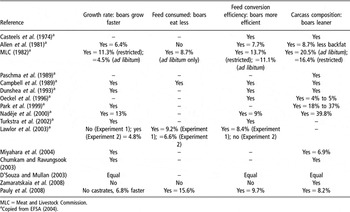
The EFSA review on the castration of piglets (EFSA, 2004) states that entire male pigs grow faster, eat less food, convert food to live-weight gain more efficiently and produce leaner carcasses than castrates (see Table 1 for a summary of differences between boars and castrates in production traits). Indeed, the benefits of raising entire males were recognised as early as the 16th century (Mackinnon and Pearce, Reference Mackinnon and Pearce2007). It was pointed out that the size of the differences varies from trial to trial and that this is likely to be due to differences in factors such as breed, feeding system, diet and weight at slaughter. The advantages of boars over castrates can be summarised as follows: (i) superior growth rate of boars, up to 13%; (ii) entire males may eat up to 9% less feed; (iii) feed conversion (to live-weight) up to 14% more efficient and (iv) generally leaner than castrates, by up to 20% (with an exceptional difference of 40% being recorded in one trial, Naděje et al. (Reference Naděje, Koucký, Ševčíková, Adamec and Laštovková2000)). This leads to improved grading and higher payments to the producer, although current grading methods may underestimate the difference between the sexes (Andersson et al., Reference Andersson, Hansson, Lundström and Karlsson1995). Because of differences in carcass composition, the lean tissue growth rate is even higher than the live growth rate for entires as compared with castrates. The increased performance means that entire males need a smaller forage area in extensive production systems (Dragoeva and Stoikov, Reference Dragoeva and Stoikov2003). There is evidence, however, that the advantage of entires in lean growth rate has decreased due to selection for leaner pig breeds (Udesen, Reference Udesen1998). The actual feed prices in the EU will also influence the profitability of raising entires.
Summary of differences between boars and castrates in production traits

MLC = Meat and Livestock Commission.
aCopied from EFSA (2004).
Immunocastration is an alternative to surgical castration, which is claimed to provide the production advantages of rearing entire males whilst avoiding the potential problem of boar taint. A potentially promising vaccine, Improvac™, has recently been tested in Europe. Vaccination with Improvac™ is performed twice in the growing/finishing period, at least 4 weeks apart, with the booster injection given 4 to 6 weeks before slaughter (Evans, Reference Evans2006). This technology seems to have been favourably received in a number of countries, including Switzerland (Bielefeld, Reference Bielefeld2006) and Australia (Hennessy, Reference Hennessy2006). When compared with surgically castrated animals, Improvac™ treated animals are generally found to have more rapid growth, lower feed intake and more efficient feed conversion (Mackinnon and Pearce, Reference Mackinnon and Pearce2007). Hennessy (Reference Hennessy2006) summarised eight studies from five countries. Where significant differences were found, these were all in favour of immunocastration resulting in improved feed conversion efficiency, average daily gain and carcass leanness. An economic model has been developed to assess the costs and returns of using Improvac™ in the US market. This suggests an additional income (after slaughter) of $5.48/pig when compared with surgical castration (Deen et al., Reference Deen, O’Connor, Sorensen and Baker2008).
Not all studies have compared immunocastrates with castrates. As much of the work has been conducted in markets where castration is not always carried out (i.e. Australia), comparisons have been made with entire males. In this case, the immunocastrates generally have similar performance to entires (clearly they are expected to be the same until vaccinated). In the period from the second injection to slaughter, immunocastrates can have higher feed intake and higher growth rate with similar feed efficiency to entires (Moore et al., Reference Moore, Mullan, Hennessy, Dunshea and D’Souza2005). A recent review of metabolic modifiers included a comparison of immunocastrated animals with entires (Dikeman, Reference Dikeman2007). The authors cited benefits of increased intake and increased growth of immunocastrated animals during the final finishing period with no difference in feed efficiency (Dikeman, Reference Dikeman2007). It is suggested that this is through reduced male activity (Mackinnon and Pearce, Reference Mackinnon and Pearce2007). Zamaratskaia et al. (Reference Zamaratskaia, Andersson, Chen, Andersson, Madej and Lundström2008) found that there were no differences between males, castrates and immunocastrates for most performance parameters, with a difference only for weight gain (higher for immunocastrates).
Carcass and meat quality (excluding boar taint)
The EFSA report stated that entire males are generally found to be considerably leaner than castrates reared under identical conditions. The difference found ranges between about 9% and 21% in backfat depth. More recent results support this (Bañón et al., Reference Bañón, Andreu, Laencina and Garrido2004). This results in a higher lean meat content and longissimus muscle cross-sectional area (Miyahara et al., Reference Miyahara, Matsuda, Komaki, Sakari and Tsukise2004). This difference in leanness increases the economic benefit to producers of non-castration. The decreased adipose tissue content of meat cuts from entire males also makes them more appealing to the consumer. As with production parameters, the advantage is dependent on production system; for example, group penned systems seem to reduce the advantages compared with those seen in individual penned animals (Suster et al., Reference Suster, Leury, Kerton, Borg, Butler and Dunshea2006).
The EFSA review reported that some negative carcass quality factors have been identified that bear an impact on the economic value of entire males: (i) lower killing out percentage (carcass weight as a percentage of live weight); (ii) higher proportion of dark, firm and dry meat depending on handling; (iii) lower bacon yield and (iv) less favourable joint proportions. The latter two differences are rather small. There is also some evidence of quality advantages to entire males. Miyahara et al. (Reference Miyahara, Matsuda, Komaki, Sakari and Tsukise2004) found that the meat was redder and possessed better ability to retain moisture.
A number of papers cited in the EFSA report show that the characteristics of muscle and adipose tissue differ between entire males and castrates (EFSA, 2004). The lower lipid content and the higher content of unsaturated fatty acids in adipose tissues of entire males may be regarded as favourable from the human dietetic point of view. It was considered, however, that the decreased amount of adipose tissue in entire males might be a disadvantage in some circumstances – in particular, in very lean genotypes. Extreme leanness can result in a lack of cohesion between backfat and the underlying muscle (Wood, Reference Wood1984).
The higher degree of unsaturation and higher water content in leaner animals can result in carcasses with unacceptably soft fat. A series of studies on boars and castrates concluded that even at the same fat thickness as castrates, boars had softer fat because both C18:2 fatty acid and water concentrations were higher (Wood et al., Reference Wood, Buxton, Whittington and Enser1986). In the UK industry, where pigs are generally very lean (partly because of the predominance of entire males), there are guidelines to limit the quantity of unsaturated fatty acids in finishing-pig diets (Meat and Livestock Commission, 1996) to avoid the development of soft fat.
The conclusion from the EFSA report (EFSA, 2004) is still valid: ‘Although the above-mentioned problems with meat quality may be important, particularly in lean strains of pigs and in organic pig production, the most important limitation to the use of entire males is the existence of boar taint.’
Immunocastration reduces killing out percentage and backfat thickness, as compared with castrates (Mackinnon and Pearce, Reference Mackinnon and Pearce2007). When compared with entire males, in most cases, immunocastration results in similar, or slightly poorer, killing out percentage and similar or higher fat depths (Mackinnon and Pearce, Reference Mackinnon and Pearce2007). Immunocastration has sometimes been found to result in lower drip loss and darker meat than entire males, suggesting a lower propensity to develop pale, soft and exudative meat (Hennessy and Walker, Reference Hennessy and Walker2004; Mackinnon and Pearce, Reference Mackinnon and Pearce2007). There is no significant difference in other studies (Jeong et al., Reference Jeong, Choi, Han, Lee, Hennessy and Kim2008a). Zamaratskaia et al. (Reference Zamaratskaia, Andersson, Chen, Andersson, Madej and Lundström2008) found that there were no differences between males, castrates and immunocastrates for most carcass-quality parameters, with differences for dressing percentage (lower for immunocastrates) and lean meat content (highest for entire males, followed by immunocastrates and then castrates). There were no differences in pH or fibre optic probe reflectance readings.
Any differences in sensory traits other than boar taint are small and inconsistent between the categories of male pigs. In some studies, immunocastration has resulted in more tender and acceptable pork than that from either surgically castrated or entire males (D’Souza and Mullan, Reference D’Souza and Mullan2003; Hennessy and Walker, Reference Hennessy and Walker2004), or pork that is more tender than entire males and equivalent to castrates (Jeong et al., Reference Jeong, Choi, Han, Lee, Hennessy and Kim2008a). In others, there is little difference between immunocastrates and surgical castrates (D’Souza and Mullan, Reference D’Souza and Mullan2002; Singayan-Fajardo et al., Reference Singayan-Fajardo, Quizon and Hennessy2006; Jeong et al., Reference Jeong, Choi, Han, Lee, Hennessy and Kim2008b). In a UK sensory panel study in which immunocastrated pigs were compared with untreated entire males, there was no perceived difference in meat tenderness and juiciness between the two; however, flavour intensity of the lean and fat was significantly higher and abnormal flavour and odour intensity lower in pork from Improvac™ treated pigs (Nute et al., Reference Nute, Baker, Hughes and Wood2007). The hedonic assessment of the panel of assessors rated flavour-liking and overall-liking significantly higher in pork from Improvac™ treated pigs (Nute et al., Reference Nute, Baker, Hughes and Wood2007). In a consumer test in Spain, Font i Furnols et al. (Reference Font i Furnols, Gispert, Guerrero, Velarde, Tibau, Soler, Hortós, García-Regueiro, Pérez, Suárez and Oliver2008) concluded that pork from immunocastrated pigs was accepted by the consumers and was comparable to pork from surgically castrated pigs or female pigs, in contrast to pork from entire males.
Boar taint
Boar taint mainly occurs in meat from some entire male pigs and makes it undesirable for sensitive consumers. Two substances are primarily responsible for boar taint – androstenone (5α-androst-16-ene-3-one) (Patterson, Reference Patterson1968) and skatole (3-methylindole) (Vold, Reference Vold1970; Walstra and Maarse, Reference Walstra and Maarse1970). Other chemicals might also contribute to off-odour in meat as reviewed by Zamaratskaia and Squires (Reference Zamaratskaia and Squires2009), but as the main emphasis has been directed against androstenone and skatole, we will concentrate on these substances.
Sensory perception of boar taint
Sensory perception of boar taint has been extensively reviewed in the EFSA report (2004). For clarity, a summary of that report is included here with some additional facts.
Boar taint is an unpleasant off-odour and off-flavour described by various researchers, with sensory properties characterised as urine-like, animal-like, sweat-like and faecal-like. In a large European study involving trained sensory panels in six countries, it was found that androstenone related mostly to a ‘urine’ attribute whereas skatole was mostly associated with ‘manure’ and to a lesser extent to ‘naphthalene’ (Dijksterhuis et al., Reference Dijksterhuis, Engel, Walstra, Font i Furnols, Agerhem, Fischer, Oliver, Claudi-Magnussen, Siret, Béague, Homer and Bonneau2000). However, sensory characterisation of boar taint is very complex, even with an extensive training of the panel and statistical correction of discrepancies among panellist. This is probably due to the fact that there is a lack of clear references during the training of the assessors to approve by consensus the quantitative and qualitative use of the attributes (Font i Furnols, Reference Font i Furnols2000). People react very differently to boar taint, depending on their sensitivity. As many as 99% of consumers are sensitive to skatole, according to Weiler et al. (Reference Weiler, Fischer, Kemmer, Dobrowolski and Claus1997), whereas the proportions of individuals that are insensitive or anosmic to androstenone varies in different studies; women are generally more sensitive. Depending on geographic region, the percentage of anosmic women has been reported to be 11% to 30% compared with 24% to 37% for men (Gilbert and Wysocki, Reference Gilbert and Wysocki1987). In a more recent study, the percentage of insensitive persons in Germany and in Spain was 66% and 48% for women, and 70% and 60% for men, respectively (Weiler et al., Reference Weiler, Font i Furnols, Fischer, Kemmer, Oliver, Gispert, Dobrowolski and Claus2000). Not only does the sensitivity to androstenone differ between individuals, but so does the liking. As many as 8% (3.3% women and 16.2% men) of highly sensitive consumers liked the odour of androstenone (Font i Furnols et al., Reference Font i Furnols, Gispert, Diestre and Oliver2003), and the authors draw the conclusion that appreciation of androstenone odour discriminates more than sensitivity in consumers’ acceptance of pork. New interesting findings show that a human odorant receptor, ORD7D4, is involved in sensitivity to androstenone. Depending on the ORD7D4 genotype, human subjects differed in sensitivity, and genotype explained 39% of the variance in the intensity of androstenone odour perception (Keller et al., Reference Keller, Zhuang, Chi, Vosshall and Matsunami2007). It might thus be possible in the future to have better knowledge about the proportion of consumers that is sensitive for androstenone when performing consumer studies with meat from entire male pigs.
Because meat from entire male pigs has been purchased in the UK for several decades, people sensitive to boar taint might have ceased to eat pork (Matthews et al., Reference Matthews, Homer, Punter, Béague, Gispert, Kempster, Agerhem, Claudi-Madgnussen, Fischer, Siret, Leask, Font i Furnols and Bonneau2000). This fact will certainly introduce a bias when consumer responses in different countries are compared. In the large European study, consumers in different countries had different attitudes to meat from entire male pigs (Bonneau et al., Reference Bonneau, Walstra, Claudi-Magnussen, Kempster, Tornberg, Fischer, Diestre, Siret, Chevillon, Claus, Dijsterhuis, Punter, Matthews, Agerhem, Béague, Oliver, Gispert, Weiler, von Seth, Leask, Font i Furnols, Homer and Cook2000). Consumers in France, Germany, Spain and Sweden were critical of pork from entire male pigs; consumers in Denmark and Holland were negative to the odour but not to the flavour; whereas consumers in UK were not critical at all. In all other cases but in the UK, substantially more consumers would be dissatisfied with entire male than with gilt pork, the difference ranging from 6.1% to 10.2% for odour and from 2.4% to 6.3% for flavour.
Also, information about the existence of tainted meat on the market will influence the perception to pork from entire male pigs. In a Swedish study, consumers informed that the product tested might be from entire male pigs were also more critical of pork from female pigs (Lundström et al., Reference Lundström, Malmfors, Fjelkner-Modig and Szatek1983).
Skatole has been reported to produce a bitter taste in meat from entire male pigs (Andresen et al., Reference Andresen, Frøystein, Rødbotten, Mortensen, Eik-Nes and Lea1993), which should be easily perceived for sensitive persons. Sensitivity to bitter taste has a strong genetic background (Reed et al., Reference Reed, Tanaka and McDaniel2006), and this might also be one of the reasons for the large variation in how meat from entire male pigs is liked or disliked.
The thresholds used for sensory perception of the boar taint compounds androstenone and skatole are usually 0.5 to 1 ppm and 0.20 to 0.25 ppm, respectively (as reviewed by Walstra et al. (Reference Walstra, Claudi-Magnussen, Chevillon, von Seth, Diestre, Matthews, Homer and Bonneau1999)). These levels are based on concentrations in fat and are determined by possible consumer reactions on consumption of pork. Androstenone is non-polar and thus mostly fat soluble, whereas skatole is both water- and fat-soluble. The water solubility of androstenone is as low as 0.00023 g/l at 25°C (Amoore and Buttery, Reference Amoore and Buttery1978) compared to 0.45 g/l at 20°C for skatole (Windholz et al., Reference Windholz, Budavari, Blumetti and Otterbein1983), that is, approximately 2000 times lower. de Kock et al. (Reference de Kock, Heinze, Potgieter, Dijksterhuis and Minnaar2001) present an interesting discussion about the consequences of the chemical differences between androstenone and skatole on the sensory properties. As androstenone is retained longer in the fat matrix, it should have a more stable and longer lasting flavour. Androstenone can thus be expected to have a lower but more lingering impact on taint compared to skatole. Skatole would be more readily released from the fat matrix into both the aqueous and gaseous phases. The nose would detect skatole before androstenone due to its higher volatility. Skatole, being slightly water-soluble and therefore more polar than androstenone, would be less affected by the fat content of a product. It can therefore be concluded that the actual concentrations of androstenone in muscle, and to a certain degree skatole, are dependent on the fat content. For skatole, concentrations in lean muscle have been reported to be from 2% (Dehnhard et al., Reference Dehnhard, Claus, Herbert and Hillebrand1995) to approximately 10% of the concentrations in fat (Gibis, Reference Gibis1994; Rius and García-Regueiro, Reference Rius and García-Regueiro2001). According to Claus (Reference Claus1975), androstenone could not be detected in fat-free muscle.
When meat and meat products are consumed cold, odour release is lower and boar taint is therefore not perceived to the same degree as in products served hot. This will make it possible to market products such as salami that are usually consumed cold, with a higher amount of tainted meat. The risk with such an approach for negative consumer responses is the use of these products as ingredients in dishes served warm, such as pizza. Of interest is that de Kock et al. (Reference de Kock, Heinze, Potgieter, Dijksterhuis and Minnaar2001) found an increase in the relative contribution of androstenone to the overall odour profile in cooled samples compared to hot, whereas the relative contribution for skatole intensity decreased.
Effect of various cooking temperatures and cooking procedures on perception of boar taint
As both androstenone and skatole are volatile, their concentrations will be reduced when the products are heat-treated during cooking or processing (Dehnhard et al., Reference Dehnhard, Claus, Herbert and Hillebrand1995). Final internal temperature and muscle influenced the perception of off-flavour in a study by Agerhem and Tornberg (Reference Agerhem and Tornberg1995), where meat with varying combinations of androstenone and skatole was included (low–low; low–high; high–low and high–high). In ham (Musculus semimembranosus; SM), off-flavour was lower at 80°C than at 68°C for all combinations. For pork loin (M. longissimus dorsi; LD), the group with high androstenone and low skatole had the highest level of off-flavour at 80°C, whereas at a high skatole content, off-flavour was not affected by temperature. Both muscles were cut into 2 cm thick slices and fried in a pan at 175°C to the respective end-point temperature. Subcutaneous fat was trimmed from LD but with 5 mm left. It is thus possible that the remaining fat on the loin samples contributed to the different effect of final temperature between the muscles. Wood et al. (Reference Wood, Nute, Fursey and Cuthbertson1995) also found a decrease in off-flavour when the final internal temperature of pork chops was increased from 65°C to 72.5°C and 80°C, but with no difference between entire male and female pigs. As cooking to a high final temperature will decrease juiciness and tenderness in pork (Fjelkner-Modig, Reference Fjelkner-Modig1986; Wood et al., Reference Wood, Nute, Fursey and Cuthbertson1995), this will not be optimal for obtaining a high eating quality for pork.
Samples from loins, with varying amount of skatole and androstenone, were compared in a study by Siret et al. (Reference Siret, Béague, Fischer and Chevillon1997). The samples included were from gilts and entire male pigs with different combinations of skatole and androstenone (low skatole–low androstenone (LS/LA), low skatole–high androstenone (LS/HA) and high skatole–high androstenone (HS/HA)). In a consumer survey, the scores for acceptability were higher when the samples were cooked in a frying pan compared to oven cooking. The frying procedure was also less discriminating than the oven procedure. With both cooking procedures, HS/HA samples got significantly lower acceptability scores than all other classes. Samples from the LS/LA and LS/HA classes were inferior to the gilts in the oven procedure, but were not significantly discriminated from the gilt samples when fried in a frying pan. Also, with a trained panel, the oven procedure was more discriminating with significant differences between HS/HA pork and the other classes for all attributes but rancid (gilts) or sweet (LS/LA and LS/HA). No differences were found between LS/LA and gilt pork for any attribute. Thus, consumers were more discriminating against LS/LA pork than the trained panel, at least for the oven-cooked samples. As pork cutlets are usually prepared in a frying pan in some countries, this cooking procedure is advantageous to decrease the negative effects of boar taint.
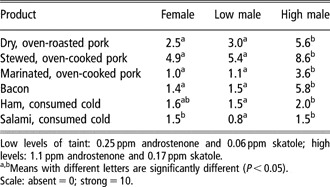
In a study of taste panel responses to meat cooked in various ways and containing different concentrations of boar taint compounds, McCauley et al. (Reference McCauley, Hennessy, Boghossian, Sali, Salvatore, Reynolds and Mawson1997) found that meat from entire male pigs with low levels of androstenone and skatole was not judged differently from meat from females (Table 2). In contrast, meat from entire male pigs with high levels of androstenone and skatole received significantly higher scores for boar odour in dry oven-roasted pork, stewed oven-cooked pork, marinated oven-cooked pork and bacon. Stewing produced the highest tainted scores, whereas marinating gave lower scores, indicating that the marinade seemed to mask boar taint to some degree.
Differences in sensory quality (assessed as boar odour by a trained sensory panel) between products from females and entire male pigs (after McCauley et al., Reference McCauley, Hennessy, Boghossian, Sali, Salvatore, Reynolds and Mawson1997)

Low levels of taint: 0.25 ppm androstenone and 0.06 ppm skatole; high levels: 1.1 ppm androstenone and 0.17 ppm skatole.
a,bMeans with different letters are significantly different (P < 0.05).
Scale: absent = 0; strong = 10.
Effect of processing on perception of boar taint
Processing will lead to a higher acceptability of tainted meat as shown in several studies (Walstra, Reference Walstra1974; Bonneau et al., Reference Bonneau, Desmoulin, Frouin and Bidard1980 and Reference Bonneau, Le Denmat, Vaudelet, Veloso-Nunes, Mortensen and Mortensen1992b; Diestre et al., Reference Diestre, Oliver, Gispert, Arpa and Arnau1990). Threshold values were three-fold higher for both androstenone and skatole in hams consumed cold in a study by Bonneau et al. (Reference Bonneau, Le Denmat, Vaudelet, Veloso-Nunes, Mortensen and Mortensen1992b). Hams with androstenone levels <1.5 ppm and with skatole levels <0.75 ppm in the raw hams were considered as acceptable as hams from castrates. Also, Diestre et al. (Reference Diestre, Oliver, Gispert, Arpa and Arnau1990) found processed ham to be acceptable with androstenone concentrations in fat above 1 ppm in the raw ham. In contrast, the same authors found a lower acceptability in brine-cured bellies and Spanish dry-cured hams with a high androstenone content. Desmoulin et al. (Reference Desmoulin, Bonneau, Frouin and Bidard1982) concluded that processed ham from entire male pigs with androstenone levels below 1 ppm and served cold did not differ from control meat or meat with low levels of androstenone. Sausage production is one way of using tainted fat from entire male pigs. Matthews and Homer (Reference Matthews and Homer1997) found only small differences between sexes for traditional British style sausages, with lower saltiness and overall acceptability for entire male pigs. Walstra (Reference Walstra1974) concluded that a maximum of 25% meat and fat from entire male pigs with a boar odour could be included in smoked pasteurised sausages, without negative effects on acceptability when the sausages were consumed cold. However, if they were consumed warm the percentage was decreased to between 6% and 12%.
In the study described above by McCauley et al. (Reference McCauley, Hennessy, Boghossian, Sali, Salvatore, Reynolds and Mawson1997), ham and salami served cold to the taste panel got similar ratings for boar odour for tainted and non-tainted meat, whereas boar flavour was higher in the tainted group. In contrast, differences were even higher for bacon, which was served hot. The authors thus suggest that the positive effect of processing is due more to the temperature of presentation, rather than the processing itself. It should be noted that the increased temperature during some processing steps, such as production of cured cooked ham, could have a lowering effect on boar taint. Androstenone concentration was reduced from 46% (Bonneau et al., Reference Bonneau, Desmoulin, Frouin and Bidard1980) up to 60% (Dehnhard et al., Reference Dehnhard, Claus, Herbert and Hillebrand1995) after ham processing, as compared to fresh pork. In contrast, androstenone in sausages was hardly reduced in spite of heat treatment (Dehnhard et al., Reference Dehnhard, Claus, Herbert and Hillebrand1995). Of special interest is that the authors found a total elimination of skatole after ham processing and a reduction of skatole in sausages, which varied depending on the permeability of the casing.
Boar taint compounds can be masked by using spices or smoking; the use of liquid smoke and oregano extracts in the marinade for pork chops seemed especially to mask boar taint (Lunde et al., Reference Lunde, Egelandsdal, Choinski, Mielnik, Flåtten and Kubberød2008). In fermented sausages, smoking was effective in reducing boar taint (Stolzenbach et al., Reference Stolzenbach, Lindahl, Lundström, Chen and Byrne2009). The effect of smoking can possibly be explained by a reaction between skatole and some components in the smoke such as formaldehyde, as suggested by Dehnhard et al. (Reference Dehnhard, Claus, Herbert and Hillebrand1995). Also, the use of polyphosphates seemed to mask boar taint in a study by Sheard et al. (Reference Sheard, Nute, Richardson, Perry and Taylor1999).
It can be concluded that in most studies no differences in sensory quality are found between pork from entire male pigs with low levels of androstenone and skatole and pork from castrates and females. Some studies have, however, reported lower acceptability in spite of low levels of androstenone and skatole (Walstra et al., Reference Walstra, Engel and Mateman1986; Bonneau et al., Reference Bonneau, Le Denmat, Vaudelet, Veloso-Nunes, Mortensen and Mortensen H1992a; Babol et al., Reference Babol, Squires and Gullett1996; Siret et al., Reference Siret, Béague, Fischer and Chevillon1997; Font i Furnols et al., Reference Font i Furnols, Gispert, Guerrero, Velarde, Tibau, Soler, Hortós, García-Regueiro, Pérez, Suárez and Oliver2008). The question remains as to which substances are responsible for boar taint besides androstenone and skatole and whether they need to be considered. Another possibility is of course that the threshold values used for androstenone and skatole were too high for highly sensitive persons.
Rapid detection of boar taint in pork carcasses
There is a great need for rapid on/at-line detection in abattoirs for identifying carcasses with unacceptable levels of boar taint compounds which may make them unsuitable for production of high-quality products. A large EU study found that the proportion of carcasses from entire males with androstenone and skatole concentrations above the commonly-used thresholds (1.0 ppm androstenone and 0.25 ppm skatole) were 30% and 11%, respectively (Walstra et al., Reference Walstra, Claudi-Magnussen, Chevillon, von Seth, Diestre, Matthews, Homer and Bonneau1999). This was the average for six countries although there was wide variation, presumably caused by breed, carcass weight and production system differences between countries, as well as differences in analytical techniques.
EU Regulation (854/2004) contains the general provision that ‘meat is to be declared unfit [for human consumption] if it indicates…organoleptic anomalies, in particular a pronounced sexual odour’. Member States may establish their acceptability criteria and recognise a test method to ensure that carcasses with pronounced sexual odour will be detected.
At present, in the EU, there is no harmonised method for detecting boar taint, but some Member States have tried to establish an appropriate test system; for example, in the UK, occasionally a hot wire test may be used (EFSA, 2004). An alternative is a soldering iron applied to the exposed backfat of the carcass. The adipose tissue is heated, causing a volatilisation of androstenone and skatole which can be detected by a trained operator at the slaughterline (Jarmoluk et al., Reference Jarmoluk, Martin and Fredeen1970). In Germany, a cooking test and melting test are used to detect sexual odour in carcasses (Bundesanzeiger, 2007). However, this strategy is ineffective, as detection differences between operators and fatigue of the sensory response develops quickly. In addition, the levels of skatole and androstenone of rejected samples based on the ‘cooking’ tests applied occasionally in Germany and the UK are poorly documented.
Recent development in rapid boar-detection methods has been characterised by two methodological strategies. One is based on vapour ‘fingerprinting’ methods, which aim at indirect measurement of boar odour by applying non-specific methods based on non-specific chemical (gas) sensor arrays (e-noses) and direct mass spectrometry (MS). The other alternative is to measure the boar odour substances directly with high selectivity, that is, specific measurement techniques where the single substances are analysed and quantified. These are typically based on fast gas chromatography (GC), spectroscopy/colorimetry and biosensors.
Chemical sensor arrays
Recently, there has been a rapid development in chemical sensor technology for analysis of volatile compounds. Chemical sensor arrays, combined with multivariate data processing methods – so called electronic noses – have been shown to have a potential for rapid non-destructive analysis of meat quality (Haugen and Kvaal, Reference Haugen and Kvaal1998; Blixt and Borch, Reference Blixt and Borch1999). Non-specific gas-sensor arrays have the potential to detect several compounds in the vapour phase related to boar taint. Chemical sensors can be based on different measurement principles: heat generation, conductivity, electrical polarisation, electrochemical activity, ionisation, and optical, dielectric and magnetic properties. These systems have been reviewed by Haugen (Reference Haugen2003) and Hurst (Reference Hurst1999). Gas-sensor technology has been suggested as a potential technology for future on-line use in sorting of boar tainted carcasses on the slaughter line. In recent years, several attempts to apply gas-sensor technology for the detection of boar taint have been reported (Berdagué and Talou, Reference Berdagué and Talou1993; Bourrounet et al., Reference Bourrounet, Talou and Gaset1995; Van Dijk, Reference Van Dijk1995, Reference Van Dijk2001; Annor-Frempong et al., Reference Annor-Frempong, Nute, Wood, Whittington and West1998; Di Natale et al., Reference Di Natale, Pennazza, Macagnano, Martinelli, Paolesse and D’Amico2003; Santos et al., Reference Santos, Garcia, Aleixandre, Horillo, Gutierrez, Sayago, Fernandez and Ares2004; Vestergaard et al., Reference Vestergaard, Haugen and Byrne2006) and the potential and limitations of these techniques for boar taint detection have been discussed (Haugen, Reference Haugen2003). The published research in this field comprises limited laboratory-based feasibility studies analysing pure lipid phases (oils and fats) spiked with androstenone or skatole and mixtures of both compounds at different concentration levels, as well as real back fat samples from boars with different levels of skatole and androstenone. The results show significant correlation (r = 0.6 to 0.9) between the sensor readings, levels of skatole and androstenone, and sensory attributes related to boar odour and flavour. Prediction errors vary from 5% to 30% of the measurement range. However, the types of chemical sensors used so far are not specific and may only detect the major volatile compounds in the vapour phase. Since the boar compounds may occur only in minor concentrations, this technology must be seen as a fingerprinting technique, and would reflect rather an indirect relation to the boar odour compounds or sensory perceived boar odour. State-of-the-art gas-sensor array-based methods replace neither complex analytical equipment nor odour panels, but may if successful, supplement them (Röck et al., Reference Röck, Barsan and Weimar2008). It is essential for further work in this field, that these techniques are being validated properly to prove their fitness for purpose. Unless selectivity and sensitivity is improved with regard to the boar substances, these methods will not be applicable to rapid boar detection.
Mass spectrometry
Recently, direct MS has also been applied to measure boar odour compounds. This technique is based on direct transfer of sample vapour into the ion-source of the mass spectrometer, followed by mass fragmentation of the molecules. Since all the volatile compounds are fragmented, the output data represent the accumulated fragment masses over the scanned mass range, and therefore chemometrics is required to interpret the data. This method represents a fingerprinting method, unless only the selected target molecule fragment masses are monitored. It can be combined with different sampling methods and the most used are headspace or pyrolysis. The combination of pyrolysis–MS has been applied to the detection of boar taint (Ampuero and Bee, Reference Ampuero and Bee2006). Recent results show that high classification rates can be obtained based on cut-off levels of 1.0 ppm for androstenone and 0.16 ppm for skatole, respectively (Ampuero and Bee, Reference Ampuero and Bee2008).
Spectrophotometry
The most successful method used so far is the spectrophotometric method for skatole used in Danish slaughter plants (Mortensen and Sorensen, Reference Mortensen and Sorensen1984). This is a ‘skatole equivalent’ method as it measures both skatole and indole and has an analytical error of 0.04 ppm on fat basis. Basically, it is an at-line method, as back fat samples are physically removed from the carcass and taken to an automated analyser in the abattoir and the results are used for sorting carcasses later down in the production line. The method is based on solvent extraction of fat followed by addition of reagent and spectrophotometric measurement. The limitation is that androstenone is not measured and no more than 180 samples/hour can be tested.
Fast gas chromatography
Recently, commercial ultra-fast gas chromatographic instruments have become available, enabling significantly shorter analysis times than conventional gas chromatographs. Recent work has demonstrated that androstenone, skatole and indole, in principle, can be separated and detected within 10 s by use of ultra-fast GC (Haugen et al., Reference Haugen, Lundby, Wäckers, Olson, Kauppinen, Ferber, de Wiel, Briens and Tuyttens2008a). However, sampling is the critical stage of the analysis. Combining static headspace sampling with fast GC is not sensitive enough to allow direct gas-phase measurement of the boar taint substances. In addition, by running fast GC, the selectivity may also be poor with regard to the boar substances, as they occur at low levels and may be partly masked by interfering major volatile compounds.
It is therefore necessary to carry out a proper cleanup step to isolate boar taint compounds prior to GC analysis. Normally, this requires different protocols for isolating the androstenone and indoles and would therefore be the time consuming step of the analysis. However, recent research suggests that it may be possible by the use of novel solid-phase extraction (SPE) phases to isolate the compounds simultaneously in one procedure (Haugen et al., Reference Haugen, Zamaratskaia, Lundström, Chen, Squires, Lou and Whittington2008b). So far, the single-step SPE cleanup combined with fast GC has a detection limit of 0.2 ppm for the indoles and 0.5 ppm for androstenone, respectively. This methodology would enable quantification of all three compounds in one analysis, and could also be automated using commercial GC-interfaced SPE systems. However, this would still be an at-line method, since samples would need to be taken from the carcasses and transferred to the automated analysis system.
Gas-phase spectrometry
Another technique that is under development for boar taint detection is gas-phase Fourier transform infrared (IR) combined with photo acoustic spectroscopy (PAS) (Kauppinen et al., Reference Kauppinen, Wilcken, Kauppinen and Koskinen2004; Haugen et al., Reference Haugen, Lundby, Wäckers, Olson, Kauppinen, Ferber, de Wiel, Briens and Tuyttens2008a). It has been shown that the boar taint compounds have distinguishable gas-phase IR spectra that would enable direct detection in the vapour phase. By using PAS, the water issue is also overcome, as the photo acoustic signal is highly linear and the interfering water background spectrum can therefore be subtracted from the spectra to obtain the pure spectrum of the individual boar taint substances and allow specific detection of each compound. As it is a very fast technique, it should have a potential for on-line use. However, gas sampling is a critical point that needs to be adapted to the slaughter line.
Biosensing
The use of insects for detecting volatile compounds is a research field that has found recent applications in drug and explosives detection. By using classical conditioning (associative learning), the insects are trained to detect the target odour compounds (Olson et al., Reference Olson, Rains, Meiners, Takasu, Tertuliano, Tumlinson, Wäckers and Lewis2003). Presently, work is being done on both bees and wasps within the Norwegian boar taint detection project where the potential use of insects for detecting boar odour/taint is being investigated (Haugen et al., Reference Haugen, Lundby, Wäckers, Olson, Kauppinen, Ferber, de Wiel, Briens and Tuyttens2008a). So far, the insects seem to be able to perceive individual boar taint substances in 1 : 1 : 1 (androstenone, skatole and indole) mixtures and could therefore have the potential to detect boar taint at the slaughter line and possibly also on-line. It still remains to be seen whether they can detect quantitatively the boar substances at the suggested sorting levels.
Recommendations for future research
Immunocastration
A robust cost–benefit analysis of immunocastration compared with raising entire males has not been carried out. This should take into account the labour and materials, cost of vaccination, the general lack of difference in performance and the cost of tainted pig meat (which will vary with the market). It would also be of interest to investigate other schedules for immunocastration, for example, if it is possible with earlier vaccination than currently recommended. There appears to be limited knowledge on the effect of immunocastration on the processing quality of pork, with only a few references to water-holding capacity and colour, for example.
Boar taint compounds
Identification of other compounds that might contribute to boar taint would be of great interest. Boar taint is not restricted only to androstenone and skatole, even if they are most important, but can be due to a complex combination of various compounds. Other substances have been suggested to play a role in the overall perception of boar taint, that is, indole (Annor-Frempong et al., Reference Annor-Frempong, Nute, Wood, Whittington and West1998), 4-phenyl-3-buten-2-one and short fatty acids (Sole and García-Regueiero, Reference Sole and García-Regueiero2001; Rius et al., Reference Rius, Hortós and García -Regueiero2005).
Effective and consistent methods for the sensory evaluation of taint are needed. Ultimately, this needs to reflect consumer preferences for pork products. So far, there is a lack of established threshold levels for boar taint compounds, especially androstenone. Commonly used threshold levels are 0.2 to 0.25 μg/g for skatole, and 0.5 to 1.0 μg/g for androstenone. The relatively large range in androstenone threshold value is likely to be due to the differences in individual ability to detect androstenone smell by consumers. Thus, the androstenone threshold value may vary depending on population, and on the method for androstenone analysis. It may also be due to differences in how sensory evaluation of taint has been carried out and how the amount of taint that is acceptable has been determined.
In order to define sensory threshold levels, it is essential to base the results on a standardised analytical protocol for the measurement of the boar taint substances, androstenone and skatole. At present there is a great variability in the analytical protocols that makes it difficult to compare results between laboratories (Haugen et al., Reference Haugen, Zamaratskaia, Lundström, Chen, Squires, Lou and Whittington2008b).
Detection methods
A rapid method for the detection of boar-tainted carcasses in the abattoirs is still a challenge. So far, most of the methods that exist and the ones that are still in a research and development stage represent advanced and sophisticated technology that would require highly qualified staff to operate. The analysis time should be very short (seconds to minutes) to obtain a fast result. Few methods under development have very short analysis times. In most cases, it is the sampling that is the time consuming part of the analysis. Methods are still too costly, because at the end it is the cost efficiency that is the driver for industrial implementation of new measurement technology.
The chosen method should ideally have a performance that allows 100% correct classification of both acceptable and not-acceptable samples with regard to boar taint. A low percentage of false positives may be acceptable, depending on the national market conditions, but the number of false negatives should be zero. So far, several of the methods that have been described – in particular the fingerprinting based methods – show that there is still too a high percentage of false negatives; ranging from 5% to 20%. There is still no dedicated measurement technology available for on/at-line detection of boar-tainted carcasses that measures both androstenone and skatole.
Cost-effective, automated, simple technological solutions, in order to adapt a proper methodology to slaughterhouse conditions for identifying tainted carcasses are needed, together with development of proper instrumental software, hardware and sampling solutions that meet the industrial requirements for on/at-line use. In particular, this applies to the sampling, which is a key issue. Development of a method with a sufficiently high sample throughput, that is, an analysis capacity of several hundreds of carcasses per hour is necessary to have a method that works in practice.
Acknowledgements
This review was carried out within the EU FP6 Specific Support Action project no. 043969 ‘PIGCAS’.