Introduction
The timely diagnosis of dementia is increasingly regarded as a prerequisite for beginning adequate treatment, planning for the future and coping with the prognosis (Vernooij-Dassen et al. Reference Vernooij-Dassen, Moniz-Cook, Woods, De Lepeleire, Leuschner, Zanetti, de Rotrou, Kenny, Franco, Peters and Iliffe2005; Salloway & Correia, Reference Salloway and Correia2009). However, diagnosis is often delayed until disabling symptoms are well established (Salloway & Correia, Reference Salloway and Correia2009). The time from the presentation of an individual's first symptoms to a dementia diagnosis has been found to be 1 year on average (Wilkinson et al. Reference Wilkinson, Stave, Keohane and Vincenzino2004), but delays of up to 5 years have also been reported (Holzer & Warshaw, Reference Holzer and Warshaw2000; Bamford et al. Reference Bamford, Eccles, Steen and Robinson2007). Some of the barriers to early diagnosis in primary care are failure to recognize the slowly evolving symptoms, lack of confidence to make and disclose a diagnosis, negative attitudes towards diagnosis, for example, because of a lack of support resources for the person with dementia or potential risks of an early diagnosis (Iliffe & Manthorpe, Reference Iliffe and Manthorpe2004; Iliffe et al. Reference Iliffe, Wilcock and Haworth2006). Long delays may be particularly true for young-onset dementia (YOD) due to its lower prevalence and larger variety of aetiologies (Mendez, Reference Mendez2006; Ridha & Josephs, Reference Ridha and Josephs2006; Rossor et al. Reference Rossor, Fox, Mummery, Schott and Warren2010). YOD may also present differently from late-onset dementia (LOD), with more marked neuropsychiatric symptoms than cognitive symptoms in frontotemporal dementia (FTD) and several other rare aetiologies typically occurring at a young age (Mendez, Reference Mendez2006; Rosness et al. Reference Rosness, Haugen, Passant and Engedal2008; Kelley et al. Reference Kelley, Boeve and Josephs2009). Non-recognition can have serious consequences for younger people and their families, such as tension with family members living in the same house (often children) and a higher chance of divorce or job loss (van Vliet et al. Reference van Vliet, de Vugt, Bakker, Koopmans, Pijnenburg, Vernooij-Dassen and Verhey2011). Timely recognition makes it possible to adjust to the consequences of the disease; therefore, it is important to gain insight into the factors associated with time to diagnosis and to what extent they influence the duration of that period. Young age (Luscombe et al. Reference Luscombe, Brodaty and Freeth1998; Rossor et al. Reference Rossor, Fox, Mummery, Schott and Warren2010) and a diagnosis of FTD (Rosness et al. Reference Rosness, Haugen, Passant and Engedal2008) have both been associated with diagnostic difficulties in separate studies, so their independent roles are unknown. We hypothesize that younger age is related to longer time to diagnosis independent of the influence of a diagnosis of FTD. Furthermore, it is assumed that a high education level and female gender are associated with a shorter time to diagnosis based on studies of help-seeking behaviour (Tijhuis et al. Reference Tijhuis, Peters and Foets1990; Mackenzie et al. Reference Mackenzie, Gekoski and Knox2006; Tedstone Doherty & Kartalova-O'Doherty, Reference Tedstone Doherty and Kartalova-O'Doherty2010). Likewise, it is hypothesized that a family history of dementia is related to the length of time to diagnosis (Ramakers et al. Reference Ramakers, Visser, Bittermann, Ponds, van Boxtel and Verhey2009) because such a history would promote the earlier recognition of symptoms. In addition, recognition of dementia by general practitioners in patients living alone has been found to be reduced; thus we expect this to be related to increased time to diagnosis (Pentzek et al. Reference Pentzek, Wollny, Wiese, Jessen, Haller, Maier, Riedel-Heller, Angermeyer, Bickel, Masch, Weyerer, Werle, Bachmann, Zimmermann, van den Bussche, Abholz and Fuchs2009). The aim of the present study is to compare the duration of the period from symptom onset to diagnosis for YOD and LOD and to investigate the influence of age of onset, dementia type, gender, education, living situation and family history of dementia on the time to diagnosis.
Method
Subjects
This study is part of a Dutch prospective cohort study, the Needs in Young onset Dementia (NeedYD) study, which has been described in more detail elsewhere (van Vliet et al. Reference van Vliet, Bakker, Koopmans, Vernooij-Dassen, Verhey and de Vugt2010). A total of 215 participants with YOD were recruited who had an age at onset of less than 65 years. They were included in the study together with their primary caregivers. Patients were consecutive referrals from university medical centres (n = 56), regional hospitals (n = 10) and regional community mental health services (n = 20); they applied to participate (n = 14) or were recruited through specialized day-care facilities (n = 115). The diagnoses were made on the basis of clinical, neuropsychological and neuroimaging data according to the criteria from the Diagnostic and Statistical Manual of Mental Disorders, fourth edition, text revision (DSM-IV-TR; APA, 2000) for dementia and the Dutch consensus guidelines (CBO, 2005) that include internationally accepted criteria for the subtype diagnoses (McKhann et al. Reference McKhann, Drachman, Folstein, Katzman, Price and Stadlan1984; Erkinjuntti, Reference Erkinjuntti1994; Neary et al. Reference Neary, Snowden, Gustafson, Passant, Stuss, Black, Freedman, Kertesz, Robert, Albert, Boone, Miller, Cummings and Benson1998; Mesulam et al. Reference Mesulam, Grossman, Hillis, Kertesz and Weintraub2003; McKeith, Reference McKeith2006). Clinical diagnoses were checked against clinical files for every patient and against medical hospital records when available. The exclusion criteria were: (1) unreliability on the part of the informant (if the informant and person with dementia did not have contact with each other at least once per week); (2) lack of informed consent of the participant; (3) living in a nursing home; or (4) dementia caused by human immunodeficiency virus (HIV), traumatic brain injury, Down's syndrome, Huntington's chorea or alcohol dementia. Since these diagnoses are associated with a range of specific problems, which would have obscured the impact of a younger age at dementia onset, these diagnoses were excluded.
A total of 173 subjects with LOD were used as a comparison group. They were selected from a 2-year follow-up cohort study, the Maastricht Study of Behaviour in Dementia (MAASBED) study (Aalten et al. Reference Aalten, van Valen, de Vugt, Lousberg, Jolles and Verhey2006), overall using the same design, assessment measures and diagnostic criteria. The NeedYD study protocol was based on the methods of the MAASBED study to be able to compare outcomes. Both the MAASBED and NeedYD studies are prospective studies, with assessments every 6 months during 2 years. Inclusion criteria and recruitment differed somewhat between the studies. In the MAASBED study, patients with dementia were included irrespective of their diagnostic subtype and they were consecutively enrolled from the Memory Clinic of the Maastricht University Medical Centre (MUMC+) or from the Regional Institute for Community Mental Health Care (RIAGG) in Maastricht. The MAASBED cohort included 26 YOD patients added to the YOD group in the present study. For the current study, the data collected from the primary caregivers of the patients in the NeedYD and MAASBED studies were used.
Procedure
The study protocol was approved by the Medical Ethics Committee of the University Medical Centre Maastricht. The written informed consent of the subjects or their legal representatives was obtained prior to the investigation. During a semi-structured interview with the patient as well as the primary caregiver the following questions were asked: ‘Which diagnosis was given to you? Do you know what type of dementia you have?’, followed by the question: ‘In which year did the very first symptoms or complaints occur?’. The interviewer was instructed to ask whether there were any earlier signs or symptoms. In addition, a semi-structured open-ended interview with the primary caregiver was tape-recorded including the following questions: ‘When did you first notice something was wrong with your family member?’, ‘What did you notice?’, ‘Can you describe the period prior to diagnosis?’, ‘What did you think was wrong?’, ‘Which problems did you experience during this period?’. Again the interviewer was instructed to encourage caregivers to elaborate on their answers and to think of any other signs or symptoms that occurred. The year of the earliest sign or symptom, either in the cognitive, behavioural or functional domain, was recorded as the year of symptom onset. The moment that caregivers consciously noticed changes mostly occurred later than the moment that was indicated with hindsight. In these cases, the year that was indicated with hindsight was noted as the year of symptom onset. Subjects' medical records were used to determine the year in which each diagnosis was established. The duration (in years) between symptom onset and diagnosis was calculated by subtracting the year of symptom onset from the year of diagnosis.
Demographic data were collected that indicated age, gender, education level divided into eight categories of the Dutch educational system ranging from (1) primary school to (8) the completion of university-level education and family history of dementia, which was determined to exist if any family member had had dementia. The Global Deterioration Scale (GDS) was used to assess the severity of the dementia (Reisberg et al. Reference Reisberg, Ferris, de Leon and Crook1982).
Analysis
First, a sample-size calculation was performed for the group comparisons and the regression analysis, with a medium effect size, an α level of 0.05 and power of 0.80, which showed that the sample size should be at least 64 in each group for the group comparisons and 103 for the regression analysis. Analyses were performed using SPSS software, version 17.0 (SPSS, Inc., USA). To assess descriptive group characteristics, χ2 tests and Mann–Whitney U tests were used as appropriate. For comparisons of duration to diagnosis between groups (YOD and LOD), Mann–Whitney U tests were performed. These non-parametric tests were used, because the distribution of the dependent variable was skewed or because the variance of the dependent variable was not homogeneous across groups. A multiple linear regression analysis was performed to assess the relationship between group (YOD v. LOD), type of dementia, living arrangements (alone v. not alone), education, gender and family history of dementia (the independent variables) and the estimated duration from symptom onset to diagnosis in years (the dependent variable). The data were log-transformed because of the heteroscedastic variance of the residuals of the variable: duration from symptom onset to diagnosis. The types of dementia were divided into four categories and dummy-coded with Alzheimer's disease (AD) as the reference group: (1) AD; (2) FTD; (3) vascular dementia (VaD) and mixed dementia (AD and VaD); and (4) other. Education was recoded as low (1–4) or high (5–8). The collinearity between the predictors was explored using phi-correlations. The potential influence of outliers was determined. In order to detect outliers, which are data points of the dependent variable (i.e. time to diagnosis) that differ largely from the values predicted by the model, the standardized residuals (residual/estimated standard deviation of the residual) were assessed. As a general rule, 99.9% of standardized residuals (or z scores) should lie between −3.29 to 3.29, and 3 is generally used as an approximation. The α level was set at 0.05 for the analyses. In addition, outliers were detected by visual inspection of the data. For these cases it was checked whether the year of symptom onset that was noted by the researcher corresponded with the tape-recorded interviews. In one case, this resulted in correction of the year of symptom onset.
Results
Sample characteristics
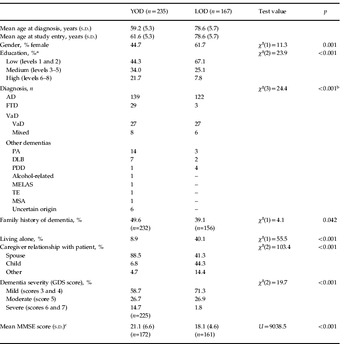
The overall study group consisted of 414 patients (241 with YOD and 173 with LOD). Information on the duration between symptom onset and diagnosis was not available for six YOD and six LOD patients (year of diagnosis was missing in one case, year of symptom onset in the other 11 cases). These patients were similar to the group with complete data with regard of age at study entry (U = 2291.5, p = 0.78), gender (p = 0.25, Fisher's exact test), education (p = 0.47, Fisher's exact test), distribution of diagnoses (p = 0.96, Fisher's exact test) and group (YOD v. LOD) (χ2 = 0.34, p = 0.56). Thus, 402 patients with complete data were included in this study. The mean estimated age at onset was for the YOD group 54.8 years (s.d. = 5.9) and for the LOD group 75.8 years (s.d. = 5.9). Table 1 shows the age at diagnosis and the sample characteristics of both groups at study entry. The patients of the YOD group were more frequently male, they had a higher education and they more often had a family member with dementia. In addition there were significant differences in the distribution of diagnoses between groups, with more FTD and ‘other’ dementias in the YOD group. The dementia was more severe in the YOD group based on GDS scores. Mini-mental state examination (MMSE) scores were missing in a large sample and therefore less reliable. Spouses were most often the primary caregiver in the YOD group, while in LOD children were primary caregiver in the largest proportion of cases. In the LOD group there were also more patients living alone than in the YOD group.
Demographic variables at study entry of the YOD and LOD groups

YOD, young-onset dementia; LOD, late-onset dementia; s.d., standard deviation; AD, Alzheimer's disease; FTD, frontotemporal dementia; VaD, vascular dementia and mixed dementia; PA, progressive aphasia; DLB, dementia with Lewy bodies; PDD, Parkinson's disease dementia; MELAS, mitochondrial encephalomyopathy, lactic acidosis and stroke-like episodes; TE, toxic encephalopathy; MSA, multiple system atrophy; GDS, Global Deterioration Scale; MMSE, mini-mental state examination.
a Education level ranged from the category (1) primary school to (8) the completion of university-level education.
b Based on the categories: AD, FTD, VaD, other dementias.
c Reasons for missing MMSE scores: refusal, cognitive problems, e.g. language problems, emotional reactions or lack of motivation during testing.
Duration from symptom onset to diagnosis
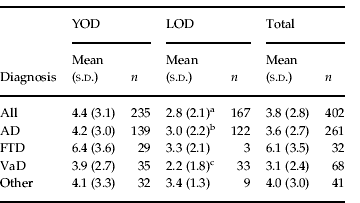
The group comparison between YOD and LOD of estimated duration from symptom onset to diagnosis showed a significant difference, with an average time to diagnosis of 4.4 years (s.d. = 3.1, range 0.5–18.0) in the YOD group and an average time to diagnosis of 2.8 years (s.d. = 2.1, range 0.2–10.0) in the LOD group (U = 13343.5, p < 0.001).
For each dementia subtype, the period was longer in the YOD group than in the LOD group, with significant differences for those with AD (U = 6212.5, p < 0.001) and VaD (U = 353.0, p = 0.006). Differences between young- and late-onset FTD or ‘other’ dementias could not be assessed because of the small sample sizes, especially in the LOD group (Table 2).
Estimated duration (years) from symptom onset to diagnosis for each dementia subtype and test statistics for the differences between young- and late-onset AD and VaD
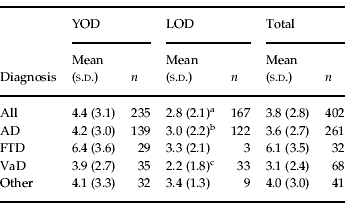
AD, Alzheimer's disease; VaD, vascular and mixed dementia; YOD, young-onset dementia; LOD, late-onset dementia; s.d., standard deviation; FTD, frontotemporal dementia.
a U = 13343.5, p < 0.001.
b U = 6212.5, p < 0.001.
c U = 353.0, p = 0.006.
Factors related to time to diagnosis
The data for the variable ‘family history of dementia’ were missing in 19 cases. In most of these cases, the person providing the information was not a spouse or partner and may not have been aware of the family history. This was significantly more frequent in the group with missing data than in the group with complete data (spouse v. other: p < 0.001, Fisher's exact test). To determine the effect of family history of dementia on time from symptom onset to diagnosis, a regression analysis was performed with the predictors group, type of dementia, living arrangements, gender and education in the first block and ‘family history of dementia’ in a second block. Adding this variable did not significantly improve the model (ΔR 2 = 0.00, p = 0.40); therefore, family history of dementia was left out of the analyses so that the cases with missing data for this variable could still be included.
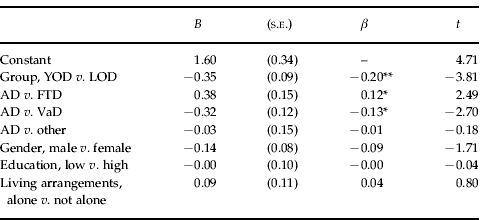
The regression analysis (Table 3) with estimated time from symptom onset to diagnosis as the dependent variable and group, type of dementia, living arrangements, gender and education as predictors showed that having LOD [β = −0.20, t(395) = −3.81, p < 0.001] and being diagnosed with VaD as opposed to AD [β = −0.13, t(395) = −2.70, p = 0.007] were significantly associated with a shorter time to diagnosis and a diagnosis of FTD with a longer time to diagnosis [β = 0.12, t(395) = 2.49, p = 0.013], with group the most important predictor. The model explained 10% of the variance. A sensitivity analysis was performed excluding the YOD patients that were recruited in the MAASBED study, which did not change the results. In addition, the analyses were repeated, excluding the FTD and ‘other’ diagnostic categories and results again showed that having LOD [β = −0.34, t(324) = −5.93, p < 0.001] and being diagnosed with VaD as opposed to AD [β = −0.11, t(324) = −2.19, p = 0.029] were significantly associated with a shorter time to diagnosis.
Results from the multiple linear regression analysisa
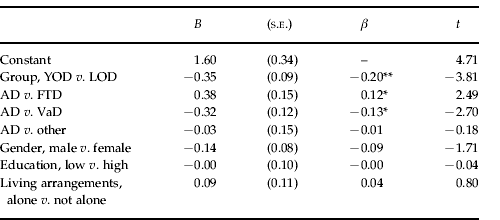
s.e., Standard error; YOD, young-onset dementia; LOD, late-onset dementia; AD, Alzheimer's disease; FTD, frontotemporal dementia; VaD, vascular and mixed dementia.
a Adjusted R 2 = 0.10 (p < 0.001).
* p < 0.05, ** p < 0.001.
There were no outliers with a standardized residual outside the range of ±3. A post hoc regression analysis of family history of YOD within the YOD group showed that this was not a significant predictor of the duration from symptom onset to diagnosis [β = −0.03, t(190) = −0.35, p = 0.73].
Dementia severity around time of diagnosis
Post hoc we selected patients that were included shortly after diagnosis and we excluded the FTD subcategory to compare more homogeneous groups. Time from symptom onset to diagnosis, GDS score and MMSE score were compared between these subsamples of YOD (n = 93) and LOD (n = 164) patients. Results confirmed our previous finding that a significantly longer time from symptom onset to diagnosis was found in the YOD group (4.6 years, s.d. = 3.1) compared with the LOD group (2.8 years, s.d. = 2.1) (U = 4789.0, p < 0.001). Groups did not differ in GDS scores [χ2(2) = 5.5, p = 0.065], which were categorized into mild- (74.7% YOD, 71.3% LOD), moderate- (18.7% YOD, 26.8% LOD) and severe-stage dementia (6.6% YOD, 1.8% LOD). There was a significant difference in MMSE scores between groups, with a mean score of 20.3 (s.d. = 5.6, n = 85) in the YOD group v. 18.1 (s.d. = 4.5, n = 158) in the LOD group [F(1) = 10.9, p = 0.001].
Discussion
Main findings
This study investigated the estimated time that elapses between the appearance of the first symptoms of dementia and moment of diagnosis using a relatively large sample of both YOD and LOD patients. The group comparisons showed that the duration of this period in the YOD group took an average of 1.6 years longer than in the LOD group. The average time from symptom onset to diagnosis in the YOD group exceeded that of the LOD group for every dementia subtype; it was statistically significant for AD and VaD.
The regression analysis showed that having YOD was the most important predictor for an extended period between symptom onset and diagnosis. A diagnosis of FTD independent of age at onset was also associated with a longer time to diagnosis. These findings can be explained by the typical clinical characteristics of FTD, which include behavioural and personality changes and an early loss of insight, both of which can delay help-seeking behaviour (Passant et al. Reference Passant, Elfgren, Englund and Gustafson2005; Rosness et al. Reference Rosness, Haugen, Passant and Engedal2008; van Vliet et al. Reference van Vliet, de Vugt, Bakker, Koopmans, Pijnenburg, Vernooij-Dassen and Verhey2011). VaD appeared to be diagnosed earlier in comparison with AD. This trend may be a function of the more abrupt onset of the disease when it was due to cerebrovascular accidents, the presence of neurological symptoms, or its potentially more fluctuating course (Reilly et al. Reference Reilly, Rodriguez, Lamy and Neils-Strunjas2010). Higher education levels and female gender were hypothesized to facilitate earlier recognition and help-seeking behaviour (Tijhuis et al. Reference Tijhuis, Peters and Foets1990; Mackenzie et al. Reference Mackenzie, Gekoski and Knox2006; Tedstone Doherty & Kartalova-O'Doherty, Reference Tedstone Doherty and Kartalova-O'Doherty2010). These effects may be masked by other factors such as the failure of physicians to recognize dementia or their providing a diagnosis other than one of dementia (van Vliet et al. Reference van Vliet, de Vugt, Bakker, Koopmans, Pijnenburg, Vernooij-Dassen and Verhey2011). This may have resulted in a prolonged time from symptom onset to diagnosis, while presenting to services could have taken place early. Unfortunately, the moment presenting to services was not assessed in our study. Contrary to our expectations, family history of dementia and living situation did not predict time to diagnosis. The finding that living situation is not related to time to diagnosis may be explained by the small number of patients living alone in the YOD group.
The age at onset effect
Although the findings regarding time to diagnosis in YOD patients are supported by the previous literature, this period was much longer than that previously found: 3.3 years in the YO-AD group, 4.9 years in the YO-FTD group and 1 year in the LOD group (Wilkinson et al. Reference Wilkinson, Stave, Keohane and Vincenzino2004; Rosness et al. Reference Rosness, Haugen, Passant and Engedal2008). This discrepancy could be a result of country-related differences or differences in the way the time between symptom onset and diagnosis was estimated. Whereas the former study (Rosness et al. Reference Rosness, Haugen, Passant and Engedal2008) used medical records to determine both the moment of first symptoms and the diagnosis, the latter (Wilkinson et al. Reference Wilkinson, Stave, Keohane and Vincenzino2004) based the data regarding both the moment of symptom onset and the moment of diagnosis on caregiver recollections. In the current study, the information on the moment of symptom onset was collected through caregivers and the moment of diagnosis from medical records. The most important and inevitable drawback of all these studies is the retrospective estimation of moment of symptom onset, which alone could account for heterogeneous study outcomes.
Dementia is a slowly progressing condition, in which pathological changes generally occur over extended periods before clinical presentation (Braak & Braak, Reference Braak and Braak1997). The fact that it takes time to recognize symptoms and diagnose them is therefore an inherent feature of many dementia aetiologies. There are several possible explanations for the longer time between estimated symptom onset and diagnosis in YOD. The finding that disease severity at time of diagnosis was comparable between groups indicates that YOD caregivers may notice the dementia symptoms in an earlier stage of the disease process. This may be due to the higher demands and expectations of younger people, for example, at work. However, when it concerns VaD, one may expect symptoms to be picked up by YOD and LOD caregivers in a roughly similar stage of the disease process, because of the more obvious signs of VaD. Still, for the YO-VaD patients in the present study the time from symptom onset to diagnosis was substantially longer than in the LO-VaD group. Previous studies showed equivocal results. Similar or higher MMSE scores in YOD as compared with LOD around the time of diagnosis have been reported (McMurtray et al. Reference McMurtray, Clark, Christine and Mendez2006; Papageorgiou et al. Reference Papageorgiou, Kontaxis, Bonakis, Kalfakis and Vassilopoulos2009). However, this difference may be explained by the higher proportion of YO-FTD-patients in these studies. A similar study, comparing only AD patients showed that the YOD group was more cognitively impaired than the LOD group at time of diagnosis (Picard et al. Reference Picard, Pasquier, Martinaud, Hannequin and Godefroy2011), while another study assessing only FTD patients showed YO-FTD patients to be less cognitively impaired than LO-FTD patients (Shinagawa et al. Reference Shinagawa, Toyota, Ishikawa, Fukuhara, Hokoishi, Komori, Tanimukai and Ikeda2008).
An additional explanation of the predictive value of younger age at onset may be that people are less inclined to consider dementia as a possible source of symptoms in young patients as has been suggested by other researchers (Williams et al. Reference Williams, Cameron and Deardon2001; Harris & Keady, Reference Harris and Keady2004; Werner et al. Reference Werner, Stein-Shvachman and Korczyn2009). YOD also has a vastly differential diagnosis: it includes not only atypical dementias and rare sporadic or hereditary diseases (Sampson et al. Reference Sampson, Warren and Rossor2004; Ridha & Josephs, Reference Ridha and Josephs2006), but also psychiatric conditions. Some studies have reported the relatively frequent occurrence of behavioural and personality changes as a presenting sign in patients with YOD (Mendez, Reference Mendez2006; Rosness et al. Reference Rosness, Haugen, Passant and Engedal2008; van Vliet et al. Reference van Vliet, de Vugt, Bakker, Koopmans, Pijnenburg, Vernooij-Dassen and Verhey2011). Whereas behavioural problems in older patients seem to trigger the timely and adequate recognition of dementia by caregivers (Eustace et al. Reference Eustace, Bruce, Coen, Cunningham, Walsh, Walsh, Coakley and Lawlor2007), in younger people they may be more likely to be explained in psychosocial terms. Our previous qualitative report on the experiences of YOD caregivers in the period prior to diagnosis showed that most caregivers did not attribute symptoms to dementia and were likely to link behavioural changes to psychological causes (van Vliet et al. Reference van Vliet, de Vugt, Bakker, Koopmans, Pijnenburg, Vernooij-Dassen and Verhey2011). In line with this notion, FTD caregivers have been found to experience the failure to recognize the early stages of illness as dementia as a major troublesome aspect (Chow et al. Reference Chow, Pio and Rockwood2011).
Our previous study also showed that initial non-dementia diagnoses in YOD cases are relatively common and several caregivers felt that the medical profession was not responsive when they sought help (van Vliet et al. Reference van Vliet, de Vugt, Bakker, Koopmans, Pijnenburg, Vernooij-Dassen and Verhey2011). Another survey on YOD found that a higher number of diagnostic problems, such as misdiagnosis, was related to patient and caregiver's younger age (Luscombe et al. Reference Luscombe, Brodaty and Freeth1998). Persons suffering from FTD are more likely to receive an initial diagnosis indicating that they have burnout or depression than patients with AD, probably because FTD is characterized by behavioural changes in conjunction with a relatively preserved memory capacity (Rosness et al. Reference Rosness, Haugen, Passant and Engedal2008). These factors may therefore also contribute to a longer duration from symptom onset to diagnosis in YOD. In our study, the effect of age of onset on time to diagnosis was relatively small, with only 10% of the variance explained. We acknowledge that the model proposed does not nearly describe the interplay of all possible factors influencing time to diagnosis. Aspects such as denial among patients (van Vliet et al. Reference van Vliet, de Vugt, Bakker, Koopmans, Pijnenburg, Vernooij-Dassen and Verhey2011), type of diagnostic service (Cordery et al. Reference Cordery, Harvey, Frost and Rossor2002), patient residing in a rural versus an urban area (Koller et al. Reference Koller, Eisele, Kaduszkiewicz, Schon, Steinmann, Wiese, Glaeske and van den Bussche2010), contact rate with the primary care physician (Eefsting et al. Reference Eefsting, Boersma, Van Den Brink and Van Tilburg1996), and primary care physician attitude towards the early detection of dementia are important (Hansen et al. Reference Hansen, Hughes, Routley and Robinson2008) but unfortunately have not been assessed in the current study. Furthermore, it could be that age does not explain a greater part of the variance because distinct factors related to older age can cause a diagnostic delay in this age group. For example, patients and their relatives as well as general practitioners may be more likely to put down memory problems to ‘old age’ in the elderly than in younger people, or attribute them to co-morbidities or medication use (Cahill et al. Reference Cahill, Clark, Walsh, O'Connell and Lawlor2006; Leung et al. Reference Leung, Finlay, Silvius, Koehn, McCleary, Cohen, Hum, Garcia, Dalziel, Emerson, Pimlott, Persaud, Kozak and Drummond2011).
Strengths and limitations
The strength of the present study is that the factors related to time to diagnosis were investigated and compared in a relatively large sample of both YOD and LOD subjects, whereas previous studies presented qualitative data and/or data from smaller studies focusing on one age group. Furthermore, different diagnostic groups were compared. Some potential limitations, however, also exist. Since dementia commonly has an insidious onset, it is by definition difficult to accurately time the onset (Ratnavalli et al. Reference Ratnavalli, Brayne, Dawson and Hodges2002). Therefore we used the year of symptom onset of which estimation variation will average out over groups. Memory bias could be a factor in our study, given that the moment when symptoms first appeared was assessed retrospectively. The recruitment strategy for the YOD patients differed from the strategy that was used in the MAASBED study, which may have also biased our results. While the LOD group from the MAASBED study was recruited both from a University Memory Clinic (MUMC) and from the Regional Institute for Community Mental Health Care (RIAGG) in Maastricht, the YOD patients were recruited through more diverse settings across the Netherlands including specialized day-care centres in 115 cases. The interval between diagnosis and study entry was larger in the YOD group; therefore recall bias could be more pronounced in this group. By contrast, memory problems in the LOD caregivers associated with their advanced age could have led to recall bias in this group. Also the fact that older people may be more likely to dismiss memory problems as ‘just ageing’ may be a confounding factor. In addition, the dementia diagnoses were not standardized, although regular criteria were used. Finally, the FTD and ‘other’ dementia subgroups were rather small and may not be representative of the intended populations. Especially in the LOD group these subsamples were small, because of the inherent differences between YOD and LOD, with more heterogeneous aetiologies and a higher prevalence of FTD at a younger age. This may have resulted in an overestimation of the effect of FTD on time to diagnosis. In addition, the outcomes of the ‘other’ dementia subgroup are by definition hard to compare between YOD and LOD, because this is not a homogeneous category. The results regarding time to diagnosis of these categories should therefore be interpreted with caution and replicated in larger homogeneous samples. However, a post hoc analysis showed that including these categories did not unduly influence our results of the impact of age at onset and having a diagnosis of VaD on time to diagnosis.
Implications
As yet, it is not clear which factors cause the extended time from symptom onset to diagnosis in YOD. Future studies should therefore assess the influence of factors such as denial among patients, misattribution of symptoms, type of diagnostic service and primary care physician attitude towards the early detection of dementia on time to diagnosis in YOD and LOD within large homogeneous diagnostic samples. In addition, our finding that FTD, independent of age at onset, results in a delay in diagnosis should be replicated in a larger sample of YOD as well as LOD patients. This would provide important issues to focus on when supporting patients and caregivers in the diagnostic trajectory as well as starting points to facilitate timelier diagnoses in both groups.
The present study, together with our previous qualitative report, shows that the time from symptom onset to diagnosis is relatively long in YOD, that it considered too long by many caregivers and that this delay may result in detrimental psychosocial consequences for YOD families (van Vliet et al. Reference van Vliet, de Vugt, Bakker, Koopmans, Pijnenburg, Vernooij-Dassen and Verhey2011). In addition, it shows that not only in YO-FTD patients time to diagnosis is longer than in their older counterparts, but also in other YOD diagnostic categories. Hence, we advocate that efforts should be made to reach a more timely diagnosis in YOD patients. Therefore, our recommendations are aimed at promoting public awareness of YOD as well as increasing knowledge among the medical profession. In addition, the development and/or enhancement of specialized diagnostic centres for the diagnosis of YOD are important, because a structured approach based on all clinical features is required to diagnose YOD (Rossor et al. Reference Rossor, Fox, Mummery, Schott and Warren2010). These centres may in turn increase awareness of this subgroup in primary care (Rosness et al. Reference Rosness, Haugen, Passant and Engedal2008). However, in promoting awareness of YOD we must be alert to the risk of false-positive diagnoses, which may even lead to more harmful consequences. Previous research indicated that erroneously diagnosing psychiatric disease as dementia is common in YOD (Marsden & Harrison, Reference Marsden and Harrison1972; Ron et al. Reference Ron, Toone, Garralda and Lishman1979); therefore we emphasize the urgent need to maintain or, better still, improve the standards of diagnostic accuracy of YOD.
In conclusion, the present study underlines the need to raise special awareness of YOD, to facilitate a timely diagnosis, but also demonstrates that more research is necessary focusing on the mechanisms that cause an extended time between symptom onset and diagnosis.
Acknowledgements
This study was supported by a grant from the Dutch Alzheimer's Society and a grant from the Florence Care Group in the Netherlands. We would like to thank all research assistants for collecting the data.
Declaration of Interest
None.