Introduction
As people age they almost invariably develop diseases leading to the prescription of drugs both with the intent of preventing disease progression and for symptom control.
Unfortunately, drug treatment in later life is also problematic. There is a shortage of evidence from clinical trials on the efficacy of drugs in people aged over 80, and age-related changes in pharmacokinetics and pharmacodynamics become significant. Older people also more frequently experience multiple co-morbidities and use multiple prescriptions, increasing the risk of adverse drug events (ADEs) and interactions. However, it is also important to recognize that underprescribing is associated with considerable morbidity and mortality.Reference Gurwitz, Field and Avorn1, Reference Hanlon, Schmader, Ruby and Weinberger2
In 2007 in England older patients accounted for 58.9% of prescriptions dispensed in the community.3 Despite being the core business of health services, frail older people are still under-represented in clinical trials, resulting in a poor evidence base for clinical decision-making.Reference Habicht, Witham and McMurdo4
Prescription drug data from the USA highlight the extent of polypharmacy in older patients, with 36.7% of patients aged 60 and over taking five or more drugs compared with 7.9% between ages 20 and 59 years. Among older Americans, 76% use two or more prescription drugs.Reference Gu, Dillon and Burt5
In England, National Service Framework data show that 80% of patients aged over 75 years take at least one medicine, and 36% take four or more.6 This is significant in the light of evidence of correlation between increasing age and ADEs. Adverse events in hospital are more often related to medications in patients aged over 65 years compared with younger patients (20.1% of adverse events compared with 9.6%).Reference Merten, Zegers, de Bruijne and Wagner7 In the USA, ADEs are said to be the fifth leading cause of death.Reference Kohn, Corrigan and Donaldson8 More than 80% of adverse drug reactions (ADRs) leading to admission or occurring in hospital are dose related and predictable.Reference Routledge, O'Mahony and Woodhouse9 In one study of 1756 patients aged 65 years or older, 45.1% of ADRs were classified as definitely avoidable and 31.4% as possibly avoidable.Reference Franceschi, Scarcelli and Niro10 This highlights the importance of key interventions, including advice, education and support to individual prescribers, and active monitoring of treatments, to help mitigate the risk of potentially avoidable ADEs.
The current review is an update of a previous paper published in 2007.Reference Mukhopadhyay, Lally and Crome11 Since the original paper was written significant developments have occurred, in particular with regard to explicit prescribing criteria and use of information technology. These will be discussed below and the concept of appropriate prescribing in older people and the difficulties in achieving optimal prescribing practice will be explored.
The concept of appropriate prescribing
Many words and terms have been coined to describe standards that should be achieved in prescribing, including ‘safe’, ‘rational’, ‘optimal’ and ‘appropriate.’
The concept of ‘appropriate prescribing’, and its early definition, dates from the early 1970s.Reference Parish12 Over time its usage has developed, especially in relation to prescribing for older people, where there is evidence of greater heterogeneity than observed in the rest of the population.Reference Somel, Khaitovich, Bahn, Paabo and Lachmann13, Reference Nelson and Dannefer14 According to one definition of appropriate prescribing, patients would ‘gain maximum benefit from medication’ but not ‘suffer unnecessarily from illness caused by excessive, inappropriate or inadequate consumption of medicines’.15 Therefore, conversely, a prescription where risks outweigh the potential health benefits could be considered inappropriate. It has also been suggested that the term ‘appropriate prescribing’ should be expanded to cover misuse, overuse and underuse of treatments.Reference Jackson, Mangoni and Batty16
It is also important to consider whether we are discussing appropriateness from a patient-benefit perspective or from a criteria-based perspective. Sometimes what may seem, at first sight, to be inappropriate may well be the most appropriate and acceptable option for a patient, and what may be perceived as appropriate by a patient may not be by the patient's physician. The 2012 Beers Criteria (discussed in detail in the Explicit Prescribing Indicators section) update goes some way to addressing the difficulty in shaping criteria that allow more individualized clinical care with the creation of a new third category of medications that should be used with caution.17 They recognize that plausible reasons exist why the use of particular drugs in certain individuals may be appropriate, although substantial potential for misuse or harm exists, meriting an extra level of caution.
We must question whether parameters such as safety, benefit and economics should always override the patient's wishes and beliefs. This is illustrated in an account by Barber, who describes the experience of a terminally ill man who requested a particular brand of hypnotic, which was the only one he had found to be effective.Reference Barber18 The drug the patient wanted was on a list of medications that, although licensed, are not generally prescribable on the NHS and the prevailing opinion was that temazepam was as effective, cheaper and readily available. Barber was the chief pharmacist and was asked for an opinion by a clinician. The request was refused although Barber said that it ‘felt’ wrong.
Some years later Barber published the anecdote with the assertion that his original judgement was wrong and that patient preference should, on occasion, prevail. Despite these complexities, tools have been designed to identify inappropriate prescribing, such as the Beers Criteria already mentioned, and these will be discussed in more depth later in this article. However, the authors of the 2012 Beers criteria update explicitly state that criteria should not be applied punitively or be viewed as superseding clinical judgement or an individual patient's values, recognizing that prescribing decisions are not always clear cut, and that physicians must consider multiple factors.17 It is important to recognize that the clinician–patient relationship has, over time, become more of a partnership and the concept of ‘shared decision-making’ (SDM) has become increasingly important. A systematic review of 11 randomized controlled trials (RCTs) of SDM concluded that it is particularly useful for long-term decisions, especially in the context of chronic illness, and can be an effective method of reaching treatment agreement.Reference Joosten, DeFuentes-Merillas, de Weert, Sensky, van der Staak and de Jong19
Prescribing difficulties
Over a century ago the physician and pioneer Ignatz Leo Nascher introduced the term ‘geriatrics’ into medicine, proposed that a specialist approach was required when prescribing for older people, and warned of the need for caution when using drugs in combination.Reference Nascher20 Because of the difficulties and complexity associated with balancing safety and quality of prescribing with appropriate treatment of all co-morbidities in older people, a more specialized approach is needed. Unfortunately, it is not generally feasible for a geriatrician to assess all older patients. Therefore, the development of systems and indicators to guide individual prescribers is of paramount importance and we will come on to discuss developments in these areas.
Lack of evidence from clinical research trials
The best clinical evidence for treatment of medical disorders comes from the results of good quality RCTs. Unfortunately, there has been gross under-representation of the older population in clinical trials. There is a general paucity of high-quality studies in elderly patients. For example, although 60% of patients suffering from cancer are above 65 years of age, they make up only 22–36% of participants in trials for cancer treatment.Reference Lewis, Kilgore and Goldman21, Reference Hutchins, Unger, Crowley, Coltman and Albain22 Commonly reported barriers to enrolment relate to the opportunity to participate in trials due to protocol design and exclusion criteria based on co-morbid conditions or chronological age.Reference Ford, Howerton and Lai23 Although older men and women develop complications from myocardial infarction more commonly than the younger population,Reference Rich, Bosner, Chung, Shen and McKenzie24 40% of major randomized trials of coronary artery disease between 1991 and 2000 had explicit exclusions on the basis of age.Reference Lee, Alexander, Hammill, Pasquali and Peterson25 Although there have been advances in the treatment of heart failure, fewer than one-third of older patients suffering from the condition met the enrolment criteria for heart failure trials.Reference Masoudi, Havranek and Wolfe26 Despite these examples, evidence from phase II cancer trials suggests that older patients can be recruited successfully and are tolerant of treatments.Reference Giovanazzi-Bannon, Rademaker, Lai and Benson27 This is of ever-increasing importance given the growing burden of disease within the older population. With reference to the future of cancer care, it is anticipated that, in the United States between 2010 and 2030, there will be a 67% increase in cancer incidence for older adults, compared with an 11% increase for younger adults. The percentage of cancers diagnosed in older adults will increase from 61 to 70% during this period.Reference Smith, Smith, Hurria, Hortobagyi and Buchholz28
As a result of the dearth of RCT evidence, most groups developing ‘potentially inappropriate medication’ (PIM) lists for older patients have had to use a Delphi process to reach consensus agreement. Furthermore, evidence has also commonly come from observational studies with no interventional component, making it difficult to establish true ADE causality.
It is clear that there is a need for well-designed pragmatic RCTs to establish whether there is clinical benefit from the application of screening tools for PIMs.
Some progress has been made, although extensive further work is required to redress the imbalance of representation in clinical trials. In the United States, recognition of the under-representation of over-65-year-olds led to a change in Medicare policy, in 2000, to include coverage of routine patient care costs of clinical trials. This had a positive impact on older patient enrolment to cancer clinical trials, with an increase from 31% between 1997 and 2000, to 38% between 2001 and 2003.Reference Unger, Coltman and Crowley29 With regard to thrombolysis treatment for acute ischaemic stroke, the recent publication of the Third International Stroke Trial (IST-3) has gone some way to addressing the previous under-representation of older adults in all previous trials. Prior to IST-3 fewer than 80 patients over the age of 80 had been recruited to trials of intravenous thrombolysis. In IST-3, 1617 (53%) of patients recruited were older than 80 years of age.30
There are signs of a growing collective will to address age discrimination in clinical trials. As part of an American Geriatric Society Meeting, European Union and American Geriatric Societies met with regulatory agencies. The conclusion of a roundtable discussion was that geriatric societies and regulatory agencies must work together to propose new definitions, study designs and technologies aimed at improving evaluation of drugs in older people with multiple co-morbidities and polypharmacy.Reference Cherubini, Del Signore, Ouslander, Semla and Michel31
Communication problems and non-compliance
A significant proportion of older people may find it difficult to understand and adhere to complex treatment regimens. Those with dementia or other forms of cognitive impairment may encounter problems following more simple prescriptions and may face considerable barriers to compliance in the context of polypharmacy. It has been estimated that, in the UK, about 50% of older people may fail to adhere to their treatment regimens.32, 33
Factors such as patient preference, complex instructions and unpleasant side-effects may lead to non-adherence.Reference Thomson and Crome34 Large quantities of medicines and lack of knowledge as to why a medicine has been prescribed also contribute to non-compliance.Reference Kairuz, Bye and Birdsall35 Patients prescribed drugs with narrow therapeutic indices such as insulin, warfarin and non-steroidal anti-inflammatory drugs (NSAIDs) are frequently ignorant about their side-effects.Reference Burns, Austin and Bax36 To further complicate matters, older patients commonly present with falls, immobility, delirium, incontinence or other geriatric syndromes. All of these may be drug-related events, adding complexity to prescribing decisions, with the risk of a drug cascade developing where a drug is used to treat the adverse effect of another, if it is not identified correctly.
Multi-compartment compliance aids are widely used, despite a limited evidence base. Although some patients see aids as maintaining independence, others see them as casting doubt on their independence.Reference Nunney, Raynor, Knapp and Closs37 Aids are often issued without discussion, which can be interpreted as paternalistic. Views of older people must be considered and respected, and clear communication is vital. The patient role in medical decision-making is often absent from research, and it has been argued that the traditional concept of compliance is outmoded in a modern healthcare system with questioning patients with chronic illnesses.Reference Donovan38
Inappropriate prescribing
As explained above ‘inappropriate prescribing’ is a blanket term and includes unregulated polypharmacy, under-prescribing, the prescription of medications that have more potential risk than benefit and poor prescribing practice leading to the potential of ADEs. The World Health Organisation defined an ADE as ‘a noxious, unintended and undesired effect of a drug, excluding therapeutic failures, intentional or accidental poisoning and drug abuse’.39 Inappropriate medication is linked with worsening physical function and can account for excess health care utilization.Reference Chin, Wang and Jin40, Reference Lindley, Tully, Paramsothy and Tallis41
Inappropriate prescription has been reported in about 12–40% of older people residing in community and nursing homesReference Beers, Ouslander and Fingold42 assessed by consensus-based explicit criteria.Reference Beers, Ouslander, Rollinger, Reuben, Brooks and Beck43 Despite the attention that has been given to quality of prescription, a recent systematic review found that approximately one in five prescriptions to older patients in primary care was inappropriate.Reference Opondo, Eslami, Visscher, de Rooij and Verheij44 A study by Goulding in older ambulatory care patients found that the highest risk of inappropriate prescription came from visits to general and family practitioners, compared with visits to specialists other than internal medicine physicians.Reference Goulding45 Other potential risk factors for inappropriate prescribing include female gender, lower socio-economic characteristics, older age, number of health visits, depression, poor health and use of multiple drugs.Reference Goulding45–Reference Zhan, Sangl and Bierman47 One study found that older patients with dementia were more commonly exposed to drug duplication and to drugs acting on the central nervous system such as anti-depressants, anti-psychotic and anxiolytic drugs.Reference Giron, Wang, Bernsten, Thorslund, Winblad and Fastbom48 Non-demented patients, however, were more commonly affected by drug–disease interactions, mostly with the use of cardiovascular medications. Common, potentially inappropriate drug treatments include psychoactive medications such as long-acting benzodiazepines and tricyclic anti-depressants, medications which increase the risk of falls such as neuroleptic and vasodilator drugs, NSAIDs and opiates and duplicate drug class prescriptions.Reference Gallagher and O'Mahony49
Problems and ADEs may also potentially arise from drives to meet generalized clinical practice guidelines. Strict adherence to guidelines developed from evidence in younger populations may have undesirable effects in older patients with multiple co-morbidities. Furthermore, basing standards of care and pay-for-performance on such adherence may lead to inappropriate judgements.Reference Boyd, Darer, Boult, Frier, Boult and Wu50
Polypharmacy
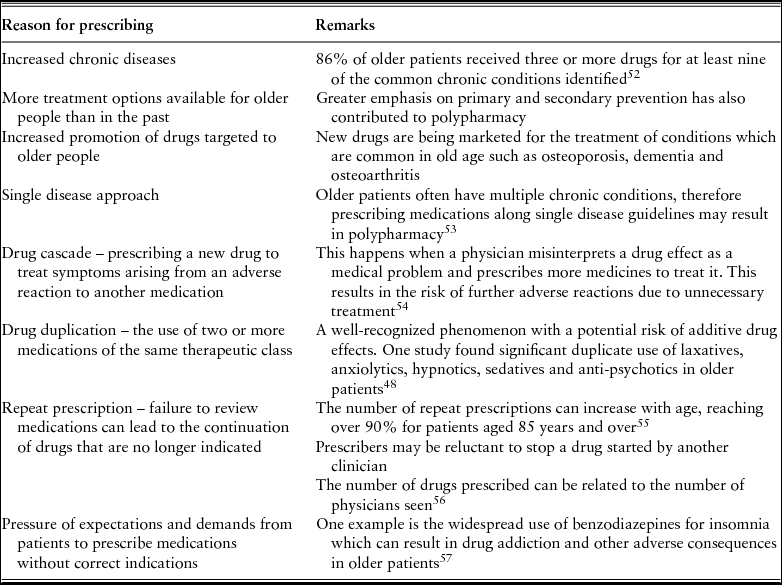
Polypharmacy refers to concurrent use of multiple medications by a single patient. It can be appropriate in an older patient who is suffering from a number of medical conditions. However, it may also imply excessive or unnecessary use of medications and the risk of ADEs increases with higher numbers of drugs taken concurrently. Patients prescribed five or fewer medications are significantly less likely to present to hospital with a PIM-related ADE than those taking six or more (odds ratio 0.59).Reference Gallagher and O'Mahony49 The average number of medications used by older people rises significantly with age.Reference Kennerfalk, Ruigomez, Wallander, Wilhelmsen and Johansson51 In the United States, fewer than 18% of patients between the ages of 20 and 59 years take three or more drugs compared with 64% of those over the age of 60, of whom 36% take five or more medications.Reference Gu, Dillon and Burt5 The reasons for polypharmacy in older patients are summarized in Table 1.
Reasons for polypharmacy in older people

Almost half of people older than 65 years have three chronic conditions, and 21% have five or more. As a result, different drugs are often given at different points along patients’ lives, by an expanding number of specialists following guidelines relevant to their areas of interest. Therefore, a single disease approach is likely to lead to polypharmacy.Reference Garfinkel and Mangin53 To compound this problem, clinicians often find it much easier to start than stop treatments.
A complex drug regimen increases the risk of non-concordance, resulting in sub-therapeutic benefit from treatment.Reference Rollason and Vogt56 Polypharmacy increases the risk of drug–drug interactions (DDI), for example, the combination of an angiotensin-converting enzyme inhibitor and an aldosterone antagonist may precipitate life-threatening hyperkalaemia. Other types of drug interactions that may occur include drug–herbal products, drug–alcohol and interaction with illicit substances used by older people.Reference Zarba, Storr and Wagner58 Polypharmacy significantly increases the cost of health care and utilization of health care resources.Reference Rollason and Vogt56 Polypharmacy correlates with an increased risk of hip fracture in older people, with an odds ratio of 8.42 for patients taking 10 or more drugs.Reference Lai, Liao, Liao, Muo, Liu and Sung59 The risks of ADRs are also increased by polypharmacy, with associated increased morbidity and mortality.Reference Hajjar, Cafiero and Hanlon60
Underprescribing
Underprescribing or under-utilization of medication occurs when a drug, which has a clear beneficial role in the treatment of a disease, is omitted without appropriate reasons. Inappropriate prescribing encompasses acts of omission as well as commission. Most of the published literature deals with the latter, although underprescribing is increasingly recognized as an important problem. Using the validated START (screening tool to alert doctors to the right treatment) list, one study found one or more prescribing omission in 57.9% of older patients admitted to hospital from the community with acute illness.Reference Barry, Gallagher, Ryan and O'Mahony61 The probability of an omission was found to be significantly related to age, with those between 65 and 84 years having an approximately 55% likelihood of a medication omission, rising to 72.2% in those aged over 85 years. The most common prescribing omissions were statins in atherosclerotic disease (26%), warfarin in chronic atrial fibrillation (9.5%), anti-platelets in arterial disease (7.3%) and calcium and vitamin D supplementation in symptomatic osteoporosis (6%). Cardiovascular disease is the commonest cause of morbidity and mortality in older adults.Reference Wei, Hazzard, Beirman and Blass62 However, other studies have also supported the above findings and found significant underprescribing for cardiovascular disease, including undertreatment with beta-blockers after myocardial infarction.Reference Soumerai, McLaughlin, Spiegelman, Hertzmark, Thibault and Goldman63 Similarly, only 33–75% of patients suffering from heart failure were treated with ACE inhibitors.Reference Chin, Wang, Zhang and Lang64–Reference Mendelson and Aronow66 This undertreatment of common medical problems of old age such as ischaemic heart disease and hypertension is likely to increase the incidence of preventable strokes, myocardial infarctions and associated consequences.
Possible reasons for omission of potentially beneficial drugs include lack of knowledge of evidence-based secondary preventative therapies, low therapeutic expectation in frail elderly patients, multimorbidity, desire to avoid polypharmacy, fear of ADEs, economic problems, focus on palliation of symptoms and ageism.Reference Barry, Gallagher, Ryan and O'Mahony61, Reference Cherubini, Corsonello and Lattanzio67 In some cases there may be rational and appropriate reasons not to prescribe, such as limited evidence for drug therapies in patients aged over 80 years, lack of a favourable risk–benefit ratio, limited life expectancy or patient preference.
In one study, the estimated probability of underprescribing increased significantly with the number of drugs a patient was prescribed. Amongst patients taking five drugs or more, there was a 42.9% chance of being undertreated compared with 13.5% in those taking four drugs or fewer.Reference Kuijpers, van Marum, Egberts and Jansen68 This suggests that efforts to avoid polypharmacy may contribute to underprescribing.
Poor prescribing practice
The Royal College of Physicians of London (RCP) has cited a number of physician-related factors that are causes of sub-optimal prescribing in older people.69
These include:
• Inadequate clinical assessment leading to incorrect diagnosis
• Failure to record current medications, including over-the-counter medications
• Failure to monitor response to treatment
• Failure to document previous adverse drug reactions
• Excessive prescribing
• Inappropriate prescribing
• Failure to review repeat medication
• Failure to take account of altered pharmacokinetics and pharmacodynamics
To reduce or prevent the causes of inappropriate prescribing a variety of approaches are required, including education, production of guidelines, patient and carer involvement and methods of monitoring and auditing the prescription of medicines.
Tools for appropriate prescribing
Indicators have been developed to evaluate prescribing performance with a view to identifying inappropriate prescribing and improving practice. Many different approaches have been adopted. These include the development of lists of medications, dosages or drug–drug combinations (explicit) known to cause harmful effects in older people. An alternative approach (implicit) uses expert clinical judgement based upon individual patients and the individual prescribing situation. Significant developments have occurred over recent years, which we will discuss in the following sections.
Explicit prescribing indicators
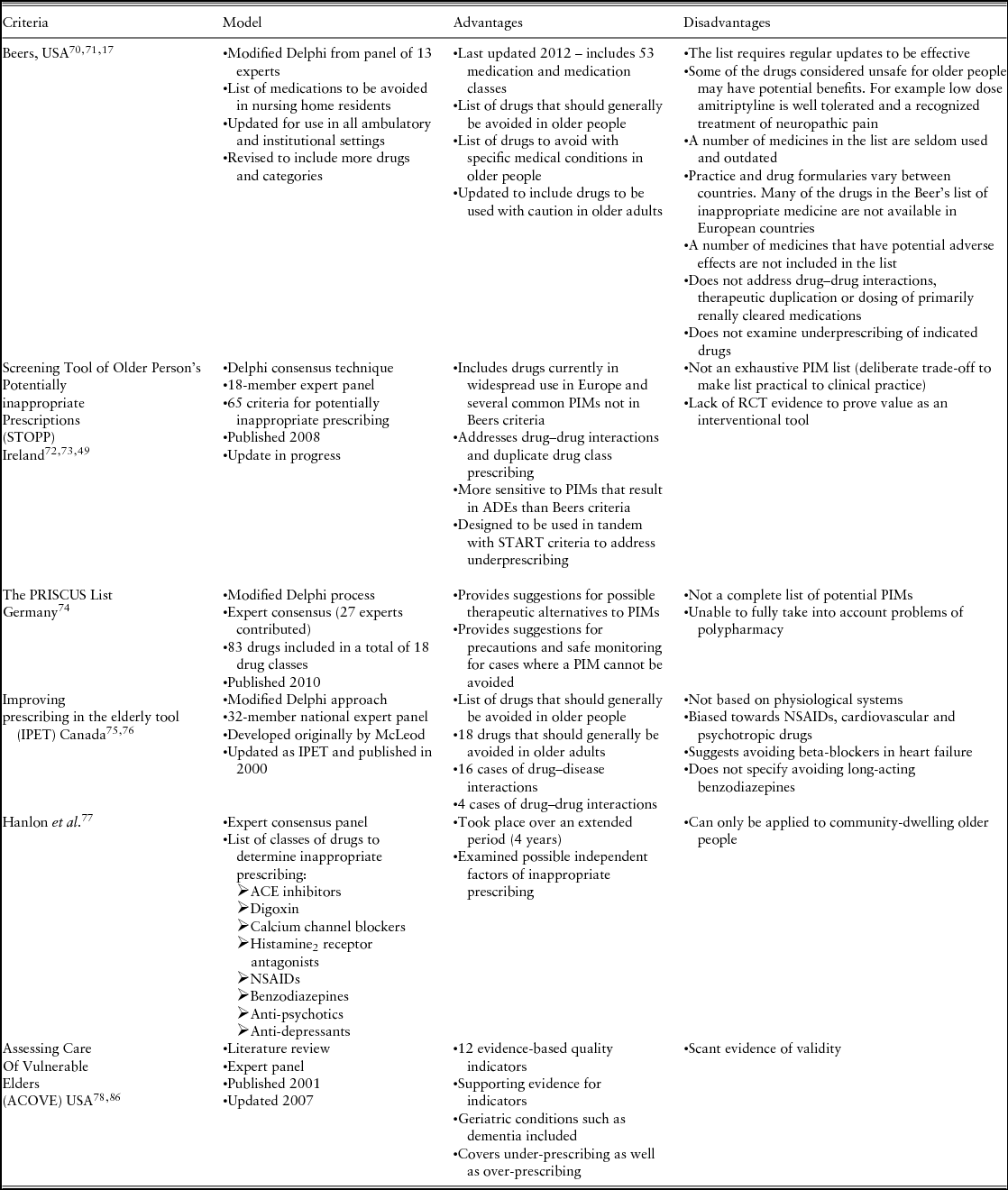
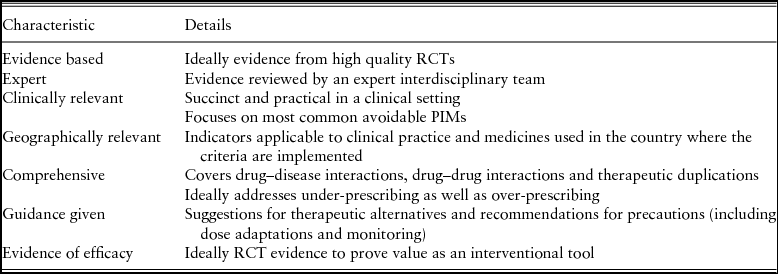
Several groups have published lists of explicit criteria for defining and detecting PIM use in older people. Table 2 includes a number of the most frequently cited. Most have been developed via a consensus approach, commonly using the Delphi process, often based on initial evidence drawn from literature reviews. Explicit prescribing indicators are therefore dependent not only upon available evidence but also the ability to routinely include new evidence.Reference Tully and Cantrill79 The ideal features of explicit prescribing criteria are described in Table 3.
Comparison of criteria for appropriateness of prescribing
Features of ideal, explicit prescribing criteria
The most widely known are the Beer's criteria, developed in the United States. Initially, a list of medications to be avoided in nursing home residents was formulated.Reference Beers, Ouslander, Rollinger, Reuben, Brooks and Beck43 This list was later revised to include more drugs and categories for ambulatory people aged over 65 years from any background.Reference Beers70 The most recent revision of this list was published in 2012 by the American Geriatric Society.17 The development process involved systematic review and grading of the evidence on ADEs with an interdisciplinary team of 11 experts in geriatric care and pharmacotherapy applying a modified Delphi method to reach consensus. The final updated criteria included 53 medications or medication classes. These were divided into three categories of PIMs and drug classes: (i) avoid in older patients, (ii) avoid in older patients with certain diseases and syndromes, and (iii) use with caution in older adults. The authors estimate that as many as 40% of older adults receive one or more medications on this list.
Limitations of the Beer's list include that it does not address potential PIMs that are not unique to ageing, including drug–drug interactions, dosing of primarily renally excreted medications and therapeutic duplication. A significant issue and source of debate since the publication of the first Beer's criteria over two decades ago is the lack of a consistent, statistically significant, association between PIMs and the incidence of ADEs.Reference Onder, Landi, Liperoti, Fialova, Gambassi and Bernabei80–Reference Budnitz, Shehab, Kegler and Richards82 Most studies have had significant limitations, including retrospective design. Furthermore, there is little evidence to support a clear benefit from the application of Beer's criteria in terms of clinical outcomes.Reference Spinewine, Swine and Dhillon83
Validated criteria have also been developed in Canada by a 32-member national consensus panel, originally published by McLeod et al.Reference McLeod, Huang, Tamblyn and Gayton75 These were applied to a series of hospital in-patients, and the potentially inappropriate prescribing practices detected were used to develop the Improving Prescribing in the Elderly Tool (IPET), consisting of a list of 18 drugs that should generally be avoided in older people, 16 drug–disease interactions and four drug–drug combinations.Reference Naugler, Brymer, Stolee and Arcese76 The authors reported excellent inter-rater reliability of the IPET, with a kappa co-efficient of 1.0.
As a result of perceived deficiencies of Beer's criteria, other groups have also sought to construct and validate alternative criteria with more relevant PIM lists. Notably, the Screening Tool of Older Person's Prescriptions (STOPP) was developed using a Delphi consensus technique with an 18-member expert panel from centres in Ireland and the UK.Reference Gallagher, Ryan, Byrne, Kennedy and O'Mahony72 Important differences from Beer's criteria are that STOPP includes drugs currently in widespread use in Europe, several PIMs not in Beer's criteria and it addresses drug–drug interactions and duplicate drug class prescribing.
In a study of 715 acutely ill elderly patients, STOPP identified PIMs in 35% of patients compared with Beer's criteria identifying them in 25%. Furthermore, STOPP PIMs contributed to 11.5% of admissions compared with only 6% of Beer's criteria PIMs.Reference Gallagher and O'Mahony49 Another prospective study of 600 patients aged 65 years or older detected 329 ADEs in 26.3% of patients. Of these, 66.6% where deemed to be causal or contributory to admission, of which 68.9% were avoidable or potentially avoidable as defined by Hallas criteria. Serious avoidable ADE detection increased when STOPP PIMs were prescribed (odds ratio 1.85) compared with Beer's criteria PIMs. Definitely or possibly avoidable ADEs relevant to admission were 2.76 times more frequently detected with STOPP criteria PIMs.Reference Hamilton, Gallagher, Ryan, Byrne and O'Mahony73 This evidence suggests that STOPP criteria are more sensitive to PIMs that result in ADEs, but RCT evidence is needed to prove their value as an interventional tool.
There has been debate about whether indicators are generalizable across countries. Many drugs included in Beer's criteria are infrequently used in Western Europe, and prescribing practices vary significantly between countries. As a result, a number of PIM lists have been developed over recent years. A French consensus panel used a two-round Delphi method to create a list of 36 criteria applicable to people aged 75 years or older, with 29 medications or medication classes to be avoided in all patients and five medications to avoid in specific medical conditions.Reference Laroche, Charmes and Merle84 More recently, the PRISCUS list of 83 PIMs was generated by expert consensus by a German group, also utilizing a two-round Delphi process.Reference Holt, Schmiedl and Thurmann74 Importantly, therapeutic alternatives are suggested and, for cases where the administration of a PIM is clinically necessary, recommendations for precautions, including monitoring and dose adaptations, are made.
A key limitation in the development of PIM lists and the widespread use of the Delphi process is the lack of methodologically high-quality pharmacological studies and clinical trials in older patients. Due to the paucity of evidence to guide evaluation of PIMs and potential therapeutic alternatives, the use of expert consensus and the Delphi method, despite their subjectivity, can be seen as an acceptable way to develop criteria.
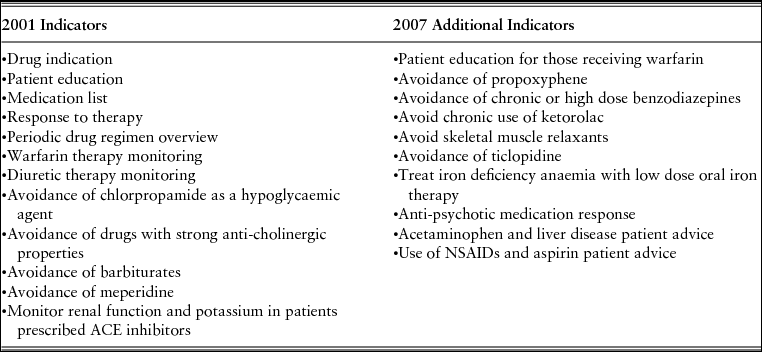
The Assessing Care of Vulnerable Elders (ACOVE) project created a set of indicators designed to measure the quality of care of vulnerable adults in the USA.Reference Wenger and Shekelle78 These indicators go further than identifying a list of medications or classes of drugs to be avoided, since they include indicators for appropriate medication.Reference Knight and Avorn85 A review of these indicators was undertaken in 2007 using the original methodology, and is set out in Table 4. In ACOVE-3 several indicators were added so that, overall, it incorporates 392 quality indicators, comprehensively covering domains of care including screening and prevention, diagnosis, treatment, follow-up and continuity, which can form the basis of interventions to improve care.Reference Wenger, Roth and Shekelle86
Quality indicators for medication use (ACOVE)
Implicit prescribing indicators
Implicit indicators allow clinicians to use information from the patient and published literature to make judgements about the appropriateness of medications. They may allow important factors such as co-morbid diseases and patient preference to be taken into account, but the trade-off is that they are more time consuming and dependent on the knowledge of the clinician. They are based on more generic quality criteria than explicit indicators that are applied using expert clinical judgement.
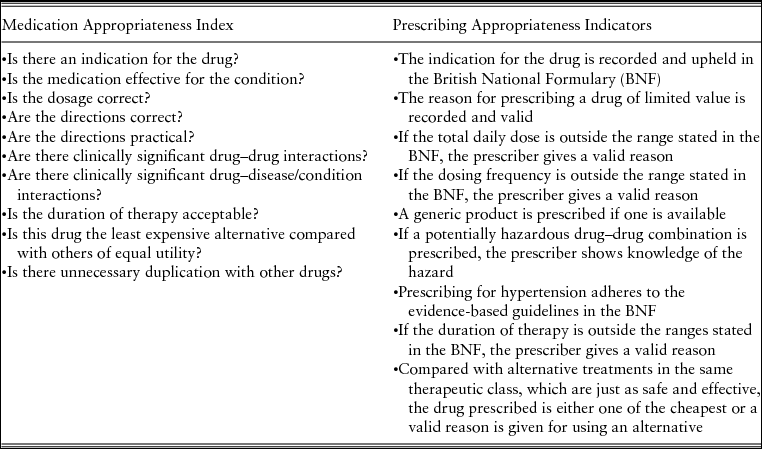
The Medication Appropriateness Index (MAI) is a measure of appropriate prescribing developed in the USA. It is not drug specific, and focuses on individual patients by using ten criteria.Reference Hanlon, Schmader and Samsa77 As an implicit indicator, the MAI requires clinical judgement; however, it also incorporates more explicit instructions that help standardize the process, resulting in good inter-rater reliability and an overall kappa of 0.83. There is evidence to support the reliability of the MAI as an instrument to evaluate medication appropriateness in ambulatory elderly patients and by community pharmacies.Reference Fitzgerald, Hanlon and Shelton87, Reference Kassam, Martin and Farris88 A similar system has been developed by a UK group that produced the Prescribing Appropriateness Indicators.Reference Cantrill, Sibbald and Buetow89Table 5 compares the indicators used in both of these tools.
Criteria used in the Medication Appropriateness Index and the Prescribing Appropriateness Indicators
The Good Palliative-Geriatric Practice Algorithm for drug discontinuation, developed in Israel, has been shown to be effective in reducing polypharmacy as well as in reducing morbidity, including admission to acute care facilities, and mortality in elderly nursing home patients.Reference Garfinkel, Zur-Gil and Ben-Israel90 The group demonstrated a statistically significant difference in 1-year mortality, with a rate of 21% in the study group compared with 45% in the control group.
A feasibility study of the application of the Good Palliative-Geriatric Practice algorithm to a cohort of community-dwelling older patients found that the protocol recommended discontinuation of 58% of prescribed drugs.Reference Garfinkel and Mangin91 Successful discontinuation was achieved in 81%, including non-consent and failures. Of discontinued drugs, only 2% were restarted because of the recurrence of the original indication, and no significant adverse events or deaths were attributable to discontinuation. On a modified Likert scale, 88% of patients reported a global improvement in health and there was some evidence of improvements of cognitive impairment.
It has been suggested that the use of both explicit and implicit criteria together may be more advantageous than either one alone.Reference Lindley, Tully, Paramsothy and Tallis41, Reference Buetow, Sibbald, Cantrill and Halliwell92 In 1998, the National Health Service in the UK initiated the National Sentinel Clinical Audit, which consisted of projects of national relevance within the health service. One of these was to measure the prescribing performance of health care providers nationally by using prescribing indicators. The indicators were developed to identify and improve suboptimal prescribing in older people and fall into three groups: purely descriptive, indicators of potentially harmful or unnecessary prescribing, and evidence-based indicators.Reference Oborne, Batty, Maskrey, Swift and Jackson93 The audit analysed combinations of prescribed drugs, collection of clinical data for corroboration of prescriptions for commonly overprescribed drugs and shortfall of prescriptions for commonly underprescribed drugs. The initial investigation of the use of these indicators demonstrated the ability to improve certain clinical services in relation to prescribing and in a variety of settings.Reference Grant, Batty and Aggarwal94 A disadvantage is that the indicators are dependent on the quality of clinical data and are limited by the standard of documentation in case notes.
Appropriate prescribing towards the end of life
Older patients reaching the end of life are significant consumers of health care and are at increased risk of polypharmacy and ADEs.Reference O'Mahony and O'Connor95, Reference Maddison, Fisher and Johnston96 Unlike the terminal phase of illness, where pharmacotherapy is relatively well defined, there is a much weaker evidence base for the treatment of patients who have not yet reached the terminal phase but have a limited life expectancy of less than 1 year. Frail, older people are usually excluded from randomized controlled trials; therefore trying to apply such evidence to end-of-life treatment may be of limited benefit to the patient and potentially of detriment.
It is of key importance that clinicians recognize patients entering the end-of-life stage and, at this point, carefully review and define treatment goals. A considerable proportion of patients with a known terminal illness continue to take preventative medications for chronic disease until death, despite questionable benefit.Reference Maddison, Fisher and Johnston96 As a general rule, drugs for primary prevention, for example statins, are not appropriate in the treatment of end-of-life patients. The same is true for secondary prevention if the time to therapeutic benefit exceeds life expectancy. The concept of ‘oligopharmacy’, the deliberate avoidance of polypharmacy, has been proposed as a key issue in appropriate prescribing in end-of-life care.Reference O'Mahony and O'Connor95 Algorithms have been created to help guide deprescribing and a systematic approach to the discontinuation of medications has been shown to be feasible and to reduce morbidity and mortality.Reference Garfinkel, Zur-Gil and Ben-Israel90, Reference Garfinkel and Mangin91, Reference Hardy and Hilmer97
When people enter the terminal stage and death approaches, the total number of medications often increases. A study of 260 patients in the palliative phase of their illness found that, as death approached, the mean total number of medications increased by 2.5.Reference Currow, Stevenson, Abernethy, Plummer and Shelby-James98 This increase in prescribing is likely to be largely appropriate due to the increased use of symptoms-specific medications. The prompt availability of medications to manage symptoms is a key aspect of high-quality end-of-life care and it is generally thought that anticipatory prescribing is good practice in the terminal phase of illness. Challenges are encountered by primary and community health professionals related to anticipatory prescribing, including resourcing concerns, professional expertise and experience, as well as professional relationships with patients and other professionals.Reference Faull, Windridge, Ockleford and Hudson99 It is important that such issues are addressed to avoid underprescribing and inadequate symptom control.
Other approaches to enhancing appropriate prescribing
Prescription tools for underprescribing
There are fewer published data on screening tools that measure the under-use of drugs that are clearly indicated and likely to benefit older patients, although explicit criteria have been developed. A study using the Assessment of Underutilization of Medications instrument, in 196 outpatients aged 65 years and older, observed medication under-use in 64% of patients.Reference Steinman, Landefeld, Rosenthal, Berthenthal, Sen and Kaboli100
START (screening tool to alert doctors to the right treatment), mentioned earlier, is an evidence-based screening tool to detect prescribing omissions in older patients, arranged according to physiological systems.Reference Barry, Gallagher, Ryan and O'Mahony61 A systematic literature review was performed, followed by a two-round Delphi process by an 18-member expert panel consisting of hospital consultants in geriatric medicine, clinical pharmacologists, old-age psychiatrists, primary care physicians and senior hospital pharmacists with an interest in geriatric pharmacology, which established 22 evidence-based prescribing indicators for commonly encountered diseases in older patients. Good inter-rater reliability was found, with a kappa coefficient of 0.68.Reference Gallagher, Ryan, Byrne, Kennedy and O'Mahony72
The validated version of START has been applied to the prescription information of 600 patients aged 65 years and above who were admitted to hospital with acute illness. Using the START list, one or more prescribing omissions were found in 57.9% of patients, without any evidence of contraindications.Reference Barry, Gallagher, Ryan and O'Mahony61 In order of prevalence, this included statins for atherosclerotic cardiovascular disease, warfarin thrombo-embolic prophylaxis in chronic atrial fibrillation, angiotensin-converting enzyme inhibitor therapy for congestive cardiac failure, anti-platelet therapy in arterial disease and calcium supplementation for osteoporosis. The probability of omission was related to age, with the highest incidence in the age group older than 85 years (72.2% with one medication omission). The tool was also found to be quick to use, taking less than 3 minutes in the majority of cases.
However, as most of these studies are not linked with health outcome measures, it is difficult to demonstrate that application of these tools results in benefit, in terms of improving morbidity, mortality, hospital admission and quality of life.
Review of drugs and treatment response
The simplest method of reviewing appropriateness of medication is to check the current medication list of an older patient at the time of hospital admission or out-patient appointment. This will identify potential causes of new symptoms that may be drug related, eliminate duplication of therapies and identify potentially dangerous drug–drug interactions.Reference Shrank, Polinski and Avorn101 Drugs that are no longer indicated or are potentially harmful should be stopped or replaced with safer alternatives.
Indication for new treatment should be clearly documented in the notes or in the electronic patient record. It is important to document an appropriate response to a new drug before deciding to continue it. Older patients can have varied responses to a particular drug and are more vulnerable to drug toxicity, which may go unnoticed. They are also more sensitive to certain groups of drugs, such as those with anti-cholinergic properties, tricyclic anti-depressants, anti-psychotics and diuretics, which should be avoided if possible or replaced with safer alternatives. For example, in the treatment of overactive bladder, newer anti-muscarinic agents such as solifenacin have been shown to have comparable efficacy to that of oxybutynin and tolterodine but with a more favourable side-effect profile.Reference Basra and Kelleher102, Reference Hesch103
It is usually important to initiate treatment with a new drug at a low dose and titrate gradually under careful supervision in order to minimize the risk of adverse effects, the so-called ‘start low, go slow’ approach. This is not necessary for drugs with large safety margins and is clearly inappropriate for drugs that have to be given in optimal doses as soon as possible, for example antibiotics.
Most emergency hospitalizations for ADEs are as a result of supratherapeutic effects. A review of adverse-event data for US adults aged 65 years or older found that warfarin was associated with approximately one-third of these.Reference Budnitz, Lovegrove, Shehab and Richards104 Anti-coagulation management services have been shown to improve warfarin control and reduce both thrombo-embolic and bleeding events.Reference Ansell, Hirsh, Hylek, Jacobsen, Crowther and Palareti105 Insulins, oral hypoglycaemic agents and oral anti-platelet agents also account for high numbers of ADEs.
A regular drug review by general practitioners or pharmacists, at least annually, can be useful to discontinue any inappropriate medication and add any necessary therapies. The number of medications that have been prescribed should be reduced where possible. Implementing quality control measures to monitor safe use of medications can be more challenging than implementing tools to identify the use of PIMs.Reference Budnitz, Lovegrove, Shehab and Richards104 Although reducing polypharmacy may lower the risk of ADR, it is necessary to guard against depriving older people of potentially efficacious treatment in the process. This means that a balanced and informed approach needs to be taken, with patient benefit as the key outcome.
Education
Older patients and their carers should be involved in decision-making about drug treatments. The indication, dosing, duration and possible side-effects should be clearly explained. A meta-analysis of trials of interventions to improve medication-adherence has indicated that educational intervention in older patients can improve drug compliance and reduce hospital admission rates.Reference Peterson, Takiya and Finley106 Although no single strategy was found to be superior, educational intervention is thought to improve patients’ knowledge and awareness to identify adverse effects. It has been suggested that clinicians and clinical pharmacists should be used to educate prescribers in the use of drugs by older people, along with age-related changes in pharmacodynamics and pharmacokinetics.Reference Jackson, Mangoni and Batty16
The World Health Organisation (WHO) has produced a guide for good prescribing, which is aimed at medical students and junior doctors.Reference de Vries, Henning, Hogerzeil and Fresle107 This guide offers a six-step approach to aid appropriate prescribing:
• Step 1: evaluate and clearly define the patient's problems
• Step 2: specify the therapeutic objective
• Step 3: select the appropriate drug therapy (use P-treatments – drugs with which the practitioner has become familiar and the effectiveness and safety is considered for each patient)
• Step 4: start the treatment
• Step 5: give information, instructions and warnings
• Step 6: monitor the treatment
Multidisciplinary approach
Involvement of a multidisciplinary team in the care of older patients has been shown to have favourable outcomes in improving the quality of drug treatment.Reference Crotty, Halbert and Rowett108 The team may involve nurse-practitioners, clinical pharmacists and other health professional who can review medication lists from hospital records and out-patient clinics and alert the clinician or the patient about concerns regarding the use of a particular drug. In a randomized controlled trial it was found that periodic telephone counselling by a pharmacist was associated with improved compliance and reduced mortality in patients receiving polypharmacy for chronic diseases.Reference Wu, Leung and Chang109 The counselling involved clarification of treatment regimes, checking drug compliance and advice regarding any potential side-effects of drugs. The pharmacist also reminded patients of their next clinic appointment. These procedures help to maintain appropriate prescribing by reducing risk factors.
Use of information technology
Development of information technology (IT) can alert or remind physicians and pharmacists of potential drug interactions or drug errors and can reduce the chances of medication prescribing errors. One study that used a drug utilization database to integrate computers, pharmacists and physicians demonstrated improved prescribing in older people.Reference Monane, Matthias, Nagle and Kelly110 The authors reported rates of change to more appropriate therapeutic agents that were significantly greater than expected, and as high as 40% for long half-life benzodiazepines. Methods such as computerized provider order entry (CPOE), computerized drug-interaction software, and computerized decision-support systems have been found to be effective in reducing medications errors.Reference Teich, Merchia, Schmitz, Kuperman, Spurr and Bates111–Reference Kuperman, Bobb and Payne114 Such technologies are particularly helpful for those doctors working in acute care environments without enough time to review the list of preventative drugs. Use of electronic patient records supported by computer software technologies can be helpful in avoiding potentially harmful medicines in older patients and reducing ADR. It is important to check and update databases to include new drug information. Drug information software is also used in personal digital assistants and hand-held computers for greater ease and mobility. With the growth in smartphone technology, a diverse range of pharmacology-themed apps has become available.Reference Haffey, Brady and Maxwell115 As well as general prescribing guidance, there is potential for the use of apps to disseminate local prescribing policy. A study analysing the development and implementation of a smartphone application for the delivery of antimicrobial prescribing policy found that clinicians rapidly adopted the app, allowing the policy to reach a wider audience than paper or desktop-based versions.Reference Charani, Kyratsis and Lawson116 There is also a potential role for smartphone apps for patients to help achieve greater medication adherence.Reference Dayer, Heldenbrand, Anderson, Gubbins and Martin117 However, a degree of caution is required by users of prescribing apps due to the frequent lack of information regarding the medical expertise of app developers, evidence-based content and peer review.Reference Haffey, Brady and Maxwell115, Reference Haffey, Brady and Maxwell118 A comparison of the reliability of smartphone apps for opioid conversion found that 52% had no stated medical professional involvement.Reference Haffey, Brady and Maxwell118 It appears clear that stronger than current regulation of medical applications is necessary to ensure patient safety.
Other advantages of the use of IT systems are that they can help reduce errors in prescribing by eliminating poor handwriting and by enhancing record keeping. Furthermore, electronic databases can be used to monitor adverse events on a large scale, for example the National Electronic Injury Surveillance System-Cooperative Adverse Drug Event Surveillance Project in the USA.Reference Budnitz, Lovegrove, Shehab and Richards104 Up-to-date, population representative data on ADEs are important as treatment practices evolve and new safety initiatives are introduced.
By the end of 2009, 25% of all office-based prescribers in the USA were using e-prescribing.Reference Hume, Quilliam, Goldman, Eaton and Lapane119 As part of a study, in a primary care setting with access to e-prescribing, 15 treatment algorithms were developed for clinicians attempting to prescribe PIMs for older patients, offering suggestions for alternative therapies.Reference Hume, Quilliam, Goldman, Eaton and Lapane119 The algorithms were well received by primary care physicians and it was concluded that prospectively identifying older people receiving PIMs and providing feasible interventions may prevent ADEs.
Currently underway is the SENATOR project (Software ENgine for the Assessment & optimisation of drug and non-drug Therapy in Older peRsons), which aims to design and build a software engine with the capacity to optimize therapy and simultaneously minimize ADR, inappropriate prescribing and polypharmacy.120 The intent is to create a system that will evaluate drug interactions and contraindications, assess ADE risk and detect inappropriate prescribing using validated criteria, identify cheapest brands and give specific advice on non-drug therapies. It will also recommend symptom-focused drug therapy and avoidance of drugs unlikely to benefit frailer older people with low 1-year life expectancy.
The efficacy of the SENATOR engine will be tested in a multicentre randomized controlled trial involving 1800 older multimorbid patients hospitalized with acute illness under the care of specialists other than geriatricians.
Conclusion
Prescribing for older people is often complex and challenging. Increasing awareness and practice of appropriate prescribing are likely to lead to benefits in the health of this age group. Evidence suggests that inability to apply existing knowledge to a new and complex situation contributes more often to the occurrence of ADEs in older people than in younger people.Reference Merten, Zegers, de Bruijne and Wagner121 There is also the ongoing problem of the under-representation of older people in clinical trials, which limits the quality of the evidence base for the use of many drug therapies.
Prescribing tools can enhance prescribing practice and can also be used for audit at the health service level. However, the currently available tools have limitations and there remains a paucity of evidence for their benefits in terms of clinical outcomes. An area with particular promise and scope for advancement in the coming years is the development of integrated IT systems and software engines to efficiently aid clinicians in appropriate prescribing. More training of junior medical staff and students in geriatric medicine, with a specific focus on medications, is required, as well as involvement of other health care professional such as pharmacists and nurse-practitioners.
Prescribing indicators and tools should not be used in isolation. Good clinical judgement and an understanding of the patient's overall condition, treatment goals, wishes and preferences remain paramount to providing high-quality individualized care.
Conflicts of interest
None.
Acknowledgements
The authors wish to acknowledge the important contribution of Indranil Mukhopadhyay and Frank Lally who co-authored the original paper upon which this update is based.Reference Mukhopadhyay, Lally and Crome11