Introduction
This article discusses how the power of the door was utilized by Viking Age communities to obtain contact with the dead in the Otherworld, materially and metaphorically. Doors and thresholds are near-universal expressions of social transformation, boundaries, and liminality. The main topic of the article is the practice of echoing domestic architecture, specifically doors, in mortuary contexts in Viking Age Scandinavia (A.D. 750–1050; for an overview of sites mentioned in the text, see figure 1). It is suggested that the door could create an access point between the world of the living and the world of the dead, where the dead could be approached. Creating ritualized doors in mortuary contexts can be understood as one of multiple ritual strategies in a society with diverse cultic traditions, rooted in practice rather than dogma. Interaction with the dead was achieved through ritualized practices, by ritualized bodies, in a highly ritualized environment. Thus the ‘door to the dead’ constitutes an excellent case study for exploring ritualization (Bell Reference Bell1992).
Map of the Scandinavian peninsula, indicating sites discussed in the paper. The grey area represents the core distribution area of grave mounds with south-west portals.

The socio-ritual significance of doors has been sporadically explored in Viking Age research (Andrén Reference Andrén and Andrén1989; Reference Andrén1993; Arrhenius Reference Arrhenius1970; Beck Reference Beck2010). In this article, I aim to expand on previous studies and underline the potential of exploring the door's role as an influential spatial, social and ritual element of Viking Age society. Door and threshold are deep metaphors in almost all sedentary cultures and languages of the world – to paraphrase Lakoff and Johnson (Reference Lakoff and Johnson1980), they constitute metaphors we live by. The near-universal metaphorical significance of the door, while impossible to date, probably developed early in human history, because of the door's vital role as a border between the inside and outside of inhabited space. The door controls access and marks the boundary between antagonistic spaces confronting each other (Bourdieu Reference Bourdieu1977, 130). Yet it is also the architectural element allowing passage from one space to the next. Crossing the threshold means abandoning one space and entering the next, a bodily practice recognized both in ritual and in language as a transition from one social role to another. Doors and thresholds are thus closely linked with rites de passage – the word ‘liminality’ itself stemming from Latin for ‘threshold’ (e.g. Blier Reference Blier1987, 27–29, 150–51; Bourdieu Reference Bourdieu1977, 130–32; Davidson Reference Davidson1993; Lefebvre Reference Lefebvre1991, 209–10; Trumbull Reference Trumbull1896; Turner Reference Turner1977, 94). This does not imply that each and every crossing of a threshold constitutes a liminal ritual – but rather that passing through a doorway is an embodied, everyday experience prompting numerous social and metaphorical implications (cf. Bell Reference Bell1992, 92–93; Bourdieu Reference Bourdieu1977, 90–92; de Certeau Reference De Certeau1984).
The power of doorways and thresholds
The power of a doorway can be, and has been, used consciously throughout history. According to architectural philosopher Simon Unwin (Reference Unwin2007), the doorway is one of the most effective and affective instruments available to the architect; capable of influencing perception, movement and the relationships of agents. The definition of all architecture is, according to Unwin (Reference Unwin2009, 25–34), to identify a place. The exceptional thing about a doorway is that it is simultaneously a place and a non-place. The door stands between spaces, but also connects them.
Doors function in many ways, but this article focuses on three ways doors exert power over their human makers and users. First of all, doors create axes. Doorways are based on the human form, made in the body's image (Unwin Reference Unwin2007, 38). Large portals, frequently used in sacral architecture, can bestow on us a feeling of awe as the body becomes minuscule in comparison to the portal. Human movement and sight create a forward-oriented axis, and the human axis is mobile (Tuan Reference Tuan1977). Doors likewise create an axis, similar to the body, but the doorway axis is physically static. Thus doors create a permanent axial link between two spaces (Unwin Reference Unwin2007, 38–39). This axial link is capable of channelling movement and drawing the gaze of the beholder. Second, simultaneously as the door creates a relation between spaces, it creates an opposition. The door is the physical and symbolic border between space within the door and space outside, and constitutes a fundamental physical manifestation of oppositions. Doors literally create insiders and outsiders. Third, while creating axes (connections) and oppositions (boundaries), door and threshold also materialize a space between. Standing in a doorway one is neither here nor there, but between spaces, or outside space. In short, the power of the doorway lies in its ability to effect and affect our embodied, sensory experience of space and relations.
This article applies the concept of ritualization to the study of doorways. Catherine Bell's (Reference Bell1992) theoretical exploration of ritualization intimately connects practice, ritual and power. As a practice-theoretician, Bell emphasizes the act of performing rituals, instead of what rituals may represent, and argues that ritual is a strategy to distinguish certain social actions from others. A point of departure here is that the archaeological record may materially identify such actions in the past (Bradley Reference Bradley2005, 119–20; Stutz Reference Stutz, Andrén, Jennbert and Raudvere2006; Reference Stutz and Fogelin2008; Reference Stutz2010). Extrapolated from Bell's concept of ritualized actions, the paper uses the term ‘ritualized doors’: real or symbolic doors that are made to be qualitatively distinct from ordinary (though meaningful) doors. ‘Door’ is here interpreted widely, as variations of archaeological features that allude to the concept are included. Thus the ritualized doors discussed are part of a culturally specific strategy to distinguish and privilege mortuary space, or domestic connections with realms of the dead, within the context of the everyday (cf. Bell Reference Bell1992, 74–75). The ritualized door is a translation of the everyday object and architectural feature of the door into new socio-ritual meanings.
Ritualization is driven by a circular reciprocity between ritualized body, spatial–temporal environment and ritualized practices (ibid., 92–93). Creating and using doors to obtain contact with the dead is a process of ritualization where the body (a Viking Age person) engages with its material environment (domestic architecture and doors) through practice (crossing over, walking through). The practice is inscribed in the body (cf Mauss Reference Mauss1979), which builds the ritualized door, which in turn influences the practice. The process leads to a situation where some doors, or doors at specific times, are seen as qualitatively distinct from others, and are used as ritual instruments.
The power of the longhouse
It is impossible to discuss ideas of the Viking Age door without discussing the space to which it leads. The Iron Age longhouse was a central social arena in Scandinavia (Herschend Reference Herschend1997; Reference Herschend1998; Reference Herschend2009, and an important arena for creating and negotiating social status (cf Blanton Reference Blanton, Price and Feinman1995). Houses are highly and reciprocally structuring human phenomena, and frequently have close links to cosmology, world view, and social organization (Bourdieu Reference Bourdieu1977; Carsten and Hugh-Jones Reference Carsten and Hugh-Jones1995; Parker Pearson and Richards Reference Parker Pearson and Richards1994a; Wilson Reference Wilson1988). According to Lévi-Strauss (Reference Lévi-Strauss1987, 156), the material form of the house might represent ‘a veritable microcosm reflecting in its smallest details an image of the universe and of the whole system of social relations’. The longhouse was, throughout the Iron Age, repeatedly amended with spatial innovations, corresponding to ideological, technical and socio-economic changes (e.g. Carlie Reference Carlie2008; Herschend Reference Herschend1993; Komber Reference Komber1989; Løken Reference Løken2001; Norr Reference Norr1996; Schmidt Reference Schmidt1999; Skov Reference Skov1994; Reference Skov and Klapste2002; Skre Reference Skre2001). Alterations of the longhouse would influence and euphemize the increasingly asymmetric power relations of the Late Iron Age. Especially the innovation of feasting halls, the representational space of the rulers, has been seen as a spatial expression of symbolic power with ritual and political overtones (Bårdseth Reference Bårdseth2009; Callmer and Rosengren Reference Callmer and Rosengren1997; Eriksen Reference Eriksen2010; Reference Eriksen2011; Herschend Reference Herschend1993; Reference Herschend1997; Larsson Reference Larsson, Grim and Pesch2011; Løken Reference Løken2001; Niles, Christensen and Osborn Reference Niles, Christensen and Osborn2007; Söderberg Reference Söderberg2005; Reference Söderberg, Anglert, Artursson and Svanberg2006).
Not only aristocratic hall buildings, but also ordinary Viking Age longhouses, had cosmological and ritual connotations (Carlie Reference Carlie2004; Reference Carlie, Andrén, Jennbert and Raudvere2006; Kristensen Reference Kristensen2010; Parker Pearson Reference Parker Pearson, Andrén, Jennbert and Raudvere2006; Paulsson-Holmberg Reference Paulsson-Holmberg1997). Richard Bradley (Reference Bradley2003; Reference Bradley2005) intimately connects ritual with domestic life. Bradley views ritual as emerging from domesticity, where practices of domestic life are extracted and emphasized in a theatrical way. Agrarian and domestic actions, such as ploughing, grinding, cooking, spinning and weaving, had ritual and mythological overtones in Iron Age Scandinavia (e.g. Fendin Reference Fendin, Andrén, Jennbert and Raudvere2006; Fredriksen Reference Fredriksen2002; Gräslund Reference Gräslund, Sundqvist and Nahl2001; Heide Reference Heide, Andrén, Jennbert and Raudvere2006; Welinder Reference Welinder1993). Intriguingly, allusions to these domestic practices are frequently made in mortuary settings (e.g. Kaliff Reference Kaliff1997; Kristoffersen Reference Kristoffersen2000; Reference Kristoffersen and Wedde2004). Social, ritual and economic practices were interwoven in a tapestry that could not be unravelled.
The longhouse could have multiple entrances along the long walls or, more rarely, in the gables. The placement of entrances seems to vary a great deal (e.g. Beck Reference Beck2010). Entrances nonetheless served as important boundaries and access-control points. Controlling access and entry may be a public way of communicating and negotiating social status (Hillier and Hanson Reference Hillier and Hanson1984). On occasion, the performative act of entering the enclosure, the door or the central room of the longhouse may have been extremely ritualized, separating agents in physical as well as social space (Herschend Reference Herschend1998, 37–39, 171). There is limited information on the construction of the door itself – wood has generally not been preserved. Therefore entrances are most often identified in the archaeological record by observing two doorpostholes, oriented in the opposite direction of the longhouse. The two doorposts would have a lintel or crossbeam connecting them into a portal structure (Beck Reference Beck2010, 56–57).
Doors in the written sources
When exploring a metaphorical and material relationship between doors and the dead, it is relevant to examine if there are any connections between the two in the written sources. The relationship between medieval written sources concerning the Viking Age and the material record of the period has been subject to changing academic approaches for some time. From a somewhat uncritical reading of Icelandic sources (e.g. Munch Reference Munch1852) to a critical approach refuting almost any source value (Bugge Reference Bugge1867; Jessen Reference Jessen1862; Weibull Reference Weibull1911; Reference Weibull1918); most researchers today seem to aim at a middle ground (e.g. Andrén Reference Andrén1997; Hedeager Reference Hedeager1999; Reference Hedeager, Andrén, Jennbert and Raudvere2004; Reference Hedeager2011; Lund Reference Lund2009; Price Reference Price2002; Solli Reference Solli2002; Steinsland Reference Steinsland, Jennbert, Andrén and Raudvere2002; Reference Steinsland2005). In general, Viking Age scholars today neither take medieval sagas and poetry at face value, nor disregard their potential insight into 12th–14th-century reflection and commemoration of a not-too-distant past. The written sources reflect a high medieval world view, but at a time where oral traditions stood strong (Bertell Reference Bertell, Andrén, Jennbert and Raudvere2006) and when society, in spite of the conversion and changing political organization, still alluded to their recent pre-Christian past. This article attempts to use written sources as a relational analogy (Wylie Reference Wylie1985), and aims to identify possible homologous metaphors in the archaeological record and in the later texts.
Gateways of the dead
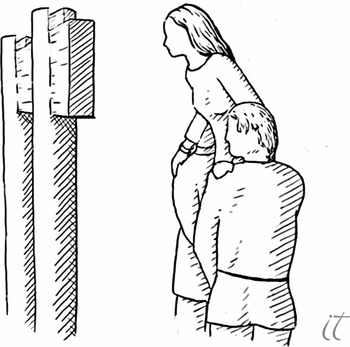
A famous tale of doors in mortuary context should be well known to scholars of the Viking Age: Arabic diplomat ibn Fadlan's eyewitness description of a Viking ship burial on the River Volga in A.D. 922. It should be pointed out that this is not a later, mythological account, but a contemporary text, briefly discussed by Anders Andrén (Reference Andrén and Andrén1989) in connection with Viking Age door symbolism. For an archaeological perspective regarding the source value of Risala, see Price (Reference Price, Whitley and Hays-Gilpin2008a; Reference Price2010, 132–33). Here it suffices to point out that in a complex sequence of rituals leading up to a ship burial of a powerful chieftain, a slave girl is being sacrificed. After having sexual intercourse with the dead chieftain's men, she is led to an open-air construction ‘which looked like the frame of a door’. The girl stands on the palms of the men and is lifted over the door three times (figure 2). The first time she sees her father and mother, the second time all her dead relatives in the realm of death. The third time she sees her dead master with his men. He calls for her, and she asks to be taken to him. The communication between dead and living through the door prompts the final stage of the funerary rites. The doorframe is the central object in this ritual, and is here closely associated with divination – the girl gazes into the world of the dead; and the dead chieftain speaks to her, calls for her.
Vizualisation of a scene from ibn Fadlan's Risala. The slave girl is being lifted over a doorframe three times, in a ritual where she communicates with the dead. Illustration: Ingvild Tinglum, © Marianne Hem Eriksen.

A similar idea of the living being able to communicate with the dead through a mortuary door is found in two poems from the Poetic Edda (oldest known manuscripts from the 13th and 14th centuries). In Baldrs draumar (The Dreams of Baldr), Odinn fears for the life of his son. Baldr is prophesied to die and thus start Ragnarök, the end of the world. Odinn rides to the death realm to seek the advice of a dead völva – sorceress; whom he intends to wake with sorcery (galdr), to ask the fate of his beloved son. Arriving at the hall of Hel, he rides to her grave, placed east of the door. The second Eddaic poem using the same motif is Grógaldr (cf. Arrhenius Reference Arrhenius1970). Grógaldr is a difficult source to use, as the earliest written copy is from Svipdagsmál from the 17th century. However, the poem is written in Eddic metre (Larrington Reference Larrington, Clark and Phelpstead2007, 23), and uses many concepts from pre-Christian mentality, such as sorcery, necromancy and the role of the völva (Davidson Reference Davidson1968, 153–54). In Grógaldr a son wakes his sorceress mother from her grave: ‘Wake thee, Groa, Wake, mother good, At the doors of the dead I call thee’ (author's emphasis). With magic speech the son manages to wake the dead woman behind the door. She then stands on an earthbound stone in the doorway, and gives him advice on how to survive. Thus both poems tell of a dead woman – a sorceress – being buried behind a door, and a man using galdr, magic speaking/singing, to wake the body from the dead, and ask for prophecy.
In several Eddic poems (e.g. Grimnesmål 22) another type of door to the dead is mentioned, called Valgrind, Nágrind or Helgrind. The literal meaning is ‘the gateway of the fallen/bodies/to Hel's realm’. All three can be understood as portals the dead needed to pass through on the way to the death realms. In this particular motif, the door is not used for communication (creating connections), but as a boundary (creating oppositions) and as a transformative architectural feature that the dead need to cross to get to the Otherworld.
Fear of the dead: controlling the thresholds
It may have been of utmost importance that the dead crossed the portal to the death realm properly. The literary sources are full of references to draugr, walking corpses threatening the living (Davidson Reference Davidson1964, 154–57). Liklúker, ‘cadaver doors’ are both a mortuary custom described in the sagas (Eyrbyggja saga and Egils saga Skalla-Grímssonar) and an architectural feature preserved in some of the oldest still-standing houses in Scandinavia (figure 3). Cadaver doors survived into modern times in both Denmark and Norway (Feilberg Reference Feilberg1907; Husetuft Reference Husetuft1933; Solheim Reference Solheim1965), implying a tradition of the longue durée. After death, the relatives perform a practice of closing the eyes, nostrils and mouth of the body – the ‘doorways’ of the cadaver. Afterwards, they cut a hole in the wall – a liklúke – and carry the body out through the hole, instead of through the door. The purpose is to trick the dead so that the body will not find its way back – an attempt to control the threshold to the domestic space. Equally important, perhaps, was to establish that the cadaver no longer belonged within the space of the house. Transporting the dead out through the wall instead of the door seems to be a particularly resistant door practice, which may well have had its roots in a prehistoric world view, as the sagas claim.
Photograph of a liklúke, a ‘cadaver door’, used to transport bodies out of the house. From the late medieval Otnemstova, Selje, now reconstructed and displayed at the Nordfjord open-air museum. Photo: Ole-Marius Kildedal.

Another narrative of how doors were used to deny access to the dead is the duradómr – ‘door-court’ – from Eyrbyggja saga (50–55; see also the Gulating Law and Landnámabók). An Icelandic farm experience severe attacks from haunting dead, and in order to get rid of the dead once and for all the head of the farm summons all the dead to the main door of the farm to hold trial. Through the proceedings, the living dead are vanquished, one by one, and expelled through another door than the one by which they held court. The facts that the trial is held by the main door, and that the dead were expelled through a second door, point to a ritual and judicial significance of the doorway. Both concepts – cadaver doors and door-court – underline the ambivalent relationship between living and dead. At times, people in the Viking Age needed protection from their dead. Several excavated graves show signs of precautionary actions taken toward the dead: by placing stones on the bodies so that they could not rise from the grave, or placing/thrusting spears into the burial (Brendalsmo and Røthe Reference Brendalsmo and Røthe1992, 65–69; Gardeła Reference Gardeła2011; Reference Gardeła2012; Lund Reference Lund2009, 65–69; Reference Lund2013; Nordberg Reference Nordberg2002; Price Reference Price2002, 130–33).
The oldest copies of the written sources are from the high medieval period or later, a time that also included ritualized doors, in particular church portals (Nordanskog Reference Nordanskog2006a; Reference Nordanskog, Andrén, Jennbert and Raudvere2006b). It is therefore a hypothetical possibility that Eddic poetry and Icelandic sagas reflect a high medieval, rather than prehistoric, door symbolism. I find that explanation to be improbable. Sorcery, necromancy and galdr are not concepts easily reconcilable with the medieval, Christian world view. Another possibility is that the content of the sources is a pure medieval construction. This argument approaches the kind of hyper-criticism that was popular in the 19th and 20th centuries. In recent years, archaeological works have pointed out various homologies between concepts from the written sources and the archaeological record (e.g. Gardeła Reference Gardeła2011; Hedeager Reference Hedeager1999; Reference Hedeager, Larsson and Hårdh2002; Reference Hedeager, Andrén, Jennbert and Raudvere2004; Kristoffersen Reference Kristoffersen1995; Reference Kristoffersen and Wedde2004; Myrberg Reference Myrberg2005; Price Reference Price2002; Reference Price2010), indicating that concepts from the texts were expressed through material culture centuries earlier. I will now turn to discussing such a homologous metaphor, a connection between doors and mortuary practice that can also be identified in the archaeological record.
Mortuary architecture: creating doors to the dead
Mortuary practices could vary almost infinitely in pre-Christian Scandinavia (Price Reference Price, Brink and Price2008b; Reference Price2010; Svanberg Reference Svanberg2003). Bodies could be handled, manipulated and buried in numerous ways: no burial, simple pits with cremated bones, urn graves, inhumations with no superstructure, ship settings, elaborate chamber graves, small mounds, large mounds, and extraordinary ship burials. It was argued above that agrarian and domestic practices such as ploughing, weaving and grinding could be ritualized and referenced in mortuary contexts. Likewise, elite graves of the Iron Age and Viking Age frequently allude to feasting and drinking in halls (e.g. Herschend Reference Herschend1997, 49–60) or to the house structures themselves (e.g. Gjerpe Reference Gjerpe and Gjerpe2005b; Løken Reference Løken, Bertelsen, Lillehammer and Næss1987). The hogback stones of the British Isles (figure 4), interpreted as Anglo-Norse objects connected with Viking colonization, are grave markers made in the image of the halls (Lang Reference Lang, Hawkes, Campbell and Brown1984) – possibly constituting ‘a house for the dead’.
A Hogback stone, Viking Age grave marker, from Brompton, Yorkshire. The hogbacks are carved to look like Viking Age hall buildings. After Schmidt (Reference Schmidt1999), with kind permission from Jysk Arkæologisk Selskab.

The main point of this article is that the domestic practice of building doorways and crossing thresholds was evoked in some mortuary contexts of the Viking Age. Indirectly, this underlines the strong influence of domestic architecture on both world view and ritual practice. Doors are capable of both allowing and denying access to the spaces they guard – creating linkages and oppositions – and it seems that the Viking Age populations used ritualized doors to do both – arguably because of their ambivalent attitudes toward the dead. There are several archaeological variations upon the theme of doors to the dead.
Gotlandic picture stones
Birgit Arrhenius explored the phenomenon of symbolic doors in the Viking Age in her groundbreaking article ‘Tür der Toten’ (1970), an article that has inspired the present work, and which I hope to expand on. One type of ‘door to the dead’ studied in more detail in Viking Age archaeology are the Gotlandic picture stones (Andrén Reference Andrén and Andrén1989; Reference Andrén1993; Arrhenius Reference Arrhenius1970). Roughly 450 picture stones are known from the island of Gotland in the Baltic Sea. Type C stones, dated to A.D. 800–1000, are interpreted as memorial stones in honour of the dead (Andrén Reference Andrén1993, 35–36), recent excavations revealing that they can also be placed above the grave itself (Andreeff Reference Andreeff and Karnell2012). Much attention has been focused on the stones’ ornamentation, depicting scenes and concepts from Norse mythology, possibly including scenes from death realms (Andreeff Reference Andreeff, Cornell and Fahlander2007; Andrén Reference Andrén and Andrén1989; Lindqvist Reference Lindqvist1941, 104–7; Myrberg Reference Myrberg2005). The shape of the type C stones is most relevant to the topic at hand. Arrhenius (Reference Arrhenius1970) proposed the interpretation of the stones depicting doors, partly based on the close similarity to the portal of Urnes stave church (figure 5). Anders Andrén (Reference Andrén1993; cf Hållans and Andersson Reference Hållans, Andersson, Andersson, Carelli and Ersgård1997) points out that the placement of the picture stones is highly significant. The stones are placed in transitional zones in the landscape, between infield and outfield, which may correspond to cosmological boundaries of the Viking Age. The picture stones are shaped as doors, and placed at borders in the landscape, doubling the liminal quality. When you add the third component, the stones’ images of heroes and valkyries, it is strongly implied that these memorial stones were ‘doors to other worlds’ (Andrén Reference Andrén1993). A recent study suggests that the last pagans of 11th-century Gotland reused picture stones in graves to allude to older, pre-Christian beliefs (Rundkvist Reference Rundkvist and Karnell2012), placing their dead, quite literally, at the foot of the door (ibid., unnumbered figure at 148).
The Gotlandic picture stones are suggested to be symbolic doors, partly based on the resemblance with the Urnes stave church portal. On the left: the Fröjel Bottarve picture stone, an example of a type C picture stone found in two parts, reused in a cemetery at Fröjel harbour, Gotland. Frottage by Helena Andreeff and Alexander Andreeff, with kind permission. Right: the portal to Urnes stave church from Sogn, Norway. Photo: Micha L Rieser.

‘Bury me in the doorway . . .’
I argued above that written sources could contain motifs also identifiable in the archaeological record. In addition to the two mythical sorceresses interred behind doors discussed earlier, there is a saga episode mentioning doorway burial. Laxdæla saga 17 tells the story of the malicious man, Hrapp, who is constantly tormenting his neighbours. On his deathbed, Hrapp says to his wife, ‘When I'm dead I want to be buried in the kitchen doorway. Have me placed in the ground upright, so I'll be able to keep a watchful eye over my home’. The saga goes on to state laconically, ‘But if it had been difficult to deal with him when he was alive, he was much worse dead, for he haunted the area relentlessly’. The chapter ends with Hrapp being disinterred and moved to a place where he could hurt neither people nor animals.
Astoundingly, the practice of burying individuals in doorways did occur in the Late Iron Age and the Viking Age. Eva Thäte (Reference Thäte2007) discusses house burials in her dissertation on reuse of monuments in Late Iron Age Scandinavia. She identifies a concentration of burials in contemporary or older longhouses, in Rogaland, south-western Norway (figure 6), a burial practice that has been linked with cultural memory, territorial claims, and negotiations over inheritance (Thäte Reference Thäte2007, 118). The first site of house burials, Storrsheia, included two longhouses, each containing a doorway burial. Directly west of the south-eastern entrance to Longhouse 1, a cremation grave with artefacts such as spindle whorl, oval brooch and weaving sword was dug (Petersen Reference Petersen1933, 41–42), meaning that in the Viking Age, after the house was abandoned, a woman was buried by the door of the older house. At the second house at Storrsheia the situation was somewhat different: the longhouse and doorway burial were contemporaneous. The house had only one entrance, to the north. The entrance had been extended to a passageway, possibly with a superstructure, and in the passageway wall a grave was made of rectangular stone slabs. The grave contained a small amount of cremated human bones, and two pieces of whetstone (Petersen Reference Petersen1933, 45). The placement of the grave means that the inhabitants at Storrsheia 2 would walk past the grave (of their ancestor?) each and every time they entered or exited their house.
Longhouses from Rogaland, with burials in, over or close to doorways. From top: Storrsheia 1, Storrsheia 2, Ullandhaug 1, and Ullandhaug 3. The arrows indicate entrances, and the stars the placement of graves. NB drawings are not to scale. Illustrations of Storrsheia after Petersen (Reference Petersen1933), with kind permission from the Institute for Comparative Research in Human Culture. Illustrations of Ullandhaug after Myhre (Reference Myhre and Skår1992), with kind permission.

Not far from Storrsheia is the Migration Period settlement of Ullandhaug. The houses of Ullandhaug contained several younger burials placed within the older houses; I will mention only a few of them. In Longhouse 1, two monumental ship-shaped burial mounds were placed above the ruins of the longhouse. The shapes and size of the mounds imply a date in the Viking Age (Myhre Reference Myhre and Skår1992, 57). One of the mounds was placed neatly inside the walls in the north-west end of the longhouse. The second ship-shaped mound in House 1 was placed so that it centred on – and completely closed – the south-eastern entrance to the house. The excavators did not find a grave in this mound, and it may have been a cenotaph. The placement of the mound is nonetheless conspicuous (ibid., 55–57).
In a second longhouse at Ullandhaug, House 3, a burial was placed directly inside the possible entrance no 7. Forty-two iron nails were found in a concentration, interpreted to represent a wooden casket placed directly on the fire layer, inside the doorway, after the building burnt down (deliberately?) in the sixth century (Myhre Reference Myhre1980, 82–83). Alongside the nails, archaeologists found burnt human bone and an axe dated to the early 9th century (Myhre Reference Myhre and Skår1992, 57–58). Thus, after the fire, a casket filled with cremated bones and an axe was left standing in the door of the ruins of the house.
In addition to the threshold burials from south-western Norway, the extraordinary burial of the so-called ‘Elk-man’ from the central place of Birka in Sweden could be relevant to address. The Elk-man inhumation burial, oriented approximately north–south, consists of two bodies placed over each other. On top, a heavily built man of 20–30 years of age was placed in a cramped position on his side, with one arm behind his back. His right foot was entirely missing, he was buried without any personal artefacts, and he had been decapitated, with the head placed at chest height. The bottom man was placed in a supine position, with the legs bent to the right. A man aged 40–50 years, he was buried with weaponry and beads, and is interpreted to be a semi-professional or professional warrior. A complete, unornamented antler of an elk (Alces alces) was found by the man's head (Holmquist Olausson Reference Holmquist Olausson1990). The entire burial, with the possibly sacrificed younger man, a warrior with weapons and an animal antler by his head, is interpreted as the result of an unusual ritual event at Birka. The animal symbolism represented by the antler could be part of ideas of human–animal transformation (Hedeager Reference Hedeager, Andrén, Jennbert and Raudvere2004; Kristoffersen Reference Kristoffersen2010). Most important to the topic at hand, however, is the fact that the burial was found under the threshold of a Viking Age longhouse (Holmquist Olausson Reference Holmquist Olausson1996; Holmquist Reference Holmquist2011, 224).
There are earlier instances of burials/human depositions in entrances from the Scandinavian areas: at Orred, Sweden, part of a skull was deposited under the stone threshold of a longhouse in the Roman Iron Age (Artelius Reference Artelius, Artelius, Englund and Ersgård1999). In the Migration Period, a find concentration thought to represent two women was found right inside the entrance of a longhouse at Högom, Sweden, the excavator's interpretation being that they were trapped inside the house when it was set on fire through a hostile act (Ramqvist Reference Ramqvist1992). Also in the Migration Period, fragments of two individuals, one male, one female, were deposited between the hearth and the entrance of a longhouse at Vallhagar in Gotland (Gejvall Reference Gejvall and Stenberger1955).
Burying or depositing human remains in the entrance to the house seems to be a sporadic practice. It is impossible to determine whether occurrences of burial in the doorway are all part of the same idea. But from what is known of the general ritualization of doorways, the door is an archetypical boundary and access point to other spheres. On some occasions, it has clearly been meaningful to bury individuals in the entrance – the boundary – to the house. Perhaps the practice was related to the function of the doorway as a between-space, a connection point between worlds of the living and worlds of the dead. The door could constitute a sphere where the ancestors were approachable. Or, as discussed at the end of this article, could this tradition be a spatial expression of deviance?
Echoing door design
Another possible strategy of using doors as instruments to make contact with the death realm was to kindle allusions to domestic architecture in burial contexts. In Arrhenius's article from 1970 the main case study is from Helgö, a small island in Lake Mälaren in Sweden, excavated in the 1950s and 1960s. The Helgö excavations unearthed a Migration Age–Merovingian Period trade and craft production centre with several settlement groups and grave fields and a hill fort. The name Helgö means ‘the holy island’, and emphasizes the strong socio-religious connotations of the site (Arrhenius Reference Arrhenius1970; Arrhenius and O'Meadhra Reference Arrhenius and O'Meadhra2011; Holmqvist Reference Holmqvist1961; Holmqvist and Granath Reference Holmqvist and Granath1969; Zachrisson Reference Zachrisson, Clarke and Lamm2004). Arrhenius's primary focus is on one of the largest Viking Age grave mounds, Mound 30 in Cemetery 116. The mound, 12 metres in diameter, was differentiated from others because of its unusual construction (Arrhenius Reference Arrhenius1970, 384). At the south-west edge of the monumental mound, red sandstone slabs formed a rectangle, filled with tightly packed moraine. Red sandstone was otherwise exclusively found in excavated longhouses on the island (Arrhenius Reference Arrhenius1970, 386). Arrhenius describes this rectangular structure on the edge of the mound as a step or threshold. The threshold was flanked by two large postholes – over half a metre in diameter – with stone foundations. These would be very similar to doorposts in domestic houses. Arrhenius suggests that the threshold, together with the monumental doorposts, formed a literal entrance portal into the grave.
Multiple burials and/or depositions were interred in Mound 30. In the surface layers of the mound, unburnt bone of one or several females was found, in addition to animal bones. Various objects were found in the mound, such as knives, shears, glass, a bronze rod and ceramic shards. The finds were concentrated in the south-west part of the mound, where the main burial was identified, and consisted of large stones covering a cremation layer, a great amount of burnt human bone, two gaming pieces, a gold-foil bead, iron objects and vessel shards (Arrhenius Reference Arrhenius1970, 385). It is unusual to place the main burial at the edges of a mound and not in the centre. However, this would ensure that the burial was placed directly inside the portal, which may have been the point.
Arrhenius connects the Helgö burial with Gotlandic picture stones, rune stones and written sources from various time periods and cultural spheres. She rejects the portal's being used in practice, and argues that it should be understood as an abbreviated form of ‘mortuary house’. As will be discussed, I take a contradictory stand and suggest that ritualized doors may have been used in ritual practice.
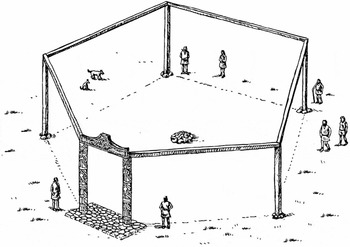
A second Swedish burial portal has been excavated, albeit from a period before the Viking Age. At Åby in Södermanland, Sweden, a large pentagonal monument was located in the south-west of a large grave field. The pentagon consisted of four massive free-standing postholes and, in the south-west of the monument, a rectangular stone setting with two monumental posts. These two posts, with a probable crossbeam lintel (Lloyd-Smith et al. Reference Lloyd-Smith, Nordström, Larsson and Rundkvist2002, 73), are interpreted as a portal leading into the monument (figure 7). In the centre of the pentagon there was a cremation grave. The portal dates to c. A.D. 500, but is interpreted as having stood for ‘a considerable length of time after the monument went out of use’ (ibid., 57). The entire grave field was revisited and reused in the Viking Age, after the main usage period was over (ibid., 72). Thus, even though the Åby portal is older than other archaeological material discussed in this article, I consider it to be such a close parallel that it is part of the same concept.
Suggested reconstruction of the Åby portal. After Lloyd-Smith et al. (Reference Lloyd-Smith, Nordström, Larsson and Rundkvist2002), with kind permission from Arkeologikonsult.

Both the Åby portal and particularly the Helgö portal create intriguing links with the ibn Fadlan doorframe. Although it is not specified in the Risala exactly where the doorframe was set up, it is undoubtedly used in a mortuary context and placed somewhere in the vicinity of the subsequent ship burial. The parallel between the only existing eyewitness description of a Viking Age burial and the archaeological evidence at Åby and Helgö brings further correlation between textual and archaeological sources. Moreover, it is not unusual to find postholes during excavations of grave fields; however, if the features are not part of a clear constructional context they may be overlooked. It is conceivable that the practice of erecting portals in connection with graves is more widespread than previously has been acknowledged.
Entrances and threshold spaces
Other archaeological features in Viking Age mortuary contexts allude to the metaphor of doors to the dead. The so-called ‘south-west portals’, named after their general orientation to the south and south-west, may be relevant in this discussion. Grave mounds with south-west portals are almost exclusively found in the area of Uppland and Södermanland in Sweden (figure 1) – intriguingly, the districts where the portals at Helgö and Åby are located. The south-west portals are open or closed rectangular chains of stone, located on the edge of grave mounds or stone settings. Their size can vary between 0.5 × 0.7 m and 4 × 4 m, and the structures are usually filled with stone or gravel. In a student paper, which is to this date the most extensive work done on south-west portals, Mikael Johansson (Reference Johansson1993) identified 62 graves with south-west portals. In his doctoral thesis on monumental mounds from the Mälar valley, Peter Bratt (Reference Bratt2008) added another 18 grave mounds with south-west portals, bringing the total to (at least) 80 graves. The majority of the south-west portals are empty; a few contain ceramic shards or burnt bones, and a minority contain burials.
Anne-Sofie Gräslund (Reference Gräslund, Christiansson and Hyenstrand1969; Reference Gräslund, Sundqvist and Nahl2001) has argued that these stone rectangles were used as altars for sacrificing food to the dead. Simultaneously as written sources indicate multiple death realms in Norse mythology, there was a seemingly contradicting idea of the dead living in their graves (Davidson Reference Davidson1964; Kaliff Reference Kaliff1997, 22–23; Price Reference Price, Brink and Price2008b). They were called haugbúi, ‘mound-dwellers’. Arrhenius (Reference Arrhenius1970) and Johansson (Reference Johansson1993) have connected south-west portals with door symbolism rather than food sacrifice, partly because of the close resemblance with the Helgö threshold. Four other graves at Helgö – in addition to Mound 30 discussed above – featured south-west portals (Sander Reference Sander1997, 45), although without adjoining postholes. Based on the parallel with the Helgö portal, and following Arrhenius (Reference Arrhenius1970) and Johansson (Reference Johansson1993), I interpret the south-west portals as threshold spaces. They created a spatial contact point between the exterior and the interior of the grave. Doors lead movement and create relations between spaces, it was argued above. Perhaps people offered food and beverages at the ritualized doors, as Gräslund argues, because the threshold space made the dead approachable and created a between-place where the dead and living could communicate.
Geography and orientation of ritualized doors
The south-west portals cluster in a narrow geographical area in eastern Sweden – probably reflecting a regional tradition within the upper strata of society. However, parallel structures can be found in other parts of Scandinavia. Two entrances in the stone kerb of a Viking Age grave mound from Hovet, Aust-Agder, Norway, could constitute doors to the dead. The grave mound has two narrow, but organized, symbolic entrances leading into the mound from the south-west and the north-east. Directly outside the south-west opening, a horse bridle was deposited (Kjos Reference Kjos2009). Likewise, at Kaupang in Vestfold, Norway, one of the mounds had an interpreted southern entrance in the regularly organized kerb (Blindheim and Heyerdahl-Larsen Reference Blindheim and Heyerdahl-Larsen1995, 18–19, 89). The entrances are oriented along a south-west/south or north-east/north axis, corresponding to the orientations of the south-west portals. The vast majority of graves, boats and bodies at Kaupang were oriented north/north-east–south/south-west (Stylegar Reference Stylegar and Skre2007).
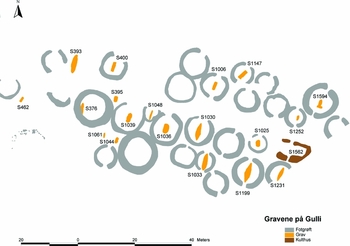
Moreover, the phenomenon of causewayed ring ditches encircling grave mounds (‘land bridges’) is a widespread mound feature in Scandinavia. In a student paper, Britta Z. Geschwind (Reference Geschwind2005) points out that in Sweden the land bridges constitute a Viking Age phenomenon, and are generally oriented to the south-west, again indicating a link to the south-west portals. Although no exhaustive study has been undertaken in Norway, the same pattern may be indicated; causeways in ring ditches are frequently, though not exclusively, oriented south-west, north-east or both, creating south-west–north-east axes through the mounds (e.g. Gjerpe Reference Gjerpe2005a, 14; Rødsrud Reference Rødsrud and Bårdseth2007; Rønne Reference Rønne and Gjerpe2008). The causeways in the circular ditches delimiting the grave mound can arguably be related to the idea of a passageway or threshold leading into the grave (Lund Reference Lund2009, 256–57), and may have been used as walkways leading onto the mound space (figure 8).
Map of a boat grave field at Gulli, Vestfold County, Norway. The structure S1562 on the right is interpreted as a mortuary house. Note how the boats and the causewayed ring-ditches are generally oriented along a north-east–south-west axis. After Gjerpe (Reference Gjerpe and Gjerpe2005b), with kind permission from the E18 project/Lars-Erik Gjerpe, Museum of Cultural History, University of Oslo.

Hence the Helgö portal, the Åby portal, the south-west portals and many causewayed ring ditches are all oriented along an approximate south-west–north-east axis. The emphasis on this axis in burials from wide areas of Scandinavia has to my knowledge scarcely been discussed, and is difficult to interpret. One explanation is that it is connected with the idea of Hel's realm – one of the death realms – lying to the north (e.g. Davidson Reference Davidson1968; Gurevič Reference Gurevič1969; Parker Pearson Reference Parker Pearson, Andrén, Jennbert and Raudvere2006). When approaching a south-west portal, one would be directed northwards or north-eastwards – towards the direction of the dead. Another possibility is that the direction may be related to the passage of the sun. In a completely different context, Parker Pearson and Richards (Reference Parker Pearson, Richards, Parker Pearson and Richards1994b) point out that the south-west orientation of the Neolithic passage grave at Maeshowe would be aligned with the setting midwinter sun. Perhaps the ritualized doors of the Viking Age were oriented towards the northern European sunset? This is an area where further research is required. Ultimately, the key point here is that the ritualized doors are generally aligned along an approximate south-west–north-east axis, and their alignment, in my view, supports the argument that they are part of a similar idea.
Discussion: embodied engagement with ritualized doors
Doors exert power over humans in many ways, it was argued above. Three of them were creating axes (connections), creating boundaries (oppositions) and creating between-spaces. Although the ritualized doors discussed above are not complete parallels, I suggest that an overarching symbolism is at work. In order to obtain some sort of relationship between the world of the living and the Otherworld of the dead, which possibly exist on different spatial and temporal planes, the dead could be placed in the doorway space itself, or a ritualized door could be built between them. The ritualized door could take the form of a symbolic threshold, an opening in a kerb or a causewayed ring ditch, or it could be a literal portal of posts, erected at the edge of the grave or in the open landscape. These practices were some of many mortuary strategies in an eclectic and non-dogmatic belief system.
Creating axes: connections
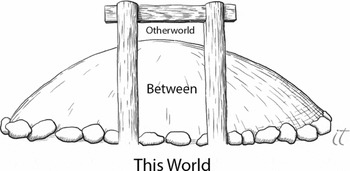
The door created a relation between the realm of the living and realms of the dead. Ritualized doors and thresholds created an axis connecting the grave and the surrounding landscape. Figure 9 is a stylistic visualization of how ritualized portals may have looked, based loosely on the portals from Helgö and Åby. The illustration demonstrates how the ritualized door creates an axis and an access point – or even entry point – to the space of the dead. Perhaps the door space – the south-west portal or an erected doorframe – was used to communicate with loved ones, like the son in Grógaldr receiving prophecy and advice from his mother, and the doorframe in the ibn Fadlan narrative was used to open communication between the slave girl and the chieftain in the death realm. Possibly, the veil between worlds was perceived as thinner, or even lifted, inside the door space.
Stylistic visualization of how portals on the edges of mounds may have looked, and associations they may have prompted. The illustration attempts to communicate how the door can simultaneously signify connection, opposition and a space between. Illustration: Ingvild Tinglum, © Marianne Hem Eriksen.

Yet the nature of the communication at the door does not seem to be of an everyday character. Written sources indicate that the dead possessed powers and secret knowledge that could be passed to the living through ritual practice and necromancy. One of these rituals was útiseta – sitting on a mound, or underneath a hanged man, to gain prophecy and esoteric knowledge from the dead (Davidson Reference Davidson1968, 184, 99; Solli Reference Solli2002, 137–38). On the topic of hanged corpses, it is worth briefly noting that gallows have a structure similar to portals: two posts with a crossbeam or lintel. Gallows constitute a between-space on several axes: first, the dead body would be suspended in the air, only connected to the rope, not touching the earth or the sky. Second, the body would be aligned with the doorframe, which would encompass and frame the body, placing it between on a horizontal scale. Perhaps gallows were another type of ritualized doorway of the dead?
Ritualized doors may have created a connection point for divination and acquisition of esoteric knowledge. Although speculative, yet following the contemporary report of ibn Fadlan, it is possible that people would attempt to communicate with the dead at ritualized doors in mortuary contexts, although such practices would leave little archaeological trace. People aspiring to communicate with or gain knowledge from the dead could perform actions such as walking through, standing inside or being lifted above various types of ritualized doors. Additionally, archaeological evidence indicates that at some portals the living would, in some sense, share a meal with the dead. In front of Gotlandic picture stones, charcoal and animal bones have been found – plausibly the material remains of ritualized meals taking place by the stones (Andrén Reference Andrén1993). Likewise, south-west portals have been interpreted as altars for food offerings, where food and drink were sacrificed to the dead (Gräslund Reference Gräslund, Sundqvist and Nahl2001). Food sacrifice could constitute a shared sensory experience between living and dead, creating a connection to dead ancestors.
Creating boundaries: oppositions
Although contact with the dead was possible and at times aspired to, the delimitation of grave mounds, ring ditches and portals may express opposition: the dead belonging in a differentiated space. The written sources discussed above contained examples of people trying to control the thresholds between worlds. The ritualized door in figure 9 demonstrates how the doorway qualifies and differentiates both the inside and outside spaces, corresponding to Bell's statement that the ritualized environment is qualified and differentiated from other environments (Bell Reference Bell1992, 74, 88–89). The mound space is intuitively experienced as different because of, first, the delimitation of the mound and, second, the ritualized door which physically manifests opposing spaces. An agent standing in front of a monumental grave mound with a door to the dead would conceivably experience the space on the other side of the portal as different, sacral, exclusive or Otherworldly – and clearly differentiated from this side.
Other forms of practice expressing boundaries and transition can be imagined. Building a ritualized door may be part of the mortuary ritual itself. I suggest that the portals at Helgö and Åby may have been used during burial rites, possibly by carrying dead bodies through the portal. A ritual practice of carrying a body through a grave portal or over a threshold could constitute a fundamental materialization of a rite de passage – a transformation of the individual from one social state to another (Gennep Reference Gennep1960). As there are multiple burials in, e.g., the Helgö mound, this opens for repeated use of the portal. It is tempting to draw lines to the aforementioned mythological concepts Valgrind, Nágrind, Helgrind. Did Viking Age people erect a material version of the gateways of the fallen/bodies/Hel in order to ease the passing of the dead to the death realms? Or, perhaps, is the gateway of the written sources a memory of an old ritual practice?
Creating spaces between: expressions of deviance?
The dead may belong neither in the here-and-now of this world, nor in the world of the dead. This sense of betwixt and between may be understood as a manifestation of liminality (Turner Reference Turner1967). Some mortuary practices discussed in this paper can be interpreted as placing the dead in liminal spaces. As stated earlier, standing in a doorway one is neither here nor there, but between spaces, or outside space. It is noteworthy that a folkloristic belief recorded in Sweden states that you should never stand in a doorway supporting your arms on the doorframe – filling the between-space – as this would ‘bring death into the house’ (Hagberg Reference Hagberg1937, 46).
Burials in doorways, and burials in thresholds to grave mounds, may be understood as strategies for expressing ‘spatial otherness’ (cf. Reynolds Reference Reynolds2009, 206–7). Why were some individuals buried neither here nor there, but between? Eva Thäte (Reference Thäte2007) and Leszek Gardeła (Reference Gardeła2012) have recently explored deviant burial in the Viking Age. Thäte (Reference Thäte2007, 266–67) points out several indicators for deviant burial in Viking Age contexts: marked variations of orientation within a grave field; deviant body positioning; and deviant treatment of cadavers such as decapitation, tied limbs, placing knives on the body and stoning the body. Yet bodily manipulation is not the only indicator of ambivalence: placement of bodies can likewise be seen as aspects of deviance. Parker Pearson (Reference Parker Pearson1999, 15) argues that ‘distinction between normal and deviant individuals can . . . be expressed spatially’. In his doctoral thesis, Peter Bratt briefly discusses the phenomenon of burial in the south-west portals discussed above, stating that burials here would place the dead ‘on the threshold to the death realm’, between the world of the living and the world of the dead. He concludes that this interpretation is unconvincing, arguing that it was immensely important to provide the dead with a proper funeral and thus prevent them from haunting the living (Bratt Reference Bratt2008, 95–96). I disagree with Bratt. Burial practices could vary almost infinitely in the Viking Age, and multiple strategies for procuring a proper death were acknowledged. Gardeła (Reference Gardeła2012, 88), critiquing the term ‘deviant burial’ on the grounds of the heterogeneity of Viking Age mortuary practices, points out that ‘brutal treatment of the cadaver may not necessarily reflect that the particular people were regarded as malevolent during their lives, but rather signal fear of what might become of them after the moment of death’ (ibid., 316).
Burying an individual on the threshold to the grave, or in the doorway of a house, may have been a practice relevant for particular individuals. The research material may indicate such an interpretation. In the written sources discussed above the individuals so closely linked with burial in the doorway display deviant aspects. The mother buried behind the door in Grógaldr is a sorceress – as is the unnamed völva buried behind the eastern door in Baldrs draumar. Hrapp from Laxdæla saga is apparently not a magical practitioner, but he is a malicious character, constantly attacking and tormenting his neighbours. The Birka Elk-man is interpreted as a powerful individual, buried with elk antler and a decapitated man under the threshold of a longhouse. Thus it is a clear possibility that some of the buried individuals discussed in this paper were considered deviant, either connected to power, sorcery, and witchcraft, or transgressors against rules of social conduct. Perhaps they were trapped in a transitional phase between living and dead on purpose, as a protective act, or as punishment? Or perhaps, as indicated above, they had qualities of divination and prophecy, and the spatial context of the door would allow for the living to still communicate with these powerful individuals.
Concluding remarks
This article intended to explore Viking Age practices of using ritualized doors in mortuary architecture. Ritualization presumes an embodied experience within a symbolically structured environment. In this case, we have a (possibly ancient) metaphorical meaning of the door as a boundary, a physical expression of liminality. This expression of liminality was sensed and used by Viking Age agents in order to create points of access between worlds of the living and worlds of the dead. In the archaeological record, there are diverse practices alluding to a connection between the door and the dead: erecting door-shaped picture stones in boundary spaces; traditions of burying the dead in entrances; erecting portals and thresholds leading into burial mounds; and including openings and causeways aligned along a south-west–north-east axis, creating ritualized doors into spaces of the dead. At the gravesites, ritual practices of some form conceivably took place. I have suggested a few types of possible embodied engagement with the mortuary architecture, such as walking through the portals, lifting a living person or body over the threshold, or sharing a meal with the dead.
Through the power of the door as creator of axes, oppositions, and a between-space, it has been suggested that the door encompassed simultaneously an intimate relationship and an opposition between living and dead populations. Moreover, the ritualized door created a space between life and death, perhaps spatially expressing liminal aspects of the dead. The power of doorways and thresholds is a fusion between embodied experience and symbolically structured environments. The door to the dead arguably resonated on multiple levels of understanding, belief, and practice – perhaps even on a level of emotion – in Viking Age Scandinavia.
Concurrently, the usage of the door as a ritual instrument displays the profound significance of the house for ritual behaviour in the Viking Age. The domestic space of the longhouse, and its boundaries, served as excellent metaphors for mortuary and ritual practices – a topic that opens for new discussions on Viking Age ritual behaviour. Ultimately, the liminal nature of the door made it an ambiguous place where it was possible to, through ritual practices, connect the intimate space of the household with worlds lying just beyond the reach of the here-and-now of the everyday.
Acknowledgements
This article springs from an ongoing Ph.D. project at the Department of Archaeology, History and Conservation at the University of Oslo, where I am currently employed as a Ph.D. Research Fellow. I am indebted to the following people who have read and commented on various drafts of the text: my present and former supervisors Lotte Hedeager, Andrew Reynolds, Julie Lund and Per Ditlef Fredriksen, as well as members our postgraduate writing group: Lars Aas, Elise Neumann and Lene Os Johannessen. Individuals and institutions granted permission to reproduce images, and in a few cases procured new images for me; I am very grateful. I also wish to express my gratitude to the two anonymous reviewers for their thorough reading of the article, which I believe substantially improved the paper. Needless to say, all mistakes remain my own. Last, but not least, I wish to extend heartfelt thanks to associate editor of Archaeological dialogues Liv Nilsson Stutz, for encouraging me to pursue publication on this topic.