Decontamination of surgical instruments to prevent postoperative infections is a challenge in healthcare facilities.Reference Dancer, Stewart, Coulombe, Gregori and Virdi 1 , Reference Southworth 2 Many attempts have been made to improve the effectiveness of instrument cleaning,Reference Rutala, Gergen and Weber 3 – Reference Evangelista, Santos, Stoianoff and Oliveira 5 as well as to determine the level of initial contamination in used instruments.Reference Nyström 6 – Reference Rutala, Gergen and Weber 9 Methods to assess the efficacy of cleaning have also been evaluated.Reference Nayuni, Cloutman-Green, Hollis, Hartley, Martin and Perrett 10 – Reference Carter, Krüger and Schmidt 12
It is the task of healthcare professionals to update the cleaning methods for new equipment such as robotic surgical systems. These systems enable surgeons to handle tissues or organs meticulously in circumstances of restricted movement in laparoscopic surgical procedures.Reference Tan, Ashrafian and Scott 13 , Reference Wehrl and Michels 14 However, simultaneously, hospital staff in central sterile supply departments are troubled by the reprocessing of robotic instruments because they cannot be disassembled for cleaning like other endoscopic instruments.Reference Wehrl and Michels 14 , Reference Ayliffe 15 Their complex structure impairs brushing the inner surface of narrow lumens, resulting in failure to remove contaminants. Furthermore, there is no standard for the assessment of cleanliness of robotic instruments.Reference Deshpande, Smith and Smith 16 Accordingly, supportive conditions, such as cleaning methods, should be established around surgical instruments along with the advancement of technology. 17
There is limited information available on the effectiveness of cleaning processes for robotic instruments. The aim of this study was to assess the level of residual contamination of instruments for robotic surgery and to develop a method to evaluate the cleaning efficacy for complex surgical devices.
METHODS
Instruments Evaluated
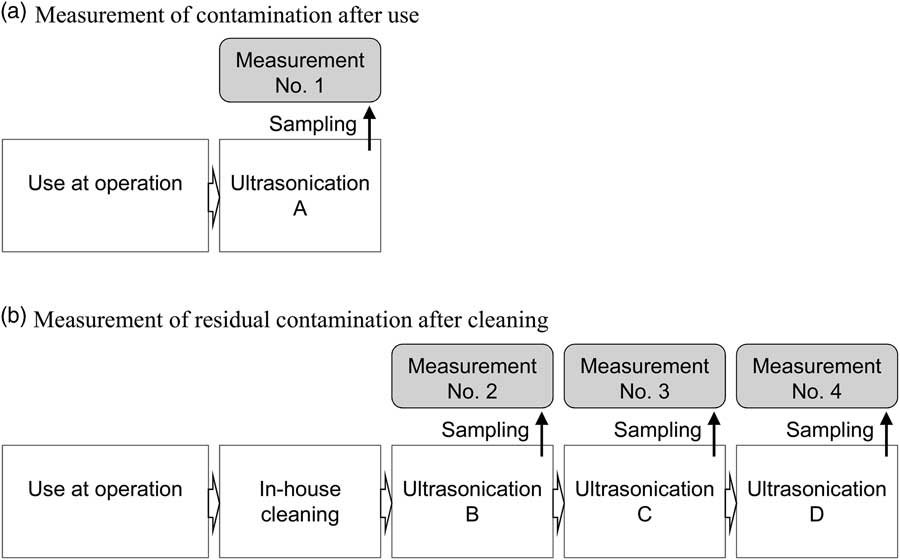
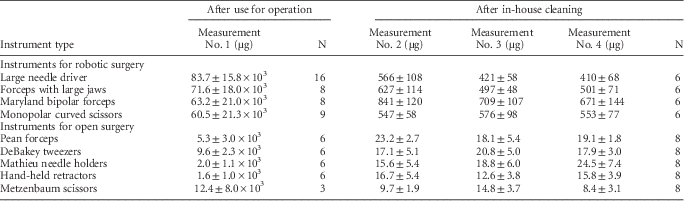
This study was performed from September 12, 2013, through June 24, 2015. We analyzed 41 surgical instruments for robotic surgery (da Vinci Surgical System; Intuitive Surgical) used in 7 cases of radical prostatectomy and 2 cases of anterior resection of the rectum, and 27 instruments for open surgery used in 1 case of gastrectomy and 2 cases of colectomy. They were collected immediately after operation to determine the level of contamination (Table 1). The cases were chosen from class 2 (clean-contaminated) surgical procedures performed in the same study period. Open colectomy was arbitrarily chosen as a counterpart of robotic anterior resection of the rectum. We collected another 24 robotic instruments and 40 ordinary instruments for measurement of residual protein after in-house cleaning (Figure 1).
Procedures of cleaning and sampling for measurement of residual protein on instruments. (a) Instruments were collected just after use at operation. Measurement was performed just once. (b) Instruments were collected after in-house cleaning. Measurements were performed 3 times by sampling after completion of each ultrasonic cleaning procedure. In-house cleaning for robotic instruments consisted of processes of manual brushing and 15-minute ultrasonication with enzymatic detergent, whereas that for ordinary instruments consisted of 5-minute ultrasonication, 10-minute spraying with alkaline detergent, and 10-minute disinfection at 93°C.

Amount of Protein Released From Instruments in Study of Residual Contamination of Instruments for Robotic Surgery in Japan

NOTE. Data are presented as mean ± SEM.
Cleaning Process
In-house cleaning of robotic instruments was conducted using a manual procedure with ultrasonication in accordance with the manufacturers’ instructions. It included brushing the outer surface of the instruments while moving the instrument wrists through their full range of motion, 15-minute ultrasonication with enzymatic detergent, flushing the lumen via flush ports using a water gun, and rinsing the entire instrument. In-house cleaning of ordinary instruments was conducted using washer-disinfectors. It included 5-minute ultrasonication, 10-minute spraying using alkaline detergent, and a 10-minute disinfection process at 93°C.
Evaluation Methods
Each robotic instrument was put in a plastic bag and flushed with 200 mL of sterile water via 2 flush ports. The bag was immersed in an ultrasonic sink so that the whole instrument was below the water level. After 30-minute ultrasonication, the protein concentration was measured using a bicinchoninic acid assay kit (Micro BCA Protein Assay Kit; Thermo Fisher Scientific), which is one of 2 comparable methods reported in the literature and available in our laboratory.Reference Wehrl and Michels 14 For the measurement of ordinary instruments, the same procedure was performed except for the use of 10 mL of water and 15 minutes of ultrasonication. The measurements of residual protein after in-house cleaning were repeated 3 times. After each measurement, the instruments were drained of water, blotted well, and put into another plastic bag. The plastic bags were replaced between measurements. The ratio of removed protein to initial protein was used to calculate the efficacy of cleaning.
Analysis of Protein Release
We hypothesized that the rate of decrease of the amount of protein released from instruments was proportional to the total residual protein stuck to the surface of the instruments. This means residual protein would decline along an exponential curve. The curves were determined using the least squares method. In this model, the total amount of residual protein was calculated as the area under the fitted curve.
We compared the pattern of change in the amount of protein released from the instruments in serial measurements, which would be derived from differences in the types of instruments—that is, instruments for robotic surgery and those for open surgery. Data were adjusted before comparison on the basis of the weight of instruments, for standardization.
Statistical Analysis
Statistical analyses were performed using JMP Pro11 (SAS Institute). The t test was used for comparisons. P<.05 was considered significant.
RESULTS
Residual Protein Release From Instruments
After use for operations, robotic instruments were contaminated with 72.3×10³ µg protein/instrument and ordinary instruments with 5.5×10³ µg protein/instrument. There was a significant difference in contamination between them (P<.0001).
Protein release was 650, 550, and 530 µg/instrument in robotic instruments, versus 16, 17, and 17 µg/instrument in ordinary instruments, in measurement No. 2, 3, and 4, respectively. There was a significant difference in each measurement between robotic and ordinary instruments (P<.0001). The efficacy of cleaning was 97.6% for robotic instruments and 99.1% for ordinary instruments.
Pattern of Protein Release
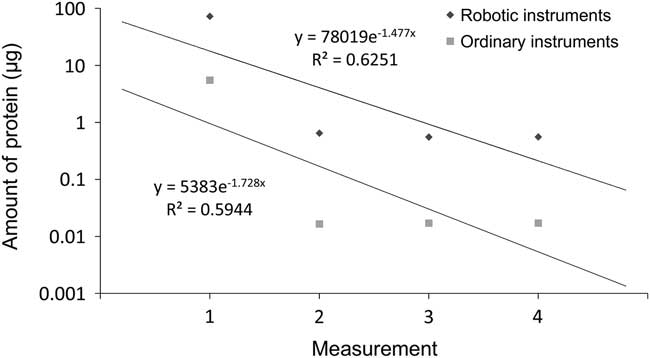
The equation of the fitted curve for protein release was determined as
 $$y=78019\,{\rm e}^{{{\minus}1.477x}} \,({\rm R}^{2} =0.63),$$
for robotic instruments and
 $$y=5383\,{\rm e}^{{{\minus}1.728x}} \,({\rm R}^{2} =0.59),$$
for ordinary instruments, where y is the amount of protein release and x is the number of measurements (Figure 2). Accordingly, the estimated total amount of residual protein was 2.8×10³ µg for robotic instruments and 98 µg for ordinary instruments.
Exponential decline in amount of residual protein on robotic instruments. The amount of residual protein after ultrasonication declined along exponential curves, which appear as straight lines with a logarithmic scale on the y-axis.

There were 3 distinctive patterns of protein release. A declining pattern was observed for needle drivers, forceps with large jaws, and Maryland bipolar forceps. A constant pattern was observed for ordinary instruments. An inverted V-shaped pattern was observed for monopolar curved scissors.
DISCUSSION
The present study showed that it was hard to remove residual contamination from robotic instruments, even after meticulous cleaning in accordance with the manufacturers’ instructions. The protein release remained comparatively high, although it gradually decreased during serial ultrasonication. Our data are supported by a previous report showing residue on the surface of surgical instruments by scanning electron microscopy.Reference Baxter, Baxter and Campbell 18
Our results also demonstrated an exponential decline of protein release from robotic instruments. It might be necessary to establish a new standard for cleaning instruments that uses repeated measurements of residual protein, rather than a single measurement.Reference Carter, Krüger and Schmidt 12 , Reference Wehrl and Michels 14
Several patterns were identified in the serial measurements. We assumed that the patterns would reflect the complexity of the instrument structure, such as a simple structure showing a flat or sinking pattern and a complex structure showing an inverted V-shaped or rising pattern. Our model using pattern analysis could provide a novel approach to assess structural complexity of instruments in relation to whether or not they are easy to clean.
The greater protein release and lower cleaning efficacy of robotic instruments were caused partly by their complex structure, which could not be disassembled to brush the inner surface of lumens.Reference Lucas, Nagaraja, Gordon and Hitchins 19 The structural features for cleaning would have been given lower priority than the function for surgery.Reference Lucas, Nagaraja, Gordon and Hitchins 19 , Reference Saito, Yasuhara, Murakoshi, Komatsu, Fukatsu and Uetera 20
There are some features of our study that need to be addressed. The duration of ultrasonication in preparation before measurement was shorter with ordinary instruments. More protein might have been released if they had been ultrasonicated for a longer time. However, there were still significant differences between robotic and ordinary instruments even if twice as much protein had been released, according to the ratio of the time duration compared with that of robotic instruments (2.0=30 minutes/15 minutes). We believe the difference in cleaning duration would not have influenced our conclusion.
In this particular study, the robotic instruments were cleaned using a manual procedure with ultrasonication. New washers with International Organization for Standardization certification and equipped with a specific cleaning function for narrow canals are appearing on the market. The results may vary depending on the type of washers.Reference Alfa, Nemes, Olson and Mulaire 21 Further study should be conducted using these washers with improved cleaning efficacy.
We are not aware of the extent to which contaminated instruments would be associated with adverse events in patients. Because there are few reports of postoperative infections caused by failed decontamination, we have to recognize that there might be a considerable volume of insufficient cleaning or occult surgical site infections.Reference Dancer, Stewart, Coulombe, Gregori and Virdi 1 , Reference Southworth 2 This relationship should be studied as a future project.
In conclusion, the present study indicated that it is virtually impossible to completely remove contamination from robotic instruments by manual cleaning in accordance with the manufacturers’ instructions. The level of contamination declined exponentially during the course of serial ultrasonication processes but never reached zero. The pattern of protein release differed according to the type of instrument, reflecting the complexity of the structure or difficulty in cleaning. A new standard for the cleaning of complex surgical instruments needs to be established, especially for those used in robotic surgery.
ACKNOWLEDGMENTS
Financial support. Japan Society for the Promotion of Science Grants-in-Aid for Scientific Research (grant JP25860477).
Potential conflicts of interest. All authors report no conflicts of interest relevant to this article.