Most discussions in late precolonial Andean archaeology have focused on what might be called major entities and their related objects: from gods in religion to rulers in politics. Although this focus may have allowed for the development of clear definitions of major divinities and types of sociopolitical organization in the late precolonial Andes, it has led to the neglect of detailed and critical explanations of the forms, functions, and names of minor entities and objects. But major entities, in the Andes and elsewhere, can only be fully explained by paying attention to their component parts; that is, minor entities. Correlating forms, functions, and names to propose definitions or concepts is a fundamental exercise in narrating the past, but it is a topic that is particularly underdeveloped for the late precolonial and early colonial periods in the Andes, despite a recent flourishing of material culture studies among Andeanists. This limitation is especially evident with respect to minor objects or entities, which usually have been assumed, incorrectly, to be uniform across time and space in the Andes. Therefore, while it is necessary to improve the definitions and concepts applied in Andean archaeology, it is also imperative to improve the methodology used to construct these definitions by incorporating cultural and geographic diversity into the explanations of minor entities and objects. Building upon the critique of a linguist who claimed that scholars have been proposing definitions of Andean entities without exerting even a minimum of linguistic care (Cerrón Reference Cerrón2008:9–10), I suggest that in the case of objects (material culture), truly interdisciplinary definitions are lacking. By this, I refer not only to basic linguistic standards but also to elemental archaeological methods used to relate functions, shapes, and contexts.
With respect to precolonial Andean objects, assumptions about the relationships between the three features of form, function, and name have generally been based on ethnographic data from the southern Peruvian Andean region without taking into account regional, altitudinal, or latitudinal variability within the Andean world. These limitations partially stem from the fact that a significant number of valuable ethnographic monographs produced between the late 1970s and early 1990s were on specific villages in southern Peru (Supplemental Text 1). Because of their high quality, but also for political and linguistic reasons, these monographs have had an enormous impact on Andean studies in the anglophone academy, resulting in a southern Andean bias. Archaeologists who have worked in the central and north-central Andes frequently use these monographs as their main references, ignoring, perhaps intentionally or because other studies are less visible, intra-Andean variability (see the observations of Pärssinen Reference Pärssinen1992:305; Ramón Reference Ramón2008:16; Urbano Reference Urbano1999:xciii, xcvi, xcviii). Following this critical approach, this article presents a study of a single Andean object: a peripheral and ignored kind of ushnu, an object documented in the seventeenth century. Such an analysis shows that minor objects can be indispensable for understanding and narrating late precolonial and early colonial contexts while being attentive to cultural and social variability in the Andes. Building on previous scholarship, I will also propose a typological approach to the ushnu, useful for explaining any other material item from the Andes, from precolonial times to the present.
Research Objectives and Documentary Sources
This article discusses a broad issue using a specific case. The broad issue is the association of objects (their forms and functions) with names in late precolonial and early colonial Andean archaeology. Typically, historians (and linguists) come across terms used for certain objects in colonial documents, but in general neither the scholars nor the documents pay close attention to physical aspects such as shape or function. Conversely, through excavation or exploration of museum collections, archaeologists handle objects whose names or functions are not always well defined in the Andean literature. In both cases, in order to advance a variety of research questions, the standard procedure has been to analogically survey three main sources of information: early colonial documents, twentieth-century ethnography, and the (precolonial) archaeological record (Ramón Reference Ramón2008:7– 16).
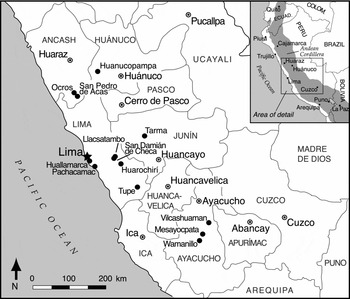
The specific case analyzed here is the single mention of the word husno recorded in the Huarochirí Manuscript (HM).Footnote 1 This document was produced circa A.D. 1608 and compiles myths and ritual practices of a territory situated in the province of Huarochirí, in the south-central highlands of Lima, Peru (Figure 1). Currently held in the Spanish National Library in Madrid (No. 3169), this manuscript belonged to the priest Francisco de Ávila from the parish of San Damián de Checa, Huarochirí. The information recorded in the document was likely requested by Ávila of the local Indian authority (curaca) and scribe, Cristóbal Choquecasa from Checa, to learn more about local religious lore in order to eradicate it in an effective manner. Durston (Reference Durston2007:227–228) attributes to Choquecasa not only the transcription but also the authorship of the HM. The Quechua of the HM is the lengua general (sensu Taylor Reference Taylor2000a [1990]:41–42), which was an official colonial Quechua adapted from a southern Andean dialect of Cuzco origin, although it contains many localisms, or orthographic adjustments related to the local Quechua. Choquecasa was trained in the lengua general and used it to transcribe the information collected from local informants (Durston Reference Durston2007:234–236). The HM is unique in Andean colonial literature because its 31 chapters have been translated into seven languages (Dutch, English, French, German, Latin, Polish, and Spanish), making it possible to confront the different—at times very dissimilar—translations provided for specific terms, and thus show the complexity of correlating names and objects in early colonial sources for the purpose of archaeological interpretation. The HM contains two supplements not included in Trimborn's first translation (Reference Trimborn1939) or in Galante's (Reference Galante1942). The missing section of Trimborn's first translation was published separately in Reference Trimborn1941. In the case of the ushnu, while many colonial documents describe its late precolonial and early colonial uses, including its locations and shapes, the HM is special, as it is the only (currently known) reference that includes information about the conditions associated with the making of an ushnu. Moreover, and of significance to this study, no previous analysis of the ushnu has discussed its reference in the HM in detail.
Some Central Andean locations mentioned in the text. (Map by M. Bell.)

Archaeological Forms and Ethnographic Functions
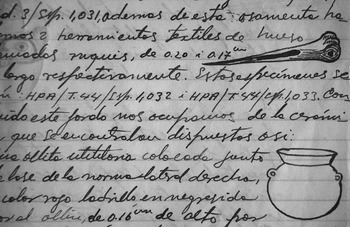
Before analyzing the specific case of the HM ushnu, a brief discussion of formal and functional ascription is necessary (Salmon Reference Salmon1982). Three cases from Andean precolonial archaeology inform the perspective adopted in this article. The first two help us build our approach; the third shows another option that has been important in Andean studies. The first comes from Jorge Zegarra's notebooks on his excavations of the Middle Horizon and Late Intermediate period contexts at the site of Huallamarca, Lima, in 1958 (Zegarra Reference Zegarra1958). In this document, Zegarra frequently associates forms, functions, and names (including Quechua names) when describing the precolonial artifacts. For instance, when dealing with the content of Tomb 44, he describes objects under number 1029 as “46 needles of various sizes made out of wood like chonta with two pointy ends and 6 pushcas .” Later in the same document Zegarra describes objects 1032–1033 as “two textile tools made out of bones called ruquis, of 20 and 17 cms [in length].” Putska is defined as “spinning device” by Parker and Chávez (Reference Parker and Chávez1976), and ruqui as “the bone with which they make a textile more compact [hueso con que tupen]” by González Holguín (Reference González Holguín1952 [1608]; Figure 2).
Identification of artifacts: the textile tool called ruqui. Detail from Jorge Zegarra's notebooks on his excavations at the site of Huallamarca, San Isidro district, Lima. (Museo de Sitio Puruchuco, Lima; photo by G. Ramón.)

The second case appears in Morris and Thompson's (Reference Morris and Thompson1985:18) book on their excavations at the Inca site of Huanucopampa, Huánuco. Here, when project members were grouping all excavated bones together, a local worker, Teodocio Herrera, noticed that several of the bones were actually weaving tools. Being a weaver, Herrera demonstrated how to weave a poncho using these artifacts. His observations allowed for the reclassification of those bones as weaving tools and—given the frequency of these artifacts throughout Huanucopampa—certain areas of the site came to be associated with textile production. Thus, the functional ascription of one tool through ethnographic analogy had important implications for the interpretation of the entire site.
The third case comes from Lumbreras (Reference Lumbreras1984), who wrote about the relation between function and form, particularly the distinction between function (as structurally linked to form) and use (as something more occasional). For instance, we could say that a cup's function is to contain liquids, but we also recognize that the cup could be used to trap an insect or to store beans. Although this proposal has been influential among Andean scholars, Lumbreras suggests that the archaeologist “who intends to classify objects beginning from the infinite possibilities of use that each of them could have, starting, for that purpose, from ethnographical analogies or logical discourses of any kind, is only creating great confusion about the classified materials,” concluding that this muddles “the essential with the phenomenical” (Lumbreras Reference Lumbreras1984:3; emphasis added). Following Lumbreras's reasoning, it is not necessary to pay attention to cultural difference related to regional variation of uses. Classifications would merely tell us what we already know, even if this were contradicted by cases such as the two that have been cited, in which functional attribution was only possible because of ethnographic analogies.
The three cases discussed above are a small representation of a long-running discussion in Andean archaeology on how to associate forms, functions, and names. This sort of inquiry began with the work of Uhle (Reference Uhle1903:70, Figure 99) at the archaeological site of Pachacamac, Lima, which demonstrated the functions of the Late Horizon gourds used as containers for the lime used in coca chewing. Probably the most remarkable study of this kind is by Duviols (Reference Duviols1979) on stone stelae (huancas) using early colonial documents and ethnographic evidence. Duviols's research extended from the interpretation of the object's function to the definition of the broader concept, recognizing its potential intra-Andean variability (Supplemental Text 2). Importantly, Duviols considered the relation between ecological settings and social and cultural changes in the distinction between quechua and puna when analyzing material culture and objects mentioned in historical and ethnographic sources. The quechua level, usually between 2,500 and 3,800 m asl, is particularly suitable for cultivating grains such as maize. The puna ecological level, the highest with permanent human occupation, is generally above 3,800 m asl and is characterized by grasslands mostly devoted to herding, with limited agriculture (on the limits between those ecological levels, see Ramón Reference Ramón2008:46–48, Reference Ramón, Meddens, Willis, McEwan and Branch2014:26). In Andean studies, the huari (farmer, sedentary, villager) are recognized as the typical inhabitants of the quechua and the llacuaz (herder, transhumant) as those of the puna (Duviols Reference Duviols1973). The HM is mostly written from a quechua setting, and the llacuaz is identified as other in the text (chapter 19). Thus, the application of ethnographic analogy (considering uses as local functions) allows us to identify cultural variability within a larger region such as the Andes.
Taken together, the three cases discussed above demonstrate how the application of ethnographic analogy (i.e., considering uses as local functions) can be used to identify cultural variability within a larger region, such as the Andes. My approach to the ushnu draws on this foundation, as well as the three philological operations followed by Taylor (Reference Taylor2000b [1974]:1–2) for translating the HM. First, he uses dictionaries and grammars dating from the period of the HM to perform a comparative dialectological study. Second, he examines all the available documentation on the rites described in the HM, mainly from the Huarochirí region, to better understand them. Similarly, for the ushnu, I reviewed all the available ethnographic and historical sources that included any variant of the term and the archaeological literature that deals with that subject. Third, assuming that some lexical peculiarities disappeared with the language of the HM, Taylor tried to identify the meanings of some obscure terms by isolating and comparing their contexts. In this study, I consider the husno the obscure object to be defined. Taylor (Reference Taylor2000b [1974]:1, note 1) also indicated that some passages of the HM are difficult to understand because of the “blind acceptance” of either the traditional values attributed to some Quechua terms since Christian evangelization or the meanings of these terms in the better-known Quechua dialects. In the case of the husno, besides these two issues, we also need to deal with the influence of Zuidema's definition, which is discussed below.
The examples of Huallamarca and Huanucopampa tell us about the everyday strategies used in Andean archaeology to articulate forms, functions, and names. While the archaeologists working at Huanucopampa used and incorporated the weaver's suggestion after research was already underway (explicit ethnographic analogy), Zegarra combined archaeology and ethnography from the outset, applying names (and functions) to artifacts based on his ethnographic knowledge, albeit without always referencing the source material for his attributions (implicit ethnographic analogy). An ideal procedure—which I try to follow here—would be one of explicit and systematic ethnographic analysis. This would mean incorporating all the available ethnographic and historical information in the project design, including documentation of the sources of the analogies (Perelman and Olbrechts-Tyteca Reference Perelman and Olbrechts-Tyteca1989:570, 571, 575).
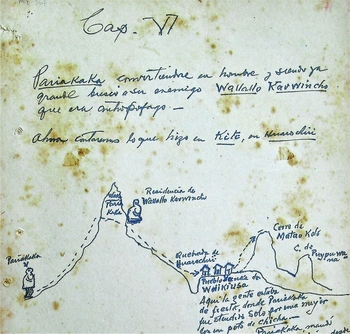
Situated between three epochs—pre-Inca, Inca, colonial—and given its extraordinary narrative content, the HM is particularly attractive as a source for an examination of how concepts are shaped over time, and yet it presents singular difficulties. The earliest direct precedent for the present inquiry is the research by the archaeologist Toribio Mejía. Between 1941 and 1943, Mejía (Reference Mejía1943) produced two Spanish translations of the HM; they included several graphics to clarify spatial and material aspects of the stories and characters (Figure 3). Unfortunately, Mejía never finished or published this innovative exercise (see also Szemiñski ca. Reference Szemiñski1988). More recently, other authors have discussed references to material culture in the HM: for example, Estenssoro (Reference Estenssoro2003:323–332) on rromano and Salomon (Reference Salomon, Salomon and Urioste1991) on a coin. This kind of study of objects goes beyond disciplinary limits and is prompted by research questions that may only be answered by combining approaches from ethnography, history, archaeology, and linguistics. Building on such previous work, this article investigates the form and function of the husno made by members of the Checa community (llacta) as they searched for the material manifestation of a sacred being (huaca) called Llocllayhuancupa, as described in chapter 20 of the HM.Footnote 2
Graphic interpretations of the Huarochirí Manuscript by Toribio Mejía: Pariacaca and Wallallo Carwincho. (Archivo Histórico Riva Agüero, Lima; photo by G. Ramón.)

Defining Ushnu: Structural and Typological Approaches
In an exercise comparable to Duviols's (Reference Duviols1979) huanca study, Zuidema (Reference Zuidema and Burga1989a [1980]) sought to define the ushnu (see also Zuidema Reference Zuidema and Burga1989b [1977/1978], Reference Zuidema2004, Reference Zuidema2010, Reference Zuidema, Meddens, Willis, McEwan and Branch2014). Two years before his classic work on the topic (Reference Zuidema and Burga1989a [1980]), Zuidema published an article on “shaft tombs” (Zuidema Reference Zuidema and Burga1989b [1977/1978]) in which he proposed a link between those structures and the ushnu. The link, which was key to his concept of ushnu, is based on a single documental reference from Ocros, a village situated in the current department of Ancash (Hernández Príncipe Reference Hernández Príncipe and Duviols2003 [1621]). In that document, the ushnu is defined as an arcaduz: a water conduit or pipe (“de un usnu, que es un arcadus, que deshicimos en este lugar”; Hernández Principe Reference Hernández Príncipe and Duviols2003 [1621]:745).Footnote 3 Besides that mention, all of Zuidema's assumptions in his article (Reference Zuidema and Burga1989b [1977/1978]) regarding that link are based on comparisons: he used documents that do not include either the term ushnu or arcaduz and documents that include one term but not the association between the two elements. Building on the link, Zuidema's main essay on the topic (Reference Zuidema and Burga1989a [1980]) employs early colonial and ethnographic evidence to explain the precolonial concept of ushnu. Its arguments have oriented most, if not all, subsequent archaeological studies of that subject (see, among others, Meddens Reference Meddens1997; Meddens et al. Reference Meddens, Willis and McEwan2014; Monteverde Reference Monteverde2010; Pino Reference Pino2004, Reference Pino2005, Reference Pino2010).
Zuidema began by making chronological and regional distinctions, but unlike Duviols, he completely disregarded altitudinal, latitudinal, and typological nuances. He established two main distinctions, a chronological one, between the pre-Inca and Inca ushnu, and a regional one, between what happened in imperial Cuzco and other areas of Tahuantinsuyu. In addition, Zuidema distinguished between what early colonial writers saw in that city (and were able to describe) and the observations of those who came later. Each of these distinctions is crucial for understanding the ushnu in colonial sources such as the HM. Because the testimonies of early authors in Cuzco are useful for understanding the Inca world, but not necessarily the pre-Inca ushnu, Zuidema (Reference Zuidema and Burga1989a [1980]:419–425) turned to ethnography. In Tarma, Junín, in the 1970s, ushnu was described as a place where the ground absorbs water (Adelaar Reference Adelaar1977:370–371, 488). According to Zuidema, this natural or almost culturally unmodified element was transformed by the Incas through adding other (structural) elements, such as the platform, at sites outside the city of Cuzco (Zuidema Reference Zuidema and Burga1989a [1980]:452–453, Reference Zuidema, Meddens, Willis, McEwan and Branch2014; cf. Farrington Reference Farrington, Meddens, Willis, McEwan and Branch2014). The early colonial authors described the ushnu in the center of the imperial capital using various terms, including escaño, fuente, pilar, or pila (bench, fountain, pillar, font). It was situated according to astronomical alignments. In light of this formal variety, Zuidema (Reference Zuidema and Burga1989b [1980]:420) suggested a conceptual definition of the ushnu as an axis mundi, a communication point between several spheres (the celestial sphere, the surface of the earth, and the underground). The ushnu was akin to Rome's mundus, “the most sacred place, a central place, a hole opened once a year” (Zuidema Reference Zuidema and Burga1989b [1980]:453, Reference Zuidema2004:223). Given that Zuidema cited Rykwert (Reference Rykwert1985:54–55) to define mundus, it is worth mentioning that this Polish architect indicated that besides the central mundus in Rome, there were others, including some devoted to specific deities, such as the mundus for Ceres, an agricultural deity (see Coarelli Reference Coarelli1983:199–226; Deubner Reference Deubner1933).
Two questions arise with respect to Zuidema's production of definitions of precolonial and early colonial artifacts. First, why should the ethnographic material from the second half of the twentieth century be assumed to be equivalent to the pre-Inca? When discussing the ushnu, Zuidema (Reference Zuidema and Burga1989a [1980], Reference Zuidema and Burga1989b [1977/1978], Reference Zuidema, Meddens, Willis, McEwan and Branch2014) suggested a link between the ethnographic and the pre-Inca data but did not explain the reasons that justify the analogy. Second, how should intra-Andean ethnographic variety, or synchronic difference, be handled? While Zuidema was correct that it is useful to compare, when relevant, precolonial and ethnographic data, what should be done when there is wide variability within the ethnographic record, such as the different definitions of ushnu in Supplemental Text 3? Like Lumbreras, Zuidema focused on commonalities, and his writing does not incorporate meaningful differences resulting from ethnographic evidence. It is necessary to keep these questions in mind when dealing with the husno of the HM.
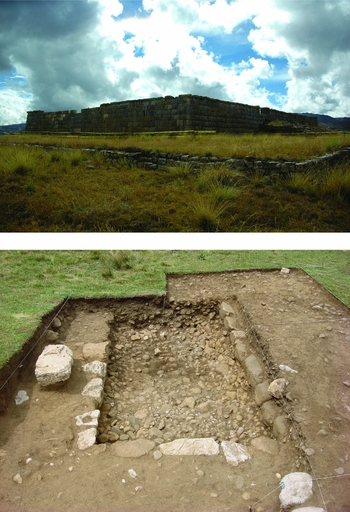
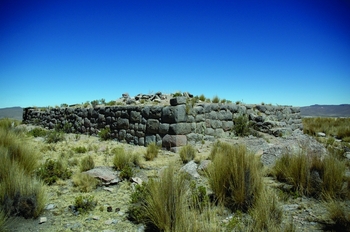
Zuidema's main audience has been archaeologists, who usually follow a less sophisticated definition of ushnu than that given above (but see Moyano Reference Moyano2013; Pino Reference Pino2004, Reference Pino2005). The typical archaeological definition of the Inca ushnu has not centered on the hole or perforation in the earth (the arcaduz), but rather on the platform above it (Hyslop Reference Hyslop1990:70; Tello Reference Tello1939:643, 707). For Zuidema (Reference Zuidema2004:223), the hole was a diagnostic feature for the platforms: “In order to use the name ushnu, the hole must be looked for; if it exists, it is more likely to be one [an ushnu].” In this sense, the ideal case of the ushnu is a platform with a relatively small perforation in the central part of the top level, like the one at Huanucopampa (Figure 4; see also Monteverde Reference Monteverde2010:60), some of the platforms located in the puna of Ayacucho, like Mesayocpata, a village in Circamarca, province of Víctor Fajardo, and Wamanillo, a village in Putaccasa, province of Huancasancos (Figure 5; Ramón Reference Ramón2009:112, 125, 127; Supplemental Text 4). Zuidema (Reference Zuidema and Burga1989b [1980]:448, 451) discussed the iconic step-pyramid of Vilcashuaman, Ayacucho. In this Inca site, the ushnu was not placed in the step-pyramid, but to one side, marking a tangible difference between these elements (see image and diagram in Zuidema Reference Zuidema, Meddens, Willis, McEwan and Branch2014:7). As will be shown, despite this valuable remark, the platform has had notable influence on the definition of ushnu, including some translations of the HM. Even if an exhaustive formal inventory of what archaeologists call ushnu is still lacking, it can be said that the most common shape is the simple or double platform, while step-pyramids (three or more levels) are rare (see the images in Cavero Reference Cavero2010; Meddens et al. Reference Meddens, Branch, Vivanco, Riddiford, Kemp and Staller2008:327–339; Monteverde Reference Monteverde2010:49; Moyano Reference Moyano2013; Oberti Reference Oberti1997:17; Ziółkowski 2008:134–135).
Top: Platform at the center of the Inca site of Huanucopampa, Dos de Mayo province, Huánuco department. (Photo by G. Ramón.) Bottom: Perforation for offerings at the top of the platform. (Photo by J. L. Pino.)

Platform at Wamanillo, village of Putaccasa, Víctor Fajardo province, Ayacucho. The stones on top of the platform are placed in a circular pattern, probably related to recent interventions at the site. (Photo by G. Ramón.)

Since most archaeologists have identified ushnus based on the presence of a platform, it is relevant to ask whether it is possible to find an ushnu from the Late Horizon without a platform. How might one be identified in the archaeological record? Only one case, the site Ruinas de Chada in central Chile, has been documented to date. For this site Ruano (Reference Ruano2012) and Moya- no (Reference Moyano2013:44, 284–294) suggest the presence of an ushnu based on a hole with astronomical alignments but without a platform. Recent approaches to defining the concept and shape of the Inca ushnu sensu lato suggest the possibility of diverse ushnu categories or types. In 2009, I proposed the distinction between capac ushnu, related to major Inca sites, using liberally a term mentioned by Juan Santa Cruz Pachacuti Yamqui (Reference Pachacuti Yamqui, Duviols and Itier1993 [1613]:245), capac usno, and yllapa ushnu, related to those small platforms in the puna of Ayacucho, referring to a term mentioned by Cristóbal de Albornoz (Reference Albornoz and Millo- nes1996 [1584]:287) for the same area. The distinction was based on several features, such as size, location, and potential relation with specific sacred entities (Ramón Reference Ramón2009:115, 117, Reference Ramón, Meddens, Willis, McEwan and Branch2014:170–173, Table 15.1). In the same way, Moyano (Reference Moyano2013:60, note 37) proposed quilla ushnu [moon ushnu] for the Collasuyu region, incorporating a latitudinal variable to the typological approach. More recently, Meddens (Reference Meddens and Bray2015:244–252) distinguished three types: capac ushnu platforms, ushnu platform pilgrimage sites, and isolated ushnu platform sites. This typological emphasis has made possible localized discussions about specific terms such as yllapa usno, which has already been interpreted in at least two different ways (Pino Reference Pino2010; Ramón Reference Ramón2009:115–117, Reference Ramón, Meddens, Willis, McEwan and Branch2014).
It seems productive to continue with this typological approach, which allows us to recognize commonalities and variability. More important than the types themselves (or their names) are the criteria used to establish them. Therefore, we must consider the relation between political hierarchies and certain formal and functional features of the ushnu as well as the ecological levels in which they are situated. The ecological location of an ushnu is crucial for defining it because in the Andes these levels are linked to different ways of living, different subsistence strategies, and consequently to different pantheons (Ramón Reference Ramón2009, Reference Ramón, Meddens, Willis, McEwan and Branch2014:168–170). This typological procedure also allows us to stop associating every ushnu exclusively with the sun by default, as Zuidema and his followers tended to do. This is an unfounded assumption, as I have suggested regarding the puna (Ramón Reference Ramón, Meddens, Willis, McEwan and Branch2014), just as it is for cases such as the husno from the HM, as will be shown below. Chapter 22 of the HM includes an explanation of the relation between ecology and pantheons that helps us to consider more options for association when dealing with the husno that was made while looking for Llocllayhuancupa: “It is said, that when the Ingas were in the highlands, they adored the Sun in its sanctuary of Titicaca saying: ‘This is who transmitted the vital force to us the Ingas.’ When they were in the lower lands, they adored Pachacamac saying: ‘This is who has transmitted the vital force to us the Ingas’” (Taylor Reference Taylor and Acosto1987:329; emphasis added).
This situation, which is also found in other early colonial sources, is a case of negotiation in political and religious terms. Andeanist literature has examined how the Incas imposed themselves and left their imperial imprint; few studies detail how they adapted themselves, or how the local communities impacted the Inca. What material consequences prompted the shift from worshipping the Sun to worshipping Pachacamac? What happened in the intermediate territories between the high and low lands? A category and an object so well studied as the ushnu could give us some clues in this respect, since it allows for mapping difference.
A Wandering Huaca
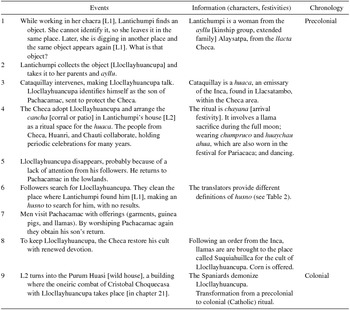
Chapter 20 of the HM deals with the husno made by the Checa while searching for the huaca Llocllayhuancupa in a chacra (agricultural field) of a member of their community named Lantichumpi. This community is located in an intermediate place both geographically and politically. San Damián de Checa's center is situated at approximately 3,230 m asl, within the quechua.Footnote 4 This husno was placed in a territory where the Inca, the Sun, Pachacamac (as a deity and as a center of political power), and the divinities of the puna, such as Pariacaca, were all present. How does the husno reflect these complicated conditions? The HM provides information about the appearance, disappearance, vanishing, and return of Llocllanhuaycupa, the son of Pachacamac; this information is summarized in Table 1.
Sequence of Characters and Actions Related to the Husno, Chapter 20, Huarochirí Manuscript.

Note: Plot based on Arguedas (Reference Arguedas and Duviols1966), Salomon and Urioste (1991), and Taylor (Reference Taylor1980, Reference Taylor and Acosto1987).
The sequence in Table 1 includes five significant details. First, L1 and L2 are completely different places, the chacra and the cancha (corral or patio) at Lantichumpi's house, respectively. Second, after the initial incident, L1 is only mentioned once. The rest of the story mostly happens in L2. The ritual center is L2, where the combat between Choquecasa and the demonized huaca (Llocllayhuancupa) occurs. Third, the husno is made in L1, but Llocllayhuancupa is not found there, so the Checa go down to Pachacamac to continue their search. Fourth, in political terms, this sequence describes the arrival of the new llactayoq or marcayoq, the local deity, who is subordinate to a major one, his father Pachacamac, already officially adopted by the Inca. Llocllayhuancupa was a deity linked to floodwaters and Pariacaca's nephew (Taylor Reference Taylor and Acosto1987:295, note 10). This data places him in a geographic middle point. Fifth, regarding chronology, two main periods are represented: precolonial and colonial. It is even possible to further divide the precolonial period according to Inca imperial presence. The huaca Cataquillay, who facilitates communication between the Checa and the new huaca, is an Inca emissary. A stronger imperial presence is felt when the Inca issues a direct order impacting the ritual for Llocllayhuancupa. At this point, if we want to visually represent the husno, we know its location (a chacra), but not its precise shape.
Shaping an Husno
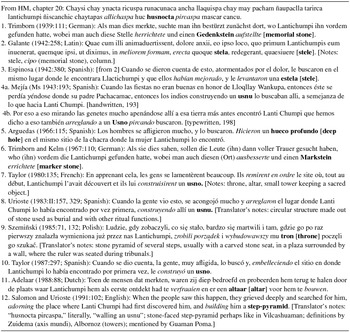
What was the form and function of the husno that was made while looking for Llocllayhuancupa? To answer these questions, it is necessary to compare the 13 available translations of the text (on the translations, see Hartmann Reference Hartmann1981; Itier Reference Itier1994; Taylor Reference Taylor1982; Salomon Reference Salomon, Salomon and Urioste1991; Table 2). Among these alternatives, which is the most accurate translation? The enormous interpretative differences among the translations show that the topic exceeds linguistics, due to formal, typological, and even conceptual differences that have significant consequences for reading this entire chapter of the HM. The significance of the HM in Andean studies means that the definition of the word husno would impact discussions about the religious and political elements of this Quechua term (ushnu) more generally. The following section explains the commonalities and differences among the translations.
Comparison of Translations of the Huarochirí Manuscript, by Author and Year.

Note: Translations of husno are in bold; translations of the verbs allichaspa and pircaspa are in italics.
Retaining the Quechua Term
Both of Mejía's (Reference Mejía1943) translations use the terms usnu or usno. Mejía initiated the strategy that Taylor (Reference Taylor1980, Reference Taylor and Acosto1987; usno) followed in both of his translations, as did Urioste (Reference Urioste1983; usnu). I am using two translations by Taylor (Reference Taylor1980, Reference Taylor and Acosto1987). It must be mentioned that he included minor changes at the beginning of the phrase in his 1999 and 2008 versions, but the actual term remained untranslated in the main text. His definitions in the notes did, however, change. This option makes the term adaptable to diverse definitions, but the meaning of the sentence where the term occurs changes depending on whichever definition of ushnu is chosen.
Formal Definitions
Trimborn assumed husno to be a stone on the surface of the ground; he rendered it as “memorial stone” (Gedenkstein) in his first translation (1939) and “marker stone” (Markstein) in the second (Trimborn and Kelm Reference Trimborn and Kelm1967). Galante (Reference Galante1942), who used the word stela, followed the same idea, also likely inspired by González Holguín's definitions of usnu (Reference González Holguín1952 [1608]): “Judge's tribunal made out of a stone placed in vertical position. . . . Mojon [marker stone] made of a big stone in vertical position.” In his translation, Galante kept many Quechua words for key concepts such as huaca (Durston Reference Durston2014:330), but he had no doubts about the translation of husno. Espinosa (Reference Espinosa and Galante1942) simply translated the Latin term stela (from Galante's version) into Spanish (estela). After Trimborn, five of the other translators defined husno in formal terms: four using early colonial sources (in their main texts: Salomon and Urioste [Reference Salomon and L. Urioste1991] and Szemiñski [Reference Szemiñski1985]; in their notes: Salomon and Urioste [Reference Salomon and L. Urioste1991], Szemiñski [Reference Szemiñski1985], Taylor [Reference Taylor1980, Reference Taylor and Acosto1987], and perhaps Urioste [Reference Urioste1983]). Only one translator (Arguedas Reference Arguedas and Duviols1966) probably used ethnographic evidence. The most spectacular extremes of this group are “deep hole” (Arguedas Reference Arguedas and Duviols1966) and “stone pyramid of several levels/step-pyramid” (Salomon and Urioste Reference Salomon and L. Urioste1991; Szemiñski Reference Szemiñski1985).
Functional Definitions
Adelaar (Reference Adelaar1988) translated husno as “altar,” a religious structure, probably derived from Santo Thomas (Reference Santo Thomas1951 [1563]), Anonymous (1951 [1586]), and Bertonio (Reference Bertonio1984 [1612]). Szemiñski (Reference Szemiñski1985) proposed “throne” (literally: place where the ruler sits), which is perhaps a bit more political and borrowed from Guaman Poma (Reference Guaman Poma1980 [1613]:265). Both senses were also included in a note by Taylor (Reference Taylor1980) in his French translation (“throne, altar, small tower that holds a sacred object inside”). At first glance, “altar” seems like the most sure, neutral, and economical solution, since it avoids formal aspects, alluding only to function: a sacred space of connection with a divinity. Moreover, remembering the beginning of Bertonio's (Reference Bertonio1984 [1612]) elegant definition (“Altar of the guacas”), this fits well with the idea of an altar for Llocllayhuancupa. Nonetheless, I do not propose this definition as the best option for the HM. The second definition (throne) is probably the hardest to support, because its main proponent associates it with a specific form: the stone pyramid of several levels (Szemiñski Reference Szemiñski1985; see Table 2). A decade after publishing his translation of the HM, when discussing the prayer of Manco Capac reproduced by Pachacuti Yamqui, Szemiñski (Reference Szemiñski1997:65, 67) translated capac osnoyki as “royal usnu.” He added that usnu could be “throne,” “but it was a stone construction and not an armchair,” and quoted González Holguín's definition, which does not support the step-pyramid shape, nor the function as a throne.
Four years before Szemiñski, Itier (Reference Itier1993:66, 141) translated the same prayer of Manco Capac, assuming “throne” for capac osnoyki. Itier added that in this case, ushnu did not designate the precolonial ritual structure defined by Zuidema, but rather was employed in its quechuista sense; that is, it was written in Quechua but transmitted a meaning with a strong colonial imprint. In this sense, the husno of the HM is clearly different from the one included in Manco Capac's prayer, but Szemiñski did not consider this difference. Meanwhile, by defining the husno as “step-pyramid,” Salomon and Urioste did something similar to what Itier (Reference Itier1994:564, 565) criticized them for doing with other key concepts in the HM (including kamay, llacta, and pacha): they used the colonial reinterpretation of those terms in contexts where the precolonial meaning was more appropriate.Footnote 5
A second reason to discard the “stone step-pyramid” translation is that chapter 20 of the HM does not provide any information that would allow us to assume that this is the shape of the ushnu. The only two terms that could provoke discussion in this respect are allichaspa, which can be translated as “arranging” or “embellishing,” and pircaspa, translated as “building or making a wall” (see all options in Table 2). The text tells us that the Checa people were sad after Llocllayhuancupa left, and thus searched for him in the place where he manifested the second time (L1), as he could have escaped using the same path. Considering that the Checa remembered the place as where the sacred manifested itself, it is reasonable that they would have arranged or embellished it (allichaspa) before searching there. Nevertheless, the interpretation of this verb is strongly conditioned by how husno is defined. If we read the verb allichaspa without any ritual connotation and assume that to make a hole in a chacra (one definition of ushnu), the first step would likely be clearing the surface by moving stones or scrub; in other words, allichaspa would be translated as “to arrange.” This explains why—just to mention two extremes—Salomon and Urioste translated allichaspa as “adorning” (since they were thinking of ushnu in relation to “step-pyramid”), while Arguedas did not even include the verb (because he was thinking of ushnu in relation to a not-necessarily-sacred “deep hole”). This relation can also be perceived in all the other translations (see Table 2). Depending on the context, allichaspa might or might not suggest a ritual space, but it does not offer a clue about shape. The second verb is pircaspa, which means “to make a wall using stones but without using mortar.” Pircaspa does not imply a specific orientation in relation to the ground: one can pircaspa upward or down into the ground; one can pircaspa the wall of a corral but also make an underground structure with stone walls, like the puquios of Nazca in south-central Peru; one can even pircar the edges of ponds, lakes, or rivers to contain the former or to alter the flow of the latter, as employed in the Libro de Cabildos de Lima in the seventeenth century, and in the HM itself (Bell Reference Bell2015:82). Apart from its use in chapter 20, pirca- appears at least seven times in the HM, in chapters 2, 5, 9, 24, and 31 (Galante Reference Galante1942:169). In the passage in Table 2, pircaspa does not imply a specific shape; as in the case of allichaspa, the definition of husno has influenced the translation of the verb.Footnote 6
The final argument for discarding the step-pyramid hypothesis is that Zuidema was emphatic in distinguishing the step-pyramid as separate from the ushnu at Vilcashuaman, pointing out that Guaman Poma assumed the former element to be the ushnu and projected this understanding to Cuzco. It could be argued then that Salomon and Urioste, as well as Szemiñski, did something similar in Checa.
Some authors provide more than one translation of husno, giving us various versions of the same object. Trimborn modified his definitions slightly: “memorial stone” became “marker stone,” which is a more general term; a memorial stone is a special kind of marker stone. Taylor, in his French translation, kept the original term but added a footnote offering three potential definitions. In the Spanish version, he used the term without a translation, reminiscent of Mejía's strategy. The most recent definition of ushnu by Taylor (Reference Taylor2008:20) is “an altar containing a hole into which offers to the huaca were poured, frequently built on top of an elevated platform in order to be more visible within the plaza” (my translation). This reveals the impact of the work of archaeologists. It could be useful for some kinds of ushnu but not necessarily for the HM, since the new definition assumes the existence of a plaza, which is clearly not present in the HM case. In chapter 20, the husno was placed in a chacra. Urioste initially (Reference Urioste1983) kept the original usnu (and added a note) but later, with Salomon (Reference Salomon, Salomon and Urioste1991), decided on “step-pyramid.” Unfortunately, the changes in translation introduced by Trimborn, Taylor, Salomon, and Urioste did not lead to better explanations of the husno.
Discussion: Two Hypotheses
After reviewing all of the formal and functional translations for husno in the HM, I argue that Arguedas's is the strongest. He proposed “deep hole,” which is supported by several pieces of information. First, L1 (chacra) and L2 (cancha) are different places. Ritual activity is never mentioned at L1 after the husno is dug; that only occurs at L2, the place devoted to Llocllayhuancupa. Second, allischaspa and pircaspa do not suggest rigid formal or functional options; specifically, they do not exclude the possibility of a hole. Third, the reference to usno in the diary of Francisco de Melo (Reference Melo and Spalding2012 [1761]:19v, 148, 276), an eighteenth-century Spanish miner of Huarochirí, indicates a hole of some kind. Melo's text is the closest in geographical and chronological terms to the HM's mention of husno, which makes this testimony significant for proposing translations following Taylor's criteria (Reference Taylor2000b [1974]:1–2). According to Melo, on Tuesday, July 28, 1750, the herder María Micaela Chinchano told him that rebels had “hid themselves inside that usno while you passed,” and, immediately,
with this news I went to the Usno, which is an underground cave, taking with me the administrator [Caporal], and six other Indians, and I found there Joseph Macañapa, and Christoval de Torres, rebel Indians, who provided me with the details of all of what María Michaela had told me; and taking them outside the Cave, I ordered them to be tied up, and gave them each 100 lashes [Melo Reference Melo and Spalding2012 (Reference Melo and Spalding1761):19v, 148, 276, emphasis added; Supplemental Text 5].
In Melo's diary, usno (spelled almost exactly as it is in the HM, without the h) is an underground cave where multiple people were able to hide. This detailed definition is very close to Arguedas's translation. It must be mentioned that in the 1940s, before translating the HM, Arguedas participated in an enormous project to collect ethnographic information from many Andean villages. The story of Ushnu Machay, from the village of Acolla, Junín, includes a meaning of ushnu similar to that in Melo's diary (Teobaldo Zapata, testimony, December 20, 1946, José María Arguedas collection, Centro. 4. Región Junín 1. a. Libro Junín. i. Departamento de Junín [Jauja], legajos 46–2/46–5:158–159, Museo de la Cultura Peruana, Lima). Perhaps this early project allowed Arguedas to familiarize himself with the diverse options for translating some Quechua terms, allowing him to choose the most appropriate ones. In the dictionary of Quechua from Junín-Huanca, usnu is also a “hollow, small natural gallery” (Cerrón Reference Cerrón1976).
Thus, I suggest that Arguedas's is the most reasonable option: the hole (husno) as an element at the beginning of an unsuccessful ritual action; namely, the search in the chacra. It was not necessarily an altar or a throne, and, even less likely, a step-pyramid (for criticisms of Arguedas's translation, see Duviols in Pinilla [Reference Pinilla2011:15–17, 23–32] and Torero [Reference Torero2005:19–20]). Nonetheless, a second hypothesis may be suggested, which is that the husno could be an altar in the middle of an agricultural field. This second option has less support than the first, but is difficult to discard completely. Besides proposing three initial criteria for making translations, Taylor (Reference Taylor2000a [1990]:123–126, Reference Taylor2000b [1974]:1–2) also performed ethnographic fieldwork in areas close to Huarochirí to better understand some of the details of the HM. Following Taylor's methodology, I explore both the ethnographic and colonial data from the greater Lima region to evaluate the second option. The first step is to assume hypothetically (with Bertonio and Adelaar) that the husno is functionally an altar; thus, allichaspa would become slightly more ritually charged, but pircaspa (related to shape) would remain the same, in that it could mean building upward or downward. For the husno as an altar in a field, I introduce the label chacra ushnu.
Chacra ushnus have not been discussed at all in the archaeological literature on ushnu, but they do appear—significantly—in ethnographic and colonial sources from the highlands of Lima, relatively close to the province of Huarochirí. One ethnographic example comes from the community of Tupe in Yauyos (southern highlands of Lima), whose center is approximately 2,830 m asl, with lands between 1,100 m asl (Catahuasi) and 4,450 m asl (Lake Huacracocha). In that community, at least two kinds of ushnu were recorded: one related to the puna (Delgado Reference Delgado1965:247, 259, 250, 251, 312–313) and another situated on agricultural land. It was noted that in the village of Aysa (or Aiza; 2,500 m asl) during the festival of corn planting, a llama was sacrificed “at the center of the agricultural field where there was an USÑO or special altar” (Ávalos Reference Ávalos1952:158; Delgado Reference Delgado1965:243, 256; Supplemental Text 6). In historical sources, the chacra ushnu appears in testimonies collected by the priest Bernando de Noboa in San Pedro de Hacas (now Acas), in the colonial jurisdiction of Cajatambo and currently in the district of Acas, province of Ocros, department of Ancash. The village of Acas is 3,690 m asl, in the upper quechua on the border between Ancash and Lima. In 1657, two relevant testimonies were recorded in Acas. According to one witness, Hernando Chaupis Condor, “in the agricultural field called Tauya, in the middle of it, there was a small cancha corralito called osno and there he [Chaupis] performed a ceremony annually before starting to work the land” (Archivo Arzobispal de Lima, Hechicerías e Idolatrías, Leg. 3, Exp. 11, 19v, in Duviols Reference Duviols2003:351; Supplemental Text 7). Also in 1657, a second witness (Bartolomé Chuchucondor) declared that at the beginning of the rainy season his father used to practice a ritual “in a corralito in the middle of the chacras that is called Husnu” (Archivo Arzobispal de Lima, Hechicerías e Idolatrías, Leg. 3, Exp. 11, 63v, in Duviols Reference Duviols2003:429; Supplemental Text 8). Acas is less than 10 km from Ocros (in the district and province of Ocros, Ancash), where three decades earlier Rodrigo Hernández Príncipe (Reference Hernández Príncipe and Duviols2003 [1621]:745) found an arcaduz, also referred to as usnu in his documents, associated with the shaft tomb of Tanta Carhua, a girl sacrificed by the Inca administration. As has been noted, this case was key for Zuidema's definition of ushnu. We can conclude that the two documents (Hernández Príncipe and Noboa) are dealing with different kinds of structures. We cannot tell if the ushnu from Acas included an arcaduz, but it is clear that the Inca imperial funerary structure placed in a remote site in a high mountain (alto cerro) belongs to a different category than those rather humble corralitos in the middle of the agricultural fields described by Noboa. Zuidema used ethnography to expand certain points of grand Inca history (such as the capacocha and capac ushnu) found in colonial documents. He did not, however, employ ethnography to expand the social scope of historical narrative or to illuminate simpler aspects such as the chacra ushnu. Zuidema repeatedly quoted the works on Tupe, but he overlooked the ushnu placed in the agricultural field.
With this data from the same region (central Andes, Lima), a similar setting (agricultural field), and the same ecological level (quechua), it is possible to propose the existence of a kind of altar, different from the capac ushnu and yllapa ushnu, called the chacra ushnu. In the case of the altar from chapter 20 of the HM, we also can identify the huaca to which this potential chacra ushnu was devoted: Llocllayhuancupa. Since location and function are rather clear, its precise shape could probably be resolved analogically, but the cited evidence already suggests that it was different from the ushnus at the center of major Inca sites. This challenges Zuidema's concept and method, suggesting that the general definition of ushnu must be closer to that proposed by Bertonio, that of “Altar of the guacas” sensu lato. Therefore, if the Checa husno was an altar, it was neither central nor for the sun; rather, it was an altar for a local huaca. This revised definition supports the possibility that there may be multiple mundi (Rykwert Reference Rykwert1985:54–55).
Conclusion
The implications of our second option—the existence of a chacra ushnu—could be explored at length, but the path is already clear. As Taylor argued, all translations are hypotheses: at the current stage of our knowledge of the ushnu, and of the HM, both options (the deep hole and the chacra ushnu) are highly probable, but Arguedas's definition (“deep hole”) prevails for the HM, mainly because the closest geographical reference (Melo) defines husno clearly as “hole.” There is also, of course, the theoretical possibility that the two options intersect: the chacra ushnu (an altar in a chacra) could be, or could include, a deep hole. But neither the HM nor the other sources reviewed in these pages have provided any evidence to confirm that possibility. The analysis presented in this article has demonstrated a general approach to the definition of objects from late precolonial and early colonial times in terms of both form and function. It suggests two working hypotheses for the definition of the husno in the HM, and in so doing, illuminates a completely ignored type of ushnu (the chacra ushnu). This is possible not only because more historical information was incorporated into the discussion but also because variability in ushnus was considered from the outset.
It is evident that the different translations of the HM, from Trimborn to Salomon and Urioste, require careful handling of the relationship between general and local uses of definitions and names in the Andes. When describing the analytical techniques used in his several translations of the HM, Taylor explicitly indicated that he wanted to illuminate local categories. Meanwhile, Zuidema followed the opposite approach to explain the ushnu: he combined all of the information related to this subject from different parts of the Andes to construct a macroconcept that disregarded variability (for example, Zuidema Reference Zuidema and Burga1989b [1977/1978]:90, 171–176). It is only because of the findings of both perspectives that the present discussion has been possible. Nonetheless, the interpretative issues regarding the case of the husno from the HM show the clash between the two, as well as the limitations of Zuidema's approach when dealing with Andean material culture. When local cases differ from the supposedly pan-Andean concepts, they pose the issue of anomaly: we need to explain the difference to improve the definition of the whole category.
There are still many unanswered questions regarding the concept(s) of ushnu, but it is clear that the most productive way to approach new evidence on this topic is with an operational definition that includes several types of ushnu. Ideally, in the future, each case could be compared against a systematic inventory of the archaeological, ethnographic, and historical data that considers formal features and potential astronomic alignments as well as regional, altitudinal, and latitudinal variability. In this way, intra-Andean cultural and social variability could be efficiently explored through material culture, and vice versa. Certainly, the category of ushnu could unite numerous characteristics, but to identify them in the Andes we need to stop imposing Cuzco features upon every new case found in the documents or in the field. This peripheral case from Huarochirí shows the necessity of considering intra-Andean variability, not just with regard to ushnus, but when dealing with any other kind of object, particularly from the precolonial past.
Acknowledgments
I am grateful for assistance and contributions from Willem Adelaar, Luis Andrade, Martha Bell, Julia Burtenshaw, Norma Matos, Ricardo Moyano, José Pino, Luis Ramírez, Nicolás Ruano, Idilio Santillana, Karen Spalding, and Jan Szemiñski, and to the members of the ushnu team (British Museum, Royal Holloway, University of Reading), particularly Francisco Araujo, Frank Meddens, and Colin McEwan. Martha Bell did the cartography and corrected my translation. The three anonymous reviewers made important suggestions. A preliminary version of this text was presented at the conference “Los incas: Propuestas y debates interdisciplinarios,” organized by Rodolfo Monteverde and Revista Haucaypata in Lima, September 2012.
Data Availability Statement
A complete digital copy of the data presented in this article is available upon request to the author: glramon@pucp.edu.pe.
Supplemental Materials
Supplemental materials are linked to the online version of this article, which is accessible via the SAA member login at https://doi.org/10.1017/laq.2017.22:
Supplemental Materials. Supplemental Texts 1–8.