I INTRODUCTION
Pedanios Dioskourides, a Greek pharmacologist from Anazarbos in Roman Cilicia, composed his treatise Περὶ ὕλης ἰατρικῆς (On the Materials of Medicine) in the second half of the first century a.d.Footnote 1 Today the text is more often known by its Latinised title, De materia medica. This remarkable treatise enumerated the medicinal properties of more than 600 plants, as well as thirty-five animal products and ninety minerals. It was originally divided into five books, each of which was sub-divided into a long series of chapters, with each chapter treating a particular plant or medicinal product. The individual chapters were ordered according to a system of ‘drug affinity’: that is, according to the physiological effect(s) that they had — or were believed to have — on the human body.Footnote 2
The arrangement of medical materials according to ‘drug affinity’ was undermined in the centuries following Dioskourides’ death, when some versions of the treatise re-arranged the individual chapters into alphabetical order.Footnote 3 A terminus ante quem for this re-arrangement is supplied by the Medical Collection written by Oribasius, the personal physician of the emperor Julian (361–363), in the second half of the fourth century. This text contained a condensed and alphabetised version of parts of Dioskourides’ original treatise.Footnote 4
A series of parchment codices containing lavishly illustrated versions of De materia medica was produced in late antique and Byzantine times. From a philological perspective, the most important is a ninth-century manuscript now in Paris containing a version of the original five-book treatise, which was used by Max Wellmann for establishing his authoritative version of Dioskourides’ text.Footnote 5 The subject of the present article, however, is the earliest and best known illustrated Dioskourides codex: an early sixth-century manuscript now in Vienna containing an alphabetical version of De materia medica accompanied by sumptuous full-page illustrations of the botanical species described in the text. These full-page illustrations were painted on large parchment folios by skilled manuscript illuminators working in the usual secco technique. They were executed prior to the corresponding chapters of text, judging by a folio on which a chapter of De materia medica was transcribed carefully around its associated illustration.Footnote 6
Many of the botanical illustrations of the Vienna Dioskourides stand out by virtue of their astonishing naturalism, offering a stark contrast to the more schematic, stylised representations of plants often found in late antique and early Byzantine art. It is because of this perceived dislocation between the style of the illustrations and the comparatively late date of the codex that previous studies have sometimes argued that the illustrations were based on classical archetypes. Most famously, Kurt Weitzmann (1904–1993) suggested that the Vienna Dioskourides was modelled on an illustrated version of De materia medica produced when the text was first written in the second half of the first century a.d.Footnote 7 This formed part of his overarching theory that late antique and Byzantine illustrated manuscripts were directly descended from (lost) illustrated books produced when the texts themselves were originally composed.Footnote 8
Weitzmann's approach has since drawn criticism, particularly for how it obfuscates the significance of illustrated codices in their immediate late antique and Byzantine contexts.Footnote 9 His methodology is particularly difficult to uphold in the case of the Vienna codex, since there remains no consensus concerning whether Dioskourides’ De materia medica was originally illustrated. If anything, most recent studies seem to incline to the view that the treatise was unillustrated.Footnote 10 Considerations in favour of this viewpoint include: that the text itself does not contain explicit references to illustrations; that the earliest papyrus fragments of the treatise, dating to the second and third centuries a.d., are unillustrated;Footnote 11 and that Photius does not mention illustrations when discussing the original text.
This article seeks to uphold the view that the finest illustrations of the Vienna Dioskourides were descended from classical archetypes, while challenging Weitzmann's influential assumption that these archetypes were earlier, unattested illustrated books. What will emerge is a new hypothesis concerning how detailed, polychrome images were transmitted and reproduced not only during Late Antiquity, but also during Hellenistic and imperial times.
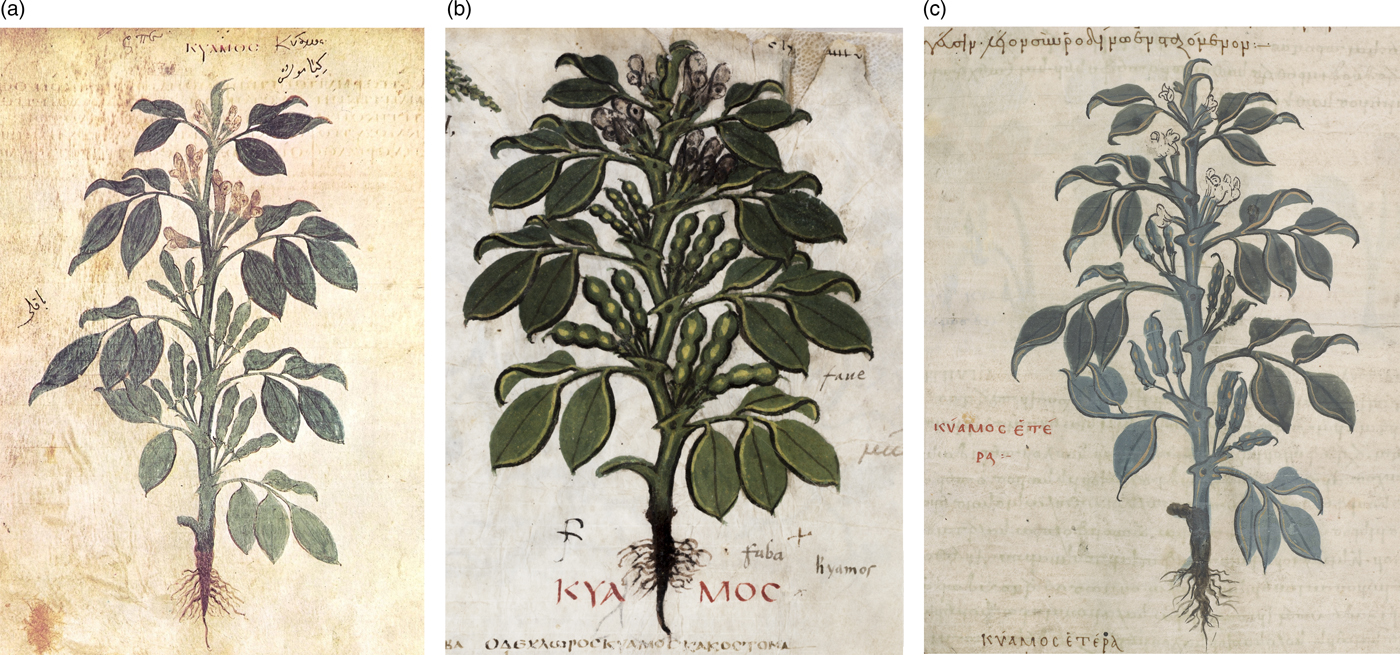
Any assessment of the illustrations of the Vienna Dioskourides requires a consideration of two further manuscripts containing alphabetical, illustrated versions of De materia medica: a late sixth- or early seventh-century codex now in Naples and a tenth-century codex now in New York. It has long been recognised that a significant number of botanical species are represented in a near-identical manner in all three codices, betraying a shared iconographic genealogy of some kind. This point is well illustrated by the plant labelled κύαμος, representing the fava bean (Vicia fava L.), which appears on f. 189v of the Vienna codex (Fig. 1a), f. 86 of the Naples codex (Fig. 1b), and f. 75v of the New York codex (Fig. 1c). The species is depicted in a uniform manner in all three manuscripts, with a near-identical arrangement of beans, branches and leaves around the central stem.
a. Representation of fava bean (Vicia fava L.) on f. 189v of the Vienna Dioskourides. (Photo: © Österreichischen Nationalbibliothek, Vienna); b. Detail from f. 86 of the Naples Dioskourides, with representation of fava bean. (Photo: © Biblioteca Nazionale di Napoli); c. Representation of fava bean on f. 75v of the New York Dioskourides. (Photo: The Morgan Library & Museum, New York. MS M.652, f. 75v purchased by J. P. Morgan (1867–1943), 1920)

This shared artistic genealogy has traditionally been explained in one of two ways. According to the first view, the illustrations of the manuscripts in Naples and New York were copied directly from those of the earlier Vienna codex. This interpretation will be challenged in Section II of this article, where a series of differences between the three manuscripts will be highlighted that speak against the possibility that the Vienna codex served as an archetype for the two later codices. A second theory holds that the illustrations of all three manuscripts were copied from a now lost authoritative codex, containing an alphabetical version of De materia medica accompanied by a comprehensive set of botanical illustrations. We shall see in Section III that this interpretation is also problematic, since a series of differences between the manuscripts in terms of their formatting, ordering and contents are difficult to reconcile with the notion of a lost authoritative codex. Rather, the most we can say is that all three codices depended on a pre-existing repertoire of detailed botanical illustrations that was already available when the Vienna Dioskourides was commissioned in the early sixth century.
The second half of this article will examine this pre-existing repertoire of botanical illustrations in greater detail. In Section IV, it will be argued that the finest illustrations of the repertoire should be traced back to classical models that were first conceived in Hellenistic or early imperial times. With this in mind, Section V will consider the question of how these ‘classical’ archetypes could have been preserved and transmitted prior to being reproduced in Late Antiquity. As we shall see, there are serious difficulties with the usual assumption that the repertoire was transmitted by ‘illustrated texts’ or ‘pattern books’ executed in papyrus or parchment. Rather, it is suggested here that the designers of the Vienna codex utilised a set of detailed representations of individual plants depicted on a much larger scale, possibly on whitened wooden boards. This hypothesis has important implications for our understanding of ancient science, but also for our appreciation of how detailed artistic designs were transmitted and reproduced during antiquity. These implications are explored in Section VI.
II THE VIENNA ‘ARCHETYPE’ THEORY
As we have noted, a large number of botanical species were depicted in a near-identical manner in the Vienna, Naples and New York manuscripts, precipitating the view that the illustrations of the latter pair were modelled directly on those of the former. Since this theory rests on the chronological precedence of the Vienna codex, it will be useful to introduce the manuscripts and the evidence for their dating, before evaluating the theory itself in more detail.
The Vienna Dioskourides (Österreichische Nationalbibliothek, Vienna, Codex Vindobonensis med. Gr. 1)Footnote 12
- Dimensions:
c. 37.0 x 31.2 cm
- Script:
Greek uncial majuscule
- Date:
The codex can be dated to c. a.d. 512 with precision, thanks to its famous dedicatory portrait (fol. 6v) of Anicia Juliana, daughter of Flavius Anicius Olybrius, the emperor of the West for eight months prior to his death in 472.Footnote 13 A barely visible acrostic epigram surrounding the portrait records that the codex was a gift given to Anicia Juliana by the citizens of Honoratae, a district of Constantinople, in thanks for her construction of a ‘temple of the Lord’ in their part of the city.Footnote 14 Further information is supplied by Theophanes Confessor, who records that Juliana dedicated a church of the Virgin Mary in Honoratae in 512,Footnote 15 hereby providing an approximate date for the production of the codex.
- Provenance:
Constantinople. It is possible that the codex was produced in an imperial scriptorium.Footnote 16
- Contents:
(1) a series of prefatory illustrations and a decorative title page (ff. 1v–7v);Footnote 17
(2) an alphabetical index of plants listing 264 of the species discussed in the following version of Dioskourides’ text (ff. 8–10v);
(3) an ‘Alphabetical herbal recension’ of Dioskourides’ De materia medica, accompanied by 382 illustrations of medicinal plants (ff. 10v–387);
(4) the Carmen de viribus herbarum, a poem concerning healing herbs, illustrated with a representation of a coral flanked by a marine deity or personification (ff. 388–92);
(5) Euteknios’ paraphrase of Nikander of Kolophon's Theriaka, illustrated with paintings of poisonous creatures and the sources of their antidotes (ff. 393–437v);
(6) Euteknios’ paraphrase of Nikander of Kolophon's Alexipharmaka with spaces for illustrations that were never filled (ff. 438–59v);
(7) an incomplete paraphrase of Oppian's Halieutica, unillustrated (ff. 460–73);
(8) a paraphrase of Dionysios of Philadelphia's Ornithiaka, a treatise on birds and bird-catching, illustrated with twenty-three birds interspersed with the text and a further twenty-four birds set within a gridded frame on a single folio (ff. 474–85v).
The Naples Dioskourides (Bibliotheca Nazionale, Naples, Cod. gr. 1)Footnote 18
- Dimensions:
c. 28.7 x 26.0 cmFootnote 19
- Script:
Greek uncial majuscule
- Date:
Late sixth or early seventh century a.d. (palaeography).
- Provenance:
A series of graphic, codicological and artistic considerations suggest that the manuscript may have been produced in Italy, possibly in Ravenna.Footnote 20
- Contents:
(1) an ‘Alphabetical herbal recension’ of Dioskourides’ De materia medica, accompanied by 409 illustrations of medicinal plants (ff. 1–172).Footnote 21
The New York Dioskourides (Pierpont Morgan Library, M 652)Footnote 22
- Dimensions:
39.5 x 29.0 cm
- Script:
Greek miniscule bouletée
- Date:
Early to mid-tenth century a.d. (palaeography).
- Provenance:
Constantinople. It has been suggested that the manuscript should be associated with the court of Constantine VII Porphyrogenitus (913–959).Footnote 23
- Contents:
(1) a version of the ‘Alphabetical Five Book recension’ of De materia medica (ff. 1v–305v);
(2) a treatise on the helpful and harmful power of strong drugs, erroneously attributed to Dioskourides (ff. 306–19v);
(3) a treatise on poisons and their effects, erroneously attributed to Dioskourides (ff. 319v–27v);
(4) a treatise on the cure of efficacious poisons, erroneously attributed to Dioskourides (ff. 328–30v);
(5) an unillustrated Mithridatic anecdote (ff. 331–3v);
(6) an anonymous poem on the powers of herbs that may be related to the Carmen de viribus herbarum of the Vienna codex, here unillustrated (ff. 334–8);
(7) an illustrated version of Euteknios’ paraphrase of Nikander's Theriaka (ff. 338–61);
(8) an illustrated version of Euteknios’ paraphrase of Nikander's Alexipharmaka (ff. 361v–75);
(9) an incomplete, unillustrated paraphrase of Oppian's Halieutica (ff. 375–6v).
In short, the early sixth-century Vienna Dioskourides contains 382 botanical illustrations, the late sixth- or early seventh-century Naples Dioskourides contains 409 botanical illustrations and the tenth-century New York Dioskourides contains 443 botanical illustrations.Footnote 24
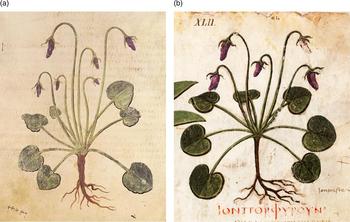
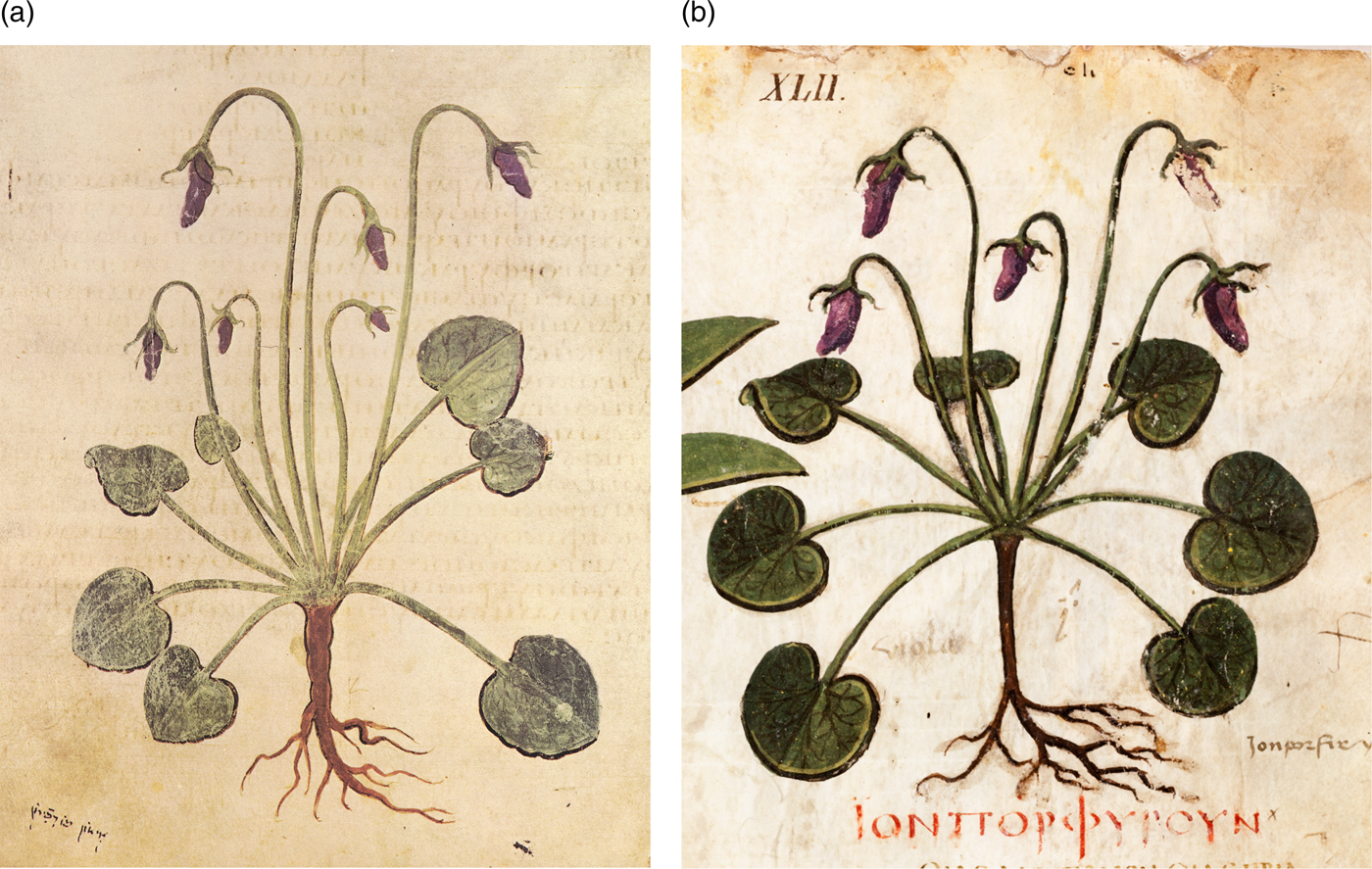
Of the 382 species illustrated in the Vienna Dioskourides and the 409 illustrated in the Naples Dioskourides, 350 are common to both manuscripts. In the majority of cases, the illustrations are sufficiently similar to suggest that they are ‘genetically connected’: that is, they share a sufficient number of intricate, closely observed details to suggest that they are both versions of the same original design, even if they sometimes also exhibit stylistic and/or iconographic idiosyncrasies that speak against the possibility that one illustration was modelled directly on the other.Footnote 25 A representative example is supplied by the plant labelled ἴον πόρφυρον, identified as the sweet violet (Viola odorata L.), which appears on f. 148v of the Vienna codex (Fig. 2a) and f. 42 of the Naples codex (Fig. 2b). Here the shared heritage of the illustrations is underscored by the symmetrical arrangement of the two tallest flowers, and by the presence of seven heart-shaped leaves emanating from the central stem.
a. Representation of sweet violet (Viola odorata L.) on f. 148v of the Vienna Dioskourides. (Photo: © Österreichischen Nationalbibliothek, Vienna); b. Detail from f. 42 of the Naples Dioskourides, with representation of sweet violet. (Photo: © Biblioteca Nazionale di Napoli)
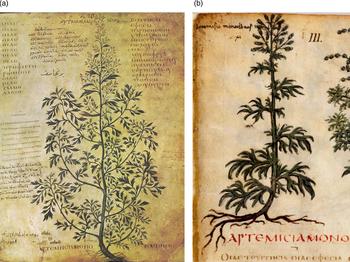
But there are also instructive differences between the illustrations of the two codices. Most importantly, the Naples Dioskourides contains fifty-five botanical illustrations that are not found in the Vienna Dioskourides, only two of which can be accounted for by missing folios of the latter manuscript.Footnote 26 It follows that fifty-three of the illustrations included in the late sixth- or early seventh-century Naples Dioskourides were not included in the early sixth-century Vienna Dioskourides. This observation is significant, since it precludes the possibility that the botanical illustrations of the Naples codex were modelled directly and exclusively on those of the Vienna codex, suggesting that the close iconographic correspondences between the two manuscripts need to be explained in another way.Footnote 27 Further support for this conclusion is supplied by the nineteen or so botanical species that are accompanied by different illustrations in the two manuscripts,Footnote 28 since the dependence of one codex upon the other can likewise be excluded in these cases. A good example is provided by the plant labelled ἀρτεμισία μονοκλώνος, identified as a variety of wormwood (Artemisia campestris L.), which appears on f. 20r of the Vienna manuscript (Fig. 3a) and f. 3 of the Naples manuscript (Fig. 3b). The specimen depicted in the Vienna codex seems more developed than its counterpart in Naples, with a more extensive network of branches and leaves, and with delicate red flowers blossoming towards the top of its stem.
a. Representation of plant labelled ‘ἀρτεμισία μονοκλώνος’ on f. 20r of the Vienna Dioskourides. (Photo: © Österreichischen Nationalbibliothek, Vienna); b. Detail from f. 3 of the Naples Dioskourides, with representation of plant labelled ‘ἀρτεμισία μονοκλώνος’. (Photo: © Biblioteca Nazionale di Napoli)

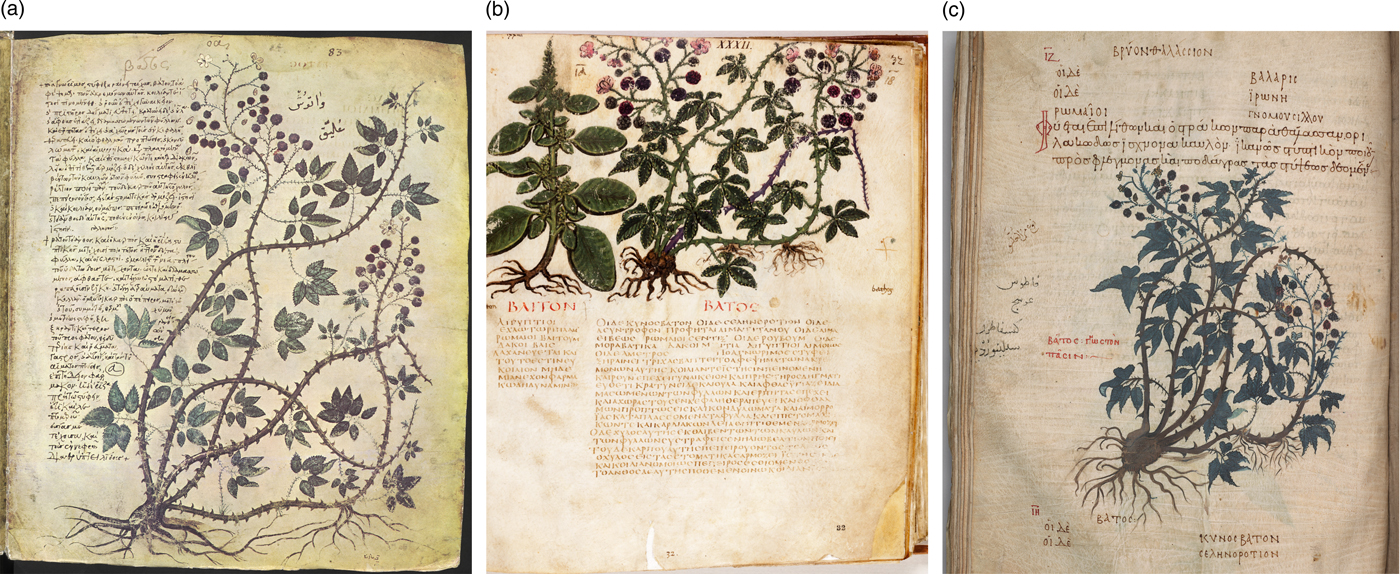
The botanical illustrations that accompany the version of De materia medica in the New York Dioskourides also fit into this typological picture. Of the 443 species illustrated in this book, 282 are also illustrated in both the Vienna and Naples manuscripts, seven are found only in the Vienna and New York manuscripts, forty-five are found only in the Naples and New York manuscripts, and ninety-nine are exclusive to the New York manuscript. Whenever the same species is illustrated both in the New York codex and in one or both of the earlier codices, the illustrations are usually sufficiently similar to suggest that they are versions of the same original design (Figs 1c, 4c). The illustrations that are exclusive to the New York Dioskourides, for their part, have been described as ‘rudimentary’,Footnote 29 and tend not to correspond very closely with the chapters of Dioskourides’ treatise that they purport to illustrate.
a. Vienna Dioskourides f. 83r, with representation of blackberry bramble (Rubus ulmifolius). (Photo: © Österreichischen Nationalbibliothek, Vienna); b. Naples Dioskourides f. 32, with representation of blite (labelled ‘βλίτον’) at left and blackberry bramble (labelled ‘βάτος’) at right. (Photo: © Biblioteca Nazionale di Napoli); c. New York Dioskourides f. 25v, with representation of blackberry bramble beneath text describing the sea lettuce depicted on the previous folio. (Photo: The Morgan Library & Museum, New York. MS M.652, f. 25v purchased by J. P. Morgan (1867–1943), 1920)

The observation that some botanical illustrations are confined to the manuscripts in New York and Vienna while others are confined to those in New York and Naples is significant, since this duality precludes the possibility that the illustrations of the New York codex were modelled exclusively on those of either of these earlier codices. Confirmation of this fact is supplied by the 282 illustrations in the New York Dioskourides that have parallels in both the Vienna and Naples codices, since some are closer to their counterparts in the Vienna codex than those in the Naples codex, others are closer to their counterparts in the Naples codex than those in the Vienna codex, while in some cases it is difficult to tell.Footnote 30 A possible explanation for this nexus of connections is that the artists of the New York Dioskourides had access to both the Vienna and Naples codices when executing the manuscript.Footnote 31 But this contingency seems speculative — even unlikely — when we consider the lapse in time between the production of the Vienna and Naples codices and the New York codex, as well as the idiosyncrasies of the New York manuscript in terms of its formatting and contents, which will be enumerated in detail in the next section.Footnote 32
In short, then, the typological differences between the codices demonstrate that the botanical illustrations of the Naples and New York manuscripts were not copied directly and exclusively from those of the Vienna exemplar. Rather, the ‘genetic connections’ between the illustrations of the three codices can only be explained with reference to a visual source (or sources) outside the surviving manuscripts themselves.
III THE AUTHORITATIVE CODEX THEORY
It is in this context that we should consider the alternative theory that the illustrations of all three codices were modelled on those of a now lost ‘authoritative codex’ containing an alphabetical version of De materia medica accompanied by a comprehensive set of botanical illustrations.Footnote 33
A recent instantiation of this theory holds that an authoritative codex of this kind could have been commissioned for Theodosius II (402–450),Footnote 34 the great-grandfather of Anicia Juliana on her mother's side.Footnote 35 This view stems from the testimony of Sozomen, a Christian historian of the fifth century, who states explicitly in the preface to his Ecclesiastical History that Theodosius II enjoyed studying late into the night, and that he was interested in the properties of roots and their cures.Footnote 36 In truth, however, the intersection between Theodosius’ intellectual interests and the contents of our surviving manuscripts is not enough to suggest that this emperor owned a codex that served as a comprehensive archetype. In the absence of any direct evidence, the theory remains entirely speculative.
Several other considerations suggest that the underlying idea of an authoritative codex should be questioned. Particularly revealing are the different ways in which De materia medica is formatted in each of our surviving manuscripts. In the Vienna Dioskourides, the botanical illustrations each occupied a full-page, with the accompanying text situated on the adjacent folio (Fig. 4a); in the Naples Dioskourides, the illustrations were usually arranged two or three to a page, with the accompanying text written in a column of equivalent width situated immediately beneath (Fig. 4b); and in the New York Dioskourides, the illustrations were painted into gaps in the text left by the scribe (Fig. 4c). In the Naples and New York manuscripts, the smaller image formats led to illustrations being simplified or truncated in order to fit the available space, sometimes resulting in a less naturalistic overall appearance. There are also several instances where the illustrations of the Naples and New York codices constitute ‘mirror images’ of their counterparts in Vienna.Footnote 37 But quite apart from impacting upon the iconography of the illustrations in this manner, the differences in formatting leave us with a fundamental question. If the manuscripts were all modelled on (or descended from) a single, illustrated version of Dioskourides’ De materia medica carried in an authoritative codex, why did their designers all interpret and reproduce this model in such markedly different ways?
Further problems are encountered when we consider the contents of the manuscripts, since there are significant differences between the Vienna and Naples codices in terms of the ordering of the individual chapters of the treatise. A good example is provided by the pair of species labelled ἡπακλιον ἠ πανκράτιον and ἡμεροκαλλές, identified as the sea daffodil (Pancratium maritimum) and the Martogon lily (Lilium martagon L.) respectively, which were depicted on ff. 127r and 133r of the Vienna codex, but which were painted side-by-side on f. 79 of the Naples codex. Similarly instructive are the species known as Δελφίνιον and Δελφίνιον ἑτέρον, possibly two variants of pellitory (Anthemis pyrethrum L.), which were originally separated by several folios in the Vienna manuscript,Footnote 38 but were later juxtaposed on f. 61 of the Naples manuscript. Such discrepancies have important implications for the authoritative codex theory, since they require us to believe that the designer(s) of at least one of these manuscripts decided to adjust the order of chapters transmitted by this postulated model.
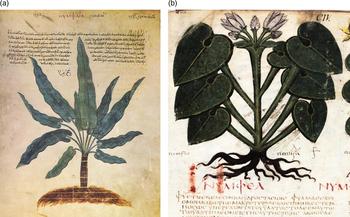
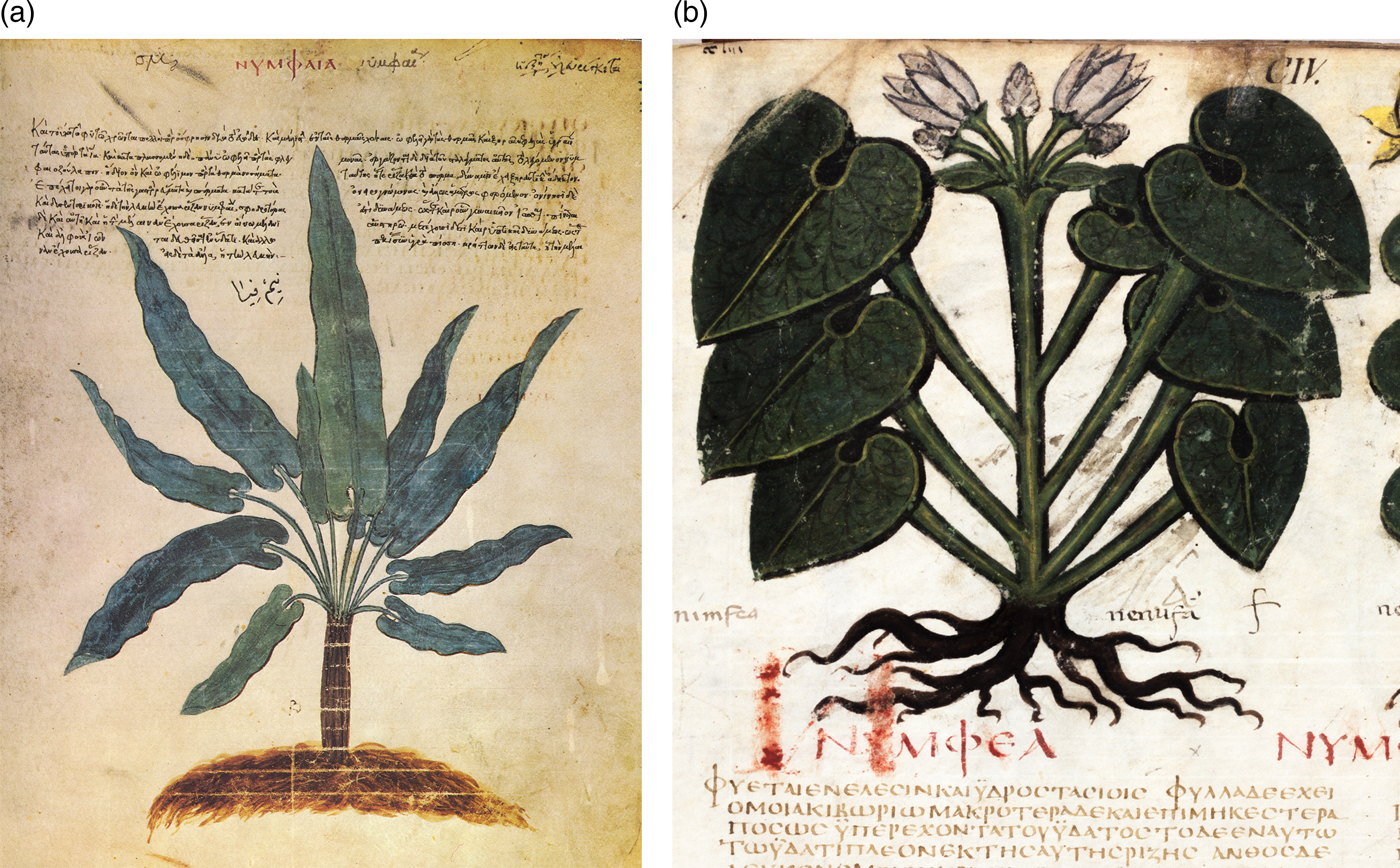
The theory becomes still more difficult to substantiate when we consider those instances in which a chapter of Dioskourides’ text was accompanied by different illustrations in two or more of the surviving codices. The clearest example is supplied by the chapter concerning the νυμφαὶα, identified as the white water lily (Nymphaea alba L.).Footnote 39 In both the Naples and New York manuscripts, this passage is accompanied by illustrations that conform to Dioskourides’ description of the plant, with large heart-shaped leaves and delicate white flowers sprouting from its central stem (Fig. 5b). In the Vienna manuscript, however, the illustration accompanying the same chapter bears no resemblance to the white water lily itself, but instead looks like a young fern (Fig. 5a).Footnote 40 It is clear that this combination of text and image occurred in error, but it is difficult to believe that the designer(s) of the manuscript would have made this mistake if they were working from an authoritative codex in which the correct illustration of the white water lily was obviously available and already associated with the corresponding chapter of the treatise. There are other cases in which the illustrations accompanying the same chapter of text in the Vienna and Naples codices are so far apart that they may represent different species. The illustrations accompanying the chapter concerning the βούγλωσσον, the Italian bugloss (Anchusa italic Retz), for example, are entirely different in terms of their leaf size, leaf shape, stem prickles and flowers.
a. Representation of plant labelled ‘νυμφαὶα’ on f. 239r of the Vienna Dioskourides. (Photo: © Österreichischen Nationalbibliothek, Vienna); b. Detail from f. 104 of the Naples Dioskourides, with representation of white water lily (Nymphaea alba L.) labelled ‘νυμφαὶα’. (Photo: © Biblioteca Nazionale di Napoli)
The differences between the Vienna and Naples codices, then, in terms of their formatting, ordering and contents are difficult to reconcile with the notion that the close iconographic correspondences between their illustrations should be attributed to a shared descent from a now lost authoritative codex.Footnote 41 The most we can say is that a common repertoire of botanical illustrations was formulated prior to the production of the Vienna Dioskourides in 512, and that the three manuscripts considered here reproduced overlapping elements of this repertoire during the centuries that followed. These conclusions are important, since they re-open a series of questions concerning the pre-existing repertoire, notably when its illustrations were formulated, and how these illustrations were transmitted and reproduced during antiquity. In the following sections, these issues will be examined in detail.
IV DATING THE ILLUSTRATIONS OF THE REPERTOIRE
It will first be useful to consider the date at which the illustrations of the repertoire were originally conceived. This is a difficult task, since any chronological assessment necessarily depends on a subjective analysis of the style of the illustrations, and of where they fit within the longue durée of botanical representation in two-dimensional artistic media during antiquity. A further complication is introduced by the fact that the illustrations of the Vienna Dioskourides — and so the repertoire — exhibit considerable variety in terms of their style and their fidelity to real life specimens.Footnote 42 A good example of an illustration lying at the more naturalistic end of the spectrum is supplied by the species labelled βάτος on f. 83r, identified as a blackberry bramble (Rubus ulmifolius), which stands out by virtue of its refined three-dimensionality and its precisely rendered shapes, colours and contours (Fig. 4a).
Previous studies have suggested that the most naturalistic illustrations of the Vienna Dioskourides were modelled on classical archetypes,Footnote 43 thanks largely to a perception that they exhibit a level of three-dimensionality and verisimilitude alien to late antique and early Byzantine art.Footnote 44 This viewpoint is too simplistic, since there are other late antique and early Byzantine compositions that incorporate plants and animals depicted with comparable naturalism. A famous example is the mosaic from the Great Palace at Constantinople, which depicts (among other things) a selection of animals and a series of bucolic scenes against a plain white background, all surrounded by a sumptuous acanthus scroll border.Footnote 45 Clearly this naturalistic mode of representation remained available to patrons who wanted it, and who were prepared to pay a premium for ‘a somewhat isolated work of art’ of this kind.Footnote 46
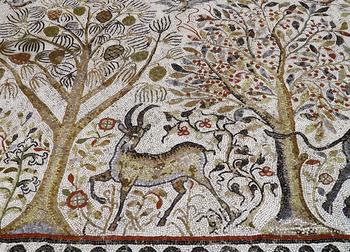
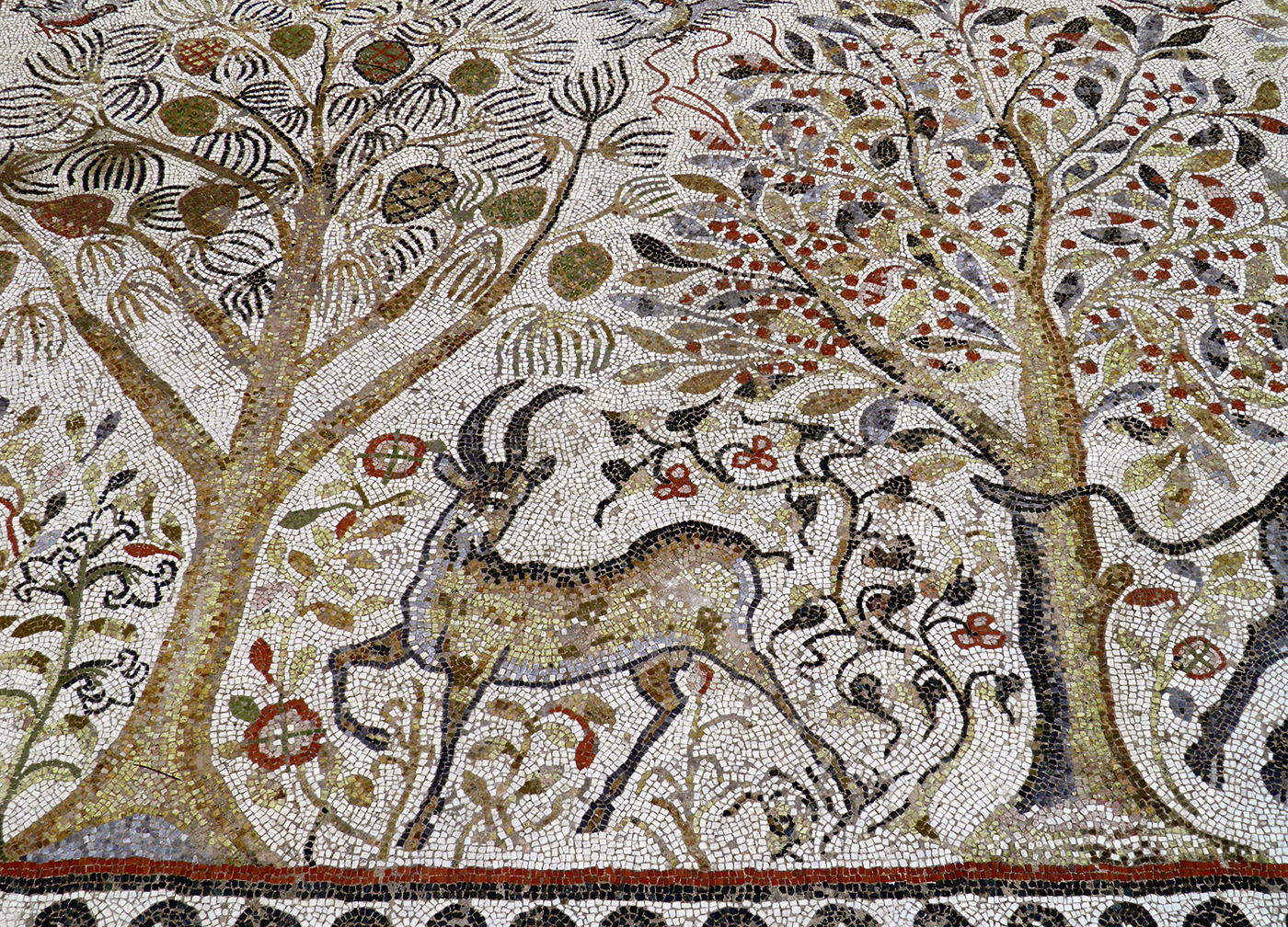
Still, we cannot deny that a large proportion of the plants and trees depicted in late antique and early Byzantine works of art seem schematic and two-dimensional when compared to the best illustrations of the Vienna Dioskourides. We might compare, for example, the surviving corpus of church mosaics that incorporate representations of symmetrically disposed flowers, trees and shrubs, including: the apse mosaic of the fifth-century Basilica of Sant'Apollinare in Classe in Ravenna;Footnote 47 the apse mosaic of the Basilica of San Vitale in Ravenna;Footnote 48 and the narthex mosaic of the Great Basilica in Herakleia Lynkestis in Macedonia (Fig. 6).Footnote 49 The fundamental differences in style and approach lend support to the view that the finest illustrations of the repertoire were modelled on ‘classical’ archetypes produced in the Hellenistic and/or early imperial periods, rather than being conceived for the first time during Late Antiquity.Footnote 50
Herakleia Lynkestis, Large Basilica, mosaic in narthex, detail. Pine tree and fruit tree with goat standing beneath; sixth century. (Photo: Carole Raddato, via Wikimedia Commons)
Further support for this notion of ‘classical’ origins is supplied by a series of specific iconographic correspondences between the finest botanical illustrations of the Dioskourides codices and representations of the same species in large-scale works of art — particularly wall paintings — surviving from late Hellenistic and early imperial times. Previous studies have sometimes alluded to these similarities in very general terms, without adducing any specific points of contact.Footnote 51 Here it will be useful to present a handful of more precise correspondences, which add some structure to the theory of classical origins.
Rose (Rosa gallica L.) = ῥόδον ἤ ῥόδα Footnote 52
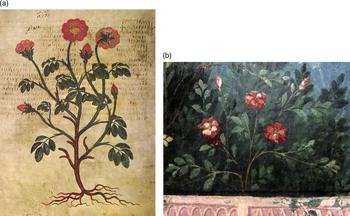
The Vienna Dioskourides contains a full-page illustration of a red rose on f. 282r (Fig. 7a). Illustrations modelled on the same original design are found on f. 129 of the Naples Dioskourides and f. 142v of the New York Dioskourides. Of the latter pair, the New York illustration seems closer to the specimen in the Vienna codex by virtue of its more refined morphology and colouration.
a. Representation of a rose (Rosa gallica L.) on f. 282r of the Vienna Dioskourides. (Photo: © Österreichischen Nationalbibliothek, Vienna); b. Representation of a rose on the north wall of Livia's subterranean ‘Garden Room’ at Prima Porta. (Photo: author)

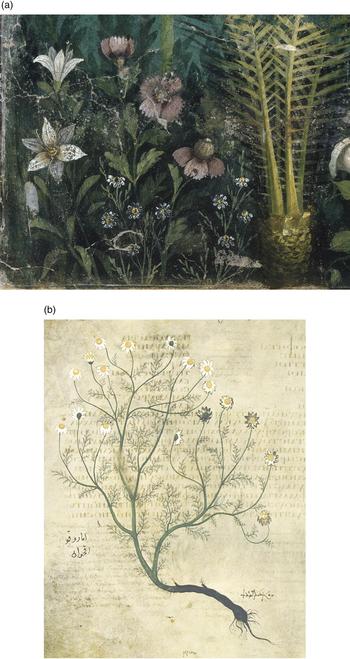
The Vienna illustration depicts a flowering rose bush with a prickly stem and pinnate leaves. Emanating from the stem's branches are three closed rosebuds and three blossoming flowers. The central flower is turned to face the viewer, while the flower to the left is turned upwards and the flower to the right is turned away. This illustration can be usefully compared to representations of the same species in the garden paintings that decorated the subterranean garden room of the Villa of Livia at Prima Porta and Rooms 31 and 32 of the House of the Golden Bracelet at Pompeii.Footnote 53 The specimens in the Villa of Livia are depicted behind a low marble balustrade, and a well preserved example on the long north wall has three red flowers configured in a manner reminiscent of the codex illustration (Fig. 7b).
Oleander (Nerium oleander L.) = ῥοδοδάφνη Footnote 54
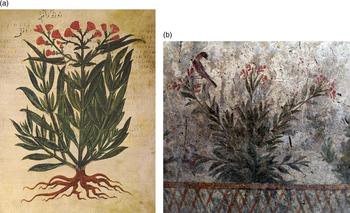
The Vienna Dioskourides contains a full-page illustration of an oleander bush on f. 283v (Fig. 8a). Illustrations modelled on a shared, original design are found on f. 130 of the Naples Dioskourides and f. 143r of the New York Dioskourides. Of the latter pair, the New York illustration again seems closer to its counterpart in Vienna.
a. Representation of oleander (Nerium oleander L.) on f. 283v of the Vienna Dioskourides. (Photo: © Österreichischen Nationalbibliothek, Vienna); b. Representation of an oleander bush on the exterior of Room 78 of the Villa at Oplontis. (Photo: author)

The specimen depicted in the Vienna codex has five stems, with four disposed roughly symmetrically to either side of a central stem. All five stems carry leathery, lanceolate leaves, but only the central stem culminates in bright red flowers. These red flowers are grouped into three clusters, each carried by a small branch sprouting from the central stem. The flowers themselves seem unnaturalistic, since most are rendered as bell-shaped openings, possibly inspired by the central corolla tubes surrounded by petals in real life specimens. Still, one of the flowers in the left-hand cluster is a rudimentary constellation of three such petals. A useful point of comparison is supplied by the oleander bush painted on the exterior of Room 78 of the Villa at Oplontis (Fig. 8b).Footnote 55 Here, too, the oleander was conceived as a series of symmetrically disposed stems carrying heavy lanceolate leaves, and the bright red flowers were grouped into neat clusters in a roughly symmetrical arrangement.
Chrysanthemum (Chrysanthemum coronarium L.)= βούφθαλμον Footnote 56
The Vienna Dioskourides contains a full-page illustration of a chrysanthemum on f. 75v. Illustrations modelled on the same original design are found on f. 27 of the Naples Dioskourides and f. 16v of the New York Dioskourides. The Vienna codex also contains an illustration of another variant of this species on f. 373r, which has analogues on ff. 167 and 189r of the Naples and New York codices respectively.
The illustration on f. 75v of the Vienna codex is a refined representation of the chrysanthemum, incorporating the bi-pinnately lobed leaves characteristic of this species and three yellow flower heads emanating from its stem. These flower heads are shown in a variety of perspectives, the one to the left in three-quarter view, the one in the centre pointing upwards, and the one to the right in reverse three-quarter view. This illustration can also be compared to representations of the same species from the Villa of Livia at Prima Porta and the House of the Golden Bracelet at Pompeii. On the south wall at the Villa of Livia, for example, we observe a specimen whose flowers are depicted in a comparable array of perspectives.
Madonna Lily (Lilium candidum L.) = κρίνον βασιλικόν Footnote 57
The Vienna Dioskourides contains a full-page illustration of a Madonna lily on f. 176v. Illustrations modelled on the same original design are found on f. 82 of the Naples Dioskourides and f. 84r of the New York Dioskourides. In the latter codex there is a second illustration of the species on the same folio that has no clear analogue in the earlier manuscripts.Footnote 58
The unique illustration in the New York codex is of particular interest here. The design is simple, with a leafy stem shooting vertically from a bulb that culminates in a single white flower with a symmetrical arrangement of petals, here pointed upwards. Two smaller buds are disposed symmetrically to either side. This illustration closely resembles a representation of the same species in Room 32 of the House of the Golden Bracelet, which likewise culminates in a white flower pointed vertically, with its petals organised in a symmetrical arrangement (Fig. 9a).
a. Detail from foreground of garden painting decorating Room 32 of the House of the Golden Bracelet (VI 17, 42) at Pompeii, including a Madonna lily (Lilium candidum L.) at left and a feverfew (Tanacetum parthenium L.) at bottom. (Photo: © 2019. Photo Scala, Florence); b. Representation of feverfew (Tanacetum parthenium L.) on f. 31v of the Vienna Dioskourides. (Photo: © Österreichischen Nationalbibliothek, Vienna)

Feverfew (Tanacetum parthenium L.) = ἀμάρακον Footnote 59
The Vienna Dioskourides contains a full-page illustration of a feverfew plant on f. 31v (Fig. 9b). A less refined representation of the same species is found on f. 7 of the Naples Dioskourides. The Vienna codex also contains another illustration of the feverfew — or perhaps a closely related species — on f. 193r, which is paralleled on f. 170 of the Naples codex.
The specimen depicted on f. 31v of the Vienna manuscript stands out for its sumptuous naturalism. Indeed, the bi-pinnately lobed leaves emanating from the stem are elegantly rendered, and its daisy-like flower heads are shown in a variety of perspectives. Again the illustration can be compared to representations of the same species from the Villa of Livia at Prima Porta and the House of the Golden Bracelet at Pompeii. A specimen on the east wall of Room 32 of the House of the Golden Bracelet, for example, is depicted with delicate lobed leafs of a similar kind (Fig. 9a).
Some qualifying comments are required. Firstly, these points of contact are by no means close enough for us to be able to trace direct connections between the representations of particular plants in the wall paintings and the codices, in the sense of both reproducing precisely the same original designs. Rather, the most we can say is that certain botanical species were depicted with the same high level of naturalism in both contexts. Secondly, there are important differences between the wall paintings and the codices in terms of the quantity of represented plants and their contextualisation in space. Indeed, a larger number of botanical species is depicted in the codices than in the wall paintings: something to be expected given the fundamental differences in function and format. The botanical specimens in the wall paintings also differ in that they were carefully integrated into large-scale works of art, forming single components of more comprehensive designs.
Even so, these similarities lend a greater sense of precision to the view that the finest botanical illustrations of the Vienna Dioskourides and its related manuscripts should be traced back to classical archetypes. The very clear correspondences in morphology and colouration may betray an indirect connection with these earlier representations of the same species, even if the precise nature of this connection remains difficult to pin down.
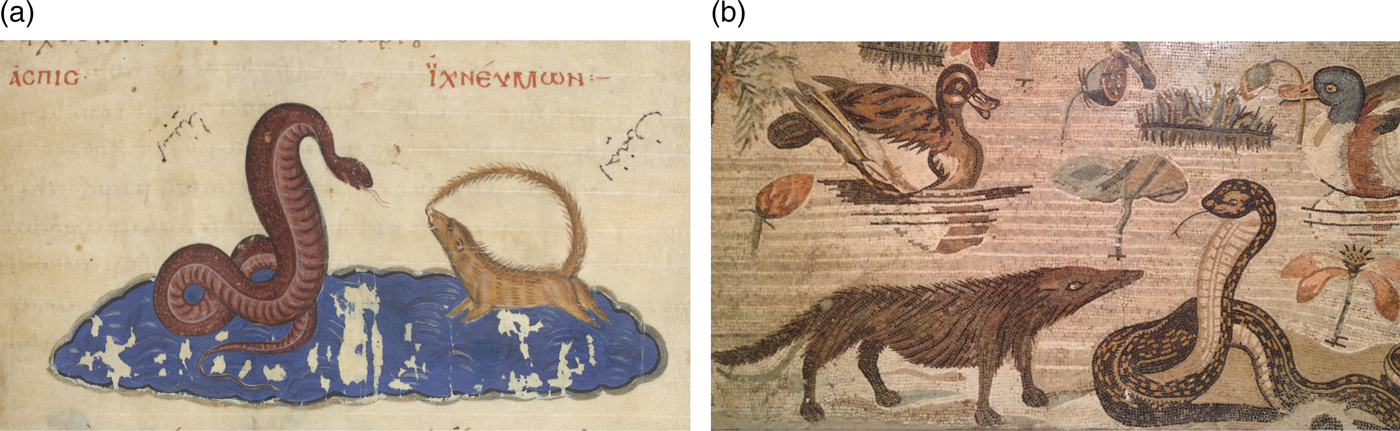
Additional support for this interpretation is supplied by the illustrations that accompany the subsidiary treatises in the Vienna and New York codices. Particularly instructive are the ornithological illustrations that accompany the paraphrase of Dionysios’ Ornithiaka in the Vienna codex,Footnote 60 several of which can be compared to depictions of the same species in Hellenistic and early imperial wall paintings and mosaics.Footnote 61 Here it will suffice to mention only: the Alexandrine parakeet (Psittacula eupatria) depicted on f. 475v of the Vienna codex, which recalls the famous mosaic emblema depicting this species excavated in Palace V in Pergamon,Footnote 62 as well as a series of later representations from Pompeii and elsewhere; the purple swamp-hen (Porphyrio porphyrio) depicted on f. 480v, which can be compared, for instance, to a specimen depicted on the east wall of Room 32 of the House of the Golden Bracelet at Pompeii;Footnote 63 and the mute swan (Cygnus olor) depicted on f. 482v, which closely resembles the representation of the same species (labelled ‘αἰγίλωψ’) on the verso of the Artemidorus papyrus.Footnote 64 We might also mention the illustration of a cobra confronting a mongoose that accompanies Euteknios’ paraphrase of Nikander's Theriaka in the New York codex (f. 345), which embodies a zoological topos recorded by ancient writers including Aristotle and Pliny the Elder (Fig. 10a).Footnote 65 This miniature can be compared to three representations of the same subject surviving from Hellenistic and imperial Italy: a vignette in the late second-century b.c. Nile Mosaic at Praeneste;Footnote 66 a scene in the late second-century b.c. Nilotic mosaic decorating the threshold of the exedra containing the Alexander Mosaic in the House of the Faun at Pompeii (Fig. 10b);Footnote 67 and a pair of painted panels that decorated the socle of the rear wall of the Ekklesiasterion of the Temple of Isis at Pompeii.Footnote 68
a. Detail from f. 345r of the New York codex, showing an antagonistic encounter between a cobra and a mongoose. (Photo: The Morgan Library & Museum, New York. MS M.652, f. 345r purchased by J. P. Morgan (1867–1943), 1920); b. Detail from the tripartite Nilotic mosaic from the House of the Faun at Pompeii, showing an antagonistic encounter between a cobra and a mongoose. (Photo: author)

V THE TRANSMISSION OF THE REPERTOIRE
The hypothesis presented here, then, is that some of the best botanical illustrations of the repertoire depended on classical archetypes. It is important to consider how these ‘classical’ illustrations might have been preserved and transmitted all the way from the Hellenistic and/or imperial period(s) until the production of the Vienna Dioskourides in the early sixth century — and beyond.
This question bears on one of the most controversial issues in the study of ancient art: how best to account for the transmission of detailed images over long geographical distances and/or extended chronological periods. Those attempting to explain this phenomenon have traditionally drawn on two theoretical possibilities.Footnote 69 The first is that artists were taught how to depict particular subjects in a workshop environment, and that they were subsequently able to reproduce these designs from memory alone.Footnote 70 The second possibility is that artists instead used artistic intermediaries of some description: that is, images carried on transportable media that could be copied and consulted when executing particular designs.Footnote 71 These possibilities are not mutually exclusive, and a large proportion of artistic production in antiquity can be accounted for by some combination of the two. In the particular case of the botanical repertoire, however, the enormous number of illustrations, their intricate, repeated details and their prolonged period of circulation suggest that at least some were transmitted using artistic intermediaries rather than through workshop tradition and artistic memory alone.
We are then faced with the question of the material format of these intermediaries. It is inconceivable that the ‘classical’ illustrations of the repertoire were originally executed and/or transmitted on parchment codices, since the parchment codex was not invented until at least the high imperial period, and did not come into widespread use until considerably later.Footnote 72 In other words, there is a significant chronological gap separating our postulated ‘classical’ archetypes from the widespread adoption of the parchment codex, and this gap speaks against the possibility that the repertoire was transmitted using this medium.
Previous studies have therefore favoured the view that the illustrations of the repertoire originated in the context of illustrated herbal treatises executed on papyrus. This theory stems from the observation that many of the earlier chapters of De materia medica in the Vienna codex, from ff. 12–42r and 70–94, are supplemented by extracts from the pharmacological treatises written by Galen of Pergamon and by Krateuas the rhizotomist (‘root-cutter’), a Hellenistic herbalist who served as the personal physician of Mithridates VI Eupator of Pontos (120–63 b.c.).Footnote 73 Given its Hellenistic date, there can be no doubt that Krateuas’ treatise was originally executed in the papyrus roll format. We also know that it was illustrated thanks to an important passage of Pliny the Elder's Natural History:
Krateuas, Dionysios and Metrodorus adopted a most attractive method, though one that makes clear little else except the difficulty of employing it. For they painted likenesses of plants and then wrote under them their properties. But not only is a picture misleading when the colours are so many, particularly as the aim is to copy Nature, but besides this, much imperfection arises from the manifold hazards in the accuracy of copyists. In addition, it is not enough for each plant to be painted at one period only of its life, since it alters its appearance with the fourfold changes of the year. For this reason the other writers have given verbal accounts only: some have not even given the shape of the plants, and for the most part have been content with bare names, since they thought it sufficient to point out the properties and nature of a plant to those willing to look at it.Footnote 74
Viewed together, then, this passage and the quotations from Krateuas in the Vienna codex have been taken as evidence that at least some of the repertoire illustrations were transmitted by illustrated papyrus roll herbals composed by writers like Krateuas, as well as by Dioskourides himself.Footnote 75
There are, however, serious difficulties with this theory. Firstly, we have noted already that it is far from certain that Dioskourides’ original papyrus roll De materia medica was illustrated. Secondly, Pliny explicitly states that the botanical illustrations that accompanied the work of Krateuas and his contemporaries often failed to achieve a truly naturalistic effect, an assessment that hardly holds true for the finest illustrations of the repertoire. A degree of caution is necessary here, since the inability of art to imitate nature accurately constitutes a recurring topos in the Natural History,Footnote 76 suggesting that Pliny's assessment was influenced by rhetorical considerations as opposed to constituting a purely objective appreciation of the quality of the botanical illustrations that he discusses. Compare, for example, the same author's well known chapters on portraiture, in which he laments the decline of this art form in his own time in a manner that seems completely incongruous with the virtuoso portraits surviving from the late Julio-Claudian and Flavian periods.Footnote 77 Still, Pliny's comments on the illustrated treatises of Krateuas and his contemporaries remain difficult to reconcile with the view that the finest illustrations of the repertoire originated in the context of the illustrated papyrus roll herbal.
Even stronger objections to this theory can be founded on material considerations, since there are several inherent characteristics of the papyrus roll format that made it poorly suited to carrying large, detailed, polychrome illustrations of the kind preserved in our surviving parchment codices.Footnote 78 Indeed, the rough surface of papyrus meant that it was difficult for artists to execute intricate details when composing illustrations in this format. Moreover, any illustrations executed in thick paint on papyrus would have suffered greatly from the repeated rolling and unrolling of the scroll.Footnote 79
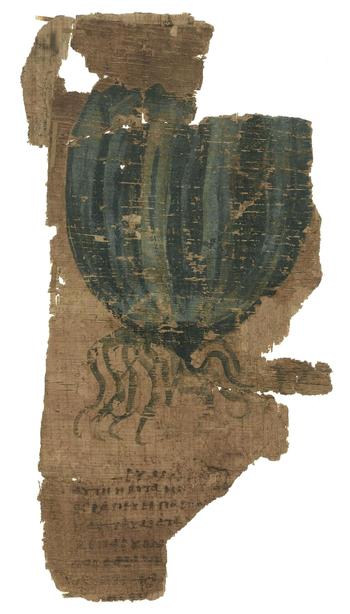
These considerations are well exemplified by two fragmentary illustrated herbal treatises on papyrus, both originally from Egypt. The first, recomposed of twenty fragments found in Tebtunis (Umm el-Baragât) in the Fayyum, can be dated to the second century a.d. on palaeographic grounds, and offers a unique example of an illustrated herbal treatise executed in the papyrus roll format.Footnote 80 From the surviving fragments it is clear that the roll contained descriptions of botanical species arranged in columns beneath their accompanying illustrations. The surviving passages of text pertain to the chondrilla (Chondrilla juncea L.) and false dittany (Ballota acetabulosa L.), and both exhibit certain correspondences with Dioskourides’ descriptions of the same species,Footnote 81 perhaps indicating a reliance on common sources. The artistry of the accompanying illustrations, however, falls far short of the illustrations of the Vienna Dioskourides, being described by the original editor as ‘crude and unreal’.Footnote 82 Equally instructive is a papyrus codex leaf from Antinoöpolis (Sheikh ‘Ibada), dated on palaeographic grounds to c. 400 (Fig. 11).Footnote 83 This codex leaf carries painted botanical illustrations on both sides, with each positioned in the space above a short passage of otherwise unknown text. The text and image on Side A pertain to a botanical species known as the sumphuton, which should perhaps be identified as the comfrey (Symphyton officinale L.), while the text and image on Side B pertain to the species known as the phlomos, which should perhaps be identified as a mullein (Verbasum sinuatum L.). While these botanical illustrations are more vibrant than their counterparts on the Tebtunis papyrus, they remain schematic in appearance, and do not approach the naturalism of many of the illustrations of the Vienna Dioskourides.
Recto of ‘Johnson Papyrus’, with representation of comfrey (Symphyton officinale L.) and associated text underneath; late fourth or early fifth century. Wellcome Library, London, MS 5753. (Photo: Wellcome Images)

These papyri strongly suggest that the finest botanical illustrations of the repertoire did not depend on earlier illustrations contained in herbal treatises executed on papyrus, and the same conclusion is reached even if the scope of comparison is extended to include the entire corpus of illustrated papyri surviving from antiquity. Simply put, even the best papyrus roll illustrations of the Hellenistic and imperial periods fall well short of the artistry of the botanical illustrations of the Vienna Dioskourides.Footnote 84 To take just one example, the much discussed anatomical and zoological illustrations of the Artemidoros Papyrus are comparatively sketchy in appearance, and appear to have been executed by their draughtsmen relatively quickly.Footnote 85
In summary, it seems unlikely that the finest illustrations of the repertoire were first conceived — or transmitted — on either parchment or papyrus. It is therefore worth considering what exactly the botanical illustrations in our surviving codices imply about the artistic intermediaries used to transmit them during antiquity. Firstly, they suggest that these intermediaries carried highly detailed, taxonomically specific illustrations of large numbers of botanical species, which were presumably executed on a scale comparable to — or larger than — that of the full-page illustrations of the Vienna Dioskourides.Footnote 86 Secondly, they suggest that the intermediaries could be reproduced and combined in a flexible manner, accounting for the differences between the Vienna, Naples and New York codices in terms of their formatting, ordering and contents. Thirdly, they suggest that these intermediaries were durable and long-lasting, and that they might sometimes have transmitted botanical designs from the imperial period into Late Antiquity and beyond.
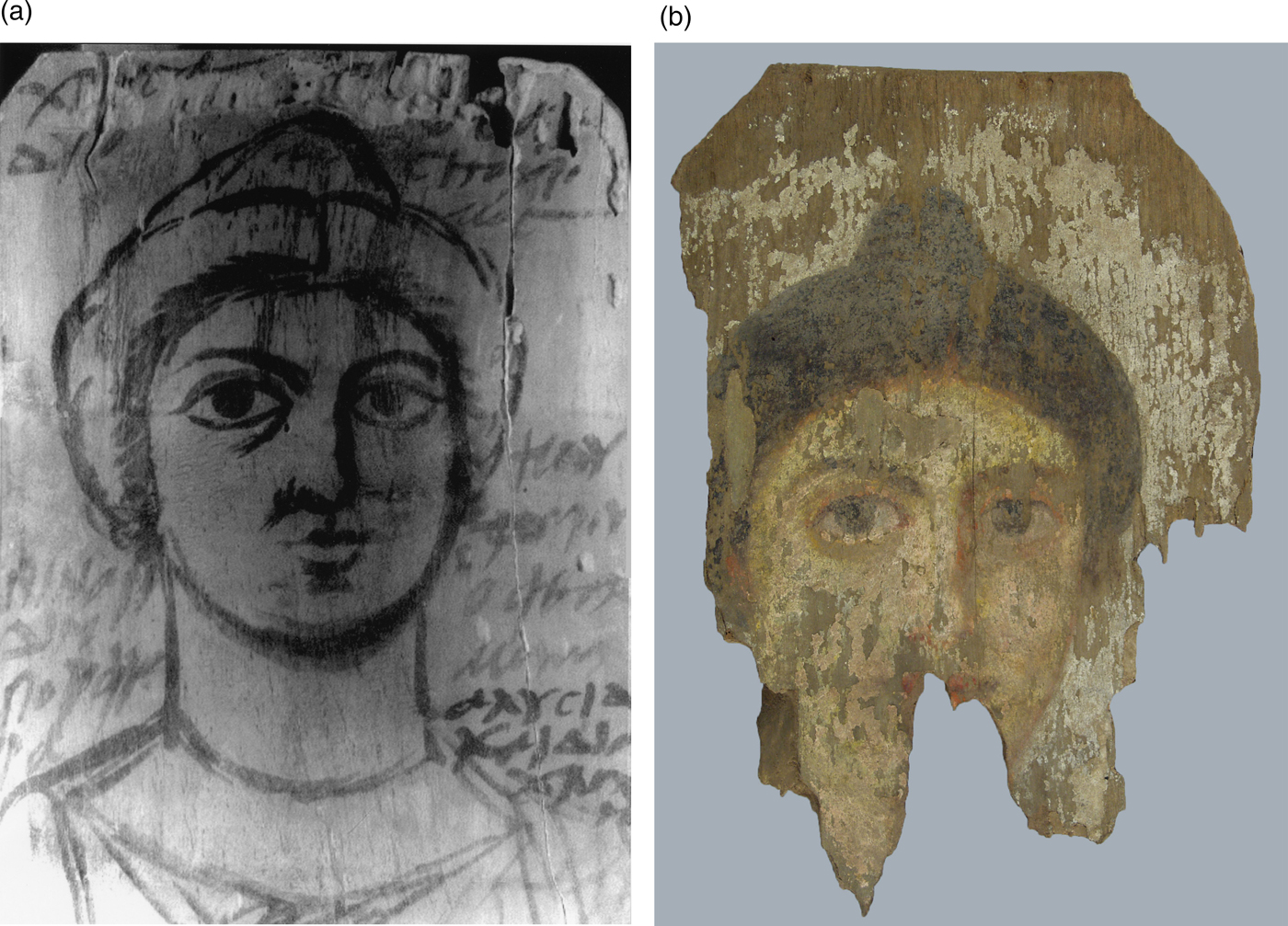
There is, in fact, a final possibility that could account for all three criteria: that detailed illustrations of botanical species were transmitted on whitened wooden boards known as pinakes (πίνακες), leukōmata (λευκώματα) or sanides (σανίδες). Such wooden boards are known to have carried detailed paintings in antiquity thanks to a selection of epigraphic and literary sources,Footnote 87 notably the inscribed temple inventories from Hellenistic Delos.Footnote 88 The perishable nature of these boards means that they have left few traces in the archaeological record, but the Fayyum mummy portraits and other panel paintings surviving from Roman Egypt may offer some indication of their original appearance.Footnote 89 Particularly instructive is a sketched portrait of a woman with a fashionable Antonine hairstyle on a rectangular wooden board (H: 36 cm, W: 24 cm), which also incorporates artist's instructions written in Greek (Fig. 12a).Footnote 90 According to one view, this board served as the preparatory drawing for a mummy portrait from Tebtunis now in the Phoebe Hearst Museum (Fig. 12b),Footnote 91 and so may provide some indication of the role played by such wooden boards in transmitting detailed iconographic designs during antiquity.
a. Sketch portrait of a woman on wood, with instructions for the artist in Greek. Found in Cemetery VII or VIII at Tebtunis in 1899–1900. Photographed using infrared reflectography. Phoebe A. Hearst Museum of Anthropology. (Photo: Courtesy of the Phoebe A. Hearst Museum of Anthropology and the Regents of the University of California (photography by J. Paul Getty Museum, Cat. no. 6-21378a)); b. Mummy portrait from Tebtunis; second century a.d. Phoebe A. Hearst Museum of Anthropology. (Photo: Courtesy of the Phoebe A. Hearst Museum of Anthropology and the Regents of the University of California (Cat. no. 6-21375))

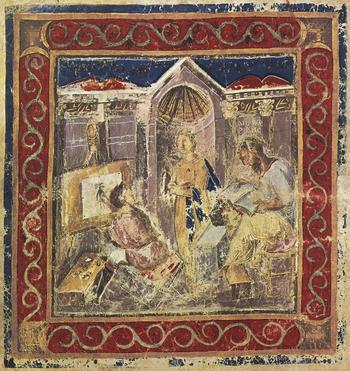
The possibility that the botanical illustrations of the Vienna Dioskourides were transmitted on wooden boards has already been suggested by Stavros Lazaris in an important article published in 2010.Footnote 92 Lazaris pinpointed two features of the Vienna codex that support this hypothesis. Firstly, the full-page illustrations of the codex (e.g. Figs 1a, 2a, 3a, 4a, 5a, 7a, 8a) correspond very neatly with how we envisage wooden boards carrying detailed depictions of individual plants might have appeared. In other words, the formatting of this version of Dioskourides’ treatise may have been conditioned by the format of the repertoire. The second observation pertains to one of the prefatory illustrations at the beginning of the codex (f. 5v) (Fig. 13). Here we see Dioskourides, seated to the right, holding a codex and writing a description of the mandrake that is being held aloft by a female figure labelled as a personification of Intelligence (ἐπίνοια) in the centre of the scene. To the left, an unnamed artist is shown painting the mandrake on a large, loose sheet that has been pinned to an easel.Footnote 93 The fact that the designer of this illustration insisted upon the spatial separation of text and image may reveal something about the nature of the archetypes used by the designers of the version of De materia medica contained within the codex itself.
Prefatory illustration on f. 5v of the Vienna Dioskourides, showing an artist drawing the mandrake being held by a personification of Intelligence. (Photo: © Österreichischen Nationalbibliothek, Vienna)

This hypothesis also accords well with the observations presented so far in this article, since the use of wooden boards could account for the differences between the Vienna, Naples and New York manuscripts in terms of their formatting and contents. That is, codex designers working from an unillustrated version of Dioskourides’ treatise and a series of loose pinakes carrying botanical illustrations might choose to combine and compile these in a variety of ways.
Lazaris’ observations concerning the Vienna Dioskourides contributed to his overarching theory that medical texts and illustrations were sometimes created and circulated independently during antiquity. As we shall see, this theory has important implications for our understanding of how scientific texts were experienced and understood by contemporary readers. But this focus on reader experience did not allow Lazaris to engage with more detailed questions concerning the chronological and cultural origins of the botanical repertoire, or to consider the broader art historical issue of how intricate, large-scale artistic designs were transmitted and reproduced during antiquity. While this art historical issue will be tackled in Section VI, it will first be useful to offer two further observations concerning the origins of the repertoire.
Firstly, we should not necessarily assume that all of the botanical illustrations of the repertoire originated in the same place and at the same time. That this was not the case is suggested by our earlier observation that the illustrations exhibit variety in terms of their naturalism and fidelity to real life specimens. While the finest illustrations probably descended from classical archetypes, it is possible that some of the less refined illustrations were first conceived at different dates and/or in different cultural and artistic milieux.Footnote 94 In this case, the repertoire would have comprised several sets of illustrations that were combined and consolidated sometime before the production of the Vienna Dioskourides in 512.
Secondly, it is far from certain that all of the illustrations were executed directly in conjunction with (or in response to) Dioskourides’ De materia medica. It is equally possible that some of the illustrations were conceived independently of the treatise, and that the combination of text and image occurred at a comparatively late stage. Support for this view is supplied by the observation that the version of De materia medica in the Vienna codex is a compilation of sorts, combining content taken from a variety of independent sources. Some of the chapters were accompanied by quotations lifted from the herbal treatises of Krateuas (late second or early first century b.c.) and Galen (second century a.d.), and all of the chapters were accompanied by lists of plant names borrowed from the work of Pamphilos, an Alexandrian grammarian of the first century a.d.Footnote 95 Further evidence is supplied by the illustrated paraphrase of Dionysios’ Ornithiaka in the same codex, which is a compilation of a comparable nature. Indeed, many of the naturalistic ornithological illustrations that accompany the treatise do not correspond closely with the contents of the text itself,Footnote 96 again suggesting dependence on a variety of sources.
VI CONCLUSIONS
There are then good reasons to suppose that the finest botanical illustrations of the repertoire were transmitted on a comparatively large scale, possibly on whitened wooden boards known as pinakes. To conclude, it will be useful to consider the historical and art historical implications of this hypothesis.
The historical implications have been explored already by Lazaris, who argued that scientific texts and images were sometimes created and consulted independently during antiquity.Footnote 97 This possibility accords very well with the scarcity of surviving papyri carrying detailed, large-scale, polychrome illustrations of the kind contained in our late antique and Byzantine illustrated codices. It also makes good sense when we consider the contexts in which scientific texts and images were consulted in the ancient world. In a library setting, for instance, the separation of texts and images would have permitted scholars to use a single image as a reference point for more than one text, or to compare two or more images when consulting a single treatise.Footnote 98 In a didactic context, meanwhile, students would have benefited from consulting independent, large-scale images while texts were read aloud by their tutors. It is tempting to suppose that this was the kind of arrangement envisaged by Theophrastus in a passage of his will quoted by Diogenes Laertius in the early third century a.d.:
From the funds entrusted to Hipparchos I desire the following distributions to be made … the small stoa adjoining the museion should be rebuilt at least as handsomely as before, and the boards (τοὺς πίνακας) containing the maps of the world (αἱ τῆς γῆς περίοδοί) replaced in the lower stoa.Footnote 99
Some scientific fields were better suited to independent images than others. In technical disciplines like mathematics, geometry, architecture, automata and siege-engine construction, illustrations were sometimes crucial for understanding the texts themselves, and so did not lend themselves to spatial separation. Hence Vitruvius, in his De architectura, eight times refers to illustrations ‘at the end of the scroll’ (extremo libro or extremo volumine), and twice refers to an illustration ‘at the bottom of the page’ (ima pagina).Footnote 100 But it is significant that the illustrations that accompanied such works were often simple line drawings in ink rather than paint, which could be executed in the papyrus roll format with relative ease.Footnote 101 In the case of other disciplines — medicine, geography, astronomy, botany and zoology, for instance — illustrations were both less important for understanding the texts themselves, and less suited to the papyrus roll format, increasing the likelihood of texts and images being separated. This view accords well with our surviving corpus of Byzantine illustrated manuscripts concerning these disciplines, several of which incorporate large, detailed, polychrome illustrations that might have been descended from earlier, stand-alone originals.Footnote 102
From an art historical perspective, the view that the illustrations of the repertoire were transmitted using large, detailed models has significant repercussions for our appreciation of how detailed iconographic designs were transmitted and reproduced during antiquity. Indeed, there remains a widespread, problematic assumption that when ancient artists did use pre-existing archetypes during the design process, these necessarily took the form of a ‘book’ of some description. As we have seen, it is very difficult to substantiate the view that the finest botanical illustrations of the Vienna codex were copied from illustrated ‘books’ made from papyrus, and the same might reasonably be said of detailed designs reproduced in other artistic media, such as mosaics, wall paintings and relief sculpture.
This ‘pattern book problem’ is particularly pronounced in those cases where an identical design appears in two works of art separated by a large chronological gap and/or a geographical distance, and those cases where an extant work of art clearly constitutes a later replica or version of a famous lost original. Here it will be useful to mention a pair of well-known examples belonging to the latter category: the Alexander Mosaic laid in the House of the Faun at Pompeii, which is demonstrably a replica of a famous royal battle painting of the later fourth century b.c.;Footnote 103 and the ethnos reliefs of the North Building of the Sebasteion at Aphrodisias, which were surely modelled on a pre-existing set of depictions of personified conquered territories in Rome itself.Footnote 104 To my mind, it is difficult to envisage how the iconography of such compositions could have been transmitted and reproduced using ‘pattern books’ in the papyrus roll format. The notion that designs were instead transmitted on a larger scale and in greater detail, perhaps on whitened wooden boards, offers an attractive alternative possibility that deserves further consideration.