Introduction
The family Galeommatidae sensu Ponder (Reference Ponder, Besley, Ros and Wels1998) is a group of tiny marine bivalves, with approximately 620 described species and numerous undescribed species (Huber, Reference Huber2015). Many commensal species within this family live attached to the body surface or burrow walls of benthic invertebrates (Boss, Reference Boss1965; Morton and Scott, Reference Morton and Scott1989; Goto et al., Reference Goto, Kawakita, Ishikawa, Hamamura and Kato2012; Li et al., Reference Li, Ó Foighil and Middelfart2012). Sagamiscintilla thalassemicola (Habe, Reference Habe1962) is a distinctive commensal galeommatid that almost exclusively lives on the proboscis of the echiurans, Anelassorhynchus spp. (Annelida: Thalassematidae: Thalassematinae: Thalassematini), and has been known only from the temperate Japan (Habe, Reference Habe1962; Goto and Ishikawa, Reference Goto and Ishikawa2019). This species was originally described based on the specimens collected from Amakusa, west of Kyushu Island, western Japan (Habe, Reference Habe1962). The list of the molluscs collected from Wakayama Prefecture, Japan, in Habe (Reference Habe1981) contained S. thalassemicola from the middle western part of the Kii Peninsula without detailed information. As there have been no reliable records of this species since the original description, it was once suspected to be extinct (Wada et al., Reference Wada, Nishihira, Furota, Nojima, Yamanishi, Nishikawa, Goshima, Suzuki, Kato, Shimamura and Fukuda1996). However, it has recently been rediscovered in southern Kyushu and western Shikoku Islands of western Japan (Goto and Ishikawa, Reference Goto and Ishikawa2019).
In this study, we collected S. thalassemicola attached to the proboscis of the large echiuran Ochetostoma sp. (Thalassematidae: Thalassematinae: Thalassematini) in subtropical coasts of the Ryukyu Islands, southern Japan, which provides a new host record and significantly updates the southernmost record of this species. We also collected S. thalassemicola attached to Anelassorhynchus sp. 1 in Kushimoto, Wakayama, Kii Peninsula, middle Japan, which updates the easternmost record of this species. We investigated their morphological characteristics and compared the specimens collected from Ochetostoma sp. and Anelassorhynchus spp. based on the mitochondrial cytochrome c oxidase subunit I (COI) and nuclear internal transcribed spacer 2 (ITS2) sequences to test whether they are conspecific. In addition, morphological and molecular characteristics of the echiuran hosts were provided.
Materials and methods
Sampling
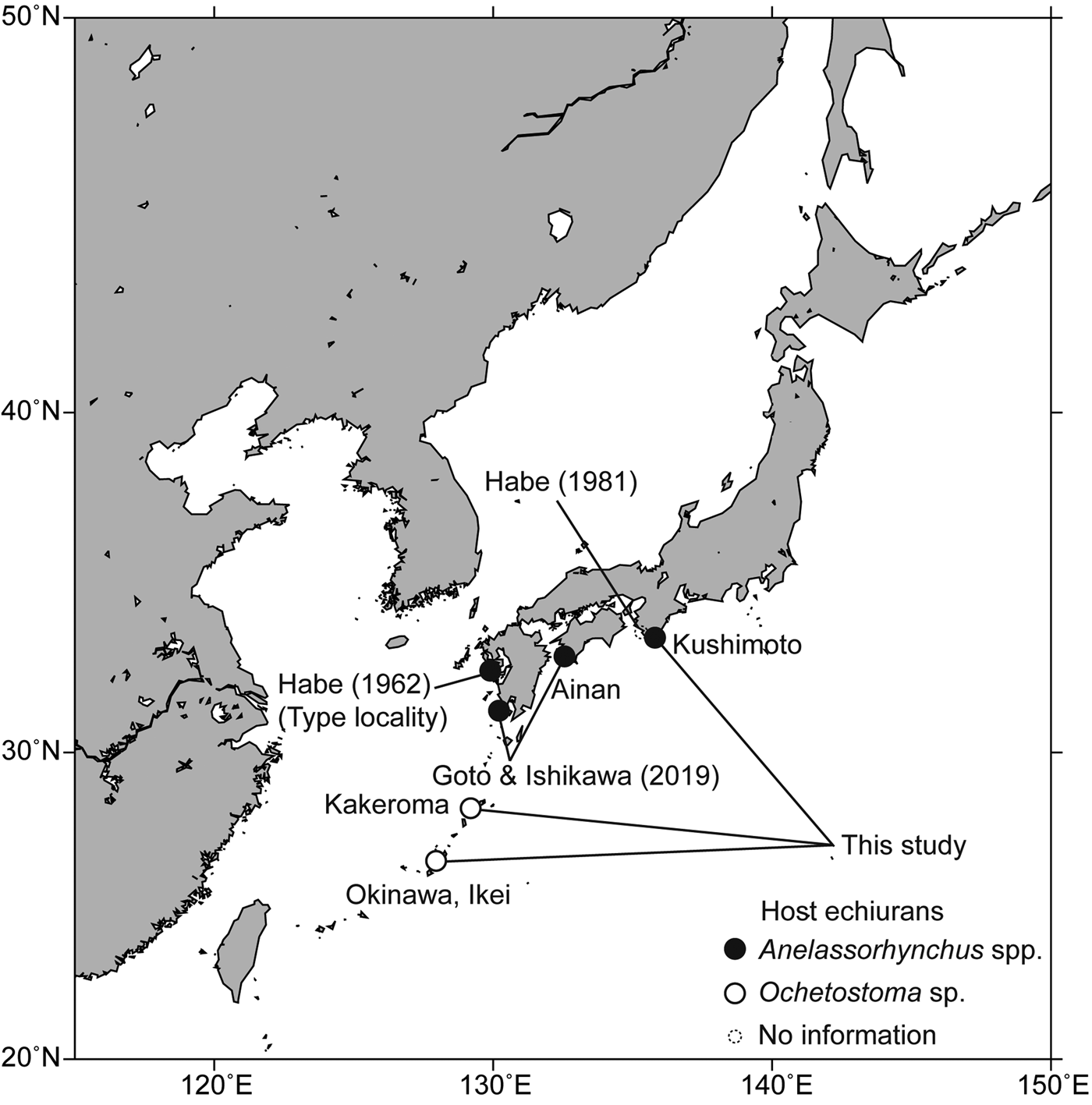
We collected S. thalassemicola from echiuran hosts on the intertidal flats of the Ryukyu Archipelago (Kakeroma, Okinawa, and Ikei Islands) in 2010, 2021, and 2022, as well as from the intertidal flat of Kamiura, Kushimoto in the Kii Peninsula, Wakayama, Japan in 2022 (Table 1). Figure 1 shows the sampling localities of this study and the sampling records of the previous studies (Habe, Reference Habe1962, Reference Habe1981; Goto and Ishikawa, Reference Goto and Ishikawa2019). The host echiurans in Kakeroma Island and Kamiura were collected from their burrows beneath the rocks embedded in the sediment bottom, whereas those in Okinawa and Ikei Islands were collected from their burrows by using a yabby pump. Sagamiscintilla thalassemicola and their host echiurans were photographed in a living state before fixation.
Sampling information of Sagamiscintilla thalassemicola

Sampling localities of Sagamiscintilla thalassemicola in this study and previous studies (Habe, Reference Habe1962, Reference Habe1981; Goto and Ishikawa, Reference Goto and Ishikawa2019) with the host information.

Sagamiscintilla thalassemicola and its host collected from Kakeroma Island were fixed in 70% ethanol except for a small tissue of the echiuran proboscis fixed in 99.5% ethanol, which was already used for molecular phylogenetic analyses of echiurans in Goto et al. (Reference Goto, Okamoto, Ishikawa, Hamamura and Kato2013, Reference Goto, Monnington, Sciberras, Hirabayashi and Rouse2020) and Goto (Reference Goto2016). Morphological characteristics of the specimen of Ochetostoma sp. from Kakeroma Island were described in Goto (Reference Goto, Motokawa and Kajihara2017). Sagamiscintilla thalassemicola collected from Okinawa and Ikei Islands, as well as Kushimoto, were fixed in 99.5% ethanol along with small tissues of the proboscis of their echiuran hosts. The trunk and a part of the proboscis of Anelassorhynchus sp. 1 collected from Kushimoto were fixed in a 10% formalin solution.
Morphological characteristics of S. thalassemicola were observed under a microscope. The following specimens were dissected to observe the hinge structure and internal anatomy: one from Kakeroma (A-1, see Table 2 for sample IDs), two from Okinawa Island (B-1 and B-2), and one from Kushimoto (C-1).
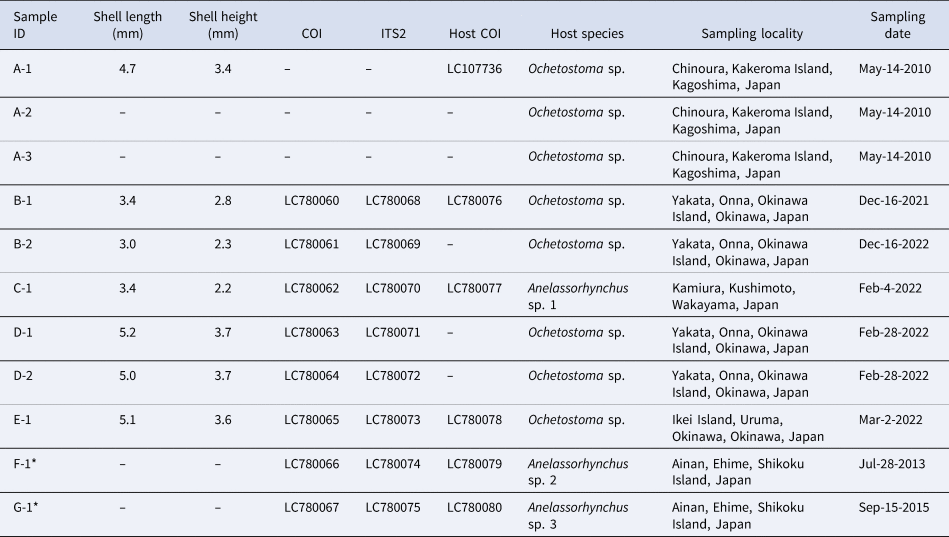
Specimen information of Sagamiscintilla thalassemicola

Shell length and width of S. thalassemicola. Accession numbers of the COI and ITS2 sequences of S. thalassemicola and the COI sequence of the host thalassematids. The alphabets and asterisks in the sample IDs of S. thalassemicola indicate the host individuals (see Table 1) and the specimens derived from Goto and Ishikawa (Reference Goto and Ishikawa2019), respectively.
For molecular comparison with S. thalassemicola from the Ryukyu Archipelago and Kushimoto, we obtained the sequence data of the COI and ITS2 genes from two individuals of S. thalassemicola, which were collected from Ainan, Ehime, Shikoku Island, Japan in the previous study (Goto and Ishikawa, Reference Goto and Ishikawa2019; F-1 and G-1 in Table 2), in addition to the specimens collected in this study. The hosts of these specimens were previously identified as Anelassorhynchus sp. (Goto and Ishikawa, Reference Goto and Ishikawa2019). The COI gene of one individual (the host of F-1) was already sequenced in Goto (Reference Goto2016) as ‘Anelassorhynchus sp. 10’ (accession number: LC107732). Additionally, we sequenced the COI gene of another individual (the host of G-1) of Anelassorhynchus sp. collected in 2015 and used in Goto and Ishikawa (Reference Goto and Ishikawa2019).
DNA extraction
We extracted genomic DNA from small tissues of the ethanol-fixed specimens of S. thalassemicola and the host echiurans’ proboscis using a DNeasy Blood & Tissue Kit (Qiagen, Germantown, MD, USA) following the manufacturer's protocol. Polymerase chain reaction (PCR) was performed using the primers LCO1490/HCO2190 (Folmer et al., Reference Folmer, Black, Hoeh, Lutz and Vrijenhoek1994) and Echi_cox1L/Echi_cox1H (Tanaka et al., Reference Tanaka, Kon and Nishikawa2014) to amplify the COI genes (~650 bp) of bivalves and echiuran hosts, respectively, and also ITS2F/ITS2R (Xu et al., Reference Xu, Guo, Gaffney and Pierce2001) for the nuclear ITS2 gene (~522 bp) of bivalves. Thermal cycling for the COI gene was performed with an initial denaturation for 3 min at 94°C, followed by 35 cycles of 45 s at 94°C, 1 min 30 s at 42°C, and 1 min at 72°C, with a final 4 min extension at 72°C. As for the ITS2 gene, the annealing temperature was set to 50°C. All PCR products were purified by ExoSAP-IT (Thermo Fisher Scientific K.K., Tokyo, Japan) and then sent to Eurofins Genomics with PCR primers for sequencing. The obtained sequences were deposited in the DDBJ/EMBL/GenBank databases with the following accession numbers: S. thalassemicola (LC780060–LC780075), Ochetosoma sp. (LC780076 and LC780078), and Anelassorhynchus spp. (LC780077, LC780079, and LC780080) (Table 2). The voucher specimens have been retained by the first author in the Seto Marine Biological Laboratory, Kyoto University.
Molecular analysis
Haplotype networks of S. thalassemicola were constructed using the Median Joining Network function (Bandelt et al., Reference Bandelt, Forster and Röhl1999) implemented in software PopART (Leigh and Bryant, Reference Leigh and Bryant2015). We compared the Kimura two-parameter (K2P) genetic divergence among the specimens of S. thalassemicola and also among Ochetostoma sp. using ‘distance’ function of MEGA11 (Tamura et al., Reference Tamura, Stecher and Kumar2021).
Results
Field observation
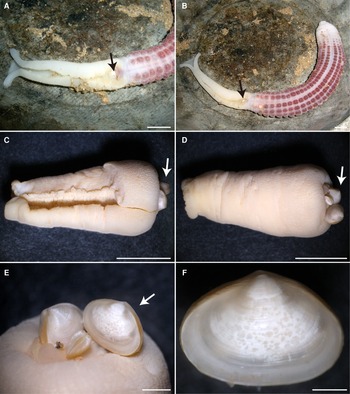
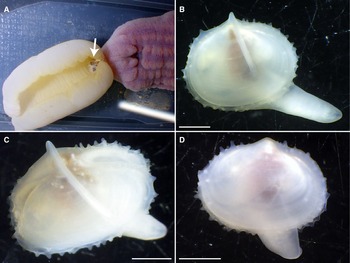
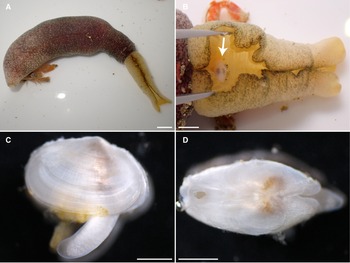
All the individuals of S. thalassemicola collected in three localities of the Ryukyu Archipelago (Kakeroma, Okinawa, and Ikei Islands), southern Japan, were found from the basal part of the proboscis of Ochetostoma sp. (Figures 2 and 3), while the individual collected in Kamiura, Kushimoto, Kii Peninsula, middle Japan, were found from the basal part of the proboscis of Anelassorhynchus sp. 1 (Figure 4). All the bivalve specimens were found hidden within the gutter of the host's proboscis (Figures 2–4) and were attached around the host's mouth (Figures 3 and 4), except for those from Kakeroma, which were attached inside the host's mouth (Figure 2). Regarding Ochetostoma sp., four of five (80%) collected in this study harboured S. thalassemicola. Number of individuals per host varied from one to three (Table 1).
Sagamiscintilla thalassemicola (A-1, A-2, and A-3; see Table 2 for sample IDs) with their host Ochetostoma sp. collected from Chinoura, Kakeroma Island, Kagoshima, southern Japan. (A, B) S. thalassemicola living on the basal part of proboscis (inside the mouth) of Ochetostoma sp. (C, D) Ventral and dorsal view of the proboscis of Ochetostoma sp., attached by three individuals of S. thalassemicola. (E) Close up of the basal part of the proboscis. (F) An individual of S. thalassemicola removed from the host's proboscis. Scale bar: (A–D) 1 cm, (E) 2 mm, (F) 1 mm. Sagamiscintilla thalassemicola is indicated by white or black arrows.

Sagamiscintilla thalassemicola (B-1 and B-2; see Table 2 for sample IDs) and their host echiuran Ochetostoma sp. collected from Yakata, Okinawa Island, southern Japan. (A) Two individuals of S. thalassemicola on the proboscis of Ochetostoma sp. (B, C) A larger individual of S. thalassemicola (SL 3.4 mm). (D) A smaller individual of S. thalassemicola (SL 3.0 mm). Scale bar: 1 mm.

Sagamiscintilla thalassemicola (C-1; see Table 2 for sample ID) and its echiuran host Anelassorhynchus sp. 1 from Kushimoto, Wakayama, Japan. (A) Anelassorhynchus sp. 1 with its commensal shrimp Alpheus barbatus Coutère, 1897. (B) S. thalassemicola on the host's proboscis. (C, D) Lateral and dorsal view of S. thalassemicola removed from the host. Scale bar: 3 mm (A, B), 1 mm (C, D).

Morphological characteristics
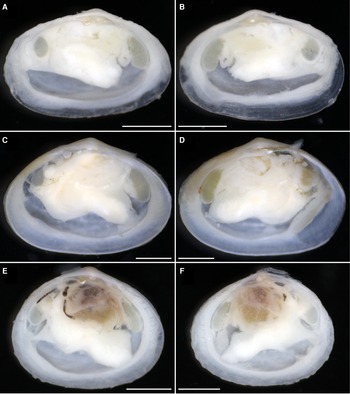
General morphological features of the specimens collected in this study were identical to those of S. thalassemicola described in Habe (Reference Habe1962) and Goto and Ishikawa (Reference Goto and Ishikawa2019): (1) shells are elongated- or rounded-oval in outline and fully covered by a white soft mantle robe with short papillae (Figures 3B–D and 4C, D), (2) the hinge has a single anterior cardinal tooth in front of internal ligament of each valve (Figure 5), and (3) all the specimens dissected possess a single inner demibranch composing both ascending and descending lamellae (Figure 5). The soft mantle of the specimens collected from Okinawa Island formed a keel-like structure from right to left valves through the umbo (Figure 3B–D), which were not described in Habe (Reference Habe1962) or Goto and Ishikawa (Reference Goto and Ishikawa2019).
Internal anatomy of left and right valves of Sagamiscintilla thalassemicola collected from different localities: (A, B) Kushimoto, Wakayama, (C, D) Kakeroma Island, and (E, F) Okinawa Island. Sample ID: C-1, A-1, and B-1. Scale bar: 1 mm.

Shell length and height of the specimens collected from the Ryukyu Archipelago and Kushimoto are shown in Table 2. The shell of S. thalassemicola from Anelassorhynchus sp. 1 (C-1) is slightly longer than those from Ochetostoma sp. even in the same size stage (e.g., B-1) (Figure 5).
Haplotype networks and genetic divergences of S. thalassemicola
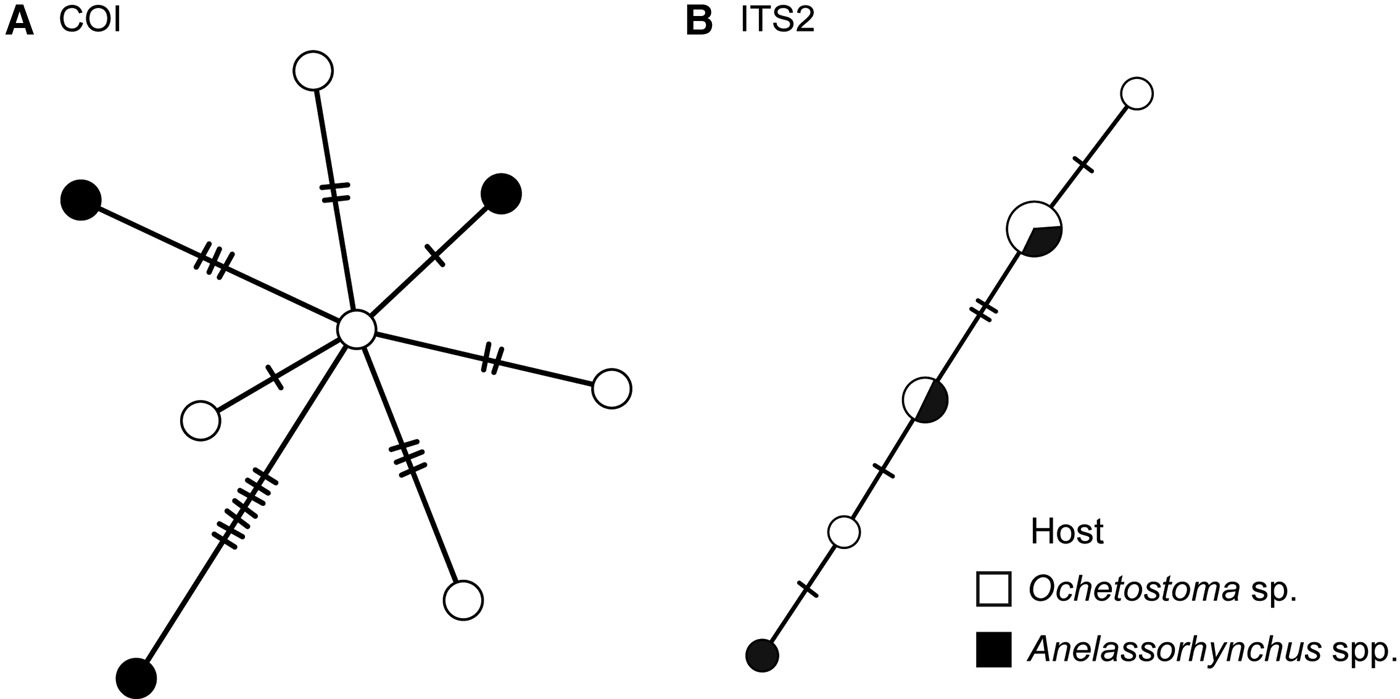
Figure 6 shows the haplotype networks of the COI and ITS2 genes of S. thalassemicola collected from the Ryukyu Archipelago (Okinawa and Ikei Islands), Kushimoto, and Shikoku Island. The COI and ITS2 gene haplotype networks contained eight and five haplotypes, respectively. In the COI haplotype network, one haplotype derived from G-1, which was obtained from Anelassorhynchus sp. 3 in Ehime, Japan, was separated from the other. No clear genetic structures were detected corresponding to each host genus in both haplotype networks (Figure 6A, B). There were only 0.1–1.5 and 0–1.0% differences in the K2P genetic divergence of the COI and ITS2 genes among the specimens, respectively.
Haplotype networks from COI and ITS2 data for Sagamiscintilla thalassemicola from the Ryukyu Archipelago, Kushimoto, and Shikoku Island, Japan. Each circle represents a unique haplotype. Size and colour of the circles represent the haplotype frequency and host echiuran species, respectively. Each connection represents one inferred base-pair change.

Host echiuran identification
Ochetostoma sp. collected from Kakeroma Island had three pairs of gonoducts and eight longitudinal muscle bands. The host echiuran Ochetostoma sp. from Okinawa Island in 2021 had ten longitudinal muscle bands without internal information. There was only 0.2–0.8% K2P genetic divergence in the sequences of COI gene among Ochetostoma sp. specimens collected from Kakeroma, Okinawa, and Ikei Islands.
Anelassorhynchus sp. 1 collected from Kushimoto possessed two gonoducts. The COI gene of Anelassorhynchus sp. 1 from Kushimoto was identical to that of ‘Anelassorhynchus sp. 9’ sequenced in Goto (Reference Goto2016), which was previously collected from Ehime, Japan. Morphological characteristics of this species were described in Goto (Reference Goto, Motokawa and Kajihara2017) as ‘Anelassorhynchus sp. 6’. One of the host specimens of ‘Anelassorhynchus sp.’ in Goto and Ishikawa (Reference Goto and Ishikawa2019) was previously sequenced in Goto (Reference Goto2016) and corresponds to ‘Anelassorhynchus sp. 10’. In this study, we additionally sequenced the COI gene of another host specimen of ‘Anelassorhynchus sp.’ in Goto and Ishikawa (Reference Goto and Ishikawa2019) and its sequence corresponded to that of ‘Anelassorhynchus sp. 12’ in Goto (Reference Goto2016). Morphology of this species was described as ‘Anelassorhynchus sp. 5’ in Goto (Reference Goto, Motokawa and Kajihara2017). Overall, S. thalassemicola uses at least three species of Anelassorhynchus.
Discussion
The bivalves attaching to the proboscis of Ochetostoma sp. in the Ryukyu Archipelago are morphologically identified as S. thalassemicola. The genetic divergences among the specimens (0.1–1.5% in COI and 0–1.0% in ITS2), including those from Kushimoto and Shikoku Island with Anelassorhynchus spp. and those from the Ryukyu Archipelago with Ochetostoma sp., are similar to or less than intraspecific variation reported in other galeommatids [COI: Koreamya arcuata (A. Adams, 1856) in Sato et al. (Reference Sato, Owada, Haga, Hong, Lützen and Yamashita2011); Neaeromya rugifera (P. P. Carpenter, 1864) in Li and Ó Foighil (Reference Li and Ó Foighil2012), ITS2: Lasaea australis (Lamarck, 1818) in Li et al. (Reference Li, Ó Foighil and Park2013)]. Overall, our finding significantly updates the southernmost limit of the distribution of this species and provides a novel host record of this species. Sagamiscintilla thalassemicola from Ochetostoma sp. tended to be more rounded than that from Anelassorhynchus sp. 1 (Table 2). Such host-associated intraspecific morphological differences are also known in other commensal galeommatids (Sato et al., Reference Sato, Owada, Haga, Hong, Lützen and Yamashita2011; Li and Ó Foighil, Reference Li and Ó Foighil2012).
Although the number of the longitudinal muscle bands of Ochetostoma sp. was different between Kakeroma and Okinawa Islands (eight vs ten), there were only 0.8% (5 of 656 bp) genetic differences between them, suggesting that they are conspecific. Longitudinal muscle bands of Thalassematini are known to vary within species (e.g., Tanaka et al., Reference Tanaka, Kon and Nishikawa2014) and thus these can be considered within intraspecific variation. Our results suggest that Anelassorhynchus spp. contain at least three species, corresponding to Anelassorhynchus spp. 9, 10, and 12 in Goto (Reference Goto2016) and Goto et al. (Reference Goto, Monnington, Sciberras, Hirabayashi and Rouse2020). Overall, S. thalassemicola uses at least four species of two genera of thalassematids as hosts.
Habe (Reference Habe1981) included S. thalassemicola in the list of molluscs collected from Wakayama Prefecture and recorded it from the middle western part of the Kii Peninsula without details. Our collection of S. thalassemicola in Kushimoto thus confirms the record from the Kii Peninsula and updates the easternmost record of this species.
About 45 species of commensal galeommatids have been recorded from the Japanese Islands (Goto, Reference Goto2022). The geographic distribution of each galeommatid species around Japanese Islands is generally limited to either the temperate or subtropical regions (Goto, Reference Goto2022). The commensal galeommatid species found both in the temperate and subtropical regions are rare, except for a few examples such as Nipponomontacuta actinariophila Yamamoto & Habe, 1961 (Miura and Miura, Reference Miura and Miura2015). Our study newly added S. thalassemicola to such rare examples.
Most commensal galeommatids use a specific genus or family as host (Sato et al., Reference Sato, Owada, Haga, Hong, Lützen and Yamashita2011). Thus, it may not be surprising that S. thalassemicola uses host echiurans belonging to multiple genera (i.e., Anelassorhynchus and Ochetostoma) of the tribe Thalassematini. However, S. thalassemicola may not use a broad range of the species of these genera as host. Ochetostoma sp. is a very rare echiuran species in the Ryukyu Archipelago. Although the echiuran fauna in the Ryukyu Archipelago has been investigated by us since around 2010, we obtained only five specimens of Ochetostoma sp. Despite its rarity, 80% of them harboured S. thalassemicola on their proboscis. In contrast, Ochetostoma erythrogrammon Rüppel & Leuckart, 1828, which is the most common species of this genus occurring in the Ryukyu Archipelago (Goto and Kato, Reference Goto and Kato2012), has never been found together with S. thalassemicola, although we investigated many individuals of this echiuran species for their commensals (Goto et al., Reference Goto, Hamamura and Kato2011; Goto and Kato, Reference Goto and Kato2012). These suggest that S. thalassemicola may exhibit a host specificity for a peculiar species of Ochetostoma. The species of Ochetostoma are common in subtropical and tropical regions, but not in the temperate regions, whereas those of Anelassorhynchus are common both in temperate and warmer (subtropical and tropical) regions (Biseswar, Reference Biseswar2010; Goto, Reference Goto, Motokawa and Kajihara2017). We have collected various species of Anelassorhynchus in the Ryukyu Archipelago and other Pacific Islands (Goto, Reference Goto2016, Reference Goto, Motokawa and Kajihara2017), but never encountered the echiurans of this genus with S. thalassemicola. Thus, S. thalassemicola also prefers to live symbiotic with the specific species of Anelassorhynchus in the temperate zone. Explaining the cause of such a ‘picky’ host specificity is difficult as the host species of Anelassorhynchus and Ochetostoma are not so ecologically distinct from other congeneric species: both host echiuran species are burrower in intertidal sediments, which is usual in each of these genera. Interestingly, some galeommatid also shows such a host specificity pattern (Li and Ó Foighil, Reference Li and Ó Foighil2012). However, its cause also remains poorly understood.
Latitudinal shift of the associated hosts is probably common in symbiotic or parasitic marine animals, although it remains not well investigated. If the genetic isolation occurs between the northern and southern populations of such species, it likely leads to the separation of the species associated with different hosts. Some sister species of commensal galeommatids actually show such a distribution pattern: the ectosymbiotic bivalves, Peregrinamor ohshimai Shôji, 1938 and its sister Peregrinamor gastrochaenans Kato & Itani, 2000, use different upogebiid hosts and are distributed in the temperate and subtropical regions, respectively (Itani, Reference Itani and Tamaki2004). A further investigation on latitudinal host variation of commensal galeommatids will advance our understanding of the host-associated speciation of symbiotic or parasitic animals in the sea.
Acknowledgements
We thank Profs. Makoto Kato (Kyoto University) and Atsushi Kawakita (the University of Tokyo), and Kato's laboratory members for helping us to collect the specimens in the field; and Genki Kobayashi (Ishinomaki Senshu University) for supporting the preparation of figures.
Data availability
The genetic data newly obtained in this study are available on NCBI GenBank at https://www.ncbi.nlm.nih.gov/genbank/ and can be accessed with the following accession numbers LC780060–LC780075 (Table 2).
Author's contribution
R. G. wrote the initial draft of the manuscript, and collected, identified, and sequenced the specimens. T. Sa., H. N., T. Su., and H. I. collected the specimens. All the authors contributed to finalize the manuscript.
Financial support
This study was supported by KAKENHI grants to R. G. (20K15860 and 23K05906).
Competing interests
None.