Children's exposure to interparental violence (EIPV) is a harmful experience that increases the risk for maladaptive behaviors and relationships across development. Estimates indicate that over 10 million US children are exposed to interparental violence each year, and 7 million are exposed to severe interparental violence (McDonald, Jouriles, Ramisetty-Mikler, Caetano, & Green, Reference McDonald, Jouriles, Ramisetty-Mikler, Caetano and Green2006; Straus, Reference Straus1991). Like maltreatment, EIPV represents a frightening experience outside the range of typical development (Cicchetti & Valentino, Reference Cicchetti, Valentino, Cicchetti and Cohen2006; Margolin & Gordis, Reference Margolin and Gordis2000; Maughan & Cicchetti, Reference Maughan and Cicchetti2002) and threatens children's basic sense of safety because it indicates danger from their expected source of protection (Davies & Cummings, Reference Davies and Cummings1994; Margolin, Reference Margolin2005). Children with EIPV have been found to fare just as poorly as physically abused children, and EIPV has recently been considered a form of emotional abuse (Holt, Buckley, & Whelan, Reference Holt, Buckley and Whelan2008; Kitzmann, Gaylord, Holt, & Kenny, Reference Kitzmann, Gaylord, Holt and Kenny2003).
The effects of EIPV can lead to behavioral dysregulation, such as an inability to manage conflict and increases in externalizing behavior (e.g., aggression or conduct problems) in childhood and adolescence (Bauer et al., Reference Bauer, Herrenkohl, Lozano, Rivara, Hill and Hawkins2006; Cummings, Schermerhorn, Davies, Goeke-Morey, & Cummings, Reference Cummings, Schermerhorn, Davies, Goeke-Morey and Cummings2006; Fite et al., Reference Fite, Bates, Holtzworth-Munroe, Dodge, Nay and Pettit2008; Litrownik, Newton, Hunt, English, & Everson, Reference Litrownik, Newton, Hunter, English and Everson2003; Yates, Dodds, Sroufe, & Egeland, Reference Yates, Dodds, Sroufe and Egeland2003). Witnessing violence against one's mother in early childhood is also reportedly the greatest risk factor for violence in the next generation (American Psychological Association, 1996). Studies have found that EIPV in childhood and adolescence predicts both dating violence victimization and perpetration (Ehrensaft et al., Reference Ehrensaft, Cohen, Brown, Smailes, Chen and Johnson2003; O'Keefe, Reference O'Keefe1998; Roberts, McLauglin, Conron, & Koenen, Reference Roberts, McLaughlin, Conron and Koenen2011; Tschann et al., Reference Tschann, Pasch, Flores, Marin, Baisch and Wibbelsman2009), although many of these studies utilized concurrent or retrospective data (Stith et al., Reference Stith, Rosen, Middleton, Busch, Lundeberg and Carlton2000). Elevated externalizing behavior also has been identified as an antecedent of dating violence (Magdol, Moffitt, Caspi, & Silva, Reference Magdol, Moffitt, Caspi and Silva1998; Wekerle & Wolfe, Reference Wekerle and Wolfe1999) in addition to being an outcome of EIPV. These findings suggest that externalizing behavior may be part of the mediating pathway between EIPV and dating violence.
Many investigators acknowledge that more research is needed to sharpen understanding of the prospective relations among EIPV, externalizing behavior, and dating violence, and the timing in development when they pose the greatest risks (Gewirtz & Edleson, Reference Gewirtz and Edleson2007; Herrenkohl, Sousa, Tajima, Herrenkohl, & Moylan, Reference Herrenkohl, Sousa, Tajima, Herrenkohl and Moylan2008; Kitzmann et al., Reference Kitzmann, Gaylord, Holt and Kenny2003). Research that prospectively identifies children with histories of EIPV who are at risk for later dating violence and also identifies the intervening influences in this pathway could optimally inform interventions to halt intergenerational cycles of family violence.
The purpose of the current study was to examine (a) the prospective effects of EIPV in early childhood and middle childhood on dating violence perpetration and victimization in early adulthood, (b) the role of externalizing behavior in childhood and adolescence as an intervening influence that reinforces the risks for dating violence, and (c) the effects of these developmental risk factors versus concurrent life stress in early adulthood on dating violence across 5 years. By examining EIPV, externalizing behavior, and dating violence at multiple periods in development, this study clarifies whether and how the timing and continuity of these risks influence dating violence over time.
Theoretical and Empirical Pathways of EIPV to Dating Violence
Theoretically, from an organizational developmental perspective, experiences with parents play a critical role in shaping children's expectations of social partners and beliefs about how others will respond (Bowlby, Reference Bowlby1969; Rutter & Sroufe, Reference Rutter and Sroufe2000; Sroufe, Reference Sroufe1979). Early perturbations in the home environment, such as EIPV between caregivers, can teach children that violence is a tolerable strategy and an acceptable tactic to resolve conflicts (Davies & Cummings, Reference Davies and Cummings1994; Margolin, Reference Margolin2005; Osofsky, Reference Osofsky2003; Widom, Reference Widom1989). EIPV can also preclude parents, who may be violent or injured themselves, from teaching children appropriate conflict resolution strategies (Holt et al., Reference Holt, Buckley and Whelan2008; Margolin & Gordis Reference Margolin and Gordis2000; McIntosh, Reference McIntosh2002).
The ways in which children witness and navigate early relationships serve as an anchor to shape and constrain future relationship experiences (Ainsworth, Bell, & Stayton, Reference Ainsworth, Bell, Stayton, Woodhead, Carr and Light1991; Sroufe, Egeland, Carlson, & Collins, Reference Sroufe, Egeland, Carlson and Collins2005). Expectations and behaviors from childhood may be internalized and reactivated throughout development and across generations (Cappell & Heiner, Reference Cappell and Heiner1990; Rutter & Sroufe, Reference Rutter and Sroufe2000). When resolving conflict and managing tension with a romantic partner, internalized templates of early social experiences are highly salient (Hazan & Shaver, Reference Hazan and Shaver1987; Waters & Cummings, Reference Waters and Cummings2000). Therefore, theoretically, EIPV may have enduring effects on development by reactivating expectations of violence between loved ones.
Developmental sequelae of EIPV to dating violence
Empirically, the developmental legacy that individuals with histories of EIPV tend to have increased violence in romantic relationships has been documented. Retrospective studies have shown that adults who reported witnessing violence between parents in childhood also reported higher rates of both perpetration (Roberts et al., Reference Roberts, McLaughlin, Conron and Koenen2011) and victimization (Miller et al., Reference Miller, Breslau, Chung, Green, McLaughlin and Kessler2011) with their romantic partners. Moreover, the likelihood of engaging in violence may begin early. Children with histories of EIPV or physical abuse were more likely to perpetrate aggression in relationships as early as adolescence (O'Keefe, Reference O'Keefe1998; Tschann et al., Reference Tschann, Pasch, Flores, Marin, Baisch and Wibbelsman2009; Wolfe, Scott, Wekerle, & Pittman, Reference Wolfe, Scott, Wekerle and Pittman2001).
Given that children with histories of EIPV also are likely to directly experience physical abuse (Holt et al., Reference Holt, Buckley and Whelan2008; Wolfe, Wekerle, Reitzel-Jaffe, & LeFebvre, Reference Wolfe, Wekerle, Reitzel-Jaffe and LeFebvre1998), many studies have examined the predictive effects of EIPV for dating violence after accounting for child physical abuse, with mixed results. In a longitudinal study, after controlling for physical abuse, retrospective but validated reports of EIPV in childhood directly predicted adults' victimization by romantic partners (Ehrensaft et al., Reference Ehrensaft, Cohen, Brown, Smailes, Chen and Johnson2003). Adolescents' severe EIPV also prospectively predicted involvement in dating violence over and above the effects of physical abuse (Ireland & Smith, Reference Ireland and Smith2009). However, other studies that assessed EIPV retrospectively from adults' reports or examined EIPV only in males have not found significant effects of EIPV on dating violence after accounting for physical abuse or corporal punishment (e.g., Fergusson, Boden, & Horwood, Reference Fergusson, Boden and Horwood2006; Simons, Lin, & Gordon, Reference Simons, Lin and Gordon1998). These discrepancies suggest that many factors influence the conclusions drawn about EIPV, such as whether retrospective or prospective reports of EIPV are gathered, whether the severity of EIPV is captured, and whether both males' and females' EIPV are measured. Prospective longitudinal research on EIPV that also assesses child maltreatment and examines EIPV during multiple developmental periods is needed to clarify the long-term effects of EIPV on dating violence.
Timing of EIPV in development
Empirically, EIPV has been reported to have different effects depending on children's age or developmental stage during exposure (Cunningham & Baker, Reference Cunningham and Baker2004). A meta-analysis reported that preschool EIPV is a particularly salient predictor of children's social deficits (Kitzmann et al., Reference Kitzmann, Gaylord, Holt and Kenny2003). Prospective studies found that timing of EIPV uniquely predicted timing of externalizing behavior, such that EIPV in early childhood (ages 0–64 months) predicted externalizing behavior in adolescence but EIPV in middle childhood (Grades 1–3) predicted concurrent externalizing behavior (Yates et al., Reference Yates, Dodds, Sroufe and Egeland2003). In another study, exposure to parental discord in both early and middle childhood predicted increased externalizing problems in adolescence (Fergusson, Horwood, & Lynskey, Reference Fergusson, Horwood and Lynskey1992), suggesting that continuity of exposure may also be a significant risk factor for maladjustment.
Investigators have postulated that early childhood EIPV may be the most deleterious because there has been less time for competent development to provide a foundation for resilience (Cunningham & Baker, Reference Cunningham and Baker2004; Margolin & Gordis, Reference Margolin and Gordis2000). However, we are not aware of research that has prospectively compared the timing of EIPV at multiple developmental periods or the timing versus the continuity of EIPV across development on the risk for dating violence. In the current study, we extend past research that has examined these issues with externalizing behavior as an outcome (Fergusson et al., Reference Fergusson, Horwood and Lynskey1992; Yates et al., Reference Yates, Dodds, Sroufe and Egeland2003) to determine whether EIPV during one or multiple developmental periods is most detrimental to the risk for dating violence.
Theoretical and Empirical Pathways of Externalizing Behavior
Theoretically, mastery of early childhood behavior, such as accomplishing self-control and suppressing impulsivity and aggression, is a developmental milestone that children achieve with the help of parents (Masten, Burt, & Coatsworth, Reference Masten, Burt, Coatsworth, Cicchetti and Cohen2006; Sroufe, Reference Sroufe1979). In contexts of EIPV, when caregivers may be threatening and less accessible to scaffold children's self-regulation (Davies & Woitach, Reference Davies and Woitach2008), young children's immature reasoning skills may render them vulnerable to behavioral dysregulation (Cunningham & Baker, Reference Cunningham and Baker2004; Davies & Cummings, Reference Davies and Cummings1994; Kitzmann et al., Reference Kitzmann, Gaylord, Holt and Kenny2003) and lead to negative coping skills, such as externalizing problems, to manage feelings of fear or anger (Davies & Cummings, Reference Davies and Cummings1994). Although these behaviors might be adaptive in violent families, they are likely maladaptive in other social contexts (Margolin & Gordis, Reference Margolin and Gordis2000; Wekerle & Wolfe, Reference Wekerle and Wolfe1999).
Although young children generally cannot control their exposure to violence, exposed children are more likely to have elevations in externalizing behavior, affiliate with deviant peers, and continue to act aggressively (Holt et al., Reference Holt, Buckley and Whelan2008; Margolin, Reference Margolin2005). These are all experiences that children can actively influence (Cicchetti & Valentino et al., Reference Cicchetti, Valentino, Cicchetti and Cohen2006; Holt et al., Reference Holt, Buckley and Whelan2008; Sroufe et al., Reference Sroufe, Egeland, Carlson and Collins2005). Chronic externalizing behavior stemming from EIPV in childhood could theoretically shape a maladaptive developmental pathway to increased externalizing behavior in adolescence and affiliation with aggressive peers and romantic partners (Dishion & Patterson, Reference Dishion, Patterson, Cicchetti and Cohen2006; Moffitt, Reference Moffitt1993).
Developmental sequelae of EIPV to increased externalizing behavior
Many empirical studies have found that EIPV is a predictor of elevations in externalizing behavior (Bauer et al., Reference Bauer, Herrenkohl, Lozano, Rivara, Hill and Hawkins2006; Cummings et al., Reference Cummings, Schermerhorn, Davies, Goeke-Morey and Cummings2006; Herrera & McCloskey, Reference Herrera and McCloskey2001; Litrownik et al., Reference Litrownik, Newton, Hunter, English and Everson2003). For example, EIPV between ages 2 and 4 years predicted more than a threefold increase of developing concurrent externalizing problems (Martinez-Torteya, Bogat, von Eye, & Levendosky, Reference Martinez-Torteya, Bogat, von Eye and Levendosky2009). After controlling for parental alcoholism, divorce, socioeconomic status, and child physical abuse, EIPV throughout childhood significantly predicted externalizing behavior and general distress into adulthood (Henning, Leitenberg, Coffey, Bennett, & Jankowski, 2007). EIPV also significantly predicted children's increased externalizing behavior at age 9 years, above and beyond parents' own histories of externalizing behavior (Ehrensaft & Cohen, Reference Ehrensaft and Cohen2012). Furthermore, retrospective reports of EIPV in childhood were significant antecedents of clinical levels of externalizing behavior, such as conduct disorder and criminal offense, after controlling for the effects of physical abuse (Fergusson & Horwood, Reference Fergusson and Horwood1998).
Developmental sequelae of externalizing behavior to dating violence
In addition to the consistent findings that EIPV predicts increases in externalizing behavior, a history of externalizing behavior also is a prominent antecedent to violence in intimate relationships. Adolescents' externalizing behavior was a significant predictor of both victimization and perpetration (Fergusson, Boden, & Horwood, Reference Fergusson, Boden and Horwood2008; Magdol et al., Reference Magdol, Moffitt, Caspi and Silva1998). A likely mechanism that facilitates the translation of externalizing behavior to dating violence involves choosing a romantic partner who also tolerates or engages in aggression (Quinton, Pickles, Maughan, & Rutter, Reference Quinton, Pickles, Maughan and Rutter1993; Shortt et al., Reference Shortt, Capaldi, Kim, Kerr, Owen and Feingold2012). Adolescents with antisocial behaviors were more likely to choose a dating partner from the same pool of aggressive friends, reflective of “assortative mating” of externalizing behavior (Capaldi & Crosby, Reference Capaldi and Crosby1997; Vézina & Hébert, Reference Vézina and Hébert2007; Wolfe et al., Reference Wolfe, Wekerle, Reitzel-Jaffe and LeFebvre1998). Such a mate from an aggressive group is also likely to have deficits in managing conflict and a history of unsupportive relationships (Capaldi & Crosby, Reference Capaldi and Crosby1997; Quinton et al., Reference Quinton, Pickles, Maughan and Rutter1993). Externalizing behavior and dating violence also have been found to exert reciprocal influences on each other over time (Roberts, Klein, & Fisher, Reference Roberts, Klein and Fisher2003; Shortt et al., Reference Shortt, Capaldi, Kim, Kerr, Owen and Feingold2012).
Timing of externalizing behavior in development
The timing of emerging externalizing behavior has been reported to affect the risk for dating violence. Youth with chronic increases in externalizing behavior throughout childhood, and specifically those with early onset maladaptive behavior, were more likely to engage in dating violence than were youth with externalizing problems circumscribed to adolescence (Raudino, Woodward, Fergusson, & Horwood, Reference Raudino, Woodward, Fergusson and Horwood2012; Woodward, Fergusson, & Horwood, Reference Woodward, Fergusson and Horwood2002). These findings align with Moffitt's (Reference Moffitt1993) seminal theory that childhood-onset rather than adolescent-onset externalizing problems predict more severe and chronic maladjustment in adulthood. However, these pathways have not been examined prospectively, within the backdrop of EIPV in early versus middle childhood, while also accounting for child maltreatment and the severity of EIPV witnessed at both stages. More research is needed to tie the pathways among EIPV, externalizing behavior, and dating violence together and to examine externalizing behavior as a mediator of EIPV and dating violence. To address these gaps, we examine whether externalizing behavior in middle childhood is a stronger mediator of EIPV and dating violence than is externalizing behavior in adolescence, given the existing research that externalizing behavior in childhood may portend worse outcomes in adulthood than externalizing behavior in adolescence (Moffitt, Reference Moffitt1993).
Sex Differences
EIPV has been reported to be an equally strong predictor of males' and females' dating violence victimization and perpetration (Kalmuss, Reference Kalmuss1984; Wekerle & Wolfe, Reference Wekerle and Wolfe1999). Contrary to past findings that males are more likely to be perpetrators and females are more likely to be victims of dating violence (e.g., Stith et al., Reference Stith, Rosen, Middleton, Busch, Lundeberg and Carlton2000), recent findings indicate that males and females are equally likely to play both roles (Anderson, Reference Anderson2002; Fergusson, Boden, & Horwood, Reference Fergusson, Boden and Horwood2008; Langer, Lawrence, & Barry, Reference Langer, Lawrence and Barry2008), perpetrate with similar frequencies (Roberts & Klein, Reference Roberts and Klein2003), and be forthcoming about their violent behavior (Capaldi & Crosby, Reference Capaldi and Crosby1997; Ehrensaft, Moffitt, & Caspi, Reference Ehrensaft, Moffitt and Caspi2004). Moreover, some studies have found that females were more likely to be perpetrators of low-severity violence and initiate violent confrontations (Ehrensaft et al., Reference Ehrensaft, Moffitt and Caspi2004; Magdol et al., Reference Magdol, Moffitt, Caspi, Newman, Fagan and Silva1997). Given that both sexes may similarly report and engage in perpetration and victimization, in the current study we examined whether sex influenced pathways of EIPV and externalizing behavior to dating violence, but we did not anticipate sex differences in dating violence roles.
Pathways to Victimization Versus Perpetration
Although pathways to victimization and perpetration may not be differentiated by gender, they may be differentiated by individuals' histories of physical abuse, EIPV, or externalizing behavior (Cappell & Heiner, Reference Cappell and Heiner1990; Cunningham, Reference Cunningham2003; Herrenkohl et al., Reference Herrenkohl, Sousa, Tajima, Herrenkohl and Moylan2008). Given that EIPV may signal to children that physical abuse toward romantic partners is acceptable (Kalmuss, Reference Kalmuss1984), EIPV may transmit “learned vulnerability” across generations and increase both males' and females' risk of victimization (Cappell & Heiner, Reference Cappell and Heiner1990). To support this finding, Ehrensaft et al. (Reference Ehrensaft, Cohen, Brown, Smailes, Chen and Johnson2003) found that, although EIPV in childhood was the strongest predictor of dating violence victimization, conduct disorder in adolescence was the strongest predictor of perpetration. Cappell and Heiner (Reference Cappell and Heiner1990) argued that family violence increases victimization, but experiential factors (e.g., the development of externalizing problems) increase perpetration. In contrast, in another study EIPV predicted adolescent males' perpetration, but physical abuse predicted females' perpetration (O'Keefe, Reference O'Keefe1998). It is still unclear what factors influence pathways to victimization and perpetration and how these pathways differ. Empirical reports and reviews (e.g., Cummings et al., Reference Cummings, Schermerhorn, Davies, Goeke-Morey and Cummings2006; Gewirtz & Edleson, Reference Gewirtz and Edleson2007; Margolin, Reference Margolin2005; Stith et al., Reference Stith, Rosen, Middleton, Busch, Lundeberg and Carlton2000; Wekerle & Wolfe, Reference Wekerle and Wolfe1999) have acknowledged that prospective research examining maltreatment, EIPV, and externalizing behavior is needed to sharpen understanding of these pathways. Our study was equipped to address these issues.
The current study also examined how dating violence unfolds over time in early adulthood, an issue few studies have addressed. Karney and Bradbury (Reference Karney and Bradbury1995) explained that dating violence is likely to be a chronic pattern rather than a one-time event or reaction to stress. Consistent with this explanation, couples' physical aggression toward each other over 4 years coincided with mutually reinforcing cycles of heighted stress and aggression, as well as relationship dissatisfaction, discord, and dissolution (Lawrence & Bradbury, Reference Lawrence and Bradbury2007). Moreover, ongoing life stress is likely to perpetuate cycles of violence. Life stress directly related to violent tendencies for both sexes, especially in the context of a history of early adversity such as EIPV (Cano & Vivian, Reference Cano and Vivian2003; Frye & Karney, Reference Frye and Karney2006; Langer et al., Reference Langer, Lawrence and Barry2008; Roberts et al., Reference Roberts, McLaughlin, Conron and Koenen2011).
More research is needed on the patterns of stability and change in dating violence over time, in the context of developmental stressors, such as EIPV and externalizing behavior, and concurrent risks, such as life stress. Although studies have yet to examine how EIPV in early childhood predicts dating violence over time, EIPV in adolescence was found to predict dating violence across a span of approximately 10 years in early adulthood (Smith, Ireland, Park, Elwyn, & Thornberry, Reference Smith, Ireland, Park, Elwyn and Thornberry2011). To add to these findings, our study accounts for current life stress in early adulthood and examines EIPV in early childhood and dating violence across 5 years.
The Current Study
The current study addressed the need to clarify the long-term, prospective effects of EIPV by examining the developmental sequelae of EIPV to dating violence and the mediating role of externalizing behavior. This study examined the timing and continuity of EIPV in early and middle childhood, and the timing and continuity of externalizing behavior in middle childhood and adolescence as they affect perpetration and victimization in early adulthood. Dating violence was assessed at two time points, spanning 5 years, to examine whether participants' perpetration or victimization continued to be more strongly predicted by developmental risk factors, such as EIPV or externalizing behavior, or concurrent risk factors, such as life stress. All pathways in the analytic models were examined after controlling for theoretically driven covariates previously found to relate to EIPV or dating violence, such as direct maltreatment (physical abuse or neglect) from infancy to late adolescence, families' socioeconomic status (SES), maternal age, and child sex (Moffitt & Caspi, Reference Moffitt and Caspi1999; Yates et al., Reference Yates, Dodds, Sroufe and Egeland2003).
Consistent with the above research suggesting that EIPV and externalizing behavior occurring earlier and more continuously through development may be particularly deleterious for dating violence, we hypothesized that (a) EIPV occurring in early childhood and continuing through middle childhood would most strongly predict dating violence; (b) the link between EIPV and dating violence would be mediated by externalizing behavior, particularly in childhood as opposed to adolescence; and (c) dating violence at age 23 years would predict dating violence at age 26 years, indicative of the stability of relationship violence over time.
Methods
Participants
Participants (N = 168; 87 males, 81 females) in the current study were drawn from the Minnesota Longitudinal Study of Risk and Adaptation, an ongoing study that began with young, high-risk mothers aged 12–34 (M = 20.5 years, SD = 3.74 years) and their firstborn children. Mothers were deemed “high risk” because they lived in poverty (100%), were unmarried (61%) and teenagers (50%), and had low educational attainment (only 59% had completed high school at the time of their child's birth). They were initially enrolled 3 months before children were born to obtain information about prenatal functioning and their home environment. Children were enrolled at birth and followed into adulthood (see Egeland, Reference Egeland, Starr and Wolfe1991, and Egeland & Brunnquell, Reference Egeland and Brunnquell1979, for more information on the original sample). The participants in this study were 67% Caucasian, 11% African American, 17% mixed race, and 5% other minority.
Given that the current study examined dating violence in early adulthood romantic relationships, the 168 participants were those who had participated in the early adulthood (ages 23 or 26 years) assessments. Attrition analyses indicated that there were no significant differences between participants included in the study and those who had not participated based on demographic characteristics that could account for effects of EIPV on dating violence (e.g., SES, or mothers' age or marital status at children's birth). There also were no significant differences in EIPV or externalizing behavior at either time point for participants who were or were not included in the current study. The race of participants in the current analyses was more likely to be Caucasian, χ2 (4, 168) = 28.18, p < .01.
Measures: Independent variables
EIPV (0–64 months and Grades 1–3)
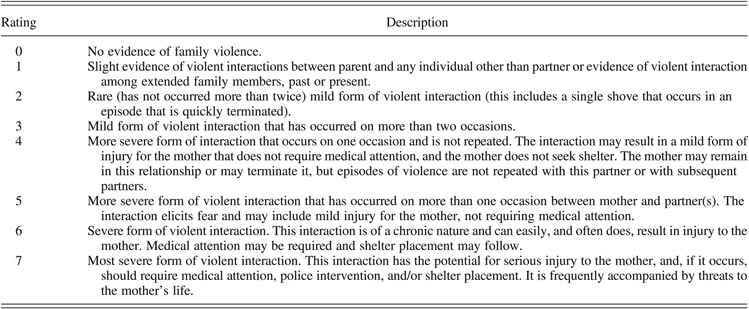
EIPV was coded based on mothers' responses to interviews and the Life Events Scale (see below) when children were 12, 18, 24, 30, 42, 48, 54, and 64 months old and when they were in Grades 1–3. Mothers were asked about experiences of interparental violence with male spouses or partners. (During original data collection of EIPV in the late 1970s and early 1980s, mothers were only asked about their experiences of victimization; as a result, information on mothers' potential perpetration was not available.) At each time point, a score for EIPV was rated on 7-point scale from “No evidence of violence” to “Most severe form of violent interaction that is potentially seriously injurious to the mother and should require medical attention, police intervention, and/or shelter placement” (see Table 1 for complete scale description). Coders were trained to rate EIPV, and interrater reliability was computed for 50 cases coded by two trained graduate students at each time point. Intraclass correlations (ICCs) ranged from 0.93 to 0.99. Scores for EIPV were collapsed, and the most severe ratings from 0 to 64 months and Grades 1 to 3 were used to characterize EIPV in early childhood and middle childhood, respectively.
Description of the rating scale for exposure to interparental violence

Note: This scale, developed by project staff from the Minnesota Longitudinal Study of Risk and Adaptation, was also published in Yates et al. (Reference Yates, Dodds, Sroufe and Egeland2003).
Externalizing behavior (Grades 1–3 and age 16 years)
When children were in first, second, and third grades, their teachers provided ratings of externalizing behavior on the Achenbach Teacher Report Form (TRF; Achenbach & Edelbrock, Reference Achenbach and Edelbrock1986), a behavior checklist of 118 items on 3-point scales (i.e., not at all true, sometimes true, and often true). The externalizing problems subscale is one of two broadband scales (the other is internalizing problems). Given that the scores on the externalizing scales across the three time points were strongly related (r p = .52–61, p < .01) and reflected a unifying construct, the mean of the scales across Grades 1–3 was computed to obtain one average score of externalizing behavior in middle childhood.
When participants were 16 years old, teachers again completed the TRF in adolescence. Participants also completed the Youth Self-Report (YSR; Achenbach, Reference Achenbach1991), a parallel measure of 112 items assessing youths' behavior from their own perspective that provides the same broadband externalizing scale as the TRF. Given that the teacher and adolescent reports were modestly related (r p = .27, p < .01), to better account for adolescent externalizing behavior in multiple contexts and to capture externalizing behavior from multiple informants, the mean of the TRF and YSR externalizing scales was computed. At all time periods, raw scores from the TRFs and the YSRs were transformed into T scores before they were averaged.
Measures: Dependent variables
Dating violence victimization and perpetration (23 and 26 years)
Participants were interviewed about dating violence experiences at two time points, ages 23 and 26 years. At both ages, participants completed the Conflict Tactics Scale (Straus, Reference Straus1979), a set of self-report items about verbal and physical behaviors (only physical items were used in this study). The physical items include eight behaviors of increasing severity (threw something at partner, pushed, slapped, kicked, hit, beat up, threatened with a gun or knife, and used a gun or knife). At age 23, participants reported how many behaviors they had inflicted toward (perpetration) and received from (victimization) their current partner and any past partner(s) since age 21. At age 26, participants were again asked about perpetration or victimization of these behaviors with their current partner and any past partner(s) since age 23. (Violence with recent past partners was included to obtain information about participants who recently had been in romantic relationships but who were single at the time of the assessments.) The number of different behaviors endorsed across past or current partners by ages 23 and 26 years was summed for a behavioral severity score for perpetration and for victimization at ages 23 and 26.
Given that participants reported on their general experiences of perpetrating or being a victim of each behavior, the current study did not capture the number of participants' relationships during which violence had occurred or whether violence had occurred with the same partner at both ages. However, being with the same partner or having a longer relationship was not significantly related to less perpetration or victimization. In addition, the use of the same violent behavior with both a current and a past partner within the same assessment period received a maximum score of 1 to control for participants who had been in multiple violence relationships from ages 21 to 23 or between ages 23 and 26.
Measures: Control variables
Child sex and maternal age
Child sex and maternal age at the birth of the firstborn (enrolled) child were obtained from hospital birth records.
Family SES (prenatal)
A measure of the SES of the household into which children were born was computed from the average of z scores from three sources of information: the occupational status of the mother (or the head of household), an estimate from the revised Duncan Socioeconomic Index (Duncan, Reference Duncan and Reiss1961; Stevens & Featherman, Reference Stevens and Featherman1981) mothers' educational attainment in years; and yearly household income. The resulting overall SES scores were transformed into T scores to yield positively scaled distributions.
Child maltreatment (0–17.5 years)
Maltreatment comprised physical abuse, which was considered to be parents' behavior toward a child that resulted in physical injury (e.g., bruises, cuts, or burns), and neglect, which was considered to be depriving the child of basic needs (e.g., nutrition or health care) or lack of supervision resulting in an unsafe home environment. We included a history of neglect to account for the possibility that participants' dating violence in early adulthood was not solely due to them having never learned appropriate conflict resolution strategies as a result of parents' inadequate care.
A team of project staff collaboratively rated the presence or absence of physical abuse or neglect beginning in infancy based on three sources of information: interviews with mothers, home observations made by study staff (including observations of physical injuries on the child, such as harsh physical discipline that left marks, and unsafe living conditions), and any records from Child Protective Services (CPS) that maltreatment had occurred. The presence of CPS records was checked for all study participants, regardless of whether or not mothers reported maltreatment during the interviews. All cases that involved maltreatment were perpetrated by the mother or primary caregiver(s), had already been referred to CPS, or were receiving services from public health nurses for inadequate caregiving at the time that data was collected.
The maltreatment variable used in the current study was compiled from comprehensive, multiple-informant ratings beginning in childhood and updated with maternal and participant reports throughout adolescence. When participants were 24 months old, project staff collaboratively compiled a list of all children with maltreatment experiences since birth, and the list was updated through early childhood (at ages 48 months and 64 months) for new maltreatment that had begun after 24 months or that had occurred previously but had not been reported. Maternal reports and CPS records were continually checked and updated as participants aged in order to obtain the most accurate and comprehensive maltreatment information. The list was checked at each subsequent assessment (Grades 1–3 and 6, and ages 13, 16, and 17.5 years) and revised according to newly reported maltreatment or cross-validation with CPS records (i.e., a positive CPS record that indicated maltreatment in the absence of a maternal report led to an updated “maltreated” status for that participant). In adolescence, participants were also asked whether they had experienced parental maltreatment in childhood or adolescence. To resolve discrepancies, at least two independent sources of information were needed to confirm maltreatment if it was retrospectively reported.
Adult life stress (23 and 26 years)
As part of the assessment at ages 23 and 26 years, participants were administered the Life Events Scale (Egeland, Breitenbucher, & Rosenberg, Reference Egeland, Breitenbucher and Rosenburg1981), a questionnaire composed of 41 items that describe stressful events or transitions (e.g., employment changes, physical or mental health problems, deaths in the family, legal or financial issues, and personal and family stress). Participants who endorsed experiencing such events were requested to elaborate in order to obtain sufficient information to rate the extent of the stressor as disruptive to the family using a 3-point scale (i.e., no disruption to highly disruptive). As a result, each item was weighted according to the degree of disruption. At age 23 years, trained coders rated all cases and pairs of coders rated 46 cases for reliability (ICC = 0.94). At age 26, trained coders rated all cases and pairs of coders rated 50 cases for reliability (ICC = 0.98). The current analyses utilized the total life stress score at both ages, which was the sum of each weighted item minus one item about physical fights with a romantic partner that was relevant to our outcome variable.
Data analytic plan
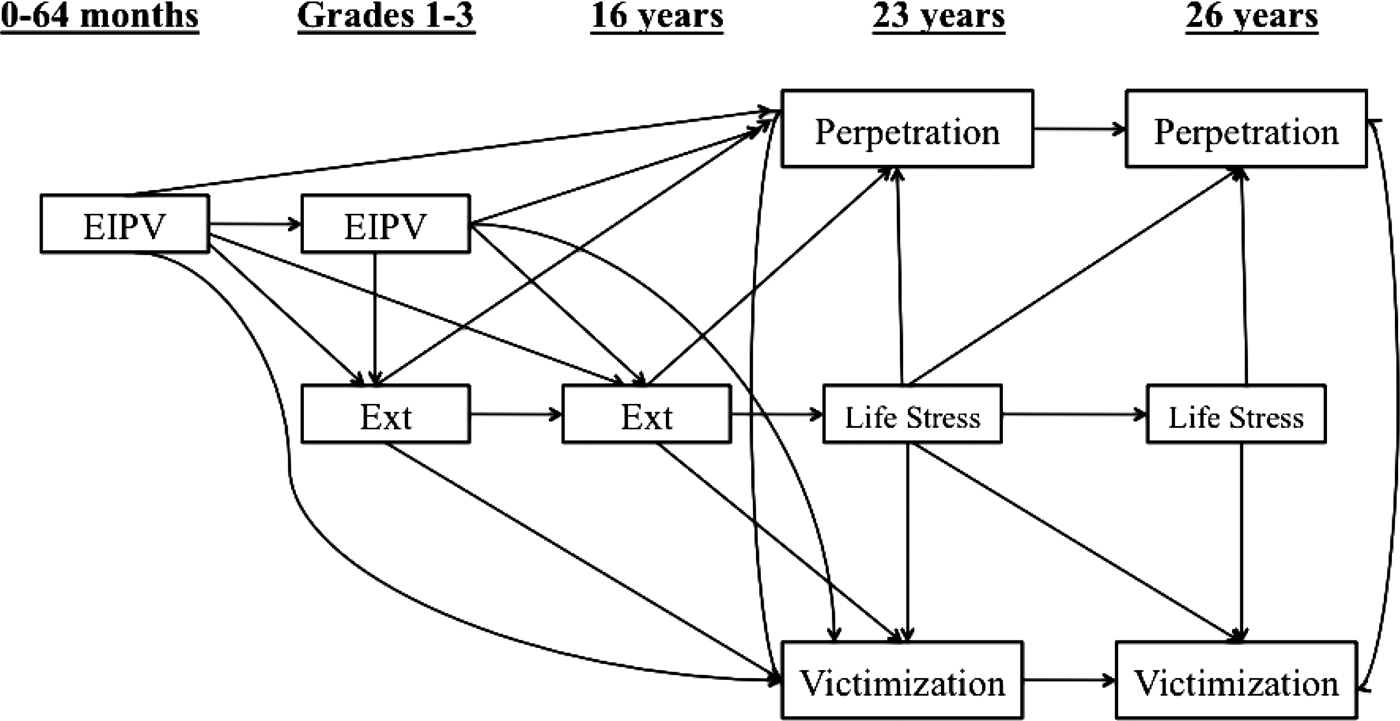
To examine the relations among EIPV in early and middle childhood, externalizing behavior in middle childhood and adolescence, and dating violence in early adulthood, path analyses were conducted using MPlus version 6.1 (Muthén & Muthén, Reference Muthén and Muthén1998–2010) and variations of the proposed conceptual model (Figure 1). We constructed and tested a series of five hierarchically nested developmental models that first examined the direct effects of all developmental predictors on dating violence and then tested each of the three hypotheses: the timing versus the continuity of EIPV for dating violence (Hypothesis 1), the indirect effects of EIPV to dating violence through externalizing behavior (Hypothesis 2), and the effects of developmental risks versus concurrent life stress and dating violence as predictors of dating violence over time (Hypothesis 3). (When “dating violence” is subsequently referred to, it includes both perpetration and victimization unless otherwise noted.)
The proposed conceptual model of timing and continuity of exposure to interparental violence (EIPV) and externalizing (Ext) behavior as predictors of dating violence.
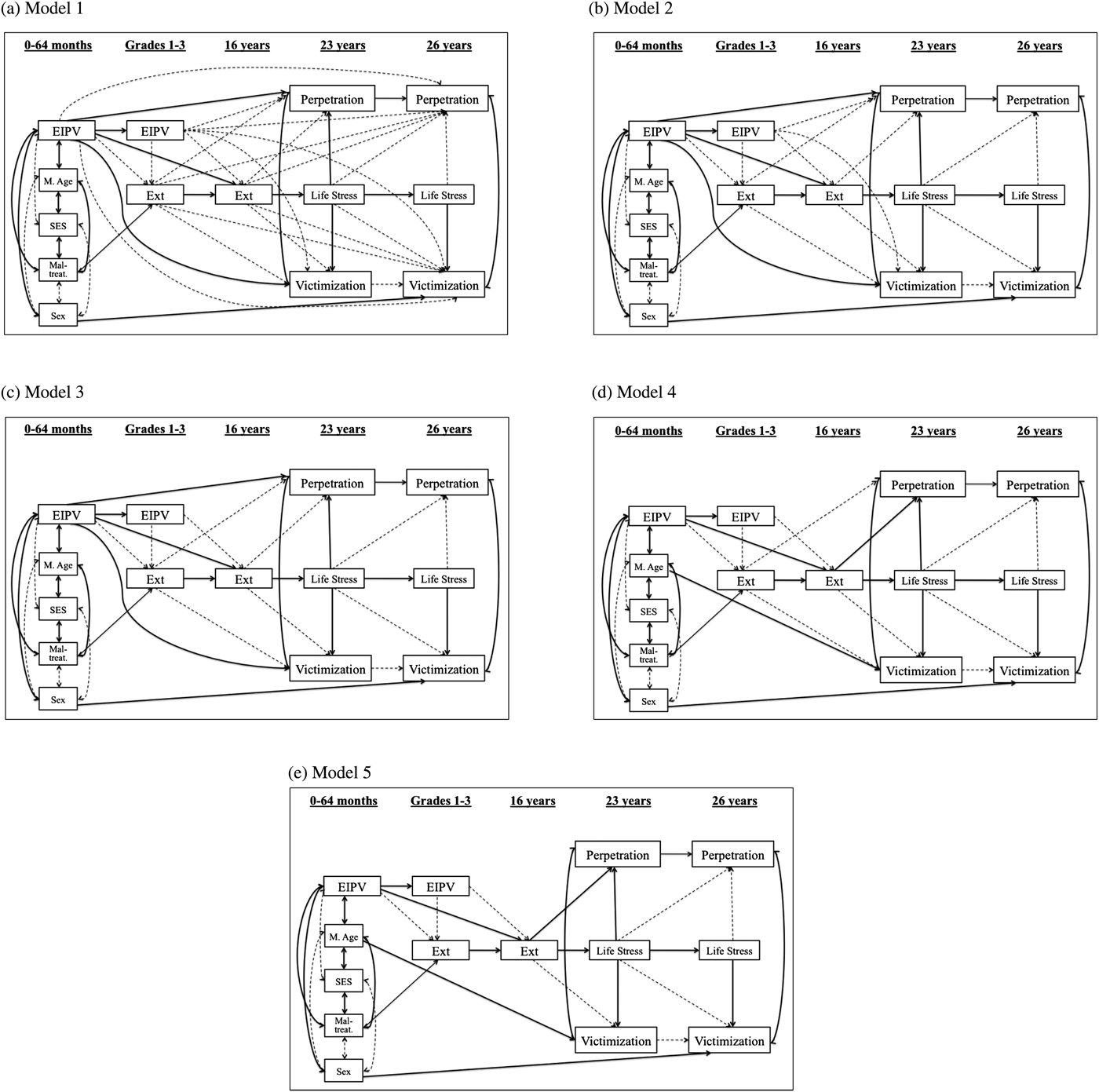
Model 1 (Figure 2a) tested the direct effects of all developmental predictors to dating violence at both ages 23 and 26 years. Model 1 had the most paths specified, and all subsequent models were nested within Model 1 and within each other. Model 2 (Figure 2b) tested the direct effects of all developmental predictors to dating violence at age 23 years, the timing and continuity of EIPV from early childhood to middle childhood to dating violence, the timing and continuity of externalizing behavior from middle childhood to adolescence to dating violence, and the indirect effects of EIPV to dating violence through externalizing behavior at both time periods. Model 3 (Figure 2c) eliminated paths from EIPV in middle childhood to dating violence, thereby only testing the timing of EIPV in early childhood and not the continuity of EIPV. Model 4 (Figure 2d) eliminated the direct paths from EIPV in early childhood to dating violence, thereby testing the indirect effects of EIPV to dating violence through externalizing behavior in middle childhood or adolescence. Model 5 (Figure 2e) eliminated the paths from externalizing behavior in middle childhood, thereby testing the indirect effects of EIPV to dating violence through externalizing behavior in adolescence.
Depictions of the five hierarchically nested models tested in the path analyses. The solid lines represent significant paths, and the dashed lines represent paths included but not significant. All covariates (child sex, family socioeconomic status, maternal age, and maltreatment) were included on every path. For simplicity, only the interrelations between covariates and any significant paths from them are shown. EIPV, exposure to interparental violence; Ext, externalizing problems; SES, socioeconomic status.
Given that past literature reports that both partners often perpetrate dating violence and that it is a chronic pattern rather than a solitary event (Karney & Bradbury, Reference Karney and Bradbury1995), we also included paths embedded in all models to specify that perpetration and victimization would be intercorrelated at age 23 and age 26 years, that age 23 perpetration would predict age 26 perpetration, and that age 23 victimization would predict age 26 victimization. Further, because the literature suggests that higher levels of life stress increase the risks for dating violence (Cano & Vivian, Reference Cano and Vivian2003; Langer et al., Reference Langer, Lawrence and Barry2008), we included paths to specify that concurrent life stress at ages 23 and 26 years would predict dating violence during the same time period and that life stress at age 23 years would predict dating violence at age 26 years.
Multiple theoretically driven covariates also were included as predictors on every pathway in every model. Child sex was accounted for on every path because although current evidence is inconclusive regarding sex differences in frequency of victimization versus perpetration, we sought to examine whether sex influenced the relations among EIPV, externalizing behavior, and dating violence. As in past studies of EIPV (Fergusson et al., Reference Fergusson, Boden and Horwood2006; Yates et al., Reference Yates, Dodds, Sroufe and Egeland2003), SES at the time of birth was also accounted for to rule out the possibility that relations between EIPV and dating violence are not primarily influenced by very low-income environmental contexts. Maternal age was included as a covariate given that it was highly associated with EIPV and dating violence, of which it is a documented risk factor (Moffitt & Caspi, Reference Moffitt and Caspi1999). Maltreatment (physical abuse and/or neglect) was also included on every path as a covariate given previous research that calls for the need to separate the effects of EIPV and maltreatment on dating violence (Herrenkohl et al., Reference Herrenkohl, Sousa, Tajima, Herrenkohl and Moylan2008; Holt et al., Reference Holt, Buckley and Whelan2008).
We determined acceptable model fit for the data by evaluating the comparative fit index (CFI), the root mean square error of approximation (RMSEA), and the standardized root mean square residual (SRMR). Adopting usual practice, we considered a CFI at 0.90 or above and a RMSEA (or SRMR) at 0.08 or below to be an acceptable fit, and a CFI at 0.95 or above and an RMSEA (or SRMR) of 0.05 or below to be a good fit (Hoyle, Reference Hoyle and Hoyle1995; Hoyle & Panter, Reference Hoyle, Panter and Hoyle1995; McDonald & Ho, Reference McDonald and Ho2002). We used chi-square difference testing to compare each of the models (Muthén & Muthén, Reference Muthén and Muthén1998–2010). On all model tests, we used the bootstrapped standard errors method in MPlus to account for nonnormality of our dependent variables, perpetration and victimization at 23 and 26 years, which were positively skewed. MPlus was also used to obtain bootstrapped standard errors for the indirect effects (Preacher & Hayes, Reference Preacher and Hayes2008).
Missing data
Of the 168 participants in the current study, 9 people at age 23 and 6 people at age 26 were missing information because they did not participate in the assessment at that time period. However, they were included because they did have information on dating violence at the other time period. The amount of missing data from all variables was minimal, ranging from 0% (EIPV at both time periods, child maltreatment, SES, and externalizing behavior in middle childhood) to 5% (dating violence and life stress at age 23), with a mean of 2% missing data across all variables at all time points. In order to obtain complete data for all 168 participants, we used full information maximum likelihood estimation in MPlus (Muthén & Muthén, Reference Muthén and Muthén1998–2010), which generates unbiased parameter estimates for data missing at random or missing completely at random (Graham, Cumsille, & Elek-Fisk, Reference Graham, Cumsille, Elek-Fisk, Schinka and Velicer2003; McDonald & Ho, Reference McDonald and Ho2002).
Results
Descriptive analyses
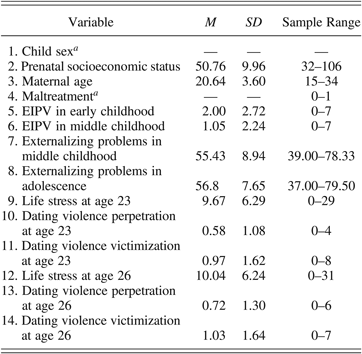
Descriptive information for all variables is summarized in Table 2. A total of 74 children experienced some EIPV in childhood; 65 children experienced EIPV in early childhood, 32 experienced EIPV in middle childhood, and 23 experienced EIPV during both time periods. The distribution of EIPV ratings across all participants revealed that slightly over one-third of participants (35.7%) experienced high severity EIPV in early or middle childhood (a rating of at least 5 out of 7). In terms of maltreatment, 51 children had records of facing physical abuse or neglect. Thirty of the 51 maltreated children also had a history of EIPV. In terms of externalizing behavior, 22.7% of children in middle childhood and 28.5% of children in adolescence had levels of externalizing behavior in the borderline clinical range (T scores ≥ 60) and 7.7% of children in middle childhood and 4.8% of children in adolescence had levels of externalizing behavior in the clinical range (T scores ≥ 70; Achenbach, Reference Achenbach1991).
Descriptive characteristics of the sample
Note: EIPV, exposure to interparental violence.
aChild age and maltreatment were ordinal variables so sample means are not relevant. There were 87 males and 81 females in the current study, and 51 (30.4%) children in this study experienced maltreatment.
Regarding dating violence victimization and perpetration, approximately one-third (31.5%) of our participants had never been involved in perpetration or victimization at either time point, whereas two-thirds (68.5%) of participants were involved in some aspect of perpetration or victimization during either or both time periods in early adulthood. Half of the participants (50.6%) reported never perpetrating violence at either time point, whereas 19.0% reported perpetrating violence at both time points. Similarly, 38.7% of participants reported never being victimized, whereas 25.0% of participants reported victimization at both time points.
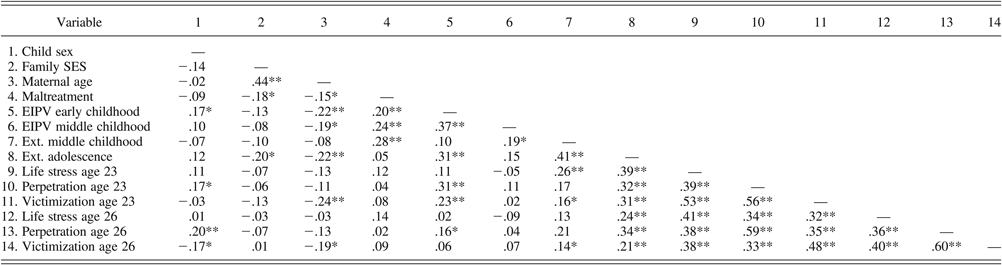
Polychoric correlations between all variables are displayed in Table 3. Only EIPV in early childhood (not middle childhood) was associated with dating violence in early adulthood; externalizing behavior in both middle childhood and adolescence were associated with dating violence.
Correlations between all variables
Note: Polychoric correlations were used due to ordinal variables. SES, socioeconomic status; EIPV, exposure to interparental violence; Ext., externalizing behavior.
*p < .05. **p < .01.
Path model analyses
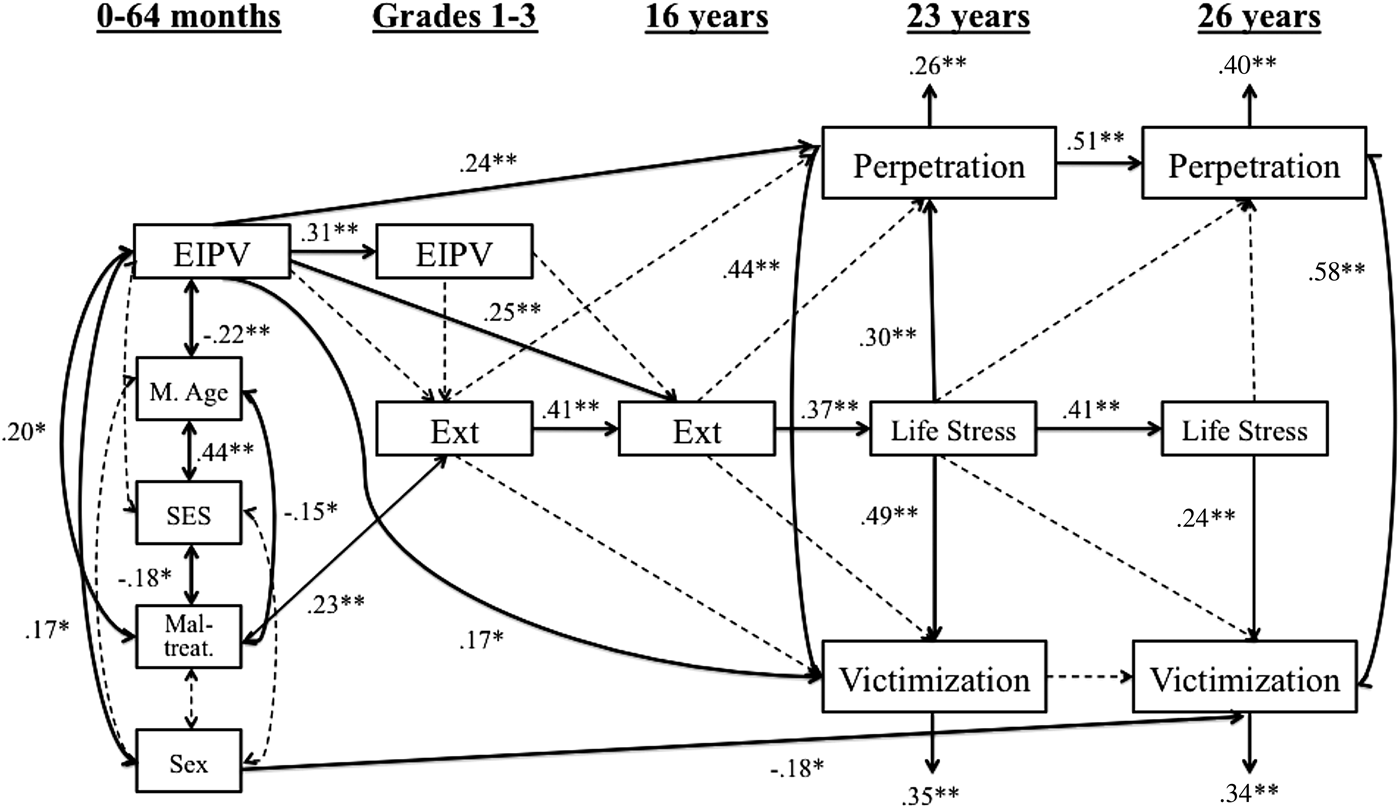
Based on chi-square difference testing (Muthén & Muthén, Reference Muthén and Muthén1998–2010), Model 3 was the best-fitting, most plausible model after examining fit comparisons among Models 1–5 (Table 4). Model 3 showed good fit with the data, χ2/df = 1.59, RMSEA = 0.06 (90% confidence interval = 0.005–0.097), CFI = 0.98, p = .05, SRMR = 0.04. Standardized coefficients for significant paths in Model 3 are displayed in Figure 3. Model 3 accounted for 25.5% of the variance in perpetration and 35.4% of the variance in victimization at age 23 years, and 40.0% of the variance in perpetration and 34.0% of the variance in victimization at age 26 years.
The best-fitting model (Model 3) from path analyses describing the relationships among exposure to interparental violence (EIPV), externalizing problems (Ext), dating violence perpetration and victimization, and covariate and control variables, χ2 (19, 168) = 30.27, p = .05, root mean square error of approximation = 0.06, comparative fit index = 0.98. The solid lines represent significant paths, and the dashed lines represent paths included but not significant. All covariates (child sex, family socioeconomic status, maternal age, and maltreatment) are included on every path. For simplicity, only the interrelations between covariates and any significant paths from them are shown. Maltreatment spanned ages 0–17.5 years. SES, socioeconomic status. *p < .05. **p < .01.
Goodness of fit indices for final model (Model 3), null model, and alternative models
Note: Models 1–5 were compared hierarchically. Model 1 versus 2: Model 2 was not significantly better fitting but was more parsimonious than Model 1; Model 2 was retained. Model 2 versus 3: Model 3 also was not significantly better fitting than Model 2 but was more parsimonious than Model 2; Model 3 was retained. Model 3 versus 4: Model 4 was significantly worse fitting than Model 3; Model 3 was retained. (Model 4 vs. 5: Model 5 was not significantly better fitting than Model 4 but was more parsimonious; Model 5 was retained.) Model 3 versus 5: Model 3 was a significantly stronger fit than Model 5, so Model 3 was determined to be the best fitting, final model. CFI, comparative fit index; RMSEA, root mean square error of approximation; SRMR, standardized root mean square residual.
*p < .05.
Hypothesis 1: Timing versus continuity of EIPV in early versus middle childhood
Models 1–3 tested the hypotheses of whether the timing of EIPV in early versus middle childhood or the continuity of EIPV from early to middle childhood would most strongly predict dating violence. The final, best-fitting model (Model 3) showed that EIPV in early childhood directly predicted both perpetration (β = 0.24, p < .01) and victimization (β = 0.17, p < .05) at age 23, even after accounting for child maltreatment, maternal age, family SES, and child sex. EIPV in early childhood predicted EIPV in middle childhood (β = 0.31, p < .01), but EIPV in middle childhood was not a significant predictor of dating violence in any of the models.
Hypothesis 2: Timing versus continuity of externalizing behavior as a mediator of EIPV and dating violence
Models 3–5 tested the hypotheses of whether the timing of externalizing behavior in middle childhood versus adolescence would mediate EIPV and dating violence. Overall, in the final model the total indirect effects from EIPV to dating violence at age 23 were significant for both perpetration and victimization: there was a significant indirect pathway from EIPV in early childhood to victimization at age 23 through both externalizing behavior in adolescence and life stress at age 23 (β = 0.05, p < .05); this same indirect pathway from EIPV in early childhood to perpetration at age 23 through externalizing behavior and life stress was marginally significant (β = 0.03, p = .07). More specifically, the final model (Model 3) showed that EIPV in early childhood was a significant predictor of externalizing behavior in adolescence (β = 0.25, p < .001), and there were significant indirect effects from externalizing behavior in adolescence to perpetration at age 23 through life stress at age 23 (β = 0.11, p < .05) and to victimization at age 23 through life stress at age 23 (β = 0.18, p < .01). Although we hypothesized that externalizing behavior in middle childhood would mediate EIPV and dating violence, there were no direct relations between EIPV in early childhood to externalizing behavior in middle childhood, or to externalizing behavior at either time period to dating violence in the final model (Model 3). Of note, however, the next best-fitting model (Model 5) displayed a significant direct pathway from externalizing behavior in adolescence to perpetration at age 23 when the direct path from EIPV in early childhood to perpetration at age 23 was removed.
In addition, although our hypothesis that externalizing behavior in middle childhood would mediate EIPV and dating violence was not supported, externalizing behavior during this period played a unique and unexpected role in the final model. Externalizing behavior in middle childhood was a significant predictor of externalizing behavior in adolescence (β = 0.41, p < .01). There were also significant indirect effects from externalizing behavior in middle childhood to perpetration at age 23 (β = 0.05, p < .05) and victimization at age 23 (β = 0.08, p < .01) through externalizing behavior in adolescence and life stress at age 23. Moreover, although EIPV in early childhood did not significantly predict externalizing behavior in middle childhood, child maltreatment did significantly predict externalizing behavior during this time (β = 0.23, p < .01).
Hypothesis 3: Stability of dating violence across time
To test whether dating violence was stable across time, we examined whether dating violence at age 26 years was most strongly predicted by early adulthood risk factors, such as previous dating violence or life stress at age 23, or developmental risk factors, such as EIPV and externalizing behavior. The results were consistent across all models, including our final model (Model 3). The strongest predictor of perpetration at age 26 was perpetration at age 23 (β = 0.51, p < .01), but the strongest predictor of victimization at age 26 was life stress at age 26 (β = 0.24, p < .01). However, there were also significant indirect effects of externalizing behavior in adolescence to perpetration at age 26 through life stress at age 23 and perpetration at age 23 (β = 0.06, p < .05) and to victimization at age 26 through life stress at age 23 and life stress at age 26 (β = 0.04, p < .05).
Additional analyses: Sex differences
Finally, although we did not have specific hypotheses about the role of sex, there were some significant sex differences. There was a direct effect of sex on victimization at age 26 years, such that males were more likely to report being victimized by partners (β = –0.18, p < .05). Females, however, were more likely to have histories of EIPV in early childhood (r = .17, p < .05). There were no significant sex differences for externalizing behavior, life stress, or maltreatment.
Discussion
The current study examined the prospective developmental pathways of EIPV in early and middle childhood as predictors of dating violence in early adulthood, the mediating role of increased externalizing behavior along the hypothesized pathway from EIPV to dating violence, and the stability of dating violence over time. Our theoretical models were grounded in an organizational developmental perspective, which provides a guide for understanding how children are shaped by experiences with caregivers that are carried forward to later relationships, but children also actively shape their environments through their own behaviors (Ainsworth et al., Reference Ainsworth, Bell, Stayton, Woodhead, Carr and Light1991; Bowlby, Reference Bowlby1969; Cicchetti & Valentino, Reference Cicchetti, Valentino, Cicchetti and Cohen2006; Hazan & Shaver, Reference Hazan and Shaver1987; Holt et al., Reference Holt, Buckley and Whelan2008; Rutter & Sroufe, Reference Rutter and Sroufe2000; Sroufe, Reference Sroufe1979; Waters & Cummings, Reference Waters and Cummings2000). From this developmental framework and using path analyses, we examined the timing and the continuity of EIPV during two developmental periods as risks for dating violence, hypothesizing that EIPV in early childhood would predict dating violence more strongly that would EIPV in middle childhood. We also examined the timing and continuity of externalizing behavior in early childhood and adolescence as mediators of EIPV and dating violence, hypothesizing that externalizing behavior in middle childhood would be a stronger mediator given that it has been found to portend a worse course of long-term functioning, including increases in dating violence (Moffitt, Reference Moffitt1993; Woodward et al., Reference Woodward, Fergusson and Horwood2002).
The role of EIPV: Timing of risk
Our findings indicated that EIPV in early childhood was a direct predictor of both dating violence perpetration and victimization at age 23 years after controlling for maltreatment, maternal age, family SES, and child sex. Our first hypothesis was supported; EIPV in early childhood was a stronger predictor of dating violence than was EIPV in middle childhood. These findings illustrate that early EIPV exerts powerful influences on reactivating violence in later romantic relationships, above and beyond EIPV that occurs later. These findings align well with research documenting the particularly deleterious effects of negative or traumatic early relational experiences on long-term relational maladaptation (Macfie, Cicchetti, & Toth, Reference Macfie, Cicchetti and Toth2001; Sroufe et al., Reference Sroufe, Egeland, Carlson and Collins2005). Our findings also extend past EIPV research to suggest that the timing of EIPV in early childhood, rather than the continuity or persistence of EIPV through early and middle childhood, is a substantial risk for dating violence in early adulthood.
The effects of EIPV in infancy and preschool may be particularly salient and enduring because they occur when children are first mastering critical developmental tasks of early childhood, such as forming expectations of social relationships and learning how to control their negative behaviors and emotions (Ainsworth et al., Reference Ainsworth, Bell, Stayton, Woodhead, Carr and Light1991; Masten et al., Reference Masten, Burt, Coatsworth, Cicchetti and Cohen2006; Sroufe, Reference Sroufe1979; Sroufe et al., Reference Sroufe, Egeland, Carlson and Collins2005). Experiences of EIPV at a very young age may serve as a guiding framework for future relationship expectations (Holt et al., Reference Holt, Buckley and Whelan2008; Margolin, Reference Margolin2005; Osofsky, Reference Osofsky2003). EIPV in early childhood may also have lasting implications on development because young children have less positive experiences to override negative events and may internalize violence as a conflict resolution tactic between romantic partners (Cappell & Heiner, Reference Cappell and Heiner1990; Davies & Cummings, Reference Davies and Cummings1994; Fite et al., Reference Fite, Bates, Holtzworth-Munroe, Dodge, Nay and Pettit2008; Widom, Reference Widom1989).
The role of externalizing behaviors: Timing of mediation and continuity of risk
The current findings also revealed that there were indirect effects from EIPV in early childhood to dating violence in early adulthood through both externalizing behavior in adolescence and life stress at age 23 years. Our second hypothesis was partially supported, such that increased externalizing behavior did comprise the indirect pathway between EIPV and dating violence, but this effect was significant for externalizing behavior in adolescence rather than in middle childhood. Moreover, this indirect pathway also included life stress at age 23 years.
These findings suggest a number of varying interpretations. First, higher levels of externalizing behavior in adolescence may proximally increase life stressors by constraining lifestyle choices in young adulthood and distally influence dating violence through the effects of life stress, consistent with past findings on the salient role of life stress for heightened dating violence (Cano & Vivian, Reference Cano and Vivian2003; Langer et al., Reference Langer, Lawrence and Barry2008). Couples may be more vulnerable to dating violence in the context of high stress (Frye & Karney, 2005), especially if they have histories of EIPV (Roberts et al., Reference Roberts, McLaughlin, Conron and Koenen2011). Second, it is likely that externalizing behavior in adolescence was a product of both EIPV in early childhood and externalizing behavior in middle childhood, because both of these earlier developmental factors significantly and directly increased adolescents' externalizing behavior.
Third, although our lack of findings of a direct relation between externalizing behavior in adolescence and dating violence are somewhat inconsistent with past research (e.g., Fergusson & Horwood, Reference Fergusson and Horwood1998; Magdol et al., Reference Magdol, Moffitt, Caspi and Silva1998), our study has important distinctions from other studies. First, much of the past research that has documented the relations between externalizing behavior and dating violence has either not examined these relations in the context of EIPV (Fergusson et al., Reference Fergusson, Boden and Horwood2008; Shortt et al., Reference Shortt, Capaldi, Kim, Kerr, Owen and Feingold2012) or has measured or documented EIPV later than early childhood (Ehrensaft et al., Reference Ehrensaft, Cohen, Brown, Smailes, Chen and Johnson2003; Fergusson et al., Reference Fergusson, Boden and Horwood2006; Magdol et al., Reference Magdol, Moffitt, Caspi and Silva1998; Raudino et al., Reference Raudino, Woodward, Fergusson and Horwood2012). Second, a comparison of our best-fitting model (Model 3) and our next best-fitting model (Model 5) revealed important differences to inform our pattern of findings. Model 5 depicted a significant direct path from externalizing behavior in adolescence to perpetration at age 23, but this path was not significant in Model 3 when the direct path from EIPV to perpetration was included. Together, these models emphasize that externalizing behavior in adolescence may prospectively predict dating violence, but this path becomes indirect after accounting for the direct relations between early EIPV and dating violence.
Furthermore, although externalizing behavior in middle childhood did not mediate EIPV and dating violence as expected, it comprised another indirect pathway to dating violence at age 23 years (independent of EIPV) through externalizing behavior in adolescence and life stress at age 23 years. This finding emphasizes that the continuity, or persistence, of individuals' negative behavior and stress are additional risks for dating violence. Externalizing behavior as a unique antecedent to dating violence also supports other empirical evidence that a history of behavior problems significantly increases the likelihood of engaging in both perpetration and victimization (Magdol et al., Reference Magdol, Moffitt, Caspi and Silva1998; Moffitt & Caspi, Reference Moffitt and Caspi1999; Roberts et al., Reference Roberts, Klein and Fisher2003) and even more so when these behavior occur earlier in childhood (Moffitt, Reference Moffitt1993; Woodward et al., Reference Woodward, Fergusson and Horwood2002).
Child maltreatment also played an unexpected role in our findings, such that externalizing behavior in middle childhood was predicted by a history of child maltreatment, although maltreatment did not affect the pathways from EIPV to dating violence. This finding is consistent with past research that child-onset externalizing behavior may be uniquely predicted by pernicious caregiving (Moffitt, Reference Moffitt1993). Taken together with our primary findings that EIPV in early childhood directly predicted dating violence after accounting for maltreatment, these findings suggest that there may be two independent pathways of risk to dating violence: one that stems from EIPV in early childhood and one that stems from maltreatment and externalizing behavior in childhood.
Patterns of dating violence across early adulthood
The current findings also revealed that dating violence persisted over time but was influenced by factors unique to perpetration versus victimization. According to our third hypothesis, we expected stability of dating violence across early adulthood, such that perpetration and victimization at age 23 years would predict perpetration and victimization at age 26 years. To test this hypothesis, we examined whether developmental risks versus recent dating violence or life stress at age 23 years would most strongly predict dating violence at 26 years. Our third hypothesis was partially supported. Perpetration at age 26 was most strongly predicted by perpetration at age 23 years; however, victimization at age 26 was most strongly predicted by life stress at age 26 years. These findings indicate that the experience of perpetrating violence may be more stable over time, consistent with research on the stability of dating violence (Karney & Bradbury, Reference Karney and Bradbury1995), but the experience of being victimized may be more strongly predicted by life stress affecting the couple, consistent with research on the salience of stress for heightened dating violence (Langer et al., Reference Langer, Lawrence and Barry2008). These findings must be interpreted with caution, however, given that participants reported on both perpetration and victimization.
We also found evidence for assortative mating of dating violence at both 23 and 26 years (Capaldi & Crosby, Reference Capaldi and Crosby1997; Quinton et al., Reference Quinton, Pickles, Maughan and Rutter1993). Concurrently at both time periods, victimization and perpetration were related, which is consistent with previous reports that in violent relationships both partners are likely to inflict and receive physical aggression (Anderson, Reference Anderson2002; Langer et al., Reference Langer, Lawrence and Barry2008). Participants who had never been violent tended to affiliate with partners who also refrained from violence, whereas violent individuals tended to pair with each other (Capaldi & Crosby, Reference Capaldi and Crosby1997; Moffitt, Reference Moffitt1993; Shortt et al., Reference Shortt, Capaldi, Kim, Kerr, Owen and Feingold2012; Vézina & Hébert, Reference Vézina and Hébert2007; Wolfe et al., Reference Wolfe, Wekerle, Reitzel-Jaffe and LeFebvre1998). Moreover, the current findings emphasize that violence tends to become an entrenched pattern in relationships, it is reciprocally influenced by both partners, and it is likely not a one-time event (Karney & Bradbury, Reference Karney and Bradbury1995; Moffitt & Caspi, Reference Moffitt and Caspi1999).
Although not hypothesized, notable sex differences were found for EIPV and dating violence. Female participants were more likely to have histories of EIPV in early childhood than were males, which was not expected but suggested that females in our sample had been more vulnerable to early EIPV. Male participants were modestly but significantly more likely than female participants to report being victimized by their romantic partners at 26 years. This finding adds to previous studies reporting slightly higher rates of female-to-male perpetration in community samples (e.g., Ehrensaft et al., Reference Ehrensaft, Moffitt and Caspi2004; Magdol et al., Reference Magdol, Moffitt, Caspi, Newman, Fagan and Silva1997).
Strengths and limitations
Our findings support the current empirical but largely retrospective evidence on the salient and enduring role of early childhood EIPV as a predictor of violence in romantic relationships (Miller et al., Reference Miller, Breslau, Chung, Green, McLaughlin and Kessler2011; O'Keefe, Reference O'Keefe1998; Roberts et al., Reference Roberts, McLaughlin, Conron and Koenen2011). By employing prospective data that documented participants' EIPV from infancy, this study provided evidence that the severity of violence witnessed in early childhood predicts the extent of perpetration or victimization in early adulthood. Children who witnessed more threatening violence against their mothers were more likely to engage in a greater number of distinct violent behaviors with romantic partners. These findings extend the extant empirical research on the intergenerational transmission of dating violence (Ehrensaft et al., Reference Ehrensaft, Cohen, Brown, Smailes, Chen and Johnson2003; Kalmuss, Reference Kalmuss1984; Stith et al., Reference Stith, Rosen, Middleton, Busch, Lundeberg and Carlton2000) to show that the severity of exposure to violence may be transmitted to a greater behavioral repertoire of violence with partners in early adulthood.
Our study also provides novel and clarifying information on the relative influences of EIPV on dating violence when considered in tandem with externalizing behavior and child maltreatment. Recent reviews have acknowledged the difficulties associated with investigating EIPV and maltreatment separately (e.g., Herrenkohl et al., Reference Herrenkohl, Sousa, Tajima, Herrenkohl and Moylan2008; Holt et al., Reference Holt, Buckley and Whelan2008), and past empirical studies have reported mixed evidence about whether EIPV and maltreatment affect dating violence and how they differentially affect perpetration or victimization (Cappell & Heiner, Reference Cappell and Heiner1990; Ehrensaft et al., Reference Ehrensaft, Cohen, Brown, Smailes, Chen and Johnson2003; O'Keefe, Reference O'Keefe1998). The current study found that EIPV was a significant direct predictor of perpetration and victimization after accounting for maltreatment; however, externalizing behavior in middle childhood was a significant indirect predictor of dating violence, and it may have originated from experiences of maltreatment.
A number of reasons may explain why these findings differ from past studies. One explanation for why maltreatment did not influence the effects of EIPV on dating violence could be that we conceptualized maltreatment as “physical abuse and neglect” to provide a more stringent test of the relations between EIPV and dating violence and also to account for the possibility that a history of neglect could potentially preclude children from learning appropriate conflict resolution strategies. Another explanation could be that a history of EIPV might confer direct risk for violence between romantic partners, whereas a history of maltreatment might confer direct risk for abusing one's children, which the current study did not examine. Lending support to this conjecture, past research from our team has found that of participants who had been physically abused as children, 70% of their mothers also reported being abused in their childhoods (Egeland, Jacobvitz, & Papatola, Reference Egeland, Jacobvitz, Papatola, Gelles and Lancaster1987). Future research should examine the prospective pathways from EIPV versus maltreatment in childhood to risks for perpetrating dating violence versus maltreatment in the next generation.
Another explanation as to why our findings differ from some past studies could be that our study used prospective data of EIPV gathered in early childhood, whereas other studies have relied on retrospective (Fergusson et al., Reference Fergusson, Boden and Horwood2006; Miller et al., Reference Miller, Breslau, Chung, Green, McLaughlin and Kessler2011: Roberts et al., Reference Roberts, McLaughlin, Conron and Koenen2011) or partially retrospective but concurrently validated reports of EIPV (Ehrensaft et al., Reference Ehrensaft, Cohen, Brown, Smailes, Chen and Johnson2003). In addition, other studies have assessed EIPV in adolescence (e.g., Ireland & Smith, Reference Ireland and Smith2009; Tschann et al., Reference Tschann, Pasch, Flores, Marin, Baisch and Wibbelsman2009). When these studies are examined in conjunction with our study of EIPV in early childhood, the current findings highlight that the interpretation of the risks associated with EIPV may vary with the developmental timing and measurement of this construct. If our study had only measured EIPV in middle childhood, our conclusions would have been much different.
Our study also possessed several methodological strengths. The prospective design illustrated the developmental sequelae of EIPV beginning in early childhood and documented at the time it occurred. Recent literature on EIPV has recommended that prospective longitudinal data is best suited for clarifying the relations between EIPV and dating violence (Gewirtz & Edleson, Reference Gewirtz and Edleson2007; Herrenkohl et al., Reference Herrenkohl, Sousa, Tajima, Herrenkohl and Moylan2008; Margolin, Reference Margolin2005; Margolin & Gordis, Reference Margolin and Gordis2000). Information on the developmental predictors was also gathered from multiple sources such as maternal reports, observations, and CPS records in early childhood and teacher and self-reports in adolescence and early adulthood. The opportunity to utilize a multiple-informant design guards against reporter bias, which could result from reporters' perceptions of one variable (e.g., dating violence) influencing their recollections and reports of another variable (e.g., EIPV). We also included a number of theoretically driven covariates, which when accounted for provide a more stringent test of the relations among EIPV, externalizing behavior, and dating violence.
Similar to many prospective longitudinal studies, the current study also possessed a number of limitations, such as relatively small sample size. These findings also apply to one community sample of high-risk, impoverished families in one Midwestern area. Given that the entire sample was deemed high risk, these findings may not generalize to middle-class or more affluent community samples. In particular, the rates of maltreatment, EIPV, and dating violence may have been higher in this sample than in other community samples (e.g., Katz & Windecker-Nelson, Reference Katz and Windecker-Nelson2006). However, high-risk samples with greater variability in experiences of adversity provide means to study deleterious influences on development via “natural experiments,” or windows into how developmental maladaptation may unfold (Rutter, Reference Rutter2000).
Additional limitations involve the properties of the EIPV and dating violence variables. When the interview questions on interparental violence were administered to mothers in the late 1970s and early 1980s, only information on mothers' experiences with victimization was gathered. Thus, the current findings may have underestimated the impact of maternal perpetration on children's maladjustment. We were also unable to quantify the extent to which mothers may have repartnered with different partners or spouses across their children's development. Our measure of EIPV also did not include information on children's proximity to the actual violence that mothers reported. Previous research has indicated, however, that EIPV as reported by parents is highly salient to children (Kitzmann et al., Reference Kitzmann, Gaylord, Holt and Kenny2003). For example, children were reported to indirectly or directly witness up to 80% of reported violent incidences in homes (Jaffe, Wolfe, & Wilson, Reference Jaffe, Wolfe and Wilson1990). Another study reported children could hear or see 81% of violent events, confirmed by police reports (Fantuzzo & Fusco, Reference Fantuzzo and Fusco2007).
Similarly, because the two assessments of dating violence in early adulthood were provided by participants' reports of their perpetration and victimization, our sample rates of dating violence prevalence may be underestimated without partners' reports. We did find, however, that approximately half (49.4%) of our participants reported perpetrating at least one violent behavior over the 5-year span and almost two-thirds (61.3%) of participants reported being victimized at least once by a romantic partner. Thus, even considering that these percentages may be an underestimate, there was wide variability and a high prevalence of different violent behaviors used by our participants. Finally, the current sample was constrained to early adulthood and only examined dating violence that had occurred by age 26 years. This research could be replicated in a larger sample extended further into adulthood.
Implications and future directions
The current study described the maladaptive pathways from EIPV in early childhood to dating violence in early adulthood, but it also highlighted the role of resilience processes in development. Resilience is defined as the ability to withstand or recover from significant adversity (Egeland, Carlson, & Sroufe, Reference Egeland, Carlson and Sroufe1993; Masten et al., Reference Masten, Burt, Coatsworth, Cicchetti and Cohen2006), a process that has been observed in children exposed to EIPV who continue to fare well (Holt et al., Reference Holt, Buckley and Whelan2008; Kitzmann et al., Reference Kitzmann, Gaylord, Holt and Kenny2003; Martinez-Tortoya et al., 2009). In the current sample, approximately one fourth of participants (25.7%; n = 19) who had some degree of EIPV did not go on to engage in dating violence. Previous research on resilience in children with EIPV suggests that absence of parental psychopathology and warm and supportive parent–child relationships might buffer the consequences of EIPV on development (DeBoard-Lucas, Fosco, Raynor, & Grych, Reference DeBoard-Lucas, Fosco, Raynor and Grych2010; Holt et al., Reference Holt, Buckley and Whelan2008; Magdol et al., Reference Magdol, Moffitt, Caspi and Silva1998; Martinez-Tortoya et al., 2009; Sturge-Apple, Davies, Winter, Cummings, & Schermerhorn, Reference Sturge-Apple, Davies, Winter, Cummings and Schermerhorn2008). These findings emphasize multifinality, or multiple developmental outcomes, in children with violent parents (Cicchetti & Rogosch, Reference Cicchetti and Rogosch1996; Margolin, Reference Margolin2005). They also suggest that protective mechanisms, such as positive, supportive relationships, may underlie pathways to adaptive interpersonal functioning. However, in contrast to the participants with EIPV who refrained from dating violence, 49.1% (n = 53) of participants involved in dating violence at least once in early adulthood had no history of EIPV. Future studies should continue to examine the protective factors that deter the negative consequences of EIPV, the intervening developmental stressors that increase the risk for dating violence, and the timing of EIPV in development.
There is much research to be done to sharpen our understanding of children's experiences with family violence and to determine how to effectively intervene immediately after exposure and in the long term. Although the current study implicates timing and severity of exposure to violence as significant developmental stressors, the evidence for children's specific experiences immediately after a domestic violence incident is scarce (Gewirtz & Edleson, Reference Gewirtz and Edleson2007). Multiple mediating and moderating processes following EIPV could undermine children's functioning or promote resilience, such as fractures in the family system, emotional dysregulation, fragile and ineffective coping processes, and extended support systems. An example of one possible intervention that may ameliorate psychological harm in the immediate aftermath of EIPV is the Child Developmental Policing Program, which trains police officers in developmentally appropriate communication with young children exposed to violence. This program has been reported to promote awareness of young children's needs and facilitate access to mental health services (Gewirtz, Harris, & Avendano, Reference Gewirtz, Harris and Avendano2006). Specific efforts to restore stability and predictability to children's daily routines, maintain family ties, and tailor interventions to the developing timing of exposure are also critical in promoting recovery (Osofsky, Reference Osofsky2003).
In terms of long-term interventions, attachment-based therapy, such as child–parent psychotherapy for strengthening the parent–child relationship and restoring security, support, and trust, has been reported to have significant long-term effects on child adjustment after EIPV (Egeland & Erickson, Reference Egeland, Erickson, Sameroff, McDonough and Rosenblum2004; Lieberman, Van Horn, & Ghosh, Reference Lieberman, Van Horn and Ghosh2005). Trauma-focused cognitive behavioral therapy, widely validated for maltreated children, also shows promise as an effective treatment for young children exposed to violence, especially those with posttraumatic stress symptoms (Cohen, Manarino, Murray, & Igleman, Reference Cohen, Mannarino, Murray and Igelman2006). However, presence of elevated externalizing behavior also would likely influence treatment effects.
Intervention efforts should also preventatively target couples and parents at risk for domestic violence. Parents in highly stressful environments with low social support are at risk for perpetrating violence and maltreatment (Sroufe et al., Reference Sroufe, Egeland, Carlson and Collins2005). Couples with children, and especially young parents, also may be more likely to be violent than those without children (McDonald et al., Reference McDonald, Jouriles, Ramisetty-Mikler, Caetano and Green2006; Moffitt & Caspi, Reference Moffitt and Caspi1999). Efforts to address maladaptive behaviors in romantic relationships and promote healthy conflict resolution could have potential to prevent children's EIPV as well as halt intergenerational cycles of dating violence in those with a history of EIPV. Policies designed to reduce families' current stress could also deter dating violence.
Conclusions
The current study addressed a need for prospective research on the developmental sequelae of EIPV to dating violence, the timing of exposure of EIPV, and the mediating influences of externalizing behavior in development. The main findings of this study revealed that EIPV in early childhood and externalizing behavior at both time periods played prominent roles in pathways to dating violence. EIPV in early childhood more saliently predicted perpetration and victimization than did EIPV in middle childhood, suggesting that timing of EIPV, rather than continuity, is a critical predictor of dating violence. Continuity of externalizing behavior in middle childhood, stemming from maltreatment and continuing through adolescence, also was a critical risk for future dating violence, compounded and aggravated by early adulthood life stress. The timing of externalizing behavior in adolescence also played an important role in two indirect pathways to dating violence, with one beginning with EIPV in early childhood and the other comprising maltreatment and externalizing behavior in middle childhood. Finally, dating violence at age 26 years was predicted by a previous history of dating violence as well as concurrent life stress. These findings emphasize the complexity of negative early experiences for dating violence, as well as the continuity of negative behavior and current life circumstances (Sroufe et al., Reference Sroufe, Egeland, Carlson and Collins2005). Interventions to deter the intergenerational transmission of dating violence might have the most significant benefit if they target parents at risk for violence, promote recovery in children after EIPV, and deter the development and continuity of increased externalizing behavior in middle childhood and adolescence.