INTRODUCTION
A large number of studies have investigated how children acquire the speech sounds of their native language, and cross-linguistic data have been used to test existing theories on phonological acquisition. According to Jakobson's seminal monograph, first published in 1941 (translation, 1968), all children will follow the same developmental course regardless of the language they are learning. Jakobson's notion of universality in child phonology predicts an invariant order of speech sound acquisition based on typological studies of languages in the world. For example, stops are acquired before fricatives because the presence of fricatives presupposes the presence of stops in the phonological systems of adult languages. The universal theory regarding phonological acquisition was associated with biological or physiological constraints (Stokes & Surendran, Reference Stokes and Surendran2005). Thus, phonemes with less complex articulation are acquired earlier than phonemes with more complexity. The presence of universal patterns in children's phoneme acquisition has been confirmed in diverse languages (e.g. Amayreh & Dyson, Reference Amayreh and Dyson1998, for Arabic; Hua & Dodd, Reference Hua and Dodd2000, for Putonghua; So & Dodd, Reference So and Dodd1995, for Cantonese; Templin, Reference Templin1957, for English). A few studies, however, have reported cross-language differences (e.g. Hua & Dodd, Reference Hua and Dodd2000; Pye, Ingram & List, Reference Pye, Ingram, List, Nelson and van Kleek1987; Stokes & Surendran, Reference Stokes and Surendran2005). Such differences were interpreted as evidence of a relationship between the order of phonemic acquisition and phoneme frequency in the ambient language (Stoel-Gammon, Reference Stoel-Gammon and Paul1998; Stokes & Surendran, Reference Stokes and Surendran2005). Stokes & Surendran (Reference Stokes and Surendran2005) suggest that both articulatory complexity and the phonology of the ambient language influence phonological acquisition, but note that the relative importance of these two variables differs across languages.
This study explores the acquisition of Korean obstruents (i.e. stops, affricates and fricatives). Korean obstruents form an unusual system in terms of variations in laryngeal types. Whereas most languages use a voicing contrast to distinguish between obstruents produced at the same place of articulation, Korean obstruents are characterized by a three-way contrast among stops and affricates: fortis, aspirated and lenis, and a two-way fricative contrast: fortis and lenis (Cho, Jun & Ladefoged, Reference Cho, Jun and Ladefoged2002). In terms of voicing, all these obstruents are voiceless in word-initial position. Despite a large literature on Korean obstruents, especially Korean stops, only a few studies have described the acquisition of this sound system (e.g. M.-J. Kim & Pae, Reference Kim and Pae2005). Moreover, none of the studies attempted to compare the Korean child data with those of other languages and provide a theoretical interpretation to describe phonological patterns present in young Korean children, particularly the language-specific laryngeal variations. The following sections of this introduction provide a brief review of the acquisition of consonants (primarily stops, affricates and fricatives) in various languages.
Acquisition of stop consonants: age and order of acquisition
Stops are the most common consonants in both prelinguistic and early linguistic development regardless of a child's ambient language community (Locke, Reference Locke1983; Macken & Barton, Reference Macken and Barton1980; Eilers, Oller & Benitogarcia, Reference Eilers, Oller and Benitogarcia1984; Stoel-Gammon & Dunn, Reference Stoel-Gammon and Dunn1985). In general, many group studies have provided support for the universal patterns in stop consonant acquisition predicted by Jakobson's theory (e.g. Amayreh & Dyson, Reference Amayreh and Dyson1998, for Arabic; Hua & Dodd, Reference Hua and Dodd2000, for Putonghua; Locke, Reference Locke1983; So & Dodd, Reference So and Dodd1995; Stoel-Gammon, Reference Stoel-Gammon1985; Templin, Reference Templin1957, for English). Thus, stops are acquired before fricatives, front stops before back stops, and voiceless unaspirated stops before voiced stops.
Templin (Reference Templin1957) reported that English-speaking children mastered all six English stops by the age of four years with a criterion for ‘mastery’ designated as the age at which 75% of the subjects produced the target phoneme correctly in all word positions. Sander (Reference Sander1972) proposed an alternative approach to provide age norms for phoneme development. He reanalyzed Templin's data and established two ages of acquisition: the age of ‘customary production’, which was the age level at which the combined test average at the various word positions exceeds 50% correct production, and the age of ‘mastery’; the age level at which the combined test average reaches 90% correct production. According to his study, the age of customary production for all English stops was age 2 ; 0 while the age of mastery for most English stops is age 4 ; 0.
Investigations of the acquisition of stops in languages other than English yield results that vary from language to language, depending, in part, on the number of stops in the language and the phonetic characteristics of those stops. Locke (Reference Locke1983) reviewed cross-sectional studies on phonemic acquisition from Japanese and reported that most three-year-old Japanese children produced all stops (i.e. /p, b, t, d, k, g/) correctly in both word-initial and medial positions (Yasuda, 1970, cited in Locke, Reference Locke1983). Hua & Dodd (Reference Hua and Dodd2000) investigated the developmental patterns of Putonghua (modern standard Chinese) phonology in Putonghua-speaking children aged 1 ; 6 to 4 ; 6. Putonghua has six stop consonants with a two-way contrast for homorganic stops: unaspirated vs. aspirated. The researchers found that stops were acquired before fricatives, but that front stops were acquired at about the same age as back stops. With regard to phoneme mastery, the authors examined phoneme ‘stabilization’ using the criterion of 75% and 90% of children who produced correctly at least two out of three opportunities for a target phoneme. They reported that 75% of children mastered initial stops by 2 ; 6. These findings suggest early mastery of Putonghua stops when compared to English (mastery of initial stops by 2 ; 6 in Putonghua vs. 3 ; 0 in English using the same 75% criterion). So & Dodd (Reference So and Dodd1995) examined the phonological development of consonants produced by Cantonese-speaking children and reported that all Cantonese stops (i.e. /p, ph, t, th, k, kh/) in initial and final positions were acquired by 3 ; 6 with a 75% criterion.
A large-group investigation of acquisition of Spanish consonants was carried out by Jimenez (Reference Jimenez1987). Spanish has six stops, voiced (prevoiced) and voiceless (voiceless unaspirated) cognates at three places of articulation. Findings indicated that Spanish-speaking children of Mexican descent, who lived in California, acquired /p/, /b/ and /t/ by 3 ; 3 and /k/ by 3 ; 7 with a 90% criterion, but they did not master /d/ and /g/ until age 4 ; 7. In Mexican Spanish, voiced stops are typically spirantized (i.e. produced as fricatives) in intervocalic position, adding another layer of complexity to the acquisition process (Macken & Barton, Reference Macken and Barton1980).
Amayreh & Dyson (Reference Amayreh and Dyson1998) conducted a normative study on the acquisition of Arabic consonants. Arabic has a total of eight stop consonants including emphatic (/t/ and /d/) and non-emphatic stops. Emphatic consonants are produced with the root of the tongue retracted toward the pharyngeal wall. The target consonants included standard consonants and ‘acceptable’ variants (/q/ and /ʔ/), which can occur due to dialectal differences. It was reported that non-emphatic stops were acquired earlier than emphatic stops, and voiceless stops were mastered earlier than voiced stops. Most of the Arabic stops in all word positions were acquired with 75% accuracy by age 3 ; 0.
Mowrer & Burger's (Reference Mowrer and Burger1991) study compared the developmental patterns of Xhosa phonemes from Xhosa-speaking children with those of English phonemes from age-matched English-speaking children. Xhosa is one of the Nguni languages (spoken in South Africa), which has ejectives and implosives as well as plosives, and Xhosa consonants rarely occur in initial or final position. Due to this phonological pattern, only consonants in intervocalic position were tested. The criterion for mastery was correct production of each target consonant in intervocalic position by 80% of children. It was found that Xhosa-speaking children mastered most phonemes earlier than English-speaking children: all plosives, ejectives and implosives were mastered before 3 ; 0. Xhosa clicks were mastered early, even though clicks are rare sounds in languages of the world; the dental and alveolar clicks were acquired before 3 ; 0, and the alveolar lateral click was acquired between ages 3 ; 0 and 3 ; 6.
Several studies have investigated developmental patterns of stop voicing contrasts through the instrumental analysis of voice onset time (VOT). The universal preference for voiceless unaspirated stops in the world's languages is also seen in child data at the prelinguistic and early linguistic stages. Eilers et al. (Reference Eilers, Oller and Benitogarcia1984) reported both English- and Spanish-learning infants in the pre-meaningful stage of development predominantly produced voiceless unaspirated stops. At the early linguistic stage, children learning different languages acquire voiceless unaspirated stops before voiceless aspirated or voiced stops (Allen, Reference Allen1985, for French; Clumeck, Barton, Macken & Huntington, Reference Clumeck, Barton, Macken and Huntington1981, for Cantonese; Gandour, Petty, Dardarananda, Dechongkit & Mukngoen, Reference Gandour, Petty, Dardarananda, Dechongkit and Mukngoen1986, for Thai; Kewley-Port & Preston, Reference Kewley-Port and Preston1974, for English; Macken & Barton, Reference Macken and Barton1980, for Spanish).
Acquisition of affricates and fricatives
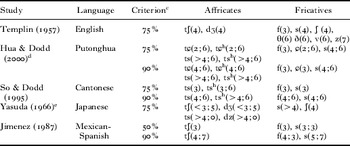
In support of Jakobson's universal pattern of acquisition, cross-linguistic studies have confirmed that affricates and fricatives are acquired after stops (e.g. Hua & Dodd, Reference Hua and Dodd2000; Locke, Reference Locke1983; Templin, Reference Templin1957). Table 1 summarizes large-sample studies of the acquisition of affricates and fricatives for diverse languages.
AgeFootnote a of acquisition of initial affricates and fricativesFootnote b in different languages

a Ages in parenthesis.
b Glottal fricatives are excluded.
c % of the subjects who produced the target phoneme correctly.
d Retroflex affricates and fricatives are not presented.
e Cited in Locke (Reference Locke1983).
The order of acquisition between affricates and fricatives is inconsistent across different languages. For example, the alveolo-palatal affricates of Putonghua and the palatal affricates of Japanese are acquired before fricatives (alveolo-palatal or palatal affricates>fricatives), but the alveolar affricates of Japanese, Putonghua and Cantonese tend to be acquired later than fricatives (fricatives>alveolar affricates). When the age of acquisition is compared cross-linguistically, it can be seen that Japanese palatal affricates are acquired relatively early compared to English. Such cross-linguistic differences likely reflect differences in the phonemic repertoire and frequency of occurrence of the phonemes in different languages (cf. Hua & Dodd, Reference Hua and Dodd2000). For example, Pye et al. (Reference Pye, Ingram, List, Nelson and van Kleek1987) also reported early acquisition of /tʃ/ in Quiché-speaking children compared to English-speaking children. The researchers found a positive correlation between the frequency of occurrence and order of acquisition of the phonemes. They also reported different types of substitutions for the same sounds in children learning different languages, patterns that may be associated with the phonological system of the specific language. They concluded that ‘children exposed to different types of linguistic input proceed along substantially different paths of phonological development’ (p. 182).
Error patterns
Jakobson's (Reference Jakobson1968) monograph predicted a set of ‘universal’ error patterns in the development of phonemes: substitutions of stops for target fricatives, front stops for back stops, and word-initial unaspirated voiceless stops for voiced or aspirated stops. Studies of the acquisition of English show that children begin to reduce substitutions of a stop for /f/ and /s/ between 2 ; 6 and 3 ; 0 while they continue to replace fricatives such as /θ/, /ð/ and /v/ by stops until after 3 ; 0 (e.g. Grunwell, Reference Grunwell1982; Stoel-Gammon & Dunn, Reference Stoel-Gammon and Dunn1985). Locke (Reference Locke1983) found the ‘stopping’ process in two- to three-year-old children learning different languages such as Greek, Hindi, Czech, Slovenian and Norwegian, and noted that substitution of a stop for /s/ appeared to be most common in many languages. While Spanish-speaking children's use of ‘stopping’ significantly decreases after 3 ; 0 (Goldstein & Iglesias, Reference Goldstein and Iglesias1996), about 50% of children learning Putonghua replaced affricates by stops until 4 ; 0 (Hua & Dodd, Reference Hua and Dodd2000). Dyson & Amayreh (Reference Dyson and Amayreh2000) reported that Arabic-speaking children demonstrated less ‘stopping’ process than children learning other languages such as English, Cantonese and Spanish at the similar age level.
‘Velar fronting’ is also a common error pattern used by children from diverse language communities (Jakobson, Reference Jakobson1968; Locke, Reference Locke1983). Children learning English substitute alveolar stops for velar stops (i.e. [t] for /k/ and [d] for /g/). This fronting pattern is reported to disappear by about age 3 ; 0 (Grunwell, Reference Grunwell1982; Stoel-Gammon & Dunn, Reference Stoel-Gammon and Dunn1985). In the acquisition of Cantonese, [t] and [th] replace /kw/ and /khw/ as well as their velar counterparts, /k/ and /kh/, but the labialized velars /kw/ and /khw/ are also fronted to [p] sometimes, perhaps because of the labial offset. This process in Cantonese-speaking children persists after age 3 ; 0 (So & Dodd, Reference So and Dodd1995).
It is well known that initial aspirated stops are often deaspirated (i.e. voiceless aspirated stops become voiceless unaspirated, a process often referred to as ‘prevocalic voicing’). Hua & Dodd (Reference Hua and Dodd2000) reported that Putonghua-speaking children demonstrated both deaspiration and aspiration processes, noting that deaspiration was more prevalent.
Although similar error patterns were found across a variety of languages, there are language-specific error patterns that can be attributed to the phonological system of the target language. For example, velar fronting in Cantonese-speaking children persists after 3 ; 0, while this process in English-speaking children begins to disappear before 3 ; 0. In addition, some languages do not show error patterns that occur commonly in other languages. For example, Mowrer & Burger (Reference Mowrer and Burger1991) reported that Xhosa-speaking children aged between 2 ; 6 and 6 ; 0 did not make any errors in producing nine stops, and Bortolini & Leonard (Reference Bortolini and Leonard1991) also noted that Italian-speaking children aged 2 ; 5 made no stopping or fronting errors.
Acquisition of Korean obstruents
The Korean phonological system has a relatively large number of obstruents, as shown in Table 2. The stops system is unusual in that it includes three types of stops produced at three places of articulation – labial, alveolar and velar – yielding a total of nine stops; all are voiceless phrase-initially, and word-initially in words produced in isolation. In phrase-initial position, including single word productions, fortis stops are described as unaspirated and laryngealized, aspirated stops as strongly aspirated, and lenis stops as slightly aspirated and breathy (e.g. Cho et al., Reference Cho, Jun and Ladefoged2002). The three types of stops are distinguished by three acoustic properties: VOT, fundamental frequency (f 0) of the following vowel, and voice quality at the onset of the following vowel. In general, mean VOT values are shortest for fortis stops, intermediate for lenis stops, and longest for aspirated stops. Whereas the VOT values markedly distinguish fortis stops from aspirated stops, f 0 differences serve to distinguish lenis stops from fortis or aspirated stops: f 0 at the onset of the vowels following lenis stops is generally lower than f 0 following fortis or aspirated stops. The voice onset after a lenis stop has a breathy voice, and the voice onset after a fortis stop has a creaky (or pressed) voice. The difference in amplitude between the first and second harmonics (H1–H2) at the onset of voicing is greater for lenis stops and aspirated stops relative to fortis stops in Korean (Cho et al., Reference Cho, Jun and Ladefoged2002).
Korean obstruents

Korean alveolo-palatal affricates also have a three-way distinction (fortis, lenis and aspirated), and Korean alveolar fricatives have a two-way distinction (fortis and lenis). In word-final position, all Korean affricates and fricatives are neutralized to a lenis stop /t/ (Sohn, Reference Sohn1999).
There are a limited number of studies investigating the acquisition of Korean. Two large-scale group studies have revealed similar patterns of phoneme development of Korean obstruents, using slightly different criteria for acquisition and the specific age levels at which each consonant was acquired (M.-J. Kim & Pae, Reference Kim and Pae2005; Y.-T. Kim, Reference Kim1996). In terms of manner classes, children in both studies acquired stops first, followed by affricates and then fricatives; the order of acquisition among the different laryngeal types, however, was inconsistent across studies. Y.-T. Kim (Reference Kim1996) reported that lenis consonants were acquired earlier than fortis and aspirated consonants, whereas M.-J. Kim & Pae (Reference Kim and Pae2005) found that fortis consonants were acquired earliest. These studies utilized an articulation test to elicit child productions and analyses were carried out based on a single production of each target phoneme. In order to determine children's gradual acquisition of phonemes, analyses of multiple productions are required (cf. Ingram, Christensen, Veach & Webster, Reference Ingram, Christensen, Veach, Webster, Yeni-Komshian, Kavanagh and Ferguson1980).
Investigations of error patterns in children's production of Korean obstruents have revealed that some errors conform to Jakobson's universal theory, while others appear to be language-specific (Y.-T. Kim & Shin, Reference Kim and Shin1992). For example, substitution of a stop for an affricate or a fricative commonly occurs in the productions of young Korean children as in children learning other languages; however, substitution of a fortis stop for a lenis or an aspirated stop is specific to Korean. To date, no studies have attempted in-depth descriptions on error patterns across different laryngeal types in Korean obstruents.
Summary of the literature
Cross-linguistic studies have generally confirmed Jakobson's phonological universals: stops are acquired before affricates and fricatives. With regard to voicing contrasts, voiceless unaspirated stops are acquired before (pre)voiced stops, perhaps because they require less complex articulatory control. Cross-language differences in the age and order of phonemic acquisition have also been found; such differences are attributed, in part, to differences in frequency of phoneme occurrence in the ambient languages. Both universal and language-specific patterns were found in the acquisition of Korean obstruents. In accordance with universal patterns, young Korean children substitute stops for affricates and fricatives. They also exhibit language-specific error patterns among different types of stop categories. In terms of order of acquisition across different laryngeal types, results of prior studies are inconsistent, and there are no studies describing in detail error patterns across the laryngeal types specific to Korean.
The present study adds to the literature regarding the acquisition of obstruents in Korean, using a cross-sectional sample of forty children aged 2 ; 6–4 ; 0. The specific research questions are: (1) What are the developmental patterns observed in the acquisition of word-initial Korean obstruents? Do they adhere to the universal patterns of phoneme development? and (2) In what order do Korean children acquire different laryngeal types? What factors in the current theoretical framework can account for the observed order of acquisition?
METHOD
Participants
A total of forty typically developing monolingual Korean children participated in this investigation. They all lived in Seoul or Gyounggi province, where the Seoul dialect is used, and all their mothers speak Seoul dialect. Four age-based groups of children, ten children per group at ages 2 ; 6, 3 ; 0, 3 ; 6 and 4 ; 0, were recorded. Each age group had an equal number of male and female children. The children had no speech, language, hearing or cognitive problems as reported by their parents, and scored above the 16th percentile on the Korean Picture Vocabulary Test (Y.-T. Kim, Jang, Yim & Paik, Reference Kim, Jang, Yim and Paik2004), which was designed on the basis of the Peabody Picture Vocabulary Test–Revised (Dunn, Dunn, Robertson & Eisenberg, Reference Dunn, Dunn, Robertson and Eisenberg1979) and standardized on Korean children. Participants were recruited through a church community, daycare centers or the experimenter's acquaintances.
Data collection
Recordings were made in a quiet room at the participants' homes. A 40- to 60-minute recording session occurred within ten days of the target age. Speech samples were audiotaped using a Sony DAT recorder. Children wore a vest with an Azden WMS-PRO wireless microphone attached approximately 10 cm from the mouth, along with a small transmitter placed in a pocket inside the vest. During the session, each child was engaged in naming activities with toys, objects or picture cards. The experimenter interacted with most of the children, but with some of the youngest children, the mother was also involved in the activities as instructed by the experimenter. An attempt to obtain multiple productions was made by providing children with opportunities to produce the target words through repeated questions and presentations of the stimulus materials. The children produced target words spontaneously or in response to questions such as ‘What is this?’ or ‘What is he (are they) doing?’ If the child failed to produce the target word, the experimenter provided semantic cues or a model. Some younger children occasionally imitated the experimenter's model and then made spontaneous responses in subsequent trials.
The stimulus materials for stop consonants were monosyllabic near-minimal triplets for word-initial fortis, aspirated and lenis stops at each place of articulation (see Appendix). For word-initial affricates and fricatives (aspirated, fortis and lenis affricates; fortis and lenis fricatives), both mono- and multisyllable words were targeted due to the limited vocabulary repertoire of the children. Most of these words were listed in the McArthur Communicative Development Inventory–Korean (Pae, Chang, Kwak, Sung & Sim, Reference Pae, Chang, Kwak, Sung and Sim2004) and were names of toys or objects, or were early acquired verbs. To examine acquisition patterns across different laryngeal types in stops, affricates and fricatives, the use of target words controlled for phonetic context is preferred. However, it is difficult to find (near-)minimal triplets and pairs for affricates and fricatives from Korean children's vocabulary. Therefore, an alternative method of using words with target phonemes in various syllable structures was used for affricates and fricatives.
The productions analyzed in the present study consist of five repetitions, in most cases, of a single monosyllabic word for each stop consonant, and productions of a variety of words for each affricate and fricative consonant. For stop productions, five tokens of each stop consonant were randomly selected for phonetic analysis, and only stops that were produced at the correct place of articulation were included in the data. Place of articulation errors were few: only eight tokens were discarded from the original data, four from the 2 ; 6 group and two from each of the 3 ; 0 and 3 ; 6 groups. For affricates and fricatives, all the productions except for tokens with ambient noise were included. Although the experimenter attempted to elicit all target words (see Appendix), not all children produced all of them, and the number of repeated productions per target word varied.
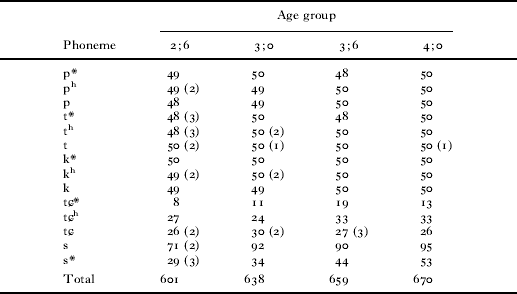
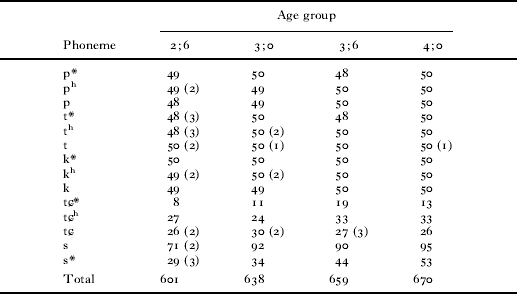
Table 3 shows the number of tokens produced by each age group per phoneme. The numbers in parentheses indicate the numbers of imitated productions. Most tokens were spontaneous or elicited productions in isolation, but a few imitations (4% of the data) were included. Because of the limited number of words with initial /tɔ*/ in Korean children's vocabulary, the number of tokens for this phoneme was relatively small; most children had only one or two productions and some younger children yielded no tokens for this phoneme. A total of 2568 tokens from the child speech samples (stops: 1783; affricates: 277; fricatives: 508) were phonetically transcribed by the first author, a native speaker of Korean.
Number of tokens measured in the study, by phoneme per group (number of imitations in parentheses)
Data analysis
The age and order of acquisition of Korean obstruents were examined through analysis of multiple productions of each target phoneme. For Korean affricates and fricatives, possible effects of phonological structure of words on the production of target phonemes were assessed by examining words that vary in the number of syllables.
Errors of word-initial targets, based on phonetic transcriptions, were also examined. Error production of any target phoneme in word-initial position was identified from transcribed data. For stops, only substitutions across different laryngeal types were of interest for this study (e.g. /p/→[p*] or /ph/→[p*]). In the case of affricates and fricatives, all substitutions were analyzed. Error patterns other than substitutions (e.g. omissions, distortions) were not examined. There were only eight instances of omission of initial affricates or fricatives in the dataset, occurring in the productions of one child aged 2 ; 6 and two children aged 3 ; 0.
Some children occasionally produced target phonemes with diphthongized vowels, adding a high vowel between the target phoneme and the following vowel. Because Korean has a phonological rule that a fricative is palatalized before a high vowel, the addition of a high vowel after a fricative makes the target fricative palatalized. Some previous studies (e.g. M.-J. Kim & Pae, Reference Kim and Pae2005) considered such cases as distortions; e.g. /son/ produced as [sjon]. It seems, however, more reasonable to regard such cases as vowel errors rather than consonant errors, because the addition of a high vowel often occurred in other consonantal environments as well. Vowel errors were excluded from the analysis in this study.
Both intra-transcriber and inter-transcriber reliability for initial consonants was assessed using speech samples from two children in each age group; this represents approximately 20% of the data (a total of 2568 tokens). Mean intra-transcriber reliability was 96·5%, with a range of 94·7% to 98·6% for all age groups. Inter-transcriber reliability was conducted using two additional transcribers: a Korean speech–language pathologist and a Korean researcher familiar with child speech. Each person transcribed 10% of the data. Mean inter-transcriber reliability was 86·8%, ranging from 78·9% for the 2 ; 6 group to 92·2% for the 4 ; 0 group.
RESULTS
Age and order of acquisition
In this study, two developmental stages for individual children were established: emergence and acquisition. The criterion for the emergence stage was the age at which a child had one (or more) correct production(s) of a target phoneme; for the acquisition stage, the criterion was 75% correct production by the child, meaning in practice that the child had to produce the target correctly in four out of five productions of a word. For affricates and fricatives, the number of tokens for each target phoneme varied, and not all children produced every target phoneme. In addition, there were quite a few cases in which a target phoneme was produced with fewer than four tokens. In such cases, all productions of a target phoneme had to be correct for a child to meet the 75% criterion of accuracy.
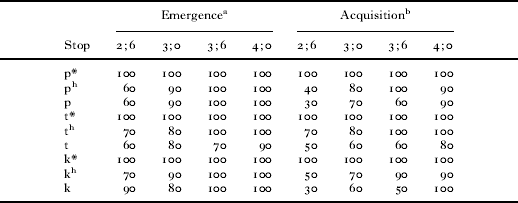
Table 4 presents the percentage of children who fell in the stages of emergence and acquisition for each stop consonant. All children at all ages reached the acquisition stage for the three fortis stops /p*, t*, k*/. Aspirated and lenis stops, on the other hand, emerged in most children at age 3 ; 0, but only two aspirated stops, /ph/ and /th/, were acquired by more than 75% of children at this age. Correct production of all lenis stops did not occur in a majority of children until age 4 ; 0. The results indicate that Korean stops are acquired in the order fortis>aspirated>lenis.
Percentage (%) of children for the stages of emergence and acquisition of each stop consonant across age groups, ten children per group
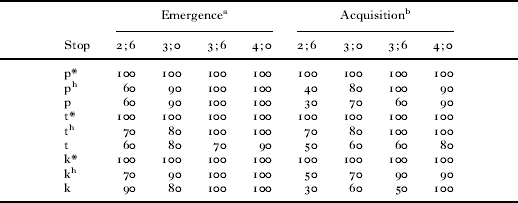
a At least one correct production of a target phoneme was made.
b The target phoneme, per child, was produced with at least 75% accuracy.
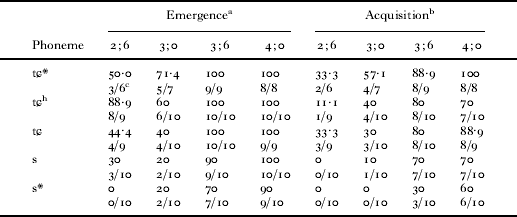
Developmental aspects of Korean affricates and fricatives are shown in Table 5. The three affricates emerged in all children at age 3 ; 6 and were acquired by more then 75% of children at the same age. While the fricative /s/ emerged in 90% of children at age 3 ; 6, the two fricatives did not reach the acquisition stage until after age 4 ; 0. The fortis fricative /s*/ emerged last; even at age 4 ; 0, only 60% of children produced this phoneme accurately in at least 75% of their tokens.
Percentage (%) and number of children for the stages of emergence and acquisition of individual affricates and fricatives for each age group
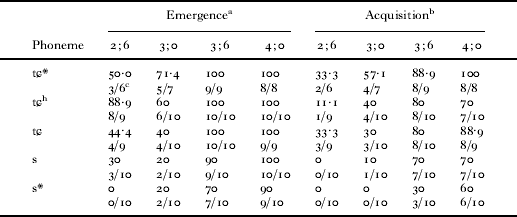
a At least one correct production of a target phoneme was made.
b Each target phoneme was produced with at least 75% accuracy.
c Number of children who reached criterion/total number of children who produced words with the target phoneme.
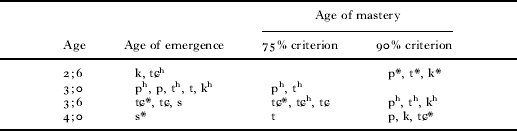
Developmental patterns of all Korean obstruents are summarized in Table 6. age of emergence was defined as the age at which 75% of the children produced at least one correct production of the target phoneme. For age of mastery, two criteria were utilized: 75% and 90% of children who had met the criterion for the acquisition stage. These criteria are often used in the literature for age of phoneme mastery, and using both criteria makes it possible to compare the results of this and other studies.
Age of emergence and age of mastery of word-initial Korean obstruents
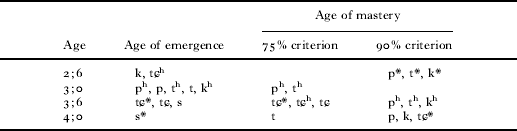
Table 6 shows that by age 4 ; 0, 90% of the children produced all stops correctly, except for lenis /t/, in at least 75% of the tokens. Aspirated affricates emerged relatively early compared to other counterparts, and all affricates were acquired by age 3 ; 6 with a 75% criterion. In contrast, fricatives were not mastered by the age of 4 ; 0. The finding that all stops and affricates are acquired by age 4 ; 0 with a 75% criterion is consistent with results from M.-J. Kim & Pae's (Reference Kim and Pae2005) study, except for /kh/. They attributed the late acquisition of /kh/, compared to other stops and affricates, to the fact that the single test word had a diphthong, which might have made the target phoneme hard to produce.
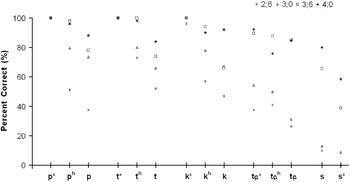
Performances of phoneme production were also assessed by calculating the percentage of correct productions of each target phoneme made by all children at each age. Some results are similar to those obtained using the percentage of children. As shown in Figure 1, stop production was more accurate than affricates and fricatives at the two younger ages, but the accuracy of lenis stops did not increase much between ages 3 ; 0 and 3 ; 6. On the other hand, the accuracy of affricates improved a great deal during the same period and was higher than that of fricatives at all ages.
Percentage of correct productions (%) of each phoneme by all children at each age.

In terms of comparisons among different laryngeal types, the percentage of correct production for stops is greatest for fortis, intermediate for aspirated, and smallest for lenis category across all ages. Although the performance pattern of affricates is somewhat different from that of stops, the percentage rate of correct production is lowest for lenis affricates across all age groups except for the age 4 ; 0 group. The results suggest that the lenis category is mastered later in both stops and affricates relative to the fortis and aspirated categories. In contrast, the lenis fricative /s/ was more accurately produced than the fortis fricative /s*/ in children at all ages, and was produced with 80% accuracy in children aged 4 ; 0.
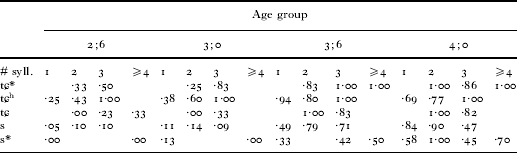
Effects of phonological complexity
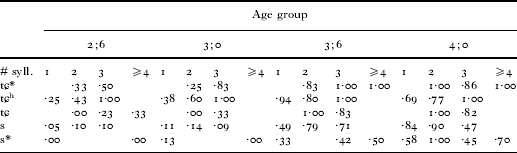
Because the target words used to elicit fricatives and affricates varied in length (see Appendix), possible effects of this factor on the accuracy of production were examined by comparing productions of affricates and fricatives in words varying in number of syllables. Table 7 displays the proportions of correct productions by children at each age with regard to the number of syllables of target words. Although differences in the number of tokens across words make it difficult to determine possible effects, there does not appear to be a decrease in accuracy with an increase in the number of syllables of target words. For example, the three-year-olds produced the alveolar affricate /tɔ*/ more accurately in trisyllabic words (e.g. /tɔ*itɔʌjo/) than in bisyllabic words (e.g. /tɔ*εk tɔ*εk/). Higher proportions of correct productions were also found in bisyllabic and trisyllabic words than in monosyllabic words for the target /tɔh/ at ages 2 ; 6 and 3 ; 0 and for /s/ at 3 ; 6.
Proportions of correct productions of target words by children at each age
Error patterns
Stop consonants
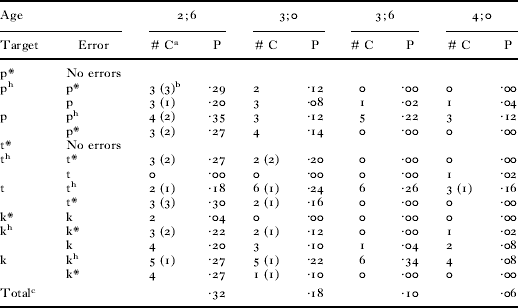
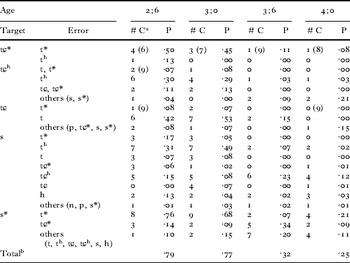
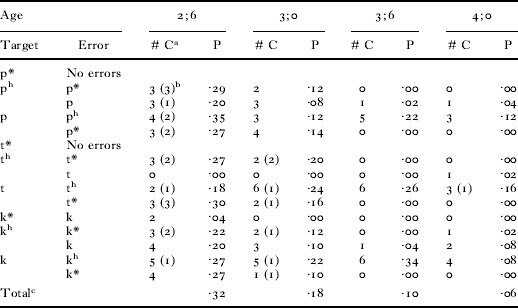
Table 8 shows substitutions across stop categories with the number of children and proportional use of the error for each age group. The number of children who replaced each target phoneme by one type of error with consistency is presented in parentheses. Fortis stops, which are mastered by age 2 ; 6, show only two cases of errors in that age group. As for aspirated stops, substitutions often occurred before age 3 ; 6, when /ph/ and /kh/ were produced as their fortis or lenis counterparts ([p*], [k*] or [p], [k]) ; however, /th/ produced as [t*] was the predominant error for the aspirated alveolar target.
Substitution errors across stop categories, number of children (# C) producing the error, and proportional use (P) of the error for each age group
a Total number of children per target phoneme is ten.
b Number of children showing consistent errors in parentheses.
c Total number of errors as a proportion of the total number of tokens produced.
In the case of lenis stops, substitutions of either fortis or aspirated stops were found in the younger age groups, but only aspirated stops replaced lenis stops at 3 ; 6 and 4 ; 0. Given the later acquisition of lenis stops relative to fortis and aspirated stops, a considerable proportion of substitutions associated with lenis stop production was still evident in the older children.
Affricates and fricatives
Substitution patterns for affricates and fricatives are presented in Table 9. Substitutions of stops for affricates were predominant, and a tendency toward preserving the original laryngeal type was evident. This pattern can be seen in productions of target lenis affricates by children aged 2 ; 6, when lenis stop productions are still unstable. The number of errors in production of affricates substantially decreased after age 3 ; 6.
Substitution errors for affricates and fricatives, number of children (# C) out of 10, and proportional use (P) for each age group

a If fewer than ten children provided data, the number of respondents is shown in parenthesis.
b Total number of errors as a proportion of the total number of tokens produced.
With regard to fricatives, the most common substitutions for the lenis fricative /s/ were [th] and [tɔh]. Children aged 2 ; 6 and 3 ; 0 produced [th] more frequently than [tɔh] for a target /s/, but the substitution of [tɔh] for /s/ occurred more often among children aged 3 ; 6 and 4 ; 0. It is interesting to note that the substitutions for /s/ are aspirated even though the target is lenis. As with the production of lenis /s/, there were more substitutions of stops among younger children and increased errors with affricates in older children for production of fortis /s*/.
DISCUSSION
Order of acquisition in different laryngeal types and articulatory complexity
The present study examined the acquisition of Korean obstruents with laryngeal variations specific to Korean. Of particular interest was the order in which Korean children acquire different laryngeal types. The developmental order across phonemes depends on the criteria adopted for terms such as age of emergence and age of mastery.
Results show that aspirated and lenis stops emerged at the same ages (except for /k/). For phoneme mastery, the developmental order was: fortis stops first (before 2 ; 6), followed by aspirated stops (by 3 ; 6), and then lenis stops which did not meet the mastery criterion until age 4 ; 0. This finding indicates some children need more time to master lenis stops after they have appeared in the child's system.
Evidence of later acquisition of the lenis category was also found in the acquisition of affricates, although the pattern was not as clear as for stops. The rate of correct production was lower for lenis affricates than other types of affricates, especially at younger ages. M.-J. Kim & Pae (Reference Kim and Pae2005) also reported later acquisition of lenis affricates versus aspirated and fortis affricates (i.e. /tɔ*, tɔh/>/tɔ/) using a 75% criterion for acquisition. In the present study, in contrast, all affricates were acquired by the same age. Given that both emergence and acquisition of Korean affricates occurred by more than 75% of children at the age of 3 ; 6, it appears that Korean affricates, once they emerge, are acquired more quickly than other obstruents. It should be noted, however, that the relatively small number of tokens that were assessed might have obscured the acquisition process for affricates. In addition, the unbalanced number of target words, particularly the limited number (n=2) of target words for fortis affricates, might have affected results. A better understanding of the order of acquisition of different types of affricates will require a larger number of productions and target words, and longitudinal studies or cross-sectional studies with a smaller age interval than in this study.
In the case of Korean fricatives, the present data cannot be used to determine the order of acquisition because the 75% criterion was not met by the oldest group (four-year-olds) for either lenis or fortis fricatives. Nevertheless, the finding of earlier emergence and up to 80% correct productions of the lenis fricative /s/ by four-year-old children supports the prediction that this fricative will be acquired earlier than its fortis counterpart /s*/.
Regarding order of acquisition, a question that should be considered is why lenis stops and affricates are acquired later than other stops and affricates, while the lenis fricative is presumably acquired earlier than the fortis fricative (i.e. /s/>/s*/) (cf. Y.-T. Kim, Reference Kim1996; M.-J. Kim & Pae, Reference Kim and Pae2005). An acoustic study of Korean stops produced by the same group of young Korean children (M. Kim & Stoel-Gammon, Reference Kim and Stoel-Gammon2009) proposes that the late acquisition of lenis stops may be related to their phonetic and phonological characteristics: lenis stops are (1) perceptually less salient with weaker articulation; (2) context-sensitive by being voiced intervocalically; and (3) presumably articulatorily more complex. In our view, the third characteristic is most closely associated with late acquisition of lenis stops. In Korean, both lenis stops and lenis affricates are realized with low fundamental frequency (f 0) of the following vowel, which is the major feature associated with phonological contrasts between lenis and other categories. The lowering of f 0 may require additional laryngeal adjustments, which could increase articulatory complexity for young children. The findings from this study indicate that lenis stops emerge at a similar age as other laryngeal types but were mastered last (see Table 6). Given that accuracy of production may increase with improvement of precise and fine-motor control capability (cf. Stokes & Surendran, Reference Stokes and Surendran2005), it appears that young Korean children need more time to master lenis stops which have greater articulatory complexity. For lenis affricates, it should be noted that supralaryngeal articulation for affricates is different from that for stops, although the laryngeal settings for stops and affricates are similar (cf. Kagaya, Reference Kagaya1974). The production of affricates involves a period of frication, and aspirated affricates are produced with longer frication than lenis affricates. This additional phonetic feature might be related to differences between acquisition patterns for affricates and stops.
In contrast to the other obstruents, the phonetic characteristics of the Korean lenis fricative /s/ include frication, aspiration with wide glottal opening, and relatively high f 0 at the vowel onset compared to counterpart stops and affricates (Cho et al., Reference Cho, Jun and Ladefoged2002; Kagaya, Reference Kagaya1974). Given these phonetic properties for the word-initial fricative /s/, the categorization of this phoneme as aspirated or lenis has been debated. Cho et al. (Reference Cho, Jun and Ladefoged2002) provided several reasons as to why Korean fricative /s/ should be categorized as a lenis, rather than an aspirated, fricative. They reported evidence of intervocalic voicing as in lenis stops and affricates, loss of aspiration word-medially, and a slightly lower f 0 than fortis fricative /s*/, whereas f 0 for the fortis category is lower relative to the aspirated one for Korean stops and affricates.
Despite the phonologically grounded categorization of /s/ as a lenis fricative in adult language (cf. Iverson, Reference Iverson1983), Korean children appear to develop this fricative based on the acoustic and articulatory properties of the segment in a specific syllabic position. That is, some common phonetic properties between /s/ and aspirated obstruents in word-initial position might facilitate early acquisition of the fricative /s/. The error patterns related to the fricative /s/ also support this view. While the original laryngeal type tends to be preserved in substitutions for affricates, substitutions of aspirated phonemes, namely /th/ and /tɔh/, rather than lenis /t/ and /tɔ/, for the lenis fricative /s/ are predominant. This substitution pattern highlights the acoustic (and maybe articulatory) similarities between aspirated obstruents and the fricative /s/.
The question that still remains is why the fortis fricative /s*/ is acquired later than the lenis fricative /s/ (i.e. /s/>/s*/), whereas the fortis category was acquired earlier than aspirated and lenis categories for stops (i.e. fortis>aspirated or lenis), and near-simultaneous acquisition was found for fortis and aspirated affricates. This question also may be answered by differences in the phonetic properties of the target phonemes. Cho et al. (Reference Cho, Jun and Ladefoged2002) reported that the frication is longer and often is followed by glottalization at the onset of the following vowel for /s*/. They also reported that acoustic analyses reveal a higher centroid (the center of gravity of a defined part of the spectrum) frequency for fortis /s*/ than for /s/, suggesting a relatively smaller cavity in front of the constriction for /s*/ than /s/ and possibly greater velocity of air flow in the front cavity. Based on these phonetic characteristics, it seems plausible that the production of /s*/ is more complex than that of /s/, and this articulatory complexity might lead to later acquisition of the fortis /s*/ relative to the lenis /s/.
Analyses of phoneme frequency from words in the McArthur Communicative Development Inventory–Korean (Pae et al., Reference Pae, Chang, Kwak, Sung and Sim2004) and from Shin's (Reference Shin2005) study of spontaneous utterances produced by Korean children aged three to eight years, do not reveal any obvious effects of phoneme frequency in Korean; unlike the findings for other studies, there was no evidence of early acquisition of the most frequent phonemes. When type frequency of word-initial consonants (how often the phoneme occurs in children's words) and token production frequency of word-initial consonants (how often the child produces the phoneme) are calculated from each of the two studies, the lenis category, which is acquired last, occurs most frequently in children's words beginning with stop consonants. For Korean affricates, the most common type is also the lenis category, which appears to be acquired somewhat later than other affricate categories (i.e./tɔ*/, /tɔh/>/tɔ/). The predominance of phoneme frequency for the lenis category relative to the fortis and aspirated categories was also present in child-directed speech. Lee, Davis & MacNeilage (Reference Lee, Davis and MacNeilage2008) examined segmental properties of input to one-year-old infants in all word positions and found that the lenis category (70·0%) was most common relative to the fortis (18·2%) and aspirated (11·8%) ones.
For Korean fricatives, on the other hand, the lenis category is acquired earlier than the fortis category (i.e. /s/>/s*/) and has a substantially greater percentage of occurrence in young children's vocabulary and spontaneous speech. Across phoneme classes, however, order of acquisition appears to be better explained by articulatory factors, given that the patterns of acquisition for different laryngeal types are inconsistent across different manners of articulation.
Although effects of phoneme frequency for manner of production appear to be minimal, such effects can be seen in analyses of place of articulation. Although this study did not focus on place of articulation, it was noted that velar stops were acquired at the same age as bilabial and alveolar stops. Cross-linguistic studies have shown that velar stops tend to be acquired later than front stops (bilabial and alveolar) and that velar targets are often substituted by alveolars (Jakobson, Reference Jakobson1968; Locke, Reference Locke1983). Interestingly, the percentage of words with Korean velar stops in children's spontaneous productions is noticeably greater than that for other Korean obstruents. In the children's vocabulary list (Pae et al., Reference Pae, Chang, Kwak, Sung and Sim2004), the percentage of stop-initial words with velar stops is 15·2%, whereas the percentages of words with initial bilabial or alveolar stops are 13·0% and 11·0%, respectively. In children's spontaneous speech (Shin, Reference Shin2005), the average percentages of words with initial bilabial, alveolar and velar stops across ages were 7·0%, 13·2% and 24·6% respectively. The occurrence of velar stops in a larger number of words may boost early mastery of Korean velar stops.
Cross-linguistic comparisons
As reported in studies of phonemic acquisition of other languages, Korean children acquired stops before fricatives. Korean alveolo-palatal affricates, /tɔ/ and /tɔh/, however, were acquired before fricatives. Data from Putonghua-speaking children (Hua & Dodd, Reference Hua and Dodd2000) also demonstrated earlier acquisition of alveolo-palatal affricates relative to fricatives, but later acquisition of the alveolar affricates (/ts/ and /tsh/). Cantonese-speaking children also acquired alveolar affricates later than other phonemes (So & Dodd, Reference So and Dodd1995). A recent study (Lee, Davis & MacNeilage, Reference Lee, Davis and MacNeilagein press) reports that affricate consonants are more frequent in Korean than in English in speech directed to infants. The differences in phoneme frequency in two languages may be related to early acquisition of Korean affricates relative to English ones.
In terms of age of mastery, Korean stops are acquired relatively late compared to stops in some other languages. Using the 75% criterion (75% of children and 75% accuracy), the full set of word-initial Korean stops was not acquired until after age 4 ; 0, whereas word-initial stops in English and Putonghua were acquired by 3 ; 0 and 2 ; 6, respectively (Templin, Reference Templin1957, for English; Hua & Dodd, Reference Hua and Dodd2000, for Putonghua). Later mastery may be associated with the fact that the number of types of stops is greater in Korean than in English or Putonghua. The findings of Davis (Reference Davis1995) appear to support this explanation; in her study of Hindi, Davis reported that the four-way stop contrast (i.e. voiceless unaspirated, voiceless aspirated, prevoiced unaspirated, prevoiced aspirated), which yields twelve stop consonants, was not acquired even by six years of age. However, Mowrer & Burger (Reference Mowrer and Burger1991) found that children learning Xhosa, which also has a great number of stop types such as ejectives and implosives as well as plosives, mastered all stops before age 3 ; 0 although the target consonants occurred only in intervocalic position. Thus, neither the total number of stops nor the number of stop types can fully explain the acquisition data. Alternatively, Hua & Dodd (Reference Hua and Dodd2000) claimed that cross-linguistic differences in the acquisition of consonants can be explained by different phonological systems across languages. They suggested that early mastery of forty-one Xhosa consonants may be due to a simple syllable structure and fewer consonant clusters in Xhosa, and therefore higher saliency of consonants compared to other languages such as English. Given the fact that Korean has no consonant clusters and does not maintain the three-way laryngeal contrasts in final position, Hua & Dodd's (Reference Hua and Dodd2000) concept of ‘phonological saliency’ does not seem to explain later acquisition of Korean initial stops relative to English initial stops.
Language-universal and language-specific error patterns
The developmental patterns of Korean obstruents exhibited both language-universal and language-specific error patterns. Substitutions of stops for target affricates or fricatives, a common error in child speech in all languages (e.g. Locke, Reference Locke1983), occurred frequently in Korean children, particularly at the younger ages. For the three-way contrast of Korean stops, language-specific errors such as laxing (e.g. /ph/→[p]), tensing (e.g. /p/→[p*]) and aspiration (e.g. /p/→[ph]) were common. Tensing occurred frequently in younger children, and laxing and aspiration were often seen in older children. Although errors across different laryngeal types were common in stop productions, affricates were more frequently replaced by stops rather than by other types of affricates. This phenomenon might be related to the need for greater articulatory control at the supralaryngeal level in the production of this phoneme class. For fricatives, substitutes were either stops or affricates. It is interesting to examine how substitutions changed over time in the development of fricatives (as shown in Table 9). While substitutions of stops for fricatives (the more universal way to simplify speech sounds) appeared commonly in the productions of the younger children, affrication of target fricatives (presumably a phonetically more complex substitution) occurred more frequently in older children.
Limitations and future directions
There are several limitations in this study. First, as with all other cross-sectional studies, developmental patterns are inferred from data gathered from groups of children at different ages. It is not possible to know if individual children followed from 2 ; 6 to 4 ; 0 would provide the same developmental patterns. Ferguson & Farwell (Reference Ferguson and Farwell1975) suggested that individual variation, particularly in children in the ‘first-50-word’ stage, can lead to each child's own ‘strategies and preferences’. Given that the youngest children in the present study had vocabularies far exceeding fifty words, it is unlikely that individual differences of the sort reported in the Ferguson and Farwell study were present. It is, however, important to conduct longitudinal studies to examine general and child-specific patterns in the acquisition of Korean obstruents.
Second, this study is a relatively small cross-sectional design with only ten children in each age group. The findings should be assessed through investigations with larger groups of children. Finally, this project focused on word-initial Korean obstruents only. Investigations of word-medial and word-final consonants will provide a more complete understanding of the acquisition of obstruent consonants in Korean.
APPENDIX
Target Words with Word-Initial Korean Obstruents