In 1926, Jón Þorláksson, the Icelandic Minister of Finance, travelled to London to negotiate a loan. After returning, he confided in a local newspaper editor that it was ‘so delightful to take out a loan on the behalf of Iceland and receive 1.5 percent lower interest rate than countries such as Greece are offered by the same bank for the sole reason that we are a Nordic country and it is widely accepted that we are an honest people who can be trusted with money’.Footnote 1
Unlike countries at the lower end of the ethno-racial hierarchy, Þorláksson believed that Icelanders had been accorded – only a few years after receiving full sovereignty from Denmark in 1918Footnote 2 – their civilisational status from the lords of international finance, such as the Hambros Bank in London and the National City Bank in New York. But that the new Icelandic state merited inclusion in the higher echelons of the global economic order alongside the Scandinavian states had been far from obvious in the aftermath of the First World War. To avert external default in 1921, the small island nation was reduced to taking on a large state-guaranteed loan from the Hambros with ‘extreme conditionalities’.Footnote 3 State revenues were pledged as collateral, solidifying newfound political independence at the cost of compromising financial sovereignty. As an influential Icelandic politician put it, these were usually reserved for the world's ‘beggar nations’ at the bottom end of the global hierarchy.Footnote 4 By 1926, however, Þorláksson believed that Icelanders had demonstrated ability to properly manage money and been rewarded with favourable terms comparable to their Nordic neighbours on the upper rung of the civilisational ladder.
This essay argues that the new Icelandic state adopted austerity policies and economic expertise that were internationally prescribed to states as the path to economic development in the wake of the First World War. Historians have recently emphasised the intertwined role of economic experts and international institutions, such as the League of Nations, in the creation of what we could call an international policy discourse to coordinate the stabilisation of the socio-economic turmoil that swept across post-war Europe. As Patricia Clavin shows, economists assumed a new role working for international bodies to provide explanation for financial problems and framing appropriate policy responses, such as balanced budgets, central bank independence and the restriction of credit. These were held as the key to post-war stabilisation on the terms of the capitalist order.Footnote 5
Charles Maier and Adam Tooze have underscored how the subsequent deflationary wave in the 1920s re-established this global economic order.Footnote 6 Jamie Martin has traced the origins of international economic governance to the attempts of bodies such as the League of Nations to formally enforce orthodox policies as a part of stabilisation programmes across Europe and beyond, including new debtor states in former Habsburg and Ottoman territories. These new practices of external intervention reproduced ideas of racial and civilisational hierarchy, reducing embarrassed European countries to a subaltern status usually reserved to non-European peoples.Footnote 7 Clara E. Mattei, in turn, has shown how fascist Italy voluntarily implemented austerity policies developed under the auspices of the League of Nations at the international financial conferences held in Brussels in 1920 and Genoa in 1922.Footnote 8 While international cooperation was not formalised, the meetings led to the codification and diffusion of an international consensus on orthodox economic statecraft that prefigured the post-Second World War adjustment programmes of international organisations such as the International Monetary Fund.Footnote 9
This essay explores how Iceland, a newly independent state on the northern European periphery, responded to the agenda set out by international financial collaboration and how it adapted to the post-war reorganisation of the hierarchy of the global order. Historians of Iceland have not adequately addressed either the international or intellectual context of the post-war regime of austerity policy and economic expertise – or appreciated its novelty.Footnote 10 Yet a nascent conservative right-wing movement in Iceland recognised the agenda emerging from the Brussels conference as ‘exceptionally clear and rational instructions’ for financial reconstruction.Footnote 11 I argue that, under the reign of Jón Þorláksson and his so-called Austerity Alliance (Sparnaðarbandalagið), Iceland voluntarily adopted the international austerity programme developed at the Brussels and Genoa conferences with the aim to secure a privileged status in the hierarchy of the post-war economic order. Following leaders the United States and the United Kingdom (and the Scandinavian states) into deflation rather than monetary stabilisation, Þorláksson implemented a comprehensive fiscal and monetary policy of austerity, a balanced budget, a debt redemption programme and the creation of a new and politically-independent central bank. The essay also suggests that this agenda was enforced by the terms set by the managers of international credit.
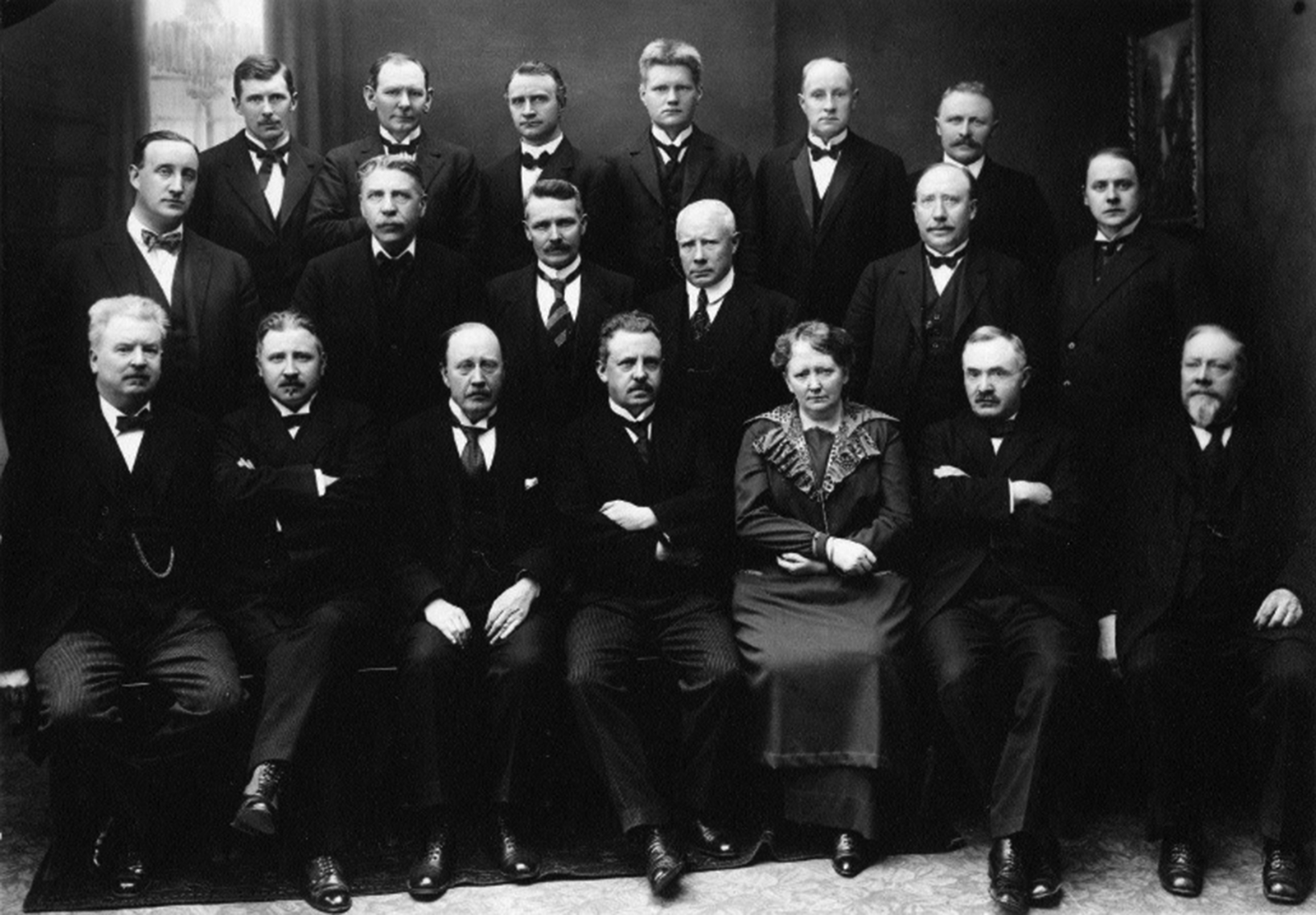
As the leader of the conservative and liberal factions of Icelandic politics in the 1920s and early 1930s, Þorláksson was a self-declared conservative in the sense of wanting to ‘conserve’ the capitalist market order of the late nineteenth century.Footnote 12 In 1922, he led the formation of the Austerity Alliance among a group of parliamentarians aiming to combat the post-war slump and spiralling inflation through fiscal and monetary austerity.Footnote 13 This group found itself in power at the start of 1924 under the banner of the newly formed Conservative Party (Íhaldsflokkurinn), with Þorláksson becoming Minister of Finance and later Prime Minister. The subsequent session of the Alþingi (the Icelandic parliament) became notorious as ‘the Great Austerity Parliament of 1924’ (Sparnaðarþingið mikla).Footnote 14 Þorláksson studied the work of Swedish economist Gustav Cassel, a progenitor of the Stockholm school of economics. Cassel was perhaps the most influential ‘money doctor’ advising the conferences in Brussels and Genoa.Footnote 15 Þorláksson drew on Cassel's memoranda for the two conferences, which closely reflected their policy platform. Moreover, Þorláksson and his collaborators sought to collect the ‘core of current economic wisdom’ by directly consulting other foreign economic advisors on monetary policy and central banking and interviewing the central bank directors of the Nordic countries.Footnote 16 (Figure 1)
Parliamentary members of the new Conservative Party (previously, the Austerity Alliance) in the spring of 1924. Jón Þorláksson is in the middle of the front row. Courtesy of Photo Gallery of Iceland / Ólafur Magnússon. https://www.althingi.is/tilkynningar/hatidarsamkoma-i-tilefni-af-thvi-ad-100-ar-eru-lidin-sidan-fyrsta-konan-tok-saeti-aalthingi

Þorláksson's ambition, however, was less to divorce markets from government in a return to a pre-war era of laissez-faire as the scholarly literature suggests.Footnote 17 Instead, this essay argues that Þorláksson implemented austerity and raised Iceland's status in the global economic order by carving out ‘the national economy’, a measurable entity that was legible to expert management by government.Footnote 18 Þorláksson was pivotal to the introduction of economic expertise to Iceland. Educated as a civil engineer at the Danish Polytechnic University, he had been one of the few academically trained experts in the service of the new Icelandic state as its state engineer. Although not an economist, Þorláksson explicitly sought to base government policy on academic economics, privileging ‘scientific’ expertise over ‘practical’ know-how. He adopted Cassel's monetary business cycle framework and combined it with new economic aggregates such as inflation measurements to offer the very first analysis of ‘the Icelandic economy’ and the Icelandic ‘business cycle’. By accounting for the causes of post-war inflation and falling exchange rates in terms of Cassel's amended Quantity Theory of Money, Þorláksson prepared the ground for new institutions and policies geared towards economic management. Therefore, Þorláksson implemented an austerity agenda was that was not laissez-faire ‘liquidationist’, passively confined to balancing the budget.Footnote 19 Instead, I argue that it assumed a technocratic or managed form that included an active role for the state. It required making ‘the economy’ legible and its cyclical movements amenable to control by a politically-independent central bank.Footnote 20
This essay, which is divided into five parts, begins by exploring Þorláksson's identification of the Icelandic business cycle in a 1924 treatise he authored as Minister of Finance. Þorláksson's aim was to make it visible to the implementation of fiscal and monetary austerity – the subjects of part two. The third part explores how Þorláksson and his allies sought to cement their agenda by framing Iceland's first central bank as a politically-independent institution based on the international expert consensus. Part four examines how Þorláksson introduced unorthodox edits to this script to accommodate conditions of late development, giving the new central bank extraordinary powers over the financial system. The final part highlights the role played by international financial markets in enforcing the austerity agenda.
‘The Icelandic Business Cycle’
The post-war programmes for European stabilisation, which were developed and codified at the financial conferences in Brussels and Genoa, provided the context for Þorláksson's austerity agenda.Footnote 21 The Icelandic press reported on the meetings and Sveinn Björnsson, Iceland's ambassador in Copenhagen, participated in the Genoa proceedings. According to the main right-wing newspaper, Morgunblaðið, which officially supported Þorláksson's Austerity Alliance, ‘the conference [in Brussels] gave exceptionally clear and rational instructions on the financial reconstruction of Europe’.Footnote 22 In his writings and speeches, Þorláksson aligned himself with ‘academic experts’ and ‘economic science’ over ‘practical bankers’. He maintained that economists had been able to discern the true causes of wartime inflation and fluctuating exchange rates. They had instructed and corrected the ‘misguided’ views of bankers and politicians and were therefore to guide fiscal and monetary policy. Þorláksson read widely in Swedish economics, particularly Cassel, Eli Heckscher and Knut Wicksell, in addition to John Maynard Keynes.Footnote 23
In crafting his agenda, Þorláksson drew explicitly on the memoranda that Cassel produced for the League of Nations’ international conferences in Brussels and Genoa. These events marked the rise of Cassel to international fame as an authority on financial issues second only in reputation to Keynes. Invoking academic expertise, a group of economists, which included Cassel, Arthur Pigou, and Maffeo Pantaleoni, was invited to submit papers to diagnose the financial crisis facing the world. Cassel's submission, ‘Memorandum on the World's Monetary Problems’, made the greatest impact. The experts prepared a joint statement to instruct participants and set out the conference agenda. As has been pointed out, their diagnosis and policy advice were fully represented in the conference resolutions. The conference disseminated a common template for identifying the causes and policy solutions to the financial crisis, thus laying out the steps governments needed to take to achieve economic stability and access to international credit markets.Footnote 24
Cassel arrived at his policy prescriptions from the study of ‘the economy’ – which he defined as a ‘self-contained’ system within which ‘all economic processes take place’.Footnote 25 Cassel was an important part of the movement to develop the Quantity Theory of Money of Alfred Marshall, Irving Fisher and Knut Wicksell into monetary business cycle theory. Scholars have argued that the very conception of ‘the economy’, as a self-contained sphere of human activity, a measurable entity and site of intervention, emerged out of the aggregate analysis of the cycle in 1920s.Footnote 26 Like economists Keynes and Ralph Hawtrey, Cassel understood business cycles as the source of change in ‘the national economy’ and assumed a central role for government policy in managing it.Footnote 27 Business cycles were propelled less by overproduction or overestimation of consumer demand than an overestimation of the supply of credit, or the amount of saving available for investment. Even in the absence of government deficits, this problem of estimation was compounded by the future-oriented nature of a capitalist economy. The capacity of savers to provide capital had to be calculated many years in advance since large-scale investments were initiated years before their demands were made on savings, making credit inherently unstable. Cassel's economics were technocratic in the sense of encompassing a move from theory to practice. He was not laissez-faire or ‘liquidationist’, as were many leading austerity advocates, accepting the inevitability of cycles and insisting that intervention only made them worse. In fact, Cassel railed against such approaches to the cycle.Footnote 28 The study of economic change, he stated, ‘must follow the practical aim of suppressing them [the business cycles] as much as possible’.Footnote 29 Cassel advocated a technocratic or managed form of austerity (as opposed to liquidationist) that reserved an active role for the state in decoding the future and ironing out cycles by administering a healthy dose of monetary austerity, thus ameliorating the crisis by checking the boom. Cassel assigned the key charge to the central bank and its interest rate which had to be adjusted to synchronise the different time scales of the capitalist enterprise.Footnote 30
Þorláksson followed Cassel in explaining the world's economic problems after the First World War in monetary terms. The latter challenged anti-quantity theorists, which held that the rise in prices was caused by a scarcity of commodities. Instead, Cassel maintained that the problem was the creation of ‘artificial purchasing power’ in excess of production. This had become a key concept for Cassel to circumvent critics of the Quantity Theory who challenged the causal relationship between the supply of money and the rise in prices. Artificial purchasing power was created when banks supplied credit for investment, usually to governments, beyond available savings. Since this fresh purchasing power was not underpinned by increased production, there was more money chasing the same number of goods, leading to higher prices. Furthermore, Cassel expounded a theory of purchasing power parity, in which inflation propelled falling exchange rates, thus grounding both the stability of prices and exchange rates in domestic policies.Footnote 31
Consistent with his technocratic stance, Cassel had a special penchant for boiling analysis down to policy recommendations. The key policy goal of the central bank in managing the business cycle was to limit investment to available savings through the discount rate, often a long time in advance, thus preventing the creation of ‘artificial purchasing power’. In the midst of the post-war slump, however, there was less of a need for the deciphering of an uncertain future than a firm hand. Post-war stabilisation ‘altogether depends on the limitation of the supply of money’ and this was to be carried out immediately by, first, eliminating state budget deficits and, second, severely restricting the provision of credit through a politically-independent central bank employing high discount rates.Footnote 32
Þorláksson used Cassel's conceptual framework to provide the first analysis of ‘the Icelandic economy’ and ‘the Icelandic business cycle’ in his 1924 treatise Lággengið (Depreciated Currencies). It offered an authoritative explanation of the country's economic woes in monetary terms. While scholars have not recognised its significance, the treatise was widely read at the time, reviewed in Icelandic journals, and cited in parliamentary debates. The treatise coined the Icelandic terms for business cycles (hagsveiflur) as well as inflation (verðbólga) and made use of novel ones such as balance of payments (greiðslujöfnuður). Before the 1920s, intellectuals, politicians and officials rarely spoke of ‘the Icelandic economy’. They spoke of the condition of political entities such as ‘the state’, ‘the country’ and ‘the population’. The concept of þjóðarbúskapurinn, a translation of the German term Volkswirtschaft, started to appear in print in the second half of the nineteenth century but almost solely in terms of public finances.Footnote 33 The concept referred to ‘the national farm’, understood as a parallel to the individual farm and encompassing the state of the public treasury, that is, ‘the equilibrium between revenues of the government and its expenditures’.Footnote 34
By contrast, Þorláksson used the concept of Volkswirtschaft to refer to the totality of economic processes as measured by novel economic statistics, namely inflation, balance of payments and capital investment.Footnote 35 Þorláksson pioneered this synthesis of economic theory and statistics in the Icelandic context, a country of few if any formally trained economists. Internationally, this combination was first put into practice in the 1920s less by economists than engineers like Þorláksson.Footnote 36 Starting in 1914, the newly created Icelandic Statistical Bureau (Hagstofa Íslands) published regular reports on all imports and exports crossing the borders registered at current values in addition to reports on fisheries, agriculture, and other productive industries.Footnote 37 Most importantly, the First World War represented the start of inflation measurements and the construction of cost-of-living indices in Iceland. In 1914, the Statistical Bureau began collecting quarterly reports on retail prices directly from merchants in the capital, Reykjavik, and published an unweighted price index. By 1924, it had introduced a weighted index, extrapolated back to 1914.Footnote 38 That the cost-of-living measurement only encompassed Reykjavik is indicative of the economic state of Iceland at the time. A former dependency of Denmark located far away in the North Atlantic, only one-third of the population lived in urban areas and mostly worked in fisheries, the main export industry and driver of economic growth. More people lived in the countryside and made a living from agriculture. Economic output was more determined by seasonal fluctuations in fish catch and harvest than the monetary processes of the modern capitalist economy.
Yet the non-seasonal, periodic cycles of prosperity and depression, which accompanied industrialisation and the rise of modern banking, were seen as signs of civilisation and economic development.Footnote 39 Reading the Icelandic experience through the combination of monetary theory and newly-forged statistical aggregates, Þorláksson argued that the war represented the start of a business cycle with investment, credit and savings increasing in conjunction with a favourable balance of payments and production of new assets. But the upswing carried within it the seeds of a speculative bubble in investment and credit which had no solid foundation in increased production. In 1917, exports fell, and terms of trade worsened, leading to balance of payments problems and the accumulation of foreign debts. Despite contraction in terms of production, however, savings and bank deposits continued to increase. Conceding that price increases had preceded the expansion of the money supply, Þorláksson followed Cassel in emphasising the artificial generation of savings for investment and the role of state interference in bringing it about. As the public saved its earnings and businesses postponed investment, the government overtook a large part of the import trade to secure sufficient stock in the country during the war, taking out foreign loans to pay for it. Instead of paying for new imports as it did before, the merchant class deposited its accumulated funds.Footnote 40
The resulting increase in savings was fourfold and, according to Þorláksson, ‘unnatural’ since it was not derived from an increase in actual production. It was a product of state interference and paid for with foreign debts. But the banks mistook it for ‘war profit’.Footnote 41 They also had to pay interest on deposits and responded favourably for demands for loans. As a result, a ‘credit inflation’ was created. The new loans were not even invested in productive enterprises since imports of fixed capital were restrained due to the war. Instead, credit was used for the buying and selling of real estate and other pre-existing assets, leading to rapid price increases. Businesses also took advantage of the availability of credit to keep themselves afloat and cover their losses, especially in the fisheries. The main culprit for Þorláksson was, again, the government, which used loans to monetise its deficits. Following the war, the credit inflation continued, directly this time through the government's foreign loans rather than domestic deposits. Þorláksson could conclude that monetary factors, or ‘artificial purchasing power’, was the cause of rising prices, falling exchange rates, bankruptcies, and unemployment.Footnote 42
‘Saving the Nation through Austerity’
After taking up the position as Minister of Finance in March 1924, Þorláksson introduced a novel approach to public finance in Iceland: austerity.Footnote 43 It was rationalised in terms of managing ‘the business cycle’ and intended to eliminate the causes of the depression phase of the cycle, that is, ‘artificial purchasing power’. The austerity agenda began with the government budget in the spring of 1924. In a statement closely echoing the resolution of the Brussels conference, Þorláksson deemed ‘whimsical public opinion’ responsible for sanctioning deficit spending. The Austerity Alliance set out to bring voters to realise the imperative of re-establishing public finances on a sound basis. According to Þorláksson's analysis, the previous governments had passed an endless stream of new laws requiring more and more expenditures. The accumulated deficit since the end of the war was substantial, or over one-year's annual expenditure. The results of the fall elections of 1923 gave the Austerity Alliance a mandate to push a ‘counteroffensive’ of slashing expenditures.Footnote 44 After a series of negotiations at the start of 1924, the Austerity Alliance, now rebranded as the Conservative Party, took the reins of government. The King of Denmark's secretary telegraphed Þorláksson on behalf of the head of state to convey the message that the austerity proposals of the new government had elicited a highly positive response in Copenhagen.Footnote 45
While balancing the books had been a common aim of public finance since Iceland became financially autonomous in 1874, this was the first time an Icelandic government adopted an all-out austerity programme.Footnote 46 The subsequent session of the Alþingi in 1924 became known as ‘the Great Austerity Parliament’.Footnote 47 The budget was cut by 15.5 per cent. As the financial conference in Brussels insisted, a balanced budget was not to be achieved by increasing taxation since ‘reduction of government expenditure is the true remedy’.Footnote 48 Similarly, Þorláksson's programme focused solely on cutting expenditures, not increasing revenue, and the former was reduced across all sectors. Iceland had no armed forces, which meant that public spending was relatively lower than in many European countries and the possibility for reduction less. Infrastructure spending and public works suffered heavy cuts, or about 25 and 30 per cent, respectively. Support for primary education and religion was cut by 26 per cent. Higher education, arts and sciences were cut by 36 per cent. Spending on the courts and the police was not reduced and expenditures for doctors and health increased by 10 per cent.Footnote 49 Þorláksson also abolished state monopolies such as tobacco and oil. The initial bout of austerity successfully eliminated the budget deficit and delivered a surplus, but Þorláksson kept reducing expenditures over the following years. Critics charged that Þorláksson had converted the Alþingi into ‘the Slaughterhouse of the South nr. 2’.Footnote 50
Þorláksson's aim was quite explicitly to engineer a ‘ruthless deflation’.Footnote 51 In addition to slashing expenditures, Þorláksson oversaw monetary austerity. In 1924, the state-owned Landsbanki's interest rates went up to 8 per cent, which was roughly 1–2.5 per cent higher than in neighbouring countries.Footnote 52 Þorláksson explained that the Landsbanki, a commercial bank which was set to assume the role of the central bank, should further ensure rapid deflation. When savings streamed into banks, they should not be loaned out again (indeed, they were an ‘unnatural’ source of purchasing power). Rather, savings should be deposited with the central bank, which would take them out of circulation. Once money scarcity took hold, Þorláksson continued, industries would either force down wages or go bankrupt and generate unemployment, thus translating monetary austerity into industrial austerity. In the year after Þorláksson came into power, the Landsbanki implemented the ruthless reduction of its circulating money by 47.5 per cent, forcing the total down by 17 per cent.Footnote 53 Compounding this were rapid price decreases; prices in Iceland had risen more than elsewhere during the war and came back down with the same ferocity (with real interest rates around 20 per cent).Footnote 54 Aided by good years in exports, by the fall of 1925, Þorláksson's austerity agenda had helped spur a deflation that raised the exchange rate of the Icelandic króna from 47 per cent to 86 per cent of its pre-war value, as stipulated by the gold standard.Footnote 55
One law professor at the University of Iceland lamented, ‘austerity is the holy word in Icelandic politics at this time’.Footnote 56 While austerity enjoyed sufficient support in parliament, not everyone fell in line. Bjarni Jónsson, a parliamentarian and lecturer in Latin and Greek at the University of Iceland, claimed that it was more important that the government provide necessary support to industry rather than eliminate the deficit. Jónsson claimed that the role of the state was to ensure the multiplication of investment, ‘the bloodstream of society’. What counted was less the government budget than society's economic health. Interestingly, Jónsson, who also translated Goethe's Faust into Icelandic, juxtaposed the public treasury to an individual savings account; the former could never be reduced to only spending what had been deposited. Thus, Jónsson condemned the effort of ‘saving the nation through austerity’ as leading to ‘depressing stagnation’.Footnote 57 Invoking Cassel and Keynes's argument for financial stabilisation at current exchange rates, Progressive leader Tryggvi Þórhallsson, Þorláksson's successor as Prime Minister, declared that it amounted to ‘the slaying of Icelandic industries’.Footnote 58 The Social Democratic Party's Jón Baldvinsson summarised the weaponisation of economics across the political spectrum: ‘Cassel here and Cassel there and Cassel everywhere’.Footnote 59
Þorláksson followed Cassel in framing austerity in novel macroeconomic terms of managing the business cycle. In response to critics such as Jónsson, who argued that total investment was a more important indicator than budgetary equilibrium, Þorláksson made the case for a counter-cyclical fiscal policy based on a ‘crowding-out argument’.Footnote 60 Here ‘the business cycle’ helped Þorláksson justify austerity. At the start of the cycle – Þorláksson argued, correctly, that an upswing was under way in early 1924Footnote 61 – the most effective support that the state could give to the economy was to get out of the way. If the state spent on infrastructure it was entering into competition with private industry over labour and capital. When private industry could employ the labour and capital in the economy, it was natural that the government let it by withholding spending and repaying debts. During the crisis phase of the cycle, the government should use its accumulated surpluses (not borrowing) to engage in public works so as to ‘compensate’ for the inability of private industry to provide investment.Footnote 62 It is important to note, however, that Þorláksson was somewhat disingenuous in suggesting an active form of fiscal policy. As Bjarni Jónsson actually predicted, Þorláksson recanted when a downturn came in 1926. Even in crises, public works should be kept within strict limits to avoid creating a demand for labour that would keep nominal wages from coming down and preventing the economy's self-correcting equilibrium mechanism from doing its work.Footnote 63
An important component of Þorláksson's austerity agenda was increasing spending on debt redemption. Servicing and repaying debts went up to 26 per cent of the total government spending. Over the course of three years, Þorláksson eliminated short-term public debts and reduced the long-term debt, taking total indebtedness down by 36 per cent. Þorláksson urged parliament to embark upon this path of ‘self-denial’ since repaying the debt at this pace required cancelling public works and road building beyond what was required to balance the budget. The economist in Þorláksson overpowered the engineer, privileging debt redemption over infrastructure development in a country largely without traversable roads. Þorláksson went on to explain that the only meaningful lesson Iceland could give to the world in economic affairs was the absence of public debt. This had changed during and after the First World War. But now Iceland should again serve as a model for the world as ‘the state without state debt’.Footnote 64
‘Without Any Political Interference at All’
Þorláksson next introduced legislation for a new central bank to cement the austerity agenda.Footnote 65 Since 1904, Íslandsbanki, a private bank, had served as a bank of issue. Dissatisfaction with over-issuing of notes during the war had led to removing its right of issue in 1921 and reestablishing the Landsbanki as a genuine central bank.Footnote 66 Taking a step beyond rationalising budget austerity in macroeconomic terms, Þorláksson coded into the eventual legislation an explicit central bank mandate, in addition to managing gold convertibility, to avert ‘the disturbance to the monetary order and business life, that can be expected, that business cycles will lead to’ [emphasis added].Footnote 67 The central bank was explicitly charged with ‘introducing equilibrium into the economy, minimising the risks and smoothing out the cycles’.Footnote 68 As on the fiscal side, Þorláksson believed this meant monetary austerity, i.e. a sharp restriction of credit and currency issue. The main instruments of the new central bank were, on the one hand, to collect foreign currency deposits and lines of credit to be able to back the króna as well as the national industries when in need. On the other, the central bank was to control the extension of credit domestically through the discount rate and other instruments. Following Cassel, Þorláksson was not a liquidationist. His central bank was to exercise ‘discretion’ to observe the progression of the business cycle, deciphering when a boom was in the making and acting quickly to raise interest rates and restrict the lending operations of commercial banks.Footnote 69
Þorláksson's succinct articulation of these objectives in a special preamble to the 1925 version of the central bank bill was recommended by Jón Krabbe, the Icelandic chargé d'affairs at the Danish Foreign Ministry in Copenhagen and inspired by the 1924 charter of the German Reichsbank, to help ensure central bank independence. As Axel Nielsen, a professor of economics at the University of Copenhagen, put it to Þorláksson, it was necessary to articulate the position of the central bank as an independent institution and defend it against demands made upon it by the government.Footnote 70 Krabbe and Nielsen were Þorláksson's main advisors in creating the new Icelandic central bank charter. Krabbe had access to and forwarded charters of other European central banks, including the 1924 German charter and the new Baltic states and Hungary in addition to the Scandinavian countries. Nielsen, who was also on the governing council of the Danish central bank, had just published a book on central bank history.Footnote 71 Moreover, Nielsen was a leading force in the reestablishment of the Scandinavian Monetary Union in the 1920s under central bank auspices.Footnote 72 Þorláksson solicited Nielsen's written memoranda on the bill and Krabbe held conversations with him in Copenhagen.Footnote 73 In addition, a special committee was set up in 1925 to review the issue and interview the central bank directors of all the Scandinavian countries, who turned in written reports on Þorláksson's bill.Footnote 74
At the international financial conferences in Brussel and Genoa, the expert consensus was that central bank independence was the key to ensuring financial stabilisation. Recent scholarship has also emphasised how central bank independence became an international norm in the decade following the First World War.Footnote 75 As a core policy prescription of the League of Nations and its Financial Committee, as well as UK and US money doctors, it was a conditionality imposed on defeated powers, debtors and newly created states around the globe.Footnote 76 According to the Genoa conference resolutions, central banks ‘should be free from political pressure and should be conducted solely on lines of prudent finance’.Footnote 77 The Alþingi's 1925 special committee closely echoed this language: the central bank was to be ‘independent of changes in government and parliament and thus able to govern the bank according to the natural laws of governing central banks’.Footnote 78
Historians have overlooked how closely the new central bank, whose establishment was passed into law in 1927, adhered to these international norms.Footnote 79 As Þorláksson's bill made its way through successive legislative sessions, several institutional designs were suggested to secure central bank independence. The first was to organise the bank as a private entity in which the state held stock. After parliament rejected the proposal, Þorláksson claimed that there was ‘an even greater reason to ensure the bank against the state’.Footnote 80 A second unsuccessful attempt was made to formalise the bank's independent status in the new Icelandic constitution.Footnote 81 Þorláksson wanted to apply the same rules to the separation of ‘the political power from the monetary power in the country’ as with the separation of powers between the legislative and judicial branches.Footnote 82 Þorláksson's immediate concern behind isolating the central bank from politics was the farmers-based Progressive Party. It wanted to determine interest rates in parliament to push them below the market rate to distribute credit into the countryside.Footnote 83 Björn Kristjánsson, another member of the Austerity Alliance and an ex-Minister of Finance, considered it important that the bank be ‘opposed to the socialist movement’. Pointing to the new Soviet Union, socialists would view the bank as ‘public property’ and extend credit to people without collaterals or mortgages.Footnote 84
In the place of explicit constitutional guarantees, a handful of articles made their way into the bill aiming to fix the relationship between the bank and the government to furnish the bank's governors with ‘weapons’ to resist the ‘pressures of the government’.Footnote 85 In addition to declaring the bank as an independent institution, which enjoyed autonomy in its decision-making, the extension of any loans at all to the government or state-owned enterprises was forbidden (except for small three-month-long advances). Þorláksson claimed that this was essential to prevent cash-strapped governments from ‘misusing the bank’ for deficit financing.Footnote 86 Jónas Jónsson, a leading member of parliament for the Progressive Party, pointed out that the clause was lifted from the 1924 charter of the German central bank made in connection with the Dawes Plan to ensure the interests of the Allied victors in collecting reparations. In fact, the charter of the German bank had accompanied Krabbe's memorandum as well as his advice to incorporate the clause.
The clause in the Icelandic bill was copied verbatim from the Icelandic translation of the German charter. Krabbe consulted Nielsen on the details of adopting the numbers to Iceland and they agreed. Krabbe lamented that it was impossible to forbid the bank from purchasing government and municipal bonds as in the German case since the new central bank conducted commercial operations. But he devised other means of legislating against it by limiting the purchase of such bonds to a share of actual savings deposits.Footnote 87 Þorláksson insisted that ‘forbidding the bank to extend loans to the treasury is a direct consequence of the sad experience of all countries in the northern hemisphere where banks have surrendered to the demands made by government for loans’.Footnote 88 Moreover, the clause was to serve the pedagogical purpose of restraining governments and parliament – to make it difficult for them to contract debts. If there was a deficit risk, Þorláksson explained, the government should simply balance its books.Footnote 89
Similarly, the appointment of the three bank directors was not to be made by the parliament but by institutional intermediaries. The appointment itself was in the hands of a special governing council, which, in turn, was to be appointed by a second intermediary body to further insulate it from the opinion of parliament. For this reason, the terms of service for these bodies were to extend beyond the election cycle to prevent an incoming majority in parliament from gaining a majority on the intermediary bodies. This idea was originally espoused by Axel Nielsen, based on the US Federal Reserve as a method of ‘excluding political influence from the bank’ and staving off ‘political wishes for cheap money’.Footnote 90 Fourth, the chief of the bank's governing council had to be experienced in finance. As one parliamentarian explained, independence would be best achieved as in Sweden by appointing calm and collected men of finance.Footnote 91
‘A Central Bank Stronger than Elsewhere’
Inspired by Cassel's monetary business cycle theory, Þorláksson and his collaborators envisaged an active role for the central bank in purging the post-war inflation and ironing out cycles through monetary austerity.Footnote 92 Therefore, Þorláksson wanted the central bank to be able to ‘command’ commercial banks and their lending policies, administering monetary austerity at the first sight of overconfidence. As the 1925 parliamentary committee pointed out, ‘to achieve this aim [smooth out the cycles] the central bank must have great power over industry’.Footnote 93 The concern with the financial and administrative capacity of the new central bank to control commercial banking – what has been called ‘financial dominance’Footnote 94 – lay behind the decision to reconstitute the Landsbanki, a pre-existing, state-owned commercial bank, as a central bank. This combination of central banking and commercial operations in the Landsbanki distinguished the Icelandic central bank because it departed explicitly from the international model propagated by the League of Nations and the United Kingdom in post-war Europe. In Geneva, the spread of ‘Modern Central Banking’ necessitated a sharp division of labour between central banks (public) and commercial banks (private).Footnote 95 Critics in the Icelandic parliament championed this model, generating sustained debate in the Alþingi and the press over the course of several years. The most vocal critic of Þorláksson's bill was fellow Austerity Alliance member Björn Kristjánsson, who introduced a competing legislation, proposing the establishment of a new and separate institution to issue bills according to fixed rules. Invoking expert authority – including Cassel and Nielsen – Kristjánsson and other critics pointed out that, according to the ‘universal laws’ of economic science, central banks should be confined to the role of the ‘bank of the banks’.Footnote 96 According to this international consensus, as the League and the British government made clear to debtors, commercial operations should be clearly separated from central banking. As critics in the Alþingi charged, the Landsbanki would enter into competition with commercial banks, and eventually establish a monopoly on the money market.Footnote 97
Following these critics, historians have dismissed the refashioning of the Landsbanki as ‘the National Bank of Iceland’ in 1927 because it combined commercial and central bank operations. The former fast overshadowed the latter.Footnote 98 Not only does this view overlook that the emphasis on macroeconomic objectives as well as its independence from politics were very much in line with economic theory and international norms. It also ignores that the combination was legitimated by orthodox Scandinavian economic authorities and implemented to overcome the structural conditions of late development in Iceland and ensure the capacity of the state to control the financial sector. As recent studies have underscored, the United Kingdom's and the League of Nations’ one-size-fits-all model, which was derived from the experience of the most powerful actors, turned a blind eye to this question of ‘financial dominance’ in latecomer countries with shallow or non-existent financial markets. More concerned with ensuring central bank independence from governments, little thought was given to the central bank's relationship to commercial banks or how active monetary policy could be implemented.Footnote 99
The early central banks in Europe were often the first or sole commercial bank in the country. This applied to pioneers, such as the United Kingdom, as well as latecomers, from Germany to Italy and the Scandinavian states.Footnote 100 Since Iceland was a former dependency of Denmark (under the Danish central bank until 1918), it did not fit the experience of the first wave of latecomers. Like many of the new central banks created in the post-First World War period across the globe, the Icelandic central bank was created after the development of commercial banks of substantial strength. Even if the Landsbanki, as the new central bank, kept its commercial operations, there was still the Islandsbanki, which had over a third of all deposits and loans, in addition to smaller savings-and-loans cooperatives.Footnote 101 As with other post-war newcomers in Europe and the British dominions, the Icelandic central bank, thus, encountered the problem of controlling a pre-existing commercial sector and monetary conditions in underdeveloped financial markets.Footnote 102 Magnús Jónsson, who was a member of the 1925 special committee, explained that commercial banks’ interests would contradict prudent monetary policy. If they could get away with it, commercial bankers would not take their lead from the central bank but concede to social demands for cheap money. Moreover, the Icelandic commercial sector was not solely in private hands, as the international model presumed, but split into private and state-owned banks. If the Landsbanki was not converted into a politically-independent central bank it would remain a state-owned commercial bank reporting to its true master, the Alþingi. The combined effect would be to relegate the central bank to ‘an impotent bystander’.Footnote 103
The challenge of bringing commercial banks and market rates into line with the discount rate had frustrated even the most powerful central banks. As commercial banks increased in size in the second half of the nineteenth century, central banks found that the former were far from willing to accept its leadership in rate setting in a passive fashion. Central bankers thus developed different forms of ‘open market operations’ to make their rate effective in the money market. The Bank of England exercised control over credit through intermediate financial institutions, such as discount houses, selling interest-bearing securities (consoles).Footnote 104 The old German Reichsbank drained reserves from the banking system by selling off government debt. Prohibited to hold government debt, and without access to financial intermediates, these orthodox prescriptions were of little use in latecomer countries. As a result, countries such as Greece and Australia sought, like the Icelandic government, to fuse together central and commercial banking functions with the aim of exerting control over credit conditions. But the League of Nations vetoed the Greek government's proposal to remake the National Bank into a central bank, forcing the creation of an orthodox institution. Without adequate financial tools at its disposal, the Greek central bank was prevented from controlling the money supply, realising Jónsson's vision of an impotent bystander unable to influence the credit policies of the dominant commercial banks.Footnote 105
Historians of central banking have noted that central banks, through commercial operations, could clearly influence market rates of interest and external gold flows but concluded that there is little evidence to suggest that they ‘had a full understanding and command of open market operations’.Footnote 106 The interviews held by the Icelandic special committee in 1925 with the Nordic central bank governors suggest a clear non-profit-maximising, non-competitive central bank rationale for traditionally commercial operations. Like the 1924 Reichsbank and most of the post-war central banks, the new Icelandic central bank was prohibited from holding government debt. Þorláksson and his collaborators followed the Scandinavian practice of extending, or reducing, the central bank's own loans and deposits with explicitly non-profit-maximising, non-competitive monetary policy aims focused on controlling credit, market rates of interest and external gold flows. All the Scandinavian central banks continued making loans directly to industry in the 1920s and renewed interest in attracting interest-bearing deposits to control the extension of credit in commercial banks. A parliamentary committee in Sweden in 1917 had investigated the question of bringing private bank rates into line with the central bank with the aim of restricting credit and controlling inflation. It concluded that making loans to industry was a necessary condition to ensure the transmission of the interest rate policy of the central bank. But since market rates were still too low, the committee recommended that the Swedish bank be given the right to pay interest on deposits to ‘correct’ the rates of private banks.Footnote 107
Knut Wicksell, one of Europe's leading economists, elaborated on the efficacy of this unorthodox policy substitution for open market operations in controlling the business cycle. Attracting interest-bearing deposits, Wicksell commented, would clearly enhance the effectiveness of the discount rate in restricting the availability of credit. Furthermore, this was effectively what other central banks were already doing, except through more sophisticated market operations. Wicksell addressed the English practice of selling and repurchasing consoles, concluding it amounted to paying interest on financial assets to reduce the circulation of money. Where deposits were the key financial asset in the money market, it was just as good that the central bank drain the money supply by attracting them directly. Wicksell went on to explain that it gave the central bank more power over the financial system and enhanced its ability to manage the business cycle.Footnote 108
Gaining the acceptance of the Scandinavian central banks, which followed the United States and the United Kingdom into a deflationary return to gold at pre-war rates, was essential to secure international respectability. They admitted Iceland into a formalised collaboration of Nordic central banks under the auspices of the Scandinavian Monetary Union in 1925, thus associating the new nation with the dominant powers in the world economy, the United States and the United Kingdom.Footnote 109 The Icelandic central bank committee printed extracts of the Swedish proceedings, including Wicksell's comments, along with its 1925 report. Its interviews with the central bank governors of the other Nordic countries, and their subsequent memoranda, offered a ringing endorsement of the Scandinavian model and its application in Iceland. Having recently returned the Swedish krona to pre-war parity, the governor of the Riksbank, Adolf af Jochnick, insisted that these powers were necessary for the central bank to establish control over the lending operations of the private banks and guard the balance of payments.Footnote 110 It had become a new normal for central banks to act as ‘the bank of the banks’, but confining their role to these narrow terms threatened to isolate monetary authorities and thus prevent them from controlling interest rates, the extension of credit and the stability of the exchange rate.Footnote 111 Þorláksson and his allies made the non-profit-maximising central bank rationale central to their argument. If the central bank was to restrain the lending policies of recalcitrant commercial banks, it was imperative that it was ‘the strongest financial institution in the country’.Footnote 112 To them, the ‘right to conduct business directly through loans and savings is a necessary condition that the bank will have sufficient power over the financial market to carry out its central bank objectives’.Footnote 113 Indeed, as Wicksell had prescribed, Þorláksson's model for implementing ‘ruthless deflation’ presumed the ability of the central bank to drain the money supply by taking charge of commercial deposits and retiring them (as opposed to loaned out). Magnús Jónsson argued that ‘the central bank had to be much stronger in Iceland than anywhere else’. Commercial operations had the added benefit of bringing the central bank into direct contact with the nation's industries and thus giving the bank ‘perfect and exact knowledge of their condition’.Footnote 114
Þorláksson and his allies justified their arrangement less as a departure from the expert consensus than an act of translation. Þorláksson readily admitted to his conservative colleagues that the ‘healthy arrangement’ would be to limit the central bank to the role of ‘the bank of the banks’ and leave commercial operations to private banks.Footnote 115 However, combining functions was no ‘Eskimo arrangement’ unsuited to a civilised nation. Economics was not a ‘natural science’ like physics or astronomy, and its precepts had ‘to be adapted to local conditions’.Footnote 116 Converting the state-owned commercial bank into a central bank not only gave it necessary power over the financial market, without which deflationary austerity could not be implemented. In one fell swoop, it also put the monetary system on a developmental path towards the ‘healthy’ division of labour advocated by economic theory by removing a state-owned commercial bank from the political control of parliament, setting the stage for the future privatisation of its commercial functions.Footnote 117 As economist Axel Nielsen at the University of Copenhagen prophesised, these ‘great powers’ would further ‘Iceland's economic maturity’.Footnote 118
‘The Yellow Loan’
In October 1930, another Icelandic Minister of Finance travelled to negotiate a loan in London.Footnote 119 This time Þorláksson remained in Iceland as the leader of the opposition. Þorláksson argued that the terms of the new loan were a damning indictment of the financial conduct of the party in power, the Progressive Party, supported by the Social Democratic Party. In the previous three years, Þorláksson explained, the Progressive government had destroyed the gains made under his administration in moving the country up the ethno-racial hierarchy of the international financial order. The Progressives had forfeited the nation's credit by running budget deficits, racking up debt and threatening to discard obligations to foreign creditors. Þorláksson and his conservative allies derided the 1930 loan as ‘the yellow loan’ – a derogatory category explicitly racialising the lending terms extended to the Icelandic government. As Þorláksson himself put it, Iceland had lost its top-tier status in the financial order, its creditworthiness sunk below even occupied European countries and to the level of ‘the yellow peoples’ of Asia. This was a national humiliation sparked by a racialised incapacity to manage money.Footnote 120
To be sure, the Progressive Party considerably expanded the role of the state in providing investment for infrastructure and agriculture.Footnote 121 It had favoured stabilisation at current exchange rates rather than deflation. Under its auspices, the banking system increasingly moved under political control, prefiguring loose monetary policy throughout the Great Depression and the post-Second World War era.Footnote 122 The more immediate reason for attracting the wrath of international finance was the Progressive Party's reaction to the collapse of the Íslandsbanki – a private bank owned largely by external capital – in February 1930. Facing collapse, the Íslandsbanki's governors had asked the government to step in. The Progressive Party initially refused a bailout since it was a private bank. It threatened to leave the bank's foreign creditors, especially the Hambros Bank and the Danish Privatbanken, with losses. In an extraordinary intervention, Charles Hambro, then a governor of the Bank of England, telegraphed a governor of the Icelandic central bank following an emergency overnight session of the Icelandic parliament in February 1930. Hambro warned of ‘irreparable harm to Icelandic credit’ if the government failed to bail out the Íslandsbanki. His father, Sir Eric Hambro, the chair of Hambros, told the Icelandic Prime Minister that the ‘credit of government and all Icelandic institutions’ was imperilled and offered to extend funds to the government to support ‘strong measures’ for reopening of the bank and ‘reassure foreign creditors’ – most notably himself. Þorláksson highlighted in parliament that Eric and Charles Hambro held the keys to Anglo-American finance in Scandinavia, warning that the consequences of default would either be a total cut-off or the extreme conditionalities faced by delinquent states.Footnote 123 Faced with these open threats, the Progressive Party capitulated. But the detrimental terms of the ‘yellow loan’ were directly attributed to the Íslandsbanki affair. In other words, London creditors Hambros and Barclays dispensed punishment on a national government.Footnote 124
According to the financial code of Brussels and Genoa, international financial actors such as Hambros, which was also involved in providing the international loans made to Greece and Austria in addition to the Scandinavian states in the 1920s, were to enforce economic orthodoxy and the stratification of the world economic order. It was spelled out in conference resolutions that access to international credit was dependent on pursuing an austerity agenda.Footnote 125 In the Icelandic debate over the ‘yellow loan’, economic performance of the first Icelandic governments since 1918 was ranked by the interest rates offered by the lords of international finance. This, in turn, served as a benchmark for comparing the new state with other countries and placing it within the hierarchy of the global order. Government spokesmen claimed the 1930 loan was comparable to terms negotiated by Austria, Japan, Germany and Greece. The opposition mocked the government for choosing embarrassed countries for comparison and argued that the terms were even worse, on par with Asian countries worse off than Japan.Footnote 126
During this debate, Þorláksson directly attributed the improvement in Iceland's global position from 1924 to 1927, as indicated by creditworthiness, to the policies pursued during his tenure as Finance Minister. As he put it, paying up foreign loans ‘attracted considerable attention in the financial world’.Footnote 127 The evidence Þorláksson cited included the favourable terms of a series of loans he negotiated in 1926 and 1927 with Hambros, Hafnia in Denmark, and the National City Bank, with interest rates as low as 5 per cent and without any embarrassing conditionalities. Icelanders had shown through ‘a fiery trial’ (austerity) that they could ‘meet the demands that are right and fair to make of an independent state’. They were capable of ‘standing on an equal footing with the other Nordic countries’.Footnote 128 It was not an issue that the Icelandic nation was much smaller and poorer or that, by 1926, economic performance had not substantially improved.Footnote 129 What mattered was the commitment to the proper set of public policies. In Þorláksson's words, the ‘1924–1927 government showed that it is possible to conduct its public finances so that creditworthiness will follow’ in the eyes of ‘foreign financiers’ to the extent that it had ‘joined the rank of those nations which enjoy the best terms of credit’.Footnote 130 In other words, Þorláksson had raised the new Icelandic state to the top-tier of the post-war economic order.
What was conveniently left out was that, in negotiating the loans, Þorláksson and his deputies in Copenhagen – Krabbe and Sveinn Björnsson, Iceland's ambassador to Denmark – were willing to resort to extra-financial enticements to secure favourable terms. It has not been documented before that Björnsson, who became Iceland's first president in 1944 after it became a republic, conveyed to Þorláksson that Hafnia's director, Wilhelm Hennig, was willing – ‘sub rosa’ – to push the interest rate down in exchange for being awarded the Icelandic Order of the Falcon.Footnote 131 Created by the King of Denmark in 1921, the Falcon medal was routinely worn by the King himself, as well as his sons, at court. The King's secretary, who managed the honour, explained to Þorláksson that its cultural prestige in Copenhagen made it a convenient instrument to advance Icelandic interests abroad.Footnote 132 In a second letter, Björnsson commented: ‘that we got the interest rate down to as low as 5.75 percent was only for the fact that we have an order of chivalry’. Björnsson thus reiterated his ‘strongest recommendation’ that Hennig be given the honour, which took place the following year.Footnote 133 Elite status could be determined by more than an allegedly virtuous ability to manage money.
Conclusion
While preserving formal political independence – and procuring favourable access to international capital – the Þorláksson government's embrace of economic expertise helped lock in high levels of poverty, underdevelopment, and the new nation's peripheral status as an exporter of raw foodstuff, primarily fish, to the European core. If Þorláksson's credit terms were comparable to the other Nordic countries, almost no progress was made in catching up with general standards of living. In fact, Iceland remained much poorer than its Nordic neighbours and one of the most impoverished countries in Europe until the Second World War. Paradoxically, I suggest, the hierarchy of the global financial order did not necessarily reflect economic performance. Despite its glaring underdevelopment, the new Icelandic state was accepted into the top-tier of the reconstituted financial order by demonstrating a civilisational capacity to join the United States, the United Kingdom, and the Scandinavian countries in implementing austerity policies and monetary contraction to deflate its currency close to pre-war levels. Þorláksson and his liberal-conservative allies clearly supported such measures on their own terms. Yet the strategy also reflected a sober understanding of state-building in the context of post-war practices of international collaboration, expert governance, and financial markets. It highlights an important point about the reestablishment of the global capitalist order in the wake of the First World War and how the achievement of political sovereignty involved genuine constraints to economic autonomy as states and domestic political parties were urged or coerced to adhere to policy norms devised by external experts and creditors.
This essay has further argued that the international austerity agenda adopted in Iceland was not about rolling back the state in the spirit of liquidationist laissez-faire. Instead, austerity assumed a technocratic or managed form that was enforced by expanding the scope of state intervention. Inspired by Cassel's monetary theory of the cycle, Þorláksson implemented his policies by identifying ‘the economy’ – an entity or domain of statistical aggregates that was legible to expert management. If inflationary credit expansion was an inherent feature of capitalist economies, smoothing out resulting cyclical booms and busts required a lot more than imposing fiscal discipline on government. The government itself had to be capable of imposing monetary austerity on the economy through a politically-independent central bank. To achieve the required level of expertise and ‘command’ over economic life in the context of latecomer development, Þorláksson incorporated Scandinavian edits to the international script that granted the central bank ‘extraordinary powers’. Unlike many other European states, which were denied the chance to do the same, the Icelandic government adopted the international expert model without the direct supervision of the League or the great powers. The result was greater scope in tailoring economic theory to local conditions – adopting unorthodox means to achieve an orthodox end.
Acknowledgements
I am grateful to Valur Ingimundarson and Guðmundur Jónsson for helpful comments on earlier draft versions of this article. I thank the anonymous reviewers and the editors of Contemporary European History for insightful comments and suggestions.